Author: Mei Ling Tan

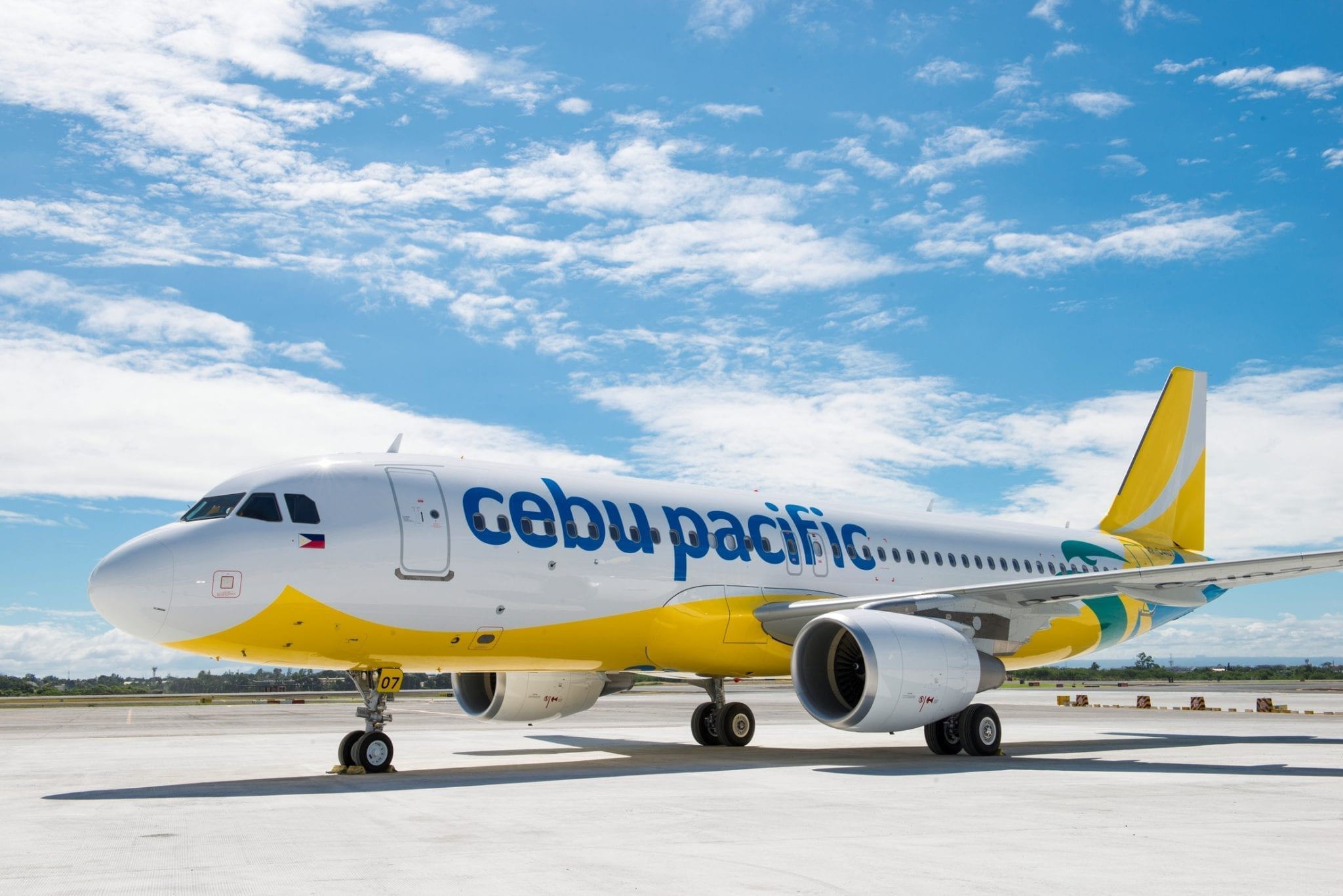
  • Cebu Pacific gets 2 aircrafts, increases flights

    Cebu Pacific gets 2 aircrafts, increases flights

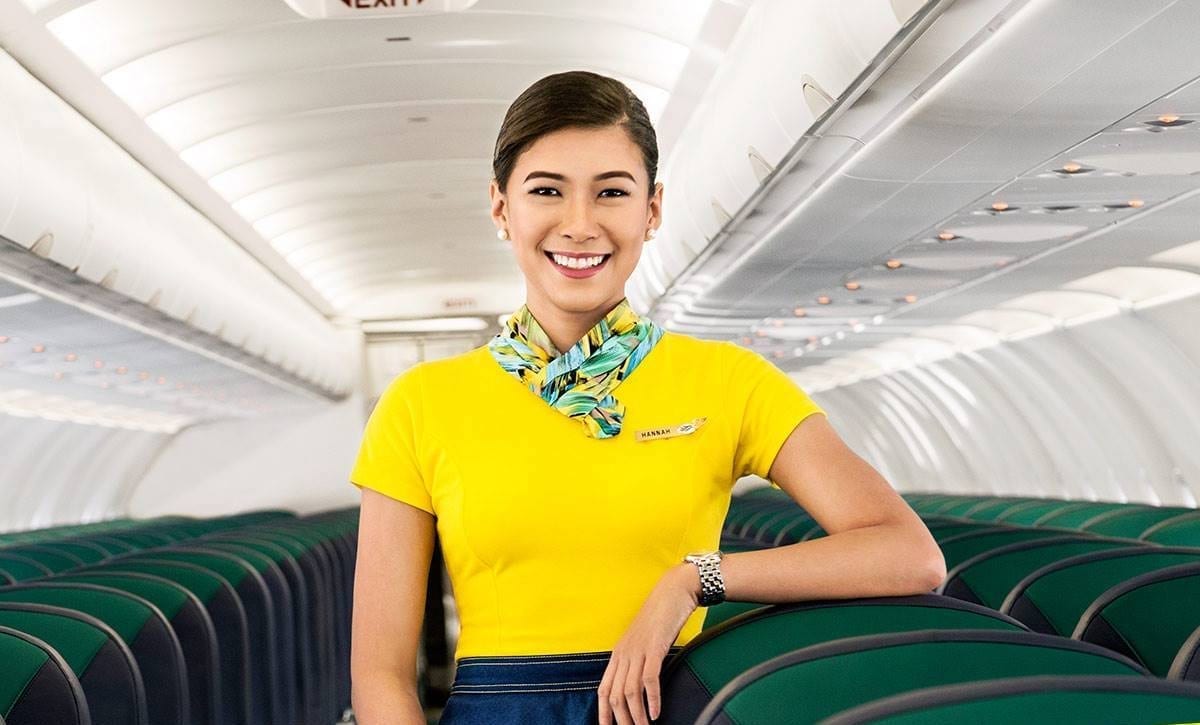
    The Philippines’ Cebu Pacific Air increases the frequency and capacity of its flights to Cebu, Davao, and Hong Kong, with the upgrading of its aircraft from an Airbus A320 to an A330. The increase in frequencies comes as Cebu Pacific added two brand-new aircraft into its fleet. Starting July 4, Cebu Pacific will be increasing frequency of its Manila to Hong Kong route by 50 percent, resulting in thrice-a-day flights, or a total of 21 flights a week, from the current twice-a-day.

    The Cebu Pacific will also use the A330s to fly between Manila and Cebu three times daily, or 21 times a week, while the Davao hub will get a boost with two additional daily flights to and from Manila, bringing frequency to four times daily, or 28 weekly flights. The upgrade from a 180-seater A320 to a 436-seater A330 makes available an additional 256 seats for each flight, or 59 percent more capacity.

    “More seats and more flights in high-demand destinations will help lower fares for every Juan. Moreover, using larger aircraft will make flying more efficient, freeing-up some aircraft and slots at the Ninoy Aquino International Airport. This will also enable us to increase capacity and frequency for other routes moving forward,” said lawyer JR Mantaring, Cebu Pacific Vice President for Corporate Affairs. The brand-new ATR 72-600 aircraft, on the other hand, will form part of the existing ATR fleet of wholly-owned subsidiary Cebgo.

    The latter recently announced five new domestic routes set to start operations in July, namely: Cebu to Masbate, Cagayan de Oro to Zamboanga, Davao to Dumaguete and Tacloban, and Zamboanga to Cotabato. Cebu Pacific boasts of one of the youngest fleets in the world, with an average aircraft age of 4.99 years. The carrier’s now 61-strong fleet is comprised of four Airbus A319, 36 Airbus A320, eight Airbus A330, eight ATR 72-500, and five ATR 72-600 aircraft. B

    etween 2017 and 2021, Cebu Pacific expects delivery of 32 Airbus A321neo, and 11 ATR 72-600 aircraft. Cebu Pacific currently offers flights to a total of 37 domestic and 26 international destinations, operating over 100 routes spanning across Asia, Australia, the Middle East, and United States of America.

  • WeChat Pay and Alipay North American expansion presents golden opportunity for retailers

    WeChat Pay and Alipay North American expansion presents golden opportunity for retailers

    With Chinese travelers being one of the most valuable customer bases for luxury goods, negotiations are underway to make mobile payment solutions WeChat Pay and Alipay acceptable in North America.

    The move comes at the behest of Citcon, a cross-border commerce company, China Luxury Advisors and The Momentum Group, a marketing agency that works with WeChat. Together, the three are hoping that Chinese travelers will soon be able to use WeChat Pay and Alipay while abroad in the United States, easing the purchase of international luxury goods.

    “Chinese travelers are already the highest spending international tourists in the United States – having spent more than $27 billion in the U.S. in 2015, and this number is expected to continue to grow rapidly,” said Renee Hartman, co-founder of China Luxury Advisors, Los Angeles. “This tremendous growth brings new possibilities for American retailers and destinations to continue to grow their share of visitation and spending from Chinese tourists.”

    But what makes Chinese luxury consumers so interesting is that few are actually purchasing their luxury goods in China. Due to China’s strict laws on imports and what stores can open shops within its borders, many affluent Chinese get their luxury goods while abroad.

    The other important factor to understand about this announcement is that for many Chinese consumers, they use an entirely different ecosystem of digital platforms than many other nations.

    Most notably, WeChat Pay lets Chinese customers make mobile payments, something that is extremely popular in China.

    Along with Alipay, Chinese online retailer Alibaba’s mobile payment system, the two make up almost three-quarters of purchases made in China through mobile.

    Many luxury brands already have heavy presences on WeChat. A recent campaign from Swarovski illustrated some of the ways WeChat can be used by luxury brands.

    Alipay has also seen integration with international luxury retailers. LVMH-owned travel retailer DFS Group is furthering its partnership with Ant Financial’s Alipay by giving exclusive promotions to customers checking out with the mobile payment method.

    With an already built-in integration with many luxury brands, bringing these two China-centric mobile payment platforms to North America will be an obvious boon for American luxury retailers looking to capture more of the lucrative Chinese traveling customer base.

  • Carnival targets cruise shoppers with Alipay option

    Carnival targets cruise shoppers with Alipay option

    Carnival Corporation, the world’s largest cruise group, has introduced cashless Alipay payment services on its ships in Asia, including those in China.

    The move will enable Chinese guests in the region to pay for products onboard using the mobile payment platform, said to be the most popular in China.

    Carnival’s largest brand in China – Costa Cruises – has launched the service this month. Passengers can now use their Alipay accounts to pay for all onboard spending, including shopping, food and drinks, activities and excursions. These are added to guest cabin folios as purchases are made, and then cleared nightly via their Alipay account.

    Alipay – which has over 450 million users in China – is operated by Ant Financial Services Group, a related company of Alibaba, the largest online commerce company in the PRC.

    The deal means that Carnival Corporation’s other leading brand in the region, Princess Cruises, also has the potential to offer Alipay on its ships sailing in Asia, including the all-new Majestic Princess that begins its first homeport season in Shanghai this July. “It is the first cruise ship tailor-made for the Chinese market,” said Carnival. However, future roll-out plans are not yet confirmed.

    Riding the digitalisation wave

    Carnival Corporation wants to ride the digitalisation wave to give cruise guests in Asia a more seamless experience. Costa Group and Carnival Asia Group CEO Michael Thamm, who oversees operations in China for Carnival Corporation, commented: “As we continue to grow interest and demand for cruising within the larger vacation market in China, this is another example of being able to stay close to our guests – understanding their needs and tailoring our offerings to their preferences.”

    Carnival is a core cruise operator in China with six ships based in the market across the Costa and Princess brands. The company handles four million passenger cruise days and nearly half of the overall cruise market in China, it claims.

    Alipay, meanwhile, is increasingly targeting the travel channel. Angel Zhao, COO of International Business Unit and Vice President of Ant Financial, said the company has been offering payments on some flights between China and Europe “since this Lunar New Year Chinese”. He added: “One of the most important goals of Alipay going overseas is to provide convenient ‘cashless’ experiences for both Chinese tourists and global merchants.”

  • Airtel secures approvals for Telenor India merger

    Airtel secures approvals for Telenor India merger

    India’s Bharti Airtel is closer to completing its acquisition of Telenor’s Indian operations, after securing approval for the proposed merger from the Competition Commission of India (CCI).

    In a statement to the Bombay Stock Exchange (BSE), Airtel said CCI signed off on the proposed merger on Monday.

    The announcement comes hot on the heels of Airtel also receiving approval  from the Securities and Exchange Board of India (SEBI), BSE Limited and the National Stock Exchange of India Limited. Airtel and Telenor have also fild a joint application with the New Delhi Bench of the National Company Law Tribunal.

    Airtel arranged in February to acquire Telenor India’s existing operations in seven high-population telecoms circles. The acquisition will include Telenor’s all assets and 44 million customers in the circles, as well as an additional 4.3.4MHz of spectrum in the valuable 1800-MHz band.

    Airtel has also reportedly agreed to take on Telenor India’s outstanding spectrum payments, amounting to around 16.5 billion rupees ($256.1 million) , as well as other financial commitments by way of payment.

    India’s telecoms sector is going through a wave of consolidation triggered by the price war resulting from the entry into the market of Reliance Jio Infocomm.

    Reliance Communications recently announced it has been granted a seven month reprieve to its debt repayment obligations while it completes a planned merger with Aircel, and Vodafone India and Idea Cellular are pursuing a merger that will create India’s largest mobile operator by subscribers.

  • New international container route goes through Quang Ninh

    New international container route goes through Quang Ninh

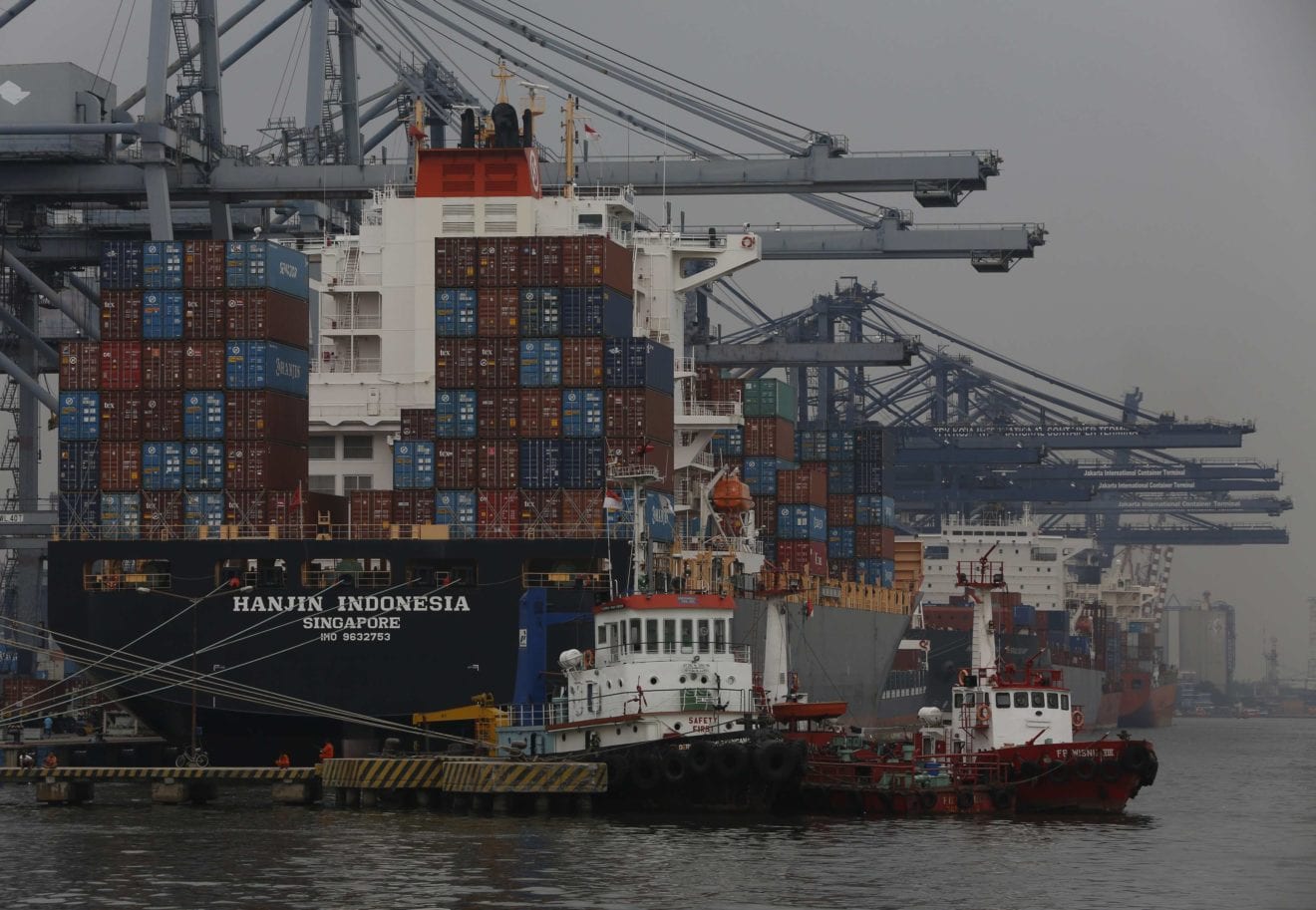
    Cái Lân International Container Terminal (CICT) announced the launch of a new route for container vessels ACS Cái Lân connecting India, Malaysia, Singapore, Việt Nam, China and the Republic of Korea on Tuesday.

    The operator of Cái Lân Terminal also welcomed the 5,023 TEU Hyundai Premium container ship from Hyundai Merchant Marine to the port during the launch.

    Founded by an alliance between two leading carriers, Hyundai Merchant Marine and Gold Star Line, the new route goes through Cái Lân Terminal in the northern province of Quảng Ninh of Việt Nam once a week.

    The Cái Lân link to the ACS international route is an opportunity for Quảng Ninh province and other northern localities to utilise their potential in the marine industry.

    Nguyễn Đức Long, chairman of the provincial People’s Committee, said the province would establish a team delivering streamlined public administration services at the port and not collect port infrastructure fees to aid marine-based businesses.

  • Cebu Pacific to buy 7 Airbus jets for $812M

    Cebu Pacific to buy 7 Airbus jets for $812M

    The Philippines’ largest airline Cebu Pacific is ordering seven Airbus A321ceo aircraft in a deal worth $812 million to meet growing domestic and regional demand, the airline said Wednesday.

    Cebu Pacific, best known for its budget flights, said in a statement the new planes would start arriving next March.

    “There is… the need to increase our current capacity to meet growing domestic and regional network demand, thus the A321ceo order,” chief finance officer Andrew Huang was quoted in a statement as saying.

    The A321ceo order comes on top of an existing order for 32 Airbus A321neo aircraft which were originally scheduled to arrive from September 2017 to 2021.

    However these deliveries have been pushed back till late-2018 until 2022 due to delays with the engines selected to power them, the statement said.

    “The aircraft will enable us to increase capacity on popular routes, while at the same time benefiting from the lowest operating costs in this size category,” said Cebu Pacific president Lance Gokongwei.

    Cebu Pacific, which started operations in 1996, boasts a 61-plane fleet of which 48 are Airbus planes. It flies both domestic and international routes.

  • Auto Expo 2017 opens in Hanoi

    Auto Expo 2017 opens in Hanoi

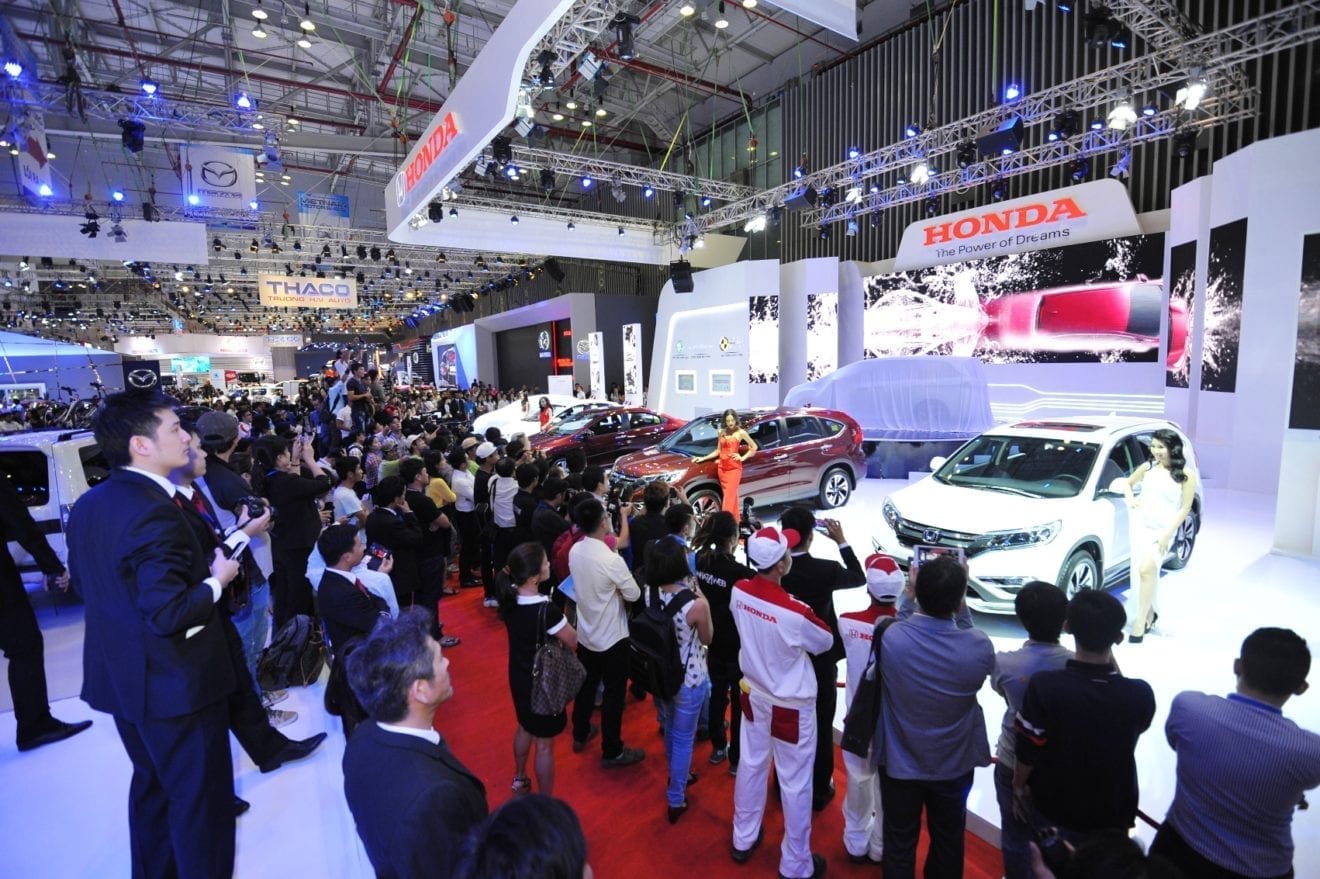
    Domestic auto assemblers and parts suppliers are showcasing their latest products at the 14th International Automobile and Supporting Industries Exhibition (Auto Expo 2017), which opened in Hanoi today.

    The four-day event, sponsored by the Ministry of Industry and Trade (MoIT), is being held at theHanoi International Exhibition Centre by the MoIT’s Industry Policy and Strategy Institute (IPSI) and the Vietnam Society of Automotive Engineers (VSAE).

    The expo has around 450 booths that have on display a wide range of vehicles, including passenger cars, buses, trucks, vans, vehicles for special purposes such as those serving construction, mining, agricultural, military, medical and hygiene activities, as well as two-wheelers such as scooters, motorcycles and electric bikes.

    With an exhibition space spanning 10,000sq.m, the expo also showcases spare parts and components for producing, manufacturing and assembling automobiles, motorbikes and other vehicles. On display are technologies in moulding, welding, plating, painting, automobile interior decor and toys; maintenance and repair equipment; measurement and diagnosis systems; as well as transportation rescue vehicles and devices.

    At the event, exhibitors have introduced services such as garage services, banking and insurance services, and consultative and assistance services for activities related to vehicle manufacturing and trading.

    In addition to the participation of local auto firms such as Vietnam Engine and Agricultural Machinery Corporation (VEAM), CAMC Việt Nam and Vietnam Machine Investment Development JSC (VIMID), the exhibition has also attracted foreign manufacturers and companies from the US, Japan, Thailand, South Korea, mainland China, Taiwan and Malaysia.

    Speaking at the opening ceremony of the exhibition, Deputy Minister of Industry and Trade Đỗ Thắng Hải said the expo would bring more business opportunities for auto firms, help them connect with the auto market and provide a favourable environment for enterprises looking for clients.

    In 2016, the Vietnamese auto market sold around 300,000 cars, up 24 per cent over the previous year, of which the sales of commercial vehicles and special purpose vehicles increased by 25 per cent and 33 per cent, respectively. In the first quarter of 2017, the auto market sold around 65,000 vehicles, a year-on-year increase of 8 per cent.-

  • Lamborghini prepares for a new chapter

    Lamborghini prepares for a new chapter

    On the basis that Italian is the official language of fast, beautiful cars, Lamborghini’s unabashed use of the word ibrido (hybrid) at the launch of its latest concept should silence any petrol hearts out there still in denial that the world has seen the last of gas-chugging/carbon-spewing supercars. That said, even in the world of hybrid F1 and Le Mans cars, LaFerraris and Porsche 918s, it does still seem slightly bizarre to be contemplating a Lamborghini hybrid, even if it is now 17 years since the Mk I Toyota Prius.

    You get the sense that it’s a slightly bizarre experience for Lamborghini also; the concept, called Asterion, doesn’t have the reckless swagger we’ve come to expect of Lamborghini. This, says the company’s suave CEO Stephan Winkelmann, is deliberate; the Asterion is not designed to chase, thrills, lap times and the tails of the LaFerrari and the 918. Instead its ibrido powertrain is programmed to deliver a less visceral experience than the V12 Aventador and V10 Huracan. It is, says Winkelman, more of a GT.

    Filippo Perini, head of design at Lamborghini, last year completed a full cycle of new cars with the Huracan, which replaced the Gallardo designed by his predecessor Luc Donckerwolke (now at VW Group’s Bentley label).

    The 2011 Aventador now looks in retrospect the high water mark for Lamborghini’s intensely geometric phase; the Huracan is visibly softer and the Asterion softer still. It still has the ability to shock, mind you. In profile it appears to carry a lot of weight between the cabin and the rear wheels, as the 1976 Silhouette did (there are shades of another ‘70s supercar in there also; the De Tomaso Pantera) Is this Perini getting hip to the ‘70s supercar revival or is he trying to tell us there is something different going on in there?

    The powertrain uses the Huracan’s 5.2-litre V10, here rated at just over 600bhp. However the Asterion has no less than three electric motors, one for each front wheel and another between the V10 and the seven-speed transmission. Together they can add nearly 300bhp more to the output, taking it close to 900bhp maximum and, of course, four wheel drive. The electrical power is stored in a lithium ion battery pack that sits along the spine of the car, where the mechanical drive for the front wheels would normally be. Engineering wise the Asterion is based on the carbon fibre and aluminium structure of the Huracan; philosophically the hybrid layout is borrowed from yet another VW label, Porsche.

    Lamborghini is running something of a deficit when it comes to turning concepts into reality. The Estoque four-door was shown in Paris six years ago now and is presumed dead. The Urus SUV (first shown in China two years ago) has been confirmed for production, although no date has yet been given. The Asterion’s rear-heavy profile has an echo of the Urus concept and you wouldn’t want to bet against the SUV using some kind of ibrido powertrain; the longer the wait, the more dated the idea of an old-school Lamborghini SUV seems.

  • Qatar Airways taps Inmarsat for in-flight broadband

    Qatar Airways taps Inmarsat for in-flight broadband

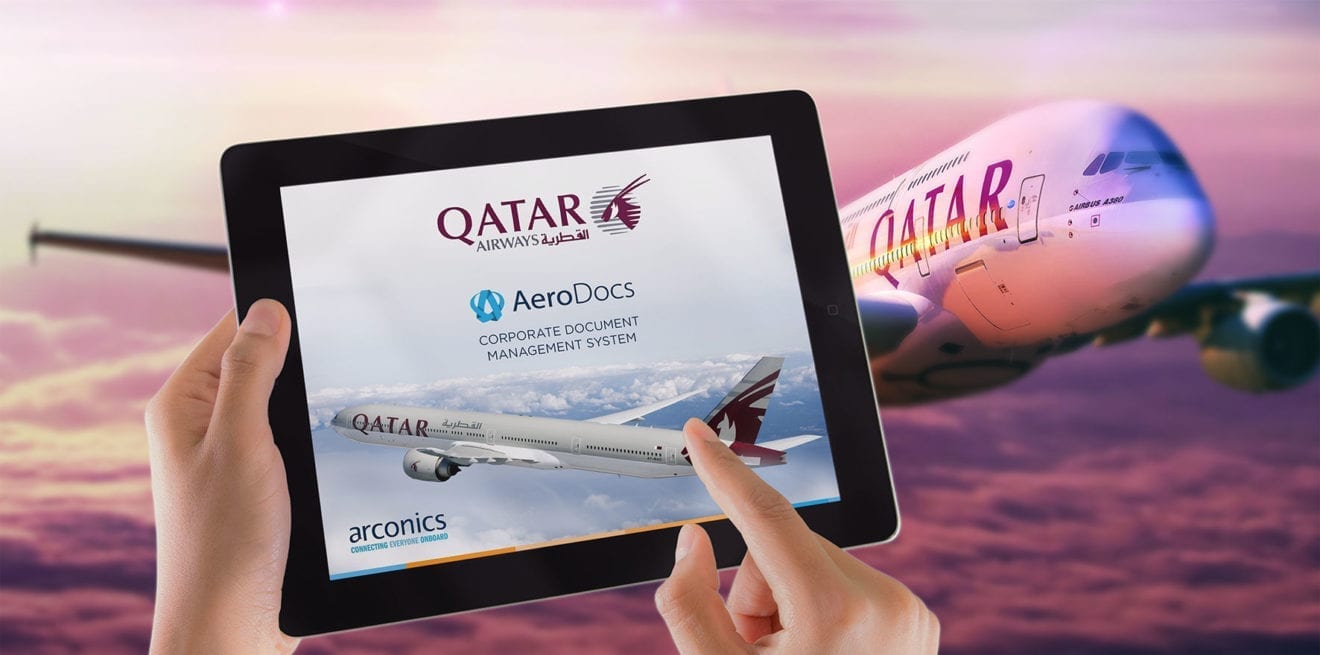
    Qatar Airways has become the first major Middle East airline to select Inmarsat’s new GX Aviation in-flight broadband solution for in-flight broadband.

    The Inmarsat solution will initially be available to Qatar Airways passengers on board more than 130 aircraft, consisting of Airbus A350s and Boeing 777s.

    GX Aviation technology has already been equipped on Qatar Airways’ latest Airbus A350s. Installations on the airline’s remaining Airbus A350s, together with the Boeing 777s, will start on a retrofit basis from this summer.

    GX Aviation is touted as the world’s first in-flight connectivity solution with reliable, seamless high-speed global coverage provided through a single operator. Inmarsat says the service allows airline passengers to browse the internet, stream videos, check social media and more during flights, with an on-board connectivity experience “on par with broadband services available on the ground.”

    “Broadband transformation on the ground is already well advanced and we are able to transfer that into the very challenging in-flight environment, working with Qatar Airways to make connectivity a success,” said Leo Mondale, president of Inmarsat Aviation.

    “Our networks are engineered with multiple layers for redundancy and global coverage. Our design philosophy is to scale up capacity over time to fit the route systems of our airline customers and reflect the industry’s real needs.”

    The service will integrate with Qatar Airways’ in-flight entertainment system and ensure that connectivity initiatives, such as its passenger app and aircraft technology, will be strengthened using dependable in-flight broadband. GX Aviation also complements the airline’s latest passenger experience innovations.

    Qatar Airways will connect to the GX network using exclusive JetWave terminals produced by Inmarsat partner Honeywell Aerospace. The terminals are designed for ease of installation and maintenance to assure the lowest downtime for any cabin connectivity solution in the market.

    The selection of GX Aviation follows a separate announcement that Qatar Airways has activated an advanced new space-based system, supplied by Inmarsat, to track all of its flights across the world.

    Inmarsat worked exclusively with Qatar Airways to develop this solution, which uses Inmarsat’s satellite technology to provide the exact real-time location of the airline’s aircraft in latitude and longitude.

  • Toyota working on ‘flying car’, Lexus luxury ‘yacht’

    Toyota working on ‘flying car’, Lexus luxury ‘yacht’

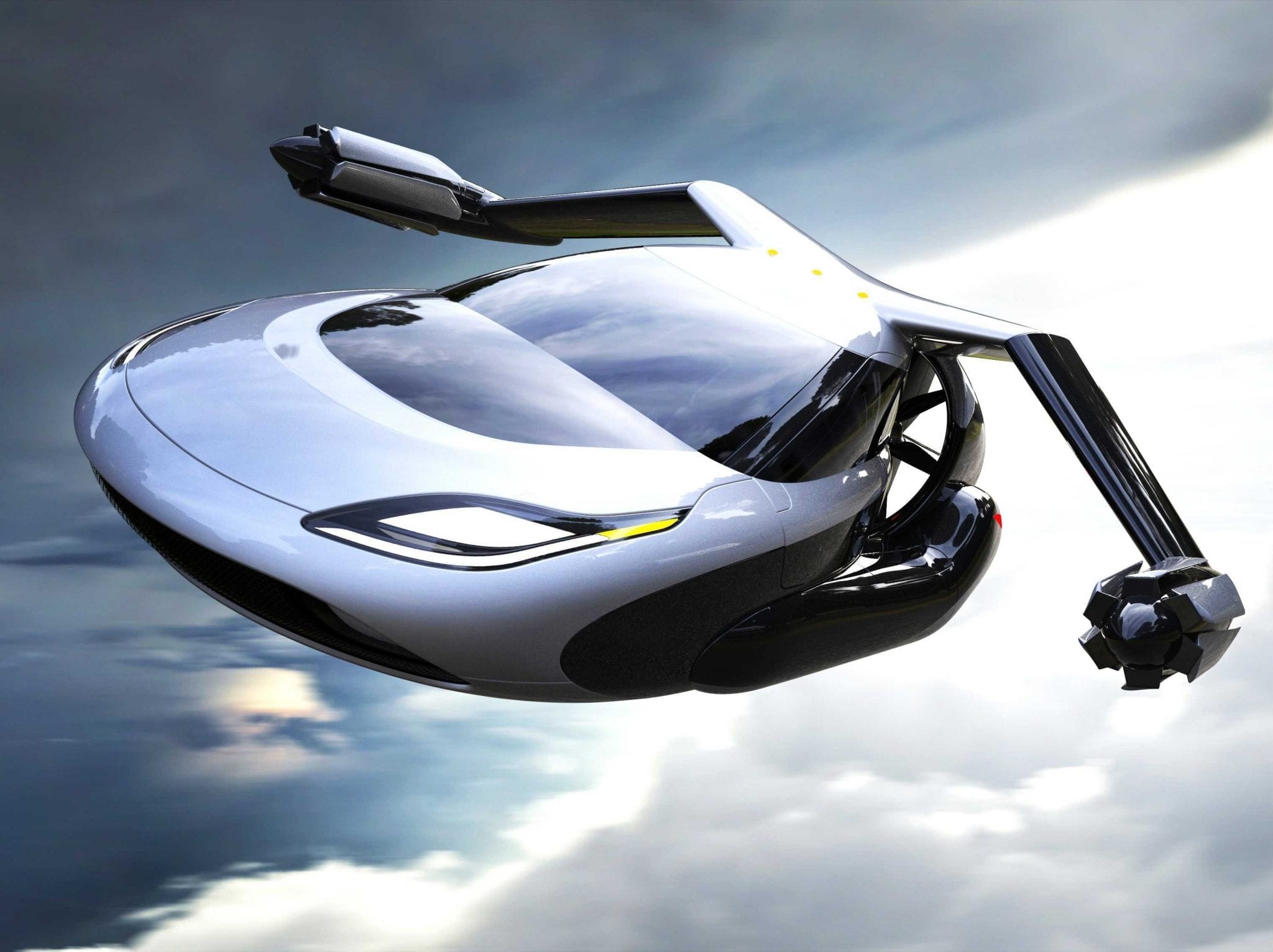
    A startup backed by the Japanese automaker has developed a test model that engineers hope will eventually develop into a tiny car with a driver who’ll be able to light the Olympic torch in the 2020 Tokyo games. For now, however, the project is a concoction of aluminum framing and eight propellers that barely gets off the ground and crashes after several seconds.

    Toyota has invested 42.5 million yen ($386,000) in startup Cartivator Resource Management to work on ” Sky Drive .” At a test flight Saturday in the city where the automaker is based, the gadgetry, about the size of a car and loaded with batteries and sensors, blew up a lot of sand and made a lot of noise.

    It managed to get up as high as eye level for several seconds before tilting and falling to the ground. Basketballs attached to its bottom served as cushions. After several attempts, the endeavor had to be canceled after one of the covers got detached from the frame and broke, damaging the propellers.

    The goal of Cartivator’s is to deliver a seamless transition from driving to flight, like the world of “Back to the Future,” said the project’s leader Tsubasa Nakamura.

    “I always loved planes and cars. And my longtime dream was to have a personal vehicle that can fly and go many places,” he told.

    The group is now working on a better design with the money from Toyota with the plan to have the first manned flight in 2019. No one has ridden on Sky Drive yet, or any drone, as that would be too dangerous.

    Still, dabbling in businesses other than cars is Toyota’s trademark. In recent years, it has been aggressively venturing into robotics and artificial intelligence, investing a billion dollars in a research and development company in Silicon Valley. It’s also working in Japan on using robotics to help the sick walk. It also just announced a five-year $35 million investment in its research center in Ann Arbor, Michigan, for autonomous and connected vehicle technologies.

    The idea that each generation must take up challenges is part of Toyota’s roots, said auto analyst Takaki Nakanishi.

    President Akio Toyoda’s great-grandfather Sakichi Toyoda started out developing the loom and then its automated improvements from the 1890s, before the company became an automaker. More recently, Toyota sees software and services as central to the auto industry, as cars become connected, start driving themselves and turn into lifestyle digital tools, Nakanishi said.

    As Toyota gets into the business of ecological vehicles, such as hybrids, electric cars and fuel cells, it’s turning into an energy company as well.

    “Toyota’s business is centered on mobility, anything that moves, including people, things, money, information, energy,” said Nakanishi.

    Toyota is traveling not only in the skies but also to the waters, although that still remains a tiny part of its sprawling empire.

    Toyota’s boat operations began in 1997. Toyota now offers four models and has sold a cumulative 845 boats. In contrast, Toyota sells about 10 million vehicles a year around the world.

    Reporters recently got a ride in Tokyo Bay of a Lexus luxury concept “yacht,” which runs on two gas engines. With a streamlined curvaceous design, inspired by a dolphin and evocative of a Lexus car, it’s being promised as a commercial product in the next few years.

    Designed for executives zipping through resort waters, it comes with fantasy-evoking features, like an anchor pulled in by a chain into a tiny door in the bow, which opens then closes mechanically.

    The engine, shiny like a chrome sculpture, is visible beneath the sheer floor surface. Shigeki Tomoyama, the executive in charge, said the boat was going for “a liberating effect.” A price was not given. Many Americans have already expressed interest, according to Toyota.

    The project started about two years ago under direct orders from Toyoda, who has with Tomoyama spearheaded Toyota’s Gazoo internet business, another non-auto business for Toyota.

    “He asked us to create a space that can work as a secret hiding place in the middle of the ocean,” Tomoyama said. “We went for the wow factor, which requires no words.”

  • LINE starts to attract luxury brands in Japan

    LINE starts to attract luxury brands in Japan

    While Japanese social media consumption patterns are similar to those in the United States with significant popularity of Facebook, Twitter, and YouTube, one local platform dominates all of them: LINE.

    Originally popularized as a phone replacement when telecommunications infrastructure was damaged by the Tōhoku earthquake in 2011, the mobile messaging app is used by 77% of all smartphone users in Japan—making LINE the top social media channel in the Japanese market by a wide margin, with a higher adoption rate by smartphone users than YouTube (55%), Facebook (41%), Twitter (30%), and Instagram (19%).

    In spite of LINE’s popularity, brands have been resistant to launch official accounts on the app due to the high cost of setting one up. The official account allows a brand to launch its own collection of the immensely popular LINE stickers and have larger numbers of followers than a small business LINE@ account, but costs at least $25,000 a month with price increases for a higher fan base and greater frequency of messaging. International fashion brands have been especially reluctant to join, with an adoption rate of only 32% among Index brands in the Luxury Fashion category as of May 2017.

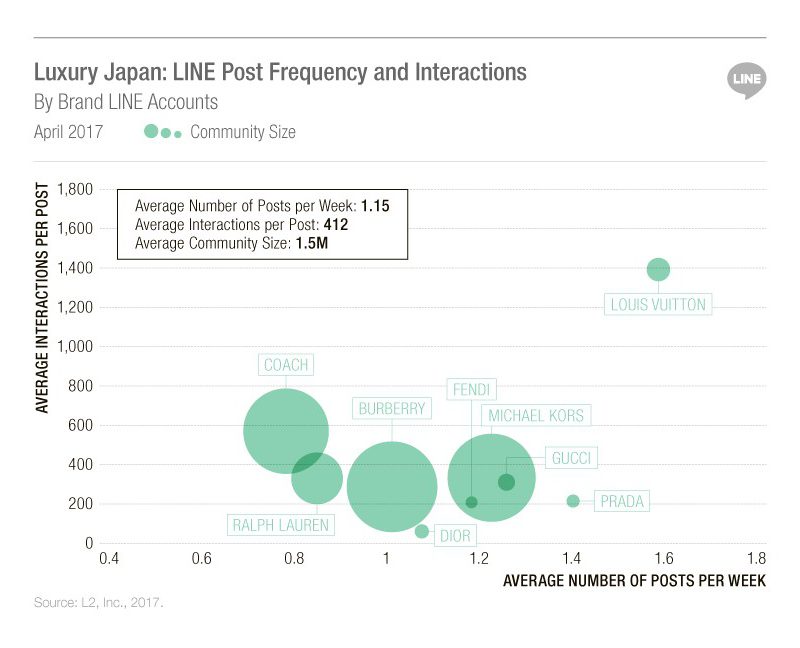
    There are signs that the luxury industry is taking more interest in the platform in 2017, as several major fashion labels have flocked to the app this year. LVMH brands Louis Vuitton, Fendi, and Dior launched official LINE accounts at the beginning of the year, and were joined by Prada in February.

    As these new brands launch on the platform, they’re forcing early adopters including Coach, Michael Kors, and Burberry to step up their game to keep up with luxury marketing innovations. In the months since its January launch, Louis Vuitton has surged ahead of competitors, generating 237% more interactions per post in April than the Index Luxury brand average, despite a lower follower base. Its engagement was boosted by offering exclusive LINE wallpapers, including a set of wallpapers inspired by its Cruise 2018 fashion show in Kyoto as well as a promotion offering a wallpaper download to followers who visited its official message menu eight days in a row.Luxury Japan Line News - Retail in Asia

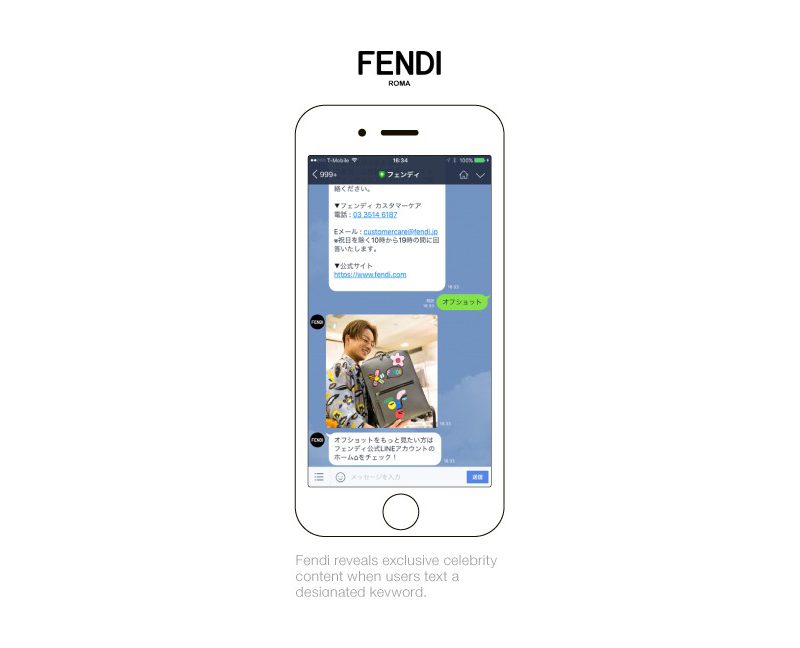
    Fendi is also investing in LINE with a strategy that understands the role of LINE as a closed one-to-one communication tool, where users expect brands to behave more like their friends and less like advertisers. The brand used chatbots to reveal exclusive celebrity content when users message a designated keyword, and utilized gamification for a virtual slot machine that offered the chance to win an original Fendi USB flash memory stick.

    Fendi News - Retail in Asia

    In addition to keeping up with competitors, brands should also monitor LINE’s growing list of services as additional opportunities to differentiate. Like China’s WeChat, LINE is expanding its functions in an attempt to become an operating system within itself. Its payment service LINE Pay now boasts 30 million users, while it also offers features such as livestreaming and social games. LINE launched LINE Business Connect in 2016, which allows brands to sync their customer databases and run one-to-one marketing campaigns.

    LINE also recently announced that early this summer, it will release a Siri-like AI digital assistant called Clova that will be available through its new Wave speaker, which is similar to the Amazon Echo. Unlike the social platforms focused on viral campaigns, LINE offers a wide range of opportunities to brands to implement valuable CRM, payment, and personal communications strategies to resonate with shoppers in Japan.

    source: L2

  • Vietnamese fruits conquer Japanese market

    Vietnamese fruits conquer Japanese market

    Before bananas, white-flesh dragon fruits and mangos were constantly shipped to the Japanese market. Meanwhile, red-flesh dragon fruits reached Japanese consumers in March shortly after they were licensed for export to the East Asian country.

    Hidekatsu Ishikawa, President of Vient Co. Ltd, a Japanese importer, said Vietnamese bananas suit Japanese people’s taste and they are sold at competitive prices.

    To date, besides such key exports as garments, footwear and aquatic products, Vietnamese dragon fruits, mangos, frozen litchis and bananas have been present in Japan. Fresh litchis and star apples also see great potential in this fastidious market.

    According to Tran Thanh Hai, Deputy Director of the​ Agency for Foreign Trade under the Ministry of Industry and Trade, the Vietnam-Japan Economic Partnership Agreement (VJEPA) is entering a new phase, opening opportunities for Vietnamese exports.

    Vietnamese products, especially farm produce and aquatic products, will enjoy preferential tax rates in the Japanese market. Regarding aquaculture, tax will be cut down to 1.31 percent in 2019 from 5.4 percent in 2008. Thus, domestic enterprises should take full advantage to gain benefits, Hai stressed.

    He also recommended that exporters must ensure utmost quality for their products as Japan has put in place numerous technical barriers on agricultural imports.

    Meanwhile, a representative from the Japan External Trade Organisation (JETRO) also noted that packing and transportation should be paid special attention, ensuring that origin of agricultural products can be traced easily.

  • Changi Airport Group showcases Jewel project in virtual video tour

    Jewel Changi Airport (Jewel), the lifestyle destination being developed at Singapore Changi Airport and set to open in 2019, is the subject of a striking new video.

    Developed by Jewel Changi Airport Trustee Pte. Ltd. (JCAT), a joint venture between Changi Airport Group and CapitaLand Mall Asia, Jewel is a mixed-use complex featuring a broad offer. It includes a five-storey indoor garden, play attractions, shopping and dining options, a hotel and facilities for airport operations.

    There are two main centrepiece attractions in Jewel – the Forest Valley, a five-storey garden filled with thousands of trees, plants, ferns and shrubs, and the 40m high Rain Vortex, currently the world’s tallest indoor waterfall.

  • Mastercard to transform Cyberjaya into a cashless hub

    Mastercard to transform Cyberjaya into a cashless hub

    Mastercard, Cyberview and the Malaysian Global Innovation & Creativity Centre (MaGIC) have entered a collaboration to transform Cyberjaya, a technology hub in Malaysia, with a focus on cashless initiatives.

    Mastercard will be providing its global expertise in innovative payment technology and network to increase the digitalization of payments, an initiative which is in line with Cyberjaya’s aim to become a cashless society.

    Mastercard will embark on a pilot program to test several smart city applications beginning Q3 2017. This also entails a partnership with internationally-renowned player in the smart city scene, Masabi, a global leader in mobile ticketing and innovative fare collection for transportation based in London to implement quality innovations that will benefit the Cyberjaya community.

    The pilots will first focus on the transportation as well as food and beverage (F&B) sector with more sectors to be included in phases. Cyberjaya will be the starting point and benchmark of this cashless society development, as part of larger plans to replicate these concepts into other Smart Cities throughout Malaysia, in the future.

    The pilot program include: introduction of the Masterpass QR solution to allow consumers to  pay for goods and services from their mobile phones by utilizing a QR code without the need of a point of sale terminal, a mobile ticketing application with Masabi, a bike-sharing platform based on GPS trackers and AI chatbots for retail applications.

    “E-payments are at the center of a city’s economic vitality and its integration is crucial to promote a smarter, more sustainable and inclusive space for residents, commuters and local businesses,” Mastercard country manager for Malaysia and Brunei Perry Ong said.

    “We will work towards enhancing Cyberjaya’s payment ecosystem with a comprehensive suite of simple, safe and smart digital solutions. The implementation will cover various sectors in Cyberjaya such as urban mobility, lifestyle, finance, health, supply chain and education sectors to help the community to go cashless. This initiative is in line with the government and Bank Negara Malaysia’s vision to transform Malaysia into a digital economy and cashless society.”

  • Uber, Grab conquer airport taxi market

    Uber, Grab conquer airport taxi market

    Uber launched a service package at the flat price of VND150,000 to carry passengers from any location in the inner city of Hanoi. In HCM City, Grab sometimes has a promotional fee of VND20,000 for trips to the airport.

    “You will have to pay VND130,000 for every trip to the airport with traditional taxi service, while it’ll take you VND70,000 to go with Grab, and sometimes the fee is just VND20,000 when Grab runs sale promotion campaign,” Tin, a passenger said.

    Uber, Grab cars flood airports

    Quang Huy in Cau Giay district, Hanoi said the service fee of VND150,000 set by Uber is ‘very reasonable’ which is much lower than the fee of VND200,000-250,000 he has to pay to traditional taxis.

    “I wonder if Uber gives any support to taxi drivers, so they can charge so little. However, as a customer, I really like this. And Uber’s services are acceptable,” he said.

    However, some passengers complained that it is difficult to catch Uber taxis. Uber drivers tend to refuse to serve passengers, saying that the VND150,000 service fee set by Uber is too low, which cannot bring profit to them.

    Hieu, a driver, said with the fee, drivers pocket VND40,000-50,000 for every trip to the airport after paying for fuel and other expenses. He would rather serve passengers within the city to get more profit.Uber drivers confirmed that they won’t serve passengers at the service fees set by Uber.

    Reporters also tried to hail Uber taxis and all drivers refused to serve when asked to go to Noi Bai Airport.

    Airport taxi firms complain about income 

    Traditional taxi drivers complained that their income has become unstable, though it is now the high season: children are finishing their academic year and people are beginning to travel.

    Quang Truong from Bac Ninh province, an airport taxi driver, said the appearance of Uber and Grab has badly affected his job. He could serve 10 trips a day on the Hanoi – Noi Bai route, but the number has been cut by half.

    However, Truong doesn’t think Uber and Grab drivers have better income.

    “More taxis in the market means higher competition and lower income,” he said.