Author: Mei Ling Tan

  • Philippine property giants turn to retail

    Philippine property giants turn to retail

    Philippine property giants are entering record capital expenditure programs in 2016, on the back of strong economy, according to the global property advisor Savills.

    Three of the eight biggest property developers – Ayala Land, SM Prime Holdings and Robinsons Land – are also the biggest mall developers in the country.

    “When the real estate boom started, residential sales were the sweet spot. It seems that the residential market is becoming more saturated that’s why developers are shifting to the commercial side,” said Antton Nordberg, research and consultancy manager at KMC MAG Group.

    The 2016 capex budget will mostly fund the development of large-scale mixed-use communities, mostly commercial components such as office and retail, Nordberg said.

    Nordberg said real estate firms – mostly listed in the Philippine Stock Exchange – could spend an all-time high of P369 billion (US$7.9 billion) this year, surpassing the record investment of P360 billion last year by 2.5 per cent.

  • Thailand’s most illustrious real estate event returns for the 11th year

    Thailand’s most illustrious real estate event returns for the 11th year

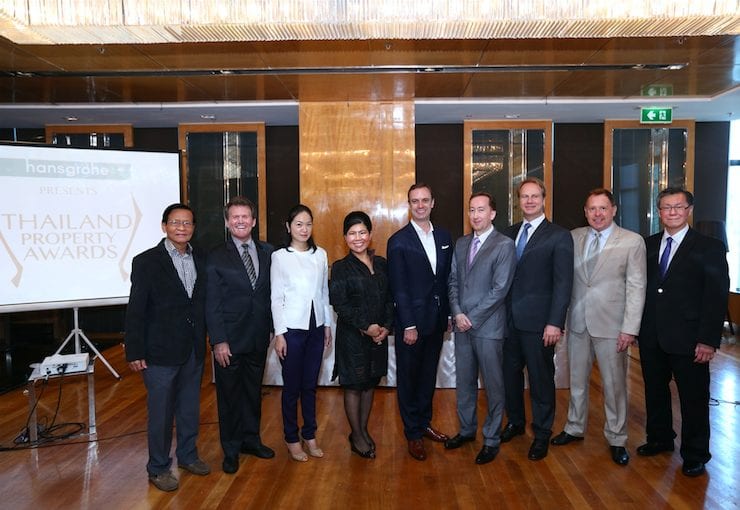
    The Thailand Property Awards presented by Hansgrohe returns for a successful 11th edition to reward the finest developers and current developments in the country’s resilient real estate sector. The annual event, which is attended by some 600 C-level executives, industry leaders and innovators annually, was officially launched to the media on 29 March 2016 at the Renaissance Bangkok Ratchaphrasong Hotel.

    Building on the monumental success of last year’s 10th anniversary event, which saw SC Asset Corporation PLC claim the biggest award for Best Developer, the kingdom’s biggest and most respected industry awards programme will champion the leading industry players in Bangkok and Phuket, which continue to evolve alongside the secondary markets of Hua Hin, Chiang Mai, Khao Yai, Samui and the Eastern Seaboard.

    “The tourism sector is playing an increasingly important role in driving the country’s economic growth,” Suphin Mechuchep, managing director of JLL Thailand and newly elected chairperson of the central panel of judges, said.

    “A decent chunk of tourist spending goes to retailers in various retail formats from street-side retail strips to modern shopping centres,” she added. “Retail markets in key tourist destinations such as Bangkok, Pattaya, Phuket, Krabi, Koh Samui, and Chiang Mai will benefit most from this trend.”

    This economic boost, as well the recently reported strong year-end finish to 2015 following the implementation of the government-led boosting measures and incentives, will be discussed by the industry’s leading experts, developers and innovators at the high-level forum that takes place before the awards gala – the Property Report Congress Thailand. The whole day conference on Thursday, 22 September from 09:00 to 15:00, and will be held at the Plaza Athenee Bangkok, a Royal Meridien hotel, the official venue of the Thailand Property Awards.

    On the panel: Srikorn Techarattanaptasert, consultant of title sponsor Hansgrohe; central panel of judges chairman Suphin Mechuchep, JLL Thailand; Terry Blackburn, founder of the Asia Property Awards and managing director of PropertyGuru International; returning judge Professor Dr Manop Bongsadadt, 2016 president of judges panel; and Alexander Kunz, Asia regional director of sponsor Kuppersbusch by Teka
    On the panel: Srikorn Techarattanaptasert, consultant of title sponsor Hansgrohe; central panel of judges chairman Suphin Mechuchep, JLL Thailand; Terry Blackburn, founder of the Asia Property Awards and managing director of PropertyGuru International; returning judge Professor Dr Manop Bongsadadt, 2016 president of judges panel; and Alexander Kunz, Asia regional director of sponsor Kuppersbusch by Teka

    An internationally recognised celebration of the country’s real estate achievements, the Thailand Property Awards 2016 have already begun accepting nominations from developers and the general public starting in late February. The nomination period will close on 8 July, with the official shortlist revealed to the world in the third week of August.

    Entry is free. All successful entries will be supervised by BDO, one of the world’s largest accounting and auditing firms, and the trusted awards supervisor of the Asia Property Awards, which, in its 11th year, is widely recognised for its fairness and transparency.

    This year’s awards programme will be boosted by the support of title sponsor Hansgrohe, a leading global manufacturer of innovative and designer bathroom products, official media partner Property Report, as well as the large network of awards organiser PropertyGuru, Asia’s largest online property portal group.

    “We’re excited to be working with PropertyGuru Group as the Asia Property Awards programme continues to expand in ASEAN in its second decade,” said Terry Blackburn, founder and managing director of the Asia Property Awards. “In trying times like these, Thailand can always depend on exceptional projects that boost investor confidence and elevate market standards. We’re delighted to reward their hard work at the Thailand Property Awards.”

    Suphin will be joined on the esteemed judging panel, which is presided by Dr Manop Bongsadadt, renowned professor of architecture at Bangkok’s Chulalongkorn University, by some of the best-known names in the industry. Aside from the central panel of judges, each region will have its own panel comprising local experts to ensure credibility of the Awards.

    A total of 31 trophies will be presented in 2016, with award categories covering the condominium, housing/villa, hotel, office, and retail segments. A special recognition for Thailand’s Real Estate Personality of Year, whose influence and achievements resonate across the kingdom, will be named by the editors of Property Report prior to the gala night.

  • Uniqlo to open flagship store in Singapore

    Uniqlo to open flagship store in Singapore

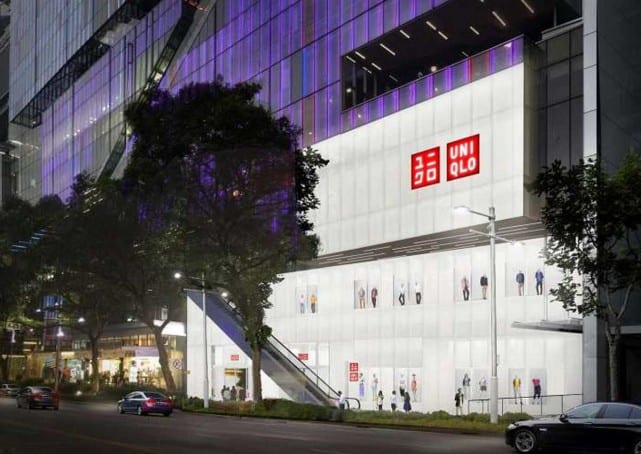
    Japanese clothing brand Uniqlo is set to open its first global flagship store in Singapore and the Southeast Asia region at Orchard Road by the second half of this year.

    The store, spanning across three levels at Orchard Central (a total area of 2,700 sqm), will generate more than 300 jobs here. It will be Uniqlo’s biggest outlet in Singapore and the region.

    “We are very honoured, and excited, to open our first UNIQLO Global Flagship Store in Singapore. Having been a member of the local retail scene since 2009, we remain committed toward contributing to the local community and being an integral part of Singapore’s growth and future,” said Taku Morikawa, CEO of Uniqlo Southeast Asia.

    Uniqlo fans can expect the flagship store to provide an extensive range of Uniqlo’s latest lines for women, men, kids and babies. The store will also serve as a platform to showcase the brand’s LifeWear collection.

    There are currently 13 global flagship stores around the world, including cities such as New York, London, Paris and Shanghai.

  • Dubai-based group behind Robinsons and Zara to refresh retail offerings

    Dubai-based group behind Robinsons and Zara to refresh retail offerings

    Dubai-based conglomerate Al-Futtaim Group is embarking on a slate of moves to refresh the offerings at its stable of retail brands here, such as household names Robinsons department store and the Marks & Spencer chain.

    The multi-faceted efforts to draw more shoppers are part of a drive by its Asia group chief executive, Mr Christophe Cann, who was appointed to the role in January to grow the company’s business in the region.

    “The strategy is to build a profitable long-term business, to bring new brands to the market and to keep the strength of the group which is quite diversified,” said Mr Cann, at the Robinsons store at The Heeren.

    The group’s diversified retail portfolio also includes sports brands such as Royal Sporting House, Reebok, and fashion labels such as Zara, Pull and Bear, and Massimo Dutti.

    For a start, it will inject $12 million to renovate Robinsons at Raffles City in phases over one year, starting in July. Upgrading plans are also afoot for Marks & Spencer stores at shopping malls – Parkway Parade, Paragon and Raffles City.

    Shoppers will also be able to take a pit stop at a new 1,000 sq ft cafe at the Marks & Spencer outlet at Wheelock Place in Orchard Road, set to open in the third quarter.

    “Having new concepts and new brands are ways to keep customers’ money in Singapore… We need to give more reasons for customers to visit us, to stay longer in the store,” said Singapore-based Mr Cann.

    The group is also adding more food and beverage offerings at Robinsons at The Heeren, with a new restaurant by chef and TV personality Angela May due to open on level two of the store next month.

    Mr Cann also flagged an upcoming outdoor F&B area at The Heeren – where T.G.I. Friday’s outlet used to be – to be connected to level two of Robinsons via a bridge. The F&B area will be up and running in the third quarter.

    Apart from culinary offerings, Al-Futtaim will be trying out new retail concepts, with the opening of a “sneakers bar” at Orchard Central later this year. The new store, spanning about 1,000 sq ft, will carry limited-edition footwear.

    Mr Cann added that the Royal Sporting House outlet at VivoCity will also be given a makeover and will open next month.

    “Sports is not just about products these days, it is about lifestyle. The new shop will look more fashionable and appeal to a younger crowd. We will also downsize on the number of brands, carrying only the best performing ones,” he said.

    This big revamp of its stores across various brands is expected to boost profitability.

    For example, Mr Cann said Robinsons, which has three outlets here – at The Heeren, Raffles City and Jem mall – booked a loss of “a few million dollars” last year, but is likely to break even this year; while its Marks & Spencer chain here is already profitable.

    Singapore is Al-Futtaim’s second- largest market in the region after Malaysia, followed by Thailand and Indonesia.

    Mr Cann said the company expects to invest around $80 million a year across the four markets to enhance its offerings.

  • Rough patch for Smoothie King as it closes outlets here

    Rough patch for Smoothie King as it closes outlets here

    American food chain Smoothie King has closed all seven of its stores in Singapore over the past month – although it says it is still keen to operate here within a franchise agreement.

    The news has shocked observers as the food and beverage segment is said to be one bright spot in an otherwise gloomy retail scene.

    While Smoothie King did not comment on the performance of its stores here, a company spokesman said its owner and chief executive Wan Kim recently sold his interest in the South Korean operations.

    Smoothie King Singapore is wholly owned by Smoothie King Korea, according to a company search.

    “As a result of this transaction, Smoothie King Company has chosen to not own and operate outside the United States. This decision has led to the strategic closing of all operations in Singapore,” the spokesman told The Straits Times on Monday.

    The company appears to have quietly exited the market. No mentions were made on its website and Facebook page, which were both unavailable yesterday.

    Smoothie King has been on a rapid expansion path over the past few years. It opened its first store here in December 2012, and said it planned to launch at least 30 shops in three years.

    Apart from the US, it is also open in the Cayman Islands and South Korea. The only Smoothie King- owned outlets are in the US. The rest are franchise agreements, the company spokesman said.

    It has agreements to open stores in the Middle East and will be announcing further international developments in the coming days.

    “Smoothie King vigorously continues to seek operating partners in Asean… It will be exploring opportunities to operate in Singapore within a franchise agreement,” she said.

    The company may have had limited appeal here. Staff at a store opposite its former Nex outlet said that while it would be packed with students from Friday to Sunday, it would typically not even be half full at lunchtime on weekdays.

    It was a similar story at its former Marina Bay Link Mall outlet, with staff at nearby outlets noting it would not be a full house during lunch hours.

    Mr Steven Goh, who runs retail consultancy SG Retail Network, said the chain’s growth and pricing strategy were not suited to the Singapore market.

    “It’s a premium to pay $6, $7 for a smoothie and they are, unlike coffees, not something most people will drink every day.

    “Smoothie King was in a very niche category but also expanded fast, with outlets in prime locations and high rental costs. Not all the stores may have been performing… But for chain store operations to be sustainable, at least 90 per cent of the stores should be profitable.”

  • Li & Fung proves nimble

    Li & Fung proves nimble

    Hong Kong-listed global supply chain management company Li & Fung has proved nimble weathering one of the most challenging retail environments for many years.

    Yet despite an overall increase in trading volume, its revenue for the year ended December 31 fell 2.4 per cent to US$18.8 billion for the year.

    Mainly servicing US and EU brands, department stores, hypermarkets, specialty stores, catalogue-led companies and eCommerce sites, the family-led company reorganised during the year with the aim of delivering innovation and product differentiation while focusing on client solutions.

    Growth was strong in its e-logistics division, thanks to the eCommerce boom, and with an unprecedented drop in ocean freight rates, its logistics network grew in both turnover and unit volume.

    Adding to the difficulties of the year were political uncertainties in Europe and Asia. Meanwhile, increased competition from fast-fashion, off-price and eCommerce players continue to challenge retail customers, resulting in margin pressure across the board.

    Turnover eased by 2 per cent year-on-year to $18.8 billion, largely because of soft macroeconomic conditions and the challenging retail environment.

    Turnover in Asia decreased by 2.5 per cent to $2 billion, with distribution being hit by the slowdown in China, geopolitical issues in Southeast Asia and Asian currencies depreciating against the US dollar.

    However, Li & Fung’s logistics network continued to grow in Asia, largely thanks to support by new contracts and expansion, particularly into Southeast Asia.

    Across its trading network, the company served a diversified group of customers including brands, department stores, specialty stores, clubs, hypermarkets and pure-play eCommerce ventures. The network covers more than 40 economies, and the top three sourcing countries continue to be China (more than half of products), Vietnam and Bangladesh.

    The company’s entrance into Indonesia, Japan and Korea also began to generate positive contribution, and it launched a regional distribution centre in Singapore.

    “Globally, our industry is going through an unprecedented structural change, led by the changing conditions at retail,” says group CEO Spencer Fung, the great-grandson of the company’s founder.

    “Retail is becoming more competitive as more eCommerce players enter the marketplace, and global competition overall is being augmented by cloud computing, mobile connectivity and cross-border logistics.”

    He says consumer preferences and buying patterns are also changing, led by millennials and the newer Generation Z.

    “The way these consumers discover, socialise and finally make a purchase decision has had immense consequences to brand loyalty, to sustainability and to the sharing economy… the speed of change is only increasing as we look ahead.”

    Li & Fung is partnering with companies that offer technology and innovation to create products “with more excitement”, and has simplified its structure and business to improve speed and flexibility.

    “With fewer acquisitions in 2015 compared to previous years, we have been very focussed on growing organically and increasing our market share with our existing customer base,” says Fung.

    “All indications point toward a challenging 2016, but I am confident we will weather these changes as we build for the future.”

  • J Crew ends ‘torrid year’

    J Crew ends ‘torrid year’

    In closing what can only be described as a torrid year for the company, J Crew has posted a weak, but improved, set of fourth quarter figures.

    Total sales rose by 1 per cent, boosted by strong sales gains of 26 per cent at Madewell. While this compares favorably to the 5.5 per cent decline of last quarter, this is but a small bright spot surrounded by a sea of relatively gloomy numbers.

    Total comparable sales fell by 4 per cent off the back of a 3 per cent decline in the prior year. Here the gains made at Madewell were more than wiped out by the continued decline of the core J Crew brand where comparable sales fell by 5 per cent and total sales by 3 per cent.

    The company remains firmly in the red with a US$7.03 million loss recorded during the quarter – although, to be fair, this is a marked improvement on the $30.6 million loss recorded last year. Notably, however, losses for the full fiscal year now stand at a staggering $1.2 billion – something that leaves the company, and its balance sheet, in a very weak position.

    While there are many reasons to be negative, the results at least bring some respite in as much as they suggest that J Crew is at last starting to stem the tide of decline – especially so given that the shallower falls occurred during a quarter when overall demand was notably weak. Even so, the group still faces a herculean task in turning around its fortunes.

    Thanks to changes made by management across the year, many of J Crew’s full line stores are now looking much more disciplined in terms of merchandising and display. However, products are still priced above what many consumers are willing to pay – especially for relatively simple garments that have nice detailing but little else in terms of fashion credentials.

    The issue of price is underlined by the fact that while J Crew’s mainstream stores suffer, J Crew Factory stores are fairly popular with more shoppers willing to buy its products at a reduced price. This isn’t the position that the company would like to be in, but it is one that reflects the fact that there is much more work to do in terms of refining the brand image and the product offer so that it can attract the premium J Crew wants to charge.

    That people are unwilling to pay full price means that discounting at mainstream stores and via the mainstream website is also frequent. While this is a necessary evil to clear down inventory, J Crew is building a reputation as a retailer from which customers should never buy at full price – something that is hampering its ability to rebuild its brand and price integrity.

    In our view, what J Crew needs is a fresh take – and this is something it is hoping will be delivered by the spring collection, the first designed by its creative director Somsack Sikhmounmuong. Even if this is a hit it will be just the first of many steps that J Crew needs to take to rebuild itself into a successful lifestyle brand.

    The market is more competitive and crowded than ever and J Crew needs to do much more to stand out.

  • Philippines’ first microsatellite lifts off

    Philippines’ first microsatellite lifts off

    The Philippines’ first microsatellite, Diwata-1, was launched into space last week from the National Aeronautics and Space Administration in Camp Canaveral, Florida.

    Department of Science and Technology (DOST) Secretary Mario G. Montejo said that Diwata-1’s launch into space would enable the government to generate real-time data that will help the country improve its disaster response mechanisms.

    “The satellite will also aid the rest of the country in terms of agriculture and tourism, with the satellite giving data that will help farmers decide what crops to plant and where, while also capturing the country’s natural wonders,” Montejo said.

    A 50-kg imaging satellite,Diwata-1 was assembled by nine young Filipino engineers stationed in Tohoku and Hokkaido University over the last 14 months. IT has four specialized cameras for imaging weather patterns, agricultural productivity, and land and water resources.

    Diwata-1 is expected to be in orbit for approximately 20 months, taking images twice daily. And while it is still in orbit, its sister Diwata-2 will be launched late 2017 or early 2018.

    Diwatas 1 and 2, and the ground station called the Philippine Earth Data Resources Observation (PEDRO) are part of a three-year, 40.82-million peso ($18.1 million) microsat program.

    In 2014, the Philippine government through the DOST embarked on a research program to develop the necessary local expertise in space technology and allied emerging fields in science and engineering.

    The flagship project of this program is the PhilMicrosat Program handled by several departments at the University of the Philippines and DOST’s Advanced Science and Technology Institute. The program also has two partner universities in Japan where the Diwata engineers are taking their higher studies.

    Along with the microsatellite development is the installation of the satellite ground receiving station in Subic, Zambales that is tasked to receive DIiwata-1 imagery, including other images from selected commercial satellites.

    Another space-related facility under construction is the UP Diliman Microsatellite Research and Instructional facility which will be the hub of training for future space technology research and development activities.

  • Mix of innovation, soft power drives ‘K-beauty boom’ in China

    Mix of innovation, soft power drives ‘K-beauty boom’ in China

    Eating exotic and wild species is nothing new in China, just like a saying well known in Guangzhou: “Chinese will eat everything with four legs except tables and eat everything that swims except a submarine.”

    Their openness to new ingredients and recipes strikes a similar note, as South Korean cosmetics companies embrace such quirky ingredients as snail slime, horse oil and pig skin collagen as long as they are considered good for the skin.

    With ingredients ranging from an extract from cocoons, goat milk and volcano clay, Korean beauty items come in all imaginable forms. They range from hair mousse styling foam and fruit flavored yogurt to mask sheet packs for the feet and breasts.

    The relentless experimentation may be one of the most decisive factors behind Korean cosmetics’ success in China, which helped spread the “K-beauty boom” beyond Asia to reach Western customers over the past few years.

    South Korea’s cosmetics exports to China doubled on-year to US$1.08 billion in 2015, which accounts for nearly 40 percent of its total global sales, according to the Korea International Trade Association. South Korea is the second-largest cosmetics exporter to China following France.

    Chen Ming, a 30-year-old makeup artist from Guangzhou, says she has tried several basic skin care products and massage packs by Korean brands, which emphasize naturally flawless skin. For the “nude makeup look,” she is willing to try highly functional cosmetics with bizarre ingredients.

    “Let’s say horse oil is known as good for moisturizing and healing for skin, but you don’t want to use it until it is turned into some kind of dermatological formula to apply onto the skin,” the resident of China’s third-largest city on the southern coast said. “Unlike major Western cosmetics, many Korean cosmetics put key ingredients before labels to give a sense of what it is made of. I think it’s an effective way to sell a product.”

    While major cosmetics companies, including No. 1 AmorePacific Co. and its smaller rival LG Household & Healthcare Ltd., have a wide range of luxury and lower-end lines, independent brands put more focus on targeting safety-conscious Chinese consumers who also care about price tags. Most lower-end brands have lineups ranging from $10 to $50 per item, with advanced formulas below $100.

    “In China, cheap products are considered not reliable because they could contain harmful chemicals, while expensive products are just too expensive for ordinary consumers,” Lou Wei, a 46-year-old music teacher in Guangzhou, said. “Korean products are known as cost-effective compared to Western brands. Plus, the skin types are similar between Koreans and Chinese.”

    The unwavering popularity of Korean dramas and entertainment shows has also elevated their brand power to the next level.

    According to a survey by the Korea International Trade Association last year, 70 percent of 1,400 middle-class consumers in major Chinese cities said they have seen Korean dramas and shows. Eight of them evaluated that such experiences positively affected their perception towards Korean products.

    Most recently, “Descendants of the Sun,” a mega hit KBS drama currently on air both in Korea and China, showed how companies can benefit from consumers who want to mimic styles of celebrities.

    Laneige, AmorePacific’s mass brand, saw skyrocketing sales of items used by actress Song Hye-gyo, who starred as a doctor in the drama, which was viewed a combined 1 billion times on iQiyi, its official streaming site in China.

    At 11st Street, a Korean online retailer that runs a Chinese language site, sales of Laneige’s blemish balm pact jumped 10-fold from March 14 to March 20, while a new lipstick sold out three days after its release.

    “As Korean dramas were usually aired in China at least several months later, sales of related products were reflected with time lag,” said Yoo Sang-woo, a sales director at 11st Street’s Chinese shopping page. “As ‘Descendants of the Sun’ is simultaneously aired in Korea and China, the customer reaction is almost instant.”

    While major players have built production lines in China to get ahead in the fast-growing market, smaller brands have raised considerable sales at duty-free shops and through Chinese vendors who buy in bulk in Korea and resell with a margin both online and offline.

    Experts say the biggest hurdle for those who have yet to establish a direct sales network in the mainland is how to tackle the rising number Chinese knock-offs, stressing the need to expand official distribution channels.

    “In the case of best-selling items, consumers are reluctant to buy them at local shops or through private vendors over concerns of fake products. Some of them buy cosmetics in Hong Kong shops or ask a favor of friends visiting Korea,” said a Guangzhou-based trade official. “Chinese prefer products made in Korea because they have safety concerns over food and anything related to the body.”

    In light of such growing calls, the Korea Trade-Investment Promotion Agency (KOTRA) has pledged to provide support to emerging cosmetics companies via overseas marketing efforts jointly with international retail giants.

    On Wednesday, KOTRA held a “K-beauty Summit” with officials from 40 small and medium-sized cosmetics companies and U.S. retail behemoth Amazon. It also agreed with Taobao, the online market place by Chinese e-commerce giant Alibaba, to hold a beauty trade fair in the first half of this year to expand their sales network.

    Experts say online marketing efforts have become ever more important for further expansion to reach out to the growing number of smartphone users in smaller Chinese cities.

    “Despite recent economic slowdown, the Chinese consumer goods market still offers a great deal of opportunities to Korean cosmetics and clothing companies,” Park Hyun-jin, a researcher at the Seoul-based Dongbu Securities, said.

    “The e-commerce market will continue to grow thanks to the popularity of mobile shopping. As the number of smartphone users has sharply risen in smaller cities and urban areas, brand marketing via mobile and online will help boost sales in China.”

  • China’s web shoppers want more

    China’s web shoppers want more

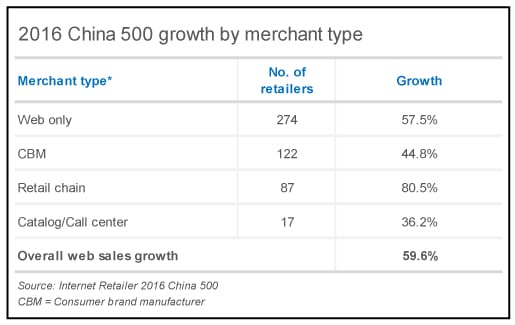
    China’s growing middle class craves imported goods and that’s driving big opportunities for overseas brands and retailers. China’s 500 largest web retailers grew combined sales by 60% in 2015, according to the all-new Internet Retailer 2016 China 500, which ranks the 500 leaders of the world’s largest and fastest-growing e-commerce market

    China’s slowdown to only 6.9% growth in gross domestic product in 2015, one of the lowest increases in decades, has been blamed for hurting the economies of trading partners in other countries. But China’s growing middle class keeps buying more online, and its thirst for foreign goods creates a big opportunity for overseas retailers and brands.

    Chinese consumers purchased $589.61 billion worth of goods online in 2015, an increase of 33.3% from a year earlier, according to the National Bureau of Statistics in China. By comparison, U.S. online retail sales grew roughly 15% per year from 2011 to 2014 to $304.9 billion, according to the U.S. Commerce Department.

    China’s 500 largest e-retailers grew their combined online sales by a stunning 60% in 2015 to $198 billion, according to the all-new Internet Retailer 2016 China 500, which ranks and provides a wealth of financial and operating data on the 500 leaders of the world’s largest and fastest-growing e-commerce market. And the data contained in Internet Retailer’s newest research report on e-commerce in China shows that the world’s biggest online market is rapidly consolidating, with the 500 largest competitors now controlling 33.6% of China’s e-retail market, up from 28% just one year ago.

    Retailers and brands based outside of China shared in that growth. The 52 U.S.-based retailers ranked in the China 500, for example, grew online sales 24.3% to $17.77 billion last year—the bulk of that coming from Chinese customers. The 79 retailers based outside China, including those in the U.S., grew sales by 24.0%, to $21.31 billion in 2015.

    The growing online retail sales for brands and retailers based outside of China is not surprising given the strong demand among middle-class Chinese for foreign goods, from Apple Inc. iPhones to food and household goods from Wal-Mart Stores Inc. Alibaba Group reported that 33% of Chinese consumers bought items from international brands during the 24-hour Singles’ Day event Nov. 11, with U.S. goods in the top spot. Singles’ Day is a marketing initiative that Alibaba created to spur single consumers to buy goods online for themselves, as opposed to other marketing days where consumers buy gifts for loved ones.

    Among the factors driving online sales growth are increasing sales from consumers in China’s villages, and the steady growth in the number of Chinese shoppers who can access the web through mobile phones.

    “In China, the major market drivers in the past year have been cross-border e-commerce, mobile shopping, omnichannel and e-commerce in villages,” China E-commerce Research Center senior analyst Zhang Zhouping says.

    There were 668 million Internet users in China by June 2015, and about 89%, roughly 594 million consumers, could access the web through mobile devices, according to China Internet Network Information Center. During Alibaba’s Singles’ Day sale, Chinese consumers purchased $14 billion worth of products, and 70% of sales were generated on mobile devices, according to Alibaba.

    Rural areas, where there are few bricks-and-mortar stores, also present huge potential for online merchants. There were 186 million Internet users living outside of cities as of June 2015, and 60% of them had never bought products online, according to China’s Ministry of Commerce. To encourage rural shoppers to order online, e-commerce firms are rapidly improving their facilities in those areas. Alibaba, whose big marketplaces Taobao and Tmall account for about 75% of China’s online retail sales, has helped about 14,000 merchants with small stores in rural China sell their wares on Taobao, the company says. Alibaba is aiming to establish up to 100,000 such service centers among about 570,000 villages in rural areas of China.


  • JD.com Dominating The Rapidly Growing Chinese Online Retail Market

    JD.com Dominating The Rapidly Growing Chinese Online Retail Market

    Rapidly Growing Online Retail Market

    There are multiple dimensions through which the Chinese online retail market is growing such as growing Internet users and expanding middle class. Unlike developed countries with largest online retail markets such as the UK, the US, and Germany, the penetration of online retail is fairly low at a meager 12.9% (2015) of the country’s overall retail sector. Despite that, China is the largest e-commerce market in the world, which is also growing rapidly. Chinese consumers spent 33.3% more on online shopping last year. And the expanding middle class is making the market lucrative for e-commerce players in the B2C segment, which was an unprofitable prospect a few years ago due to unscalability. This is where the two fiercest competitors JD and Alibaba’s Tmall are fighting to capture a larger chunk of the growing pie.

    JD.com or Jingdong is the second-largest e-commerce player in China, only behind Alibaba. BABA provides marketplaces for businesses (Alibaba.com), consumers (Taobao), and brands (Tmall), along with technological support and services; it generates revenues primarily through advertising and commissions. On the other hand, JD is more of an online retail pure-play with a lion’s share of revenues generated from direct sales; however, it also hosts third-party sellers. JD operates in the B2C segment and directly competes with BABA’s Tmall.

    Why Invest In JD.com?

    Largest logistics infrastructure

    This is the key differentiator between the two. JD operates its own logistics network while BABA provides these services to its merchants through a group of logistics service providers called Cainiao. JD has been aggressively investing to expand the largest fulfilment network operated by an e-commerce company in China. Its last mile delivery distinguishes it even from Amazon, resulting in the fastest and reliable delivery as evident from the nearly 80% orders fulfilled on the same day. While BABA has stepped up its efforts in building several large-scale logistics centre, it would still rely on third-party delivery personnel. Even though the strategy is better in terms of its less labour-intensive nature, it lacks control on the quality of service.

    Rising revenues in non-core areas

    One of the reasons JD started building its logistics network in 2007 was to attract third-party sellers. Its strategy has been successful as evident from the y-o-y jump of 101% in revenues from marketplace fees, ads, and logistics services. Third-party sellers find JD more attractive as the company doesn’t ask for exclusivity, unlike Tmall. Additionally, the company has seen strong growth in the apparels and shoes segment. JD was a consumer electronics and home appliances focused retailer, but the segment’s 66% growth was outpaced by the 92% y-o-y growth in general merchandise/other segment during Q4 2015.

    Increasing market share

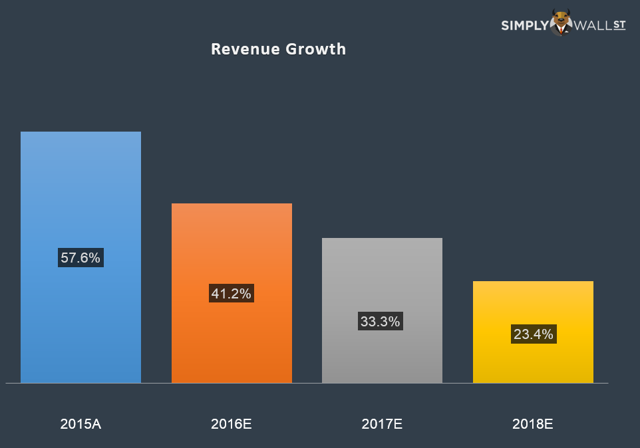
    JD’s revenue growth of 57.6% (in US dollars) during 2015 was well above the industry’s growth rate (33.3%). It indicates that the company increased its market share which accounted for the incremental growth. During early 2015, analysts at William Blair highlighted that during Q4 2014, JD gained 5% market share in GMV compared to a 2% decline experienced by Tmall. During the first three quarters of 2015, JD’s market share increased to 23.2% from 18.6% at the start of the year compared to Tmall’s contraction to 54% from 61.4%.

    Improving gross margin

    Source: Simply Wall St

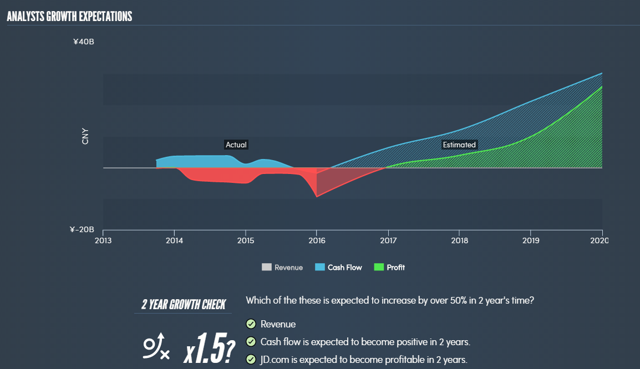
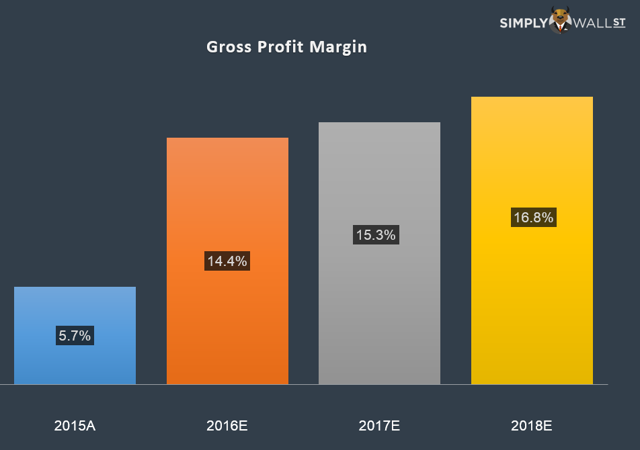
    JD was unprofitable last year. More than 85% of the loss was related to impairment charges (Paipai platform) and acquisitions; however, the company is expected to deliver positive earnings in 2016 and sizable earnings growth thereafter. JD’s improved utilization of infrastructure – growth in marketplace, ads, logistic services revenues – and increase in higher-margin product mix – general merchandise/other segment – will start reflecting in improved gross margin. Its loss doesn’t come as a surprise, as the management clearly stated in early 2015 that it is in investment mode, and this year’s target was to grow its market share and expand infrastructure.

    Source: Simply Wall St

    Smart money and the strategic partnership

    As per Bloomberg, the hedge fund holdings in the company increased from less than 4% at the start of 2015 to over 18% at the end of Q2. Q3 saw a decline, but the smart money increased its stake by nearly 7% during Q4. One of the key reasons behind hedge funds’ interest was JD’s strategic partnership with Tencent, the operator of China’s largest messaging service: WeChat. This has allowed JD to tap into the fastest-growing customer network as evident from the 61.4% sales coming from mobile devices during 2015 compared to nearly 36% in Q4 2014.

    Source: Simply Wall St

    Source: SEC 13-F filings, National Bureau of Statistics China, company fillings, S&P Capital IQ, WSJ.com, Simply Wall St

  • Do malls, online shops mix? Zalora says Pinoys have best of both worlds

    Do malls, online shops mix? Zalora says Pinoys have best of both worlds

    Like most disruptions in the past, the advent of ecommerce has been framed as a battle between online convenience and the traditional brick and mortar experience: your couch or the mall.

    Ecommerce has played its part as the upstart in this battle, with brands such as Lazada and Zalora coming from nowhere a few years ago to winding their way into the public consciousness.

    Despite this, ecommerce currently accounts for only about 1% of the local retail market. However, as Paulo Campos III, founder and CEO of fashion retailer site Zalora Philippines pointed out, “Where it’s going – that’s the exciting part.”

    “If you believe that the concept of ecommerce is universal, and not just a western country thing, then the experience of other countries provides a glimpse of what’s in store for the country,” he said in an exclusive interview with Rappler.

    In the US and EU, ecommerce now represents about 8-10% of the retail market including big names like Amazon.com.

    But more relevant to the Philippines is its success closer to home.

    “China is the shining story of ecommerce in emerging markets and and somehow validates the thesis that ecommerce is a global, universal thing and that it’s going to happen eventually here and everywhere else,” Campos said.

    Indeed, some of China’s best known companies, including the record holder for biggest IPO ever, Alibaba, are built upon ecommerce and already have 6-7% of China’s giant retail market.

    But its success there doesn’t guarantee it would work here, especially in a country where malls have become the de facto townsquares.

    This is especially true of a firm like Zalora that plays in the fashion space where the fit and feel of clothes are so essential to the buyer.

    Unlike Uber

    Setting up shop in the country in 2012, initially as a venture of Rocket Internet, Zalora has since grown to become the leading fashion-focused ecommerce platform in the country, averaging around 200,000 users per day.

    To visualize this, that’s about on par with the amount of daily foot traffic the big malls get, Campos said.

    Yet, he doesn’t see this as a signal that malls will soon be disrupted in a way Uber has done to taxis around the world.

    “Filipinos will continue to go to the mall in the large numbers they do now. Culturally, the mall is more than just a place to go to buy stuff, it’s where people hang out, cool off and even go to Mass,” he said.

    “In terms of how I see the development of the brand, we’re moving to an omni-channel experience,” Campos explained.

    For example, someone goes to the store to check out an item but then does the research online and then might go back to the store or they can just buy from the site.

    “This omni-channel experience means that ecommerce and the mall will coexist and in fact reinforce each other in a harmonious way,” he said.

    Consumer patterns

    Another interesting point about this relationship lies in consumer patterns.

    Campos pointed out that Zalora sales are highest on Wednesday and Thursday, while they are lowest, at only 50% of the highest days, on Saturday and Sunday.

    Within a day, sales are highest between 1 pm and 4 pm and are lowest between 6 pm and 8 pm. This has been true for every week for 4 years.

    These patterns are the exact opposite of sales patterns in the offline world.

    “What I tell our brand partners is that when customers are in the mall, they are shopping with you. When they’re not in the mall like during downtime at the office that’s when people are shopping with us,” Campos said.

    “People are shopping with us on hump day and 1-4 pm, taking advantage of fast Internet at the office. Somehow it’s complementary,” he said.

    He also pointed out that Zalora’s retail brand partners also found that online shopping doesn’t cannibalize sales. It’s just one way of reaching out to customers at another time and through a different channel.

    This blending of both worlds can already be seen in individual brands that all have their own ecommerce websites. You can buy Nikes online but that doesn’t mean they’ve closed down their stores.

    Local retailers like Bench and SSI, both of which sell through Zalora, already have online ecommerce sites, although Campos is confident that they will continue to sell on Zalora.

    “Customers who are shopping for a specific brand can go to its website directly, and those shopping around looking for many brands can go to Zalora. Brands are basically doubling their retailing channels through us,” he said.

    To facilitate this, Campos said that Zalora sells everything at suggested retail price (SRP). This means nothing will ever be cheaper or more expensive in the mall than on the site, and when an item goes on sale offline, it does so online as well.

    GLOBAL GROUP. Having been incubated by Rocket Internet, Zalora Philippines has since taken out different institutional investors and is now part of mother company Global Fashion Group (GFG). Campos describes GFG as essentially the leading fashion ecommerce group player in 27 emerging markets or "all of the interesting ones except for China." Photo from GFG's website

    GLOBAL GROUP. Having been incubated by Rocket Internet, Zalora Philippines has since taken out different institutional investors and is now part of mother company Global Fashion Group (GFG). Campos describes GFG as essentially the leading fashion ecommerce group player in 27 emerging markets or “all of the interesting ones except for China.” Photo from GFG’s website

    Digital department store

    Campos said that what Zalora brings to the table for consumers, besides convenience, is the ability to browse established brands while getting exposed to new ones.

    “About half of our brands, 750, are mall brands that work together with us on a virtual inventory basis or a marketplace basis. The other half are independent brands, the SMEs [small and medium-sized enterprises], and entrepreneurs that don’t have the scale to work with us like the big brands do,” Campos said.

    He added that while they have the top 20 online retail sellers, they don’t have a store so most consumers have never heard of them. On top of that, Zalora also has its own brand that encompasses about 20% of sales.

    He also pointed out that many users visit the site as an information resource to check on product alternatives and get reviews on different items.

    CUSTOMER SERVICE. Zalora Philippines now employs around 100 customer services representatives with 10 servicing excess demand from sister site The Iconic, serving Australia and New Zealand. Campos says that the firm plans to increase this number in the future as global ecommerce grows. Photo by Chris Schnabel/Rappler

    CUSTOMER SERVICE. Zalora Philippines now employs around 100 customer services representatives with 10 servicing excess demand from sister site The Iconic, serving Australia and New Zealand. Campos says that the firm plans to increase this number in the future as global ecommerce grows. Photo by Chris Schnabel/Rappler

    Tip of the iceberg

    Approaching its 4th anniversary in the Philippines, Campos said that Zalora is profitable on a unit economics basis. But at the moment it is sacrificing profitability for the bigger battle for market share.

    Far from traditional retailers, Campos said that the main challenge facing Zalora, as well as other big ecommerce players, is getting consumers comfortable with buying online, which is why it is channeling money into various marketing efforts.

    These efforts include the pop-up stores they had last year as well as hosting a Zalora Style Awards Ceremony to be held on April 7, and a regional model scouting competition to mark its 4th anniversary.

    Just getting consumers online is also proving to be tricky with Campos sharing that they are still fighting a battle on educating Filipinos on how to use mobile data.

    “I recently saw a Google study that showed that among all our peers in Southeast Asia, we use Internet on a fewer number of days per month than any other ASEAN country and significantly so,” he shared.

    “Out of 30 days, only 80% use it 1-5 days a month. So this phenomenon of being constantly connected or being a digital native is not true for most people in the country,” Campos added.

    Even potential customers who are connected are hampered by poor network infrastructure.

    “We have the benefit of comparing all the ASEAN countries that have Zalora side by side and through the comparison you can really see that we really do have an inordinately slow mobile Internet speed even compared to Indonesia or Vietnam,” he said.

    On the flipside, Campos pointed out that 40 million Philippine users have access to the Internet now, and the number is expected to go up to 75 million in the next two years. If the Internet improves in the next few years, this would bring huge potential to online businesses.

    With Internet speeds improving, the firm is hoping that as more and more consumers become digital natives, they would eventually get comfortable browsing the site from anywhere.

    Maybe even while hanging out in a mall.
  • Standard Chartered opens Singapore innovation lab

    Standard Chartered opens Singapore innovation lab

    Standard Chartered Bank has opened a new innovation lab in Singapore to explore the use of emerging technologies and data sciences in support of the bank’s digital transformation strategy.

    The ‘eXellerator’ builds upon Standard Chartered’s established technology outpost in Silicon Valley, SC Studios, and is the bank’s first dedicated space for innovation in Asia, located at the heart of its main office building at Marina Bay Financial Centre.Anju Patwardhan, Standard Chartered’s global chief innovation officer, says: “This is where we can tap the depth of knowledge and talent, as well as work with local universities and research organisations, to help drive the bank’s innovation agenda.”

    The bank has secured the support of the Monetary Authority of Singapore (MAS) in establishing the facility. MAS has been actively encouraging the development of a ‘Smart Financial Centre’, in line with country’s ‘Smart Nation’ plan, and recently appointed a ‘chief fintech officer’, Sopnendu Mohanty, to co-ordinate its efforts.

    Says Mohanty: “The financial sector is an integral part of Singapore’s ambition to be a Smart Nation. A Smart Financial Centre with an open architecture and collaborative fintech community will promote innovation, application of technology advancements and talent development in financial services.”

    Standard Chartered has already laid the groundwork for the new lab through a multi-year collaboration agreement with A*Star’s Institute for Infocomm Research (I2R) – Singapore’s national information and communications technology research institute – to jointly work on data science research and experimentation by tapping the Institute’s network of data scientists and software engineers.

    It has also partnered with DBS Bank and Singapore’s Infocomm Development Authority (IDA) to successfully complete a proof of concept (PoC) on the application of distributed ledger technology in trade finance invoicing with the objective of reducing risk around duplicate invoice financing for banks while preserving client confidentiality.

  • Hong Kong textile eye India as alternative production base to cut cost

    Hong Kong textile eye India as alternative production base to cut cost

    India is rising, not only as a new choice of relocating labour-intensive industries from China, but also as a retail market of good potential, says a research report by The Hong Kong Trade Development Council (HKTDC).

    In recent years, the sustained rise in production costs on the Chinese mainland has eroded the profit margins of many Hong Kong companies with labour-intensive factories located on the Chinese mainland, prompting them to seek alternative production bases elsewhere.

    While Southeast Asian countries offer many choices, the HKTDC report says India offers many advantages as an alternative production base, along with the added advantage of having a domestic market of great potential.

    According to the report, the majority of Indian garment producers are focused on the domestic market, as their product quality was generally lower than the standards required by overseas importers.

    Despite this, many big Indian exporters have successfully lined up with international buyers, including department stores, retail chains and brands.

    The paper was written after a recent field trip to India that included factory visits and interviews with garment manufacturers.

    In the four years to 2014, India’s garment exports increased at an average annual rate of 12 per cent, surpassing China’s 9 per cent, in line with Bangladesh’s 13 per cent and eclipsed by Vietnam’s 17 per cent.

    With advantages of raw materials and prospects of vertical integration, India is a strong garment exporting country and a location worth considering for factory relocation in relation to labour-intensive manufacturing, such as garment-making.

    The report pointed out that while China is the undisputed world leader in exporting textiles and garment products, many have overlooked India’s position as the world’s second biggest exporter of textile and garment products in 2014, selling a total of $36 billion, during the year, far behind China’s $399 billion.

    For textile exports alone, India was second after China in 2014, with a share of 5.8 per cent of the global market, compared to China’s enormous 35.6 per cent share.

    HKTDC says it is not surprising that the bulk of garment manufacturing in India is for the domestic market, supported by the country’s huge capacity in textiles production.

    India stands out to be a substantial exporter in both garments and textiles. In 2014, India imported textiles worth only $3.8 billion, lagging much behind Vietnam’s $12 billion, Bangladesh’s $6.8 billion, and just ahead of Cambodia’s $3 billion, the report said.

  • Shell seeking new upstream growth

    Shell seeking new upstream growth

    Following the sale of its shares in Shell Refining Company (federation of Malaya) Bhd (SRC) to a Chinese company, Royal Dutch Shell plc is seeking new opportunities for further growth in its upstream portfolio in Malaysia and to reinforce its joint ventures here with Petroliam Nasional Bhd (Petronas), besides strengthening its position in the retail segment.

    In a press conference held in conjunction with the Offshore Technology Conference Asia 2016 yesterday, its upstream director Andy Brown reaffirmed the oil and gas (O&G) major’s commitment in growing in the exploration, development and production side of the industry in Malaysia.

    “If I look at Shell in Malaysia, over the last two years, we have made 11 gas discoveries. We are very focused on our upstream business in Malaysia, seeking new opportunities for further growth, but also reinforcing our joint ventures, like the Baram Delta Offshore that we have [with Petronas].

    “I think it is not the time to be spending a lot of money, but we are demonstrating that we are here to stay, that Malaysia is an important part of Shell’s upstream business,” said Brown. Shell is the second-largest oil and gas producer in Malaysia after state-owned Petronas.

    On Feb 1, Shell Overseas Holdings Ltd entered into a conditional sale and purchase agreement with Malaysia Hengyuan International Ltd for the disposal of its 51% stake in SRC for US$66.3 million (RM265.2 million).

    The disposal sparked rumours that Shell might look at selling off some of its stakes in its O&G fields in Malaysia. However, Shell dispelled any connection between the disposals of the refinery with its upstream business in Malaysia.

    In a press release dated Feb 17, Shell explained that the sale of the stake in SRC should be seen in context with the oil major’s global strategy and portfolio activities. It said a refinery of SRC’s scale is not a strategic fit for its portfolio and that it would find it difficult to compete for new capital.

    Yesterday, Shell Malaysia Ltd chairman Datuk Iain Lo said the sale of the refinery is actually to ensure the stability and continuation of fuel supply in the country, as there was a concern that the SRC is a weak link in the supply chain.

    “We were concerned, [that] perhaps this is a very weak link in the supply chain of fuel supply in Malaysia. That is why we decided to find somebody who is prepared to invest in it, because it is not strategic for Shell to invest in it,” said Lo.

    In the upstream sector, Shell has been pioneering deepwater field developments in Malaysia, through the Gumusut-Kakap and Malikai fields, both offshore Sabah, and the Central Luconia and Baram Delta projects off Sarawak.

    According to Brown, Gumusut-Kakap has a peak production capacity of 135,000 barrels of oil equivalent per day (boepd). About 20% of Malaysia’s average oil production of around 650,000 boepd, comes from Gumusut-Kakap. Malikai will also be coming online soon.

    “When it comes to Malaysia, we’ve been here over 100 years, starting with Miri in 1910, and we’ve grown from that position. Last year for instance, we produced half the gas in Malaysia.

    “We have built in Malaysia a business that has the key elements of integrated gas, deepwater, and our fundamental fuel retail and lubricants, which really kind of mirrors the key focus areas for Shell now and going forward. We continue to look at ways we can partner with Petronas to continue to build that position,” said Brown.