Author: Mei Ling Tan

  • Prada finance chief Galli resigns

    Prada finance chief Galli resigns

    Italian luxury goods group Prada said on Friday its finance chief was resigning with immediate effect, two days after the company reported almost flat full-year sales, held back by weakness in Greater China.

    Prada said in a statement to the Hong Kong stock exchange that Donatello Galli was stepping down for personal reasons to pursue new career opportunities, adding there had been no disagreement with the board during his tenure.

    “There is no other matter relating to his resignation that needs to be brought to the attention of shareholders of the group,” the statement said.

    Galli, who was also a board member, had been chief financial officer since joining the company in 2004.

    Hong Kong-listed Prada said Alessandra Cozzani, head of investor relations and executive director of the company, had been appointed to replace Galli.

    A search is also under way for a new board member, the company added.

    Prada, best known for handbags that retail for as much as 6,000 euros ($6,667), has seen earnings slump in recent quarters, hurt in part by costly investments in new shops in the face of softening demand for luxury goods.

    On Wednesday, the Milanese fashion house said net revenue totalled 3.55 billion euros in the year to Jan. 31, little changed from a year earlier.

    “We haven’t spoken to the company yet, but a management change is hardly surprising. The company’s been under a lot of pressure of late and has come down heavily from peaks,” said an analyst, who spoke on condition of anonymity.

  • Travellers and shoppers prefer apps to browsers

    Travellers and shoppers prefer apps to browsers

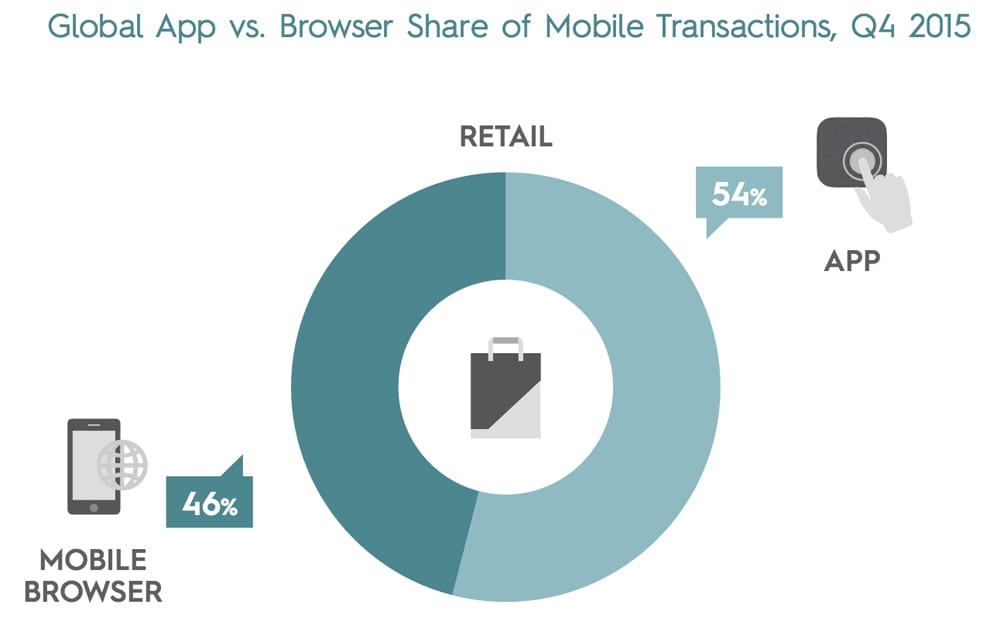
    Criteo’s analysis of shopping data from Q4 2015 demonstrates that mobile is an established channel for retail transactions and that apps have overtaken mobile browsers for the very first time as a vehicle for purchasing.

    Interestingly, the number of mobile transactions carried out on travel apps (58%) outstripped those made via travel mobile browsers in this period (42%). The figure rose from 42% in Q2, to 49% in Q3 and the balance finally tipped in Q4 to 58% of mobile transitions. This should be of interest to travel retailers as it is indicative of how travellers are purchasing.

    Having a fully functioning website may no longer be enough, as travellers increasingly prefer to make transactions via applications instead. Thankfully these are relatively easy to set up in tandem with an existing retail website.

    Criteo-q4-2015-report-1

    Continuing the trend from past quarters, the overall share of app transactions consists of half or more of all transactions.

    “Nearly four-in-ten transactions occurred on multiple devices and were completed on a mobile device almost a third of the time,” says Criteo. “Dedicated shopping apps dwarf the mobile web at all points on the path to purchase, from browsing products to the sale itself.

    “Retailers whose apps focus on providing shoppers relevant and useful products and remove barriers to purchase drive a higher share of transactions than mobile web.”

    Continuing the trend from past quarters, the overall share of app transactions consists of half or more of all transactions.

    Criteo-q4-2015-report-2

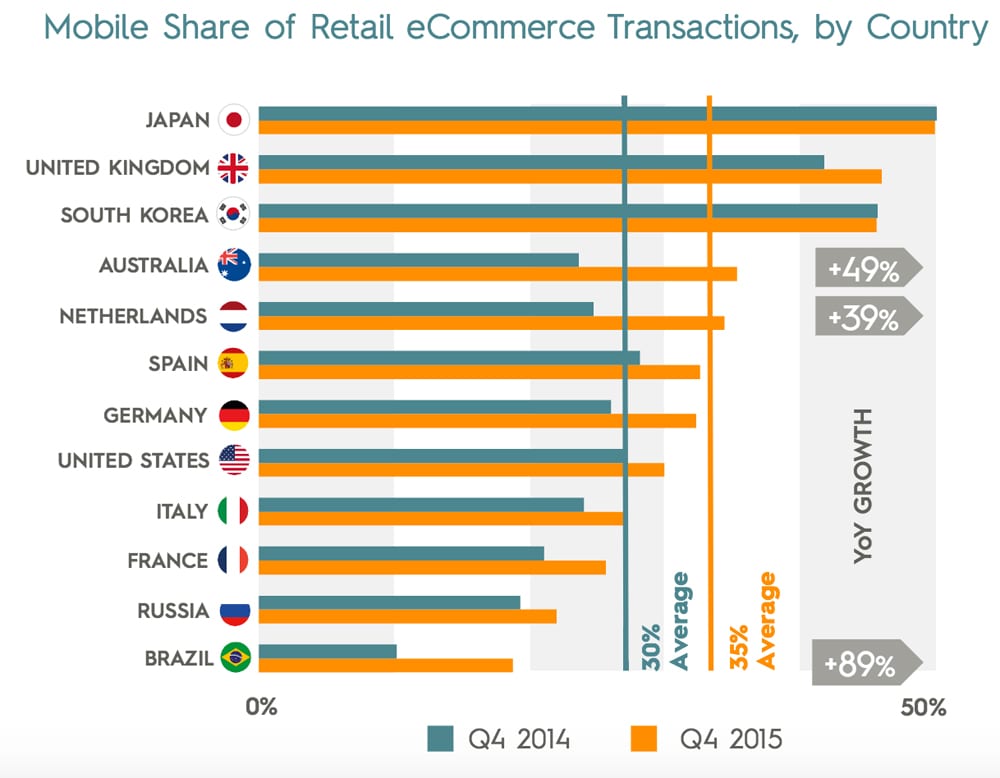
    Japan, UK and South Korea make up the top three countries ranked by mobile share of transactions, globally. Advanced mobile countries remained constant while others are catching up.

    Due to the native environment and additional control of the purchase path, retailers see a higher conversion rate on their apps than both mobile web and desktop.

    “Technologies like deep linking and mobile re-targeting can help retailers drive sustained engagement and transactions in their apps,” says Criteo.

    “Not only do apps convert a higher percentage of your customers, they also bring in more revenue per transaction. Controlling the environment allows retailers to give customers engaging product content (i.e. videos, images, reviews) targeted to things like buying history and browsing behavior. This is more effective than generic targeting signals found on mobile web and desktop sites.”

    In terms of overall transactions made on mobiles – whether through apps or browsers – Japan, UK and South Korea make up the top three countries ranked by mobile share of transactions, globally. Advanced mobile countries remained constant while others are catching up.

    The biggest gainers were UK, which passed South Korea for second, and Australia, which leapfrogged five countries to land in fourth.The US remains in the middle of the pack, but trails the global average along with Germany, France and Spain.

    Criteo-tablet-use-generic

    Tablet transactions were the most likely to have multiple devices in the path to purchase, indicating that tablet buyers are most likely browsing on devices like desktops and smartphones before purchasing.

    “For retailers with a strong mobile shopping experience, mobile transactions neared parity with desktop in 2015. They successfully met consumers on their devices and shifted browsers into buyers.”

    In Q4 2015, mobile hit 30% of transactions versus 27% in 2014. Top quartile retailers, as ranked by percentage of transactions occurring on a mobile device, increased mobile’s share of all transactions even faster – from 35% to 44%

    Criteo-q4-2015-report-4

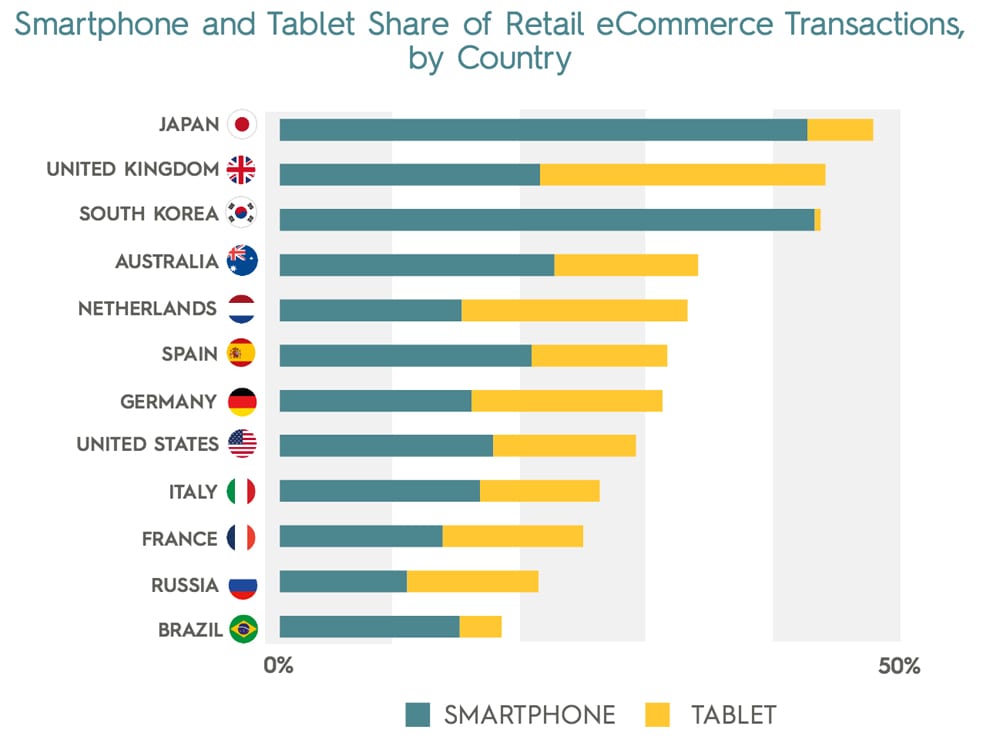
    Japan, UK and South Korea continue to lead the globe in mobile transactions, and smartphones lead tablets in most countries.

    “Mobile is becoming an integral part of the shopping experience, particularly for verticals such as fashion and mass merchants,” adds Criteo. “Health & beauty transactions saw the largest increase in mobile share at 38% year over year, followed by home and mass merchant categories.”

    Smartphone’s share of mobile transactions grew by more than 15% year over year, now accounting for 60% of all mobile transactions in the US. The combination of better transaction channels, ubiquity, more phone models with big bright screens and fast wireless broadband is giving retailers better options for displaying their goods on mobile devices – ultimately leading to more transactions.

  • Prada also experiences issues in China

    Prada also experiences issues in China

    Italian Prada Group‘s 2015 turnover dropped ever so slightly, blaming it on the lousy economic state China is in. The country is an important market for plenty of luxury brands, although the expensive dollar also had a negative effect.

    Strong growth in home territory

    Prada’s 2015 turnover dropped slightly, from 3.55 billion euro to 3.54 billion euro, with drops in Asia and the United States. Asian turnover fell 4 %, mainly because of China’s negative results, while American turnover dropped 9 % as the Italian fashion company struggled with the expensive dollar.

    Prada believes the European turnover growth (6 %) was thanks to the many Asian and American tourists, with a significant boost in Italy. Japanese turnover did extremely well, with an 11 % increase, the exact same number as in the Middle East.

    “Price variations and diverted tourist traffic”

    “Throughout 2015, we had to deal with an economic environment characterized by extreme volatility in currency markets, as well as by the deteriorating geopolitical situation in many world regions. These two factors have made prices fluctuate widely and diverted tourist traffic in sudden and unpredictable ways”, Prada CEO Patrizio Bertelli said.

    Prada will increase its focus on its retail network expansion. It already has 618 stores and retail turnover grew 76 million euro to 3.1 billion euro, while wholesale activities dropped 88 million euro to 444 million euro.

  • Construction of second Bangkok Ikea store starts

    Construction of second Bangkok Ikea store starts

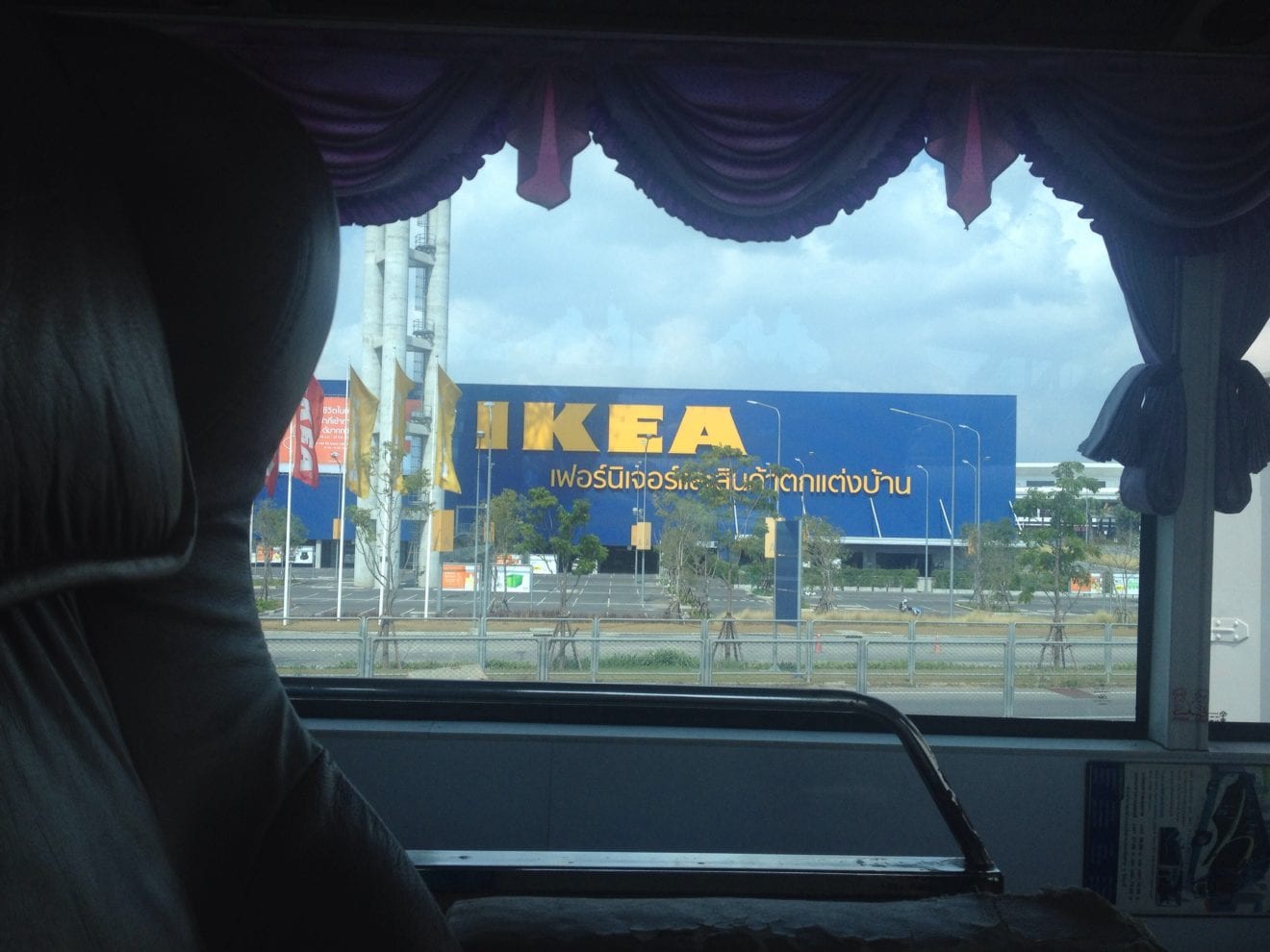
    On 18 February 2016 Ikano and Central Pattana representatives broke ground at the site for Thailand’s second IKEA second store in West Bangkok.

    IKEA-Bangyai-Ground-Breaking2

    From left to right: Ms. Amornrat Bunyongsin GM-Central Plaza Westgate; Ms. Lacia Sherlock, IKEA Retail Project Leader for Ikano Private Limited; Mr.Sebastian Hylving, Expansion Director for Ikano Private Limited; Mr. Narit Ratanaphichetchai, Executive Vice President-Business Development Central Pattana Public Company Limited; Mr. Isareit Chirathivat, Vice President of Property Management, Central Pattana Public Company Limited; Mr. Mike King, the IKEA Retail Director for Ikano Private Limited

    The site is in Bangyai, to be fully integrated into Central Plaza Westgate shopping centre with wide open entrances at all levels of the mall and direct link to the upcoming MRT (public transportation) line.

    “We are creating the world’s best integration of an IKEA store into a shopping centre,” said Sebastian Hylving, Expansion Director for Ikano Private Limited, owner of the IKEA franchise in Singapore, Malaysia and Thailand.

    In a highly complex design, the showroom and a market hall are housed inside an expansive two-storey concourse building that creates a bridge to the Westgate mall. The self-serve warehouse will be on the ground floor.

    IKEA-Bangyai-Ground-Breaking

    “This is not going to be the usual blue box,” said Lacia Sherlock, IKEA Retail Project Leader for Ikano. “This will be our only store that offers customers an opportunity to enter and checkout at every level. We will deliver a fantastic customer experience.”

    Ms. Sherlock explained that the 50,278m2 building includes 1,900 parking spaces, a dedicated area for outdoor furniture, and two unique cafes – one will “float” over the showroom in an open mezzanine. The 6.3 billion THB project also aims to reach new heights in Thailand terms of sustainable construction and operation. It will be fitted out with hundreds of rooftop solar panels, 100% LED lighting and other features that are expected to earn this IKEA store the highest level of LEED certification.

    Mike King, the IKEA Retail Director for Ikano, is confident many of the 1.6 million people who live in Bangyai and the surrounding area – including a growing population of young families – will make the trip to the new store when it opens at the end of 2017.

    IKEA-Bangyai-perspective

    “There may be a lot of competition in the home furnishing business here in Thailand, but no other retailer offers the whole family a great day out in the way IKEA does,” said Mr. King. “No other retailer provides customers both an inspirational showroom and 9,500 functional, well-designed products – flat-packed and ready to take home the same day.”

    In November last year, the company opened a second store in Kuala Lumpur and a Pick Up and Order Point in Phuket. The Bangyai project marks Ikano’s first collaboration with Central Pattana Public Company Ltd.

    Isareit Chirathivat, Vice President of Property Management, Central Pattana Public Company Limited said: “We are honored to join hands with Ikano to develop the newest model of IKEA store. We are confident IKEA will help Central Plaza Westgate achieve its vision of being ‘The Most Complete Super-Regional Mall in Southeast Asia’. We will attract Thai and foreign customers alike and create a truly great destination for people to shop, dine and play in West Bangkok.”

  • Martell adds Asia travel-retail exclusive Millésime 1972

    Martell adds Asia travel-retail exclusive Millésime 1972

    Martell has unveiled its third addition to the Millésime Collection, called Millésime 1972, made exclusive to Asia travel-retail.

    The Martell Millésime 1972 is a limited-edition series with only 3,500 units numbered and bottled worldwide, of which 2,500 are exclusive to Asia’s travel-retail market, available at $838 with key product showcases in Hong Kong , Taoyuan, Changi and Kuala Lumpur International airports.

    The Martell Millésime 1972 bottle is inspired by the Martell “montre”, a small cylindrical carafe traditionally used to present samples of the various eaux-de-vie to the Cellar Master for blending. A vintage eau-de-vie, Millésime 1972’s sensory fullness has come of age after 43 years in old barrels and a resting period in the Chais de la Coquille, the Martell House’s oldest cellar in Cognac.

    Martell Millésime 1972 celebrates the expertise of the House, the perpetuating savoir-faire initiated by Jean Martell in 1715, with the promise of an unforgettable tasting experience.

  • Mobi724 signs deal with Philippines government

    Mobi724 signs deal with Philippines government

    Tangent produces payment industry software. It manages the payments terminals for more than 80 banks through partnerships with the nation’s largest ATM switch and every major credit card acquirer.

    Mobi724 President Robert Rioux said all banks and retail payment terminals in the Philippines must be EMV compliant by the end of this year. The agreement with Tangent Solutions goes a long way in meeting that goal.

    “This is an opportunity for us to leverage our EMV gateways to connect and route the retail payment terminals to the proper issuing bank. This agreement allows us to reach over 40 percent of all the retailers in the country and it will allow us to connect MPOS transactions.”

    Mr. Rioux said they will deploy its couponing solution in a future phase. That is part of a much larger vision, he added.

    “Our vision is to enhance the value of commoditized payment transactions to the players in this ecosystem (card associations, banks, mobile carriers and retailers) by adding layers of intelligence to these card-linked transactions (i.e. smart transactions) in a seamless manner for all the players in the ecosystem.”

  • Swarovski and DFS put customers in the frame

    Swarovski and DFS put customers in the frame

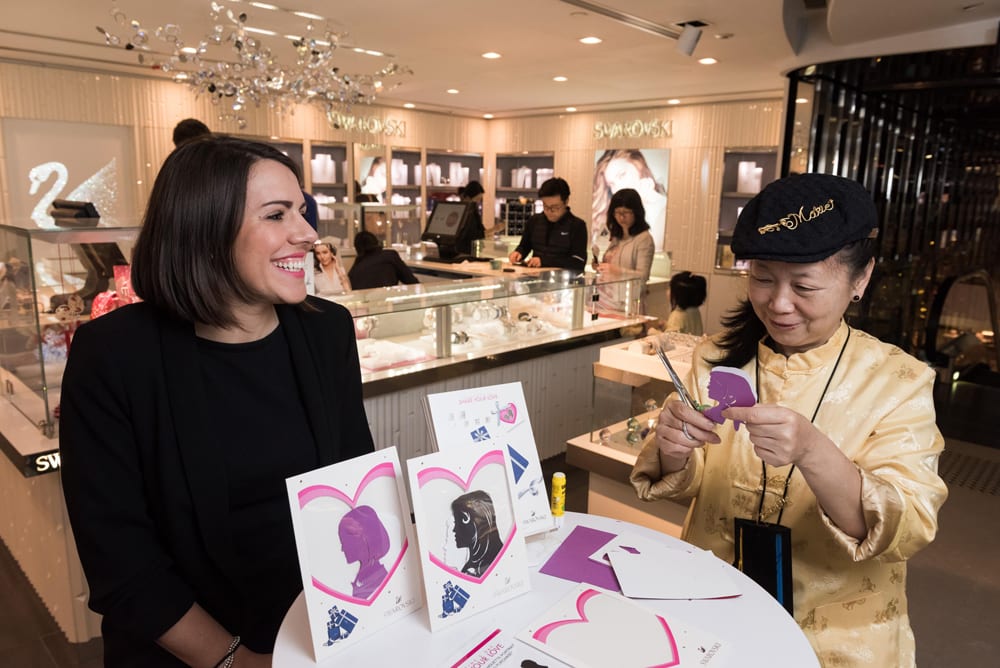
    Throughout February 2016, shoppers who make purchases at selected T Galleria by DFS stores in Hong Kong and Macau can enjoy an ‘exclusive’ silhouette portrait created by local artists as part of a new Swarovski campaign.

    The portraits are gifted in a Swarovski paper frame decorated with the brand’s iconic crystals.

    The service is now available at the T Galleria by DFS stores in Canton Road and Tsim Sha Tsui East in Hong Kong, as well as at City of Dreams and The Shoppes at Four Seasons in Macau.

    Swarovski-DFS-Valentines-Day-offer2

    Karen Tse, Director, Travel Retail Asia Pacific, Swarovski, said: “Swarovski believes that the shopping experience is crucial to how consumers appreciate and value our brand and our exquisite jewellery.

    Swarovski-DFS-Valentines-Day-offer1

    “That is why we have been introducing innovative consumer events such as the Valentine’s Day portrait offer. We
    want to give Swarovski customers an enjoyable memory of visiting our shops and that’s particularly important in prime locations for tourists such as our shops in T Galleria by DFS.”

    Jason Blejwas, Director Merchandise, Sunglasses, Fashion Watches and Jewellery, Global Merchandising, at DFS Group Limited, said: “We’re excited to partner with Swarovski to bring our T Galleria by DFS customers another exciting activation that celebrates our local destinations as well as our fantastic Swarovski product offering.

    “We’re confident this delightful and engaging in-store experience will make for a memorable trip for visitors to Hong Kong and Macau this Valentine’s Day.”

  • China e-commerce huge opportunity for British merchants

    China e-commerce huge opportunity for British merchants

    New research says almost half of the UK’s top online retailers are failing to capitalize on China’s burgeoning e-commerce market. E-commerce service provider Global-e reports that British companies are significantly missing out on a marketplace that’ll be worth $1.5 trillion within four years.

    Chinese shoppers love doing it online. Buying big brands from around the world, It’s global, China’s Centre for Economic Exchange anticipates online retail will account for 30 to 40 per cent of world trade in less than a decade. E-commerce entrepreneur Amir Schlachet says most firms see that as a huge opportunity.

    “Most of them actually do realize that China is an important market. It’s close to a trillion shoppers online. Very open to the world. It’s already around half of the online population actually buying cross border.” said  Schlachet.

    Recent research by market research company Emarketer backs him up, claiming nearly 45% of people in China shop on overseas websites. And the internet shopping giant Alibaba offered further evidence with figures for 2015 indicating a revenue rise of more than 30 percent. However, while many UK retailers have seen the online potential, to others claims Schlachet are failing to take advantage.

    But global’s also local and the trick to getting into the Chinese online market baffles some. Shoppers in China want websites in Mandarin; prices in Renminbi the local currency and payment using local systems such as Tenpay.Union Pay and Alipay. So, while shops in Britain go out of their way to welcome Chinese shoppers, researchers at Global-e found traders needed help online.

    It’s all a barometer of how globalization is changing the way we go shopping, but at the same time it’s a real indicator of how new businesses can start up to take advantage of that.

  • Colgate-Palmolive keeps the Philippines smiling on its 90th year

    Colgate-Palmolive keeps the Philippines smiling on its 90th year

    2016 marks the 90th year of Colgate-Palmolive in the Philippines and with that, the various global brands that have helped improve the lives of Filipinos. These brands include: Colgate, Palmolive, Gard, Tender Care, Axion and Ajax.

    Colgate continues to be the Oral Care brand most recommended by Dentists* and Palmolive remains to be the #1 Personal Care brand, in the Philippines**.

    Keeping Philippines Smiling has been the mission of the company since it first opened its doors in 1926 at Binondo, Manila. For almost 20 years, Colgate-Palmolive has been driving oral health education in public schools across the country, together with the Department of Education thru the Colgate Bright Smiles Bright Futures Program. This program provides oral health education as well as oral care kits (toothbrush, toothpaste) to every first grade public student in the Philippines. In 2015 school-year alone, 2.3 Million students benefited from this program.

    The company is also the exclusive partner of the Philippine Dental Association since 2001 to raise oral health awareness during Oral Health Month. This February, we will offer free dental check-up and free fluoride treatment to 100 kids in 100 barangays. That’s 10,000 kids that will have healthier smiles at the end of the month.

    The team has also been working closely with Public Health agencies to further improve the reach of oral health education and fluoride treatment application, among communities that need this support the most.

    In addition, aspiring dentists have the opportunity to receive scholarship grants from Colgate-Palmolive and the Philippine Association of Dental Colleges. Our first scholar in the 1980s: Ma. Jona Godoy, DMD became Dean of CEU’s College of Dentistry and is an active officer representing the Philippines at the International Association for Dental Research (Southeast Asia Division) since 2000. Since the partnership was officially forged in 2001, Colgate-Palmolive and PADC have granted 248 scholarships.

    _OLE3673

    Stephen Lau, Vice-President & General Manager for Colgate-Palmolive Philippines announces the company’s theme “Keep Philippines Smiling” for its 90th year.

    Stephen Lau, Vice President and General Manager for Colgate-Palmolive Philippines explains “Indeed, the company feels privileged to have this opportunity and capacity to make a meaningful impact to the community. At Colgate-Palmolive, we firmly believe that good oral health is a basic right of every citizen.”

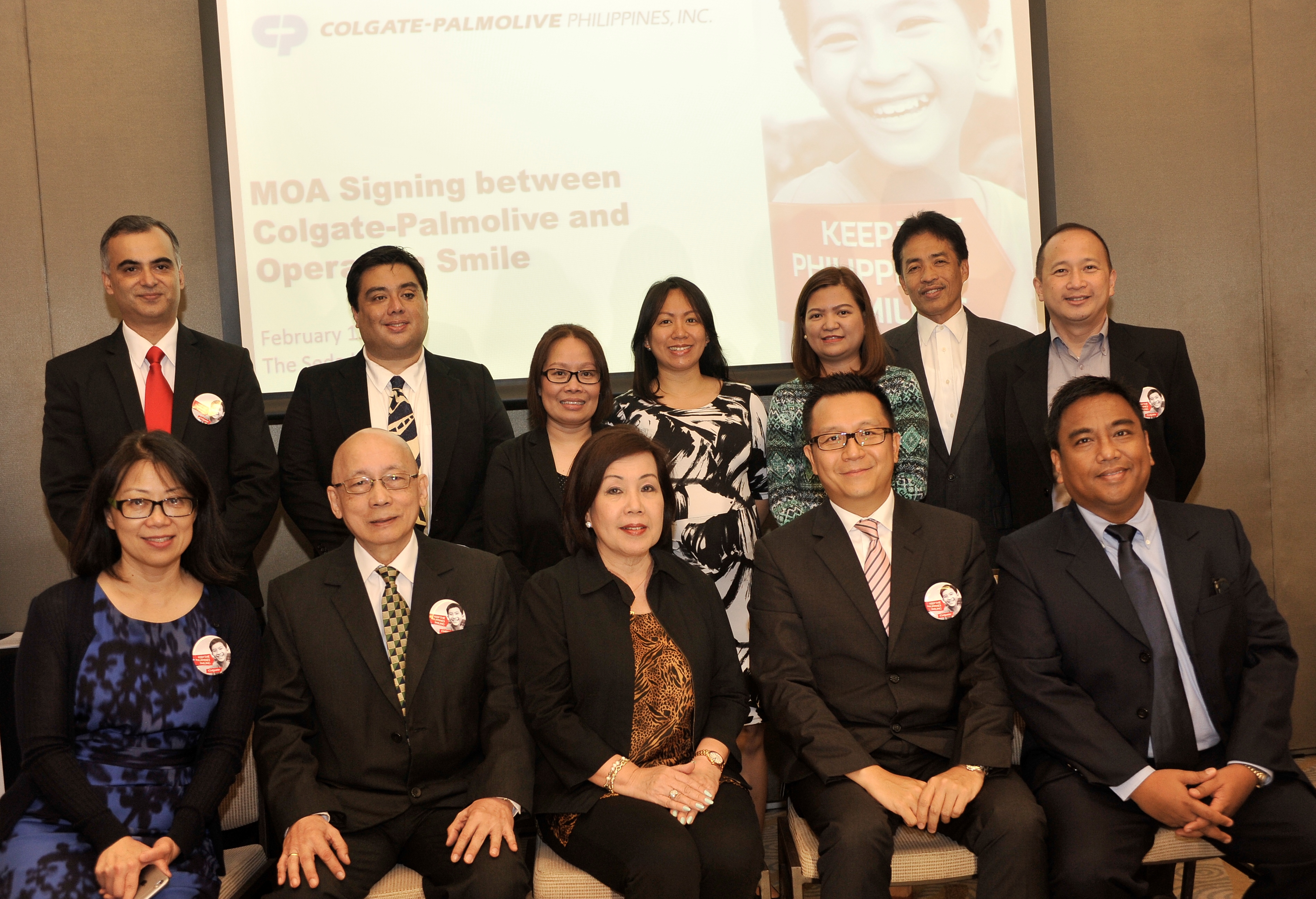
    Management Teams of Colgate-Palmolive Philippines, Operation Smile Philippines and Puregold Price Club Inc. have joined forces to raise funds for oral cleft surgeries and dental check-up. This kicks-off a series of community service programs to commemorate Colgate- Palmolive’s 90th year in the country

    Management Teams of Colgate-Palmolive Philippines, Operation Smile Philippines and Puregold Price Club Inc. have joined forces to raise funds for oral cleft surgeries and dental check-up. This kicks-off a series of community service programs to commemorate Colgate-
    Palmolive’s 90th year in the country

    To Keep the Philippines Smiling even more in 2016, Colgate-Palmolive has teamed up with Operation Smile Philippines Foundation, Inc.. Operation Smile brings groups of medical volunteers from across the world to help indigent children afflicted with oral cleft. It is estimated that 1 in every 500 new-born babies in the Philippines has oral cleft. This life-changing surgery not only improves the child’s oral health but significantly boosts their confidence and self-esteem.

    Puregold is the retail partner for this endeavour to help raise funds for surgeries, dental check-up and fluoride treatment. When Puregold shoppers buy participating Colgate products from February 15 to April 17, the amount of Php5 from every product purchased will be donated to Operation Smile.

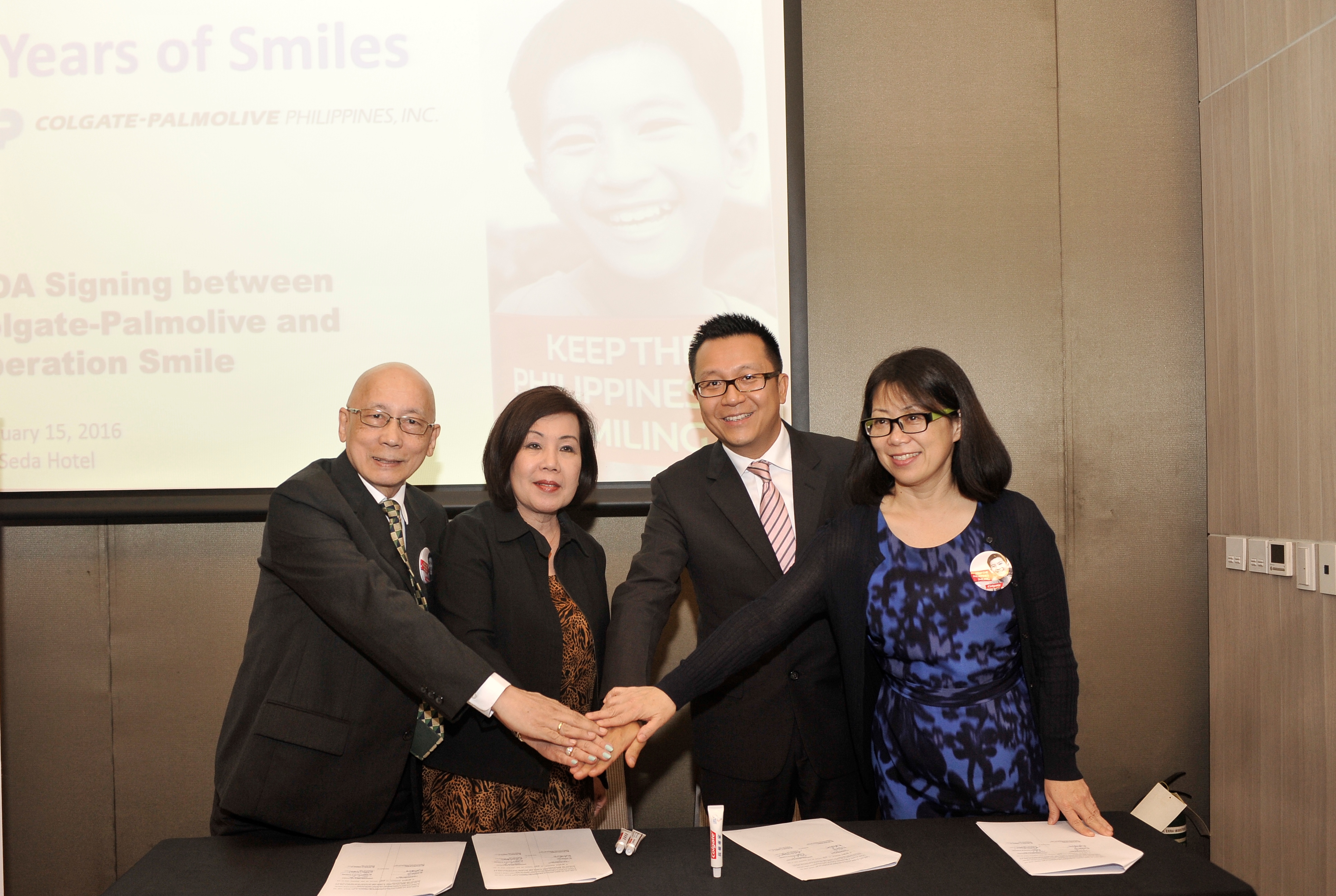
    To Kick-off the company’s 90th Year, a MOA was signed between Colgate-Palmolive Philippines and Operation Smile Philippines to bring brighter smiles to children with oral cleft. In the picture (L-R): Bobby Manzano (Country Director of Development for Operation Smile Phils), Edith Villanueva (Chairman Board of Trustees, Operation Smile Phils), Stephen Lau (Vice-President/General Manager, Colgate-Palmolive Phils) and Jennifer Peng (Finance Director, Colgate-Palmolive Phils)

    To Kick-off the company’s 90th Year, a MOA was signed between Colgate-Palmolive Philippines and Operation Smile Philippines to bring brighter smiles to children with oral cleft. In the picture (L-R): Bobby Manzano (Country Director of Development for Operation Smile Phils), Edith Villanueva (Chairman Board of Trustees, Operation Smile Phils), Stephen Lau (Vice-President/General Manager, Colgate-Palmolive Phils) and Jennifer Peng (Finance Director, Colgate-Palmolive Phils)

    “This collaboration with Operation Smile is only one of several activities that Colgate-Palmolive Philippines will implement on its 90th year. We have allocated significant resources for this year-long campaign of giving back to the Filipinos. I am proud to see that the entire organization is extremely dedicated towards Keeping the Philippines Smiling more each day”, declares Stephen Lau.

  • Hong Kong’s Disneyland struggling to work its magic

    Hong Kong’s Disneyland struggling to work its magic

    As Walt Disney readies to open its first Disneyland resort in mainland China and its sixth in the world by June, its decade-old theme park in Hong Kong has tumbled back into a loss, portending challenges ahead amid the country’s slowing economic growth.

    Hong Kong Disneyland recorded a loss of HK$148 million (S$27 million) in the year ended October last year, its first loss in four years, after fewer Chinese tourists visited the city. The resort had suffered seven years of losses from its opening in 2005, before turning in its first profit in 2012.

    The former British colony has already seen retail sales slump as fewer mainland Chinese tourists visit, hurt by a combination of China’s slowdown and a weak yuan, relative to the Hong Kong dollar, that has dulled the city’s attractiveness.

    WHY HONG KONG

    It’s very easy for us to visit Shanghai. We will definitely go later… There are more things to do in Hong Kong, as well as other famous attractions like Victoria Peak.

    MS LU MEI-YIN, 45, a graphic designer from the northern coastal city of Qingdao in China, who visited Hong Kong Disneyland earlier this year.

    WHY NOT HONG KONG

    Who will go to Hong Kong Disneyland when we have one at our door? Even if we want to visit a foreign Disney park, I will go to Tokyo, which many of my friends have recommended.

    MS HUANG SHILIN, a 33-year-old mother of two children from Hangzhou, in Zhejiang province.

    • MIXED FORTUNES FOR ASIA’S DISNEYLANDS

    • Hong Kong Disneyland

      Opened: Sept 12, 2005

      Visitor numbers: 6.8 million last year, down 9.3 per cent from the year before

      Ticket prices: General adult entry fee is HK$539 (S$98); the park is planning to give discounts

      Size: 126ha

    • Shanghai Disneyland

      Opening: June 16, 2016

      Visitor numbers: 15 million people expected in the first year; projected yearly visitor numbers of 25 million to 30 million

      Ticket prices: Peak period adult ticket costs HK$590 per day; HK$438 at other times

      Size: 400ha

    • Tokyo Disneyland

      Opened: April 15, 1983

      Visitor numbers: Traffic for the entire fiscal year expected to fall 3 per cent to 30.4 million for the fiscal year through next month. Attendance in 2013 and 2014 was up sharply, due to factors such as the park’s 30th anniversary and the launch of large attractions

      Ticket prices: Starting from April 1 this year, adults will pay 7,400 yen (S$91) for a single-day ticket, a 500-yen increase

      Size: 200ha

    Revenue at the Hong Kong resort fell 6.4 per cent to HK$5.1 billion, while annual attendance slipped 9.3 per cent to 6.8 million, it said.

    With Disney’s Shanghai park set to open on June 16, more Chinese could be lured away. Mainland Chinese customers helped boost Hong Kong Disneyland to a record profit of HK$322 million in fiscal year 2014.

    Last year, they formed the biggest group of visitors to Hong Kong Disneyland, accounting for 41 per cent, followed by Hong Kong residents at 39 per cent, and international visitors at 20 per cent, the resort said in a statement on Monday.

    It will be contending with a sister resort in Shanghai that is three times larger in size, and with similar ticket prices.

    Adult tickets at Shanghai Disneyland will be more expensive than at its counterpart in Hong Kong during peak times, such as at weekends and on holidays, but cheaper during other periods.

    Recruitment and staff training are now under way at the Shanghai theme park, the South China Morning Post (SCMP) reported.

    “The next two years will be very challenging,” Hong Kong Disneyland managing director Andrew Kam told reporters on Monday.

    In anticipation of the stiff competition, Hong Kong Disneyland will offer discounted entrance fees and hotel room rates, he said.

    A one-day ticket, for example, would cost about 400 yuan (S$86) and include lunch, while hotel room rates would be discounted by up to 30 per cent, SCMP reported.

    A 750-room hotel is due to open next year.

    Mr Kam said new attractions this year include a revamp of the Space Mountain roller coaster, with elements from the Star Wars movies, and a themed area based on Marvel’s Iron Man franchise.

    “Our asset is really differentiation,” he was quoted as saying by Nikkei Asian Review. “We will focus on serving customers around the region.”

    Falling numbers from China have encouraged the theme park to look harder at South-east Asian markets, including countries like Indonesia, the Philippines and Thailand.

    Hong Kong Commerce and Economic Development Secretary Greg So said the Shanghai park highlights more Chinese characteristics, while Hong Kong is an “international playground”.

    Hong Kong’s other big tourist attraction, Ocean Park, is also feeling the heat, with profits down 53 per cent at HK$45.2 million for the fiscal year that ended last June. It has announced plans to seek new markets in Asia and boost its retail and food sectors, SCMP reported.

    In an editorial published on Wednesday, the Hong Kong English-language newspaper said mainland tourists are increasingly spoilt for choice amid a proliferation of theme parks in the region. It called on Hong Kongers to change their attitude towards mainland Chinese visitors.

    “There is another cloud in Disneyland’s outlook that only Hong Kong people themselves can disperse – anti-mainlander sentiment, which has a negative impact on Hong Kong’s image as a safe, welcoming city.

    “Sadly, it is compounded by violent incidents such as the Mongkok riot,” SCMP said.

  • Chinese influx lifts Jeju’s growth

    Chinese influx lifts Jeju’s growth

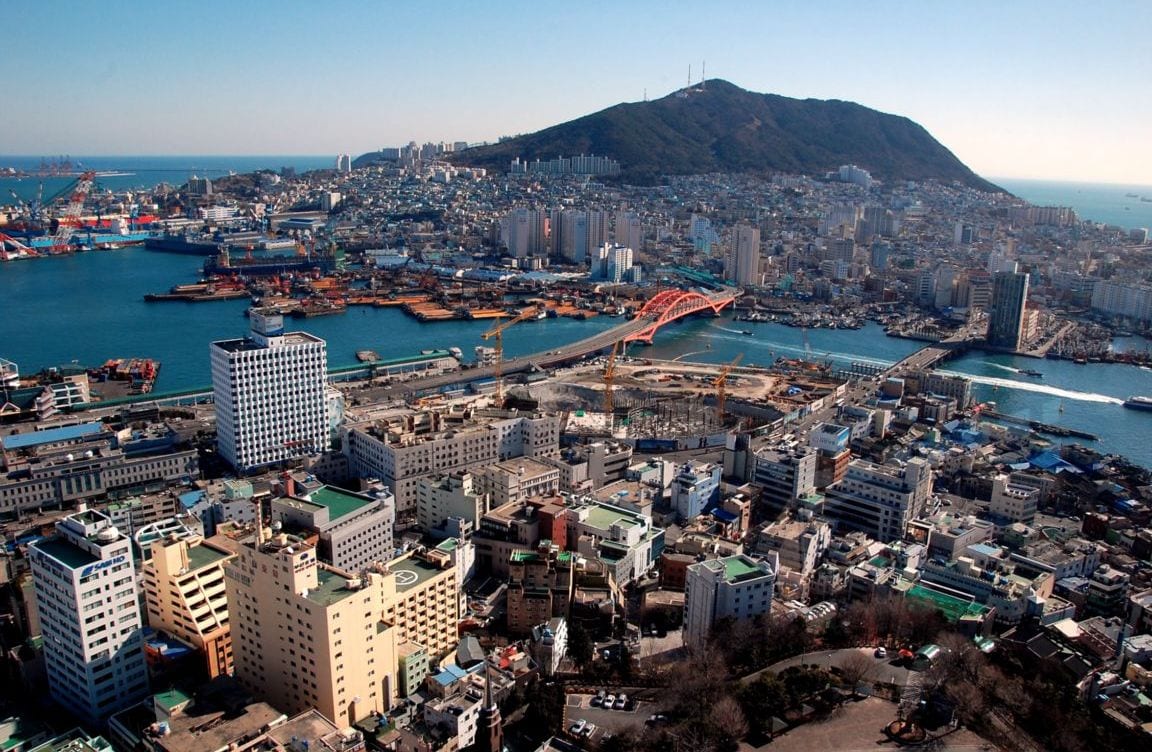
    The southern resort island of Jeju showed the highest rate of growth in productivity in the service sector and retail sales last year.

    Jeju’s service sector productivity rose 6.7 percent in the fourth quarter of 2015 compared to the same quarter the previous year, according to a Statistics Korea report released Thursday. The growth rate is two times higher than the national average rate of 3.1 percent and nearly three times more than Seoul’s 2.3 percent.

    Statistics Korea said productivity growth rates were high in areas such as Jeju, South Chungcheong and Gangwon, as more financial and social welfare businesses moved in to the areas. Gyeonggi and Seoul also saw increases of around 2 percent, but their rates were relatively small as the number of related businesses decreased last year.

    The nation’s retail sales also rose in the fourth quarter of 2015 from the same quarter of the previous year.

    Retail sales increased most in Jeju at 10.8 percent, which is nearly two times higher than the national average of 5.7 percent, while Gyeonggi and South Chungcheong each scored 6.7 percent to tie in second place. In these places, sales at large discount stores and car dealers rose significantly, according to Statistics Korea.

    Sales in large discount stores accounted for 20.8 percent of total retail sales in the fourth quarter of 2015 in Jeju.

    Industry experts believe Jeju is over-performing in both productivity and sales growth rates as more Chinese tourists are visiting the island.

    For example, real estate and leasing services accounted for 25 percent of total productivity growth in Jeju. Currently, many Chinese are interested in investing in the island’s real estate. Jeju, the warmest place in Korea, was also able to attract more local and foreign tourists in the fourth quarter.

    Additionally, the popular trend of urbanites heading back to suburban areas like Jeju has also helped bolster the island’s economy. Net migration, the difference between immigrants and emigrants, reached 14,257 last year. In 2014, it was at around 11,112.

    In all 16 major cities and provinces, both service sector productivity and retail sales increased in the fourth quarter of 2015.

    Meanwhile, the service sector productivity growth rate nationwide last year is expected to reach 2.9 percent from the previous year. In 2014, the growth rate was 2.2 percent. The nation’s retail sales growth rate is projected at 3.4 percent, double the 1.7 percent in 2014.

  • Ikea breaks ground for Bang Yai outlet

    Ikea breaks ground for Bang Yai outlet

    “We are creating the world’s best integration of a Ikea store into a shopping centre,” said Sebastian Hylving, expansion director for Ikano Private Ltd, holder of the Ikea franchise rights in Singapore, Malaysia and Thailand.

    The branch will offer wide-open entrances at all levels of the CentralPlaza WestGate shopping centre and a direct link to the future mass-transit line.In a highly complex design, the showroom and a market hall are housed inside an expansive two-storey concourse that creates a bridge to the WestGate mall.

    The Ikea self-service warehouse will be on the ground floor.

    “This is not going to be the usual blue box,” said Lacia Sherlock, Ikea retail project leader for Ikano.

    “This will be the only Ikea store that offers customers an opportunity to enter and check out at every level. We will deliver a fantastic customer experience.”

    Mike King, the Ikea retail director for Ikano, is confident that many of the 1.6 million people who live in Bang Yai and the surrounding area – including a growing population of young families – will make the trip to the new store when it opens at the end of next year.

    “There may be a lot of competition in the home furnishing business here in Thailand, but no other retailer offers the whole family a great day out in the way Ikea does,” he said.

    The Bang Yai Ikea store is an integral part of the overall expansion plan for Ikano. In November, the company opened a second store in Kuala Lumpur and a pick-up and order point in Phuket.

    The Bang Yai project marks Ikano’s first collaboration with Central Pattana, developer of the shopping centre.

  • SATO empowers Singapore fashion retailer

    SATO empowers Singapore fashion retailer

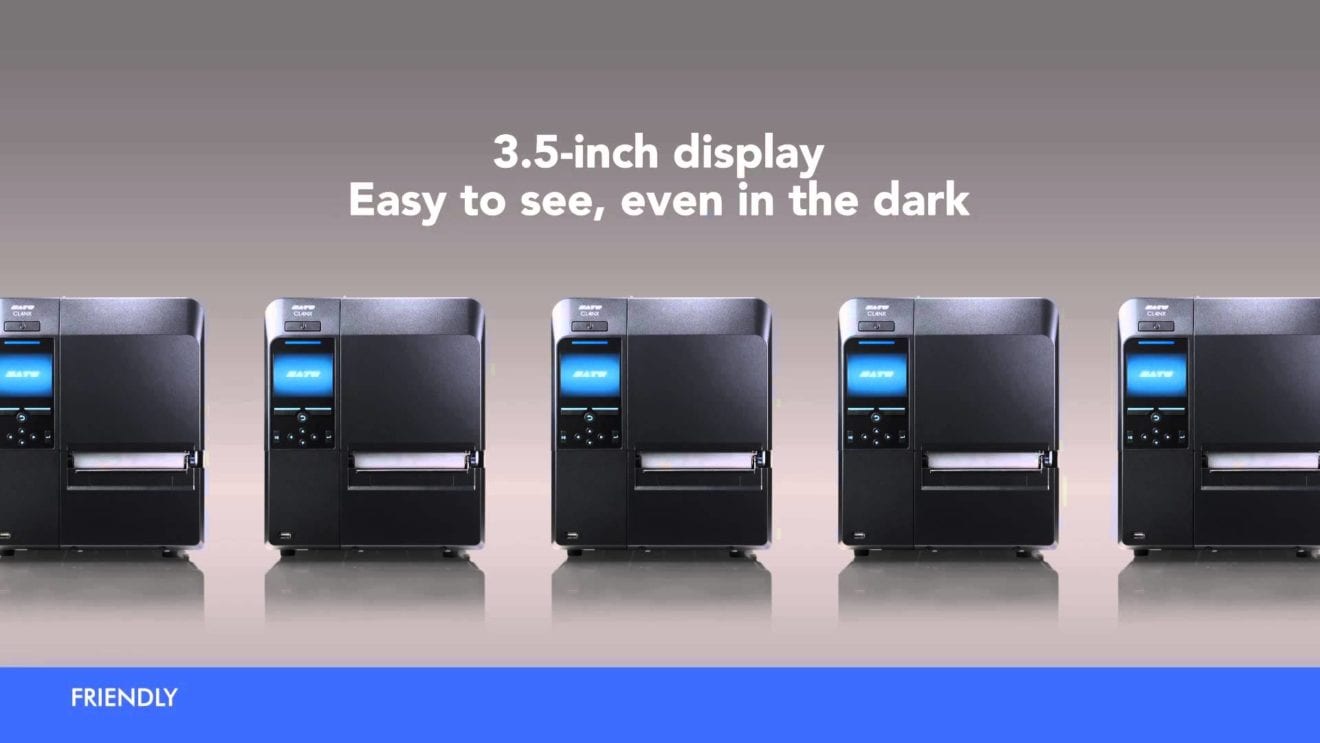
    SATO has supported the implementation of an RFID inventory and stock-taking system for Decks.

    The Singapore-based fashion retailer and apparel supplier has achieved greater efficiency and accuracy with Auto-ID solutions from SATO.

    Decks was previously spending up to 600 worker-hours for its annual stock-taking with 88% accuracy.

    It has now adopted RFID inventory system from SATO involving tagging apparel with RFID labels, and scanning incoming as well as outgoing items through an RFID enclosure.

    This has simplified stock-taking as it is done with a simple sweep of a mobile RFID scanner.

    “Today’s visit to Decks retail shop is an eye-opener for me,” said Singapore Minister for Manpower Lim Swee Say. “They have improved business outcomes for their company to create better jobs for Singaporeans and made their careers more meaningful.”

    The Retail Sectoral Manpower Plan (SMP) builds a future-ready retail workforce with the skills required to support the sector’s transformation.

    Retail SMP was developed by SPRING Singapore and the Singapore Workforce Development Agency (WDA) in consultation with industry stakeholders and unions.

    Decks was hailed as an example for the retail sector at the launch of the Retail Sectoral Manpower Plan (SMP) by Say.

    Looking forward, SATO will continue working with Decks through other retail solutions such as Anti-Theft and Self-Checkout and also help other players in this industry facing similar issues.

    “With the retail industry growing more competitive and the rise of e-commerce and m-commerce changing the way consumers shop, retailers have to act fast to keep up and stay ahead in the game,” said Kelvyn Chee, managing director of Decks Pte. Ltd. “Besides stock-taking advantages, the new RFID system SATO provided also helps us achieve greater inventory data accuracy enabling us to ensure stock availability and customer satisfaction.”


  • Standard Chartered hires Capital One’s James Dolphin as retail CIO

    Standard Chartered hires Capital One’s James Dolphin as retail CIO

    Standard Chartered has hired James Dolphin from Capital One as chief information officer, retail banking, to help kickstart the bank’s digital transformation initiative.

    Dolphin’s appointment comes after the bank announced plans to cut 15,000 jobs and accelerate its retail transformation strategy after reporting an unexpected $139 million loss for the third quarter, 2015. The updated strategy entails an investment of more than $3 billion in strengthening its technology and compliance and risk functions and a stated objective to reach 30% of sales and 40% of payments online by 2018.Dolphin joins Standard Chartered from Capital One where he has been CIO for retail and direct banking since 2012. In this role, he was instrumental in instilling a software development culture as the platform for change in the company’s retail business.

    Based in Singapore, Dolphin will report directly to Group CIO, Dr Michael Gorriz, a former aerospace engineer who joined the bank from Daimler last year.

    Gorriz says: “James brings with him a strong reputation as a technology leader and innovator. He is highly experienced in leading large teams and driving an agile culture that is innovative and customer-centric.”

  • Challenger’s net profit in 2015 up 22%, plans to open new online store in April

    Challenger’s net profit in 2015 up 22%, plans to open new online store in April

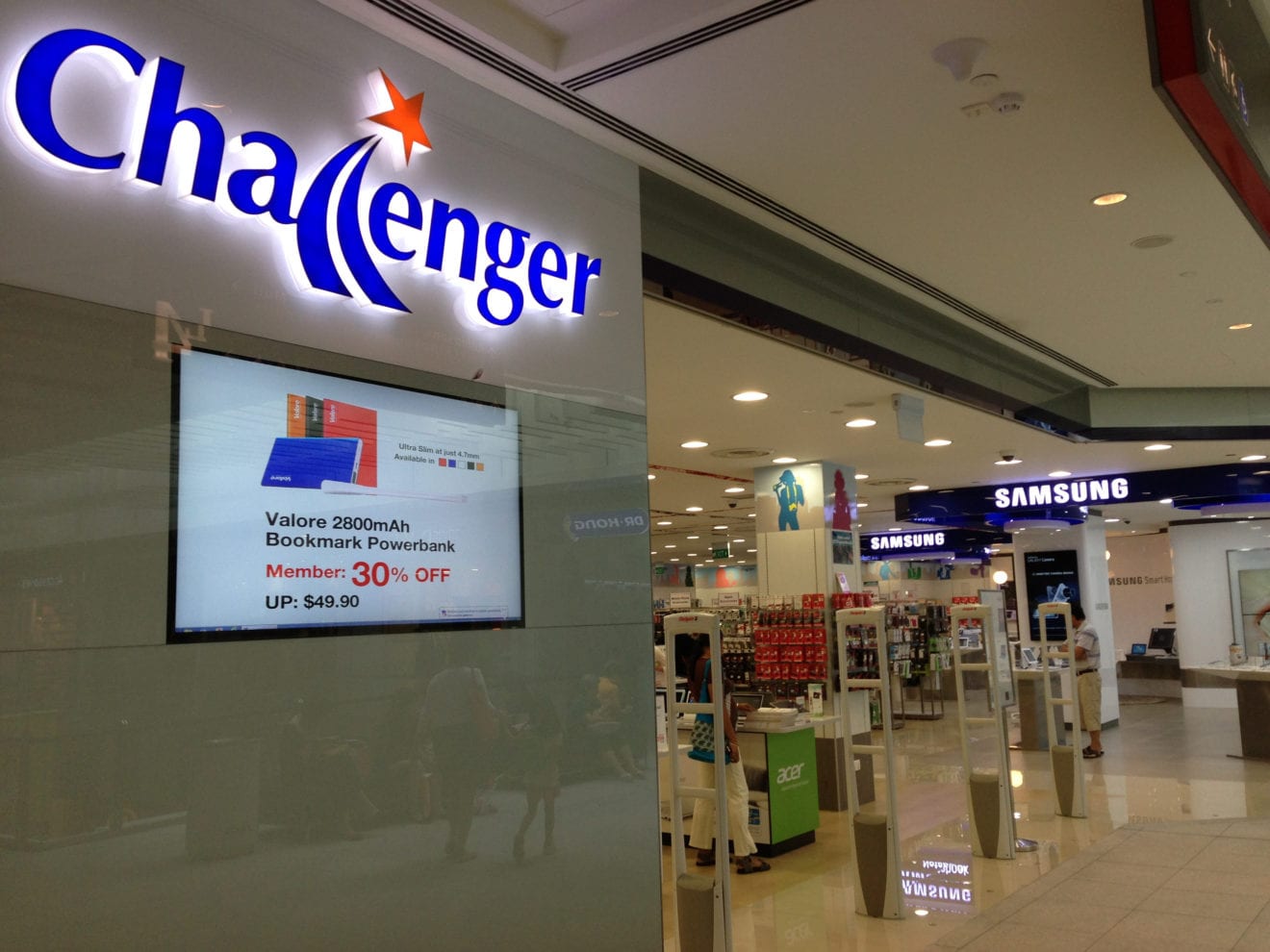
    IT products and services provider Challenger will establish a new online store to maintain its relevance in the retail market.

    Known as Hachi.sg, the portal, which will be unveiled in April 2016, will boast more products, an improved shopper interface and an online sales platform, Challenger said in a statement on Tuesday (Feb 16).

    Chief executive Mr Loo Leong Thye said: “Our strong network of offline stores will complement the online business so our customers can enjoy a true shop-anywhere, offline-to-online and vice versa experience.”

    On Tuesday, the SGX Mainboard-listed technology company also announced net earnings of $18.3 million in 2015, a 22 per cent increase from the $15 million profit recorded the year before.

    The IT retailer attributed the higher net profits to higher government grants received and lower operating expenses from the closure of its Malaysia retail operations.

    In the final quarter of 2015, net profit also increased by 50 per cent, $7.5 million more than the previous year.

    Meanwhile, earnings per share rose by 1.01 cents, from 4.28 cents in 2014 to 5.29 cents in 2015.

    However, it recorded a one per cent dip in revenue over the year from $355.1 million in 2014 to $352.2 million, due to lower contribution from retail revenue in Singapore.

    Looking at the year ahead, Mr Loo observed that 2016 will continue to be a challenging year for the retail industry.

    “Weak market sentiment from last year will spill over into 2016. Hence, retailers like us have to keep innovating to retain existing customers and attract new ones. On top of that, we will continue to focus on other hygiene factors like keeping operating costs low with better cost management and increasing productivity,” he said.

    Mr Loo added that Challenger is looking to build up to a stronger position by investing resources and manpower for the next three to five years towards its online business.

    Currently, Challenger has a total of 48 stores in Singapore. But it revealed last December that it would be closing its flagship megastore in Funan DigitaLife Mall, after it was announced that the mall will shut down this year for redevelopment.