Author: Mei Ling Tan

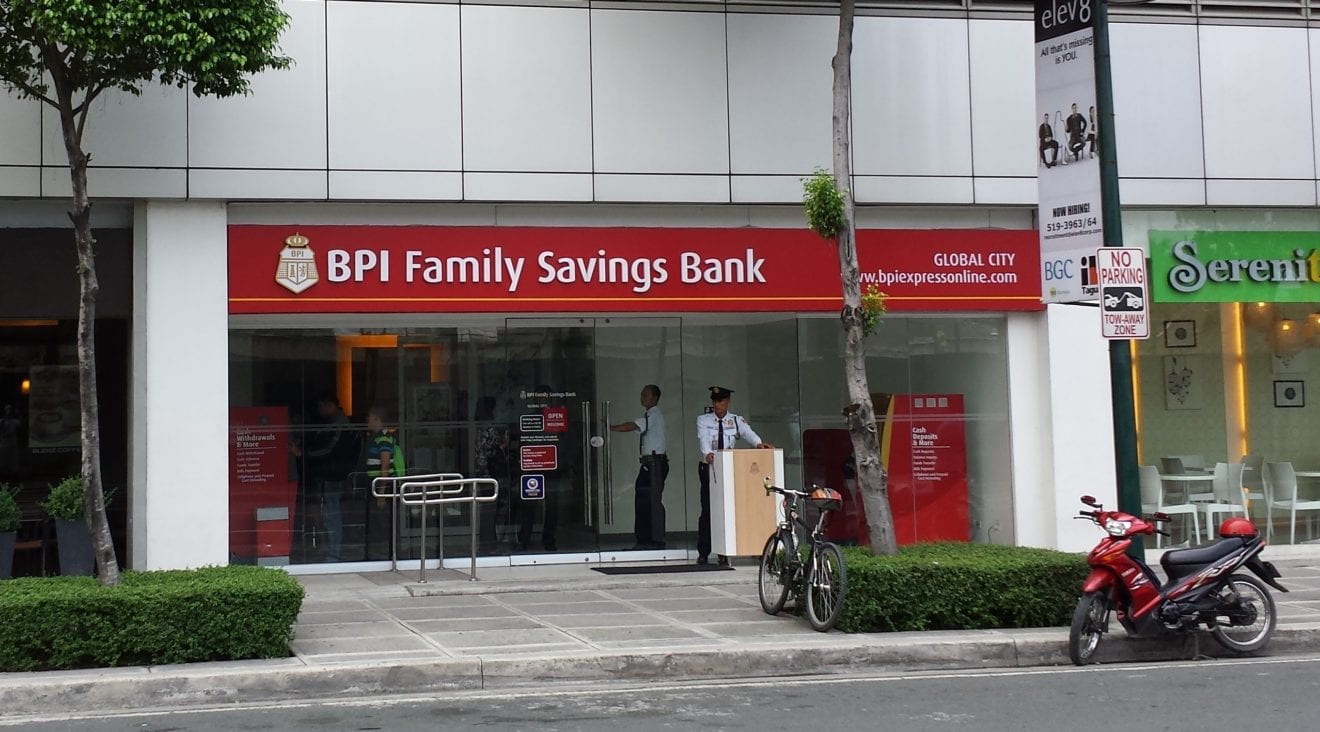
  • BPI books P13.8-b net profit

    BPI books P13.8-b net profit

    Bank of the Philippine Islands, the third-largest bank in the country, posted an 8-percent increase in net income in the first nine months to P13.84 billion from P12.8 billion year-on-year on the strength of its core businesses.

    Total revenues increased 9 percent or P3.67 billion to P44.1 billion year-on-year as both net interest income and non-interest income grew P2.98 billion and P0.68 billion, respectively.

    Operating expenses rose 6.7 percent to P22.89 billion on year, a slower rate than revenue growth. As a result, the bank’s cost-to-income ratio improved to 51.9 percent from 53.1 percent a year ago. Return on equity decreased to 12.6 percent, from last year’s 13.3 percent.

    Both total loans and total deposits rose in double digits year-on-year. Total loans stood at P780.07 billion, an increase of 11.2 percent on year. Corporate loans accounted for 76.6 percent while retail loans stood at 23.4 percent.

    “Gross 90-day non-performing loans rose slightly to 1.9 percent from 1.8 percent of total loans, while loan loss cover remained 107 percent. Total deposits stood at P1.18 trillion, up 13.3 percent higher year-on-year. CASA ratio ended the quarter at 72.5 percent,” the bank said.

    Total assets during the period stood at P1.41 trillion, 8.8 percent or P113.78 billion higher than that of the same period last year.

    Investment securities closed at P303.28 billion, a 15.2 percent hike year-on-year. The bank’s investment securities remained mostly held-to-maturity, at P240.87 billion.

    Capital, net of cash dividends of P3.54 billion paid to shareholders on Sept. 2, 2015, ended at P150.44 billion. This represents a 9.3-percent growth in total capital versus September last year.

    Capital adequacy ratio was at 14.9 percent from 15.7 percent a year ago. CET1 stood at 14.0 percent.

    Earlier in the year, the Asian Banker named BPI as the Best Retail Bank in the Philippines for 2015. BPI also received the Best Electronic Delivery Channel award during the inaugural Bank Marketing Awards night, organized by the Bank Marketing Association of the Philippines.

    The award recognizes the bank that successfully implemented the most innovative electronic delivery systems and achieved the desired results in terms of usage and acceptance.

    BPI, the first bank in the Philippines and in Southeast Asia, is a commercial bank with an expanded banking license. BPI’s services include consumer banking and lending, asset management, insurance, securities brokerage and distribution, foreign exchange, leasing, and corporate and investment banking.

  • DFS Group looks for new wine business leader

    DFS Group looks for new wine business leader

    Christian Pillsbury has left DFS Group where he headed up DFS Group’s international wine business in Hong Kong to join Coravin Inc., the maker of Coravin Wine Systems as Director of Sales, Asia Pacific with immediate effect.

    According to a statement by Coravin, Pillsbury oversaw operations across more than ten countries and 120 retail outlets at DFS Group and prior to that was the founder of Applied Wine, a first of its kind company devoted to helping restaurants make wine a core part of their business.

    Commenting on his new appointment, Pillsbury said: “Asia is becoming an exciting destination for wine and is seeing tremendous growth.

    “Coravin has transformed the way wine is sold, served, and enjoyed in both North America and Europe and I am honoured to introduce the brand to wine lovers all over Asia.

    When contacted to see if a replacement has been found, a DFS spokesperson told: “We’ll announce Christian’s replacement soon.”DFS has recently been been looking to fill a position for a new senior member to join its global wine team based in Hong Kong, to work across 11 countries and manage a team of experienced travel retail professionals.

  • John Lewis going Dutch with de Bijenkorf shop-in-shops

    John Lewis going Dutch with de Bijenkorf shop-in-shops

    UK department store chain John Lewis has announced its first physical foray into the European retail market, with seven stores planned for the Netherlands over the next two years.

    John Lewis has announced it will have a physical presence in Europe by opening shop-in-shops within seven branches of Dutch department store, de Bijenkorf. Starting with openings in Amsterdam, Rotterdam and The Hague flagships in spring 2016, the UK business will then enter Eindhoven and Utrecht by the end of next year, and in Amstelveen and Maastricht in 2017.

    Having sold and shipped its goods in Europe for a number of years, via its online operations, John Lewis’s new strategy is the first significant sign that it sees its next stage of growth coming from outside the UK.

    It comes after John Lewis opened 14 shop-in-shops across Singapore and the Philippines earlier this year, following the launch of a similar format in South Korea in 2014.

    Andy Street, managing director at John Lewis, called de Bijenkorf “the perfect partner to enable us to bring John Lewis to a new customer base and country”.

    “Our existing shop-in-shops in Singapore, the Philippines and South Korea have been well received and are trading well,” he added.

    “Whilst we remain committed to our UK physical expansion we hope to announce more international collaborations in 2016.”

    The John Lewis departments will be between 300 sq ft and 500 sq ft, with the retailer’s in-house store design team responsible for designing the look and feel of the retail space.

  • 40 per cent of online trade in China fake or substandard

    Chinese lawmakers have been urged to tighten controls on online trade after a report suggested counterfeit and low quality goods accounted for just over 40 per cent of sales.

    The report on the implementation of the latest iteration of the Law on the Protection of the Rights and Interests of Consumers also notes that China is now the biggest online marketplace in the world, overtaking the $300bn US market, and was valued at 2.8trn yuan ($442bn) last year.

    An article notes that complaints concerning online purchases rose 357 per cent to reach 77,800 last year, according to data from the General Administration of Quality Supervision, Inspection and Quarantine (AQSIQ).

    This has prompted calls for the Chinese government to bring in new legislation to govern e-commerce, particularly with regard to the rights of consumers and the responsibilities of retailers.

    The report (in Chinese) was presented at a plenary meeting of the National People’s Congress (NPC) Standing Committee, which was presided over by Chairman Zhang Dejiang.

    The revelations come as China’s online retail platforms, and particularly Alibaba, have come under intense scrutiny of late over counterfeit listings, and the measures taken by the sites to take them down.

    Earlier this year, the State Administration for Industry and Commerce (SAIC) accused Alibaba of being ‘lax’ in what it allows traders to sell on its online retail platforms, prompting a war of words between the company and Chinese government.

    Alibaba’s chief executive Daniel Zhang said during the company’s financial results conference last week that the company “remains committed to providing a trusted consumer experience with authentic products by driving merchants that peddle counterfeit products off our marketplaces.”

    .

  • Hong Kong tenders five new retail contracts

    Hong Kong tenders five new retail contracts

    Hong Kong International Airport is currently tendering three retail contracts in the merchandise areas of fashion accessories, audio visual/electronics and gifts/souvenirs and toys.

    The first consists of a fashion or fashion accessories shop opportunity comprising 50sq m on Level 5 Departures in the North Satellite Concourse restricted area, where bids close on December 3.

    Another tender process is for an audio visual/electronics concession consisting of five shops, with four located on Level 7 in the Departures Check-in Hall, Terminal 1 non-restricted area. These outlets vary from between 18 to 70sq m in size.

    Another outlet comprising 48sq m which falls under the same contract is also located on Level 5 Arrivals in the Pre-Immigration Hall, Terminal 1 restricted area. The date for submission for offers for this five-outlet contract is December 10, 2015.

    Tenders also close for a small 48sq m gifts/souvenir/toy concession at Hong Kong Airport tomorrow afternoon. This is located on Level 5 Departures in the North Satellite Concourse restricted area.

    The airport describes all of these opportunities as ‘extraordinary’ and in ‘premium locations’.

  • Canon Increases Investment in Singapore with New Office

    Canon Increases Investment in Singapore with New Office

    Canon, the global leader in photographic and digital imaging solutions, today announced the company’s official move to Galaxis, a Platinum Green Mark Building located in One North. Showcasing state-of-the-art facilities and powered by Canon office solutions, the new premise promises to be a one-stop destination for its customers’ imaging needs.

    Putting the customer at the centre of the new office, Canon has invested SGD$20million to build the Canon Delight Hub, an integrated customer engagement hub. This hub brings together all of Canon’s businesses – from consumer imaging to business solutions, creating a more centralised, holistic customer experience across Canon’s suite of solutions.

    These customer-centric investments in Singapore speak to Canon’s ambitions in South and Southeast Asia. Mr. Kensaku Konishi, President and CEO, Canon Singapore: “We continually seek to invest in this region to increase our capabilities and footprint in line with the tremendous growth we expect from the South and Southeast Asia region.”

    Housed in this facility is the enhanced Customer Care Centre, which provides customers access to try out the latest Canon consumer products as well as the same comprehensive customer service. To better meet the service and repair needs of customers, the new Customer Care Centre offers improved testing and interactive facilities, such as a 30m darkroom, one of the longest darkrooms for lens testing in the region.

    As a keen advocate of photography, Canon established the Canon Imaging Academy to help and teach Canon users to do more with their digital cameras. The new Canon Imaging Academy today offers wider training facilities, including a studio catered to the training needs of both budding and professional photographers.

    For the first time ever, Canon’s wide range of solutions is housed in a single location. For example, the Production Printing Excellence Centre and the Business Excellence Centre showcases Canon’s suite of innovative solutions aimed at improving enterprise productivity, efficiency and security. Potential corporate customers will be able to experience first-hand the comprehensive range of products ranging from large format printers (imagePROGRAF), digital production printers (Oce VarioPrint), digital multi-functional devices (imageRUNNER), production inkjet printer (DreamLabo 5000) and surveillance cameras.

    Canon’s move to the Galaxis, a Platinum Green Mark Building, marks a new milestone as the company continues to grow alongside Singapore. With this new office also functioning as a showcase for the modern office and a proof of concept lab, Canon will continue achieving sustainable growth and engaging with the community across the region.

    Since it was founded in 1979, Canon Singapore has continued to delight Singaporeans with its products and attention to customer service. In line with its kyosei corporate philosophy of living and working together for the common good, Canon is also an active contributor to the local community, supporting diverse arts, environment and sports programmes.

  • L’Oreal sales soar 13.2% to $20.4bn in first 9 months

    L’Oreal sales soar 13.2% to $20.4bn in first 9 months

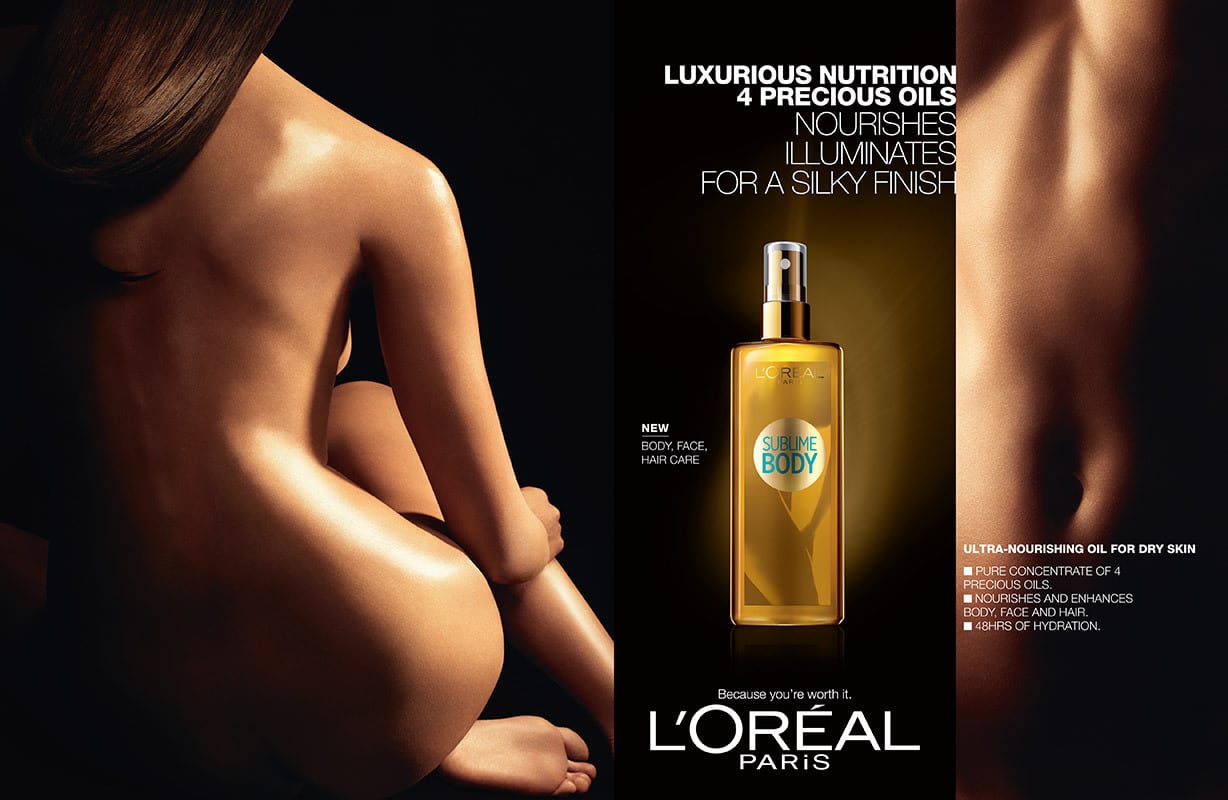
    L’Oréal has released its nine-months sales results pointing to strengthened growth in the North American Consumer Products Division; maintained growth in Western Europe; a temporary third quarter slowdown for L’Oréal Luxe in Asia; strong e-commerce sales (projected at +€1bn in 2015); a slowdown in travel retail; and ‘significant’ sales and profit growth.

    Commenting on the figures – including the top line €18.76bn ($20.4bn) in total 9-month sales – Jean-Paul Agon, Chairman and CEO of L’Oréal, said: “At the end of September, the Group’s reported growth is strong, at +13.2%, still supported by a very positive currency effect.

    “In the third quarter, the Consumer Products Division is confirming the gradual strengthening of its growth, notably through strong momentum in make-up with its three brands: Maybelline, L’Oréal Paris and NYX. The Active Cosmetics Division continues to forge ahead and the Professional Products Division keeps outperforming a lacklustre market.

    “L’Oréal Luxe experienced a temporary slowdown as a result of market turbulence over the summer in Asia, in Hong Kong and in Travel Retail. By geographic zone, North America’s growth is gradually increasing and Western Europe confirms its positive trend. In the third quarter, the New Markets have been hampered by the difficult Brazilian market, market turbulence in Asia and the taking over of agents’ contracts in the Middle East. In China, sales growth is in line with earlier quarters.”

    Loreal 9m sales 2015

    Agon, added that ‘despite a global context that is still volatile’ the company remains confident for the year as a whole. He said: “The beauty market remains dynamic. In each Division, our brands are pushing forward with successes such as Maybelline and NYX in the Consumer Products Division, Yves Saint Laurent, Kiehl’s and Urban Decay at L’Oréal Luxe, Redken in the Professional Products Division and La Roche-Posay at Active Cosmetics.

    “Finally, the acceleration of our digital transformation is making us stronger, in particular with the rapid increase (+40%) of our e-commerce sales which should significantly exceed one billion euros this year. We are confirming our ambition to outperform once again the beauty market in 2015 and to achieve significant growth in both sales and profits.”

    Looking at the first nine-months sales to September 30, the company said that on a like-for-like basis and based on a comparable structure and identical exchange rates, sales growth of the L’Oréal group would have been +3.7%. It adds that the net impact of changes in scope of consolidation was +1.2%, while growth at constant exchange rates registered +4.9%.

    The company said that currency fluctuations actually had a positive impact of +8.3% and if September-end exchange rates (€1 at $1.12) are extrapolated up to December 31, then the impact of currency fluctuations would be +6.7% for the whole of 2015.
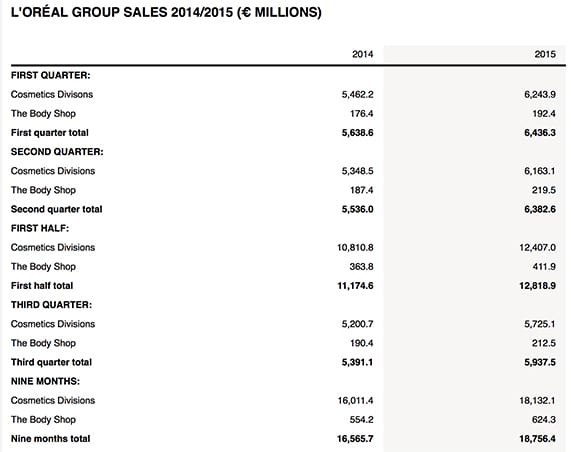
    L'Oreal 2014 2015 sales

    Turning to the product divisions, L’Oréal said that at the end of September, the Professional Products Division posted growth of +3.2% like-for-like and +13.4% based on reported figures.

    The company said: “Hair care is the largest contributor to growth, powerfully driven by the latest innovations, such as Thérapiste by Kérastase, Pro Fiber by L’Oréal Professionnel, and Frizz Dismiss by Redken. The dynamic trend in hair colour is continuing across all brands.

    “Professional skincare with Carita is expanding rapidly in Western Europe. All the geographic Zones are growing. Eastern Europe is accelerating, while Brazil is slowing the growth rate in Latin America.”

    L’Oréal Consumer Division

    As for the Consumer Products division, the beauty giant recorded a rise of +2.3% like-for-like and +11.2% based on reported figures. The company commented that gradual improvement growth trend continues and thanks to the new momentum of Maybelline, the strong expansion of NYX, and the success of L’Oréal Paris, this division is strengthening its leadership in the make-up market.

    L’Oréal also notes that hair care is winning market share, thanks notably to L’Oréal Paris. For Garnier, the Ultimate Blends’ successful launch process has continued in many European countries. At the same time, the division is outperforming the markets in Eastern Europe, Asia, Pacific, Africa and the Middle East, while the ‘strong make-up dynamic’ is said to be accelerating the division’s growth in the US, while e-commerce is growing fast across all Zones.

    Meanwhile, L’Oréal Luxe posted growth of +5.8% like-for-like and +17.9% based on reported figures. Within the more detailed picture, Yves Saint Laurent grew strongly, driven by make-up, men’s fragrances with L’Homme and women’s fragrances with Black Opium. L’Oréal added that Giorgio Armani remained dynamic across all geographic Zones.

    The company added: “Urban Decay is accelerating worldwide with the high-profile launch of the Naked Smoky palette and is building a global beauty offering with initiatives in foundations and lipstick. Kiehl’s is launching Daily Reviving Oil Concentrate and continuing its double-digit growth.

    “Growth at Lancôme is being driven by market share gains in Europe, the success of the fragrances La vie est belle, Miracle and the newly released La Nuit Trésor; Grandiôse and Hypnôse Volume à Porter mascaras; and the acceleration of its Génifique facial skincare.”

    L’Oréal adds that despite a market that slowed in the third quarter in Asia and in Travel Retail, L’Oréal Luxe has strengthened its worldwide position with significant gains in Western Europe, in Asia, Pacific, in the Middle East and in Latin America.

    Active Cosmetics division

    The company’s Active Cosmetics division also improved its performance further with strong growth of +7.3% like-for-like and +9.7% based on reported figures. L’Oréal reported that Vichy is innovating with Neovadiol Substitutive Complex Serum, a formula that acts on skin changes linked to menopause.

    At the same time, Roche-Posay is renewing its expert franchise for oily skin with the launch of Effaclar K(+). The company adds that the brand is continuing to post double-digit growth in all geographic Zones, with ‘outstanding performances’ in France, Brazil and China. The successful international roll-out of SkinCeuticals is continuing.

    The beauty company also reported that all geographic zones continue to contribute to growth, with sales accelerating in the third quarter and new markets maintaining growth at more than 10%.

    Western Europe recorded growth of +2.1% like-for-like and +4.5% based on reported figures, with L’Oréal Luxe is continuing to act as a growth driver. Garnier is also said to be winning market share in hair care and skincare, while L’Oréal is continuing to outperform the market in Germany and the UK thanks to L’Oréal Luxe.

    In North America L’Oréal posted growth of +3.0% like-for-like and +25.4% based on reported figures. Both the Active Cosmetics and Professional Products Divisions drove growth and notably thanks to the La Roche-Posay and Redken brands.

    Kiehl’s and Urban Decay also contributed to the development of L’Oréal Luxe, while the Consumer Products Division also grew with good make-up contributions from L’Oréal Paris, Maybelline and above all NYX, which is described as ‘growing at a remarkable pace’. Meanwhile, the Body Shop recorded growth of +2.0% like-for-like and +12.6% based on reported figures.

    Commenting on other markets, the company reported a mixed picture, beginning with the Asia and Pacific territories: “At the end of September, L’Oréal posted growth of +4.4% like-for-like and +21.9% based on reported figures. Kiehl’s, Yves Saint Laurent and Giorgio Armani are contributing to the dynamism of L’Oréal Luxe, in a context of slower third-quarter growth in Hong Kong and Travel Retail Asia.

    “The Consumer Products Division is performing well in India, Australia and Thailand. In China, growth at L’Oréal Paris is accelerating, while Magic is undergoing a transitional period. The Active Cosmetics Division is growing strongly, thanks to the success of La Roche-Posay.”

    Tough Brazilian market

    By contrast, in Latin America sales grew by +5.5% like-for-like and by +4.7% based on reported figures. Excluding Brazil, sales achieved double-digit growth, thanks to L’Oréal Paris, Maybelline and Lancôme, although the company says that the Brazilian market is being held back by a very difficult economic environment and by the reform of the IPI (Tax on Industrialised Products).

    Looking at Eastern Europe, L’Oréal said that the zone posted figures of +9.5% like-for-like and -4.1% based on reported figures. The Consumer Products and Professional Products Divisions recorded double-digit growth, boosted by Russia, Turkey and Ukraine.

    As for Africa and the Middle East, sales growth amounted to +9.8% like-for-like and +28.1% based on reported figures. L’Oréal said: “The reorganisation of part of our distribution network in the Gulf States caused a temporary growth slowdown in the third quarter. The Group is strengthening its positions at a time when most markets in the Zone are seeing their growth rates decelerate.

    “Egypt and Saudi Arabia are still posting strong performances. L’Oréal Paris and Garnier are gaining market share. Yves Saint Laurent, Giorgio Armani, Kérastase and La Roche-Posay are also recording solid growth rates.”

  • Government to privatize Merpati airline company

    Government to privatize Merpati airline company

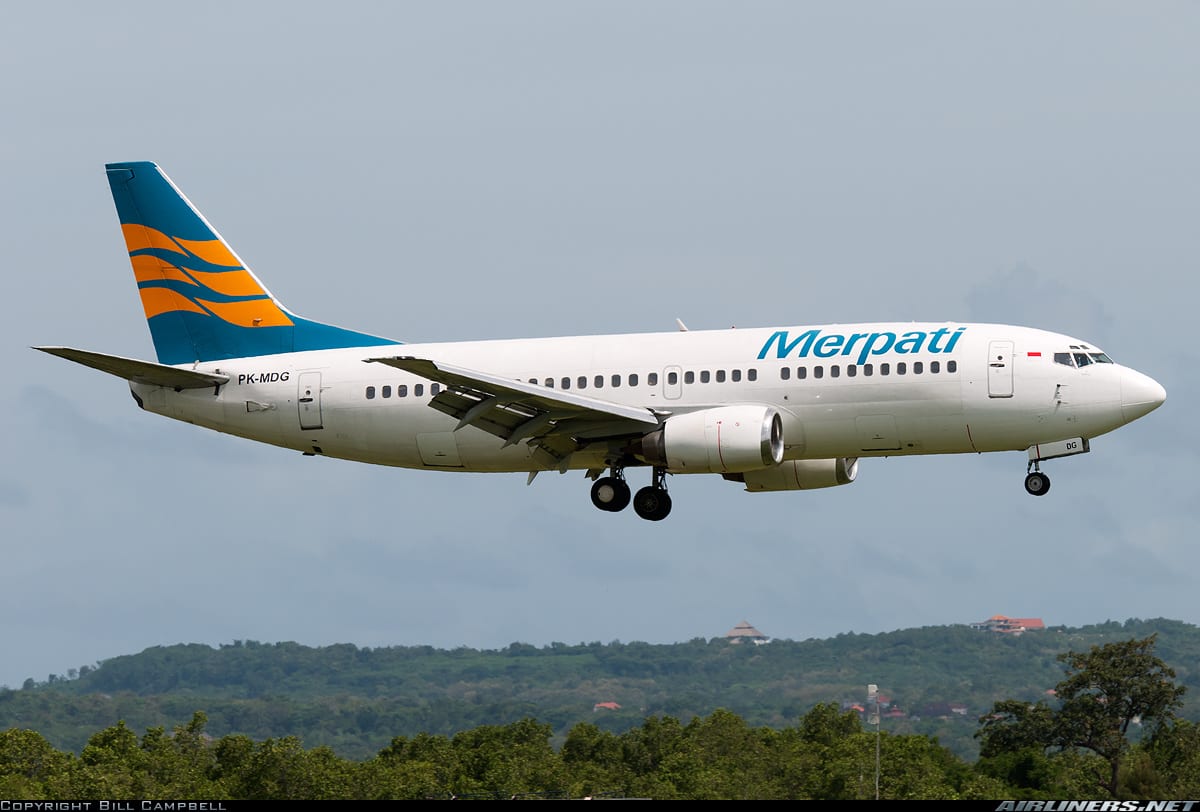
    The Indonesian government will privatize PT Merpati Nusantara Airlines by inviting investors to resolve the disputes in the company, deputy state enterprises minister Aloysius K.Ro said here on Tuesday.

    “By undertaking this privatization effort, one hopes Merpati is revived again and finds it possible to settle the fate of its employees,” he said at his office.

    He said the investors being invited could come from within the country or abroad and it is hoped that they will be ready in the first quarter of 2016 to resolve the issue, adding, “The investors (who we are looking at) are new players who have never participated in the privatization process (earlier).”

    “Investors who will come will be those ready to run it. They see the brand name Merpati. We are the majority share holder. It is alright. The important thing is to revive Merpati,” he said.

    Initially, Merpati will receive Rp500 billion in capital from the Asset Management Company (PPA) for right sizing, including settling the normative rights of its employees, an issue pending for long now.

    “We must negotiate. What is important is that the unpaid salaries are settled. As for the issue of severance pay, it will be discussed with the prospective investor,” he said.

    In line with the plan, all Merpati employees will be laid off and Merpati will appear as a totally new company with new employees.

    “All employees will be laid off and thus Merpati will be like a new born baby. They, however, will have the right to seek re-employment if the company is already in good health,” he said.(*)

  • Philippines’ Metro Retail IPO priced below guidance

    Philippines’ Metro Retail IPO priced below guidance

    Philippine supermarket and department store chain Metro Retail Stores Group Inc said its initial public offering (IPO) was priced at a steep discount of 35 percent due to market volatility, cutting the expected proceeds from its listing to $86 million.

    The offer price was set at 3.99 pesos each, down by a third from the guidance of 6.10 pesos, said Reginaldo Cariaso, chief operating officer of underwriter BPI Capital Corp.

    Metro Retail is now expected to raise 4 billion pesos ($85.58 million) through the sale of 1 billion shares, including the over-allotment option of up to 92 million shares, to fund its store expansion programme. The company would have raised 6.17 billion pesos as per earlier guidance.

    Only two firms have debuted on the Philippine Stock Exchange this year, raising a total of 1.77 billion pesos ($37.87 million) as markets reel from volatility and investors seek clarity on the next move by the U.S. Federal Reserve.

    “We had strong interest from domestic and international investors but given that markets are very volatile, there was price sensitivity,” Cariaso said.

    Metro Retail’s price-to-earnings (PE) ratio of 15 times was more attractive than its peers, Cariaso said.

    Retail chains Puregold Price Club Inc and Robinsons Retail Holdings Inc traded at more than 20 times PE multiples on Wednesday.

    Listing is scheduled for Nov. 24. BPI Capital and Deutsche Bank are the joint global coordinators and lead underwriters of the IPO. ($1 = 46.7400 Philippine pesos)


  • Tech innovations for retail industry on show at A*Star event at Biopolis

    Tech innovations for retail industry on show at A*Star event at Biopolis

    More than 60 ICT-based solutions for the retail industry are on show at the Media Exploits event at Biopolis on Wednesday and Thursday (Nov 4 and 5).

    Now in its fifth year, the annual event is organised by Exploit Technologies (ETPL), the commercialisation arm of the Agency for Science, Technology and Research (A*Star). While targeted at industry professionals, the event at the Matrix Building is also open to the public from 9am to 5.30pm.

    The innovations on show include an augmented reality application, developed by A*Star researchers, that allows consumers to visualise how a piece of furniture would look in their homes.

    There is also a web application that enables customers to try on different hairstyles at hair salons. This was developed by local start-up Gamurai, based on 3D-modelling technology licensed from A*Star.

    Other projects in various stages of development also propose solutions in the areas of healthcare, robotics, home care and interactive digital media.

    Mr Philip Lim, chief executive officer of ETPL, said a major objective of the event was to bring people from different communities together, particularly those who understand markets and consumer demand.

    He said: “You need to bring teams of people and talent forward to where the technology has been groomed, maybe even to the point where they can influence the technology.

    “They can tell the researchers – why are you doing this? Isn’t this a better way of doing things, because this is what people need out there.”


  • Hana Tour to Reinvent Itself as Global Cultural Tourism Retail Company

    Hana Tour to Reinvent Itself as Global Cultural Tourism Retail Company

    Established in 1993, Hana Tour is the largest travel company in Korea. In the last couple of years, on average, the company has recorded approximately 380 billion won (US$335 million) in sales and 40 billion won (US$35 million) in profits annually. Recently, the company has received a lot of publicity thanks to its successful bid for duty-free businesses in Incheon International airport and in downtown Seoul. The duty-free business is known as a cash cow, and annually generates approximately 300 billion won (US$264.9 million) in sales and 12 billion won (US$10.6 million) in profits. It is likely that Hana Tour will see significant synergy effects from combining tourism and the duty-free businesses, which will also impact the company’s overall business performance.

    It turns out that the company has set itself up for global tourism and cultural enterprises for some time. Following the goal of becoming the number one multinational cultural tourism group by 2020, the company has branched out into the retail, hotel, culture and performance enterprises. In the process, it has also secured significant overseas opportunities.

    Along with launching into the duty-free business, Hana Tour has been expanding into a variety of businesses that create synergy effects combined with the existing tourism business. Locally, drawing on culture and performance businesses, Hana Tour offers accommodation packages featuring art and performance events. Moreover, in cooperation with 8,000 local travel agencies and logistics channels, Hana Tour has also launched into e-commerce featuring ticketing businesses for art and performance enterprises. Titled “Hana Free Ticket,” the company’s retail site handles ticketing for musicals, concerts, and cultural events. Also by getting into the hotel business, Hana Tour can provide  travel packages with competitive prices, as the company can cut down accommodation costs. Beginning in 2012, Hana Tour opened the Center Mark Hotel in Insa-dong, followed by the T Mark Hotel in Chungmu-ro in 2013. A 560 room hotel is scheduled to be opened in the Namdaemun area in 2016. It also opened T Mark City Sapporo in Sapporo. With management expertise under its belt, Hana Tour has been commissioned to run the Pattaya Hotel in Thailand since last April.

    Hana Tour has started focusing on foreign opportunities and selling travel packages to foreign travelers in overseas markets. Hana Tour currently has 33 outpost offices worldwide. Using its overseas network, outpost offices in foreign countries developed travel packages in third countries, targeting local travelers in the foreign country. This is quite an innovation internally, given that in the past, 90 percent of the company’s travel business has been done with local outbound travelers.

    Given this, the Korean government’s recent decision to delegate the Chinese visa handling task to Hana Tour is a big overseas business breakthrough. In March this year, in the face of an increasing amount of Chinese tourists and laborers seeking Korean visas and handling the overwhelming administrative work, the government decided to delegate the task to Hana Tour. Although the delegation is currently in trials limited to the Guangzhou and Qingdao areas and the final decision to extend to other Chinese cities has not been made, many consider that the opportunity would bring many Chinese travelers to use Hana Tour travel products and Hana Tour–run Duty Free Stores in Korea.

    Although a majority of industry insiders consider a company’s venture into the duty-free business a terrific opportunity for the company, some raise concerns.

    The Hana Tour-led consortium SM Duty Free is formed by 10 small and medium enterprises, while Hana Tour represents a 76.8 percent stake. The SM Duty Free store has to stock 50 percent of its stores’ shelves with products produced by local SMEs.

    Although this feature is viewed positively by society, provided this gives SMEs a critical marketing venue, however, many questions whether focusing on SMEs’ products will give SM Duty Free competitive edges compared to its competitors in the duty-free business. Access to high-end products with relatively lower prices is a traditional appeal of duty-free stores for many consumers. Also, the fact that the combined shares of the company’s largest shareholders are mere 17 percent means that in the future, the company can’t make big investments into large-scale projects.

    Nevertheless, positive views about the future of Hana Tour dominate these days. Following the opening of the SM duty-free shops in Incheon Airport in November, Hana Tour will open a duty-free shop in Insa-dong in January next year. In fact, Hana Tour plans to turn its headquarters in Insa-dong into a duty-free store. Insa-dong SM Duty Free store will sell products featuring Korean Hallyu celebrities in partnership with SM Entertainment. An insider in the company said that shoppers will have unique cultural experiences apart from shopping. Hana Tour is also trying to make the best out of commercial and tourist trends in Insa-dong associated with big tourist attractions like Gyeongbokgung Palace.

  • Mazda CX-3 goes on sale in Thailand

    Mazda CX-3 goes on sale in Thailand

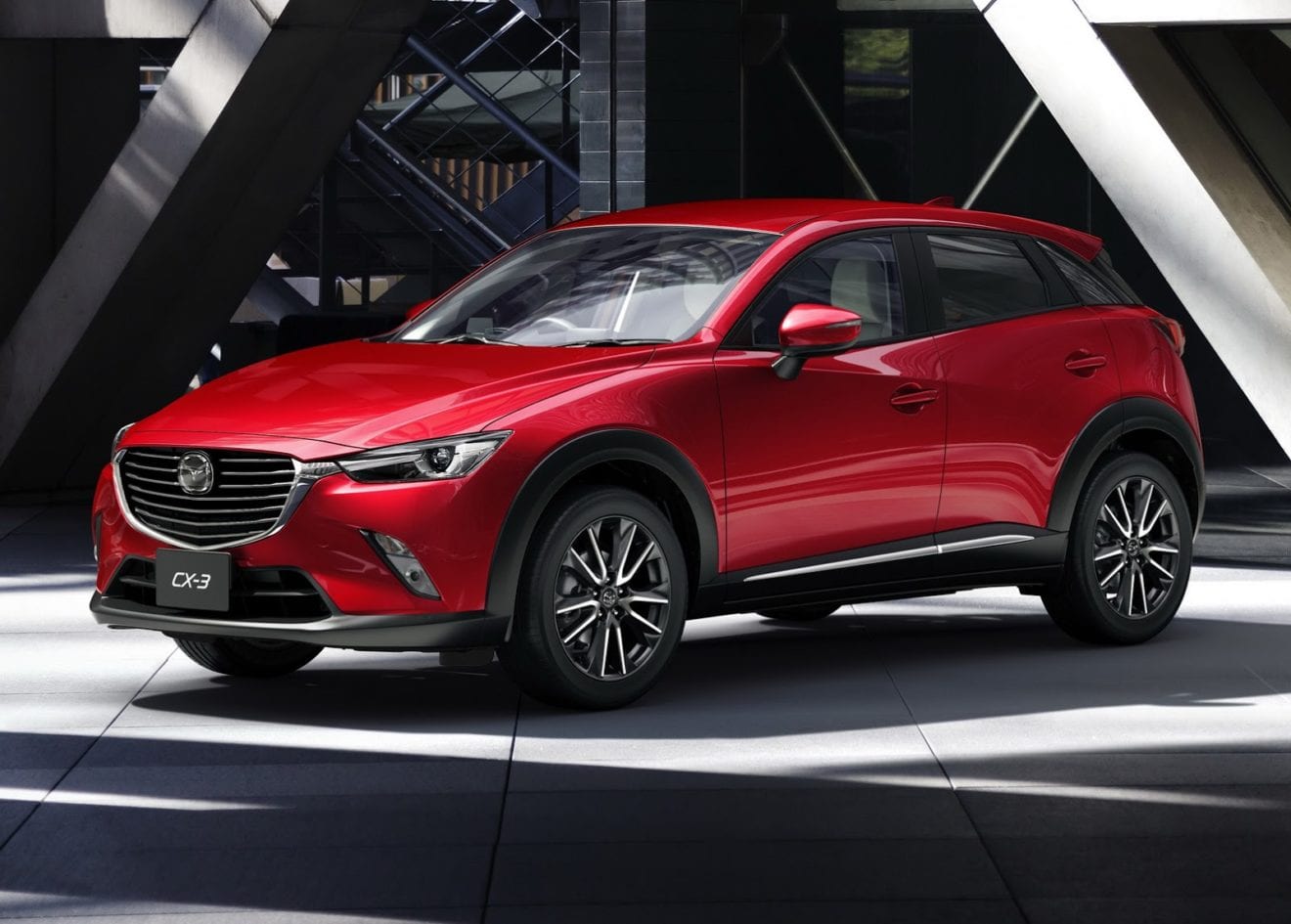
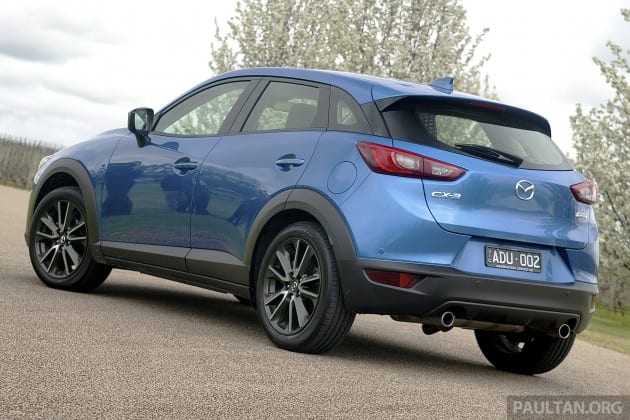
    The Mazda CX-3 has been launched in Thailand with prices kicking off at 835,000 baht – or at RM102k, give or take, with the current exchange rate. Taking into account our previous story, where the Malaysian-spec CX-3 is expected to retail from RM130k, that is still a considerable difference.

    Thai customers will be presented with a choice of five trims in total with two engine options – a 2.0 litre SkyActiv-G four-cylinder petrol engine and a turbocharged 1.5 litre SkyActiv-D four-cylinder diesel mill. The former puts out a total of 156 PS at 6,000 rpm and 204 Nm of torque at 2,800 rpm while the diesel unit manages 105 PS at 4,000 rpm and 270 Nm of torque from 1,600 to 2,500 rpm.

    A six-speed automatic transmission is the only gearbox choice offered on the Thai-spec Mazda CX-3 – an engine/gearbox combination that’s slated to be introduced for the Malaysian market, as well. As mentioned earlier, five trims are available – the base 2.0 E is priced at 835k baht while the 2.0 C and 2.0 S retail for 910k and 975k baht, respectively. The top petrol trim, the 2.0 SP, goes for 1.045 million baht.

    Mazda CX-3 4

    Sitting at the very top of the entire range is the aforementioned diesel model. Dubbed the 1.5 XDL, it goes for 1.155 million baht. As for standard equipment, the 2.0 E and C models are equipped with 16-inch wheels wrapped in 215/60 tyres while the rest of the range get 18-inch wheels shod with 215/50 rubber.

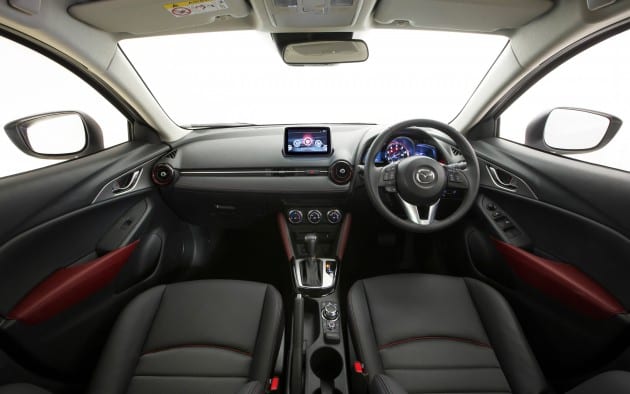
    The base 2.0 E and C are also equipped with halogen headlights while the 2.0 S, SP and 1.5 XDL get LED units with daytime running lights (DRLs). As for the interior kit, all models feature push-start button but the base 2.0 E misses out on the keyless entry system. Elsewhere, all models are also equipped with the seven-inch touchscreen and Commander Control interface save for the entry-level variant.

    Mazda CX-3 sTouring Oz 16

    Safety wise, the Thai-spec models appear well-equipped with DSC, EBD, traction control, Hill Launch Assist and an Emergency Signal System. The flagship diesel model one-ups the rest by adding on Advanced Blind Spot Monitoring, a Lane Departure Warning System, Rear Cross Traffic Alert and Smart City Brake Support.

    Also, the Mazda CX-3 is now assembled at the AutoAlliance (AAT) Plant in Rayong, Thailand – making said country the first nation to assemble the CX-3 outside of Japan. So while we wait for the local launch to take place, why not check out our review of Mazda’s HR-V rival here.

  • BDO Unibank Nomura partnership presents new opportunities

    BDO Unibank Nomura partnership presents new opportunities

    BDO Unibank, already the Philippines’ largest lender, with total assets of 1.86 trillion pesos ($39.3 billion), has big plans — some of which include a new Japanese partner.

    The bank is part of the SM Group, which mainly operates a range of retail businesses and has piggybacked the Philippines’ economic growth to steady revenue gains. The lender is now aiming to explore new business areas at home and abroad through a joint venture with leading Japanese brokerage Nomura Holdings as well as partnerships with Japanese regional lenders.

    BDO Unibank Chairwoman Teresita Sy-Cosop

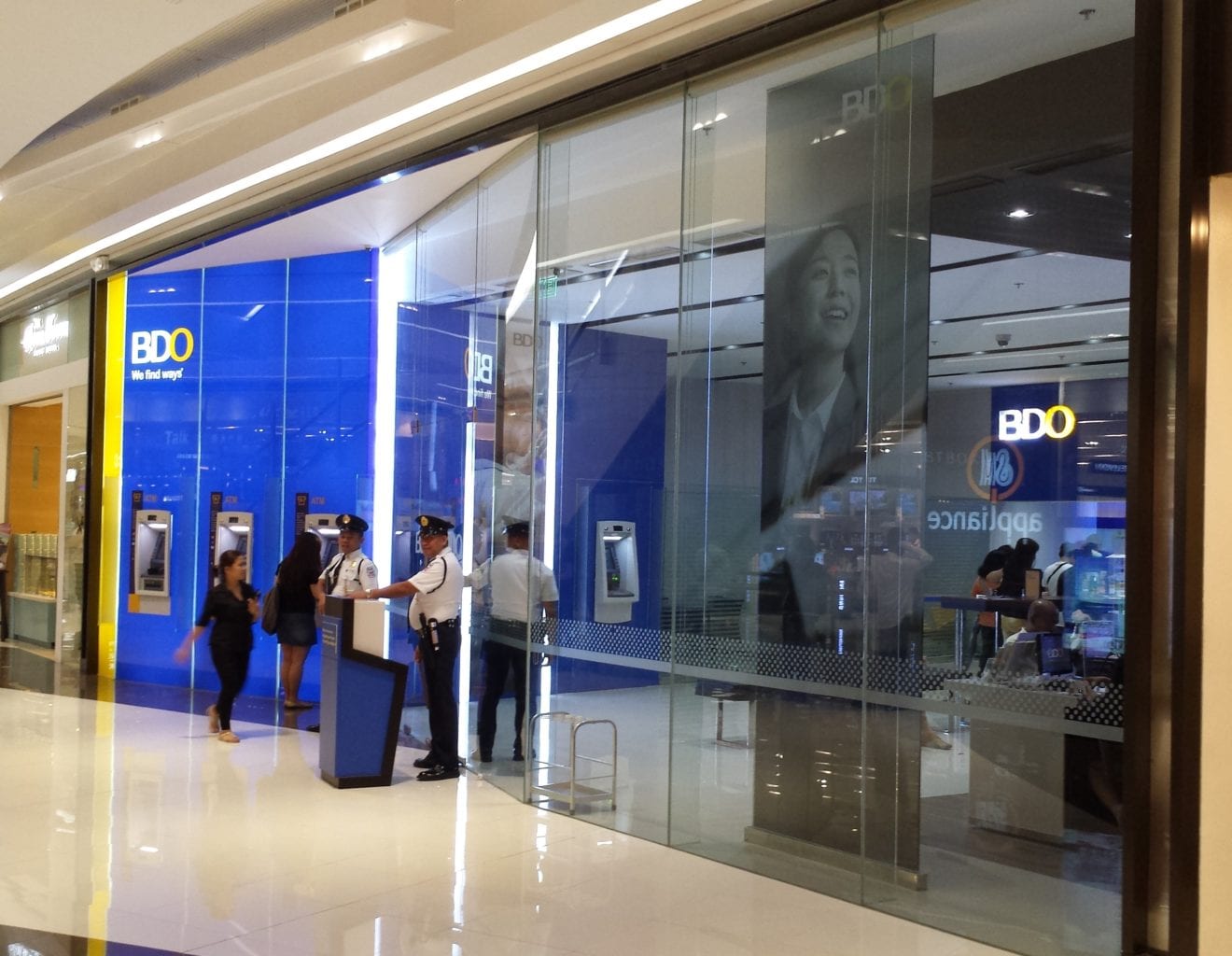
    BDO Unibank has been expanding its business scale through a series of acquisitions since 1976. As a result, it now has more than 900 branches throughout the Philippines. Moreover, the lender in recent years has taken various measures to improve the quality of its services; it has extended its opening time by two hours, to 5 p.m., and has used blue as the base color at all its branches in an attempt to create a clean, fresh image.

    The efforts have been led by BDO Unibank Chairwoman Teresita Sy-Coson, the eldest daughter of SM Group founder Henry Sy. Sy-Coson’s business acumen has won the admiration of Tadashi Yanai, chairman and president of Fast Retailing, the Japanese holding company that operates the Uniqlo chain of casual clothing stores. Yanai praised her in one of his books, and Fast Retailing has formed a joint venture with SM Retail, an SM Group company.

    Sy-Coson is eyeing more Japan-Philippine business transactions. BDO Unibank has forged partnerships with a number of Japanese regional lenders, including Joyo Bank, based in Mito, Ibaraki Prefecture. In addition, the Philippine bank is set to open a money remittance center in Tokyo in December.

    As the Philippine economy has been growing, more Filipinos have begun to open securities trading accounts. The trend has Sy-Coson anticipating a future in which more pesos in circulation further boost the country’s economic growth.

    In June, BDO Unibank and Nomura agreed to set up a joint stock-trading venture in which the Philippine lender has a 51% stake and the Japanese securities house holds the remaining 49%.

    BDO Unibank says it manages around 7 million bank accounts. What’s more, the SM Group operates large shopping malls across the country that can attract tens of thousands of visitors a day. As such, the bank is well-positioned to raise the new brokerage’s profile through ads and other platforms.

    Sy-Coson expects synergies from BDO Unibank’s countrywide network and Nomura’s investment banking expertise. “In the future, we hope to offer our clients more services, to include cross-border investments,” she said. “This will provide a wider choice of opportunities to investors, particularly in the context of Asean integration.”

  • Saturation hits luxury retail, but new trends provide hope

    Saturation hits luxury retail, but new trends provide hope

    The Asia Pacific region is experiencing a slowdown in the luxury retail sector, but new emerging trends are set to provide the retail sector with a solid new stimulus for demand in the coming years, according to the CBRE’s special report, ‘The Future of Luxury Retail in Asia Pacific: New Demand Drivers and Shifting Occupier Requirements’.

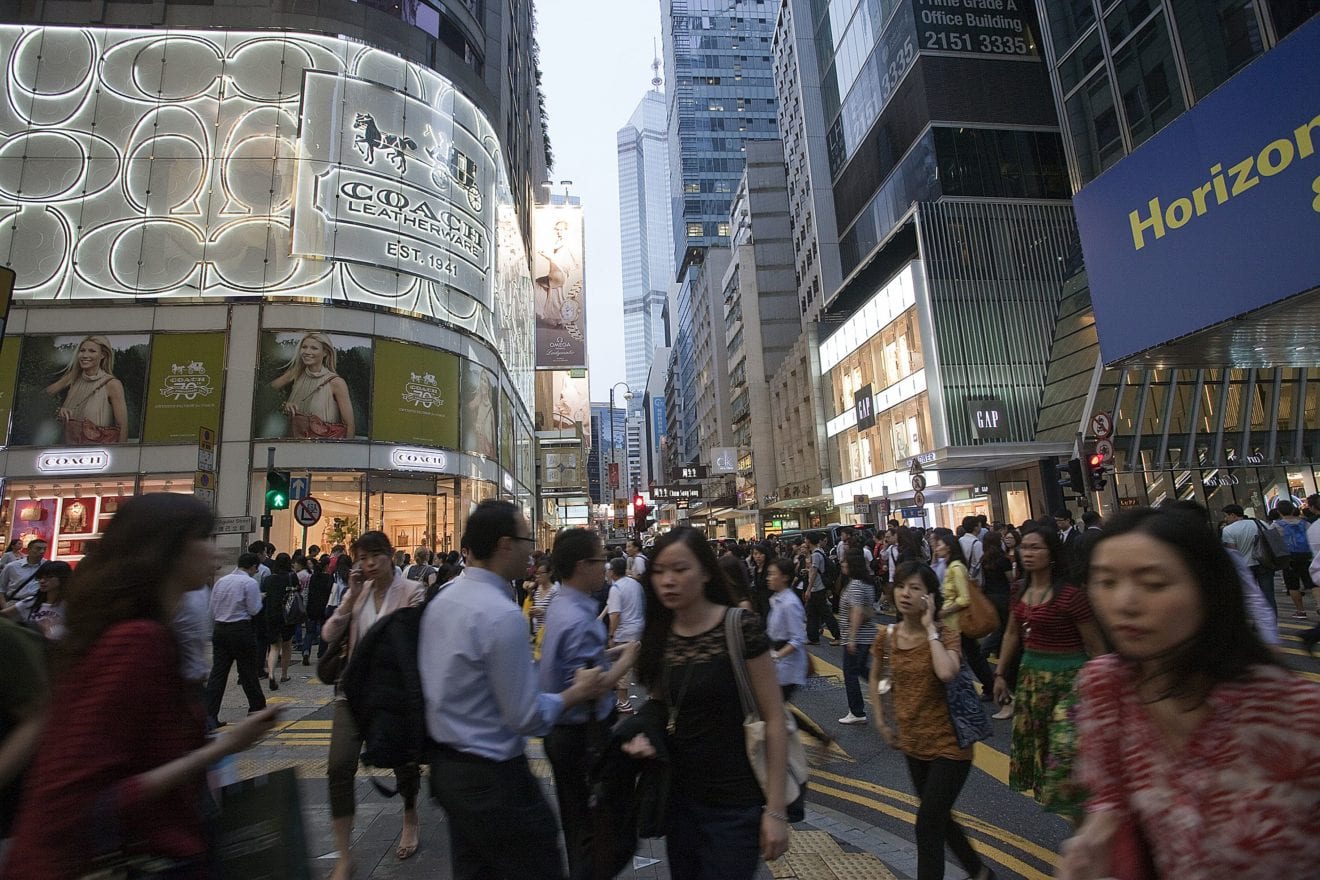
    Most major luxury retailers are now well established in Asia Pacific with China and Hong Kong being two of the most penetrated markets at 89 per cent and 81 per cent, respectively. However, following several years of rapid expansion, these markets are approaching saturation point.

    “Accounting for one-third of personal luxury goods sales globally in 2014, Asia Pacific is a key region for international luxury brands with key markets including China, Hong Kong, Japan, Singapore, South Korea and Taiwan. However, the high growth period for luxury retailers in the region is gradually coming to an end,” said Dr Henry Chin, Head of Research, CBRE Asia Pacific.

    ”Over-saturation, surging operational costs and weaker retail sales – especially in Hong Kong due to the slowing mainland China economy – have prompted retailers to consolidate their existing store networks and slow their rate of entry into new markets focusing on operational efficiency,” said Dr Chin.

    CBRE has identified three emerging trends which will partially offset some of the negative effects arising from the slowdown and compensate for the loss of demand: Emergence of Affordable Luxury, Inclusion of F&B and Growth of Luxury Childrenswear.

    “With the momentum behind these trends, this will account for a bigger slice of leasing demand for prime retail space,” says Joel Stephen, Senior Director, Head of Retailer Representation, CBRE Asia. “Retailers and landlords can benefit from the projected growth in these market segments,” he adds.

    Emerging retail trends are already impacting luxury retailers’ real estate requirements, resulting in new, and in some cases, weaker demand for different types of retail property, the report said.

    Some of the key trends that CBRE have identified include weaker interest in department stores despite continued interest in prime locations; stronger focus on flagship stores; increased popularity in short-term opportunities for brands to set up exhibitions, pop-up and concept stores, and workshops, to generate greater consumer awareness; affordable luxury brands continuing to drive demand; and more interest in upper floor retail space, but limited to top-tier malls and driven by F&B and childrenswear segments.

  • Mazda to cap prices once tax takes effect

    Mazda to cap prices once tax takes effect

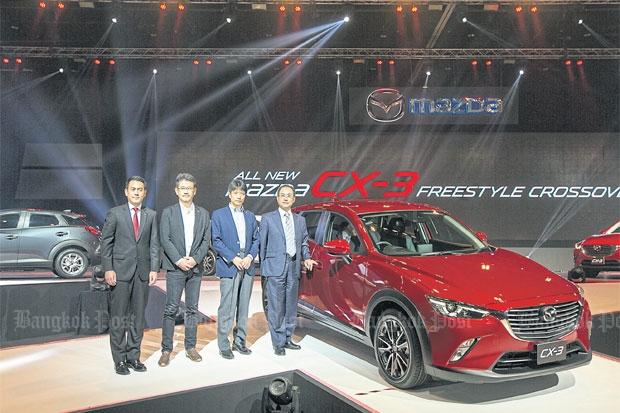
    The Mazda CX-3 SkyActiv sport-utility vehicle was launched yesterday for the domestic market. Mazda began making the CX-3 last month at AutoAlliance (Thailand), a joint venture with Ford Motor Co.

    Mazda Sales (Thailand) has vowed to cap retail prices for large passenger cars and pickup trucks that are subject to a new excise tax next year.

    President Hidesuke Takesue said the Japanese car maker would opt to control production costs and manage volume carefully , as the excise tax rates would be based on ex-factory prices, not retail.

    Mazda is also committed to subsidising the difference in amounts incurred by the excise tax.

    From 2016 on, vehicles sold in Thailand will be subject to a new excise tax based on carbon dioxide emissions, E85-gasohol compatibility and fuel efficiency rather than just engine size as before.

    The excise tax on eco-cars with CO2 emissions below 100 grammes per kilometre will be cut to 12-14% from 17%, but the 10% rate for hybrid vehicles will remain.

    The company estimates prices for its Mazda3, CX-5 sport-utility vehicle (SUV) and BT-50 Pro pickup truck will increase by 3-5% early next year once the new tax regime takes effect.

    “There are many factors in setting car prices, based not only on excise tax but also an import duty for some auto parts, local tax and value-added tax, so the company will take all factors into account before announcing retail prices,” Mr Takesue said.

    For the Mazda2 eco-car, the retail price will drop by roughly 20,000 baht next year with the new excise tax.

    Mazda posted sales of 29,641 vehicles in the January-October period, up 2.2% year-on-year.

    The company also gained a higher market share during the period, to 4.8% from 3.89%.

    Mazda2 eco-cars had a 49.6% share of total sales for the period, followed by the BT-50 (21.4%), the Mazda3 (19.6%), the CX-5 (9.3%) and other models.

    Mr Takesue expects sales to grow by 10.7% this year to 38,000 vehicles after falling 35.1% in 2014 to 34,326.

    In related news, the company yesterday introduced the CX-3 SkyActiv, which it started making last month at AutoAlliance (Thailand), a joint venture with Ford Motor Co.

    The Hiroshima-based parent firm has invested 800 million baht in production of the model to serve the local market and exports.

    The Mazda CX-3 is available in both 1.5-litre SkyActiv-D (diesel) and two-litre SkyActiv-G (petrol) engines, with prices ranging from 835,000 to 1.155 million baht (to remain unchanged next year).

    The Mazda CX-3 is the fourth model on the SkyActiv platform in the Thai market after the CX-5 SUV, the Mazda3 and the Mazda2.