Author: Mei Ling Tan

  • Carrefour opens 4th distribution center in China in Wuqing

    Carrefour opens 4th distribution center in China in Wuqing

    The grand opening ceremony of Carrefour supply chain in China-North-West China distribution center is held in Wuqing Economic Development Area, Tianjin municipality. The foundation of the center is expected to become the overpass of Carrefour China’s supply chain in northern China, which can form the radiation of Beijing-Tianjin-Hebei integration economic cycle and Shandong, Shanxi and other provinces’ logistics and distribution network, increase the distribution efficiency, support the business of stores, and boost the regional economics.

    The northern distribution center of Carrefour launched this time has superior geographical location, which is located in ProLogis modern international distribution park, Wuqing economic development area, Tianjin municipality, covers an area of 39,000 square meters. Carrefour northern distribution center will utilize the Voice Picking System, achieving 99.997% in its picking accuracy rate. The tray utilize 100cm*120 standard operating procedure to reduce packaging and labor costs and improve efficiency; moreover, the center is equipped with professional temperature controlled room which sustain temperatures of 18-22 degrees for the storage of alcohol, chocolate and milk powder.

    To reply to the supply chain strategy development needs of Carrefour in China, the establishment of northern China distribution center will cover more than 30 stores in northern China, greatly improve the company’s northern China supply chain system to provide more high-quality, convenient products and services for numbers of consumers.

    After the establishment of the distribution center in Eastern, western and northern region, Carrefour is planning to set up 2 new distribution centers in North-East Territory and South Territory of China. It is estimated that by the end of 2016, Carrefour will complete the establishment of 6 modern distribution centers in China, and cover more than 200 hypermarkets in China to fully support the emerging industry such as E-commerce of Carrefour, “easy Carrefour” convenience stores.

  • Hacking of Hong Kong’s VTech may prove worst cybersecurity breach of 2015 in Asia

    Hacking of Hong Kong’s VTech may prove worst cybersecurity breach of 2015 in Asia

    The massive hacking of customer accounts at Hong Kong-based educational toy maker VTech, which left more than six million children’s profiles exposed, may have been the worst cybersecurity breach in the Asia-Pacific this year.

    “If we made a top-five list today, VTech would place first on the list for the Asia-Pacific based on the reported number of accounts affected,” Forrester Research senior analyst Heidi Shey said.

    The VTech incident last month compromised 4.8 million parent accounts and 6.4 million related children’s profiles on the company’s Learning Lodge app store customer database and Kid Connect servers.

    Also affected were 235,708 parent and 227,705 children accounts at the company’s Planet VTech online games platform.

    That was worse than the data breach at Japanese online shopping mall operator Rakuten in April, when the identification and passwords of about five million customers were stolen.

    A recently published Forrester report showed the Rakuten incident was listed as the top corporate data breach in the Asia-Pacific over the past 12 months. Details of the VTech hack were only released last week.

    VTech chairman Allan Wong Chi-yun said he blames an “orchestrated and sophisticated attack on our network” for the incident, which ranks as the largest known targeted hack on children’s data worldwide.

    Hong Kong’s privacy commissioner Stephen Wong Kai-yi last week said an investigation had been launched into VTech’s system of collecting personal data and the safeguards used to protect that information.

    The company said it was cooperating with law enforcement worldwide to investigate the incident, and has hired US cyber forensic firm Mandiant to help in that effort.

    Companies in mainland China and Hong Kong are forecast to remain under siege from growing cyberattacks as the number of data breaches in those two markets escalated this year.

    The average number of detected cybersecurity incidents on the mainland and the city increased 417 per cent to 1,245, up from 241 last year, according to a new survey by global professional services firm PwC.

    “Today, we are witnessing attacks from all angles, but the industries facing the most impact include consumer, retail and technology,” Kenneth Wong, PwC China and Hong Kong’s cybersecurity leader, said on Thursday.

    Customer data, internal records and intellectual property were the most targeted data in detected cyberattacks in mainland China and Hong Kong, according to the PwC survey.

    Respondents reported a 64 per cent rise in security incidents that compromised customer records, much steeper than the global average increase of 35 per cent.

    The average total financial loss due to cybercrime for companies on the mainland and Hong Kong was up 10 per cent to US$2.63 million, compared with US$2.4 million in the survey last year.

    Wong pointed out that the numbers from its survey will likely be conservative because many companies rarely publicise cybersecurity incidents in their operations.

    Respondents also said current and former employees were the source of half of all the detected data breaches security in the survey.

  • Manpower plan launched for retail sector

    Manpower plan launched for retail sector

    The labour-starved retail industry will be getting a leg-up over the next five years to implement more manpower lean practices and schemes to train and retain workers under a new plan launched today (Dec 10).

    The Singapore Retailers Association (SRA) told TODAY that more than 40 per cent of frontline positions in the industry still remains unfilled, and the figure is unlikely to change due to current restrictions on foreign manpower.

    December 10

    The new manpower blueprint by SPRING Singapore and the Singapore Workforce Development Agency for the retail sector includes a study starting next year that will involve up to 30 retailers from different industries and company sizes.

    The study will identify training and skill needs for the sector, as well as offer guidelines for companies to adopt leaner manpower models and create higher added-value job roles.

    At the second stage of the study, retailers who are keen to implement the study findings can tap on grants offered by SPRING.

    The guidelines from the study will serve as best practices for industry players — mostly Small and Medium Enterprises (SMEs) — to learn at a quicker pace and from each other, noted Manpower Minister Lim Swee Say at the plan’s launch.

    According to SPRING, small retailers with annual revenues of less than S$10 million make up 98 per cent of the retail sector.

    Under the new manpower plan, up to 100 retail companies can also revamp their existing human resource (HR) strategies to improve on their compensation, and learning and development aspects. Companies will be able to receive up to 70 per cent of funding from SPRING, while employers can also tap onto SPRING to review and give recommendations on current HR practices.

    Other measures to help the retail industry include piloting new job roles for interns so as to equip them with skills needed for future jobs, and programmes to support existing staff with skills upgrading and leadership development.

    Decks, a fashion retailer which carries brands such as Surfers Paradise, was hailed as an example for the retail sector at the launch today.

  • Funan the IT mall closes amid e-commerce boom

    Funan the IT mall closes amid e-commerce boom

    It was the place where hundreds queued at midnight to get their hands on Microsoft’s Windows 95, the landmark operating system that first brought out much of today’s modern features.

    It was also where pirated game CDs were sold and sound cards could be bought in anti-static bags, with no warranty or idea where they came from.

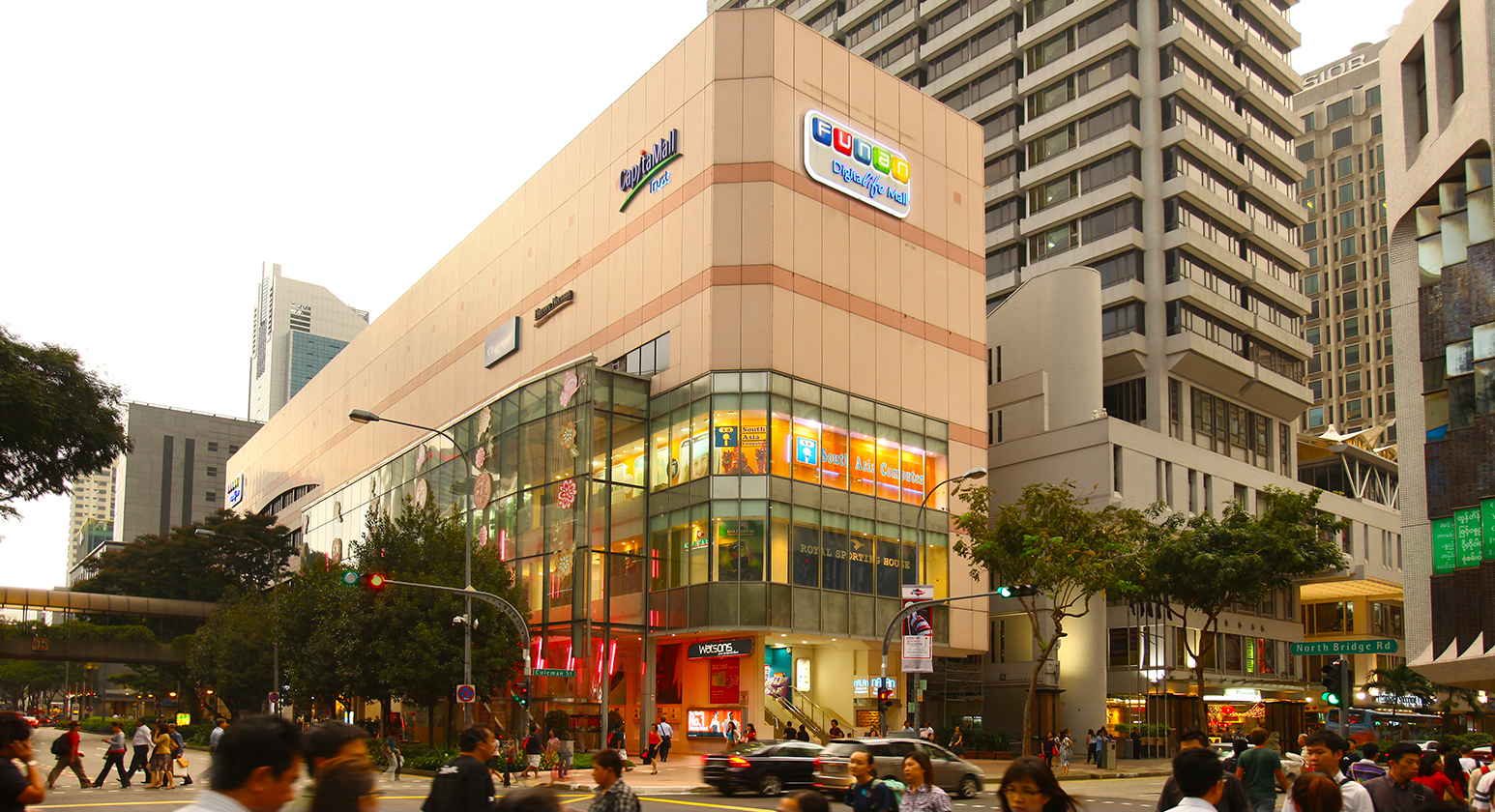
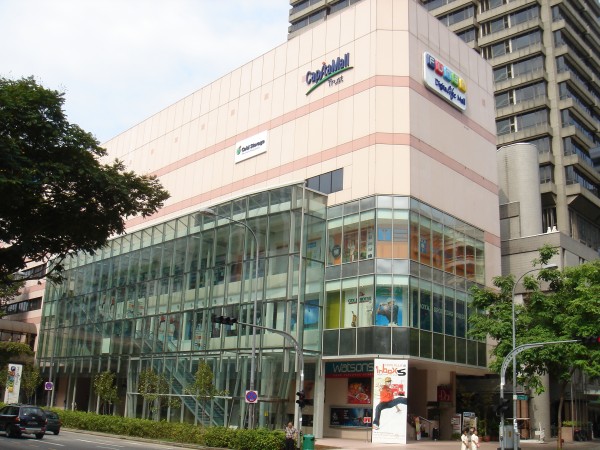
    Funan DigitaLife Mall, better known to many geeks by its original name, Funan Centre, is closing in the third quarter of next year. In its place, after a renovation, will be an “experiential creative hub”. Whatever that is.

    While Singapore’s techies miss a familiar, old haunt, where they first got their hands on a 486 PC or even where they studied in the open tables available, the writing has been on the wall long before today’s news.

    The end for Funan, while sad, is inevitable.

    Funan DigitaLife Mall. Source: Wikipedia. Creative Commons BY-SA 3.0

    Funan DigitaLife Mall. Source: Wikipedia. Creative Commons BY-SA 3.0

    Years of quarterly tech bazaars, the most recent one just a couple of weeks ago, have made some buyers delay purchases at retail outlets, which face increasingly high rentals. Some stores simply joined the fray in these shows to offset what sales they would lose during the price-cutting weekends.

    The biggest issue for Funan, however, may be e-commerce. Perhaps belatedly for such a well-connected country, Singapore has finally embraced the idea of buying things online, be it a PC or a pack of rice.

    Today, the likes of Lazada and Qoo10 make it easy to compare prices. Once, it was fun to walk to each store in Funan to see if you could get S$10 off a mouse or laptop. Today, you just move your mouse on your PC to compare.

    The change isn’t unique here. In the United States, for example, big chain stores have suffered too from the move towards online shopping.

    And to make things worse for retailers in Funan, Singapore shoppers are also buying from American sites, such as Amazon, which have become far more competitive for many items (see some examples).

    I just shipped a couple of Blu-ray discs and a Razer mousepad over from Amazon this month. Okay, I don’t get the instant gratification of walking into a shop to buy them, but the prices are lower over at Amazon.

    The last time I bought something from Funan was just weeks ago, when I picked up a Panasonic Lumix camera from a small store. I had to get some hands-on feel of the camera, so I went to Alan Photo, known for its bargains. At least the prices for some cameras are still competitive.

    I’ll be honest, though. I haven’t been to Funan much. Part of this is down to the congested parking – it’s not unique to the building to be fair; it’s the same for so many malls in Singapore on weekends. Another is the fact that I can get many commonly used items, such as printer cartridges or keyboards, at many other malls.

    That’s the biggest irony, isn’t it? As more people are buying laptops and phones, at a time when IT has become more than a geeky obsession and is a necessity in life, a big IT mall is closing down in Singapore.

    The reason is simple – people no longer have to go there to get what they need regularly. The stuff is available in neighbourhood malls. You can buy it at lifestyle shops like Tangs.

    As technology has ceased to be some specialised item, so have the shops selling it. You can buy a Mac in so many places today.

    The closing of Funan will raise questions for the other IT mall in Singapore. Of late, Sim Lim Square has been receiving bad press for a shop that brazenly cheated customers, even though many there are decent businesses.

    Will it also face the pressures that Funan did, that made developer CapitaLand Mall Trust Management Limited pull the plug? Geeks will hope not.

    Yet, if they see where they have bought their gadgets recently, they’d realise they have been spending less at their favourite technology malls. That’s why one of them is closing down.

    Related Posts Plugin for WordPress, Blogger...

  • Foreign wine imports to hit Myanmar’s shelves

    Foreign wine imports to hit Myanmar’s shelves

    U Tin Ye Win, a commerce ministry director in Nay Pyi Taw, said three or four companies have been granted licences, and several more are in the process of applying, but have not yet met all the requirements.

    Premium Distribution Company has been importing wines from South Africa and Italy since late November and Loi Hein Group has been granted an exclusive licence to import Thailand’s Spy wines. “These suppliers are well-experienced and will influence the whole market,” U Tin Ye Win said.

    Further liberalisation will depend on whether wholesalers buy wine imports from the official suppliers, or choose to continue selling cheaper illegal imports, he added.

    Shops are not allowed to sell foreign-made liquor under the current laws. While large supermarkets stick to the rules, smaller shops sell a range of illegally imported foreign brands, such as Johnnie Walker. If sellers switch to legal wine imports, officials may soon allow foreign liquors to be distributed, U Tin Ye Win said.

    The commerce ministry also needs to discover which companies have been dodging taxes by, for example, paying for 100 bottles but importing 100,000. However, it remains hard to keep track of the exact number of bottles entering the country, he said.

    A Ministry of Commerce notification in March said importers must register for a company trading licence and must have a dealership.

    This means they must first secure their licence and then contract a dealership with one or more foreign wine companies, before applying for an FL11 licence from the General Administration Department. This licence allows distribution of foreign liquor brands, which are taxed at 82 percent – 30pc customs duty, 50pc commercial tax and 2pc income tax.

    Importers must pay tax on every bottle, and ensure that ingredients are displayed in English. They can only import by sea or air – not by land – and must declare the country of origin. Suppliers must also ensure that products are Food and Drug Administration-approved, and have a certificate of free sale from the Ministry of Commerce, industry sources said.

    Beyond the big suppliers, DTR Company was set up last April specifically to apply for a wine licence, and has been importing French wines since October. Managing director Ko Thiha Sitt said the company distributes six wine brands for K10,000 to K30,000 a bottle to wholesale, retail, bar, hotel and restaurant markets in Yangon and Mandalay. The company plans to expand to other tourist hotspots in the near future.

    “I understand that this will take some timeas we are in the period of transition, but strongly believe that the government will take serious action on illegal importations,” he said.

    In the past, the Myanmar Customs Department has held auctions of confiscated products at a discount to licenced products and revenues went to the Internal Revenue Department.

    Now the auctions are a thing of the past, and officials say they are toughening up. New tax labels are more secure, and tear as soon as the bottle is opened, he said. In addition, a unique code is printed on the labels of licenced importers.

    It was easy to re-use the old-style tax labels, by peeling them off and sticking them to new bottles, and people made money by collecting labels and selling them to wholesalers and retail outlets, said Ko Thiha Sitt. “We can now guarantee our products, so customers can’t complain,” he said.

  • Inditex optimistic about push into China

    Inditex optimistic about push into China

    Intidex, the parent company of fast fashion chain Zara, has revealed a sales increase of 16% year-on-year to 14.74bn (£10.6bn) over the first nine months of its financial year. Despite a dip in the economy, the Spanish group has said that it remains optimistic about its China prospects.

    The group’s profits, which include a 20% increase to £2.02bn, come not long after founder Armanocio Ortega surpassed Bill Gates as the world’s wealthiest man.

    Though luxury fashion retailers such as Burberry and Hugo Boss have experienced difficulties in the Chinese market, Inditex is positive about its expansion overseas.

    “We have no doubt that the fashion appetite in China is large, our brands are better and better known. We are still feeling very optimistic,” said Chief Executive Pablo Isla.

    During its first three fiscal quarters, the group added 136 new stores to its estate making a total of 230, the same amount as the same time last year.

    Zara had the most openings with 60 new stores, as well as 44 Zara home sites and 26 new branches for lingerie brand Oysho.

    In addition, Zara’s e-commerce platform is being extended to all of the European Union, Taiwan and Hong Kong, while a website for Zara Home has debuted in Australia.

  • Price Of Illegally Poached Ivory Halves In China

    Price Of Illegally Poached Ivory Halves In China

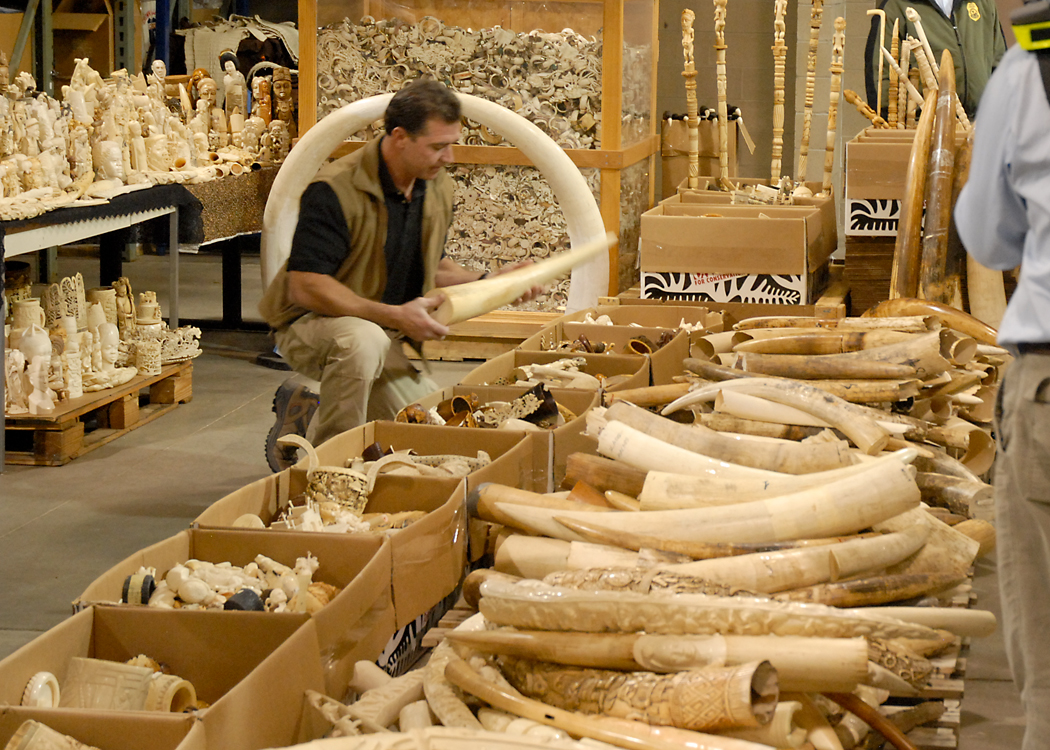
    The price of elephant ivory in China has fallen by almost 50 percent over the past 18 months, likely due to a shrunken demand in the country for illegally poached tusks, the Wildlife Conservation Network wrote this week in a blog post.

    Raw ivory in Beijing went from costing an average of $2,100 per kilo (about $955 per pound) in 2014 to $1,100 (or about $500) by November, ivory researchers Lucy Vigne and Esmond Martin revealed in a study scheduled to be released by Save the Elephants in early 2016. The price drop reflects China’s significant decrease in demand for the commodity, believed to be a result of the government’s explicit commitments to cut down on ivory trade and prevent illegal elephant poaching.

    Elephant poaching typically involves killing the animal, hacking off its tusk and discarding its carcass, The New York Times wrote in a gruesome report.

    Historically, China has considered ivory ornaments and carvings to be status symbols, and the country is still widely believed to be the world’s largest ivory consumer. But activists have long urged China to impose strict legislation on the ivory trade.

    Chinese authorities announced in May a commitment to phase out the country’s domestic ivory industry. In September, the United States and China also announced a deal to carry out “nearly complete bans” on ivory imports and exports. To show its dedication, mainland China destroyed almost 7 tons of ivory to show the country’s dedication to ban the wildlife crime, according to the World Wide Fund.

    Demand for ivory within the country also seems to have diminished. Vigne and Martin, who traveled across eight Chinese cities to conduct their research, said they “didn’t see a single person buying an ivory item during weeks spent surveying the ivory retail outlets.” The researchers also noted that many ivory retail outlets had cut back on floor space for displays of ivory items.

    Other countries have also ramped up their efforts to prevent illegal elephant poaching. Last year, the Obama administration announced that it would prohibit all commercial trade of elephant ivory. And in October, Tanzania arrested a number of high-level ivory traffickers accused of smuggling at least 4,200 pounds of elephant tusks from East Africa to East Asia.

    But despite the fallen demand for ivory in China, Save the Elephants founder Iain Douglas-Hamilton said the world still had a long way to go to stop the African elephant poaching business. Indeed, the number of elephants in Africa fell from 26 million in 1800 to about 400,000 in August. At least 65 percent of the continent’s forest elephants were poached between 2002 and 2013, WildAid reported last year.

  • Alibaba Group Acquires Major Hong Kong Newspaper

    Alibaba Group Acquires Major Hong Kong Newspaper

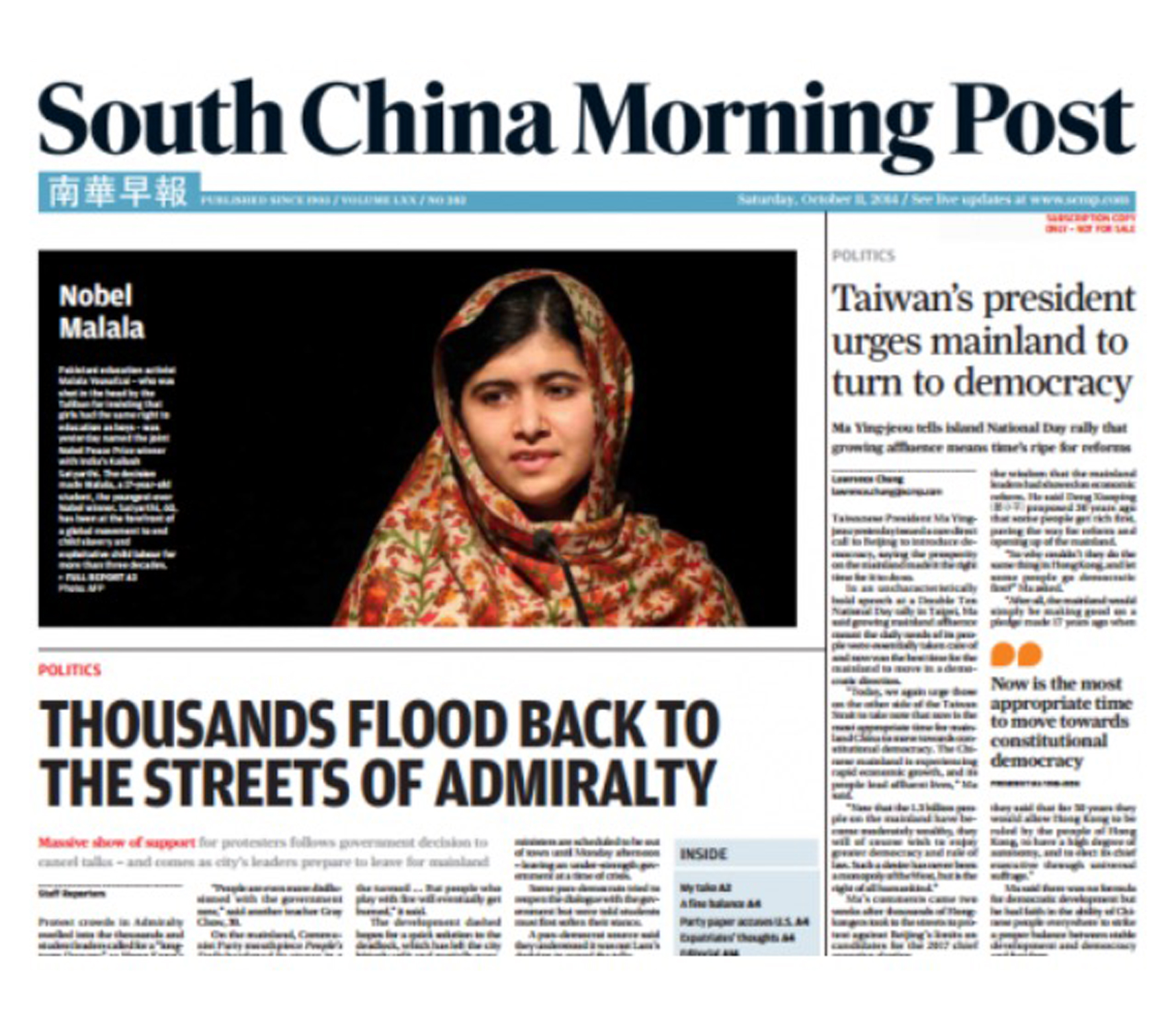
    The Alibaba Group has announced that will acquire the South China Morning Post, one of Hong Kong’s most influential English language newspapers, and other media assets of SCMP Group Limited.

    The move is reportedly part of an effort to improve China’s image in the West and combat what company executives call the “negative” portrayal of China in the Western media.

    “The South China Morning Post is unique because it focuses on coverage of China in the English language. This is a proposition that is in high demand by readers around the world who care to understand the world’s second largest economy,” said Joseph Tsai, executive vice chairman of Alibaba Group.

    The South China Morning Post has long reported on subjects that state-run publications have been forbidden to cover, such as political scandals and human-rights violations. The paper has a relatively small circulation (at about 100,000). Despite the paper’s size, it has significant influence in the West because of its proximity to China and English language format. However, critics have recently taken aim at the paper, claiming that it has become increasingly pro-Beijing.

    The acquisition is an ambitious move that sees Alibaba taking a significant stake in print journalism, with an eye to developing its digital potential.

    “Like many print media the SCMP faces challenges amid the dramatic changes in the way news is reported and distributed. But these changes play to Alibaba’s strengths, which is why we believe the two companies complement each other well,” said Tsai in an open letter to the readers of the South China Morning Post.

    As part of the changes, Alibaba will remove the pay wall on SCMP.com, allowing readers to access content for free on the internet and mobile.

    Other assets included in the acquisition are SCMP’s magazine, recruitment, outdoor media, events and conferences, education and digital media businesses. Besides the flagship South China Morning Post, other titles include SCMP.com and related apps, and Nanzao.com and Nanzaohinan.com, as well as the Hong Kong editions of Esquire, Elle, Cosmopolitan, The PEAK and Harper’s Bazaar.

    The acquisition represents a relatively minor investment on the part of Alibaba, with SCMP valued at an estimated US$100 million, a drop in the ocean compared with Alibaba’s multi-billion yearly revenue.

    It’s unclear at this point what degree of editorial control Alibaba will exercise over the controversial publication. While Hong Kong operates with a relatively free press, at least compared with mainland China, some are concerned that Alibaba will seek to water down the paper’s political stance to curry favour with Chinese leadership and advance its (Alibaba’s) own agenda, which is reportedly closely aligned with the Communist Party.

    Willy Lam, a political commentator and former editor at the South China Morning Post, said an Alibaba takeover would most likely exacerbate a trend at the paper toward self-censorship on sensitive political issues, reported the New York Times.

    The company has been quick to address this. “Some have suggested that ownership by Alibaba will compromise the SCMP’s editorial independence,” said Tsai. “This criticism reflects a bias of its own, as if to say newspaper owners must espouse certain views, while those that hold opposing views are ‘unfit’.

    “In fact, that is exactly why we think the world needs a plurality of views when it comes to China coverage. China’s rise as an economic power and its importance to world stability is too important for there to be a singular thesis.

    “In reporting the news, the SCMP will be objective, accurate and fair. This means having the courage to go against conventional wisdom, and taking care to verify stories, check sources and seek all viewpoints. These day-to-day editorial decisions will be driven by editors in the newsroom, not in the corporate boardroom,” said Tsai.

    “Alibaba and Jack Ma have done a good job maintaining good relations with the power structure and not getting involved in politics,” Orville Schell, a director at the Asia Society, told the New York Times.

    “But buying a newspaper, particularly in Hong Kong, could be hazardous,” he said, adding, “China is always tempted when things go wrong to take control.”


  • VP Kalla reviews preparation to build hotels in Mandalika

    VP Kalla reviews preparation to build hotels in Mandalika

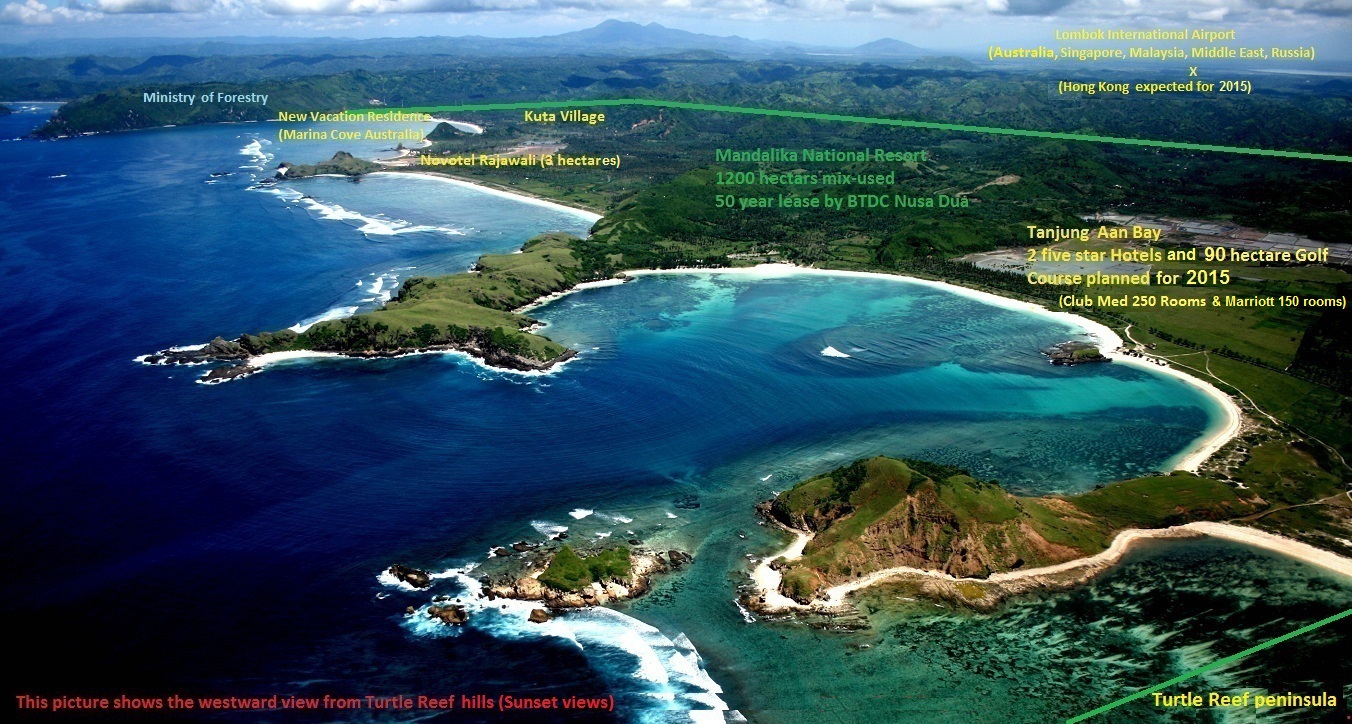
    Vice President M. Jusuf Kalla had the opportunity to review the preparations for the construction of four five-star hotels at Mandalika Special Economic Zones in Central Lombok, West Nusa Tenggara, Saturday.

    The Vice President reviewed the area together with Peoples Consultative Assembly (MPR) Chairman Zulkifli Hasan and Tourism Minister Arif Yahya.

    Arriving on the scene, the Vice President and the group immediately got the exposure of a number of investors who will build the four five-star hotels at the Mandalika Special Economic Zone (SEZ) in Central Lombok.

    Four hotels to begin construction in 2016, are Pullman Hotel of the investment fund PT Indonesia Tourism Development Corporation (ITDC), which is a state-owned enterprise (SOEs) in the field of tourism.

    Other hotels are Intercontinental Hotel, Club Med Hotel and Lees Hotel, and the construction of the entire capacity of the 850-room hotels was targeted to be completed within a period of two and a half years.

    “Everything has been completed, and there no reason not to accelerate the construction of these four hotels,” the vice president noted.

    After hearing the exposure of investors, the vice president then listened to the explanation of President Director of PT ITDC, Abdulbar M. Mansoer, related to the development of Mandalika SEZ within the next 10 years.

    In addition to building hotels, ITDC will also build the basic infrastructure needed by the hotels to support their operation, such as the need for clean water that will utilize seawater through the refining process.

    This work is done by establishing a partnership with EBD Bauer, one of the American companies engaged in the purification of seawater into fresh water.

    Other infrastructure that is in the process of being set up is a solar power plant (SPP) and gas power plants for hotels in Mandalika SEZ, which will not use electrical energy from the State Electricity Company (PLN).

    ITDC is also getting constructed the Tourism College (STP), which will create the human resources needed by the hotels.

    “Thus, some 20 star-rated hotels will be built in the Mandalika Special Economic Zone within 20 years. For the first stage, we will build four five-star hotels, and we have prepared the basic infrastructure,” said Abdulbar.

  • SME recognition awards to expand to Indonesia in 2016

    SME recognition awards to expand to Indonesia in 2016

    Kossan Rubber Industries Bhd group managing director and chief executive officer Datuk Lim Kuang Sia (second from right) receiving the Platinum Entrepreneur 2015 Award from Ahmad Husni. Kang (left) and working committee chairman Chey Onn Wah (right).

    THE SME Recognition Award will be “going Asean” next year, by first tapping Indonesia and later, eight other countries in the region.

    SME Association of Malaysia national president Michael Kang announced this during the SME Recognition Award 2015 Presentation and Gala Dinner held last Friday at the Sunway Pyramid Convention Centre.

    The award, in its 14th year, honours Malaysia’s top SMEs for their excellence.

    There were 101 award recipients from 17 categories such as SME Achievers Award, SME Green Excellence Award, SME Export Excellence Award, SME Women Entrepreneur Award and SME Service Excellence Award.

    The Platinum Entrepreneur 2015 Award was awarded to Kossan Rubber Industries Bhd group managing director and chief executive officer Datuk Lim Kuang Sia.

    Besides showcasing the achievements of Malaysia’s top SMEs, this award provides a premium platform to benchmark the service standards and quality of SMEs as well as enhance their intellectual properties and brand image in the global marketplace.

    The award theme this year was “Shaping up to the New Economic Landscape”.

    Kang said it represented a critical call for Malaysian SMEs to re-invent, harpen their skills, and brace themselves to match the global competition associated with a borderless business environment.

    “In terms of productivity, Malaysia ranks low with a ratio of 4:1 and 7:1 compared with Singapore and the US respectively.

    “This means that one Singaporean can do the job of four Malaysians, and one American can do the job of seven Malaysian,” said Kang.

    “As the National President of the SME Association of Malaysia, I wish to share my perspective on issues affecting SMEs in the country,” he added.

    If we continued to be contented instead of improving ourselves, Kang projected that at least 30% of SMEs would disappear when the Trans-Pacific Partnership Agreement (TPPA) comes into full force, two years after signing, because with companies from the TPPA country partners offering products and services of better quality here, SMEs would die off if they are not ready to advance.

    Second Finance Minister Datuk Seri Ahmad Husni Hanadzlah was the guest of honour for the event.

    In his speech, he saidSMEs were one of the drivers of our economic growth, contributing 335 to our Gross Domestic Product.

    “We expect it to reach 41percent by 2020. On the part of the government, we will provide endless support in order for SMEs to achieve your aim.”

    Kang also said the association has signed a Memorandum of Understanding with Next Generation Movement to promote growth of young entrepreneurs with effect from Jan 1, 2016.

    “The MOU intends to help young entrepreneurs penetrate the ASEAN market of 630 million population through business matching, investment cooperation, and the exchange of information with regard to trade, supply chain, innovation and technology,” he said.

    He added the association looked forward to work hand-in-hand with the Next Generation Movement to enhance the capabilities of young entrepreneurs by leveraging on these regional opportunities.

  • Several German companies interested to invest in automotive component industry

    Several German companies interested to invest in automotive component industry

    Several German companies have expressed interest to invest in automotive component manufacturing industry using aluminum as its raw materials, state enterprises minister Rini Soemarno said.

    “One of the companies is Rheinmetall Land System. We will discuss it further with them when I visit Germany later,” she said when asked for her confirmation about the news here on Sunday.

    She said Rheinmetall Land is currently building cooperation with PT Pindad to produce defense and security equipment.

    PT Pindad is cooperating with Rheinmetall Land System in overhauling, upgrading, servicing, maintenance and modification of a number of military combat vehicles.

    The cooperation covers several products such as MBT Leopard 2 RI, Leopard 2 A4, AIFV Marder aA3 RI, Gunnery/Driving Simulator and others.

    “But the big business that the company carries out also includes car components and many of them are exported across the world,” she said.

    She said she would follow up Rheinmetalls plan to invest in Indonesia especially in aluminum car components.

    “If they do decide to invest supply chain from upstream to downstream will be done by Indonesia,” she added.

  • Balinese farmers insure 4,000 hectares of rice fields

    Balinese farmers insure 4,000 hectares of rice fields

    As many as 4,000 hectares of rice fields belonging to Balinese farmers are included in the rice farming insurance program for the planting period of October 2015-March 2016, an official has said.

    “Our previous target this year is 11 thousand hectares of rice fields, but only 4,000 hectares can be insured due to limited time,” Head of Bali Provincial Agriculture and Foodstuffs affairs office Ida Bagus Wisnuardhana said here on Sunday.

    Thus, if the crop failure occurs due to floods or pest attacks after the rice fields have been insured, the farmer can get the claim of Rp6 million per hectare, he stated.

    In addition, the farmers should not pay the entire premium because 80 percent of it is subsidized through the state budget. The amount of the premium per hectare is Rp 180 thousand, but 80 percent (Rp144 thousand per hectare) is covered through the state budget.

    “Thus, the farmer concerned only has to pay Rp36 thousand per hectare in every planting season,” Wisnuardhana pointed out.

  • Online Sellers Tout Successful ‘Harbolnas’ Campaign

    Online Sellers Tout Successful ‘Harbolnas’ Campaign

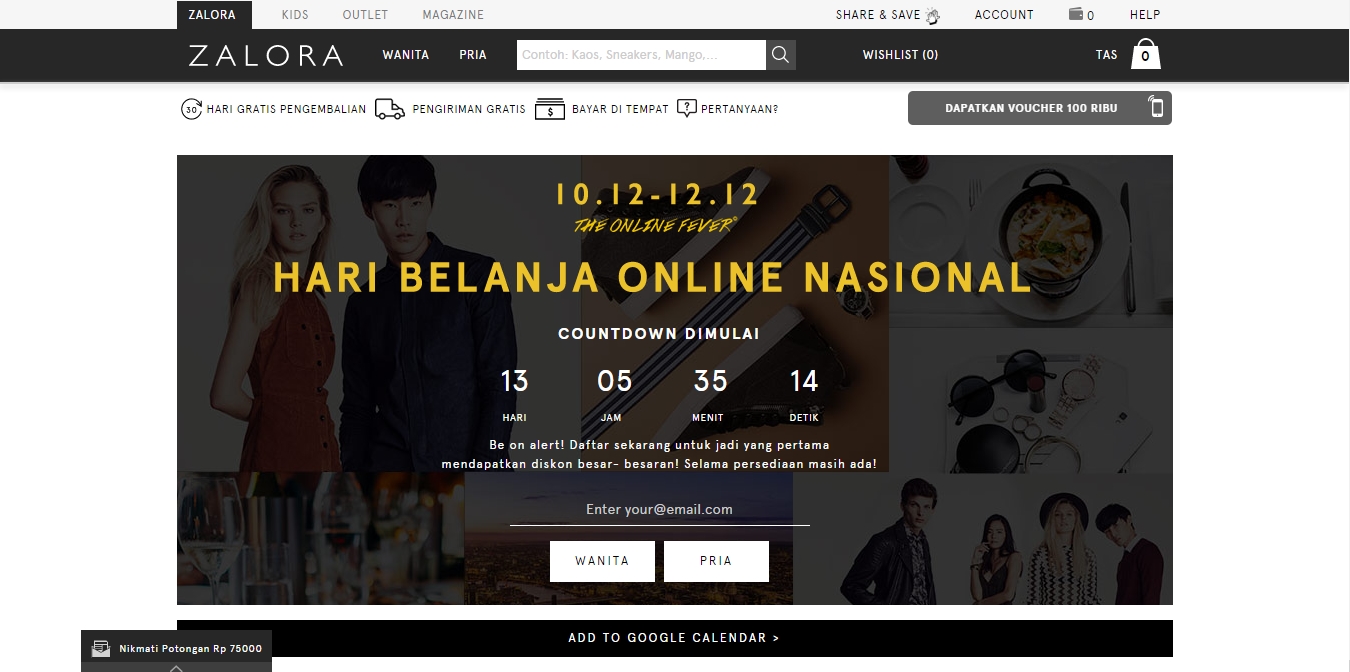
    Anthony Fung, managing director of online fashion retailer Zalora Indonesia said in a statement on Monday that the company saw sales surge thirty-fold during the three-day shopping event, but did not give a figure.

    “Everything is going so well that we decided to extend this campaign one more day, until December 13, so that we can give consumers more opportunities to get their favorite fashion brands at Zalora,” Anthony added.

    MatahariMall.com, the e-commerce arm of the Lippo Group, with which the Jakarta Globe is affiliated, claimed that sales went up 10 times the daily average during Harbolnas, with electronic goods and smartphones leading sales, according to chief executive Hadi Wenas.

    Fair game

    The hefty discounts promised, including up to 99 percent from MatahariMall, have prompted concern from consumers and industry lobby groups.

    The Association of E-commerce in Indonesia, or idEA, issued a statement over the weekend urging Harbolnas participants to divulge the actual value of sales derived from the event. This is in order to “assert the potential of Indonesia’s e-commerce market from local and international perspectives,” citing similar practices by online retailers in the United States and China.

    “There is concern over the hype in huge discounts offered during Harbolnas,” said Tulus Abadi, chairman of the Indonesian Consumer Protection Foundation (YLKI), as quoted by Merdeka.com.

    He urged consumers to be cautious about wild-sounding deals online, noting that consumer protection was still largely unregulated by the government.

    Lazada Indonesia was among the companies under scrutiny for manipulating prices, after a customer spotted a seller on the online marketplace listing infant diapers at a pre-Harbolnas price of Rp 130 million ($9,210), before a discount of nearly 100 percent dropped the price to Rp 93,482.

    Lazada said in a subsequent statement that it was not the company’s policy to deceive customers and that the seller in question had been banned from the marketplace.

    Similarly, MatahariMall listed a PlayStation 4 game console at an initial Rp 10.8 million before discounting it to Rp 4.599 million. Other sellers list the price of the same item outside the Harbolnas at Rp 4.7 million.

    Faced with the rapid growth in online retail in Indonesia, the government is in the process of laying the groundwork for regulating the e-commerce industry, from foreign ownership and taxes to consumer protection and business models. A regulatory road map devised by the Communications and Information Technology Ministry is expected before the end of the year.

    At the same time, idEA said it was also currently devising an ethical code of conduct when offering promotions and discounts, which it aims to unveil in the first half of next year in a bid to boost consumer trust and satisfaction when shopping online.

  • Indonesia retail Japanese convenience stores think small to survive

    Indonesia retail Japanese convenience stores think small to survive

    Japanese convenience store operators are shrinking the size of their outlets in Indonesia amid growing competition from local rivals. But the strategy of pursuing profitability over scale runs the risk of downsizing the companies out of the market.

    In Jakarta, the two leading local operators — Indomaret and Alfamart — have over 10,000 outlets each. Japanese rivals are finding it difficult to stay competitive with their traditional focus on larger shops, which often include cafes. To fight back, Lawson and Seven-Eleven Japan plan to increase the number of smaller stores in office and commercial buildings.

    During lunchtime in an office building in Jakarta, people form long lines to buy bento box lunches, bread products and other items at a Lawson outlet. A karaage, or deep-fried chicken, bento sells for 45,000 rupiah ($3.20). “It’s my turn to pick up lunch today,” said a female office worker as she carried a shopping bag full of food from the store.

    The outlet, which opened in August, is Lawson’s first small store in an office building. It is less than half the size of a typical Lawson shop in Indonesia and has only one row of shelves. Midi Utama Indonesia, the local retailer that runs the stores, has been considering such new locations as shopping malls and train stations, one official said.

    Lawson entered Indonesia in 2011 after granting Midi a license to operate its stores. The Japanese company was ambitious, with plans to open 10,000 outlets in the first 10 years. But in mid-2013, after having opened just 80 shops in the country, sluggish profits forced it to withdraw from Bali. Lawson cut the number from 60 to 50 in 2014. Today, there are only some 40 Lawsons in Indonesia.

    In the meantime, Indomaret and Alfamart have been steadily increasing their store networks. They have adopted some of the techniques brought in by Japanese rivals, such as in-store cooking and in-store cafes. Duskin, a Japanese housekeeping equipment company, chose Indomaret over Japanese players as its local partner to run Mister Donut when it entered the market this year.

    Following the money  

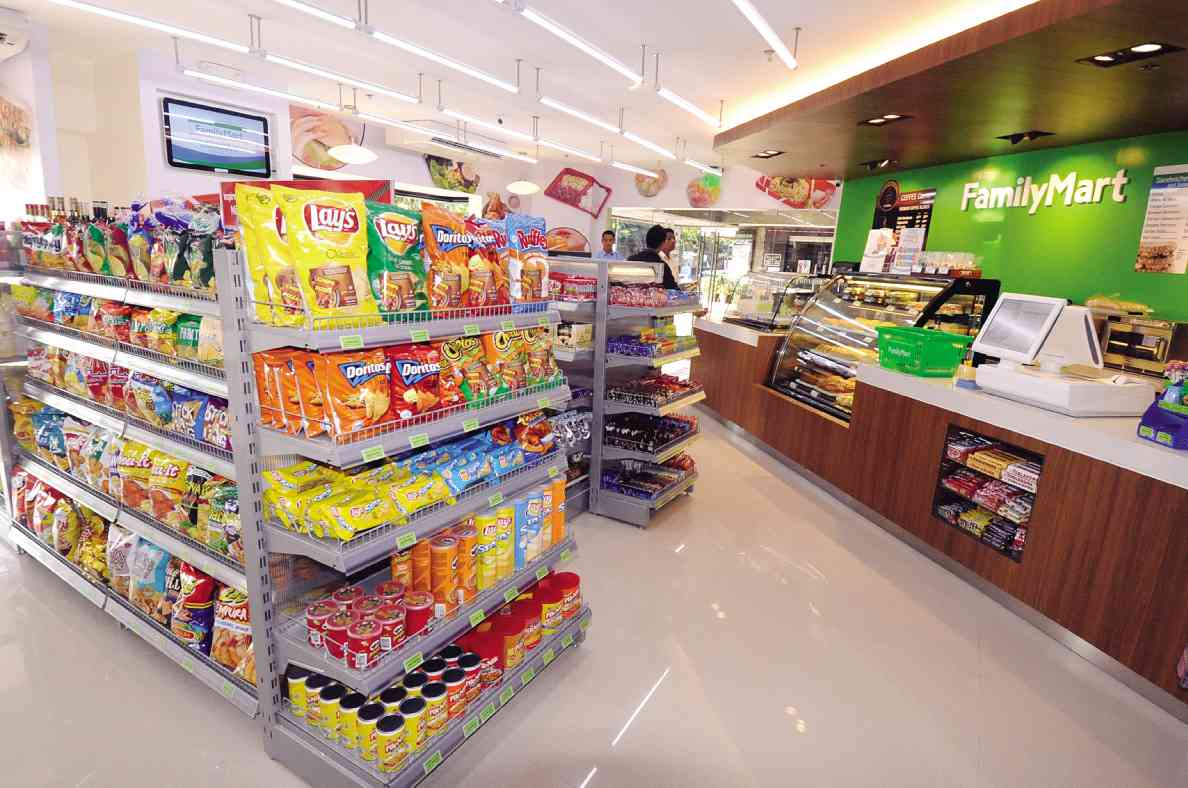
    With their limited number of stores, Japanese operators are finding it hard to continue offering the level of product and service quality associated with Japan while still turning a profit. As a result, they are betting on small outlets in commercial buildings to drive earnings. In explaining the shift, a FamilyMart official cited “the high income level of customers and the easy-to-predict demand structure.”

    FamilyMart plans to start opening stores in office buildings and upscale condominiums in 2016. Its existing 25 outlets are in stand-alone buildings or buildings shared with Japan’s Yoshinoya chain of gyudon beef bowl restaurants.

    Seven-Eleven Japan, the largest Japanese convenience store operator in Indonesia, is considering opening more small stores in train stations, commercial buildings and other busy locations, according to Modern Internasional, the operator of 7-Eleven stores there.

    Ministop, which has six Indonesian outlets, the fewest among Japanese companies, plans to cut costs by operating smaller stores and revamping its product lineup. For example, the matcha green tea-flavored soft ice cream it is promoting is selling three times as well as the chocolate flavor, the company said.

    According to Alfamart, Indonesia’s convenience store market grew about 13% by sales in the first nine months of this year. Though that is down from 19% in the same period last year, the growth is still significant compared with midsize retailers such as supermarkets, which saw 3.6% growth.

    Japanese players are not alone in their “go small” approach. Local operators are also increasing the number of smaller outlets in train stations and other facilities amid a shortage of space to build stand-alone stores, and also because of the difficulty in obtaining approval from authorities in the metropolitan area.

    With local rivals not only adding more stores to their already-large networks but also adopting strategies similar to those used by their foreign counterparts, the pressure on Japanese operators to find new ways to remain competitive will likely increase.

  • Autos drive solid China retail sales report

    Autos drive solid China retail sales report

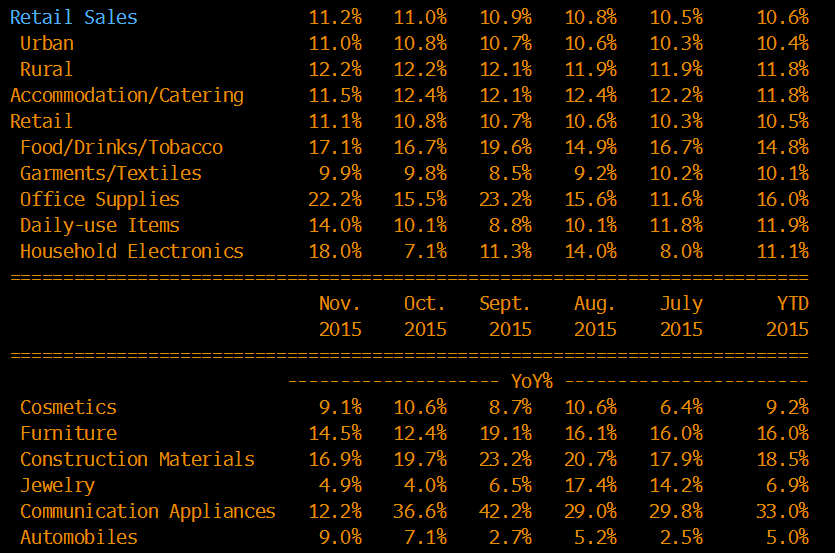
    Retail sales rise 11.2% y/y in November vs 11.1% expected

    Chinese retail sales were slightly stronger than estimates as auto sales picked up. Vehicle sales climbed 9% y/y in November compared to 7.1% in October.

    A strong automotive sector also boosted industrial production.

    The strength in auto sales and manufacturing was likely due to a sales cut tax in September for small and medium-sized cars.