Author: Mei Ling Tan

  • Swiss Banks See Opportunity From Google and IT Layoffs

    Swiss Banks See Opportunity From Google and IT Layoffs

    Tech giants such as Google, Meta, and Microsoft are cutting tens of thousands of jobs worldwide. Swiss financial service providers, desperate for IT talent, are now positioning themselves.

    We are seeing candidates with careers at the big tech groups looking for new employment,» observes Stephan Surber.

    This should greatly boost the active job market for these sought-after forces, the Switzerland head and senior partner of executive recruiter Page Executive said.

    The Swiss financial industry waited a long time for this to happen. Until now, it has been practically impossible to poach IT talent from Google, which has around 5,000 employees in Switzerland. Banks were not only outdone in terms of coolness but also in terms of wages.

    But now the winds are shifting. American companies Amazon, Microsoft, and Google parent company Alphabet are planning to lay off 40,000 employees worldwide in the next few months. The Facebook group Meta is said to be cutting 11,000 jobs.

    The technology giants are not only correcting the exuberant job growth during the Corona crisis but responding to business model headwinds. Rapid growth has become more difficult in the face of a weakening economy. Investors are not as flush with cash as they once were since the central banks ended loose monetary policies.

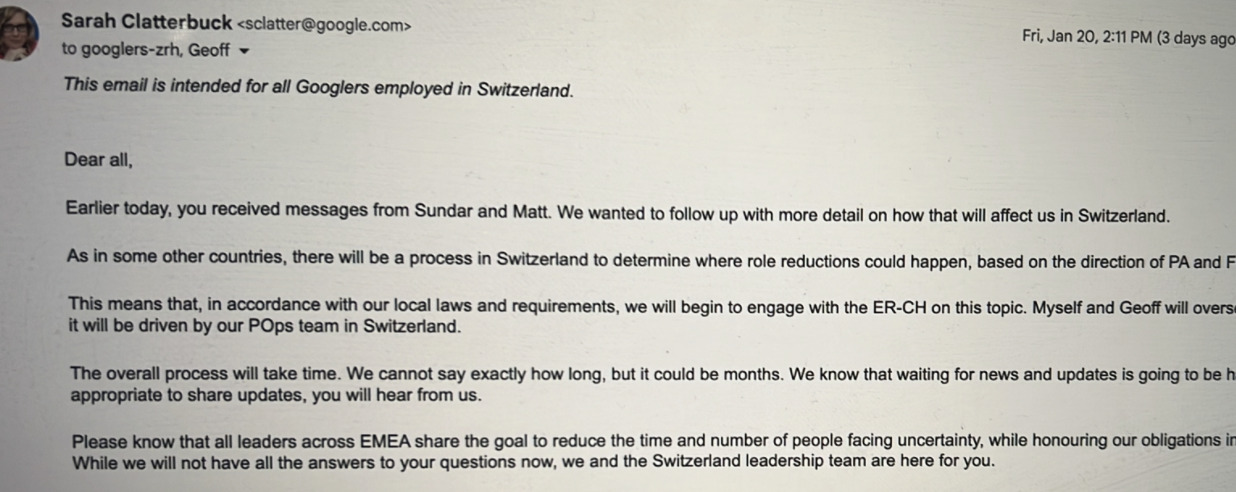
    As the financial portal Inside Paradeplatz reported, the wave of layoffs is hitting one of the country’s most sought-after employers: Google Switzerland. According to internal e-mails, management is preparing the workforce for possible job cuts. However, they said this could only take effect in a few months.

    Swiss Banking is keeping its ear to the ground, according to Reto Jauch, a managing partner at Zurich-based executive search firm Schulthess Zimmermann & Jauch.

    Downsizing at tech firms is already an issue at many Swiss banks, he says. Boards and managements are assuming they can attract talent.

    This comes after financial institutions struggled to attract up-and-coming technology talent, like most Swiss industries desperate for IT expertise. A survey conducted by the industry association Arbeitgeber Banken in 2021 showed IT is the only area in which the institutions still plan to create jobs in the next few years, amidst a declining employment trend for the profession as a whole.

    Even if the job cuts in tech offer a golden opportunity to poach experts, this will not be a cakewalk for the banks. It is by no means enough to place advertisements. «A clear positioning is needed; these forces demand purpose and a destination from their employer,» says headhunter Jauch.

    The search for purpose in one’s work, is often laughed off as a fad by veteran bank managers. UBS CEO Ralph Hamers, a fan of digitization who coined the term in Swiss banking, is seen by more than a few as an irritant because of it.

    But the country’s largest bank is not letting anything go to waste in the battle for IT talent. Not only does UBS advertise a culture of engineers it also beckons with continuing education for IT specialists and internal awards. Borrowing from tech industry practices and depending on their level of training, employees can call themselves Certified Engineer, Distinguished Engineer or even Technology Fellow.

    It remains to be seen whether UBS will be able to score points with these titles given the cutbacks at Google & Co. For Oliver Berger, partner at search boutique Witena in Zurich, this means that at most one battle has been won, but not the talent war.

    This has just started and will continue for the next ten to 15 years, says the executive recruiter. What we are seeing at the moment are just the precursors, he . That’s because he said Switzerland has too few skilled workers, trains too few, and lets too few cross the border.

    Accordingly, the layoffs at tech companies are also likely to be short-lived before the market picks up again, he warns. We’re kind of experiencing a bull market rally in a bear market here.

  • Coffee shops, eateries packed with customers on first days of Lunar New Year

    Coffee shops, eateries packed with customers on first days of Lunar New Year

    Businesses serving food and drink in Hanoi and Hai Phong have seen a surge in consumers during the first few days of the Lunar New Year.

    Many coffee shops in Hanoi closed on January 22, the first day of Tet, and started welcoming patrons again the following day.

    Highlands Coffee, The Coffee House, Phuc Long, Starbucks and other coffee chains didn’t raise prices on Tet to entice people

    Several smaller shops charge an extra VND5,000-VND10,000 (21 cents-43 cents) for each drink.

    There has been a noticeable increase in the number of young people seen at downtown establishments since the Lunar New Year’s Eve.

    Huong Mai, a resident of Hanoi’s Nam Tu Liem District, had to walk to a number of cafés on Ly Thuong Kiet Street at around 7 p.m. to find one with a table big enough for eight people.

    “Most stores have a high volume of customers coming in and out at any given time,” said Mai. “The wait time for refreshments is also longer than usual.”

    Not only do large coffee chains attract a huge number of customers, but so do a plethora of smaller, more affordable sidewalk cafés.

    On the second day of Tet, Dang Hoang Viet of Hanoi’s Ha Dong District said he and his family ate grilled steak at an eatery on Cua Dong Street for VND750,000.

    His family spends around VND650,000-VND700,000 on a normal day for a similar meal.

    In northeastern Hai Phong City, the food court at Aeon Mall was also filled with patrons.

    It took Quang Thanh, a local resident, over half an hour to find an available table on the first level of the shopping complex when he came at 6:30 p.m. on the second day of Tet.

    When asked about Lunar New Year’s Eve dining, Thanh said: “It took me a long time to find a table, and it took the restaurant another half an hour to make and serve my food.”

    On the first day of Lunar New Year, many eateries in Hai Phong stayed open late.

    Nguyen Ngoc Anh, owner of a row of vermicelli and banyan cake shops on Le Lai Street in Hai Phong, says he has kept his shops open till the end of Tet in recent years to accommodate the growing number of customers who venture out to the city to see fireworks or visit temples. She says that this period has the potential to bring in more business than any other time of the year.

  • Vinasun’s 2022 profit almost seven times higher than target

    Vinasun’s 2022 profit almost seven times higher than target

    Vietnam’s leading taxi firm Vinasun posted VND185 billion (US$7.89 million) after-tax profit last year, which is 6.8 times higher than targeted.

    The taxi operator recorded profits in all four quarters of 2022 after suffering losses in 2020 and 2021 due to the Covid-19 pandemic.

    With efforts to recover the market in HCMC and the nearby Binh Duong and Dong Nai Provinces, and look for partnership opportunities in transport, technology and consumption sectors, the company earned revenues worth VND1.089 trillion last year, which is twice the figure of 2021.

    By the end of last year, Vinasun’s total assets were worth VND1.836 trillion, up nearly 20% from the beginning of the year.

    At the closing the session on January 19 before the Lunar New Year break, Vinasun (VNS)’s stock value increased by nearly 6.8%, to VND18,150 per share.

  • Steel giants report huge losses in Q4

    Steel giants report huge losses in Q4

    A drop in prices and consumption put major steel businesses Hoa Phat, Nam Kim and VNSteel in the red in the fourth quarter of 2022, dragging their annual results to the lowest level in many years.

    Hoa Phat, which accounts for nearly 35% of Vietnam’s construction steel market, reported a nearly VND2 trillion (US$85 million) loss in the fourth quarter of 2022, after earning a profit of VND7.419 trillion in the same period of 2021. Losses in two consecutive quarters of Q3 and Q4 dragged the company’s profits down by around 75% compared to the first half of the year, to more than VND8.4 trillion.

    Vietnam Steel Corporation (VNSteel), accounting for 11.2% of the construction steel market, reported VND410.5 billion loss in the fourth quarter and a VND822.4 billion loss for the whole year, which was the company’s first loss since 2014 and its biggest loss since it started issuing financial statements in 2011.

    Nam Kim Steel, the leading coated steel manufacturer in Vietnam, lost VND356.3 billion in the fourth quarter, which resulted in a loss of VND67 billion for 2022, after more than 10 years of making huge profits, including VND2.225 trillion in profits in 2021.

    The steel market was gloomy last year.

    A Vietnam Steel Association report shows that steel production dropped nearly 12% from the previous year to 29.3 million tons, while steel consumption dropped more than 7% to 27.3 million tons.

    “For Vietnam’s steel industry, 2022 was a challenging year with falling consumption and complicated developments in material costs,” the report said. “Many businesses encountered difficulties and suffered losses.”

    Domestic steel prices have been falling since August 2022, hitting a two-year low of VND14 million a ton in the fourth quarter.

    The industry depends largely on public investment and the property market, the latter of which has been in a slump for months.

    VNDirect Securities Corp. projected that the industry will continue to face difficulties this year amid a low demand for construction and high manufacturing costs.

    The sector may see some upturn in the export market with China reopening and its real estate market recovering, the corporation said.

  • Singapore-based food-ordering platform Gobble ceases operations

    Singapore-based food-ordering platform Gobble ceases operations

    Social media-based food-ordering platform Gobble has shut down in Singapore after more than 18 months of operations.

    The company’s founders announced the closure on their LinkedIn page. One of them, Ashwin Purushottam, cited the company’s inability to raise additional funding to fuel its growth as the main cause of the company’s failure.

    “Running a group-buying marketplace in a space such as food ordering, which has seen an onslaught of disappointing IPOs, set an unfortunate precedent for our next fundraise,” said Purushottam.

    The platform reached US$350,000 in annual gross merchandise value with revenue surging by 47 per cent month-on-month. However, despite the high volume of sales, the profit margins were too low for the company to continue running.

    “As we continue to grow and develop Gobble, we realised that relying solely on a B2C model wasn’t sustainable for us,” said fellow co-founder Domenico Tan. “We failed to show a quick enough path to positive cash flow. With our current funding, we knew we would not be able to generate enough revenue just from Singapore to raise our Series A.”

    The food pick-up app for discount group orders was founded by the two entrepreneurs in 2021. The company subsequently bagged $1.3 million in a seed round led by Beenext and Flash Ventures.

    According to a report released by Grab and Euromonitor International, the Southeast Asian online food delivery gross merchandise value is estimated to grow from US$9 billion in 2020 to $28 billion in 2025.

  • AirAsia X Resumes Flights Between KL and Osaka, Japan

    AirAsia X Resumes Flights Between KL and Osaka, Japan

    AirAsia X (AAX) has resumed flights between Kuala Lumpur and Kansai Airport (KIX) in Osaka, Japan.

    The thrice weekly flights to Osaka are expected to carry more than 116,000 travelers between Malaysia and Japan monthly and deliver a welcome boost to both countries’ tourism and business sectors.

    “Following the resumption of services from Kuala Lumpur to Tokyo (Haneda) and Sapporo late last year, we have carried close to 30,000 guests between Malaysia and Japan post-pandemic,” said AirAsia X Malaysia CEO Benyamin Ismail. “We had a strong passenger load factor for our inaugural flight of more than 95% and we are confident that this route will be very well received despite the competitive landscape. As travel demand rebounds, we will continue to expand our services to exciting destinations in Asia from our regional hubs in Kuala Lumpur and Bangkok.”

    As a group, AAX flies to three destinations in Japan namely Tokyo, Osaka and Sapporo from Kuala Lumpur operated by AirAsia X Malaysia (D7) and from Bangkok (Suvarnabhumi) operated by AirAsia X Thailand (XJ).

    AirAsia X operates flights with Airbus A330 aircraft in a two-class configuration.

  • Google News app on tablets to get a Material You redesign

    Google News app on tablets to get a Material You redesign

    Material You has been the de facto design language for Android since its unveiling back in 2021. Since then, Google has been hard at work updating all their apps to fit the new design, including those used in tablets, but there was one app that was partly overlooked, Google News.
    Back in May, with Google News version 3.53, the Material You design philosophy began to be implemented by making the bottom navigation bar taller, giving it a slight hue, and adding a pill-shaped indicator for whatever tab you’re now viewing. This revamp was still in the early stages at the time, as the Material You features did not yet adhere to the Android theme colors.
    However, now with version 5.71, the story begins to change. This version brings that same redesign of the Google News app in tablet view. As before, a navigation rail with Material Design 3 (MD3) components was added, even if only available in landscape orientation.
    The new look was documented with screenshots via the Google News Telegram group, as seen below:
    In this redesign, the page content is now separated from the header and navigation rail by staying enclosed in its own section with rounded corners on top. The shape of the search bar was also modified slightly, but the navigation rail is visible on tablets and phones if used in landscape orientation.
    The navigation rail seems to be a common theme for Google when it comes to implementing Material You. It has already used a similar design in Google TV and Google Drive, and if the trend continues it is sure to make its way into other Google apps as well.
    I happen to like the navigation rail, as I believe it makes the design cleaner and less cluttered. The ability to expand it to view more content per category highlights its flexibility and adaptability to any app it may get implemented on.
  • Google widens its testing of WhatsApp-like feature for its Messages platform

    Google widens its testing of WhatsApp-like feature for its Messages platform

    Android users, you can’t complain about how messaging on the platform is behind the times if you’re using one of the messaging apps offered by your carrier. If you want features like end-to-end encryption, read receipts, typing indicators, and no character limit (vs. 160 limit with SMS), Android users need to be using the Google Messages app which can be downloaded from the Google Play Store.
    It sounds a lot like Apple’s Messages app, right? And here’s the thing. When are Android users using RCS Chat to message fellow RCS Chat users, what color their text bubbles are? Did you say blue? And what do you think happens in a group chat when an iOS user joins the convo? All of these features disappear. Sound familiar?
    Last October Google started beta testing a feature already employed by some of the better third-party messaging apps. Replacing delivery indicators such as Sent, Delivered, and Read (which are all self-explanatory), Google turned to the tried and true checkmark system. One single checkmark in a circle indicates that a message has been sent. Two checkmarks in a circle icons side-by-side reveal that a message has been delivered. And if those two side-by-side checkmarks in a circle icons appear filled out, it means that the message has been read.
    Android Police notes that Google has extended the beta test to more Android devices and this writer discovered the checkmarks on a Pixel 6 Pro running Android 13 QPR2 Beta 2.1. To see if this feature is available for your phone, simply engage in a chat with one of your Android-using pals (make sure that they are using the Google Messages app) and check to see how the read receipts are being handled on your device. The use of a checkmark system as a delivery indicator can be seen in third-party messaging apps such as WhatsApp, Messenger, and Signal.
    Google, as you might know, has been asking Apple to support RCS in the hope that both Android and iOS users can live in peace and harmony. As expected, Apple has not agreed to Google’s request.
  • YouTube Music partially down on the web and all mobile devices

    YouTube Music partially down on the web and all mobile devices

    YouTube Music is experiencing a partial outage affecting the home page and loading many listeners’ playlists and library. The issue was discovered around 1:50PM PST today and is happening across all devices, including the web.
    The official Team YouTube account tweeted the issue after reports of the outage started flooding in. When opening the app, the Library and Explore tabs appear empty, as if nothing was ever added to them.
    Additionally, artists pages and albums fail to load and cover art appears to be missing. The issue was also reported and is being documented via the YouTube Music Help page where Team YouTube has confirmed that the Music team is actively working to resolve the issue.
    One workaround that the team has offered is to access your playlists from youtube.com, which is working at the moment without issues.
  • Abbott faces US criminal probe over baby formula

    Abbott faces US criminal probe over baby formula

    Abbott Laboratories is under investigation by the U.S. Department of Justice, the company confirmed Friday, almost a year after it shut down a Michigan baby-formula plant after illnesses were reported.

    Abbott did not specify what aspect of the company is under Justice Department scrutiny.

    “DOJ has informed us of its investigation and we’re cooperating fully,” an Abbott spokesperson said in a statement to NBC News.

    The Wall Street Journal reported earlier Friday that the Justice Department was investigating conduct at Abbott’s plant in Sturgis, Michigan, citing people familiar with the matter who it did not name. NBC News has not independently confirmed the nature of the investigation. The Department of Justice did not immediately respond to a request for comment from NBC News.

    Abbott voluntarily shut down production at its Sturgis infant formula manufacturing plant on Feb. 17, 2022, after infants who consumed formula made at the plant became sick.

    The shutdown contributed to a nationwide infant formula shortage.

    Four infants, two of whom died, were sickened by a rare bacteria after consuming powdered formula made at Abbott’s Michigan factory.

    Federal investigators could not definitively determine the source or sources of the bacteria, Cronobacter sakazakii, which can cause severe illness.

    The company signed a consent decree with the federal government in May that laid out what it would do before re-opening its plant.

    The Food and Drug Administration said when the proposed consent decree was announced that “the government alleges that powdered infant formula products manufactured at Abbott Nutrition’s Sturgis facility were adulterated because they were made under insanitary conditions and in violation of current good manufacturing practice requirements.”

    Production at the Michigan factory, which makes three of the country’s most popular brands — Similac, Alimentum and EleCare — resumed in June.

    Abbott Labs previously said that it “continue[s] to enhance our manufacturing and quality processes to ensure that our products remain free of Cronobacter Sakazakii” and had “already begun implementing corrective actions and enhancements at the facility.”

    The company also said the lack of a genetic match between sick infants and the formula confirmed its own internal testing showing there was no link, and it said it has not found the bacteria in any of its distributed products. baby

    formula


  • Consumer Reports urges dark chocolate makers to reduce lead, cadmium levels

    Consumer Reports urges dark chocolate makers to reduce lead, cadmium levels

    Last month, Consumer Reports said 23 of the 28 dark chocolate bars it tested included potentially harmful levels of lead, cadmium or both for people who eat more than one ounce of chocolate a day.

    Five had elevated levels of both metals: two from Theo, and one each from Hershey-owned Lily’s, Mondelez-owned Green & Black’s, and Trader Joe’s.

    Consumer Reports said many consumers eat dark chocolate for its potential health benefits and relatively low sugar levels, but “there’s nothing healthy about ingesting heavy metals.”

    The chocolate makers did not immediately respond to requests for comment.

    The National Confectioners Association, a trade group, said the California health guidelines that Consumer Reports used and considered “the most protective available,” are “not food safety standards” and that chocolate remains safe to eat.

    Consumers have been sued at least nine times by Trader Joe’s over its dark chocolate since Consumer Reports released its study.

    Hershey’s and Mondelez have also been sued over the magazine’s findings, as have other chocolate makers, including Godiva and Lindt (LISN.S).

  • Nearly 35,000 PayPal user accounts were hacked due to reused passwords

    Nearly 35,000 PayPal user accounts were hacked due to reused passwords

    Nearly 35,000 PayPal user accounts have been breached by so-called “credential stuffing”. PayPal managed to stop the two-day intrusion and reset the affected users’ passwords.

    In fact, PayPal’s own servers weren’t hacked. The reason for the hack was the so-called “credential stuffing”, a technique the hackers used to gain access to the user accounts. This type of attack is when a hacker uses previously leaked login info – and if the user has reused it for their PayPal account, the hacker can get access.

    The intrusion reportedly lasted two days, between December 6 and December 8, 2022, and it affected 34,942 user accounts. It is possible that the hackers were able to access a significant amount of personal information for the affected users, including full names, birth dates, postal addresses, social security numbers, and individual tax identification numbers. On top of that, hackers had access to transaction histories, connected credit and debit card details, and PayPal invoicing data.

    However, PayPal was able to stop the attack and reset the passwords for the users so the hackers would lose access. The popular online payments platform reassures that no unauthorized transactions were attempted. The affected users also get two free years of credit monitoring from Equifax.

    All in all, this could have become a very bad situation if the hackers were trying to make transactions from the affected users’ accounts. Fortunately, this didn’t happen. The entire situation shows that not reusing the same password across platforms (especially PayPal or other payment platforms) is of primary importance.

    Basically, PayPal wasn’t hacked; so if the users had not reused passwords, they wouldn’t have been hacked either. So, better not to reuse passwords. If you’re having trouble remembering all your passwords, you can use a service like 1Password or other password managers. Also, you can benefit from PayPal’s two-factor authentication for an even tighter security of your account.

  • Messenger rolls out default end-to-end encrypted chats to more people

    Messenger rolls out default end-to-end encrypted chats to more people

    End-to-end encrypted chats isn’t a new feature for Messenger. Six years ago, the feature was introduced via Secret Conversations, but default end-to-end encrypted chats has been a beta feature for very long time (and it still is). However, Meta has decided that now would be a good time to enroll more Messenger users into the beta program.

    In a new announcement released this week, Meta revealed that it has started to expand testing default end-to-end encryption for Messenger gradually. The feature should become available for more people over the next few months. According to Meta, people who will receive the beta feature will be notified in individual chat threads.

    As far as the method of choosing who’s going to get their chats upgraded with an extra layer of protection, Meta says that it’s been designed to be random “so that there isn’t a negative impact on our infrastructure and people’s chat experience.”

    But that’s not the only thing messenger users will get in the coming months. Along with default end-to-end encrypted chats, Meta announced the introduction of some new features, like chat themes, custom emojis and reactions and a few more, which will be available into Meta’s end-to-end encrypted experience.

    Group profile photos is another new feature that will allow Messenger users to pick group profile photos for different chats. The link previews feature has been redesigned for end-to-end encrypted chats to let users see where a link is taking them before they actually click on it.

    The new Active Status feature lets Messenger users see when you’re active. Thankfully, the feature can be turned off, which comes in handy if you don’t want to be disturbed. Finally, Bubbles (a circle with a friend’s picture) allows Messenger users to read and reply to messages while Messenger users to read and reply to messages while they’re using other apps. It needs to be enabled to make the bubble appear whenever you receive new messages. Sadly, Bubbles is only available on Android for the time being.

  • Screenshot reveals a new feature is coming to the Google Messages app

    Screenshot reveals a new feature is coming to the Google Messages app

    Some of the better third-party messaging apps, like WhatsApp, allow you to create a profile that includes a picture or avatar. On WhatsApp you can check out the profile created by one of your contacts by tapping the magnifying glass icon found on the upper right of the display and typing in his or her name in the search bar when that name appears on the top of your chat page, press on it. You will see that person’s WhatsApp profile.
    It would appear that Google is going to allow Android users employing the Google Messages app to create their own profiles. The page was discovered by going to settings and searching for profiles. We need to point out that Android Police says that Esper’s Mishaal Rahman actually discovered the Profile page, so we should give credit where credit is due. The page, currently, is not functional though.
    The tipster says that if implemented by Google, Google Messages users can create a profile with a photo, name, and email address. Based on the screenshot, it appears that users will be able to decide who can view their profiles. We’d expect the options to include one setting that would allow anyone who sends you a message to view your profile if you send back a response. Another setting would allow only your contacts to see your profile, and the third and most restrictive option would allow only you to view your profile.
    Other controls would allow you to receive a notification when one of your contacts makes a change to his/her profile, and one that would send you a notification when a new contact is found.
    Currently, we have no idea when or if Google plans to launch this feature. It’s probably a good idea since most people are not going to remember every person they’ve ever engaged in an online chat. A quick look at a user’s profile might restore their memories.
  • Luxury giants bank on Chinese return as Western shoppers sober up

    Luxury giants bank on Chinese return as Western shoppers sober up

    The focus of the luxury industry is shifting back to China, with hopes that its high-end spenders will once again splurge on designer goods during Lunar New Year festivities as Beijing relaxes Covid curbs after three long years.

    Quarterly results from LVMH and Europe’s other luxury goods companies will offer glimpses of the toll of last year’s Covid-related disruptions in China, even as the companies roll out pricey new collections tied to the Year of the Rabbit.

    They are expected to see a deceleration in sales growth over the quarter as the post-pandemic splurge on designer fashions begins to ease in the United States and Europe.

    Consensus estimates cited by UBS are for fourth-quarter sales growth of 7 per cent at LVMH, which releases full-year results on Thursday, and for a sales decline of 2 per cent at Kering, which reports results on February 15. Hermes, which reports fourth-quarter results on February 17, is expected to show sales growth of 17 per cent, a decline from 24 per cent in the third quarter.

    The industry’s showing in China will highlight the hit from lockdowns and its subsequent exit from a zero-Covid policy, which has spurred a surge of infections in the world’s second-largest economy. Luxury spending by Chinese nationals had dipped from 33 per cent of the global personal luxury goods market in 2019 to as little as 17 per cent last year, according to estimates from consultancy Bain.

    “We do believe they will come back to the luxury sector in a heavy way, to catch up on what they couldn’t do in 2022,” said Caroline Reyl, head of Premium Brands at Pictet Asset Management, referring to Chinese consumers.

    End-of-year trading updates last week from Britain’s Burberry and Cartier-owner Richemont gave investors a peek at the knock.

    Richemont missed market estimates after sales in China plunged by a quarter. Customer traffic at its stores dwindled and staff at times were not available. Many stores reduced hours or closed temporarily. Burberry’s like-for-like sales growth slowed sharply to 1 per cent in the quarter to the end of December after a 23 per cent fall in mainland China.

    But Burberry said it was optimistic consumers in China would start spending again and Richemont saw a rebound there before the holiday, adding to rising expectations for the months ahead.

    China is forecast to become the luxury industry’s biggest market by 2025. The luxury sector is among the largest expected winners from China’s loosening of restrictions that kept shoppers out of stores for months, with shares at LVMH, Europe’s most valuable listed company worth about US$433.1 billion and Hermes recently hitting historic highs.

    At Paris fashion shows, which run through the end of this week, Chinese buyers, a staple at such events before the pandemic hit, still haven’t returned in droves.

    Although the Chinese are expected to initially resume travelling within Asia, Europe is a region that particularly stands to benefit from a return of Chinese tourists. Reyl told Reuters she believes Chinese shoppers may begin to return to Europe in a noticeable way at the end of the second quarter or during the second half of this year.

    In the United States, some Americans are cutting back discretionary spending due to decades-high inflation. Credit card data from Citigroup showed that luxury spending in the United States in December was down 10 per cent year-on-year and, compared to 2019, turned negative, down 2 per cent, largely due to weaker business in department stores and online platforms.

    However, travelling Americans likely continued boosting the fortunes of luxury labels in Europe, with US nationals leading a recovery in tax-free shopping in Europe, according to December data from Global Blue.