Category: Automotive

Retail News Asia is committed to providing both local and global retailers with the latest Auto and Car news throughout the Asian market. This on a daily base.

  • High-powered Mustang marks a Thai first for Ford

    High-powered Mustang marks a Thai first for Ford

    Ford has officially launched the Mustang sports car in Thailand with prices ranging from Bt3.599 million for the 2.3-litre EcoBoost Coupe to Bt4.799 million for the 5.0-litre V8 GT.

    The iconic Mustang, imported from the US, is the first high-powered model offered by the American automaker in Thailand. Other models offered in the Thai market include the Fiesta, Focus, Ecosport, Ranger pickup and Everest PPV (Pickup Passenger Vehicle).

    The Mustang takes on the form of a fastback and is available in four exterior colour choices along with different wheel options. For the 2018 model, the 5.0-litre V8 engine with Ford’s new dual-fuel, high-pressure direct injection and low-pressure port fuel injection for better low-end torque, has been beefed up to 460hp and 556Nm. Acceleration from 0-100km/h is claimed at 4.3 seconds.

    The turbocharged 2.3-litre motor develops 300hp and 440Nm and features overboost function. Both are equipped with a newly developed 10-speed automatic that Ford claims has been tested over a distance of more than 10 million kilometres. Last month the American automaker was ordered by a Thai court to pay compensation worth Bt23 million to 296 customers of the Ford Fiesta, Focus and Ecosport for its defective Powershift dual-clutch transmission.

    As for the Mustang, Ford engineers highlighted the various settings available for each drive mode, saying that the new gearbox allows the engine to maintain peak power and torque while upshifting, resulting in faster acceleration and seamless shifts. Both models also get the electronic line lock system that brakes the front wheels so drivers can burn the rear tires in order to achieve optimal temperature for quick standing starts.

    The drag strip mode also optimises all systems for each of the many driving modes, while the exhaust volume can also be adjusted (to keep the neighbours happy).

    The 2018 model gets suspension improvements for better grip and handling, including thicker anti-roll bars. Inside there’s a 12-inch digital instrument cluster and a pulsating red engine start button, gearshift paddles behind the multi-function steering wheel, along with aluminium finish and soft touch materials on the door panel. There’s also a full driver assistance package and infotainment system compatible to both Android and iOS.

    The Mustang is available at only 19 selected Ford dealerships in the country. The cars come with Ford Premium Care package that includes five-year/100,000km warranty, five complimentary service checks in 60 months/75,000km, and 24-hour roadside assistance for five years.

  • VinFast sedan, SUV should cost around $50,000

    VinFast sedan, SUV should cost around $50,000

    Experts say VinFast’s sedan and SUV should cost below and just above $50,000, respectively, to be competitive in Vietnam.

    VinFast’s debut at the Paris Motor Show this month has sparked much speculation among Vietnamese customers on the selling price of the two models expected to hit the domestic market next year.

    Apart from promising “high-end cars at reasonable prices”, the automaker has not revealed any concrete price range.

    Industry analysts say vehicle prices depend on multiple factors such as dimensions, comfort, vehicle safety technology, operation, design as well as production, assembly and localization.

    However, these factors will only amount to a base number, as the final price would depend heavily on the brand’s business strategy, they add.

    The marketing and sales director for a Japanese automaker believes that reasonable price tags for the sedan and SUV should fall approximately below VND1 billion ($42,800) and VND1.2 billion ($51,300) respectively.

    Product position is crucial to any car brand, he explained. The company cannot just simply open with high prices and lower them once it achieves a desired market share. The strategy may seem workable at first glance, but runs the potential risks of previous customers feeling that they have lost something, and therefore, turn their backs on the brand.

    He also believed that LUX A2.0 and LUX SA2.0 are not VinFast’s ‘trump cards’. Initially, the manufacturer may accept not to prioritize profits. Attention and acceptance of the brand, especially for new products, would in fact be the most important factors when entering a new market.

    The director of a distributor of imported German cars said he also believes reasonable prices should hover around the VND1 billion mark. If the price is set between VND1.4-1.6 billion ($59,900-68,500) as per, the company will be creating obstacles for itself, as VinFast is still very young.

    “Even if VinFast is 5 to 10 years ahead of other companies, it would still need just as much time or longer to establish a brand and build customer trust,” he said. “The initial ‘national pride’ and excitement for novel products will inevitably cool down over time.”

    Moreover, he said, it would take at several years after the models hit the road to verify their quality and durability, not the mention the fact that technology and equipment for the cars have not yet been finalised.

    Bui Sinh, who has held senior positions with several luxury car brands in Vietnam, praised VinFast’s ‘clever’ strategy to start with high-end models. “Once you make a good impression with a mid-range or above product, making small cars will be easy”.

    VinFast had not done the opposite, as in reality many automakers specialising in affordable cars faced much difficulties expanding upwards into luxury segments, he added.

    However, Bui Sinh reminds that caution must be taken with a low pricing strategy. If the market response does not meet the company’s expectations, the company would be locked into covering losses over the next few years.

    On specialist said: “If customers are enthusiastic over a VND1 billion car, selling smaller models at VND300-400 million ($12,800-17,100) will be much easier.”

  • Experts on the fence over first made-in-Vietnam cars

    Experts on the fence over first made-in-Vietnam cars

    Several experts and industry insiders are advising caution over judging carmaker Vinfast too highly, too soon.

    VinFast, a unit of Vingroup JSC (VIC.HM), Vietnam’s largest business conglomerate, officially showcased its first two vehicles: the LUX A2.0 sedan and the LUX SA2.0 SUV at the Paris Motor Show on Tuesday.

    The new carmaker impressed everyone by doing this just one year after kicking off production in northern Hai Phong City. It received much praise for completing design and development of its models, as well as putting together a production line at an astonishing pace.

    Supporters pointed to the company’s ‘daring’ strategy of gaining a head start by taking a shortcut, by signing agreements with a strong list of global partners.

    The company uses Siemens’ plant construction expertise; BMW’s intellectual property; Pininfarina’s design; and Bosch for hardware, software and service solutions.

    Experts say that VinFast’s car falls into the mid-luxury segment. Automobile expert Le Anh believes the sedan can sell for VND1.4 billion ($60,869) and the SUV for VND1.8 billion ($78,260).

    However, amidst all the praise and euphoria, many people have advised caution in assessing VinFast’s progress.

    An expert with many years of experience in the luxury car sector in Hanoi said: “Initial images and figures do not say much about the product line’s final performance. The commercial version of the models have not even been completed yet.”

    “The fact that VinFast could develop the models so quickly is easy to understand given that it has bought most of the required technology, designs and engineering from other carmakers,” the expert said.

    This observation matches that of Bill Russo, head of Shanghai-based consultancy Automobility Ltd and a former Chrysler executive.

    “The key question is why the world needs yet another car brand in an era when hardware is commoditising. The fact that they have outsourced design and manufacturing and are relying on foreign R&D tells me they are following a traditional path that may not be competitive in an era of digital mobility services,” Russo said.

    Meanwhile, a former Vietnamese engineer who has worked for Volkswagen in Germany for many years, said Vietnamese people have the right to be proud at the birth of a new Vietnamese brand.

    “But what comes next? Quality, reliability and price are the real problems that VinFast needs to overcome when approaching customers,” he added.

    Bui Sinh, who has many years of experience with other luxury car brands, said that there were no grounds to trust the two new models.

    “The information provided is one-dimensional, and there is no actual car to verify these claims. Only when we know the car works, should we move on to analyse the quality of the car and the calibre of its technology.”

    Sinh also pointed out that if VinFast were to position the first two models in the luxury car market segment, ‘national pride’ would just form part of the brand, and have little effect in the actual selling.  For wealthy customers used to driving luxury or mid-luxury vehicles, patriotism cannot replace actual function, he said.

    Other experts have also said people should be careful in assessing VinFast’s progress. Previously, two other automobile makers in Vietnam– state-owned VEAM Motor and private venture Vinaxuki– have flopped.

    Bui Ngoc Huyen, chairman of Vinaxuki, which tried to produce a domestic car but ceased production just before its first car was to be officially released in 2012, said VinGroup’s deep pockets would help, but warned that building a brand takes time.

    “You have to move from producing small and cheap cars to luxury ones,” he said. “It will take several years for a new carmaker to fine tune its products and win the confidence of consumers. It will take between 10 and 20 years.”

  • David Beckham introduces first made-in-Vietnam cars

    David Beckham introduces first made-in-Vietnam cars

    Former Manchester United football star David Beckham introduced the first made-in-Vietnam cars in Paris on Tuesday.

    VinFast, a unit of Vietnam’s largest conglomerate Vingroup, invited Beckham to attend the opening of its new cars at the Paris Motor Show in France.

    Beckham is also known for his collection of rare, valuable cars including an Aston Martin V8 and a Porsche 911 Cabrio.

    His fame as a car connoisseur was a major factor in VinFast choosing to invite Beckham to appear on stage with its new cars, the seven-seater SUV and the four-Sedan, a source said.

    Beckham will also share his first-hand experience driving these cars, the source added.

    VinFast plans to up its to produce 250,000 cars annually in the next five years or so, equivalent to 92 percent of all the cars sold in Vietnam last year, according to Vietnam Automobile Manufacturers’ Association (VAMA) data.VinFast is set to become Vietnam’s first full-fledged domestic car manufacturer when its first models hit the streets next August.

  • Hyundai Motor hydrogen trucks are going to Europe

    Hyundai Motor hydrogen trucks are going to Europe

    Hyundai Motor’s hydrogen-powered truck will take to the streets of Europe, where the hydrogen infrastructure is better than in Korea and subsidies for hydrogen cars more generous.

    The nation’s No.1 carmaker announced Thursday that it signed a memorandum of understanding with Swiss hydrogen energy company H2 Energy to supply 1,000 large hydrogen trucks from 2019 to 2023.

    They will include both refrigerated and unrefrigerated cargo trucks. H2 Energy will lease the trucks to local gas station companies and grocery franchises.

    Under the partnership, Hyundai Motor and H2 Energy will try to expand the use of hydrogen-powered trucks not only in Switzerland but all over Europe.

    “The MOU with H2 Energy allowed Hyundai Motor’s hydrogen trucks to advance into the European eco-friendly commercial vehicle market,” said Lee In-cheol, executive vice president of Hyundai Motor’s commercial car team.

    The hydrogen-powered trucks being sent to Europe from next year are based on Hyundai Motor’s flagship large-sized Xcient truck. The development is near completion, Hyundai Motor says, to meet local transportation regulations.

    The trucks will have 190 kW fuel-cell batteries.

    They are expected to have a range of 400 kilometers (259 miles) per charge, which will take about 7 minutes.

    In terms of safety features, they will have forward collision avoidance and lane departure warning systems.

    Hyundai Motor explained that it is initiating its hydrogen truck business in Europe rather than Korea due to better infrastructure and state support as well as rising demand.

    State support comes in various ways in European countries. Germany, for example, offers subsidies, while the Netherlands and Norway give tax incentives to people who purchase eco-friendly vehicles.

    Switzerland, the first market for Hyundai Motor’s hydrogen-powered Xcients, has eliminated tolls on 3.5-ton or heavier trucks that run on eco-friendly engines. Trucks powered by diesel engines, in contrast, have to pay heavy tolls.

    The carmaker plans to launch a midsized truck fueled by hydrogen in the near future that could be used for road cleaning or collecting garbage.

  • Hyundai Mobis makes autonomous car radar

    Hyundai Mobis makes autonomous car radar

    Hyundai Mobis said Thursday that it developed its own short-range radar system for use in autonomous cars and plans to offer the system to local automakers from 2020.

    Radar can be used as an object detection system to help self-driving cars avoid collisions. The company said it is the first local firm to develop this type of radar on its own.

    The short-range radar developed by the auto parts maker is used for blind-spot collision warnings, a driver assistance service that alerts drivers of a potential collision with a car behind it, depending on the position and speed of the car to the rear.

    According to Hyundai Mobis, its radar works twice as fast as existing systems and detects objects 1.5 times further away. The hardware for the system weighs roughly 120 grams (4.2 ounces), half the amount of existing devices, the company said.

    Local automakers have been depending on imports for object detection systems and the Hyundai Motor affiliate said its system can replace imported radar.

    The parts maker’s goal is to develop four different radar systems used in self-driving cars within this year. To develop high-performance long range radar, the company is working with two German radar companies.

    According to Hyundai Mobis, the market for radar systems for cars will grow by an average of 20 percent every year to reach 20 trillion won ($17.8 billion) by 2023.

    Gregory Baratoff, the vice president of Hyundai Mobis’ DAS engineering group, said the company will soon introduce video recognition technology and sensor fusion technology that integrates data collected from different sensors with the ultimate goal of developing parts for fully autonomous cars, in a statement Thursday.

    To expand its sensor portfolio by 2020, the company said it will secure technologies to develop all types of sensors used in self-driving cars.

  • Kia to hire 1,300 of its contractors’ workers

    Kia to hire 1,300 of its contractors’ workers

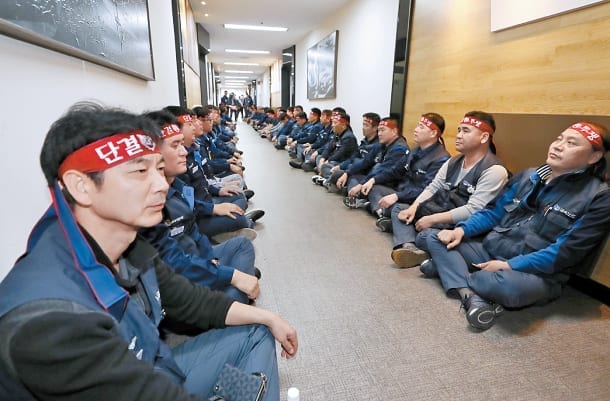
    Kia Motors will directly hire 1,300 employees at its contractors by next year in response to the Moon Jae-in administration’s goal of reducing the number of contract workers, the carmaker announced on Thursday.

    If it completes the transition, Kia Motors will have directly hired all contracted workers at its factories. Since 2015, Korea’s No. 2 carmaker has already directly hired 1,087 employees of its contractors as of this June.

    “The latest agreement between management and the labor union lives up to the current administration’s initiative on [improving the work environment for] contract workers,” the company said in a written statement Thursday. “The management and the union preemptively approached the issue and came out with a solution.”

    The agreement, which was made at Kia Motors’ Sohari factory in Gwangmyeong, Gyeonggi, on Wednesday comes two weeks after the Ministry of Labor announced that it is considering mediating the employment issue between Kia Motors and its contracted workers. Until recently, Hyundai Motor Group avoided negotiating directly with contracted workers, as it already had its hands full dealing with its permanent employees.

    In July, however, a committee dedicated to reforming unfair administrative issues at Ministry of Labor advised the ministry to resolve an illegal dispatch of workers issue at Hyundai Motor Group. In response, the labor ministry recently told the carmaker to directly negotiate with the contracted workers at its company.

    Kia Motors’ bigger affiliate, Hyundai Motor, has already been working on the issue since 2017. In 2017, the carmaker directly hired some 6,000 employees from its subcontractors. From 2018 to 2021, the carmaker also promised to directly hire an additional 3,500 employees.

    “The latest agreement will put an end once and for all to the issue of contractors’ employees at Kia Motors,” said an official from the carmaker.

    In 2015, Kia Motors’ contract workers’ unit of the Korean Metal Workers’ Union sued Hyundai Motor Group Chairman Chung Mong-koo and Kia Motors CEO Park Han-woo for violating regulations on dispatched workers, but the case has not been decided yet.

  • Automotive sales in September to be lower than in August: Research

    Automotive sales in September to be lower than in August: Research

    Kenanga Research expects sales volume for the automotive sector in September to be lower than the August 2018 level with the end of the tax holiday, despite certain makes seeing reduction in prices under the sales and service tax (SST) regime.

    “With the new SST gazetted on September 1, 2018, vehicles are charged 10% sales tax. Nevertheless, from the recent announcement by certain car makers, the prices for the locally-assembled and completely-knocked-down (CKD) units have dropped by 1% to 3% (compared with 6%-rated goos and services tax), whereas the prices for the completely-built-up (CBU) units have increased by 1% to 3%,” it said in a research note last Friday.

    Kenanga Research believes the unexpected price decrease in locally-assembled and CKD units was attributed to the better compliance of Industrial Linkage Programme regulation, which provides incentives and duty exemption to the original equipment manufacturers that use local components under the National Automotive Policy 2014.

    The research house is maintaining a “neutral” rating on the automotive sector, with Tan Chong Motor Holdings Bhd being the top pick for its turnaround in earnings after two consecutive years of losses with focus on high-margin vehicles, and expected expansion of its Indochina operations for larger market share volume.

    “Our other top pick for the sector is MBM Resources Bhd, which is trading at an undemanding 6.3 times FY18 PER (price-to-earnings ratio) compared with the five-year forward average of 11 times.”

    According to the Malaysian Automotive Association, Malaysia’s vehicle sales increased 27% year-on-year to 65,551 units in August, ending the historic three-month zero-rated tax holiday.

    However, on a month-on-month basis, car sales dropped 4% due to Perodua’s supply disruption and run-out of popular passenger vehicle models during the first two months of the tax holiday.

  • India is Hyundai’s land of opportunity

    India is Hyundai’s land of opportunity

    Hyundai Motor is still working hard to woo Indian consumers as the world’s second-most populous country emerges as one of the fastest growing markets in the global auto industry.

    Hyundai Motor Vice Chairman Chung Eui-sun made a speech at the first Move Global Mobility Summit on Thursday, presenting the automaker’s plan to pursue future mobility and its dedication to the Indian market.

    The summit is a two-day state-run event taking place in New Delhi under the theme “Shared, Connected and Zero Emissions Mobility.” More than 1,200 attendees, including the CEOs of auto giants and start-ups, will participate in discussions centering on future mobility.

    “Hyundai Motor will actively pursue to become a smart mobility solution provider from a manufacturer,” Chung said in his speech.

    “I am certain that innovation in mobility will improve not only people’s lives but also improve environment and energy issues at the same time. It will also act as a means to connect the urban with the suburban and a person with another person,” he added.

    Chung also unveiled plans to launch a total of four eco-friendly vehicles in India in the near future, three of which will be electric models and the fourth a hydrogen-powered Nexo.

    Hyundai Motor, the world’s fifth-largest automaker, has seen huge potential in India’s auto market for some time.

    India is currently the world’s fourth-largest auto market, posting a year-on-year sales growth rate of 9.5 percent according to 2017 market data.

    Hyundai Motor established its Indian office in 1996 and has been using the regional office as an export hub, sending cars made there to more than 90 countries.

    Hyundai Motor is currently the No. 2 player in India. It sold some 320,000 units this year as of July, posting a year-on-year growth rate of 7.5 percent. The i20 hatchback and small SUV Creta are the most popular models.

    Most recently, the automaker has made a hefty investment in local car-sharing start-up Revv.

    Hyundai’s smaller affiliate Kia Motors belatedly entered the Indian market in 2017 by starting the construction of a local factory with a $1.3 billion investment. It will start sales of its models from next year.

    At the forum, Hyundai Motor summed up its strategies in pursuing future mobility with three keywords – clean mobility, freedom in mobility and connected mobility.

    “India has been taking significant steps toward the future it has long dreamt of,” Chung said. “[The country] will play a leading role not only in the manufacturing industry but also in ICT in the face of the fourth industrial revolution as well,” he added.

    According to Hyundai Motor, Chung attended a tea meeting with Indian Prime Minister Narendra Modi and 50 other global companies CEOs after making the speech on Thursday.

    The CEOs of Maruti Suzuki, Mahindra & Mahindra, Tata, Toyota, Ford, Mercedes-Benz, Uber and SoftBank all attended the summit.

  • Expert investigation says BMW software to blame in fire incident

    Expert investigation says BMW software to blame in fire incident

    An investigation by the Korea Consumer Association (KCA) concluded that the spate of BMW fires that left Korea in a state of panic over the summer was the fault of the engine control unit (ECU) software, not the hardware issue that the German carmaker has maintained.

    The KCA claim that BMW updated the ECU software to make an engine part, called the bypass valve, open at higher temperatures, leading to higher engine performance and better fuel efficiency but also to a higher risk of fire.

    “An update in the ECU to enhance the car’s performance and fuel efficiency is not wrong by itself,” said Lee Ho-geun, an automotive engineering professor at Daeduk University who is leading the investigation team at the KCA, at a press briefing Tuesday.

    “But the fact that the carmaker didn’t fortify other parts to make them endure higher temperatures, leading to engine fires which put consumers’ lives at risk, is wrong,” Lee added.

    The KCA’s investigative team comprising of experts in the auto industry and law carried out a separate investigation into two BMW vehicles manufactured before August 2011 that are not subject to recalls and four recall-subjected cars.

    The team said that the bypass valve for recall-subjected vehicles opened while in operation, while that of vehicles not subject for recall didn’t open at all while in operation.

    According to Lee, a bypass valve in a diesel engine is generally supposed to be closed in order to block gas that’s hotter than 500 degrees Celsius (932 degrees Fahrenheit) from entering the intake manifold in the engine. It usually opens when the coolant’s temperature is lower than 50 to 60 degrees Celsius.

    “Bypass valve operation is controlled by the ECU,” said Lee. “If a vehicle opens the bypass valve while driving – causing a high possibility of a fire breaking out – it means BMW set the software to behave that way.”

    BMW Korea has persistently claimed that the cause of the fire is a hardware issue in the exhaust gas recirculation (EGR) cooler and valve. The ongoing recall process also includes replacing the two parts and cleaning the EGR pipe.

    The KCA investigative team said it is nothing but a temporary fix.

    “It will reduce the number of fires until the car gets that much accumulated sediment inside the pipe,” said Choi Younh-suk, a professor of smart automotive engineering at Sun Moon University at the briefing.

    According to Koo Bon-seung, an attorney at Heon Law, who is in charge of handling legal issues for the team, a total of 1,784 BMW owners have applied for a class-action lawsuit against BMW with Heon.

    Each owner will seek 15 million won ($13,547) in compensation.

    “As this case involves compensation worth 15 billion won in total, we are going to seek the provisional attachment of BMW Korea headquarters in central Seoul as well as the BMW Driving Center in Incheon and other logistics centers as well,” Koo said.

    Meanwhile, BMW Korea Chairman Kim Hyo-joon said he will look into the option of suspending sales of affected cars in Korea at a hearing held at the National Assembly on Tuesday.

    Kim said he feels shame for selling such defective vehicles in Korea and said he will take responsibility.

    Kim reiterated that the issue derives from a defect in the vehicles and not from the driving habits of Korean consumers.

    Earlier this month, BMW spokesman Jochen Frey came under fire for blaming Korean driving habits and traffic conditions for the fires in an interview with Chinese media. BMW Korea instantly refuted the comment, saying it was a translation error.

  • Vietnam BMW importer faces fines for faking documents, evading tax

    Vietnam BMW importer faces fines for faking documents, evading tax

    Vietnam’s Finance Ministry has accused the sole importer of BMW cars of several violations, but won’t press criminal charges.

    The trader, Euro Auto, which was Vietnam’s sole official of BMW cars until this year, created fake invoices and packing lists for 133 BMW cars in December 2016, the ministry said in a letter recently sent to Prime Minister Nguyen Xuan Phuc.

    It plans to fine the firm VND40-80 million ($1,700-3,400) for this fraud.

    Euro Auto “did not list or listed incorrectly” VND105 million ($4,500) in expenses incurred in importing the cars, which resulted in a tax loss of about VND180 million ($7,700), the ministry said.

    It said it plans to fine Euro Auto 20 percent of the tax loss, apart from collecting the back taxes.

    The ministry will allow the cars, which are at the Vietnam International Container Terminal port in HCMC, to be returned to Germany, if it requests. It will also refund taxes paid if the cars are returned.

    If Euro Auto still wants to import these cars into Vietnam, the PM should take a final decision on this issue because current laws don’t deal with such a situation, the ministry said.

    It also said it plans to fine Euro Auto chairman Simon Adrew Rock for evading special consumption tax.

    From July 2016 to March 2017, Euro Auto evaded VND7.3 billion ($312,700) in taxes by listing wrong information about its imports.

    Although the HCMC Tax Department issued a warning and fined the firm in September 2016, it persisted with the practice.

    The company even produced fake invoices to legalize the purchase of auto parts for the BMW cars from the open market instead of authorized agencies.

    The letter noted that PM Phuc had decided not to criminally punish Simon Adrew Rock and other individuals involved in tax evasion in the spirit of maintaining good relations between Vietnam and Germany, Malaysia and the U.K., where these cars have been imported.

    In late November 2016, the Ministry of Finance ordered customs agencies to suspend clearance procedures for imported BMW cars in order to investigate alleged violations by Euro Auto.

    Ministry officials found that the importer had falsified purchase contracts and receipts while importing the cars and failed to provide certificates of origin and other required documents.

    Euro Auto rejected these allegations.

    In April last year, HCMC police arrested Euro Auto CEO Nguyen Dang Thao and two delivery employees for faking import documents.

  • Kia Motors unveils KX1 entry-level SUV in China

    Kia Motors unveils KX1 entry-level SUV in China

    Kia Motors, Korea’s second-largest automaker, said Thursday that it has unveiled its KX1 entry-level SUV in China in its latest move to meet the demands of young customers.

    The KX1 SUV comes with a 1.4-liter MPI gasoline engine mated to a five-speed manual gearbox or a six-speed automatic transmission, the carmaker said.

    Chen Bingzhen, a senior executive at Dongfeng Yueda Kia, said the KX1 is a trendy SUV that has been tailored specifically to young people.

    Dongfeng Yueda Kia is a joint venture between Kia Motors and China’s Dongfeng Motor.

    Kia has three plants in China, which have a combined capacity of 890,000 units.

    The carmaker sold 191,328 cars in China in the January-July period, up 27.8 percent from the same period a year earlier.

  • Cadillac House Korea aims for the trendy

    Cadillac House Korea aims for the trendy

    Cadillac hopes to shake off its stodgy image and attract younger, trendier drivers in Korea, and it has opened a flashy brand experience center to win them over.

    The American luxury brand opened Cadillac House Seoul in southern Seoul on Monday. Visitors can check out photo exhibitions and souvenir shops related to the brand, and many of the carmaker’s models are also on display.

    Cadillac House operated as a pop-up store last year, but the company decided to make it permanent after receiving positive feedback.

    “Our objective this year is to diversify marketing strategy to increase point of contact both online and offline,” Cadillac Korea President Kim Young-sik said in a press conference held Monday at Cadillac House Seoul.

    Cadillac Korea unveiled the Escala Concept sedan in Korea for the first time. It was first revealed in the United States in 2016. Cadillac, which is known for its bulky and classic designs, added futuristic features to the concept car, including a curvy sideline and vertical headlight lamp in the front. The carmaker said that this design identity will be implemented in the company’s production lineup from 2021. The Escala will be on display at the Cadillac House for the next three weeks.

    Cadillac Korea also unveiled a limited-edition version of its ATS sedan called the ATS Supreme Black. The all-black limited edition vehicle also has some of the performance features, such as a rear spoiler, that are only found on Cadillac’s premium vehicles. Fifty of the cars will be sold in Korea.

    The photo exhibition on the second floor showcases Cadillac Korea’s collaboration with camera brand Leica. Three renowned figures in art and culture took photos of Cadillacs in different cities with Leica cameras. Donghae from K-pop group Super Junior is one of the photographers.

    The souvenir shop on the first floor sells diverse lifestyle and fashion products Cadillac developed with New York-based designer Jamie Lee.

    Kim said that Cadillac House showed the carmaker’s ambition to renew its image and become more attractive to younger buyers. It said the latest change of the company’s name from GM Korea to Cadillac Korea will contribute to improving the brand’s image.

    “The fact is that Korea is the only country among Cadillac’s 52 global market that uses the car’s brand [Cadillac] as the company’s name, whereas other countries still use just GM,” Kim said. “It shows that the New York headquarters is showing that there is much interest in the Korean market and a willingness to invest here.”

  • Vietnamese firms conspicuously absent as auto parts industry thrives

    Vietnamese firms conspicuously absent as auto parts industry thrives

    Vietnam enjoys a trade surplus in the auto parts industry, but domestic firms play no role in this success.

    The reason for this strange situation is that the market is dominated by export-oriented foreign invested enterprises, while domestic firms are shackled by a lack of policy and regulatory support, both officials and industry insiders say.

    Last year, the country exported $4.4 billion worth of auto parts and imported the same $3.5 billion, said Nguyen Thi Xuan Thuy, head of research at the Institute of Strategic Research and Policy under the Ministry of Industry and Trade.

    This trade surplus of $900 million mostly came from foreign direct investment (FDI) businesses, not local firms, she said at a recent conference.

    The FDI businesses, including Nissei, Furukawa, MTEX, FAPV and Pronics, produce in Vietnam and export auto parts to major auto makers in China, Japan, Korea, Thailand and the U.S, she added.

    Importers of made-in-Vietnam auto partsin percentageJapanU.S.ChinaKoreaThailandGermanyOther countries

    Meanwhile, for the automakers in Vietnam, 90 percent of the 30,000-40,000 parts to make a car are imported, said Pham Tuan Anh, deputy head of the Department of Industry under the Ministry of Industry and Trade.

    There is a lack of suppliers in Vietnam compared to other countries in the region, he added.

    Echoing Anh, Thuy said that Vietnam has 20 auto assemblers, but only 226 parts suppliers. Neighboring Thailand, meanwhile, has 16 auto assemblers and 2,390 suppliers.

    Many constraints

    Vietnamese companies in the auto parts industry face many challenges, and one of them is the lack of assistance in terms of legal framework, said Do Huu Hao, chairman of the Vietnam Society of Automotive Engineers.

    Regulations concerning parts suppliers are changed often and the tax policies are also unsuitable for the industry, he said.

    Another reason is that local manufacturers have limited financial capacity to compete with their foreign counterparts.

    The auto part industry is heavily dependent on imported material, but the low financial capacities of local suppliers prevent them from buying more of it, Hao said.

    These factors make cars made in Vietnam 10-20 percent more expensive that of Thailand or Indonesia.

    Vietnam’s total vehicle sales increased 3.9 percent to 21,466 units in July from a year ago, according to the Vietnam Automobile Manufacturers’ Association (VAMA).

    Total vehicle sales in the first seven months of 2018 dropped 4.1 percent from the same period last year to 148,536 units, VAMA said.

  • Korea falls in love with electric vehicles

    Korea falls in love with electric vehicles

    The adoption of electric vehicles may have been rather slow in Korea, but the market for micro electric vehicles – small two-seater electric cars with less range but cheaper price tags – is booming.

    While sales figures and the charging infrastructure for EVs in Korea falls well behind other countries like Japan and the United States, micro electric vehicles are proving surprisingly popular.

    Renault’s Twizy has become the global poster boy for these mini EVs. In Korea, 984 of the tiny Renault Samsung Motors’ cars were sold in the first half of this year, nearly double the number sold in the previous half. Globally, an average of about 1,300 Twizys are sold every six months, which means that nearly 90 percent of global sales took place in Korea this year.

    In fact, the Twizy is so popular here that the French headquarters is considering moving some of the assembly line from Spain to Korea.

    One of the biggest benefits of micro electric vehicles, like the Twizy, is that they do not require a new charging infrastructure. The vehicles can be charged through any standard 220-volt socket – it takes 3.5 hours and costs about 600 won ($0.53) to fully charge the battery.

    To foster the industry, the government in June categorized electric micro cars in the compact car segment, giving new legal grounds for diverse R&D activities and the establishment of better safety standards.

    Seizing on the opportunity, multiple midsize companies have jumped on the bandwagon and are introducing increasingly souped-up micro electric vehicles.

    Daechang Motors, manufacturer of the infamous Yakult cart in Korea, started mass producing a two-seater electric vehicle called the Danigo in March. The new model costs only about 5 million won for Seoul residents after subsidies, one of the cheapest models on the market.

    Semisysco, another midsize company, has been selling a two-seater electric vehicle called the D2 since February. The D2 is manufactured by Chinese firm Zhidou, and Semisysco is in charge of importing them. From later this year, however, Semisysco is planning on manufacturing them in Korea.

    “The micro e-mobility industry has even more possibilities than traditional electric cars in Korea at the moment,” said Kim Pil-soo, an automotive engineering professor at Daelim University College in Gyeonggi.

    “It has a lower entry barrier from both manufacturers and customers. It is definitely a fledgling industry now but has a lot of potential to grow,” he added.

    Safe and economical

    Upon the government’s announcement on the renewed car segment categorization, institutions that rely on delivery have quickly started to adopt the micro electric vehicles to replace their motorbikes and scooters.

    Korea Post is at the forefront.

    Just last month, the postal delivery service pledged to buy 1,000 micro-electric vehicles to replace its two-wheeled delivery vehicles this year. It said it will replace 66 percent of its current 15,000 two-wheeled vehicles into micro electric cars by 2020.

    “About 300 accidents are reported per year while delivering post,” said Sunwoo Hwan, an official at Korea Post.

    “It mostly results in the driver being severely hurt. In that sense, micro electric vehicles are much safer for delivery drivers,” Sunwoo added.

    Operation costs are also as advantageous when utilizing micro electric vehicles, according to the official.

    “For two-wheeled vehicles, we estimate the life span to be about three to four years,” the official said. “For micro e-mobility, we estimate them to last about eight years. The initial cost may be more expensive but not if you see it in the long term.”

    Fried chicken franchise BBQ has also signed a memorandum of understanding with Renault Samsung Motors to use their Twizys to deliver chicken. It said it will gradually implement a total of 1,000 Twizys within this year.

    “On top of enhanced safety compared to two-wheeled bikes, micro electric cars are extremely cost-effective because it costs about 20,000 won to 30,000 won in charging fees per month,” the chicken company said in a written statement.

    Korea, known for its top-notch delivery service, will continue to take advantage of the new option in the delivery method.

    Shake Shack, La Grilla and Baskin Robbins, which are all F&B affiliates of SPC Group, have also started using Twizys in their delivery fleet to test out their convenience. Pizza delivery franchise Pizza Alvolo also uses Daechang Motors’ Danigo.

    “Demand for delivery food is on a constant rise, and we decided to use Twizy to enhance the convenience of the customers and the staff as well,” a spokesman at SPC Group said.

    Easier access

    Traditionally, cars are purchased at offline dealerships where a long consultation with a talkative dealer is inevitable. Manufacturers of micro electric vehicles are shifting the retail landscape by offering the cars online and in discount stores.

    Daechang Motors has been offering its Danigo vehicle on e-commerce platform TMON since January. It first put a limited 100 units on the platform, but they sold out in two days. It added 200 more units afterwards but they sold within a day as well.

    On the back of such popularity, Daechang Motors is currently offering its cars only through TMON.

    Semisysco is also opting for an online platform to enable easier access to the car.

    It started offering its electric vehicle D2 through Interpark in July.

    It has also signed a partnership with Emart, Korea’s largest discount chain, to display its vehicle along with other household products. The D2 is available at 21 Emarts and other affiliated stores nationwide.

    “The largest number of orders is through Emart,” a spokesperson for Semisysco said.

    “Its price is not burdensome. People who come to the discount store to shop for other products can casually look around, and sometimes that leads to purchase decisions,” the spokesman added.

    Renault Samsung Motors and Semisysco said a majority of their cars’ purchases were made for individual use, such as commuting.

    Room for improvement

    Despite the economic value and agility on narrow roads, it’s not all plain sailing in a micro electric car.

    Under current regulations, vehicles that cannot travel faster than 80 kilometers (50 miles) per hour are not allowed to drive on highways or roads that are built exclusively for cars.

    Although this might not be an issue for short commuting within metropolitan areas, it means that long-distance driving on the weekends or on holidays will not be possible with these miniature vehicles.

    Ultimately, this is the same hurdle that conventional electric cars face when trying to expand in Korea.

    Price could also be an issue for some potential customers. An average price of 9 million won may be cheaper than conventional electric vehicles, but with that money, people can also buy a compact internal combustion engine car from domestic carmakers or a small sedan from a secondhand car market.

    “A subsidy needs to be maintained or expanded in order to further foster the industry,” said Kim. “This segment is completely new and people’s awareness is still lacking,” he added