Category: E-Tailing

Retail News Asia is committed to providing both local and global retailers with the latest E-Commerce & Etail news throughout the Asian market. This on a daily base.

  • Trade Minister Warns about E-Commerce Funding Crisis

    Trade Minister Warns about E-Commerce Funding Crisis

    Trade Minister Thomas Lembong asked Indonesia e-commerce companies to be careful in assessing risks posed by the e-commerce business.

    “What would happen if the funding stopped? In the United States, tech business boom has started to decline,” Thomas said at the Indonesia E-commerce Summit & Expo in BSD, South Tangerang, on Wednesday, April 27, 2016. “I’m always paranoid. As a risk manager, I always ask ‘what if’.”

    Thomas added the natural selection in online business would determine which companies would continue exist. According to him, a business with a fast downturn will have a short cycle. Therefore, Thomas suggested business owners to prepare for “rainy days”.

    The Trade Minister revealed that other ministers in President Joko “Jokowi” Widodo’s Working Cabinet were proud with Indonesia’s e-commerce rapid growth. Thomas said that he wanted his ministry to learn from former US President Bill Clinton’s administration that supported the development of the Internet. Thomas explained Clinton improved the Internet with ‘light touch’ and refused the temptation to regulate everything on the Internet.“Innovation can thrive without restrictions. There has to be a space to develop. Innovators are usually rebellious,” Thomas added.

  • KinerjaPay Establishes Wholly-Owned Subsidiary in Jakarta

    KinerjaPay Establishes Wholly-Owned Subsidiary in Jakarta

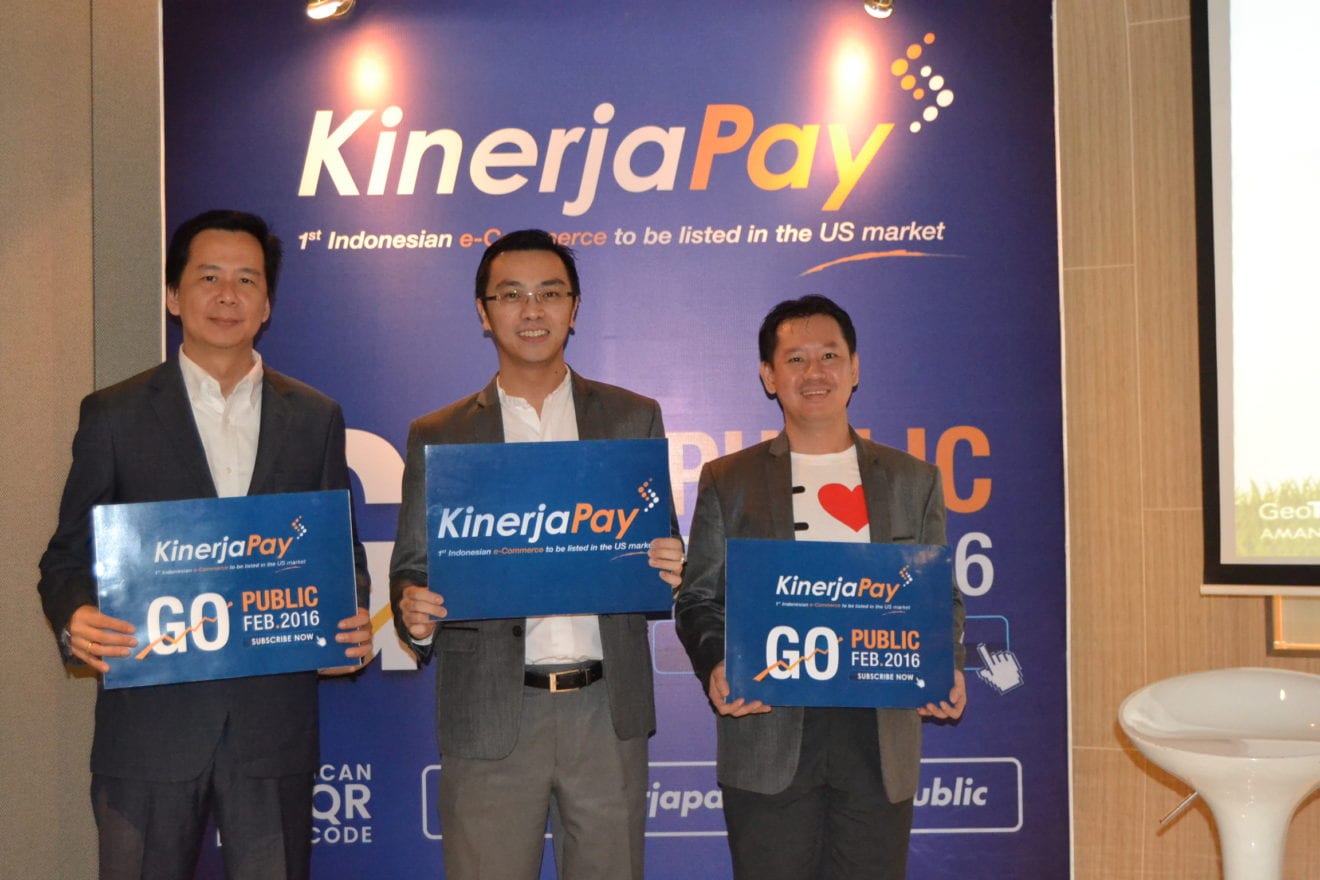
    KinerjaPay, today announced that it established its new wholly-owned subsidiary, PT Kinerja Pay Indonesia, with offices located in Jakarta city, Indonesia. The new Subsidiairy was organized under Indonesian Incorporation Law Article No.34, dated 14 April 2016, and Principal License from Indonesia Investment Coordinating Board (BKPM) No.909/1/IP/PMA/2016 dated 06 April 2016. The Company has also appointed Mr. Deny Rahardjo as Chief Executive Officer (CEO) of PT Kinerja Pay Indonesia.

    Mr. Edwin Ng , Chairman and CEO for KinerjaPay Corp. stated. “We are extremely excited that Mr. Rahardjo accepted his appointment as CEO of our new subsidiary, PT Kinerja Pay. With his extensive experience in Information Technology and Business Management, Mr. Deny Rahardjo is the right person to manage and expand Kinerja Pay’s business operations in Indonesia. With Deny Rahardjo at our helm, we plan to grow our business and become one of the largest mobile payment and eCommerce providers in Indonesia. Since 2015, we have registered more than 35,000 active users with total of 170,000 transactions to date. We fully believe that Mr. Rahardjo, formerly a Microsoft, Polycom, and Telstra Executive in Singapore, will truly revolutionarize eCommerce in Indonesia and enable Kinerja Pay to become the most highly used and popular online payment solution/platform within the next several years, as well as expand its business opportunities throughout the SE Asian marketplace.”

    Mr. Ng further stated that “we chose to establish our initial business operations in Indonesia due to several economic factors, including its population size (est. 260 million according to Worldometers), user demographics, which consists of younger generations, and its ever-growing eCommerce market, which is expected to reach USD $3.8 billion by 2019.”

    With the growing trend of online shopping, Kinerja Pay will offer its users with convenient shopping experience as well as secure payment option. The Company also expects to launch several other applications to complement its mobile eWallet business by entering into other eCommerce verticals such as travel industry, fashion, online games, time-saver application, and many more.

    Notice Regarding Forward-Looking Statements

    This press release may contain forward-looking statements, about KPAY’s expectations, beliefs or intentions regarding, among other things, its product development efforts, business, financial condition, results of operations, strategies or prospects. In addition, from time to time, KPAY or its representatives have made or may make forward-looking statements, orally or in writing. Forward-looking statements can be identified by the use of forward-looking words such as “believe,” “expect,” “intend,” “plan,” “may,” “should” or “anticipate” or their negatives or other variations of these words or other comparable words or by the fact that these statements do not relate strictly to historical or current matters. These forward-looking statements may be included in, but are not limited to, various filings made by KPAY with the U.S. Securities and Exchange Commission, press releases or oral statements made by or with the approval of one of KPAY’s authorized executive officers.

    Forward-looking statements relate to anticipated or expected events, activities, trends or results as of the date they are made. Because forward-looking statements relate to matters that have not yet occurred, these statements are inherently subject to risks and uncertainties that could cause KPAY’s actual results to differ materially from any future results expressed or implied by the forward-looking statements.

    Many factors could cause KPAY ‘s actual activities or results to differ materially from the activities and results anticipated in such forward-looking statements, including, but not limited to, the factors summarized in KPAY ‘s filings with the SEC. In addition, KPAY operates in an industry sector where securities values are highly volatile and may be influenced by economic and other factors beyond its control. KPAY does not undertake any obligation to publicly update these forward-looking statements, whether as a result of new information, future events or otherwise. Please see the risk factors associated with an investment in our securities which are included in our Annual Report on Form 10-K as filed with the U.S. Securities and Exchange Commission on February 11, 2016.

  • Lazada Malaysia claims double-digit growth

    Lazada Malaysia claims double-digit growth

    Online retailer Lazada Malaysia claims it had at least double-digit growth in sales last year, yet is still losing money.

    It was a challenging year for retail, says CEO Hans-Peter Ressel of Ecart Services Malaysia, the company behind Lazada Malaysia.

    He says the focus is now on making Lazada’s service more accessible to the “general masses”, particularly those in east Malaysia, starting with improving its logistics and distribution centres in east Malaysia, where the company had 80 per cent sales growth last year.
    However, this growth was lower than in other regions, which saw at least 110 per cent year-on-year growth, says Ressel.

    He says Lazada would appeal to most Malaysians because of its affordability, accessibility and convenience. With its complex supply chain, Lazada and its 10,000 third-party sellers can now offer products below store prices, and many of the 5.5 million items on sale are not even available in stores in Malaysia.

    Lazada had the most application downloads of e-tailers in Malaysia, 2.3 million as at the end of December. Second is 11street.my at half of Lazada’s downloads, while fashion application Zalora had 700,000 downloads.

    Malaysia has 10.3 million smartphone users, according to mobile marketing firm Vserv.
    Ecart Services wants to double its items in inventory to 10 million stock-keeping units this year. The company will also have a third warehouse 16 times larger than its first warehouse in Subang Jaya, plus there is another warehouse and distribution centre in Sarawak.

    Ecart Services’ new loss blew out by 72.94 per cent to RM87.54 million (US$22.28 million) in the financial year ended December 31, but its its top-line growth of 142.22 per cent saw record sales of RM114.81 million from RM47.4 million the previous year. Ressel says the company has yet to break even.

    Following Alibaba Group Holdings’ purchase of Lazada Group, founded by Germany’s Rocket Internet in 2012, Ressel said he looks forward to more synergies between the two eCommerce giants.

    “With Alibaba’s eCommerce knowhow, systems and processes, we will also be better able to help our sellers grow their businesses.”

  • Indonesia’s Muslim cyber warriors take on IS

    Indonesia’s Muslim cyber warriors take on IS

    A group of Indonesian “cyber warriors” sit glued to screens, as they send out messages promoting a moderate form of Islam in the world’s most populous Muslim-majority country.

    Armed with laptops and smartphones, some 500 members of the Nahdlatul Ulama (NU) – one of the world’s biggest Muslim organisations – are seeking to counter the Islamic State group’s extremist messages.

    “We’ll never let Islam be hijacked by fools who embrace hate in their heart,” tweeted Syafi’ Ali, a prominent member of the NU’s online army, a typical message to his tens of thousands of followers.

    They are trying to hit back at IS’s sophisticated Internet operations, which have been credited with attracting huge numbers from around the world to their cause.

    Internet propaganda is believed to have played a key role in drawing some 500 Indonesians to the Middle East to join IS, particularly among those living in cities where it is easier to get online.

    The dangers of the growing IS influence in Indonesia were starkly illustrated in January when militants linked to the jihadists launched a gun and suicide bombing attack in Jakarta, leaving four assailants and four civilians dead.

    It was the first major attack in Indonesia for seven years, following a string of Islamic militant bombings in the early 2000s that killed hundreds.

    As well as firing off tweets, the NU members have sought to dominate cyberspace by establishing websites promoting the group’s moderate views, an Android app and web-based TV channels, whose broadcasts include sermons by moderate preachers.

    The initiative has been building momentum for a while but started to pick up pace a few months ago. A handful of cyber warriors operate from a small office in Jakarta, while the rest work remotely, and the group mostly communicate with one another over the web.

    But it will be an uphill battle and the NU, which has been promoting moderate Islam for decades, conceded they have previously struggled to take on IS’s hate-filled messages.

    “NU has for a while wrestled with this radical propaganda,” said Yahya Cholil Staquf, secretary general of the NU, which claims at least 40 million followers.

    “Every time we defeated them, it didn’t take long for them to regain their strength.”

    The online drive comes as the NU is set to take its campaign to promote their tolerant form of Islam onto the international stage this week, with a two-day meeting from tomorrow of moderate religious leaders from around the world.

    They aim to showcase their particular brand of the Muslim faith, known as “Islam Nusantara”, to counter the IS jihadists’ radical interpretation of Islam.

    Meaning “Islam of the Archipelago” – Indonesia is the world’s biggest archipelago, comprising over 17,000 islands – it is accepting of diversity and stresses non-violence.

  • WearYouWant advises start-ups to add profitability to execution strategy

    WearYouWant advises start-ups to add profitability to execution strategy

    WearYouWant, Thailand’s leading online fashion and beauty marketplace is advising start-ups to have a clear strategy toward profitability as investors are now demanding it and that the e-commerce space in SE Asia is currently experiencing an exciting time.
    At the Last Mile Fulfilment Asia (LMFAsia) Conference & Exhibition 2016 held in Singapore last month which brought together  retailers, e-commerce businesses, logistics and parcel industry professionals, CEO and Co-Founder of WearYouWant Martin Toft Sorensen said there was considerable discussion on how start-ups should focus beyond just team, product and market to become successful.
    “Start-ups should have a clear path and strategy towards achieving profitability by scaling the business without forgetting the life time value of the customer versus cost per acquisition,” pointed out Sorensen.
    “If e-commerce businesses simply follow a desire to climb user acquisition heights quickly without keeping an eye on the ROI, there is a higher risk of a greater fall. Penetration from online platforms can go far, wide and deep but the trajectory needs to be based on running a business that brings money for investors, shareholders and other stakeholders in the near future.”
    Echoing this advice is Thailand’s e-commerce guru, Pawoot Pongvitayapanu, CEO and Founder at efrastructure inc. and Managing Director and Founder of TARAD.com, who also attended the business platform event. 
    Sorensen advises that in addition to creating a viable business model that balances cost of acquiring customers with the ability to monetize the lifetime value of a customer, start-ups should also be creative in how to attract and keep customers. 
    While many e-commerce sites are reporting high sales growth, the reality is that they may not be showing any profitability, said Sorensen. 
    “In Thailand, we have yet to see any e-commerce companies proving they can scale and yet become profitable.
    The recent acquisition of Rocket Internet’s fast growing, yet loss-making e-commerce site Lazada by Chinese e-commerce giant Alibaba, and Zalora (Thailand and Vietnam) by Central Group, has definitely created waves in the e-commerce industry”.
     Martin (left) and Pawoot (right) at LMF Singapore Mar2016_RS
    Sorensen says that while Lazada will pave the way for Alibaba to penetrate into SE Asia in a market leader position, it remains to be seen whether Zalora’s acquisition by a traditional offline retailer will kick start true omni-channel experiences in Thailand.
     
    Sorensen adds that this is an exciting time particularly for e-commerce companies and start-ups in general, as well as for investors. 
  • AEON Showcase Their Product Line-Up and Other Financial Services at the 16th Money Expo Bangkok

    AEON Showcase Their Product Line-Up and Other Financial Services at the 16th Money Expo Bangkok

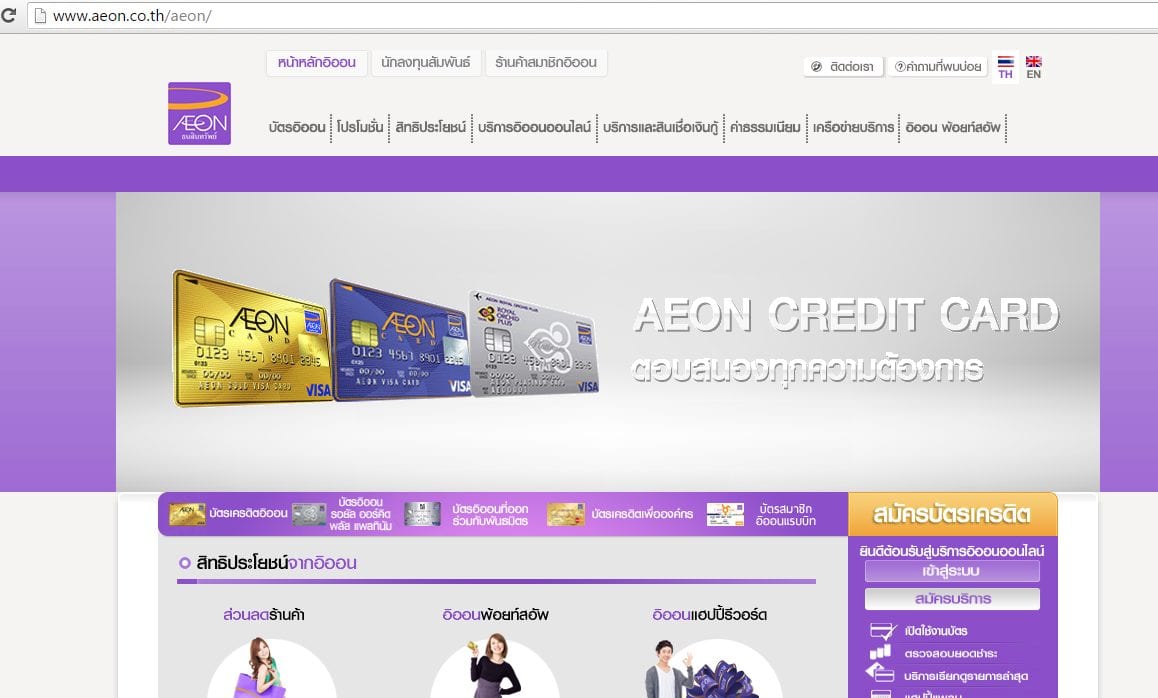
    AEON Thana Sinsap (Thailand) Public Company Limited will join the 16th Money Expo Bangkok from May 12th to 15th 2016 at Challenger Hall 2 – 3 , Impact Arena, Muang Thong Thani. AEON’s booth, B1, is inspired by the concept “Your Future Begins Today” with the beautifully laid out on the 850 square meters spread.

    At the expo, AEON line up their various financial services including the AEON M GEN VISA Card which aims to offer the special entertainment privileges to match with customers’ lifestyle such as free movie ticket every month, exclusive discounts for M GEN Set at THB 120 and M GEN Buddy Combo set at THB 99. Moreover, AEON introduces the AEON Royal Orchid Plus JCB Platinum Card exclusively for Japan lovers which exchange every THB 20 spending to 1 mileage as well as access to our exclusive lounge and discounts to many Japanese restaurants. Exclusively for AEON customer who subscribe to any service with AEON, they will get a chance to win the luxurious 3 days and 2 nights accommodation package from Sri Panwa valued at THB 112,800 as well as iPhone 6s 64 GB valued at THB 30,700 , John Lang Ford bag valued at THB 1,290 and other various premium.

    AEON customer will also enjoy other exclusive deals such as special interest 0% installment on the Honda motorcycle or gold, special tour packages from H.I.S and insurance services. They will also be entertained with a special mini concert from Bie Sukrit, Wier Sukollawat and Kang Vorakorn. For more information, visit www.aeon.co.th.

  • Amazon Q1 profits surge

    Amazon Q1 profits surge

    E-commerce giant Amazon.com posted its fourth straight profitable quarter, boosted by a 28 per cent sales increase and a surging growth in its Amazon Web Services division.

    Amazon reported a net income of $513 million for the first quarter, or $1.07 per share, compared with the net loss of $57 million, or $0.12 per diluted share, in first quarter 2015.

    The Seattle online retailer saw a 28 per cent increase in its net sales for the first quarter compared with the $22.7 billion in the previous corresponding period. Excluding the $210 million unfavourable impact from year-over-year changes in foreign exchange rates throughout the quarter, net sales increased 29 per cent compared to first quarter 2015.

    “Amazon devices are the top selling products on Amazon, and customers purchased more than twice as many Fire tablets than first quarter last year,” said Jeff Bezos, founder and CEO of Amazon.com.

    “Earlier this week, the $39 Fire TV Stick became the first product ever — from any manufacturer — to pass 100,000 customer reviews, including over 62,000 five star reviews, also more than any other product ever sold on Amazon. Echo too is off to an incredible start, and we can’t yet manage to keep it in stock despite all efforts,” Bezos said.

    Bezos added they are building premium products at non-premium prices, and they are thrilled many customers are responding to their approach.

    Amazon’s retail business saw a 31 per cent increase for the quarter to $20.5 billion, up from the $15.6 billion from the previous corresponding period.

    Amazon Web Services, with customers that include Netflix, Airbnb, Yelp and Expedia, saw a 63 per cent increase to $2.6 billion, up from the $1.6 billion from the same period the previous year.

    For the second quarter of 2016, the company expects its net sales to be between $28.0 billion and $30.5 billion, or to grow between 21 per cent and 32 per cent compared with the previous corresponding period. Operating income is expected to be between $375 million and $975 million, compared with the previous period’s $464 million.

  • Alipay extends partnership with Uber

    Alipay extends partnership with Uber

    Uber has teamed up with Alipay to allow passengers from China to pay for international Uber rides in Chinese yuan using their Alipay accounts.

    Alipay has been available as a payment option for Uber in China since 2014. However, Chinese travelers who wish to use the Uber service outside of mainland China require dual currency credit cards or currency conversions.

    The new deal aims to make the Uber service more accessible to Chinese travelers by doing away with this requirement.

    Uber’s head of business for Asia Pacific Eric Alexander told Economic Times that the partnership with Alipay will enable Uber to cater to the growing number of Chinese travelers who use Uber internationally. Alexander expects the integration to grow the number of rides taken by 9 to 10 times globally. Alipay’s userbase numbers 450 million.

    Alipay’s parent company, Alibaba, is an investor in Didi Kuaidi, Uber’s competitor in China.

    The partnership is also expected to affect Uber users from India due to Alipay’s partnership with Paytm, a mobile wallet and e-commerce operator in India.

    The latter is expected to integrate the Uber app into its own mobile app in the coming month.

    With the Paytm integration, riders in India will be able to use the Paytm app to hail Uber rides globally and pay for the service in their domestic currency.

    The integration is targeted at enabling passengers with no credit cards to use the Uber service internationally.

  • Applecrumby & Fish wins $300k funding boost

    Applecrumby & Fish wins $300k funding boost

    An online boutique that offers all-natural and organic baby products, Applecrumby & Fish has obtained a fresh round of seed funding worth $300,000 from Silicon Valley’s VC 500 Startups.

    The Malaysian company aims to use the money to establish itself as the top-of-mind site for safe baby essentials, reports Tech in Asia. Founded by husband and wife Sean and Jesmine Tan in Kuala Lumpur in late 2012, Applecrumby & Fish started out with 900 products. These have increased tenfold, and free same-day delivery is offered in its home market.

    Like other parents, the Tans resorted to importing their preferred baby products. After having their first child in 2011 they fell in love with organic brands not easily available in Malaysia.

    “We are very sensitive to the needs of parents who are looking for the best they can afford for their baby, at fair prices,” says Sean.

    Applecrumby & Fish sells skincare products, toiletries, food, supplements, gear and toys. Its brands include Bellamy’s, Drypers, Enfa, Gerber, MamyPoko, Putto, Spectra, Stephen Joseph and Quinny, and there are plans to add other brands not unavailable online.

    Its new funding will help it develop an in-house brand for baby products, starting with wipes and nappies. The company also wants to boost its content marketing and gear up for its launch in Indonesia as well as Brunei.

    As well as those markets, it ships to Singapore, Thailand and the Philippines.

    Applecrumby & Fish was among startups in the annual 10-week Distro Dojo program in Malaysia. Led by 500 Startups, the program focuses on customer acquisition, growth and distribution.

    Applecrumby & Fish graduated at the top of the program last month, increasing its site traffic by more than 200 per cent and tripling its revenue in less than four weeks.

    Meanwhile, the Tans aim to disrupt the diaper and wipes industry of South-East Asia with their inhouse brand, says Digital News Asia.

    “We have done our research and there is nothing quite like our brand in the market, not at our kind of non-premium pricing but with premium quality,” says Jesmine, who is also COO.

    She says the company has had 300 per cent year-on-year growth in terms of revenue, and aims to hit RM6 million (US$1.5 million) by the end of this year.

    Before launching Applecrumby & Fish, the Tans were property investors who also freelanced as interior designers. Despite Applecrumby & Fish sounding similar to US retail giant Abercrombie & Fitch, the name stems from their daughter’s first word at the age of six month, “apple”.

    “She would walk and crawl, dropping crumbs of food everywhere she went, hence crumby, while her favourite food was steamed fish,” says Jesmine.

  • BookMeds invited to move into Malaysia

    BookMeds invited to move into Malaysia

    Hyderabad-based startup BookMeds, which allows customers across India to order medicines online and have them delivered from their nearest pharmacy, may move into Malaysia.

    Launched in December 2013, BookMeds is now the third-largest online pharmacy chain after Apollo and Medplus. With a presence across 18 cities, it serves more than 15,000 customers and 400-plus pharmacies.

    Now BookMeds has been chosen by the Malaysian government’s Magic Accelerator program to explore entry into Malaysia.

    “The pharma-retail model in Malaysia is similar to that of India, offering BookMeds a great opportunity,” says BookMeds founder/CEO Mohammed Abubakr.

    Apart from finding workspace and accommodation, Magic provides advice on setting up a working model for Malaysia. “Initially, we will be targeting the urban population of Kuala Lumpur, then expand across Malaysia,” says Abubakr.

    Meanwhile, BookMeds is in discussions with venture firms to raise $2 million for its continuing expansion across India, with more than 50 cities as targets. Previously, the company raised seed funding from Flipkart VP Ravi Krishnaswamy and Xtream IT CEO Javed Sikander, along with angel funding from Back Office Associates CEO Krish Datta.

  • Awakening giant: E-commerce in China

    Awakening giant: E-commerce in China

    With the largest population and the most Internet users of any country in the world and the rise of its middle class, it is not surprising that China is also the world’s largest and fastest-growing e-commerce market. However, capitalizing on this huge market is becoming increasingly difficult for a variety of reasons.

    Recently, McKinsey, the consulting giant, released a new report on this burgeoning market that holds “enormous potential”.

    A growing market

    Two years ago, China’s online retail market overtook the United States’ online retail market. In 2015, China’s online retail market was approximately USD $630 billion of sales, the world’s largest and nearly 80 percent bigger than the US’.

    E-commerce in China accounts for 13.5 percent of all of its retail spending.  Although in the near term Chinese e-commerce is forecast to increase significantly, McKinsey’s survey shows that companies need to prepare for major changes in the Chinese market.

    Major changes coming

    From new customer segments to new product categories and sales channels, China’s online market is set for huge future growth. Representing 30 percent of total retail sales, the categories of consumer electronics and small appliances are well-established online categories, as is apparel.

    On the other hand, Food (including packaged and fresh food), is a category that faces more challenges and opportunities. Though 50 percent of respondents have purchased some food online, online spending represents only five percent of the total food spending.

    The category of food holds promise for companies that can attract consumers to do their regular grocery shopping online stand to capture a lot of business.

    Online-to-Offline (O2O)

    Consumers in China are accustomed to buying through O2O services companies—they are attracted to the website or app, then buy offline. The top sectors for O2O seem to be travel, dining, and mobility, where respondents who use O2O vendors report spending much more than they did before.

    Huge Opportunities

    McKinsey’s survey of China’s digital consumers tells us that growth in e-commerce and O2O is shifting to new areas. “Succeeding in this market is a matter of keeping pace with changes that are playing out across geographies, product categories, and channels.”

    The opportunities are huge for companies willing to look closely into these aspects of the market to find them, then move quickly to take advantage of them before their competitors can.

  • Indonesian ride-hailing firm Go-Jek needs more funds in market fight-CEO

    Indonesian ride-hailing firm Go-Jek needs more funds in market fight-CEO

    Indonesian online ride-hailing service Go-Jek is in talks with potential investors to raise fresh funds to expand the business, as the heavy subsidies it gives to drivers to keep rates competitive are unsustainable in the long run, its chief executive said on Friday.

    Go-Jek, a play on the local word for motorbike taxis, has become popular among commuters on the traffic-clogged streets of Jakarta as its phone app removes much of the hassle of finding a driver and negotiating fares.

    Go-Jek, which has a network of more than 200,000 motorbike taxi drivers, is battling aggressively with other ride-hailing apps such as Grab and Uber [UBER.UL], driving rates lower to gain market share in the country of 250 million people.

    But Go-Jek cannot afford to continue relying on subsidies as “you end up where you run out of money”, Go-Jek founder Nadiem Makarim told on the sidelines of an e-commerce industry conference in Jakarta.

    Raising funds from investors to expand the business is part of the solution, the Harvard Business School graduate said, adding that several venture capital and private equity firms have expressed an interest in Go-Jek because of its size and potential.

    Founded in 2010, Go-Jek has since increased its services to food deliveries, cleaning and even massages. The company, which already operates in big Indonesian cities like Bandung and Surabaya, also plans to broaden its reach and add more drivers.

    Its ambition, however, has been met with regulatory obstacles and strong resistance from established taxi operators such as PT Blue Bird Tbk and PT Express Transindo Utama Tbk.

    Taxi drivers’ protests turned violent in the Indonesian capital last month, when they called for ride-hailing apps to be banned. Government ministers had also said the tech firms should be subject to the same regulatory and tax requirements as conventional public transportation companies.

    Yet Go-Jek’s Makarim told a packed conference that regulations and demonstrations were not his “biggest headaches”.

    “For me, the number-one challenge is building something to scale,” he said. “It’s the technology part that I think is the hardest, it’s what keeps me up at night.”

  • Indonesian online retailer Bhinneka plans IPO to fund expansion

    Indonesian online retailer Bhinneka plans IPO to fund expansion

    Indonesian online retailer PT Bhinneka Mentari Dimensi is planning an initial public offering (IPO) in 2018 to widen its reach, one of its directors said on Thursday, as the e-commerce battleground heats up in Southeast Asia’s biggest economy.

    The e-commerce market in the country of 250 million people is ripe with potential but it is fragmented and comes with complex regulatory and logistical barriers.

    “Our objective to go public is for scaling,” director Andi Boediman said, adding that the company plans to expand its store network and strengthen its supply chain while investing in technology and marketing.

    The company operates online through Bhinneka.com, with customers able to have purchases delivered to their homes or its physical stores, which also serve as retail outlets for the electronic goods specialist.

    Bhinneka is in a good position to attract investors, Boediman told reporters on the sidelines of a conference in Jakarta.

    “We are an online retailer that is focused and reasonably sizeable,” Boediman said, adding that revenue “at least doubled” last year and that he expects a strong performance in 2016.

    Bhinneka decided to pursue an IPO in Indonesia because it can be a dominant player on its home ground, Boediman added. He declined to disclose how much the IPO is expected to raise or the company’s financial figures.

    The company’s domestic rivals include SoftBank-backed Tokopedia, Blibli and Indonesian conglomerate Lippo Group’s MatahariMall.com. Lippo is also considering an IPO for its e-commerce business, a director said in February

    The Indonesian market is still growing while being supported by a large consumer base, said David Rimbo, managing partner for transaction advisory services at Ernst & Young in Indonesia.

    “I think the timing is right for Indonesian players to actually realize basically decent valuations,” he said.

  • E-Commerce to Take Up 20% of the Indonesian Retail Market

    E-Commerce to Take Up 20% of the Indonesian Retail Market

    The Trade Ministry said that the e-commerce business has a chance of capturing 20 percent of the conventional retail market. The scouring of conventional retail markets is likely to happen given the fact that customers are now more familiar and accustomed with online shopping, due to its time and budget efficiencies.

    “This phenomenon must be supported by adequate policies and infrastructure,” Srie Agustina, the ministry’s acting director general of domestic trading, said during the Indonesian E-Commerce Summit and Exhibition in Serpong, Banten, yesterday.

    Srie estimated that the e-commerce industry will take over 20 percent of the conventional retail market share in the next four years. Right now, e-commerce’s share in the conventional retail market is five percent.

    At the E-Commerce Summit opening yesterday, President Joko Widodo warned local e-commerce businesses about the “attack” of foreign players. According to the President, the acquisition of Southeast Asia’s popular online shopping site Lazada by China’s e-commerce giant Alibaba two weeks ago is something that industry players must keep an eye on. “It’s a warning for everyone.”

    Alibaba announced that it has acquired Rocket Internet’s stake in Lazada worth US$1 billion (Rp13 trillion). The takeover strengthens Alibaba’s position in the e-commerce markets of Asia and the world. The acquisition allows Alibaba to reach 560 million online consumers in Southeast Asia, including Indonesia.

    To boost the quality the domestic e-commerce industry, the Trade Ministry will mandate online trade sites to register with the ministry.

    The Indonesia E-Commerce Association (IDEA) is planning for an accreditation of e-commerce sites, in a bid to improve the quality and credibility of local e-commerce players. The accreditation assessment will begin in June carried out on 200 sites online sales-and purchase businesses. The assessment categories include operational sites, clarity payment, and customer service aspects.

    Earlier, Minister of Communications and Informatics Rudiantara expressed his optimism that the retail e-commerce business this year can record a transactions deals total of US$20 billion or around Rp260 trillion.

  • Rakuten drones to deliver from May 9

    Rakuten drones to deliver from May 9

    Japanese eCommerce giant Rakuten will launch the Sora Raku drone delivery service for general consumers on May 9.

    The  Rakuten drones will make their debut on a golf course, where they will deliver golf equipment, snacks, beverages and other items to players at pickup points.

    Using the service, players can use the dedicated Android app to place orders, confirm the total possible order quantity, and receive push notifications when preparations begin for dispatch and when the drone commences its journey. To use the service players will need to log in using their Rakuten Member IDs, and can choose to pay by either credit card or with Rakuten Super Points.

    Drone rakuten


    On the operator’s side, once an order has been received, staff waiting at a dedicated depot pack the goods into a delivery box and load it onto the drone. The staff then initiate the delivery process from the control screen on a dedicated tablet, and the drone flies to the pickup point autonomously. After landing, the drone automatically releases the load and returns automatically to the takeoff point.

    The drone to be used in the service is the “Tenku,” a dedicated drone developed specifically for Sora Raku by Rakuten and Autonomous Control Systems Laboratory Ltd. (ACSL), which Rakuten invested in in March this year, based on an existing ACSL drone. In addition to the new load-release feature, the drone also uses image recognition technology from the Rakuten Institute of Technology for landing. Tenku is equipped with an autopilot system developed domestically by ACSL and boasts highly stable flight performance, even in strong winds. The drone also employs a design that makes it highly visible even on a golf course.

    Drone rakuten 1

    Initially, the service will be offered for a period of one month at the Camel Golf Resort, a golf course in Chiba Prefecture. Based on user feedback and analysis of the operation, Rakuten will look into the continuation and expansion of the service, as well as its implementation at other golf courses.

    By offering the Sora Raku drone delivery service at golf courses,  Rakuten hopes to provide a new shopping experience and make drones more widely accepted among consumers. In addition, Rakuten is looking into the use of drones for deliveries in sparsely populated areas and mountainous regions, in transporting supplies during disasters and in its eCommerce businesses, including Rakuten Ichiba, and aims to accumulate technical and operational expertise through running the service and put it to use in developing further innovative drone delivery services.