Category: E-Tailing

Retail News Asia is committed to providing both local and global retailers with the latest E-Commerce & Etail news throughout the Asian market. This on a daily base.

  • Challenger Technologies going online

    Challenger Technologies going online

    To maintain its relevance in a fragmented and slow retail market, Singapore-listed Challenger Technologies will launch a new online store concept in April.

    In announcing its results for the full year and fourth quarter ended December 31, the IT products and services provider says the portal, Hachi.sg, will have “significantly” more products, an improved shopper interface and a robust sales platform.

    CEO Loo Leong Thye says that with the weak market sentiment from last year spilling over into 2016, retailers like Challenger have to keep innovating to keep customers and attract new ones.

    While the group’s net profit for the year increased by 22 per cent to $18.3 million, its fourth-quarter profit ballooned by 50 per cent to $7.5 million, year-on-year. This is mainly attributed to higher government grants received and lower operating expenses following the closure of retail outlets in Malaysia.

    During the year, the group also learnt that it will lose its flagship megastore when Funan DigitaLife Mall is demolished to make way for an integrated development.

    Group revenue dipped 1 per cent for the full year – by $2.9 million to $352.2 million, mainly because of lower contribution from retail revenue in Singapore and the absence of revenue after closing its Malaysian businesses in the second half of the year. This was partially offset by higher corporate sales and a writeback of deferred revenue on loyalty program activities.

    Fourth-quarter revenue shrank by $9 million, or 9 per cent, compared to the same quarter the previous year, attributed mainly to lower retail and corporate sales.

    While higher expenses will be incurred to kick-start and grow online sales this year, the online focus corresponds with the overall market trend in the region.

    “The next wave of growth is online, and we are building up to a stronger position by investing our resources and manpower for the next three to five years toward the online business,” says Loo. “Our strong network of offline stores will complement the online business.”

    Incorporated in 1984 and listed in January 2004, the group has a chain of 48 stores in Singapore, plus more than half a million members in its loyalty program.

  • Indonesia’s MAP Group is the latest to venture into e-commerce

    Indonesia’s MAP Group is the latest to venture into e-commerce

    Indonesian lifestyle retail company PT Mitra Adiperkasa (MAP Group) has launched a fashion products portal MAP EMALL, with an aim to capture the country’s robust e-commerce sector.

    Targeting the middle and upper class segment, the online store will sell fashion products from leading brands such as Marks & Spencer, Lacoste, Mango, Swatch, Birkenstock, Nike, Adidas, Reebok, and Converse.

    MAP EMALL plans to develop an O2O feature that will enable customers to pick up their products purchased online at MAP Group’s offline retail stores. This is in addition to the traditional home delivery services.

    MAP will also launch a mobile app in April this year.

    “MAP has a clear and strong roadmap to unite all of its assets to offer a reliable and wholesome omni-channel shopping experience for all our loyal customers,” said CEO VP Sharma during the launch event.

    The company also announced a partnership with Standard Chartered, which will be giving exclusive offers to credit card holders to shop on the new platform.

    The MAP Group has partnered with more than 150 global lifestyle brands, and has at least 2,000 offline retail stores in 60 cities across Indonesia.

    MAP Group is the latest major Indonesian business mogul to venture into e-commerce. In early February, MNC Group marked their entry into e-commerce by launching a fashion e-commerce portal BrandOutlet.

    Earlier, Lippo Group had forayed into e-commerce with MatahariMall.

    MAP EMALL is also one of the very few e-commerce platforms that target the middle- and upper-class segment, apart from Bobobobo.

  • Another $3.5m funding for Grana

    Another $3.5m funding for Grana

    Hong Kong-based online clothing retailer Grana has secured an extra US$3.5 million in seed funding.

    This brings total funding to date to $6 million, with an additional Series A funding pending. The lead investor  is Golden Gate Ventures, with MindWorks Ventures and Bluebell Group also involved.

    Grana has just launched in the US market, and the extra funding will help the brand continue its international growth. The company offers clothing made from international fabrics including Chinese cotton twill and silk, French poplin, Irish linen, Italian merino wool, Japanese chambray and denim, Mongolian cashmere and Peruvian cotton. Designing in-house, Grana works directly with fabric mills to ensure the best possible prices.

    In its beta launch in March last year it sold 2000 Peruvian Pima cotton T-shirts in three weeks, shipping to eight countries. Month-over-month sales have been increasing by 40 per cent since the company launched in October 2014.

    As well as helping Grana ship to new markets, the new funding will support its entry to the China and US markets. The funds will also be critical to new product category launches such as leather goods, undergarments and activewear.

    “The support is critical to our US expansion, a priority market that already represents 20 per cent of our global sales,” says CEO and co-founder Luke Grana, an Australian based in Hong Kong.

    Grana opened a “fitting room” in San Francisco in December, and has also introduced the concept in Hong Kong, Singapore and Sydney. These outlets are designed as showrooms rather than retail shops, offering interaction with Grana Cheetahs (customer service representatives) and the chance to explore the website.

    “In a world where startups are disrupting established industries, Grana is disrupting how to build a global brand with bottom-up marketing from their biggest fans, city by city,” says Golden Gate Ventures managing partner Vinnie Lauria.

    Grana will also use the new funding to build its global team. It now has more than 40 employees in Hong Kong, and has just added team members in San Francisco.

  • The future of cross-border eCommerce

    The future of cross-border eCommerce

    Unrestricted by geographic borders, today’s consumers are buying from international merchants more than ever before.

    While B2C eCommerce sales in Asia Pacific are projected to increase at moderate double-digit rates through to 2019, consumers are increasingly expecting brands to maintain service levels with prompt delivery and regular updates on their order status.

    Nevertheless, retailers serving eCommerce customers in other countries often face challenges  with customs procedures, regulatory requirements and taxation issues. These complications can lead to delays in shipping, as well as making it hard to predict delivery times.

    With the final part of the delivery journey (the “last mile”) being the most important touchpoint between a brand and a consumer, having the right fulfilment strategy is vital.

    Technology helps determine the efficiency of cross-border eCommerce. For example, Flexible Order Management Systems and Warehouse Management Systems are software packages designed to support eRetailers with multi-channel sales and distribution. They help to improve order accuracy as well as drive efficiency in processing orders.

    Moreover, data analytics offer businesses insights into buying behaviour, sales cycles and trends, as well as help with troubleshooting.

    Internet of Things (IoT) technologies also play a significant role in last-mile fulfilment by connecting parcels, machineries, logistical equipment and transport vehicles, thus driving dynamic new business models.

    One interesting aspect in IoT-enabled last-mile fulfilment is the flexible delivery address. This offers recipients greater accuracy about expected delivery times, enabling them to specify a change in address if necessary (such as having their parcel delivered to their workplace instead of their home).

    It is crucial for retailers to work with the right fulfilment partners, especially with consumers demanding greater flexibility in shipping options. Partners that offer both domestic and international delivery options at affordable rates will allow businesses to meet customers’ wishes regarding deliveries.

    Another key consideration is a fulfilment partner’s ability to overcome the legal limitations of each country. Duties and taxes, import and export laws, packaging and returns, and varied consumer privacy and protection laws hinder prompt door-to-door delivery. A fulfilment centre in the right location is an asset to online and offline merchants, who will be seen as reliable while slashing costs commonly associated with cross-border logistics.

    eCommerce consumers have zero tolerance for delivery delays or problems. Retailers, logistic service providers and fulfilment centres all play an integral role in ensuring the “last mile” is a success. The entire eCommerce chain needs to collaborate to ensure delivery times are prompt, costs are kept low and customer experiences stay positive.

  • Lotte in joint e-commerce venture in Indonesia

    Lotte in joint e-commerce venture in Indonesia

    Lotte Group is planning a joint effort to enter the e-commerce market in Indonesia, which has a population of almost 250 million people.

    The company plans to start building up the e-commerce venture with Indonesia’s biggest conglomerate, the Salim Group, during the first half of this year and expects to be in full operation by early next year.

    According to the Korean retail giant on Sunday, the deal was agreed when Lotte Group Chairman Shin Dong-bin met with Anthony Salim, the chairman of Salim Group in Singapore on Friday, during the Asia Business Council meeting.

    Lotte hopes to secure a strong foothold in the e-commerce market in one of Southeast Asia’s biggest markets by employing an omnichannel retailing strategy and establishing a stable delivery service by utilizing the existing networks Lotte’s and Salim’s offline stores. Lotte has one department store in Indonesia but has 41 retail stores. Salim Group has 11,000 Indomaret convenience stores.

    The Korean retailer said it also plans to introduce selected products that are popular in Korea to the Indonesian market.

    Under Chairman Shin, Lotte Group has been aggressively expanding its overseas businesses and Indonesia has been considered one of its key strategic markets.

    The Korean retail giant first got involved in the Indonesian market in 2008 when it acquired 10 chain stores of the Dutch discount store Makro.

    The advance into e-commerce comes as Indonesia’s online market has been growing rapidly. The country’s online market, which is estimated to have been about 3.2 trillion won ($2.5 billion) in 2014 is expected to expand to about 25 trillion won by 2020. This is largely due to the growing internet distribution, which already has exceeded 30 percent of its population.

    Smartphone distribution, which speeds up the growth of e-commerce, was 21.3 percent in Indonesia as of 2014.

    This figure is expected to reach 40 percent by the end of this year as faster LTE service was adopted last year.

    The Salim Group is Indonesia’s biggest conglomerate that is involved in wide range of businesses from food, distribution, telecommunication, media, automobile manufacturing and property development. It is most famous for its instant noodles Indomie. Additionally Salim Group’s logistic company Indomarco ranks No.1 in Indonesia.

  • Mobile, millennials to drive retail innovation

    Mobile, millennials to drive retail innovation

    Mobile commerce, millennials and faster fulfilment will drive retail innovation this year, according to commercial supply chain specialist Manhattan Associates.

    It predicts a rapid migration to more personalised shopping, with mCommerce presenting big challenges as well as inspiring innovation.

    Emerging Asia is still the fastest-growing region of the global economy, says the company, with strong labour markets and a growth in disposable income expected, especially in Southeast Asia. This means a continued rise in consumer spending along with mounting pressure for retailers to keep up with consumers and their rising expectations.

    “Millennials particularly demand seamless experiences across multiple channels, as well as more and slicker order and fulfilment options,” says Manhattan’s Southeast Asia MD Richard Wright.

    This means retailers must make informed choices about not only what is right for the consumer, but also right for the business.

    Wright says retailers will have to make some fundamental changes this year to address growing consumer demand, expectations for a more personalised shopping experience and increased use of mobile technology.

    “We have identified five key areas in which retailers can focus attention, not only to achieve customer satisfaction but also to drive business growth and profitability.”

    He defines the five key areas as:

    • Making the shopping experience personal and frictionless,
    • Recognising the power of millennials,
    • Embracing mobile technology to achieve customer-centric retailing success,
    • Delivering faster; and
    • Being more flexible with returns.

    “The anonymous shopping experience has had its day,” says Wright. “On the back of digital personalisation success, retailers are turning their attention to the in-store experience, recognising both the rise in customer expectation and the differentiation personal service can offer.”

    He says this experience can range from recipe ideas and ingredients lists in supermarkets to intuitive, customer-inspired fashion recommendations. “Retails have the chance to transform the in-store engagement.”

    Research by the group last month has shown that tailored shopping experiences will encourage more shoppers to engage with the in-store experience. In a consumer survey, 49 per cent of respondents said they would interact more with store staff members if the shopping experience was personalised.

    “When a shopped reaches the point of sale, give them tailored discounts, recommendations based on their shopping history, and even style tips matched to their recent purchases,” the group suggests.

    Manhattan Associates also says personal shopping is back. “It is time for retailers to redefine the role of stores, embrace technological innovation that drives both service enhancements and operating margins, and engineer a cultural shift that will enable staff to reinforce brand value and deliver personalised service across every channel.”

    There is a need to redefine the role of the store assistant. As consumers become ever more connected, store assistants need the knowledge, skills and desire to offer the best possible shopping experience.

    Dissatisfaction impacts brand reputation

    “Failing to give customers what they want will result in dissatisfaction and more complaints, which can have a longer-term impact of brand reputation and sales.”

    In Malaysia alone, says the company, the National Consumer Complaints Centre received 41,531 complaints in 2014, a 28 per cent increase for the previous year.

    Retailers can avoid such dissatisfaction by educating their store staff, but more is needed than just product information, says Manhattan Associates.

    Frontline staff need access to stock levels across all stores, warehouses and distribution hubs so they can sell the entire network of available inventory rather than just the stock in an individual store.

    Having an overview of enterprise stock and being able to offer delivery alternatives will keep customers loyal.

    “We predict that many retailers will being emulating the experiences of companies like Parkson, and change their structure so the store assistant plays a fundamental part in the buying process from start to finish, and acts more as a personal advisor.

    “However, a cultural change such as this cannot happen unless it is championed from the top down. Board-level executives need to buy into the potential results possible from investment in staff and customer experience initiatives.”

    Manhattan Associates believes millennials, who constantly interact with the online world, are frequent yet demanding shoppers.

    “We think it is time for millennials to take the lead on what they would like from a retail experience, and help retailers drive new strategies and initiatives. With 40 per cent of Millennials happy to give up cash completely, and 91 per cent opting to use a self-service checkout, it is clear these 18 to 34-year-olds shop differently to the traditional retail model. They adapt to technology quickly and expect retailers to do the same.”

    Another finding from the company’s research is that customers shopping via mobile devices spend up to 66 per cent more than those solely shop in a store. But as mobile devices now play a more important role in not only browsing and buying, but also paying for goods, the potential is even greater.

    Manhattan Associates predicts that retailers will use more beacons this year to augment the in-store experience.

    “Not only are these devices cost-effective, they communicate directly with smartphones through Bluetooth, meaning stores can lure in passing customers with offers and discounts.”

    Store assistants can also use mobile technologies to enhance the shopping experience. Tablet devices can enable assistants to deliver a personalised experience. They can access an online product catalogue populated with a shopper’s purchasing history, wish lists, online shopping cart and return history, improving their ability to up-sell and cross-sell.

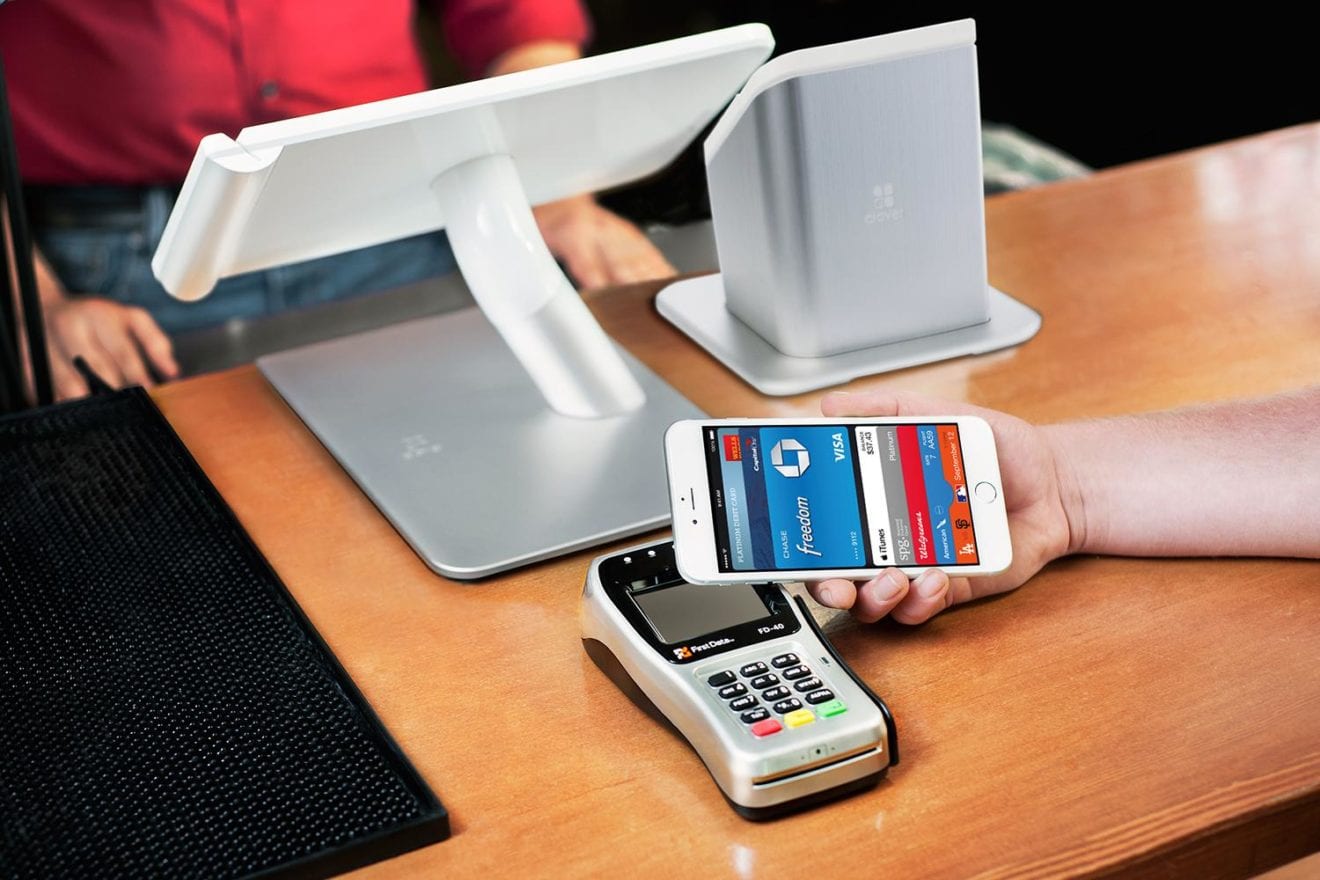
    Meanwhile, POS technology is transitioning from fixed-point transactions to mobile engagement, offering payment acceptance “on the go” for all of a customer’s orders in a single transaction. This can be by cash, cheque, credit or such systems as Apple Pay.

    Advanced mobile POS technology can handle the most complex return situation with the least amount of friction, regardless of which channel initiated the order or how the customer chooses to receive credit.

    While price is the main attraction for 67 per cent of shoppers, across both online and in-store shopping, fast delivery is important for 51 per cent, and flexible returns for 42 per cent.

  • Apple Pay’s China Launch: Who Will Win Over Chinese Luxury Consumers’ E-Wallets?

    Apple Pay’s China Launch: Who Will Win Over Chinese Luxury Consumers’ E-Wallets?

    With an optimistic plan to take on entrenched Chinese mobile payment rivals, Apple Pay made its move into mainland China on Thursday this week in hopes of making the country its biggest market.

    While some experts doubt the prospects of Apple’s high-tech payment system to compete with local giants including Alipay and WeChat, luxury retail is taking notice of the method. On the date of Apple Pay’s launch, Lane Crawford announced that all of its mainland China locations will offer Apple Pay, making it one of the first retail locations in the country to offer the service. “Offering Apple Pay as a payment option to our customers is another important step towards an even stronger connected commerce strategy, constantly evolving and leveraging on the digital and mobile world which is vitally important in Asia,” said Lane Crawford President Andrew Keith in a press release.

    The launch allows China’s only credit card company UnionPay, which has teamed up with Apple Pay, to take on Alipay and Tencent’s TenPay as they compete to win over Chinese consumers’ e-wallets.

    Limited to the iPhone, some experts are saying Apple Pay faces an uphill battle in China as local mobile options have already become incredibly popular. In addition to the fact that Apple will have to take on local giants, experts have found that many Chinese netizens are wary of Apple Pay for a variety of additional reasons. Online comments suggests that many are suspicious of giving their bank card number to a U.S. company and show a preference to earn interest from Alipay. Meanwhile, Apple Pay doesn’t have built in “shopping app” features and discounts found on Alipay and WeChat Wallet, including WeChat’s direct link to dining app Dianping.

    But as the iPhone remains a luxury status symbol for Chinese consumers, Apple Pay could possibly find a niche among affluent urbanites, depending on whether or not more retailers like Lane Crawford choose to make it available.

    The development of this competitive landscape is of equal importance to luxury retailers not only in China, but also abroad, which are scrambling to keep up with payment methods most popular with Chinese tourists. Many international luxury retailers now offer UnionPay, but a growing number of them are allowing Chinese customers topay with Alipay or with WeChat, giving them an advantage over those who haven’t moved past UnionPay. Regardless of whether or not Apple Pay manages to catch on with China’s jet-setting iPhone owners, retailers across the world will need to up their payment technology to keep up with their Chinese VIPs’ preferences.

  • Mobi724 signs deal with Philippines government

    Mobi724 signs deal with Philippines government

    Tangent produces payment industry software. It manages the payments terminals for more than 80 banks through partnerships with the nation’s largest ATM switch and every major credit card acquirer.

    Mobi724 President Robert Rioux said all banks and retail payment terminals in the Philippines must be EMV compliant by the end of this year. The agreement with Tangent Solutions goes a long way in meeting that goal.

    “This is an opportunity for us to leverage our EMV gateways to connect and route the retail payment terminals to the proper issuing bank. This agreement allows us to reach over 40 percent of all the retailers in the country and it will allow us to connect MPOS transactions.”

    Mr. Rioux said they will deploy its couponing solution in a future phase. That is part of a much larger vision, he added.

    “Our vision is to enhance the value of commoditized payment transactions to the players in this ecosystem (card associations, banks, mobile carriers and retailers) by adding layers of intelligence to these card-linked transactions (i.e. smart transactions) in a seamless manner for all the players in the ecosystem.”

  • China e-commerce huge opportunity for British merchants

    China e-commerce huge opportunity for British merchants

    New research says almost half of the UK’s top online retailers are failing to capitalize on China’s burgeoning e-commerce market. E-commerce service provider Global-e reports that British companies are significantly missing out on a marketplace that’ll be worth $1.5 trillion within four years.

    Chinese shoppers love doing it online. Buying big brands from around the world, It’s global, China’s Centre for Economic Exchange anticipates online retail will account for 30 to 40 per cent of world trade in less than a decade. E-commerce entrepreneur Amir Schlachet says most firms see that as a huge opportunity.

    “Most of them actually do realize that China is an important market. It’s close to a trillion shoppers online. Very open to the world. It’s already around half of the online population actually buying cross border.” said  Schlachet.

    Recent research by market research company Emarketer backs him up, claiming nearly 45% of people in China shop on overseas websites. And the internet shopping giant Alibaba offered further evidence with figures for 2015 indicating a revenue rise of more than 30 percent. However, while many UK retailers have seen the online potential, to others claims Schlachet are failing to take advantage.

    But global’s also local and the trick to getting into the Chinese online market baffles some. Shoppers in China want websites in Mandarin; prices in Renminbi the local currency and payment using local systems such as Tenpay.Union Pay and Alipay. So, while shops in Britain go out of their way to welcome Chinese shoppers, researchers at Global-e found traders needed help online.

    It’s all a barometer of how globalization is changing the way we go shopping, but at the same time it’s a real indicator of how new businesses can start up to take advantage of that.

  • Rakuten Singapore axes eCommerce site

    Rakuten Singapore axes eCommerce site

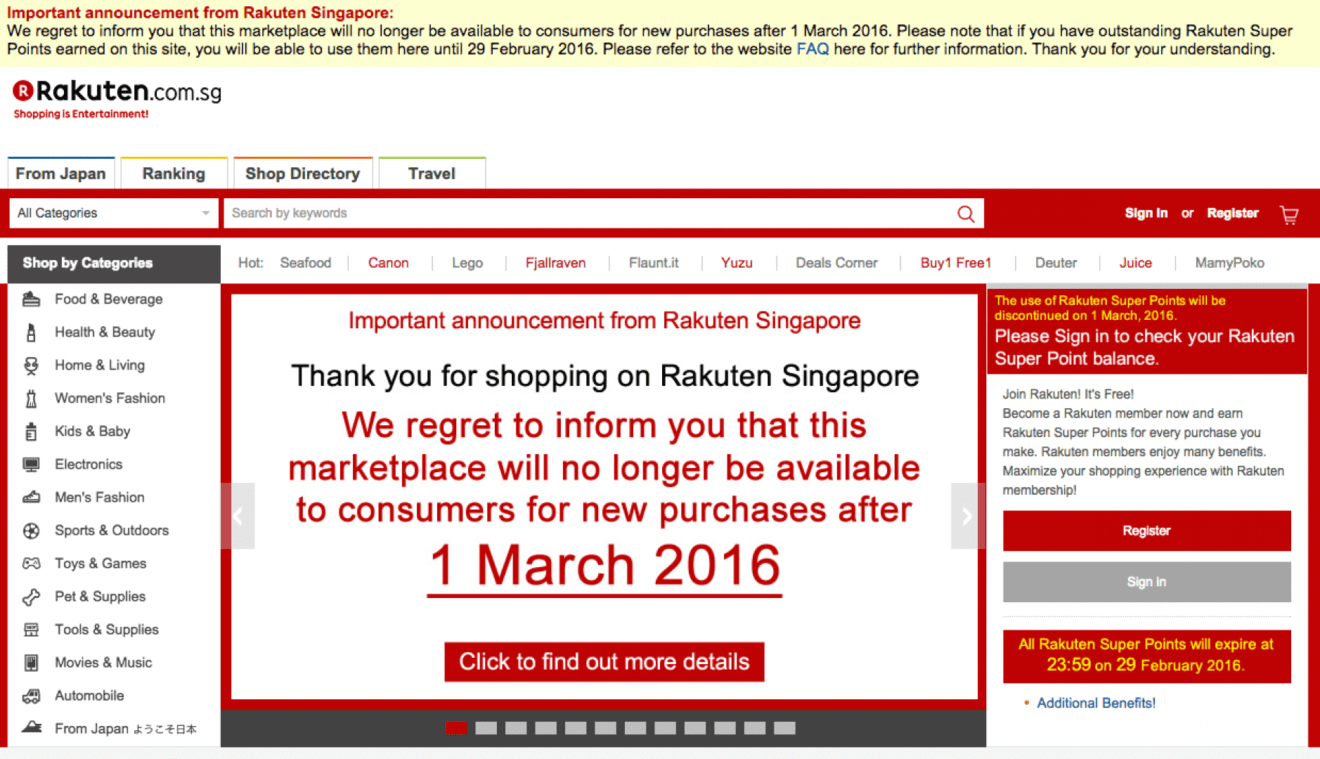
    Japan’s online retailing giant Rakuten is to close its eCommerce websites in Singapore, Indonesia andMalaysia on March 1.

    And it is reportedly seeking a buyer for its Thailand business Tarad.com which it bought in 2010.

    The decisions follow a disappointing trading result which has prompted the business to refocus on its domestic operations and scale back unprofitable overseas activities. The company reported net profit for the year fell 38 per cent year-on-year to 44.3 billion JPY (US$393 million) on revenue of 714 billion JPY ($6.3 billion) – up 19 per cent, largely due to writedowns of its Kobo, Southeast Asian and other struggling divisions.

    Some 30 staff in Singapore had their employment terminated on Friday, just five days into the Lunar New Year. By the time the sites are wound down, about 150 staff will have been axed in the three markets, but the company will retain a regional headquarters in the city state.

    Rakuten’s apparently profitable Taiwan business will continue to operate.

    Tech website Techcrunch reported the three eCommerce sites to be shuttered will be replaced by a new product in Southeast Asia, “a consumer-to-consumer app called Rakuma” which, Rakuten said, has grown 20 per cent month-on-month in Japan.

    “That concept sounds a lot like (indeed, the same as) Carousell, the app that Rakuten Ventures is an investor in. Singapore-based Carousell is currently in three countries in Southeast Asia but, as we reported late last year, it is trying to raise a $50 million round to expand its service significantly across Asia.”

    No further details of the Rakuma concept, which is mobile-based, have been released, with the project still under development.

    In a statement to Reuters, Rakuten said the new concept was a consumer-to-consumer business model, rather than the aggregation-based business-to-business-to-consumer format of the closing Rakuten sites.

    “In Southeast Asia, as the market itself changes and adapts, we are looking toward C2C (customer to customer) and mobile business models for eCommerce and other businesses,” Rakuten said.

  • China Jo-Jo finds gold online

    China Jo-Jo finds gold online

    While its physical stores and wholesale revenues slipped, pharmacy retailer China Jo-Jo Drugstores recorded an increase of about 96.7 per cent in its online revenues during the third quarter ended December 31.

    Through its own retail stores (59 in Zhejiang Province), wholesale distribution and online pharmacy, the New York-listed company is a leading provider of pharmaceutical and healthcare products in China.

    Overall, its revenues of about $24.7 million for the period were up 15.9 per cent. Its retail drugstores brought in $12.9 million, down 2.7 per cent, while its wholesale businesses netted about $3.1 million, a decrease of of 13.8 per cent. However, its online pharmacy revenue rose 96.7 per cent to total about $8.6 million.

    This gave the company a gross profit of about $4.8 million for the quarter, up 52.3 per cent on the previous year. The online profit soared 194.1 per cent to about $1.8 million, while its stores had a 20.3 per cent increase to about $2.8 million.

    Over the nine months of the financial year, revenue totalled $68.6 million, up 22 per cent, with gross profit up 56.1 per cent to about $13.2 million.

    Sales and marketing expenses grew by $1.1 million, or 50.5 per cent, mainly because of higher labour costs and service fees for its eCommerce platforms.

    “We are seeing improvements in gross margin from increased volume in our online business as our revenue mix continues to shift to our fast-growing online business,” says chairman/CEO Lei Liu, who predicts a strong quarter to end the fiscal year.

    “Investments and efforts in building critical mass to service China’s consumer needs in the pharmacy space is taking shape, creating new opportunities to diversify our revenue base.”

    Closer collaborations with large local pharmaceutical vendors are also providing cost advantages. Co-operation with business-to-consumer online vendors have expanded, with the company’s products listed on such platforms as Taobao, JD and www.yhd.com and customers being directed back to China Jo-Jo’s website.

    Meanwhile, the company continues to benefit from working with large insurance companies such as The People’s Insurance Company of China. Commercial health insurance in China continues to expand to supplement the nation’s social health insurance.

    Lei Liu says there is a “relentless call” for healthcare reform in China, including an end to hospitals dominating prescription sales. Meanwhile, China Jo-Jo has also seen its loyalty program expand to embrace more than 2 million customers.

  • Grana, Online Retailer Offering Luxury Apparel at Disruptive Prices

    Grana, Online Retailer Offering Luxury Apparel at Disruptive Prices

    Grana (grana.com), an online clothing retailer creating luxury fabrics and wardrobe essentials at guilt-free prices, announced today it has secured an additional $3.5 million U.S. dollars in seed funding. The lead investor is Golden Gate Ventures, along with investments from MindWorks Ventures and Bluebell Group, bringing their total funding to date to $6 million U.S. dollars, with additional Series A funding pending. Grana recently launched in the U.S. market, and the additional funding will help the brand continue its international growth and expansion.

    Grana offers timeless wardrobe essentials created from fabrics found around the world, including Chinese Silk, Mongolian Cashmere, Irish Linen, Japanese Denim, Peruvian Pima Cotton, French Poplin, Chinese Cotton Twill, Italian Merino Wool and Japanese Chambray. Grana designs its merchandise in-house and works directly with fabric mills in order to bring the highest quality clothing to customers at the best possible prices.

    Grana has grown extensively since its March 2014 beta launch, during which the brand sold 2,000 Peruvian Pima Cotton t-shirts in three weeks, shipping to eight countries directly from Hong Kong. Month-over-month sales are currently increasing by 40 percent since Grana launched in October of 2014.

    The new round of funding will expand Grana’s shipping to new markets as well as aid the entry into the U.S. and China markets. The funds will play a critical role in new product category launches such as leather goods, undergarments and activewear.

    “We’re pleased to receive financial backing from Golden Gate Ventures and MindWorks Ventures,” said Luke Grana, CEO and co-founder of Grana. “The support is critical to our U.S. expansion, a priority market that already represents 20 percent of our global sales. This new investment allows us to further disrupt the online clothing market and provide consumers with luxury-quality wardrobe essentials without the luxury price point.”

    Since launching, Grana has brought a number of “Fitting Rooms” to consumers across Sydney, Singapore, and Hong Kong, and mostly recently opened a U.S. location in San Francisco in December 2015. Designed as a showroom instead of a retail shop, customers can experience the brand personality in the space, interact with Grana Cheetahs (customer service representatives), and discover the website. Retail showroom spaces are increasing in popularity, and Grana’s Fitting Room model is helping to lead this global trend. The new funding will also allow Grana to open additional Fitting Room locations in the U.S. and provide support for a technological upgrade to the shops, reinventing the way people buy clothes in-store.

    “In a world were startups are disrupting established industries, Grana is disrupting how to build a global brand with bottom-up marketing from their biggest fans, city by city,” said Vinnie Lauria, Managing Partner at Golden Gate Ventures.

    “We envision Grana’s model of providing the highest-quality modern essentials at revolutionary price points as the future of retail,” said David Chang, Partner at MindWorks Ventures. “This investment round provides Grana with greater capacity to expand its growing Fitting Room network, and product range and develop its omnichannel strategy.”

    As part of its international expansion and growth in existing markets, Grana will also use the newly acquired funds to build out a global world-class team. Currently, Grana has more than 40 employees in Hong Kong, and most recently has added team members in San Francisco.

    ABOUT GRANA

    Grana is a global ecommerce brand delivering luxury-quality wardrobe essentials made from the world’s best fabrics at guilt-free prices. Grana operates online and deals directly with their fabric mills, cutting traditional middlemen costs. Once the fabrics have been selected, Grana’s in-house product team designs the collections. With a focus on the perfect fit, Grana’s wardrobe essentials are designed to last far beyond the season.

  • Nation gets first crowdfunding platform

    Nation gets first crowdfunding platform

    As of 6 p.m. on Monday, Marine Techno, a cosmetics company that specializes in products made from marine collagen, successfully gathered 76 million won ($64,000) from retail investors on the nation’s first crowdfunding portal, which had opened earlier in the day.

    A total of 13 investors, including angel investors, the government-led Creative Economy and Innovation Fund, and other retail investors contributed to the biotechnology firm based out of the Jeonnam Creative Innovation Center in Yeosu, South Jeolla.

    Created in 2014, the start-up produces cosmetics by recycling marine byproducts. It owns as many as 30 patents for collagen-producing technologies.

    The company’s success on the crowdfunding platform meant it reached 110 percent of its investment target.

    “I was wondering about this, but we unexpectedly ended up with a good result,” said Hwang Jae-ho, founder of Marine Techno. “We rolled out investor relations activities at many events, and that’s what has led to the good result today.”

    Hwang said the new funds will be used to expand production facilities to meet growing demand.

    Individuals who want to invest in new promising businesses can log in to www.crowdnet.or.kr, operated by the Korea Securities Depositary, to connect with one of the five intermediary firms registered with the Financial Services Commission, the nation’s top financial regulator.

    The five intermediaries that can broker deals with the start-ups online are Wadiz, Ucanstart, OpenTrade, Yinc and Wealth Funding Management.

    On the first day, 18 start-ups, including Marine Techno, attracted investments through the intermediaries.

    The FSC introduced the crowdfunding system as part of its efforts to support the creative economy and financial technology initiatives. The regulator revised the nation’s Capital Market Act in July to provide start-ups with better access to financial resources, hoping to boost the fintech industry and create more jobs for young people.

    Crowdfunding platforms have become increasingly popular, with the U.S.-based Kickstarter attracting as many as 270,000 online investors in just two hours to raise 10.9 billion won for Pebble, a smartwatch maker.

    If they have a crowd funding account with any of the 18 securities firms offering them, retail investors can invest up to 2 million won in a single firm, and up to 5 million won a year. Start-ups are allowed to receive up to 700 million won in total every year through the crowdfunding portal. If a company fails to reach 80 percent of its target by the deadline it has set, the funding will be nullified.

    “There is some concern that the investment limit is too small, but we plan to support the regulator’s move to heat up the mood,” said Kim Young-soo, an executive at Korea Venture Business Association.

    Marine Techno was the only company that surpassed its goal on Monday, with crowdfunding still a foreign concept to many. On the homepage for Yinc, a message reading, “Please be my first investor,” was still flickering at around 5 p.m.

    Still, large financial groups are joining the trend. KB Financial Group launched a matching service for investors and start-ups on Monday. It began to attract investors by using the crowdfunding platform of OpenTrade to help fund four promising start-ups chosen by the group.

  • ShopBack Malaysia Hosts Biggest Cashback Sale to Encourage Malaysians to Shop and Save via Cashback

    ShopBack Malaysia Hosts Biggest Cashback Sale to Encourage Malaysians to Shop and Save via Cashback

    ShopBack Malaysia, the top Cashback site in Southeast Asia, will be offering up to 100% Cashback to supplement Malaysians’ online shopping on its first birthday, 22 February 2016. From everyday essentials to quirky gadgets, Malaysians are encouraged to get the 24-hour exclusive deal from over 500 online retailers through Shopback.my.

     Gil Carmo, Country Head of ShopBack Malaysia says: “Cashback is a very popular saving tool for online shoppers in the West. Ever since ShopBack introduced the concept in Southeast Asia, many shoppers have benefitted from it whereby Malaysian shoppers have cashed out more than RM 4M in 2015 alone.

    Our current pool of local shoppers makes up about 1% of Malaysia’s population – that means there are still enormous opportunities for us to reach out to the rest and educate them to utilise ShopBack to earn more savings.”

    Popular online retailers such as Agoda, Booking.com, Groupon, HappyFresh, Hermo, Lazada, Qoo10, Photobook Malaysia, Supermodel’s Secrets, Taobao, and Zalora are joining this biggest cashback sale from past midnight (00:01) on 21 February 2016 till midnight (00:00) on 22 February 2016.

    Shoppers can expect discounted deals, exclusive promo codes, contest, and Cashback from 50% to 100% on special home electronics, mobile gadgets, travel packages, hotel accommodations, beauty and fashion, as well as grocery items on the event day.

    “More Malaysians are buying online nowadays and similar to the traditional retailers’ loyalty programme, ShopBack Malaysia helps shoppers to save even better because we reward with cash rather than credit. Registration is free and shoppers can get Cashback in just two simple steps – sign up/log into your account, select online retailers and proceed to shop. Shopper will receive an email on the earned amount within one day, and it can then be transferred to local bank account once the status becomes redeemable. It is a totally hassle-free process.” Gil added.

    ShopBack entered Malaysia on 22 February 2015 and it has emerged as the top Cashback site in the country, as well as in the SEA region. It works together with a comprehensive range of over 500 international and local online retailers to reward shoppers with hard cash after they made a purchase online through the platform.

    For more information, please visit www.shopback.my or follow us at Facebook www.facebook.com/shopbackmalaysia.

  • Kakao launches Hair Shop O2O

    Kakao launches Hair Shop O2O

    Kakao, the Korean internet pioneer, has  selected ‘Hair Shop’ as its first O2O (online to offline) business in the beauty sector.

    Kakao plans to expand its O2O business by releasing new services  – relief drivers and the hair industry.

    According to industry analysts, Kakao is planning to launch ‘Kakao Hair Shop’ (working title) during the first half of the year through its affiliate Hasys.

    If Kakao’s Hair Shop is launched, related businesses could use Hasys solutions such as ‘Hair Zzang’ or ‘Beauty Zzang’ to easily build online and mobile reservation systems. Research on consumer satisfaction and marketing education could also be supported.

    Customers could have access to information about various hair shops through a Kakao-based platform, and compare prices at each salon.

    Some predict that Kakao will charge a commission for providing the platform when a user makes a reservation through the Hair Shop application and pays through Kakao Pay. However, Kakao claims that the details of the service have yet to be confirmed.

    Hasys is a beauty solution business Kakao took over in October 2015 through K-Venture Group, an affiliate of Kakao specialising in investments. Hasys has developed and is providing solutions such as ‘Hair Zzang’ and ‘Beauty Zzang’, which manage clients of beauty salons, skin care parlors and nail shops.

    Hasys has 10,000 beauty businesses as members, and ranks at the top of the industry with 69 per cent market share as of September 2015.

    Kakao revealed its intentions to launch O2O services related to the beauty industry at the time it took over Hasys. As a first step, Kakao officially entered the hair industry.

    Kakao officials said the company is planning to concentrate on the Hair Shop business, as it could be a service that is attractive to people of all genders and ages. “We have no other plans to expand our offerings into other beauty businesses.”

    Hasys is currently meeting with owners of hair shops across Korea, explaining about the launch of Kakao Hair Shop. Currently 2000 shops have agreed to become members of the service.