Category: E-Tailing

Retail News Asia is committed to providing both local and global retailers with the latest E-Commerce & Etail news throughout the Asian market. This on a daily base.

  • Foodpanda answer to rumors

    Foodpanda answer to rumors

    Foodpanda India has rubbished reports it will close down, parent Rocket Internet saying the market is one of its fastest growing internationally.

    “We are extremely happy with the development of our business in India,” Saurabh Kochhar, CEO, Foodpanda India said in a statement emailed to Inside Retail Asia.

    “We are a global player in food ordering business, backed by a group of renowned investors. Whenever we have felt the need for investments we have invested and we will continue to do so.”

    Kochhar said the company is market leader in India’s online food sector.

    “We have achieved an outstanding rate of automation in India and have built incredible technological innovations that have dramatically improved our order processing, vendor management and delivery rider allocation.

    “Marketplace businesses generally require many years to turn profitable,” he continued. “We are happy to see this happening even faster at Foodpanda. Online food ordering is one of the most profitable internet business models and we are proving so in India as well.”

    Further, Kochhar told the Times of India the country is expected to be one of its top three globally by 2019.  Currently, its top markets are Russia, Singapore, Hong Kong, Saudi Arabia, India and Malaysia.

    “We have no plans to exit from the Indian market. We are best placed to grow and consolidate our leadership in the Indian market,” Kochhar said.

  • Shinsegae Group in massive expansion plan

    Shinsegae Group in massive expansion plan

    Shinsegae Group says it will invest 4.1 trillion won ($3.4 billion) this year and hire 14,400 new staff to expand its retail business and revitalise the “sagging domestic economy”.

    “The overall retail sector has been struggling to deal with continued sluggish domestic consumption,” a Shinsegae Group official said. “But we decided to invest more and hire more workers to find new growth engines and help inject vigor into the stagnant domestic market.”

    Shinsegae, Korea’s largest retail group, will open 10 shopping centres across the country in 2016, including the massive Hanam Union Square southeast of Seoul, built on a 117,000 sqm site and employing 5000 staff. That project is worth 1 trillion won alone,  (US$832 million).

    The company’s discount arm E-Mart, is building a logistics centre in Gimpo, in the Gyeonggi province, to support an expanded online business as it ramps up competition with rivals including Coupang. It also plans to increase the size of many of its existing stores as well as opening new shops in Vietnam and other Southeast asian markets.

    Three new Shinsegae department stores will open their doors – in Hanam, Gimhae (in South Gyeongsang Province) and in Daegu. Stores in southern Seoul and downtown Busan will be expanded.

    And the company’s Shinsegae Duty Free operation is putting the finishing touches on an upmarket duty free store inside its downtown Seoul department store. That shop is scheduled to open in May.

    “Business conditions at home and abroad have largely been unfavorable for us,” said Shinsegae Group vice chairman Chung Yong-jin.

    “We expect to bear fruits this year from our investments in multipurpose shopping centers, duty free shops and department stores. We will continue to invest and hire workers as a leading retailer to help bolster the domestic economy,” he said.

  • Myntra India pins hopes on sportswear

    Myntra India pins hopes on sportswear

    Adding more products and international brands to its portfolio, online fashion retailer Myntra India aims to grow its outdoor and sports range revenue by 20 per cent over the next 15 months.

    Owned by Flipkart, the company earns about 15 per cent of its revenue from sportswear and has just introduced apparel and footwear from US brand The North Face (TNF), reports The Times of India.

    “The North Face is an important addition to our list of international exclusive brands,” says Myntra head of eCommerce Prasad Kompalli.

    He says the outdoor category is expected to double its growth in 2016-17.

    TNF’s range went on sale this month. Part of VF Inc, it was founded in California in 1966 and specialises in outerwear, fleece and coats. It competes directly with Columbia Sportswear, which entered India in December 2013.

    VF Asia executive Bruno Feltracco says India offers a huge opportunity as a market.

    “Our experience in China helped us decide to first go online and understand the market. There is nothing that prevents us to go offline after we reach a certain stage,” he says. “We already have some of our other brands here doing really well.”

    VF Asia’s other brands include Lee, Wrangler and Nautica.

  • Foodpanda India ‘likely to close’

    Foodpanda India ‘likely to close’

    Foodpanda India appears likely to be shut down after parent Rocket Internet failed to find a buyer at a bargain basement price.

    It’s the latest chapter for the increasingly troubled Asian operations of Foodpanda which last monthgave up in Vietnam after failing to win market share off rivals and in Hong Kong axed its upmarket spinoff brand Foodora, merging the two businesses into one.

    India’s Economic Times reports Foodpanda is “desperately searching for a buyer” for the troubled Indian business, despite setting the price tag at just US$10 – $15 million.

    “Both Zomato and Swiggy have been approached for a buyout, besides one larger horizontal company. But Rocket is yet to garner keen interest from possible suitors for Foodpanda,” another source told theTimes of India.

    At the end of December, Foodpanda India laid off 300 staff , about 15 per cent of its local workforce, as it faced increasing competition from Zomato. The company said the redundancies were the result of achieving near 98 per cent automaticon of its ordering process.

    The Economic Times reports Rocket’s problems in India are not restricted to Foodpanda.

    “The Samwer brothers-led Rocket Internet’s interest in its Indian portfolio has been waning with most of its flagship firms, including FabFurnish and PrintVenue, being put on the block,” the newspaper said.

    It concluded that if a buyer for the sites cannot be found the company would simply close them.

  • Alibaba Group conquers China slowdown

    Alibaba Group conquers China slowdown

    Going into this quarter the main concern for Alibaba was that a slowdown in Chinese economic growth would damage its performance.

    Fortunately, this has not materialised with very solid uplifts in its Chinese retail marketplace proposition underpinning a respectable 32 per cent rise in overall revenues.

    Some of this uplift was undoubtedly aided by the company’s very strong performance over the Singles Day shopping festival in November. During this time, it attracted over 115 million visitors to its marketplaces and processed some 467 million orders across all of its platforms during a 24-hour period. The fact that its systems and infrastructure coped well with this volume, which is around 10 times more than the usual daily average, is a testament to Alibaba’s technological prowess, especially in areas like cloud computing.

    This focus on technology is also helping Alibaba to understand the habits and preferences of Chinese consumers as they browse and navigate the group’s various sites, news feeds, and entertainment options. This understanding puts Alibaba in a prime position when it comes to helping Western brands expand into China. In many ways Alibaba and its marketplaces are the ideal conduit through which foreign retailers can target and reach appropriate audiences. In our view this remains one of the main sources of commercial advantage for the company.

    Despite its success at home, Alibaba has struggled to gain traction in already established markets like the US. While this was once a stated ambition, and perhaps remains a long term goal, it is clearly not the main agenda for the year ahead. Indeed, over the latest quarter the proportion of revenue from international operations shrunk by 1 percentage point and the growth rate of 17 per cent, while respectable, was well below that of the Chinese operation.

    As much as this will no doubt come as a relief to many Western retailers, it is the right decision. Despite its dominance in the country, Alibaba’s growth potential in China remains enormous – especially as it expands operations into more rural areas. As such, chasing lower margin, profit eroding international gains for the sake of vanity makes little sense.

    That noted, over the longer term Alibaba would like to become more international. The route it will take, however, is likely to be one of investing in, and partnering with, local players in order to grow its share and presence. The company clearly has the financial muscle to undertake such corporate activity and we expect to see more of this in 2016 and the years beyond.

  • Amazon sales hits $100 billion

    Amazon sales hits $100 billion

    With total revenue growth of 22 per cent during its final quarter, Amazon has emerged as one of the clear winners in the battle for holiday spend.

    Even in its more mature home market, Amazon sales rose by 24 per cent, making it responsible for 22.6 per cent of all online retail spend in the US over the final quarter of the year.

    These impressive figures are accompanied by another achievement: Amazon has now comfortably passed the $100 billion annual sales mark. Taking some $107 billion in its latest fiscal year confirms Amazon’s status as an online behemoth.

    Fortunately for Amazon, this stellar topline performance has been joined by a continued improvement in profitability – something that has previously eluded the group. Across the year as a whole operating income was up by an impressive 1154 per cent, which helped turn a net loss of $241 million in the prior year into a net profit of $596 million this time around.

    That noted, by comparative retail standards Amazon’s level of profitability is still painfully weak. For every dollar the company takes, it makes just 0.75 of a cent in profit. However, this is a conscious decision by a company that uses a large chunk of its revenues to invest back into generating future growth. Clearly this is a strategy that is working, and it is one that is accepted by the market. That it is, makes life much more challenging for traditional players like Walmart which are much more constrained in terms of the degree to which they can erode profitability in order to boost their own online operations.

    Once again, one of the standout areas for Amazon has been Prime, where membership continues to grow strongly. In addition to the direct revenue it brings via the associated membership fees, Prime has also proved to be an important way of locking in customer loyalty. This is important because while Amazon is still a destination of choice for many online shoppers, it faces increasing levels of competition from both traditional retailers moving more aggressively into eCommerce and from new online startups. This is something underlined by the fact that despite its strong growth, Amazon’s share of all eCommerce sales in the US has fallen over the past five years.

    Creating an ecosystem of services and benefits, which include free delivery and access to special discounts and promotions, keeps Amazon top of mind by making it an integrated part of consumers lives. Arguably it also gives the company a whole host of ways in which it can increase its share of wallet from consumers, including via the sale of digital content and services.

    Despite its high share of online across many of the geographies in which it is established, Amazon’s actual share of many individual categories remains fairly low. This is especially so for areas such as grocery where, in share terms, Amazon remains an extremely small player. This demonstrates the extent to which Amazon has significant future headroom for growth, especially as it deepens its expertise and offer across key products.

    The warning for other retailers is that even as it passes the $100 billion milestone, Amazon is still only getting started.

  • The guy who built the Kindle is leading Amazon’s retail plans

    The guy who built the Kindle is leading Amazon’s retail plans

    Amazon’s long-time executive Steve Kessel is in charge of running the company’s new retail business, according to a report by Re/code’s Jason Del Ray.

    Kessel joined Amazon in 1999 and was part of the team that built the original Kindle. He’s known to be close with Amazon CEO Jeff Bezos, as he was one of the 10 people who directly reported to him before leaving for a sabbatical in 2012.

    In early 2015, Kessel returned to Amazon, but his role has been unclear until now. Re/code says he’s been working on this project secretly for a long time.

    Amazon’s retail ambitions were first revealed in November 2015 when it opened its first brick-and-mortar bookstore in downtown Seattle.

    Aside from the bookstore, Kessel’s team is also planning to open physical stores that sell things other than books, although it’s unclear what they will be. Another idea it’s testing is a store without a payments gateway, allowing the customer to pay with a smartphone app instead.

    Amazon is planning to open a new bookstore in Southern California, based on the job listings spotted by Re/code. One of the jobs says it’ll be in La Jolla or San Diego, the report said.

    The news comes on the heels of a report that said Amazon could soon open 300 to 400 additional bookstores. Although the mall CEO who made those statements backpedaled Wednesday, saying his comments were “not intended to represent Amazon’s plan,” it’s seems clear that Amazon is getting serious about the retail space.

  • Alibaba and Amazon China gear up for the Chinese New Year

    Alibaba and Amazon China gear up for the Chinese New Year

    Feb. 8 will be the most important holiday this year in China, as it marks the Chinese New Year. Family members will come together to celebrate with holiday feasts and most workers will enjoy a one-week vacation, many returning to their rural homes from big cities for the festivities. A lack of delivery personnel during this period is leading many sellers on China’s biggest e-commerce marketplaces to shut down, but Amazon China says it will keep delivering in big cities.

    Many merchants on Alibaba Group Holding Ltd.’s marketplaces Taobao and Tmall have announced that they will stop taking orders Feb. 4-Feb. 14 because shipping companies are unable to deliver orders.

    But Alibaba, whose online marketplaces account for more than three-quarter of online retail purchases in China, organized a major promotion in advance of the New Year’s vacation, the Ali Chinese New Year Shopping Festival, which lasted from Jan. 17-23.

    Alibaba reports consumers purchased 2.1 billion holiday items from its websites during the sale, mostly food and gifts. 15% of the orders came from rural residents, a focus of the promotion, and sales at the 12,000 Taobao service centers in rural areas were 331% higher than average, the company says.

    “By hosting this online shopping event, we enabled rural customers to access an extensive range of New Year goods from home and abroad, while making agriculture products from rural China more available among urban customers.” Alibaba Group CEO Daniel Zhang said at the event kickoff meeting.

    Meanwhile, Amazon China, No. 5 in the Internet Retailer 2015 China 500, says it will continue to fulfill orders during the holiday period in 20 big Chinese cities, including Beijing, Tianjin and Shanghai. In fact, the largest overseas e-retailer operating in China says it will extend delivery hours to midnight during the holiday in order to allow Chinese online shoppers to get their orders on time.

    Amazon China operates 13 fulfillment centers in China and employs its own fulfillment staff. The subsidiary of Amazon.com Inc. offers same-day delivery in 123 Chinese cities and second-day delivery in over 1,400 Chinese cities and towns.

    For a fuller report on the openings for foreign companies to sell online in China, see “Open Door Policy” in the November 2015 issue of Internet Retailer magazine.

  • Less than Half of Filipinos are Fully Satisfied with the Valentine’s Day Gifts they Receive

    Less than Half of Filipinos are Fully Satisfied with the Valentine’s Day Gifts they Receive

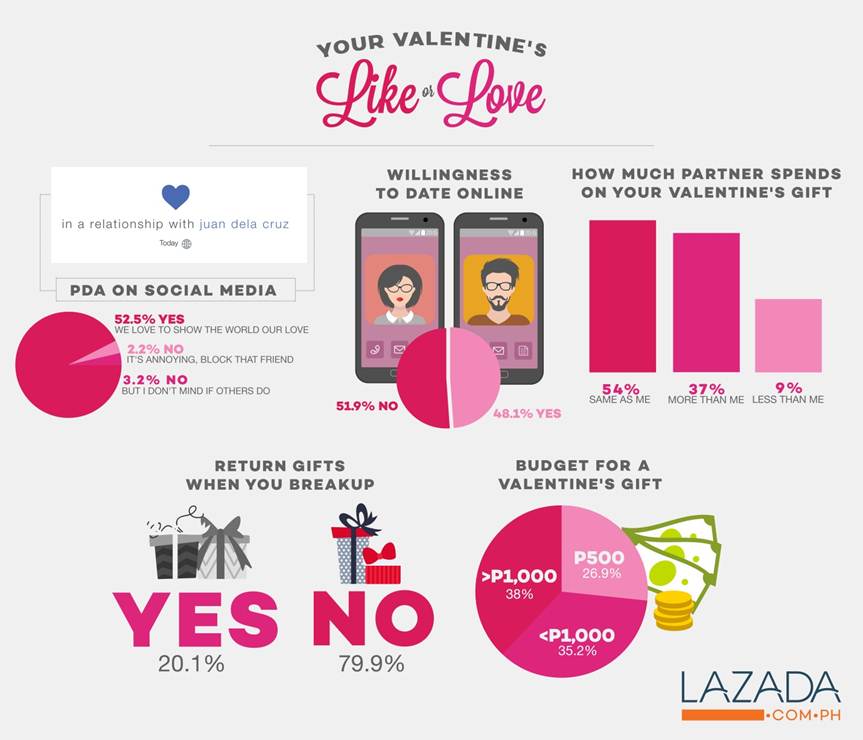
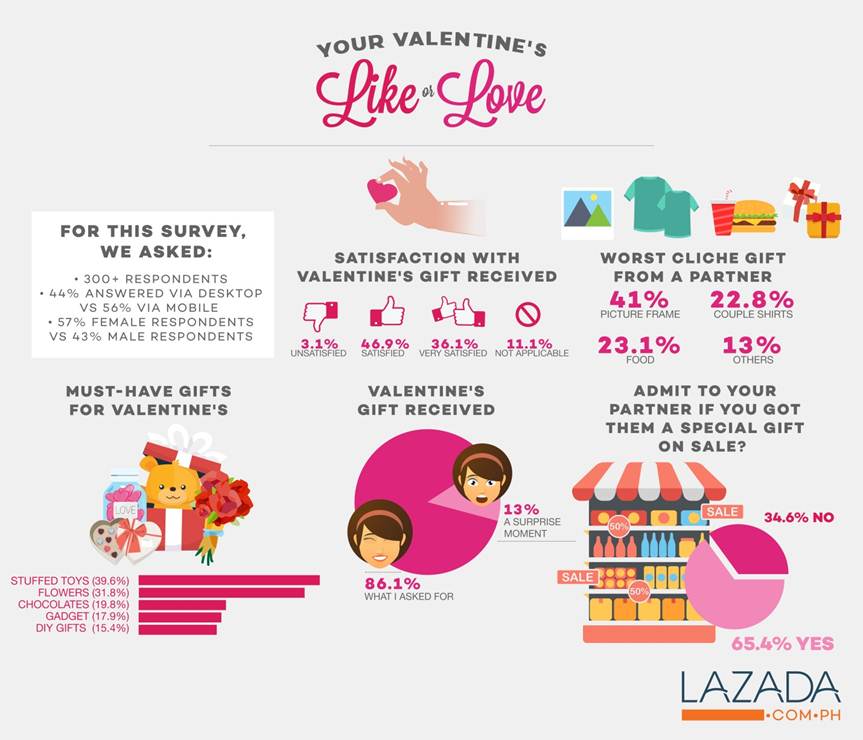
    In an online survey of over 300 respondents, only a third (36%) of Filipinos are really happy with their Valentine’s Day gifts. Less than half (46%) said that they were satisfied while 3% expressed absolute dissatisfaction.

    The survey, conducted by Lazada, explored the processes and reasons for the lack of contentment over Valentine’s Day gifts.

    Avoid Cliché’s but Never Forget the Essentials

    Almost one in four respondents (23%) expressed that chocolates and couple’s shirts are cliché, but the most cliché gifts are picture frames with over 40% of people agreeing they are passé.

    On the other hand, over 30% of respondents agree that flowers are a must have, beating out chocolates (19%), stuffed toys (9.6%). Surprisingly, more and more people (15%) see gadgets as an essential gift for the month of romance.

    image002

    Ask and You Shall Receive

    It seems surprise gifts are falling out of fashion as an overwhelming 86% of respondents prefer to express to their partners what they want. This transparency between couples extends to finding deals. 65% of respondents said they don’t mind sharing that they got their gifts on sale. The implicit learning is that if you get your partner the gift they want, it doesn’t matter if you got it on discount.

    Digital Love
    The survey also explored love in the digital space. Overtly expressing affection over social media or “Online PDA” seems acceptable with 52% of respondents saying they practice social media PDA themselves. 

    However, when it comes to meeting love interests online, half of the respondents had hesitations with online dating. 51% agreed with the statement:  “Online shopping never hurt anyone, people do.” Talk about #hugot.

    image001

    Love to Shop and Shop to Love

    As our Valentine’s Day gifting habits evolve and improve, it is important for Filipinos to discover more convenient and cost effective ways to find the perfect gift. That’s why Lazada’s Valentine’s Day promo makes it the perfect place to get the gifts your partner wants in ways you can easily afford.

  • Alibaba Beats Profit, Sales Estimates on Rural China Push

    Alibaba Beats Profit, Sales Estimates on Rural China Push

    Alibaba Group Holding Ltd. beat analysts’ estimates for revenue and profit after an online-sales extravaganza and expansion into rural China helped the nation’s biggest e-commerce operator defy a slowing economy.

    Sales rose 32 percent to 34.5 billion yuan ($5.2 billion) in the three months ended December, the company said Thursday, compared with the 33.2 billion-yuan average of estimates compiled by Bloomberg. Net income more than doubled to 12.5 billion yuan, topping estimates of 10.3 billion. Shares rose more than 5 percent in premarket trading in the U.S.

    Record revenue during November’s annual “Singles’ Day” promotion drove transaction growth as Alibaba captured more sales from mobile e-commerce, which is replacing shopping from computers. Billionaire Chairman Jack Ma is trying to tap the spending power of the countryside with the Internet expected to blanket all of rural China by 2020, according to the China Academy for Rural Development at Zhejiang University.

    “Alibaba continues to grow as urbanization and an ever more ambitious middle class continues to drive up China’s cost of living and consumption,” said New York-based Brian Buchwald, chief executive officer of Bomoda, a consumer intelligence company with a focus on the Chinese market. “At the heart of it, is continued investment in mobile and simplifying payments for virtual and actual purchases.”

    Mobile Monetization

    Longer-term, Ma is investing in video content, media, on-demand services and cloud computing to generate new sources of income as he takes the e-commerce company global. Shares of Alibaba closed Wednesday at $69.54 in New York. The stock has declined 14 percent this year after a 22 percent slump in 2015.

    Gross merchandise volume in its China retail marketplaces rose 23 percent to 964 billion yuan in the quarter, while mobile GMV almost doubled to 651 billion yuan.

    More than half the purchases through Alibaba’s e-commerce platforms were done from mobile devices. While it’s crucial that Alibaba serve the growing ranks of consumers acquiring a taste for shopping through smartphones and tablet computers, smaller mobile screens typically generate less advertising revenue.

    “Alibaba is on track to gain more shoppers in rural areas and smaller cities in China,” said Li Yujie, an analyst at RHB Research Institute Sdn in Hong Kong. “The sales promotion in November also gave the company a boost.”

    The Nov. 11 Singles’ Day promotion logged a record 91.2 billion yuan in sales, a 60 percent increase from the year earlier. A third of buyers made purchases from merchants and brands outside of China during the one-day event.

    Overseas Push

    Ma has set a goal of getting 50 percent of the company’s revenue from beyond China with Michael Evans, a former Goldman Sachs Group Inc. partner, named president in August to lead the global push.

    Cloud computing revenue rose 126 percent to 819 million yuan, Alibaba said. Its AliCloud unit is staking $1 billion on the belief that demand for processing and storage from governments and companies will boost growth during the next decade as its tries to compete with Amazon.com Inc. in computing services. It plans to work with Nvidia Corp. on services and artificial intelligence, recently opened a second U.S. data center and plans its first in Europe this year.

    Alibaba is also expanding in the online-to-offline services market. Tencent, Alibaba and Baidu Inc. are competing for supremacy in a local-services industry primed for growth as more people turn to their smartphones or the Web to order food, schedule beauty treatments or hire domestic helpers. Users of those services could rise 29 percent to 400 million by next year, with sales expected to reach 7.28 trillion yuan by 2017.

    Last year, the company backed the merger of Didi and Kuaidi to create China’s biggest ride-hailing application.

    Investors have highlighted escalating scrutiny about the sale of counterfeits on its websites, such as Taobao Marketplace, as a key risk for 2016. Though the company has said it’s committed to combating fakes, cleaning up its image next year is crucial to Alibaba’s goal of winning the trust of merchants and shoppers overseas.

    In December, the U.S. Office of the Trade Representative warned the company it had to do better to stay off the “Notorious Markets” blacklist it escaped only in 2012. The federal agency issued a stern warning that Alibaba’s efforts to fight piracy and respond to complaints would be monitored in the coming year.

  • Uber Tests Cash Option For Bangkok

    Uber Tests Cash Option For Bangkok

    Thailand has become the latest country where Uber taxi drivers can take cash from a passenger instead of a credit card.

    Uber tested its cash payment scheme in Bangkok on Wednesday as an alternative to the credit card option.

    Passengers have to tell the firm before the ride about their cash option and pay the driver at the end of the trip, it said on the website.

    “Bangkok, as a global business, cultural and tourist hub with a sophisticated rider and driver base is the right environment to conduct this cash experiment,” it said.

    Thailand follows nine other countries where cash is a choice for its passengers, Uber spokesman Karun Arya said. The other countries are India, Kenya, Nigeria, Saudi Arabia, Egypt, Peru, Vietnam, the Philippines and Indonesia.

    The test run is being held only in Bangkok and does not cover all customers. But the firm said it planned to expand the option for more passengers in the future.

    Uber was launched in Thailand in 2014. Bangkok is regarded as one of the three fastest-growing cities in Southeast Asia for the firm.

  • Alibaba’s global marketplace attracts 5400 foreign brands

    Alibaba’s global marketplace attracts 5400 foreign brands

    U.S. goods are among the best sellers on Alibaba’s Tmall Global shopping site. More than 5,400 foreign brands from 53 countries are selling goods on Tmall Global, an online marketplace Alibaba Group Holding Ltd. launched in 2014 to take advantage of China’s relaxed rules on consumer purchases from foreign websites.

    Of those 5,400 brands, 4,300 have never sold in China, according to a just-released 2015 China Cross-Border Consumption Report from Tmall Global and Chinese consulting firm CBN Data. Tmall Global allows retailers and brands without a China business license to take orders from Chinese consumers and then send the products through Chinese customers.

    Sales on Tmall Global increased 179% in Alibaba’s fiscal third quarter ended Dec. 31, according to Alibaba’s recent quarterly report. Alibaba did not report the value of sales on the marketplace for foreign goods.

    The new report says U.S. companies are most often ranked among the top 10 in various products categories on Tmall Global, followed by brands from Japan, Germany, Australia and Korea. The fastest-growing categories on Tmall Global are children’s products, nutritional items, cosmetics and snacks.

    Among the retailers selling on Tmall Global are U.S. department store chain Macy’s Inc., the U.K.’s House of Fraser and Sainsbury’s, and Metro Group of Germany. Consumers can also buy Huggies diapers from Kimberly Clark, food products from Danone of France (whose products are marketed under the name Dannon in the United States) and cosmetics from Japanese brands Kao and Shiseido.

    Alibaba has worked with government agencies in 13 countries to set up “pavilions” featuring goods from those nations. For example, the U.S. Department of Agriculture has cooperated with Alibaba on a program to sell cherries from the northwestern United States on Tmall Global.

    During the big Singles’ Day sales that Alibaba promotes every Nov. 11, 95 million consumers visited Tmall Global and 30 million made purchases, the report says.

    Alibaba’s chief rival in China, JD.com Inc., also has created an online shopping mall for foreign brands called JD Worldwide. Among the companies to recently launch on the JD site are luxury brands Tod’s and TAG Heuer.

    China in recent years has made it easier for Chinese consumers to buy goods for their personal use online from foreign companies. The government recently increased the maximum purchase allowed under these cross-border e-commerce regulations from 10,000 yuan ($1,519) to 50,000 yuan ($7,597) per transaction, according to a report on the Chinese luxury market by U.S. consulting firm Bain & Co.

    JD is No. 1 Internet 2015 Retailer China 500, which ranks retailers by their online sales in China. While Alibaba’s China marketplaces account for more than three-quarters of online retail purchases in China, it’s not ranked in the China 500 because Alibaba is not the merchant of record for those sales, instead providing a platform for other merchants to sell.

  • Online shopping is killing department stores in Singapore

    Online shopping is killing department stores in Singapore

    Even grocery items are being bought online now.The rise of e-commerce is sounding a death knell for Singapore’s once-ubiquitous department stores and gadget shops, according to a report by property consultancy group JLL.

    The number of shoppers buying groceries and computer equipment rose around 70% in the last two years, while over 60% of shoppers already buy some clothing or footwear online. The report said that shoppers are buying lower value goods online and higher value goods over $500 in a physical store.

    “We expect online sales of groceries and electronic goods to grow exponentially in the next three years,” JLL said.

    As a result, department stores, supermarkets and houseware shops have reduced in size over the past few years, particularly in suburban malls. In contrast, food and beverage, fashion, beauty and health trades have taken up more space in the last seven years.

    “As shoppers tend to buy lower value goods online, malls are likely to attract higher-priced fashion and beauty brands, even in the suburbs. We expect to see electronics and grocery stores cutting back further in the next three years as more shoppers buy these goods online,” JLL said.

    Latest data from the InfoComm Development Authority (IDA) showed that about 1.44 million Singapore residents shopped online in 2014, 30% higher than in 2012.

    The sharp increase came from shoppers above 35 years old, as those in this group that used portable devices to access the internet rose 50% over two years. Over 70 per cent of those below 35 years old already shop online in 2012.

  • Equinix doubles capacity of Jakarta Data Center in partnership with DCI Indonesia

    Equinix doubles capacity of Jakarta Data Center in partnership with DCI Indonesia

    Equinix a global interconnection and data center company has announced the expansion of its data center in Jakarta, known as JK1, through its partnership with DCI Indonesia (DCI).

    Coupled with its alliance with DCI and a premium connection with the Indonesian Internet Exchange (IIX), the second phase of development at JK1 is an indicator of Equinix’s continued commitment to the region, where market demand from the cloud and financial sectors for world-class data center services is flourishing.

    “Our partnership with Equinix has helped to fast track the expansion of JK1 and has bolstered our commitment to bringing in more carriers to further enrich network density. We will be collaborating with the Indonesian Internet Service Provider Association (APJII) for direct peering connection to the IIX,” said Marina Budiman, CEO, DCI Indonesia.

    “This will provide companies looking to expand or establish themselves in Indonesia with more opportunities to interconnect with other service providers to help grow their business,” added Budiman.

    JK1 phase two will add approximately 400 cabinets to the data center, doubling the available capacity to a total net size of 800 cabinets. The expansion is scheduled to be completed by the end of February 2016.

    Through the DCI and Indonesian Internet Service Provider Association (APJII) collaboration, JK1 enables direct peering connection to the IIX. Companies can also access Equinix’s highly interconnected International Business Exchange (IBX) data centers across strategic global markets via existing major network providers.

    “We are delighted to have partnered with DCI Indonesia to present direct peering to the Indonesia Internet Exchange (IIX) which is managed by APJII in the DCI data center,” said Jamalul Izza, President & Chairman – APJII.

    “This is in line with our vision and mission which is to be actively participating in building and developing the Indonesia Internet governance to enhance the potential of human resources in the field of internet technology and in one of APJII’s programs in increasing local traffic,” added Izza.

    JK1 is located at Cibitung, approximately 30 km from the Sudirman Central Business District (SCBD), offers a full range of premium colocation, interconnection and support services.

    The carrier-neutral facility will be bringing more carriers into the data center to enrich network density by partnering with Indonesian Internet Service Provider Association (APJII) to provide more options for direct peering connection to the IIX.

    The JK1 phase two will further extend Platform Equinix to cater to the increased demand for premium interconnection and data center services in Indonesia and the Asia-Pacific region.

    The expansion will give existing customers the added capacity to easily scale when required, ensuring high-performance, network reliability, redundancy, and low latency. It is in line with the steady growth of the company’s leading global interconnection platform, in which Equinix has invested more than $7.5 billion over the last 17 years.

    “The phase two expansion of JK1 does more than just cater to ongoing demand from our financial services customers. Access to IIX will provide greater connectivity for customers, especially cloud and content providers, who will benefit from interconnection to other network providers,” said Clement Goh, Managing Director – Equinix South Asia.

  • Mobile shopping soar 42% as retail sales hit record high in Dec.

    Mobile shopping soar 42% as retail sales hit record high in Dec.

    Retail sales in South Korea hit a record high in December aided by brisk demand for furniture, food and beverages, and cosmetics, a government report showed Tuesday.

    Retail sales amounted to 33.19 trillion won ($27.6 billion) in December, up 2.7 percent from the 32.3 trillion won tallied the previous year, according to the report by Statistics Korea. It also marks a 2.8 percent gain from November’s 32.3 trillion won.

    The December figure marked the highest monthly amount since January 2010 when the state statistical bureau started to compile related data.

    Sales of furniture jumped 6.4 percent on-year to 423 billion won in December, with food and beverage sales rising 4.1 percent to 6.8 trillion won. Demand for cosmetics grew 3 percent to 1.5 trillion won over the cited period.

    However, sales of home appliance goods, computers and mobile phones dropped 2.2 percent on-year to 3.2 trillion won, while sales of clothing fell 3.7 percent to 5.2 trillion won.

    Department stores saw their sales fall 2.7 percent on-year in December, while large discount outlets and supermarkets basked in a 3.1 percent and 1.1 percent rise, respectively.

    Convenience stores saw their sales jump 21.5 percent from a year earlier, the data showed.

    Online shopping sales, which have been growing swiftly in recent years, jumped 15.3 percent on-year to reach a record 5.33 trillion won in December on the back of the strong sales of food products, cosmetics and clothes.

    Online shopping accounted for 16.1 percent of all retail sales in December, up from 15.3 percent the previous month.

    Purchases made through mobile devices, meanwhile, soared 41.73 percent on-year to 2.65 trillion won, accounting for 49.6 percent of all online sales in the period, according to the report.

    For the whole of 2015, Statistics Korea said the amount of retail sales reached 366.5 trillion won, up 1.9 percent from a year earlier.