Category: Finance

Retail News Asia is committed to providing both local and global retailers with the latest Finance news throughout the Asian market. This on a daily base.

  • UOB appoints new Vietnam CEO

    UOB appoints new Vietnam CEO

    Singaporean bank UOB has named Victor Ngo its CEO in Vietnam.

    The 30-year banking veteran replaces Harry Loh, who returns to Singapore to lead group non-financial risk management, according to a statement.

    He started working for UOB in 2004 and has occupied several key positions, including head of group internal audit and head of group compliance.

    Since 2015 he has been active in Vietnam, including helping establish the bank’s first foreign subsidiary in 2017.

    “With Ngo’s extensive experience in the banking industry and within UOB Group, he is well placed to drive our Vietnam franchise to new heights,” UOB deputy chairman and CEO Wee Ee Cheong said.

    UOB, which opened a representative office in Vietnam in 1993 and a branch in HCMC two years later, is the sixth largest foreign-owned bank in the country by charter capital (VND5 trillion, US$215.5 million).

  • Deutsche Bank Raided Over Alleged Greenwashing

    Deutsche Bank Raided Over Alleged Greenwashing

    German prosecutors raided the offices of asset manager DWS and its controlling shareholder Deutsche Bank over allegations of greenwashing, according to media reports.

    Deutsche Bank and its around 80 percent-owned asset manager DWS were raided over allegations DWS misled investors about how green the investments marketed as green or greener really were, the reports said.

    The move may send shivers down the spine of investors globally as green investments, or investments marketed as using environmental, social and governance (ESG), indicators have surged in popularity. In early 2021, global ESG assets were projected to top US$53 trillion by 2025, or more than a third of the projected total of assets under management of US$140.5 trillion in that timeframe.

    The German authorities said they were responding to news reports and a whistle-blower’s allegations about DWS’ marketing tactics greenwashing its offerings, adding sufficient factual evidence has emerged» about how little ESG factors were allegedly used to determine investments.

    In a statement, DWS said it has fully cooperated with authorities in the matter and will continue to do so. DWS has previously denied the allegations.

    We understand a variety of actions are required to ensure a thorough and complete investigative process. We remain committed to working with any authorized bodies to clarify any and all queries they may have, DWS said.

    Deutsche Bank has previously said they would cooperate with authorities. Deutsche Bank said the raid was directed at «unknown people» in connection with the DWS allegations.

    DWS has stopped using the label ESG integrated, in a move that came after DWS’ former sustainability head, Desiree Fixler, alleged the label didn’t result in meaningful moves by fund managers. Fixler was fired last year, and lost her unfair dismissal case in Frankfurt in January.

    Both U.S. and German regulators had begun investigations in 2021 into allegations from Fixler over potential greenwashing, noting both U.S. and EU regulators are working to create rules to define greenwashing.

  • Deutsche Bank Raided Over Alleged Greenwashing

    Deutsche Bank Raided Over Alleged Greenwashing

    German prosecutors raided the offices of asset manager DWS and its controlling shareholder Deutsche Bank over allegations of «greenwashing,» according to media reports.

    Deutsche Bank and its around 80 percent-owned asset manager DWS were raided over allegations DWS misled investors about how green the investments marketed as green or greener really were, the reports said.

    The move may send shivers down the spine of investors globally as green investments, or investments marketed as using environmental, social and governance (ESG), indicators have surged in popularity. In early 2021, global ESG assets were projected to top US$53 trillion by 2025, or more than a third of the projected total of assets under management of US$140.5 trillion in that timeframe.

    The German authorities said they were responding to news reports and a whistle-blower’s allegations about DWS’ marketing tactics greenwashing its offerings, adding sufficient factual evidence has emerged about how little ESG factors were allegedly used to determine investments.

    DWS and Deutsche Bank have previously said they would cooperate with authorities, and DWS repeated its denial of the allegations. Deutsche Bank said the raid was directed at unknown people in connection with the DWS allegations.

    DWS has stopped using the label ESG integrated, in a move that came after DWS’ former sustainability head, Desiree Fixler, alleged the label didn’t result in meaningful moves by fund managers. Fixler was fired last year, and lost her unfair dismissal case in Frankfurt in January.

    Both U.S. and German regulators had begun investigations in 2021 into allegations from Fixler over potential greenwashing, «Reuters» said, noting both U.S. and EU regulators are working to create rules to define greenwashing.

  • Nuvei eyes the rise of local payment systems among key e-commerce trends

    Nuvei eyes the rise of local payment systems among key e-commerce trends

    The general shift in retail towards e-commerce transactions and online payments – broadly accelerated by the pandemic – has been evident for quite some time. Industry observers who have been watching the rise of digital transactions have universally been encouraging retailers to undergo their digital transformation at speed if they want to survive well into the coming era – and at the very least, to set themselves up to receive payments online in the many convenient forms now available to customers.

    These trends are something that Praful Morar has been carefully monitoring in his capacity as chief expansion officer, digital payments (Apac) for global payments technology firm Nuvei. Founded on the belief that payment barriers can be turned into accelerants, Nuvei helps propel merchants’ businesses forward with powerful, tailored payment solutions. Nuvei connects businesses to their customers in more than 200 markets, with local acquiring in 45+ markets, 150 currencies and more than 550 alternative payment methods, including cryptocurrencies – all on one powerful platform.

    Nuvei offers its merchants connectivity with more global alternative payment methods (APMs) than anyone on the market. But why are local, alternative payment methods becoming so impossible to ignore in today’s payment ecosystem?

    APMs are closely related to customisation, which can ultimately help merchants drive more revenue out of their payments. Consumers have come to expect payments to be secure, frictionless, and fast. They want to pay using their preferred currency and payment method, and these often differ, depending on where they are in the world. Merchants, on the other hand, can have their own needs – often based on their business model. Some may need recurring billing, while others may wish to expand into specific territories. All these differences point to the sophisticated needs businesses have when it comes to offering optimal payment experiences – and they make the case for customisation.

    The ‘one size fits all’ approach made popular by incumbent payment providers a decade ago no longer suits the need of the modern business. Merchant needs are far from being ‘one size’ and therefore their payment solutions shouldn’t be either. It all comes back to profitability – payment providers who refuse to customise to meet their merchant’s needs are depriving them of incremental revenue.

    So, at a table stakes level, payment providers wishing to succeed in today’s increasingly digital payments world must be flexible, nimble, and innovative to keep pace with shifting business and consumer expectations for secure, frictionless and fast payments. They will succeed by working in close partnership with their merchant clients and customizing their solutions to fit the needs of their clients and their customers. That’s why at Nuvei, we’re always looking for new ways to customise our offering to suit our client’s needs across the different regions in which they operate.

    The rise in popularity of APMs is also a key reason why customisation is so important to helping merchants drive revenue through payments.

    There are a few changes that directly contributed to the rise of APMs in the global payment ecosystem.

    1. Growth in domestic schemes: Born out of a desire for governments around the world to gain independence from card networks, domestic schemes are a key driver of APMs. Domestic payment schemes accounted for 12 per cent of all global payments last year – and they’re adapting strongly to the digital environment. (1).
    2. The rise of open banking: Underpinning much of the innovation we are witnessing in payments today, including the rise of real-time payments, open banking provides a secure and frictionless alternative to paying by card. Open banking enables anyone with a bank account and a mobile phone to make a payment.
    3. Growth in cryptocurrencies: While still nascent and not yet a widely adopted payment method, cryptocurrency is slowly gaining traction as major brands like Microsoft, Home Depot and even Starbucks (2) are leading the charge in accepting crypto payments.
    4. The rise of Buy Now Pay Later (BNPL): The flexibility and convenience of BNPL have already enjoyed initial success, particularly in the retail sector and with younger shoppers. The BNPL payment adoption is expected to grow steadily over the forecast period, recording a CAGR of 24.5 per cent during 2022 to 2028 (3). On the topic of BNPL, Praful comments: “I’m also starting to see consumers picking what they want to do when it comes to purchases – they could use a credit card and then pay later, but they may also want to use a BNPL option because the local payment method is cheaper, faster and more flexible.”
    5. Growth of digital wallets: With more and more consumers being accustomed to living life through the digital lens of a mobile phone, this has translated into the payment space as well. A report by Mordor Intelligence published last year estimated that between 2021 to 2025 the adoption of digital wallet apps will increase by a compound annual growth rate of 26.93 per cent (4).

    The rise and growth in popularity of these methods have helped shape consumer attitudes toward using alternatives when paying for goods and services. But an increase in trust brought on by strong data protection capabilities is another reason consumers today are more susceptible to using APMs.

    “More and more consumers have confidence in the merchants they’re dealing with,” says Morar. “Data protection is paramount, it’s virtually sacred that people want to assure that their card, account and personal data are assured and managed. And I think the growth of data protection practices will really drive volumes on the e-commerce side, certainly beyond 2025. So, more countries will have to start to provide that. I think this is a key growth point.”

    But what makes APMs tricky for merchants? This lies in the lack of uniformity when it comes to processing and accepting preferred payment methods globally.

    Across APAC for example, most consumers use WeChat and AliPay but in Brazil, it’s Pix or Boleto and some of those payment methods are completely based on offline dynamics. The US is largely dominated by ACH, RTP and cards – but even cards are complicated because not all cards are created equal. So, merchants wishing to operate in more than one territory globally must seek out relationships with domestic schemes.

    This is important because if merchants can’t accept payments using methods their customers know and trust in the countries they operate in or wish to expand to, those transactions are ultimately lost. So, payment localisation ultimately makes good business sense, and it is paramount for payment partners to be able to connect with multiple APMs globally.

    For Nuvei – whose strategy going forward relies on further expanding its capacity to process payments across these localised next-gen platforms – the goal is to allow its merchants to take payments from consumers at any time and any place, via any payment method that the consumer prefers to accept. Through its vast capabilities in the realm of APMs, the company aspires to drive higher acceptance amongst merchants of these different payment forms that already have strong user bases in the local areas where they operate. This, in turn, will help accelerate their merchant client’s business and drive incremental revenue.

    “It’s built for the future,” says Morar as he sums up how Nuvei’s proprietary technology platform is built to service international retailers at a time when digital payments of all forms are starting to indicate how the character of global markets will evolve over the next decade. “We monitor our services constantly, we’re flexible, and we’re agnostic – which basically means we can sell our own services, but if a merchant wants to partner with multiple providers, we have a solution that connects with all of them, which is a key differential because it allows the merchant to operate with whoever they want. And we’re a fully licensed, fully regulated provider, including all of the security data protection requirements that you would need as a global processor of payments.”

  • Mastercard focuses on Southeast Asia, LatAm after India ban, Russia exit

    Mastercard focuses on Southeast Asia, LatAm after India ban, Russia exit

    Southeast Asia and Latin America are strong growth regions for Mastercard after its withdrawal from Russia in March and India’s 2021 ban on it from issuing new cards, the company’s co-president for international markets said.

    “Southeast Asia is exciting (due to) the right demographics, the adoption of technology and digitisation, and governments’ focus on financial inclusion,” Ling Hai told the Reuters Global Markets Forum, adding that countries in the region would also benefit as supply chains shift away from China.

    India’s central bank banned Mastercard after declaring it “non-compliant” with the country’s 2018 rules that required foreign card networks to store Indian payments data locally for “unfettered supervisory access”.

    “Our sense is we are getting really close to a resolution,” Hai said on the India ban, adding that the company was working “very constructively” with the Indian government and the Reserve Bank of India (RBI).

    Hai said Mastercard was ready to comply with India’s local data-storage rules. “The goal is to be 100% compliant. Anything we need to localise in India, we are taking tangible steps to get there.”

    Mastercard says India is a key growth market and has invested $2 billion in the country since 2014 to build technology centres and support innovation in digital payments.

    Mastercard suspended operations in Russia – a market that accounted for roughly 4% its net revenue in 2021 – in March, over its invasion of Ukraine.

    In Russia, if an opportunity arose to improve rules and regulations in areas such as financial inclusion, sustainability and data privacy, Mastercard will “work towards changing them together with other stakeholders in the ecosystem, including the government themselves”, Hai said.

    Hai also said that Europe was an exciting market for the company due to its post-COVID economic recovery and the scope of innovation that the continent offers.

    Besides geography, the payment network company is also focusing on high-growth parts of the business, such as business-to-business payments flows, telecommunications and retail.

  • Dubious move to earn crypto copycats emerge in Vietnam

    Dubious move to earn crypto copycats emerge in Vietnam

    Hai Hoang was invited to join a ‘make love to make money’ project, a copy of the increasingly popular ‘move to earn’ crypto trend.

    The Da Nang office worker said he is curious to know how the app works, but members rarely talk about it, mainly discussing the token price.

    It is one of the many apps trying to replicate the success of the ‘move to earn’ trend, in which users spend a few hundred to a few thousand dollars to buy shoes and jog to earn cryptocurrencies.

    The ways they reward users vary, and include driving, sleeping and even having sex.

    But they have two things in common: few details are given out about how they operate, and participants are urged to invest as soon as possible to make the most profit.

    Tran Dinh, executive member of the Vietnam Blockchain Association, said some crypto move to earn projects have succeeded, but many others have collapsed, while some are just scams, he warned.

    Quan Ngoc, a move to earn game developer in HCMC said the dubious apps contribute nothing to the community, and merely create a bad image for the industry.

    Online security tool ScamAdviser gave a sex to earn app, SexN, a low trust score, saying it could be a scam.

    “We lowered the sexn.finance review score as we found several websites on the same server with a low trust score. Online scammers have a tendency to set up multiple malicious websites on one server, sometimes in the hundreds.”

    Earlier a click to earn app called CryptoBike was accused of scamming users to the tune of $1.4 million.

    SleepN, a sleep to earn app that attracted the crypto community’s attention, turned out to be a joke.

    “Many apps are ponzi schemes in disguise, trying to scam new investors,” Dinh said.

    Users should research the market to avoid dubious apps, analysts said.

    In the past it was not uncommon for blockchain developers to stay anonymous, but many have decided to come out to demonstrate their projects’ legitimacy following many scams.

    It is imperative that users find out about the development team before deciding to invest, Dinh said.

    He pointed out that move to earn scams are not confined to Vietnam but also plague more developed markets like the U.S. and Europe.

  • VN-Index starts off week in red

    VN-Index starts off week in red

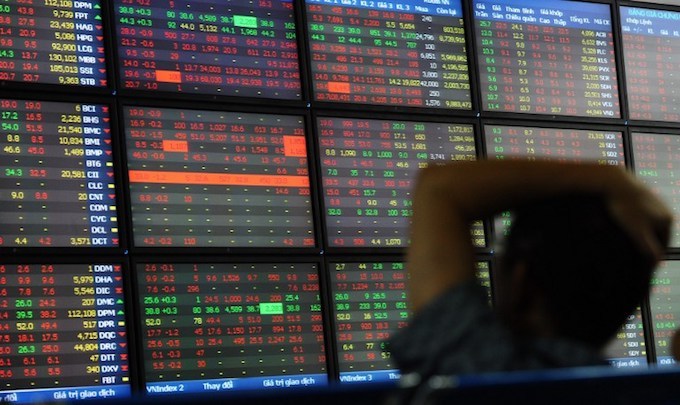
    Vietnam’s benchmark VN-Index continued to fall Monday with a 1.77 percent decline to 1,218.81 points, with most blue chips in the red. The index started off in the green but plunged in the afternoon and closed almost 22 points lower after losing nearly one point Friday. Trading on the Ho Chi Minh Stock Exchange (HoSE) increased by 7 percent to VND13.33 trillion ($579.56 million).

    The VN-30 basket, comprising the 30 largest capped stocks, saw 27 tickers dropped. SSI dropped 6.85 percent, continuing to fluctuate around its one-year low level.

    It was followed by five banks, with STB of Ho Chi Minh City-based lender Sacombank losing 5.8 percent TPB of private TPBank falling 4.5 percent. Other losers included MSN of conglomerate Masan Group, VNM of dairy giant Vinamilk and HPG of steelmaker Hoa Phat Group. BVH of insurance company Bao Viet Holdings was the only ticker that bucked the trend by rising 1.2 percent.

    Foreign investors were net sellers for the third straight session to the tune of VND439.11 billion, mainly selling SSI and VIC of biggest private conglomerate Vingroup.

    The HNX-Index at the Hanoi Stock Exchange, where mid and small caps list, was down 2.07 percent while the UPCoM-Index at the Unliste

  • UBS to Launch Banking App in Singapore

    UBS to Launch Banking App in Singapore

    UBS will soon be launching a new app in Singapore, CEO Ralph Hamers announced. UBS CEO Ralph Hamers announced that the world’s largest wealth manager will launch its Circle One digital product in Singapore on Tuesday. If successful, the new app which is designed to connect investors with ideas in a global ecosystem could be used in other markets.

    The offering is the latest digital effort from UBS, having launched its Key4 initiative last week.

    Hamers also commented on the financial markets during the interview at the World Economic Forum in Davos, noting investors are inclined to stay at the moment, given the market volatility. While clients are not necessarily exiting the market, they’re not exactly investing either, noting they are more or less sidelined and waiting for things to clear up, he said.

  • Careers in Crypto After the Crash

    Careers in Crypto After the Crash

    This month’s crypto crash is unlikely to keep graduates, drawn to blockchain, from continuing their careers in crypto. With top-notch master’s degrees in banking and finance from the University of St Gallen, Markus Geissler (27) and Bastian Wetzel (26) would be prime catches for a bank or financial institution. However, they rejected offers from major financial establishments, each joining a startup anchored in blockchain technology.

    Geissler and Wetzel are part of a shift that has been happening over the last three years. Previously graduates would spend three to five years working with an established financial player before venturing out to fintechs, whereas now, they are going directly after university, the head of Page Executive Switzerland, Stephan Surber, said.

    A look at other financial hubs shows that Swiss alumni are no exception, with fnlondon recently citing career progression, a lack of hierarchy, and token options, with significant upside potential, as crypto bait luring young professionals away from Wall Street. That was before the crash.

    Not About Cryptocurrencies

    Yet even this month’s dramatic fall in crypto markets has done little to put Geissler or Wetzel off the companies they work for.

    Blockchain is not just about cryptocurrencies» Wetzel said.  He works at Crypto Valley Venture Capital (CV VC), a young investment company that invests in startups based on blockchain. For so many use cases that CV VC funds, people wouldn’t actually know that they are using Blockchain, he added.

    Although the crypto market is declining this week. I’m not worried about the discount, because there is a proven benefit of what we do at Daura, a company specialized in tokenizing shares of unlisted small-to-medium-sized Swiss companies, Geissler said.

    Lower salaries aren’t a deterrent either. While fintechs might pay less than established institutions, some makeup for the fallout with equity in the company, Surber said.

    For Geissler, joining Daura didn’t mean taking a significant pay cut in comparison to his peers who joined investment banks, especially when one takes the hours they work into account, he said.

    Attracted to Technology

    In Surber’s observation, the trade-off lies in the work that the graduates end up doing: Young people are attracted by the broad range of responsibilities and by the technology itself, he said. Adding that «it takes longer for graduates to develop such skills at a bank.

    For Wetzel it is being at the forefront, watching technology evolve in front of him that brought him to CV VC: As early-stage investors, we see where innovation is heading, he said. I really feel like I’m part of the innovation.

    He reckons this wouldn’t be the case had he taken the offer that an established consultancy firm made him last year. The role would have involved advising traditional banks and asset managers on their blockchain technology, helping them «to adapt to innovation that has already happened,» he said.

    Driver’s Seat

    Geissler, who previously worked at one of Switzerland’s biggest banks for three years during his studies, swayed between private equity and investment banking roles because those seemed familiar, before finally getting sucked into this new environment of tokenization, of blockchain technology, he said.

    The allure of assuming a broad range of responsibility was also a hook.

    Now, as a part of Daura’s three soon to-be-four people strong management team, Geissler finds himself in the driver’s seat: At a bank, or let’s say at a financial institution I would probably also have been the person who is told what to do and when to do it,  he adds.

    Risk and Innovation

    For Wetzel taking risk goes hand in hand with innovation,» something he has learned over the 15 investments he has been involved in over the last six months, which he admits is kinda crazy.

    Besides the vast exposure he gets from his job, Wetzel cherishes the collaborative environment where superiors are keen to share their knowledge, as in the end, you want to learn from people, he said.

    Considering that the startup CV VC invests in focus on areas including decentralized finance, supply chain solutions, or real estate, there are plenty of topics to get his head around.

    Learning from Others

    Understanding blockchain technology is an advantage CV VC has over other early-stage investment companies, Wetzel said, as the startups themselves are also looking for investors they can learn from.

    When investment companies without the technological knowledge end up making investments, «they don’t have the resources or the network to help the startups grow,» he said.

    Seeing financial markets become more democratic is a key motivator for Geissler. Daura’s objective to allow individuals to become the true owner of their shares, by enabling them to transfer their tokens without a financial intermediary directly and without any cost, is game-changing for the industry and something he is proud to be part of.

    It’s not about the revolution, but more about the evolution of financial markets in Switzerland, he said. At some point, there has to be some sort of consolidation as there are so many tokens and so many projects, he said, conceding that there is a hype around certain projects.

    Back to Banks

    Large banks will drive this consolidation, as they buy up fintechs for certain financial products they have fine-tuned. Ironically, this will make them «more interesting to work for again sooner or later, but not for me. At least not now, Geissler said.

    For those who don’t know which path to take, working with a corporate is good because you still learn a lot and you have the opportunity to change your path at any time, Wetzel said. However, those, who know their future is in crypto, had better begin building their network soon because the industry is moving fast! he added.
  • Julius Baer Outlines its New Targets

    Julius Baer Outlines its New Targets

    Bank Julius Baer announces new targets for 2023 to 2025 and will sharpen its capital distribution policy, and focus on the development of a pure wealth management business model. Swiss Julius Baer is looking to return more capital to its shareholders, targeting an adjusted return on common equity tier 1 capital (CET1) of at least 30 percent during its medium-term time frame running from 2023 through 2025, the private bank announced Thursday.

    It said it updated the capital distribution policy with a clear commitment to return capital exceeding a CET1 capital ratio of 14 percent through annual share repurchases, in addition to the 50 percent dividend payout ratio.

    The bank said it would focus on sustainable profit growth and the development of a pure wealth management business model.

    It will focus on improving earning quality by increasing its ability to improve recurring revenues, including increasing its wealth management mandate by offering a strong value proposition to complement its advisory solutions.

    We are embarking on a new phase of profitable growth, building on the transformation we have successfully pursued since 2020. Our unique client-centric business model with dedicated focus on high net worth and ultra-high net worth clients gives us a strong competitiveness to shape our future. Building on this strength, we will consolidate our position as the leading international wealth manager by the end of the decade. To do so, we will grow business volumes and profitability, improve earnings quality and evolve the way we do business, said CEO Philipp Rickenbacher.

    The strategy will be supported by a binding sustainability strategy and strong risk management, the statement said.

    The bank aims to save 120 million Swiss francs on a gross basis by 2025, by streamlining its geographic footprint and market coverage.

  • Securing Digital Assets Gets Physical

    Securing Digital Assets Gets Physical

    As bad as losing money in the current market for cryptocurrencies might be, losing them altogether would be even worse.

    By some estimates, some 20 percent of all bitcoin has been lost for various reasons, including theft, forgotten passwords, or wiping out a hard drive, leading to a loss in value of well over $100 billion. What is there to do?

    One way to try to get back lost, stolen, or misplaced digital assets is to hire a firm that specializes in recovering them, although the price can be quite steep. One such company is the father and son team that founded cryptoassetrecovery.com which charges 20 percent of the value of the recovered assets. The duo estimated that around $4.7 billion is lost assets are recoverable. Still, if you have lost, say $10 million in Bitcoin, that might be a small price to pay.

    Going to the Ballet

    So much is written about the digital world, that it might be surprising that one way to help secure cryptocurrencies is with a physical wallet. These do not have a connection to the internet and are referred to as a cold wallet, while a hot wallet is a form of digital storage accessible via a device or computer.

    Ballet is a U.S.-based company that offers a physical wallet having a two-factor cryptographic private key securely concealed on the physical wallet itself, allowing the wallet to function as a bearer asset similar to cash or gold. A companion app, Ballet Crypto, serves as a digital interface for physical Ballet products and provides all the essential functions of a cryptocurrency wallet while allowing private keys to remain securely offline.

    A cold wallet would make more sense for someone planning to hold onto a cryptocurrency for a longer period. The drawback of losing a cold wallet is that you lose access to your investments, and the investor is in the same boat trying to recover assets.

    From Freeports to Fintech

    While the exact origins of freeports are subject to debate, the idea took hold around the time of the Renaissance as a way of attracting trade. Modern versions are often at airports and outside of customs areas. Malca-Amit is one company that has numerous vaulting facilities at several airports globally, including Zurich, where it offers storage for high-value assets including diamonds, gems, jewelry, gold, and other precious metals.

    In addition, it provides services the for luxury goods industry, high-net-worth individuals, and international banks access to a global team of experts in logistics, security, customs houses, and special operations (i.e. security) professionals.

    It also provides courier services for those goods and transportation of artworks. So that Warhol or Picasso you bought in New York and needs to be shipped to your home, Malca-Amit will handle the door-to-door delivery.

    It is now taking its experience in this traditional business of protecting and storing assets by offering physical vault protection to digital assets, in what they call «deep cold» storage either for individual clients or as a custodial service.

    What this means is the private key required to access the digital assets is secured offline, as part of the customer’s physical wallet, which we protect in state-of-the-art facilities. These are the same facilities used to safeguard the assets of investment-grade banks, luxury brands, and digital asset custodians explains Mark Titmarsh, who is head of digital assets at Malca-Amit.

    Titmarsh stresses that if a private key is lost or it is stolen, the thief has control of the assets in the case of theft. By physically storing wallets, customers remain in control of their private keys. This is because the private key is only generated when both private key elements on the physical Ballet wallet are combined, which are protected under seal. Whilst the wallet is in our care the private key elements will never be revealed. It’s pretty simple, we provide the physical infrastructure to keep the wallet and private key elements safe he says, noting that the firm is backing the assets against loss with full liability coverage.

    Casascius Coins

    While digital bitcoin is online on the blockchain, the Casascius coin can only be accessed by the person in possession of the coin’s private key, which is stored under a tamper-proof hologram that allows the owner of the physical coin to claim the associated Bitcoin.

    Holders of Casascius coins, which were introduced in 2011, can also be storied with Malca-Amit and are also covered by the same liability insurance.

  • HSBC Veteran Taking Over at Quintet

    HSBC Veteran Taking Over at Quintet

    A change of leadership is underway at Luxembourg-based private bank Quintet after the previous CEO’s surprise exit. Luxembourg-based Quintet Private Bank is appointing Briton Chris Allen as CEO effective July 1, the firm said in a statement released by the firm on Monday. Allen, who most recently headed private banking in Europe, the Middle East, and Africa at HSBC, spanning a 15-year career there, is replacing Jakob Stott.

    Stott, who joined Quintet in 2019 has stepped down as CEO and will leave the company after a short transition period, although no mention was made of any future roles. Stott was appointed by ex-UBS manager Juerg Zeltner, who died in 2020, and relaunched the former KBL Group as Quintet.

    During his tenure, Stott merged Quintets EU-based subsidiaries and strengthened core operations at the firm where he presided over a rise in total client assets from, around €72 million ($75 million) at the end of 2018 to nearly €100 billion by the end of last year.

    The banking group which is controlled by the ruling family of the Emirate of Qatar had entered the Swiss market with the ambition of becoming a major voice in the local wealth management industry. But just 16 months after opening following the acquisition of Bank am Bellevue, it closed shop and referred its clients to a competitor.

    After reaching an agreement with the Ticino-based private bank PKB at the end of last year on the sale of its remaining client assets, Quintet is expected to disappear from the Swiss scene by the fall at the latest.

    The private banks under Quintet’s umbrella include the following:

    • Brown Shipley (UK)
    • InsingerGilissen(Netherlands)
    • Merck Finck (Germany)
    • Puilaetco (Belgium)
    • Quintet Danmark (Denmark)
    • Quintet Luxembourg (Luxembourg)
  • UBS Data Thief Headed for Prison

    UBS Data Thief Headed for Prison

    An appeal by a former UBS banker who was convicted in absentia of espionage was denied by Switzerland’s highest court.

    The banker, only known as Rene S. was convicted of selling the data of wealth clients to tax authorities in Germany, and sentenced to 40 months in prison and fines and court costs of over 125,000 Swiss francs.

    In 2020, the verdict was upheld by an appeals court, and was again by the Swiss Federal Court, dismissing an argument that the lower appeals court did not correctly conduct the proceedings.

    At the heart of the case was the accusation that Rene S. pocketed 1.1 million euros ($1.14 million) from the sale of the documents and moved to a small town in Germany near the Swiss border.

    Swiss banks have paid billions in settlements related to charges they made it possible to wealthy foreigners to hide their wealth.

    Earlier this week, an attempt to change Swiss banking secrecy laws to exempt whistleblowers and journalists was blocked by lawmakers

  • SoftBank Q3 profit collapses as Arm deal falls through

    SoftBank Q3 profit collapses as Arm deal falls through

    SoftBank Group Corp. reported on Tuesday a 97 percent tumble in quarterly profit and the collapse of a deal to sell chip designer Arm worth over $60 billion, mounting pressure on the Japanese conglomerate to support its sagging shares.SoftBank reported that it had squeezed out a net profit of 29 billion yen ($251 million) in the October to December quarter, compared with a record 1.2 trillion yen profit booked a year earlier as its portfolio rallied.Separately, SoftBank announced that the sale of Arm to Nvidia had fallen through amid regulatory hurdles in a major setback to its fund raising plans.

    The decision comes after US authorities filed a lawsuit seeking to block the sale and probes were launched into the deal in the United Kingdom and Europe.The Japanese investment giant said it would recognize a $1.25 billion breakup fee that Nvidia had deposited as a profit in the fourth quarter.After tech unicorns plunged into the “valley of the coronavirus” in the early days of the COVID-19 pandemic, SoftBank CEO Masayoshi Son rode a recovery in valuations as startups such as e-commerce firm Coupang came to market.

    Now valuations are again under pressure as investors cast a skeptical eye over tech firms promising future profits and central banks move toward paring pandemic stimulus.

    The Vision Fund unit posted an investment gain of 111.5 billion yen during the quarter, a sharp decrease from a 1.4 trillion yen gain a year earlier.

    “Even though some of the public companies have come down in value, there have been significant follow-on funding rounds where outside institutional investors have led those rounds,” Vision Fund’s Chief Financial Officer Navneet Govil told Reuters.

    Many SoftBank portfolio companies are trading below their listing price, with office-sharing firm WeWork, ridehailer Grab and used-car platform Auto1 all falling during the quarter.

    The group’s exposure to China has also affected performance, as regulators take action against tech firms. Shares of e-commerce giant Alibaba, in which SoftBank has a stake, dropped a fifth in the three months to the end of December.

    Such assets are used by the group for loans as it invests through its Vision Fund unit, which runs the $100 billion Vision Fund and a smaller second fund and has become the priority for the group.

    Vision Fund 2, which had $51 billion in committed capital at the end of December, had invested $43.1 billion in more than 200 startups. Industry observers have noted a disconnect between frothy private markets and skepticism in public markets.

    “We are seeing some healthy rebalancing… at some of the more extreme ends of the market,” Govil said. “We did turn down quite a few transactions because we thought valuations were rich.”

    Portfolio companies, including sports e-commerce firm Fanatics, held funding rounds during the quarter. Vision Fund has distributed $44.2 billion to its limited partners across both funds.

    The earnings come at a watershed moment for the conglomerate as senior executives exit the firm, including Chief Operating Officer Marcelo Claure , who led the restructuring of WeWork and launched the group’s Latin American-focused fund.

    The company has also seen internal turbulence recently following reports that Claure’s demands for as much as $1 billion in compensation had fuelled an internal clash.

    SoftBank launched a 1 trillion yen buyback in November.

    Group shares closed down 0.9 percent ahead of the earnings and have lost about half since highs in March last year.

    Son, who three months ago said SoftBank was in a “blizzard,” will speak at a news conference at 4:30pm local time

  • UBS Appears to be Mapping out a Digital Roadmap

    UBS Appears to be Mapping out a Digital Roadmap

    Many banks are making digital products an essential part of their offerings. It looks like UBS is joining the fray. UBS, Switzerland’s largest bank as registered several new brand names in the Swiss trademark register.

    Among the new brands are UBS Key4 banking, UBS Key4 wealth, and UBS Key4 business, which have been registered and are now legally protected product names of the bank.

    To date, however, Key4 is only the name of the online portal by which UBS has been selling its own and third-party mortgage loans since 2020. According to the report, the registrations of the new trademarks could indicate UBS is in the process of building additional brands for a future digital business.

    UBS rival Credit Suisse launched a digital product in 2020 and trades under the name CSX.