Category: Research

Retail News Asia is committed to providing both local and global retailers with the latest Research throughout the Asian market. This on a daily base.

  • Demand for inflight broadband in APAC hits new heights

    Demand for inflight broadband in APAC hits new heights

    Airlines in Asia-Pacific are seeing soaring demand for inflight broadband service, with a majority of passengers in the region expecting to have such services onboard, a new survey said.

    The survey, conducted between August 2015 and March 2016, garnered respondents from more than 9,000 passengers in Asia, Australasia, Europe, and Central and South America who had taken a short, medium or long haul flight in the past year and carried at least one personal device onboard the aircraft.

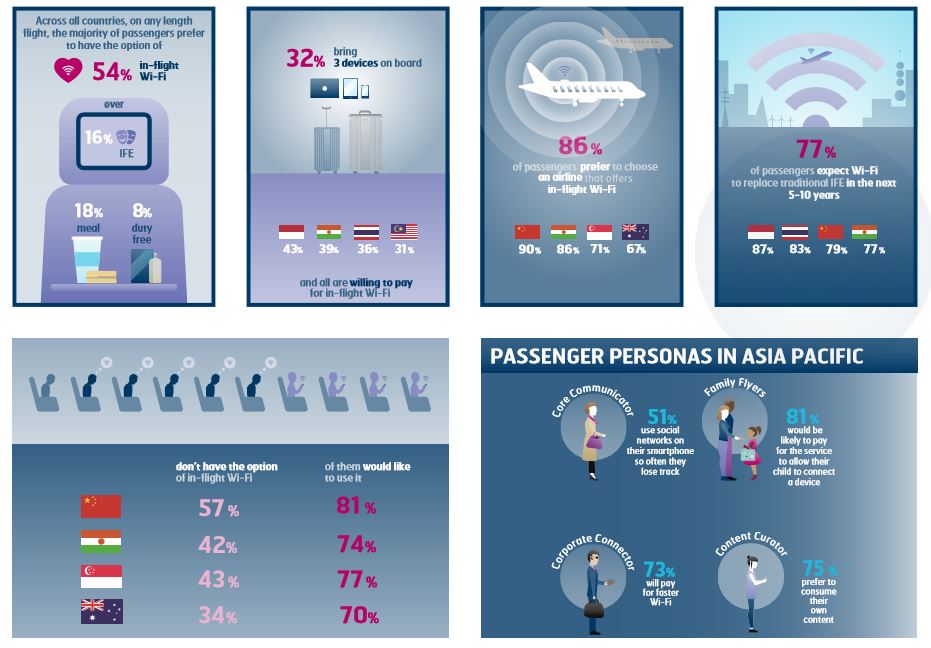
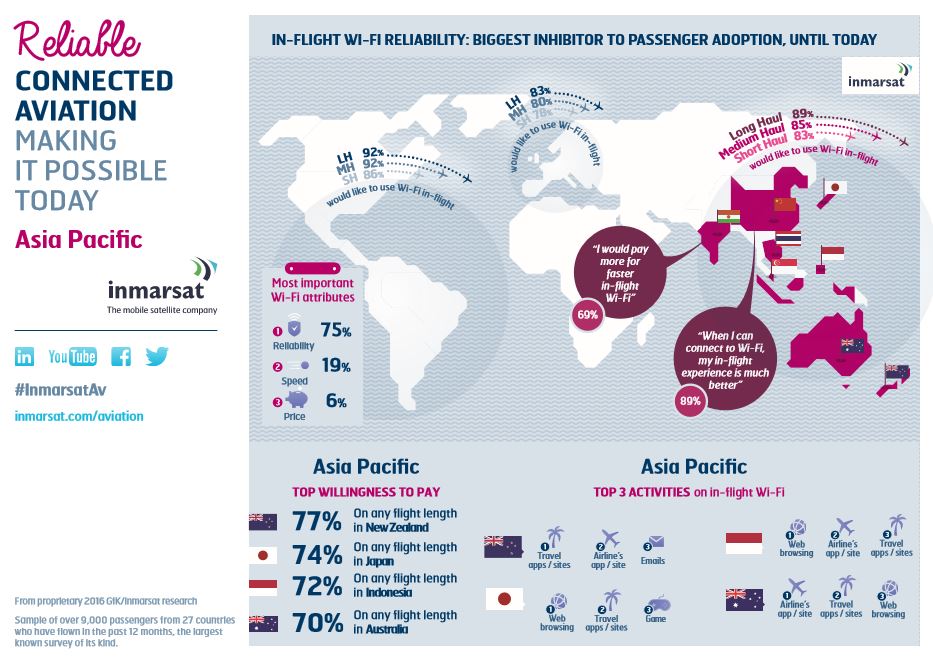
    According to the survey, conducted by Inmarsat and market research firm GfK, nine out of ten respondents from the region say the availability of onboard connectivity would influence their choice of airline, while over two thirds are willing to pay for the service.

    Meanwhile, 54% and 57% of Asia Pacific passengers would choose inflight broadband as a preferred service in short-haul and long-haul flights, compared to only 16% and 18% choosing traditional in-flight entertainment (IFE) as their preferred onboard service.

    Business flyers are even more likely to recognize the value of paying for high-speed onboard connectivity than vacationers, with 74% of business travelers surveyed indicating they are willing to pay more for faster inflight broadband compared to 62% of leisure travelers.

    The survey revealed that 64% of passengers felt that in-flight broadband can deliver all of their onboard entertainment needs. This highlights an opportunity for airlines to use in-flight broadband to increase ancillary revenues, as the majority of passengers are willing to pay for the service, with 68% of passengers under 34 years old and 55% of passengers over 45 years old willing to pay for unlimited internet usage during a flight.

    When it comes to the quality of the inflight broadband service, passengers are most concerned about reliability (that a connection does not drop out or cut off), availability (that the connection is available throughout the flight), and speed of the connection.

    Inflight WiFI reliabilityThe survey showed that quality is even more important than price in Asia Pacific, as passengers are prepared to pay more for a quality service. Some 72% of flyers in Asia Pacific would prefer not to use broadband that is of poor quality with 62% stating they would pay more for faster in-flight broadband

    “Our survey has highlighted a growing appetite for fast, reliable and consistent broadband in the air, with more than half of Asia-Pacific passengers preferring in-flight connectivity over a meal or traditional IFE,” said Bill Peltola, Asia Pacific regional director at Inmarsat Aviation.

    “Although three-quarters of Asia Pacific flyers would like to try onboard broadband in the future, only 3% of aircraft operating in Asia Pacific today offer the service, highlighting the potential for airlines to use it as a differentiation point to attract more customers.

    The inflight broadband connectivity survey

  • On the cusp of a Vietnam franchising boom

    On the cusp of a Vietnam franchising boom

    A Vietnam franchising boom is nearing with about 40 foreign brands reportedly seeking franchise partners in the nation.

    With the signing of several free-trade agreements and Vietnam’s involvement in the Asean Economic Community (AEC), the franchise industry is expected to boom, reports VietnamNet.

    Figures from the Ministry of Industry and Trade show that it has licensed more than 150 foreign-brand franchises since 2007.

    VF Franchise Consulting CEO Sean Ngo says the recent free trade agreement with the EU and, more importantly, the upcoming TPP, promise to be beneficial for Vietnam. He is also Southeast Asia MD for global franchise consultancy Edwards Global Services (EGS).

    While industries such as manufacturing, textiles, and food processing are sure to benefit, he says other franchised businesses that will also do well include equipment, furniture and fixtures and raw materials, as Vietnam drops import duties or lowers them to near zero under the new agreements.

    He says that when the AEC materialises it promises even more benefits, as the focus in franchising is to offer products and services that cater to the Asean consumer.

    “This will help many regional franchises successfully enter markets like Vietnam, and help Vietnamese franchises also expand further into the region,” says Ngo.

    Retail & Franchise Asia chairwoman Nguyen Phi Van says 90 per cent of the franchisors its represents in Vietnam are from the EU and the US, primarily in the fields of food, education and training, and gyms.

    “Although 90 per cent of franchise brands are in the food industry, as the market thrives over the next five years, the percentage of franchises in the service industry will increase substantially,” says Van.

    She says Vietnam has the three factors needed for developing franchising. Besides its large market size, the country’s stable macro-economic situation is also key to development.

    Meanwhile, Vietnamese enterprises have not really seized the opportunities from franchising. Van says the main drawbacks include inefficient operations, weak management and lack of finance.

    She says that devising the right pricing strategy will be critical to success, as consumers typically have lower disposable incomes than other Asean markets.

    Meanwhile, the Vietnam Retail & Franchise Show will be held in Ho Chi Minh City from June 8 to 10.

  • Taxing the internet giants: Catch me if you can

    Taxing the internet giants: Catch me if you can

    Southeast Asia is experiencing rapid growth in digital technology, social media, mobile activity and internet usage. Like every other emerging market that is witnessing rapid smartphone adoption, Indonesia is seeing mobile phones increasingly chosen as the platform for digital content consumption. According to US research firm eMarketer, spending on digital advertisement is growing very fast in Indonesia.

    The world consists of hundreds of different nations and legal jurisdictions, each with their own set of tax regulations. In cross-border transactions, the interaction of domestic tax systems can leave gaps that result in income not being taxed anywhere.

    Google is the poster boy of companies successfully practicing “tax optimization”. In the last couple of years, there have been intense discussions on how foreign-based online businesses have apparently failed to pay their “fair share” of tax.

    Multinational internet corporations with the help of their financial advisers used the tax treaty network and international structuring regime to minimize their tax burden through various mechanisms. In the digital era, taxing multinational companies becomes a lot more complicated.

    First, under international tax rules, local corporate tax will usually be levied on a business in its home country. The target country has the right to tax under traditional international tax concepts, if a non-resident business has a permanent establishment.

    Permanent establishment typically requires a relatively strong physical presence or a relatively high number of activities before a state has source-based jurisdiction over income.

    Most online businesses do not need these to do business; their online presence and payment systems are sufficient. It is very easy for businesses to claim that they have no taxable presence in a country. It becomes more difficult to apply traditional concepts to link an item of income with a certain location.

    Second, having a taxable presence is only the beginning of the story; countries then have to determine how much profit is attributable to that entity.

    There is a lack of definite legislation for guidance on this. Tax authorities have often left it to the companies to bargain with them.

    However, while negotiating, both parties will also be looking over their shoulders at their home country.

    Especially companies from the US, such as Google and Facebook, would prefer any tax they pay in other countries to be deductible as a credit against taxes to be paid in the US.

    Another question is how the government could tax a large business that has not yet been monetized, meaning it does not really earn any money, like WhatsApp? It is pretty much playing on the valuation, and taxes are applicable only when the business is sold.

    Third, governments are often slow to adapt their tax laws to technology. Many countries are now struggling with how streaming video services like Netflix fit into their tax structure.

    Historically, the problem with the taxation of digital goods is that the sales tax was designed to be imposed on the sale of tangible personal property.

    The tax base has been expanded over time to include several specific services, but many digital products are a mix of an intangible product and a service. Most transactions do not systematically fit into existing tax laws.

    Indonesia’s government has tried to address some of these problems. The Communications and Information Ministry has issued Decree No. 3/2016, which stipulates that internet companies providing services in the country must establish a permanent establishment.

  • Asia Pacific Premium OTT Market Will Experience Exponential Growth Despite Challenges

    Asia Pacific Premium OTT Market Will Experience Exponential Growth Despite Challenges

    Vindicia, the leader in enterprise-class subscription billing, and Ooyala, a leading video, analytics, and advertising technology provider, today announced key findings from a study that explores the Asia Pacific (APAC) market opportunity for premium over-the-top (OTT) services. Conducted by top research and strategy consultancy, MTM, the findings reveal significant challenges to expansion due to broadband infrastructure and content localization, revenues are expected to grow strongly between now and 2019.

    The report explores the evolution of premium OTT in APAC, focusing on three key territories: Australia, Indonesia and Thailand. Over 80 participants, including a broad range of senior industry professionals, provided their perspectives on current and future market trends and developments.

    The study’s central finding was that despite challenges, APAC’s premium OTT market will undergo rapid growth by 2019: from around $85M in 2015 to $230M in Australia; from $7M to $40M in Indonesia; and from $8M to $45M in Thailand. Local service providers will own a significant portion of the market and will dominate in Indonesia and Thailand, while Netflix will be the dominant player in Australia.

    The study highlights three main challenges to premium OTT market expansion:

    • Broadband infrastructure. Industry executives believe broadband infrastructure challenges and limited access to affordable fixed-line services are significant barriers to growth. In Australia, the average connection speed is 8.2 MBps, about half that of the UK and US. Thailand has a similar average of 9.2 MBps, but only 9 percent of consumers subscribe. In Indonesia, there is only 1 percent broadband penetration with an average speed of 3.9 MBps. Participants view APAC as a mobile-first market.
    • Content localization. Despite the appeal of international content, respondents believe local-language programming is essential to the proliferation of premium OTT services in Indonesia and Thailand. Furthermore, they expect stiff competition among local pay-TV providers over licensing of existing local content libraries.
    • The Netflix Factor. While the presence of Netflix will drive OTT market expansion in general, consumers will struggle with Netflix’s one-size-fits-all offering. Because of this, there will be a period of uncertainty as consumers choose between standalone Netflix and competing offerings from local content providers, whose multiplatform and bundled packages ultimately may prove more appealing.

    “There’s no doubt that Asia Pacific is a hotbed of premium OTT service expansion that will evolve based on regional nuances, tastes and economics,” said Bryta Schulz, Vindicia senior vice president of marketing. “The next 12 to 24 months will function less as a test of whether or not premium OTT will take off, but more as a measure of how it will penetrate popular appetites. Among the creative and flexible approaches to generating reliable revenue, service providers will need platforms that can accommodate a range of content delivery and payment preferences. This is where solutions from Ooyala and Vindicia become vital.”

    “Intensifying OTT competition and major market consolidation, like what we’re seeing in Australia, are key identifiers of an industry on the crux of a massive opportunity,” said Vice President and General Manager of APAC for Ooyala, Keith Budge. “APAC OTT providers must build a rich, personalized user experience with unique content offerings that are competitively priced, and further, have a data-driven approach to understand audience behavior and preferences. Having analytics and insights will be a major differentiator to drive revenue and reduce churn as new OTT services launch into the market.”

    “The study provides a snapshot of industry perspectives about the prospects for premium OTT across the region. Local executives are positive and excited about future market prospects – and expect local players to perform strongly, especially in Thailand and Indonesia,” said Jon Watts, managing partner and co-founder at MTM. “International providers will need to find ways to partner with local pay-TV providers, telcos and ISPs to gain traction with local customers.”

  • Use Data To Show Customers They’re More Than Just A Number

    Use Data To Show Customers They’re More Than Just A Number

    Companies claim that customers aren’t “just a number to us,” but that’s more than a catchphrase for number-crunching analytics firm 84.51°.

    The company is the recent spinoff of former Kroger-Tesco analytics joint venture dunnhumby, now wholly owned by US supermarket giant The Kroger Co. Renamed for the longitude of its Cincinnati headquarters and rebuilt from the ground up in 2015, 84.51° now focuses much of its activities on Kroger customers and partners, such as global consumer packaged goods companies. It believes that its core competitive differentiator is not technology, but rather its focus on helping customers build long-term relationships with their consumers and other customers.  (The company says its new name also represents the “longitudinal view” it takes on understanding customer behavior.)

    Most retailers rely on segmentation analysis to determine which promotions to send consumers, creating blocks of homogenous groups of people (such as single-parent households in middle-class neighborhoods). But 84.51° uses analytics differently, eschewing what CIO Yael Cosset calls an “archaic” approach in favor of a much more relevant, personalized one.

    “We think of it as a snowflake, because we believe no two individuals are the same, and hence we should not engage them the same way, send them the same promotions,” he says.

    So, for example, you might send a promotion for a particular kind of bottled water to consumers who have already demonstrated an affinity for that kind of product, but you wouldn’t send them a promotion for a cola drink just because the supplier is offering one. This is the kind of commitment necessary to develop long-term relationships with consumers, Cosset says.

    The company goes beyond knowing which consumers like to buy bottled water or condiments; it tries to identify which ones prefer sparkling water to flat, or Dijon mustard to steak sauce. “You can’t do that with segmentation,” Cosset says.

    That approach requires investing in the development of sophisticated algorithms that enables 84.51° to analyze millions of data points about each individual consumer, including their reactions to previous promotions.

    Using Oracle Exadata and Oracle Big Data Appliance, teams of analysts and data scientists at 84.51° leverage a combination of conventional statistical packages and more advanced machine learning algorithms to generate the analytics foundation required to deliver personalization at scale.

    A single campaign uses dozens of targeting models in combination with complex optimization algorithms to send the right offers to the right people. Often, offers are based on contextual cues gathered in real time and are specifically targeted for each customer.

    “We spend a huge amount of time, money, and resources to really get solid sustainable data assets,” Cosset says. “Our data asset is a competitive advantage.”

    Retailers cannot expect to build long-term, sustainable relationships with customers if they base the terms of those relationships on financial incentives alone, Cosset says. “They’re transactional, not relationship-based,” he says. “The real differentiator is what you do with the data—how do you provide real and relevant value to every single customer, how do you engage them the way that matters most to them, how do you create this personal relationship.”

  • Does Your Brand Need a Store in China to Succeed?

    Does Your Brand Need a Store in China to Succeed?

    As brands speculate about continued economic buoyancy in China, the necessity of having physical stores has come under increasing scrutiny. The unrelenting enthusiasm for e-commerce shown by Chinese consumers has also given cause for questioning the relevance of physical retail.

    Luxury and fashion brands have scaled back on their original optimistic plans to store expansion in China. Most notably, Louis Vuitton announced the closure of several Chinese stores last November. Also Walmart, has this week, launched a major brand repositioning to offer e-commerce solutions to Chinese consumers.

    Pessimism about store space is becoming endemic. Dangdang.com, a local online bookseller similar to Amazon, has launched an audacious plan to create actual bookstores based on the idea they will receive free-rent in increasingly vacant shopping malls in big cities.

    When a store, is not just a store

    Looking at the importance of a store presence in China requires a specific cultural lens. A key starting point for most, if not all, foreign brands is that they are not inter-generational. That is, the reputation and trust of the brand has not been passed down through family legend. Instead, brands are initiating relationships from scratch with a fresh generation of consumers.

    Taking the case of luxury, consumers have experienced the brand as a personal form of development. A key moment of truth in their relationship with brands is formed through store experiences –the physical inspection and feeling of products.

    When interviewing Chinese consumers, the key difference that strikes me is how emotional the store experience and service are in the stories they tell about their favourite brands. Often, they become aware of a brand through peer recommendation, but their loyalty and ultimate advocacy is created through their retail experience.

    Forgoing or not maintaining a retail presence is like introducing a ‘circuit breaker’ at the most crucial stage of brand adoption. Stores, irrespective of economic forecasts, must be seen as a symbolic, practical and emotional stepping stone for new consumers in China.

    In one particular interview with in Chengdu, the thriving city in the Western part of the country, a Chinese entrepreneur was describing to me that one of his favourite brands was Tod’s (which he could not pronounce, and jokingly called it “potato slices” because it was the closest Chinese word he could find).

    Despite having extreme difficulty in engaging with the brand at the official level, he has become a Tod’s aficionado based on his experience at the store – that he described as “like the home I imagine I would live in Italy”.

    For him, the brand was the retail experience, it was enough to cement this loyalty and enthusiastic promotion to a large group of businessmen, who like himself, were ‘finding their feet’ with luxury brands.

    Beyond a transaction point: Chinese stores as brand equity

    From a broader strategic point of view, brands need to see stores in a wider cultural perspective. Beyond a point of transaction and sales number, stores are the clearest and most uncompromised expression of your brand to new consumers in China.

    In the context of ‘face’, retail presence in new malls and as part of the new middle class’ weekend walkabouts is essential to suggest status and respect to Chinese consumers.

    Once again, using Chengdu and luxury as an example: The way foreign brands were perceived in terms of their premium offering was directly related to their presence in two of the city’s new mall developments –meaning Burberry and Michael Kors enjoyed almost equal rating as early-arriving European brands.

    Adding to perceptions is the way that Chinese consumers share their recommendations with others in-person and online is almost always footnoted with a proof point on quality. Invariably, this is described as the look, feel, or physical appearance of the product materials – the fabric of the dress or the sheen of the casing. In this initial peer-to-peer introduction to brands, physical inspection at a store is an essential part of the purchase journey.

    Forgoing or not maintaining a retail presence is like introducing a ‘circuit breaker’ at the most crucial stage of brand adoption. Stores, irrespective of economic forecasts, must be seen as a symbolic, practical and emotional stepping stone for new consumers in China. Something that e-commerce, or lack of stores, can not address.

  • Lessons to be learned from South Korean TV

    Lessons to be learned from South Korean TV

    Stepping inside the Munhwa Broadcasting Corporation (MBC) in Seoul, you would be surprised how the Korean broadcaster has managed to turn its headquarters into a tourist spot.

    On the ground floor, booths are set up to allow visitors virtually learn singing and take pictures with the K­pop stars, or even pretend to be their girlfriends or boyfriends.

    Upstairs, visitors could take a further step to have a taste of being anchors in news castings or even acting as the empress in the signature dramas.

    Korean dramas have stirred up crazes in Asian countries over the past decade and created huge business opportunities. With the recent success of the military-­setting drama Descendants of the Sun, produced by another broadcaster KBS, many would wonder how Hong Kong, which sees a new free station ViuTV goes on air earlier this month, could learn from the Korean experience.

    It was important for the government to take a careful position, said the country’s envoy in Hong Kong, by pouring resources in nurturing talents in one hand but refraining from meddling in the production.

    “Even though the Korean government support the entertainment industry, they would not intervene directly,” said Yu Byungchae, the country’s consul in Hong Kong on culture. “The content of the dramas and movies depended on the creator’s ideas.”

    The more competitive environment in South Korea, with the rise of new cable broadcasters, has helped boosting the production’s quality, said Yu, and now the industry is eyeing not just locally but the huge overseas market.

    The Descendant of the Sun ­– the first TV series jointly produced by Korean and Chinese firms and aired in both nations simultaneously ­ — has already been sold to 32 countries, including United States, Germany and Russia.

    The drama’s success also helped giving a strong boost to the tourism and retail sectors, said Yu. One of the examples was the surging sale of red ginseng extract ­which the leading actor Song Joong­ki was seen drinking in Descendant of the Sun.

    “In the past, [promoting] culture, drama or K­pop are the responsibility of the Ministry of Cultural, Sports and Tourism,” he said. “But now financial ministers and other sectors are all interested in coordinating [to see] how the government can help those industries to develop more.”

    Yu also said Hong Kong’s advanced financial system actually was a great advantage the city enjoyed to develop its cultural industry, adding he believed the emergence of ViuTV would bring Hongkongers more diversified content.

    “Things we have not imagined before might [happen] now,” he said, referring to the new broadcasters’ all-female mixed martial arts reality show G-1 Fight Club which featured eight Hong Kong starlets beating on each other.

    “It’s natural that competition [boosts] creativity. To survive, [broadcasters] have to create things they have not done before.”

    But Korea watcher Steve Chung Lok­wai was not so optimistic at the city’s capacity in producing dramas of Korea’s quality in short run.

    ViuTV was placing its focus on entertainment or reality shows instead of dramas, he said, as the production of the latter required enormous and sustaining capital and it would be very tough for the newcomer to compete with the broadcaster giant TVB.

    The decades-­long monopoly of TVB has also made Hong Kong lag way behind South Korea, Chung, an assistant lecturer of Global Studies programme in Chinese University, lamented.

    “TVB used to sell its dramas to the overseas Chinese markets, but now even the expat Chinese communities have given up TVB to watch Korean or Japanese dramas instead,” he said.

    Chung said Hong Kong government did not have a macro cultural and entertainment policy and argued only by granting more free-to-air TV licenses, which facilitates true competition, would help improving the stagnant development.

  • Removing online commercial curbs can hurt consumers

    Removing online commercial curbs can hurt consumers

    Hong Kong manufacturers and retailers that increasingly use e-commerce may know that their contracts with EU companies may contain vertical restraints on online distribution. Competition authorities across Europe are currently discussing the appropriate treatment of such restraints under competition law.

    This is being done with a view to preventing distributors from imposing more restrictions on online retailers than on their rivals in traditional brick-and-mortar shops, Hong Kong Trade Development Council Research (HKTDC Research) has said in a report.

    The UK’s Competition and Markets Authority (CMA) commissioned a report from independent consultants in order to know why businesses use these restrictions and how these may affect consumers, both positively and negatively. The report surveyed 33 mostly small and medium-sized UK-based manufacturers and retailers. It was released on 30 March 2016 and will prove to be of interest to e-commerce users, HKTDC Research said.

    The businesses interviewed use a wide range of restraints in their contracts, with the most common being selective and exclusive distribution agreements (often excluding online retailers) and recommended retail prices (RRP) for retailers. The participants explained such restrictions by the need “to prevent free-riding” and to “protect brand image”.

    Free-riding may occur when customers visit ‘service retailers’ (e.g. providing free advice on products), but purchase the product from a cheaper retailer that does not provide any service support.

    Participants who mentioned maintenance of brand image said restrictions “helped signal the high quality of the product and maintain the image of the product (particularly for luxury brands)”.

    However, the report further shows that the restrictions are also “attractive because they limit the direct competition faced by the relevant manufacturers or retailers, particularly from online channels”, without any consumer benefit.

    Hong Kong companies may be interested in the conclusions of this report. In the long term, forbidding these restrictions “could bring about lower retail service standards and a poorer quality experience of the underlying product”. This is likely to hurt consumers, especially for high-tech products. On the other hand, especially in the short run, the absence of such restrictions could cut prices and widen product availability.

    The European Commission is also conducting an inquiry into the e-commerce sector. The inquiry was launched on 6 May 2015 and a Preliminary Report is due to be published in mid-2016.

    A sector inquiry is an investigation that is carried out by the European Commission into sectors of the economy and into types of agreements across various sectors, when it believes that a market is not working as well as it should, and that breaches of the competition law rules might contribute to the malfunctioning of that market.

  • In Asia, Netflix trips on regulation, content, and competition

    In Asia, Netflix trips on regulation, content, and competition

    Months after its global rollout, Netflix is facing problems in several major Asian markets as it struggles to provide enough strong content to attract consumers amid tough local competition, and also faces many regulatory hurdles, underlining concerns about disappointing subscriber numbers reported this week.

    From complaints that programming libraries offered in many countries are far smaller than in the United States to delays in offering its signature “House of Cards” series in some markets due to rights issues, the U.S. video streaming giant’s January launch into 130 new markets worldwide, including a slew in Asia, has been bumpy.

    When it launched in Indonesia in January, for example, Netflix ran afoul of the film censorship board for carrying content deemed inappropriately violent or sexual. The communications ministry also demanded that Netflix set up a local office and pay Indonesian taxes.

    State telecoms company PT Telekomunikasi Indonesia Tbk (Telkom) will continue blocking Netflix until it adheres to regulations, Arif Prabowo, vice president for corporate communications at the carrier, told Reuters, declining to give details.

    Netflix is still available in Indonesia via wifi connections and other carriers.

    “Services delivered over the Internet present new questions for everyone, including policymakers, and our intention is to comply with applicable laws and regulations,” said Jessica Lee, Netflix’s head of communications for Asia.

    “It is all part of the journey as we roll out in different countries,” she said.

    The cost of dealing with these kinds of issues are reflected in its results, which show that Netflix suffered a first-quarter operating loss of $104.2 million for streaming video outside the U.S., partly because of higher marketing costs, and also showed that it is earning less per subscriber overseas than at home.

    Netflix had 34.5 million international subscribers against 47 million in the U.S. at the end of the quarter. It is unclear how many of its customers are in Asia.

    LICENSING RESTRICTIONS

    In South Korea, where local content is popular and consumers have numerous streaming options, the Netflix site offers fewer than 20 local TV shows or movies.

    “Korean Netflix’s library in terms of content is pretty thin,” said Jung Dong-yoon, a 29-year-old Seoul office worker and subscriber since January.

    Netflix viewers in the country also this week discovered that well-known shows including “How to Get Away with Murder” and season two of “Better Call Saul” were missing – temporarily, Netflix says – as the shows are submitted for age appropriate ratings by the country’s ratings board.

    Programming rights are an issue globally.

    As of January, Netflix Australia, which launched service more than a year ago, offered just 443 TV shows, compared with 1,157 in the United States, and had 1,585 movies, compared with 4,593, according to Finder.com – fewer than those available in Iraq, Haiti, Cuba and many other countries.

    “With the traditional way in which rights to movies and TV titles are structured, there will be licensing restrictions and the goal is to get to a global library that is the same everywhere but that takes time,” Lee said.

    Vivek Couto, executive director of consultants Media Partners Asia, said it is still early in Asia for Netflix. He expects the company will ramp up local content and eventually get “reasonable penetration” in markets such as India, South Korea, Singapore, Hong Kong, the Philippines, Thailand, and Vietnam.

    “Markets like Singapore and India, over time, they can do reasonably well, but I think they’re going to find more challenging markets like Japan, Korea, China,” he said.

    Netflix has yet to win permission to enter the coveted but highly restricted China market.

    SLOWER GROWTH

    Netflix this week said it expected to add about 2 million non-U.S. subscribers in the second quarter, below analysts’ average expectations for about 3.5 million.

    Chief Executive Reed Hastings on Monday cited a lack of local language content and local payment options for limiting initial sign-ups in some countries.

    “Over the next couple years as we further localize, we’ll be able to see more opportunity,” he told analysts on a conference call. Netflix can take heart from its performance in Latin America, where it launched in 2011 and is by far the dominant video streaming service.

    However, it has seen its share of the key Mexican market eroded slightly by competition from Clarovideo, a streaming service offered by billionaire Carlos Slim’s America Movil.

    One of Netflix’s biggest obstacles to growth in Mexico has been the low-level of broadband subscribers, according to one industry source. Broadband availability also looms as a potential concern in Brazil, where the telecoms regulator announced earlier this week that broadband providers would soon be allowed to set Internet usage limits.

    In Asia, Competition is intensifying from local streaming sites as well as global providers such as Amazon, Hulu, HBO and BBC iPlayer.

    Around the time Netflix debuted in South Korea, local company Frograms Inc launched its own Watcha Play service. Two months later, SK Telecom made its video streaming service available to customers who do not subscribe to its phone service.

    Around the time Netflix debuted in Australia, publisher Fairfax Media and broadcaster Nine Entertainment Co Holdings launched a joint venture streaming service, while News Corp and Seven West Media teamed up to do the same. All offered heavy discounts, including free trials.

    Netflix had an explosive start in Australia, counting nearly 3 million Australians as viewers, OUT OF A population of 24 million, within nine months of its March 2015 launch. But growth has slowed just as dramatically, from a 55 percent leap between April and May to a rise of 4 percent between September and October, according to Roy Morgan research.

  • Why Is Apple Opening More Retail Stores in Emerging Markets?

    Why Is Apple Opening More Retail Stores in Emerging Markets?

    Apple continues to remain optimistic about China despite the country’s economic slowdown. As a result of this optimism, Apple plans to open a number of retail stores in emerging markets such as China and India. Apple had 28 stores in China through the end of 2015, but it plans to add 12 more by mid-2016.

    In India, Apple had depended on subdistributors for the sale of its products until now. However, Apple has sought approval from the Indian government to open its own retail stores in India.

    Apple considers India to be an important market in the coming days, as the country is now the second-largest smartphone market in the world after China. Apple’s revenues in India grew by a healthy year-over-year (or YoY) rate of 38% in the quarter ended December 2015.

    Percentage of users buying iPhones from Apple US retail stores declining

    India has some positive macroeconomic factors that make it an attractive market. It is one of the fastest-growing economies with a huge young population. According to Apple’s CEO, Tim Cook, “The population of India is incredibly young. The median age there is 27. I think of the China age being young, at 36, 37 and so 27 is unbelievable. Almost half the people in India are below 25. And so I see the demographics there also being incredibly great for a consumer brand and for people that really want the best products.”

    The focus on retail in emerging markets is big for Apple, but it’s the opposite in the US. According to a report, citing research from Consumer Intelligence Research Partners, users are increasingly buying iPhones from telecom providers such as Verizon, Sprint (S), and AT&T (T) rather than its own stores. The above chart shows this trend. The main reason for this trend is that these providers offer consumers attractive leasing, installment plans, and exchange offers.

    Apple commands only 2% share of India’s smartphone market

    In the previous part of this series, we discussed the growing focus by Apple on India. According to Counterpoint, India recently overtook the US to become the second-largest smartphone market, behind only China. However, Apple still only commands a 2% share in India’s smartphone market.

    According to that report and as the chart below shows, Samsung led the Indian smartphone market last year, with Micromax, Intex, Lenovo, and Lava taking the up the remaining four positions among the top five players in this market. Microsoft lost its place among the top five players in this market due to the declining popularity of the Lumia line of smartphones.

    Apple Aims to Increase Penetration of India’s Smartphone Market

    Apple’s initiatives in India have yet to bear fruit

    Apple released the low-cost iPhone SE in March 2016, accompanied by high expectations. It released this smartphone in India in early March, but it has so far failed to garner much interest from users. The problem with the iPhone SE is that although it costs $430 in the US, it is sold at the higher price of $586 in India.

    iPhones cost more in India because Apple currently depends on third-party distributors to sell the devices in India, adding their commissions to the phone’s price. However, as discussed in the previous article, Apple plans to open its own stores in India, which could help bring down the prices of iPhones in India going forward.

    This isn’t the first time Apple has launched a cheaper version of the iPhone. In 2013, Apple launched the iPhone 5C at around $500.

    In 2015, Apple announced that it would slash the price of the iPhone 5S from $665 to $370, according to a report from the Times of India. However, all these efforts have still not helped Apple’s penetration of the Indian smartphone market. In our view, Apple would have to do much more to achieve that goal.

  • Tips on starting a business

    Tips on starting a business

    The fun really begins now, as there is so much to learn about starting a new business. There is a lot of preparation and risk involved in starting out in a new venture. There are a lot of options available for you to look into, as you start your venture as an entrepreneur. I must admit it takes a lot of courage and want, to succeed and to create a viable business. There is no point in creating a business if you are not prepared to give it your all. The risks involved are far too high, to take a step into a new business venture light heartedly. I’m not trying to scare you but merely emphasize, what to expect if you decide to take on the challenge.

    Create a Business Plan

    It is imperative that you create a business plan before you start your venture. A business plan is like a road map to your success. You will find that there are many different areas that you should have a firm understanding of. A few examples of this include a Marketing plan, Equipment list, suppliers list and a list of processes for your daily operations. These are just a few areas you should be looking into and there is a lot more preparation required for a successful business. There is a number of ways you can set out your business plan there issoftware and templates available. The main thing is that you have one!

    Don’t Over Capitalize

    The best way to start a business is to start out small and dip your toe in so to speak. The advantages to testing your market will ensure you do not end up in a hole, with nothing to show. There is a lot of successful businesses. Which have started out with a very minimal investment a great product and a great business strategy.

    Understand the Nature of What you are Selling

    It is a good idea to enter an area of business where you have experience. The obvious upside to entering a business that you know a lot about is the rate of failure will be lower. Imagine for a second that you have a great idea started investing your time and hard earned savings, to find that you had no idea what you were doing . You may not be able to sustain the business based on your turnover. A lot of your learning would be now coming from on the job learning, which can be quite costly.

    If you had experience already around certain areas of the business you were starting, you would eliminate a large part of the risk. So in basic terms the more you know in advance to your commencement, obviously the less risk involved. Business is all about eliminating the levels of risk associated with it. There will always be risk but you must manage it efficiently to succeed.

    Market your Business Effectively

    Your business obviously must be marketed to your audience. Now there is no point marketing to an audience that is not receptive to your product. For instances if your selling men’s business shoes, you want to market to business men. The chances of selling those men’s business shoes to truck drivers, will be quite minimal. I hope you understand the point I am trying to outline.

    Once you have indentified your market, then it’s time to test different ways of marketing. Most of the best entrepreneurs try small efforts, in different areas tweaking to maximize results. Marketing is a complete topic on its own and needs to be looked at very thoroughly if you are to succeed. In saying this there are some very cost effective ways, available to start marketing your business.

    Read as Much Literature as you Can

    If you are dedicated to your success and follow your dreams then you will succeed. We are in the information age and can access a great wealth of information from basically anywhere. The best part is a lot of this information is FREE. We must constantly learn from investing time, in advancing our knowledge to succeed. Remember that Rome wasn’t built in a day and that you don’t need to go it alone. Many people have already made the mistakes, you just need to learn from them and tailor it to your own situation.

  • Malang city expected to go intl through digital technology development

    Malang city expected to go intl through digital technology development

    The Minister of Trade, Thomas Lembong, expects Malang to go global, thanks to its digital technology-based development, and by introducing the world to its potential, especially in creative products.

    “Malang must go global. I believe Malang and its people can go global in the digital age through internet and social media,” Lembong said here on Friday (April 1).

    He added that the potential that Malang city offers, particularly in culture, creativity and innovation, should be introduced to the world through digital technology.

    Moreover, the community of Malang City is a creative community, he said.

    “Malang has creative people with modern ways of thinking. I wonder if the creative industries are well developed here?” Lembong said.

    According to the minister, the use of digital technology in everyday life in Malang can act as a strong resource to face regional and international economic competition.

    A life style based on digital technology is key to development in the 21st century when competition is more about human resources.

    “Any modern city should attract innovation and be inspirational. I can see that Malang will be very good in these aspects,” he said.

    In accordance with the governments program of Nawacita (the nine goals), it will build or revitalize 5,000 traditional markets by 2019.

    The Ministry of Trade prioritizes the development of local markets which are older than 25 years, and those which were destroyed by fire, natural disasters and post-conflict.

    In addition, the markets which are located in disadvantaged areas and border areas that lack trading facilities, or those with a huge trade potential, will also be developed.

    Since 2011-2016, the Ministry of Trade has revitalized or built 43 markets in East Java province with a budget of Rp250 billion.

  • Expansion Alibaba to Indonesia to Cause Rising Trade Deficit with China?

    Expansion Alibaba to Indonesia to Cause Rising Trade Deficit with China?

    Through the acquisition Alibaba is to have a firmer grip on the online retail business in Southeast Asia, including Indonesia, the region’s largest economy where Internet and smartphone penetration have been developing rapidly in recent years (although coming from a low base). The Southeast Asian nations where Lazada has been operating so far have a combined population of 560 million (of which an estimated 35 percent are online and thus potential online shoppers). However, Southeast Asia is also a challenging environment for online retail firms as the area is characterized by tough logistical issues (partly due to the relatively weak state of infrastructure) and there remains a lack of warehousing outside more advanced markets such as Singapor

    Through the China-ASEAN Free Trade Agreement (CAFTA), effective per 1 January 2010, about 90 percent of imported goods between Indonesia and China are subject to a zero percent tariff. Due to China’s higher developed manufacturing industry and lower logistics costs the implementation of CAFTA has caused a continuously rising flow of Chinese products into Indonesia. This has caused a rising trade deficit and also curtails development of Indonesia’s manufacturing sector (after all it is cheaper and quicker to import products from China than to invest in costly and long-term import-substitution industrialization).

    In 2015 Indonesia imported USD $29.22 billion worth of (non-oil & gas) products from China, while Indonesian exports to China only totaled USD $13.26 billion, implying a trade deficit of nearly USD $16 billion for Indonesia that year. This is in stark contrast to the years before 2008 when Indonesia had the upper hand in trade with China. The table below shows that Indonesia’s trade deficit with China rose significantly after the implementation of CAFTA in early 2010.

    Indonesia-China Trade Balance (non-oil & gas):

     2007  2008  2009  2010  2011  2012  2013  2014  2015
    Export to China
    (in USD billion)
      9.7  11.6  11.5   14.1   21.6   20.9   21.3   16.5   13.3
    Import from China
    (in USD billion)
      8.6  15.3  14.0   19.7   25.5   29.0   29.6   30.5   29.2
    Trade Balance
    (in USD billion)
      1.1  -3.7  -2.5   -5.6   -3.9   -8.1   -8.3  -14.0  -15.9

    Source: Indonesian Trade Ministry

    With Alibaba now owning a controlling stake in e-commerce platform Lazada, which has a rising costumer base in Indonesia, it could cause two developments: (1) due to the stronger ties between Lazada and China it gives rise to an increasing flow of Chinese products into Indonesia putting pressure on Indonesia’s trade balance, and (2) it threatens the position of local Indonesian start-up e-commerce businesses such as Bukalapak or Tokopedia because Lazada is expected to get a capital injection from Alibaba for expansion purposes and has easier access to cheap Chinese products (more competitive).

  • 43% of Hong Kong consumers shop on smartphones

    43% of Hong Kong consumers shop on smartphones

    Mobile shopping has taken hold in Hong Kong, with more than two in five consumers making purchases via their mobile device in the past three months, the latest MasterCard Online Shopping Survey reveals.

    The widespread use (98.8%) of internet-enabled smartphones in the city has set the backdrop for more and more Hong Kong consumers (42.9%) choosing to engage in mobile shopping, marking an 18.3% increase since 2011.

    The survey also indicated that an increasing number of local shoppers are now embracing new payment technologies, with 11.2% currently using digital wallets compared to 7% last year.

    Similar to previous years, convenience (53.2%) continues to be the key driver for mobile shopping, followed by the growing availability of apps that make it easy to shop (33.8%) and the ability to shop on the go (28.4%).

    Almost half (48.6%) of local respondents said they had downloaded a shopping app on a mobile phone in the last six months, and the most popular items bought via mobile shopping include clothing and other fashion accessories (24.3%), movie tickets (21.9%) and toys and gifts (16.2%).

    Hotel accommodation (14.3%) and items from supermarkets (12.4%) also climbed up the list as some of the most common spending categories among local consumers.

    The majority of Hong Kong consumers (84.2%) made at least one purchase online in the past three months, and their average length of online shopping experience is 3.2 years. And 81.8% of local consumers planned to shop online in the next six months.

    But over three quarters (77.8%) regarded security of payment facility as a key consideration when shopping online.

    When asked about the major improvement area for online shopping, more than half of the respondents (54.4%) also expressed that one should be assured that transactions are secure.

    “While Hong Kongers cited convenience as the top motivating factor for mobile and online shopping, we also understand that security of payment facility remains a key consideration,” said Anna Yip, head of Hong Kong and Macau, MasterCard.

    Overall, consumers in Asia-Pacific are embracing new payment technologies with one in five (19.5%) using digital wallets, a two-fold increase from two years ago (9.7%). Emerging markets are leading the way with smartphone users in China (45%), India (36.7%) and Singapore (23.3%) being the region’s biggest adopters of digital wallets.

    In terms of online shopping, China continues to lead the Asia-Pacific region as in previous years, with almost every respondent (97%) having shopped online at least once in the previous three months. However, when it comes to mobile shopping, India surpassed China (76.1%) for the first time, with 76.4% of respondents indicating that they had made a purchase through their smartphones.

  • Most consumers install apps carelessly

    Most consumers install apps carelessly

    Kaspersky Lab has has published research indicating that consumers are installing apps on their devices, without being aware of the potential consequences.

    Kaspersky Lab’s “Are you cyber savvy?” Quiz, which questioned 18,507 consumers about their online habits, found that an alarming number of consumers are leaving their privacy, and the data on their phones, exposed to cyberthreats because they are not installing apps on their devices safely.

    A “shocking” 63% of consumers neglect to read the license agreement carefully before installing a new app on their phone and one-in-five (20%) do not read messages when installing apps. They simply go through the motions of clicking “next” and “agree,” without understanding what they could be signing up to.

    When users neglect to read license agreements or messages during the app installation process, they do not know what they are agreeing to. Some apps can affect user privacy, prompt the installation of other apps, or even change the OS settings of a device completely legally, because the user has “agreed” to it during the installation process.

    The quiz also discovered that just under half (43%) of users could be at risk from the apps on their mobile device, because they are not “cyber-savvy” enough to limit app permissions when installing apps.

    Further, 15% of respondents do not limit what their apps can do on their phone at all and 17% give apps permissions when prompted, but then forget about it, while 11% think they cannot change those permissions.

    When app permissions are left unchecked, it is possible, and legal, for apps to access the personal and private data on mobile devices, from contact information, to photos and location data.

    To protect themselves, consumers should only download apps from trusted sources; select the apps you wish to install on your device wisely; read the license agreement carefully during the installation process; read the list of permissions an app is requesting carefully. Do not simply click “next” during installation, without checking what you are agreeing to; and use a cybersecurity solution that will protect your device from cyberthreats.