Tag: apple

  • Apple will likely reveal next iPhone on Sept. 12

    Apple will likely reveal next iPhone on Sept. 12

    Apple said on Thursday that it would host an event on Sept. 12 at the Steve Jobs Theater at the company’s Cupertino, California, campus, where it is widely expected to unveil new iPhone models.

    Analysts believe Apple plans to release three new smartphones this year, including one with a larger display than previous models. Analysts also expect Apple to release an iPhone with an edge-to-edge display similar to the iPhone X but using less-costly LCD screen technology.

    Apple’s event invitation made heavy use of the color gold, fueling speculation on social media that the company plans to launch a gold-colored successor to the iPhone X, which is only available in silver and gray.

    Documents filed with the U.S. Federal Communications Commission that were unsealed earlier this year showed Apple had sought approval for a gold version of its iPhone X, but it never released the phone with the color.

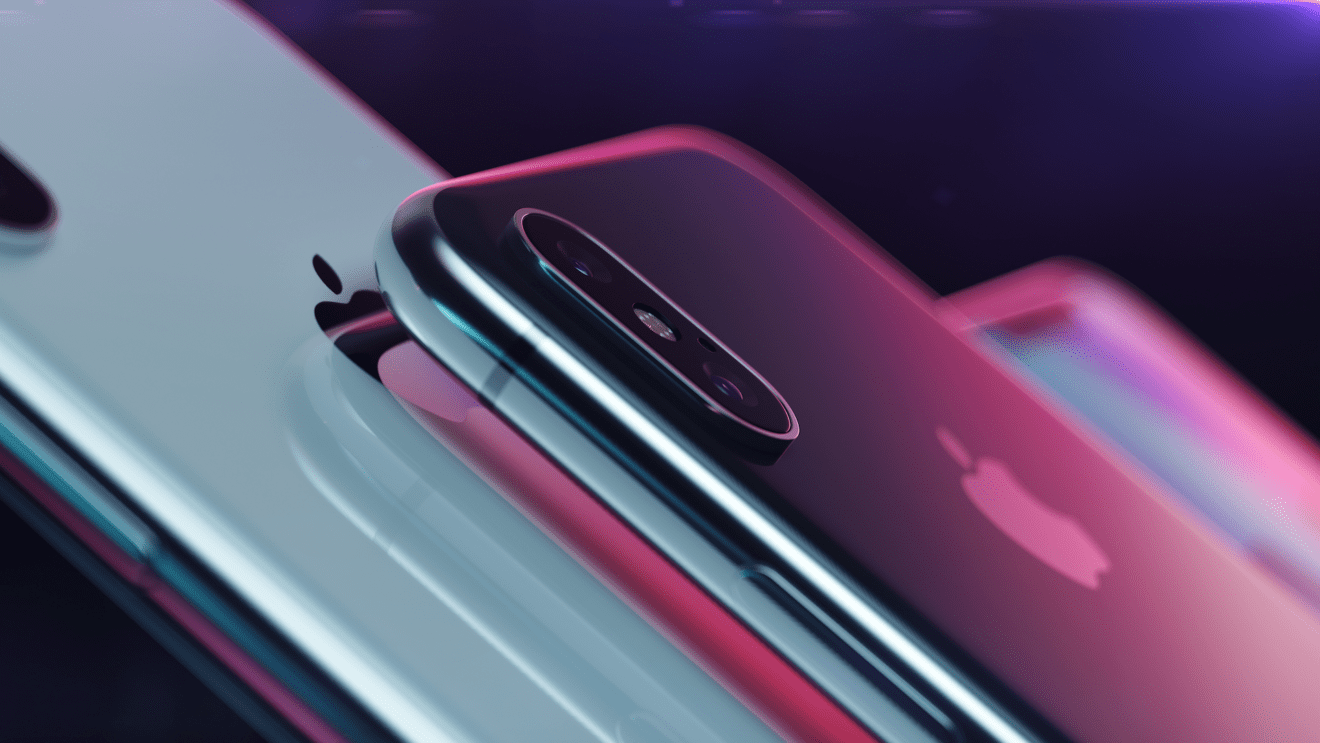
    A few hours after Apple’s announcement, 9to5Mac, a technology news website, posted photographs of two gold iPhone models stacked on top each other, with a larger-screened model on the bottom. Both models resemble the current iPhone X.

  • Apple is now a $1 trillion company

    Apple is now a $1 trillion company

    Apple has become the first US company with a market cap of more than US$1 trillion overnight, with a jump in stock prices pushing the company past the historic milestone.

    Following the tech giants Q3 earnings report in which it found a quarterly revenue of US$53.3 billion, the “best June quarter ever, and our fourth consecutive quarter of double-digit growth”, according to Apple CEO Tim Cook, stock prices jumped from approximately US$190 to approximately US$200, continuing to climb to a high of US$207.

    The large jump was enough to push the company over the line faster than Amazon, which is on track to reach a US$1 trillion market cap soon, currently sitting at approximately US$885 billion.

    Given the nature of the stock market, it is entirely possible the company will fluctuate below and above US$1 trillion mark, but the feather is now well in Apple’s cap.

    The company is not the world’s first US$1 trillion company though, with PetroChina having briefly reached the coveted position in 2007.

  • Apple Piazza Liberty now open in Milan

    Apple Piazza Liberty now open in Milan

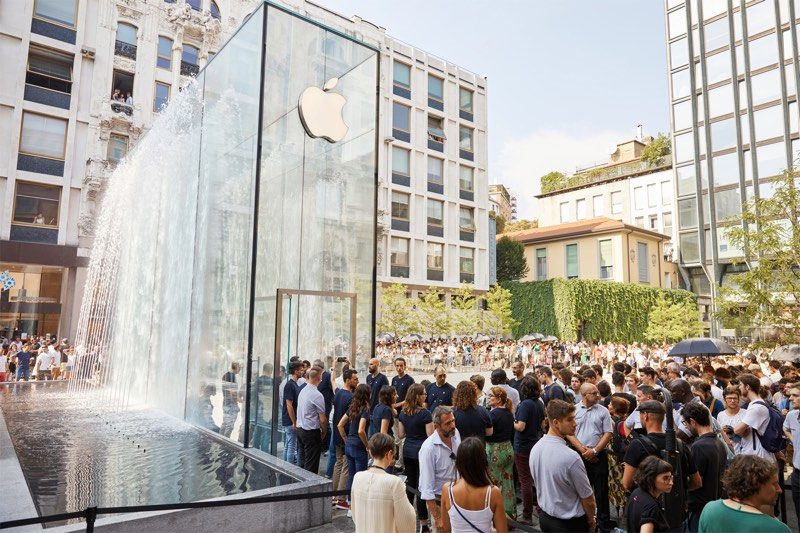
    Apple Piazza Liberty has opened in Milan, the latest significant global flagship for the tech retailer.

    The store is an ensemble of two fundamental elements: a stepped plaza and a fountain. Located just off the Corso Vittorio Emanuele – one of the most popular pedestrian streets in Milan – visitors are drawn towards the piazza by the sight of the dramatic new fountain.

    Designed by London-based Foster + Partners, which has an ongoing relationship with Apple to design flagships globally, the store is described as “a celebration of the joys of city life” and embodying Milan’s dynamic nature with a signature water feature which is an “interactive, multisensory experience”.

    Visitors enter the fountain through a glass-covered entrance enveloped by the sights and sounds of vertical jets of water that splash against the 26-foot (8-metre) high glass walls.

    A Foster + Partners spokesperson likens the experience as “an immersive recreation of the childhood game of running through fountains” with an experience which changes throughout the day as sunlight filters through the water. At night, the glass ceiling creates a kaleidoscopic effect, with the water falling down the walls, its reflections travelling infinitely up into the sky.

    The fountain flows down into the base of the amphitheatre, a new social hub and an outdoor extension of ‘Today at Apple’. The amphitheatre is defined by broad and sun-soaked stone steps descending below street level and opening up to a stage, backed by a second fountain’s wall of water. The entire plaza is newly created and paved with Beola Grigia – a typical local stone from Lombardy, and surrounded by 21 new Gleditsia Sunburst trees.

    “The interior is a bright, monolithic space, metaphorically carved out of the same stone as the plaza above,” says Foster + Partners. “The ceiling follows the stepped profile of the amphitheatre, with skylights and backlit ceiling panels that innovatively combine artificial and natural light. Through the roof and stairs, warm shafts of sun penetrate deep into the sunken store, connecting the interior with the light and rhythm of Milan and giving it a feel of a spacious daylight-filled art gallery.”

    The stairs leading into the store consist of polished stainless-steel clad cantilevering treads that also become a sculptural light installation, the designers say creates a theatrical and exciting experience.

    View the full gallery below (7 images) :

  • Apple and Samsung duke it out in South Korea

    Apple and Samsung duke it out in South Korea

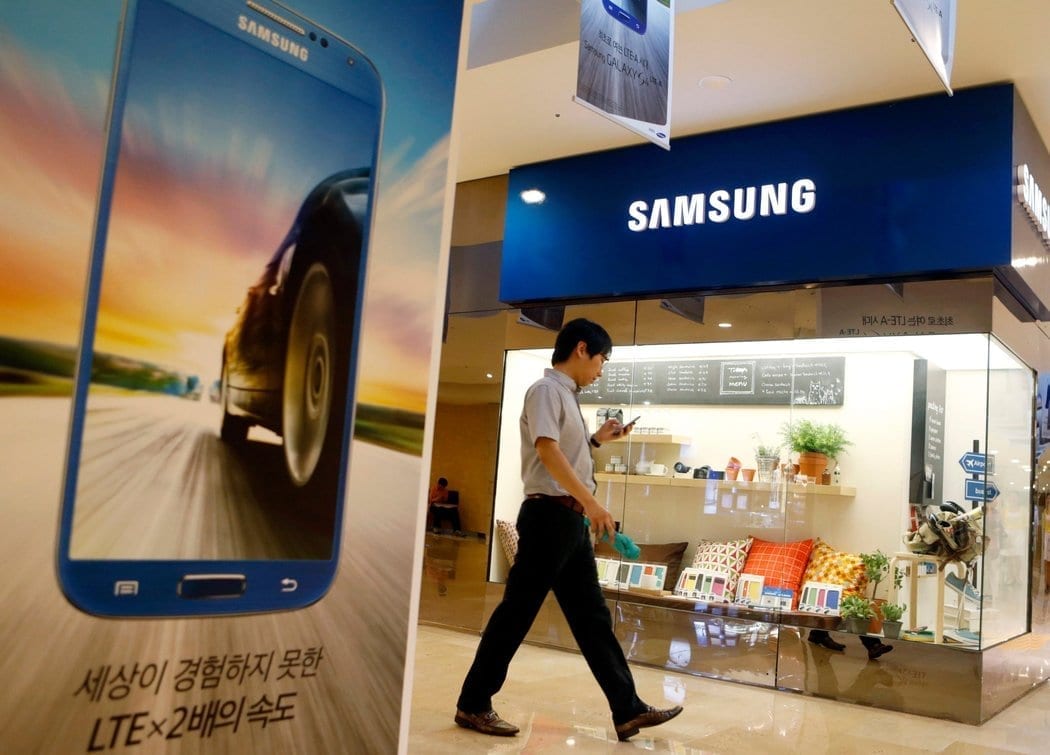
    South Korea’s capital Seoul is one of the world’s most technologically advanced, known for its rapid Internet speeds and advanced infrastructure.

    It was one of the first to introduce city-wide free Wi-Fi, and 5G will be introduced commercially in 2019. It is the home of global tech titans Samsung and LG. But in one way Seoul lagged behind other cities.

    Apple announced the opening of their first retail stores in May 15, 2001. Four days later, on a Saturday, the first ever Apple stores opened in Maclean, Virginia, and Glendale, California. “The Apple stores offer an amazing new way to buy a computer,” said the late Steve Jobs, Apple’s CEO at the time.

    Over the years more stores opened, going on to stock the iPod, the Macbook Air, and the iPhone. Tokyo got its first Apple store in 2003. London a year later. Beijing in 2008. And the Middle East in 2015 with Dubai’s Apple store.

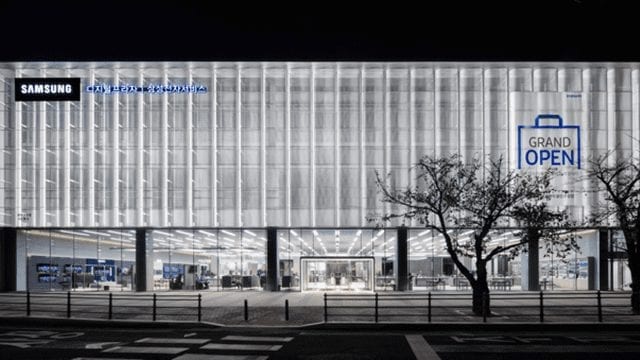
    But South Korea, the 11th largest economy in the world and one of the most technologically advanced, saw its first Apple store open on January 26, 2018.

    In the Apple outlet is located in Garosu-gil,we see a fashionable street in trendy Gangnam-gu, popular with tourists and chic locals. Inside the pristine and meticulous store, lined with four potted trees at its entrance, were a busy amount of people.

    Ju-Won Shin, 38, an accountant, was sitting down at a table looking to buy an iPhone SE, while already owning an iPhone 6S and iPad Pro. What does he think of Apple? “Their products are easy to use, refined, and have a good vibe,” he said. Shin preferred Apple to Samsung because “they’re constantly trying hard to make good quality products.”

    Another store wanderer was So-ri Lee, 22, a waitress at a cafe, who was browsing phone cases. So-ri had an iPhone 8 and had been using it for two years. Before that she owned a Samsung Galaxy Mega. She said she preferred iPhone because she loved the design– “it’s pretty and easy to use, and now I’m used to iOS,” she said.

  • Take a look inside the new Apple store at Sands Cotai Central

    Take a look inside the new Apple store at Sands Cotai Central

    The newly opened Apple Macau store has been designed to offer “a calm complement to the buzz and excitement of Macau,” says its creator, Foster + Partners.

    “We wanted to create something very simple and pure – a beautiful and elegant building that complements the sounds, sights and colors of Macau, while embodying a sense of clarity and quietude,” explains Stefan Behling, head of studio at London-headquartered practice.

    “The design creates two distinct spaces, one inside and one outside, imbued with a sense of authentic beauty arising from the innovative use of natural materials.”

    The new store anchors the extension of the Sands Cotai Central retail space, which houses 25 stores. It opened last Friday.

    Technology, entertainment and arts come together in the new store, giving locals and tourists alike an inviting, contemplative space. Behling says its timeless design reinvigorates a corner of Cotai with a distinctive addition – a luminescent cube, whose pure geometry and warm ‘beacon-like’ glow draws passers-by closer, set within a quiet bamboo grove and an external plaza.

    Apple Cotai Central is conceptualised as a ‘paper lantern’ that glows mysteriously. Visitors entering the store are treated to a magical experience, surrounded by glowing stone panels that shimmer throughout the day as the sun brings them to life, while at night the cube radiates a warm glow, contrasting against the bright lights of Macau. The first-of-its-kind glass-stone composite facade comprises five layers of glass integrated with wafer-thin layers of stone, which gives the building its distinctive materiality – appearing as translucent stone walls, akin to stained-glass, explains Behling.

    The structural frame is supported by just three corner columns wrapped in mirrored stainless-steel that reflect the patterns and colors of the facade, dematerialising the structure and blending seamlessly with the surrounding environment.

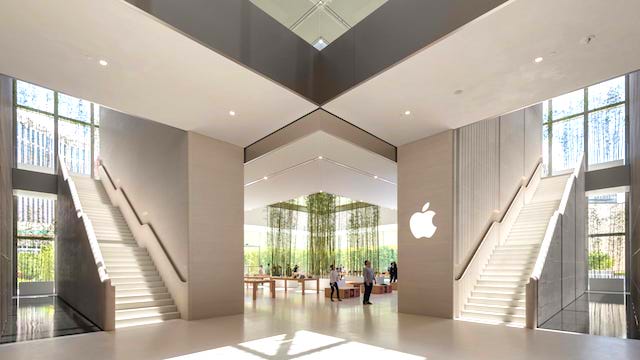
    Inside, a quiet bamboo grove has been taken from the ‘forest’ outside and placed under a soaring central atrium. It is capped by a large central skylight with punched pyramidical apertures that brings natural light deep into the interior. The ground level is wrapped in a glazed facade that looks onto a layered bamboo screen, providing a heightened sense of enclosure, while blurring the boundaries between the inside and outside.

    At the far end of the store is a 10.6m by 4.5m video wall, alongside an entrance from the adjacent retail shopping mall and casino.

    Two grand stone staircases lead to the upper level, lit by skylight strips that bring in filtered natural light.

    Display tables are arranged around the central atrium looking onto the bamboo grove below. The composite glass-stone facade wraps around the entire upper level, creating what Behling describes as a soft internalised environment that exudes a sense of calm and serenity.

    The Apple Macau store design is the result of a close collaboration between the Apple team led by chief design officer, Sir Jonathan Ive and Angela Ahrendts, senior VP of retail and online stores, and Foster + Partners.

    Full images of the store can be viewed below :

  • New phase of Sands Cotai Central opens with Apple anchor

    New phase of Sands Cotai Central opens with Apple anchor

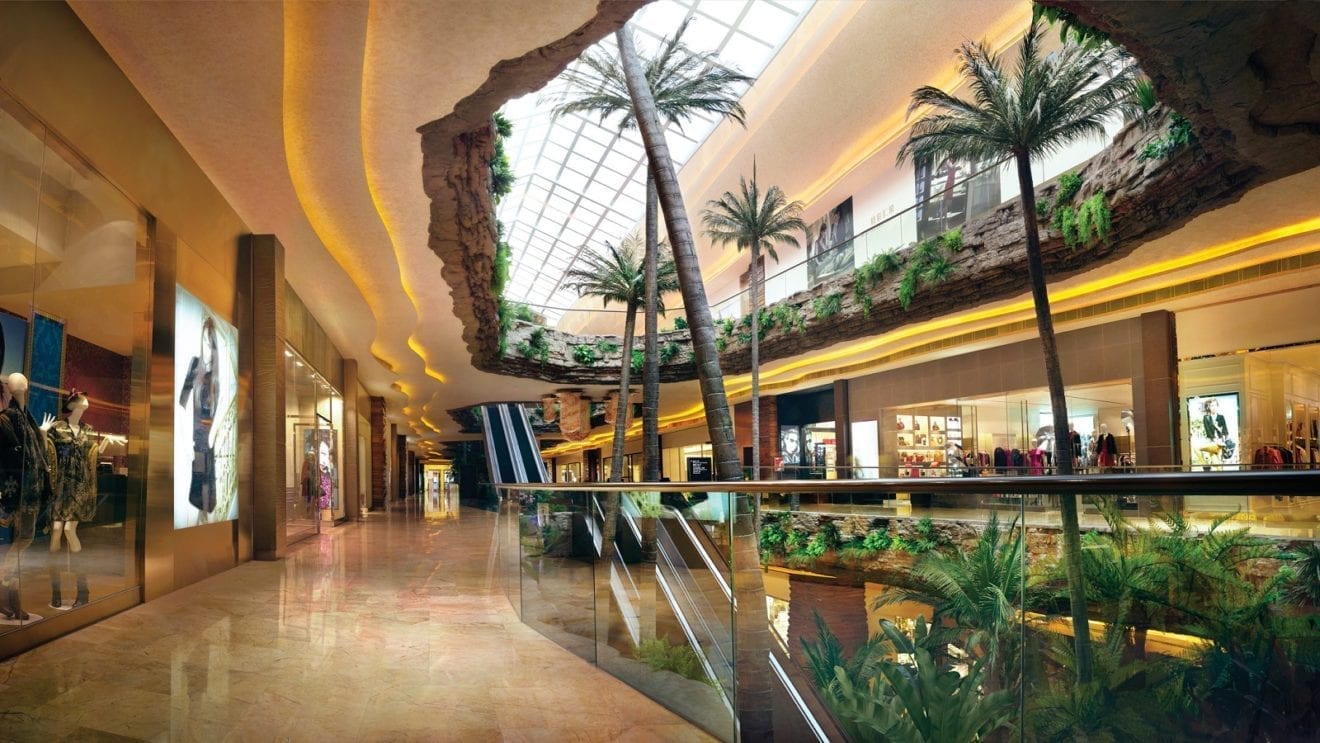
    Sands Cotai Central has opened phase four of its retail offer, adding almost 100,000sqft of retail space and 25 retailers.

    At the heart of the expansion is an Apple store, which opens today.

    The new space is home to several brands new to Macao: Calvin Klein Performance and Razzle. Other stores to open are MLB, Esprit, Guess, Watson’s, Noble Mart, Levi’s, Florsheim, Timberland, The North Face, Boy London, Zaxy and Bauhaus.

    Later this year, several restaurants will be added to the line-up, including Chiado, a modern yet authentic Portuguese concept developed in partnership with celebrity chef Henrique Sa Pessoa, and Crystal Jade La Mian Xiao Long Bao, which brings a contemporary twist to classic Beijing, Szechuan and Shanghai cuisine.

    “The addition of these new stores, especially the introduction of an iconic Apple Store, continues to ensure we provide our customers with more new-to-market brands, more choice and more amazing experiences,” said David Sylvester, executive VP of global retail at Las Vegas Sands Corp.

    Sands Cotai Central, which celebrated its sixth anniversary in April, has been the focal point of a wide range of products, offerings and experiences on the Cotai Strip, with access to four hotels since it opened in 2012.

    Earlier this year Sands China revealed plans to transform Sands Cotai Central into The Londoner Macao, which will feature new attractions including some of London’s most-recognisable landmarks.

  • Apple is opening second store in Macau

    Apple is opening second store in Macau

    Construction crews have begun assembling a green facade at the site of the second Apple Macau store, to be located next to the Sands Cotai Central casino resort.

    A sign says the shop is “coming soon”, but the facade sports a wave pattern and a chrome-like logo, signalling that Apple considers it an important outlet (the company often uses a plain black facade for smaller openings).

    The first Apple Macau store opened in June 2016 at Galaxy Macau.

    Apple’s store in Causeway Bay, Hong Kong, is also undergoing renovations as the tech retailer rolls out an updated store model across the region.

    And in Beijing,  the Apple store on Wangfujing Road will close on June 24 for a makeover, with no date set for re-opening.

    Opened in 2012, it is one of Apple’s older stores in China, a two-floor outlet with a round glass facade.

    Apple’s remodelled stores often gain extra space to accommodate both more products and customers. A larger floor gives room for Today at Apple sessions related to photography, coding, exercising with the Apple Watch, and other topics.

    Apple’s latest retail design, introduced in 2015, typically includes glass doors, video screens for product marketing and in-store events, and sequoia wood shelves on the walls for accessories.

    Its flagship Covent Garden store in London will also be closed from June 27 for renovations. This location became Apple’s largest store when it opened in 2010.

  • Samsung Electronics calls for retrial in Apple case

    Samsung Electronics calls for retrial in Apple case

    Samsung Electronics on Tuesday called for a retrial of the latest ruling by a U.S. court, which ordered the Korean tech giant to pay Apple $539 million over design infringement.

    The Korean tech giant claimed that the amount awarded to Apple by the latest ruling is excessive, demanding that the U.S. District Court in San Jose, California, reconsider the ruling.

    The conflict between the two companies surrounding alleged design infringement started in 2011, with the court ruling ordering Samsung to compensate Apple coming in May.

    The U.S. company claimed Samsung violated its designs, such as a “black rectangular front face with rounded corners,” a “rectangular front face with rounded corners and a raised rim” and a “grid of 16 colorful icons on a black screen.”

    Shortly after the court ruling, Samsung said it would “consider all options to obtain an outcome that does not hinder creativity and fair competition for all companies and consumers.”

  • Samsung tops Asia’s top 1000 brands ranking

    Samsung tops Asia’s top 1000 brands ranking

    Samsung again tops Asia’s Top 1000 Brands list, produced by Campaign Asia-Pacific and Nielsen.

    In its 15th year, the list again has Apple at second place.

    Rounding out the top 10 are Panasonic (up two spots), Sony (down one place), Nestle (down one), LG, Google (up six), Chanel, Nike (down two) and Philips (up 10).

    While the past 12 months have seen Samsung riding high on social awareness and release a string of hot new products, it is the brand’s size and “traditional” marketing methods that keep it at the top, say experts.

    It has emerged as the top brand in Asia for the seventh year in a row, despite the disastrous exploding Note 7 phone saga.

    Google jumped five places in the list this year, breaking into the hallowed Top 10 for the first time since 2011 and finishing in position seven. The company emerges as Asia’s favourite search engine in all markets except China and South Korea, and it is also rated top for “digital experience” in all markets except China (where consumers cited Apple) and India (Amazon).

    Still climbing

    Chinese brands are still climbing the chart. Huawei, which jumped 661 spots last year, and Xiaomi (up 577 spots) have been more moderate this time. Huawei has gained another 44 spots to rank 158th overall, while Xiaomi leapt 88 places to land at 128, making it China’s top home-grown brand throughout Asia-Pacific for this year.

    Best dressed among fast-fashion brands were Zara, which reached 52nd place in the Top 1000, and H&M, which climbed to 65th. Both brands improved significantly on their positions last year. Japanese clothing brand Uniqlo also leapt up the charts, landing in 38th position.

    Not all e-commerce brands are capitalising on the steady rise in online shopping. While top players Amazon, Lazada and Taobao saw strong gains, others like Ebay, Rakuten, Zalora and Flipkart still have work to do.

    Amazon jumped 20 spots to become Asia’s 23rd top brand overall. Lazada, powered by Alibaba, surged even more (35 places) to cement its position at 62nd overall. Alibaba’s Taobao, top in China but slower to grow outside of it, moved 31 spots higher but is still a distant third across the region, ranking 210th.

    However, other key players have been losing ground. EBay, ranked 144th two years ago, has steadily dropped to 237th this year. Japan’s Rakuten slipped slightly this year to 331st after a larger drop last year. Fashion-focused Zalora tumbled significantly this year to place 409th, while strong players in specific markets like Flipkart (second in India) and Qoo10 (first in Singapore) both dropped more than 60 places overall to land at 564th and 592nd respectively.

  • Smartphone Sales Will Drop for Second Straight Year, IDC Predicts

    Smartphone Sales Will Drop for Second Straight Year, IDC Predicts

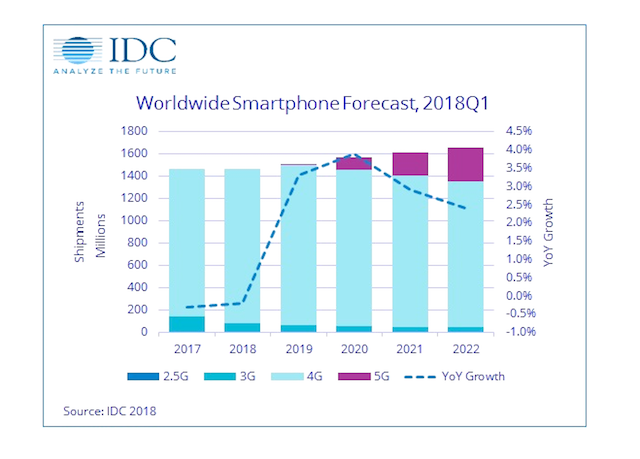
    Global smartphone sales are expected to fall for the second year running this year, before  returning to growth next year, according to analysis by the International Data Corporation (IDC).

    In the research house’s Worldwide Quarterly Mobile Phone Tracker, smartphone shipments are forecast to drop 0.2 per cent this year to 1.462 billion units, after a 0.3 per cent decline last year. Looking further out, IDC expects the market is to grow roughly 3 per cent annually from next year onwards, with worldwide shipments reaching 1.654 billion in 2022 and a five-year compound annual growth rate (CAGR) of 2.5 per cent.
    The biggest driver of last year’s decline was China, where smartphone sales declined 4.9 per cent year-on-year. And the IDC expects sales in China to decline a further 7.1 per cent this year before flattening out next year.

    The biggest growth market in Asia Pacific continues to be India, with volumes expected to grow 14 per cent and 16 per cent this year and next.

    “Chinese OEMs will continue their strategy of selling large volumes of low-end devices by shifting their focus from China to India,” says IDC. “So far, most have been able to get around the recently introduced Indian import tariffs by doing final device assembly at local India manufacturing plants. As for components, almost everything is still being sourced from China.”

    “With 2017 now behind us a lot of interesting market dynamics are unfolding,” says Ryan Reith, program VP with IDC’s Worldwide Quarterly Mobile Device Trackers. “Even though it declined 5 per cent last year, China remains the focal point for many given that it consumes roughly 30 per cent of the world’s smartphones.

    “But plenty of pockets of growth can be found beyond China. India is now grabbing headlines and the market itself is going through some rapid transformation. Local Indian manufacturing continues to ramp up, despite still having a heavy dependence on China for components. The boom in India is likely to continue in the years to come, but the move toward building up local production has certainly caught the eye of many in the industry.”
    Outside of Asia Pacific, the biggest regions for growth will be the Middle East, Africa, and Latin America. All three regions have relatively low penetration rates and plenty of upsides, says IDC. Economic challenges have been the main inhibitor over the past two years, but IDC expects consumer spending to rise throughout the forecast and smartphones to be a big benefactor.

    5G opportunity

    The other catalyst to watch will be the introduction of 5G smartphones. IDC predicts the first commercially ready 5G smartphones will appear in the second half of next year with a ramp up across most regions happening in 2020. IDC projects 5G smartphone volumes to account for roughly 7 per cent of all global smartphone sales in 2020 or 212 million in total. The share of 5G devices should grow to 18 per cent of total volumes by 2022.

    “Although overall smartphone shipments will decline slightly this year, the average selling price (ASP) of a smartphone will reach US$345, up 10.3 per cent from the $313 of last year,” said Anthony Scarsella, research manager with IDC’s Worldwide Quarterly Mobile Phone Tracker.

    “This year will continue to focus on the ultra-high-end segment of the market as we expect a surge of premium flagship devices to launch in developed markets. Devices featuring large Amoled bezel-less displays, advanced camera functions, and an overall increase in speed and performance will be the driving factor in the increase of ASPs. Moving forward, we can expect this trend to continue as the ASP for a smartphone will continue to grow throughout the forecast period. In 2022, the final year of our forecast period, the average selling price for a smartphone will be $362, resulting in a five-year CAGR of 2.9 per cent.”

    Android vs Apple

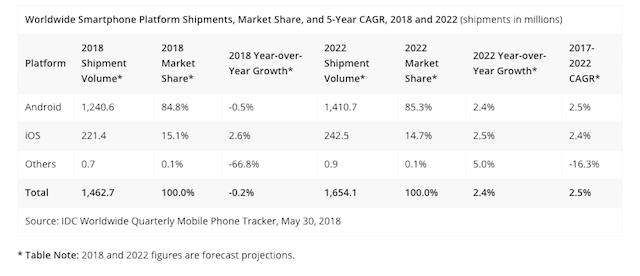
    Android’s share of t sales is expected to remain relatively stable at 85 per cent of total global smartphone sales. Volumes are expected to grow at a five-year CAGR of 2.5 per cent, with shipments totaling 1.41 billion by 2022.

    “There is no question that Android is the OS of choice for the mass market and nothing leads us to believe this will change,” says IDC. “Given the large number of Chinese OEMs dependent on Google’s OS, as well as components from other US companies like Qualcomm, it will be interesting to see how things develop with all the discussion about a US-China trade war. Android OEMs continue to drive down the cost of new technology features at a rapid pace. IDC estimates that 98 per cent of Android phones will ship with screens larger than five inches by 2022, with 36 per cent being six inches or larger. While some of these will remain premium flagship models, the aggregate ASP of Android phones with a six-inch screen or greater by 2022 is projected to be $414.

    Meanwhile, iPhone volumes are expected to grow 2.6 per cent this year to 221 million. IDC is forecasting iPhones to grow at a five-year CAGR of 2.4 per cent, reaching volumes of 242 million by 2022. With rumors of some upcoming larger screen iOS smartphones, IDC has changed its screen size forecast for Apple by introducing volumes greater than six inches. Products are likely to begin shipping in the fourth quarter of 2018, with volumes ramping up and accounting for 36 per cent of all iPhones shipped by 2022.
  • Apple gets warning for misleading consumers

    Apple gets warning for misleading consumers

    Tech giant Apple has been warned by the Commerce Commission of New Zealand after it likely misled customers, while online retailer NZSALE has pleaded guilty to four charges of failing to comply with product safety standards.

    In the Commission’s view, Apple is likely to have breached the Fair Trading Act in a number of ways, including telling consumers its products are only covered by a guarantee for two years, which is in direct violation of the Consumer Guarantees Act (CGA) in that they do not expire after a legally prescribed period of time.

    “Although businesses may form a view about how long a product should generally last, they must assess each reported fault on its own merits,” said Commissioner Anna Rawlings, “they should not base decisions solely on how long a consumer has owned a product. The reasonable lifespan of a product will depend very much on what the product is.”

    Apple was also warned for pushing customers to the manufacturer of non-Apple branded products when Apple is responsible, as a retailer, for all products it sells.

    “It is natural that many retailers may wish to liaise with manufacturers to assess and remedy product defects but they must not point blank refuse to address consumer complaints and refer consumers exclusively to manufacturers for attention,” Ms Rawlings said.

    Additionally, NZSALE has been charged with failing to comply with the product safety standard for children’s nightwear, after it was found that three types of nightwear and a sleep sack were made of material that was too flammable to be used, did not carry the right fire hazard label, or had no fire hazard labelling at all.

    The Commission’s investigation was sparked by a product recall of these products in Australia following an investigation by the Australian Competition and Consumer Commission. The products were publically recalled in New Zealand in December 2015.

    In New Zealand 73 units were sold – although only eight garments were returned through the recall and a further 15 were confirmed destroyed by consumers.

  • Samsung loses patent case retrial

    Samsung loses patent case retrial

    A U.S. court has ordered Samsung Electronics to pay $538.6 million in damages for infringing the design and utility patents of iPhones in early Galaxy models in a retrial of a case that dates back seven years.

    The retrial jurors in the Northern District of California on Thursday awarded Apple $538.6 million in damages after five days of deliberations – $533.3 million for violating design patents and $5.3 million for violating utility (technical) patents.

    The amount is $140 million more than the $399 million Samsung had agreed to pay – equivalent to all profits from the sale of the infringing smartphones – before it asked the Supreme Court to order a lower court to retry the case.

    Samsung already paid $548 million in damages to Apple in December 2015 that included the $399 million.

    In 2012, the Korean tech giant was found liable for infringing three of its U.S. archrival’s iPhone design patents – the rounded corners, the rim that surrounds the front face, and the grid of icons that users view – and two technical patents, which affect the way some features work. But the two companies have long disputed the amount of damages to be paid.

    Samsung has not decided whether to appeal the retrial verdict, which would prolong the already lengthy legal battle.

    “Today’s decision flies in the face of a unanimous Supreme Court ruling in favor of Samsung on the scope of design patent damages,” Samsung said in a statement. “We will consider all options to obtain an outcome that does not hinder creativity and fair competition for all companies and consumers.”

    Apple said in a statement it was pleased that the members of the jury “agree that Samsung should pay for copying our products.”

    “This case has always been about more than money,” the iPhone maker said, adding, “we believe deeply in the value of design, and our teams work tirelessly to create innovative products that delight our customers.”

    “Samsung is now going to consider its options,” wrote Florian Muller, an intellectual property analyst who writes a closely followed patent blog Foss Patents. “Those options are post-trial motions and, possibly, another appeal.”

    The legal feud between the two biggest smartphone rivals began in April 2011 when Apple sued Samsung for violating its patents and copying the design of its iPhone, seeking $2.5 billion in damages.

    Samsung was ordered to pay $1.05 billion in damages by jurors in 2012, which was reduced on appeal to $930 million. The U.S. Court of Appeals for the Federal Circuit stripped another $382 million from that, saying the iPhone’s appearance could not be protected through trademarks, to $548 million in December 2015.

    A year later, the U.S. Supreme Court ordered a lower court on Samsung’s petition to reconsider the $399 million in damages on unanimous opinion that damages for design patent infringement can be based only on the part of the device that infringed the patent, not on the entire product.

    Samsung argued then that it should only have to pay $28 million in damages for profits from the components of its Galaxy phones that copied Apple’s patents.

  • Apple AirPort Base Stations begin to get out-of-stock

    Apple AirPort Base Stations begin to get out-of-stock

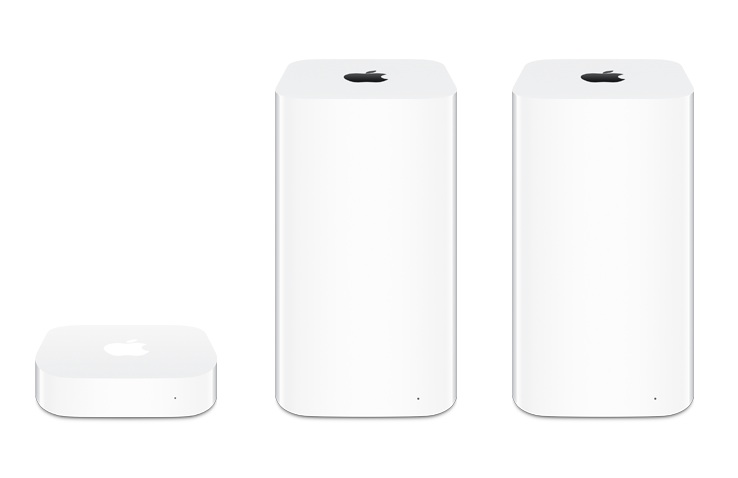
    AirPort base stations are beginning to sell out or disappear entirely from Apple’s online and retail stores in select countries, a few weeks after Apple announced it has discontinued the lineup of routers.

    The first casualty is the AirPort Extreme, now listed as “sold out” on Apple’s online store in the United States, and unavailable for pickup at Apple’s retail stores across the country. The base station remains available in limited quantities in select other countries, including Australia, Canada, Japan, and Singapore.

    AirPort Express and AirPort Time Capsule models remain in stock on Apple’s online store in the United States, and select other countries, but they will eventually sell out too as inventory continues to dwindle.

    In addition, the entire AirPort lineup is no longer listed on Apple’s online store in several European countries, such as France, Germany, Italy, Spain, and the United Kingdom. It’s possible that some of Apple’s retail stores still have inventory remaining in those countries.

    Apple said that its AirPort products would only remain available while supplies last, so this was to be expected eventually.

    Prior to being discontinued, Apple hadn’t refreshed its lineup of AirPort base stations in five to six years. The high-end AirPort Extreme and AirPort Time Capsule were last updated at WWDC 2013, while the smaller AirPort Express was last updated in June 2012 and still uses the old 802.11n Wi-Fi standard.

    The end of the road for AirPort products comes roughly a year and a half after it isreported that Apple ceased development of the base stationsto “sharpen” its focus on other major products.

    While the AirPort lineup has been discontinued, Apple will be providing service and parts for the current-generation base stations for up to five more years. Apple also shared a new support document offering tips on choosing a router to use with its devices, and now sells the Linksys Velop mesh system.

  • Apple acknowledge iPhone challenges

    Apple acknowledge iPhone challenges

    Analysis of the latest Apple sales figures shows that tech giant remains a phenomenal company, but it needs to regain the magic spark that used to be its hallmark.

    As usual, Apple’s performance is good on both the top and bottom lines. Revenue for the quarter jumped by almost 16 per cent, an impressive increase given last year’s strong results. Even more impressive was the 25.3 per cent leap in net income, an uplift that came despite a higher level of spending on research and development.

    But as good as the headline numbers are, there are some less satisfactory nuances in the underlying dynamics driving them. Foremost among these are sales of the iPhone. On the surface, revenue from iPhone sales, which rose by 14 per cent, looks strong. However, this is mostly pushed up by higher average prices rather than volume. Indeed, in unit sales terms, the number of iPhones sold rose by just 3 per cent over the same period last year.

    Given the high raw numbers that sit behind a 3 per cent unit uplift, such a criticism may seem petty. However, the second quarter last year was a weak one for the iPhone with sales down in both volume and value terms. As such, we would expect a much bigger uplift this time around. That this didn’t materialise, and that unit growth is well below the run rate for new phone launches, signals that the replacement cycle is slowing down. In essence, we maintain our view that Apple is struggling to persuade many consumers to update their phones.

    Failure to wow

    As I’ve have said before, this relative slowdown in iPhone sales is largely a function of Apple’s inability to come up with meaningful and valuable innovations that wow consumers. No matter how Apple tries to spin it, the iPhone X is essentially an incremental product that lacks the excitement and newness earlier models brought to the market.

    The same logic applies to many other product lines, including iPads and Apple Watch. These are good, quality items, however they are simply not impressing the market and Apple is losing its lustre in terms of producing compelling products. Apple has moved from a position of ‘must have this and must have it now’ to ‘might buy this at some point in the future’.

    Price increases may mitigate this but, ultimately, such a shift can only ever result in a softer sales performance.

    Adding new products, such as HomePod, into the mix provides potential new sources of revenue.

    However, with launches to date, Apple is not disrupting the market like it used to. HomePod is a case in point. Here, despite good technical specifications and design credentials, Apple was a latecomer to the smart speaker market. This crimped sales and puts Apple in direct competition with both Google and Amazon – against both of which it does not have a clear and compelling unique selling point. While we believe Apple can take a share of this market, we do not think it can win a decisive victory in the battle with other tech firms.

    One area of relative success, at least in revenue terms, is services. However, this is an area where we think Apple needs to push harder. Amazon is successfully creating an ecosystem of services through Prime. Apple needs to do something similar by building on its Apple Music subscription and its App Store offering. Content is a big growth area and is becoming increasingly linked to devices. Apple needs to play more heavily in this space both to generate new opportunities but also to defend its own device business.

  • Hong Kong Customs Roll Up Counterfeit Phone Gangs

    Hong Kong Customs Roll Up Counterfeit Phone Gangs

    A territory-wide Hong Kong Customs raid has resulted in arrests and netted 100 smartphones suspected of being counterfeits.

    During the one-day Operation Snow Leopard, officers raided 12 shops and two storage places, seizing smartphones with suspected false trademarks or bearing possibly false trade descriptions. They also found about 3400 accessories also suspected of being fakes.

    Arrested were 18 men and a woman between 21 and 48 years old, including shop owners and salespersons, while the market value of the seized goods is estimated to be about HK$1.5 million.

    Customs had earlier received information alleging that some phone-repair shops sold suspected counterfeit smartphone accessories, and some shops were suspected to have engaged in unfair trade practices by selling old smartphones as new products, or selling parallel-imported smartphones as authorised products.

    After an in-depth investigation with the help of trademark owners, Customs took the enforcement action yesterday and raided 12 shops.

    Customs also cracked down on a syndicate in connection with export, supply and distribution of suspected counterfeit smartphones and accessories. A total of 64 suspected counterfeit smartphones and 330 suspect accessories were seized from the storage places in Sham Shui Po and Tsing Yi.

    A 32-year-old male head and 34-year-old female member of the syndicate were arrested. With the investigation ongoing, more arrests are possible.

    Intellectual Property Investigation Bureau chief Catherine Yip says the successful detection of the case was attributed to reporting by members of the public and the full help of trademark owners.
    She says Customs will step up inspection and enforcement with the approach of the Labour Day Golden Week.

    Customs says traders need to comply with the requirements of the Trade Description Ordinance (TDO) as the sale of counterfeit goods can lead to a fine of up to $500,000 and imprisonment for five years.

    Meanwhile, Customs has broadened reporting options by introducing a dedicated crime-reporting email account ([email protected]).

    Intelligence Bureau chief Kitty Poon says public reports received by Customs have risen progressively by 21 per cent, from 31,994 in 2015 to 38,819 last year. Of these, the proportion received via email has grown from 30 per cent in 2015 to almost 40 per cent last year.