Tag: asia

  • Longines Masters of Hong Kong

    Longines Masters of Hong Kong

    After a gripping competition over 1.6m obstacles, on a course etched out by internationally-renowned course designer Louis Konickx, French Patrice Delaveau, astride Aquila HDC, took top honors, ahead of second-placed Max Kühner of Austria on Cielito Lindo 2 by just 0.07 seconds in the jump-off, and Longines Grand Prix of Paris 2017 winner Daniel Deusser of Germany on Cornet D’Amour, who was in with the chance of a €2.25 million bonus if he’d also won in Hong Kong, in third.

    Juan-Carlos Capelli, Vice-President and International Marketing Director for Longines, who handed the Longines Grand Prix to the winner, along with an elegant Longines watch.

    With the crown of this evening’s Longines Grand Prix in hand, Dreelaveau has an excellent chance to collect the Grand Slam Indoor bonus of €1 million if he can win the Longines Grand Prix at the final leg of the current season of the Longines Masters Series, in New York, and follow it up with a win in Paris at the start of the 2018-19 season.
    “It was great today, and my horse was fantastic,” said victorious rider Delaveau, “I love it here in Hong Kong.”

    The other competition of the final day, earlier in the afternoon, the Masters One DBS, presented by new Official Partner DBS, featured a strong field competing over 1.45m obstacles. It was Great Britain Robert Smith who showed the determination and grit to come off victorious on 11-year-old gray gelding Cimano E, clocking a time of 57.17 seconds ahead of Christian Kukuk of Germany on Cordess, and Gerco Schröder of the Netherlands on Glock’s Debalia, who finished second and third respectively.

    Earlier in the day, Hong Kong’s own Nathaniel Chan and Lay Your Love On Z won the JETS Junior Trophy, a competition that gives local fans a chance to cheer for home-grown talents from the next generation as they aspire after high-level honors in a five-star international arena. The young hopefuls were put to the test on a specially designed course in a Grand Prix format across two rounds. Both rides counted, with the winner decided by the fewest penalties across both and the best time in the second.

    The success of the Longines Masters Series has also been recognized by experts, with an award of Best Live Experience at a Professional Sporting Event by the Sports Industry Awards Asia. The 2018 edition of the Longines Masters of Hong Kong has also confirmed its “M” Mark status helping to enhance the image of Hong Kong as Asia’s sports event capital. The “M” Mark, awarded by the Major Sports Events Committee, symbolizes intense, spectacular and signature event on the territory’s sports calendar.
    The glamor and elegance of the event were echoed in the Prestige Village, where sophisticated luxury lifestyle took center stage, shining the spotlight on contemporary art, champagne and wine tastings alongside numerous fine-food outlets, and late-night musical performances from MC RiverJaxx and DJ Jérémie Charlier.

    The Prestige Village was brought to life by a selection of suitably high-end exhibitors, among them Title Partner Longines, which displayed a collection of horological masterpieces in its elegant boutique; Official Partners DBS and Maserati, and an extraordinary collection of artistic masterpieces from Macey and Sons, including works by Cézanne, Turner, Constable and Ai Weiwei.

    “Our ambition has always been to give equestrian sports the most incredible international stage. The Longines Masters Series brings together the Best of Sports and the Best of Lifestyle, with the 3 iconic capitals for backdrop: Paris, Hong Kong, New York” said Christophe Ameeuw, CEO of EEM and Founder of the Longines Masters Series.

    And so, the curtain goes down on the Asian leg of Season III of the Longines Masters Paris – Hong Kong – New York. Attention now turns to New York, which hosts the third and final leg of the Longines Masters Series.

    The American stage presented by equestrian artist Clémence Faivre to the tempo of Amazing Grace, is set to break ground, taking up new quarters in 2018 in New York, at NYCB Live from April 26 to 29, 2018, unquestionably the world’s capital for business and lifestyle, and city that calls nothing impossible.


  • Is Asia changing its way of thinking about food?

    Is Asia changing its way of thinking about food?

    More people are eating today than yesterday. The majority of these people live in Asia, a continent which has an intense cultural connection to food. Securing a better way to feed Asia’s growing population is what motivates JUST CEO Josh Tetrick to challenge the status quo of the food industry.

    Tetrick, 37, sees Asia as the tip of the spear to fix the world’s broken food system.

    “We need to answer the question of how can we produce enough food for a planet which will see 70 percent growth in food demand between now and 2050,” says Tetrick, whose company has attracted high-profile investors such as Hong Kong business magnate Li Ka-shing.

    One of the fastest growing segments of the $8 trillion global food and agricultural market is the multi-billion dollar egg industry. China produced over 30 percent of the 1 trillion eggs that were laid last year which has raised numerous environmental concerns on the continent. To disrupt this, Tetrick introduced Just Scramble at the flagship location of Green Common, a plant-based dining and shopping store that has chains across Hong Kong. Just Scramble is made from mung bean which is one of Asia’s most familiar beans. It looks and tastes just like an egg, it is high in protein, has zero cholesterol and sold over 800 orders of “Just Scramble Teriyaki” and “All Day Just Scramble” in the first six days.

    Just Scramble requires less water and emits fewer carbon emissions than conventional eggs, but Tetrick knows that this does not drive consumers. “I think far less than 1 percent of the 7.4 billion people on earth are driven by the environmental benefit of plant-based food. People just want to feed their family with something they have confidence in. They want food that tastes amazing and makes them feel amazing,” says Tetrick.

    Green Common founder David Yeung is redefining the whole experience of selling plant-based products. “The product has to be good, innovative and fit the brand. If so, we can make foreign brands become an overnight success,” says Yeung “We know what people crave in Hong Kong, that makes us so valuable to translate these products for the Asian palette.” Green Common is already seeing great sales from the American made Beyond Burger, the world’s first plant-based burger that looks, cooks, and tastes like a fresh beef burger. Providing an option for consumers to tweak their habits is what both CEOs believe will lead to wholesale change.

    Yeung is confident Hong Kong can serve as a gateway into mainland China and the rest of Asia. Yeung believes China is desperate for a healthy brand people can trust, and is using the Starbucks strategy to expand. “For 5,000 years China never drank coffee. Now, after Starbucks sold it as a lifestyle, there are over 2,500 Starbucks in mainland China. That is not supposed to happen, but Starbucks became people’s second living room,” Yeung said.

    Yeung’s goal is not to open a thousand Green Commons in Hong Kong but rather grow business to business in order to make impactful change throughout Asia. By introducing plant-based options through restaurants and catering companies, an entire office building, school, or hospital can drastically reduce meat consumption. By doing this, a fair market is being created where people from all demographics have access to sustainable foods.

    Josh Tetrick also envisions a world where everyone is enjoying “just” food, but he knows they cannot do it alone either. “I want to inspire other companies to do this,” Tetrick continued “For the institutions and the companies, who are thinking about what’s next? Take a look at food, because we need help and Asia needs help. But we can’t wait, we have to do it now.”

    Much of the energy surrounding the plant-based movement in Hong Kong started in 2011 when Sonalie Figueiras began the personal blog Green Queen which quickly turned into a trusted media source for healthy eating.

    From this loyal following, Figueiras co-founded Ekowarehouse, the world’s first online global trade platform for sourcing certified organic products and is now available in over 140 countries. “We want to become the Alibaba of organic food, and connect the organic world,” said Figuerias. “Here in the East, the sustainable conversation does not work. Personal health and safe eating for children is the conversation we need to have moving forward.”

  • Amazon buys video doorbell firm

    Amazon buys video doorbell firm

    Amazon has acquired video doorbell and home security camera maker Ring in a deal reportedly worth more than $1bn, as it pushes further into the internet of things and in-home-delivery space.

    The deal values Ring, which makes and sells popular video doorbells in the US, UK and Europe, at between $1.2bn (£86.4m) and $1.8bn, according to reports, making it Amazon’s second largest acquisition after Whole Foods Market.

    Analysts see the Santa Monica, California-based Ring fitting in with Amazon’s move into the home security market, driven by a bet on delivering packages inside shoppers’ homes to boost sales.

    “As Amazon moves more aggressively into the grocery delivery space … we believe smart security devices will be an important factor in driving user adoption,” said Baird Equity Research analyst Colin Sebastian.

    Amazon already sells two different camera products: the Echo Look fashion-advice camera and the Amazon Cloud Cam indoor security camera, which forms part of Amazon’s Key service that lets uses a smartlock to allow delivery personnel put packages inside a home to avoid theft or, in the case of fresh food, spoiling.

    Amazon’s venture capital for voice technology arm, the Alexa Fund, previously invested in Ring, which first shot to notoriety after founder Jamie Siminoff’s appearance on ABC’s Shark Tank, in which he declined investment from the show’s panel.

    The company’s line of devices, including the Ring Video Doorbell 2, currently integrate with Amazon’s voice-controlled assistant Alexa. Users of Amazon’s Echo Show or Echo Spot devices can say, “Alexa, show my front door” to receive a live feed of activity around their home via Ring cameras.

    Ring is not the first home security firm Amazon has bought in the last six months. In December, the company acquired smart camera and video doorbell startup Blink for a reported $90m. While the Blink purchase provided the retailer with access to potentially groundbreaking low-power chips that could extend the life and power-efficiency of Amazon’s cameras, Ring offers Amazon a popular consumer electronics brand that the retailer may not have been able to replicate internally.

    For Ring, Amazon provides a scale not possible for a small company. Siminoff said in an interview with the Guardian in November: “We are a lot like Amazon from the side of reinvesting revenues into the business.

    “The idea that Amazon goes into things to win, to deliver the best service to the customer, that aligns with what we want to do. We want to deliver the most cost-effective solution to customers at scale. So it is not about maximising the dollar per customer, it is about maximising the overall scale.”

    Wedbush Securities analyst Michael Pachter said: “Amazon, more than Ring, can revolutionise home security.”

    US security and alarm company ADT could be the biggest loser, Pachter said, adding that Ring’s “camera technology is far superior to physical security. With Amazon having roughly 100 million Prime members, that’s a big addressable market for them to start selling this into.”

    Ring, which employs more than 1,500 people with offices in the UK and a European headquarters in Amsterdam, was involved in a legal battle with ADT over intellectual property for a forthcoming integrated alarm system, which was settled in January. Shares of ADT Inc fell more than 2% after the news to close at $11.60. Amazon stock closed down 0.7%.

  • Moncler Sales Climb 14% in Nine Months

    Moncler Sales Climb 14% in Nine Months

    Clothing retailer Moncler international had double-digit growth in all key financial indicators last year, with soaring Asian sales playing their part.

    Its revenues for the year reached €1.1 billion (US$1.3 billion), an increase of 17 per cent at constant exchange and 15 per cent at current exchange rates. In the fourth quarter, revenues rose 17 per cent at constant exchange and 14 per cent at current exchange rates.

    Moncler chairman/CEO Remo Ruffini says the growth plus a net sales growth of about €200 million confirm the group’s strength and validated its strategy.

    In Asia, revenues grew 20 per cent at constant exchange rates with double-digit sales growth for Japan in the fourth quarter.

    Robust performances continued in China, says Moncler, driven by a double-digit organic growth in the fourth quarter, and in Hong Kong, where it opened a flagship store in Canton Road.

    Revenues from the retail distribution channel last year reached €892.4 million, up 19 per cent at constant exchange rates. The group also achieved comparable store sales growth of 14 per cent.

    At the end of December, Moncler’s mono-brand distribution network comprised 201 directly run retail stores, 11 more than the previous year, and 59 wholesale shop-in-shops, up 17. In the fourth quarter, Moncler opened six retail outlets and 11 shop-in-shops.

    For the full year, the consolidated gross margin was €917.5 million, 76.9 per cent of revenues compared to 75.7 per cent the previous year. This is attributed to retail channel growth and higher production efficiency.

    Adjusted EBITDA rose to €411.6 million from €355.1 million, resulting in an EBITDA margin of 34.5 per cent compared to 34.1 per cent.

    Net income was €133.3 million, up 63 per cent.

  • Hong  Kong to have first CLUSE mono-brand kiosk

    Hong Kong to have first CLUSE mono-brand kiosk

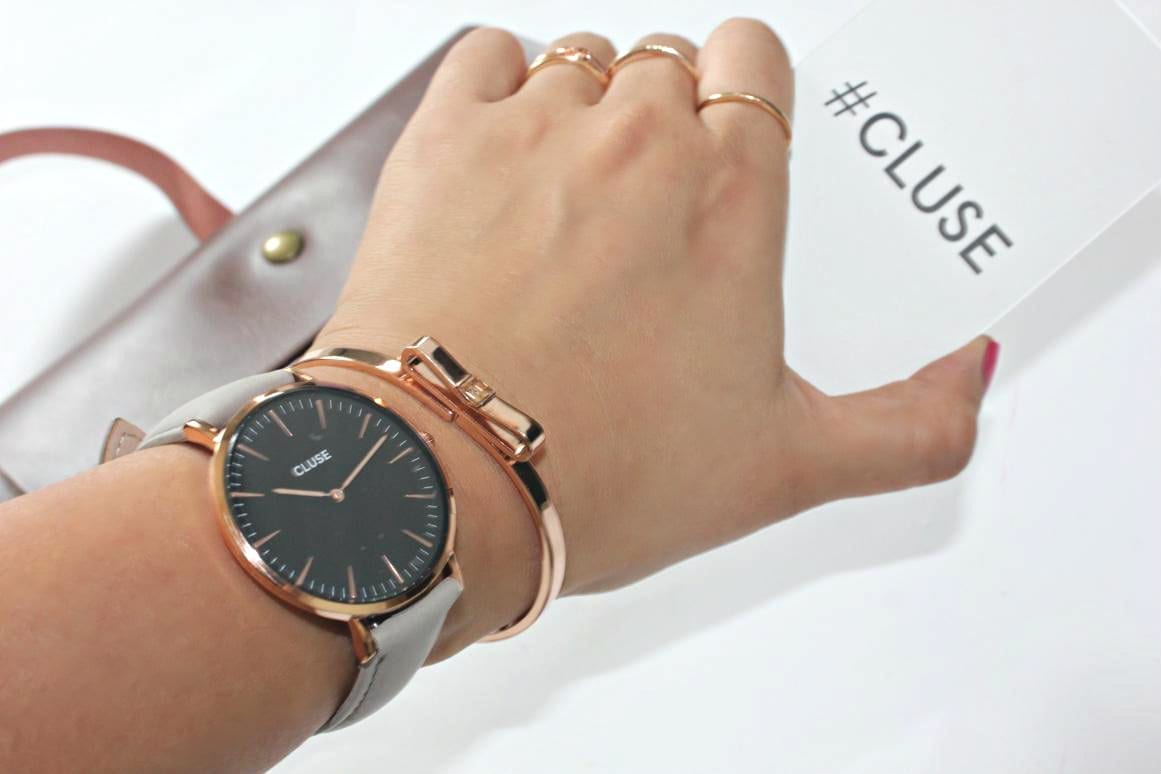
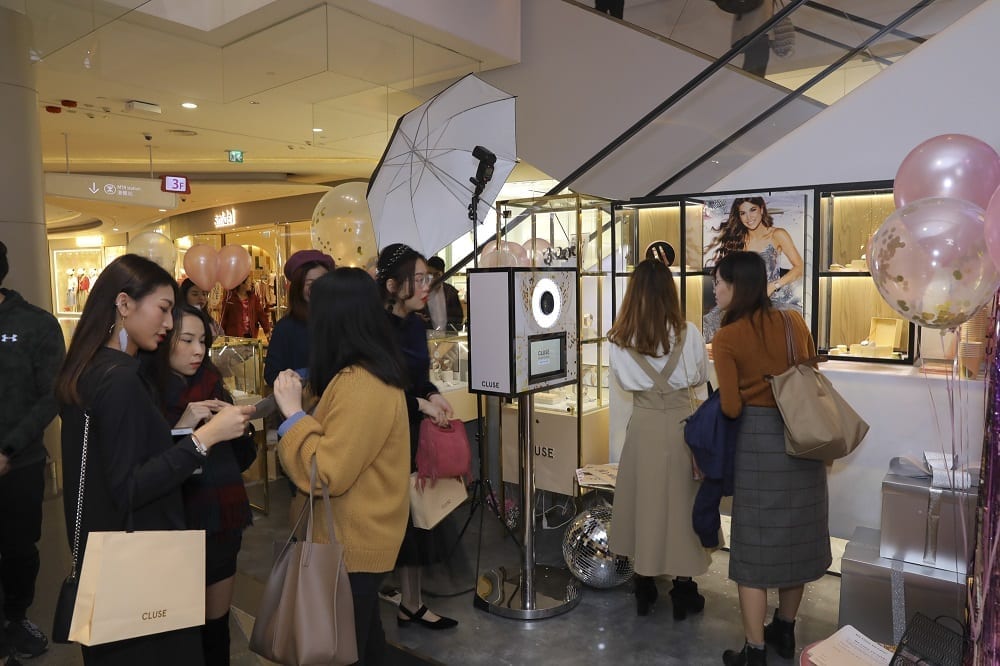
    The Amsterdam-based watch brand CLUSE, renowned for its timeless sophistication and strong focus on materials, quality, and style, opens its first branded kiosk in Asia Pacific with the leading Asian brand accelerator Bluebell Group.

    CLUSE, already popular among Hong Kong millennials after its arrival at kapok and City Chainstores last year, moves into retail expansion and chooses LCX at Habour City to launch its retail concept with the support of Bluebell Group.

    The brand has chosen HK as its gateway to Asia Pacific and also to first launch its jewellery collection with an event hosted by the founder Rudyard Bekker, who brought one of Europe’s most sought-after accessory brands to the city. Retail in Asia met him and asked him to share with our readers the secret about CLUSE fast-track success. Watch the video interview!

    Innovative, minimalistic, and affordable, CLUSE rapidly conquered millennial women in France first, becoming the bestseller among lifestyle brands, and Europe later, to quickly become DW‘s first competitor.

    As an online fanatic, Rudyard sees the importance of engaging storytelling for brands in today’s rapidly changing media landscape.

    CLUSE has been building the brand with a big focus on influencer and online marketing. It was discovered early by fashion bloggers like Sincerely Jules, Veronica Ferraro and Negin Mirsalehi.

    Proven successful, CLUSE has gained 882,000 followers on Instagram over the years; with a social media team of  people working in its Amsterdam headquarters, on its analysis, strategy and execution.

    Today, not only CLUSE has built a strong brand identity and unique design concept, but differently from its competitors it keeps refreshing its collections to provide its customers with more diversity. CLUSE watch is characterized by the use of materials such as pearl and marbles and the versatile straps available in different themes. The new store offers a wide selections of bestsellers and new collections.

    The new store will be unveiled 1 March 2018. It is the first branded kiosk in Asia Pacific and it showcases the retail concept of the brand, designed by the in-house team based in Amsterdam and HK. A 360 degree retail space that encapsulates the sophisticate CLUSE soul.

  • Macy’s shares jump at first sign of sales turnaround

    Macy’s shares jump at first sign of sales turnaround

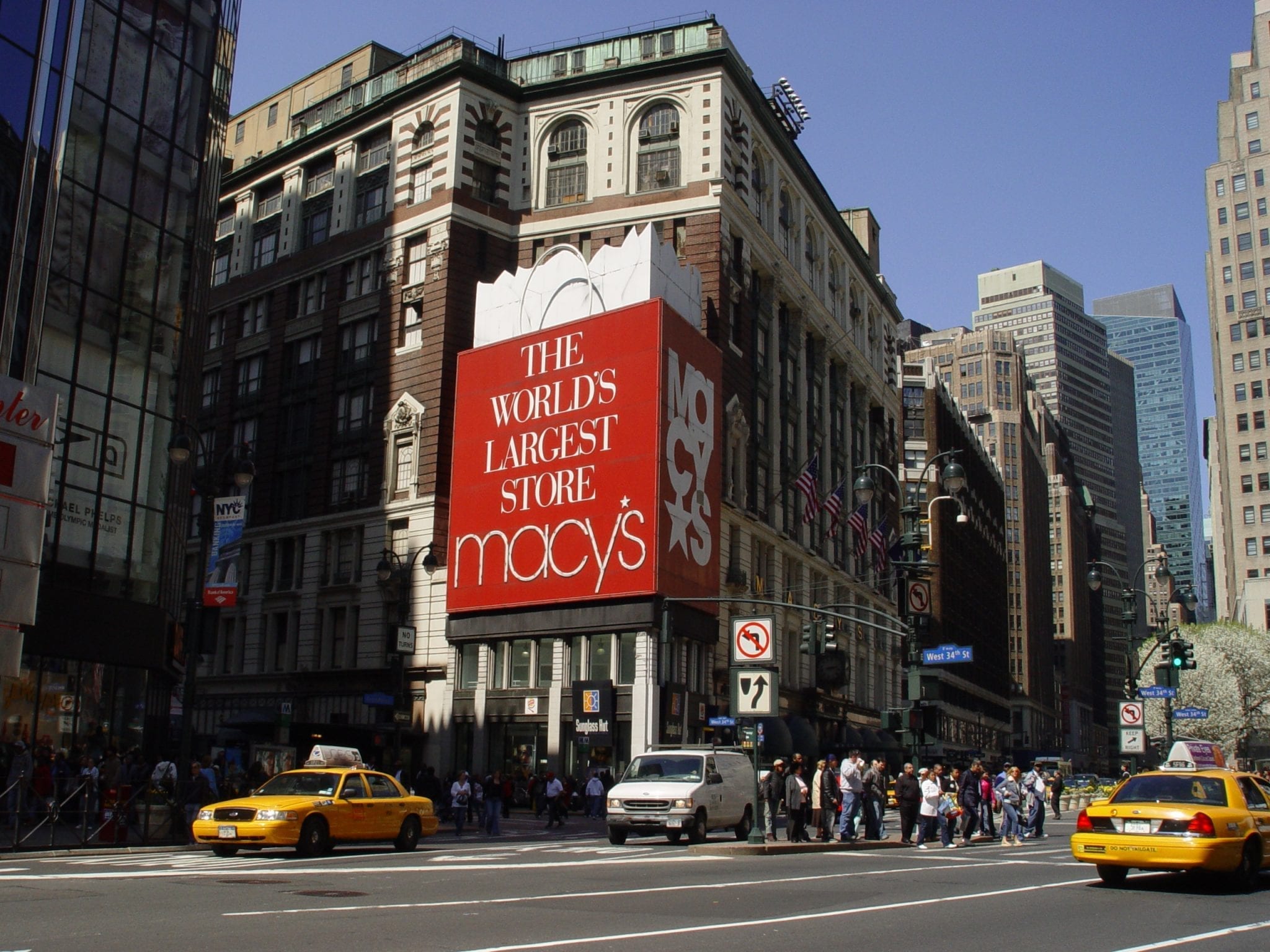
    While the latest Macy’s sales figures do not suggest there is a miracle on 34th Street – or at any other Macy’s location – they do provide a little cheer.

    Comparable sales are now positive after an extended period of decline, meaning Macy’s gets to end its fiscal year on a positive rather than a gloomy note.

    That said, the note sounded is rather faint. And these results are by no means a clarion call that Macy’s is firmly back on track. This is not pessimism, but realism about Macy’s situation and the context of the latest numbers.

    A total Macy’s sales uplift of 1.8 per cent is aided by an additional week of trading. When this is removed, we estimate that total sales shrunk. Admittedly, much of this relates to the prudent store closure program, but it nevertheless provides a more balanced picture of Macy’s current position.

    The comparable Macy’s sales figures account for the additional week of trade, so are an accurate reflection of underlying performance. However, while we applaud the 1.3 per cent growth, it is essential to unpick how much of this is down to Macy’s strategy and how much is attributable to the general uplift in external conditions.

    A simple way of assessing this is to look at whether Macy’s is gaining or losing market share. Unfortunately, on this basis, Macy’s growth is well below retail spending growth of 3.9 per cent over the same period. So, Macy’s has lost ground both at an overall level and, by our calculations, within a number of key categories like apparel and home. This view is backed by our consumer data, which shows no real recovery for Macy’s in terms of shopper share or shopper opinion about its proposition.

    None of this is to suggest that Macy’s is standing still. We know that the business has many initiatives in play, and we recognise that it is making changes. However, as we have noted before, that change is not yet established enough nor is it ambitious enough to drive a step up in performance. One of the main reasons for this is that although Macy’s highlights improvements to its proposition, there are many stores where this cannot be seen or felt by shoppers. In essence, there is a long tail of shops that look dated, are in sub-optimal locations, and where the customer experience is poor. Macy’s must remedy this if it is to transform the business.

    Thankfully, we believe Macy’s is in a position to make and create the more widespread change required. Finances are in a sound state, with asset and property sales are helping to provide capital for investment. Smaller divisions like Bluemercury and Backstage have potential and can become much more significant contributors to profits and sales. The refurbishment of departments such as home furnishings and footwear in some stores have shown that where Macy’s makes an effort, sales results follow. And the digital operation is still growing and puts Macy’s in an excellent position to meet the omnichannel needs of consumers.

    The latest boost to performance affords Macy’s more space and time to enact its plans. Hopefully, it will also give management the confidence to be bolder and more ambitious – especially as the near-term trading environment looks positive and should cushion performance. In short, Macy’s cannot just wait around for a miracle; management needs the strength and will to engineer one.

  • Tesla made over $2 billion in China in 2017

    Tesla made over $2 billion in China in 2017

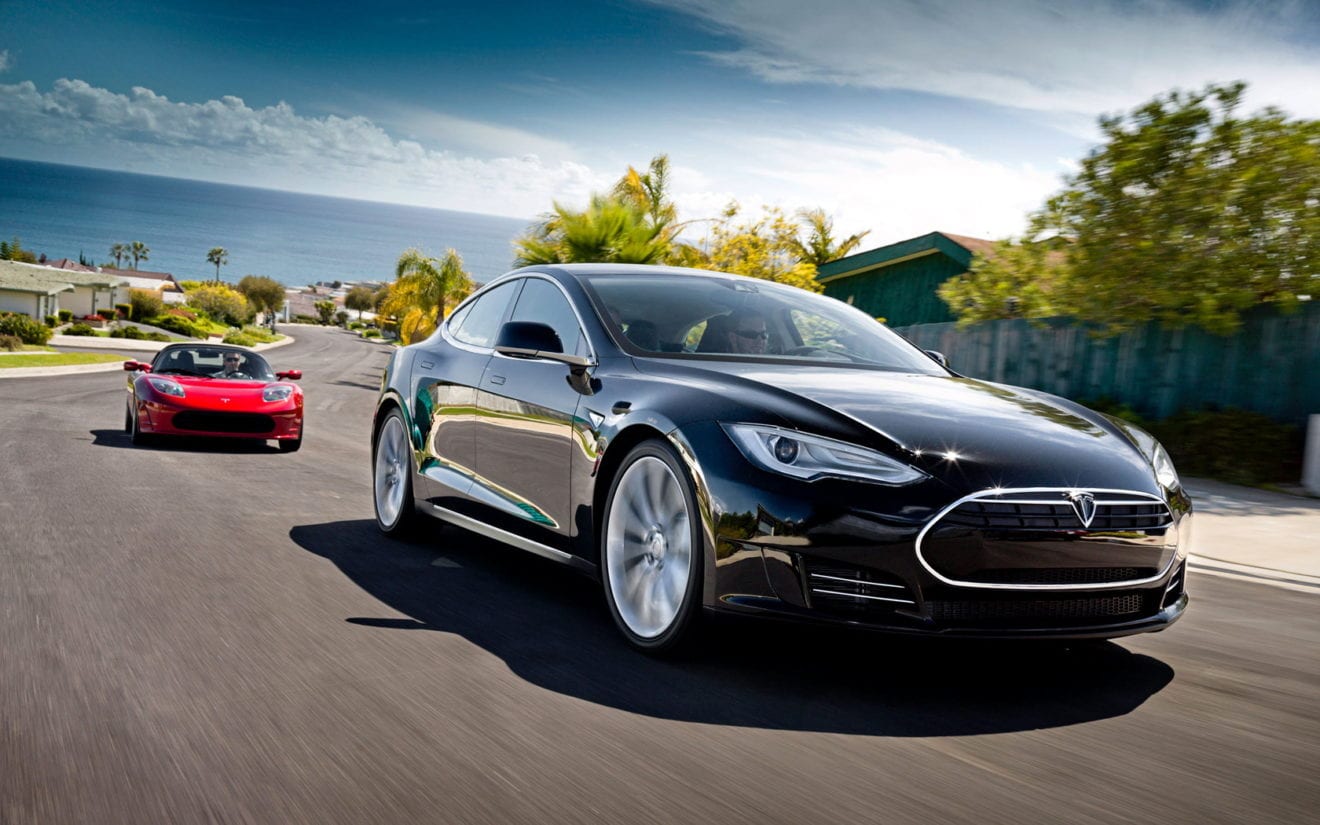
    Unlike most foreign automakers in China, Tesla has yet to establish local production and still solely relies on exporting its vehicles from California to the largest auto market in the world.

    Nonetheless, Tesla managed to double its sales in China last year as it is significantly expanding its presence in the country.

    Tesla was off to a tough start in China in 2014 and 2015, but things started to improve for them in the country in 2016 when they managed to triple their sales to over $1 billion during the year.

    The automaker wasn’t able to maintain the insane growth rate in 2017, but the company confirmed today that it still managed to double sales in China to over $2 billion in 2017.

    They don’t confirm the number of cars sold per market, but it has to represent over 20,000 vehicles based on their average sale price.

    Sales were helped in 2017 by China’s surprising demand for Tesla’s Model X. The vehicle has been extremely popular in the country. For example, look at the number of Model X SUVs at this Tesla owners meet-up in Shenzhen, China last month.

  • New global format showcased in Starbucks Reserve Seattle

    New global format showcased in Starbucks Reserve Seattle

    With the latest generation design and product offer, the new Starbucks Reserve Seattle store which opened this week offers a taste of what is to come for the 1000-plus stores planned globally bearing the sub-brand, including in Asia.

    In just 14 months since the concept was unveiled at an investors conference, dozens of Reserve stores have opened including a massive Chinese flagship in Shanghai.

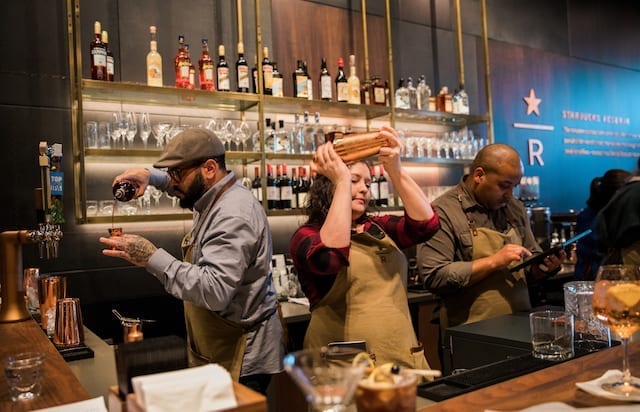
    Starbucks partners work in the new Starbucks Reserve store at the Starbucks Support Center in Seattle on Wednesday, February 21, 2018. 

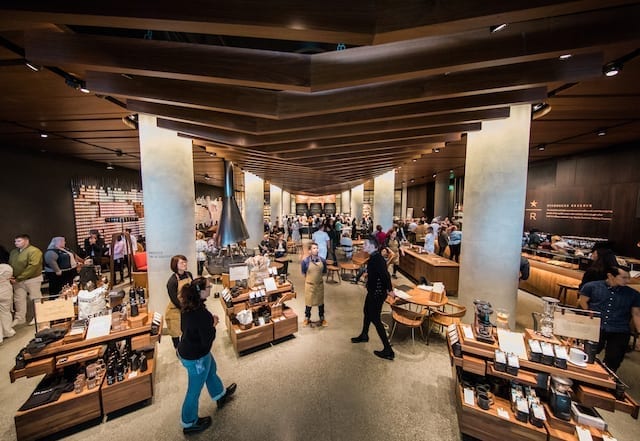
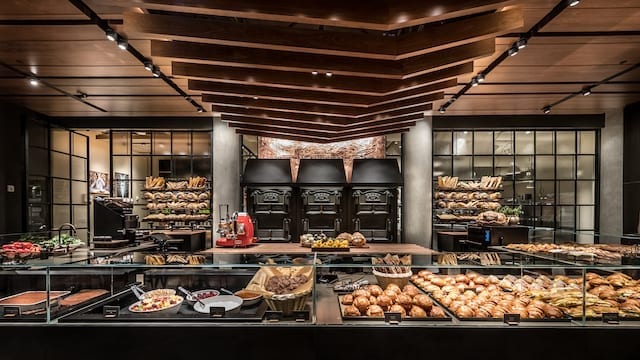
    The marketplace-styled Starbucks Reserve Seattle Sodo store is remarkable not just for the latest evolution of the upmarket sub-brand’s fit-out, but for the inclusion of the new Princi Italian restaurant concept with an open kitchen, seamlessly folded into the cafe format. Starbucks plans to open standalone Princi outlets in Seattle, Chicago and New York, so expect to see them integrated into the brand’s offer in key Asian markets as well.

    Starbucks partners work in the new Starbucks Reserve store at the Starbucks Support Center in Seattle on Wednesday, February 21, 2018.

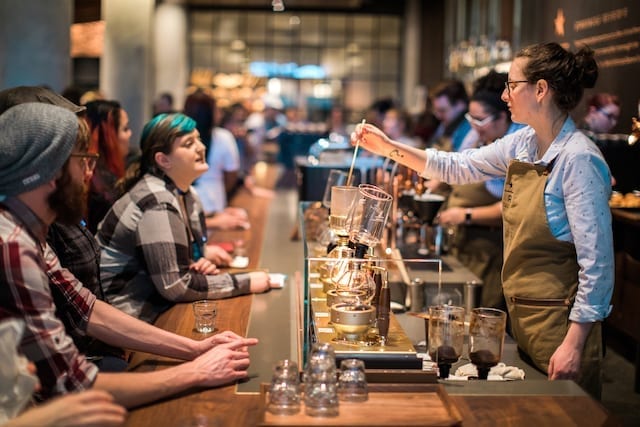
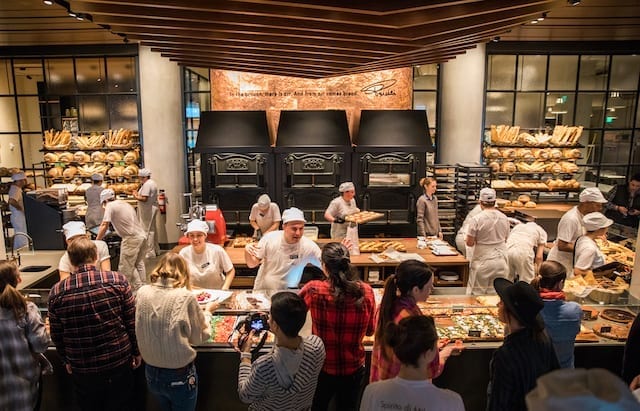
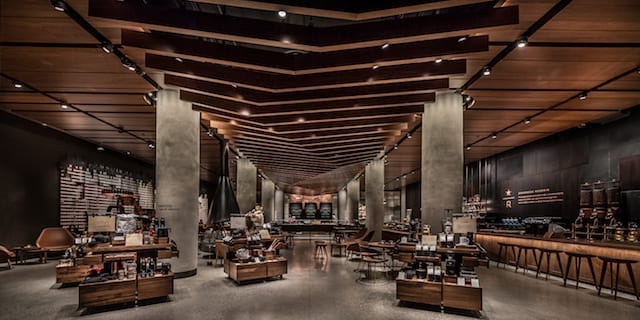
    Designed in an open, marketplace style, Starbucks Reserve Sodo store customers can engage with and order from partners (employees) at the Princi counter or Reserve coffee bar, then gather with family and friends at community tables or lounge areas around two fireplaces. Open to view is the Princi kitchen where customers can see breads and pastries being made and fresh ingredients prepared daily.


    Starbucks partners work in the new Starbucks Reserve store at the Starbucks Support Center in Seattle on Wednesday, February 21, 2018.

    Located on the street level of the company’s headquarters, the store opened on Tuesday (February 27). It was created “to offer a mingling of public and private; a place where Starbucks partners and visitors can relax in a leather lounge chair near the fireplace, nosh on a piece of focaccia at the counter or enjoy the latest Reserve espresso and a flaky cornetti from Princi,” in the words of Starbucks in-house writer Heidi Peiper.

    Christian Davies, VP creative global design & innovation for Starbucks, wants visitors to feel like they are part of an experience from the moment they cross the threshold and pass through the entry doors.

    “Every detail is deliberate, starting with the pattern on the hand-carved doors – concentric circles borrowed from the art for a Starbucks Reserve coffee card.

    “When you walk into the space from the entry, you can take everything in in the sweep of an eye,” says Davies. “We wanted people to walk through those doors and immediately find themselves in something different and unique, but they would still recognise as Starbucks.”

    To the left, there’s a colorful art installation. Just beyond is the chef’s table and Princi case.

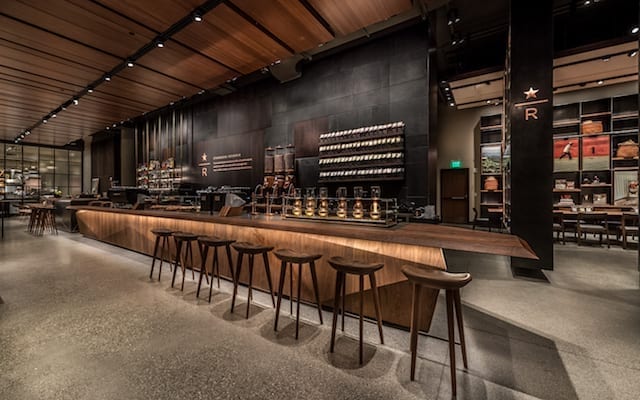
    Behind that, through framed art glass, is the Princi kitchen. Anchoring the center of the main cafe is a floor-to-ceiling fireplace, signaling a welcoming place to gather. Then look to the right and you’ll see a long wood-topped craft bar with Starbucks Reserve coffees and a mixology bar, finishing with the coffee library and doors to the patio.

    In addition to the open layout, Davies added other subtle touches, such as flecks of amber-colored glass and mirror sprinkled into the concrete floor that help suggest a path through the store.

    “When people come into a space they can navigate, you can see their shoulders relax. They instantly feel more comfortable,” says Davies.

    Art meets leisure

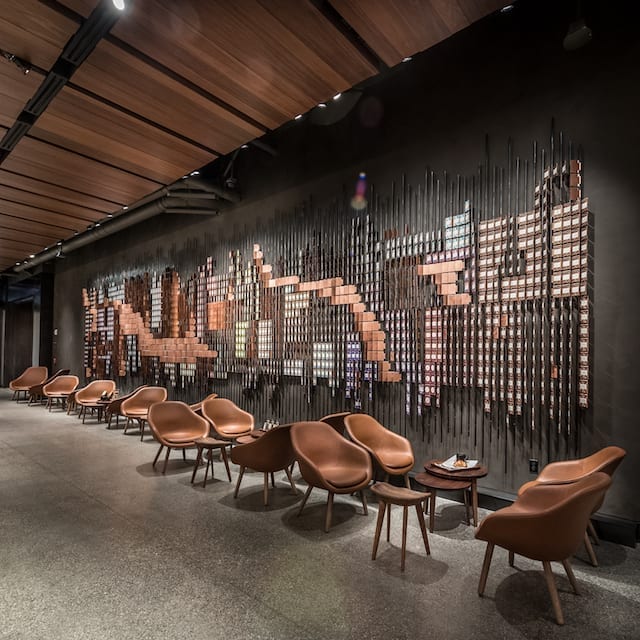
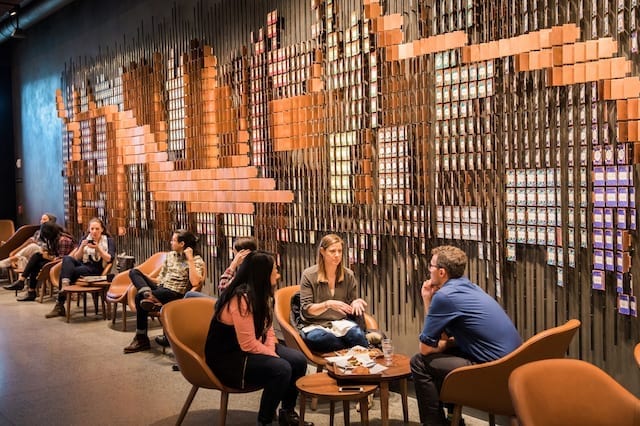
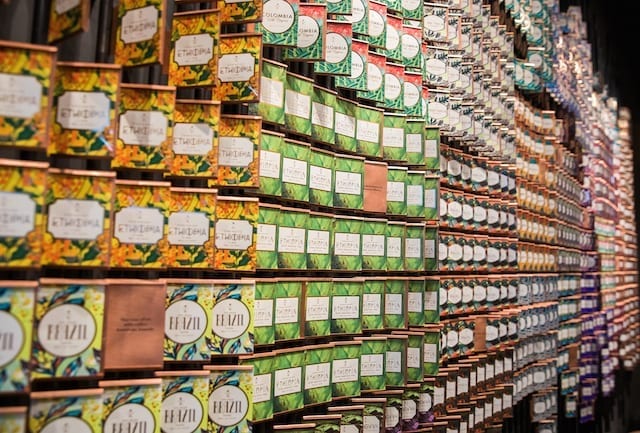
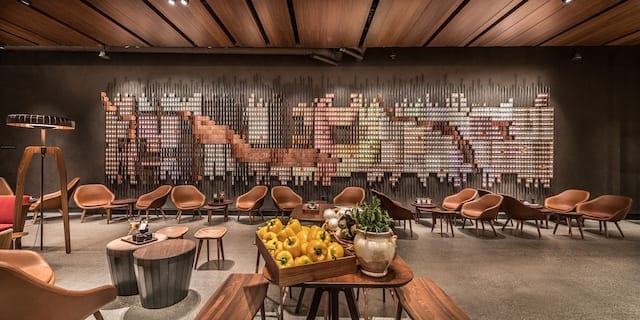
    The path begins at a stunning copper art installation that features nearly 3700 Starbucks Reserve cards, designed in-house. From a distance, the card wall’s shape evokes the topography of the gentle mountains where coffee is grown. Each card can pivot, creating shimmering waves of color like fish scales. But step closer, and individual coffee cards come into view, each one a work of art in itself. Every now says and again, a copper card is planted in the field of cards that tells a story about Starbucks Reserve.

    “On one level, it’s simply a beautiful, gestural piece,” says Davies. “As you dive into the next level, and then the next, more comes out.”

    Beyond the card wall is the first of three intimate meeting spaces, each creating its own moment of storytelling. The chef’s table room features the story of Rocco Princi, with shelves lined with ingredients from his pantry – cans of capers, artichokes and tomatoes and tall glass jars of preserved lemons. A favorite poem by Alda Merini, a friend of Princi, hangs in a place of honor.

    Gathered around the long wooden chef’s table, visitors can look through a glass wall into the Princi kitchen with artisan bakers and chefs at work.

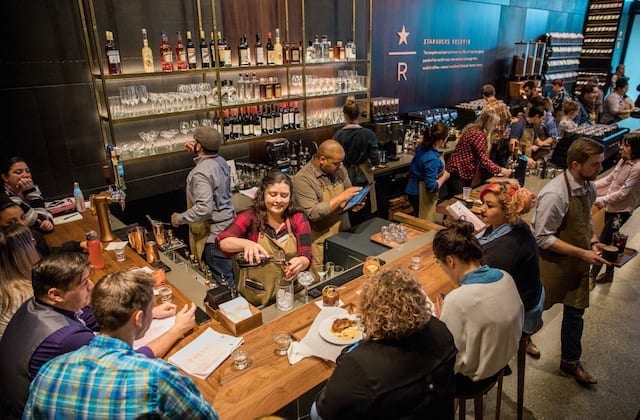
    And taking center stage is the Princi bakery and cafe, featuring the full Princi menu with artisanal baked breads, and breakfast anchored by signature cornetti and brioche. At lunchtime, the menu offers soups, salads, focaccia and pizza. To the right is the mixology bar for later in the day with traditional Italian aperitivo, such as Aperol Spritz paired with small plates, as well as beer, wine and spirits.

    Celebrating ‘our never-ending curiosity’

    The store represents the latest phase of innovation in the century-old building in Seattle’s Sodo neighborhood, which has served as Starbucks headquarters since 1993. In its previous life as a Sears Catalog distribution center, it employed what was then cutting-edge technology, with orders being picked by warehouse workers on roller skates and bicycles and delivered to the first floor via slides for quick shipping. The Reserve store continues that enterprising spirit, acting like a testing ground for the company, where it will debut new coffees, launch new products and host events. The store’s second meeting room, tucked back between the kitchen and the craft bar, is a tribute to this tradition. Starbucks R&D team will use this working lab to taste and test new beverages, starting with the cold coffee innovation.

    “The lab celebrates our never-ending curiosity,” says Davies. “We can continue to push R&D around new beverages and ingredient combinations.”

    The Reserve coffee bar is an eye-catching counterpoint to the Princi case. Here the craft of coffee is on display, with a full-lineup of brewing methods to explore, including siphon. Chemex, pour-over and Clover and a variety of Starbucks Reserve beverage creations to explore. The backdrop for this stunning display is a dark-stained walnut and leather back-bar, with hand-stitched copper wire adding sparkle and interest.


    The story from bean to cup

    In the third meeting space, visitors can learn coffee’s story from bean to cup. The Starbucks Reserve coffee library can be hidden away behind a pivoting full-height wall of 1200 bags of Starbucks Reserve Coffee. The space houses a collection of books on the geography, flora and fauna of Starbucks coffee-growing regions, and features a hand-painted Siren by Jordan Kay, the Starbucks artist behind this year’s holiday cup. An inside-outside fireplace brings warmth to those gathered in the room, and visitors enjoying the patio outside.


    “When we were designing the space, we wanted to create layers of experiences and understanding – something new to discover,” adds Kenna Giuzio, senior store concept designer for Starbucks. “I hope with each visit, our customers will come away with a new story of Starbucks.”

    The new cafe also features several new menu items, including Nitro Draft Latte, Spiced Ginger Cold Brew on tap, and new espresso drinks such as the Bianco Mocha.

  • 7-Eleven in Thailand Witness Significant Growth

    7-Eleven in Thailand Witness Significant Growth

    Convenience store group CP All, which runs 7-Eleven and Siam Makro stores in Thailand, has revealed strong growth over the past year.

    It has posted a net profit of THB19.9 billion (US$631.5 million) for the fiscal year, up 19 per cent on revenue growth with a strong performance also from its cash-and-carry subsidiary.

    Expansion and product strategy drove total sales revenue to THB278.7 billion, up 8.7 per cent from the year earlier with a gross profit margin of 28.1 per cent, down from 28.3 per cent because of higher oil prices pressurising logistics costs, says the company.

    CP All has more than 10,000 7-Eleven outlets across Thailand. It plans to add a further 700 stores this year with a goal of reaching 13,000 by 2021. It is targeting tourist destinations.

    Average daily sales at 7-Eleven stores were THB79,786 last year.

    The company plans capital expenditure of THB9.5 to 10 billion for store expansion, renovation and investments in new projects this year.

    CP All’s cash-and-carry subsidiary Siam Makro has meanwhile reported 14 per cent growth in net profit, reaching THB6.1 billion.

  • DHL gives India top ranking for growth in the ‘Big Seven’

    DHL gives India top ranking for growth in the ‘Big Seven’

    India’s economy holds the brightest growth prospects of the world’s seven largest economies, according to results from the Global Trade Barometer (GTB) from logistics company DHL.

    GTB analytics assigned India the highest growth indices of the seven countries assessed, due to strong and sustained increases in both air and ocean freight in and out of the country.

    The country’s trade in machinery and high-tech goods continues to underpin its growth, while increased imports of industrial raw materials point to an extended period of trade development for the nation.

    “More than any of the world’s largest economies, India’s major industries have displayed levels of resilience and growth that will buoy business confidence in the short-to-medium term,” said George Lawson, managing director, DHL Global Forwarding India.

    “India’s economy has built up terrific momentum in recent times: Since 2008, its GDP has risen every single year to US$2.44 trillion last year, more than double the levels of a decade ago. As the country continues to invest heavily in infrastructure, we expect it to continue its upward trajectory for the foreseeable future.”

    According to the GTB, businesses in India can expect ocean trade to further improve on already-high levels, largely thanks to demand for commodities and industrial materials from overseas.

    Air freight demand is projected to remain stable at its current highs, sustained by growth in machinery and technology imports. Both India’s air and ocean freight forecasts proved stronger than those of any other country in the GTB — in large part due to every major sector making a positive contribution to the country’s trade.

    Developed jointly by DHL and Accenture, the GTB provides a quarterly outlook on future trade, taking into consideration the import and export data of seven large economies: China, South Korea, Germany, India, Japan, the United Kingdom and the United States. Together, these countries account for 75 per cent of world trade, making their aggregated data an effective bellwether for near-term predictions on global trade. The GTB, which assesses commodities that serve as the basis for further industrial production, predicts that global trade will continue to grow in the next three months, despite slight losses in momentum.

  • AirAsia to fly to Hua Hin, Thailand from May 18

    AirAsia to fly to Hua Hin, Thailand from May 18

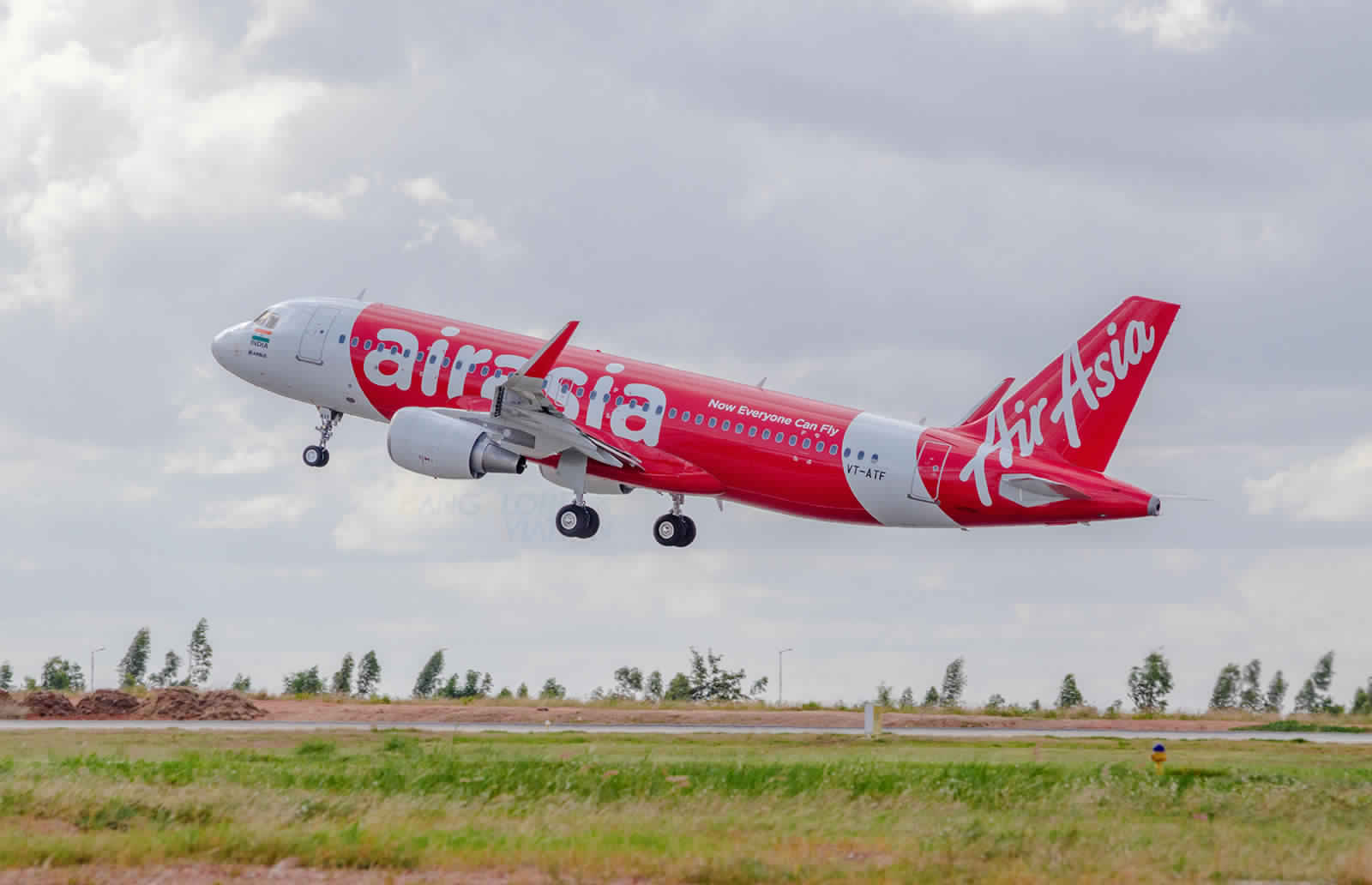
    AirAsia, is set to fly to Hua Hin, Thailand, with four times weekly direct flights from here, starting May 18. In a statement today, AirAsia said the route, operated on flight code AK, marked the airline’s seventh route into Thailand while providing the widest network in ASEAN and connecting the road less travelled in the region to the world.

    Head of Commercial, Spencer Lee, said the airline carried about 1.3 million of guests from Kuala Lumpur to Thailand and is positive that Hua Hin would be the new preferred holiday destination, while further contributing to tourism growth for both cities.

    “AirAsia currently operates 165 weekly flights one way to Thailand, including Bangkok (80 times weekly), Phuket (35 times weekly), Krabi (21 times weekly), Hat Yai (7 times weekly), Chiang Mai (14 times weekly), and Pattaya (4 times weekly) and now Hua Hin,” he said.

    To celebrate the launch of this new route, AirAsia is offering promotional all-in-fares from RM79 for one way from now to March 4, 2018, for the travel period between May 18, 2018, and Oct 26, 2018.

  • McDonald’s Hong Kong uses Elton John classic to celebrate ‘Little Big Moments’

    McDonald’s Hong Kong uses Elton John classic to celebrate ‘Little Big Moments’

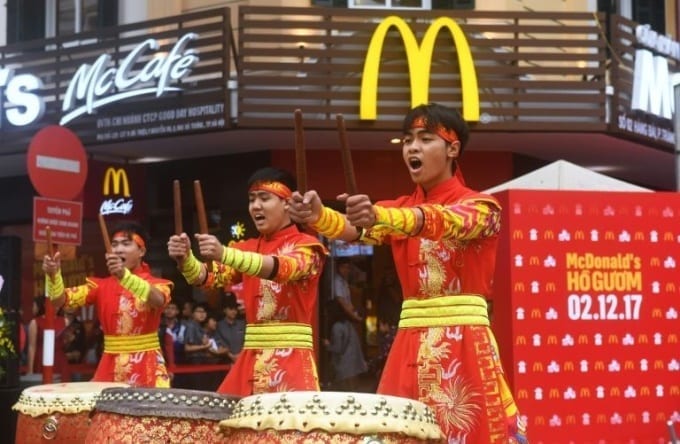
    Scenarios portrayed include a friends’ rooftop dinner, an expectant mother with her partner and a young man visiting his ailing relative.

    Created by DDB Group Hong Kong, the #LittleBigMoments video has been viewed more than a million times on YouTube, and another million elsewhere on social media, since its release last week.

    “As a brand, we understand that life is not just one big thing, but the accumulation of a million little things, a million little moments. And in the end, it is these little moments that make life big,” said Randy Lai, chief executive officer of McDonald’s Hong Kong.

    The use of pop classics is not an unfamiliar tactic used by DDB’s for McDonald’s in Hong Kong. In 2014, American fast food brand used the Billy Joel song ‘Just the way you are’ to promote its cheaper prices.

    In addition to the 60-second TVC, DDB also created three 15 second stories – each focusing a specific McDonald’s product with ‘You Song’ playing in the background.

  • Nokia 7 Plus Announced In China With 4GB And 6GB Of RAM

    Nokia 7 Plus Announced In China With 4GB And 6GB Of RAM

    The Nokia 7 Plus has been announced in China, and HMD actually decided to announce both 4GB and 6GB RAM variants in China, while only a 4GB RAM variant got announced in Europe. HMD had introduced the Nokia 7 Plus a couple of days ago at the Mobile World Congress (MWC) in Barcelona, along with four other Nokia-branded smartphones. This is one of the company’s Android One phones, and it comes with 4GB of RAM, as already mentioned. A 4GB RAM variant of the Nokia 7 Plus which was announced in China is completely identical to the European model, while the 6GB RAM model comes with more RAM, that’s it.

    Now, as the Nokia 7 Plus is an Android One handset, it comes with stock Android out of the box. Android 8.0 Oreo comes pre-installed on the Nokia 7 Plus, but HMD did say that Android 8.1 Oreo will hit the device in the near future. The Nokia 7 Plus is made out of metal, while its display sports rounded corners. All the physical keys sit on the right-hand side of this smartphone, while Nokia’s logo can be found both on its front and back sides. A fingerprint scanner is included on the back of the device, while above it you’ll notice a dual camera setup. This handset also sports somewhat thin bezels, and its spec sheet is nothing to scoff at. The device is fueled by the Snapdragon 660 64-bit octa-core SoC, while it sports a 6-inch fullHD+ display. In addition to 4GB or 6GB of RAM, you’re also getting 64GB of expandable storage.

    A 3,800mAh non-removable battery is included here, and you’re also getting fast charging. Two 12-megapixel snappers are included on the back of the Nokia 7 Plus, while a single 16-megapixel shooter sits on the phone’s front side. The device also offers two SIM card slots, and Bluetooth 5.0. If you’d like to expand this phone’s storage, you will have to utilize its second SIM card slot, which means that you can either use two nano SIMs here, or a nano SIM and a microSD card at the same time. The 4GB RAM variant of the Nokia 7 Plus is priced at 2,299 Yuan ($363) in China, while the 6GB RAM model costs 2,499 Yuan ($395). Both variants of the phone are already available for pre-order, while they will go on sale on March 7 via Tmall, Suning and JingDong Mall (JD.com). The two devices will also be available via a number of retail stores across China.

  • RHB Bank’s five-year roadmap to strengthen presence in Malaysia

    RHB Bank’s five-year roadmap to strengthen presence in Malaysia

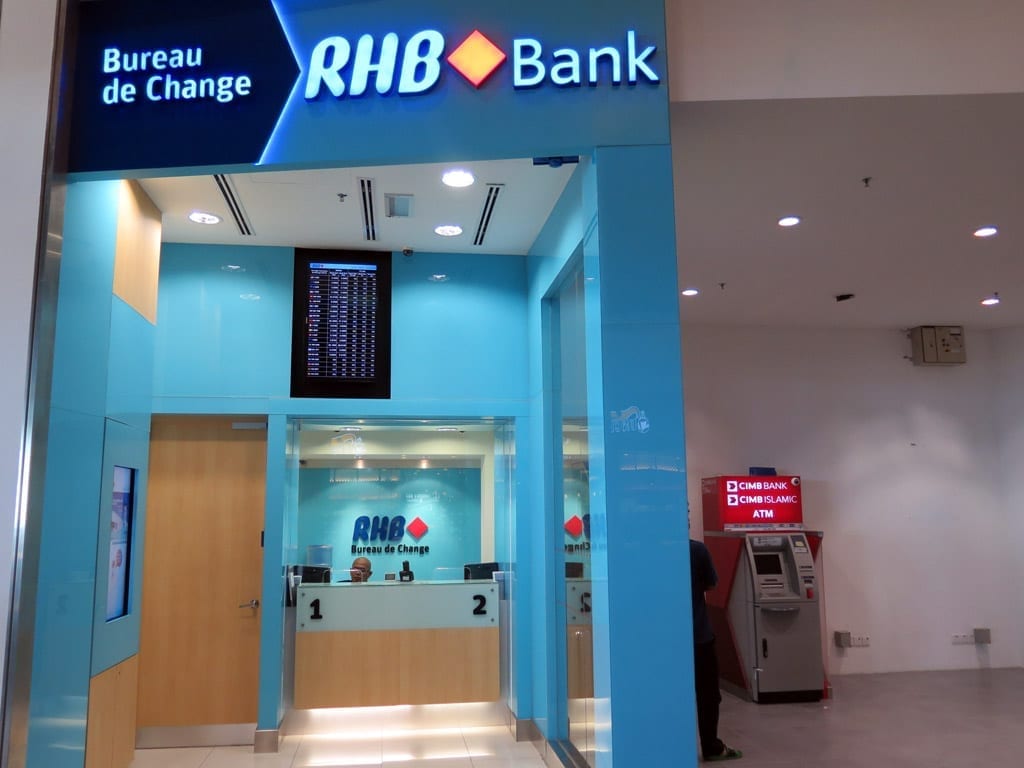
    RHB Bank Bhd, which registered a 16% net profit growth to RM1.95bil for the financial year ended Dec 31, 2017 (FY17), has outlined its strategies in a new five-year plan, FIT22.

    The roadmap entails the bank’s priorities to strengthen its presence in Malaysia and win in targeted segments, as well as to focus on its niche and strength in its overseas operations while exploring partnerships.

    Speaking at a media briefing held in conjunction with the bank’s FY17 results briefing, RHB group managing director Datuk Khairussaleh Ramli said digital enablement would be a core priority within FIT22, following the conclusion of the IGNITE 17 transformation programme last year.

    RHB intends to spend over RM200mil over the next three to five years on digital capabilities and technological investments. “We are now focusing on building scale through an agile way of doing things and believe that we still have room to grow in Malaysia to be able to gain market share and improve profitability,” he said, adding that RHB was now the fourth-largest bank in Malaysia in terms of assets.

    The core component of FIT22 will be the small and medium enterprise (SME) and retail segments to drive growth, as well as to build a connected ecosystem.

    Khairussaleh said that the retail and SME segments were expected to constitute an estimated 75% of RHB’s domestic loan portfolio from the current 69%, while the affluent customer segment will make up 25% of RHB’s retail business by 2022, from the current 18%.

    In addition, RHB aims to boost its return on equity to 11.5%, be the number three bank for SMEs as well as maintain a top-three position for investment banking.

    “We are already number one in the mid-cap segment, so if we can build our ecosystem around this segment, some day the mid-caps will grow to become large-caps for us.

    “That is something that we think can differentiate ourselves from the other banks as well,” Khairussaleh explained.

    Todate, RHB has established relationships with some 57% of mid-cap companies, of which one-third have a lending relationship with the bank.

    Meanwhile, RHB’s 2018 key performance indicator is to achieve an ROE of between 9% and 10%, a loan growth of 6%, as well as a cost-to-income ratio of below 50%.

    On mergers and acquisitions (M&As), Khairussaleh said the bank does not intend to look for any M&As overseas, and will instead focus on expanding its product portfolio across its overseas market.

    Noting RHB’s lacklustre performance in Singapore, Khairussaleh said the bank intends to move towards more secured lending and build a new private wealth business in the republic, targeting mid-tier customers with assets under management of S$1mil to S$2mil.

    In 2018, the Malaysian banking sector is expected to see a recovery in loan growth, primarily from stronger business loans, while capital market activities are also expected to pick up, which would help support the non-interest income of banks.

    RHB’s improved performance in FY17 was largely driven by higher net funding income, lower loan loss impairment and lower impairment losses on other assets.

    However, this was partially offset by higher overheads and lower non-fund-based income.

    The bank has announced a dividend of 10 sen per share, bringing its total dividend per share for FY17 to 15 sen, representing a 30.8% payout ratio.

  • Food inflation lower at 3.8% in January

    Headline inflation moderated to 2.7% in January, mainly due to lower transport inflation at 5.7% compared to 11.5% in December 2017, said Bank Negara Malaysia (BNM).

    “Although RON95 petrol averaged slightly higher at RM2.28 per litre in January 2018 (December 2017: RM2.27 per litre), the higher base of RON95 price in January 2017 (RM2.10 per litre) compared to December 2016 (RM1.90 per litre) resulted in lower inflation in the transport category,” the central bank said in a statement today.

    BNM said food inflation was also lower at 3.8% (December: 4.1%), reflecting lower inflation in the fish and seafood category.

    It said there was a higher current account surplus in the fourth quarter of 2017 (4Q 2017) as the current account surplus widened, reflecting a larger goods surplus and lower secondary income deficit.

    Going forward, BNM said the current account surplus was expected to continue registering a healthy surplus, supported mainly by the goods account.

    “Net financing growth continued to support economic activity as it increased to 7.2% in January 2018 (December 2017: 6.9%),” said BNM.

    It said the growth of net outstanding issuances of corporate bonds continued to increase, with a double-digit growth rate of 16.6% (December 2017: 15.4%).

    The central bank said the growth of outstanding loans of the banking system also increased slightly to 4.2% (December 2017: 4.1%).

    The growth of outstanding business loans increased to 2.0% in January 2018 (December 2017: 1.8%), driven mainly by wholesale and retail trade, restaurants and hotels, real estate, construction, and primary agriculture sectors, said BNM.

    “Banking system capitalisation remained strong as financial institutions are well-positioned to withstand macroeconomic and financial shocks, with excess capital buffers of RM140 billion as at January 2018,” said the central bank.

    More than 75% of total capital, comprised high-quality loss-absorbing capital in the form of Common Equity Tier 1 Capital (i.e. equity, retained earnings and reserves), it said.

    BNM said financial markets attracted non-resident inflows amid positive sentiments as in January, the domestic financial markets were supported by positive sentiments, driven by Malaysia’s strong economic outlook and higher global oil prices.

    “As a result, the Malaysian Government Securities (MGS) and equity markets attracted non-resident inflows amounting to RM4.2 billion and RM3.4 billion respectively.

    “Following the inflows, the ringgit appreciated by 4.3% against the US dollar and the FTSE Bursa Malaysia KLCI increased by 4.0% in January, while in the bond market, three-year, five-year and 10-year MGS yields increased by five basis points each, following the increase in the overnight policy rate (OPR) by 25 basis points.

    “The impact of the OPR increase on MGS yields was mitigated by non-resident inflows into the MGS market,” said BNM.