Tag: asia

  • AirAsia is hosting its first hackthon

    Budget airline AirAsia is the latest corporate to get into hackathons. The company just revealed plans to host its first-ever hack event on March 18 at its headquarters in Kuala Lumpur, Malaysia.

    AIRVOLUTION 2017” — yes, all caps and a cheesy name ? — is, as you’d expect, focused on air travel and related themes although the final challenge will be announced on the day of the event. The top prize RM 25,000 (around $5,600) in cash alongside five sets of return flights to any AirAsia destination, and 100,000 of the company’s “Big” loyalty points.

    There’s space for 20 selected teams to compete, with the only stipulation being that they must be from one of the 26 countries covered by AirAsia flights. Applications are open from now until 19 February 2017. Selected teams will be notified 3 March and those based outside of Malaysia will have their flights covered by AirAsia.

    The event, which includes Microsoft among its sponsors, is aimed at injecting fresh ideas and thinking into the 13-year-old airline, according to CEO Tony Fernandes, who last year said he wanted to make AirAsia a “digital airline.”

    “This year marks the emergence of AirAsia as a digital airline, and I believe this event can spur the kind of radical, creative thinking that will ensure AirAsia remains on the leading edge,” he said in a statement.

    AirAsia is by no means the first travel company, or even airline, to embrace hackathons. Emirates, Singapore Airlines and Malaysia Airlines all run events, while British Airways has gone one step further with its own in-flight hackathon in 2013.

  • Ericsson, Cisco to virtualize VHA’s core, IP network

    Ericsson, Cisco to virtualize VHA’s core, IP network

    Vodafone Hutchison Australia (VHA), operator of the Vodafone Australia brand, has engaged Ericsson and Cisco to evolve and virtualize the operator’s core and IP network.

    Ericsson has won a contract to lead the transformation program, building the infrastructure as well as delivering an end-to-end operational system.

    The vendors will deliver a joint architecture solution comprising an Ericsson hyperscale data center system and software components, as well as Cisco’s WAN automation engine, network service orchestrator, IP network VNFs and security gateway.

    Through the project, VHA plans to simplify its network and infrastructure to enable the operator to become more agile and proactive in the way it brings services to market. The transformation also promises to reduce opex and capex and ultimately improve the customer experience.

    The deal marks the first major collaboration between Ericsson and Cisco on telecoms cloud infrastructure, and comes as part of the global business and technology partnership the two vendors formed in November 2015.

    “Ericsson and Cisco are our existing providers of core and routing functions making

    them good partners to move into a virtualized environment,” VHA CTO Kevin Millroy said.

    “This transformation allows us to introduce new applications to drive innovation and improve customer services and user experience. The new infrastructure opens the door to new business models and markets – such as IoT for Vodafone. We are excited about the future prospects this partnership offers.”

  • DHL eCommerce has launched its fulfillment centre in Sydney

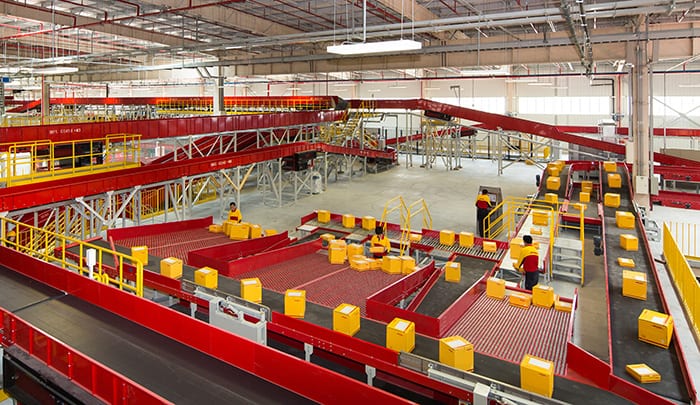
    DHL eCommerce has launched its fulfillment centre in Sydney

    “E-commerce has gone borderless, and order fulfillment needs to do the same,” said Charles Brewer, CEO of DHL eCommerce. “Our Australian facility adds another node to our standardized global network of fulfillment centres located in the US, Mexico, India, Hong Kong and Central Europe, eliminating the need for e-commerce merchants to hunt for new logistics partners as they look to expand their global reach.”

    According to DHL, the new facility integrates inbound freight, inventory and last-mile delivery into a single consolidated service, operating under the same service level agreements, management platforms and customer support as the rest of the DHL eCommerce fulfillment network. All services will be offered on a pay-per-use basis.

    “Australian shoppers are the second-most likely in the world to buy online from overseas merchants, and the significance of their purchasing power will only increase as cross-border e-commerce grows at an average of 29% per year until 2020,” said Damien Sheehan, managing director of Australia at DHL eCommerce. “Online retailers need to overcome the traditional problems associated with overseas expansion — finding new suppliers in each market, delivering shipments within days not weeks, and keeping costs in check — if they want to stay competitive in this borderless future. The launch of our Australian fulfillment centre gives our customers immediate access to one of the world’s most mature and fastest-growing e-commerce markets, with the scalability and quality needed to reach Australia’s highly savvy online shoppers.”

    Malcolm Monteiro, CEO of Asia Pacific at DHL eCommerce, said that cost-effectiveness and scalability are the most critical issues for online retailers in Australia because the value of the country’s e-commerce sales is expected to grow by almost 50% between now and 2020.

    “Whether it’s extending into new channels, offering more delivery options, or simply increasing inventory and warehouse capacity, global brands need fulfillment solutions that can adapt to their needs without requiring hands-on intervention every time a change occurs,” he said. “Global e-tailers can access our latest fulfillment centre for simplified nationwide inventory and last-mile delivery and also as part of a rapid and painless global expansion.”

  • Hawaiki completes route survey for subsea cable

    Hawaiki completes route survey for subsea cable

    Hawaki Submarine Cable and TE SubCom have completed the route survey for the 14,000km Hawaiki transpacific cable system linking Australia and New Zealand with mainland US.

    With the successful completion of the survey, the companies remain on track to complete the deployment of the cable in mid-2018.

    Once complete, the carrier-neutral cable system will be the highest cross-sectional capacity link between the US and Australia/New Zealand. It will also link to Hawaii and American Samoa, with options to expand to several other South Pacific islands including New Caledonia, Fiji and Tonga.

    TE SubCom meanwhile continues to manufacture the cable, with more than 4,500km of cable and over 25 repeaters completed.

    “The start of 2017 finds the Hawaiki cable system closer and closer to ready for service,” Hakaiki CEO and co-founder Remi Galasso said.

    “The information garnered from the recently completed deep water route survey will be instrumental in ensuring the long-term viability of the cable system, and we are thrilled with the progress on the cable and repeater manufacturing efforts. Installation will begin later in 2017 and a fully lit system that should positively impact the entire region is soon to follow.”

  • Jessica Hart leads Triumph bra campaign

    Jessica Hart leads Triumph bra campaign

    Australian model/entrepreneur Jessica Hart heads the new global spring/summer campaign for the Triumph bra brand.

    She was shot by British fashion photographer Rankin for the campaign, “Find the One for Every You”, which tells the story of the modern woman’s multifaceted life: athlete, business woman, mother. The concept is to show how Triumph bras support women whatever they do, and to help them “find the one” for every age, shape, size and occasion.

    Hart and supporting models are depicted in various roles, with the campaign playing on real personalities rather than an idealised image. Rankin says the most exciting thing about working on the campaign is that the brand is moving in a different direction.

    “The images are modern, accessible and incredibly confident. We’re really pushing the fact that it’s not just for the ‘perfect’ woman, Triumph is for every woman.”

    Hart says she is excited to be part of change, “representing this playful side of Triumph that speaks to all women”.

    The campaign spotlights the brand’s diverse styles, from the feminine Amourette 300, confidence-enhancing Magic Boost and innovative Triaction.

    Hart has also been a Victoria’s Secret model.

  • McDonald’s Japan stake for sale

    McDonald’s Japan stake for sale

    McDonald’s has reportedly invited bids for a “significant stake”  in its McDonald’s Japan unit.

    The Wall Street Journal has quoted “people familiar with the matter” saying the company is looking for buyers for up to 33 per cent of the shares, from its nearly 50 per cent stake in the listed Japanese company.

    The report said initial bids were due to be lodged this week and that a number of private-equity firms are considering the opportunity.

    Last week McDonald’s released terms of its sale of 80 per cent of its China and Hong Kong business, giving 20-year rights to the brand to state-backed Citic Ltd and private equity company Carlyle Group.

    The beleaguered Japanese business last February reported its first increase in customer numbers in nearly three years after a tumultuous period in which sales plummeted and the store network was heavily rationalised.

    Internal company figures showed footfall at stores open for more than one year rose by more than 10 per cent Japan-wide. Better yet, same-store sales rose by as much as 30 per cent, according to a report by Reuters.

    McDonald’s Holdings Co (Japan) has projected a net profit of about 1 billion yen (US$8.47 million) for the year to December 2016 – which would mark its first time out of the red in three years since a food safety scandal relating to expired chicken hit the brand in 2014. In January 2015 sales plunged 38.6 per cent, customer ranks depleted by 28.5 per cent.

    In April 2015 the company unveiled a plan to cull its restaurant network and revamp remaining stores after a US$319 million loss.

    It also revised its menu, adding salads which has clearly drawn customers back to restaurants.

  • Real Singapore retail sales slide

    Real Singapore retail sales slide

    Real Singapore retail sales fell 2.1 per cent in November in a disappointing month for the sector.

    sg-sales-11

    Month-on-month they slipped 0.3 per cent.

    Sales of motor vehicles helped drive the topline figure to an increase of 0.5 per cent.

    According to Statistics Singapore, total retail sales in November 2016 were estimated at $3.6 billion, similar to that in November 2015.

    Year-on-year, the computer & telecommunications equipment sector was the worst performer, declining 13.5 per cent

    Sales of watches & jewellery, wearing apparel & footwear, furniture & household equipment, supermarkets, food & beverages, department stores, mini-marts & convenience stores and petrol service stations fell between 1.1 per cent and 6 per cent during the period.

    Bucking the trend medical goods & toiletries, recreational goods and optical goods & books, which increased by between 0.3 per cent and 4.4 per cent.

    Food and beverage

    sg-fb-sales-11

    Turnover of restaurants decreased 11.9 per cent in November 2016 compared to November 2015. In contrast, sales of food caterers, fast food outlets and other eating places increased between 5 per cent and 7.5 per cent during the period.

    Sales of restaurants and other eating places (such as cafes) declined 6.4 per cent and 0.5 per cent respectively month-on-month. Conversely, turnover of fast food outlets and food caterers rose 8.1 per cent and 0.2 per cent.

    The total sales value of food & beverage services in November 2016 was estimated at $650 million, $9 million less than in November 2015.

  • James Dyson seeks single-brand stores in India

    James Dyson seeks single-brand stores in India

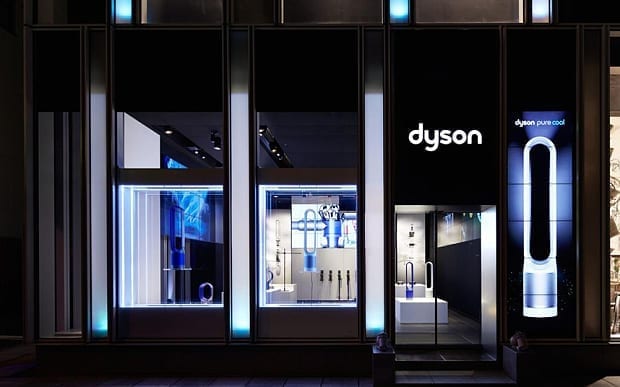
    Appliances innovator Dyson is seeking Indian government approval to open single-brand retail stores.

    But the company faces a challenge is getting the government to relax the mandatory local sourcing requirements, arguing its products as “state-of-the-art”. Such goods are exempted from the usual norms, according to Indian media.

    Dyson

    Dyson revealed plans to enter India last November.

    “We will invest 150 million British Pounds in next three to five years to open stores and set up retail network here,” founder and chief engineer Sir James Dyson said.

    “Our first store would open in the middle of next year, if we are allowed to.”

    Dyson designs, manufactures and sells appliances such as vacuum cleaners, hand dryers, bladeless fans and heaters. It has filed 7500 patents worldwide.

  • SuperGroup thrives after downsizing logos

    SuperGroup thrives after downsizing logos

    SuperGroup was a clear winner last Christmas as it benefitted from the weak pound and the opening of net nine new stores in the 10-week Christmas period helping to boost revenue to £162.1 million.

    SuperGroup’s conventional approach to discounting, with a series of online category specific promotions before Christmas and a clearance sale after, drove full price sales throughout most of the trading period.

    SuperGroup’s deliberate move away from the heavy logoed product of the past and investment in its womenswear ranges and premium menswear collection means Superdry has become a more fashion focused brand that has greater mass appeal – albeit its distinctive design flair still helps differentiate its offer from rivals.

    Communication of its updated ranges to new consumers is now imperative to its success. For females its investment in making stores more gender neutral will help shift views that it is a male brand, but with almost 50 per cent of women shopping menswear, it should consider assigning prime floorspace to womenswear to make it more appealing to browse collections when instore.

    In menswear it continues to outperform the sector boosted by its sportswear range and the prolonged athleisure trend. Despite its strong performance it still needs to shift perceptions that it is solely a casualwear retailer. The Idris Elba premium collection presents clothing that aligns it with new competitors such as Ted Baker, Whistles and Reiss; however winning the attention of these shoppers will remain difficult as merchandising, even in newer formats, still primarily focuses on casualwear.

    Dedicated window displays of the premium collection is one way Superdry can tempt new shoppers who have more tailored tastes in store and away from established smarter casualwear menswear retailers.

  • Versace Hong Kong opens flagship store

    Versace Hong Kong opens flagship store

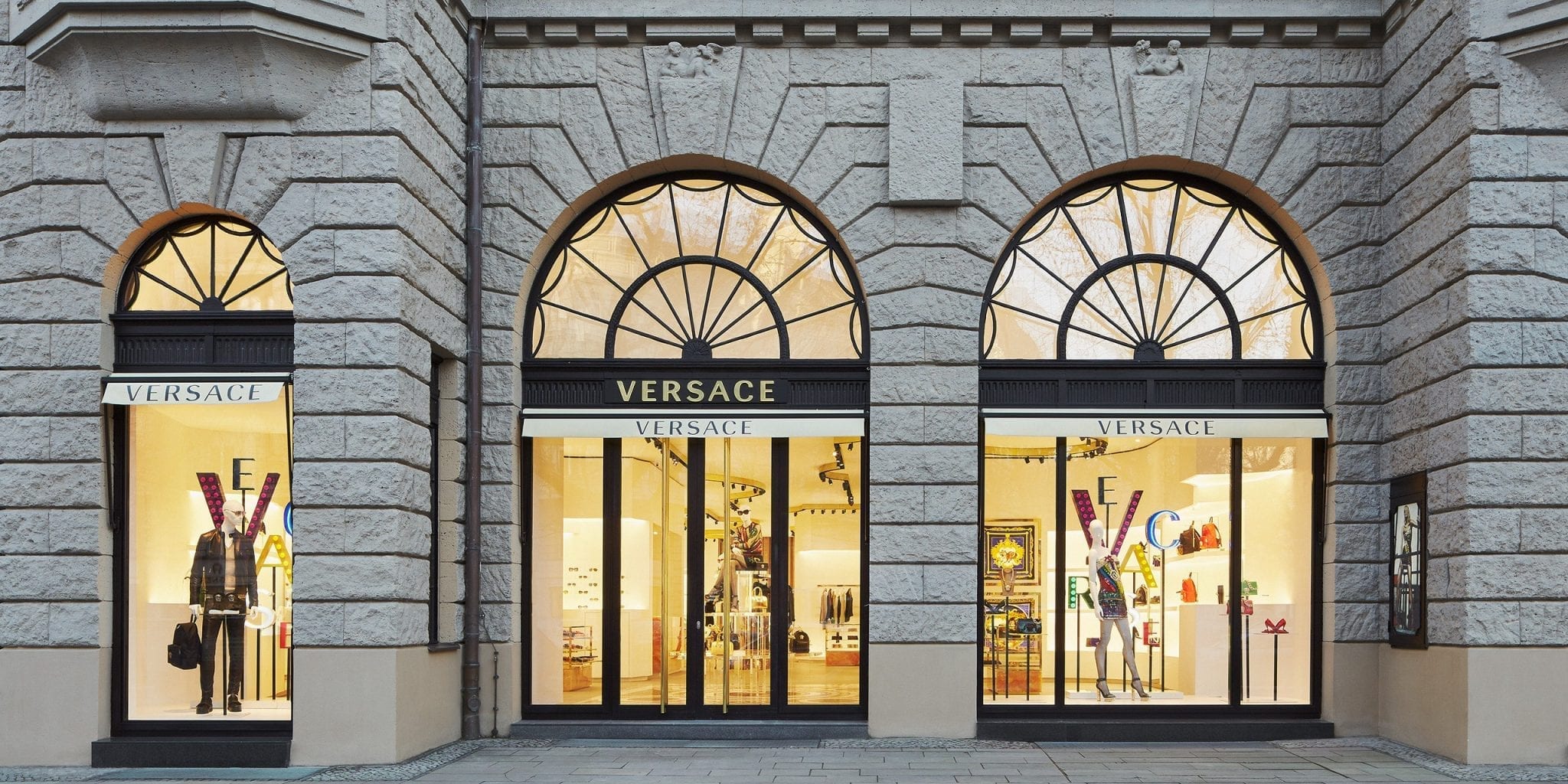
    Versace Hong Kong has opened a flagship store in the Shanghai Commercial Bank Tower in Central.

    Covering about 743 sqm, it features men’s and women’s ready-to-wear and accessories. It joins standalone stores for the Italian fashion house at Gateway Arcade, MixC Mall, Pacific Place and Sogo Causeway Bay.

    versace-hong-kong-shanghai-commercial-bank-central-2

    The flagship incorporates traditional Italian architectural values with modern touches. Architectural elements include Fior di Bosco marble flooring and brass features, while the facade features backlit onyx.

    versace-hong-kong-shanghai-commercial-bank-central-1

    “For me, the boutique suggests an uninterrupted dialogue between our past and our future, between Versace and our clients,” says Versace Group VP and chief designer Donatella Versace.

    To celebrate, Versace has designed a limited-edition mini Palazzo Empire handbag especially for the store. It is embellished with silver Swarovski crystals and includes a detachable leather shoulder strap and a palladium Medusa head, the symbol of Versace. There is also a metallic tag inscribed “The Palazzo Empire celebrating Hong Kong”.

    versace

    Also at the boutique is a limited number of medium and large Palazzo Empire handbags in exotic skins in various colours. These handbags include a removable interior metallic tag reading “Versace for Shanghai Commercial Bank Tower, Hong Kong”.

  • Ethiopian cargo terminal set for operation by April ‘17

    Ethiopian cargo terminal set for operation by April ‘17

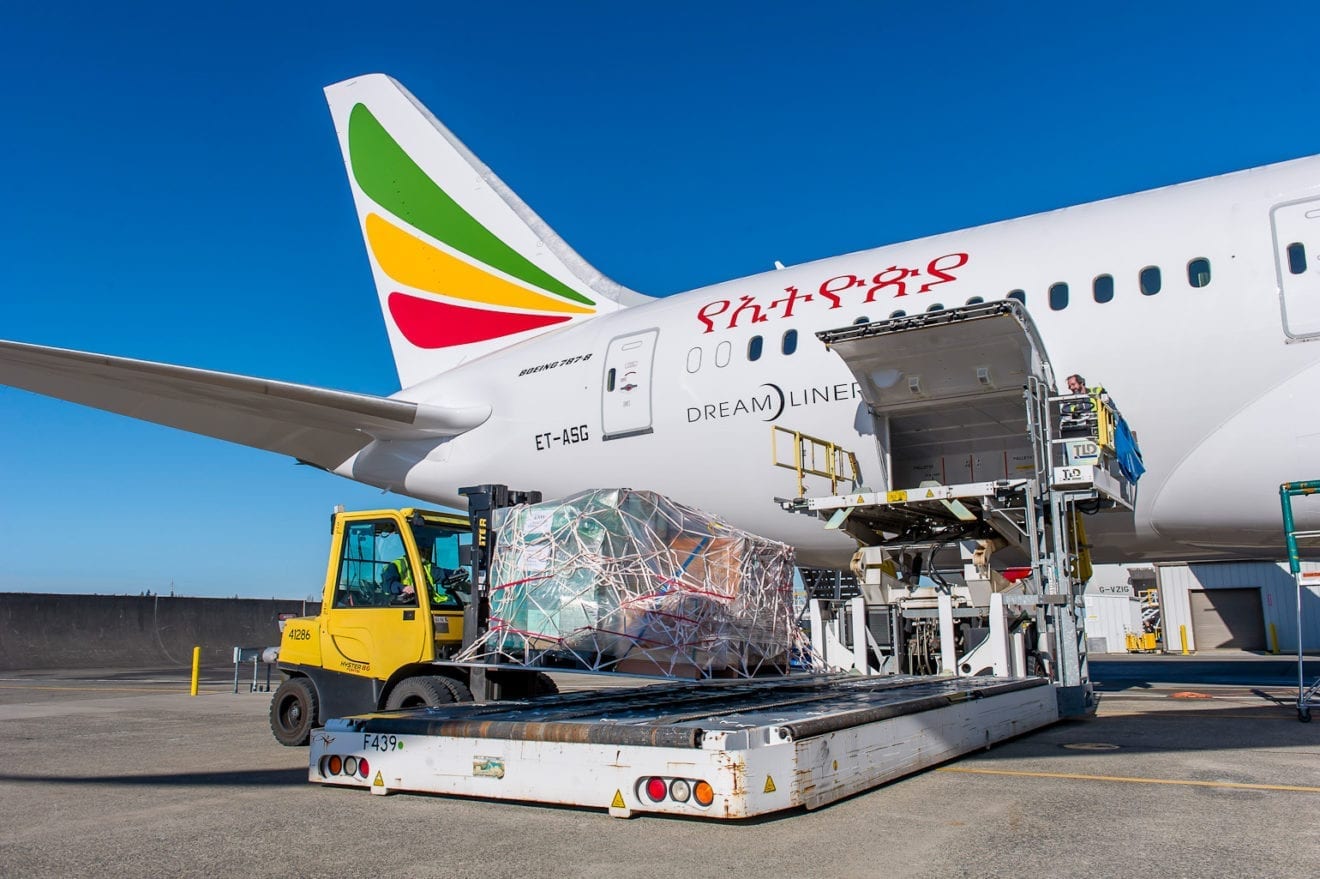
    Ethiopian Airlines Cargo Terminal, which is under construction currently, has reached 82 per cent completion and it is scheduled to be operation by April 2017, the African carrier said. The first phase of the Addis Ababa terminal cost around US$150 million.

    The terminal will have an capacity of 1.2 million tonnes of cargo including facilities for perishable goods. The facility can also handle up to eight B747-400 freighters at one time. Commenting on the the new facility, Ethiopian Airlines Group CEO Tewolde Gebremariam said: “Upon completion, our uplifting capability will be equivalent to the cargo terminals at Amsterdam Schiphol, Singapore Changi or Hong Kong.”

    The new cargo terminal is part of Ethiopian Cargo’s Vision 2025, aimed to support the country’s export of perishables including flowers, fruits, vegetables and meat. That plan includes expansion of its freighter network to eighteen aircraft serving 37 international cargo destinations by 2025.

    “At Ethiopian, we are very proud of the new heights Ethiopian has flown in the year,” Gebremariam said. “We celebrated our 70th anniversary, inaugurated the largest and the finest Aviation Academy in Africa and a state-of-the-art In-flight Catering facility which is the largest in the continent of Africa, introduced Africa’s first Ethiopian Airbus A350, and spread our wings to more countries on five continents”.

    Ethiopian has also constructed a flight simulator building and installed five of the latest full flight simulators, which includes Boeing 787, 777, 757, 767, 737NG and the Bombardier Q400. It plans to add simulators for the Airbus A350 XWB and Boeing 737 MAX aircraft.

  • Online marketing essential for enterprises in digital era

    Online marketing essential for enterprises in digital era

    Despite a large number of Internet users, investment for online advertisement in Việt Nam remains modest, a conference heard on Thursday.

    The Institute for Brand and Competitiveness strategy co-ordinated with the Việt Nam Internet Association and Việt Nam Digital Communication Association to organise a conference on building enterprise branding in the digital era in Hà Nội.

    Over the past decade, the Internet boom has had a significant impact on marketing activities, as well as the building and positioning of brands in the market.

    Internet has also created stronger brand awareness than ever before and increased the number of people who know brands. According to the Institute for Brand and Competitiveness strategy, Việt Nam ranks 16th among the top 20 countries with the highest number of Internet users, with nearly 50 million people, of which, 60 per cent are young.

    The Internet has become a popular source of advertising to users who want to search for product information. Seventy-three per cent of Vietnamese consumers seek out information on the Internet before making purchase decisions.

    Most consumers in Việt Nam choose products and services based on brand identities.

    Therefore, experts advised businesses to make changes to their business operations, adjusting brand identity to avoid falling behind compared to rivals.

    To build brands in the digital era, businesses need to increase interaction in different environments, including the online environment, said Nguyễn Quốc Thịnh, an advisor for the National Trademark Programme.

    “Businesses should not skip electronic branding, a strong interactive environment with low associated costs,” said Thịnh.

    Enterprises need to rethink the way they build their brands, not just their logos or advertising in the media, he said.

    Currently, the application of the Internet in general, and digital technology in particular, to create and develop brands is still limited.

    Data from Cimigo, a market research firm, showed that investment for online advertising in Việt Nam was only US$15 million in the past year.

    Meanwhile, according to statistics from TNS Media Vietnam, the cost of online advertising accounts for less than 5 per cent of the total advertising costs, while 95 per cent of advertising spending is still through television, newspapers, magazines, even though these forms are more expensive.

    Vũ Xuân Trường from the Institute for Brand and Competitiveness strategy said that many businesses were paying attention to profits and business strategy, while their strategies for branding remained “vague”.

    Therefore, businesses need a better strategy in branding in the digital era. In particular, businesses should focus on social networks due to their widespread use.

    Experts said that businesses need to take advantage of opportunities afforded by the Internet to build their brands. Enterprises also need to increase connections with consumers, while ensuring the quality of goods and services.

  • Axis Bank enters blockchain alliance with Ripple

    Axis Bank enters blockchain alliance with Ripple

    Axis Bank, India’s third largest private sector bank, has entered a collaboration with distributed FinTech company Ripple to offer cross-border payments solution through Blockchain technology.

    Ripple is a blockchain-based financial settlements solution that aims to reduce the time and cost of transactions. Axis is the first bank in India to partner with Ripple.

    The technology can enable instant international money transfers, compared to the 3 – 5 day norm for international remittances, and improve efficiency of payments for Axis Bank through instant and automated reconciliation with partner banks.

    “We are committed to using innovation in technology to make banking simple and convenient for our customers,” said V Srinivasan, Deputy Managing Director, Axis Bank.

    “Remittances have been a key strategic area for us, we at Axis are excited with the tie-up and the potential that the use of Blockchain technology could deliver in enabling real-time affordable money transfers.”

    “Given its status as the fastest-growing major economy in the world and the top market for remittances, India is a very important market that is ripe for payments innovation,” said Brad Garlinghouse, CEO of Ripple. “As an early adopter of Ripple, Axis Bank will set a new standard for cross-border payments services and help us continue to grow our global network in a key region of the world.”

  • As Vietnamese banks digitise, customer service key

    As Vietnamese banks digitise, customer service key

    Customers must be at the centre of banks’ attention as they make a move towards digital transformation in an effort to adapt to a changing landscape of financial innovation and disruptive technologies.

    This was said by head of Retail Banking at VP Bank, Sandeep Deobhakta, at a conference held in Hà Nội on Thursday, titled, ‘The Future of Finance in Việt Nam 2017.’

    Deobhakta, who has been holding this position since May 2015, said customers in Việt Nam are very open to new technologies and the nascent retail banking industry in Việt Nam can also adopt these technologies faster than other markets if they put customers first.

    In the future, traditional banks might lose business to companies that employ disruptive innovations if they failed to deliver better, simpler and faster solutions to customers, Deobhakta cautioned.

    VP Bank has been working with Timo, Việt Nam’s first mobile-only bank, giving customers better solutions to manage their money, bills and the ability to top up their mobile cards through the Timo app. At Timo Hangouts, one can forget about a typical bank branch and instead enjoy a coffee as one opens an account and uses bank services.

    Timo has about 4,000 customers in the HCM City and opened a Timo Hangout in Hà Nội last October, looking to attract more than 100,000 users by next year.

    Việt Nam has a huge untapped market for financial innovation, with only 20 per cent of the population having bank accounts and 3 per cent owning credit cards, Foo Boon Ping, managing editor of The Asian Banker, said at the conference.

    “The stable GDP growth of around 6 to 7 per cent, low wages, a large population with a high savings and strong innovative approach are crucial factors that will accelerate the financial and industrial development in the Vietnamese market,” he said.

    “Digital transformation is driven by real business needs to transform to become more cost efficient and to serve your customers as their behavior and preferences change,” he added.

    There are only about 36 fin-tech companies in Việt Nam, with most focusing on providing consumers and merchants with online and digital payment solutions.

  • Time spent on social, messaging apps grew fourfold in 2016

    Time spent on social, messaging apps grew fourfold in 2016

    Yahoo’s Flurry this week released its annual State of Mobile report, which found that social and daily habits apps dominated time spent on mobile apps in 2016.

    Specifically, the study found that the time spent in social and messaging apps grew by four times (394%) over the last year, compared to an average growth of 69% across all tracked segments.

    In its eighth year, the study offers insights on global mobile app usage and trends gleaned from over 2.1 billion smart devices and 3.2 trillion sessions. Phablets continue to dominate with 41% of market share, while small phones now account for just 1% of the market share, said the report.

    “Over the last year, the Flurry footprint grew to track more than 940,000 applications, across 2.1 billion devices, in 3.2 trillion sessions. In this context, we define app usage as a user opening an app and recording what we call a ‘session,’ as well as the amount of time spent in the application.” said Simon Khalaf, a senior VP at Yahoo. “Compared to the year prior, overall app usage grew by 11% and time-spent in apps grew by 69%.

    Khalaf noted that not all app categories grew in tandem in 2016, observing that certain categories of mobile apps have continued growing in terms of session and time-spent at the expense of others.

    For instance, a steep decline in usage is evidenced in the personalization category, which the report attributed to diminishing value for users of these products. Ultimately, the decelerating rate of growth could signal market maturity, saturation or simply the end of the app gold rush.

    “But let us put things in perspective. The gold rush in California ended in 1855. A lot of wealth has been generated since then. We are excited to see what app developers do in the next decade and which industry they chose to disrupt, again,” Khalaf said.