Tag: asia

  • Cybercriminals use insiders to attack telcos

    Cybercriminals use insiders to attack telcos

    Cybercriminals are using insiders to gain access to telecommunications networks and subscriber data, recruiting disaffected employees through underground channels or blackmailing staff using compromising information gathered from open sources.

    This is among the findings of a Kaspersky Lab intelligence report into security threats facing the telecommunications industry.

    Telecommunications providers are a top target for cyber-attacks. They operate and manage the world’s networks, voice and data transmissions and store vast amounts of sensitive data. This makes them highly attractive to cybercriminals in search of financial gain, as well as nation-state sponsored actors launching targeted attacks, and even competitors.

    To achieve their goals, cybercriminals often use insiders as part of their malicious ‘toolset’ to help them breach the perimeter of a telecommunications company and perpetrate their crimes.

    New research by Kaspersky Lab and B2B International reveals that 28% of all cyber-attacks and 38% of targeted attacks now involve malicious activity by insiders. The intelligence report examines popular ways of involving insiders in telecoms-related criminal schemes and gives examples of the things insiders are used for.

    Compromising employees

    According to the Kaspersky Lab researchers, attackers engage or entrap telecoms employees in the following ways:

    • Using publicly available or previously stolen data sources to find compromising information on employees of the company who they intend to hack. They then blackmail targeted individuals – forcing them to hand over their corporate credentials, provide information on internal systems or distribute spear-phishing attacks on their behalf.
    • Recruiting willing insiders through underground message boards or through the services of “black recruiters”. These insiders are paid for their services and can also be asked to identify co-workers who could be engaged through blackmail.

    The blackmailing approach has grown in popularity following online data breaches such as the Ashley Madison leak, as these provide attackers with material they can use to threaten or embarrass individuals. In fact, data-leak related extortion has now become so widespread that the FBI issued a Public Service Announcement on June 1, warning consumers of the risk and its potential impact.

    The insiders most in demand

    According to the Kaspersky Lab researchers, if an attack on a cellular service provider is planned, criminals will seek out employees who can provide fast track access to subscriber and company data or SIM card duplication/illegal reissuing. If the target is an internet service provider, the attackers will try to identify those who can enable network mapping and man-in-the-middle attacks.

    However, insider threats can take all forms. The Kaspersky Lab researchers noted two non-typical examples, one of which involved a rogue telecoms employee leaking 70 million prison inmate calls, many of which breached client-attorney privilege. In another example, an SMS center support engineer was spotted on a popular DarkNet forum advertising their ability to intercept messages containing OTP (One-Time Passwords) for the two-step authentication required to login to customer accounts at a popular fintech company.

    “The human factor is often the weakest link in corporate IT security,” Kaspersky Lab security expert Denis Gorchakov said.

    “Technology alone is rarely enough to completely protect the organization in world where attackers don’t hesitate to exploit insider vulnerability. Companies can start by looking at themselves the way an attacker would. If vacancies carrying your company name or some of your data start appearing on underground message boards, then somebody somewhere has you in their sights. And the sooner you know about it, the better you can prepare.”

  • DJI To Open Flagship Store In Hong Kong

    DJI To Open Flagship Store In Hong Kong

    DJI, the world leader in unmanned aerial vehicle technology, said Monday it will soon open a flagship store in Hong Kong featuring flight cages, experience zones, an aerial photo gallery, technical support center and DJI’s full range of consumer and professional products.

    Located at the center of Hong Kong’s busiest shopping district in Causeway Bay, the three-story, 10,000+ square-feet store will open at the end of September 2016. In keeping with the scintillating Hong Kong skyline, the building will display animated DJI logos and drone silhouettes to add to the Victoria Harbor evening backdrop.

    More than just a retail outlet, the Hong Kong flagship store will provide a location where the worldwide community can connect to share their experience of flight and explore the latest UAV products and aerial cameras. The ground floor will have on display DJI’s full range of aerial and handheld products, while the SkyPixel Gallery on the first floor will showcase breathtaking examples of aerial photography from around the world. The second floor will house the technical support center and a dedicated space for workshops, seminars and special events.

    “As interest around our aerial technologies continues to grow, the expansion of our flagship business will provide a  place for people to see, touch and learn about our products first hand,” said Frank Wang, DJI Founder and CEO. “Discovery is an important part of the learning process and when people understand how easy it is to use the technology, they will find ways to incorporate it into their lives or for their businesses.”

    The Hong Kong flagship store is DJI’s third foray into retail after the December 2015 opening of its first flagship store in in Shenzhen, China, followed by the Seoul, Korea flagship in March 2016.

    Hong Kong is an important market for DJI here in Asia and remains a tourist hot spot for people from around the world,” said DJI Hong Kong Regional Manager Sarah Chuang. “The store will provide an opportunity for us to engage consumers from all walks of life, from local photographers to aerial enthusiasts across Asia to travelers visiting Hong Kong looking for the coolest and latest technologies. We want to provide a truly unique DJI experience for anyone who walks into our store.”

    On display and for sale will be DJI’s consumer products, such the Phantom series of drones and the Osmo stabilized 4K handheld camera, as well as professional products, including the Inspire 1 and Matrice series, the Zenmuse Z3, X5R, and XT cameras, and the Ronin handheld three-axis camera gimbal line.

    The Hong Kong Flagship store is located at TOWER 535, Shop G07, 535 Jaffe Road, Causeway Bay, Hong Kong. More details will be announced closer to the grand opening day in late September.

  • SmarTone FY16 profit falls 15%

    SmarTone FY16 profit falls 15%

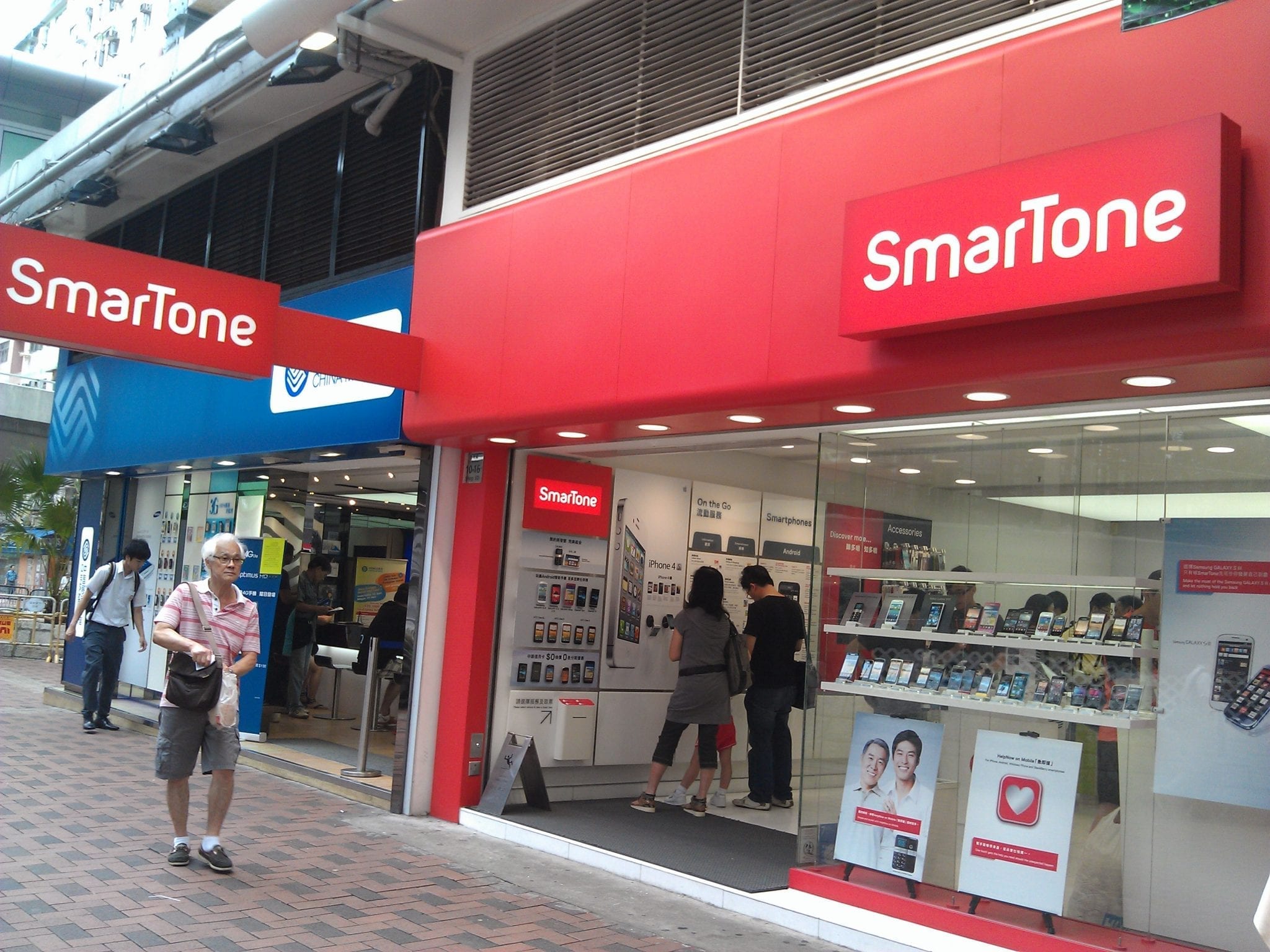
    Hong Kong’s SmarTone has reported a 15% slump in net profit for the financial year ending in June, as the company felt the brunt of the ongoing maturation of the smartphone market.

    Net profit declined to HK$797 million ($102.7 million), as handset earnings crashed 77% back to historical levels due to the impact of this maturation on the smartphone segment.

    Group total revenue fell 2% to HK$18.36 billion, with service revenue also declining 2% due in part to lower roaming and pre-paid revenue.

    But net of handset subsidy amortization service revenue stayed flat at HK$4.79 billion due to underlying growth in the operator’s local postpaid business.

    Hong Kong customer numbers grew 1% to 1.97 million, with postpaid churn remaining unchanged at 0.9%. Mobile postpaid ARPU meanwhile rose 2% to HK$301.

    While SmarTone noted that the Hong Kong telecoms market remains competitive, the operator expressed optimism about its prospects for the current financial year. SmarTone’s financial report notes that the company is “well-placed to capture industry opportunities and bring value to both customers and shareholders in the long term.”

  • Taiwan Eyes More than 200,000 Indonesian Tourists

    Taiwan Eyes More than 200,000 Indonesian Tourists

    Taiwan is eyeing as many as 200,000 tourists from Indonesia to visit Taiwan this year, or an increase from that in 2015, where at around 177,743 Indonesian tourists visiting Taiwan.

    Taiwan Tourism Bureau Director David Tsao said that to meet the target, it has held a tourism exhibition at Grand City Surabaya Mall & Convent on 26 to 30 August, 2016.

    “In 2015, tourists visiting Taiwan reached 10.439 million of them and 177,743 of them are Indonesian tourists,” he said in Surabaya.

    He added that one of the attractions of Taiwan’s tourism is its landscape that is different from the sights in Southeast Asian countries.

    “For example in the northern region of Taiwan precisely on the island of Li, the weather is cooler and you can find snowfall there,” he said.

  • Bahrain-Indonesia trade ties discussed

    Bahrain-Indonesia trade ties discussed

    Bahrain Chamber of Commerce and Industry (BCCI)’s chairman Khalid Almoayed alongside a number of board members and Acting CEO have met the Indonesian ambassador to Bahrain, Chilman Arisman.

    The meeting hailed the deep-rooted relation between the Kingdom of Bahrain and the Republic of Indonesia and discussed the promising sectors and incentives offered to investors.

    Almoayed underlined the importance of reinforcing the exchange of business delegations and holding business events to bridge the knowledge gap between Bahraini and Indonesian business owners and stimulate trade, partnership, and investments.

  • Thousands of foreign tourists come to Enliven Togean Festival

    Thousands of foreign tourists come to Enliven Togean Festival

    Thousands of tourists from Italy, France, Germany, Australia, and South Korea, among other things, were present to enliven the Togean Festival, opened by Central Sulawesi Vice Governor Soedarto in Tojo Unouno district on Saturday.

    Held from Augut 27 to 31, 2016, the Togean Marine Festival aims to promote the natural beauty and unique underwater paradise in Tojo Unouno district, according to Central Sulawesi Culture and Tourism Office Chief Siti Norma Mardjanu.

    “Yes, more than one thousand tourists from various countries are now in Tojo Unauna to enliven the marine festival of Togean Islands charm,” Mardjanu affirmed here on Sunday.

    According to her, all cottages accommodations in Tojo Unauna are fully booked by the foreign tourists, and many of them have to stay at the homes of local government officials.

    To enliven the Togean Marine Festival, the foreign tourists also participates in road race hosted by Tojo Unauna District Head Mohammad Lahay, underwater photo contest, boat race, the tug of war on the boats, cultural attraction, traditional martial arts, swimming and fishing contest.

    Increased tourism promotion in Togean, according to her, will continue to be made through the festival by involving the Ministry of Tourism to maximize the dissemination of information about the charm of the area nationally and internationally.

    “Central Sulawesi provincial government took the central government to participate in promoting the Tojo Unouno tourism through the Togean Marine Festival,” Mardjanu explained.

    Togean Marine Festival is being held to promote the regional tourism in the country and abroad in a bid to boost tourist visits to Togean Islands.

    Indonesia is home to some of the worlds most beautiful aquatic areas including the Togian Islands, where diving is one of the best things the visitors can do.

    “Tropical coral reefs filled with an abundance of marine life can be found in many areas around the island,” she said.

  • Indonesia Port Net to be Launched by Year-End

    Indonesia Port Net to be Launched by Year-End

    President Director of state-owned seaport operator PT Pelindo II Elvyn G. Masassya said the implementation of a single Internet-based electronic service or the Indonesia Port Net (Inaportnet) in Pelindo I to Pelindo IV has entered the finalization stage.

    Inaportnet is expected to improve connectivity of the four enterprises.

    Masasya added the Inaportnet application throughout all seaports managed by PT. Pelindo would be gradually done.

    “Our plan is that the Inaportnet in all the seaports managed by PT. Pelindon will be integrated at the end of 2016,” she said in Jakarta on Saturday.

    The Inaportnet will integrate the information system of ports throughout Indonesia and one of the benefits is to monitor domestic commodity and anticipation of complaints about waiting times for vessels.

  • Jokowi to Open Indonesia Fintech Festival and Conference 2016

    Jokowi to Open Indonesia Fintech Festival and Conference 2016

    President Joko “Jokowi” Widodo is scheduled to open the Indonesia Fintech Festival and Conference 2016 at the Indonesia Convention Exhibition, Tangerang, on 29th August 2016. The event is organized by the Financial Service Authority (OJK) and the Indonesia Chamber of Commerce and Industry (Kadin).

    “President Jokowi will open the event and it will be closed by Queen Maxima of the Netherlands,” said the OJK’s Deputy Commissioners for Non-bank Finance Industry (IKNB) Dumoly F. Pardede on Thursday.

    Dumoly said a startup competition will be held during the event. In addition, an international financial technology conference will also be held. It will also provide assistance to fintech startups. “It will also host meetings between investors.”

    The event is aimed at establishing shared understanding of harmonious development of fintech ecosystem among industrial stakeholders in Indonesia. “There’s a shared commitment among several fintech practitioners to enhancing fintech in Indonesia,” Dumoly explained.

    Dumoly said the festival will be held annually in order to produce the best startups. “It’s a prestigious event, we will create an area of fintech, new trends and cultures in Indonesia,” he said.

    Kadin’s Startup Technology Innovation Department head Patrick Walujo said 72 startups will participate in the festival. “They will exhibit their products. We expect to see more startups next year,” he said.

  • Many foreign banks have not complied with SMEs credit policy

    Many foreign banks have not complied with SMEs credit policy

    Bank Indonesia said many banks mainly branches of foreign banks have not complied with the call for setting aside at least 10 percent of their credits for micro, small and medium enterprises (SMEs) .

    Head of Bank Indonesias division for development of SMEs Yunita Resmi Sari in Jakarta said despite facility such linkage branches of foreign banks are still in difficulty in extending credits for SMEs as asked by the central bank.

    “We are aware that foreign banks have limited networks of branches and their capacity is not for SMEs,” Yunita said here on Thursday.

    In 2015, the central bank asked banks to increase the portion of their credits for SMEs by 5 percentage points a year to 20 percent in 2018.

    Yunita , the central bank is preparing a policy on SMEs credits from foreign bank branches.

    Until August, this year, more than 100 of the 119 banks in the country already set aside 10 percent of their credits for SMEs.

    Yunita said the SMEs credit market is still wide open , pointing out only 22 percent of 57.8 million units of SMEs have access to bank credits.

    SMEs account only 19.7 percent or Rp827.3 trillion of the total outstanding credits of banks in the country by the end of the second quarter of 2016.

    The SMEs credits grew 8.3 percent year-on-year in the second quarter of 2016.

  • Electricity Prices May Decline

    Electricity Prices May Decline

    The National Energy Board (DEN) is asking state power company PLN to review its suggestion to formulate a new formula for the basic prices of electricity. The DEN believes a new price formula will bring benefits to the public.

    “Concept-wise, it is good. But PLN must first hold a price simulation to figure out how positive a new price scheme would be for the public. The tariffs could be a lot cheaper,” DEN member Abadi Purnomo told.

    He said the opportunity to lower electricity prices arrives from the abundant power supply generated by coal-fueled power plans, which accounted for 52.8 percent of the national energy mix last year. The second largest portion is gas energy use with 24.2 percent.

    PLN suggested a new price formula that will include energy mix component in the calculaton. Today’s tariffs calculations only refer to the Indonesian Crude Price (ICP), whereas the use of oil fuel for power-generation has declined from 11.7 percent in 2015 to just 6.7 percent this year.

    Another DEN member Sonny Keraf also supports PLN’s proposal. He asks the government to evaluate the current electricity price formula as a way to develop new renewable energy sources.

    A new, cheaper price electricity scheme will trigger industry growth, Sonny said. Industry players have always complained about Indonesia’s pricy electricity rates that prevent them from competing with other nations.

    PLN’s planning director Nicke Widyawati promised to bring their proposal to the DPR.

    Meanwhile, Acting Energy Minister Luhut Binsar Pandjaitan said his ministry is reviewing the suggestion.

  • eOne’s ‘Peppa Pig’ Gains Momentum in China

    eOne’s ‘Peppa Pig’ Gains Momentum in China

    Entertainment One (eOne) has announced details of Peppa Pig’s rapidly growing popularity in China. Since launching on-air in Mainland China in 2015, eOne’s Peppa Pig has surpassed 5.4 billion views on its three on demand platforms, IQIY, Youku and Tudou. It is one of the most popular programs for pre-schoolers on state television broadcaster CCTV, where its repeat was the No. 1 animated show in its 7am timeslot.

    Peppa Pig also launched on VOD portals Tencent and LeEco in May 2016. To date Peppa episodes have already clocked up 1.7 billion views on Tencent and 850 million views on LeEco, making it the No. 1 animation on both platforms since its launch. In addition, Mango TV has recently acquired the rights to Peppa Pig and the VOD platform debuted the series earlier this month in Mandarin.

    Alongside its growing on-air presence, eOne is also nurturing the property’s digital profile through a range of social, online and interactive content. The brand’s official Peppa WeChat account, available on mobile devices, provides followers with regular news updates, tips, and activities for all the family. Peppa’s WeChat account launched in April 2016 and has already generated thousands of sign-ups.

    The Peppa Pig apps eOne has released to date have had tremendous download rates, making China the biggest territory for Peppa app downloads worldwide. Following their entrance on the App Store in late 2015, Peppa’s Paintbox and Peppa’s Actvitiy Maker have been hugely popular in China, with over 400,000 and 195,000 downloads respectively.

    Peppa’s online presence also extends onto e-commerce platforms as major Chinese online retailers Jing Dong and Tmall have launched a wide range of Peppa merchandise on their popular online shopping sites. Products now available to buy include Peppa’s house playset, vehicles, role-play sets, and plush.

    Toys are spearheading the brand’s licensing program in China and a newly launched Peppa Pig Ferris Wheel playset was sold exclusively at Toys “R” Us stores nationwide during the country’s Children’s Day celebrations in June 2016. The publishing category also continues to accelerate. A new series of Peppa Pig storybooks launched at retail in April 2016 and over 75k copies have been distributed nationally both online and in-store. Peppa Pig products will also have a presence in China’s first Hamleys toy store that is set to open its doors on October 10th. eOne’s Hong Kong team is developing bespoke Peppa artwork for a branded bay in the store.

    “We are thrilled to welcome our new broadcast partners for Peppa in China and we’re confident that these additional consumer touchpoints will significantly increase exposure for the brand as it continues to grow in popularity,” commented Olivier Dumont, Managing Director of eOne Family. “Building Peppa Pig’s digital footprint in the territory, through app downloads and social media channels, enables us to engage with audiences beyond the TV show and create the loyal fan base that is key to its longevity.”


  • Japan Home Centre revenue increases

    Japan Home Centre revenue increases

    Japan Home Centre (Macau) posted an increase of 7.6 per cent revenue year-on-year to HK$39.3 million (MOP40.5 million/US$5.7 million) for its fiscal year ended June 30, according to the annual report released yesterday on the Hong Kong Stock Exchange by the International Houseware Retail Company Limited (IH Retail).

    The comparable store sales growth rate of the stores in Macau is 1.3 per cent, down compared to the 5.9 per cent of the previous fiscal year.

    The total revenue of IH Retail went up to HK$2.04 billion (MOP2.10 billion/US$263 million), indicating a growth of 4.5 per cent year-on-year despite the short-term fluctuation and challenges of the retail market.
    ‘The increase in revenue for the year was mainly due to the opening of new stores and growth in comparable store sales,’ the report noted.

    Eight self-managed stores in Macau are under IH Retail, with 277 stores in Hong Kong.

    IH Retail and its subsidiaries is the largest house ware retail chain in Hong Kong, Singapore and Macau. Stores can also be found in Cambodia, Indonesia, East Malaysia, Saudi Arabia and New Zealand.

  • Toyota to Continue to Invest Big in Indonesia

    Toyota to Continue to Invest Big in Indonesia

    Toyota will continue its major investment plan in Indonesia, particularly in manufacturing, up to Rp20 trillion by 2020.

    PT Toyota Motors Manufacturing Indonesia (TMMIN) deputy president director Warih Andang Tjahjono in Tokyo, Japan, said Sunday, August 28, 2016, that Toyota has made Rp10 trillion investment of its planned investment in Indonesia, as promised by Toyota Motor Corp (TMC) president director Akio Toyota.

    “Major projects have been realized, the third plant has been completed,” he said.

    Since 2013, he went on, Toyota’s production capacity in Indonesia continues to increase, from 110,000 units to currently 25,000 units per day.

    According to Warih, the total TMC investment in the past few years have reached roughly Rp10 trillion, in which the biggest investment had been made to develop the production capacity of Kijang Innova and Fortuner at approximately Rp5 trillion, followed by the production of Sienta at around Rp2.5 trillion, and NR engine production with an investment value of roughly Rp2.3 trillion.

    “Investment will continue, although it would not be as big as the current investment,” Warih said.

  • Airtel to help multinationals enter India

    Airtel to help multinationals enter India

    India’s Bharti Airtel has launched a new suite of end to end networking and connectivity services for global companies looking to set up businesses in the market.

    The new India with Airtel services are aimed at improving the ease of setting up a business in India by offering companies a complete suite of fixed, mobile and added services.

    Besides telephony, India with Airtel combines global and domestic data capacity and connectivity services, VSAT, VPN, data center and cloud cervices, VAS and payment/billing integration, M2M and managed services, among others.

    “Given the impetus from the government’s ‘Make in India’ and ‘Digital India’ initiatives, India is fast becoming a definite strategic market for multinationals across the globe,” Airtel CEO for global voice and data business Ajay Chitkara said.

    “Given Airtel’s integrated product portfolio, we believe that we are uniquely placed to seamlessly serve the connectivity needs of companies looking to set up businesses in India. Also, companies can leverage Airtel’s deep understanding of the Indian market and leverage our vast customers and distribution network.”

    Airtel’s domestic mobile network covers around 95.6% of India’s population, and its global network spans around 225,000 route kilometers of subsea cable capacity, covering 50 countries across 5 continents.

  • Differentiation can make or break Singapore brands as competition heats up

    Differentiation can make or break Singapore brands as competition heats up

    Consumers are hungry for novelty, innovation.

    Tight competition online and a tough operating environment have pushed many offline retailers—especially in the footwear and apparel sub-sectors—to downsize or flee Singapore.

    However, RHB noted in a report that brands that are able to spin unique selling point will weather the sector headwinds well, as consumers continue to be attracted to novelty and differentiated experience.

    “H&M, for instance, has numerous sub-collections each year to refresh its inventories. It also rolls out special collections each year, which are tie-ups with famous brands’ designers or style icons… Uniqlo, on the other hand, is known for its product innovation including HeatTech and AIRism technologies catered specially for cold and warm weather, respectively,” RHB stated.

    Meanwhile, BreadTalk comes out on top in terms of product innovation and willingness to experiment.

    “BreadTalk launched a new bakery concept every four years to maintain a fresh brand image. It also rolled out 50 new products along with its latest concept launch,” RHB noted.

    “Furthermore, the group is also up to date in using technology to engage customers. It is planning to build a new integrated system that allows the public to view its kitchen baking processes on external screens. The new system will also allow consumers to get alerts when new buns are up on the shelves,” it added.