Tag: asia

  • Second Hotel Chocolat opens door

    Second Hotel Chocolat opens door

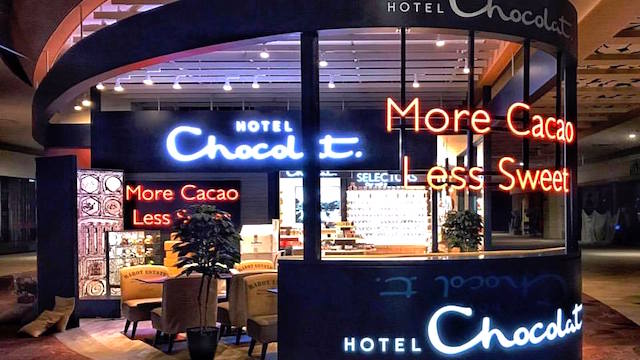
    Hotel Chocolat has opened its second store in Asia Pacific. The British-based luxury chocolate retailer has opened an outlet in Tokyo to follow up its first store in the region, in Hong Kong. The new store is in the giant Aeon Lake Town shopping mall on the outskirts of Tokyo. More are planned for Japan, where there is established demand for luxury confectionery.

    “The reaction to Hotel Chocolat in Japan on our first day of trading last week was hugely encouraging,” said co-founder and CEO of Hotel Chocolat, Angus Thirlwell.

    “Customer engagement, media attention, and sales performance were all well ahead of expectations.
    “Our portfolio of products landed with aplomb. Hot Chocolat drinks, our 8g sculpted chocolate batons, and our Selector range were all in high demand. We look forward to unfolding the brand further here.”

  • Vietnam’s blue chips fall faster than stock market plunge

    Vietnam’s blue chips fall faster than stock market plunge

    As business results fall short of targets, Vietnamese blue chips are falling faster than the stock market’s continued plunge. Vietnam’s benchmark VN-Index dropped 23.5 percent to 917.97 points on Friday from its April peak over 1,200 points. In corresponding comparison, the fall in value of blue chips stocks has been more than twice as high. A share of Vietnam’s leading stone manufacturer Vicostone (VCS) on Friday was worth VND75,000 ($3.2), down 47 percent from its peak on April 4 at VND141,600 ($6.06).

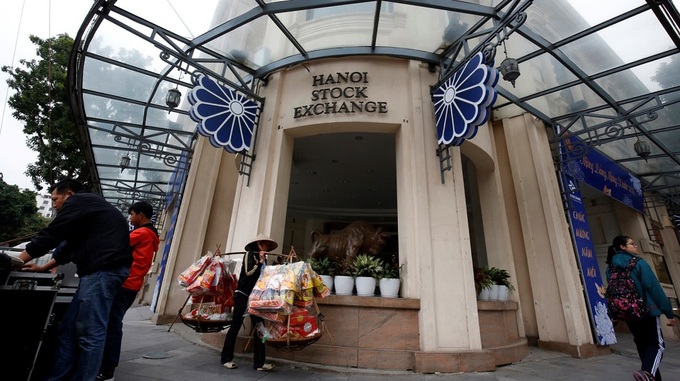
    Analysts at that time called the stock a “phenomenon,” as its value surged 50 times from VND3,000 (13 cents) in mid-2014 on the Hanoi Stock Exchange (HNX).

    Vicostone’s profits also rose over 50 percent a year from 2014 to 2017, while its revenue increased from VND2 trillion ($85.64 million) to VND4.35 trillion ($186.27 million) in the same period.

    But this year, maintaining double-digit growth seems to be a challenge for the company as its revenue has stayed the same year-on-year at VND3.2 trillion ($137 million), while net profit fell 7 percent to VND790 billion ($33.82 million) in the first nine months of this year.

    Although the company has reassured shareholders that business is normal and that Vicostone plans to buy its own shares to stop the falling momentum, investors have been selling their holdings at increasing speeds.

    A similar situation can be seen at the Vietnam Prosperity Joint-Stock Commercial Bank (VPBank). Its stocks on Friday morning closed at VND21,950 (94 cents), dropping 48.7 percent from its peak on April 9 at VND42,826 ($1.83).

    Last year, as it focused specifically on consumer finance, the bank’s stocks was one of the most sought-after when it was listed on the Ho Chi Minh City Stock Exchange (HOSE) in August.

    But its stocks value has been dropping this year because business results are not as expected, analysts say.

    The company gained a consolidated net profit of VND4.9 trillion ($209.82 million) in the first nine months, up nearly 9 percent year-on-year, but only 60 percent of the year’s target.

    Securities firm Viet Capital Securities (VCSC) said in its recent report that the bank is not likely to meet targets set earlier this year. It said its own forecast on VPBank’s profit and stock prices for the year could be revised downwards 15-20 percent.

    Major plastic stocks are also falling in value.

    Binh Minh Plastic (BMP) and Tien Phong Plastic (NTP), the country’s two leading plastic producers, had their stock values plunge 50 percent from their peak last year.

    The two companies recorded high growth from 2010-2016. Binh Minh Plastic’s revenues went up from VND1.4 trillion ($59.95 million) to almost VND3.7 trillion ($158.43 million), with gross margin going up to nearly 30 percent.

    In the same period, Tien Phong Plastics also doubled their revenue and had its gross margin rise to almost 36 percent.

    Both companies were able to achieve this growth thanks to cheap materials and continual expansion.

    But as investors started to lose faith in the potential of the plastic industry and the entrance of foreign companies along with higher material costs, the plastic manufacturers had to reduce their profit margins.

    Last year, Binh Minh Plastic’s gross margin dropped to below 23 percent, while that of Tien Phong Plastic fell to 33 percent.

    Other stocks in the country have also fallen. The HNX-Index on the Hanoi Stock Exchange on Friday closed at 104.271 points, down 24.4 percent from its peak in April.

    The UPCoM-Index for unlisted companies on Friday closed at 51.872 points, 16 percent lower from its peak in March.

  • Korean fashion firm Handsome unveils AI-designed clothes

    Korean fashion firm Handsome unveils AI-designed clothes

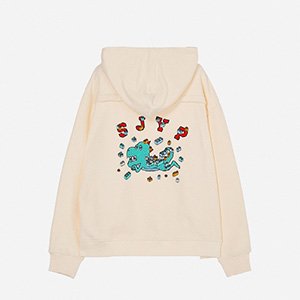
    South Korean fashion label Handsome says it will release the country’s first clothes designed with artificial intelligence technology. Handsome, an affiliate of Hyundai Department Store Group, said it joined forces with Designovel to create new patterns for clothes released under the SJYP brand. Designovel is a startup specialising in AI fashion technology.

    The fashion company said the first product, dubbed Dino Hood Tee, is printed with an image of a dinosaur and toy blocks designed by Designovel’s program, Style AI.

    The graphic was based on 330,000 images, including characters and logos, provided by Handsome.

    Style AI uses a convolutional neural network, which is an image processing technology to modify patterns.

    Handsome said it will review whether the AI technology can be applied in other areas of its fashion business.

  • Taco Bell to open store in Bangkok

    Taco Bell to open store in Bangkok

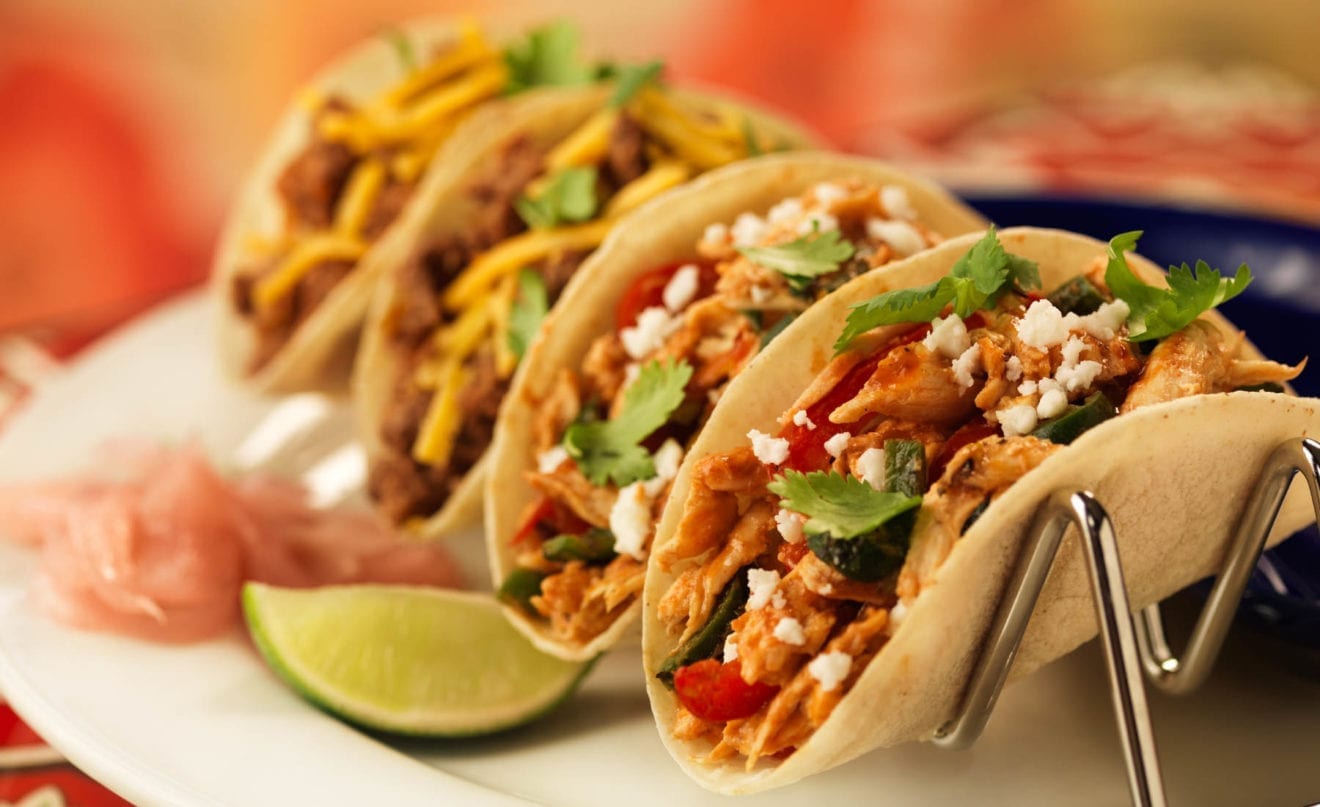
    Taco Bell Thailand is scheduled to launch in Bangkok early next year. Thoresen Thai Agencies, which also holds the Thailand franchise for Taco Bell’s sister brand Pizza Hut, is planning to open the restaurant in Mercury Ville mall on the BTS Chidlom stop. The firm has already begun scouting for employees for the outlet.

    Taco Bell’s International president Liz Williams is leading the franchise on a broad expansion campaign, with progress currently being made in India, Brazil, and Spain among others where the brand has strong franchisees.

    Thoresen Thai’s CEO Chalermchai Mahagitsiri said that Taco Bell Thailand should do well in the territory as “the strong flavours meet the palate of Asian people.”

    Taco Bell’s owner Yum Brands operates around 7000 restaurants worldwide, predominantly based in the US, bringing in US$10 billion sales per year.

  • Atelier Cologne opens first pop-up in Kuala Lumpur airport

    Atelier Cologne opens first pop-up in Kuala Lumpur airport

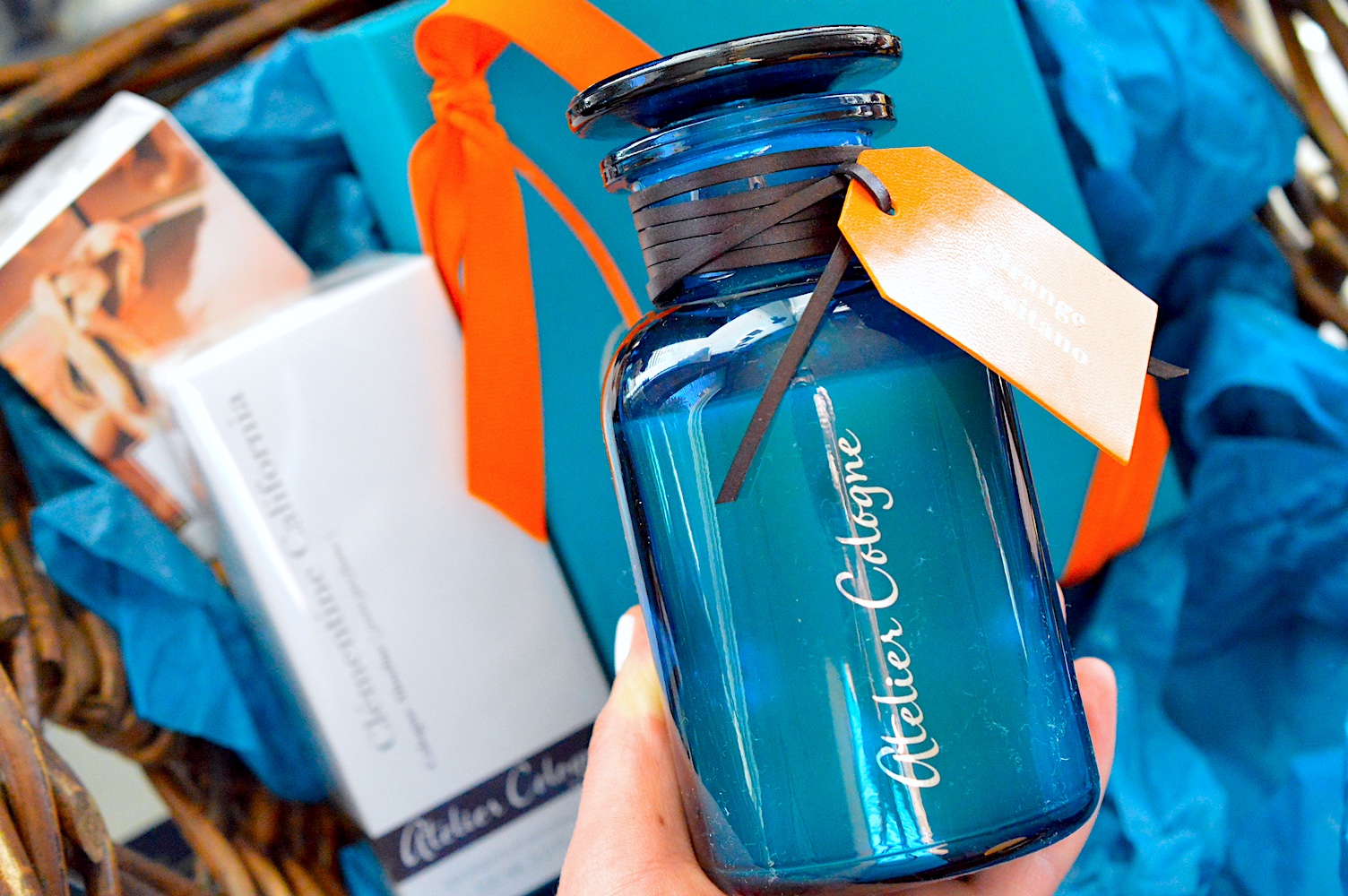
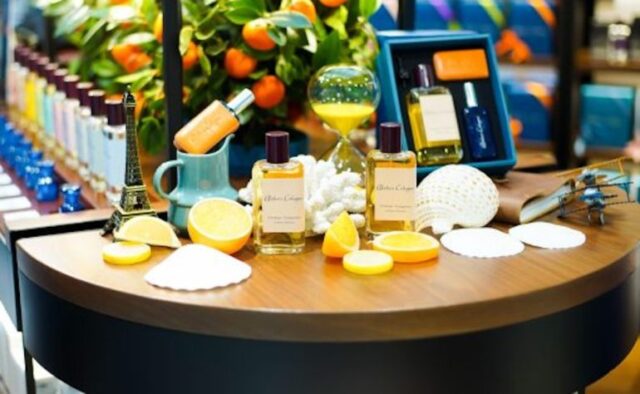
    Atelier Cologne Travel Retail Asia Pacific announced the Southeast Asia airport debut of its pop-up concept at Kuala Lumpur International Airport (KLIA). In collaboration with Malaysia Airports and Colours & Fragrances (C&F) under DR Group, the pop-up is now officially open till end February 2019 for arriving and departing passengers through the Satellite Building at KLIA.

    For the launch of the pop-up, cologners could enjoy a personalised fragrance profiling session to discover their very own scent.

    The background of the pop-up was also dressed up as a Parisian rooftop featuring a skyline of the elegant Paris, cobbled flooring and a rustic swing. This set-up will be available till end of December 2018.

    A gift and engraving workshop is offered to customers, allowing them to personalise the leather case of their perfume bottles with a name, initials or even a message.

    According to Nazli Aziz, Senior General Manager for Commercial Services, Malaysia Airports, the duty-free sales in the Asia Pacific region is growing significantly, largely driven by perfumes and cosmetics with a market value of USD 14 billion in 2017.

    As for KLIA, overall sales per passenger recorded a double-digit growth of 13 per cent in 2017.

  • Korea’s manufacturing and mining shipments up 7 percent

    Korea’s manufacturing and mining shipments up 7 percent

    Korea’s manufacturing and mining industry shipments increased in 2017, mainly due to growth in the electronics, refined petroleum and machinery sectors, a government report showed on Tuesday. Combined shipments by companies in the sectors with more than 10 employees reached 1,516 trillion won ($1.34 trillion), up 7 percent, or 99.7 trillion won, from the year before.

    The increase is attributable to a 14.6 percent year-on-year rise in electronics shipments and a 26.6 percent gain in shipments from local refined petroleum businesses during the one-year period, the agency said. The machinery sector posted a 19 percent year-on-year rise last year.

    Such gains offset losses in the shipbuilding and automaking sectors, it said.

    The report also said that the average shipments for manufacturing companies stood at 21.7 billion won last year, up 6 percent from 2016.

    It said value-added product deliveries by mining and manufacturing companies rose 8.1 percent, or 41 trillion won, in 2017 to over 547.7 trillion won.

    As of the end of 2017, there were 69,790 mining and manufacturing companies in the country employing 2.96 million people. This represents a slight fall from the year before.

  • Esprit revamp to sacrifice staffs, stores

    Esprit revamp to sacrifice staffs, stores

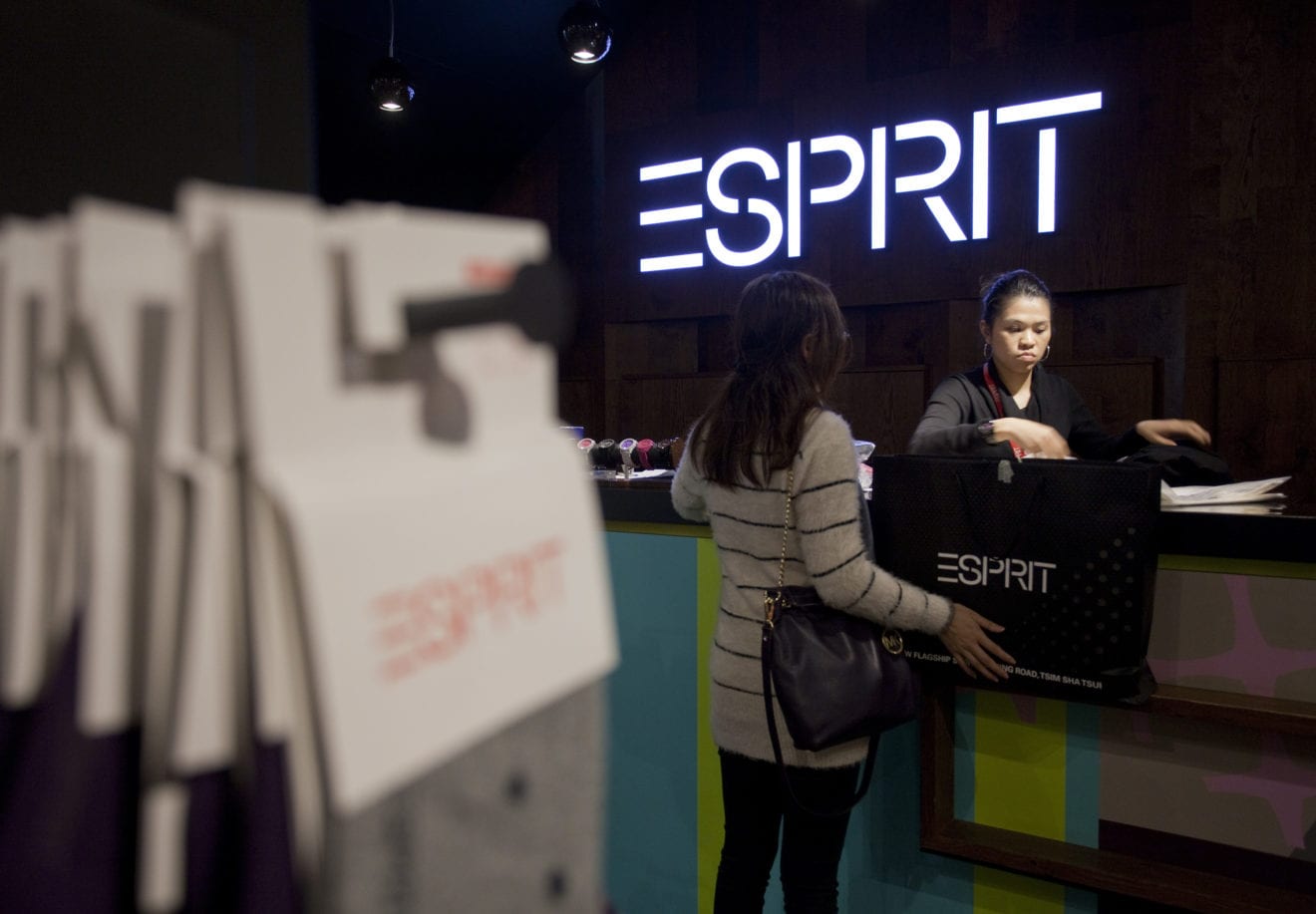
    Esprit plans to axe 40 per cent of its non-store workforce as part of a radical restructure repositioning the brand for future growth. The embattled Hong Kong-listed fashion retailer is set to incur up to US$217 million in one-off charges as it shutters stores, revamps its stock range and embarks on a new marketing campaign, with a heavy accent on social media.

    The bold Esprit revamp plans were laid out in an investor presentation which revealed a new positioning statement for the company. It has trademarked the phrase “radical positivity” but describes it as “a mindset, not a slogan”.

    Senior management has led by example, the executive team already culled from 13 to just six, although the company is recruiting two more: a chief product officer and a CEO for Europe and the Americas.

    Those remaining executives, including Group CEO Anders Kristiansen, executive chairman Raymond Or, head of marketing Simon Heckscher and CEO for Asia Jan Olsen told investors that Esprit plans to eliminate overlapping functions and reduce hierarchy to become more lean and efficient and allow faster decision making. It will merge five offices at headquarters into one and reduce the size of the office in Hong Kong.

    The Esprit revamp will come at a cost with breakeven expected only in two to three years. But the result of running a leaner and more customer-focused business will drive profitable top-line growth in three to five years. The company is targeting an EBIT margin of between 5 per cent and 7 per cent, starting year five.

    In the current year, Esprit forecasts a further decline in sales in the “low double digits” resulting from store closures and a continuing decline in customer traffic. It forecasts a one-off bill of HK$1.5 to 1.7 billion in one-off restructuring costs.

    Next year it anticipates a return to revenue growth. “We have a clear plan with bold changes. We will return to sustainable growth and profitability,” the management team said.

    Store closures

    The current store portfolio is being reviewed to evaluate which will be closed, in a phased approach which has already begun and will continue into next year. The company has already shuttered 18 stores in Asia and another 28 in Europe have been closed, downsized or had their rents renegotiated.

    From mid-next year the company will start opening new outlets, targeting 220 in China by 2023 and another 78 stores in other Asian markets.

    The company wants to reduce personnel costs from 20 per cent of store operating expenses now to between 12 and 14 per cent, and occupancy costs from 37 per cent to between 25 and 27 per cent.

    Online, the company wants to reduce its dependency on Tmall by opening on other marketplaces around Asia and revamping its own e-commerce site.

    Elsewhere in Asia, the company wants to focus on India (where it opened its first brick and mortar store on November 16), Thailand and the Philippines.

    It also plans to revamp its wholesaling business with a new ‘best-in-class’ business model in place by next September.

    New model for the future

    Esprit says it is building “a new model for the future” – a powerful organisation with a restructured cost base and the executive team has delivered a detailed outline of how it will reconnect with customers.

    They were honest about the current state of the business: “Esprit has changed – maybe too much. Our brand identity is inconsistent and we don’t know what we stand for. We’ve lost touch with our audience due to lack of customer focus. Our product, quality and fitting must be improved. Bold changes are needed to return to sustainable growth and profitability.”

    But they said there are positive sides to the story: according to a Brand Health Tracker survey in July, Esprit enjoys 87 per cent brand awareness in Germany, one of its core markets, and it is the third favourite fashion retailer there.

    And they say the brand knows what it stands for. “We are not fast fashion and we are not a discounter.

    We are a brand with a purpose. We will know our consumers by heart, provide clear brand value and strong product proposition and shape a consistent end-to-end consumer experience. We stand for radical positivity, loving our customer and quality, always. This is about more than branding. This is about changing our entire mindset. This is about who we are. .. what we do … how we do it.

    “There will always be a customer base that wants well-designed, good-quality and affordable clothes, that last beyond one season.”

    The Esprit shopping experience

    The company plans to change the Esprit shopping experience online, on app and in store. The online store will be updated and enriched with storytelling and live streaming. It will improve packaging and by the end of this year, promises 90 per cent of EU online orders will be shipped using services which are carbon neutral or commit to reduced emission programs.

    A new store concept launched in August features improved customer service, visual merchandising that elevates the product, and “music that lifts the spirit”. Merchandising will be simple, surprising, fresh and playful and storytelling will employed with signage such as “These jeans will change your life. You won’t have to change.”

    Esprit also plans a heavy focus on Instagram where it currently has 313,000 followers. Social branding will increase featuring real-time content and happenings in the world. The target is to grow followers to 1 million within 18 months.

    Range revamp

    Meanwhile, the company has already started revamping its range, addressing fabric quality, fit and the balance of products.

    It will reduce the number of SKUs, reduce so-called ‘kick colours’ and strengthen neutrals.

    “We looked at sell-through rates and consumer data per colour. Our market survey shows our competitors offer 30-40 per cent black, while Esprit has 15 per cent,” the team explained. So Esprit will strengthen its offer of neutrals like black, white, grey and beige.

    From June next year the number of stock options will be reduced by between 20 and 30 per cent. The company believes having too many items leads to higher development costs and complex stock management, which dilutes the brand message.

    It will change the balance of basic, core and highlight lines from a dominance of highlight to a more even disbursement, as shown below.
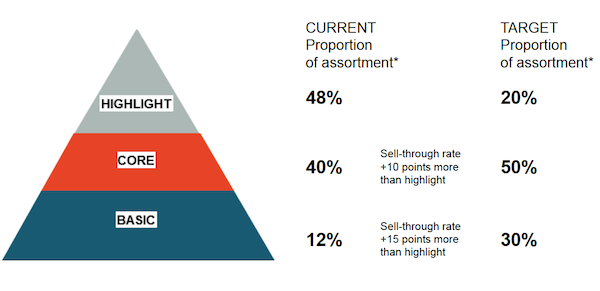
    Esprit management has identified the rise of quality basic brands, body diversity, athleisure, casualisation and conspicuous consumption as among trends shaping the fashion industry and driving consumer preferences. In response, it plans to offer a more commercial assortment of clothing, improve the quality and fit, develop signature product classes and establish “a unique Esprit handwriting”.

    Quality will be enhanced through innovation, functionality, collaboration – such as a winter range featuring 3M insulation – and by looking for opportunities for storytelling online and in stores. The company believes this will boost the sell-through rate to 75 per cent at full price. It will use sustainable denim made from organic cotton and recycled, fibres.

    Pants, t-shirts and sweaters comprise more than 50 per cent of Esprit’s current range and those are the staples it wants to be known for in the future.

    At the heart of the “handwriting” Esprit refers to is a hub of internal designers which has been created to establish guidelines and directions. It will use information gathered from market trends, competitors and data from its Esprit Friends client base to shape future designs and collections. That work is already starting and will influence collections set for release in fall next year.

    China potential

    With plans for more than 220 new stores in China over the next five years, Esprit is mindful of first addressing shortcomings in that market.

    It admits Chinese consumers perceive Esprit as in line with lower-positioned brands and that they find stores tired and uninteresting. It acknowledges it is missing “basic retail operational focus” in China, has a complicated business structure there with too many layers and its sales associate incentive schemes are not aligned with normal market practice.

    Esprit says to recover ground in China it needs to refine the fit of its clothes for Asians, improve quality, adjust deliveries to seasons, improve colour proportions and reduce product options to suit store sizes.

    In future, about 70 per cent of the brand’s mainline international collection will be adapted for Asia with amended fitting and 30 per cent will be designed specifically for Asia.

    The company plans to launch a two-phase strategic marketing approach starting in January. First, discounting will be reduced, but a “deal feel” will remain in stores and staff will be incentivised to push full-price sales. In phase 2, starting September, markdowns will be restricted, targeted discounts will be offered via email and WeChat notifications, and a new marketing campaign launched to attract new customers.
  • First Sony Lounge opens in Malaysia

    First Sony Lounge opens in Malaysia

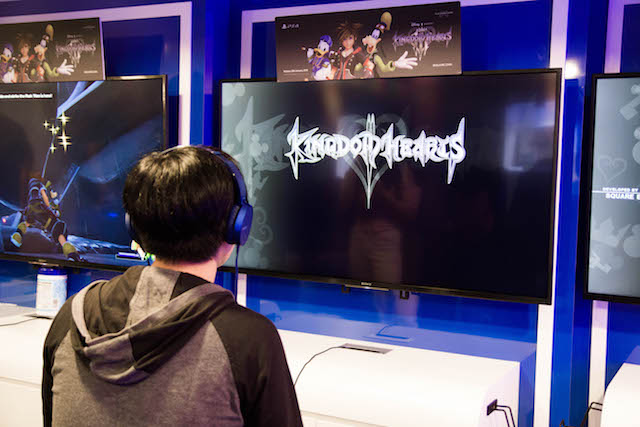
    Sony has opened its first Play Everything Lounge by PlayStation in Southeast Asia at Sunway Pyramid. The lounge, operated by Sony Interactive Entertainment’s local office, will be open until February 17. Sunway Malls and Theme Parks CEO HC Chan said he was honoured the mall has remained a mall-of-choice for experiences. “The partnership with Sony Interactive Entertainment signifies a true collaborative curation by two of the leading names of the industry. It is our privilege to work with a world-renowned gaming giant to bring another dimension of experiences for our shoppers. It is important for malls to go beyond conventions to stay relevant.”

    Sony’s regional head Hidetoshi Takigawa noted the strong performance of the PlayStation business in Malaysia, and said the Sunway Pyramid store is a means for the brand to engage with its local fans.

    Southeast Asia’s first PlayStation Experience was held in Kuala Lumpur last year.

    Gaming tournaments, community engagement activities and unreleased game trials are expected to be held in the space. A virtual reality area allows visitors to try Sony’s PlayStation VR gaming system for PlayStation 4.

    View the image of the lounge below (6 pictures) :

  • Murphy Oil said to be in talks to sell Malaysian oil & gas assets

    Murphy Oil said to be in talks to sell Malaysian oil & gas assets

    Murphy Oil Corporation is in talks to sell its Malaysian oil and gas assets after an unsolicited bid that could fetch between US$2 billion to US$3 billion (RM8.4 billion to RM12.6 billion), people familiar with the matter said, in the latest energy merger and acquisition deal in the Southeast Asian nation.

    The independent US oil and gas exploration and production company has tapped banks for the potential sale of its majority interests in eight separate offshore production sharing contracts in Malaysia, said the people, who declined to be identified because the matter is confidential.

    “Murphy wasn’t considering a sale but was approached by a party that put forward a very compelling bid. They are in negotiations,” said one of the people.

    Murphy, which has been in Malaysia since 1999, could agree on a deal in a couple of weeks, the person said. Others familiar with the matter suggested Spanish oil major Repsol, whose presence in Malaysia is focused on its upstream business, or other global majors could be potential buyers for Murphy’s assets.

    The possible transaction comes as M&A activity is heating up in Malaysia’s oil and gas sector, where international companies pursuing expansion plans are spotting opportunities.

    Repsol and Murphy declined to comment on any potential transaction or talks. There was no response to a query to Malaysian state-owned Petroliam Nasional Bhd (Petronas), which partners Murphy in Malaysia.

    “This is a good, balanced portfolio and offers a smart way for someone looking to grow quickly in the region. Otherwise, it’ll take a decade to start from scratch,” said Alex Siow, upstream oil and gas analyst at energy research firm Wood Mackenzie.

    “The buyer will be buying into an operatorship position with Murphy’s stake, therefore having the know-how and will to be an operator is important,” he said.

    Murphy produced nearly 46,700 barrels of oil equivalent a day in the quarter ended Sept 30 in Malaysia, the company said in response to the query.

  • Taiwan’s boutique Invincible coming to Shanghai

    Taiwan’s boutique Invincible coming to Shanghai

    Taiwanese streetwear boutique Invincible has opened a new store in Shanghai. The opening was marked by a brand collaboration with Japanese label Wacko Maria in the form of a capsule collection, which is on display within an in-store pop-up installation.

    The pop up’s striking-pink print wall and industrial rack set off the store’s otherwise understated design with untreated wood displays.

    The store is located at Soho Fuxing Plaza on Madang Road.

  • Chai Point to open 20 more outlets by FY 2019

    Chai Point to open 20 more outlets by FY 2019

    Tea, which conquers 70 percent of the non-alcoholic beverage market in India, is unofficially the national beverage of the country. Tea lovers never shy away from enjoying a hot cuppa, be it any season or any time of the day. Even the social and emotional lives of Indians are linked with tea. In an effort to brew never-ending excitement around tea, Amuleek Singh Bijral took a plunge into the tea business around eight years ago and since then there has been no looking back.

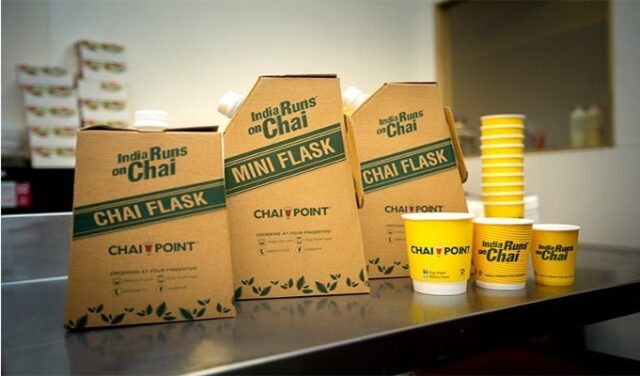
    Talking about the retail mapping of the brand, Bijral says, “We are into an Omnichannel business and have close to 106 stores. Apart from this, we also have about 2,000 plus milk-based dispensers – boxC – installed at corporate houses and our own line of packaged
    products.”

    “Going forward, we want to build a globally relevant tea platform and we are doing this with the help of our cloud-based platform – SHARK, which allows us to manage all our channels in a comprehensive fashion, connects to a common supply chain and allows us to serve customers their various demands and ensures to offer similar customer experience across all the channels,” he states.

    Initial Challenges

    According to Bijral, the initial challenges were to find the prime real estate locations as builders and landlords were not convinced about why such a concept would succeed when tea is available in every nook and corner of the city.

    “However, this notion has now changed over a period of time and the credit goes to customers who have become hygiene conscious and no longer enjoy having their tea on the roadside.”

    Marketing Strategy

    The beverage-centric brand, which gets 25-30 percent contribution towards its revenue from food, has never felt the need to do aggressive ATL spends as stores are their core brand platform.

    According to Bijral, all the brand’s spends are BTL-centric and that is the strategy Chai Point will continue to evolve and adopt.

    “Apart from this, we are very aggressive on digital awareness as our audience is digitally-savvy. We are centred around white-collared corporates and that is an area where our spends can be categorised as ATL and are likely to get more sophisticated and aggressive over time,” he explains.

    Technology Rules

    Bijral, who hails from a technology background, believes technology is an important part of the business. The tea lover has amalgamated technology with tea to provide a frictionless experience to customers.

    Explaining this further, Bijral states, “When customers enter the store, they do not want to stand in the queue, they do not want to punch in numbers to give their loyalty code, they do not want to carry loyalty cards in their wallet, but they want to be served at the earliest possible, so how will the brand solve all these problems? The answer to this problem is facial recognition.”

    “We have successfully piloted facial recognition across five stores and now we are at a stage where we are confident enough of rolling it out across other stores,”says Bijral.

    Even the loyalty program of the brand – PrioriTea – bets big on technology by combining facial recognition with Artificial Intelligence to offer enhanced experience to customers.

    Future Plans

    Singh explains, “ There is an immense opportunity in the tea business. Iced Tea which is a huge market abroad has not even opened up in India.”

    The brand is planning to open 20 more outlets in the next three to four months. As of now, all the outlets are company-owned and company-operated and going further, Chai Point will continue with the same operating model.

    “The brand is still at a relatively nascent stage and we believe that we need to have our own store to cement the system, processes and more importantly aggressively redefine and improve customer experience,” asserts Bijral.

    “Stores remain core to our brand. Delivery and boxC are faster-growing segments, which support the store format,” he adds.

    At present, stores and delivery from stores contribute 56 percent to the total revenue, 4 percent comes from packaged food business and the remaining 40 percent from BoxC business.

    “We have been operating profitable for last six years. We are aiming to be EBITDA level 100 percent profitable by this fiscal-end, covering all the expenses that we have taken towards our Omnichannel growth,” reveals Bijral.

    On a run rate basis, the brand is targeting Rs 200 crore by the end of fiscal.

  • Lanvin creative director departs the company

    Lanvin creative director departs the company

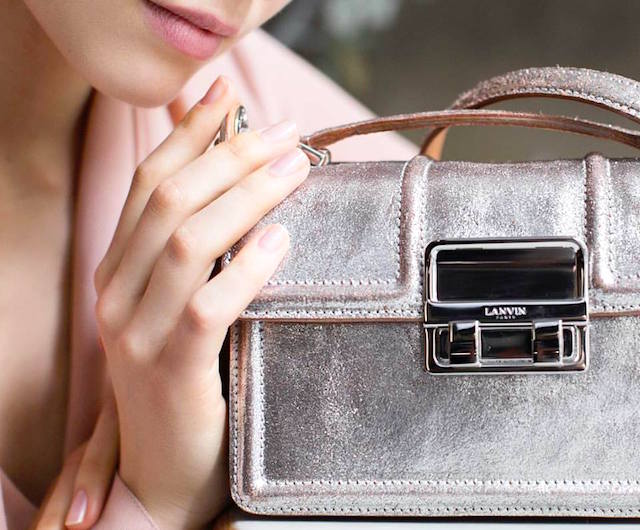
    Lanvin has announced the departure of its menswear creative director, Lucas Ossendrijver, adding to a turbulent few years for the French label. Appointed under the mentorship of former creative director Alber Elbaz, Dutch designer Ossendrijver served as the creative chief of the 129-year-old brand’s menswear department for 14 years.

    Elbaz, creative director of Lanvin’s women’s wear since 2001, left the house in October 2015 after falling out with majority shareholder Shaw-Lan Wang over the direction of the brand.

    In February this year, Wang sold the title to Chinese conglomerate Fosun International.

    French designer Bouchra Jarrar, who was Elbaz’s replacement, left Lanvin after just 16 months before her successor, Olivier Lapidus, stepped down after only eight months.

    Bruno Sialelli, former head of Loewe menswear, is reported to the front runner to replace Ossendrijver.

  • Lush opens Tokyo tech-concept store

    Lush opens Tokyo tech-concept store

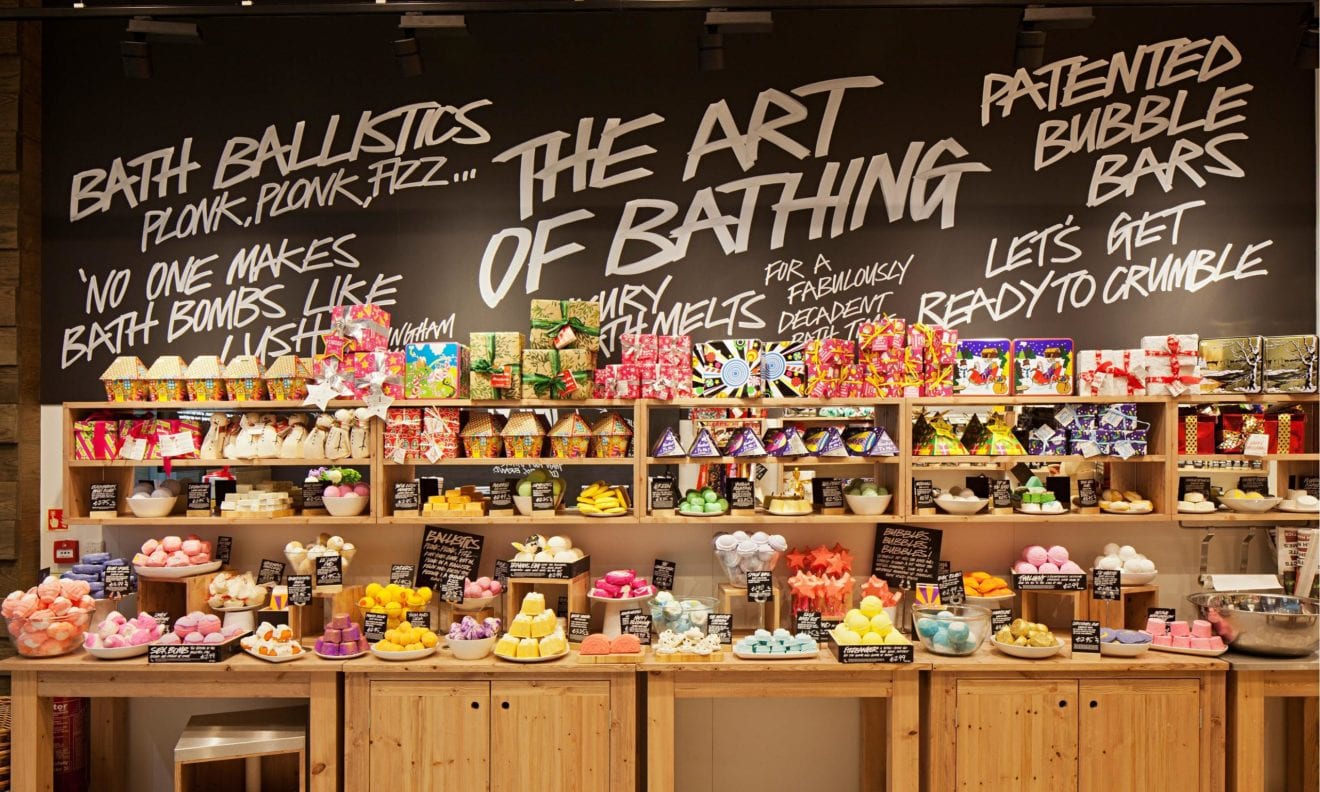
    After opening two concept stores in Milan and Berlin earlier in the year, British cosmetics retailer Lush has opened a third global concept store in Tokyo. While the Italian and German locations opened with a focus on packaging-free cosmetics, the Japanese retail outlet, which kicked off trade on November 22, will specialise in selling Lush’s bath bombs.

    Located in Harajuku, the tech-focused store will promote Lush’s best-selling bath bombs, as well as those new editions, and those known to be seasonal.

    Across two floors, Lush will also add limited-edition bath bombs sold exclusively in the new shop.

    Inspired by Japanese culture, the bath products reflect the style of the district’s Harajuku fashionistas “with their vivid colours and imaginative outfits to mythical creatures such as nine-tailed foxes,” according to a press release from Lush.

    Under the umbrella of Lush Labs, the new Tokyo store will serve as a retail experiment for future Lush stores, by incorporating online and offline retail experiences in the same setting.

    In doing so, consumers will enter a store void of signing and pricing, and even sinks typically used to demonstrate the product.

    Instead, shoppers will be encourage to shop online via the Lush Labs app, and view demonstrations and products digitally, as well as gaining ingredient detail, simply by scanning the naked bath bombs directly from their phone. In this vein, packaging is done away with too.

    “With Lush’s long term commitment to removing packaging from cosmetics, the Lush Lens feature uses the phone’s camera and Artificial Intelligence to support the customer in shopping packaging-free with ease and ensures they get all the important product information they require in a fun and environmentally-conscious way,” said Lush in a statement.

    Lush is increasingly experimenting its online retail in the offline world and will use “community feedback” from the Harajuku store as a source of research and ultimately reason to open more across the globe.

    “Customers are being invited into the R&D process once again, only this time to feedback on the retail experience as a whole, rather than just the product,” concluded Lush.

    “Each comment, reaction and critique sent back will help shape the future of the shop and each area of innovation launching within it.”


  • H&M announces closure of Cheap Monday

    H&M announces closure of Cheap Monday

    H&M is to close its Cheap Monday brand business to refocus on “core activities”. “Cheap Monday has a traditional wholesale business model, which is a model that has faced major challenges due to the shift in the industry,” H&M said in a statement announcing the closure.

    “There has been a negative trend in the Cheap Monday’s sales and profits for a long time.”

    The progressive closure process will start immediately, with the aim of being complete by June 30. The Cheap Monday retail store in London and Cheap Monday’s online store will close on December 31.

    “We need to constantly develop our business and what we choose to invest in,” said Anna Attemark, head of new business at H&M.

    “We see very good opportunities and great potential for all of the other brands within the new business [division], which all are developing positively both digitally as well as through physical stores,” she concluded.

    About 80 employees will be affected, however many are expected to be encouraged to apply for other positions within the group.

    H&M acquired Cheap Monday in 2008 from Swedish apparel company Fabric Scandinavien, a second hand store for high fashion and exclusive denim. The brand was originally founded to offer customers a more affordable denim option for customers and soon grew into a wholesale brand.

  • Amazon in advance stage to buy stake in Future Retail

    Amazon in advance stage to buy stake in Future Retail

    Online retailer Amazon is in advanced stage of talks to buy around 9.5 percent stake in Kishore Biyani-led Future Retail, according to sources. According to a report: A final shape to an agreement between the two parties is expected to take place within the next 10 days, the sources said although in case of last minute hurdles the deal could be announced as late as January 2019.

    When contacted, Amazon declined to comment while messages sent to Future Group Founder and Group CEO Kishore Biyani remained unanswered by the time of filing story.

    According to a media report, the Amazon-Future Group deal is initially estimated to be around Rs 2,000 crore executed under foreign portfolio investor (FPI).

    The agreement could also include Amazon buying out Biyani and promoter group’s entire holding in future subject to applicable regulations in India.

    As of September 2018, promoter and promoter group had 46.51 percent share of Future Retail Ltd, which operates hypermarket and supermarket under brands which include- Big Bazaar, Easyday, Foodhall, HyperCity, FBB, Heritage fresh, ezone and WH Smith.

    It has presence in 250 cities across the country.

    Leading e-commerce major Amazon, which is looking to expand its presence in India, already has stake in Shoppers Stop and More.

    If the deal is through, this would be the third investment by the US-based company in the Indian brick-and-mortar retail ecosystem.

    Last year, retail major Shoppers Stop had announced raising Rs 179.26 crore from Amazon through an issue of equity shares on preferential basis. The deal with Amazon.com Investment Holdings LLC translated into just over 5 per cent shareholding for Amazon in Shoppers Stop.

    In September this year, Amazon said it has co-invested in Witzig Advisory Services, the entity that is acquiring Aditya Birla Retail’s ‘more’ chain of stores in India.

    According to market watchers, this deal is expected to help Amazon strengthen its play in the Indian retail market that is still dominated by offline retailers.

    The move would also intensify competition further between Amazon and Walmart-backed Flipkart that are locked in an intense battle for leadership in the Indian e-commerce market.

    The US’ largest retailer Walmart had picked up 77 percent stake in Flipkart for US$ 16 billion, the largest deal in the Indian e-commerce space so far.

    Both Amazon and Flipkart are pumping in millions of dollars towards building infrastructure, and expanding operations in the country.