Tag: Business

  • LG Electronics supports Ethiopian entrepreneurs

    LG Electronics supports Ethiopian entrepreneurs

    LG Electronics announced on Thursday that it has opened an entrepreneurship center for young people at an existing technical and vocational education center run jointly by LG and the Korea International Cooperation Agency (Koica) in Addis Ababa, Ethiopia.

    The existing job training center, the LG-Koica Hope TVET (Technical and Vocational Education and Training) College, was established in Addis Ababa in 2014 to help Ethiopia achieve economic growth by offering quality education to young Ethiopians and helping them acquire the foundations of financial independence.

    The new center has been named the LG Social Campus Business Incubator Center. It provides graduation candidates of LG-Koica Hope TVET with the opportunity to receive help building a business model and launching their own company. The center will offer office and co-working spaces, as well as training in law, marketing, leadership and business administration.

    “We hope that a socially-recognized company will be born in Ethiopia with the support of the LG Social Campus,” said Yoon Dae-sik, president of the government relations division at LG Electronics.

    “We will keep up with efforts to help Ethiopian youngsters step up their competitive edge and independence.”

    The Korea International Cooperation Agency is a state-run organization devoted to supporting socio-economic development in developing countries.

  • Tommy Hilfiger opens first Indian store

    Tommy Hilfiger opens first Indian store

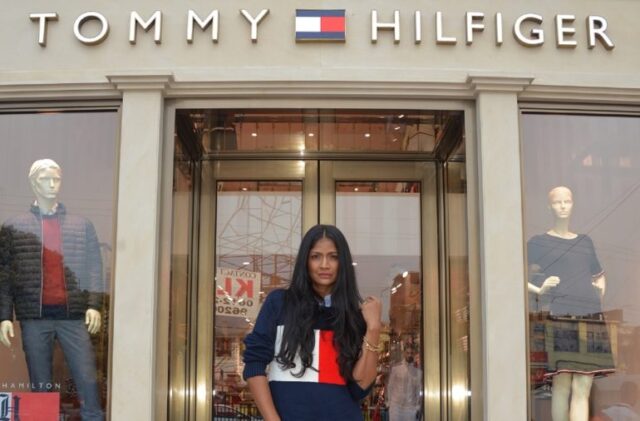
    Last week, Tommy Hilfiger has opened its first exclusive Tommy Hilfiger store in Patna, India. Actress Radhika Apte made the launch of the event wearing the brand’s clothes. “I’m excited to be in Patna to celebrate the opening of the first exclusive TOMMY HILFIGER store in the city,” she said.

    During the event, key influencers such as Ira Dubey, Carol Gracias, Neelaksh Apte, Kanishtha Dhankar and Arya Bhat, and VIPs browsed and shopped the Fall 2018 collections that celebrate American Icons while putting a modern twist on timeless classics to meet the needs of the now.

    Spanning over 125 square meters, the store’s design reflects Tommy Hilfiger’s new global retail concept, which fuses the brand’s American heritage with clean and bright aesthetic.

    The interior takes cue from the nautical lifestyle – one of Tommy Hilfiger’s longstanding sources of inspiration.

    Technology being at the center of retail today, a high-resolution digital screen
    showcases the brand’s latest global campaigns for an immersive brand experience.

  • SK’s Chey says group is committed to U.S. society

    SK’s Chey says group is committed to U.S. society

    The chairman of Korea’s SK Group was in Washington on last Wednesday, vowing to make a commitment not only to the U.S. market but also its people and society. Chey Tae-won, who heads Korea’s third-largest conglomerate by assets, formally opened the Washington office of chipmaker SK Hynix in the presence of dozens of American dignitaries, including former U.S. Secretary of State Colin Powell.

    What was initially meant to be an opening ceremony was expanded under the name “SK Night” to provide a platform for Chey to explain the group’s current operations and investment plans in the United States, group officials said.

    “Past years, every different SK subsidiary … opened up their branches in the East Coast and West Coast, Texas … but they never actually [had] real communication with society,” Chey said in a speech.

    “Well this time, we will be investing in the U.S. about more than $7 billion here and there,” he said, citing as an example the planned construction of an electric vehicle battery plant in Jackson County, Georgia.

    “That’s going to be a $1.6 billion investment, and we’re going to hire right now more than 1,400 people,” he added to applause. “But within five years and if the market allows us, then we can expand [investment to] $5 billion and hire more than 6,000 employees there.”

    The plant is to be built by the group’s energy-chemical business, SK Innovation. On Monday, SK Biopharmaceuticals said it has applied to the U.S. Food and Drug Administration to win approval for sales of a newly-developed epilepsy treatment drug.

    Chey has pushed to expand SK’s presence in North America this year to add to business networks in China, the Middle East and Southeast Asia. During his stay here, he met with American business partners and local subsidiaries to help expand their presence on the continent.

    “[By opening up] the Washington office, I’m trying to show our commitment not only [to the] business side but also social value and commitment to society,” Chey said, adding that the group’s target is to “grow together” with U.S. society.

  • L’Occitane might be an interest for Advent

    L’Occitane might be an interest for Advent

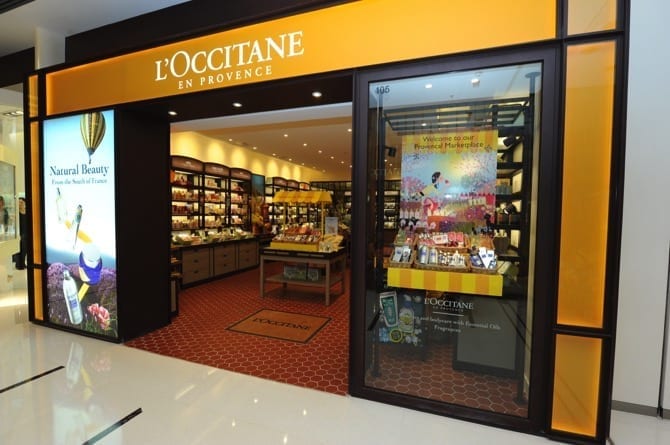
    Hong Kong-listed beauty products retailer L’Occitane may be taken private after at least one expression of interest in the business from a private equity investor. London-based private equity group Advent International has reportedly enquired about acquiring the company, which has an estimated US$2.7 billion market value.

    L’Occitane’s appeal has grown since listing on the HKSE eight years ago in a move to pursue Asian customers. While none of the parties involved have commented, sources close to L’Occitane have confirmed to European business media that “a number of potential buyers” are showing signs of interest.

    L’Occitane is thought to be well-positioned to take advantage of a fast-growing cosmetics and skincare market in the region, brought on by the expansion of the middle class and the Chinese tourism boom.

    L’Occitane’s is chaired by Austrian investor Reinold Geiger, who has overseen its growth internationally to 1555 outlets in 90 countries. The firm is experiencing sales growth in Hong Kong and China, as well as the US.

    It recently unveiled new concept stores in Canada and New York showing its future direction.

  • Vietnam’s blue chips fall faster than stock market plunge

    Vietnam’s blue chips fall faster than stock market plunge

    As business results fall short of targets, Vietnamese blue chips are falling faster than the stock market’s continued plunge. Vietnam’s benchmark VN-Index dropped 23.5 percent to 917.97 points on Friday from its April peak over 1,200 points. In corresponding comparison, the fall in value of blue chips stocks has been more than twice as high. A share of Vietnam’s leading stone manufacturer Vicostone (VCS) on Friday was worth VND75,000 ($3.2), down 47 percent from its peak on April 4 at VND141,600 ($6.06).

    Analysts at that time called the stock a “phenomenon,” as its value surged 50 times from VND3,000 (13 cents) in mid-2014 on the Hanoi Stock Exchange (HNX).

    Vicostone’s profits also rose over 50 percent a year from 2014 to 2017, while its revenue increased from VND2 trillion ($85.64 million) to VND4.35 trillion ($186.27 million) in the same period.

    But this year, maintaining double-digit growth seems to be a challenge for the company as its revenue has stayed the same year-on-year at VND3.2 trillion ($137 million), while net profit fell 7 percent to VND790 billion ($33.82 million) in the first nine months of this year.

    Although the company has reassured shareholders that business is normal and that Vicostone plans to buy its own shares to stop the falling momentum, investors have been selling their holdings at increasing speeds.

    A similar situation can be seen at the Vietnam Prosperity Joint-Stock Commercial Bank (VPBank). Its stocks on Friday morning closed at VND21,950 (94 cents), dropping 48.7 percent from its peak on April 9 at VND42,826 ($1.83).

    Last year, as it focused specifically on consumer finance, the bank’s stocks was one of the most sought-after when it was listed on the Ho Chi Minh City Stock Exchange (HOSE) in August.

    But its stocks value has been dropping this year because business results are not as expected, analysts say.

    The company gained a consolidated net profit of VND4.9 trillion ($209.82 million) in the first nine months, up nearly 9 percent year-on-year, but only 60 percent of the year’s target.

    Securities firm Viet Capital Securities (VCSC) said in its recent report that the bank is not likely to meet targets set earlier this year. It said its own forecast on VPBank’s profit and stock prices for the year could be revised downwards 15-20 percent.

    Major plastic stocks are also falling in value.

    Binh Minh Plastic (BMP) and Tien Phong Plastic (NTP), the country’s two leading plastic producers, had their stock values plunge 50 percent from their peak last year.

    The two companies recorded high growth from 2010-2016. Binh Minh Plastic’s revenues went up from VND1.4 trillion ($59.95 million) to almost VND3.7 trillion ($158.43 million), with gross margin going up to nearly 30 percent.

    In the same period, Tien Phong Plastics also doubled their revenue and had its gross margin rise to almost 36 percent.

    Both companies were able to achieve this growth thanks to cheap materials and continual expansion.

    But as investors started to lose faith in the potential of the plastic industry and the entrance of foreign companies along with higher material costs, the plastic manufacturers had to reduce their profit margins.

    Last year, Binh Minh Plastic’s gross margin dropped to below 23 percent, while that of Tien Phong Plastic fell to 33 percent.

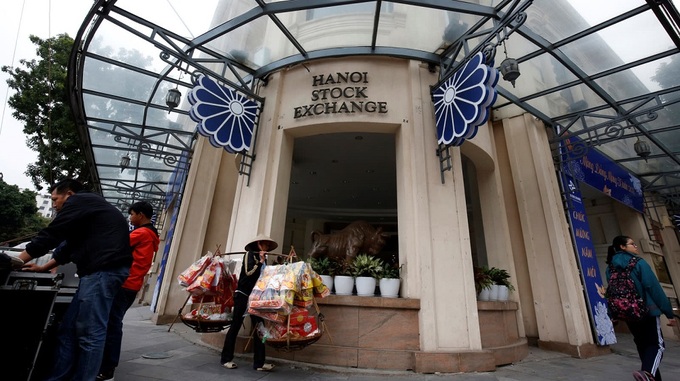
    Other stocks in the country have also fallen. The HNX-Index on the Hanoi Stock Exchange on Friday closed at 104.271 points, down 24.4 percent from its peak in April.

    The UPCoM-Index for unlisted companies on Friday closed at 51.872 points, 16 percent lower from its peak in March.

  • Esprit revamp to sacrifice staffs, stores

    Esprit revamp to sacrifice staffs, stores

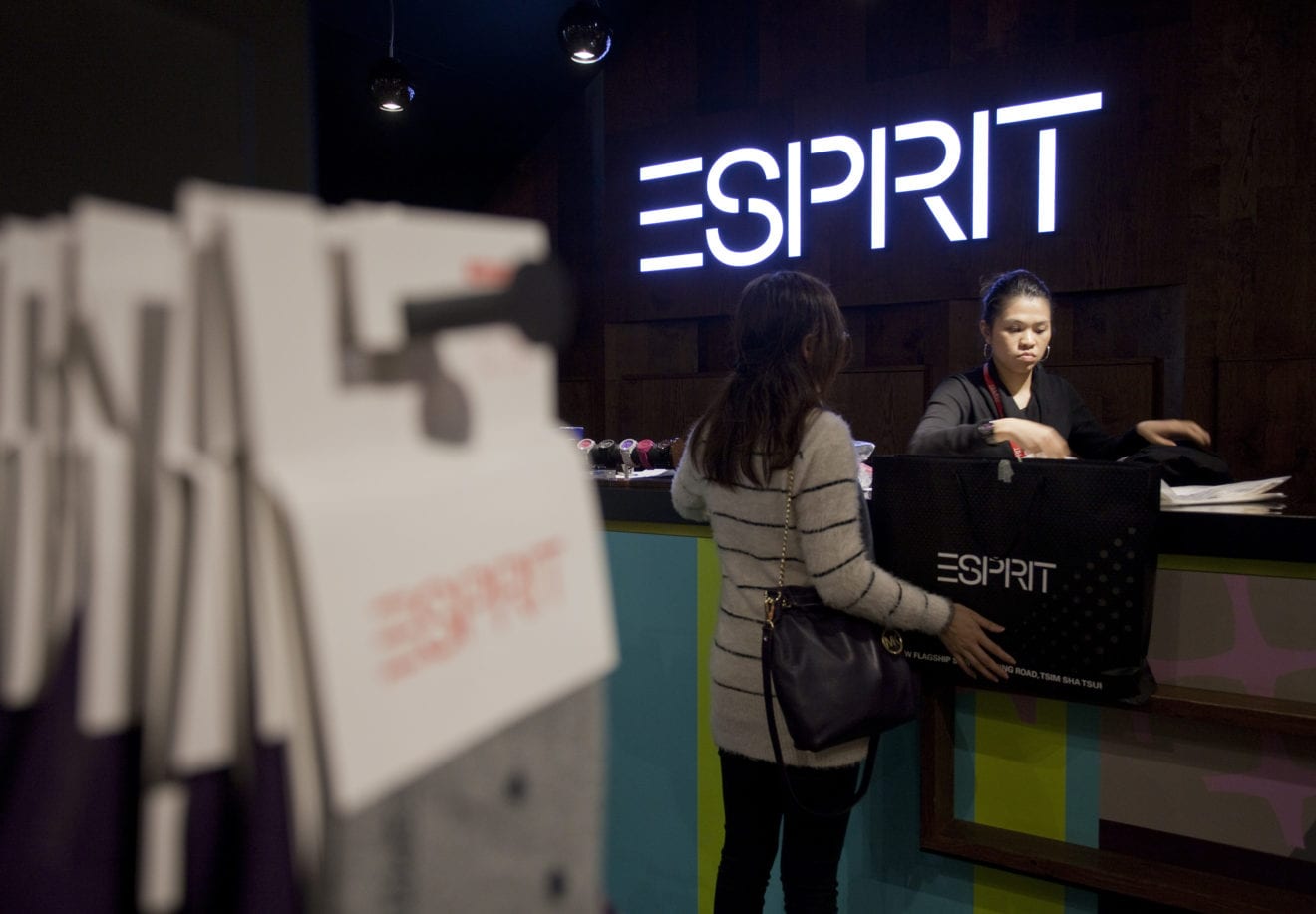
    Esprit plans to axe 40 per cent of its non-store workforce as part of a radical restructure repositioning the brand for future growth. The embattled Hong Kong-listed fashion retailer is set to incur up to US$217 million in one-off charges as it shutters stores, revamps its stock range and embarks on a new marketing campaign, with a heavy accent on social media.

    The bold Esprit revamp plans were laid out in an investor presentation which revealed a new positioning statement for the company. It has trademarked the phrase “radical positivity” but describes it as “a mindset, not a slogan”.

    Senior management has led by example, the executive team already culled from 13 to just six, although the company is recruiting two more: a chief product officer and a CEO for Europe and the Americas.

    Those remaining executives, including Group CEO Anders Kristiansen, executive chairman Raymond Or, head of marketing Simon Heckscher and CEO for Asia Jan Olsen told investors that Esprit plans to eliminate overlapping functions and reduce hierarchy to become more lean and efficient and allow faster decision making. It will merge five offices at headquarters into one and reduce the size of the office in Hong Kong.

    The Esprit revamp will come at a cost with breakeven expected only in two to three years. But the result of running a leaner and more customer-focused business will drive profitable top-line growth in three to five years. The company is targeting an EBIT margin of between 5 per cent and 7 per cent, starting year five.

    In the current year, Esprit forecasts a further decline in sales in the “low double digits” resulting from store closures and a continuing decline in customer traffic. It forecasts a one-off bill of HK$1.5 to 1.7 billion in one-off restructuring costs.

    Next year it anticipates a return to revenue growth. “We have a clear plan with bold changes. We will return to sustainable growth and profitability,” the management team said.

    Store closures

    The current store portfolio is being reviewed to evaluate which will be closed, in a phased approach which has already begun and will continue into next year. The company has already shuttered 18 stores in Asia and another 28 in Europe have been closed, downsized or had their rents renegotiated.

    From mid-next year the company will start opening new outlets, targeting 220 in China by 2023 and another 78 stores in other Asian markets.

    The company wants to reduce personnel costs from 20 per cent of store operating expenses now to between 12 and 14 per cent, and occupancy costs from 37 per cent to between 25 and 27 per cent.

    Online, the company wants to reduce its dependency on Tmall by opening on other marketplaces around Asia and revamping its own e-commerce site.

    Elsewhere in Asia, the company wants to focus on India (where it opened its first brick and mortar store on November 16), Thailand and the Philippines.

    It also plans to revamp its wholesaling business with a new ‘best-in-class’ business model in place by next September.

    New model for the future

    Esprit says it is building “a new model for the future” – a powerful organisation with a restructured cost base and the executive team has delivered a detailed outline of how it will reconnect with customers.

    They were honest about the current state of the business: “Esprit has changed – maybe too much. Our brand identity is inconsistent and we don’t know what we stand for. We’ve lost touch with our audience due to lack of customer focus. Our product, quality and fitting must be improved. Bold changes are needed to return to sustainable growth and profitability.”

    But they said there are positive sides to the story: according to a Brand Health Tracker survey in July, Esprit enjoys 87 per cent brand awareness in Germany, one of its core markets, and it is the third favourite fashion retailer there.

    And they say the brand knows what it stands for. “We are not fast fashion and we are not a discounter.

    We are a brand with a purpose. We will know our consumers by heart, provide clear brand value and strong product proposition and shape a consistent end-to-end consumer experience. We stand for radical positivity, loving our customer and quality, always. This is about more than branding. This is about changing our entire mindset. This is about who we are. .. what we do … how we do it.

    “There will always be a customer base that wants well-designed, good-quality and affordable clothes, that last beyond one season.”

    The Esprit shopping experience

    The company plans to change the Esprit shopping experience online, on app and in store. The online store will be updated and enriched with storytelling and live streaming. It will improve packaging and by the end of this year, promises 90 per cent of EU online orders will be shipped using services which are carbon neutral or commit to reduced emission programs.

    A new store concept launched in August features improved customer service, visual merchandising that elevates the product, and “music that lifts the spirit”. Merchandising will be simple, surprising, fresh and playful and storytelling will employed with signage such as “These jeans will change your life. You won’t have to change.”

    Esprit also plans a heavy focus on Instagram where it currently has 313,000 followers. Social branding will increase featuring real-time content and happenings in the world. The target is to grow followers to 1 million within 18 months.

    Range revamp

    Meanwhile, the company has already started revamping its range, addressing fabric quality, fit and the balance of products.

    It will reduce the number of SKUs, reduce so-called ‘kick colours’ and strengthen neutrals.

    “We looked at sell-through rates and consumer data per colour. Our market survey shows our competitors offer 30-40 per cent black, while Esprit has 15 per cent,” the team explained. So Esprit will strengthen its offer of neutrals like black, white, grey and beige.

    From June next year the number of stock options will be reduced by between 20 and 30 per cent. The company believes having too many items leads to higher development costs and complex stock management, which dilutes the brand message.

    It will change the balance of basic, core and highlight lines from a dominance of highlight to a more even disbursement, as shown below.
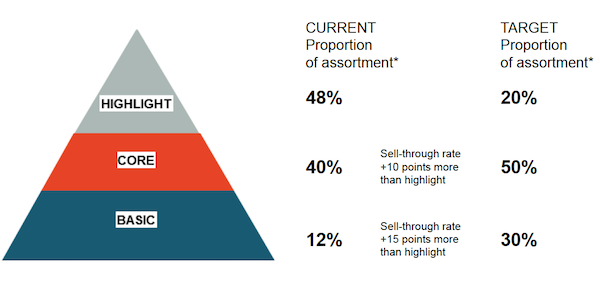
    Esprit management has identified the rise of quality basic brands, body diversity, athleisure, casualisation and conspicuous consumption as among trends shaping the fashion industry and driving consumer preferences. In response, it plans to offer a more commercial assortment of clothing, improve the quality and fit, develop signature product classes and establish “a unique Esprit handwriting”.

    Quality will be enhanced through innovation, functionality, collaboration – such as a winter range featuring 3M insulation – and by looking for opportunities for storytelling online and in stores. The company believes this will boost the sell-through rate to 75 per cent at full price. It will use sustainable denim made from organic cotton and recycled, fibres.

    Pants, t-shirts and sweaters comprise more than 50 per cent of Esprit’s current range and those are the staples it wants to be known for in the future.

    At the heart of the “handwriting” Esprit refers to is a hub of internal designers which has been created to establish guidelines and directions. It will use information gathered from market trends, competitors and data from its Esprit Friends client base to shape future designs and collections. That work is already starting and will influence collections set for release in fall next year.

    China potential

    With plans for more than 220 new stores in China over the next five years, Esprit is mindful of first addressing shortcomings in that market.

    It admits Chinese consumers perceive Esprit as in line with lower-positioned brands and that they find stores tired and uninteresting. It acknowledges it is missing “basic retail operational focus” in China, has a complicated business structure there with too many layers and its sales associate incentive schemes are not aligned with normal market practice.

    Esprit says to recover ground in China it needs to refine the fit of its clothes for Asians, improve quality, adjust deliveries to seasons, improve colour proportions and reduce product options to suit store sizes.

    In future, about 70 per cent of the brand’s mainline international collection will be adapted for Asia with amended fitting and 30 per cent will be designed specifically for Asia.

    The company plans to launch a two-phase strategic marketing approach starting in January. First, discounting will be reduced, but a “deal feel” will remain in stores and staff will be incentivised to push full-price sales. In phase 2, starting September, markdowns will be restricted, targeted discounts will be offered via email and WeChat notifications, and a new marketing campaign launched to attract new customers.
  • Murphy Oil said to be in talks to sell Malaysian oil & gas assets

    Murphy Oil said to be in talks to sell Malaysian oil & gas assets

    Murphy Oil Corporation is in talks to sell its Malaysian oil and gas assets after an unsolicited bid that could fetch between US$2 billion to US$3 billion (RM8.4 billion to RM12.6 billion), people familiar with the matter said, in the latest energy merger and acquisition deal in the Southeast Asian nation.

    The independent US oil and gas exploration and production company has tapped banks for the potential sale of its majority interests in eight separate offshore production sharing contracts in Malaysia, said the people, who declined to be identified because the matter is confidential.

    “Murphy wasn’t considering a sale but was approached by a party that put forward a very compelling bid. They are in negotiations,” said one of the people.

    Murphy, which has been in Malaysia since 1999, could agree on a deal in a couple of weeks, the person said. Others familiar with the matter suggested Spanish oil major Repsol, whose presence in Malaysia is focused on its upstream business, or other global majors could be potential buyers for Murphy’s assets.

    The possible transaction comes as M&A activity is heating up in Malaysia’s oil and gas sector, where international companies pursuing expansion plans are spotting opportunities.

    Repsol and Murphy declined to comment on any potential transaction or talks. There was no response to a query to Malaysian state-owned Petroliam Nasional Bhd (Petronas), which partners Murphy in Malaysia.

    “This is a good, balanced portfolio and offers a smart way for someone looking to grow quickly in the region. Otherwise, it’ll take a decade to start from scratch,” said Alex Siow, upstream oil and gas analyst at energy research firm Wood Mackenzie.

    “The buyer will be buying into an operatorship position with Murphy’s stake, therefore having the know-how and will to be an operator is important,” he said.

    Murphy produced nearly 46,700 barrels of oil equivalent a day in the quarter ended Sept 30 in Malaysia, the company said in response to the query.

  • H&M announces closure of Cheap Monday

    H&M announces closure of Cheap Monday

    H&M is to close its Cheap Monday brand business to refocus on “core activities”. “Cheap Monday has a traditional wholesale business model, which is a model that has faced major challenges due to the shift in the industry,” H&M said in a statement announcing the closure.

    “There has been a negative trend in the Cheap Monday’s sales and profits for a long time.”

    The progressive closure process will start immediately, with the aim of being complete by June 30. The Cheap Monday retail store in London and Cheap Monday’s online store will close on December 31.

    “We need to constantly develop our business and what we choose to invest in,” said Anna Attemark, head of new business at H&M.

    “We see very good opportunities and great potential for all of the other brands within the new business [division], which all are developing positively both digitally as well as through physical stores,” she concluded.

    About 80 employees will be affected, however many are expected to be encouraged to apply for other positions within the group.

    H&M acquired Cheap Monday in 2008 from Swedish apparel company Fabric Scandinavien, a second hand store for high fashion and exclusive denim. The brand was originally founded to offer customers a more affordable denim option for customers and soon grew into a wholesale brand.

  • Amazon in advance stage to buy stake in Future Retail

    Amazon in advance stage to buy stake in Future Retail

    Online retailer Amazon is in advanced stage of talks to buy around 9.5 percent stake in Kishore Biyani-led Future Retail, according to sources. According to a report: A final shape to an agreement between the two parties is expected to take place within the next 10 days, the sources said although in case of last minute hurdles the deal could be announced as late as January 2019.

    When contacted, Amazon declined to comment while messages sent to Future Group Founder and Group CEO Kishore Biyani remained unanswered by the time of filing story.

    According to a media report, the Amazon-Future Group deal is initially estimated to be around Rs 2,000 crore executed under foreign portfolio investor (FPI).

    The agreement could also include Amazon buying out Biyani and promoter group’s entire holding in future subject to applicable regulations in India.

    As of September 2018, promoter and promoter group had 46.51 percent share of Future Retail Ltd, which operates hypermarket and supermarket under brands which include- Big Bazaar, Easyday, Foodhall, HyperCity, FBB, Heritage fresh, ezone and WH Smith.

    It has presence in 250 cities across the country.

    Leading e-commerce major Amazon, which is looking to expand its presence in India, already has stake in Shoppers Stop and More.

    If the deal is through, this would be the third investment by the US-based company in the Indian brick-and-mortar retail ecosystem.

    Last year, retail major Shoppers Stop had announced raising Rs 179.26 crore from Amazon through an issue of equity shares on preferential basis. The deal with Amazon.com Investment Holdings LLC translated into just over 5 per cent shareholding for Amazon in Shoppers Stop.

    In September this year, Amazon said it has co-invested in Witzig Advisory Services, the entity that is acquiring Aditya Birla Retail’s ‘more’ chain of stores in India.

    According to market watchers, this deal is expected to help Amazon strengthen its play in the Indian retail market that is still dominated by offline retailers.

    The move would also intensify competition further between Amazon and Walmart-backed Flipkart that are locked in an intense battle for leadership in the Indian e-commerce market.

    The US’ largest retailer Walmart had picked up 77 percent stake in Flipkart for US$ 16 billion, the largest deal in the Indian e-commerce space so far.

    Both Amazon and Flipkart are pumping in millions of dollars towards building infrastructure, and expanding operations in the country.

  • Plum food delivery to cut entire staff

    Plum food delivery to cut entire staff

    Food delivery startup Plum has laid off its entire staff, casting doubt on its continued operations in Singapore and its home market of Hong Kong. According to a report, Plum co-founder Desmond Clinton Cheung, who is also the company’s GM, said full-time contracts for all 110 workers, including his own, had been terminated. The company is creating a new structure which would give staff who wish to remain with the company an equity ownership.

    “In the past, they were salaried staff and they would become shareholders,” he said.

    Plum was founded in Hong Kong a year ago and Cheung said it may have grown “a bit fast”.

    Efforts to reduce losses, including laying off 40 staff several months ago, had not worked and Cheung said he believed the new company structure offered an opportunity for the company to continue trading on a more sustainable basis.

  • Cover Story to launch accessories line soon

    Cover Story to launch accessories line soon

    Kishore Biyani-led Future Retail launched fast fashion brand Cover Story almost two-and-half years back with an aim to take international brands like Zara and H&M head on. The company then proceeded to set up a design house based out of London to develop cutting edge fast fashion. This design house was dubbed Future Style Lab, a wholly-owned subsidiary of Future Group, which developed and procured styles for Cover Story. And since then there has been no looking back.

    According to Manjula Tiwari, CEO, Future Style Lab, a fantastic growth has been seen for the brand, in terms of its popularity with customers and retailers alike. “Being just a 2.5 year old brand, Cover Story has established itself as a formidable competitor in the fast fashion space to international players. The brand is among one of the very few Indian brands to be present on ground floor locations across the leading malls in India, a great indication of the journey so far.”

    “We place customers in the centre of all that we do. Our product is a blend of latest trends and suitability in the Indian context and that has struck the right chord with our customers,” she adds.

    Target Audience

    The target audience of the fast-fashion brand is the 23 to 40 year old, financially independent woman with a rising disposable income which she loves to splurge on frequent shopping trips.

    “She thrives on social media, is a traveller in spirit and embraces new experiences. She frequently seeks to refresh her wardrobe. Feminine and eclectic, she switches effortlessly between Indian and western wear. Dressing up for her is a form of self-expression. She is modern but rooted,” says Tiwari.

    Store Design

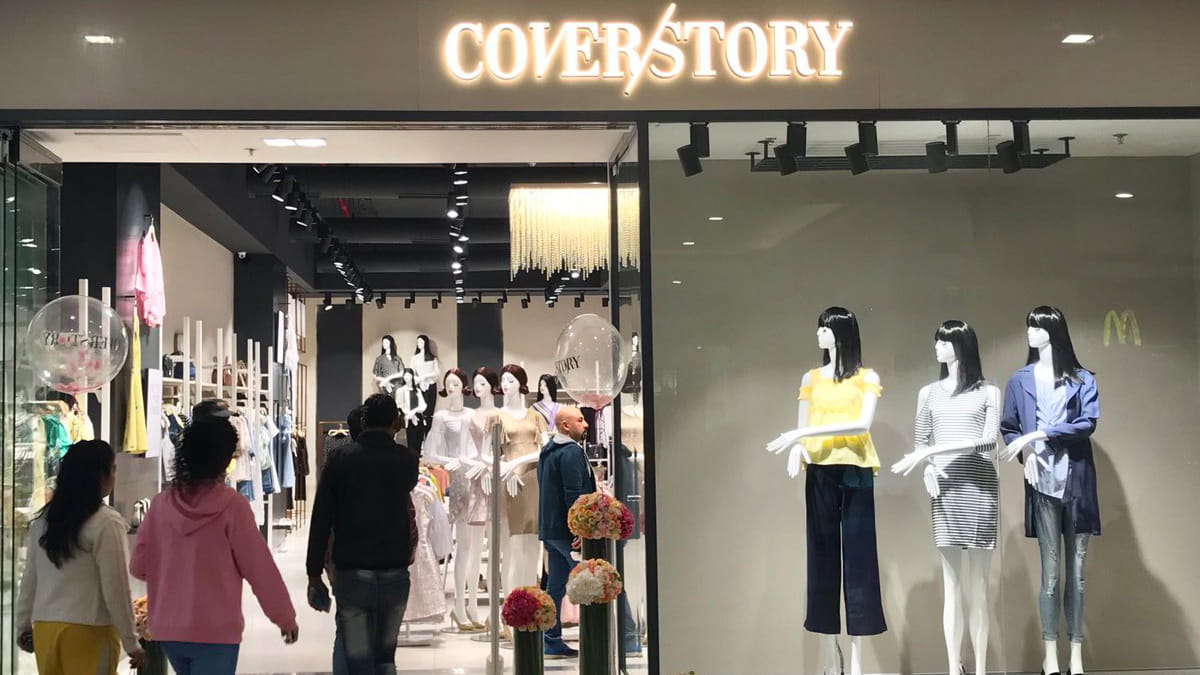
    All Cover Story outlets are designed to recreate the intimate boutique and provide a comfortable shopping experience. The layout is layers of transparency with opacity, which encourages a sense of discovery while shopping.

    “A warm and neutral palette has been chosen for the store as well as all the equipment in it. Colours such as Rose Gold have been opted for, to give the place a feminine touch, to help women identify with the store,” states Tiwari.

    The display panels in the store are designed to look like magazine editorials. Exclusive fashion clusters display merchandise as if they were stories, luring women into reading them.

    Visual merchandising is done by and premium in-store windows are designed by London stylists on the lines of international luxury brands. The cash counter mimics a woman’s vanity bag, while changing rooms have seating for the comfort of waiting friends and family.

    “Customers can browse tablets with fashion content and styling tips. Cover Story’s in-store ‘selfie booths’ are bound to create brand excitement. Consumers can browse through stores and merchandise, share their personal information, and then have their shopping home delivered,” asserts Tiwari.

    Shoppers can even make a request for sizes not currently available at the store. A personal shopper then locates the size from other outlets and delivers it to consumer.

    Product Category

    The brand offers around 450 SKUs per season under the categories like dresses, tops, tees, trousers, skirts, shorts, jackets and sweaters.

    “We also do footwear and bags and are planning to launch a jewellery and accessories line,” reveals Tiwari.

    “Dresses and tops are our fastest moving categories because we provide a wide variety in both categories for all occasions. Also these categories are generally the most sought after categories by women in general,” she adds.

    Marketing Strategy

    The marketing strategy of the brand is a healthy mix of generating brand awareness and driving traffic to the stores to convert to sales.

    According to Tiwari, “We ensure our campaign imagery is of high quality and for that we shoot internationally to bring forth the true image of the brand, being designed in London. Locally, we rely on heavy mall activations and branding to steer the customer to our stores. We also turn to Instagram as a great tool to highlight our fashion authority in the market along with a lot of support from celebs and influencers.”

    “We believe the future of consumer engagement is to get personal – create a connect with the consumer through great experiences. We intend to bring our customers a connect to our London designers with regular events and interaction, and to create constant content around international fashion and style to establish Cover Story as a go to fashion authority for the Indian consumer,” she adds.

    Future Plans

    The brand, which has 23 EBOs, 61 SIS across the country and presence on 5 online channels, will cross 100 doors by the end of this year.

    “We have been more than doubling the turnover every year and same store sales growth has been in the health double digits. Currently online contributes 5 percent to the overall revenue and we see it growing significantly in the times to come,” concludes Tiwari.

  • Luxury footwear label A.Testoni bought by Hong Kongese group Sitoy

    Luxury footwear label A.Testoni bought by Hong Kongese group Sitoy

    Hong Kong leather goods manufacturer Sitoy Group has acquired Italian luxury brand A.Testoni. Sitoy’s investment allows A.Testoni to maintain its brand identity and maximise on its artisanal heritage in a long-term strategy to drive the brand’s ongoing development.

    Sitoy’s chairman Michael Yeung Wah Keung said: “We are very pleased to welcome A.Testoni as a part of the Sitoy Group and work together to realise the full potential of the brand. As we celebrate our 50th anniversary this year, the acquisition marks an important milestone in the transformation of our retail and brand management business into a global dimension.”

    CEO of A.Testoni Bruno Fantechi said the acquisition comes after many years of fruitful partnership in Mainland China, where Sitoy has been a key partner in developing the brand’s distribution.

    “It recognises the inherent value in the brand’s unique levels of quality, craftsmanship and innovation which will drive significant future growth and development.”

  • ‘In startup world, being seen as crazy is normal’: Grab co-founder

    ‘In startup world, being seen as crazy is normal’: Grab co-founder

    Startup entrepreneurs need passion and should take risks and make sacrifices to succeed, says Tan Hooi Ling, co-founder of Grab. She said passion and commitment, not money making, should drive a startup, and that it was okay to be considered crazy. The co-founder of Grab was speaking at the closing ceremony of the 2018 Startup Vietnam contest in Ho Chi Minh City on November 15,

    She traced Grab’s journey to becoming one of the major ride-sharing services in the world. It all started seven years ago when she and co-founder Anthony Tan spoke about deploying a mobile call service. But no one could imagine what the application would be like and some even called the idea crazy.

    The skepticism and protestations did not dissuade the Grab team, which continued to plow ahead on its difficult journey.”When we shared our idea, they raised their eyebrows and asked, ‘What? What exactly do you want to do? How does this work?’”

    One of the big difficulties she and her colleagues faced frequently was finding partners and building a team with a vision and belief in the future of the startup.

    “At first, not many people understood our model, so we had to look around the world for engineers, scientists.”

    Grab is now present in 235 cities in eight Southeast Asian countries. Its application has been downloaded 125 million times, meaning every fourth smartphone user is a Grab user. Its annual revenue now tops a billion dollars.

    “It was the result of a grueling seven-year journey where we tried, failed, and stood up again so many times. This is an experience most startups would encounter.”

    A new idea could be considered crazy today, but make a tremendous impact on the world tomorrow; that is the key to innovation, Tan Hooi Ling said.

    She said another lesson to be learned from Grab is to know how to stop and ask questions whenever there is trouble or a stumble, instead of continuing with the same strategy.

    After each spill, the startup needs to calmly reflect on what has happened, why the failure, what is not going in the right direction, and how to change, she said.

    After drawing lessons, the entrepreneurs must pull themselves up and continue with their journey, she said. But that perseverance should be accompanied by a passion and the courage to take risks and sacrifice time, effort, money, and energy to realize the dream.

    “Do not start a business just because you want to make more money or you will lose a lot before seeing the light. Do it when and only when your heart races every day and when you think you have to achieve it completely and at any cost.”

    “If someone says you are crazy, let it go and move on. In startup world, being seen as crazy is normal.”

  • 8 Easy Startup Ideas For Asia

    8 Easy Startup Ideas For Asia

    We live in the times of so many possibilities. Therefore starting a new business to earn some extra money could be very easy and done very quickly wherever you are – it could even be Asia. People are really into new technologies there at the moment, especially mobile payments through various apps, so you could use the benefits of  this trend for your business idea.

    If you love the idea of making some money on your own, here you’ll find some original ideas you could use for your startup and maybe even start today.

    Specialist Of Education Progress Tracking

    Every parent wants their kid to do well at school and gain the best education possible. That’s why there are so many freelance tutors that help kids and students learn the subjects that they are failing at.

    An education progress tracking will help you reach the best result possible. This is done by tracking the progress of your child and comparing it to other students who are moving up to a similar goal. For example, the same degree in business management or biotechnology. Many criteria need to be evaluated and compared, like grades, honors, certificates, additional skills, and so much more.

    Develop An App For Coworking

    Coworking apps are in demand both for teams in creative and non-creative agencies and also for study groups. Therefore if you are not completely new to coding, you could build an entire network where people could work together on a digital platform. Surely there are already some apps that allow you to share, comment files, and work on projects together, but you can always research your competitors and make an even better product. Simply detect what’s lacking in these apps.

    Print On Demand Business

    Print on demand businesses are getting really popular lately. That is because it doesn’t require any investments and therefore is a perfect startup idea for young people like students. The best part is that you don’t need to be responsible for keeping items in stock, producing it or putting logos on it.

    One of the most popular forms of print on demand business is selling t-shirts. All you’ll need to do is come up with the design. If you want to learn more about how to sell t shirts online – there are POD platforms like Printify that are very easy to use and offer you articles that help improve your business.

    App For Acting

    This could be a similar idea to SnapChat or Instagram Stories, but with a completely different concept. Friends would be able to create short videos with specific timing, for example, 20 seconds. And other friends would have to continue the story. After finishing a story, you could watch it as a single movie clip. To access a group, you should have a special code, link or different kind of key to access. Some groups could be open to everyone thought.

    Job Interviews On Video

    Image credit: Seth Doyle

    Wasting time always means wasting money. Companies and their hiring specialist waste tons of time trying to find the best candidates for one or another job position. It’s hard to imagine, how many time has been wasted on candidates that weren’t a good fit for the company.

    And you could be the one to offer these companies a solution and create a platform with already prepared video interviews. They would be short and very specific – candidates would be asked a few questions and answer it on camera. This could be a really good filter for the hiring specialists.

    Local Social Media Network

    Social media is extremely popular nowadays. But what if you were to create a new platform that would be based only on location? You would be capable of connecting with people, see events and other information related only to the place you are currently in. This would filter out a lot of unnecessary information that we see on our Facebook every day.

    Create An App For Recycling

    Image credit: Paula Brustur

    A lot of people today care about nature and recycling, but really lack knowledge about ecology and how it works. It’s hard to determine what is truly toxic for us and our environment and sometimes we just don’t know how to properly utilize specific products.

    If you were to create a recycling app, it could help people understand recycling more, especially with all the pollution is Asia. For example, if someone would be thinking how to recycle one or another item the right way, they could type the product in your apps search and quickly find an answer.

    Sell Your Own Crafts

    If you have some skills for crafting, you should know that it’s a very trendy thing to do at the moment. Especially things like handmade jewelry and gifts. You could sell your crafts on Etsy, but you can also create your own e-store. All you need is to buy a domain, choose the design and add all needed forms for orders and contacting.

    To save some money, don’t pay the programmers for creating the forms for you, simply use CaptainForm wordpress form plugin that will offer you all the forms your website might need.


  • Appliance rentals prove popular

    Appliance rentals prove popular

    Home appliance companies are building their rental service businesses as the trend is for consumers to value experience more than ownership. With the growing size of the local home appliance rental market, some companies have started management services to take care of rental customers, while others have set up entire rental business subsidiaries.

    On Nov. 17, LG Electronics announced the formation of “Care Solution,” which will manage home appliances for rental customers. While a rental management service existed before, the new offering goes beyond simply providing replacement parts and instead regularly replaces the main components of appliances.

    For rented water purifiers, LG Electronics will exchange filters and water pipes and inspect sensors. For those who rent its Tromm Styler home dry cleaning appliance, the company will replace water container components every two years and periodically provide scented aroma sheets.

    Cuckoo Electronics, known for rice cookers, jumped into the rental market last December when it established its Cuckoo Homesys subsidiary. Last month, the company introduced a new rental brand, “Inspure,” which focuses on water and air purifier products.

    Samsung Electronics has yet to launch a rental business on its own but has partnered with professional rental companies for its home appliance products. It started renting its products through Kyowon Wells last June and also joined hands with Hyundai Rental Care last July.

    Home appliance companies are focusing on the rental business as the market seems to be growing. According to the KT Economics & Management Research Institute, the rental market in Korea is expected to grow past 40 trillion won ($35.49 billion) by 2020 from 25 trillion won in 2016.

    LG Electronics recorded 128.2 billion won in rental-related sales in the first half of this year, more than doubling the 53.8 billion won reported two years ago. Operating profit for Cuckoo Homesys through the third quarter of this year was at 52.8 billion won, a 50 percent increase from the figure over the same period last year.

    With a sluggish job market and slowing economic growth in Korea, consumers are feeling the pinch and valuing experience over ownership. The result is an increase in demand for rental products.

    The rise of premium products, which have been developed by companies to stay competitive in the crowded home appliance market, has also contributed to the rental trend. As such products are expensive, consumers are looking toward rentals.

    For example, a 55-inch LG OLED TV costs 3.6 million won to buy outright, but it can be rented out at 59,900 won per month for 36 months. The price drops further when other discounts are applied, such as those offered by credit cards companies.

    “The need to use good products exists, but with troubling economic times, penny pinching is called for. Consumers are taking an interest in rentals that can meet their needs at a low cost at the moment,” said Jung Yeon-sung, a professor of business at Dankook University.

    The increase in one-person households has also contributed to the rise in rental services as it is difficult for a single person to afford appliances that could cost millions of won. According to government data, there were 5.5 million single-person households in Korea last year, accounting for 28.5 percent of the total number of households. The figure has doubled since 2000, when there were 2.22 million single-person households.

    For companies, the rental business doesn’t bring in big profits immediately, but it provides steady profits.

    “We plan to focus on management instead of just the leasing out products and help customers improve their quality of life,” said Choi Sang-gyu, head of domestic sales at LG Electronics.