Tag: Business

  • Women can make or break Vietnam’s F&B industry

    Women can make or break Vietnam’s F&B industry

    With more women spending more on eating out, they have become linchpins of the F&B industry, a study indicates. A new survey by HCMC-based market research firm Decision Lab finds that female consumers can make or break the food and beverage industry of Vietnam.

    Average visits per capita by female consumers to the out of home food and beverage market has increased by 5 percent during last year, from 121 between the fourth quarter of 2016 and the third quarter last year to 128 between the fourth quarter last year and the third quarter this year.

    Women have also increased spending on almost all major food channels in Vietnam, namely full service restaurants (FSR), or sit down eateries where food is served directly to the customers’ table, and quick service restaurants (QSR), where table service is minimal and the typical fare is fast food, street food, convenience stores, canteens and bars.

    As a result, women’s contribution to the out of home market revenue has increased by a whopping 10 percent.

    Among the women themselves, the 15-34 year-old segment accounts for 82 percent of the visits in the out of home market, and more than half of those by white-collar workers. Students are also seen as the driving force of female visits at 25 percent.

    As such, Decision Lab points out that the growing influence of women on the foodservice market is real and the industry would be well advised to use female-friendly messages to increase the traffic.

    According to market research firm Vietnam Report (VR), Vietnamese spend more than a third of their income on food and beverages, topping education and utilities.

    VR said the food and drink market has become more exciting in recent years with the entry of technologies such as phone apps that allow users to find nearby restaurants and order deliveries.

    Food and beverages were two of the 10 most bought products online last year, it said, citing data from market research company Nielsen.

  • Tomei Malaysia sells skincare, cosmetics distribution business

    Tomei Malaysia sells skincare, cosmetics distribution business

    Tomei Consolidated Bhd’s wholly owned subsidiary Flawless Skin Care Sdn Bhd (FSC) today sold its business of distributing the skincare and cosmetic products of “The history of Whoo” and “belif” as a going concern for RM8.97 million.

    FSC, whose principal activity is retailing of skin care and cosmetic products, this week entered into an asset purchase agreement with LG Household & Health Care Malaysia Sdn Bhd for the exercise.

    LG is a company incorporated in Malaysia with its principal activities in the area of skin care and cosmetic products.

    FSC agrees to sell and LG, relying on the several representations, warranties and undertakings contained in the agreement, agreed to purchase free from all encumbrances the whole of the business as a going concern.

    “The disposal would enable Tomei to utilise its resources and focus on the core businesses of the group in the gold and jewellery business,” it said.

  • Start-up fund to create 11,000 jobs in Korea

    Start-up fund to create 11,000 jobs in Korea

    Local banks have invested an additional 345 billion won ($303.8 million) into start-up support. Based on past results, the latest funding could yield 11,000 jobs, D.Camp said on Wednesday. In 2012, 18 local banks teamed up to create and invest 500 billion won into D.Camp, a non-profit organization that supports early-stage start-ups. They decided to pour another 345 billion won into the non-profit in April.

    A total of 320 billion won of the total is being allocated to a private investment firm, K-Growth, to create a fund specializing in local start-ups. K-Growth will pull in other investors to join the new fund, with the total size targeted at 1.6 trillion won.

    The remaining 25 billion won will be utilized by D.Camp for the running of its co-working space and for the organization of various training and meet-up sessions for start-ups.

    D.Camp analyzed the number of jobs created by start-ups that received investments from the non-profit and K-Growth in the past in order to calculate how many jobs the new investment is likely to create.

    “K-Growth’s fund will produce 10,080 new jobs, while D.Camp’s support can add 960 to that figure, so the total will come to about 11,000” in the next three years, said D.Camp head Kim Hong-il at a press event in southern Seoul.

    D.Camp began investing in and incubating early-stage start-ups in 2015. Among 121 start-ups it invested in, 86.4 percent, or 110 companies, managed to survive and expand from seed stage. This is higher than the local survival rate of 38.2 percent and the Organization for Economic Cooperation and Development’s average of 57.2 percent.

    The enterprise value of the companies increased an average of 282 percent after receiving D.Camp investment. Among the 110 surviving today, 37.3 percent weren’t generating any revenue at the time the non-profit decided to participate.

    Kim said a big factor in keeping D.Camp’s success rate high is its monthly demo day, in which start-ups compete and present their businesses in front of other start-up entrepreneurs and investment managers at D.Camp. For teams with good evaluation results, D.Camp recommends investment and support.

    “D.Camp started out as something more like a social responsibility program, but today, we see it as a long-term investment for the country’s economy,” he said. “Start-ups nowadays offer services and products that even customers didn’t know they needed. That kind of innovation is something large-sized companies can’t do.”

  • Start-ups in Korea challenged by overregulation and lack of exits

    Start-ups in Korea challenged by overregulation and lack of exits

    Park Jong-hwan is a Korean start-up success story. Twenty years ago, he was living in a basement room with a friend. In 2015, he became a legendary figure after selling his Kim Gisa navigation service to Kakao for 62.6 billion won ($56.0 million).

    The co-CEO of Kim Gisa Company, who now also runs co-working space company Work&All and a start-up accelerator, met with JoongAng Ilbo on Nov. 2 to discuss the challenges faced by start-ups in Korea.

    During the interview, he expressed the need for a change in government regulations.

    “It is difficult for a second Kim Gisa to emerge in this regulatory environment,” said Park. “When I meet start-ups these days, they don’t have the confidence to start new things but instead worry about facing legal or social problems.”

    “In an environment that first regards new ideas or businesses as illegal, start-ups lose confidence and creativity,” complained the Kim Gisa Company founder.

    Park has struggled with regulations and a negative attitude towards the industry since his early start-up years. When nominated for an award, it was almost rescinded as his service didn’t provide location services inside buildings. When Kakao tried to implement Kim Gisa’s technology to match rides, it was met with government opposition. The government’s strong stance against the growing carpool and ridesharing industries is an issue that particularly frustrates the start-up pioneer.

    Park, whose father is a veteran taxi driver of 40 years, said he understands the opposition from the taxi industry but explained that the carsharing service provides a better alternative for taxi drivers.

    “If a company-owned taxi driver opts to operate on a car-sharing platform, the driver will pay two to three percent in fees instead of the payment to the taxi company, leading to increased income,” said Park. “If we set aside a partial fee for every service and provide it to the taxi industry, as it is done in Australia, private taxi drivers will be less opposed.”

    “The government should be a mediator in the changing times,” he added. Park also argued that Korea’s business environment, which make start-ups mergers and acquisitions (M&A) difficult, pose as an unseen stumbling block for tech-based start-ups.

    A positive cycle of investment, growth, profit return and reinvestment can only occur when there are numerous success stories of start-up exits. But complex tax-related regulations, difficult conditions for initial public offerings and a negative attitude toward start-up exits all prevent M&A from taking place, said Park.

    “If start-ups grow and are bought out by large corporations, they then fall under new regulations as they are considered an affiliate company of a large corporation, even if they maintain the same workforce and business structure,” explained Park. “M&A can only be undertaken by large corporations with enough cash, but the reality is that it’s difficult because of such regulations.”

    The start-up founder lamented the lack of successful exits since Kim Gisa, “There hasn’t been a large-scale M&A in the three years since Kim Gisa,” he notes. “Promising local start-ups are leaving to countries abroad.”

    Park’s co-working sharing company aims to ease some of the burdens faced by start-ups and provide an accommodating environment in the country’s tech hub in Pangyo, Gyeonggi. While tech giants such as NHN, Nexon and AhnLab are able to afford the high rent in Pangyo, it is difficult for start-ups.

    Park argues that acquisition of start-ups by tech giants will become more common if start-ups settle down in Pangyo and create an environment similar to Silicon Valley.

    “I would like to provide a mentoring space to help others reduce the time spent on trial and error,” said Park. “I am looking at two to three start-ups in which to make investments.”

    The start-up mentor said that updating regulations that stand in the way of start-up development could help create new jobs – one of the main promises of the government.

    “When the number of start-ups increases and their businesses grow, there will naturally be more recruitment. The quality of jobs will increase as the number of them rises.”


  • China’s LightInTheBox to acquire Singapore ecommerce Ezbuy

    China’s LightInTheBox to acquire Singapore ecommerce Ezbuy

    Chinese online retailer LightInTheBox will acquire Singaporean e-commerce platform Ezbuy for approximately US$86 million, subject to some closing conditions. Ezbuy, which has more than 3 million customers in Southeast Asia and Pakistan, has grown from a middleman service linking international consumers and Chinese e-retailers to become a more traditional online retailer in its own right. It secured US$17.6 million earlier this year, predominantly from Chinese investors.

    LightInTheBox CEO Zhiping Qi said: “This transaction is part of our larger plan to build our business-to-consumer cross-border ecommerce out to scale globally,” citing Ezbuy’s supply chain management as potentially supporting the firm’s emerging markets strategy.

  • SK Korea keeps building Vietnam ties

    SK Korea keeps building Vietnam ties

    SK Chairman Chey Tae-won met with Vietnam Prime Minister Nguyen Xuan Phuc in Hanoi Thursday to discuss the conglomerate’s plans to invest more in both private and public companies and introduce measures to ease environmental problems there.

    They met for the second time in a year. As a result of the previous meeting, SK purchased a 9.5 percent stake in the holding company of Masan Group, one of Vietnam’s largest private enterprises, for $470 million in September.

    “We are pursuing further cooperation with private companies after our first meeting beginning with investment in Masan Group,” said the chairman of Korea’s third-largest conglomerate. “We expect cooperation in other areas such as privatization of state-owned companies to speed up.”

    Nguyen explained Vietnam’s privatization plans to Chey while asking SK to help develop the country’s growing industries.

    “Chairman Chey is the only foreign company chief that I meet every year, my interest in SK is special,” said Nguyen.

    Chey also said the group will help Vietnam combat environmental problems that stem from industrial development. SK Group currently supports the reforestation of a mangrove forest in Vietnam.

    Mangrove forests used to cover 4,400 square kilometers (1.08 million acres) of Vietnam, but only 30 percent remains. Since last May, SK Innovation has provided support to reforestation efforts in a mangrove forest in Tra Vinh province and reforestation research by Ho Chi Minh City University of Technology.

    SK’s relationship with Vietnam has grown over the years. Energy subsidiary SK Innovation has taken part in oil exploration and crude oil production from the country’s offshore oil fields since 1998. SK’s construction unit, SK E&C, has helped build petroleum complex projects in the country.

    Chey also participated in the Hanoi Forum Friday and Saturday.

    The Korea Foundation for Advanced Studies, an academic non-profit organization, and Vietnam National University in Hanoi jointly launched the forum this year to encourage academic cooperation between the two allies.

    Korea Inc. has been paying increasing attention to Vietnam as an alternative investment destination to China. Vietnam is expediting privatization amid a difficult fiscal situation, putting on sale several government-owned companies.

    In late October, Samsung Electronics Vice Chairman Lee Jae-yong paid a visit to Vietnam and vowed to increase investment during a meeting with the Vietnamese prime minister. Samsung Electronics operates major phone manufacturing lines in Vietnam, which has helped Vietnam become the second-largest exporter of mobile phones after China. As a manufacturing location, Vietnam serves as an important strategic partner for many Korean companies’ global supply chain.

    LG Display and textile giant Hyosung are also Korean companies with manufacturing units in Vietnam.

    During President Moon Jae-in’s visit to the country earlier this year, senior executives from SK and Samsung were in the president’s entourage in an effort to establish stronger business relations.

    In 2017, Korea placed second in terms of direct foreign investment in Vietnam, following Japan. Vietnam is currently Korea’s fourth-largest export partner.

  • Businesses in Vietnam close down at increasing rate

    Businesses in Vietnam close down at increasing rate

    The number of enterprises closing down in the year to date hit 67,000, double the number in the same period last year. Chu Tien Dung, chairman of the HCM City Business Association said that this number is unusually high but can be explained by problems that have existed for years.

    The government’s target of having 1 million enterprises by 2020 is to blame in no small measure since it has led to policies that encourage quantity rather than quality, he said.

    Typically, this has seen sole traders registered as one-man limited companies and a big start-up movement in major cities such as HCM City and Hanoi.

    “The procedures for setting up a limited company have been greatly simplified so that anyone can become a boss. If within a few years or even months the owner finds the business line to be unsuitable or does not like the company name, it is not difficult to dissolve and establish a new business.”

    Statistics from the Department of Business Registration show that of the enterprises closing down each month the rate of those with charter capital of below VND10 billion ($426,350) is overwhelming.

    The reason lies primarily in the fact that small and medium- sized enterprises (SMEs) lack resources and also have difficulty accessing credit.

    The liberalization of the law on investment is being used by some to profit illegally, he said. Many enterprises have announced insolvency due to heavy losses.

    According to the World Bank, starting up in Vietnam now involves only eight steps which can be completed in 17 days while it takes 26 days on average in East Asia and the Pacific to complete formalities and enter the market.

    Tran Thi Hong Minh, director of the Department of Business Registration, said: “Dissolution and bankruptcy is the natural, objective law of the economy. The market will eliminate and purge weak businesses to replace them with those of better quality.

    “Vietnam is considered a dynamic economy with rapidly developing science and technology and so the pressure on businesses is of an equivalent magnitude.”

    Pham Chi Lan, former chairwoman of the Vietnam Chamber of Commerce and Industry (VCCI), said business owners had expressed concern the business climate had not improved much.

    Even in the case of single-door administrative procedures, where all documents are meant to be submitted and received at one office, an applicant has to go through many other doors, she said.

    “While we are talking about creating new tools and policies, old, defunct procedures are still not scrapped. As such, Vietnamese businesses are very worried about their future.”

  • Vingroup acquires mobile phone retailer Vien Thong A

    Vingroup acquires mobile phone retailer Vien Thong A

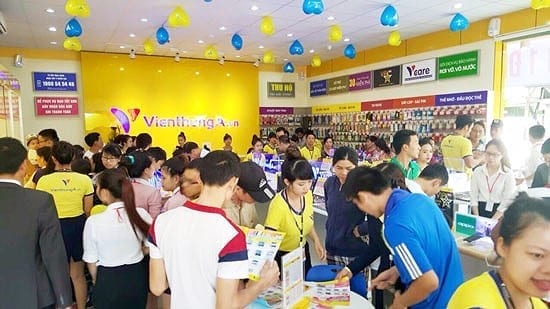
    Vietnam’s biggest private conglomerate Vingroup has officially confirmed its acquisition of major tech products retailer Vien Thong A.

    In its financial statement for the third quarter of 2018, Vingroup lists Vien Thong A Import Export Trading Production Corporation as a fully-owned subsidiary.

    On September 14, Mai Thu Thuy, board member of the Vincom Retail Joint Stock Company and Chairwoman of the Vincom Mega Mall Royal City, was appointed legal representative of the acquired company.

    Established in November 1997 in Ho Chi Minh City, Vien Thong A is the oldest retail technology chain in Vietnam. It has nearly 200 stores, including independent shops and a “shop-in-shop” model in BigC supermarket, CoopMart, and 100 service centers.

    In early 2017, Vien Thong A CEO Hoang Ngoc Vy revealed plans to restructure the company and seek investors to expand its business.

    Last month, VinCommerce, a member of Vingroup, bought Fivimart from domestic company Nhat Nam JSC and Japanese retailer AEON, which held 70 percent and 30 percent stakes, respectively.

    In the first nine months of this year, retail sales of Vingroup reached VND12.89 trillion (nearly $555 million), a 41 percent year-on-year surge.

    Vingroup, Vietnam’s biggest property conglomerate, dominates the housing and property markets with Vinhomes.

    It has also entered the healthcare market with Vinmec, runs a chain of supermarkets called Vinmart, and entertains tourists at Vinpearl resorts.

  • Lacasa Hotel opens luxury style hotel in Gwangmyeong

    Lacasa Hotel opens luxury style hotel in Gwangmyeong

    The Lacasa Hotel Gwangmyeong opened its doors on Monday in Gwangmyeong, Gyeonggi. This is the second branch of the boutique hotel brand Lacasa which launched in Sinsa-dong, Gangnam District, southern Seoul in 2011.

    It is located inside the Lacasa Tower between the seventh and 16th floors, and has 191 rooms and three penthouses. The hotel offers a green view from its windows. On the seventh floor is an outdoor garden.

    “Our goal is to make Lacasa Hotel Gwangmyeong into a comprehensive space for rest, culture, shopping and business,” said Choi Yoon-kyung, the vice president of Lacasa Hotel.

    To celebrate the opening, Lacasa will hold a classical music concert for locals on Nov. 17 inside the new venue.

  • Vietjet Air targets young aircraft fleet to keep costs low

    Vietjet Air targets young aircraft fleet to keep costs low

    Budget carrier Vietjet Air plans a fleet age average of three years to keep fuel and maintenance costs low. Vietjet Air is in negotiations to firm up the deal after ordering 100 Boeing 737 MAX aircraft and 50 Airbus A321neo aircraft at the Farnborough International Airshow in the U.K. in July.

    The planes are expected to be delivered between 2020 and 2025, Vietjet CEO Nguyen Thi Phuong Thao said recently.

    But some analysts have questioned whether Vietjet is equipping itself with way too much aircraft, given that it already owns 62 Airbus narrow body jets.

    The carrier, which leads the domestic market with a 45 percent share, expects to receive 30 new aircraft and “retire” 10 each year between 2020 and 2025 to keep its fleet young, Thao said.

    “The average age of Vietjet aircraft is three years now and we want to keep it that way,” she said on the sidelines of a CEO conference in Bangkok.

    The average age of Vietjet’s planes is half that of other low-cost and fast-growing carriers in Asia like Malaysia’s AirAsia, Indonesia’s Lion Air and India’s IndiGo, according to Airfleets.net.

    “The main reason for the young fleet is to keep the maintenance and fuel costs low and to ensure a good service for passengers on fresh, convenient planes,” said Thao.

    Deliveries of those planes are expected to happen from now until early next year.Last month, Vietjet inked a deal to buy 10 Airbus aircraft worth $1.24 billion from Japanese and French companies.

    Thai Vietjet, which operates under a franchise contract in Thailand, is flying with seven jets and expected to add ten more jets each year, the carrier had said this month.

    Vietjet runs 385 flights daily within Vietnam and to Japan, Hong Kong, South Korea, Taiwan, Singapore, mainland China, Thailand, Myanmar and Malaysia.

  • Indonesia Falls in 2019 Ease of Doing Business Ranking

    Indonesia Falls in 2019 Ease of Doing Business Ranking

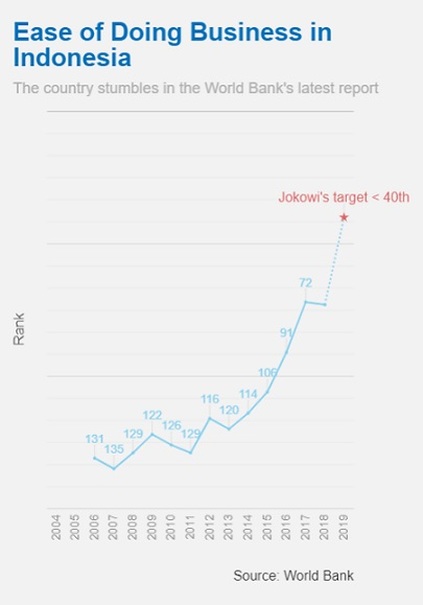
    If President Joko “Jokowi” Widodo wants to see Indonesia join the top 40 countries in the World Bank’s Ease of Doing Business ranking under his watch, he should make sure he wins re-election next year. Indonesia slipped one place to 73rd, behind Greece, the Ukraine and Kyrgyzstan, in the 2019 Ease of Doing Business report, released late on Wednesday. The president has set a target for the country to be in the top 40 by next year, but his second term will be decided in April, while the next report would not be out until next November.

    While Indonesia has made considerable progress in reforming the regulatory environment for businesses since Jokowi took office in 2014, Wednesday’s report reveals the stark realities of the country’s limited capacity to continue with these reforms.

    The country scored 67.96 out of 100 in the report’s aggregate measurement, up by only 1.46 points from last year. Slovenia, a Central European nation of only 2 million people and a $49 billion economy, sits in the coveted 40th place with an overall score of 75.61.

    Indonesia, for one, issued new rules that make starting a business, registering property and obtaining credit, easier for businesses and make it cheaper for them to get electricity. But reform stagnated in areas such as obtaining construction permits, protecting minority investors, paying taxes, trading across borders, enforcing contracts and resolving insolvencies.

    These bottlenecks allow economies like China, Kenya and Kyrgyzstan to overtake Indonesia. China made a leap to 46thplace in this year’s report, from 78th last year. Kenya moved up 19 places to 61st, while Kyrgyzstan went up seven places to 70th.

    Still, the report highlights Indonesia’s success in reforming its judiciary system and making the country a case study for others to emulate. The Supreme Court introduced training programs in 2003 for new and experienced judges, as well as special training for judges presiding over more specialized cases, such as those involving commercial or maritime disputes.

    “Indonesia’s efforts to train judges following judicial reforms bore positive results through a substantial decrease in court backlogs and insolvency case resolution times,” the World Bank said in the report.

  • Alipay to support China’s micro and small businesses to embrace digitization

    Alipay to support China’s micro and small businesses to embrace digitization

    Alipay has announced that it will launch new initiatives to provide more digital tools, safeguards, loan services and training to further improve efficiencies and support the growth and digitization of small and micro businesses (SMBs) in China.

    SMBs form the cornerstone of Chinese society and create millions of job opportunities. However, shifts in industry models mean that online and offline operations are increasingly merging together and this group has lacked the services and tools needed to improve efficiencies and seize the opportunities from digitization. Aiming to tackle this on-going issue, Alipay, will provide the following support to bolster the development of SMBs in China.

    Ÿ   Provide tools and services to support digital operations, including business analysis, customer engagement, and supply chain services aiming to help 100 million SMBs across China.

    Ÿ   Provide an additional safeguard to SMB owners. SMBs using Alipay services will be offered a maximum of RMB1000 (USD $144) rebate every half year on out-patient services. Alipay expects to extend coverage to 50 million SMBs by the end of 2018 and rebate more than RMB500 million (‪USD $71.8 million) in total.

    Ÿ   Provide MYbank’s loan services to 30 million SMB owners and self-employed people over the next three years.

    Ÿ   In collaboration with 100 start-up entrepreneurs, Ant Financial, the parent company of Alipay, will tailor 100 lessons in corporate development and operations with the aim of training 10 million SMBs and facilitate their digital transformation.

    A great number of SMBs have benefited from Ant Financial’s range of services, including those provided to QR code merchants, who are typically SMBs that use Alipay’s QR code to collect payment from customers. These services include business analysis, financial management, loan and insurance services. Powered by Artificial Intelligence, Ant Financial enables SMB owners to apply for business loans in less than three minutes by smartphone, receive near-instant approval without human intervention. One QR code merchant from Wuhan, for instance, applied for a RMB20,000 (USD $2,874) business loan during Chinese New Year and received approval within one second. In the year ending October 2018, over three million QR code merchants have applied for loans through this service with an average loan size of less than RMB8,000 (USD $1,150).

    AI facilitates the entire process of out-patient benefits offered to QR code merchants, from guiding users to upload their invoices correctly, to identifying key data points on the invoice (such as hospital name and fee amount), to reviewing the information and materials submitted. Ant Financial’s blockchain technology secures the authenticity of the invoices. Tens of millions of QR code merchants have begun to take advantage of this offer with 20,000 merchants on average signing up for the service each day.

  • Exchange rates, tax worry Vietnam’s most profitable firms

    Exchange rates, tax worry Vietnam’s most profitable firms

    Exchange rate fluctuations and high taxes are the main concerns of Vietnam’s most profitable businesses, a recent report has found. The survey of the 500 most profitable companies this year, which include 41 foreign invested ones, by consultancy and market research firm Vietnam Report, said 51.4 percent of businesses considered exchange rate volatility as the biggest challenge this year.

    For 42.9 percent of respondents the tax burden was the biggest concern.

    Other factors that affect their profitability are red tape (37.1 percent), global economic instability (31.4 percent) and environmental disasters (25.7 percent).

    However, 90 percent expected their revenues to rise this year.

    Eighty percent said their profit had already exceeded last year’s, with another 8.6 percent saying it had drawn level.

    Almost all (97.1 percent) said the government has stewarded the economy well by curbing inflation and managing the exchange rate adroitly.

    But they wanted improvements to administrative procedures, infrastructure and access to land.

    The survey found the telecommunications-information technology sector having the highest return on equity, 30 percent, followed by transportation with 24 percent and pharmaceuticals with 21 percent.

    The Vietnam Oil and Gas Group or PetroVietnam is the most profitable company this year followed by telecomunications firm Viettel and Samsung Electronics Vietnam Co. Ltd.

  • Softbank said to pick banks to lead $27b mobile IPO

    Softbank said to pick banks to lead $27b mobile IPO

    Japan’s Softbank has reportedly selected the banks that will serve as lead underwriters for the IPO of its domestic mobile business. The operator has picked banks including Nomura Holdings, Mizuho Financial, Sumitomo Mitsui Financial, Goldman Sachs and Deutsche Bank to underwite the offer for around 3 trillion yen ($26.82 billion) worth of shares, citing unnamed sources. This would make the IPO the largest ever, beating Alibaba Group’s $25 billion IPO from 2014.

    According to the sources, Softbank currently plans to start marketing the IPO next month and could list shares on the Tokyo Stock Exchange by mid-December, but this timing is subject to change.

    Softbank’s founder Masayoshi Son is seeking to squeeze value from its telecoms assets to raise funds for his Vision Fund, which aims to raise $100 billion from global investors every two to three years to invest in promising startups and emerging technologies.

    The operator is expected to market most of the shares on offer to Japanese investors.

  • Optus Business expands managed solutions portfolio

    Optus Business expands managed solutions portfolio

    Australia’s Optus, through subsidiary Optus Business, has expanded its line-up of fully managed ICT solutions for enterprises.

    The operator has added contact center, security and storage solutions to its Optus GO portfolio of managed services.

    Optus GO Contact Centre provides cloud based contact center capabilities including management of inbound and outbound calls, chat and email. Optus GO Security includes email and web protection based on cloud security architecture, and Optus GO Storage provides as-a-service flash storage for data centers.

    The Optus GO managed ICT solutions suite, which launched in February, already included connectivity, collaboration and cloud services for businesses of all sizes.

    “The Optus GO solutions were created in response to our customers who are looking for the benefits of ICT solutions without the cost or burden of ownership and management,” Optus Business managing director John Paitaridis said.

    “We designed Optus GO to save our customers time and money by simplifying technology, delivering connectivity and ICT as an end to end solution in a secure and managed environment.”

    He said Optus GO aims to provide enterprise customers with the core computing foundations to support the business opportunities that will be afforded by emerging technologies including IoT, advanced analytics, AI and 5G.

    Optus is a wholly-owned subsidiary of Singapore’s Singtel Group.