-
Make a lasting impression with moving images
-
Encourage relevant impulse purchases
-
Get interactive
-
Enhance audience targeting with real-time data
-
Highlight loyalty programs


Four in five Thai consumers (78 percent) have tried going cashless in 2018, compared to only fifty percent in previous year as confidence in digital payments grew, according to the 2018 Visa Consumer Payment Attitudes study (the “Study”). The study tracks payment habits and attitudes as well as exploring emerging topics related to payments among 4,000 consumers across eight Southeast Asian countries, including 500 respondents from Thailand.
For Thai consumers, digital payment methods, such as cards, in-app mobile payments and QR payments combined together have a larger preference (57 percent) over cash (43 per cent).
Suripong Tantiyanon, Country Manager for Visa Thailand said: “The higher preference towards using digital payments and the rise of confidence in going cashless are credited to industry players and the government, who have been relentlessly driving the national e-payments agenda.
“In addition, we believe that the higher preference towards digital payments can be attributed to the proliferation of payment form factors and acceptance points. More than ever before, Thai consumers can make payments with a wider range of connected devices and payment applications on smartphones, such as wearables and mobile payments. At the same time, QR code offers merchants in traditionally cash-based segments with a fast, cost-effective and secure digital payments solution.”
According to the study, two in five Thais (42 percent) said they carried less cash than they did two years ago, compared to 26 percent in 2017. Top reasons for the decrease in cash in wallet are cash is unsafe (65 percent), higher adoption of digital payments (65 percent) and the hassle of using cash (39 percent).
The study also showed that of those who tried going cashless, more than half (60 percent) could manage a day without cash and forty-five percent could last without cash for more than three days.
Overall, in terms of future expectation, more Thais are confident about the country becoming a cashless society. Nearly one in three (29 percent) are confident that Thailand can become a cashless society in less than three years, compared to 11 percent in 2017. Thirty-nine percent believed it will take between four to seven years while only six percent believed it will take longer than 15 years.
“The findings are encouraging. We believe that we are on the right track and it is important to help more consumers and merchants understand and embrace the benefits of digital payments. At the same time, we are committed to innovate and collaborate with all stakeholders in the payment industry and beyond as we continue our journey towards transforming Thailand into a cashless society,” Suripong concluded.

Thinking about how to create your e-commerce store in Asia? This exclusive event has all your answers.
Moni, a digital commerce and brand experience agency, providing an end-to-end suite of e-commerce services in the region, is set to take centre stage on April 2 in Central, Hong Kong.
Moni, with more than 12 years of experience of delivering digital-commerce experiences, joins together with Magento – the world’s No 1 e-commerce platform – to host an exclusive event to teach merchants how to kickstart and grow their online store. The insightful event will also explore the best practices of ever-evolving online shopping experiences. Moni is one of the few Certified Magento Partner Agencies in Asia.
Who should attend?
Retailers, B2B companies, and brands who are looking to expand their online presence and reach through e-commerce, or who are interested in understanding the nuances of Magento platform.
Join the conversation and network with knowledgeable community members who will help you grow your business to the next level. The event will help you discover why Magento is right for your business, how to drive traffic and sales to your e-commerce store, with some of the best practices detailed along with case studies to learn from.
The event hosts developers, system integrators, subject-matter experts, merchants, service providers, speakers and technology partners from Hong Kong and Singapore under one roof. Moreover, the event will also host an interactive talk session enabling attendees to get the queries answered in real-time.
What will you gain?
The session will equip attendees with a broad understanding of the Magento platform and its benefits such as modernised technology stack, better performance and scalability, smooth customisation, seamless integration and minimised testing efforts.
David François, MD at Moni, will direct the audience through several successful e-commerce projects in Asia. For more than 20 years he has specialised in helping brands create digital customer experiences that drive tangible results and outcomes.
Mel Lim, enterprise sales manager at Magento, comes from Singapore, and will share details about the full suite of Magento capabilities. She has a decade of experience working with brands across Asia Pacific on their digital-transformation journeys, specialising in commerce customer experience.
Each merchant today can capitalise on commerce system flexibility, buying patterns, maximising gross margins, driving innovation and meeting end-to-end customer expectations.
To attend this exclusive event, click here to RSVP.

Data platform Next Billion is collaborating with data exchange service Ocean Protocol to pilot a new data-sharing model that gives Indian rural store owners an extra income stream.
Next Billion, which creates insights to enable companies to expand in high-growth emerging markets, provides free point-of-sale platforms to rural store owners to record real-time inventory and sales data. It is building a data marketplace and piloting a new data sharing model based on Ocean Protocol, the first general platform for borderless data sharing that marries blockchain, data and AI.
Through the pilot, Indian rural store owners will capture real-time transactions via the POS platform and are incentivised to consistently use this platform to submit verified data. When companies buy their syndicated data, transactions can be traced back to the source via Ocean Protocol, enabling Next Billion to reward these rural store owners with royalties.
“We believe global companies’ needs for commercial data can unlock sustainable and inclusive business models that empower local data providers to share fair value from their data,” said Next Billion MD Oliver Gilbert. “Ocean Protocol enables Next Billion to monetise data and share it with companies in a safe and secure manner.”
Despite the lack of digitisation in retail practice in rural Asia, sales are climbing. Driven by the rise of the middle class, the consumption of fast moving consumer goods (FMCG) in rural areas is growing across Asia. From 2009 to 2012, spending by India’s 800+ million rural residents reached $69 billion, some 25 per cent more than their urban counterparts over the same period.
According to recent estimates, consumption in rural areas is growing at 1.5 times the rate in urban areas. The current $12 billion consumer goods market in rural India is expected to reach $100 billion by 2025.
FMCG companies are eyeing this new opportunity and have revved up their distribution channels in rural areas.
This has been reflected by a significant rise in demand for rural market-research data. However, traditional market-research firms lack rural reach, maintain outdated platforms premised on different environments, and their costs remain prohibitively expensive.
Ocean Protocol is a blockchain-based platform for the safe sharing of data that enables companies and data services to build on top. Its technology allows organisations to put a value on, own and control their data while addressing many frictions around data sharing today – including privacy concerns, trust, and auditability. Ocean also allows algorithms and models to come to the data, get trained and then leave without exposing the data or taking a copy, thereby retaining privacy and freeing up data to advance the economy and society.
“A lot of data is generated today, yet they are locked up in silos because people are scared of losing control and not getting rewarded. Ocean helps to solve this by giving the tools for people to own and control their data and develop new data-driven business models,” said Ocean Protocol founder Bruce Pon. “Data owners can program the conditions of access which are then executed precisely. In addition, data can be traced back to its source, enabling incentives to be spread across all stakeholders in the data sharing process.”
“Being incentivised, along with transparency on how data is being used, increases the willingness of people to share data,” Gilbert added. “We hope to provide high quality and agile retail insights at a fraction of what the traditional market research firms would charge while targeting an increase in sustainable livelihoods by 30-50 per cent.”

Pakistan’s leading telecom and digital services provider, Telenor Pakistan, is celebrating its 14th anniversary with a renewed commitment to empowering Pakistan. Since the beginning of its commercial operations in 2005, the company has emerged as the second largest cellular operator in the country with 44 million strong and growing customer base and 28% share in the Pakistani telecom market. Telenor Pakistan has also become the leader of ICT-powered digital transformation in the country.
Telenor Pakistan’s journey comprises many industry first initiatives and benchmarks including the country’s first and foremost mobile banking service, Easypaisa, best-in-class data and broadband services, multiple-award winning digital solutions for agriculture and civic rights, Voice Over LTE (VoLTE) enabled network, and the industry’s first and only 4.5G service, to name a few. The company recently established its new headquarters in Islamabad that is built to induce innovation and creativity into solutions for the customers. Since its inception, Telenor Pakistan has taken a frontrunner position in building and developing a digital ecosystem in Pakistan and is a key enabler of the country’s national digital agenda.
Throughout its operations, Telenor Pakistan has ensured that its purpose of ‘connecting people to what matters most to them’ is fully integrated to its products and services along with ways of doing business. Keeping sustainability a priority in all business processes and policies, Telenor Pakistan’s solutions are enabling socioeconomic growth and development in the country which is reflective of the company’s commitment towards giving more power to its customers through innovative digital connectivity.
“Since the beginning, Telenor Pakistan has been a strong proponent of technology being the answer to socioeconomic challenges,” said Irfan Wahab Khan, CEO Telenor Pakistan. “We have always been on the lookout for new ways to extend the benefits of technology not only to our customers, but to millions of Pakistanis who are yet to be digitally and financially included. With proliferation of mobile phones, we realized there’s no better way to empower them than leveraging the strong tele-density in the Pakistani market. That is when our digital interventions to empower our society shifted gears and today we lead the industry with disruptive solutions in agriculture, civic rights, IoT, emerging solutions in entertainment, and more. This is only the start of an exciting journey ahead,” he added.
During the past 14 years, Telenor Pakistan has powered the country’s digital ecosystem using a multilateral approach that includes continuous increase in network footprint, innovative products & services, and making connectivity affordable. Besides ensuring best-in-class services and expanding our network to underserved and unserved areas, Telenor Pakistan’s portfolio of affordable data devices and services is enabling accelerated digital uptake in the country. Initiatives like Telenor Velocity, Youth Forum (TYF) and Ignite encourage a sustainable entrepreneurial mindset across the country and within Telenor Pakistan.
Telenor Pakistan has made substantial contributions in the form of investment in the country that include over $3.5 billion in spectrum and infrastructure, over $2.5 billion in the national exchequer, and over $70 million in the new Islamabad HQ. Telenor Pakistan’s impact on the society has also been significant with over 1,600 direct jobs, enablement of the wider economy, and measures for sustainability in the supply chain. The impact that the company’s digital interventions are making in areas like financial services, agriculture, and ensuring easy access of civic rights through digital birth registration is redefining sustainability and setting new standards.
“We thank Pakistan and millions of Pakistanis for choosing us as their preferred telecom and digital solutions provider,” said Irfan Wahab Khan, CEO Telenor Pakistan. “On our 14th anniversary, we pledge to continue serving Pakistan by supporting our national inclusion agenda, being a gateway to the latest technological innovations and creative solutions to meet our customers’ needs, and giving them more reasons to love Telenor. We are here to stay and our commitment to empowering Pakistan only gets stronger with each passing year. With continued support from the government and our cherished customers, we are on the road to achieving greater milestones in the coming times.”

DHL Express in Sub-Saharan Africa (SSA) has announced that the company has once again signed on as lead sponsor for the 2019 DHL eCommerce Africa Conference and Exhibition, which will be held at the Cape Town International Convention Center on the 19thand 20thof March 2019.
The eCommerce Africa Conference and Exhibition, delivered by DHL, is hosted by South African conferencing company, Kinetic, and is one of Africa’s biggest opportunities to bring stakeholders in the ecommerce sector together. Later in the year, Kinetic will also bring the conference to Kenya, with the eCommerce East Africa Edition, also delivered by DHL, set to take place in Nairobi on the 12thand 13th of June 2019.
This year’s event offers participants an opportunity to learn from world-class thought leaders, both from Africa and the rest of the globe, on the innovative strategies that will unlock e-commerce opportunities over the years to come. Delegates from some of the continent’s biggest tech, retail, banking and legal firms will be in attendance to share their experience and engage with attendees to exchange knowledge.
According to the McKinsey Global Institute’s report, Lions Go Digital, e-commerce and fintech represent two of Africa’s biggest growth opportunities, with the growth of the mobile technology market driving both of these sectors. “More than half of urban African consumers already have Internet-capable devices and this number is increasing. Online shopping in Africa could account for up to $75 billion in retail sales by 2025.”
Steve Burd, Vice President Sales for DHL Express Sub-Saharan Africa, explains that the ongoing partnership between DHL and eCommerce Africa is a good fit. “As the market leaders in express logistics in Africa, we have extensive first-hand experience of the positive impact that ecommerce has on the continent. The massive growth in cross-border and international ecommerce in Africa sees DHL working with thousands more customers across the continent each year, helping them to expand their brand across borders.”
He adds that the development of ecommerce in Africa continues to unlock major opportunities for growth. “E-commerce allows entrepreneurs and SMEs to connect with a large customer base and scale up rapidly, which accelerates the need for support services. E-commerce growth therefore has a ripple-effect on many other industries on the continent.”
“DHL’s partnership with eCommerce Africa provides us with an additional platform to connect with organisations and help them to understand key logistics considerations, and learn how to plan for and overcome any logistical challenges,” adds Burd.
Terry Southam, Kinetic Managing Director, says that the collection of thought leaders and the topics under discussion this year are aimed at creating an immediate impact for African ecommerce companies.
“From marketing to fulfilment, the world’s best will be on stage sharing best practice and innovative hacks to drive online growth. It is quite remarkable to have all of these industry leaders on the same stage – not only willing to share but actively working to grow the industry and ensure African customers receive a world-class online shopping experience. This year’s theme for the conference is ‘Conquering Scale’ and we couldn’t be happier to have a market leader like DHL on board, to help us deliver 2 key e-commerce events on the continent this year,” he concludes.

Alibaba Group sales soared 41 per cent in the December quarter as its customer based neared 700 million.
The Chinese company’s turnover for the three months reached US$17.057 billion and its net income attributable to shareholders $4.807 billion.
“Our resilient operating and financial performance is a direct reflection of our persistent focus on better serving our growing base of nearly 700 million consumers across retail, digital entertainment and local consumer services,” said CEO Daniel Zhang. “Our growth is also driven by the power of Alibaba’s cloud and data technology that helps expedite the digital transformation of millions of enterprises.”
Alibaba group sales from core commerce increased 40 per cent to $14.958 billion, while the cloud-computing division posted 84 per cent growth, turning over $962 million. The digital media and entertainment division achieved 20 per cent growth to reach $944 million.
In a statement, Alibaba said its Taobao platform achieved “robust user growth and enhanced engagement”. Last December, its China retail marketplaces had 699 million mobile monthly average users, representing a quarterly net increase of 33 million. The annual active consumers on its China retail marketplaces was 636 million for the 12 months ended December 31, compared to 601 million for the 12 months ended September 30 last year, “reflecting successful user acquisition programs, such as referrals through the Alipay app”.
More than 70 per cent of the increase in annual active consumers was from third-and-lower tier cities.
Tmall thrives
Alibaba said GMV on its Tmall business grew 29 per cent year on year in the December quarter, outpacing the industry.
“This robust growth was driven by strength in the fast-moving consumer goods (FMCG), apparel and home furnishing categories,” the company said.
During the quarter, Tmall signed up new brands to the platform including Valentino, Ermenegildo Zegna, Stuart Weitzman and Sergio Rossi which opened flagship stores and joined the Tmall Luxury Pavilion.
Meanwhile, Alibaba’s proprietary grocery retail chain Freshippo (formerly Hema) continued to expand its footprint, “optimise its stores and introduce new initiatives that improve customer experience”. As of December 31, there were 109 self-operated Freshippo stores in China, primarily located in tier 1 and tier 2 cities, which continued to achieve “robust same-store sales growth” through the quarter.
‘Robust’ Lazada growth
Alibaba’s Southeast Asian e-commerce platform Lazada achieved what the company described as “robust growth” in GMV. The company upgraded Lazada’s technology, which resulted in boosting the number of active users and achieved greater user engagement on Lazada’s mobile app.
“We continue to invest resources to integrate Lazada’s business and technology operations into Alibaba with the aim of building a strong foundation for us to extend our offerings in Southeast Asia.”

Some of the world’s most inspiring marketing professionals will gather in Hong Kong later this month. MarketingPulse is an integrated branding and marketing conference for global marketers, brands, advertising agencies, media, enterprises and innovation professionals to gather and share the latest marketing trends, exchange best marketing practices and explore new collaborations in Asia.
From defining new marketing strategies to reviewing events that connect and catalyse, MarketingPulse is not only a conference, but an inspiring annual rendezvous to explore new frontiers in marketing.
The event will kickstart with a session journeying into a new era of branding, where leading chief marketing officers share tricks and tips on how they keep ahead of the pack with innovative campaigns embracing global trends, and reveal how future marketers should story tell and enhance brand experiences.
Jonathan Mildenhall, one of the speakers in this session, previously held roles as chief marketing officer at Airbnb and VP of global advertising strategy and creative excellence at the Coca-Cola Company. Mildenhall joined Airbnb in June 2014 and made it his mission to help Airbnb transform the industry, converting a disruptive property-rental platform into a global superbrand.
Just as he did at Airbnb, through TwentyFirstCenturyBrand, Mildenhall is partnering with some of Silicon Valley’s most influential founders and CEOs in order to drive transformational growth through purpose-driven marketing and world-class excellence in global brand stewardship.
Michelle Cordeiro Grant, another speaker in the session, is the Founder and CEO of Lively. She has spent her career creating brands and products for some of the world’s largest retailers including Federated, VF Corporation, Limited Brands/ Victoria’s Secret and Thrillist Media Group.
Grant is passionate about the entire process of creating and developing amazing brands and products – from concept to customer. Working with Victoria’s Secret inspired her to create a completely new experience for the lingerie category— a concept she calls Leisuree — and so Lively was born. Grant believes that “customer conversations should be the heart of your market and help you build a cohesive brand and community”.
MarketingPulse will be held on March 20 at the Hong Kong Convention and Exhibition Centre.

In a revolutionary development that could potentially redefine the global retail and e-commerce industries, Digital Mall of Asia (DMA), a first-of-its-kind digital e-commerce platform merging the real estate and the digital spaces, has announced the launch of its Noida mall. The launch took place at the company’s registered office in the Film City, Noida, setting an unprecedented example of how online portals and brick-and-mortar retailers can transcend the digital-physical divide to optimize their consumer outreach and revenue generation.
An initiative by Yokeasia Malls Pvt. Ltd., DMA is a disruptive innovation by an Indian organization recreating the experience of a physical mall in the digital space. In an industry where most of the key names are being run or backed by foreign players, this unique and disruptively innovative initiative by Yokeasia Malls has the potential to put the novelties of Digital India on the world map.
The Need
The launch of DMA Noida addresses the challenges that retailers often face and empowers them to maximize their business footprint with innovative digital offerings and an unmatched value proposition. DMA operates on a zero commission model; retailers at DMA don’t have to pay anything apart from the rent, a major revolution in a space where all the major E-commerce players charge somewhere between 5-35 percent of the revenue. Moreover, the organization will provide an immediate settlement of all payments received, ensuring complete transparency and reliability. It is also working towards completely eradicating the issue of the sale of counterfeit or fake merchandise. These unique features, apart from its focus on digital innovation, makes DMA a powerful and pioneering presence in the e-commerce space, both in India and on a global level.
The Solution
Going beyond the concept of a typical e-commerce portal, DMA’s Noida mall will have 11 towers with 10 floors each, adding up to a total of more than 5,000 shops and an available inventory currently worth approximately Rs 500 crore. The mall will incorporate visual and sensory elements to offer an immersive, stimulating environment and will have dedicated towers for different categories such as men, women, kids, electronics, home and kitchen, education, financial services, food court, hypermarket, digiplex, and online nightclub. Fundamentally, DMA Noida has all the elements that make up a physical mall, albeit virtually.
The Value Addition
By creating a new ‘digital asset’ class providing attractive returns, DMA also envisions to transform the general perception towards the term ‘investment’ while ensuring security, profit, and convenience for investors. The shops in the Noida mall are available for both sale (to investors) and rental (to retailers), whereas the shops in the rest of the 20 cities are available only to rent at present.
Commenting on the launch and the idea behind, Rishabh Mehra, Managing Director and CEO – Digital Mall of Asia, remarked, “We, at Digital Mall of Asia, are beyond ecstatic to launch our Noida mall and we are certain of its potential to bring about a revolution in the digital and retail space worldwide. This project is aimed at serving many purposes, from an industry-wide transformation to retailer empowerment through our zero-commission model. But most importantly, DMA is our effort against data colonization. I wholeheartedly agree with Mr Mukesh Ambani’s stance on how India’s data must be owned by Indians, and not controlled by global corporations. In this era of data-driven revolution, we hope that DMA’s disruptive innovation sets an example for our contemporaries to follow through and bring the ownership of Indian data back to where it belongs – in our own hands.”
The launch in Noida also marks DMA’s first step towards a pan-India launch in 20 cities including New Delhi, Mumbai, Bengaluru, Pune, Chandigarh, Jaipur, Lucknow, Coimbatore etc. After a pan-India expansion, DMA plans to expand its operations across the Asian market and has already begun the process of seller registration in China, Japan, South Korea, Malaysia, Thailand, Indonesia, and Singapore.

Retailers know they need to evolve, even though they cannot do it overnight. But while there’s no silver bullet for transforming culture, collaboration, and workflows inside a large organization, there are steps you can take to make sure your business is receptive to the change it’s about to undergo.
Understand performance goals
Before you start, you need to understand the business problem and the role that technology is going to play. Solving complex organizational issues needs the relentless management of changes in behavior, process, and technology all working together to support your performance goals and objectives.
Collaboration is not a KPI
Decide how you’re going to measure your KPIs. And remember that collaboration is not a KPI – it’s a means to an end. KPIs could include customer satisfaction, getting products to store faster, selling more products per visit, or retention. You need to get down to that granular detail.
Shut things off
If you have an existing tool which people did not like and you invest in something new to overcome those challenges and frustrations, you need to have a path to turning that tool off or at least turning off the elements that are now conflicting. This will impact adoption of new tools and ways of working.
Educate, educate, educate
Launching a tool is the easy part, the real work begins when people use it. People need to be educated on what they should be using it for. Show some examples of what ‘good’ looks like, and also what the tool should not be used for. Design an internal marketing campaign and treat it exactly the same as an external campaign. A product-driven approach could help here. Think about how companies try to refresh products in the market over time to improve adoption.
Put somebody in charge
For any system, and especially for a collaborative experience, you need someone who can get employees to use the tool in the right way at different times. That might be a community manager who understands the business cycle. Putting up content is the single most important driver of getting people to use the platform and to entice them to contribute their own.

All eyes are on Southeast Asia as the world’s next consumer powerhouse, with its young population and increasing purchasing power. Almost 280 million centennials – those born since 1995, also known as Generation Z, currently call this region home. While the size of this new generation alone makes them attractive prospects for retailers, their distinct behaviours set them apart as the ones to watch to crack Asia’s hyper-competitive retail landscape during the next few decades.
Born into the digital age and mobile natives, centennials will soon be one of the world’s most demanding consumer groups with high standards and expectations of the online-shopping experience.
Here’s what we know about the centennials….
Webrooming vs showrooming
Almost all centennials in Southeast Asia use the internet as part of their buying journeys, but their route is much more converged than other generations. Latest research commissioned by Dentsu Aegis Network, Here Comes the Centennial reveals that centennials like to use both online and offline channels – 97 per cent browse for products online before purchasing online (‘webrooming’) and 90 per cent look for products in store before buying online (‘showrooming’). Detailed research is a key part of their buying decisions – whether online or offline – to ensure they get the best price, as well as the best quality by going into stores to experience the product. Some 70 per cent browse online to find the best price, while 67 per cent use the internet for checking out product details and specifications and 65 per cent are checking out reviews.
Smartphones have also created an environment where centennials can browse products wherever they are, whatever they are doing – multi-tasking to the extreme. For example, 52 per cent look at products online while eating, watching TV or hanging out with friends or family, while 38 per cent do so while commuting, and 34 per cent browse products while at school or college.
Centennials use social-media platforms differently to previous generations, as an important and intimate touchpoint in their purchase and decision-making journey. Social media applications (47 per cent) such as Facebook and Instagram are the second most popular place for them to shop in, while 49 per cent turn to such platforms for research on their future purchases, rather than asking friends (45 per cent) or family (27 per cent). Even a good reputation with friends and family does not feature highly as a motivator to purchase – just 15 per cent choose this as an option.
Digital natives
As digital natives, centennials expect technology to be an integral part of the experience, and are highly optimistic about the use of technology.
Eighty-two per cent of centennials are excited about futuristic shopping technology such as virtual reality. They demand fast-and-easy experiences that allow them to research and buy products with minimal frustration.
To this audience, commerce has moved beyond “buying something on a website” to a series of interactions, from enticing them to view a product to providing a personalised purchase experience, to where and when the product should be delivered. In this context, online retailers need to focus on understanding the centennial customer journey, specific to the category being sold. This can be done by incorporating relevant technologies which seamlessly enhance engagement along the path to purchase. For example, the research showed that “Good customer service/reliability” ranks third among qualities of an online store with this audience, with delivering a superior and excellent customer service option using chatbots rather than call centres a more significant differentiator than low prices and free/fast delivery that every other marketplace claims to offer.
Brand irrelevance
Brand name and image are no longer a priority of centennials. Only 11 per cent of centennials cite having a prestigious or famous brand as one of their top three attributes when choosing where to shop online. Instead, personalisation and convenience are key, as 76 per cent of respondents are happy to share data with websites, if it makes more relevant recommendations.
E-commerce payments provide a unique example of this; despite being digital natives, the concept of a cashless society has yet to fully take off for centennials in the six countries surveyed, with 56 per cent of respondents still preferring to pay cash on delivery for their purchases. Whilst preferring digital shopping experiences, the next generation of online shoppers enjoy having a variety of payment methods to choose from, and 43 per cent of centennials will readily abandon their purchases because their preferred payment option is not available.
This is also accompanied by a shift towards values-based purchasing, with 82 per cent agreeing that they “prefer to buy products from ethical or sustainable brands,” while 70 per cent express a preference for local brands.
With centennials less responsive to traditional campaign and brand-based purchasing, and increasingly influenced by disparate sources of dynamic information and opinions, retailers can no longer just rely on well-designed stores or brand campaigns to drive sales. Instead, driving a unified brand experience across multiple touchpoints will be key to unlocking the centennial consumer opportunity.
This year
So what does this all mean for retail this year and beyond?
Southeast Asia’s internet economy is expected to exceed US$240 billion by 2025, according to research from Google and Temasek. One in two of centennials surveyed are already spending more than $30 per month online. Nine per cent indicated that they spend more than $100 a month – and as the centennial generation comes of age and joins the workforce, their disposable incomes will increase further.
This combination of large populations, high connectivity and smartphone penetration rates, and increasing online spending power means the centennial opportunity in Asia is large and growing. We will increasingly see e-commerce technology accelerating this year to help create innovative and memorable brand experiences of the consumer.
Centennials represent tomorrow’s consumer. They are looking for integrated solutions and a seamless experience that will allow them to purchase anywhere, anytime, and on their own terms. As this new group of consumers become increasingly elusive and multi-channel savvy, retailers need to harness creativity and technology in new ways. Combining new media and technology to deliver innovative and memorable brand experiences is the key to success – and brands are learning quickly in order to tap the huge centennial opportunity here in Asia.
For example, in Thailand, Cotton USA worked with Vizeum and Isobar to launch the Cotton USA online store through an experiential shopping campaign “Shop the Runway”, partnering e-commerce marketplace 11Street.
Targeted at the Centennial audience, Shop the Runway was the first real-time online shopping fashion show in Thailand which streamed the live programme on 11Street, while clothes from the catwalk were displayed in real time – within the same page – so viewers could purchase their favourite looks direct from the runway.
At the heart of the campaign was a unique offline-to-online (O2O) feature within the 11Street mobile application which allowed fashion-show attendees to simultaneously view and shop the runway outfits.
Shopping coupons were also given to all customers who downloaded and registered their details on the app to further encourage conversions. The campaign drew close to 500,000 campaign visitors, a 13 per cent increase in 11Street app downloads following the campaign, and ultimately boosted Cotton USA sales and brand awareness amongst the target centennial audience.
Shop the Runway is one example demonstrating how brands can leverage technology and O2O features in innovative ways to reach consumers in today’s competitive e-commerce environment. Combined with a seamless shopping experience, and varied account and purchase options to suit different consumers, moments like these will attract tomorrow’s consumers on their terms, arrest their attention in a hyper-competitive commerce landscape, and allow brands to win in Asia’s digital-led retail landscape.

Global fast-fashion retailer H&M plans to introduce further digital services and features to improve its customer experience both in physical stores and online. The brand launched a series of tests in selected stores last year while rolling out digital features and services to boost its customer offer, experimenting with factors such as the interior and exterior, the product range and the overall look and feel of its stores. The firm also introduced technical solutions to make it easier for both staff and customers to navigate stores and identify fashion favourites.
H&M plans to continue that work this year in line with the firm’s omnichannel strategy. Testing this year will include cafe concept It’s Pleat, a florist shop-in-shop, self-service checkouts, monogramming services and repair services as well as a digital wall where customers can share their H&M favourites under the #HMxME tag.

“These stores give us a chance to try out and explore new concepts and activities to make our stores more inspiring and offer customers a great experience,” said H&M MD Fredrik Olsson.
“We are looking forward to continuously evaluate these tests where we are exploring the strength of a global brand in combination with a more personal touch and local relevance. We are also rolling out digital services and features to offer fashion fans inspiring and seamless shopping in line with our omni-channel strategy.”

Retailers know they need to evolve, even though they cannot do it overnight. But while there’s no silver bullet for transforming culture, collaboration, and workflows inside a large organization, there are steps you can take to make sure your business is receptive to the change it’s about to undergo.
Understand performance goals
Before you start, you need to understand the business problem and the role that technology is going to play. Solving complex organizational issues needs the relentless management of changes in behavior, process, and technology all working together to support your performance goals and objectives.
Collaboration is not a KPI
Decide how you’re going to measure your KPIs. And remember that collaboration is not a KPI – it’s a means to an end. KPIs could include customer satisfaction, getting products to store faster, selling more products per visit, or retention. You need to get down to that granular detail.
Shut things off
If you have an existing tool which people did not like and you invest in something new to overcome those challenges and frustrations, you need to have a path to turning that tool off or at least turning off the elements that are now conflicting. This will impact adoption of new tools and ways of working.
Educate, educate, educate
Launching a tool is the easy part, the real work begins when people use it. People need to be educated on what they should be using it for. Show some examples of what ‘good’ looks like, and also what the tool should not be used for. Design an internal marketing campaign and treat it exactly the same as an external campaign. A product-driven approach could help here. Think about how companies try to refresh products in the market over time to improve adoption.
Put somebody in charge
For any system, and especially for a collaborative experience, you need someone who can get employees to use the tool in the right way at different times. That might be a community manager who understands the business cycle. Putting up content is the single most important driver of getting people to use the platform and to entice them to contribute their own.

Emart is going fully digital with its brand new Uiwang branch that will open in Gyeonggi tomorrow. Innovative features of the Uiwang branch – the first Emart store to open in 30 months – include digital displays instead of paper signs and guide robots that can escort customers to desired products. The Uiwang store will span 9,917 square meters (106,745 square feet) across two basement floors in a commercial building.
“We will introduce a revolutionary format of offline stores that breaks away from tradition in order to meet the challenges of our fast-changing era,” read an Emart report.
Going paper-free is a big change that Emart hopes will both appeal to customers and help management.
Price labels will be digitalized and controlled by a central server in the Uiwang branch, allowing store managers to display and change prices with unprecedented ease and speed. The new store will also install digital signage, or electronic displays, alongside elevators, moving walkways and cashiers instead of paper posters for advertisement and notices.

“By minimizing paper usage, we can provide consumers with a unique shopping experience while practicing green management and boosting productivity,“ read the Emart report.
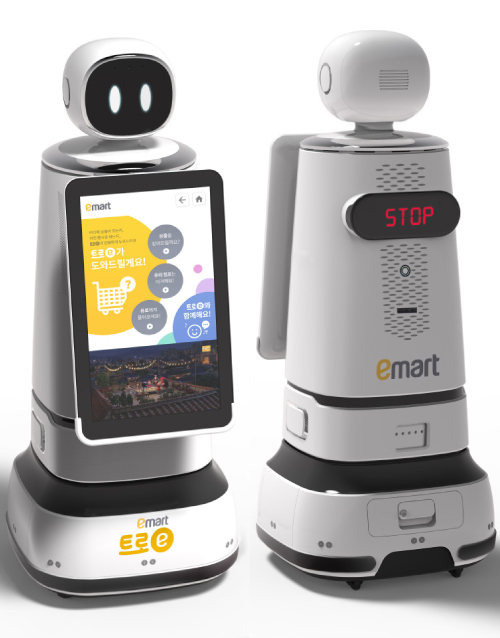
The new Uiwang store will also be home to Tro.e, an autonomous robot equipped with a 27-inch touch screen that is capable of guiding consumers to desired products and making casual conversation. Like Pepper, a robot the company employed earlier this year at its Seongsu branch in eastern Seoul, Tro.e will only be available for a limited time on a test run at Uiwang.
Emart developed Tro.e, named after the Swedish word tro, which means trust, together with Future Robot, one of the official robot providers for the PyeongChang Winter Olympics.
The grocery section of the new store will only be located on the lower floor of the store, while the upper floor will host a variety of affiliated shops including Electro Mart, Pierrot Shopping, Daiz, Boots and a Kakao Friends Store.
Emart will open a 660-square-meter “Culture Lounge” for customers to read books and purchase beverages.
“We will continue striving to offer consumers a unique shopping experience with our distinctive products and digital shopping environment,” said a senior manager in charge of development at Emart.