Tag: Digital

  • Vietnam leads Southeast Asia in digital economy development

    Vietnam leads Southeast Asia in digital economy development

    Vietnam’s internet economy is the largest relative to GDP in terms of gross merchandise volume in Southeast Asia this year. A study by Google and Temasek, a Singaporean holding company owned by the Government of Singapore, said gross merchandise volume (GMV) traded over the Internet in Vietnam was 4 percent of GDP. The study encompasses ride-hailing, e-commerce, online travel and online media.

    In second place was Singapore with 3.2 percent, according to the study which covered Indonesia, Malaysia, the Philippines, Singapore, Thailand, and Vietnam. Indonesia’s digital economy had the fastest absolute growth and looks set to reach $100 billion in 2025.

    In the last few years online businesses have been booming in Vietnam, with last year the digital economy growing by more than 25 percent, a rate that can be sustained for the next two or three years, according to the Vietnam E-Commerce Association.

    It said online sales are set to hit $10 billion by 2020, accounting for 5 percent of total retail sales.

    A Financial Times report last April cited Bain, a U.S.-based global management consulting firm, as estimating that Southeast Asia had 200 million digital consumers, or people who bought goods or services online, out of an adult population of 405 million. Vietnam, with a population of 93.7 million, accounted for 35 million.

    Vietnam’s youthful population is among the keenest users of mobile devices in the region, while the country’s consumers spend more time online than most of their neighbors, several studies have found.

    Research firm Nikkei estimated Vietnamese spend nearly 25 hours online per week, on a par with or just behind Singapore and the Philippines.

    In the ride-hailing sector, many players are expanding investments. Vietnam recently saw new entrants such as local firm FastGo, GoViet, a subsidiary of Indonesia’s Go-Jek, and Aber.

    Current market leader Grab has expanded to offer GrabFood and GrabCar Business, the latter targeting the corporate sector.

    But experts say Vietnam and many other countries in the world face a slew of challenges in the digital economy such as upgrading the skills of the workforce and adapting to rapidly changing technologies.

  • DHL plugs in to Shopify Singapore to enable simpler worldwide shipping

    DHL plugs in to Shopify Singapore to enable simpler worldwide shipping

    DHL eCommerce, a division of the world’s leading logistics company, Deutsche Post DHL Group, is working with Shopify, a leading e-commerce platform, to enable Singapore-based merchants to easily ship to their customers worldwide through a seamless plugin on a single platform. All new Singapore-based businesses built with Shopify will also enjoy special promotions for cross border shipping with DHL. Currently over 60% of Singapore-based merchants sell and ship their products internationally through the Shopify platform, and with the cross-border e-commerce opportunity continuing to grow, the DHL eCommerce plugin will make it even easier for merchants to ship their goods internationally.

    “Cross border e-commerce continues to grow exponentially and this is apparent from the borderless buying behavior of online shoppers. 70% of online buyers made a purchase from a foreign site in 2017, up 6% from the year before and this trend is expected to continue.  To deliver to buyers across borders, sellers need simple and seamless shipping solutions to manage their orders and deliver to their customers worldwide. By building tools for global shippers on Shopify, we’re making it easy to satisfy this exact requirement,” said Senthil Kumar, Managing Director, DHL eCommerce Singapore.

    Integrating different online systems can be complex, especially for sellers who sell online across multiple sales channels. By hosting their e-commerce stores on platforms such as Shopify, sellers have access to a wide array of plugins to connect the dots from click to delivery.

    Improved visibility in delivery helps to greatly enhance the entire customer experience. With DHL eCommerce shipping plugin available on Shopify, shippers can easily ship internationally by processing shipments on a single platform, from printing labels to generating tracking reference codes to enable shipment visibility for their customers — virtually automating the shipping process.

    “Shopify understands the dynamics of e-commerce, where requirements of sellers and buyers are evolving faster than ever. To ensure our merchants are keeping pace, we are working with DHL, a key driver of the global e-commerce ecosystem. The DHL eCommerce plugin, combined with the special rates for new Shopify merchants, will help retailers and brands on our platform ship with ease so they can devote more time to selling,” said Arun Verma, Country Manager, Shopify Singapore.

    DHL eCommerce is part of Deutsche Post DHL Group and, along with its sister divisions DHL Express, DHL Supply Chain and DHL Global Forwarding, DHL has been operating in Singapore since 1970, offering end-to-end solutions for the e-commerce sector.

  • High tech Nike NYC store opens

    High tech Nike NYC store opens

    Nike opened its newest Nike House of Innovation overnight, a 68,000sqft, six-storey store on Fifth Avenue.

    Nike NYC is described by the sportswear brand as a cross-category premium store, “the pinnacle expression of modern retail, representing the best of Nike global product, experiences and sport innovation”.

    “Nike NYC is designed to be a dynamic store environment, that is just as personal and responsive as digital,” said Heidi O’Neill, Nike Direct president. “This premium destination gives consumers an authentic, immersive and human connection to the Nike Brand.”

    The store is packed with technology, interactive experiential features and zones for both professional athletes and amateurs.

    Nike NYC uses the Nike App to create digitally connected journeys for consumers to discover, learn about and find the products they want quickly and easily. New and expanded Nike App in-store features include Shop the Look, Instant Checkout and updated functionalities with Scan to Try which the company says will give consumers greater opportunity to shop in-store displays, checkout in-store or request to try-on items throughout the store.

    The store is planned as something of a testbed for Nike’s digital service offerings which will “continue to evolve … giving NikePlus members even more choice in their shopping journey”.

    “Powered by digital commerce data and inspired by Nike’s newest retail concept, Nike Live, the ground floor of Nike NYC features the new Speed Shop – offering on-the-go access to the products local members know and love most,” the company said.

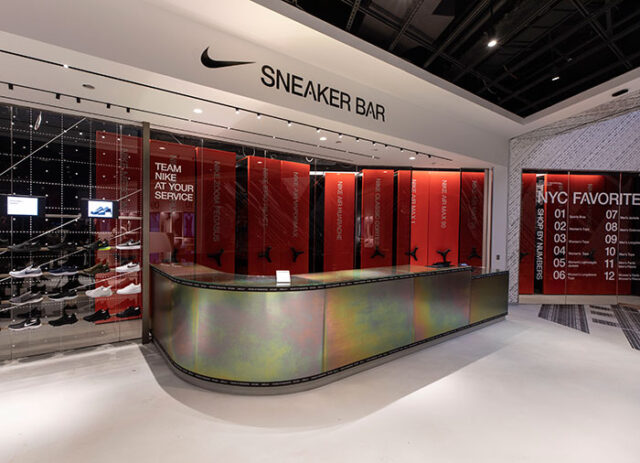
    Consumers can shop these curated New York City favourites alongside seasonal picks, visit the Nike Sneaker Bar or reserve items in the Nike App and pick them up in the Speed Shop digital lockers.

    On the fifth-floor is the Nike Expert Studio – the company’s first dedicated floor to provide even more personal service to NikePlus members, including bookable sessions with Nike Experts and the Nike by You Studio, offering members-only exclusive seasonal products, one-on-one styling sessions and even create personalised products.

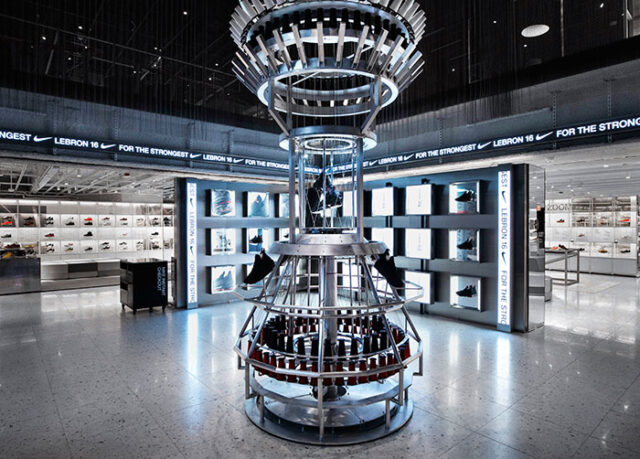
    Nike NYC features separate product floors for men, women and kids. On the fourth floor is the Nike Sneaker Lab, billed as home to the largest concentration of seasonally current Nike footwear anywhere in the world.

    The entrance to the store – dubbed the Nike Arena – showcases the most immersive seasonal and sport-inspired storytelling moments from the brand.

    The store’s exterior features slumped and carved glass designed to “reflect and create motion that mirrors the movement of athletes”, elevates the Nike Swoosh logo and reflects “the iconic aesthetic of Nike Air”.

    Technology at Nike NYC

    Here’s a quick rundown of the new and existing technology featuring in the new flagship:

    Shop the Look: By scanning a QR code on an in-store mannequin, consumers can browse every single item on the mannequin, check to see if their size is available in-store or online and see available colours. Then with just a tap, they can request for select products to be sent to a fitting room of their choice or receive the items from a store athlete at a designated pick-up spot.

    Nike Instant Checkout: Using Nike Scan, NikePlus members can skip the line and easily checkout from within their Nike App using stored or new payment methods. Members can scan the product(s) of their choice, check out like a traditional Nike App purchase and receive their payment receipt within the app. Nike Instant Checkout stations are positioned throughout Nike NYC so that shoppers can fold and bag products if they choose before leaving the store.

    Nike Scan to Try: While this technology was released earlier this year it has now been refined and expanded. After discovering any product in the store and scanning the item to learn more, shoppers can now simply tap “request to try-on” for various items. Requested products can then be collected at designated pick-up areas in Nike NYC, or they can be reserved to a fitting room location of the consumer’s choice.

    Nike Reserve: Using the Nike App, NikePlus members can reserve product at home to pick up in store. They can shop the product they want in the Nike App and then complete their purchase with an in-store athlete or with Nike Instant Checkout.

    Retail Home: When entering Nike NYC, members will gain access to an array of new features and content via their Nike App homepage.

    NikePlus Unlocks: NikePlus Member Unlocks are delivered through the Nike App to reward the best of Nike product, to deliver immersive brand experiences, to award activity achievements and to share partner rewards with members. Member Unlocks can be given directly from a Nike Expert in-store or targeted to consumers based on their sport and style interests. Select Member Unlocks may also be delivered to consumers outside of Nike NYC, which they can redeem in-store with an athlete.

    Product Concierge: If a product is unavailable in Nike NYC, an in-store staff member can search inventory across the entire marketplace – online or offline in Nike-owned stores, as well as its reseller network. If found, and available to ship or reserve, customers can have the item held at a local store or have it delivered. This service will be exclusively available on the fifth floor Nike Expert Studio Service Desk.

  • Retailers Transforming Distribution, Expanding Online and Turning to the Cloud as They Revolutionize Customer Experience

    Retailers Transforming Distribution, Expanding Online and Turning to the Cloud as They Revolutionize Customer Experience

    As retailers race to deliver more unique and personalized customer experiences, the use of Cloud, IoT and Big Data will accelerate in stores, online channels and distribution centers. However, one quarter of retailers still lag in the process of adopting new technologies and integrating them across operations to present a more integrated customer experience, according to a new report from Vertiv.

    For the report, participants included executives from 50 of the world’s largest retailers, with a combined annual revenue of $953 billion USD in 2017. The study, “Into Uncharted Territory: Retail Transformation and its Impact on Digital Infrastructure”, co-sponsored by Vertiv and DatacenterDynamics, revealed a heightened focus on online retail, as businesses transform their digital resources and capabilities to address changes in customer behavior. Over the next two years, the amount of data center space dedicated to online retail – both on-premise and colocation – is expected to increase by 20 percent, while cloud hosting would increase by 33 percent to support store applications.

    An important part of the retail digital evolution includes a massive transformation of distribution centers. The research suggests the number of distribution centers and warehouses will increase by about 26 percent over the next two years as retail companies increasingly realign operations to meet consumer demand for online purchasing. The amount of data center space dedicated to distribution/logistics is expected to increase by 10 percent and the use of cloud hosting to support distribution will increase by 87 percent.

    “It’s no secret that online retail is driving significant IT investment for retailers. However, as this study makes clear, digital transformation in the retail space is about more than e-commerce,” said Lucas Beran, analyst, data center infrastructure at IHS Markit. “Today’s retailers are striving to improve the IT systems in their stores and distribution centers as they pursue impactful customer experiences across all interactions with their brand. More business-critical online, distribution and in-store environments require new approaches to physical infrastructure to increase IT reliability, speed time to market, hold down costs and reduce management complexity,” Beran added.

    The survey confirms that more computing power is being moved into stores to support edge computing types of applications providing greater customer immediacy and influencing them at the point of use.

    “Retailers are going to move more IT footprint into the stores, to communicate with customers and to influence them closer to the point of decision,” said Martin Olsen, vice president, global edge and integrated solutions at Vertiv. “Our forecast for the next couple of years shows about two dollars going into stores and distribution for every dollar spent in the core data center. And much of that data center investment is being made to support online and stores.”

    To support their transformation, retailers are adopting new physical infrastructure options that provide higher reliability and are easy and fast to deploy. These technologies are based on standardized, modular designs that are scalable with capacity demand and future-proofed for next-generation technological advances.


  • Public Bank launches all-in-one digital payment platform

    Public Bank launches all-in-one digital payment platform

    Public Bank Bhd, in partnership with Revenue Group Bhd, today launched the all-in-one digital payment terminals. This all-in-one digital payment terminal has been piloted at selected merchant outlets of Public Bank and will be made available tomorrow.

    Public Bank managing director and CEO Tan Sri Tay Ah Lek said the first all-in-one digital payment terminal in Malaysia, developed by Revenue, will simplify the payment acceptance process as it will enable the physical retail merchants to accept both card payments and mobile wallet payments in a single digital payment terminal thus providing convenience to them.

    As at end September 2018, Public Bank has more than 60,000 electronic data capture terminals nationwide.

    Tay said it will continue with its strategy of increasing its merchant base and adding on more new acceptance services.

  • Stocking up on Digitalization to Increase Share-of-Basket

    Stocking up on Digitalization to Increase Share-of-Basket

    With the rise of e-Commerce, Asian retailers are under tremendous pressure to continuously push traditional boundaries and embark on digital transformation to engage consumers. Keeping up with the latest trends in providing the best consumer experience have retailers looking to tech innovations, particularly digital technologies, to play a key role in capturing and keeping customers’ attention and loyalty.

    Technologies such as the cloud, Internet of Things (IoT), mobility solutions, and augmented reality (AR) are driving customer-facing innovations such as digital marketing, smart shopping carts, couponing, and mobile apps – that bring people into the store and keep them coming back. Cloud applications also make it easier for store associates and corporate staffers alike to collaborate and take care of back-office needs.

    The reality is that retailers need to embrace digital transformation and use technology in innovative ways to enhance the customer experience if they want to remain competitive.

    Technology Challenges

    However, rapid adoption of digital in retail not only improves outcomes but ignites new challenges for IT administrators in retail organizations. Among the challenges are how to:

    • Support increased customer engagement with in-store technologies that have high-bandwidth demands
    • Support increasing use of applications in the cloud with a resilient and secure network
    • Ensure connectivity and provide secure access for point-of-sale (POS) applications and electronic payment transactions
    • Ensure performance for real-time applications such as voice, video, and unified communications

    Taking on one of these efforts in the past may have required every resource, but now all of these must be accomplished by the same IT staff.  Also, these changes must be deployed across hundreds and even thousands of store locations spanning vast geographical regions.

    Yet the connective element that brings everything together for retailers –  existing networks are now too complex, too expensive, and frankly, too outdated to support the challenges and opportunities that come from digital transformation. A new approach to the retail network is required.

    With a Virtual Cloud Network, retailers can create an end-to-end software-based network architecture that delivers services to applications and data wherever they are located at global scale from edge to edge, with consistent, pervasive connectivity, and security.

    Faster service delivery on the cloud

    Alfamart in Indonesia is an example of a retailer that embarked on digital transformation by adopting cloud and mobility solutions, and reaped the benefits of a modernized, connected business network.

    Faced with a vast network of over 10,300 minimarts spread across the Indonesian archipelago and basic internet infrastructure in many far-flung areas, it was difficult for Alfamart to convey information in a timely manner across its network.

    The slow flow of information impeded the business’ ability to make critical decisions in a timely manner,  resulting in them not being able to react quickly enough to customer feedback or market trends, and affected overall competitiveness.

    Alfamart decided to connect all of its store employees and partners with a bring your own device (BYOD) strategy and an enterprise mobility management platform over the cloud.

    All store employees are now equipped with the most up-to-date product information, prices and stock level at their fingertips, enabling them to act quickly to meet market trends, and manage peaks in demand for the fast-moving perishable goods they provide.

    This has improved their speed-to-market, reduced training costs by 20 per cent, enhanced mobility across device and platforms, and improved internal communications between management and employees. Customer satisfaction levels have also gone up.

    Keeping systems up and goods in stock at all times

    City Mart in Myanmar is another retailer which benefited from modernizing its legacy IT infrastructure by adopting virtualization. Lengthy downtimes were a common occurrence under their old IT system, which affected their supply chain and resulted in unfulfilled customer orders, negatively impacting revenues.

    The supermarket network implemented a software-defined IT infrastructure and automated certain IT processes, which not only eliminated server downtime but also cut operational expenses by half. Predictive analytics and smart alerts also helped improve the system performance.

    With a new inventory management system, City Mart is now able to gain visibility of their stock across their entire network of 180 stores, whether on storeshelves or in the warehouse. This enabled them to better understand changing consumer demand patterns across different stores, ensure that goods are in stock at all times, and build stronger relations with suppliers.

    Ultimately, the virtualized IT infrastructure supports City Mart’s expanding business, enabling the retailer to meet the needs of Myanmar’s growing consumer class.

    Networking for Retail 2020

    The future of networking is software, and the network of the future is the Virtual Cloud Network. Virtual Cloud Networks allow retailers to create a digital business fabric for connecting and securing applications, data, and users across the entire network in a hyper-distributed world. In this way, retailers can simplify networking and wide area network management, optimize cloud access from all locations, assure high performance for even the most demanding applications, and enforce security and compliance across the network in every store location.

  • UOB Launches Southeast Asia eLab

    UOB Launches Southeast Asia eLab

    UOB launches its pan-regional Engagement Lab (eLab) on Thursday, making it the first dedicated unit set up by a Southeast Asian bank that focuses on using the latest technology and behavioural insights to deepen customer engagement.

    «We believe that designing a simple and easy-to-navigate app interface to create an intuitive user experience is just the beginning. We want to build on this and to ensure that every touchpoint – from the on-boarding process to day-to-day banking – at the Digital Bank is relevant to our customers and resonates deeply with their lifestyle needs and priorities,» said Dennis Khoo, head of digital bank at UOB in a press statement.

    eLabs Serves Southeast Asian clients 

    The Bank will set up eLabs across its network of ASEAN countries such as Indonesia, Malaysia, Singapore, Thailand and Vietnam. UOB’s Digital Bank, set to launch in the next few months, has been modelled such that digital interactions with the customers are designed to deepen client relationships.

    Through the eLab, the Bank will use the insights drawn to design, to test and to trial ways to encourage customers to save and spend more wisely. Given ASEAN’s cultural and linguistic diversity, these conversations will be in the customers’ own mother tongue.

    Digital Capabilities

    In August, the bank had announced plans to introduce a Digital Bank for Asean customers that will use a data-centric business model to understand individual customer banking needs and habits through their digital interactions with the bank.

    «We will use next-generation digital capabilities to anticipate our customers’ needs and to prompt them to make better financial decisions to achieve their goals. This will be done through meaningful real-time digital conversations that guide customers to better financial choices,» Khoo said.

    UOB Accelerates Hiring For Digital Bank

    The Bank aims to increase its Digital Bank team by 50 per cent in the next 12 months. Of these new hires, a quarter will join the eLab. Other roles include those in areas such as user experience and user interface design, behavioural science and research, data analytics and design thinking.

    This helps to accelerate the Digital Bank’s initiatives in the region, it said. The new hires will join the 120-people strong team already working on the roll-out of UOB’s digital bank across ASEAN.

    In addition, it is looking to hire software engineers and architects to develop solutions such as in-house application programming interfaces (APIs) which tap UOB’s secure IT architecture to drive real-time data analytics.

  • Four barriers to digital transformation

    Four barriers to digital transformation

    Consumers are increasingly using digital channels for part, if not all, of the path to purchase. As a result, retailers are shifting from a product-driven approach to a more customer-centric model, allowing them to deliver a personalised experienced regardless of which channel is used.

    Investment in digital transformation is required to successfully make this transition. Think for instance of the data capture capabilities that are required to deliver a personalised experience in stores. However, innovation is easier said than done and many retailers have experienced difficulties on their digital transformation journeys.

    Here are four major barriers that retailers often encounter in their digital transformation projects are as follows:

    Overcoming resistance to change

    Digital transformation often leads to significant changes within organisations and that can provoke strong reactions. It is only human nature to resist change after all. This can manifest itself through issues such as difficulties in pushing through budgets, unsettled staff and a lack of consensus. If change is not managed carefully and communicated clearly to all staff, projects can easily derail.

    Understanding the connected customer

    Before embarking on digital transformation, it is crucial for organisations to truly understand the challenges they face. Why do customers choose to buy online and what expectations do they have when they visit a store? Technology on its own is not the answer and retailers need to be very careful to ensure digital initiatives meet their customers’ needs.

    Achieving departmental cooperation

    Digital transformation can and should touch all facets of the organisation. However, too often digital initiatives are driven by one department and key internal stakeholders are not consulted throughout the process. For changes that may disrupt the entire business model of a retailer, it is critical to get buy-in across the entire organisation, from the executive board to store staff.

    Attracting the right talent

    Digital transformation requires forward-thinking pioneers and getting the right talent on board can accelerate a retailer’s digital strategy and even provide a competitive edge. With the entire sector facing disruption, highly skilled professionals are in demand and retailers are increasingly having to look outside the sector to find the expertise they need.

    • Philip Wiggenraad is head of research with Tofugear and will be a speaker at next month’s Millennial Masterclass.

    What barriers does your organisation face when it comes to developing a digital strategy and driving organisational change? Inside Retail and Tofugear have kicked off the 2018 Asia Digital Transformation Survey and are inviting retail executives and managers in Asia to participate in the survey. Respondents will also be given exclusive access to the findings as well as a free hard copy of the final report.

  • Storefront partners with Obsess to create virtual reality stores

    Storefront partners with Obsess to create virtual reality stores

    Storefront is pushing the boundaries of the retail industry by giving brands for the first time ever the opportunity to rent Virtual Reality pop-up stores right on its platform.

    Retailers and e-commerce brands can now launch a virtual, fully customisable store powered by Obsess’ VR technology, featuring their own inventory and choosing any layout, decor and style.

    The ‘Future of Retail’ is retail everywhere, according to Storefront

    Storefront is making retail accessible to anyone in the world by now giving customers a unique selling and buying experience through Virtual Reality, in addition to its current retail space offerings. Now, anyone has the ability to experience a physical store with the ease of online shopping.

    “We see this Virtual Reality pop-up store as creating a new category between e-commerce and a physical retail space. It’s a great in between,” says Joy Fan, Storefront’s CCO.

    Get a taste of (virtual) reality

    With this new partnership with Obsess, brands and retailers can now easily book space through a New York City, Los Angeles, or San Francisco themed virtual store.

    Now with this virtual pop-up store, e-commerce brands can get a branded store environment without the need to invest in a physical space – just yet.

    “Our goal is to bring the visual merchandising and curation of retail stores into online shopping to make it a more guided and enjoyable experience,” explains Obsess founder and CEO Neha Singh.

    By booking this virtual reality experience, brands will be able to increase digital engagement, reduce costs, create more traffic and acquire new data.

    A unique initiative that allows Storefront to open all doors to all ideas.

    About Storefront

    Storefront is the world’s largest marketplace for short-term retail space rental, making it possible for brands to sell their idea anywhere; for space owners to activate their space with a click and for consumers to buy local; globally.

    Storefront’s platform powers more than 10,000 listings, which represent more than 30 millionsqft of retail space. The company offers greater access to spaces in leading retail cities around the world, including Hong Kong, New York, Paris, London, Milan, Amsterdam, Los Angeles and San Francisco.

    Since its launch in 2013, it has helped thousands of brands all over the world, including Google, Samsung, L’Oréal, Everlane, Shopify, Indiegogo; open temporary retail stores.

  • CIMB Bank’s digital push

    CIMB Bank’s digital push

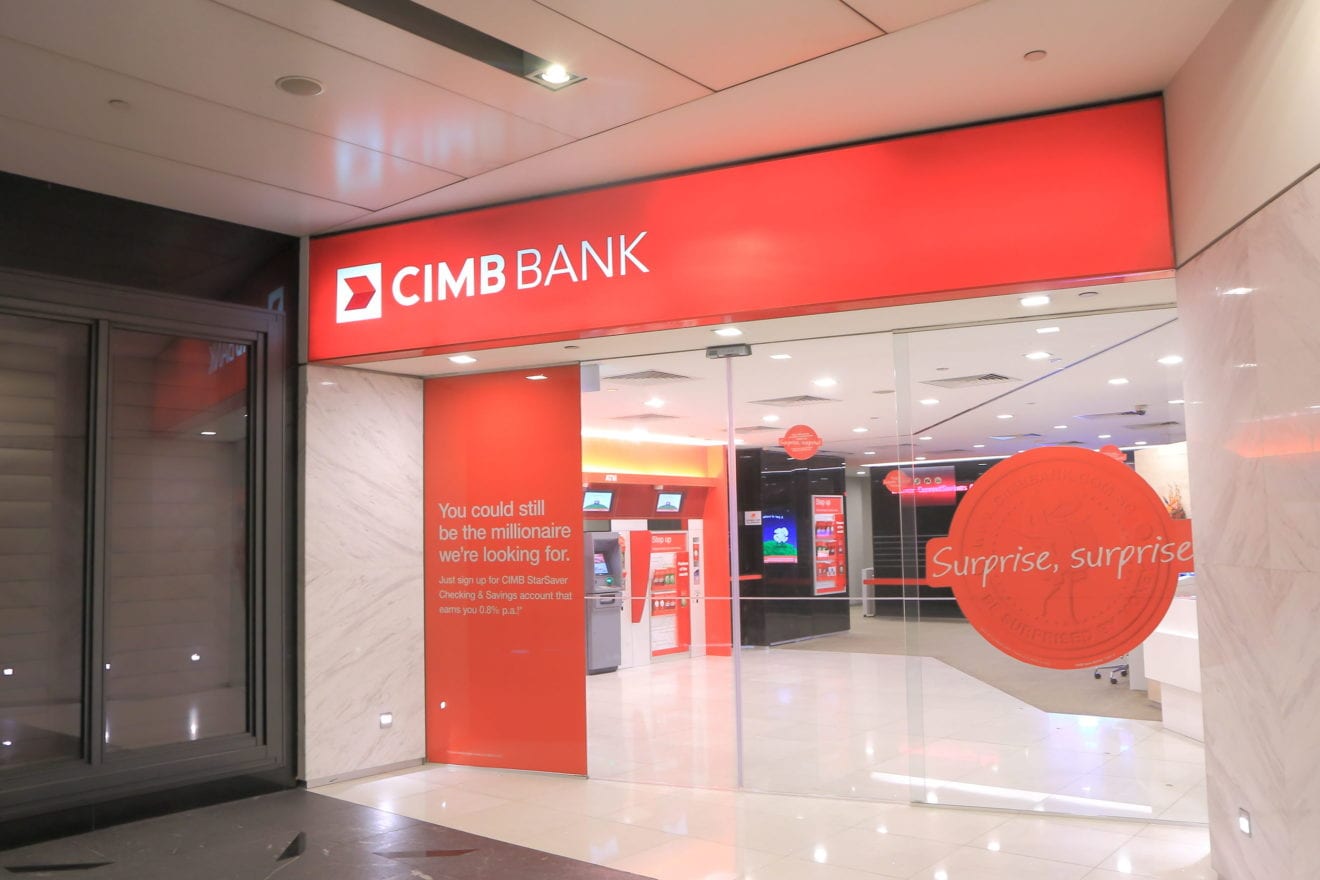
    CIMB Bank is ready to disrupt itself and will bank on data as one of the main thrusts in becoming a regional digital banking group at a time when disruptions are fast taking place in the financial services sector.

    On the whole, the group’s digital sales revenue has grown at a rapid phase from financial year 2016 (FY16) to FY17. In Malaysia it grew about 134%, in Indonesia by 200%, in Thailand and in Singapore by more than 1,000% and 464% respectively from FY16 to FY17.

    CIMB Bank Bhd CEO for group consumer banking Samir Gupta says digital sales enablement is the first phase of CIMB’s digital ambitions. Customers are moving away from over-the-counter service to digital transactions, resulting in a close to 35% drop in CIMB’s over-the-counter transactions to 2.9 million in March this year from 4.4 million in September 2016.

    Currently, more than 95% of customers’ transactions are performed via digital or self-service platforms.

    Samir adds that there had been a 27% drop in over-the-counter transactions in the last six months alone – while existing staff are being reskilled and retrained to take on more productive tasks – reinforcing the banking group’s strength and commitment to digital transactions.

    Moving forward, big data will define CIMB’s retail banking as part of the bank’s transformation into a digital banking group in South-East Asia.

    “The usage of data will build, reshape and strengthen the bank’s digital initiatives.

    “Amid the disruptions from fintech, CIMB has made a firm commitment to disrupt itself as this will help us to reach and meet consumers’ demanding needs promptly.

    “Rather than just look at existing competition, the bigger challenge is how fast we can meet consumers’ needs at a fraction of the cost. Big data will allow us to have a full view of customers’ needs and enable us to facilitate faster transactions,’’ he says during an interview.

    CIMB has launched the first big data platform in the country, using open source software and supported by a data science centre of excellence.

    There are plans underway to beef up the group’s big data initiative by hiring a significant number of data scientists and data engineers over the next two years.

    “As almost 90% of global data is unstructured, there is great demand for data scientists and data engineers who has the expertise to combine both data – structured and unstructured – to help banks to have a full view of customers’ needs,’’ he adds.

    Apart from this, the bank will also launch by next month what it terms as a “rules engine” as part of its big data push. This involves the bank’s ability to listen and react to customers’ needs instantaneously in real time.

    Big data initiatives

    The big data initiatives will be carried out at the bank’s operations in Malaysia and other regional markets. CIMB will be launching its digital “challenger” bank in Vietnam in June and in Philippines by November this year. Digital challenger bank refers to a full-fledged digital bank which challenges the traditional way of doing business.

    Commenting on the scope and market of these two countries, Samir says: “They have a combined population of over 200 million and the market is huge and offers great potential.

    “We are moving away from the traditional brick-and-mortar branch model in Vietnam and Philippines. For these markets, CIMB will be bringing totally new systems to support the full-fledged digital proposition which will be led and driven from a customer’s journey view point. We will also be replicating the challenger bank concept in Thailand by year-end.”

    Meanwhile, CIMB Bank recently added new features to its first-in-Asean, innovative and award-winning mobile chat-banking app, CIMB Enhanced Virtual Assistant (EVA), to include Spend Analyser and natural language conversational capabilities.

    With CIMB EVA’s Spend Analyser, customers are able to manage their accounts better and make smarter financial decisions via single-tap spending insights for utilities, petrol, entertainment, dining and travel made on their CIMB debit, credit, and prepaid cards.

    In addition, CIMB EVA’s chat capabilities have been enhanced to cater to a wider range of chat-based transactions, enabling customers to chat with EVA based on words in natural conversations.

    On CIMB’s strategic regional partnership with Japan’s number one insurer, Sompo, Samir comments that “this partnership in our markets in Malaysia, Indonesia, and Singapore not only allows us to optimise regional synergies and operational efficiencies, but also leverage on both parties’ digital capabilities to spur innovation and bring to market products that address customers’ protection needs instantaneously, such as the Travel Care EVA to be launched soon.”

    Soon, CIMB Bank will also be launching its personalized life stage-based holistic financial solutions – based on its F.I.R.S.T. proposition, which stands for finance, insure, returns (investment), save and transact – as part of its initiative to leverage on big data and encourage customer stickiness.

    Thanks to its push towards digital, CIMB Bank was recently awarded, for the second year in a row, the Best Retail Bank in Malaysia, and was also declared winner for The Best Productivity, Efficiency and Automation Initiative, Application or Programme by the prestigious Asian Banker’s Retail Financial Awards 2018.

    CIMB Bank is also the first bank in Malaysia to receive Bank Negara’s regulatory sandbox approval for electronic-know your customer (E-KYC), a paperless and electronic method of verifying the identity of customers, which is set to be a feasible alternative to existing face-to-face verification requirement in today’s traditional banking.

  • Target’s holiday sales are stronger than expected

    Target’s holiday sales are stronger than expected

    US discount department store chain Target has raised its quarterly profit and sales forecasts, after a better than expected festive trading period.

    Comparable sales growth of 3.4 percent in the November/December period was driven by strong traffic growth and continued strength in digital sales, which are expected to grow more than 25 percent in 2017.

    Stores fulfilled 70 percent of Target’s digital volume in November/December, meaning that stores enabled approximately 80 percent of the company’s comparable sales growth in that period.

    “As we look ahead to 2018, we will build on the foundation we established this year by launching additional exclusive brands, enhancing our digital capabilities, opening approximately 30 small-format stores and tripling the size of our remodel program to more than 325 stores,” said Brian Cornell, chairman and chief executive officer of Target Corporation.

    While Target’s holiday growth is respectable and makes it a holiday winner, GlobalData Retail managing director Neil Saunders prior year comparatives – when same-store sales fell by 1.3 per cent – are very weak and since that time Target has undertaken a raft of initiatives that should have boosted performance.

    “All that said, the growth does indicate that Target is on the right track and that it’s various ventures are starting to pay dividends. However, we believe that it also highlights some deficiencies in execution – especially in stores.”

    “Target’s holiday focused Wondershop is another example of a lost opportunity. Like last year, Target’s range of holiday decorations and sundries was comprehensive and, in our view, one of the best in the market. However, also like last year, Target buried this offer at the back of the store and, as a consequence, lost custom. We note that more effort was made to signpost the collection this year, but this proved to be inadequate.”

    Digital was the undoubted success, according to Saunders, with robust online growth underpinning performance.

    “Overall, this is a positive outcome. It shows Target is doing the right things and that its ideas have merit. However, it also indicates the need for more care in execution, a faster roll-out of the initiatives, and a greater sense of ambition. Ultimately, Target is doing well, but it could be doing better.”

  • Digitalisation of supply chains in India

    Digitalisation of supply chains in India

    The digital B2B marketplace for warehousing, Log-hub AG from Switzerland, and the Indian Supply Chain specialist 3SC are now collaborating on the Indian market. Both companies are technology based and offer advanced analytics based transportation and warehousing solutions. Log-hub and 3SC have agreed to combine their capabilities to provide seamless service offerings for those companies who want to identify and implement the savings potential of the new Indian tax regime.

    Log-hub AG and 3SC Solutions Ltd provide complete supply chain management services in terms of planning and execution throughout entire India. Their transportation and warehouse network is rendered by a control tower set up of more than 200 experts and the digital marketplace for warehousing space.

  • Shippers reluctant to embrace digital solutions risk losing money

    Shippers reluctant to embrace digital solutions risk losing money

    Forwarders and shippers unwilling to implement digital solutions will increasingly be left behind by rivals able to generate cost savings and service improvements through new technologies, according to Alex Ruf, a 25-year logistics veteran and CEO of logistics marketplace book-cargo.com, one of the world’s largest freight rate search platforms.

    “It’s not about choosing whether or not to adopt new technology and working practices,” he said. “It is about when you do so – change is inevitable.”

    Ruf insisted all supply chain stakeholders – whether procuring or providing air, land or ocean forwarding services – could now reduce costs and improve supply chain transparency by deploying new technological solutions.

    “And, of course, customers also want lower quotes and improved transparency so it’s win-win,” he added.

    “Whether now or in the near future, failing to embrace digitisation and the automation of supply chains and freight bookings will have an impact on profits and customer relations.”

    Mr Ruf also claimed it was wrong to frame the discussion about new technologies entering the logistics space as a battle between incumbents and disruptors.

    “New technology does not have to be negatively disruptive to the traditional ways that forwarders and shippers conduct business,” he said. “Certainly, book-cargo.com is designed to enhance the businesses of our users, not detract from them. The feedback we get from forwarders and shippers is very positive.”

    book-cargo.com was soft launched in October last year and already has some 6,000 registered shipper and forwarder users making it one of the world’s largest freight rate search marketplaces. The system provides a fast and easy way to request and compare freight rates for global FCL, LCL, Air and Road shipments online, with comparisons possible based on price and transit time.

    book-cargo.com offers easy-to-use tariff management and rate upload functions as well as analytical tools which enable strategic planning across variables including reply times, hit ratios and most requested lanes. Online bookings can be made by forwarders, shippers or agents with just a few clicks.

    “book-cargo.com brings the freight forwarding and logistics industry into the digital age,” said Mr Ruf. “It’s already one of the world’s largest freight rate searching platforms and we are attracting more users every week.

    “Forwarders like it because they can upload their rates. Counter-parties like it because they can get an immediate response.

    “As well as shippers using it to procure rate and routing options by all modes, freight forwarders are also reaching out to other forwarders. And book-cargo.com also helps forwarders who do not have partners or agents in specific countries to find them.”

    Using book-cargo.com, Electronic Data Interchange (EDI) connections can be established to share booking details and/or shipping instructions with other users. Chat functionality has been built in to allow information and communication at the request/shipment stage. Once a booking is made, book-cargo.com provides a tailored control tower to ensure end-to-end supply chain visibility.

    “An information revolution is taking place and companies are demanding greater visibility, more sophisticated analytics and the ability to make better and faster decisions,” said Mr Ruf. “book-cargo.com facilitates this. It is open 24/7. It enables searches, comparisons and bookings to be made in just a few clicks by forwarders and shippers. And it vastly reduces the time and resources required to effectively manage supply chains for both buyers and sellers of air, ocean and land freight services.”

  • Huawei to help drive Singapore’s digital economy push

    Huawei to help drive Singapore’s digital economy push

    Huawei has entered a strategic partnership with Singapore’s Infocomm Media Development Authority (IMDA) to accelerate the nation’s digital economy thrust.

    The company has likewise entered agreements with Keppel Data Centres, and Ascent Solutions also related to Singapore’s digital economy future for a Smart Nation.

    The partnerships aim to enhance industry collaboration, enable local companies to scale globally, empower the workforce with skills relevant for the digital economy as well as equipping companies with the technology and knowledge to build strong digital capabilities in a sustainable manner.

    Huawei, IMDA, and Keppel Data Centres will focus on a two-year strategic collaboration to explore the technical feasibility of a first-of-its-kind high-rise green data center building.

    Huawei and IMDA will also collaborate to accelerate the growth of local SMEs by leveraging Huawei’s technical expertise and facilities, go-to-market opportunities and global business network.

    Further, Huawei will support Ascent Solutions as its technology enabler, allowing the local company to tap Huawei’s global business network and explore overseas opportunities.

    In addition, IMDA and Huawei will jointly promote deeper talent and capability building among local ICT students.

    This initiative will include 45 overseas training stints and internship opportunities for students to explore new capabilities in technology areas critical to the future such as the IoT, 5G, and cybersecurity.

  • Siemens launches Digitalization Hub in Singapore

    Siemens launches Digitalization Hub in Singapore

    Siemens has launched its first fully integrated Digitalization Hub in Singapore in a bid to bring its expertise and innovations in the IoT to the Southeast Asian market.

    The company will be co-creating future digital applications with customers and partners to build a digital ecosystem.

    Supported by the Singapore Economic Development Board (EDB), the Hub brings together data scientists, solution architects, software engineers, system experts and domain specialists from the urban infrastructure, industrial and healthcare sectors. These professionals will experiment, learn, develop and test-bed innovations and future-ready digital solutions that help businesses become more efficient and sustainable.

    An integral part of the Digitalization Hub concept is MindSphere, an open, cloud-based IoT operating system that offers data analytics, connectivity capabilities and tools for developers, applications and services. This platform helps evaluate and process data to gain insights and optimize asset performance for maximized productivity.

    “Singapore is the ideal location for this Hub because of its distinctively advanced industrial and urban infrastructure development, combined with the government’s Smart Nation thrust to enable a digital economy,” Siemens CEO Joe Kaeser said.

    Sixty specialists from a variety of disciplines will work at the Hub at the outset. The number of digitalization experts is expected to reach 300 by the year 2022. The key target areas for the Hub are urban infrastructure, advanced manufacturing and healthcare.

    To mark the launch of the Siemens Digitalization Hub, three collaboration agreements were signed with Singapore partners. Nanyang Technological University, Singapore (NTU Singapore) will partner with Siemens to create and showcase data-driven innovations for urban infrastructure.

    SP Group will collaborate with Siemens to build a next-generation energy management software platform for SP’s 24/7 control centers, to enable more robust planning, surveillance and predictive maintenance of Singapore’s electricity network.

    The electronics arm of Singapore Technologies Engineering, Singapore Technologies Electronics, and Siemens also signed a partnership agreement to co-create and proactively market innovative digital use cases in the field of transportation (roads, harbors, airports and mass transit).