Tag: Indonesia

  • Alibaba Group Puts Spotlight on Indonesian Brands

    Alibaba Group Puts Spotlight on Indonesian Brands

    Chinese e-commerce giant Alibaba launched a special section for Indonesian products on its platform on Friday to promote the country’s best products to more than a billion Chinese consumers. The section, known as the Indonesian Pavilion, debuted on Alibaba’s Tmall Global, a platform dedicated to helping international retail brands and entrepreneurs reach out to the Chinese market despite not having a presence in the country.

    Indonesian Ambassador Djauhari Oratmangun and Ryan Wang, general manager of public affairs at Tmall, inaugurated the special section during an event in Shanghai.

    The Indonesian Pavilion was launched in time for Alibaba’s 2018 11.11 Global Shopping Festival, the world’s largest one-day shopping event, which takes place on Nov. 11 every year.

    The section will initially offer five leading Indonesian food and beverage brands: Indomie instant noodles, Kapal Api packaged coffee, Richeese biscuits, Yan Ty Ty swallow’s nests and Papatonk shrimp crackers.

    Through Tmall’s integrated service center, brands can increase consumer awareness of their products ahead of the upcoming shopping festival.

    Chinese consumers will also have a chance to learn about Indonesia’s cultural richness and exotic tourist destination, which will also be featured on the platform.

    This forms part of Alibaba’s ongoing initiatives over the past few years to support Indonesian startups and small and medium enterprises.

    Jack Ma, Alibaba chairman and co-founder, serves on Indonesia’s digital economy board, advising the government on how to best nurture and implement digital technology to drive development.

    The government and Alibaba are also discussing ways to help Indonesia train local talent in the digital field and increase innovations in financial technology.

  • Indonesia Falls in 2019 Ease of Doing Business Ranking

    Indonesia Falls in 2019 Ease of Doing Business Ranking

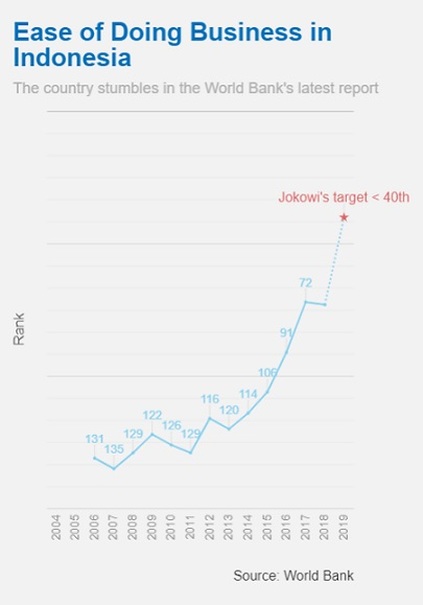
    If President Joko “Jokowi” Widodo wants to see Indonesia join the top 40 countries in the World Bank’s Ease of Doing Business ranking under his watch, he should make sure he wins re-election next year. Indonesia slipped one place to 73rd, behind Greece, the Ukraine and Kyrgyzstan, in the 2019 Ease of Doing Business report, released late on Wednesday. The president has set a target for the country to be in the top 40 by next year, but his second term will be decided in April, while the next report would not be out until next November.

    While Indonesia has made considerable progress in reforming the regulatory environment for businesses since Jokowi took office in 2014, Wednesday’s report reveals the stark realities of the country’s limited capacity to continue with these reforms.

    The country scored 67.96 out of 100 in the report’s aggregate measurement, up by only 1.46 points from last year. Slovenia, a Central European nation of only 2 million people and a $49 billion economy, sits in the coveted 40th place with an overall score of 75.61.

    Indonesia, for one, issued new rules that make starting a business, registering property and obtaining credit, easier for businesses and make it cheaper for them to get electricity. But reform stagnated in areas such as obtaining construction permits, protecting minority investors, paying taxes, trading across borders, enforcing contracts and resolving insolvencies.

    These bottlenecks allow economies like China, Kenya and Kyrgyzstan to overtake Indonesia. China made a leap to 46thplace in this year’s report, from 78th last year. Kenya moved up 19 places to 61st, while Kyrgyzstan went up seven places to 70th.

    Still, the report highlights Indonesia’s success in reforming its judiciary system and making the country a case study for others to emulate. The Supreme Court introduced training programs in 2003 for new and experienced judges, as well as special training for judges presiding over more specialized cases, such as those involving commercial or maritime disputes.

    “Indonesia’s efforts to train judges following judicial reforms bore positive results through a substantial decrease in court backlogs and insolvency case resolution times,” the World Bank said in the report.

  • Indonesia Gov’t Considers Reducing Its Levy on Palm Oil Exports

    Indonesia Gov’t Considers Reducing Its Levy on Palm Oil Exports

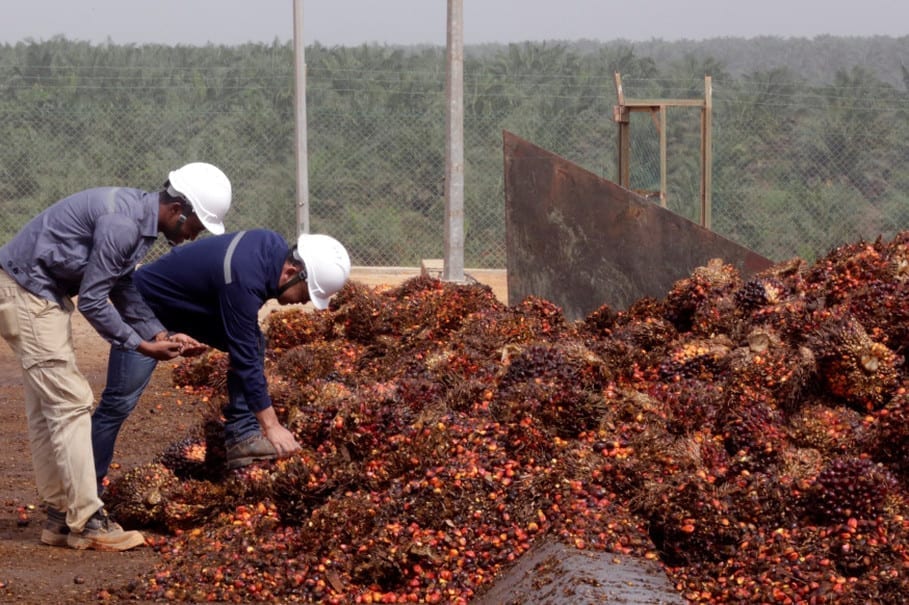
    The government is considering reducing its levy on palm oil exports, Coordinating Economic Affairs Minister Darmin Nasution said on Thursday, as the country pushes to maintain its position in international markets for the commodity.

    Speaking at an industry conference in Bali, the minister said an “adjustment” to the levy was among steps to be taken by the government, although he later said that this was still being discussed.

    “We don’t have final position yet,” Darmin said on the sidelines of the event. “We have to calculate that carefully. We don’t want lowering it only to result in lower prices.”

    Indonesia, the world’s top producer of the commodity, currently imposes a levy of up to $50 per metric ton on various palm oil products.

    The Indonesian Palm Oil Association (Gapki) said last week that it had proposed cutting the palm oil export levy by $20 per ton until prices of the vegetable oil reach $700 per ton.

    The government’s reference price for crude palm oil has stayed below $750 per ton for over a year.

    Darmin said the government would discuss the levy adjustment intensively over the next two months, hoping to reach a decision around year-end.

  • OVO lead in Cashless Payment Race in Indonesia

    OVO lead in Cashless Payment Race in Indonesia

    Lippo-backed cashless payment service OVO has announced a partnership with Tokopedia, Indonesia’s largest e-commerce platform. OVO said in a statement on Wednesday that the deal would help it cement its position as the country’s largest mobile payment platform in terms of transaction volume and reach.

    “The partnership will add Tokopedia’s close to 80 million active monthly users to OVO’s existing userbase of 60 million. It will also add more than 4 million Tokopedia merchants to what is already a market-leading merchant network, covering malls, smaller retailer, as well as GrabFood partners and Kudo agents,” the company said in the statement.

    OVO has been partnering with online-based ride-hailing service Grab since December last year, while also targeting brick-and-mortar shops and restaurants across Indonesia.

    “We see this landmark partnership as a validation of our strategy to enable payments for all Indonesian companies, both online and offline. Cash is a very difficult habit to break and consumers will only switch to cashless if it’s easier and safer than cash,” said Harianto Gunawan, director of enterprise payments at OVO.

    OVO chief executive Jason Thompson said the company expects a surge in new users and additional transactions from the e-commerce platform.

    “We have a very bullish outlook as we close out 2018. Having established ourselves as the No. 1 mobile payment platform by transaction volume, this partnership with Tokopedia and our push into e-commerce will further accelerate our growth,” Thompson said.

    The company said OVO is now available in 90 percent of shopping malls across the country, offering cashless payment options to customers at hypermarkets, department stores, coffee shops, cinemas, parking operators, hospital chains and food and beverage outlets.

    It has also set a target to expand QR-code payments to 100,000 small and medium enterprises by the end of this year.

    OVO’s online-to-offline business comprises its partnerships with Grab and Kudo, a service that allows individual agents to sell digital products, such as phone credit, tickets or insurance, to customers. Kudo currently has about 1.7 million agents in its network.

    OVO said its latest deal with Tokopedia would allow it to reach 93 percent of districts in Indonesia currently served by the e-commerce platform. It also plans to secure more deals with other e-commerce platforms.

  • LINE to Acquire 20% Stake in Bank KEB Hana to Expand Fintech Services in Indonesia

    LINE Corporation, through its subsidiary LINE Financial Asia, will acquire a 20 percent stake in lender Bank KEB Hana Indonesia to expand digital banking services in Southeast Asia’s largest economy, the Japan-headquartered messaging giant said in a statement on Sunday.

    A signing ceremony was held in Seoul on Oct. 26, the company said in the statement, adding that executives from both firms sought closer cooperation to make them become leaders in the digital finance market in Indonesia and Asia.

    LINE said the acquisition would be carried out through a share subscription agreement and that the deal was currently pending approval from Indonesian financial authorities. Still, the messaging giant said it was upbeat that it may launch its new digital banking service in the country by next year.

    Bank KEB Hana is controlled by South Korea’s Hana Financial Group – one of the East Asian country’s largest bank holding companies. The deal will see LINE Financial Asia becoming the second-largest shareholder in the Indonesian lender.

    “Through this partnership with Bank KEB Hana, we will launch easy-to-use and innovative banking services in Indonesia,” LINE Financial Asia chief executive Hwang In-joon said in the statement.

    “This agreement is an important step toward becoming a leader in mobile banking and expanding our fintech services,” he said.

    LINE, which is one of the most popular messaging platforms in Indonesia, said it was keen to add digital banking services to its broad range of content and services for Indonesian users.

    The messaging giant said with a population of 260 million people in a country of more than 18,000 islands, “Indonesia lacks banking services that can cover the entire country.”

    It added that, the deal was expected to improve LINE Financial Asia’s positioning in the archipelago, as well as globally, as it looks to become a major fintech and digital banking provider.

    Indonesia also has more than 100 million smartphone users and a very high rate of social media engagement, which present a huge potential market for digital banking services.

    Bank KEB Hana president director Lee Hwa-soo said he believes “LINE’s advanced digital technology and KEB Hana Bank’s retail banking experience will prove to be the future of the banking industry, demonstrating a new financial model that begins in Indonesia.”

    Bank KEB Hana meanwhile expects the deal to provide it with access to LINE’s large userbase, which presents huge opportunities for acquiring customers, while the lender also expects to increase its product portfolio and expand its retail banking services, to boost the volume of low-interest deposits and retail customer numbers.

    With LINE coming up as the second-largest owner of the lender, Bank KEB Hana expects to improve its digital marketing capabilities through the messaging giant’s brand power, technology, content and expertise. Both companies are “also looking to create deposit/microcredit products, and remittance and payment services for Indonesia.”

    Bank KEB Hana also expects assistance from its future investors to implement and improve credit rating models through projects with local as well as international credit rating agencies. The bank also plans to create an electronic identity verification process, known as e-KYC, that can be optimized for local regulations, among other measures.

    “With LINE expanding its fintech operations in Indonesia, the company is currently on the lookout for global talent to join us, with positions open in such areas as business development, service planning and management. Details of the available positions and applications can be found on LINE’s careers page,” it said.

  • Indonesia’s Legendary Tea Producer Declared Bankrupt

    Indonesia’s Legendary Tea Producer Declared Bankrupt

    When Indonesians enjoy a cup of hot black tea,  they are often reminded of one particular brand that seems to have been around forever: Sariwangi. The brand, established by Johan Alexander Supit in 1962 and introduced by the Sariwangi Agricultural Estate Agency in 1973, has been a household favorite for decades.

    The company based in Gunung Putri, a subdistrict of Bogor, West Java, started as tea trader, but soon diversified its business to become a tea producer. Its products were initially in sold in loose-leaf style under a different brand before the introduction of teabags, which changed the way Indonesians drink their tea.

    During the 1980s, the company also started exporting its products to other countries in the region and even as far afield as Eastern Europe, Australia and the Middle East.

    In 1989, the local unit of multinational consumer goods giant Unilever saw a business opportunity and acquired the brand, changing the styling of the name to SariWangi, and introducing several variants, including jasmine tea, green tea and circular teabags.

    The company was still expanding and selling up to 8 million tons of tea per year before it faced an unexpected downturn in 2015. This resulted in Sariwangi and its affiliate, Maskapai Perkebunan Indorub Sumber Wadung (Indorub), reportedly accumulating more than Rp 1 trillion ($66 million) in debt, owed to several lenders.

    In the same year, Bank ICBC Indonesia, HSBC Indonesia, Bank Panin Indonesia, Bank Rabobank Internasional and Commonwealth Bank took legal action against Sariwangi to recover the outstanding debt.

    This prompted Sariwangi to file a petition for a debt postponement in September 2015. In March the next year, the company filed for bankruptcy in the Central Jakarta District Court, but the court did not reach a verdict at the time.

    In August 2016, Bank ICBC Indonesia filed another lawsuit against Sariwangi and Indorub, claiming that the company and its affiliate did not have any intention to repay the Rp 322.7 billion they owed the lender.

    On Oct. 16, the court declared Sariwangi insolvent.

    Unilever Indonesia corporate secretary Sancoyo Antarikso said on Thursday last week that the consumer goods company was in no way affiliated with either Sariwangi or Indorub.

    Unilever said it once partnered with the original company to supply it with tea, but that the partnership had ended long ago.

  • An Overview of E-commerce in South East Asian Countries

    An Overview of E-commerce in South East Asian Countries

    Electric commerce or e-commerce is the activity of buying and selling online. Typical e-commerce transaction includes purchase of online books, music purchase and purchase and sales of many other items.  Three known major areas of e-commerce include online retailing, electric market and online auction. Technologies such as mobile commerce, internet market, electronic funds transfer, and electronic data interchange (EDI), online transaction process and many others.

    The practice of e-commerce in Southeast Asia started during the dot.com era in the 90’s just like in many parts of the world. The dot.com era refers to the period where companies started using doing for most of their businesses on the internet, usually through a website that uses the popular domain “.com”. During the dot com era southeastern Asia mainly purchased items from American and European companies that would be delivered in their countries. During this era companies with electronic commerce had shown great prospect with their fast growth and promising profits. Companies’ stock prices skyrocketed and Asia was pretty happy because the rise had resulted to a bubbling economy through electronic commerce.

    Asia then began to attract nearly half of the total capital inflow from developing countries appealing them with high interest rates. Countries like Malaysia, Singapore, Thailand and Indonesia experienced an increase in their GDP rates. Around the year 2000, the e-commerce market was mainly involved in a business to business (B2B) transaction due to customers mistrust after going through the 1997’s financial crises and the bubble burst in southeast Asia – bubble burst is often identified only in retrospect once a sudden drop in price has occurred – The burst is usually profitable for buyers and not sellers. In the 90’s a lot came up as hindrances to the upspring of electronic commerce

    – In those days, aside mistrust e-companies had other issues of which Southeast Asian countries were also affected. As a result of its structural shortcomings, a much more diverse range of payment solutions have become common in the region. The average internet penetration around southeastern Asia with the exception of Singapore was 38% while leading countries have an internet penetration of 70-80%, this made cash on delivery offered by 80% of the players in both Vietnam and Philippines, though bank transfer is another very popular payment method across the SEA. With each of the countries having 94%, 86% and 79% of merchants in Indonesia, Vietnam and Thailand respectively offering it.

    – In addition to a lack of uniformity in payment methods, there is also significant market fragmentation the Southeast Asian consumers have so many platforms to choose for their daily need.

    – Culture also was an inhibiting factor –the influence of Traditions in the Asian region overtime had made people have low trust in bank system and electronic payment, for example; credit card owners and other means used in payment other than in cash is small – government in those times pushed for a cashless policy in their society by trying to implement laws to suit online transactions.

    – Fraud and high level of corruption was another setback to the growth of electronic commerce in the region.

    The prospects and thrive; the battle for supremacy

    The gold rush in the online ecommerce of the as left traditional offline retailers in the Asia region like Thailand and Indonesia scramble for an online business move.

    Over the years until this day the massive growth in e-commerce around southeastern Asian has attracted big name investors into the region. In 2016 the release of the Google Temasek SEA Economy spotlight highlighted Southeast Asia as the world’s fastest growing internet region.  With an existing internet user of 260M which was projected to grow to 480m users by 2020. In the research they predicted that southeast Asia’s internet economy will grow to 200B by 2025 and that $40 – 50bn in investment will be required over a decade to achieve that goal, fast tracking to 2017 they observed that the southeast Asia’s internet user base continues to grow rapidly. there will be 330m monthly active internet users by end of 2017 adding over 70m new users since 2015 13% CAGR.  They estimate that Southeast Asia’s internet economy will reach $50b in 2017, meaning it will Grow at a rate of 27% CAGR outpacing their 20% 10year CAGR projection.

    Asia as a continent had an increase in of around 4.5  billion in the GMV ( gross  merchandise value ) of first hand goods and has had a 41% compound annual growth rate ( CAGR ) in the past couple of years- 2015 to 2017- as given by Google –Temasek’s economy southeastern spotlight 2017 report. The Temasek report went further to predict that CAGR will rise from $5.5bn of 2015 to $88bn by 2026. 2017 witnessed events which proved high results are expected from the e-market in southeastern Asia.  The explosive growth in E commerce as lured china’s two e-commerce giants Alibaba and sd.com to the southeast online market. Amazon much awaited  recent entrance into the E-market of a southeastern nation ( Singapore to be specific) to fast track its online market expansion in southeast Asia also proved there was an attractive raw material in the cyber space of the region.

    The record breaking 1billion dollar sales of shares of Lazadas to Alibaba with alibaba also putting its grip on Tokopedia; arguably a future competitor in Indonesia. The resilience of another China based heavy weight company; Tencent. Tencent has also kicked start investments in companies like SEA (previously Garena) predominantly a gaming powerhouse that runs Shopee, Go-jek, Traveloka, Tiki.nn and Pomelo. The US based KKR  in a bid not to be left out of this massive growth phase through emerald media put US$65million into e-commerce arms dealer Acommerce. This trends of acquiring more shares and grabbing more local companies across the Asian borders by these online giants  is expected in coming years as all stated above points to the fact that the riches in online space of these Asian nations is worth risking for.

    Currently, predictions have given that the home based Asian companies will have to pick sides with either of or stand their ground against the foreign forces from both the western and eastern part of the world.  Predictions went further  to specify that  foreign based companies like Alibaba, Amazon and Tencent is  likely to have a bloodbath battle for the monopoly of the regions  electronic commerce  or share the  Asian online customers, some term this head to head of the western state and eastern state as the clash of the online titans.  It is hope that this clash will result to a much needed gold-shed To Help in the growth of the developing region

    Joe Tsai, Alibaba vice chairman, in speaking with Retail News was quoted as saying “is there a land grab right now for these kind of assets? I think in the land grab they [Tencent] are following us. They are seeing that we have positioned ourselves very well, and they are sort of playing a catch up game. So what we want to do is to work with local entrepreneurs. ”

    Experienced, grown and growing

    Marc woo, Google head of ecommerce , travel and financial services was quoted to have said “Asia pacific (APAC) accounted for 40% of global ecommerce sales in the 1st quarter in 2017, but vast majority of those sales went to larger or more mature markets in the region, particularly china, but also japan, Australia, South Korea, and India. That leaves Southeast Asia as the next frontier for ecommerce in the region.  “

    A steady increase in the advantages of electronic commerce in the region resulted to a 50% growth last year and now totals 200 million individuals across southeastern Asian’s top six economies. The southeastern Asian nation Singapore takes a top spot in Asia with an average of 14.04 sessions per person per year visiting amazon.com. It is rumored and expected that by the end of the year the ecommerce companies should erect physical stores in their resident southeastern nations. This will make a great boost in the economy of this regions.  This huge development in ecommerce have led southeast Asian governments to launch a bid to introduce taxes on ecommerce sales as they look to claim their dollar-and-cents take from one of their most promising engine towards  economic and  financial buoyancy.

    This though might increase the cost price of goods and services offered by the online companies but cannot override nor underestimate its advantage as compared to import and shipping processes. Taxing online sales will align practice with those of world leading countries. It puts online retailers on a leveled playing ground with brick-and-mortar counterpart. This growing market has also initiated an online network process between the Chinese and the Asian region as Alibaba is working to set up a digital free-trade zone in Malaysia and has signed a memorandum of understanding with the government of the Asian country and the authorities of china to simplify cross-border trade between the two regions.

    If this deal falls through under the current government of china a long term mutual profit making relationship is expected to last for a very long time between the Asian nations and the Chinese government  giving that  the china parliament are rumored to have kick started plans in keeping their president more longer in office than usual.  The critical factors responsible or observed to needed for the spontaneous growth of ecommerce in the southeastern region of the continent are

    • A growing middle class – knowing that the middle class contains the highest number of mobile phone users and also the highest number of common goods purchasing.
    • Rapidly expanding internet access are positive indicators for fast paced e commerce growth in coming years. Internet access needs to be at its best for the effective running of electric commerce in a state

    The middle class population of the Asian region is expected to reach a 400million in 2020 from its 190 million of 2012, according to Nielsen project.

    Internet access in the region as not only being expanding at a high pace but has also improved strongly over the years like stated in the research of Google Temasek SEA economy spotlight report stated above.

    The electric commerce has also shown to be of disadvantage though not significant as compared to the many fruit yielded by the online market.

    • The desire for local business owners and the nation’s mobile phone user population to switch online results to more cases of fraud because this system isn’t used to them.
    • Competition between locals and foreigners which should encourage an healthy business environment is not observed as the big guns will slowly silently phase out the local brands
    • The preference of foreign products to locally made products by locals isn’t favorable for the country’s economy.
    • Owing to the creation of a good relationship with certain world leading countries, good tides with others could be altered.
    • If not properly monitored, foreign companies might have a full grip of the southeastern nation economy.

    One major benefit that has been observed to have taken the front line in the advantage of electronic commerce in the southeastern Asian region is the quest for each nation to outperform each other. Especially between Thailand, Vietnam and Indonesia, this healthy beef has led to varying developments in these nations as none wants to be left behind in the development and modernization of their country. These alongside the introduction of big time investors, the rise in economy growth, job creation in nations, strengthening diplomatic tides and many other advantages.

    Stakeholders and experts have advised to government of these Asian nations to support the region to grow by fixing reasonable tax levies in other not to discourage foreign and local investors, encourage a competitive market, improve online network and provide adequate education to ease communication with foreign partners. With the huge wealth emanating from the electric commerce sector, if properly managed these nations can get a massive boost in their nations wealth and reputation. The potentials possessed to build a nations revenue by employing electric commerce cannot and should not be undermined.

     

  • Telkomsel to adopt Kinetica analytics platform

    Telkomsel to adopt Kinetica analytics platform

    Indonesia’s Telkomsel has arranged to adopt the Kinetica advanced analytics platform to help it transform the customer experience for its users.

    The operator will use the Kinetica engine and NVIDIA graphics processing units (GPUs) to enable real-time analytics, location-based visualization and AI capabilities.

    Telkomsel plans to use thee capabilities to deliver data-driven customer experiences and to enable real-time financial and business reporting.

    “The rapid growth in mobile devices, digital users, and the micro-services nature of prepaid across the Indonesian market has led to exponentially more data generated than ever before,” Telkomsel CIO Montgomery Hong said.

    “This influx of extreme data presents a massive opportunity to develop new, personalized, digital lifestyle experiences for Indonesian consumers. Unlike traditional database solutions, the Kinetica engine is purpose-built for extreme data and provides real-time data analysis and location intelligence across our business, from prepaid and postpaid mobile, to digital lifestyle services (video, gaming, music), to mobile financial services, and digital advertising for starters.”

  • Go-Jek launches fuel delivery service

    Go-Jek launches fuel delivery service

    Go-Jek, in partnership with Indonesia’s oil major Pertamina, has launched an on-demand fuel-delivery service. Called Go-Pertamina, it brings fuel to users from the nearest Pertamina gas station. The service is available in South and Central Jakarta from 8 a.m. to 8 p.m. daily. It does not serve orders on toll roads, basements, or other enclosed areas. Given that Go-Jek has a large network of drivers who need to top up their fuel regularly, they could become some of Go-Pertamina’s biggest users.

    Go-Pertamina is part of the Indonesian ride-hailer’s Go-Life app, which offers on-demand massages, cleaning, haircare, and more. Go-Jek also recently launched a daily deals marketplace.

    Go-Jek has been expanding regionally. It has launched in Thailand and Vietnam and is set to launch in Singapore within a month. Its expansion into the Philippines, however, has hit a regulatory snag.

    It has raised about US$2.1 billion from investors, even as Grab has claimed to have outpaced Go-Jek in Indonesia’s ride-hailing market.

  • 40 travel agents join Garuda Indonesia Travel Fair 2018

    40 travel agents join Garuda Indonesia Travel Fair 2018

    More than 40 travel agencies, including five pilgrimage agencies, are joining the second phase of the Garuda Indonesia Travel Fair (GATF) 2018. The event, held by the flag carrier in partnership with Bank Mandiri, is held at the Jakarta Convention Center (JCC) in Senayan, South Jakarta, from Friday to Sunday. Various travel packages are offered by the agencies, including for the umrah as well as for cruise and winter vacations. Garuda Indonesia promises competitive prices for international as well as domestic routes. The South Korean capital city of Seoul, for instance, can be visited with round trip fares starting at Rp 2.7 million (US$177), while a return ticket to Raja Ampat in West Papua can be bought for Rp 2.1 million.

    Other programs available throughout the biannual event are Happy Hour, which offers up to 80 percent discounts from 10 a.m. to 2 p.m. and from 4 p.m. to 8 p.m., Best Deal with up to 50 percent discounts, an additional 1,000 miles for GarudaMiles customers and 30 percent discounts on prepaid baggage.

    Pikri Ilham Kurniansyah, Garuda Indonesia’s commercial director, speaks at the opening ceremony of the second phase of the Garuda Indonesia Travel Fair (GATF) 2018 at the Jakarta Convention Center (JCC) in Senayan, South Jakarta, on Friday.

    Having joined the GATF in 2017, Bank Mandiri also presents numerous special offers, including a 50 percent discount with fiestapoin, zero percent installments for up to 12 months using their credit card and up to Rp 2 million cashback using their credit or debit cards.

    One of the visitors, Citra, 27, from Bekasi, West Java, praised the variety of travel agencies there. “It’s worth it [coming to the travel fair], especially if you’re on a budget,” said Citra, who plans to fly to Labuan Bajo in East Nusa Tenggara. “The place is also comfortable.”

    The GATF has been held in 30 cities since last September. It targets total transactions of Rp 448 billion, including Rp 218 billion in Jakarta.

    Collaborating with the Tourism Ministry, Garuda Indonesia has also conducted the Wonderful Indonesia – Garuda Indonesia Travel Fair (WI-GATF) abroad to lure foreign travelers to Indonesia.

    Pikri Ilham Kurniansyah, the airline’s commercial director, said its WI-GATF event in Shanghai, which ended in early September, had generated 8.5 million yuan ($1.3 million) in sales, and the airline was focusing on the WI-GATF this year by adding Singapore and Australia as forthcoming venues.

  • Online printing startup Gogoprint raises $7.7m to prepare new markets

    Online printing startup Gogoprint raises $7.7m to prepare new markets

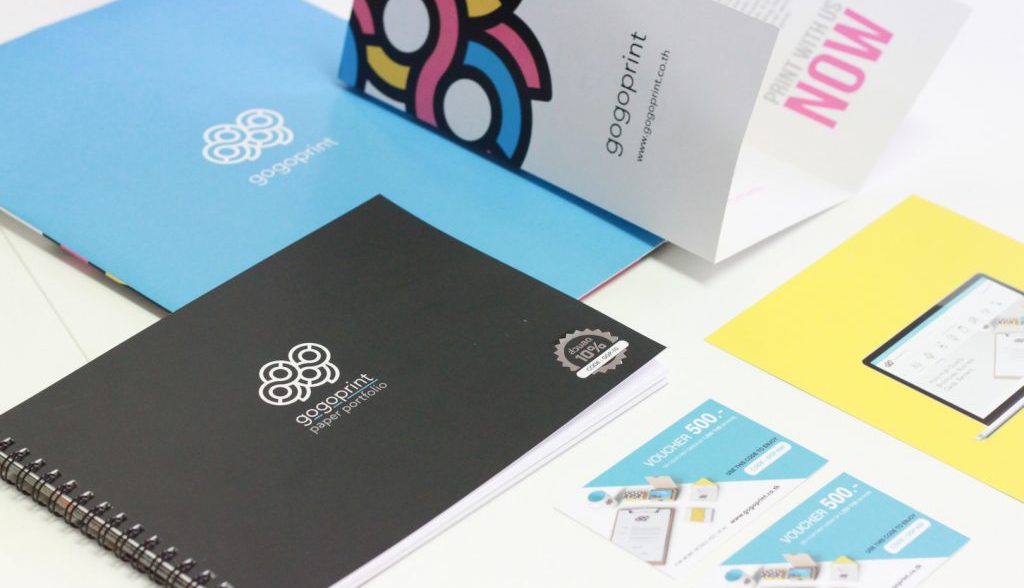
    Gogoprint, a startup that’s modernizing the printing industry, has raised US$7.7 million in series A funding to fuel its expansion into new markets like Australia, New Zealand, and South Korea in the next 12 months.

    Gogoprint is an online service for printing things like business cards, flyers, and leaflets. It uses algorithms that take into account parameters such as paper type, quantity, and delivery, and then aggregates those orders into a “print-run” or a batch of prints.

    This enables printers to make the most out of one printing sheet. Because each sheet carries fixed costs, maximizing it helps reduce prices and turnaround time for customers. It also allows printers to take in small orders from budget-conscious firms, instead of only focusing on large volume orders.

    Printers that partner with the company are able to tap new customers, helping offset the cost of any unused capacity.

    Gogoprint is active in four countries: Thailand, where it started, as well as Singapore, Malaysia, and Indonesia. In Indonesia, it faces competition from another online printing startup, Prinzio.

    To date, Gogoprint has experienced a 200 percent year-on-year growth in customer base, attracting more than 45,000 customers with over 250 million products printed. Its clients include Honda, Lazada, Lion Air, Yamaha, Singapore’s Nanyang Technological University, and Booking.com.

    Retail News reached out to the company for more financial details, but it declined to disclose figures.

    The series A round was led by its existing backer OPG (Online Printing Group), an investor and partner of Brazil-based Printi.

  • Garuda to open direct route from Singapore to Belitung Island’s Tanjung Pandan

    Garuda to open direct route from Singapore to Belitung Island’s Tanjung Pandan

    National flag carrier Garuda Indonesia has strengthened its regional network by introducing a new direct route from Singapore to Tanjung Pandan on Belitung Island, according to a press release. Set to begin on Oct. 29, the flight will be available four days a week, using the Bombardier CRJ-1000 with 96 economy class seats. Garuda Indonesia commercial director Pikri Ilham Kurniansyah said the new service is aligned with the airline’s commitment to help develop tourism in Indonesia. Moreover, the new route is to support Indonesia’s 10 priority destinations aside from Bali, which includes Tanjung Kelayang on Belitung Island.

    “The direct flight is part of the company’s strategy to expand its international network, as well as an effort to strengthen connectivity in Southeast Asia,” Pikri was quoted as saying.

    He went on to say that Singapore is one of the busiest international hubs and also close to Indonesia.

    “With a less-than-an-hour direct flight from Singapore, Belitung is a perfect short getaway destination,” said Pikri.

    He is also confident that the new route would improve the growth of trade and business in Tanjung Pandan and its surroundings, especially since it is a special economic zone and one of the 10 priority destinations.

    Tanjung Pandan is said to have beautiful beaches and being developed to be the “next Bali”.

    Garuda’s Singapore-Tanjung Pandan route will depart from Singapore’s Changi Airport at 5:20 p.m. local time every Monday, Wednesday and Friday. A Sunday flight from Changi is also available, which departs at 5:30 a.m. Arrival time at Hanandjoeddin International Airport in Tanjung Pandan is 5:50 p.m. for Monday, Wednesday and Friday, and 6 p.m. for Sunday.

    Meanwhile, all flights from Tanjung Pandan to Singapore depart at 2:50 p.m. and arrive at 4:20 p.m. local time.

    Garuda Indonesia now serves 84 flights every week to and from Singapore to Indonesian cities. Singapore-Jakarta flights are available nine times every day, the Singapore-Surabaya route has one flight daily and Singapore-Denpasar has two flights daily.

  • Alibaba’s Jack Ma opens tech institute in Indonesia

    Alibaba’s Jack Ma opens tech institute in Indonesia

    Jack Ma, executive chairman of China’s Alibaba Group Holding, plans to open an institute to train thousands of tech entrepreneurs in Indonesia, where he is already an adviser to the government on e-commerce.

    Ma did not say when the Jack Ma Institute of Entrepreneurs would launch, but said the aim was to train 1,000 tech leaders a year over the next 10 years.

    “We’re giving a lot of opportunities for young Indonesian people to learn,” Ma said after meeting Indonesian ministers on the sidelines of the International Monetary Fund and World Bank meetings being hosted by Indonesia.

    The co-founder of Alibaba, China’s biggest e-commerce firm, said it is important for Indonesia to invest in human capital because “only when people improve, when people’s minds change, when people’s skills improve, then we can enter the digital period”.

    Indonesia has a shortage of trained engineers in technology and the institute will also train hundreds of developers and engineers on cloud computing to help make Indonesian businesses more digital-savvy.

    The country is a key market for Alibaba, whose cloud computing arm Alibaba Cloud launched a data center in Indonesia in March.

    Ma said his company would continue to invest “not only on e-commerce, but also cloud computing, logistics and…infrastructure” in Indonesia, while also helping local businesses to grow.

    Indonesian Communications Minister Rudiantara stated last month that Indonesia was partnering with Ma to look into ways to harness Alibaba’s businesses to increase its exports, particularly to China.

    McKinsey estimated in a report released on Aug. 30 that the value of Indonesia’s e-commerce market will surge to at least $55 billion (£42 billion) by 2022 from $8 billion in 2017.

    Last week, Ma told a panel discussion at the IMF and World Bank meetings that “the internet is designed for developing countries”, with “great opportunities in Africa” also.

  • What research says about Indonesian mother’s buying behaviour?

    What research says about Indonesian mother’s buying behaviour?

    As Southeast Asia’s largest nation continues to grow in numbers with 2.44 births on average per female, both Indonesian-bred and global retail companies are allocating massive budgets to target the next generation of shoppers by understanding the mothers and soon to be mothers of today.

    ecommerceIQ, the leading market research firm dedicated to ecommerce insights and data in Southeast Asia, shares findings from its report: “Digital Mom and Baby Shopper Profile in Indonesia” with a select group of brands on the preferences, household income, age, average basket size, etc. of its female shoppers across the archipelago.

    The conference was held on October 11th, 2018 in Jakarta and welcomed guest speaker,  Wenny Damayanti,  Head of Marketing Baby Care PT Softex Indonesia, and Agni Pratistha, Indonesian actress, former Miss Indonesia, and a mom of two.

    The Top Online Destination preferred by Indonesian Women

    The research reveals 66% of Indonesian shoppers have purchased from the Mom & Baby category online due to the practicality of ecommerce such as convenience and variety of brands. Lesser time consumption and convenience have been cited by the respondents as key drivers.

    45% of Indonesian females chose Shopee Indonesia as the top online destination for ecommerce purchases due to a wide product selection. Lazada comes in second (34%) and Tokopedia and social media trail behind at 7% and 5%, respectively.

    Originated as a Consumer-to-Consumer (C2C) ecommerce platform, Shopee has the advantage of a wide product selection. The Mom & Baby category is also Shopee’s most popular category in Indonesia as reflected through its recent campaign known as the Mom & Baby Super Deal campaign that was organized as a form of Shopee’s gratitude for the trust given by mothers in Indonesia.

    “Indonesia is filled with more than 260 million people and has the fourth highest birth rate among all Southeast Asian nations.” commented Sheji Ho, aCommerce Group Chief Marketing Officer.

    “There is a massive opportunity for brands to deliver a satisfying and more importantly, trustworthy digital experience. Shoppers today have more access to information online to help them make informed purchasing decisions, it’s not enough to have a picture of your diapers – What are others saying about your product? Which influencer is backing your product? This all matters.”

    “Because more women are joining the workforce while also being full-time mothers, the demographic highly values convenience. Ecommerce players just need to deliver it to them.”

    Other key takeaways from the survey:

    • 64% of new mothers are shopping online;
    • 57% of women are buying goods from the Mom & Baby category once a month, spending less than 500,000 IDR (USD 33.50) per purchase online;
    • The largest spending from females online? is allocated to Baby Clothing (51%) and Baby Gear (25.5%)
    • A wide variety of products (34.4%) is crucial to attracting more shoppers as they
      likely have not formed a strong affinity for a brand yet and open to testing products;
    • 64% of Indonesian mothers start their online shopping journey by going directly to e-marketplaces, but Google and Facebook / Instagram remain powerful tools for product discovery.

    Download the full report here.

    The Digital Mom and Baby Shopper Profile in Indonesia was a survey conducted by ecommerceIQ in February 2018 and collected a total of 1,144 responses from females in Indonesia.

  • Lion Air to Serve Umrah Flight from Kertajati Airport

    Lion Air to Serve Umrah Flight from Kertajati Airport

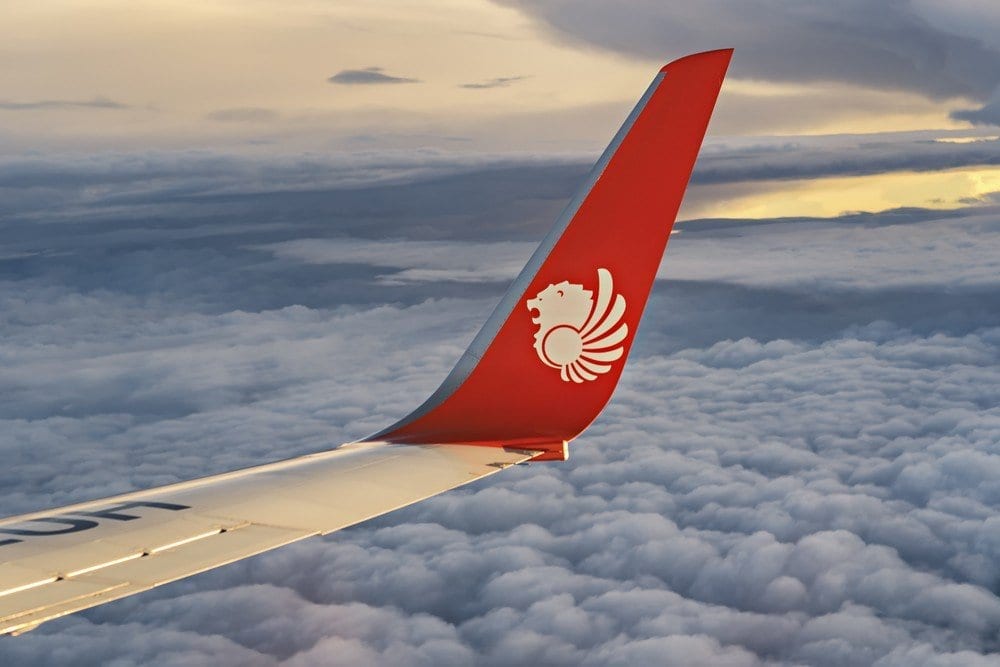
    Managing Director of Lion Group, Captain Daniel Putut Kuncoro Adi said that his company will serve the first umrah flight from Kertajati Airport, Majalengka, on Saturday, October 13. Lion Air will use Boeing 737-800 Max8 made in 2018 with the capacity of 176 passengers. “Our hope is it the flight will increase. We are ready to serve every day. For now, we start with one flight in a week,” Daniel said. The flight route is from Kertajati to Madinah, and the return flight is from Jeddah to Kertajati.

    “We start with once a week flight frequency. Up to this year’s Umrah season, the slot is already full,” he said at Gedung Sate, Bandung, Tuesday, October 9

    Daniel said that Lion Air has planned to replace the aircraft with a larger one. “We have an Airbus 330 with a capacity of 440 passengers, then a Boeing 747 with a capacity of 500 passengers,” he said.

    Samira Ali Wisata’s Managing Director, Fauzi Wahyu Muntoro, said his Umrah travel agent DGI (Dini Group Indonesia) could get 90 people in a month, to depart from Kertajati Airport.

    President Director of West Java International Airport (BIJB) Virda Dimas Ekaputra said that Lion Air agreed to serve the Umrah flight from Kertajati Airport twice a week.

    West Java Governor Ridwan Kamil said the Umrah flight service from Kertajati Airport had long been awaited by the West Java people.