Tag: #internet

  • Internet streaming one up on traditional TV in Vietnam

    Internet streaming one up on traditional TV in Vietnam

    Industry insiders say local Over-The-Top service providers should act together instead of against each other. Vietnam is seeing a trend of people switching from traditional TV to over-the-top (OTT) media services which allow them to watch movies and other shows on the internet.

    In a recent survey done by Kantar Media Vietnam, an information and consultancy group, 84 percent of the respondents aged 15-54 said they use the internet every day. In Hanoi, people spend 229 minutes each day on the internet, almost an hour and a half higher than the time for TV, which is only 145 minutes, the survey found.

    A significant 45 percent of respondents in Hanoi, Ho Chi Minh City, the central city of Da Nang and southern Can Tho said they watched video on demand (VOD).

    Vietnam is one the leading countries in the online video trend, with 90 percent of the respondents saying they watch online videos every week, said market research firm Nielsen.

    “People nowadays want to watch what they want, whenever and wherever they want,” said Bui Huy Nam, CEO of state-owned cable TV provider VTVCab, adding that this trend makes the transition from traditional TV to OTT inevitable.

    YouTube remains the largest OTT service in the country, with 87.3 percent of respondents in the Kantar Media survey saying they use this website frequently to watch videos online.

    Local sites such as PhimMoi.net [New Movie] and ZingTV rank second and third with 28.9 percent and 26.4 percent respectively, the report said.

    With such a large market demand, local OTT providers are adopting different strategies to eke out an advantage in this tight race.

    National broadcaster VTVCab is looking to work with internet service providers to provide free content to users, earning revenue from advertisements. The company’s ambition is to create a platform where users can share their own video content.

    FPT Play, a cross-platform application which allows users to watch TV shows and movies online, is focusing on improving its content by working with strong media production companies in the country.

    While there is strong competition between legal OTT providers, they also need to fight the battle with illegal ones. Illegal content makes up about 95 percent of OTT services in Vietnam, said Ngo Thi Bich Hanh, vice chairwoman of media firm BHD.

    “There is an intense competition between OTT firms in the country. It’s a competition between local firms and between them and foreign providers,” Hanh said.

    To ensure the success of OTT services in Vietnam, local businesses need to cooperate on a shared platform, said Nguyen Thanh Lam, director of the Department of Radio and Television Communication and Electronic Information. “They should not go alone in this market,” he added.

    Echoing Lam, Le Quang Minh, director of the VTV24 News Center, said that working together will keep OTT businesses from “hitting the bottom.”

    “We want local OTT providers to sit down together to create a sustainable market which is strong enough to compete with the leading video streaming services in the region and in the world instead of racing against each other,” Minh said.

    A study by OTT provider Muvi estimates Southeast Asia market revenues reaching $650 million a year in the next three years. On the global scale, Netflix, Hulu, Amazon and Youtube have a total of 2 billion subscriptions, taking 40 percent of the world’s OTT market share, the study said.


  • NetLink NBN Trust beats IPO earnings forecast

    NetLink NBN Trust beats IPO earnings forecast

    Singapore’s NetLink NBN Trust, the network company for Singapore’s next-generation national broadband network (NG-NBN), has beat its post-tax profit targets for the financial period between June 19 and March 31 by 10.8%.

    The operator reported a net profit for the period of S$50 million ($37.4 million). This compares to a projection of S$45.1 million included in the prospectus for its S$2.3 billion IPO, which was completed in July last year.

    NetLink NBN Trust attributed the higher than expected profit to lower operation and maintenance costs, staff costs and other operating expenses

    NetLink NBN Trust reported revenue of S$228.6 million, 1.8% lower than forecast, due mainly to lower installation-related revenue. But this was partly offset by higher than expected recurring residential and non-residential connection revenue.

    For the fourth quarter, the operator reported a 6.4% lower than expected profit after tax of S$15.3 million and 4.4% lower than forecast revenue of S$80.7 million.

    “Our better-than-forecast earnings reflects the resilience of our business model,” NetLink NBN Trust CEO Tong Yew Heng said.

    “The growth in the number of connections for residential, non-residential and segment fiber for the relevant financial period was higher than the forecast.”

    As the network company for the NG-NBN, NetLink NBN Trust designs, owns, builds and operates the passive fiber network infrastructure for the network. As of the end of March, the network spanned around 76,000km of fiber cables, 16,200km of ducts and 62,000 manholes.

  • New form of Hide and Seek IoT malware discovered

    New form of Hide and Seek IoT malware discovered

    Security researchers from BitDefender have discovered a new form of the ‘Hide and Seek’ IoT malware, which targets several generic devices.

    The most worrying aspect of this new strain is its ability to persist despite a reboot. With previous versions, equipment owners could always remove IoT malware from their smart devices, modems, and routers by resetting the device.

    Hide and Seek’s original version, discovered in January 2018, was notable for using a proprietary peer-to-peer network for both C&C and new infection communication. With persistence now added to the feature mix, the botnet has become a more pressing concern for owners of the 90,000+ IoT devices already infected and other equipment that are vulnerable and still unprotected.

    “The botnet seems to undergo massive development as new samples compiled for a variety of architectures have been added as payloads,” said Bogdan Botezatu, senior e-threat analyst at Bitdefender, in a blog post concerning the new variant of the malware.

    According to the Bitdefender researchers, there are at least 10 different versions of executables that can run on 10 different system variants.

    Botezatu said that new binaries now include code to leverage two new vulnerabilities to compromise more IPTV camera models. “In addition to the vulnerabilities, the bot can also identify two new types of devices and pass their default username and passwords,” he said.

    The malware targets several generic devices. Once infected, the device scan for neighboring peers for the presence of the telnet service. As soon as the telnet service is found, the infected device attempts brute-force access.

    “New variations of the Hide and Seek malware continue to exploit common issues with system/software hardening in deployed IoT devices,” Irdeto global head of software protection John O’Connor said.

    “The current generation of the Hide and Seek botnet could effectively be stopped in its tracks if diligent system hardening was applied during development, including proper management of applications, permissions, ports and user IDs/passwords. As a result, hardening should be a baseline requirement of a system in the development phase.”

  • GCX to upgrade HAWK cable

    GCX to upgrade HAWK cable

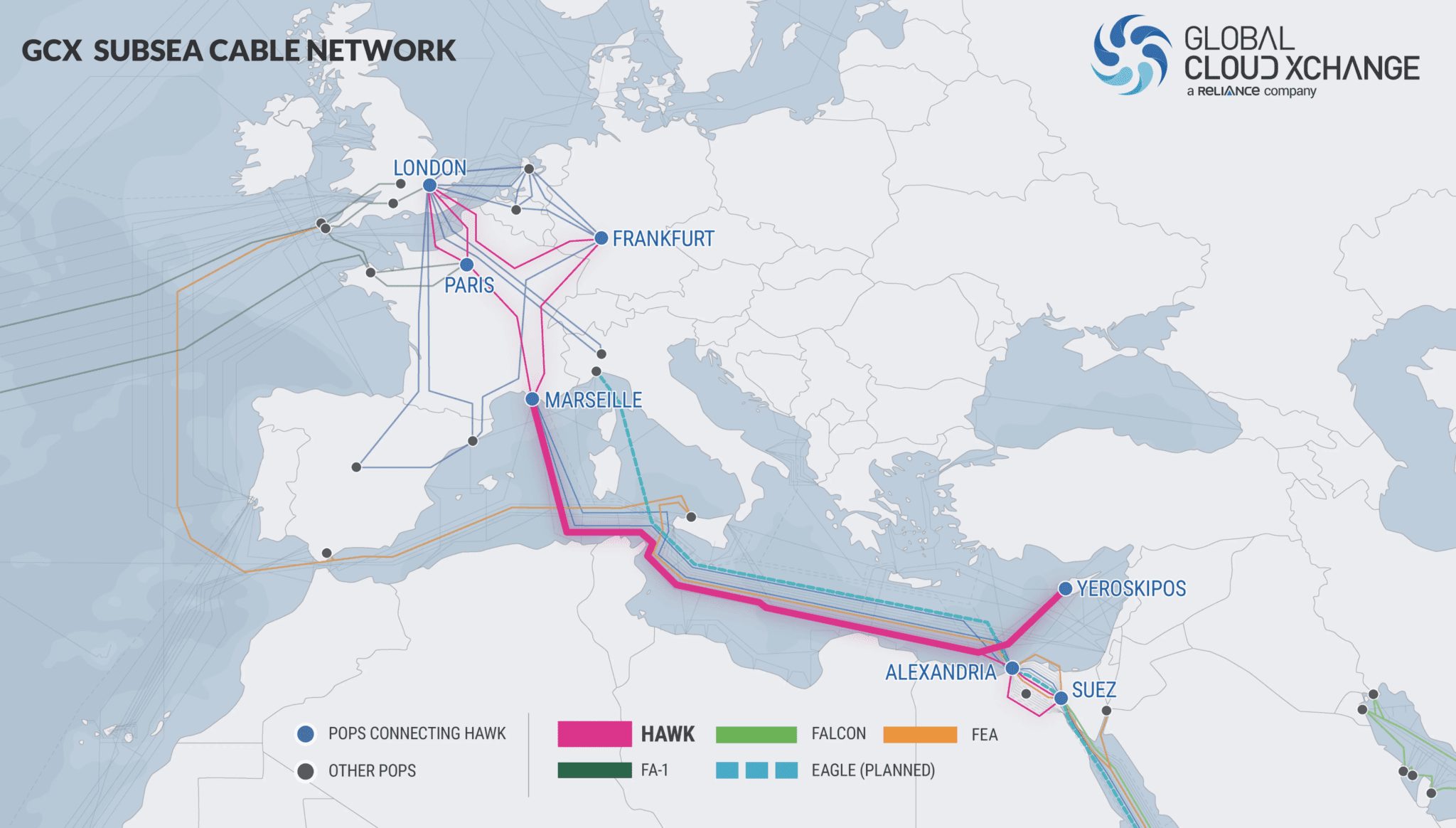
    Reliance Communications’ Global Cloud Xchange (GCX) has announced plans to upgrade a branch of the HAWK subsea cable to meet growing demand for bandwidth between Europe and emerging Asia and the Middle East.

    The company will work with Cyprus’ incumbent operator PrimeTel to upgrade the HAWK branch into Cyprus to 100Gbps.

    The HAWK cable system links Marseille and Paris in France, London in the UK, Frankfurt in Germany, Yeroskipos in Cyprus, and Alexandria in Egypt, and connects to GCX’ global subsea and European backhaul network.

    The cable is integrated with PrimeTel’s Cyprus gateway and hub, which was activated in 2011 to enable ultra-high bandwidth services across the Emerging Markets corridor.

    “With the recent upgrade, we have now broadened our reach into PrimeTel’s Cyprus Hub in Yeroskipos, providing enhanced coverage to meet the growing demand for high-performance, low-latency connectivity across the emerging markets in the Middle East and Asia,” GCX COO Wilfred Kwan said.

    “The network enhancement has already started to attract interest across key growth markets and we are pleased that the first 100Gbps wavelength connection for a major carrier is already in the process of being activated.”

  • EllaLink gets anchor customer for trans-Atlantic cable

    EllaLink gets anchor customer for trans-Atlantic cable

    The Atlantic will be getting yet another subsea cable system it seems, but this time it’s on a route rarely travelled.

    EllaLink has won a key anchor customer for a cable system connecting Portugal with Brazil. The research and education networks GEANT and RedCLARA are putting €25 million ($29.6 million) up for direct capacity between Europe and South America.

    As currently planned, EllaLink will bring some 72Tbps of connectivity between the two continents. In South America it will land at both Fortaleza and at Praia Grande near Sao Paolo, two popular cable destinations with plenty of interconnection options.

    In Portugal the system will come ashore at Sines, not far from Lisbon and at a new location distinct from other cables landing in the region and with terrestrial access over to Madrid of course. In between are several islands that will probably see branches, such as Madeira and Cabo Verde.

    We haven’t seen a cable on this route since ATLANTIS-2, and unlike most new builds it doesn’t seem to be on the radar of the big cloud/content guys. That may change as interest in the nearby interconnection market of Madrid continues its rapid growth.

    EllaLink offers a bypass route between Europe and Latin America that doesn’t land first in the eastern US. By taking the direct route and avoiding North America, latency will be substantially reduced, probably by about half or more.

    Alcatel Submarine Networks will be handling the installation, which is envisioned to be complete sometime in 2020.  With much of its funding in place, it looks as if this cable system is ready to move onto the marine survey and construction.

  • Hawaiki Cable deployment nearly complete

    Hawaiki Cable deployment nearly complete

    The Hawaiki cable is nearly complete, according to the company and TE Subcom. Each of the cable landings is complete, the final splice has been made, and final testing will begin shortly. That puts them on track to officially bring the cable online next month.

    The 15,000km Hawaiki cable Cable System will connect Oregon with Australia and New Zealand, making stops in American Samoa and Hawaii along the way. There are also stubbed branch units for New Caledonia, Fiji, and Tonga for the future.

    The system’s theoretical capacity is 43Tbps, which will add significantly to that which is available on the direct route down under. It has taken many years and iterations by those involved to make it happen.


  • M1 reports flat profit for 1Q18

    M1 reports flat profit for 1Q18

    Singapore’s M1 has reported flat profit for the first quarter despite a 3% year-on-year increase in service revenue.

    The operator’s net profit stayed stable year-on-year at S$34.8 million ($26.5 million), but this represented an 8.3% increase compared to the previous quarter.

    Service revenue meanwhile grew 3% year-on-year to S$184.7 million, driven by higher fixed and postpaid mobile revenue. But overall operating revenue grew just 0.5% year-on-year and fell 15.8% sequentially to S$254.1 million.

    Fixed service revenue was up a strong 13.9% compared to the same quarter a year ago to S$31.9 million, with M1 adding 5,000 fiber customers to take its total base to 194,000.

    By contrast, mobile revenue increased just 2.6% over the same period, and total mobile subscribers decreased by 2.6% to 1.99 million.

    Mobile data grew to account for 61.3% of mobile service revenue, up from 54% a year ago, with average postpaid smartphone data usage reaching 4.5GB per month.

    Despite the lackluster results, M1 CEO Karen Kooi said the operator is in a position to pursue new growth opportunities looking ahead.

    “We will continue to strengthen our telco core with enhanced value propositions and customer experience,” she said.

    “With our scaled up ICT and digital capabilities, we are well placed to capture the growth opportunities in the Corporate and Government segment driven by corporate digital transformation and Smart Nation initiatives.”

  • Malaysia 4G service performance below global average

    Malaysia 4G service performance below global average

    The race for LTE dominance in Malaysia is still in its infancy as operators scramble to deliver consistent quality of service nationwide.

    Statista data points to smartphone penetration in Malaysia of 62.8% in 2017 with a forecast of 68.46% by 2022. Adoption is fueled by nationwide mobile connectivity with usage in areas such as mobile shopping, social media and general internet surfing according to market research firm GfK.

    “Shopping apps, especially, are also gaining popularity, paving the path for mobile payments. More consumers today are contributing to the growth of mobile commerce (m-commerce) in Malaysia, making payments through their mobile devices for retail items, airline tickets, and services such as Grab and Uber,” observed Stanley Kee, Managing Director for Southeast Asia, GfK.

    According to the EY report “Decoding the Malaysian digital DNA: from smart to savvy” 78% of surveyed Malaysians use of the technology has improved their communication with friends and family, albeit at the expense of sleep (25%).

    As more consumers turn to their smartphones to research new products or services (83%) or make purchases online rather than in person (38%), experience and speed will trump convenience as a metric for selecting the best service provider. That said, price remains an important factor in Malaysian buying psyche.

    With more operators defaulting to LTE or 4G as the solution to consumer’s appetite for connectivity, OpenSignal published a comparative study of the performance of the mobile operators in the country.

    Four years since Maxis launched the first LTE service in Klang Valley (January 2013), five operators now claim to offer 4G service although OpenSignal reported only two operators as having LTE availability scores higher than 75%. 4G services aren’t yet ubiquitous, but they’re getting there.

    “Yes held onto our 4G availability award with a score of 92.5%, but Unifi Mobile (the new brand name for Telekom Malaysia’s Webe) and Celcom demonstrated the biggest growth spurts in our availability results. Unifi’s 4G availability increased by 10 percentage points in six months, while Celcom’s score increased by more than 7 percentage points,” said Kevin Fitchard, Open Signal lead analyst.

    Maxis has extended its lead in 4G speed metric, averaging LTE downloads to 24.4Mbps. Celcom came in second with a 16.3Mbps LTE download average. But Malaysia’s other operators fell short of the global 4G average of 16.9Mbps. U Mobile and Unifi in particular are struggling to boost LTE speeds. Both scored below 10Mbps in OpenSignal test.

    Asked about the growing interest among operators for 5G service Fitchard took a pragmatic view saying: “Countries that are still building out their 4G networks and services like Malaysia will likely be occupied with that task for the next several years. But today 5G isn’t really an option for any operator globally, so everyone has to wait,” he concluded.

  • IT leaders aim to “consumerize” cloud access

    IT leaders aim to “consumerize” cloud access

    The proliferation of cloud applications and use of a disparate range of devices within businesses has led nearly two-thirds (64%) of IT leaders and their security teams to consider implementing consumer-grade access to cloud services for employees, finds new research from Gemalto.

    Surveying more than 1,000 IT decision makers globally, Gemalto’s 2018 Identity and Access Management Index revealed that the majority (54%) believe that the authentication methods they implement in their businesses are not as good compared to those found on popular sites including Amazon and Facebook.

    With a growing number of cloud apps in use, more employees working remotely and pressure mounting to make authentication stronger while ensuring ease of use, IT decision makers are keen to ‘consumerize’ the login process. In fact, 70% of IT professionals believe that authentication methods applied in the consumer world can be applied to secure access to enterprise resources.

    Despite this, 92% of IT leaders express concern about employees reusing personal credentials for work. This comes as 61% admit that they are still not implementing two-factor authentication to allow access to their network, potentially leaving themselves vulnerable to cyber criminals.

    At the same time, there seems to be increasing recognition that new approaches to cloud access can contribute to alleviating these issues. 62% of respondents believe that cloud access management tools can help simplify the login process for users, while 72% stated that a strong consideration for implementing a cloud access solution is the desire to reduce the threat of large scale breaches.

    The fact that 61% of respondents also stated that inefficient cloud identity management would be a key factor in adopting a cloud access management solution shows that scalability and management overheads are also of high concern to IT professionals, Gemalto said.

    “These findings clearly show that IT managers are struggling to balance the need for a simple and easy login experience with security,” said Francois Lasnier, SVP Identity and Access Management at Gemalto.

    “While there is a need to make things easier for employees, there is a fine line to be walked. IT and business line managers would do best to figure out the risks and sensitivities associated with the various applications used in their organizations and then use access management policies to manage risk and apply the appropriate authentication method. In this way, they can ensure a convenient login experience for their users, while still maintaining access security.”

    With the growth in remote working, the cloud and secure access to applications have become important for organizations. As a result, almost all (94%) respondents believe that cloud access management is integral to adopting cloud applications.

    In fact, nine in 10 also feel that ineffective cloud access management can lead to issues for their company, such as security (52%), IT staff’s time being used less efficiently (39%) and increased operational overheads and IT costs (38%).

    Despite this focus on protecting cloud applications, just three of the 27 applications used on average by organizations are protected with two-factor authentication.

  • Huawei Marine to deploy subsea cable for NGCP

    Huawei Marine to deploy subsea cable for NGCP

    Huawei Marine has commenced the second phase of its Sorsogon-Samar Submarine Fiber Optical Interconnection Project (SSSFOIP) for the National Grid Corporation of the Philippines (NGCP).

    The phase two rollout, which involves the deployment of a 12.8Tbps subsea cable connecting Sorsogon and Samar, is expected to be complete in the third quarter.

    The dedicated cable will replace the existing microwave technology for the power transmission network.

    NGCP selected Huawei for the upgrade project through a public tender in 2016, aimed at enhancing branch network data exchange capabilities for the national grid. The first phase of the project, involving a marine route survey, was completed in 2016.

    “The transmission line between Sorsogon-Samar is an important branch of the network for the country,” NGCP network director for telecoms Ferdinand Dicon said.

    “During the first phase of exploration, Huawei Marine demonstrated their project delivery capabilities and experience as a world-class turnkey submarine cable supplier. We believe that in the second phase of construction, Huawei Marine will successfully deploy their leading-edge product technology with their customer focus support services.”

    Huawei Marine chief executive Mike Constable added that this project is the company’s first power grid project.

    “Based on the results of the first phase of exploration, we will deploy the latest technology to build a fit-for-purpose communication network which will transform the NGCP’s network capabilities,” he said.

  • Ministry working on faster internet with private sector

    Ministry working on faster internet with private sector

    Korea is pushing to commercialize 10-gigabit transfer speeds that are 10 times faster than Giga Internet, the fastest broadband service currently available in the country, the Ministry of Science and ICT said Sunday.

    The ministry would work closely with local IT companies to adopt 10-gigabit service, considered the core technology behind 5G wireless technology, virtual reality and augmented reality. Under the plan, the ministry plans to form a consortium to develop basic equipment and prepare networks for the rapid commercialization of 10-gigabit speeds.

    “The ministry hopes to achieve competitiveness in the ICT industry by commercializing 10-gigabit internet through close cooperation between public and private sectors,” a ministry official said.

  • China – the world’s biggest 5G market in 2025?

    China – the world’s biggest 5G market in 2025?

    According a study conducted by GSMA Intelligence and the China Academy of Information and Communications Technology (CAICT), China is set to become the world’s largest 5G mobile market in 2025.

    The China 5G study predicts that 5G connections in China are expected to reach 428 million by 2025, accounting for 39% of the 1.1 billion global 5G connections expected by that point.

    The country’s three major mobile operators – China Mobile, China Unicom, and China Telecom – are stepping up their efforts towards 5G deployment, with plans to run a phased testing period for 5G networks from 2017 to 2019 before launching commercially in 2020.

    China Mobile, for example, early this year started conducting the first phase of its 5G field trials in five major cities across the country with Datang, Huawei, ZTE, Nokia and Ericsson. The first phase of the trial will focus on PoC system field trials this year and the operator will move to pre-commercial trials for interoperability tests in 20 sites or cities next year, said Wang Xiaoyun, general manager of technical department at China Mobile.

    The trial is expected to expand to over 100 sites or cities in 2019, before the rollout proceeds to the commercial launch stage in 2020, Wang told reporters at Mobile World Congress Barcelona in February. China Mobile has also set up what it claims is the world’s largest 5G field trial in Huairou district in northern Beijing, he said.

    Together with these partners, China Mobile has conducted trials of key technologies including massive MIMO on the 3.5GHz band, as well as carried out performance testing of mmWave spectrum on different frequency bands, such as 15GHz, 28GHz and 73GHz, said Wang.

    China Unicom and China Telecom also plans to test capacity and performance across six cities over 2017-2019 before a commercial launch in 2020.

    Chinese cellcos go for “standalone” 5G deployment

    The study further points out that the three Chinese mobile carriers are expected to deploy ‘standalone’ 5G networks, which will require the construction of new base stations to site 5G equipment, backhaul links and a core network.

    That said, 5G investment in China will follow a more gradual path compared to elsewhere in Asia and over a longer timeframe than 4G, roughly seven years, from 2018 to 2025-with capex not expected to account for more than 25% of operator revenue prior to commercial launch.

    The rate of 5G network deployment and adoption in China is also expected to be slower than it was for 4G, which Chinese operators were able to deploy rapidly earlier this decade within a mature 4G ecosystem. In their early phase, 5G networks will concentrate on boosting the capacity of 4G networks to support rising cellular data traffic demands.

    Though some services will require devices with new form factors, the smartphone is expected to remain the principal 5G interface at launch. Enterprise is considered to offer operators the largest incremental revenue opportunity. Key vertical markets for 5G applications include automotive and transport, logistics, energy and utilities monitoring, security, finance, healthcare, industrial and agriculture.

  • GTT deploys new low latency routes

    GTT deploys new low latency routes

    Yesterday, GTT Communications announced a series of new low latency routes around the globe, and simultaneously launched a new time  synchronization service.

    The new low latency routes include Hong Kong to Tokyo, Hong Kong to Singapore, Mumbai to Singapore, New York City-Mexico City and Johannesburg to London. They bring the company’s total low-latency portfolio to more than 60 routes connecting over 130 financial exchanges.

    Meanwhile GTT’s time synchronization service aims to give financial customers a single source of time across their global trading footprints.

    This answers the question of what one gets when one combine’s Hibernia Networks’ financial business and transatlantic cable with the international network relationships that GTT acquired with the earlier deal for the Inteliquent/Tinet backbone.

    GTT’s more recent M&A moves have been in the US with the acquisition of Global Capacity and pending purchase of Transbeam. However, I wonder whether the next targets might come from overseas.

  • Myanmar internet-led models yet to scale but heading towards transactional phase

    Myanmar internet-led models yet to scale but heading towards transactional phase

    New internet-enabled businesses are making an appearance in frontier Myanmar, which is witnessing a telecom boom period with operators putting their might on expanding network infrastructure to meet the growing demand for data services.

    While e-commerce and consumer internet startups are yet to scale, they are slowly heading towards the “transactional” phase and launching new models borrowing from successful regional ideas but adapting them to the local market.

    Consider these developments: In the new office in Mingalar Taung Nyunt township of local content creator Myanmar Online Creations (MOC), an employee at  Onlyinburma.com, targeted to be a destination point for locals, and Langyaung.com, a local business directory, is busy uploading content for the sites.

    The company has got five apps running since its launch late last year and it is already looking to roll out a few more to touch 10 apps by the end of 2017. MOC, led by Win Ohn, also the CEO and president of Canada-based MediaNation, aims to bring new dotcom technology in Myanmar language.

    Meanwhile, in mid-August, an online wedding gift service platform named MingalarLetPhwet.com was launched to address the issue of unwanted and repetitive wedding gifts. The site has brought together suppliers of over 5,000 wedding gift related products while it is free to use for customers.

    In July, Swiss media group Ringier and Myanmar-based Information Matrix Co Ltd joined hands for their ventures, marry.com.mm (based on popular Vietnamese model marry.vn) and parenting platform kalay.com.mm. Revenue model for these engines are built around wedding fairs and workshops.

    The market also saw the launch of Flair Eyes, which allows local photographers to upload photos and video clips for use through a subscription or per piece basis.

    Ecosystem enablers

    The development of such business oriented platforms indicate the improved contribution from different stakeholders in the ecosystem in Myanmar since the military ceded power in 2011.

    The expansion of the telecom market, since the approval of foreign telecom operators, Telenor and Ooredoo, has by May 2016 reached a coverage of 43.72 million compared to the country’s total population of 54 million. Also compare the current SIM card cost K1500 ($1.3) to the previaling rates of  a staggering K4000,000 ($3,412) in 2006.

    Apart from the favourable macro indicators, the region is also beginning to see action surrounding funding of startups. Ride hailing platforms like Uber and Grab’s announcement of $100 million investment in Myanmar has captured the attention of investors.

    Recent startup funding developments include freelancing platform Chate Sat and comic application White Merak raising a six-digit investment each. JobNet.com.mm, a job website under the umbrella of MMOne Online Co Ltd, also raised a seven digit investment this year. Prior to that, their sister company, ShweProperty.com raised a six digit sum from some institutional investors.

    Other significant updates from the startup world include MyPlay’s acquisition by ASX-listed iSentric and Malaysian movie streaming company iflix establishing presence in Myanmar.

    Sumit Jasoria, MD, shop.com.mm feels, “the mindset has changed after global players came in. Local investors are also looking at the right team.”

    Ohn says, what is currently hurting e-commerce adoption and growth is lack of universal gateway. However, online retailers and users have seemingly found a way around it by relying on cash on delivery option. “It is a ‘a very creative way and a grassroot step as we evolve into e-commerce shopping and buying. I forsee a lot of solutions addressing the universal online banking credit card payment solution,” said Ohn.

    Meanwhile, a lot of payment solutions are appearing to address the issue of online payments such as Wave Money, a financial service provider of Telenor and Yoma Bank; Ooredoo’s mobile wallet M-Pitesan and 1-Stop, a partnership between Singapore-based payment service 2C2P and Myanma Awba.

    Popular retail platforms like Rocket Internet’s shop.com.mm is experimenting with offering more discounts on usage of card payments. “The idea is to create an ecosystem which helps consumers to also try cards,” said Sumit Jasoria, managing director of shop.com.mm, which has been in Myanmar for three years.

    He argues that 70 per cent of businesses in neighboring Asian countries are still using cash on delivery while the number for Myanmar is just higher, making about 90 per cent. “I think it is catching up, soon it will change for sure,” said Jasoria.

    Internet models, local twist

    Jes Kaliebe Petersen, CEO of Phandeeyar a leading Innovation Lab in Myanmar, says, the next wave of startups will be targeting a much broader audience, people present outside the city, and the new generation of smart phone users. The majority of those residing outside large cities in Myanmar use data only for Facebook and Viber.

    “The business that will emerge as the leaders in the area (online business platforms) are those who manage to handle the logistics and payments issues in a reliable manner and get people not just to buy on Facebook but also from their own apps,” said Petersen.

    A recent survey by MyanZen – the winner of Telenor Myanmar’s first accelerate program that allows social sellers to effectively sell on social network – shows that there are over 3,500 Facebook stalls involved in online shopping business in Myanmar.

    While the emergence of new business ideas are keeping up, Ohn says, it is encouraging to see a lot of companies like them starting to build the platforms and grow the awareness of the general public.

    Business ideas, that are successful in neighbouring countries, find favour in Myanmar.

    “We will always encourage the people in our accelerator to look at what’s going on elsewhere and use that as an inspiration for what can be done in Myanmar,” said Petersen.

    Shop.com.mm is also starting to replicate models of Daraz’ work in other countries and introducing fashion related products from Korea and Thailand on their platform after evaluating the consumer preference in Myanmar.

  • Interoute evaluating selling up

    Interoute evaluating selling up

    Late last week, an infrastructure M&A rumor managed to slip past my nets. The pan-European network and cloud infrastructure operator Interoute was revealed have brought in Credit Suisse and Evercore to help evaluate a sale of the company.

    Interoute is majority (70%) owned by the Sandoz family with Aleph Capital and Crestview Partners holding the remainder. The company’s network was built off of assets from the dot-com crash via a combination of organic and inorganic growth, with the most recent inorganic moves being the acquisitions of Vtesse in 2014 and EasyNet in 2015.

    In the first half of 2017, Interoute posted €354 million ($416.9 million) in revenue and €79.6 million in adjusted ebitda while spending €36.1 million in capex. As the EasyNet integration winds down, the company’s ebitda margins have risen up toward the 22% mark. The rumors indicate they’d be looking for a multiple of somewhere in the 7-10x ebitda range, which puts the value of any potential deal at somewhere in the $1.5 billion to $2 billion range.

    So the question is, who might step up to the plate to buy Interoute? There are possible strategic buyers from both the US and Europe as well as some interesting private equity possibilities. Here are thoughts on a few candidates in no particular order:

    • Level 3 – A few years ago, Level 3 would have been the first answer to come to mind. The synergies to be derived are obvious, and the scale would help the company’s enterprise business on the continent a great deal. But the timing isn’t perfect given the impending tasks of the CenturyLink integration, so this possibility seems a bit less likely than it might have in the past. It’s still quite possible though.
    • Zayo – They could be a very strong candidate. After entering the Euro market a few years ago with the acquisitions of Geo, Neo, and Viatel, Zayo has a pretty good starter set in western Europe. They’ve been uncharacteristically quiet since then, but pan-European fiber and data centre assets like Interoute don’t grow on trees. Zayo won’t sit out the chance to bid and they won’t be shy.
    • Teliasonera – the Scandinavian-based giant has been growing its international network footprint steadily and almost entirely organically over the years. But this opportunity to add pan-European enterprise and wholesale depth may not be something they can pass up.
    • Colt – For a decade I saw Colt as a likely target of consolidation, but ever since Fidelity took them private they’ve been looking like they might be ready to sit on the other side of the table. A combination with Interoute would have significant synergies and few downsides when it comes to pure numbers.
    • euNetworks – While the company probably isn’t large enough to do it on its own, its private equity owners are completely capable of making a bigger move if the opportunity is sufficiently attractive. euNetworks metro depth in the UK and Germany would help raise margins on Interoute’s revenue.
    • Telxius – This is a bit of a longshot, but when Telefonica split off its infrastructure division and sold off a piece of it to KKR, they were doing so to help with the company’s debt issues. But as with Windstream’s spinoff of what is now Uniti Group, the resulting company could become a consolidator in its own right with private equity sitting in the driver’s seat.
    • EQT Infrastructure – These guys are perhaps the most aggressive private equity guys in the market over in Europe, and I can easily see them taking the opportunity to take Interoute off of the the Sandoz family’s hands.
    • Other private equity – The list of names is quite long
    • The billionaires – One can never count out personalities like Carlos Slim, Patrick Drahi, John Malone or even Naguib Sawiris, although none seem to jump out at me in this case.