Tag: Marketing

  • Luk Fook sales soar despite challenges ahead

    Luk Fook sales soar despite challenges ahead

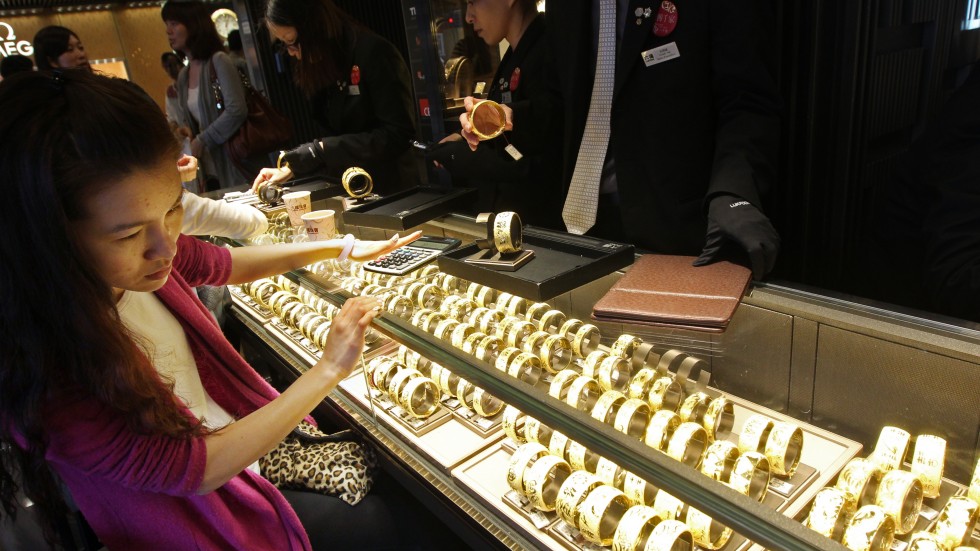
    Thanks to positive Hong Kong market sentiment and lower gold prices, Luk Fook Holdings has reported a 25.1 per cent boost in sales in the September half year. The company says sales totalled HK$7.859 billion (US$1 billion) compared with $6.283 billion in the same period last year. Profit attributable to shareholders soared 27.9 per cent to $665.4 million.

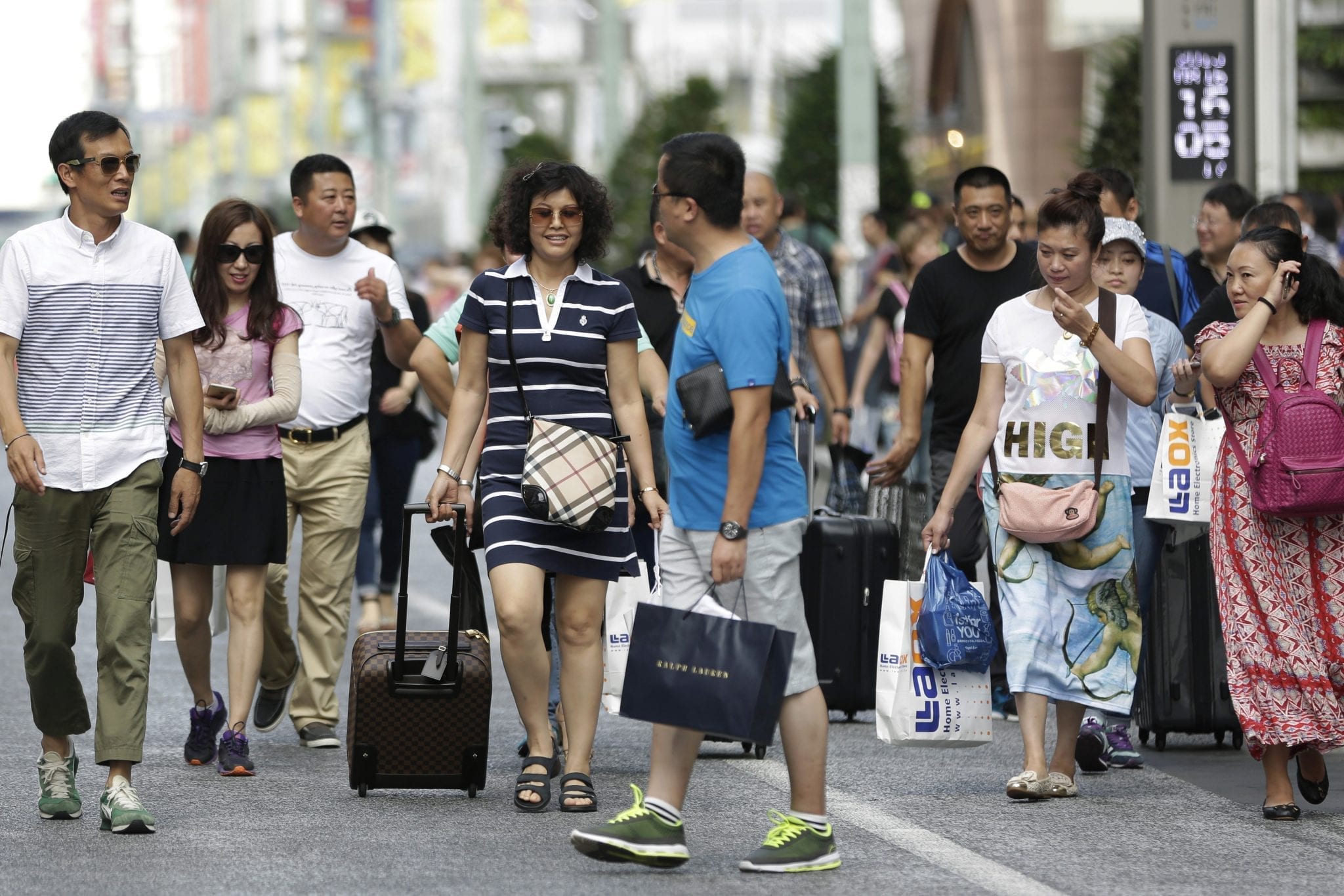
    Sales in the Hong Kong market, the company’s key source of revenue, rose 31.2 per cent as mainland Chinese visitor numbers continued to grow and retail sentiment improved.

    Sales in Macau rose 19.9 per cent.

    However the company has warned that the US-China trade war and the depreciation of the Renminbi are starting to impact on sales in the second half.

    “Same-store sales growth in the Hong Kong and Macau markets … started to see a decline since the second half of October and recorded a single-digit drop for the period from October to [the] first three weeks of November,” the company said. “In Mainland China there was a double-digit drop.

    “Therefore, the group remains prudent about its business development in the second half of the financial year. Nevertheless, with the anticipated considerable growth of the middle-class population in Mainland China, the group remains optimistic about the mid- to long-term business prospects.”

    Luk Fook said that during the coming year, it will focus on enriching its product offer, expanding its footprint in Mainland China and adopting market-oriented strategies to penetrate into the mass market, covering the middle-class, wedding couples as well as kids.

    “The group’s target for net shop addition in Mainland China for this financial year will maintain at not less than 120 shops. The group is also committed to further developing its e-commerce business and strengthening cooperation with e-commerce platforms in Mainland China.”

    Targeting younger shoppers

    In light of the enormous spending potential of young consumers on online sales platforms, the company plans to step up its efforts to promote the sales of affordable-luxury jewellery products to expand its footprint in the young consumer market.

    “By understanding customers’ spending habits, the group will adopt holistic approach to penetrate into the markets for the middle-class, wedding couples and kids. It will also continue to attract customers and encourage local consumption by visual merchandising enhancement, cross-selling boosting and VIP promotional activities, so as to improve sales and profits. Given the importance of social media in product promotion, the group will continue to showcase and promote its products on mobile applications and social media platforms such as Facebook and WeChat.”

    During the first half of the financial year, Luk Fook added a net 94 stores to its ever-growing network, including 90 in Mainland China, where is closed six self-operated stores and opened 96 licensed stores. Two company-owned stores opened in Hong Kong, one in Macau, and one in Malaysia, with a new licensed shop opening in the Philippines, However, one licensed store closed in South Korea.

    The group now boasts a global network of 1725 Lukfook shops spanning Hong Kong, Macau, Mainland China, Singapore, Malaysia, Cambodia, the Philippines and the US.

  • Dolce & Gabbana chaos continues

    Dolce & Gabbana chaos continues

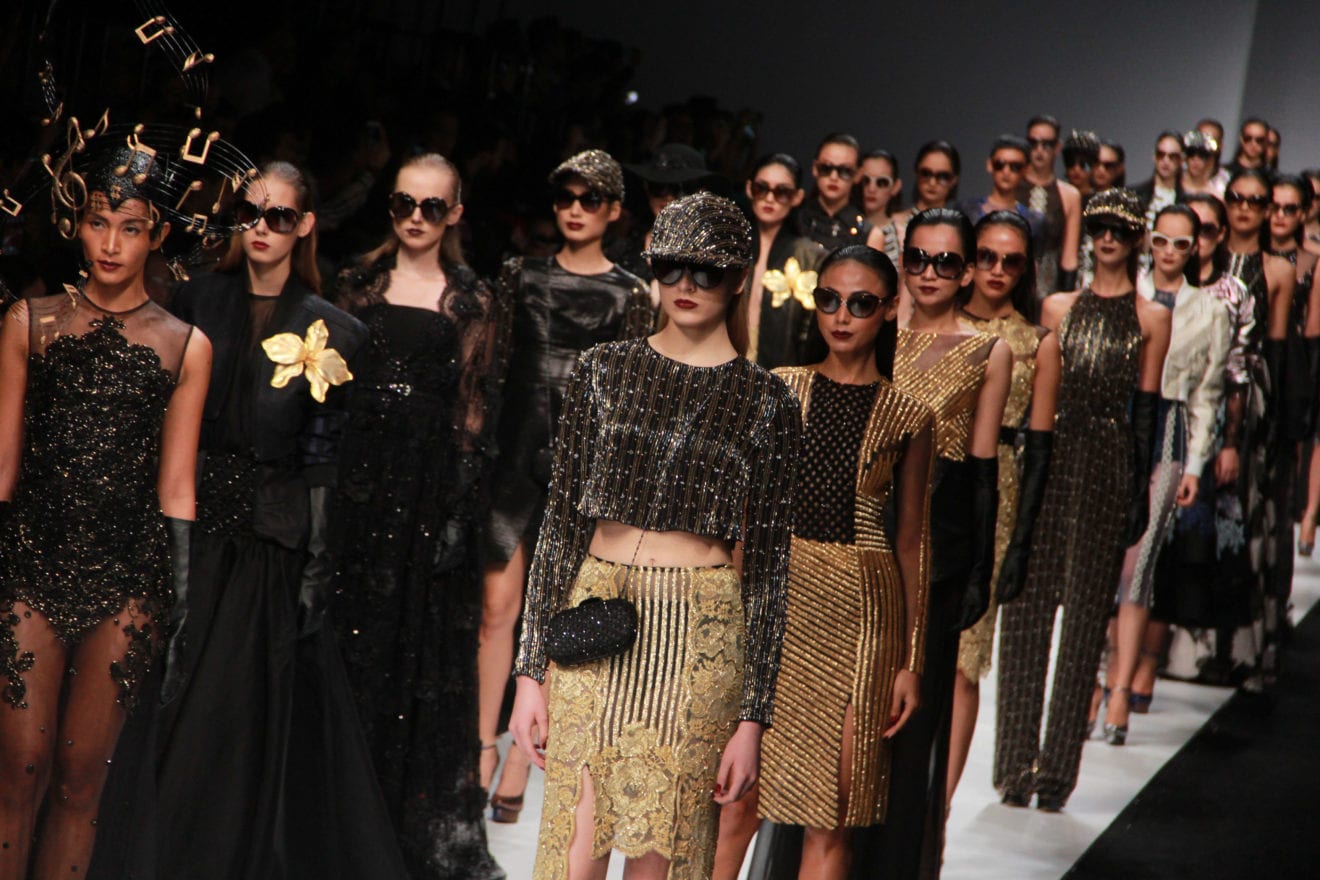
    Dolce & Gabbana has cancelled a high-profile catwalk show in Shanghai following an outcry over what many in China perceived to be a racist marketing campaign. The Italian brand products have now been dropped by e-commerce giants Alibaba, JD and Yoox Net-A-Porter. Leading Chinese e-commerce platforms Alibaba and JD.com were joined by Suning, VIPshop, Secoo and Netease in dropping the Italian fashion house’s products from sale.

    Hong Kong-based luxury department store operator Lane Crawford has also joined Chinese retailers in dropping Dolce & Gabbana products after it offended Chinese partners and internet users this week.

    Andrew Keith, president of Lane Crawford, told the Post: “With respect to our customers, we have taken the decision to remove Dolce & Gabbana from all stores in China, online and in Hong Kong.”

    The decision would take effect at 1pm on Friday, Lane Crawford said.

    Amazon China and Yoox Net-A-Porter have also removed products, with the latter dropping the brand from its Net-A-Porter, Mr Porter and Yoox.com platforms.

    Meanwhile, high-profile Chinese celebrities and KOLs including actors Li Bingbing, Chen Kun, Diliraba, Zhang Ziyi and actor-singer Huang Xiaoming were among a host of stars distancing themselves from the brand and vowing not to buy D&G products.

    A video posted on Weibo Monday of a Chinese model attempting to eat Italian food with chopsticks was taken down after less than 24 hours, but widely shared on both Chinese social media platforms and Instagram.

    The social media storm was made worse by comments attributed to Stefano Gabbana and Dolce & Gabbana’s official Instagram accounts on Wednesday, the day the brand’s #DGTheGreatShow catwalk presentation was scheduled to take place in Shanghai.

    In what Dolce & Gabbana claims was the result of a hack, the brand’s social media accounts featured derogatory comments about China and Chinese internet users.

    Though quickly removed, screenshots of the comments were widely shared on Chinese social media, along with the trending hashtag #BoycottDolce. The Weibo hashtag #DGTheGreatShowCancelled has been read 540 million times, and mentioned in 74,000 discussions.

    Show invitees have been informed that the 500-look runway event will no longer go ahead.

    China Bentley Modelling agency released an official statement saying 24 of their models who were booked to walk in D&G’s first Shanghai fashion show were boycotting the event.

    The Chinese government also stepped in with the Cultural and Tourism Department ordering Dolce & Gabbana to cancel the event just a few hours before it was scheduled to take place.

    Chinese consumers have flooded social media platforms Weibo and WeChat criticising the brand and posting videos and images of D&G products being destroyed, burned and used to clean floors and line animal litter trays. Security guards and police officers have been stationed outside Dolce & Gabbana stores in Beijing and Shanghai.

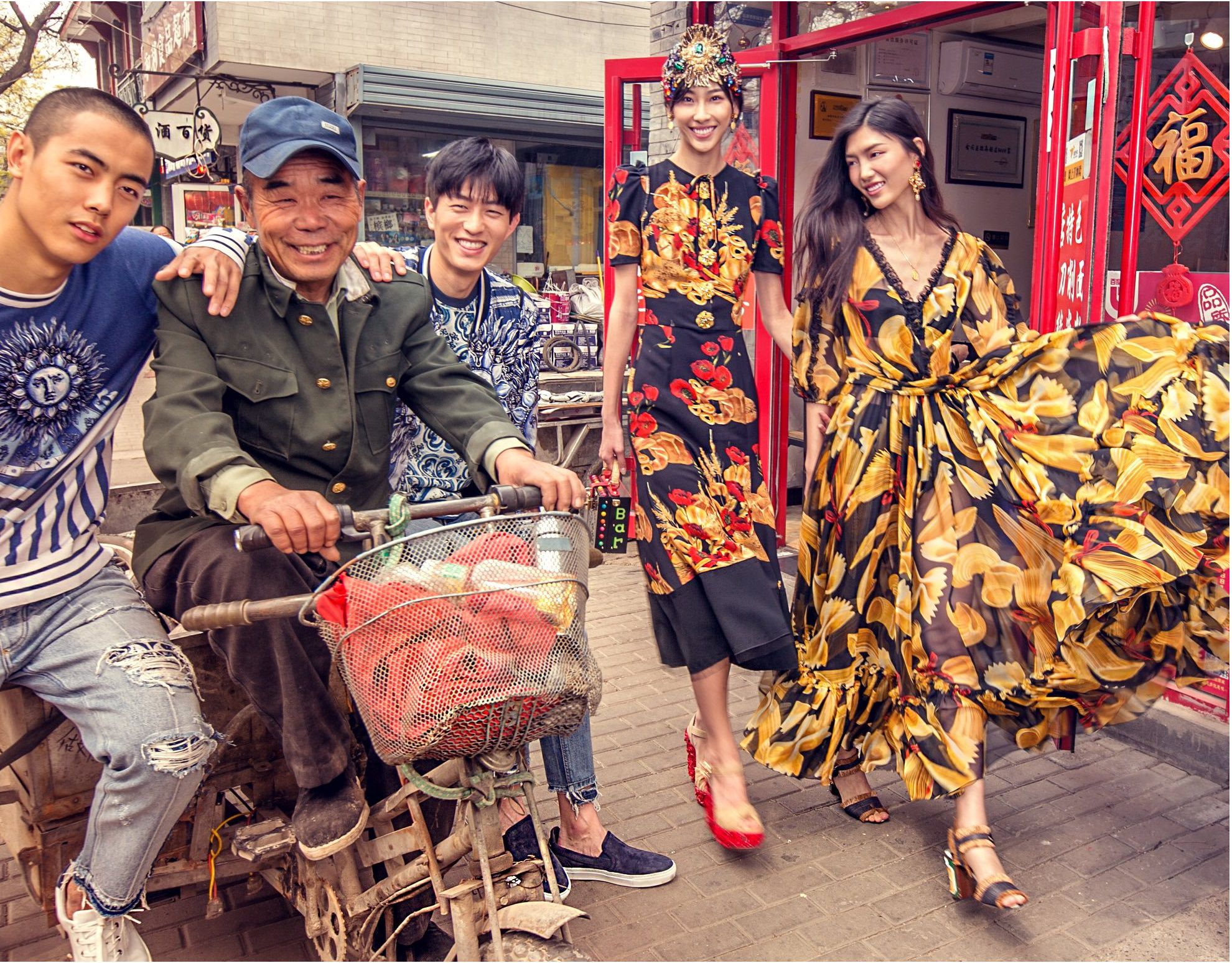
    This marks the second high-profile outcry over racist messaging from Dolce & Gabbana in only 18 months. A previous #DGLovesChina campaign depicted Beijing in a way that Chinese internet users felt looked backwards and underdeveloped.

    Both Gabbana and co-founder Domenico Dolce have been accused of making politically insensitive statements, from referring to babies conceived by in vitro fertilisation as “synthetic”, to refusing to support the right of gay parents to adopt.

    The duo has also described gladiator sandals as “slave sandals” and were quick to endorse First Lady Melania Trump.

    Gabbana in particular has a history of posting insensitive comments on social media, and came under fire for calling Selena Gomez “ugly” on Instagram in June, and the Kardashian family “the most cheap people in the world” in July.

    Though the designer duo have been known for using social media to voice their controversial opinions, upsetting Chinese consumers could have far-reaching commercial consequences.

    According to Bain & Company’s latest report on the luxury market, Chinese consumers account for an estimated 33 percent of global luxury goods spend, a share that is likely to hit 46 percent by 2025.

    Seeing as Chinese support can make or break a brand’s performance, how the label manages the controversy will be critical for its future success in the market.

    Dolce & Gabbana could not yet be reached in China or Milan for comment.

    According to a post published on Dolce & Gabbana’s Weibo account on November 21, the event has been rescheduled, and the brand has apologised for the inconvenience caused.

    Dolce & Gabbana reposted Gabbana’s ‘Not Me’ screenshot on its Weibo account, accompanied by the following statement, which mirrors the brand’s post on Instagram: “Our Instagram account has been hacked. So has the account of Stefano Gabbana. Our legal office is urgently investigating. We are very sorry for any distress caused by these unauthorised posts, comments and direct messages. We have nothing but respect for China and the people of China.”

    Last Friday, Dolce & Gabbana released a video of apologies, but the situation is not getting any better. The video was received as a way for the brand to preserve their own economic interests.

    Now, increasing attention has been given to similar episodes related to other brands, and media are populated with advertising campaigns, which show how while targeting overseas markets, lack of knowledge of local culture could be fatal to a business.

    Among the cases mentioned over the weekend, Chanel and its luxury boomerang, and Dior and Jennifer Lawrence featuring Mexican heritage without Mexican women (cultural appropriation), Zara and Nazi symbolism, and many more. However, Dolce & Gabbana case has been the first one with such global economic consequences.

  • Dolce & Gabbana Sparks Racism Backlash With Chinese Ad

    Dolce & Gabbana Sparks Racism Backlash With Chinese Ad

    Italian luxury retailer Dolce & Gabbana is facing a growing backlash in China after an ad campaign that was meant to promote the brand in arguably its most valuable market has been decried as racist.

    Amidst growing calls to boycott the brand on Chinese social media, popular e-commerce sites, including Alibaba’s Tmall and JD.com, have seemingly removed listings for Dolce & Gabbana products. Searches for the brand on those sites at the time of this writing returned no results. NetEase’s Kaola said that it had taken down the brand’s listings.

    The growing backlash forced the brand to postpone a fashion show in Shanghai just hours before it was set to take place on Wednesday, after models and celebrities reportedly said they would not attend the event. Dolce & Gabbana’s ambassadors in the region, Karry Wang and Dilraba Dilmurat, who is of Uigher ethnicity, have ended their contracts with the company.

    The uproar follows the publication of a series of ads on Chinese social media platform Weibo earlier this week, featuring a young Chinese woman attempting and failing to eat traditional Italian food, such as pasta, pizza and a cannoli, with chopsticks. The ads were released as part of the brand’s #DGLovesChina campaign ahead of the scheduled fashion show in Shanghai, but critics decried the videos as playing on racist stereotypes. The ads are still visible on Dolce & Gabbana’s Instagram page.

    The controversy was made worse after screenshots of direct messages purportedly from founder Stefano Gabbana’s Instagram account were leaked, showing offensive comments about China and Chinese people. Both Gabbana and the brand have denied that the messages were sent by the Italian designer, saying the accounts were hacked, but many have expressed scepticism, given Gabbana’s track record of getting into verbal spats on social media.

    “I love China and the Chinese culture. I’m so sorry for what happened,” Gabbana wrote in an Instagram post that asserted his account was hacked.

    The boycott is especially troubling, since China is such a crucial market for luxury retailers. A 2017 McKinsey report found that Chinese consumers account for nearly a third of the global luxury market, spending RMB 500 billion (approximately $99 billion) annually. The consulting firm expects Chinese consumers to account for the majority of the growth in the global luxury goods market in the coming years, and by 2025, the country is forecast to make up 44 per cent of the total global market.

    At the same time, McKinsey said that Chinese luxury consumers increasingly rely on word of mouth from friends and family to make purchase decisions, even more than the in-store experience. This creates treacherous terrain for global luxury brands, and Dolce & Gabbana is not the only one to have made a culturally insensitive or simply out-of-touch decision, causing offense in its most valuable market.

    Ikea, among many other brands, has faced criticism for listing Taiwan as a separate country on its packaging or website, while Mercedes-Benz ran into problems for quoting the Dalai Lama in an ad campaign. China considers the spiritual leader to be a dangerous voice for separatism in Tibet.

  • Women can make or break Vietnam’s F&B industry

    Women can make or break Vietnam’s F&B industry

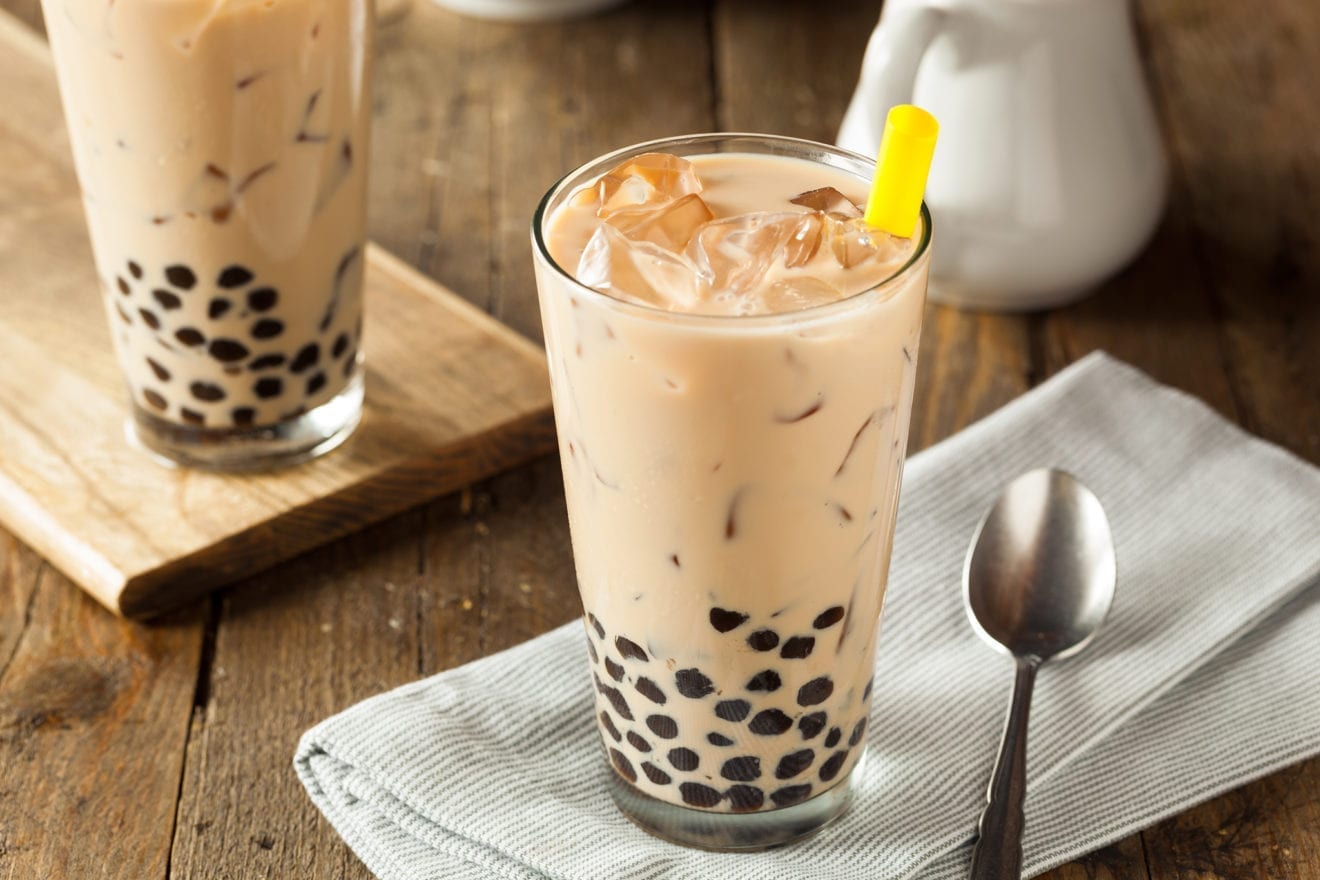
    With more women spending more on eating out, they have become linchpins of the F&B industry, a study indicates. A new survey by HCMC-based market research firm Decision Lab finds that female consumers can make or break the food and beverage industry of Vietnam.

    Average visits per capita by female consumers to the out of home food and beverage market has increased by 5 percent during last year, from 121 between the fourth quarter of 2016 and the third quarter last year to 128 between the fourth quarter last year and the third quarter this year.

    Women have also increased spending on almost all major food channels in Vietnam, namely full service restaurants (FSR), or sit down eateries where food is served directly to the customers’ table, and quick service restaurants (QSR), where table service is minimal and the typical fare is fast food, street food, convenience stores, canteens and bars.

    As a result, women’s contribution to the out of home market revenue has increased by a whopping 10 percent.

    Among the women themselves, the 15-34 year-old segment accounts for 82 percent of the visits in the out of home market, and more than half of those by white-collar workers. Students are also seen as the driving force of female visits at 25 percent.

    As such, Decision Lab points out that the growing influence of women on the foodservice market is real and the industry would be well advised to use female-friendly messages to increase the traffic.

    According to market research firm Vietnam Report (VR), Vietnamese spend more than a third of their income on food and beverages, topping education and utilities.

    VR said the food and drink market has become more exciting in recent years with the entry of technologies such as phone apps that allow users to find nearby restaurants and order deliveries.

    Food and beverages were two of the 10 most bought products online last year, it said, citing data from market research company Nielsen.

  • Why you should adopt more diverse influencers?

    Why you should adopt more diverse influencers?

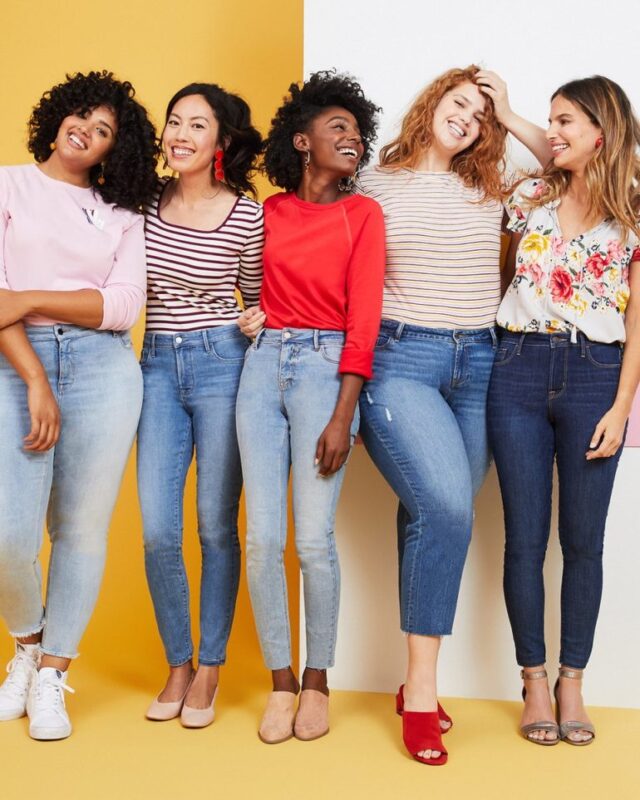
    Diversity, or lack thereof, is at the forefront of fashion industry discussions, with runways and advertising campaigns constantly—and rightly—scrutinised. Less has been said about diversity among prominent influencers, the new drivers of sales who are celebrated for their authenticity and ability to connect with customers.

    Thin, light-skinned women aren’t the only clothing shoppers, so why are so many of them the go-to for brands as they put together campaigns?

    Now several influencers, and a handful of talent agencies that represent them, are leading the charge to shake up the staid and stale landscape.

    They’re creating their own campaigns to highlight opportunities and content possibilities—along with #YouBelongNow, there are the hashtags #SupersizeTheLook and #ChicAtAnyAge — putting together initiatives to encourage and celebrate new voices in a greater range of ethnicities, sizes, and ages.

    The problem, many say, stems from the fact that the people organising the campaigns are not thinking about diversity when it comes to casting. It’s a continuation of the narrow view of beauty historically depicted in advertising, contends Jennifer Jean-Pierre Maull, a Haitian-American blogger and photographer from Washington, D.C with almost 16,000 followers on Instagram. “We need to change what we consider beautiful, we need to change what we consider marketable,” she said.

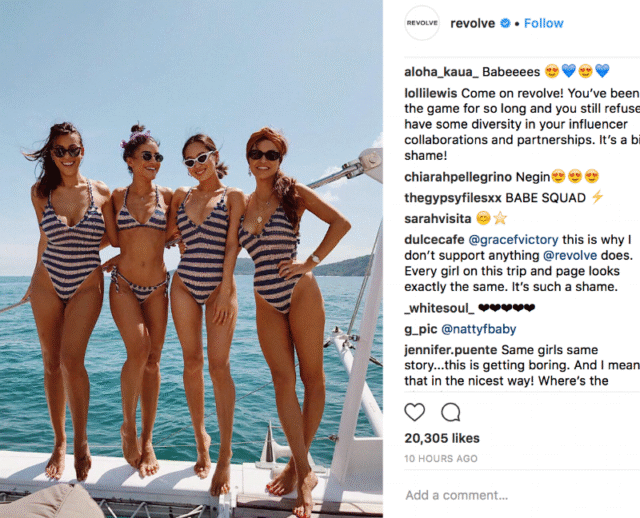
    Consider trendy online retailer Revolve: known for its influencer trips to far-flung corners of the globe, documented glamorously and exhaustively for its 2.6 million Instagram followers.

    Last January, as its squad took to the beach in Thailand, the attention turned from glowing to heated over the lack of diversity in its ranks. A shot of more than a dozen light-skinned swimsuit-clad slender women garnered more than 700 comments. A commenter tagged the picture #RevolveSoWhite.

    Revolve, which recently filed for an IPO and generated sales of $400 million last year, has never been a brand to highlight diversity, but whether or not that has had an effect on its sales is unclear.

    Revolve’s earned media value (EMV) dropped during the controversy to the brand’s lowest for the year, at $83.8 million. That cannot be solely attributed to the controversy, however, but “to the natural ebb and flow of events and campaigns.” And the dip was temporary: Revolve’s EMV bounced back to more than $140 million in each of the subsequent two quarters.

    In the firestorm, Valerie Eguavoen saw an opportunity.

    As the moment drew headlines, the North Carolina-based blogger and social justice advocate seized the chance to launch a new Instagram handle, @YouBelongNow, designed to celebrate people of all ethnicities, religions, sexualities and clothing sizes.

    “There are so many women who I could have seen on that trip, who belong in this space,” she said. “We have to get rid of this narrative that we don’t exist or it’s hard to find us.”

    Jean-Pierre Maull has kept tabs on what talent agencies she booked gigs with and which ones she hasn’t. In the latter camp was Fohr, based in New York and co-founded by James Nord. Over the summer, Nord addressed the Revolve controversy in a YouTube video, calling the retailer out for its practices while also suggesting it could be intimidating for brands to reach out to new influencers. Jean-Pierre Maull penned her response in a lengthy blog post. “Our POC (people of colour) community is not an alien force,” she wrote. “It is not hard to send a POC blogger the same pitch email that you send to others.”

    She emailed Nord, requesting to talk with him, one of many ongoing discussions Nord has had in recent months. “I leaned on this group of amazing women who did call me out,” he said.

    “Sometimes we just need to open up the conversation instead of just being angry,” Jean-Pierre Maull said. “Those in power must be self aware enough to see where they may be lacking or not doing enough.”

    One result of the chats Nord has had is a new mentoring program, called Freshman Class, to promote underrepresented influencers. More than 1,600 influencers applied, and 85 finalists were chosen. The ten winners include Alysse Dalessandro, queer plus-size fashion blogger; Ali Hemsley, a fashion influencer with a focus on chronic illness and mental health; and Destin Grayson, a menswear blogger. The winners will be flown to New York for three days of educational and networking opportunities.

    Nord hopes to help newer and lesser-known influencers build a network that can serve as sounding board, to discuss opportunities and pay rates.

    Jean-Pierre Maull said she was worried the initiative would seem like “someone need to swoop in and save” POC bloggers.

    The result, she says, has been anything but; it’s helping establish even more of a sense of community.

    “There is no lack of diversity in influencers, there is a lack of diversity in influencer campaigns,” Nord said.

    Relatability is a crucial part of influencer effectiveness, which is all the more reason why influencer campaigns should feature a more diverse range.

    Old Navy, a division of Gap Inc., looks for a range of sizes and family compositions in its influencer casting, then features them as models in its social feeds and digital marketing.

    “We’re looking for someone who people can see themselves in,” said Liat Weingarten, Old Navy’s vice president of brand communications.

    So far this year, Old Navy’s top two performing social posts featuring people (not just product), based on number of likes, comments and shares, are diverse group shots of influencers.

    One, highlighting dresses from its #SizeYES campaign, received more than 11,000 likes and more than a hundred comments. “My first thought when I saw this was: love this beautiful, diverse group of models!” wrote one commenter. “More of this, please!”

    And then there’s Revolve competitor Fashion Nova, which uses its Instagram account to highlight women of all ethnicities and sizes in its barely-there clothing.

    Its influencer hashtag, #NovaBabe, drove $54.1 million in earned media value from the second half of last year through the first half of this year.

    Mentions for @fashionnovacurve, the account for its plus-size line, generated $61.5 million in EMV.

    Followers are watching what brands are doing closely, too, said Scout the City blogger Sai De Silva.

    “When I go to events, I feel like there’s no one like me,” said Silva, whose followers have asked why she was the only woman of colour or woman with curly hair at a party “I live in New York City, how could there not be one other Puerto Rican [influencer]?”

    Influencers are finding that being proactive is the only way to move the conversation forward.

    Max Stein, founder and chief executive of agency Brigade Talent, said some of his clients will ask who else is participating before agreeing to a campaign, in the context of making sure a brand or company aligns on values—not just aesthetic. “It’s important to them that [diversity] is a value of the brand that they choose to partner with,” he said.

    However, not all brands are responsive in the way an influencer might want them to be.

    “There is sometimes a lack of cultural awareness and cultural sensitivities,” said Jaia Thomas, co-founder of The Presley Group, a management agency promoting diversity within the influencer space.

    Thomas, an entertainment lawyer, pointed to the time one of her African American clients was asked to do a post about watermelon. “There’s a long history of racial tropes and stereotypes associated with African-Americans, an affinity for watermelon being one of them,” Thomas said. “It’s important for there to be African-Americans in the room when creating social media campaigns so they can quickly and easily identify these stereotypes and ensure companies steer clear of them.”

    So, when will brands wise up? The enthusiasm that comes with a highly-engaged, targeted follower base is a big selling point in today’s noisy marketing field.

    “I don’t have a million followers,” said Katie Sturino, the force behind the handle and site The 12-ish Style. “What I do have is an audience that believes in what I’m saying and believe that if I’m showing them something, I like it.”

    Sturino’s best-performing content comes from two popular hashtags on her own account, both calling attention to sizing deficits within the industry. She recreates stars’ ensembles in #SupersizetheLook, with photographs of herself in similar outfits, performing 77 percent better than her average posts.

    Sturino also started the #MakeMySize hashtag, pairing pictures of herself in garments that are too small with captions asking brands to make a broader range of sizes, performing 65 percent better than her average posts.

    Sturino wishes more brands would take the time to find new personalities, and involve those newcomers earlier in the product-development process. “You pay them to wear the clothes, why don’t you pay them for their opinions, too?” she said.

  • “Falling Stars Challenge” has striked Asia

    “Falling Stars Challenge” has striked Asia

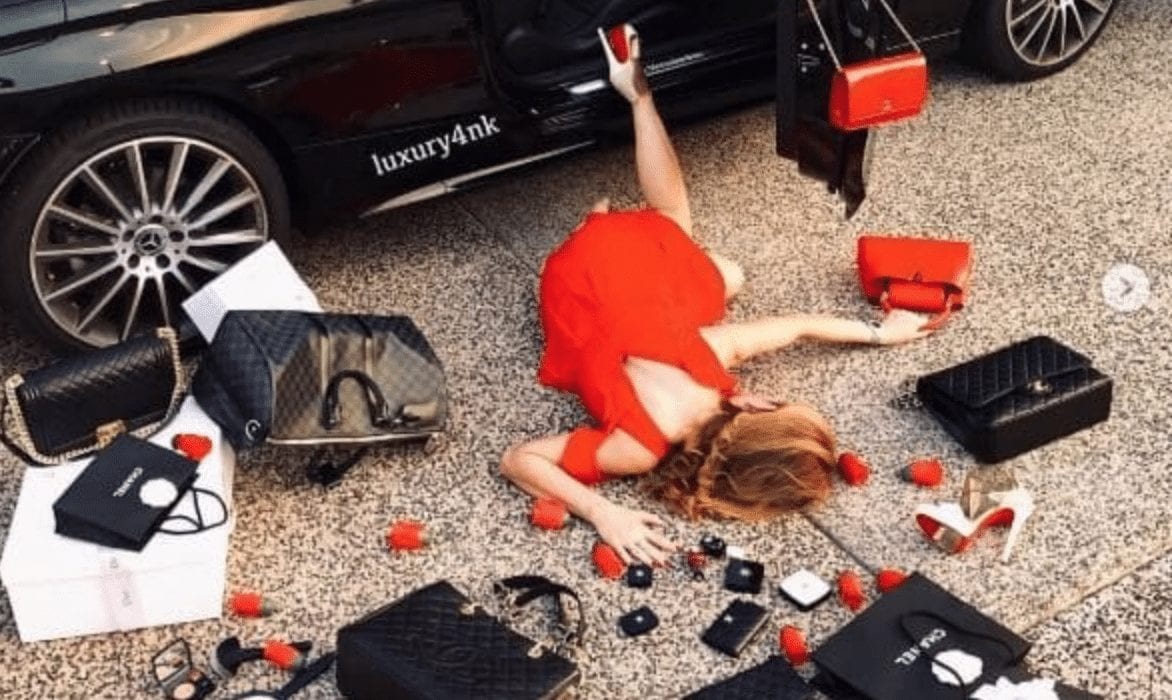
    The Falling Stars Challenge, a meme that has rocketed through Asia, features people posing as if they’ve fallen out of their luxury cars, with the luxury contents of their luxury bags spilling out on the pavement for all to see. The expensive goods are meticulously arranged so followers can admire the makeup, jewelry, shoes and other items that have oh-so-embarrassingly been laid bare.

    But the meme has become democratized, spreading from its beginnings as a way to take the humble out of humblebragging.

    It now encompasses any number of chosen identities, becoming a way to display the physical items and pursuits most closely associated with oneself.

    It’s popular among beauty and photography bloggers, fitness and food enthusiasts, and artists of all sorts.

    Hospital workers have shown off the tools of their trade, while others, with a touch of self-deprecation, have offered their more accessible collections of yoga mats, junk food and trash. They don’t even need to fall out of cars.

    The challenge originated in Russia and has spread throughout Asia, especially in China, where thousands of people have participated on Weibo, a popular social network.

    Even rigid government departments have joined in.

    The Consular Protection Center of China’s Ministry of Foreign Affairs posted a photo that showed a worker falling into a pile of paper.

    A police school photographed a fallen officer surrounded by bullets.

    The challenge has spread beyond Russia and China, with tens of thousands of posts from various countries appearing on Instagram.

  • Post-Instagram age : What’s next?

    Post-Instagram age : What’s next?

    Oscar de la Renta was early to Twitter, early to Tumblr and, yes, early to Instagram. So in July 2013, when the American fashion house debuted its fall advertising campaign via the app, the industry was hardly surprised. It was a little thing. An experiment. After all, the Norman Jean Roy-shot images would still run in the September issues of every major fashion magazine.

    Actually, it was a “really big deal,” recalled Jason Wagenheim, a former Condé Nast publishing star who was, at the time, Teen Vogue’s chief revenue officer.

    “That was a real tipping point for fashion,” said Wagenheim, who left the legacy publisher in 2015 and is now chief revenue officer of Bustle Digital Group.

    “Here is this expensive luxury brand and their fall campaign, which everyone looked forward to seeing in the print pages of Vogue; and yet everyone is talking about the engagement — the bajillion likes within hours — that the campaign got on Instagram. It foreshadowed that this could be bigger than any fashion magazine.”

    In reality, each of the Oscar de la Renta advertising images attracted not much more than 1,000 likes within the first hour of their posting.

    But the campaign was indicative of a much wider shift that has transformed fashion, changing how publishers publish, how brands brand themselves, and how consumers consume.

    Brands have closed, stores have shuttered, magazines have folded — and both survivors and upstarts alike are fighting for consumer dollars in a new world where the formula for success is not nearly as clear as it is once was.

    And no single entity has had as lasting an effect on the fashion ecosystem as Instagram, the photo-sharing service let loose on Apple’s App Store on October 6, 2010.

    Three years later, when Oscar de la Renta drip-dropped those images down its feed, traditional print magazines like Vogue were still the arbiters of style.

    It feels like a long time ago. But back then, their authority remained intact and largely unchallenged, despite the rise of independent publications that operated outside of the traditional publishing industry and the emergence of digital brands that sold directly to consumers.

    But it’s 2018 now, and times have changed.

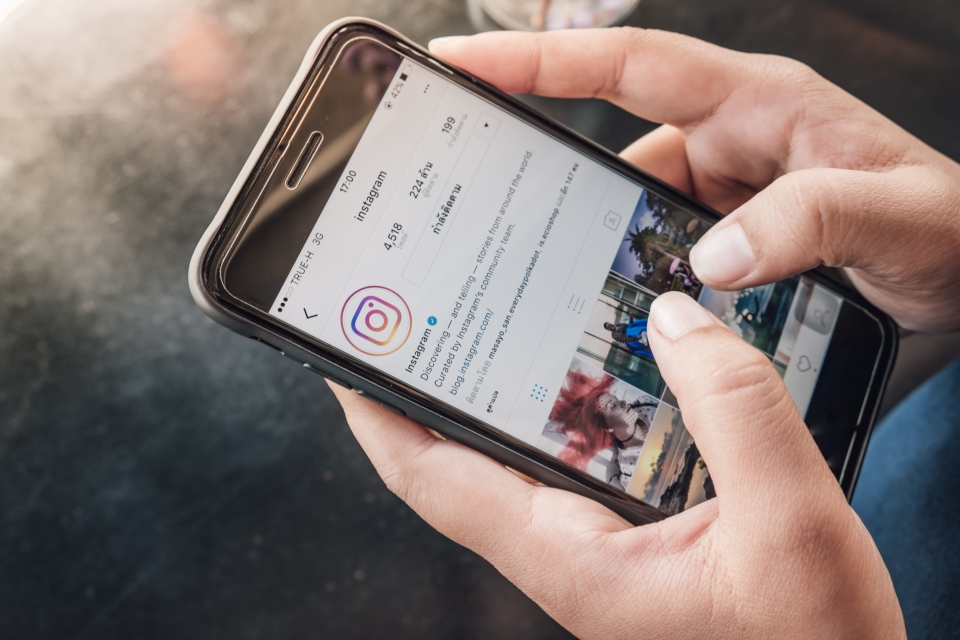
    Instagram, which was acquired by Facebook for $1 billion in 2012, is where people now go to discover fashion content and, increasingly, to shop, with 72 percent of users saying they have made fashion, beauty or “style-related” purchases after perusing the app, according to a 2017 study of 2,000 Instagram users.

    Instagram claims that more than 90 million users tap to see tags on shopping posts each month.

    In some ways, it was inevitable.

    Americans spend only 4 percent of their media-technology consumption hours with print, compared to 20 percent on personal computers and 28 percent on mobile.

    Many of them are spending their mobile phone screen time on Instagram.

    In June 2018, the app surpassed the billion-users-a-month mark, up from 800 million users in September 2017. More than 400 million people use Instagram Stories — the app’s more casual slideshow feature — every day.

    Rival Snapchat had 186 million daily active users in its most recent quarter, down from 191 million at the beginning of the year.

    As of August 2017, Instagram users under the age of 25 spend more than 32 minutes a day on the app.

    But the number dips only slightly to 24 minutes for those older than 25. That’s length of a sitcom…or a scan of a magazine.

    Of course, fewer and fewer consumers are buying those magazines. And brands have responded by following consumers online and shifting their marketing budgets from print to digital.

    In 1998, US print advertising revenue was $61 billion.

    In 2008, it was $54 billion, just a 12 percent decrease despite rising internet usage.

    But in 2018, it’s set to clock in at under $15 billion — down a staggering 75 percent from 20 years ago.

    Brands are increasingly using Instagram — via both organic and paid posts — to communicate directly with consumers.

    “Given the rising importance of social media for luxury brands — especially in the context of millennial’s growth — we believe Instagram data can no longer be ignored as a data point for luxury investors, to help them pick the winning brands,” Swiss investment bank UBS said in a recent note, going on to say that high Instagram engagement was a dependable reflection of brand heat.

    There is an unmistakable correlation between the size of a brand’s Instagram following and its retail sales.

    So it’s no surprise that, in the second quarter of 2018, global advertising spend on Instagram was up 177 percent year on year, significantly ahead of Facebook, which saw 40 percent growth in the same period.

    While Facebook still generates the majority of the company’s revenue, which hit nearly $41 billion in 2017, analysts estimate that Instagram will generate $8 billion to $9 billion in 2018.

    Projections predict that Instagram will account for about a third of its parent company’s overall ad revenue — and 70 percent of its new revenue — by 2020.

    In some ways, Instagram is to fashion what Napster was to music.

    You still can’t download a dress, but Instagram has fundamentally rewired the industry, replacing print magazines as the primary way in which people discover fashion.

    It’s the foundation on which the industry has built everything from new labels to an influencer economy worth $1.6 billion in 2018.

    All of Fashion Uses Instagram

    Consumers were quick to embrace Instagram, thanks to its simple user experience and flattering, colour-washed filters that made even grainy images look a little bit more perfect.

    They posted photos of their food, their travels and, yes, their outfits. Fashion brands picked up on this quickly, realising that creating content on Instagram — a highly visual platform — would allow them to reach more customers, and soon found themselves locked in a race for followers.

    Even luxury houses like Chanel, which has resisted selling core products online, took it seriously, using the service to post runway looks, campaign outtakes and inspiration boards.

    Some — from Proenza Schouler to Kith — have used the platform to tease their latest collections instead of waiting for a live Fashion Week moment.

    Earlier this year, Dior used Instagram as the main vehicle for the promotion of the relaunch of its classic saddle bag, tapping more than 100 influencers to spread the word.

    While the campaign proved controversial — several of the influencers did not disclose that they were paid to post on behalf of Dior — it was a blockbuster success.

    The #DiorSaddle hashtag drove $3.4 million in earned media value in the third quarter of 2018, beating #PFW, which garnered $2.6 million in earned media for the same time period.

    But it goes beyond the legacy players. “Instagram brands” — mostly independent startups with minimal capital — have caught the eye of major retailers looking to woo increasingly discerning customers.

    Why? Because their audiences are highly engaged, using Instagram stories to shop and direct message — “DMing”, in Instagram parlance — with the brands themselves.

    Labels like Doen, Cult Gaia and By Far boast little-to-no presence at major fashion weeks or within the traditional fashion system, and yet they are the brands industry insiders are most curious about because of the communities that they’ve built on Instagram.

    While Los Angeles-based bohemian apparel line Doen has just about 140,000 followers, it DMs with members of its community every day.

    The result? The brand regularly sells out of its peasant blouses and prairie dresses, creating an online frenzy.

    Cult Gaia, another Los Angeles-based label, may only have 317,000 followers on the platform, but the company says that it is on track to generate $15 million this year: far more than many independent high-end fashion brands with, in some cases, millions of followers.

    Through Instagram, we’ve built our own community.

    Instagram influencers are also launching brands, many with great success.

    Arielle Charnas, the influencer behind the account Something Navy, sold more than $4 million worth of product on the launch day of her collection with Nordstrom.

    In fact, the American department store has released multiple influencer collections, all of which are promoted via Instagram.

    Then there is the creative community, including relatively unknown artists, illustrators and photographers — from Gucci collaborator Jayde Cardinalli to artist Suzanne Jongmans, who has worked with Valentino’s Pierpaolo Piccioli— whose work now has global reach.

    But for Charles Porch, Instagram’s head of global creative programs, the platform’s crowning fashion moment came in October 2015, when American Vogue editor-in-chief Anna Wintour held a dinner during Paris Fashion Week in honour of Instagram co-founder and chief executive Kevin Systrom.

    Together, they celebrated the “Instagirls,” or models who earned or boosted their fame through Instagram, including Kendall Jenner and Gigi Hadid. Donatella Versace was there. So was Pat McGrath. They, too, were hooked.

    “To see the biggest designers, models, people in the industry talking about how much they love the platform, giving their feedback and, actually, huge people being able to talk about the product in depth … seeing their passion for a tech product … that really clicked for me,” Porch said. “They’re in so deep.”

    Earlier that year, Porch had wooed Eva Chen, an Anna Wintour protégé and the former editor-in-chief of now defunct Condé Nast shopping title Lucky, to lead fashion partnerships at the company.

    If Instagram is the modern equivalent of a fashion magazine, then you could call Chen its de facto editor-in-chief.

    Her personal brand — warm, friendly and, yes, democratic — aligns almost too perfectly with that of the platform itself. With more than one million followers, she has developed her own hashtag, written a children’s book, set to be published later this autumn, and earned a seat on the YNAP’s board of directors.

    Part of Chen’s job is to convince fashion industry stars like Kate Moss and Donatella Versace to join and use the app. But most importantly, she helps brands, image-makers, publishers and influencers get more out of their Instagram accounts.

    Chen travels the world to help fashion brands, holding master classes — filled with executives from brands like Madewell, Birchbox and Ralph Lauren — where she offers step-by-step instructions on how to take a good photo, how to get the most out of Instagram Stories, how to use hashtags without spamming people. All things that, if done well, can help improve engagement — and potentially increase sales.

    She also advises them on how to spend their advertising money on the app, although, like a traditional editor-in-chief, she is not cutting the deals and is more focused on organic marketing.

    “Instagram has made fashion more accessible,” Chen said recently one late Friday afternoon at the company’s New York city offices, wearing a pair of brown Gucci loafers and a checked blazer, the sort of off-duty look preferred by many of her friends who remain in print media.

    The Collateral Damage

    In many ways, Instagram has helped to modernise the fashion industry.

    But what about the collateral damage left in the wake of its success?

    Brands are not only pulling advertising from print, but also from legacy publications in general.

    While traditional publishers are still earning a part of the digital pie, brands are splitting up their marketing spends differently than they used to.

    Today, they might devote a certain percentage of budget to influencer marketing, and another slice to advertising directly on Instagram and other social media platforms.

    Oscar de la Renta has been using Instagram as an organic marketing tool for years, but it wasn’t until recently that it began spending a significant amount of its budget there.

    Three years ago, less than 5 percent of the overall budget was dedicated to digital advertising.

    For the spring 2019 season, it will be at least a third, said chief executive Alex Bolen, a portion of which will be spent on Instagram.

    Some brands are taking even bigger swings.

    About 55 percent of Gucci’s total 2018 media spend will go to digital efforts — mostly native advertising and paid social — per a report released by the Kering-owned brand in June. That is up from 44 percent in 2017 and 33 percent in 2016.

    And digital retailer Net-a-Porter has eliminated all national print advertising for 2018 bu for a few ads which will still run in local publications.

    Critically, the retailer also has its own newsstand-available magazine, Porter, that serves as a several-hundred-page advertisement.

    But moving away from print was not a small decision.

    “Instagram is where our customers expect to find us,” said Net-a-Porter managing director Matthew Woolsey.

    “Social media platforms certainly rise and fall, and while our outlook is agnostic, we are going to the platforms that enable us to have the brand conversation that we want to have and emotionally connect. Instagram does enable that.”

    Then there’s the talent drain.

    Image-makers and writers who would have normally held positions within legacy publications are now fleeing to digital-first publishers as well as brands, which are creating more content in-house to populate social channels.

    Many are also working independently as free agents, using Instagram to promote their projects.

    What’s more, declining advertising revenue means that there is less job security within traditional editorial.

    Today, editors might have to work across multiple publications within a company without any sort of raise or recognition. Going it alone often makes more fiscal sense.

    Legacy publications that cater to an older, affluent audience still have clout.

    As do those that still resonate with the industry.

    Doen — known for dreamy imagery and romantic silhouettes, created in limited-edition batches that often sell out — credits Instagram with much of its success.

    But it uses traditional media as a way to communicate to the trade.

    “Those are more of a tool to establish us as a brand within the fashion community,” said Doen co-founder Katherine Kleveland.

    “Through Instagram, we’ve built our own community.”

    But what happens if that community goes away?

    Testing Instagram’s Staying Power

    Eventually users will abandon Instagram.

    The question is when.

    Digital consumers can easily switch from one platform to another, making loyalty low.

    How long can Instagram keep them entertained?

    In September, the company made two significant announcements that could impact that answer.

    First, there was the introduction of new shopping features that make it easier for users to transact via the app.

    Then, just a week later, co-founders Kevin Systrom and Mike Krieger, who had carefully guided the business since its inception, announced their resignations.

    Reports in The New York Times and technology site Recode suggested that the two founders felt that parent company Facebook was moving too fast to change — and commercialise — the product, sacrificing the simplicity that made Instagram so popular in the first place.

    As Instagram has become the ultimate browsing tool, it has also become increasingly transactional.

    The company encourages this behaviour by making it easier for paying advertisers to link out and run targeted advertising both within the feed and Instagram Stories.

    Business accounts can also link out through Instagram Stories and tag products within posts.

    The addition of these tools is a natural — and welcome — progression, said Lauren Price, director of client strategy for luxury and special retail at research firm Gartner L2.

    “It doesn’t feel like it’s a huge divergence from the way that brands and consumers have used Instagram from the get-go,” she added. “The intention [to shop] has always been there.”

    After rumours that it would launch a standalone shopping app surfaced, Instagram announced that it would instead introduce a shopping channel on its “Explore” page, populated with products from brands the user follows, but also brands surfaced by its recommendation engine.

    While it is not yet possible to shop within the app, the company has linked up with major e-commerce providers including Shopify to ensure that the transition from post to check-out cart is as frictionless as possible.

    “Personalisation is a key principle,” said Layla Amjadi, Instagram’s product lead on Shopping. “In Explore, we want to make sure it’s your personalised mall.”

    Instagram insists that its focus remains on the user. That discovery is still the soul of the product.

    “Shopping is an inspiration-first product,” Amjadi said. “It maps to your interest, leans into relationships that you have… and is fantastic opportunity to help with consideration.” By “consideration” she means, “Should I buy this?”

    But as Instagram becomes more transactional, does it risk losing some of its magic?

    “I think it’s fine [for shopping] to be a part of the functionality,” said L2’s Price. “If you’re following a brand, you’re aware that it’s a brand.”

    The trouble comes in if Instagram integrates too deeply with Facebook and turns more into a pay-to-play platform.

    Right now, 93 percent of brands that advertise on social media advertise on Facebook, which prioritises advertising and organic posts from friends and family over organic posts from brands in its algorithm.

    “I advise the brands that we work [with] to get the most value out of that organic growth on Instagram in case it does change,” Price added.

    New Instagram head Adam Mosseri, the former vice president of the Newsfeed at Facebook, one of the platform’s most successful — and polarising — products, is said to have been Systrom and Krieger’s choice to lead the app into this next phase.

    But Mosseri has quite a bit of work ahead of him.

    Social networks fade as users grow tired of relentless promotions and frustrating user experiences.

    “You could certainly argue that there is an inherent scaling to the point of collapse in a social newtowrk,” said Benedict Evans, a partner at Silicon Valley-based venture capital firm Andreessen Horowitz.

    “But there isn’t an obvious next thing.”

    On the fashion front, competitors like YouTube and Snapchat are also hip to the success Instagram has seen with Chen, hiring fashion insiders Derek Blasberg and Vogue editor Selby Drummond, respectively, to head up fashion partnerships.

    And brands are likely to find it increasingly difficult to stand apart on Instagram, where they are competing for attention not only within their peer group, but with brands of all price points, quality and missions.

    The cost of advertising on the app will likely increase, as will the investment brands need to make on quality organic content.

    What if Facebook’s drive to squeeze more revenue out of Instagram makes it a less-fun experience?

    What’s more, if this “time well spent” movement actually catches on, how will this affect the new world order?

    Special interest groups are lobbying the government and private companies to better regulate the technology that powers social media.

    Instagram itself has contributed to this conversation, testing a feature that allows users to monitor their time on the app.

    Overall, fashion is still bullish on Instagram and eager to see what an easier shopping experience can do for its top line.

    For instance, the app’s bookmarking tool could be used, like Pinterest — a platform many brands still spend marketing dollars on — as a shopping list.

    If consumers continue to seek out Instagram for the fun stuff, and if Instagram can contain more of that fun stuff within the app, it could lead to more content creation, more talent discovery and more sales.

    “I don’t think Instagram is going anywhere,” Bustle’s Wagenheim said. “I feel like there’s a big opportunity to open the gates.”

    Of course, right now, fashion doesn’t really have a choice but to hope that’s the case.
  • Two thirds of the company wrong in measuring customer loyalty

    Two thirds of the company wrong in measuring customer loyalty

    A commissioned study conducted by Forrester Consulting on behalf of Collinson, a global leader in loyalty and benefits, reveals that the majority of organisations do not understand what is driving customer loyalty, and are therefore putting customer relationships and profitability at risk.

    Surveying decision-makers in organisations with revenue exceeding US$300 million, respondents graded their programmes based on a series of measures and also shared their key goals and challenges. The study surveyed and compared the results for a multitude of countries and regions in Asia Pacific (APAC), including Hong Kong, mainland China, Singapore, Indonesia, Japan, Korea and Australia.

    The research found that two thirds (65 per cent) of those surveyed markets in APAC do not understand why their customers are loyal to their organisations. Almost 7 out of 10 (67 per cent) reported that they do not have a proper framework in place to measure loyalty in the context of overall business performance. Remarkably, the research also found a misalignment between the loyalty objectives and the measurement criteria used to determine the effectiveness of their loyalty success.

    Three reasons why organisations may be struggling with customer loyalty

    1. Loyalty strategy without clearly defined business objectives and appropriate metrics

    Loyalty success is led by a holistic loyalty strategy with clear defined goals and measurement framework which needs to be embedded consistently across an organisation.

    Less than half (49%) of the APAC respondents have clearly defined business goals and objectives to define their loyalty proposition, where Hong Kong and Japan have the highest percentage (55%) compared with 39% of respondents in Singapore. Only 40% have cohesive customer loyalty strategy that spans multiple functions and is a top strategic initiative with C-level support.

    From the research, we found there is a clear discrepancy between what people are trying to achieve through their loyalty programmes and the KPIs in places to measure the performance in relation to their objectives.

    The key loyalty objectives and performance metrics shared by our respondents for their customer loyalty programme in APAC are misaligned as shown below:

    Key loyalty objectives The metrics for measurement
    1 Acquiring new customers (53%) Customer satisfaction (62%)
    2 Retaining existing customer (47%) Customer engagement (59%)
    3 Enriching customer relationships (46%) Customer retention rate (57%)
    4 Improving the customer experience (37%) Loyalty programme enrolments (57%)
    5 Increase customer advocacy (35%) Sales & revenue (57%)

    Without appropriate metrics, it could be difficult to know which areas need improvement and understand the impact of customer loyalty on overall business performance.

    1. Without a single customer view to harness data potential

    To appeal to the modern, choice-rich consumers, it is important to engage them at an individual level which means collecting all appropriate data across the customer journey.

    The research found that three-fifths (60%) of respondents in APAC do not have centralised business rules to incorporate all sources of customer data into a single customer view. Less than a half (48%) collect a wide enough range of customer data to run deep analyses, where only 26% of them automate advanced data analytics to optimise their customer strategy, and 35% would use predictive modelling to identify the right existing dynamic content based on customer behaviour.

    Predictive modelling enables brands to make better decisions and run more effective programmes where China has the highest percentage (47%) compared with the rest of respondents in Asia Pacific to harness the value of data for providing personalized offers for each member. It is vital to recognise each customer preference and behaviour to provide a personalised experience that stands out from the competition. This can only be done when brands continuously collect the right information about their customers and using it effectively, to understand what makes them tick.

    1. Competitive differentiation

    Loyalty programmes with reward, point and VIP schemes have been pervasive for years. These tactics are still frequently employed, but the effectiveness is uncertain when they are deployed without a sound loyalty strategy. From the research, we found that brands continue to see competitive differentiation as being vital, with two thirds (66%) of loyalty practitioners in APAC reporting that is a critical or high priority.

    72% in Asia Pacific, 78% in Hong Kong, Indonesia and Korea respondents planned to increase funding for developing new loyalty programme benefits and rewards.  Embracing partnerships with like-minded brands, who can offer unique experiences and access to their customer base, will enhance and strengthen the member’s engagement. It enables partner brands to expand their knowledge of the customer through an integrated cross analysis of buyer behaviour and preferences for personalized, curated communications to increases sales leveraged through the partnership.

    Mary English, Executive Vice President, APAC of Collinson, says, “A clearly defined loyalty strategy provides the foundation to design a proposition for continuous engagement with your customers in a relevant and meaningful way. Data is the fuel for ongoing loyalty to a brand with heavy weighting on a well-structured single customer view to capture, measure, gain insights, and personalise the dialogue with their customers.  Organisations need to put loyalty back on track by becoming better aligned in terms of their objectives, what they measure, and how to differentiate their programmes. There is really no ‘one size fits all’ approach and each organisation must identify their brand’s unique, valuable assets in formulating a strategy that is regularly reviewed and updated to the changing behaviours of their customers.”

    “Creating formalised processes and employing dedicated resources can be a valuable investment and demonstrate your company’s commitment to loyalty. It is logical for companies to consider ‘connected loyalty’ as a goal of their strategy. Customers who feel connected to the organisation become fans, not just purchasers of their products and services. The latter may simply be shopping out of habit or convenience, whereas fans will go out of their way for the brands they love.”

  • A US$1 Million post – Instagram’s most paid celebrities

    A US$1 Million post – Instagram’s most paid celebrities

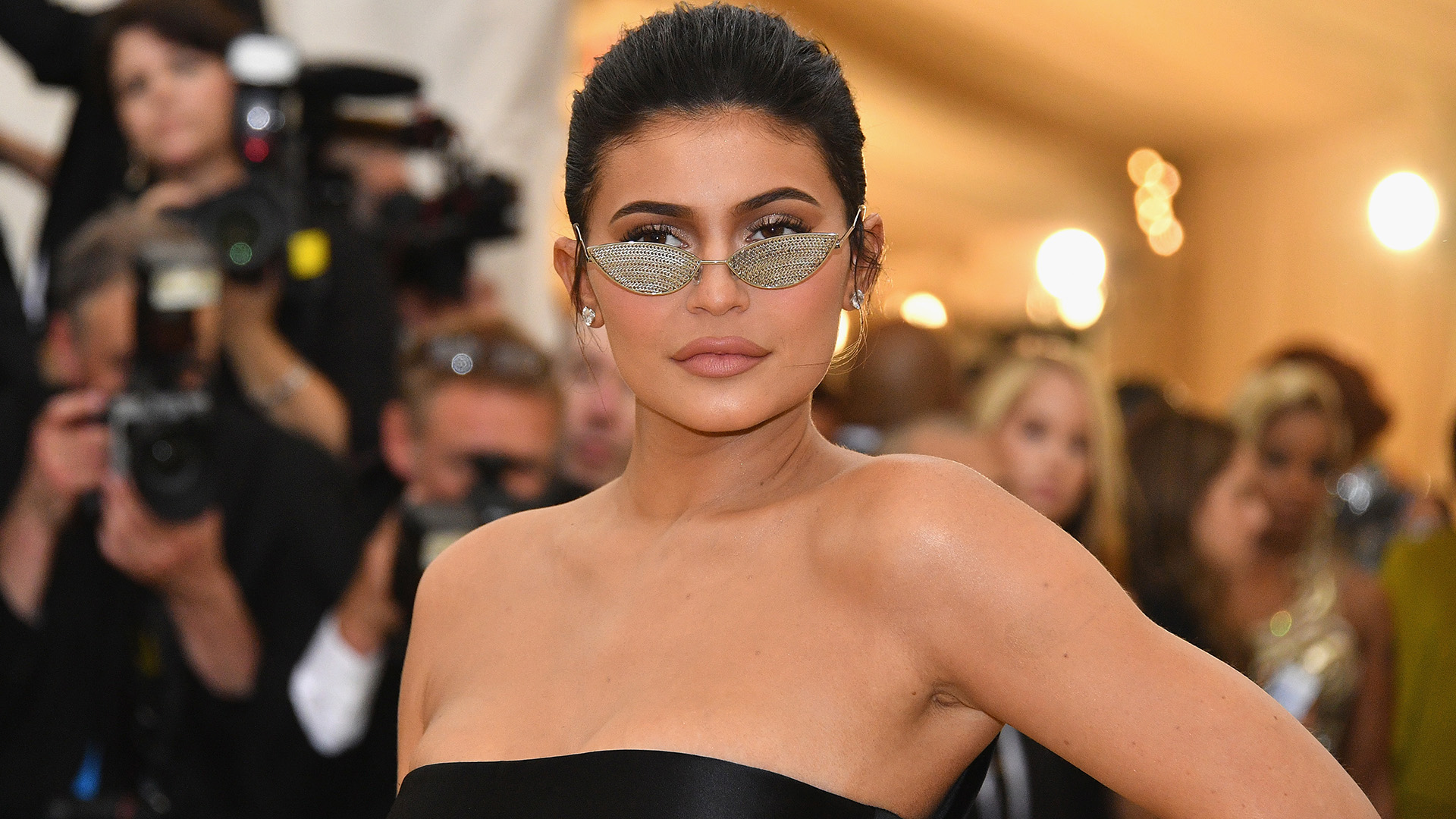
    After having its net worth valued at US$900 million by Forbes earlier this July, Kylie Jenner has now become the world’s most paid Instagram celebrity according to HopperHQ.com’s Instagram Rich List 2018.

    The annual ranking reveals which celebrities, athletes, models and influencers generate the most revenue from posting on the famous social media platform.

    Estimated at $400,000 in 2017, the youngest of the Jenner-Kardashian clan now reaps $1 million per sponsored post that she shares with her 111 million Instagram followers.

    With her 139 million followers, Selena Gomez trails in second at $800,000 per post despite having more followers.

    Surprisingly, Kim Kardashian and Beyoncé are relinquished to the 4th and 5th spot as famous football player Cristiano Ronaldo takes the 3rd position; earning roughly $750,000 per post.

    Discover the top 10 below:

    1. Kylie Jenner — $1,000,000 per post
    2. Selena Gomez — $800,000 per post
    3. Cristiano Ronaldo — $750,000 per post
    4. Kim Kardashian — $720,000 per post
    5. Beyoncé Knowles — $700,000 per post
    6. Dwayne Johnson — $650,000 per post
    7. Justin Bieber — $630,000 per post
    8. Neymar da Silva Santos Junior — $600,000 per post
    9. Lionel Messi — $500,000 per post
    10. Kendall Jenner — $500,000 per post


  • Blackstone and Sky Internasional Be Named as Masterminds of a Big Marketing Scam in Indonesia

    Blackstone Indonesia and Sky Internasional a self-claimed digital strategic marketing agency in Indonesia with premium services in interactive communications, digital strategy, brand identity, social media and online advertising are to be considered as digital fraud masterminds and to be the leaders of an organization with only one goal, to cheat clients solely to enrich themselves with personal benefits and to fund their luxury lifestyles. 

    Retail News received a lot of complaints from several Blackstone Indonesia customers, basically complaining about the same kind of practices. Retail News took the lead in this investigation and took a deeper dive into this matter. After seeing all proof we are committed to send out a warning to all startups and companies in Indonesia. Our advise is not to engage in any partnership with the two mentioned companies. It’s very likely you will lose money, time and efforts in the spiderweb these companies have build out.

    The “modus-operandi” is usually the same ; they issue invoices without tax and ask clients to wire money to a variety of bank accounts. All invoices appear to start with #1 for each clients and one of the bank accounts always coming back is from Aldino Ozky, Bank Central Asia with bank (BCA), Account No. 920000223. They use this bank account to wire company money to and to avoid paying taxes, neither issuing any tax receipts.

    After a company wires the first retainer, Blackstone shows you their digital dashboard which has all sorts of numbers on page views and impressions and gorgeous graphs. It looks like you’ll have access to loads of information about your marketing. Which in theory is a good idea… The only problem with every one of these fancy dashboards we’ve seen is they provide all sorts of information which is of no use to the business of client and they sell 0. While they charge you for a variety of things, simply to run out your budgets.

    Aldi Sky Wungkana, self-esteemed CEO of both companies has an explanation for everything, but not for all above topics we’re writing up ; also not even why the money of the company is wired without tax straight into an employees bank account. Big talker, 0 results.

    Felix Valentino is also a member of their league, he never picks up the phone when you try to call him ; uses fake whatsapp profiles and he’s to be considered as the the email writer to inform customers that their money is litterally gone. Done and dusted, simply call him the “excuse guy”.

    A random overview of what else they are practicing:

    # PPC fraud with high bounce rates and non-targeted traffic.

    # sending bot traffic to your website and charging high CPCs for this ;

    # buying FB engagement on non-legal websites and sending it over to your social media channels basically ruining everything you have build up ;

    # 0 to none connection with big newspapers, but charging the same rates to publish content on shitty websites claiming they offer premium PR services

    In regards to the proof of all statements made above, readers, the police and/or any other governemental institution can contact Retail News to received all proof. We have bundled all complaints from startups and customers. None of the phone numbers we called were available for any comments. Whatsapp groups dissolved and no response on email.

    A police case is about to be filed as well as a court case to stop these gentlemen from doing what they are doing. Companies are warned! The tax authorities received complaints as well and confirmed they have started an investigation.

  • AirAsia, Indonesian tourism ministry in joint marketing pact

    AirAsia, Indonesian tourism ministry in joint marketing pact

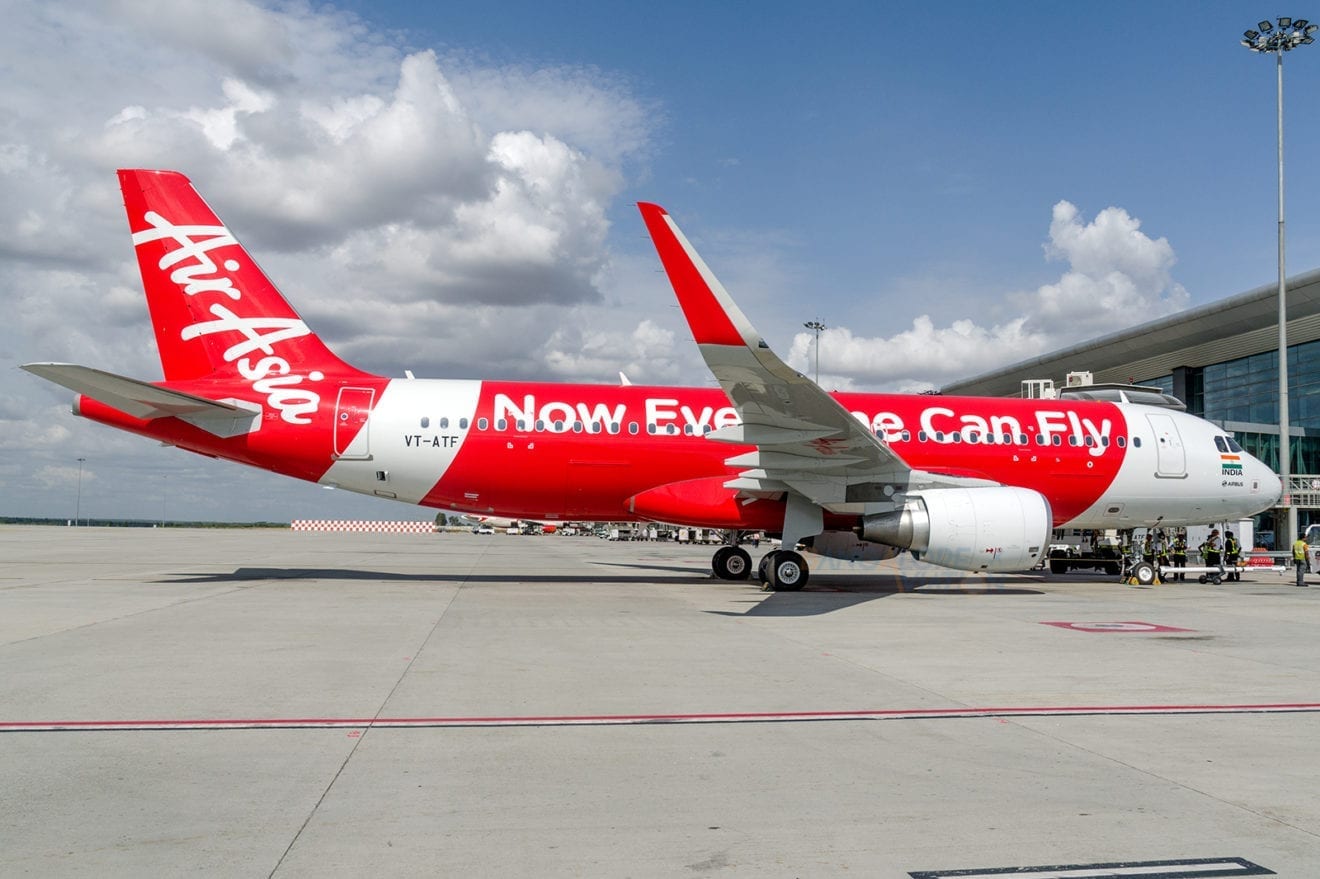
    Indonesia’s Ministry of Tourism and AirAsia have announced a collaboration in marketing in terms of brand advertising, promotional activities and activations across various touch points including, digital, print, radio, in-flight branding, consumer selling travel fair and more.

    The launch of the collaboration was held in Shah Alam, and was attended by Judi Rifajantoro, professional staff to the minister for tourism infrastructure, Indonesian Ministry of Tourism; Robert D. Waloni, senior adviser to the minister for air accessibility, Indonesian Ministry of Tourism; Aireen Omar, CEO of AirAsia Bhd; and Rifai Taberi, commercial director of Indonesia AirAsia.

    “Under the joint promotion for the media campaign, we hope AirAsia will cater more travellers to Indonesia and more people especially Malaysians can experience Indonesia thanks to AirAsia’s numerous routes. This is obviously part of a much broader agenda of collaboration with airlines and the community,” said Rifajantoro.

    Aireen said, “This partnership could not be more timely as we have been seeing a robust demand for Malaysia and Indonesia. In 2016, we have flown more than four million guests between both countries to contribute significantly to the tourist arrivals last year and this is only a fraction of the great potential we can achieve.

    “We look forward to this commitment with the Ministry of Tourism Republic of Indonesia and we are confident that we can further increase more tourist traffic and income for both countries.”

    AirAsia connects Malaysia with Indonesia with more than 350 times weekly flights to 15 different cities such as Banda Aceh, Bandung, Bali, Jakarta, Lombok, Medan, Pekanbaru, Palembang, Padang, Pontianak, Semarang, Solo, Surabaya, Makassar, and Yogyakarta.

    The airline recently added more frequencies to several routes in Indonesia and has launched direct flights from Kuching, Sarawak, to Pontianak.

    In conjunction with the partnership, AirAsia is offering promotional fares for flights into Indonesia, starting from RM79, for bookings made from yesterday until Sunday, for immediate travel until Feb 25, 2018.

  • How brands use short videos for marketing in China

    How brands use short videos for marketing in China

    As the luxury industry discusses Snapchat’s marketing possibilities and, more recently, Instagram’s latest filter feature, brands looking toward the China market are facing a completely different short video industry. It’s one that has witnessed rapid development thanks to the popularity of smartphones and upgraded communication networks in China.

    In March this year, Kuaishou, a popular short video app, was on the receiving end of a US$350 million investment from Tencent, and Alibaba put RMB 2 billion toward the transformation of Tudou from a large, formerly popular online video platform to a short video community. Also, Yixia Technology, owner of Miaopai and Xiaokaxiu, both popular short video apps in China, has already spent RMB 2 billion to encourage short video content creators and producers by building several video creation bases and providing professional studios.

    Short videos are perfect for young, tech savvy consumers who take their phone with them everywhere and use it to access social media or to fill in short breaks in the day between other activities.

    But which short video apps are the most popular in China? Who are the viewers of these short videos? How can brands market to them? What should brands take into consideration when launching short video campaigns?

    China’s short video apps

    Similar to short video platforms like Viddy and Instagram, there are numerous short video platforms and apps in China where users can record real-time short videos and share them with friends. As for users, there were 153 million regularly watching China’s short videos in 2016. This is estimated to reach 242 million by 2017, an increase of 58.2 percent.

    CIWEEK, an internet content magazine, released a list of their top 10 short video apps in China in the first half year in 2016 and Kuaishou, Miaopai, and Meipai were the most popular.

    Of these, there are actually two types of short video platform in China:

    1. Comprehensive platforms: professional short video platforms

    These platforms, such as Meipai, Miaopai, and Xiaokaxiu, provide a one-stop user experience. Users can use various shooting tools, effect settings, and formats while filming or editing a video. They also offer a community for users to share their videos with friends. Short videos uploaded on those platforms can also be shared with WeChat friends, WeChat Moments, and Weibo.

    2. Content recommendation: news apps

    These platforms, such as Toutiao, NetEase, Tencent News, and Yidian Zixun, focus on suggesting popular or professional short videos. These platforms were originally news-based and mass communication oriented. They have millions of viewers and short videos recommended on these platforms can get huge amounts of traffic.

    Who are the viewers?
    The main users of China’s short video apps are young. Most of them belong to the post-90s generation. According to a report published in March 2017 by JIGUANG, a big data provider, users ages 16 to 25 make up 39.7 percent of the total, while users aged 26-35 are at 33.3 percent. Meanwhile, over half of the users are female, making them 69.4 percent of the total number of users.

    In terms of regions, 66.9 percent of the total come from third-tier and below third-tier cities in China. The top 3 provinces for viewer numbers are Guangdong, Henan, and Shandong.

    How are brands using short video?
    Short video is becoming a new favorite marketing tool for brands for several reasons. Short videos can be used for various types of promotional materials, such as product reviews, product seeding, promoting brand culture and more. With interesting and meaningful content, short videos can deliver specific brand messages to a target audience while avoiding the annoyance that longer videos may cause. The production cycle of short videos is quick with great flexibility, which works well with brands’ marketing plans and budgets. Through audience interactions with short videos, brands can better understand their preferences, rapidly improve their user experience, and come up with effective marketing plans quickly. Integrated campaigns launched on short video platforms can be creative and diverse.

  • What retailers need to know about Artificial Intelligence marketing

    What retailers need to know about Artificial Intelligence marketing

    An influx of new technology and its impact on the retail sector in recent years has given rise to the use of artificial intelligence, bridging the gap between accruing big data and interpreting it for use as a marketing tool.

    According to research firm Emarsys, AI marketing will dominate the industry by mid-2017, meaning digital marketers should be using AI to build a clearer picture of their target audience, boost a campaign’s performance and ROI. And done correctly, it’s all without any extra effort. But, many brands don’t understand what AI is and how they can tap into it.

    What is AI?

    AI uses big data, or the aggregation of large data sets, which are then analysed via machine learning platforms to help identify consumer trends.

    These platforms identify insightful concepts and themes across huge data sets, via algorithms, and fast.  Essentially, the results are an interpretation of emotion and communication, “making these platforms able to understand open form content like social media, natural language, and email responses,” explains Lisa Manthei, marketing communications manager, Emarsys, in a blog post.

    This ensures “the right message is being delivered to the right person at the right time, via the channel of choice,” adds Manthei.

    What does AI look in marketing?

    A major function of AI is using data to break down and understand consumer search engine patterns and algorithms to help marketers identify key focus areas.

    As is, delivering smarter ad content to a brand’s target audience. With more data available, online ads can play off a “shopper’s key word searches, social profiles and other online data for a human-level outcome.”

    Thirdly, a target market –even with common interests and attributes – can be separated, and further targeted, at an individual consumer level. The data can be used to target existing and potential clients, delivering content that is customised to each person.

    Finally, AI plays a role in customer service and retention. Direct-to-consumer engagement channels, namely chat functions, can be run by Bots. Bot-run chat is more efficient and effective as the Bot has access internet data and learning algorithms, something that a human can physically tap in to so easily. With this, AI Bots save on a brand’s human resource power too, so it’s a win-win for brands.

  • Pizza Hut CMO Pankaj Batra moves on to new role after 11 years in Asia

    Pizza Hut CMO Pankaj Batra moves on to new role after 11 years in Asia

    Pankaj Batra, chief marketing officer at Pizza Hut Asia Pacific, has taken on a new role as chief brand officer at Pizza Hut, Middle East, Turkey and Africa (META). This was confirmed by him to Marketing.

    According to his LinkedIn, he will be responsible for sales and brand metrics, digital marketing and food innovation for the region. Prior to the appointment he held the CMO role since 2014, where he was responsible for brand equity and sales growth of Pizza Hut across over 2,600 restaurants in 13 countries.

    He was also responsible for marketing and sales for Home Service and Express channels. He also partnered with seasoned franchisees and a team of over 50 marketing professionals to develop regional and local programs to achieve targets and grow market share.

    Before that he was director of marketing and PR in Asia, where he handled brand marketing and sales leader for Pizza Hut Delivery across nine countries in Asia, including Japan, Hong Kong, Taiwan, Indonesia, Philippines, Malaysia, Singapore, Vietnam & Brunei.

    Last year, Pizza Hut Singapore appointed See Seow Ying as senior marketing director, who was previously head of marketing at Burger King Singapore since 2013. She replaced Michelle Lee, who moved on to take on the role as head of marketing for SEA and Korea at Subway Systems Singapore.

    During her tenure, Lee was responsible for overall brand direction, brand sales, P&L and marketing strategies. She also drove product and service innovations along with menu development with food innovation, operations and supply chains.

  • Burger King hands Lowe Lintas creative brief for the Whopper

    Burger King hands Lowe Lintas creative brief for the Whopper

    International fast food franchise Burger King has appointed Lowe Lintas Mumbai to launch a new campaign for its iconic sandwich ‘the Whopper’.

    The campaign brief is be mainly targeted at India’s millennial generation and will focus on strengthening brand awareness within this demographic.

    Describing Lowe Lintas’ team as a “talented bunch”, Burger King India’s chief marketing officer Kapil Grover said: “Creative agencies are like an extended marketing team. It’s important to have partners who understand the brand and share the same passion.”

    Lowe Lintas’ leadership recently underwent a reshuffle with the appointment of Arun Iyer to the dual role of agency chairman and chief creative officer.

    President and Mumbai office head Raj Gupta was also named chief executive officer.