Tag: Shopping

  • Vietnamese prefer overseas sites for online shopping

    Vietnamese prefer overseas sites for online shopping

    Local consumers say global giants like Amazon and eBay offer a wider range of products and better return policies. Vietnamese online shoppers spend significantly more on overseas purchases than they do domestically as they believe international e-commerce platforms offer better products and service quality, a new report has said.

    The report, from the Vietnam E-commerce Association or VECOM, said that many global retailers like Amazon and eBay have made it easier for Vietnamese consumers to buy online.

    “Meanwhile, a majority of Vietnamese e-businesses, especially small- and medium-sized companies, have yet to make significant investments in market research catering to consumers,” said the report.

    Local online shopping sites are less competitive in terms of product diversity and quality, return policy, and order placement costs, the report highlighted.

    “I shop on both eBay and Amazon,” Quoc Hung, a reader said in a comment. “I can just send a product back if I don’t like it.”

    Most Vietnamese online businesses don’t offer free delivery and free return, another reader pointed out.

    Chinese online retail giant Alibaba is also attracting more Vietnamese customers. Internet company OSB, Alibaba’s authorized agent in Vietnam, said the company’s customer base in Vietnam has expanded to 500,000 after sharp increases over the past three years.

    The online shopping trend is growing rapidly in Vietnam, where 30 percent of the population will be buying goods and services over the internet by 2020, according to the Vietnam E-Commerce and Information Technology Agency.

    The agency, run by the Ministry of Industry and Trade, said revenue from online retail is expected to account for 5 percent of the country’s retail market in 2020, up from only 2.8 percent in 2015.

    Vietnam’s e-commerce market, which has one of the world’s fastest growth rates, jumped 37 percent in 2015 to around $4 billion, based on government statistics.

    The growth rate is about 2.5 times faster than that in Japan, based on some estimates by industry experts.

  • Las Vegas Sands Corporation may offload portion of Marina Bay Sands

    Las Vegas Sands Corporation may offload portion of Marina Bay Sands

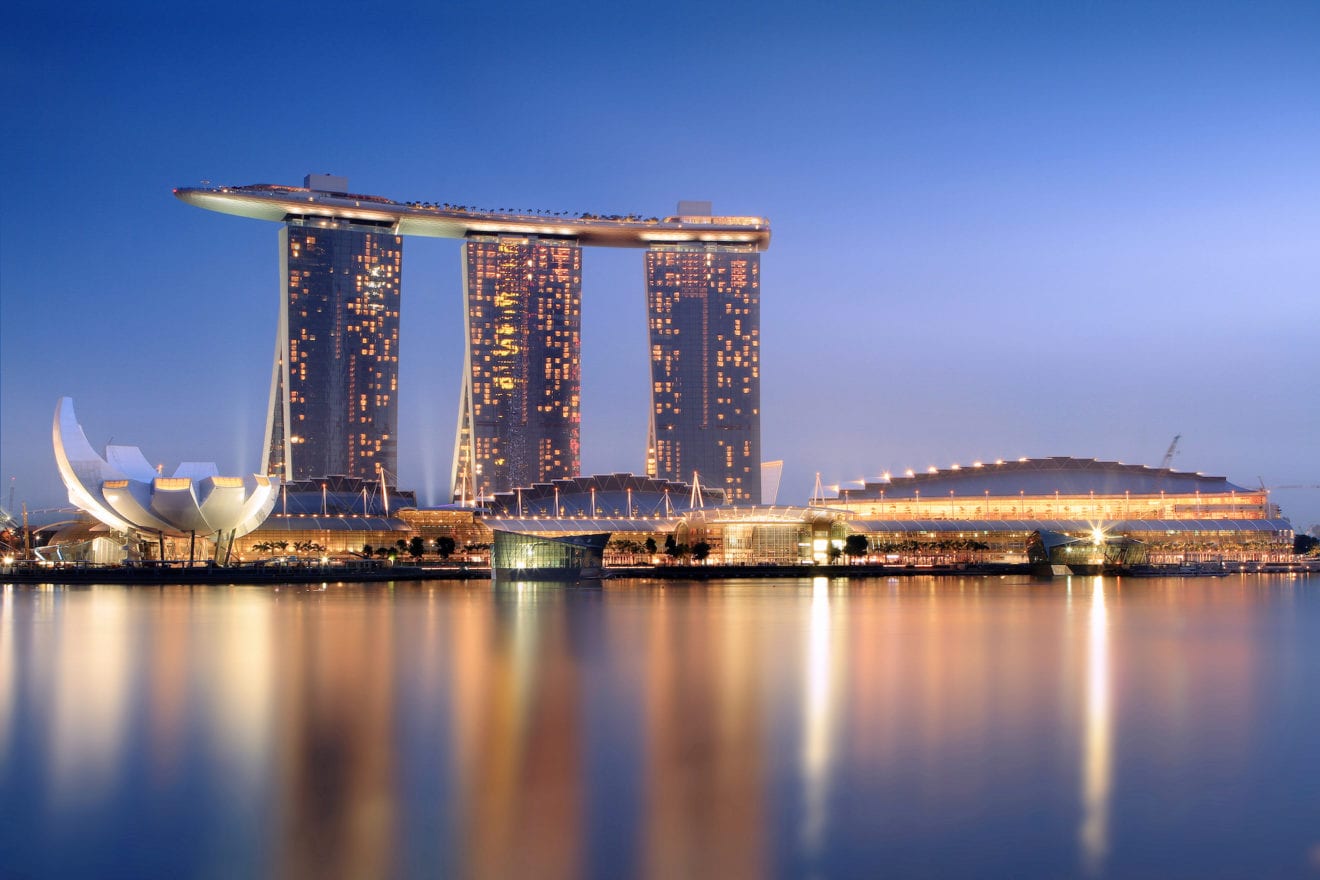
    In Singapore, giant casino operator Las Vegas Sands Corporation is reportedly hoping to sell off a large stake in its shopping mall inside the Marina Bay Sands development before potentially using the proceeds to invest in future venues in Japan or South Korea.

    According to a report from The Straits Times newspaper, the Las Vegas-based giant wants to offload a 49% share in its 800,000 sq ft The Shoppes At Marina Bay Sands for up to $3.5 billion but first needs the approval of the city-state’s government.

    “We expect to receive a very significant price for the 49% we are willing to sell,” Sheldon Adelson, Chairman and Chief Executive Officer for Las Vegas Sands Corporation, reportedly told analysts during a conference call on Wednesday. “We are looking at potentially $3 billion to $3.5 billion. We’re in preparation with our bankers to prepare that property to sell. The interest we have is that it is the highest trophy mall there is in the world. We anticipate almost an unprecedented price to sell 49% of it.”

    Adelson also reportedly declared that the desired price would make The Shoppes At Marina Bay Sands “the most expensive mall ever sold in the world” although any transaction would not take place until April or May.

    Under the terms of its original licensing deal, which began in March of 2007, Las Vegas Sands Corporation was reportedly given a ten-year exclusivity period so that it could begin to recoup the billions of dollars it had spent to construct the Marina Bay Sands. A similar agreement was moreover inked by Genting Singapore for its nearby Resorts World Sentosa integrated casino resort complex and both firms would need official approval before offloading any portion of their Singapore developments once this privileged phase expired.

    “There are more noises coming out of [South] Korea now that Japan is legalizing casino gaming,” Adelson reportedly told analysts. “We will want to see what the development opportunities are. We can always get money to develop properties.”

    Chew Tiong Heng, Infrastructure Planning And Management Executive Director for the Singapore Tourism Board, told The Straits Times that Las Vegas Sands Corporation, which also operates The Parisian Macao, The Plaza Macao, Sands Macao, The Venetian Macao and Sands Cotai Central in Macau via its Sands China Limited subsidiary, has indicated that it may sell off a portion of Marina Bay Sands but had yet to make a formal request.

    “My guess is the government doesn’t want [Las Vegas Sands Corporation] to cut and run or become asset-light and just focus on gambling,” Alan Cheong from global real estate services provider Savills Singapore told The Straits Times. “It wants Las Vegas Sands [Corporation] to still have commitment to its investment in Singapore. On the other hand, Las Vegas Sands [Corporation] may also want to retain majority control because it wants to maintain the mall’s position in the retail market.”

    Although more than 60% of Las Vegas Sands Corporation’s current revenues come from Macau, its Marina Bay Sands development is still a prized asset with the development recently posting an 8% increase year-on-year in fourth-quarter net profits to $366 million. This was helped by a 2.8% rise in overall revenues $723 million while gaming turnover swelled by 5.6% to reach $563 million.

    In terms of The Shoppes At Marina Bay Sands, turnover for the final three months of 2016 climbed by 4.8% year-on-year to hit $44 million while Cheong additionally told the newspaper that potential buyers could include “sovereign wealth funds or a consortium of large private equity firms” as there is currently “a lack of available good-quality retail mall stock” in Singapore.

  • m1nd-set reveals Chinese arrivals shopping behaviour

    m1nd-set reveals Chinese arrivals shopping behaviour

    The eyes of the travel retail industry are turning eastwards in 2017, with the planned opening of new arrivals duty free shops across many Chinese airports and border stores. m1nd-set has announced the results of recently-conducted research on the shopping behaviour of Chinese travellers. The findings provide a deeper understanding of travelling consumer preferences and behaviour of perhaps the world’s most sought-after shopper.

    Peter Mohn, owner & CEO, m1nd-set: “We see that it will be increasingly vital for retailers to provide a different shopping experience to woo the Chinese travellers. This will mean brands and retailers will need to work closer than ever together on providing location-specific travel retail exclusives and an improved, more unique shopping experience in order to retain the Chinese travellers spend in the duty free shops outside China.”

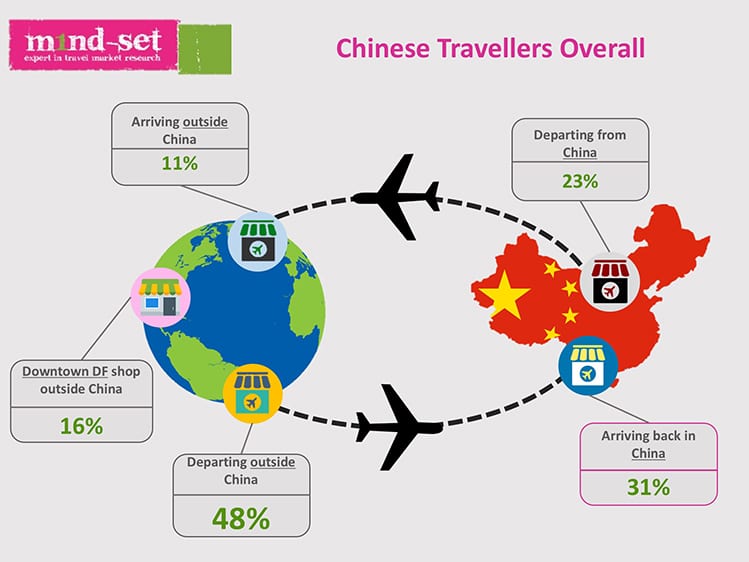
    The research was carried out among over 2,000 Chinese travellers in December 2016, and reveals what they say will influence them to purchase at the arrivals shops in China and why they would prefer to shop abroad. Convenience, quality and value for money are among the main reasons for suggesting they would rather shop on arrival back in China; language and ease of communication was another. A number of Chinese travellers still feel the products will be more affordable outside China, which is one of the main reasons for choosing to shop at the departure store on the return leg. Reassurance that the products will be authentic is another key motivator to purchase outside China.

    When asking the Chinese travellers where they would prefer to shop when the various arrivals shops have opened later this year, almost half of them said they would still favour purchasing at the departure airport duty free shop on the return journey, while only a third would purchase on arrival in China. One in five travellers indicated they would favour the departure duty free shop on their outbound trip. The findings also show that business travellers express a stronger preference to purchase at departure shops on both their outbound and return trips, as well as on arrival at their destination, than other segments. Their inclination to purchase on arrival back in China, however, is lower than the average.

    m1nd-set has announced the results of recently-conducted research on the shopping behaviour of Chinese travellers. The research was carried out among over 2,000 Chinese travellers in December 2016, and reveals what they say will influence them to purchase at the arrivals shops in China and why they would prefer to shop abroad.

    m1nd-set has announced the results of recently-conducted research on the shopping behaviour of Chinese travellers. The research was carried out among over 2,000 Chinese travellers in December 2016, and reveals what they say will influence them to purchase at the arrivals shops in China and why they would prefer to shop abroad.

    “While brands stand to gain from the increased sales outlets and the ease for Chinese travellers to purchase in their home country on arrival, retailers outside China will be showing concern for the potential lost business if Chinese travellers shift their purchasing decisions to the arrivals shops back home,” comments Peter Mohn, owner & CEO, m1nd-set. “We see that it will be increasingly vital for retailers to provide a different shopping experience to woo the Chinese travellers. This will mean brands and retailers will need to work closer than ever together on providing location-specific travel retail exclusives and an improved, more unique shopping experience in order to retain the Chinese travellers spend in the duty free shops outside China.”

    Hear more from Peter Mohn, owner & CEO, m1nd-set, at the 26th Airport Commercial & Retail Conference & Exhibition, hosted by Aéroport Nice Côte d’Azur and taking place on 3-5 April 2017 at the Hyatt Regency Nice Palais de la Méditerranée. Mohn is participating in the First Working Session “Is there a big problem in the airport retail space? Are conversion rates and yields performing far below expectations?” His defining presentation will provide a detailed analysis of the real financial performance of airport retail at a representative range of major and regional airports. With the average per passenger spend being €10.38, Mohn will consider the question of what

  • Indonesian mall integrates tech in the shopping experience

    Indonesian mall integrates tech in the shopping experience

    Supermal Karawaci, one of the largest mall entertainment center in Western Jakarta, has launched an interactive mobile application that would allow retailers to offer personalized content and engage with customers better.

    The 125,000-square-meter retail destination in Banten Province, West of Jakarta has over 1,000 retail stores and outlets, three cinemas and the largest Timezone arcade in Southeast Asia.

    The app, which was built on the shopper engagement platform of Singaporean technology firm Sprooki, is integrated with Supermal Karawaci’s touchpoints and mobile apps. Using location and contextual data, retailers would be able to offer individualized content such as vouchers, special offers, event alerts and store information.

    The system allows social sign-in and content sharing on platforms, including Facebook, which has more than 76 million users in Indonesia as of end 2016 and projected to grow to 86.4 million by end of 2017, according to eMarketer. The service will also be available in both English and Bahasa.

    Pipih Tjandra, Supermal Karawaci Marketing and Leasing General Manager, said the Sprooki platform would help keep the shopping hub at the cutting edge of technology, which customers had come to expect.

    “Supermal Karawaci works every day to be in tune with what today’s consumers want and expect through innovative marketing strategies. By implementing the Sprooki platform, our mall will be one of the first shopping precincts in Indonesia to incorporate a data-driven mobile platform to improve shopper experience, helping our tenants to increase in-store traffic and sales,” he said in a news release.

    Pablo Amante, Sprooki’s Head of Marketing, said in an email interview that the Indonesian market is ready to start adopting location-based and engagement technologies to help retailers and business to engage their shoppers, making the Indonesian retail industry much more competitive.

    The latest report from eMarketer shows that the number of smartphone users in Indonesia will rise from 55 million in 2015 to 92 million in 2019 and would be the third largest smartphone market in the Asia-Pacific.

    According to Lee Kang, the Vice Chairman of the Indonesian Cellular Phone Association (APSI), number of smartphone users in Indonesia has been growing between 30 and 50 percent each year and this growth momentum will remain intact due to the availability of affordable 4G smartphones on the Indonesian market and further development of Indonesia’s 4G network.

    “Based on these figures, retailers, shopping malls, and all companies focused on engaging their customers through mobile will see in our software a powerful tool to optimize their sales and marketing strategies, based on real data about their customers’ behavior,” Amante said.

    Cloud-based platform

    The Sprooki software is a cloud-based platform that analyzes physical and digital shopper behavior detected inside and outside stores. The platform is an analytics and contextual engine that algorithmically analyzes digital and physical data and predicts what shoppers are most likely to respond to, offering shoppers most relevant products at the best moments and locations.

    “Mall’s retailers benefit most from Sprooki platform, which gives them the possibility of engaging mobile shoppers in context and personalized ways; driving footfall to their stores; rewarding their top customers; making data and insights actionable through integrated reporting and predictive recommendations, and all these by using only one platform, saving time and efforts, so retailers and malls can focus on their marketing and sales strategies,” Amante explained.

    The software can be integrated either in mobile apps or websites. In these environments, consumers are always able to opt out or not sign in. The challenge, however, is to provide highly targeted and relevant content in a way that shoppers appreciate the added value of having access to these offers, campaigns or rewards.

    “When our customers provide to its shoppers with contextual and personalized offers, general response by consumers is very positive, as the shopping experience is different for each one and it’s relevant according to their likes and what they are looking for,” Amante added.

    While this is the first implementation of Sprooki technology in Indonesia, its customers are already spread across Southeast Asia.

    Amante said some of its customers include the 313@somerset iconic mall at Orchard Road in Singapore where the company implemented Sprooki Campaigns module, which allows shoppers to access to exclusive offers and coupons through vouchers. At Far East Organization /Shop Far East Asia (Singapore), it has also implemented Sprooki Rewards, a module that allows the mall to offer a card-less loyalty program to its shoppers.  In Vietnam, the technology allows location-based features and beacon technology to work both outside and inside the Crescent Mall to collect strategic data, providing a unique experience to shoppers.

    At this stage, Supermal Karawaci shoppers are exploring this new way of access to exclusive offers, and the response has been more than positive, with a high rate of voucher downloads since its launch last December 15.

    “Sprooki is delighted to enable Supermal Karawaci with the most advanced technology for engaging with customers and understanding their behavior. Our mobile platform will give the precinct’s retail tenants an effective way to drive frequency of visits and increase sales conversions,” said Sprooki CEO and Co-founder Michael Gethen in a media statement during the launch.

    Retail challenges ahead

    Sprooki is confident that location-based, data-driven mobile services are the present and the future for the retail industry.

    “After the struggles that retailers have suffered in the last years due to the e-commerce and online shops, the game is again on for big retailers and shopping malls that want to bring shoppers back to the physical stores. And the only way to make this happen is by providing a new shopping experience, based on offering what the digital world already offers (personalization, analytics, related purchases, recommendations, rewards, etc.),” Amante said.

    Shoppers nowadays also expect more from their brands in terms of product offerings, customer services, efficiency, and engagement. That is the reason why features such as ‘click and collect’, digital voucher redemption, scan receipts, faster and easier payment methods are raising, in order to meet consumers’ expectations.

    Taking a look at the region and the challenges that retailers are facing in Southeast Asia, Sprooki sees a lot of opportunities.

    “Retailers nowadays have a big gap in terms of what they know about their shoppers, and how they behave in their shopping journey. Even the most advanced retailers that work already with big data haven’t found an effective and sustainable way to manage all these data without the need of investing a lot of money and time,” Amante said.

    Sprooki today is currently based in Singapore, and has offices in Hong Kong and Australia, with local contacts in Indonesia, Malaysia, Philippines, and Vietnam.

  • Amazon Go aims to change retail by eliminating check-out lines

    Amazon Go aims to change retail by eliminating check-out lines

    Amazon.com is using machine learning to try to change the shopping experience and the retail industry in general. Amazon employees are testing a new brick-and-mortar store, called Amazon Go, in Seattle that lets customers using an app bypass the checkout line.

    Using a combination of machine learning, computer vision, sensors and deep learning, the smart store is designed to keep track of what users take off and return to shelves so it can track their purchases in a virtual cart. When they’re done, customers can just leave the store with their purchases; Amazon will charge their account and send them a receipt.

    “We created the world’s most advanced shopping technology so you never have to wait in line,” the company said on its site. “With our Just Walk Out Shopping experience, simply use the Amazon Go app to enter the store, take the products you want, and go! No lines, no checkout. (No, seriously.)”

    The 1,800-square-foot store, located at 2131 7th Ave. in Seattle, is in beta testing now so only Amazon employees are able to use it. The company expects it to be open to the general public in early 2017.

    The store sells pre-made meals for breakfast, lunch and dinner and snacks made by on-site chefs and local bakeries. It also stocks milk and bread, along with meal kits, local chocolates and artisan cheese.

    Customers only need an Amazon account, a smartphone and the Amazon Go app.

    “Four years ago we asked ourselves: what if we could create a shopping experience with no lines and no checkout?,” Amazon said in its statement. “Could we push the boundaries of computer vision and machine learning to create a store where customers could simply take what they want and go? Our answer to those questions is Amazon Go and Just Walk Out Shopping.”

    Patrick Moorhead, an analyst with Moor Insights & Strategy, said he’s intrigued by the concept and a bit surprised that a major retail brand already ensconced in brick-and-mortar stores didn’t come up with it first.

    “Automatic checkout is absolutely a characteristic of the store of the future,” said Moorhead. “But I can see Amazon doing this to drive even more growth by going brick-and-mortar. The only way to be successful in brick-and-mortar is to change the game, and in this case, changing the game with checkout.”

    He also noted that this is a good use of smart technology.

    “This is the ultimate way to use this technology in retail,” said Moorhead. “The challenge with all technology like this is accuracy. What if the system charges you for something you didn’t take? That could be the big challenge to the system.”

  • StarHub launches shopping channel

    StarHub launches shopping channel

    Singapore telco StarHub has launched a 24-hour Chinese language shopping channel called Go Shop in a deal with Malaysian pay-TV giant Astro.

    Singapore, 24 November 2016 – This festive season, StarHub TV customers can look forward to an exciting round-the-clock shopping destination right at their fingertips. Starting tomorrow, StarHub TV, in partnership with Astro Malaysia, will be launching Go Shop (StarHub TV Channel 110), a 24-hour, Mandarin shopping channel. Go Shop will also be made available on StarHub Go, StarHub’s video streaming service, by early next year.

    Customers in Singapore can now immerse themselves in a shopping experience that is differentiated, hassle-free and convenient, anytime anywhere. Through Go Shop’s fun and informative TV demonstrations, customers can understand the benefits of each product in-depth as well as the value of the offer. The well-researched product demonstrations are specially tailored to cater to the preferences and lifestyles of Singapore’s consumers.

    Targeted at StarHub’s audiences as well as connected online and mobile shoppers in Singapore, Go Shop offerspremium and trusted international brands such as Finn Esker, HappyCall, Kloken and Shogun across various product categories from Living, Beauty, Fashion, Kitchenware and Home Appliances. New product categories such as Digital Electronics, Health and Wellness, Sports and Leisure will be introduced progressively.

    Go Shop is a joint venture between Astro Retail Ventures, a wholly owned subsidiary of Astro Malaysia, and GS Home Shopping, the global leader in TV home shopping. GS Home Shopping has international presence in nine countries such as South Korea, Malaysia, China and Russia. To celebrate its launch in Singapore, Go Shop will be introducing some of its global best-selling items on StarHub TV. These include Age 20s, an award-winning Moisture Compact Foundation from Korea, Hurom Slow Juicer which comes with a low speed rotation to preserve nutrients, and the Roichen Cookware set, made with a safe and natural stone coating.

    To entice consumers, Go Shop will introduce special offers on TV through innovative bundling that cannot be found anywhere else. It aims to offer unbeatable value by combining the main product with other product lines to complement the core offering. For instance, a set of Laneige sleeping masks can be bundled with other items from the same skincare line for a complete, value-for-money deal. Consumers can also look forward to special festive offers from time to time.

    Commenting on the launch, Ms Lee Soo Hui, Head of Content & TV, StarHub, said: “Shopping is a favourite pastime of Singaporeans, whether it is online or at the mall. Go Shop’s extensive catalogue, accompanied with detailed product demonstrations, will enable our viewers to make informed decisions before making that purchase from the comfort of their living rooms. With the upcoming festive season, the timely launch of Go Shop on StarHub TV will enable customers to get a head start on their Christmas shopping!”

    According to Go Shop’s Chief Executive Officer, Grace Lee, “Go Shop is excited to expand our wings to serve customers in Singapore, after seeing our service grow rapidly in Malaysia. We offer a differentiated shopping experience that gives our customers choice, convenience and peace of mind through our entertaining and informative product demonstrations, reputation for providing trusted international brands and products as well as great value from innovative product bundling and free delivery in a matter of days.”

    To make a purchase on Go Shop, customers can order online via www.goshop.com.sg. Payment can be made via selected credit or debit cards. The products will then be delivered to the customer within two to three days with no additional shipping fee. In addition, customers can shop with peace of mind, knowing that sales support does not end at the point of purchase. A group of specially-trained agents called Personal Go Shoppers, will be offering their assistance online or through Go Shop’s hotline around the clock. To start shopping, tune in to Go Shop on StarHub TV channel Ch 110 at 9am tomorrow.

  • Where to shop in Singapore this Black Friday weekend

    Where to shop in Singapore this Black Friday weekend

    The post-Thanksgiving shopping tradition that’s driving many Americans off the rails at the moment is returning to Singapore this weekend with several retailers here jumping on the Black Friday bandwagon.

    For those who are still keen on shopping even after Singles Day (11 Nov), here’s where you can take advantage of Black Friday bargains in Singapore, both online and offline.

    1. Amazon

    Head on to Amazon’s website from 14 to 26 Nov if you’re looking for great bargains. Be sure to refresh their Black Friday page at 7am every day to discover new deals.

    2. Cotton On

    Now is probably the best time to restock your everyday basics as Cotton On is slashing 30 per cent off its full-priced items if you’re purchasing them online from 24 to 26 Nov. If you’d rather hit their brick-and-mortar stores, be sure to shop at the outlets at Bugis Junction, Plaza Singapura, Bedok Mall and Lot One until 28 Nov. You might walk away with a top as cheap as $10.

    3. Esprit

    Esprit is having a sale online from 24 to 27 Nov, offering 50 per cent off every second piece.

    4. Lazada

    From home appliances, health supplements to electronics, everything has been on sale on Lazada since Singles Day. Their sale ends on 12 Dec. 

    5. Robinsons

    All three Robinsons stores – The Heeren, Raffles City and Jem – will be opened from 7am on Friday (25 Nov), with up to 80 per cent discount storewide.

    6. Timberland & The North Face at Singapore Expo

    Get your adventure gear at a bargain at the Timberland and The North Face sale, happening at the Singapore Expo from 24 to 27 Nov, with discounts up to 80 per cent and 60 per cent respectively.

    7. G2000

    Need new office wear? G2000 is offering 50 per cent off your second piece. This storewide promotion will be available from 24 to 29 Nov.

    8. SaSa

    Need to shake up your beauty regime? SaSa is offering up to 70 per cent off its products storewide for outlets at Bugis Junction, Lot One and Nex shopping malls on 24 Nov. Yes, one day only.

    9. Sephora

    If you’d rather shop for beauty products from Sephora instead, the retailer is offering 20 per cent off all of their products if you buy them online on 25 Nov.

    10. New Balance

    If you’re looking for fresh New Balance kicks, head over to any of the brand’s Experience stores for 20 per cent off your purchase.

    11. Books Actually

    Here’s something for the bookworms. Homegrown books and stationery retailer BooksActually is throwing a 20 per cent off storewide sale from 24 to 25 Nov.

    12. Qoo10

    If you’re an avid Qoo10 shopper, the e-marketplace is not offering discounts, but they are giving away cart coupons priced up to $100 from 23 to 25 Nov.

    13. Shopee

    Online retail site Shopee is having a Black Friday and Cyber Monday (28 Nov) with up to 80 per cent off their items.

  • GIC snaps up a Korean shopping mall

    GIC snaps up a Korean shopping mall

    It invested $192.4m in the 28-floor retail complex. Singapore’s state-owned investment firm GIC invested $192.4m (USD 136m) in G-Square City Retail Complex in Seoul Korea.

    Tha complex, which was completed in 2012, spans 238,248 sqm across 8 floors. The building is well-situated in a prime location in the centre of Anyang City, a metropolitan area of Southern Seoul. It has a direct access to a subway line.

    “A 34,681 sqm office tower is also part of the complex, and is one of the preferred office buildings within the Anyang city district given its landmark status and building quality,” GIC said.

    The said mall is operated by Lotte Shopping Co. With the aquisition, it will be managed by IGIS Asset Management, one of the country’s largest real estate management companies with a good track record of managing retail assets.

    GIC Real Estate Chief Investment Officer Lee Kok Sun said G-Square is in line with the group’s strategy of acquiring income-generating assets.

    “As a long-term investor, we remain confident in the continued growth of the Korean economy and its retail sector,” Lee said.

    Do you know more about this story? Contact us anonymously through this link.

    Click here to learn about advertising, content sponsorship, events & rountables, custom media solutions, whitepaper writing, sales leads or eDM opportunities with us.

    To get a media kit and information on advertising or sponsoring click here.

  • Singapore shoppers look to online shopping for good deals

    Singapore shoppers look to online shopping for good deals

    The extended season will lead to an eleven percent ($9.1 billion) increase in online sales to a total of $91.6 billion, according to Adobe’s 2016 Digital Insights Shopping Predictions report. Large retailers expected to account for the bulk of the growth, with an average growth rate of 16.6% compared to smaller retailers at 7%.

    “We expect to see a five percent spike in online shopping in early November and a record 24 percent increase in the last two weeks of December,” said Mickey Mericle, the vice president of marketing and customer insights at Adobe.

    “‘Click and collect,’ faster shipping and retail promotions starting earlier than ever are all contributing to the extended shopping season. Despite the uptick in sales we expect to see slower growth in total online sales this year,” he says.

    Singapore shoppers

    Closer to home, findings specific to the Singapore market show that consumer budgets are tight and the savvy shopper prefers online shopping due to the higher likelihood of finding good deals and bargains this way.

    Marketers can also expect fewer last-minute shopping rushes as respondents are now shopping slightly earlier in November. This suggests that marketers should make the effort to reach out to these early birds accordingly.

    Notably, consumers report visiting an average of 3-5 sites before making a purchase, which offers marketers a critical chance to target these potential customers once more and bringing them back on-site via remarketing

    Almost half of Singaporean millennials (49%) surveyed value experiences more than material goods, with a sizeable 41% echoing this sentiment when all local consumers who are surveyed are factored into the picture.

    Finally, the study shows that mobile shopping is king as consumers praise retailers for better optimizing their sites for mobile browsing, allowing them to shop on the go with their hectic schedules.

  • China’s personal shoppers are cashing in

    China’s personal shoppers are cashing in

    Julie Li is laden with Harrods carrier bags full of cosmetics, but they are not hers; the 30-year-old finance graduate from Beijing is a fulltime freelance retail consultant, something known in China as a daigou.

    “I worked as a daigou alongside my day job for about three years, but six months ago, I decided to quit my job to fully concentrate on the business because the profit margin is lucrative and the hours are more flexible,” said Li, who asked to be known by a pseudonym.

    Dressed in a fashionable white Reiss dress and holding a light color Chanel leather handbag, Li is glued to her smartphone. She is using the messaging app Wechat to communicate with clients in China who are willing to pay a premium for authentic luxury goods that are usually relatively cheaper than they are in China.

    Having developed three major wholesale clients, each with around 300 customers, Li buys 10,000 pounds’ worth of top-end lipsticks on behalf of clients every day.

    “The weak pound after Brexit is also giving a boost to my business and sales have doubled in recent months,” Li said.

    Charging 5 percent of the retail price and handling large quantities on a daily basis, she is able to pocket as much as 20,000 pounds in commission during a good month.

    “My clients are usually middle-incomers in China who have a strong appetite for high-quality products,” she said. “I believe the quality standards, the product ranges and the cheaper prices are the main reasons why Chinese consumers look to the West.”

    Li said a high-end daigou has to know about products, prices, colors, range, and availability.

    Experts say the agents have challenges because customers need to be convinced the goods they receive are genuine and that suppliers are reliable.

    “An important issue is the uncertainty faced by consumers who wonder whether products are genuine because, the higher the demand for a product, the more there is a chance it will be a fake or an adulterated product,” said Pervez Ghauri, professor of international business at Birmingham Business School.

    The buyers are mainly from the Chinese mainland and specialize in helping customers in China buy luxury products, including bags and cosmetics, as well as health supplements, such as baby milk formula.

    Business has boomed in recent years, accounting for RMB 34 billion to RMB 50 billion ($5 billion to $7.4 billion) in global sales last year, according to a report from consultants Bain & Company.

    In 2008, the baby milk scandal, in which Chinese milk and infant formula was contaminated with melamine, led to many Chinese parents shopping overseas for milk formula. At the height of the boom in demand for milk formula, retailers in the UK rationed the sale of powdered baby milk to ensure availability for domestic parents.

    Observers note that safety standards are one of the reasons why some Chinese consumers buy Western products.

    Geoffrey Wood, dean of the Essex Business School, said many Chinese consumers believe Western countries have more rigorous production standards, and the will to enforce rules ensuring quality.

    Seizing the opportunity presented by the baby milk scandal, 29-year-old Jimmy Zhen-not his real name-began buying milk powder for his Chinese customers in 2009 while working a fulltime job.

    “In the beginning, I only shopped for family and friends who knew I was abroad and felt the authenticity of the products was assured. Through word of mouth, I developed a large customer base, and built trust with my clients,” he said. After demand rose, he became a fulltime shopper in 2011.

    A restriction brought in by the UK government in 2013 to cap the sales of milk formula at two cans per customer stacked the deck against Zhen’s business, but he managed to find a way out by paying students 50 pence above the retail price for every can they sold him. He currently ships more than 8,000 tins each month.

    Earlier this year, the Chinese authorities tightened regulations around cross-border online shopping. Commentators say the changes, to Chinese customs regulations and ecommerce has dented the daigou’s trade, but Zhen has adjusted by shipping four cans at a time instead of six. It ensures he avoids paying import tax.

    Daigou shoppers admit their industry exists in a grey zone legally and is likely to be short-lived, but Li is cashing in for as long as she is able.

  • Korea’s Eland Aims At Ten Shopping Centers In China In 2016

    Korea’s Eland Aims At Ten Shopping Centers In China In 2016

    South Korean apparel brand Eland plans to develop ten shopping centers in China before the end of 2016. Eland started tapping the shopping center market in China from January 2016. By cooperating with Parkson, the company aims to transfer traditional department stores into city outlets. For the next step, Eland will cooperate with other department stores and shopping malls in China, aiming to open ten shopping centers in this marketplace before the end of 2016. For the year 2017, the company aims to have over 30 outlets and by 2020, they aim at 500 outlets and sales scale of CNY200 billion.

    Eland Group has 56 Newcore Outlets in South Korea. The company plans to bring its successful operating model and experience into China and transfer traditional department stores into city outlets to attract young consumers.

    At present, Eland has opened two shopping centers in China, one cooperating with Parkson in Shanghai and the other cooperating with Hualian in Chengdu. In addition, Parkson previously closed a store in Nanchang in September 2016 and said they will team with Eland Group to implement transformation and upgrades for the store.

  • Tax free shopping spend drops in Asia and Europe

    Tax free shopping spend drops in Asia and Europe

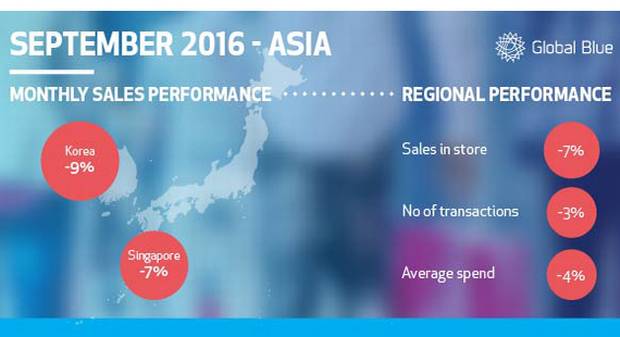
    Tax free shopping sales in Asia fell -7% year-on-year in September, compared to declines of -13% in August, according to Global Blue. The number of transactions dropped -3%, while average spend was also down -4% over the same period. Global Blue said Singapore, Japan and South Korea all saw declining tax free sales for the first time in three years.

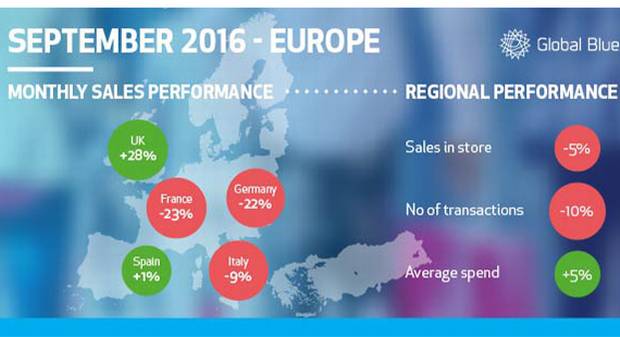
    In Europe, tax free shopping declined -5% year-on-year during September, compared to -3% in August.

    European transactions were down -10%, but average spend was up +5% year-on-year.

    asia_600x300

    Asian countries

    Global Blue said the increase in arrivals by middle-class Chinese travellers supported growth in tax free sales and the number of regional transactions, but was not enough to offset the decline in spend in Singapore, Japan and South Korea.

    Both Japan and South Korea saw a -9% dip in sales, while in Singapore sales fell -7%.

    The positive momentum seen earlier in the year has now gone, Global Blue said, reflected by the deep drop in average spend in Japan of -30% year, and the -13% fall in South Korea.

    In these two countries, the rise in arrivals was offset by the decline in average spend as a result of the strengthening currency in both countries. In September, the Japanese yen was +21% and the Korean won was +10% against the Chinese yuan, Global Blue noted.

    A shift in the Chinese traveller profile towards value seekers and experiential Free Independent Travellers is becoming the “new normal” across the region, the retail intelligence company said, which also had a negative impact on sales.

    Global Blue said it was witnessing a change in shopper profile in Japan’s department stores, as Millennials and Free Independent Travellers look beyond the country’s department stores and head to more niche or independent fashion and luxury retailers outside the Global Blue merchant network.

    With increasing numbers of less affluent Chinese arriving in Singapore from second- and third-tier cities, the country’s duty free retailers have been slow to offer a more diverse retail mix, Global Blue said.

    Chinese travellers are using Singapore as a departure point for cheaper shopping over the border in Malaysia.

    The number of travellers entering Singapore by land is rising (up +55% according to the latest Singapore Tourism Board figures reported in Jing Daily). Some of these tourists are on overland tours and therefore take in cheaper markets as well as Singapore’s high-end malls, unlike the higher-spending visitors who arrive by air.

    Singapore is also facing a challenge this quarter due to health concerns over the Zika virus outbreak, which is reducing visitor numbers, Global Blue noted.

    Chinese shopping across South Korea and Singapore saw tax free sales declines of -15% this month.

    While the tough comparison with 2015’s MERS-hit summer period has ended in South Korea, the Chinese are not returning in any great numbers due to the political tensions between the two countries, Global Blue noted.

    Hong Kongese tax free sales in South Korea and Singapore significantly declined in September (-77% and -98% respectively). While the local currency is strong, the legal context for the largely daigou traders is negatively impacting on sales, according to the company.

    Indonesians and Thais are now making up for the tax free spend at both destinations. In Singapore, Indonesian tax free sales are up +7% year-on-year, fuelled by positive currency exchange rates. In South Korea, Thais contributed to a massive sales spike of +87% year-on-year. Singaporean sales were also up +17% in September, a result of high net worth individuals who are regular shoppers in the region.

    eu-600x300

    European countries

    The tax free shopping decline in Europe is a slight improvement compared to the first half of the year, the company said, although countries hit by terrorism last year saw a reduction in sales.

    France and Germany continued to feel the effects of the downturn in visitors from Asia, with tax free sales down -23% and -22% respectively in September.

    The most serious decline in spending in France came from the Chinese, at -40%, while in Germany, Chinese spending was down -26%.

    Spain and southern European countries continued to outperform the continental Europe average of duty free sales, Global Blue said. Spain saw an increase in tax free sales of +1% compared to last September, while Greece increased total sales by +18%.

    The UK benefited from the fall in the pound and currently remains the best value luxury destination for duty free shoppers. The pound is now around -14% down on the euro since the Brexit vote, and almost -20% against the US dollar, Global Blue said.

    However, this situation is unlikely to last beyond next spring, the company noted, as most luxury goods are imported into the UK. From next season price increases on all imported goods will inevitably lead to higher prices in UK stores.

    The UK also benefited from the end of Ramadan and the annual back to school period for Chinese students, characterised by visiting families’ gift spending.

    The Chinese are the most valuable nation of shoppers for UK retailers, and they increased their spending by +25% during September.

    Saudi Arabia, Qatar, the UAE and Kuwait contributed to a +8% uplift in European sales in September.

    Cutbacks by the Saudi government, where well over half the population are state-employed, will put pressure on Saudi citizens’ outbound travel plans and spending in the medium term, Global Blue noted.

    Morocco posted a +28% rise in total sales in Q3 year-on-year, as shoppers avoided destinations that have suffered terrorist attacks. Cyprus saw a +11% uptick during the same period; Global Blue attributed this to an increase in Russian shoppers.

  • Lane Crawford selects Orange Services’ Cloud to improve digital shopping experience

    Lane Crawford selects Orange Services’ Cloud to improve digital shopping experience

    Orange Business Services has been selected by Lane Crawford, a multi-brand designer label luxury retailer, to provide a cloud-based platform to extend, secure and manage its IT resources in Hong Kong and China. This deployment will enable Lane Crawford to marry offline strengths with digital advantages and offer its customers a more connected retail experience.

    Founded in 1850, Hong Kong-based Lane Crawford is widely recognized as a leading retailer of specialty and luxury goods in Hong Kong and China. Through Orange Business Services’ cloud platform, Lane Crawford will have higher flexibility and scalability to accommodate changes in demand due to seasonal shopping, sales and promotional activities, and ad-hoc use. By adopting a cloud-based platform, Lane Crawford can appropriately align its business with the rapid growth of online shopping in China and meet the needs of new and existing customers.  In addition to meeting Lane Crawford’s needs for its digital transformation, Orange Business Services’ solution delivers an enhanced level of security infrastructure and business continuity plans.

     “Lane Crawford has a long history of delivering high quality products and excellent experiences to its customers,” said Jack Zhang, General Manager, Orange Business Services China.  “We are very pleased to have been selected as a partner in their digital transformation journey and to support them based on our deep understanding of the retail business and Lane Crawford’s existing infrastructure environment.”

    Lane Crawford selected Orange Business Services’ cloud platform for its ability to easily scale to meet rapid changes in consumer demand and its one-stop solution for all the needs it had for connectivity, flexibility and security.  Orange Business Services’ platform is fully compatible with other business critical applications being used by Lane Crawford.

     “Our former infrastructure did not provide adequate flexibility for scalability or future business growth,” said Raymond Liu, Senior Manager, IT Infrastructure, Lane Crawford.  “Orange Business Services’ cloud-based solution gives us cost-efficient performance, enhanced security and protection, and support of on-line transaction applications.  For Lane Crawford, this is a critical step forward in our digital transformation.”

  • Combine all your rewards points and get more out of your luxury shopping

    Combine all your rewards points and get more out of your luxury shopping

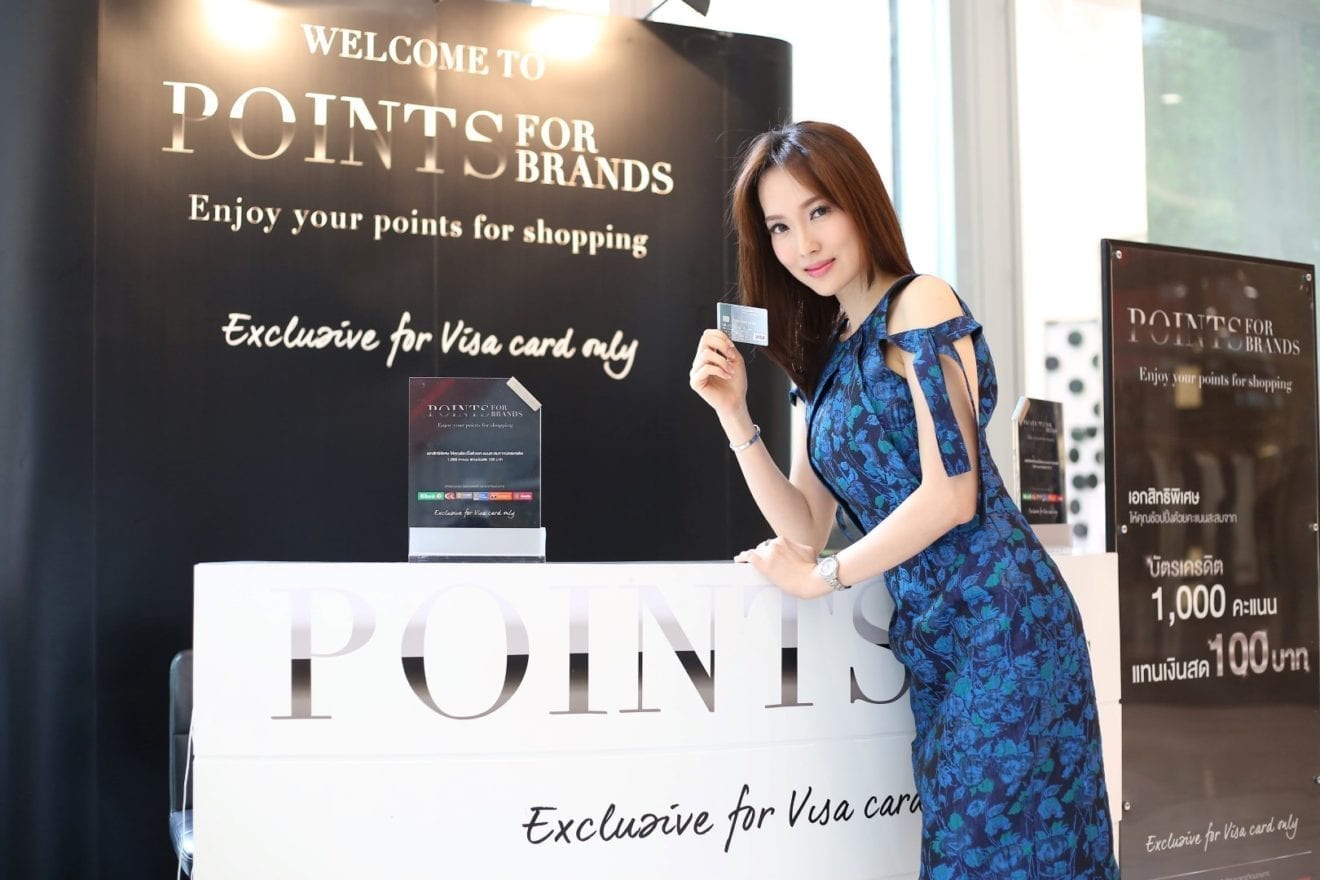
    Shoppers can now save money on luxury brands by combining reward points from their different Visa credit cards.

    The “Points for Brands” campaign enables customers with Visa credit cards issued from leading financial institutions in Thailand, including Kasikornbank, Bank of Ayudhya (Krungsri), Krungthai Bank, Krungsri First Choice, Government Savings Bank, and Thanachart Bank to pool reward points for purchase of goods at selected luxury brands at a rate of 1,000 points for THB 100.[1] 

    There are more than 70 participating brands at The Emporium and The EmQuartier, including Coach, Kate Spade, DKNY, DVF, Proenza, COMME des GAçONS, Jimmy Choo, Valentino, EMPORIO ARMANI, Balenciaga, Calvin Klein, Hugo Boss, MCM, and Club 21.

    “This is the first time our cardholders can purchase luxury brands by redeeming points from across their portfolio of Visa credit cards, a rarity for premium categories,” said Suripong Tantiyanon, Visa Country Manager, Thailand.

    Exclusive to Visa cardholders, more information, along with help on how to redeem reward points, can be found at Points for Brands booth on M Floor at EmQuartier

  • Modern Trade back for Growth for 2nd quarter of 2016

    Modern Trade back for Growth for 2nd quarter of 2016

    Kantar Worldpanel, the global market leader in consumer panels, reports the spending in fast moving consumer goods (FMCG) in 2nd quarter of 2016 grew by 4.6% year on year, faster than the 2.0% growth rate reported in 1st quarter of 2016.

    Modern trade (including hypermarkets, supermarkets, and convenience stores) showed a similar trend of improving growth, 1.4% positive growth in the second quarter in comparison to a decline of -0.5% in the 1st quarter. Modern trade’s growth was most prominent in county level cities and their surrounding urbanized counties – growth rates of 2.0% and 3.9% respectively. From a regional perspective, modern trade in the East and West performed much better than South and North regions. The East region grew at 2.8% – helped by strong performance of Sun-Art Group and Wal-Mart Group – while the West region grew at 3.6% driven by Wal-Mart Group and Yonghui Group.

    International retailers suffer from continuous share drop

    Wal-Mart Group has seen relatively stable performance in 2016, gaining 0.3 share points year on year in the latest quarter. Other international retailers such as Carrefour, Tesco and Lotus suffered from continued share erosion resulting in the overall poor performance of international retailers. Sun-Art Group and Yonghui lead the growth of Chinese players. Sun-Art group managed to grow its shopper base through both the continued development of existing stores and incremental opening of new one. Their growth was most marked in the competitive East region market; share increased from 13.5% of 2nd quarter of 2015 to 16.0% in the latest quarter – widening their leadership over competitors.

    Yonghui consolidates position as a top 5 national retailer: Yonghui continues to perform well in 2016, a fast pace of growth in penetration and basket size enabling its share to continue to exceed Lianhua Groups in Q2 after first overtaking it in Q1. Despite this strong performance – Yonghui still faces challenges in the East region. Strong growth of Sun-Art Group and Wal-Mart’s gradually recovery have meant that Yonghui’s acquisition of Lianhua has yet to see any sustained effects.

    Brick and Mortar and eCommerce retailers looking for cooperation: Continuous FMCG slow down combined with the impact from eCommerce growth in China, has pressured physical retailers into finding new solutions to drive growth. Kantar Worldpanel latest data show, 52 week end June.17th, show total FMCG eCommerce penetration% reached 49%, growing 10% from last year. The growth of online is leading by Tmall and JD, both with spend growth rate over 80%. While continuing to experiment with their own e-tailing platforms; the major retail chains are now seeking to bolster performance through strategic partnerships with existing digital players. Wal-Mart’s corporation with JD.com enables Wal-Mart to reach new online shoppers while allowing JD.com to utilize YHD’s broad footprint in East region. Vanguard’s strategic investment in the XinMeiDa (previously Meituan & Dianping) and Feiniu’s corporation with Shihui, both show brick-and-mortar chains’ new efforts to better realize their O2O strategy.