Retail News CRM

Tag: Shopping

  • New Delhi tops list of Asia’s top cities for shopping

    New Delhi tops list of Asia’s top cities for shopping

    New Delhi has topped the list of Asia’s top cities for shopping, offering a treasure trove of goods through its blend of charming traditional markets and glitzy shopping malls, according to a new survey.

    New Delhi has topped the list for the best shopping city in Asia, followed by Bangkok and Singapore, according to a survey by TripAdvisor.

    “Shopping in Asian cities can be a rich and colourful experience if you know exactly which spots to go to and how to maximise your dollar,” TripAdvisor’s Communications Director for Asia Pacific Janice Lee Fang said.

    Most cities feature top quality malls, where one can find their favourite designer shops, but there are also the night markets or street shops that sell beautiful handicraft and other local gems unique to the culture, she added.

    This ranking is based on the popularity of shopping activities in Asian cities and also includes highly-rated hotel recommendations, which are bookable on TripAdvisor, offering shoppers great value for their stay so they can save as much of their holiday budget.

    The rank of the best cities for shopping is based on the total of commercial activities for shopping, the number of commercial activities for shopping with a good score, the frequency of mention for the word shopping in the reviews relative to the destination and the average score of reviews that talk about shopping in all the languages applicable on TripAdvisor.com.

    Bangkok (Thailand) is second with its huge variety of shopping options for every lifestyle and budget, from the very high-end to street shopping, wholesale and weekend markets.

    Singapore, which ranked third in the list, is famous for its retail options across the city state, with a plethora of shopping malls that open till late.

    Other cities mentioned in the top 10 shopping destination are Beijing in China at the fourth place, followed by Hanoi in Vietnam, Tokyo in Japan, Seoul in South Korea, Kuala Lumpur in Malaysia, Kathmandu in Nepal and Jakarta in Indonesia.

  • A Short Overview of Malaysian Shopping Trends

    A Short Overview of Malaysian Shopping Trends

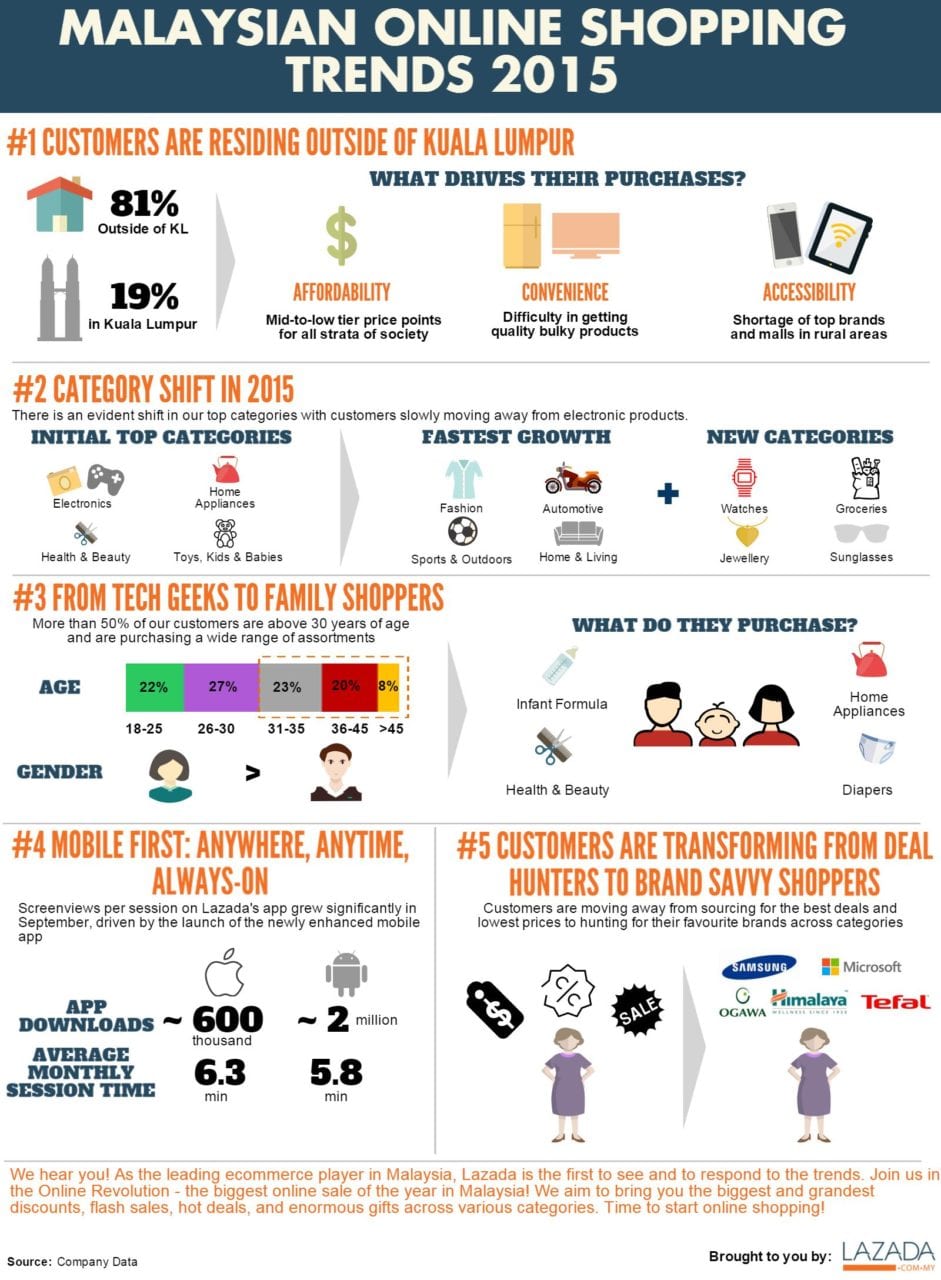
    #1 Majority of our customers are residing outside of Kuala Lumpur

    – There is an evident shift of customers shopping on Lazada with 81% of them residing outside of Kuala Lumpur

    –  Reasons behind this shift include 

        a) Affordability of products – Consumers from various backgrounds are able to purchase products from a wide price-range ( mid to low-tier)

        b) Convenience  – Consumer located outside of KL are able to purchase high- quality bulky products delivered to their location of choice            without having the need to locate these products at the shopping mall and sourcing for delivery trucks

       c) Accessibility – Consumers outside of KL now have access to purchase a variety of top brands online which were previously unavailable 

          at their area. This ensures that they are kept abreast on the best deals and promotions despite their geographical location.

    #2 Category shift in 2015

    – Previously our top selling categories were electronics, home appliances and toys kids and babies. However, there has been a surge in        

      demand in other categories ranging from sports and outdoor, fashion and groceries

    #3 From tech geek to family shoppers

    – Online shopping is commonly associated with the Gen Ys as they are presumed to be tech- savvy and are more comfortable shopping 

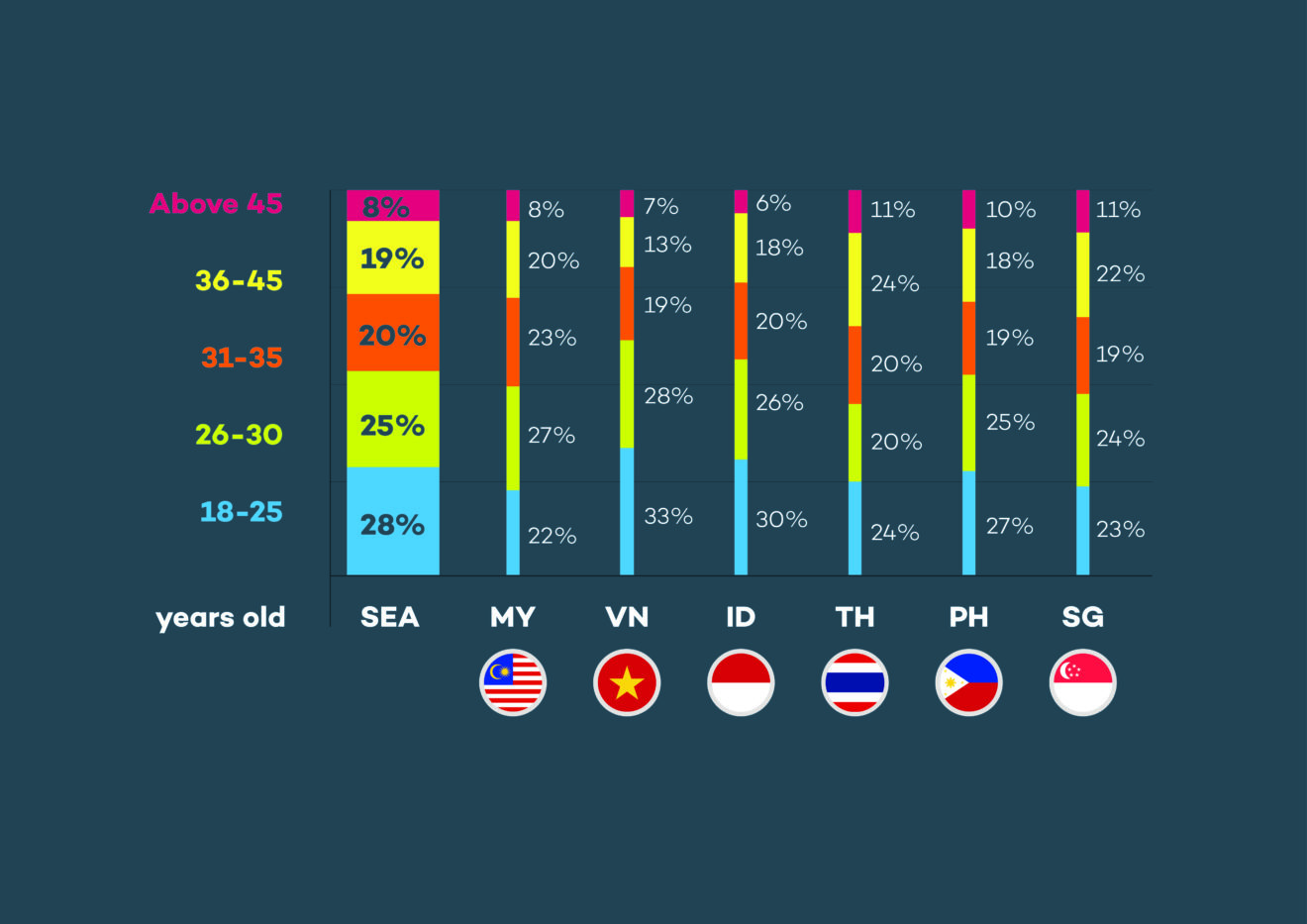
      online compared to the older generations. There has been a change in trend whereby majority of the online shoppers now are aged 30   years and above and are sourcing for a wide range of household related products ( home appliances, baby products etc)

    #4 Mobile-First: Anywhere, Anytime, Always – On

    –  Malaysia is transforming into a digital nation with high mobile penetration across the country. Hence, it comes to no surprise that majority of Malaysians are hooked to their mobile devices to obtain further information on a particular product/ source for the best online deals via mobile platforms.

    #5 Customers are moving away from deal hunter to brand savvy shoppers

    –  Consumers are no longer exclusively shopping online only during sales or are constantly on a lookout for special deals or promotions before purchasing a product. Instead, consumers now have high-brand loyalty whereby they source products from their favourite brands across categories when shopping online.

    Lazada_Infographic-06_age range

    LZD Trends v1

  • Singaporeans love to shop overseas

    Singaporeans love to shop overseas

    Never mind that Singapore is renowned globally as a shopping destination.

    Singaporeans want to shop elsewhere.

    A survey by insurance company AIG conducted back in April found 36 per cent of the 1205 polled go on holiday solely to shop.

    When they take a holiday for retail therapy, Singaporeans spend an average of S$336 a day.

    The three most popular overseas shopping destinations are Bangkok, Hong Kong and Taiwan.

    AIG says it had received 7500 insurance claims between November 2014 and October 2015 for baggage lost on trips home from – in order – Thailand, Taiwan and Hong Kong.

    The insurer says people should keep receipts or photographs of their overseas purchases to ensure a smooth claims process.

    Other reasons for non-business travel by Singaporeans rated far lower than retail therapy, including a weekend getaway (21 per cent), to see somewhere exotic (12 per cent) or to indulge in a luxury break (four per cent).

  • HKIA launches ‘deluxe shopping rewards

    HKIA launches ‘deluxe shopping rewards

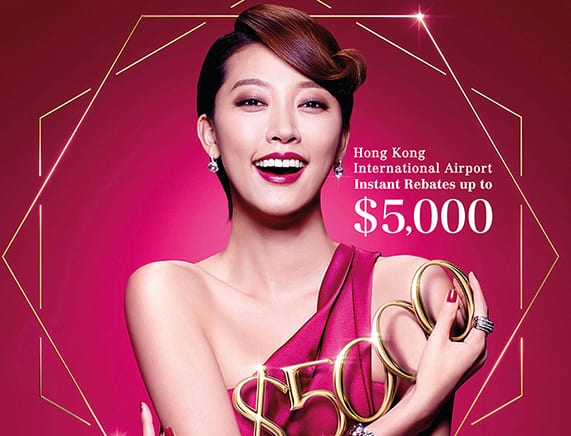
    Between now and December 16, Airport Authority Hong Kong is incentivising passengers with ‘deluxe promotions’ which include a coupon for HK$5,000 ($645) and a complimentary delivery service to all addresses in the Greater China Region.

    The offer is open to all travellers spending more than HK$50,000 ($6,450) in no more than two electronic transactions on the same day. Customers spending more than HK$1,000 ($129) in a single transaction at Hong Kong International Airport (HKIA) can also benefit from a new free local delivery service during the promotion period.

    Those customers that spend more than HK$2,500 ($322) on clothing, bags and accessories in a single transaction can also receive free delivery to Mainland China, Macau and Taiwan.

    HKIA Deluxe Rewards Ad

    As part of this promotion AAHK is also working closely with its retailers to provide its customers with what it describes as ‘fabulous shopping and dining offers’, as well as ‘an exciting selection of special complimentary gifts’.

    HKIA says travellers can discover more by scanning the QR code on the promotional materials, or by visiting its website at the following address: https://www.hongkongairport.com/eng/shopping/special-offers.html

    Meanwhile, newly-opened shops at Hong Kong International airport between September and November, include (T1) Bee Cheng Hiang; China Mobile; Discover Hong Kong; Gift & Take by Nobletime; and millie’s. (T2) ARKA; and Living Plaza by AEON.

  • Lazada launches online Christmas sale

    Lazada launches online Christmas sale

    The country’s biggest online retail firm, Lazada Philippines, has announced the launch of its month-long Christmas sale, bubbed as Lazada Online Revolution, from November 11 to December 12, slashing prices of over 200,000 goods  across 13 product categories up to 95 percent.

    November 11 or 11/11 is known in China as “Singles’ Day” celebrating bachelors and bachelorettes and e-commerce retailers have turned it into the world’s biggest online shopping event.

    Last year, they sold over $9 billion worth of products on “Singles’ Day”.

    Lazada introduced the 11/11 holiday in the country to mark the start of the Christmas shopping season and has hauled record sales since then.

    For 2015, Lazada Philippines expects to break new records, with over two million visitors to its website and mobile app on the date.

    Big brands and merchants in electronics, fashion, kids and toys as well as home goods are joining the sale.

    Online merchants will also come up exclusive items on flash sales and P99 deals on November 11.

    Participating brands include ASUS, Lenovo, Alcatel, Cherry Mobile, Bosch, Belo, Huggies, Mamy Poko, Timex and Giordano watches.

    As an early treat for Lazada shoppers, the retail firm will sell special items for P11 each.  Lazada bestsellers, such as Sandisk 8GB flash drives, 5600 mAH Powerbank and 4-layer shoe racks could be purchased for P11 starting today until 11/11/

    The P11 deals will be announced everyday at 11:11 a.m. on one of Lazada’s social media channels (Twitter: lazadaph, Facebook: lazadaph, Instagram: lazadaph).

    “We’ve been working hard with our merchants and suppliers to bring these deals to our customers,” according to Lazada Philippines CEO Inanc Balci. “We  believe that online shopping will provide a lot of convenience to shoppers especially during the holiday season.”

    “By shopping online, they can avoid heavy traffic, long lines and crowded areas,” he pointed out.

  • Online, mobile luxury spending rises in China

    Online, mobile luxury spending rises in China

    Online and mobile commerce for luxury brands in China has risen at an exponential pace while smartphone penetration continues to grow rapidly, results of a recent survey shows.

    The new study of online spending in the country was conducted by KPMG in partnership with Mei.com, a China-based online luxury flash sales retailer, and Weibo, an online social media platform in China.

    Among the key findings is that 45 percent of respondents said they purchased most of their luxury items through online options, and the maximum amount they felt comfortable paying online for a single item is RMB4,200 ($660.8), far higher than the RMB1,900 ($298.9) they indicated in a similar survey in 2014, or an increase of 121 percent.

    The average spend levels also went up about 28 percent compared to the previous 2014 survey.

    China’s consumers are spending close to one-third more on online purchases – averaging around RMB2,300 ($361.9) on each single luxury transaction.

    The top driver for purchasing online remains pricing and better deals, however, close to one-third of respondents had made luxury online purchases at the full, non-discounted price.

    “Price is becoming less of a driver. But value remains important as customers are well informed about global prices since most of them travel physically or digitally,” said Thibault Villet, CEO of Mei.com.

    The survey likewise points to an increase in the average amount spent on luxury purchases in most product categories.

    A higher amount was spent on average for popular categories such as bags (109 percent), women’s apparel (58 percent) and cosmetics (18 percent), and also noted a significant increase in spending on categories such as watches (126 percent) and jewelry (65 percent) that accounts for a relatively smaller share of total online luxury sales.

    Cosmetics is the most popular product bought online, followed by women’s shoes, bags and leather goods, women’s apparel and accessories.

    The survey finds that among the key online triggers to purchase luxury e-commerce, the most persuasive one is reading about a product on a blog or social site and seeing the product in an online shop.

    While online shops are setting up temporary or pop-up stores, most luxury brands are also increasingly developing their China websites and shops on popular e-commerce platforms.

    “The pace of change in today’s marketplace in China is taking retailers and brands by surprise. This change is unrelenting and now outrunning the company strategy in many cases,” Egidio Zarrella, Clients and Innovation Partner, KPMG China, noted.

    In addition to luxury items, the survey finds increased numbers of luxury services purchased online, including online hotel and restaurant bookings, followed by domestic and overseas trips.

    Forty-eight percent of respondents said they had bought items overseas over the previous 12 months, close to a majority. More than two-thirds of these claimed they increased their overseas online luxury purchases in the past 12 months.

    The survey sees a near doubling of Chinese luxury online consumers planning to buy overseas trips online – from 35 percent who indicated they bought an overseas trip online during the past 12 months, to a forecast 61 percent during the next 12 months, or a growth of more than 70 percent.

    “Chinese consumers have a significant propensity to spend, they are technology savvy and want the best quality. Therefore, both new and existing entrants to China must expect to compete in a dynamic and fast-paced market. They must develop the right strategies to survive and thrive in an increasingly disruptive environment,” Zarrella concluded.

  • Aeon opens B300m mall in Si Racha

    Aeon opens B300m mall in Si Racha

    Aeon (Thailand), the local operator of MaxValu supermarkets and Tanjai minimarts, has resumed its investment with a big retail project after suspending its expansion since 1997.

    The company will today have the soft opening of Aeon Sriracha shopping centre in Chon Buri’s Si Racha district to serve growing demand from Japanese expats working nearby.

    The move is part of Japanese parent Aeon Group’s efforts to expand its retail business in Asean with an expectation to drive sales to reach US$16 billion by 2020, a company source said.

    Before Thailand, Aeon Group opened various retail formats in the Asean market including Indonesia, Vietnam and Cambodia.

    The company spent about 300 million baht to develop Aeon Sriracha near Assumption College Sriracha.

    The three-storey shopping centre has saleable space of 11,000 square metres and will serve Thai and Japanese customers who work and live nearby.

    “Major frequent customers will be Japanese housewives who have free time to shop and dine at our shopping centre. They like shopping in a Japanese ambience,” the source said.

    Aeon Sriracha is surrounded by 1,300 households of Thai and Japanese people with high spending power. It has parking space for 220 cars.

    The shopping centre houses 21 tenants providing services related to Japanese lifestyle. MaxValu supermarket provides service around the clock, while other anchors are Ringer Hut Nagasaki Champon, a Japanese fast food restaurant chain with more than 600 branches worldwide, and Tackle Berry, Japan’s largest used fishing gear chain.

    Si Racha district also has Japanese community mall J-Park Sriracha.

    The artist impression of the Aeon Sriracha shopping centre.

    This is the first time in 18 years that Aeon (Thailand) has invested in a big retail project in Thailand after suspending its expansion plan due mainly to the 1997 financial crisis.

    Aeon Group has had a presence in Thailand for more than 30 years.

    Aeon (Thailand) now operates 78 retail outlets here, with 48 Tanjai minimarts and 30 MaxValu supermarkets.

    Apart from developing its new complex in Si Racha, the company will strengthen its food and information technology facilities to support its aggressive expansion in Thailand from now until 2020.

    It has plans to expand its retail business outside Bangkok, particularly in Northeastern provinces such as Ubon Ratchathani and Udon Thani, in a bid to tap opportunities from booming border trade after the launch of the Asean Economic Community by year-end.

    Aeon (Thailand) had earlier announced plans to open 40 MaxValu stores next year.

    After that, it will add 100 outlets each year for four years until 2020 for a total of 500 branches.

    Of the 500 stores, 400 will be Tanjai minimarts and the remaining 100 will be under the MaxValu supermarket brand.

    Sales at MaxValu supermarkets are estimated to reach 6.6 billion baht this year.

  • Metro Retail Stores Philippines IPO approved

    Metro Retail Stores Philippines IPO approved

    The Philippines Securities and Exchange Commission has approved Metro Retail Stores Philippines’ initial public offering, with the retail chain expected to raise P6.17bn (US$135m) next month.

    Run by the Gaisano family, Metro Retail Stores operates hypermarkets and supermarkets across the country, and plans to use the proceeds from the float to expand its network of stores, and construct a new distribution centre.

    Metro Retail Stores plans to sell up to 1.01bn shares at P6.1 (US$0.13) each, with the price to be finalised on 28 October head of an expected 12 November listing.

  • Changi Airport Group injects buzz with luxury tender

    Changi Airport Group injects buzz with luxury tender

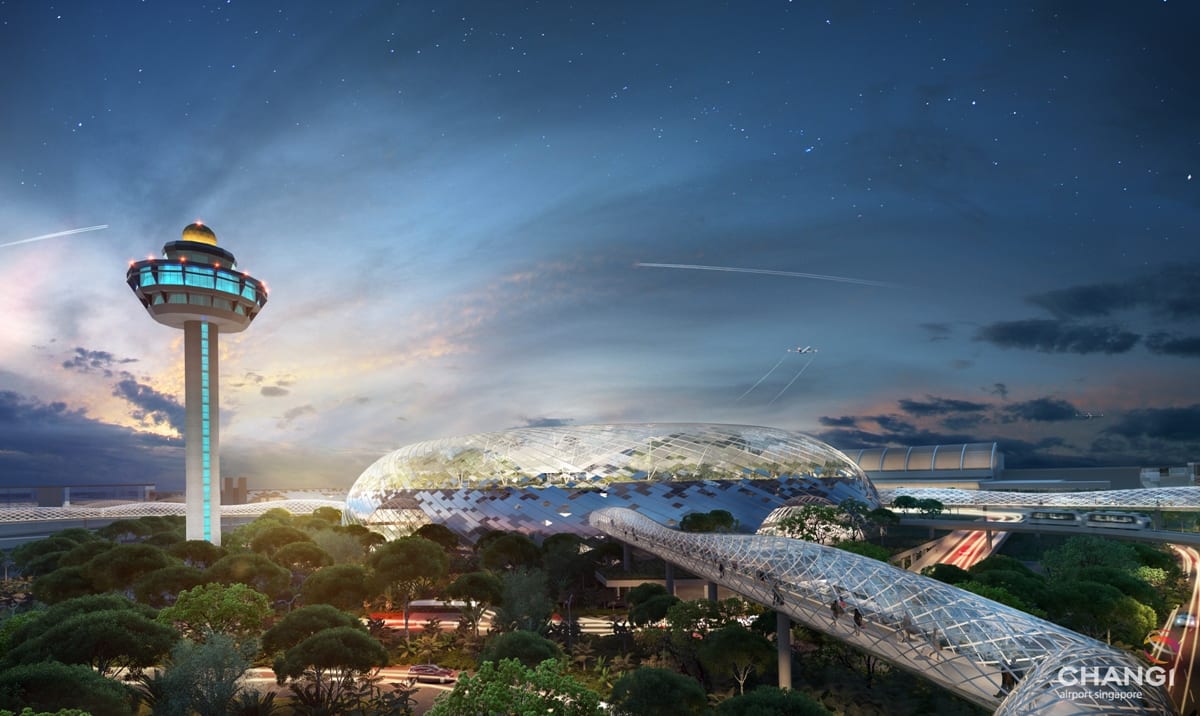
    Changi Airport Group (CAG) has issued a tender for luxury brand concessions in the terminal three departure/transit lounge south at Singapore Changi airport.

    Concession A spans 112sq m, concession B 103sq m, concession C 86sq m and concession D 100sq m. The contract for concessions A, B and C is for three years from July 1 2016 to June 30 2019. For concession D, the contract is for three years from January 9 2017 or on the physical handover of the premises to the winner, whichever is later. The deadline for submissions is October 29.

    A CAG statement said: “We are looking for unique and exciting luxury brands and concepts that are currently not represented at Singapore Changi airport terminal three and will inject buzz and differentiate the retail offerings at Singapore Changi airport. All product categories may be considered, except for liquor and tobacco and perfumes and cosmetics.”

  • Philippines retail to get yearly revenue boost from nationwide grand sale

    Philippines retail to get yearly revenue boost from nationwide grand sale

    Philippine retail will get a yearly revenue boost from the recently launched nationwide grand sale called “Philippine Shopping Festival,” which is being eyed to become a yearly event.

    The Philippine Retailers Association (PRA) and Department of Tourism-Tourism Promotions Board (DOT-TPB) partnered to revive the Philippine Shopping Festival and decided to make it an annual event to make the Philippines a new shopping destination in Asia Pacific region.

    PRA Chairman Roberto Claudio said the Philippine Shopping Festival 2015 will put the Philippine retail close to the sophisticated and globally known shopping industry of Singapore and Hong Kong.

    In Singapore, there is an eight weeks event called Great Singapore Sale, which usually occurs in the last week of May until the third week of July

    An international report showed that shoppers, a mixture of foreigners and locals, had spent a five-year high of US$2.12 billion using their MasterCard cards during the Great Singapore Sale this year.

    To be held on October 23 to November 8, the Philippine Shopping Festival will be a two weeks sale where shopping malls and retailers in the country will offer different discounts and promo to entice people, mostly foreign tourists, to shop.

    Claudio said that the first attempt of PRA to do something like this happened two to three years ago but it wasn’t that successful.

    Now, the group and the DOT are banking on the two big regional events that will happen in the country in November as this year’s major drivers for the festival.

    The events that he was talking about are Asia Pacific Retailers Convention and Exhibition (APRCE) and the Asia Pacific Economic Cooperation (APEC) meetings which will both bring thousands of foreign delegates.

    Claudio emphasized that as per DOT data, each foreign tourist visiting the country allocates a daily shopping expenditure of US$300.

    “Just imagine if thousands of foreign delegates will spend US$300 a day just for shopping,” Claudio said.

    Around 94 malls will be participating in the nationwide grand sale.

  • Chinese millennials: the new big spenders

    Chinese millennials: the new big spenders

    Chinese millennials – China’s new rich – are looking to spend double the Asia-Pacific average on luxury items in the next year.

    The millennials – those aged 18 to 29 – are already China’s biggest spenders on luxury goods in Asia Pacific, followed by those in South Korea and Hong Kong.

    According to research from MasterCard, the most popular luxury items are high-end tech gadgets, with 25 per cent of millennials in Asia Pacific planning to buy an item such as a smartphone or tablet computer in the next year. This is followed by designer clothes and leather goods (17 per cent) and jewellery (17 per cent).

    Overall, most millennials in the region take approximately a month to consider and research their luxury purchases. More millennials in Asia Pacific (a quarter) buy on impulse than those aged over 30 (a fifth).

    Meanwhile, over a third of millennials in the region prefer Western brands over regional or local, however there is a marked difference across the region. While more than half of millennial shoppers in China, Vietnam, South Korea and Hong Kong prefer Western brands, the majority in India and Indonesia would rather buy local. The top three reasons for preferring Western brands were reliability of quality, followed by value for money and brand loyalty.

    When choosing where to buy luxury goods from, the majority of millennials still prefer purchasing from local brick and mortar stores (64 per cent), instead of local eCommerce sites (nine per cent). Meanwhile a fifth prefer to buy luxury items in-store when travelling overseas, this is especially true of Chinese millennials, 51 per cent of whom are most likely to buy a luxury item in-store while travelling.

    The results are based on interviews that took place between May and June 2015 with 2272 millennials across 14 Asia Pacific markets.

    More findings:

    • Millennials from China intend to spend on average US$4362 on luxury goods over the next year, nearly double that of the Asia Pacific average of US$2584. South Korea (US$2638) and Hong Kong (US$2584) round off the top three.
    • Overall, the majority of millennials in the region will take under a month to research and consider a luxury item before buying it (44 per cent), led by those in India (64 per cent), China (51 per cent), South Korea (48 per cent) and Taiwan (48 per cent).
    • Thai (60 per cent) and Indonesian (50 per cent) millennials are the most impulsive shoppers in the region with at least half buying luxury goods on impulse, above the regional average of 26 per cent.
    • The most careful millennial shoppers are from Vietnam – the majority will only buy a luxury item after two to six months of extensive research (45 per cent), more than the regional average of 20 per cent.
    • Over one-third of millennials across the region prefer western brands to local and Asian brands. More than one in two millennials in China (66 per cent), Vietnam (60 per cent), South Korea (59 per cent) and Hong Kong (52 per cent) would pick a western luxury brand over a local or Asian luxury brand. However, in Indonesia (61 per cent) and India (50 per cent), a large majority of millennials would rather buy luxury goods from a local brand.
    • Most millennials in the region purchase luxury goods in-store rather than online – this is especially so when they are on sale locally (43 per cent) compared to when they are at full price (23 per cent). Only a small percentage of millennials in the region shop for luxury goods on local (nine per cent) and overseas sites (four per cent).
    • Chinese millennials are the most likely to buy luxury goods in-store when travelling overseas (51 per cent), whereas the majority of consumers in India (81 per cent) and Indonesia (50 per cent) buy luxury goods locally in-store at full price.
    • Millennials in Indonesia are the most likely to spend more on luxury goods in the next year than the year before (47 per cent). Across Asia Pacific, most consumers (40 per cent) intend to spend the same amount as they did the year before, 22 per cent plan to spend less while 19 per cent plan to spend more.
  • Samsung Electronics unveils ‘future of shopping’

    Samsung Electronics unveils ‘future of shopping’

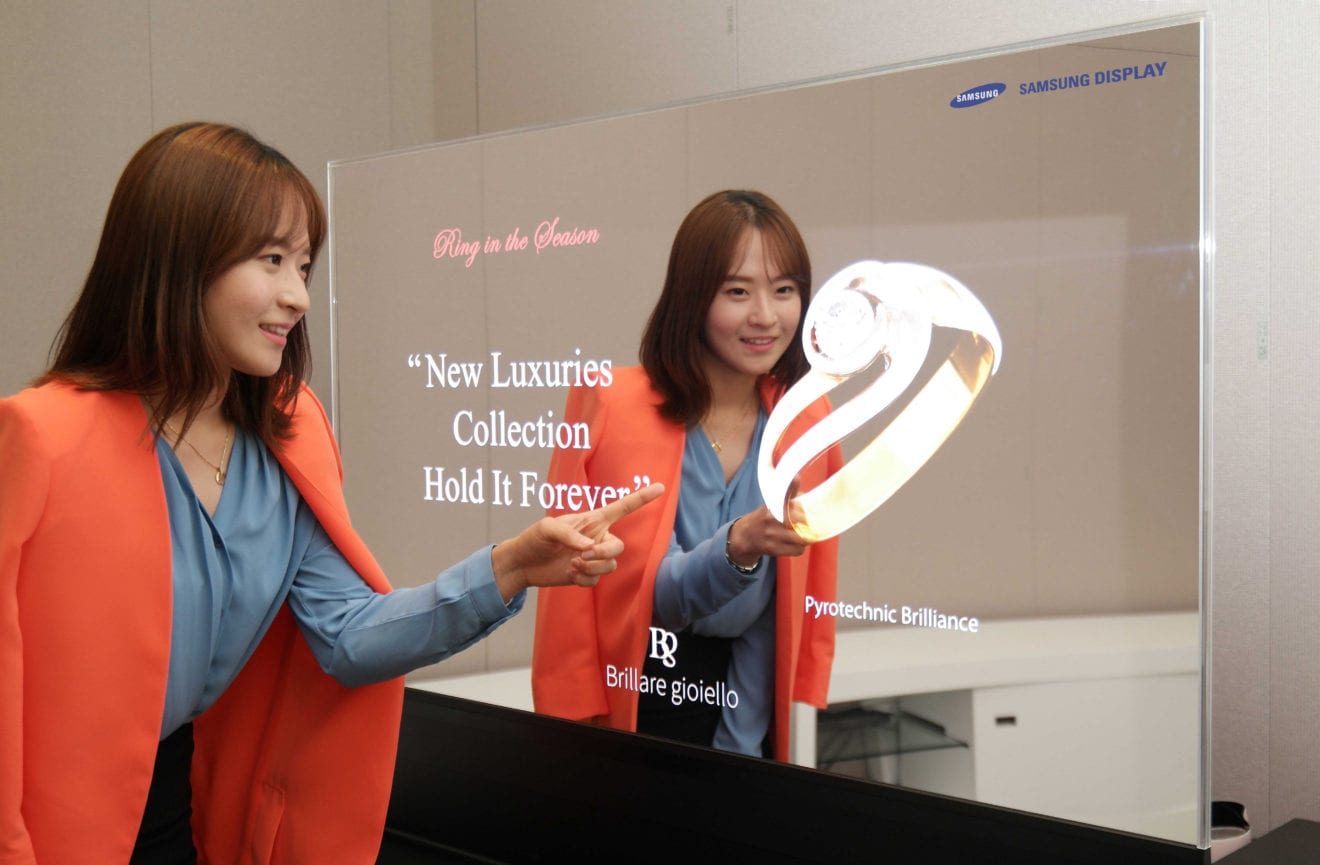
    The future is here. Pause to window shop and read information about the products displayed on the other side of a transparent OLED “window”.

    Try on outfits through virtual reality, and see how they look from all directions.

    Samsung Electronics will reveal new products using smart signage that will realize futuristic smart shopping at the IFA (Internationale Funkausstellung) 2015, in Berlin in a special space set up so visitors can experience ‘smart shopping’ through smart signage solutions such as transparent OLED and smart LED signage.

    Samsung’s transparent OLED will be revealed for the first time at the IFA. It boasts a penetration ratio of 45 per cent, which is the highest in the world, and full HD resolution.Through smart signage embedded with touch functions, virtual fitting solutions that can be used at apparel stores will also be exhibited. Customers can make a model in the screen try on the clothes instead, and see what they would look like through virtual reality. Information related to accessories that match the outfit can be provided for convenience.

    A mirror display that suggests beauty tips and information on makeup according to the user’s schedule, skin type and weather will also be revealed. The most unique part of the mirror display is that it reflects the user just like a mirror through the use of hi-tech reflecting panels.

    In addition, a smart LED signage solution with higher definition will be exhibited. The product has a high resolution with a pixel pitch (that’s the space between pixels) of 1.5mm and 2.5mm. It can be set up indoors, making it possible to be used in the lobbies of shopping malls or large scale displays.

    Samsung is also planning to show various LED signage products. “

    We are planning to suggest ideas of various usages of our signage products at the IFA. By introducing Europe to LED smart signage, we are determined to push into the global digital signage market,” said a spokesman.

  • Hong Kong pop-up mall aims to ease tensions over mainland shoppers

    Hong Kong pop-up mall aims to ease tensions over mainland shoppers

    From London’s trendy Shoreditch to a downtown revitalisation project in Las Vegas, pop-up shopping malls have become all the rage among urbanites keen to sample craft beer and buy designer sneakers.

    But, in Hong Kong, plans for the first temporary mall are designed to assuage popular anger with visiting shoppers from mainland China — derided by locals as “locusts” — rather than cater to the whims of hipsters.

    As political tensions between Hong Kong and Beijing have risen, the semi-autonomous Chinese territory has seen a growing backlash against the thousands of “parallel traders” who come from the mainland every day in search of cheap baby milk, jewellery and other goods they can sell back home for a profit.

    Now two of Hong Kong’s biggest property developers have teamed up with lawmakers to turn a car park near the Chinese border into a mall made out of shipping containers that is meant to serve mainland visitors attracted by the city’s low-tax shopping.

    Wong Ting-kwong, one of the legislative council members promoting the project, said it would “reduce the nuisance brought by excessive mainland tourists and relieve the traffic inside the city”.

    Mr Wong is a member of the main pro-Beijing political party in Hong Kong, which has frequently come under attack for failing to defend residents’ interests in the face of pressure from the central government in China.

    He hopes that the mall, which will be about the size of two football pitches, according to a recently submitted planning application, will open for business early next year.

    The land for the pop-up mall is jointly owned by Henderson Land and Sun Hung Kai Properties, which are controlled respectively by Hong Kong billionaires Lee Shau-kee and the Kwok brothers.

    SHKP said that if the plan was approved by the government, they would lease the land for a nominal HK$1 ($0.13) per square metre to a charitable foundation, which would run the pop-up mall on a non-profit basis for two years.

    After that period, the developers expect to remove the shipping containers and start construction of a permanent mall on the same site.

    The initiative has succeeded in grabbing the headlines in Hong Kong, but those who have organised protests against mainland shoppers are far from convinced it will solve their problem.

    Ray Wong, a member of HK Indigenous, a group that campaigns against mainland Chinese influence in Hong Kong, said that while the pop-up mall could alleviate some pressures, it could also disturb local residents if it generated too much traffic.

    “I think the root of the problem is that mainlanders don’t trust Chinese goods so they have to turn to Hong Kong for guaranteed quality,” he said.

  • Now, you can shop on Twitter

    Now, you can shop on Twitter

    Twitter has announced that the company is launching a product and place pages that allows users to discover and purchase items within the service.

    According to the Verge, the new pages will organise related tweets about products and brands on dedicated pages.

    A product page will let people see others’ tweets about that product, prices, and, sometimes, a buy button.

    The company is also rolling out what it’s calling Collections, a way for brands and celebrities to curate products and recommend them to followers.

    This is the second new feature Twitter has unveiled this week after announcing Project Lightning, a news platform that would allow users to follow events instead of people.

  • Jakarta Great Sale Casts Its Net Beyond Indonesia

    Jakarta Great Sale Casts Its Net Beyond Indonesia

    Last month, Jakarta celebrated its 488th anniversary. The capital, which was established by Indonesian national hero, Fatahillah, in 1527, is definitely getting old. But despite being home to more than 10 million people, the city never slows down.

    New high-rises pop up on every corner of the city. And each of them outdoes the previous in size and grandeur. Major developments are currently underway, promising that the city is on track to become one of the most glam and sophisticated in Southeast Asia.

    To celebrate its birthday, the city’s modern landmarks and shopping malls again present the Festival Jakarta Great Sale (FJGS). FJGS has been held annually since 2008.

    “FJGS has always been an important highlight of the city,” said Ellen Hidayat, chairwoman of the executive committee of FJGS 2015. “And it’s going to be much bigger and better this year.”

    This year, the event is organized by Association of Shopping Mall Management in Indonesia (APPBI), in collaboration with 12 other shopping and tourism-related associations in the country.

    Until mid-July this year, 78 malls in Jakarta will offer discounts on their merchandise by up to 70 percent.

    The event is also supported by Jakarta’s Tourism Office and featured in its official calendar of events.

    “Our office fully supports FJGS,” said Purba Hutapea, chief of Jakarta’s Tourism Office. “We hope to attract more local and international tourists with the event.”

    Jakarta is targeted to attract three million tourists this year — a 25 percent increase on tourist arrivals last year, which were about 2.4 million.

    “And FJGS is indeed a great way to attract more visitors to the city,” said Purba.

    Among the top five international tourists visiting Jakarta are Malaysians, Chinese, Singaporeans, Japanese and South Koreans. And their main reason of visit is to go shopping.

    “Malaysians love our Muslim attire, as they have very good quality at affordable prices,” said the chief of the tourism office.

    Besides Malaysians, according to Purba, the Chinese, Japanese and South Koreans are currently eyeing our fashion products.

    FJGS is also targeting Indonesian shoppers.

    “Indonesians have a habit of going to Singapore for shopping, as Singapore usually offers more products of international brands at cheaper prices,” said Ellen Hidayat. “But it’s a different story this year.”

    Ellen and her team have recently surveyed the malls in Singapore during the currently ongoing The Great Singapore Sale.

    “With today’s foreign exchange rate [between the Singaporean dollar and the rupiah], the prices of the branded products in Jakarta are actually a lot cheaper,” said Ellen. “So, this year, we hope that the locals will choose to shop in Jakarta instead of going to Singapore.”

    Ellen believes that FJGS and a series of fun activities organized in the malls during the event will see an increase in visitors by 30-40 percent to the city’s malls.

    The executive committee of FJGS 2015 hopes to achieve a total transactions of Rp 14.3 trillion this year, or about a 10 percent increase from last year’s transactions of Rp 13 trillion.

    It seems a high aim during Indonesia’s current economic slow-down, but the chief of Jakarta’s economic bureau, Adi Ariantara, remains optimistic.

    “FJGS, which is held during the school holiday season, as well as the fasting month, will surely encourage people to spend more,” said Adi. “And hopefully, it will also instigate positive economic growth for us.”

    A series of attractive events have been prepared to draw more visitors to the malls during FJGS 2015.

    One of them is Jakarta’s iconic Midnight Shopping events. During FJGS this year, a total of 19 shopping malls will take turns to hold ‘Midnight Shopping’ on weekends.

    “It’s one of the most awaited events during FJGS, as the malls will usually offer a series of entertainment, as well as special prizes for shoppers,” said Ellen.

    This year, Jakarta’s shopping malls also open their doors to traditional craftsmen and small-to-medium enterprises (SMEs) belonging to the National Handicraft Council (Dekranasda) of Jakarta.

    During FJGS 2015, these craftsmen and SMEs are allowed to offer their products at stalls dedicated to them along the corridors of the malls.

    This year, BayWalk Mall, Puri Indah Mall and Grand Indonesia Shopping Town will host these craftsmen and SMEs.

    “In the future, Dekranasda will work together with all shopping malls in Jakarta and encourage them to dedicate a special section within their malls for the craftsmen and SMEs in their regions,” said Veronica Basuki Tjahaja Purnama, chairwoman of Dekranasda Jakarta.

    But the excitement of FJGS 2015 is not only felt within the glitzy malls and shopping centers of Jakarta.

    For the first time ever, the event will also be held in traditional wet markets in Jakarta.

    “We want every layer of the community to feel the excitement of FJGS,” said Djangga Lubis, director of PD Pasar Jaya, government-owned company that manages traditional wet markets in Jakarta.

    There are currently 153 traditional wet markets in Jakarta. But only 10 are featured in FJGS this year.

    “These 10 markets are those that are most ready, in terms of cleanliness and comfort, to present the ‘Pasar Murah’ (Affordable Market) bazaars during FJGS this year,” said Djangga. “And these 10 markets also represent Jakarta’s five main regions.

    Among the 10 wet markets are Pasar Santa in South Jakarta, Pasar Gembrong in Central Jakarta, Pasar Pos Pengumben in West Jakarta, Pasar Cibubur in East Jakarta and Pasar Koja Baru in North Jakarta.

    During FJGS 2015, these traditional wet markets will take turns to present ‘Pasar Murah’ on weekends.

    The items offered during Pasar Murah are staple food items, including rice, eggs and meat. These items will be offered discounts of about 20 percent.

    It seems that FJGS is indeed getting more solid this year. Unfortunately, the growth of shopping destinations has yet to be supported by proper infrastructure development that could further push the city to become a destination that is on par with neighboring countries such as Singapore.

    Recognizing this issues, Jakarta Governor Basuki Tjahaja Purnama ensured during the opening night of FJGS 2015 that projects are underway.

    “We’ve just designed seven routes for the Light Rapid Transportation (LRT), which will connect major shopping centers and hotels in Jakarta,” said Basuki. “We’re also buying a lot of new buses for Jakarta as we plan to provide 24-hour bus transportation in the capital,” said Basuki.

    Ahok also plans to develop 12 new traditional markets in Jakarta to accommodate street-side peddlers.

    “On top of these traditional markets, we’ll also build apartments for rent at affordable prices for the peddlers,” he said.

    With these plans, Jakarta promises to be a much nicer city to visit and live in.

    “We’re planning to save Rp 10-15 trillion from corruption each year and use the money to build more infrastructure, parks and public facilities for Jakarta,” said the governor.

    “Once they are in place, we can confidently announce that Jakarta is a shopping paradise to the whole world,” said Basuki.