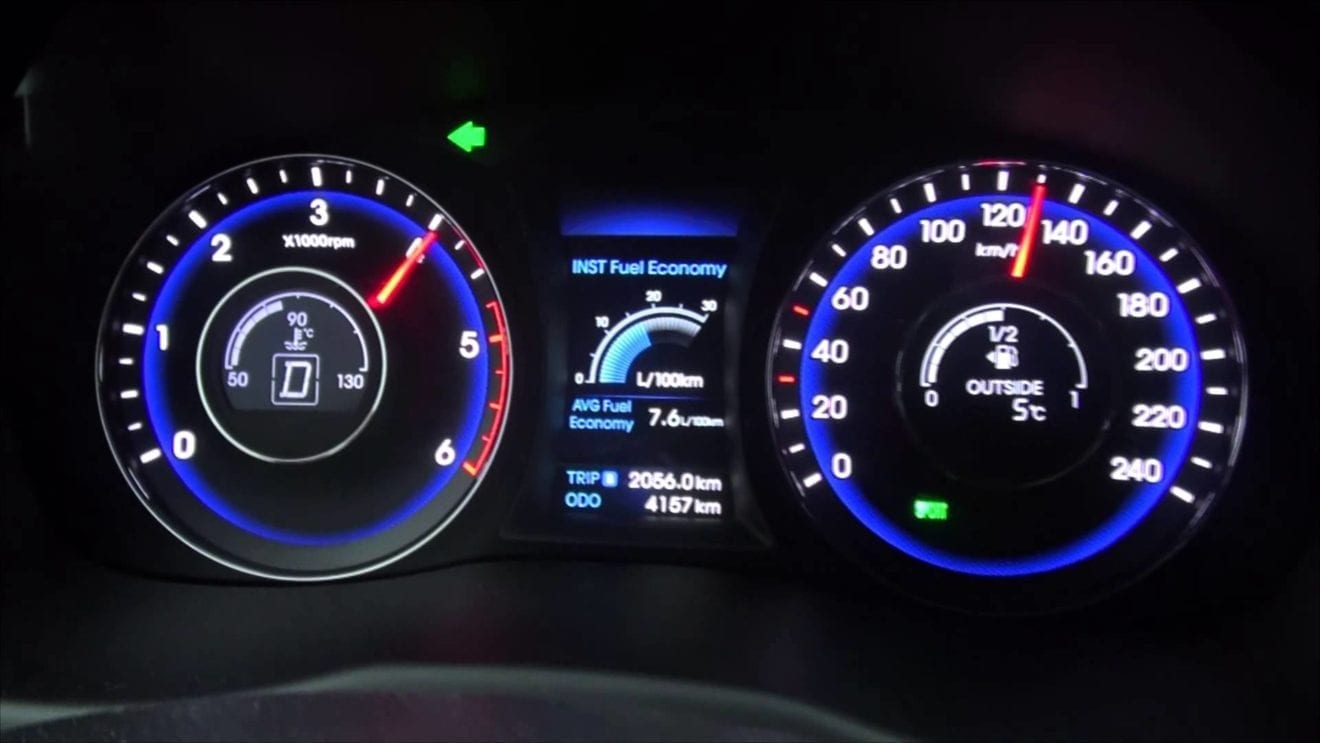
Singapore’s Land Transport Authority said Tuesday it is investigating Hyundai vehicles following reports of accidents involving sudden acceleration while reversing.
In a statement, the authority said it was looking into cases of Hyundai vehicles having “unintended acceleration in reverse gear.”
“It is premature to draw any conclusions at this point in time,” it said.
The statement gave no further details, but the local newspaper Straits Times cited recent incidents involving taxis from operator ComfortDelGro, which leases Hyundai Sonata cars, among other models. It is Singapore’s largest taxi operator with a fleet of 17,000 cabs.
Hyundai Motor said it is looking into the matter.
South Korean consumers have lodged complaints about accidents that they believed were caused by sudden unintended accelerations. But past government probes have found no evidence that this was linked to faulty vehicles.
At a public demonstration in 2013, the government tried to reproduce conditions that were believed to cause cars to suddenly accelerate without intention but those attempts failed.
The ministry concluded that it was “reasonable” to see the sudden unintended acceleration phenomenon does not exist.
eCommerce in Singapore is in full swing against the tide of fashion brands exiting the local market. Raoul, New Look and Celio, the most recent casualties of the highly competitive retail scene here, signal a shift away from brick-and-mortar stores. In 2015, the net retail space takeup was in decline as stores vacated 86,379 sq ft of retail space.
In contrast, the size of Singapore’s online retail market has expanded to SGD4.4 billion in 2015, four times the size of the market in 2010. Lower costs of entry, mobile customer base and ease of accessibility are making selling online an attractive option for entrepreneurs, quickly transforming ideas into a manageable businesses.
1- Personal Fruit Grocer Delivering To Your Doorstep
Founder of Lazyfruits Ben Phua comes from a family with over 30 years of experience in the retail and wholesale business, and his trained eye for potential markets led him to set up his own premium fresh-fruit store in 2014. Lazyfruits solves an everyday problem of wanting a healthier lifestyle but not knowing how to pick fresh fruits from the market grocer or having the time to do so by delivering your fruits to you next-day and with assured freshness through personal checks.
Image Credit: EcommerceSOS
Their success story of zero-dollar marketing shows how rewarding great customer relationships can be as regular customers bring in more business through word-of-mouth recommendations. From just a humble facebook page in 2013 with posts about their products to a social web of constant referrals and reviews, you can definitely see the spirit of a warm family business beyond their store page.
2- Top-Quality Handmade Treats For Pets
Specialized treats galore for dogs at the Barkery brings not only novel dehydrated treats like anchovies and bak kwah into the mouths of our canine companions, but also cakes and dietary supplements for a long and active life for the urban dog! The creativity behind the designs of their novelty cakes make for an extra-special dog birthday, but what is impressive is the reach of their products, which appear on multiple stores like Loyalone, Nekojam, Redmart and more!
3- Reinstating Mobility And Dignity In Aging
Founded in 2011, The Golden Concepts have made their own market with active aging and elderly independence in mind. Starting off with only 4 products, their story of expansion and sheer determination is a cultural exchange between how the elderly age in Denmark and in Singapore. Today, their catalogue of over 300 products is a true expression of their commitment to enabling the elderly to live a more mobile lifestyle through the aid of technology in Singapore.
Image Credit: eCommerceSOS Youtube
Designer canes, colourful massagers and foldable wheelchairs brighten up the idea of aging as The Golden Concepts aims to dignify the need for such aids through sleek and lively product design. Eldercare has been re-imagined by The Golden Concepts, striking off ideas of dependence and liability from the dictionary of aging.
4- Wholesome Organic Produce With A Digital Twist
Visiting the farmer’s market is always on the checklist for Singaporeans touring European countries for the first time, and SimplyFresh gives us a taste of what farm-fresh organic produce from Europe is like from the comfort of our homes in Singapore. A wholesale market with a digital twist, SimplyFresh offers a variety of affordable organic vegetables through the box subscription model used by gift companies overseas such as Lootcrate, Birchbox and Helloflo to surprise the creative cook at home. Their selection of vegetables comes from family-run farms, making SimplyFresh’s products all the more wholesome than those found in big box stores.
5- Staying Fit Without Breaking The Bank
Image Credit: Hula Hoop Singapore
Ideas sometimes come from wants, and May Lim, founder of Hula Hoop Singapore, wanted a solution to combat an unflattering waistline that didn’t involve too much time or money. Her discovery of weighted hoops for exercise proved to her that fitness doesn’t have to be burdensome or time-consuming. Wanting to try out exercise hula hoops, she soon found out that there was a supply gap of exercise hoops in Singapore. This led her to set up Hula Hoop Singapore to provide weighted hoops to Singaporeans, thus spreading her idea of fitness to others.
She remains as a one-woman team, but collaborates with ME-Retail Solutions to handle her storage and delivery. Her resourcefulness and hardworking attitude is one that should be emulated when it comes to setting up a new online retail store.
More Than Just Numbers And Convenience
Image Credit: imagesource
Passion and personality are the key factors that separate the online retail store from traditional brick-and-mortar retail stores. Most online stores have some form of direct interaction from the founders behind the business to their customers, whether it is in the form of stories,facebook posts or even whatsapp messages, making the customers feel more connected to the business. Knowing the people behind the business also makes the product feel more personable, as the customer can relate with a face associated with the product better than with just a brand or a logo. Relatability transforms online retail stores into stories which people can share, bringing back the familiar feel of the neighborhood retail store.
If you have a great idea for an online store, why not try your hand at Singtel-Shopify’s Build-A-Business Competition? With a top prize of $20,000 and an advanced eCommerce workshop worth $2,000 for the top 10 winners, Shopify will help you build your online storefront and much more in just a few clicks!
Retailers are still looking for growth across borders, with Asia a particular interest to many. Nevertheless, high eCommerce investments have slowed down the international expansion, according to real estate consultant CBRE‘s “How Global is the Business of Retail?”‘s report.
Hong Kong most appealing
The annual study, in its 9th edition, analyzes 334 international retailers’ activities in 61 countries. In their quest for expansion, retailers target “established” shopping cities, according to the study. In at least 90 % of the cities, at least 1 new retailer appeared in 2015 (compared to 85 % of cities in 2014). 30 % of all markets in the study welcomed at least 10 new retailers.
The top 20 of most popular cities for new retailers did feature some new cities: Asia is still the most important region in the top 10, with four of the five most attractive markets. Hong Kong was the most appealing market in 2015, with 73 new retail brands. Singapore is second with 63 newcomers, followed by Tokyo (57), Taipei (47), Moscow (40), London (39), Dubai (38), Beijing (37), Bucharest (35) and Doha (29).
London is still the most international shopping city in the world, followed by Dubai, Shanghai, Hong Kong, Paris and Tokyo.
Safeguard the right mixture
CBRE expects international retailers’ attention to shift to growing cities in Africa and Latin America, especially if the economic situation in the East changes. Established markets like Germany, the United Kingdom, France, the United States and China seems to get priority over others, with retailers choosing a certainty over a gamble.
International expansion is also slowing down slightly, a trend CBRE attributes to the fact many retailers have invested more in eCommerce platforms and multichannel environments. Retailers are looking at their store portfolio more diligently and are safeguarding the right mixture of locations. They will consider new formulas, like airport stores or stores in train stations.
Shopping centers are also key for retailers looking to enter new markets. These will have to reposition themselves, in order to shift their focus to food, leisure or lifestyle.
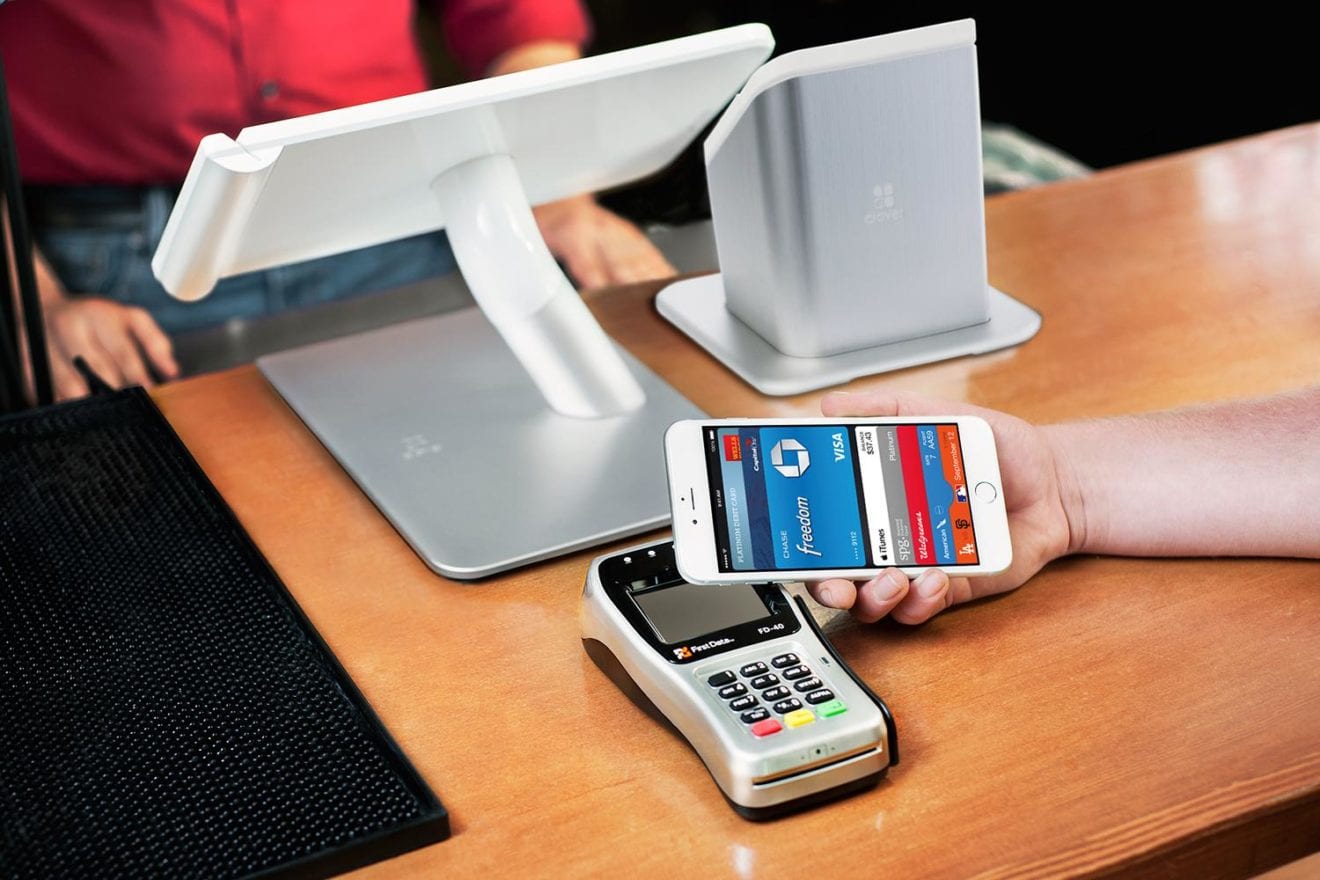
Five major banks, representing 80% of Visa and MasterCard credit and debit cards issued in Singapore, have signed up to Apple Pay, extending the use of the mobile wallet beyond a limited earlier release for AmEx cardholders.
MasterCard says it is working with DBS, OCBC, POSB, Standard Chartered and UOB, to enable iPhone and Apple watch users to make purchases in stores equipped with contactless readers.Recent figures from MasterCard indicate that consumers in Singapore are supportive of the idea of adopting contactless payments. Singaporeans are among Asia’s top three adopters of digital wallets and interest has been climbing steadily with one in four likely to use a digital wallet compared to just one in 20 three years ago.
Apple Pay’s launch comes just a month after Samsung announced plans to roll out its rival mobile wallet with the support of DBS/POSB, OCBC Bank and Standard Chartered. Previously, Apple Pay had only been available for American Express cardholders in Singapore.
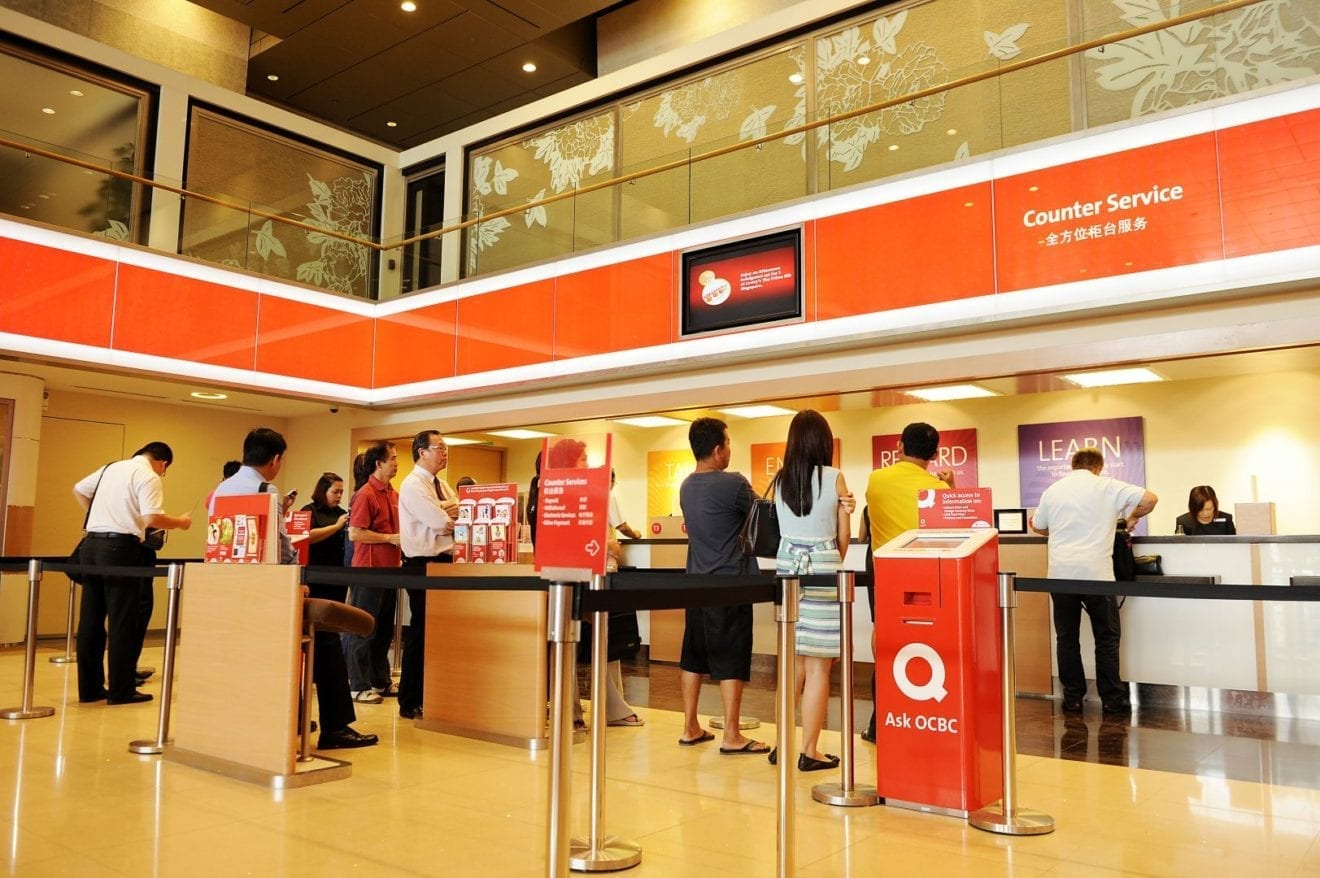
OCBC Bank in Singapore has launched voice metrics and speech recognition in its contact center to improve the retail customer experience.
According to the bank’s head of consumer financial services Dennis Tan, the solutions launched reduce the time taken for customer verification, giving customers quicker access to services required. The voice biometric authentication replaces PINs, one-time passwords and security questions at the bank’s contact centre. Customers can use their voices as vocal passwords for authentication.
Voice biometrics was launched by OCBC in September last year to a targeted group of retail customers. With the technology, customers could use their voiceprints to authenticate requests for account balances, latest transactions and the status of deposited cheques.
Voice biometrics will be available to the bank’s retail customers in the fourth quarter of this year, with customers expected to be able to use their voiceprints to authenticate a majority of banking transactions.
To enrol their voiceprint, customers are asked to say a specific phrase, called a passphrase, three times. A passphrase is an explicit sentence crafted by OCBC Bank to be spoken by the customer into the system to capture the customer’s voice. The voiceprint is created using the spoken passphrase and stored in the system’s database. A voiceprint is not a recording of a voice but a digital representation of a person’s vocal characteristics, so it cannot be disguised and is not affected by emotion or a blocked nose.
To authenticate a banking transaction, the customer will be asked to say the passphrase that was used to enroll his or her voiceprint. If further verification is needed to confirm the customer’s initial vocal password is valid and is not a voice recording, the system will then ask the customer to say a different sentence from the enrolled passphrase. The customer’s voice is captured and is compared with the relevant stored voiceprint on the database. A verification result is then provided by the system. The authentication process is hassle-free and can be done in 15 seconds.
Speech recognition
OCBC Bank launched speech recognition at its contact center in April this year to all personal banking customers.
While voice biometrics enhances customer experience by replacing PINs, passwords and security questions, speech recognition replaces the need to select service options via the phone keypad. The deployment also reduces the number of steps needed to enter the options sequentially on the keypad to access a particular service. Speech recognition technology recognizes and understands a customer’s spoken request, thereby enabling the customer to access the required service faster and more accurately.
According to OCBC Bank, the top customer enquiries received via speech recognition are checking recent transactions and account balances, requests for fee waivers, and Internet Banking and statement enquiries. These requests amount to 30.4 per cent of all requests to the Contact Centre. The success rate of the speech recognition service has been extremely high, says OCBC Bank, with 90 per cent of customers having their spoken requests recognised by the system.
Launching the Infocomm Media Business Exchange’s Ministerial Forum on ICT on Monday ahead of the official kickoff of CommunicAsia2016, Singapore Minister for Communications and Information Dr Yaacob Ibrahim (pictured) spoke of the progress that the country had made in becoming the world’s first Smart Nation – to include the world’s first data centers designed specifically for tropical climates.
Dr Ibrahim explained how he has partnered with industry and academia to launch testbeds for green data centers and is now looking at whether it is possible to design and operate data centers at temperature and humidity levels that are double the current norm.
The tests for these so-called Tropical Data Centers (TDCs) will target an ambient temperature of 38 degrees Celsius and humidity exceeding 90%. The trial will test how data servers react under various “live” situations, such as peak surges or transferring of data, and in diverse conditions, such as with no temperature or humidity controls. TDCs could reduce energy consumption by data centers by up to 40%.
This would not only expand the geographical limitations of locating data centers, but also cut back on existing energy requirements of the running of such centers – all of which is part of the Singapore Smart Nation Vision.
Data centers accounted for 7% of Singapore’s total energy demand in 2012 and is projected to reach 12% by 2030.
On the cyber security front, Dr. Ibrahim said that Singapore has signed a number of bilateral agreements with France, the UK and India in the area of cyber security. It is also supporting the annual ASEAN computer emergency response team incident drill exercises.
Earlier, the Cyber Security Agency of Singapore successfully completed a multi-sector exercise a few months ago to strengthen the ability of agencies to cooperate in handling cyber attacks. In October, Singapore will hold its inaugural International Cyber Week, which will also see the unveiling of the country’s national cybersecurity strategy document by the Prime Minister.
Dr Ibrahim also stated that Singapore will complete its switchover to digital TV by the end of 2017, freeing up spectrum for mobile and mobile broadband services, and will be one of the first countries in the world to impose minimum standards for 4G QoS.
Spanish fashion brand Mango has launched a range of Ramadan styles, including special festive garments.
For more than 10 years the brand has been globalising its collections for different markets. Its special-collections department develops exclusive designs in line with the cultural and religious norms of different countries.
The Mango Ramadan fashion offer includes casual garments such as jackets, kaftans, flowing jackets, oversized shirts, leggings and tunics made of fabrics such as poplin and imitation suede. There are also festive garments such as long dresses and double-layer body wraps (relaxed or fitted), plus midi-skirts made of fantasy fabrics. Satin finishes, lurex and laminated fabrics play a key role, as does lace.
While the Spanish market is key for development, the brand has about 80 per cent of turnover in other countries. There are more than 2200 Mango stores in 109 countries.
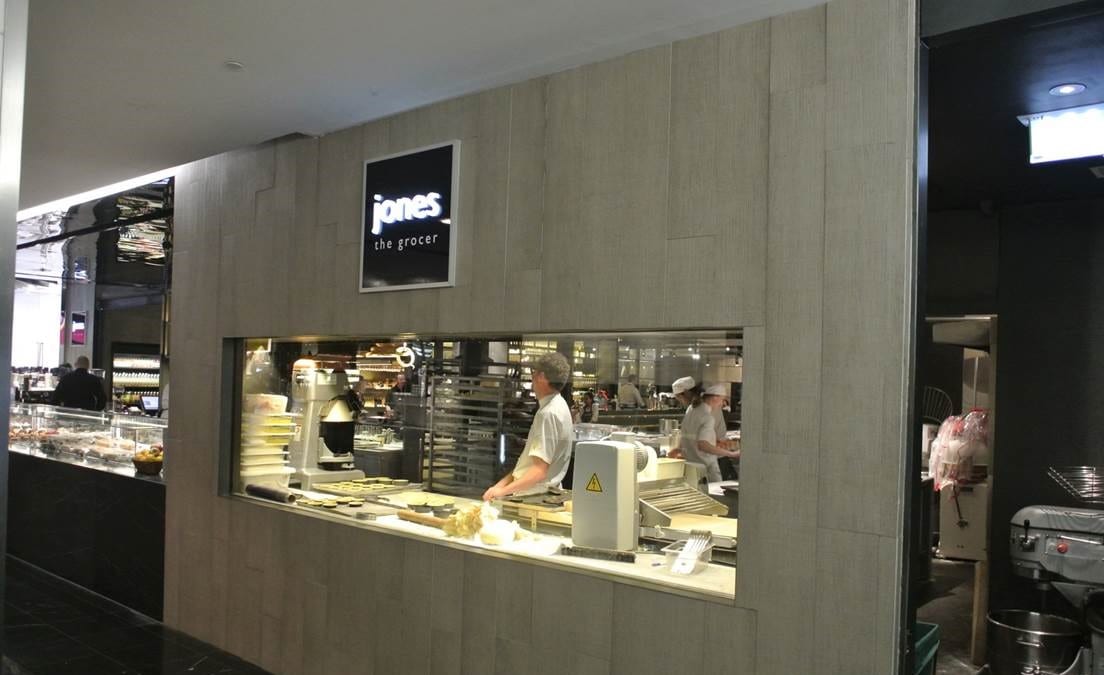
JTG Holdings, the master franchisee for Jones the Grocer in the Middle East and North Africa, has bought the global rights to the brand.
In a separate transaction LVMH investment arm, L Capital Asia has taken a minority stake in JTG Holdings with the aim of backing the brand in its international expansion.
Another subsidiary of L Capital Asia has taken master franchise rights for the brand in various markets in north Asia, Southeast Asia, Australia and New Zealand.
While its base in the UAE will give JTG Holdings a global footprint, it aims to stay true to its Australian roots and is committed to supporting franchisees as true partners.
Jones the Grocer is a cafe and retail outlet specialising in hand-selected specialty products, its flagships featuring a signature walk-in cheese room, charcuterie and deli. Established in 1996 with the launch of its flagship Australian store in Woollahra, Sydney, Jones the Grocer has now has 19 stores across Australia, New Zealand, Singapore, Thailand, Qatar, Bahrain and the UAE.
The new Toys’R’Us Asia-Pacific president is Andre Javes.
Taking up the role on May 27, Javes will oversee all operations and business activities for the company’s growing number of stores in Japan, Southeast Asia, Greater China and Australia, and he will be responsible for the profitability and success of the company in these markets. He will report directly to chairman and CEO Dave Brandon.
A seasoned retail executive with more than 30 years of merchandising and management experience, Javes most recently served as MD of Toys’R’Us, Southeast Asia and Greater China, where he oversaw all operations and business activities for the company’s more than 170 wholly-owned stores and some 2500 employees in Brunei, China, Hong Kong, Malaysia, Singapore, Taiwan and Thailand.
“Since joining Toys’R’Us, Andre has made significant contributions to the continued growth and success of our business throughout Asia and Australia,” said Brandon. “With his extensive retail background, drive for results, commitment to building and leading high-performing teams and proven track record, we expect to further grow and strengthen our brands’ position in the global marketplace.”
Javes first joined the company in Australia in 2008 as GM merchandising with responsibility for toy and baby products. After a brief hiatus, he returned to the company in April 2013 as MD, overseeing all operations and business activities for the company’s more than 30 stores, eCommerce site, corporate office and more than 1700 employees.
Prior to joining Toys’R’Us, Javes served as CEO at Anaconda Group from 2009 to 2012, a retail chain of camping, outdoor and adventure gear stores across Australia. Earlier in his career, he spent three years at Kmart as divisional merchandising manager first for seasonal and consumable items and later for the company’s toy and outdoor product categories throughout Australia and New Zealand. He also served as group merchandise manager, grocery at Coles Supermarkets Australia.
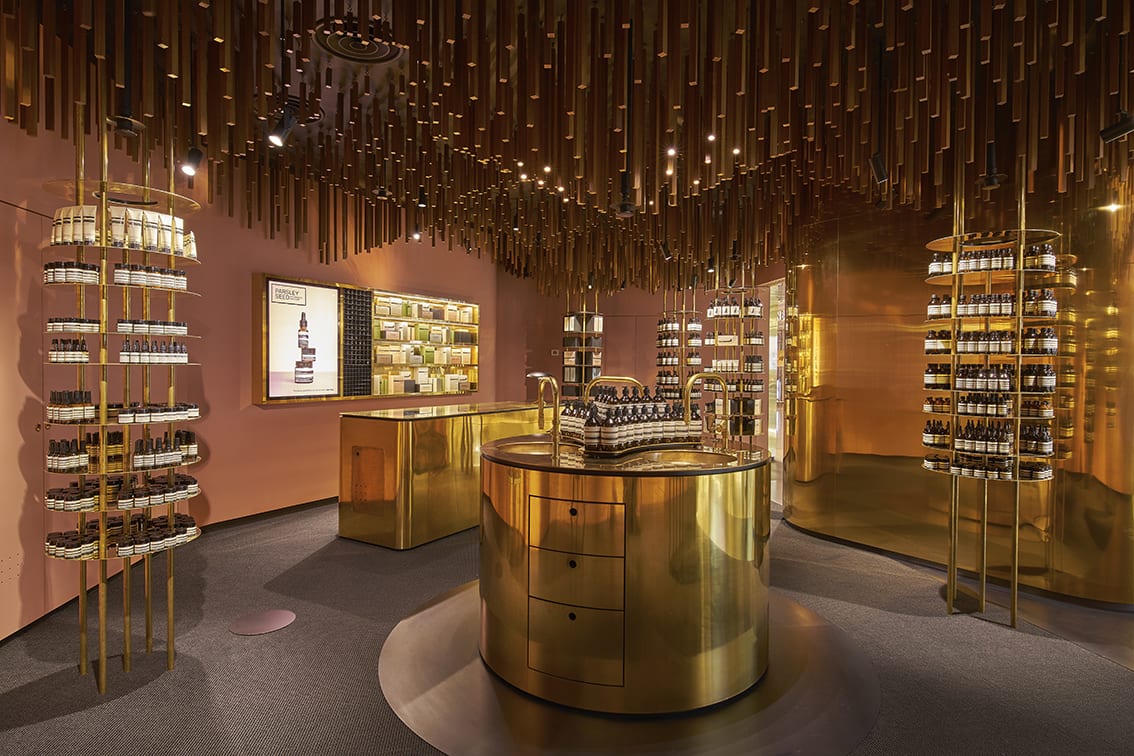
The newly-opened Aesop Ion Orchard features the brand’s newest generation store design concept.
The store, designed by Snohetta, was officially opened a week ago after about a month’s trading. It is the first time Aesop has had a presence in Ion Orchard.
The store features metals and timber, with a bold polished brass exterior. Narrow square timber batons of differing lengths hang down from the ceiling to create an ‘upside down forest’. The timber was chosen in part to mark the presence of a nutmeg plantation on the site many years before Orchard Rd became a retail hub.
The walls are painted in a pink hue, intended to be reminiscent of the colour of mace, a spice harvested from the nutmeg fruit.
“A connection with the nearby Aesop Raffles City is established through the use of brass in functional elements such as the sales counter and sink, and the metal’s lustre is enhanced by overhead lighting,” said the brand.
A lot of the product is displayed on circular shelves mounted on steel frames running from ceiling to floor creating a ‘floating effect’ which fits in with the ceiling forest effect. There are vintage style basins with old style outdoor taps for customers to wash their hands before treatments.
Aesop was founded in Melbourne, Australia, in 1987 and has since grown into an international chain of stores and department store concessions selling skin care products packaged in brown medicine bottles.
Aesop Ion Orchard is the fifth of the brand’s shops to be designed by Snøhetta – earlier stores include Raffles City, Berlin and Norway.
Aesop founder Dennis Paphitis told Dezeen “there’s a direct correlation between interesting, captivating store spaces and customer traffic within a store.”
Fast fashion chain H&M Singapore is to launch its beauty range in its city stores.
The Swedish company made its debut in the category late last year and in the third quarter of this year Singapore will be the first market in Asia where beauty products go on sale.
The product line-up includes cosmetics, body, skin and hair care products. The full range will go on sale in the H&M Orchard Building store and H&M Raffles Place will stock make-up.
“We are very excited to be the first market across Asia to carry the much-anticipated beauty concept,” said Fredrik Famm, country manager of H&M South-east Asia.
“The H&M philosophy is all about offering shoppers the latest styles and quality fashion while staying affordable, and the upcoming beauty range will stay true to our mission. Similar to our fashion, we hope the extensive selection of our beauty range will allow fans to have fun exploring and creating any kind of look they want.”
Singaporeans will be able to choose from more than 700 beauty essentials, from nail products to beauty tools.
Internationally, H&M is about to launch two additional collections within the beauty range: A premium body care line and the Conscious branded range of sustainable products which are Ecocert-approved.
Footwear label Manolo Blahnik is expanding operations in select Asian markets through a new distribution and retail partnership.
Beginning with the autumn/winter 2016 collection, Bluebell Group will be responsible for Manolo Blahnik’s distribution and retail development in Japan, Singapore and Malaysia. Depending on the success of the partnership, Bluebell Group will then be tasked with expanding Manolo Blahnik further into the region.
Finding its footing
Under the agreement, Bluebell Group will manage and provide support service for Manolo Blahnik’s 41 retail locations already in operation in the Japanese market.
The Japanese locations will be added to Manolo Blahnik’s existing 290 points of sale in 33 countries. Manolo Blahnik’s retail network consists of 11 standalone stores, including two in Hong Kong and one in Seoul, South Korea.
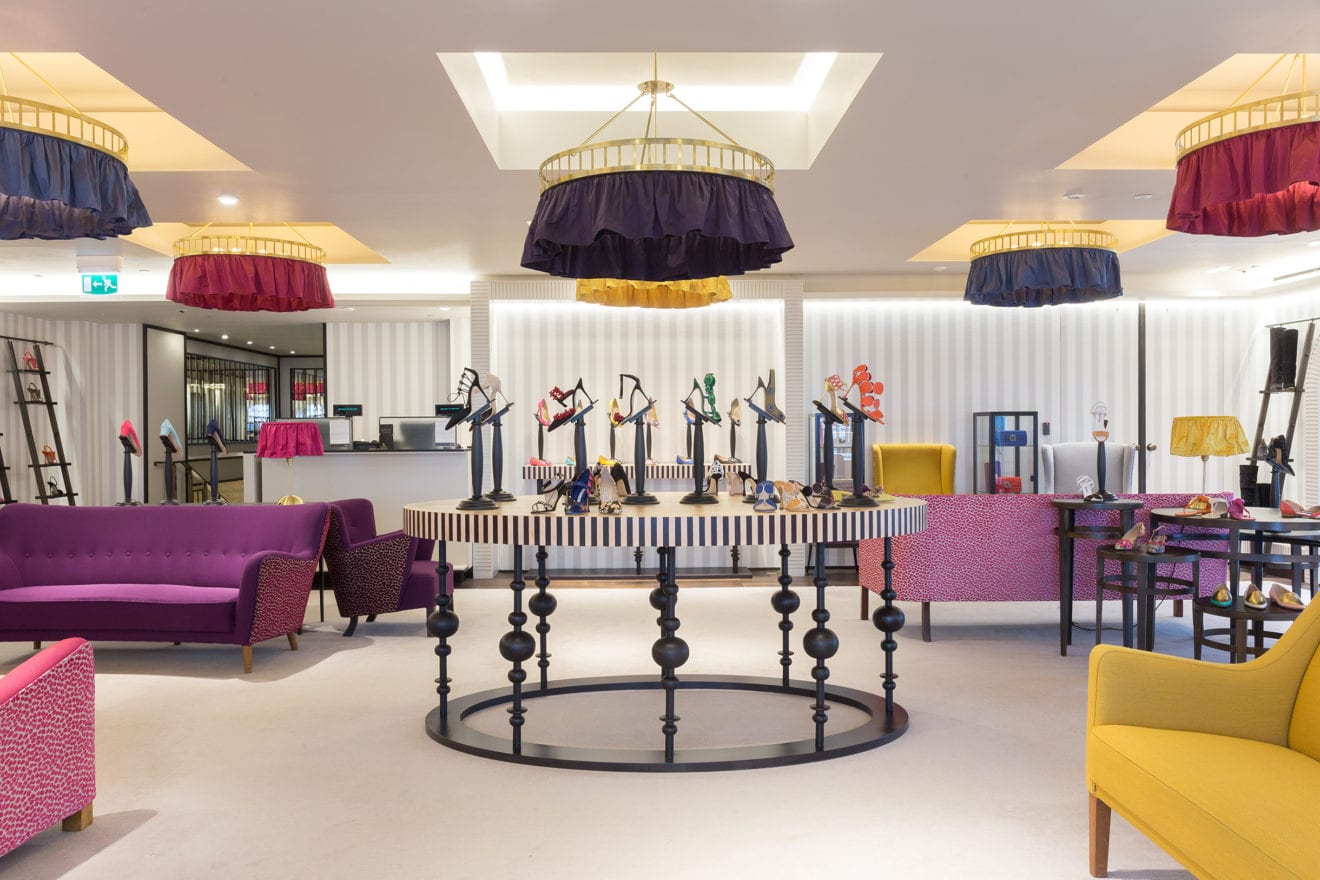
In Japan particularly, Bluebell Group will help Manolo Blahnik to launch its first shop-in-shop and corners in the market’s leading department stores. Additionally, the brand is planning its first flagship in Tokyo for 2017.
Also, Manolo Blahnik’s shop-in-shop in Takashimaya in Singapore will be operated by Bluebell’s local division. The shop-in-shop will undergo renovations later this year.
In the Malaysian market, Manolo Blahnik will open its first standalone storefront in autumn/winter 2016. The boutique will be located in the Pavilion Mall in the speciality retail section.
“We are delighted to now be working with the Bluebell Group in Asia,” said Kristina Blahnik, CEO of Manolo Blahnik International, in a statement. “Manolo Blahnik is a global brand but with comparatively small distribution in Japan, Malaysia and Singapore.
“With Bluebell now as our partners we are excited about exploring and building the business in these regions and further territories,” she said. “I have trust in their guidance and experience, and appreciate their company family values that resonate with our own. We look forward to a successful relationship.”
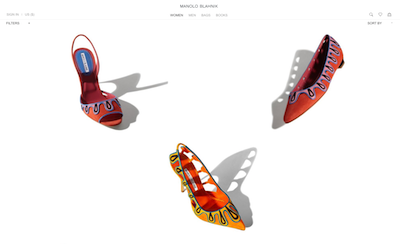
Manolo Blahnik has recently turned to ecommerce platform Farfetch to expand its global presence. As of March, the online retailer’s Black & White service powers Manolo Blahnik’s monobrand ecommerce point of sale.
Manolo Blahnik ecommerce Web site, powered by Farfetch’s Black & White
Through Black & White, Manolo Blahnik sells its entire catalog of men’s and women’s shoes as well as books relevant to the brand
If your Pizza Hut clerk seems like a robot, you may have stumbled into Singapore and a near future in retail commerce.
Before the end of this year, credit card giant MasterCard will deploy an actual robot in one lucky Pizza Hut location in Singapore that will not only engage with customers, but help them fulfill their pizza cravings by guiding them through a purchase and assisting them in completing a mobile transaction.
MasterCard announced on Tuesday that, by the end of this year, it will launch a personalized shopping and concierge experience that will also serve as the very first commerce application for Softbank Robotic’s Pepper robot.
The experiment “follows our own philosophy that every device is a commerce device,” Tobias Puehse, VP Innovation Management, MasterCard Labs, told Mashable.
Pepper’s new job comes on the heels of news that Softbank Robotics’ (formerly Aldebaran) adorable and emotive 4-foot-tall robot is finally getting an Android SDK and would soon be coming to America. The best robot
MasterCard chose Pepper because of “its early success in Japan, in terms of being active in a retail environment with various partners,” Puehse said.
The credit card company spent months programming the commerce experience and had to overcome some challenges, like the fact that Pepper doesn’t come equipped with Low Energy Bluetooth or NFC communication abilities. Eventually they settled on placing a Bluetooth LE beacon near Pepper, which connects to the store’s Wi-Fi network — the same one the Pepper robot will be on — and lets the customer connect via Bluetooth.
In practice, Pepper will greet would-be pizza hounds using natural language and cognition, as opposed to interface requests. If you have MasterCard’s MasterPass Wallet application on your phone (Android or iOS), a little Pepper icon will appear in it. If you don’t, Pepper asks you to scan a QR code. Once you’re connected, Pepper will be able to glean your name, as well as your shopping preferences, and might ask you, “Would you like to have your favorite drink again?”
Pepper will guide you through the product selection process, but, according to Puehse, can also handle random questions about, say, the calorie count in pizza. (But, do you really want to know the answer to that?)
One thing Pepper does not do, though, is complete the transaction for you. For the sake of security, MasterCard chose to keep the transaction on your mobile device. Pepper will only know that you are ready to buy that slice, send your phone the order details and, once you’ve bought it, get the transaction-complete notification. Pepper will then tell you where to go pick up your pizza. Pizza takes time
Because Pepper is a conversational robot and MasterCard designed the interaction to be “human-like,” Puehse said, there won’t necessarily be any efficiency gains from shopping with a robot. The benefit is that, when using Pepper to get that slice of buffalo pizza, there’s no learning curve. Pepper will, in essence, communicate with you just as a highly skilled pizza retail clerk might. It will know the product, respond to questions about it and, perhaps, be a bit more knowledgeable about your pizza desires and needs.
Puehse told Mashable that he can envision a store full of Pepper robotics, each one helping a different customer, but the near-term goal is to “make sure it has all the value that we anticipate it will.” If all goes well, yes, MasterCard wants pizza-selling robots to “proliferate in Asia Pacific and beyond,” Puehse said.
Unfortunately, there’s no timeline for Pepper coming to U.S.-based Pizza Huts. Still, Pepper’s new commerce chops might almost make it worth taking the longest pizza-run in history.
Have something to add to this story? Share it in the comments.
The operator will allow its customers to use the mobile payment service to make purchases at M1 Shop outlets and branches.
Apple has meanwhile revealed it has extended the reach of Apple Pay to include holders of credit and debit cards issued by five banks in the country – DBS Bank, OCBC Bank, POSB Bank, United Overseas Bank (UOB) and Standard Chartered Bank.
The five banks combined account for more than 80% of credit and debit cards issued in the country.
Apple Pay, which launched last month in Singapore, was previously only available to holders of credit cards issued by American Express in the nation.
The service is currently available in six markets – Australia, Canada, China, United States, United Kingdom and Singapore, with planned launches for Hong Kong and Spain this year.
The service can be used on Apple’s iPhone SE, iPhone 6s, iPhone 6s Plus, iPhone6, iPhone 6 Plus and Apple Watch devices for payments at physical retail outlets.
Banks are likely hoping Apple Pay transactions will increase adoption of contactless payments and eat into a chunk of the small payments pie currently dominated by cash transactions.
OCBC Bank Singapore is offering its credit and debit card customers a 3% rebate for Apple Pay transactions island-wide in the first month of activation, with a cap of up to S$15 ($11).
UOB is meanwhile aiming to lift the S$100 transaction limit for contactless payments at all its POS terminals island by the end of next year. The limit has been removed from 2,000 of the bank’s 10,000 terminals so far.
Figures from a recent MasterCard study have revealed an appetite for digital wallets among consumers in the Asia Pacific, with 19.5% using such wallets, a two-fold increase from two years ago.
The e-commerce market in Singapore is expected to be worth US$5.4 billion (S$7.46 billion) by 2025, according to a report by Temasek and Google released on Tuesday (May 24).
This is larger than the casino industry in 2015, which was valued at about US$4 billion.
The report found that Singapore’s e-commerce market was valued at US$1 billion in 2015, with online shopping making up 2.1 per cent of retail sales – the highest proportion of all Southeast Asian countries surveyed.
Come 2025, Singapore’s e-commerce market is expected to make up 6.7 per cent of all retail sales, behind Indonesia’s 8 per cent, the report stated.
Southeast Asian e-commerce markets in 2015 and projected figures for 2025. (Chart: Google, Temasek)
Countries covered in the report included Indonesia, Vietnam, the Philippines, Thailand, Malaysia and Singapore.
The report also highlighted the growth of ride-sharing services such as Grab and Uber. It noted that in 2015, the Singapore market was valued at US$800 million, tying with Indonesia. Overall, the region’s ride-sharing market was worth US$2.5 billion in 2015, with the figure expected to exceed US$13 billion by 2025.
Ride-sharing market in 2015 and projected figures for 2025. (Chart: Google, Temasek)
It added that Singapore will continue to record the highest fare per trip, three times that of the average fare in Southeast Asia.
The report, which also looked at the venture capital and startup landscape in Southeast Asia, also found that as of 2015, Singapore is the most active country with 37 per cent of deal quantity and 72 per cent of deal value. Activity was mainly driven by two startups – Grab and Property Guru, which recorded investments of about US$350 million and US$130 million, respectively.
It found that Southeast Asia is the world’s fastest growing Internet region, with an existing Internet user base of 260 million. This is expected to grow to 480 million users by 2020. Consequently, the Internet economy in Southeast Asia is expected to exceed US$200 billion by 2025, driven mostly by the growth of the e-commerce market, followed by online media and online travel, the report said.
Driving growth are three factors unique to the region: A young population, with 70 per cent under the age of 40, a lack of big-box retail, as well as a rapidly growing middle-class, the report said.