Tag: Singapore

  • Orchard Road malls seek new ways to draw the crowds

    Orchard Road malls seek new ways to draw the crowds

    As Singapore retailers face pressure from the slowing economy, Orchard Road malls are looking for new ways to draw the crowds.

    Besides renovating the mall and changing the tenant mix, landlords are also throwing in free performances in a bid to attract the crowds.

    For example, over the weekend, shoppers at ION Orchard witnessed a series of aerial circus acts. The performances marked the completion of ION Orchard’s recent revamp, which saw a refreshed facade and new tenants such as Tiffany & Co and French-Italian luxury lifestyle brand Moncler.

    Orchard Turn Developments, which manages ION Orchard, said it is important to enhance the shopping experience.

    Said Mr Chris Chong, chief executive of Orchard Turn Developments: “Increasingly, retail is not just about shopping but also about entertainment, bringing new novel experiences. Last year, we did a butterfly dome featuring live butterflies from the Crysalis. This year, we will bring an exciting new experience with the aerial sphere. We hope shoppers will enjoy this new experience and as a result also enjoy shopping with us.”

    Orchard Road retailers have been hit by a slowing local economy and weak visitor arrivals in the past two years. Analysts estimate that Orchard Road rents fell last year and could drop by another 3-5 per cent this year.

    Besides ION Orchard, other malls being refurbished include Centrepoint and Wisma Atria.

    IMPROVE OVERALL EXPERIENCE: JLL

    Property consultancy JLL said that not all Orchard Road malls require a complete physical overhaul. But landlords and retailers must work together to improve the overall retail experience, amid competition from online retailers and suburban malls.

    Ms Regina Lim, national director of advisory and research at JLL, commented: “I don’t think it has to be a total refreshment or refurbishment; it’s about being more aware of giving shopping a reason to come to your shop or to your mall.

    “So even if the mall isn’t getting a facelift, I think retailers and landlords need to think about giving some reason for families to come down and visit rather than just buy it online.

    “In this day and age where there is quite a bit of supply along Orchard Road, you really need to proactively think about how you want to make your mall a little bit different from the rest and engage the public to come down to the mall to shop. Because people really want to integrate shopping online and offline and going to the mall has to come with some kind of experiential performance and events,” Ms Lim added.

  • Indonesia’s first F1 driver is a good-looker who lives in Singapore

    Indonesia’s first F1 driver is a good-looker who lives in Singapore

    When Indonesia’s first Formula One driver Rio Haryanto makes his debut with the Manor Racing team at the new season on March 20, he is likely to set the hearts of female fans a flutter.

    The only Asian to be on the starting grid boasts not only a chiselled jaw and dashing good looks, but also a hot bod to match.

    Rio, 23, will be the third Southeast Asian driver, after a long absence, to compete in Formula One since the championship started in 1950, reported The Jakarta Post. The other two were Malaysian Alex Yoong (2001 and 2002) and Thailand’s Prince Birabongse Bhanudej in the 1950s.

    So all eyes will be on Rio, who reportedly lives in Singapore, when he competes against the likes of champion drivers Lewis Hamilton and Sebastian Vettel in the 21-race series, starting in Melbourne in two weeks’ time.

    Born in Solo, Indonesia, he is a business management graduate, having studied here at private school FTMSGlobal Academy.

    Sponsored by Indonesia’s state energy company Pertamina, the rookie driver has managed to capture a huge following in Indonesia, all eager to see their new sports icon flying their national flag high.

    “I hope by working hard, I will not only represent Indonesia in F1 but achieve [something],” he said in a press conference in February.

    When he is not competing, Rio spends four hours a day to build up his stamina by swimming, jogging, or working out in gym, according to his website.

    He likes high-protein food, and even cooks his favourite fish – salmon – often.

    Apart from his love of racing, Rio hopes to be involved in his family business – his father runs a company that produces Kiky brand writing books.

    He also likes to do his bit for the community. Whenever he returns to his hometown, he would visit an orphanage and share his adventures with the kids, like a big brother hoping to inspire and motivate his younger siblings, according to his website.

    Career jump

    Rio clinched a place in the Manor team after its owner Stephen Fitzpatrick was impressed by his performance.

    He had said in a press statement: “He is tenacious on and off the track and made a big impression on last year’s GP2 battle.”

    On Rio’s big fan base in Indonesia, Fitzpatrick said they would be a booster for his team and for F1.

    “They are keen to see [Rio] on the grid and we’re confident that we’ll see him enjoying some exciting battles in the year ahead.”

    Rio’s racing experience began when he was only six, taking part in the national and international Gokart arena. He joined Formula Asia 2.0 racing competition at 15 and emerged the winner among Asian drivers.

    In the following year he came in first again at Formula BMW Pacific 2009 racing competition.

    At 17, he was qualified to get Formula 1 super licence from Virgin F1 race in a test in Abu Dhabi in 2010. Since then, he had been racing in the GP2 Series with EQ8 Caterham Racing Team.

  • Help retail electronics customers navigate to the right products

    Help retail electronics customers navigate to the right products

    Singapore will be the first offshore location for Australian consumer electronics product information platform Product Lighthouse.

    Singapore has been identified because of the sophistication of the domestic market, the high demand for electronic goods, and the close level of integration with neighboring countries.

    Product Lighthouse acts as a bridge between vendor product content and retailer product information systems. Through Product Lighthouse, information authored by vendors can be readily made available for retailer websites, catalogues, staff training and in-store tickets.

    The launch of Product Lighthouse Singapore is slated for the second half of 2016, with discussions underway now with leading retailers and manufacturers.

    Retailers have an opportunity to increase sales and retain customers  

    Consumer research conducted by Product Lighthouse shows consumers are hungry for product information – but they are often not getting it from store staff or online. Research undertaken by Product Lighthouse showed that.

    • 87% of consumers say they leave a website and go elsewhere when they encounter poor quality or missing product
    • 64% of consumers say they would be less likely to purchase from a retailer who provided incomplete product

    CEO Chris Grannell said “Most of us have visited a store and found staff unable to answer our questions. Even though most consumers purchase electronic goods in a physical store, the growing significance of the Internet in the product discovery process means that comprehensive and accurate information online is essential.”

    Singapore audit reveals product information gaps

    Product Lighthouse undertook an audit of product information on retail websites in Singapore and found many inaccuracies and information gaps.

    Grannell said: “In Singapore our audit has shown some astonishing inaccuracies, such as incorrect specifications, key attributes missing, wrong weights and sizes. We even found one website that had a laptop listed with a gender! “

    “These things happen because content is transferred from manufacturers to retailers through a manual process. Even with the most conscientious staff, mistakes will happen. Added to that, the nature of this industry means that information is not available all at once which means that it is more of a drip feed and less of a single transfer. Never before has there been a system that can accommodate this process and facilitate the collaboration around this data”

    Product Lighthouse is designed with low-fi integration in mind

    Gex Cheng, CTO of Product Lighthouse, said “Our technology platform can be thought of as an API layer between manufacturers and retailers. But ‘making things easy’ is part of our DNA, so we’ve created the ability for retailers to export content in customised spreadsheets that can be loaded into their systems. We’ve also invested heavily in collaboration tools and in the ability to read output from all kinds of manufacturer databases and libraries.”

    Cheng continued, “I always like to remind our users that our approach is to ensure our software fits to your workflow rather than changing it.”

    Discussions taking place now

    Cheng and Grannell will be spending time in Singapore during April, when Product Lighthouse will also be showcased at the Tech in Asia expo at Suntec Convention Centre. Grannell said “We are encouraged by the current focus on productivity by the retail sector in Singapore. Programs such as the Capability Development Grants from SPRING show that government and industry alike are keen to invest in productivity, marketing and customer service.”

  • Two-pronged approach for Giordano Vietnam

    Two-pronged approach for Giordano Vietnam

    Vietnam is on the radar for Hong Kong clothing retailer Giordano International, both as a market and supplier.

    With its steady growth in the emerging market, the company is planning to establish a legal entity Giordano Vietnam.

    It is also eyeing the country as a source market for product, while it continues to develop sourcing opportunities in Bangladesh.

    While Giordano still sees opportunities for growth in developing markets such as Indonesia, Malaysia and Thailand, the company says in its annual review that those opportunities are fading.

    Meanwhile, the group has plans to launch digital sales channels outside mainland China this year, initially through the development of its own eShops.

    “Market conditions in Southeast Asia have been challenging in the past two years,” says the group, which improved its merchandising, and therefore profitability, in Singapore last year – “but this will be a tough market going forward”.

    In the 2015 financial year, consolidated sales eased by 3 per cent – but increased by 1 per cent on a constant currency basis. Global brand sales were down 1 per cent for the year, but comparable same-store sales grew by 3 per cent.

    As a strong Chinese New Year offset the impact of 81 store closures, brand sales in the first half of the year grew by 1 per cent. But in the second there was a 3 per cent drop because of unseasonably warm weather in Greater China.
    Gross profit margin declined by 0.4 percentage points to 57.6 per cent, with higher purchasing costs caused by a strong US dollar eroding margins in Southeast Asia and Taiwan.
    “Weak consumer demand in many markets has led to fierce competitive pressure on selling
    prices,” says the group.

    Nevertheless, in the second half of the year, improved purchasing and merchandising resulted in gross margin improving from 57.4 to 57.9 per cent.

  • Inside SingTel Singapore

    Inside SingTel Singapore

    SingTel Singapore has repositioned itself as a ‘human services brand’ by putting the customer at the core of its retail store design rationale.

    The latest generation store rendition was created by Sydney­-based design agency Public Design Group. Co-­founder and director of retail strategy and business development, Jason Pollard, says the agency is focused on ensuring that SingTel’s store design strategy supports the market opportunity and the business opportunity – with particular focus on recognising the rapid technological change driving the telecommunications sector and business model.

    “It’s not about device sale, the plans or the data,” he explained. “That’s only one-­third of the total revenue that’s going to be made in the future; the other two­ thirds is called the Internet of Things or information and communications technology.”

    Singtel store 2

    Since launching the partnership with SingTel Singapore, Public Design Group has implemented the new design across four additional SingTel stores, with the telco embracing the concept of ‘brand experience’ as opposed to ‘branded space’.

    Pollard explains that taking lifestyle propositions and fully enabling them across a variety of devices with different services represents the fundamental design ethos of the store.

    The approach to designing the store represents a departure from that of other telecommunications retail stores, which often emulate the streamlined devices and technology.

    “We’re not celebrating devices anymore, we’re celebrating what they can do,” said Pollard.

    Singtel store 6

    Customer ­centric design

    The store’s entrance features a digital portal showpiece, identified by Public Design Group as a gateway into the new market of information and communications technology solutions. The portal’s purpose is to emphasise SingTel’s shift in brand focus from product to people. “SingTel as a brand no longer wants to be perceived as a technology organisation,” Pollard said.

    Singtel store

    “They want to be perceived as a service brand, which is mirrored in providing the very latest greatest lifestyle solutions for their customers.”

    Singaporean retailers have widely adopted an electronic queuing system, as part of dealing with high volumes of traffic. Public Design Group saw an opportunity for personalising the customer experience and collaborated with digital agency, Texture, in Singapore to develop a bar code system, which allows waiting customers to explore the store instead of standing in a queue.

    Singtel store 1

    The ‘Q ticket’ is imbued with a barcode that can be scanned on any of the hundreds of micro screens around the store. Each screen is associated with a product or accessory, providing detail and price. Once scanned, the detail is stored in a virtual shopping basket, which is viewed by the store assistant prior to them meeting the customer.

    “That barcode allows you build a virtual shopping basket of things that interest you, so that by the time you go to meet the service staff and do whatever you want to do, you can hand them your virtual shopping basket,” explained Pollard. “Immediately that opens conversations relevant to the customer and empowers the staff to be more relevant to their customer.”

    Singtel store 5

    A customer service lounge, featuring leather wing back chairs, is designed with the purpose of creating an environment that encourages more consultative conversations. Placing the service proposition in the front window of the store as opposed to the back of the store emphasises SingTel’s focus on providing a premium customer experience.

    “One of the key factors of having to deal with a Telco is addressing how well they are going to look after me when it all goes wrong, so that service lounge is a key part of winning market share and making a statement in the market place,” Pollard said. “At SingTel, we’re looking after our customers – even if they’re not buying, we’re solving problems.”

    Singtel store 3

    Pull over push

    As part of the new ‘pull’ sales strategy for SingTel, promotional material in the store is significantly reduced, with statistics showing high value transactions typically come from conversations rather than communications.

    Similarly, new social trends and customer behaviours were studied to showcase lifestyle themed propositions on gesture­ controlled displays.

    Gesture control for the large format screens within the store was employed to allow customers to scroll through the various ‘integrated technology’ stories in the same way as they would on a tablet.

    Singtel store 7

    “People don’t like touching big technology because it’s hot, expensive and it puts them in the spotlight,” argued Pollard.

    “SingTel has put the customer first,” said Pollard. “We have developed a customer centric store and that’s why it’s such a great experience.”

  • RFID system boosts efficiency for Decks Singapore

    RFID system boosts efficiency for Decks Singapore

    Fashion retailer and apparel supplier Decks Singapore has implemented an RFID inventory and stock-taking system that saves time while ensuring greater accuracy.

    Previously, 600 worker-hours were involved in the company’s annual stock-take, with 88 per cent accuracy. With the new system, it can achieve 99.8 per cent accuracy in just five worker-hours.

    To achieve this greater efficiency and accuracy, Decks consulted Tokyo-listed auto-ID technology company Sato, which recommended the inventory system. It involves tagging apparel with RFID labels, with all incoming and outgoing items being scanned.

    “With the retail industry growing more competitive and the rise of eCommerce and mCommerce changing the way consumers shop, retailers have to act fast to keep up and stay ahead in the game,” says Decks MD Kelvyn Chee.

    “Besides stock-taking advantages, the new RFID system also helps us achieve greater inventory data accuracy, enabling us to ensure stock availability.”
    Sato Asia Pacific GM Akihiro Ito says his company will continue working with Decks to implement other retail technology such as Anti-Theft and Self-Checkout.
    Launched 19 years ago, Decks is a fashion apparel supplier for departmental stores in Singapore. It also has several retail boutiques in major Singapore shopping malls and has distribution channels in Southeast Asia.

  • Toys’R’Us Asia Pacific chief retires

    Toys’R’Us Asia Pacific chief retires

    Toys’R’Us has announced that Monika Merz, president, Asia Pacific, will retire effective May 31. Her successor will be named later.

    Monika-Merz

    As president of Toys’R’Us Asia Pacific, Merz oversees all operations and business activities for the company’s more than 300 stores in Japan, Southeast Asia, Greater China and Australia, responsible for the continued growth, profitability and success of the company in those markets.

    Since she started working at Toys“R”Us, Merz has been instrumental in the development of new store formats and merchandising concepts that have been successfully translated to other markets, ultimately strengthening the company’s position in the global marketplace.

    Dave Brandon, chairman and CEO, described Merz as a highly regarded leader “who has inspired new ideas, demonstrated innovative thinking and unwavering passion for the business and grown our Toys’R’Us brand internationally, even through challenging times and market transitions”.

    Merz’s retirement will bring to a close a remarkable career of nearly 20 years of continuous service to the company. She joined in 1996 as VP and GM, Toys’R’Us, Canada and was promoted to president, Toys’R’Us, Canada four years later. In 2007, she assumed leadership of Toys’R’Us, Japan. Her role was expanded to include responsibility for the company’s stores in Australia in 2011, and, later that year, she gained oversight of the company’s locations and corporate offices in Southeast Asia and Greater China when the company entered a joint venture agreement with Li & Fung to operate these formerly licensed stores.

    “During my time at Toys’R’Us I’ve had many experiences and challenges, but I’ve always been supported by exceptional teams and leaders,” she reflected. “I’m proud of all that we have accomplished and confident that the work we have done to provide a fun and memorable shopping experience for customers will continue after my retirement. After more than eight years in Asia Pacific, I’m now looking forward to returning to Canada and a new stage in my life.”

  • Vaniday app starts Asia foray

    Vaniday app starts Asia foray

    Beauty salon booking app Vaniday, backed by eCommerce giant Rocket Internet – the company behind fashion eTailer Zalora – has launched its first Asian platform in Singapore.

    Following in the footsteps of five other countries, the app now covers the city Vaniday co-founder and MD Robinson Blanckaert calls home.
    “Singapore is not that small actually,” says Blanckaert. “We have the most active spa-going population across the globe with more than 18,000 beauty salons.”

    With more than 800 salons signed up to the app, users can compare and review services as well as book appointments. Beauty businesses can use the app to manage staffing, appointment-making and invoicing through Vaniday’s free software.

    “From the launch in each country, we’ve learnt a lot of lessons. Now, for example, we send a professional photographer to every salon so each business benefits from professional images.”

    Vaniday has reportedly raised €15 million ($16.29 million) in funding.

    Meanwhile, AsiaOne says due diligence before stepping into a salon is worthwhile given that theConsumers Association of Singapore (Case) receives a sizeable number of complaints about spas and beauty-related businesses – almost 2000 cases of negative feedback were lodged in 2014 – and there has been an increase in complaints about unsubstantiated claims by beauty industry advertisements last year.

    In a parallel development, Case has signed a memorandum of understanding to jointly develop anaccreditation scheme for the hair and cosmetology industry in Singapore, following the signing of a memorandum of understanding with the Hair & Cosmetology Association Singapore (HACOS).

  • Bloom time for kids’ fashion

    Bloom time for kids’ fashion

    Mrs Madelaine Wong buys new clothes for her three children every fortnight.

    The 37-year-old, a regional director of sales, shops for them during lunch time or after work.

    While Mark, six, Lauren, four, and Jude, one, are at a stage of their lives where they outgrow their clothes quickly, Mrs Wong admits that she also buys them new clothes because she feels guilty about not spending enough time with them. She thinks that shopping for them is a way for her to show affection.

    She spends about $100 on each shopping trip and is a regular customer at mass market-label stores such as Cotton On and H&M.

    “I get suckered into shopping at Cotton On’s online store when the brand is having a 20 per cent discount storewide. I go online and think to myself, ‘Okay, I think they need some more pyjamas’, or I will see a pretty dress and add it to the shopping cart.”
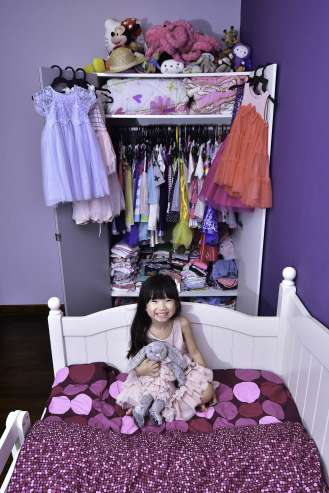

    Lauren Wong may be only four, but her wardrobe is bursting at the seams, thanks to her mother buying her new clothes every fortnight. PHOTO: DIOS VINCOY JR FOR THE STRAITS TIMES

    While parents and grandparents may have grown up with a culture of saving as much as possible… they may now feel that they could be a bit freer spending on their children and grandchildren.

    DR SESHAN RAMASWAMI, associate professor of marketing education at Singapore Management University

    Thanks to indulgent parents like her, the children’s clothing market has become the one bright spot in the weak retail sector.

    The range of children’s clothes has expanded in recent years, with the arrival of new brands and the expansion of existing ones.

    Australian label Seed Heritage, which carries clothes for women and children (from babies to teenagers), debuted with a splash in Singapore last year by opening three stores in Parkway Parade, VivoCity and Wisma Atria.

    The label’s general manager, Ms Denise Haughey, says that the 16-year-old brand had received regular inquiries from mothers living here before it opened in Singapore. She declines to give sales figures, but says: “Singaporean parents really enjoy dressing up their little ones.”

    Seed Heritage clothes feature plenty of whimsical prints and stylish pastel colours and are priced between $7.95 for three pairs of boy socks and $59.95 for a girl’s embroidered dress.

    Israeli high-street label Fox, which carries clothing for women, men and children, has enjoyed an “overwhelming” response to its children’s and baby collection.

    A spokesman for Wing Tai, which distributes the brand here, says the good response can be seen from the large number of members who sign up to collect points for discounts. The brand has accumulated 120,000 members since opening here in 2004.

    The spokesman adds: “We’ve noticed parents are becoming more trend-conscious when it comes to dressing up their children and this has helped spur the childrenswear industry.”

    Popular Swedish high-street fashion label H&M revamped its flagship store at Orchard Building in 2014 to devote the fourth floor to its children’s clothing department.

    The department previously shared space with its men’s fashion.

    H&M’s clothes for children, aged from newborn to 14, include T-shirts, jeans and cotton dresses.

    Like in the adult range, the children’s clothes are priced competitively, ranging from $19.90 for a white lace top for girls to $59.90 for a cotton blazer for boys.

    Ms Abby Wee, public relations manager for H&M Singapore, says the brand has also expanded its childrenswear range to include sportswear, swimwear and dancewear because of strong sales in childrenswear.

    Japanese casual wear label Uniqlo carries children’s clothes in 20 of its 24 stores in Singapore.

    Another popular Japanese label, Muji, sells its children’s collection at three of its nine stores here.

    Ms Jasmine Sng, general manager for Muji (Singapore), says the label had received many requests to bring in childrenswear. Muji shirts and dresses for children range from $12.90 to $59.

    Ms Sng says the sales of children’s and babies’ clothes have grown from 7 per cent of total garment sales in 2014 to about 10 per cent.

    The expansion in children’s labels is also mirrored in the luxury end of the market.

    The Shoppes at Marina Bay Sands expanded its children’s section late last year.

    Italian label Dolce & Gabbana Junior opened a 1,400 sq ft space in October. The outlet is the brand’s first junior store in the region and its collection carries clothes for children aged newborn to eight years old.

    Designer multi-brand retailer Club 21 opened standalone Armani Junior and French label Bonpoint stores at Marina Bay Sands in December.

    Other children’s labels at The Shoppes include Baby Dior, which opened a 900 sq ft store in 2014 and Ralph Lauren Children, which opened its largest standalone store for childrenswear in South-east Asia in the same year. The flagship store for the American label spans 1,985 sq ft.

    The designer label clothes for children can cost $550 for a boy’s shirt and a couple of thousands of dollars for a party dress.

    Paragon shopping mall also has a floor populated with childrenswear stores, including French brand Petit Bateau, international brand Nicholas & Bears, British brand Burberry Children, Filipino label Gingersnaps and multi-label store Kids 21.

    Retail experts interviewed say growing affluence and smaller families have led to the strong growth in the childrenswear market.

    Mr Samuel Tan, course manager (diploma in retail management) at Temasek Polytechnic School of Business, says: “With fewer children a household, parents or even relatives are willing to spend more on the kids.

    “With generally higher disposable incomes and more affluent dual-income families, design, look and quality of clothes are prioritised over price.”

    He adds that parents who are loyal customers of a brand are also more likely to shop for their children at the same store.

    “With the growing popularity of brands such as H&M, Uniqlo and Cotton On, the line extension is a logical move.”

    Dr Seshan Ramaswami, associate professor of marketing education at Singapore Management University, says that retailers may be targeting the children’s fashion market to fend off online competition.

    He adds that today’s parents have higher incomes compared with those of previous generations and are more willing to spend on their children.

    “While parents and grandparents may have grown up with a culture of saving as much as possible and have grown used to spending less on themselves, they may now feel that they could be a bit freer spending on their children and grandchildren,” he says.

    Manager Jonathan Heng, 38, admits that he shops more for his two sons than for himself.

    “It is more because of necessity. They grow so fast and outgrow their clothes and shoes quickly,” says Mr Heng of Caleb, four, and Zachary, three months old.

    “My wife and I probably shop for them every other month. As parents, our lives are about our kids now anyway,” he adds.

    Ms Sharon Yeoh, a senior consultant at the Civil Service College’s Institute of Leadership and Organisation Development who has two daughters aged six and three, says she also shops more for her children than for herself. “It is more fun shopping for them. The clothes are so cute and pretty.”

  • Changi retail +8% to $1.56bn is new record in 2015

    Changi retail +8% to $1.56bn is new record in 2015

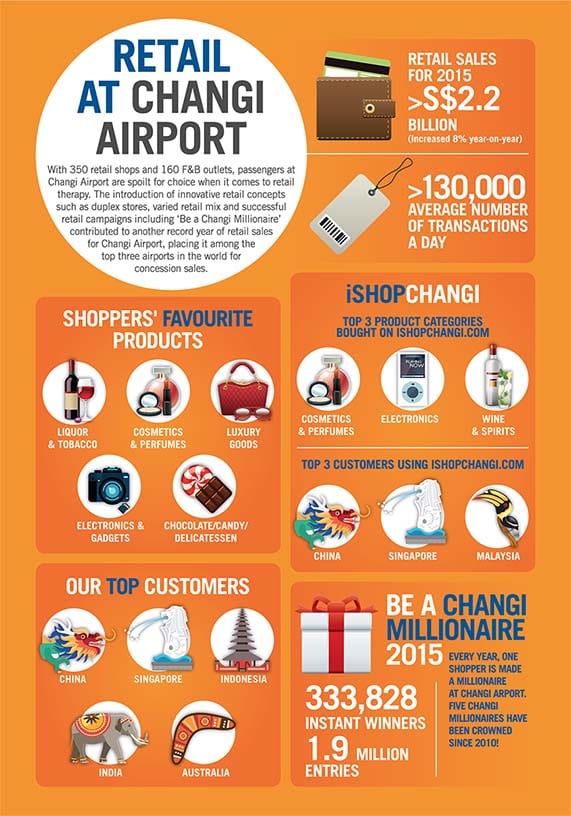
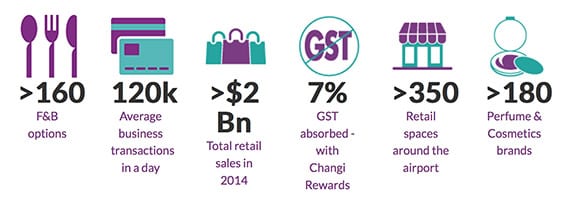
    Singapore Changi Airport has formally reported that it achieved an 8% record increase in retail and food and beverage sales worth S$2.2bn ($1.56bn) in 2015, compared with the previous trading period in calendar year 2014.

    The Changi Airport Group includes 350 retail shops and 160 food & beverage outlets within its ‘retail’ definition and it says that last year’s sales performance benefited from several innovative retail concepts.

    These included the introduction of duplex stores for duty free liquor and tobacco (DFS Group) and beauty (Shilla), a varied retail mix and successful retail campaigns – including the hugely popular ’Be a Changi Millionaire’.

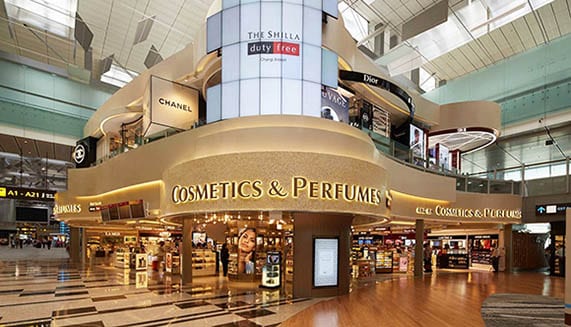
    New Shilla Duplex Sept 2015 opening

    The relatively new Shilla Duty Free duplex store in Changi Airport Terminal 3 which opened in September 2015.

    CAG says that its top customers by nationality were from China, Singapore, Indonesia, India and Australia, while its shoppers’ favourite product purchases (in order) were led by Liquor & Tobacco; Cosmetics & Perfumes; Luxury Goods; Electronics & Gadgets; and Chocolate/Candy/delicatessen.

    Interestingly, Changi Airport management added that the top three product categories bought on iSHOPCHANGI.COM were Cosmetics & Perfume, Electronics and Wine & Spirits, while the top three customers using this service were from China, Singapore and Malaysia.

    HUGELY POPULAR EVENT…

    Meanwhile, the ‘Be a Changi Millionaire’ campaign has literally crowned five winners since the competition draw began back in 2010, with another 333,828 instant winners drawn from an incredible 1.9m entries.

    Changi also claims that all of these sales and other achievements placed the airport amongst the top three in the world for concession sales.

    Singapore Changi Airport capped a resilient performance in 2015 with new benchmarks for passenger traffic and aircraft movements, handling a record 55.4m passengers and 346,330 landings and take-offs during the year. This represented a rise of 2.5% and 1.4% respectively.

    Changi Airport infographic retail 2015

  • Singapore forecasts 0-3% visitor arrivals in 2016

    Singapore forecasts 0-3% visitor arrivals in 2016


    The Singapore Tourism Board (STB) is forecasting a 0-2% rise in the range of S$22bn to $22.4bn ($15.6bn to $15.9bn) in tourism receipts in 2016 and international visitor arrivals in the range of 15.2m to 15.7m (0 – 3%).

    This follows what the STB describes as the ‘mixed tourism sector performance in 2015 in the face of global headwinds’, as visitor arrivals grew by 0.9% to 15.2m and tourism receipts declined by -6.8% to S$22bn.

    LESS MICE CAUSED MOST OF THE DECLINE

    The STB said that the decline was largely due to a fall in BTMICE (meetings, incentives, conventions and exhibitions) visitor arrivals and spending. This mixed performance came on the back of various headwinds, such as an uncertain global economic outlook and weak currencies in some of Singapore’s top source markets in 2015.

    “As the average BTMICE visitor spends about two times more than the average leisure visitor, the fall in BTMICE visitor arrivals and spending due to companies cutting back on both travel and trip budgets has had a significant impact on our tourism receipts,” he added.STB CEO Lionel Yeo commented: “We are encouraged by the upturn in visitor arrivals from May onwards that led to a positive growth for the whole of 2015. Of particular note is the 2% growth in leisure visitor arrivals in 2015, which helped offset the decline in BTMICE visitor arrivals. This shows that Singapore remains attractive as a leisure destination.

    Singapore Tourism 2015-2016
    In terms of market highlights, the top growth-markets for 2015 tourism receipts were Japan (+6%) and the UK (+4%). Tourism receipts from Japan rose due to greater BTMICE traffic, while more leisure visitors from UK also spent more.

    The STB said that the decline in tourism receipts was most keenly felt in Indonesia (-21%), Australia (-10%) and Malaysia (-26%) with all these markets facing their own economic challenges and currency devaluations.

    Turning to international arrivals by market, China led the way (+22%), followed by India (+7%), South Korea (+7%) and Taiwan (+12%). Notably, there were more visitor arrivals from both tier 1 and secondary cities in China and India, where STB has intensified its marketing and channel development efforts.

    Changi factfile 2014

    These key numbers relate to Changi Airport in 2014.

    The largest declines were noted from Indonesia (-10%), Malaysia (-5%), Australia (-3%) and Japan (-4%) where the STB reasons that macroeconomic factors, including currency depreciation and an uncertain economic outlook, depressed market demand.

    KEY HIGHLIGHTS

    More positively the key highlights in 2015 included intensified marketing efforts linked to the international attention Singapore attracted during its Golden Jubilee year. STB tried to capitalise on this by collaborating in a joint marketing effort with tourism industry stakeholders to launch a S$20m ($14.2m) campaign in seven key markets.

    The Board also put in place strategic partnerships with Changi Airport Group, Singapore Airlines and TripAdvisor to promote Singapore as the destination of choice.

    Key growth areas identified in  2015 included cruise and business events, with the former noting a year-on-year cruise passenger rise of 14% to 1m in 2015 and nine calls that were new to both Singapore and Southeast Asia.

    Singapore Tourism Board 2015
    The STB also supported more than 350 business events in 2015, representing a 27% year-on-year growth. These events generated 287,000 visitor arrivals and S$478m ($341m) in tourism receipts.

    LOOKING FORWARD…

    The STB is now forecasting that tourism receipts will be in the range of S$22bn to $22.4bn (0 – 2%) and international visitor arrivals in the range of 15.2m to 15.7m (0 – 3%) this year.

    In a statement it said: “Global economic growth may be hampered by the slower growth momentum of the Chinese and US economies, as well as uncertainties such as ongoing reforms in China and the impact of the normalisation of the US monetary conditions.

    “Increasing regional competition will also pose challenges to Singapore’s tourism sector. At the same time, Singapore remains poised to benefit from the projected growth in outbound travel in the Asia Pacific region. The pipeline for business events also continues to be strong.”

  • Ikea Kicks Off $444 Million Global Media Review

    Ikea Kicks Off $444 Million Global Media Review

    Ikea is reviewing its entire $444 million global media account, which is currently split between a range of agencies across five different holding companies. WPP’s MEC retained Ikea’s media planning and buying duties in the U.S. following the last media review in 2009. Dentsu Aegis Network’s Vizeum won the U.K. business from WPP’s MediaCom in the same review, which took more than six months to complete. In Asia, Vizeum picked up the business in Singapore, Thailand and Malyasia in September 2015, after winning Korea a year earlier.

    The Swedish furniture retailer confirmed in a statement: “Ikea is currently in the process of reviewing its media agency suppliers globally. ID Comms, our media consultancy partners, will be helping us facilitate this process.”

    An executive familiar with plans for the review said media buying is currently split among agencies from five different agency holding companies.

    Ikea’s statement continued, “As part of our commitment to the ongoing improvement of our media and marketing governance, Ikea periodically evaluates all marketing service suppliers to ensure we maintain the best working relationships with the best agency partners.

    Creative duties on Ikea are not under review. Like the current media arrangements, creative is split between a number of different agencies around the world. New York, BBH Singapore, Buzzman Paris, Mother London, and Forsman & Bodenfors and Akestam Holst in Sweden have all created memorable campaigns for the brand.

    Ikea’s sales reached $35 billion in the year ending Aug. 31, 2015, with like-for-like sales up 5% on the previous year. Including new store openings, sales were up 11.2% last year.

    The company’s head of sustainability, Steve Howard, recently told a conference organized by The Guardian in London, “We have probably hit peak stuff.” He pointed to growing emphasis on repairing and recycling in future, while at the same time declaring a target of almost doubling sales by 2020. China and Russia are currently its fastest growing markets.

    Ikea is No. 66 in the ranking of Top 100 Global Marketers compiled by Ad Age’s Datacenter. In 2014, the vast majority of Ikea’s spending – 79% – was in Europe, with 15% in the U.S. and less than 2% in Asia.

    ID Comms also worked on the $2.6 billion global Johnson & Johnson pitch last year, and on the U.S. and European A-B InBev reviews in 2014.

  • Pincon Spirit acquires Singapore-based Orbitol Solutions

    Pincon Spirit acquires Singapore-based Orbitol Solutions

    Pincon Spirit Ltd today said it has acquired Singapore-based Orbitol Solutions, engaged in merchant trading and agriculture business.

    The company’s business is dispersed through Southeast Asia.

    Pincon Spirit did not disclose financial details of the transaction, but plans to make Orbitol Solutions its subsidiary.

    It has also signed a pact for taking over of three operational bottling units in West Bengal for Indian Made Indian Liquor (IMIL).

    This strategic transaction would enable Pincon Spirit to export own liqour brands to the Southeast Asian market.

    Simultaneously, PSL would be importing foreign made liquor and pulses of foreign produce for marketing the same in India, the company said.

  • Singapore feeds first solar power into retail grid to reduce emissions

    Singapore feeds first solar power into retail grid to reduce emissions

    Singapore on Monday announced it had begun to feed solar power into its retail electric grid for the first time, as it seeks to reduce emissions and prepares to fully liberalize its electricity market.

    Singapore, one of the sunniest cities in the world, generates almost all its power from imported natural gas, with solar fuelling less than 1 percent.

    In countries like Germany and Japan, rooftop solar panels have helped boost capacity and bring record levels of renewable energy into the power mix.

    Under Singapore’s plan, commercial and industrial power users can purchase solar-generated power from the power grid. The power is generated through rooftop solar panels owned and operated by Singapore’s Sun Electric, the first solar company given an electricity retail licence, it was announced at an event held by Sun Electric and Singapore’s electricity regulator, the Energy Market Authority (EMA).

    Building owners can agree to place Sun Electric panels on their sites and the power generated can be sold onto the electric grid.

    “The EMA will continue its efforts to facilitate the entry of independent electricity retailers,” said Loh Khum Yean, chairman of EMA.

    Singapore aims to fully liberalize its electricity retail market in the second half of 2018.

    Singapore’s installed photovoltaic capacity has increased from just 1.5 megawatt (MW) in 2009 to 43.8 MW by the end-2015, enough to power around 14,000 four-room flats.

    The government aims to increase capacity to 350 MW by 2020, or about 5 percent of projected peak electricity demand, up from less than 1 percent now, according to EMA.

    At the Paris climate change summit in December, Singapore pledged to reduce its emissions intensity by 36 percent from 2005 levels by 2030.


  • Singapore’s First Online Store for Luxury Aussie Fashion Launched

    Singapore’s First Online Store for Luxury Aussie Fashion Launched

    TheWellDressedSociety.com began with one dream– to evolve the Singapore fashion scene by bringing the best of Australian designers to Singapore and the rest of Asia.

    The site has launched with leading Australian designers that are few to be seen in the Asian market. In fact – the site is the sole distributor in Singapore for global success stories such as Sass & Bide, Camilla and Marc, FELLA Swim and Bec and Bridge – four of the most renowned brands in Australia known for their unique design and quality.

    Pieces were carefully selected to fit the South East Asian climate – breathable, light and chic. A combination of swim, resort, evening and work wear is on offer, so there’s something for every occasion. As the year goes on, the online store will be adding more brands to their portfolio so watch this space!

    The website was founded by a Sydney-sider now living in Singapore, with the aim of providing easy access and a seamless shopping experience to Asia’s discerning fashionistas. ‘Having lived in Singapore for over 3 years, it became apparent that the most loved brands from home were not available or easily accessible in Singapore. Friends would often go back home for shopping trips and bulk buy clothes for the next few months,” says Catherine Shen, founder of The Well Dressed Society. “There had be an easier way to shop!”

    With the world shifting more towards online shopping, The Well Dressed Society aims to deliver a simple and seamless shopping experience with same and next day deliveries in Singapore so buyers will always be able to get the outfit for that special occasion in time.