Category: Telecom

Retail News Asia is committed to providing both local and global retailers with the latest Telecom & Telco news throughout the Asian market. This on a daily base.

  • Singtel working with Ericsson to build shared IoT ecosystem

    Singtel working with Ericsson to build shared IoT ecosystem

    Singtel and Ericsson are using Mobile World Congress 2017 in Barcelona to conduct a joint demonstration of their Assured+ integrated IoT platform.

    The companies are working to co-create a shared IoT ecosystem for operators, networks and devices.

    The jointly-developed Assured+ will support IoT applications including elder care, connected cars and other IoT applications focused on providing connected life management for consumers.

    It aims to address industry challenges associated with a fragmented IoT market, whereby most devices developed today are place-centric and closed.

    “In order to realise the full potential of IoT and offer our customers the best user experience, we need to ensure collaboration between people, devices and networks,” SingTel CEO consumer Singapore Yuen Kuan Moon said.

    “Singtel believes an open ecosystem and the Assured+ solution will enable us to achieve these aims. By integrating standalone applications into one solution, Assured+ will bring convenience to our customers and also pave the way for more IoT solutions, such as smart home, to be launched in a seamless manner.”

    Ericsson has projected in its latest Mobility Report that there will be 18 billion IoT related devices by 2022.

    US operator AT&T has separately forged a long term agreement with members of the Bridge Alliance mobile operator group aimed at extending connected car initiatives into new territories.

    The two organizations will work to grow the number of connected cars on the road in territories covered by Bridge Alliance members, which spans the Asia-Pacific and MEA regions.

    The agreement sets forth a framework to extend the geographic coverage AT&T will be able to provide to automotive manufacturers for their infotainment and other offerings.

    Bridge Alliance members will meanwhile be able to access solutions like Wi-Fi hotspots, internet radio and live traffic for car makers to implement.

    “Our collaboration with AT&T is based on the alignment and integration of processes,

    platforms and propositions. This presents exciting possibilities for the automotive industry,

    helping to accelerate the delivery of cutting-edge connected car solutions in our markets,” Bridge Alliance CEO Eileen Tan said.
  • China Mobile, Ericsson demo IoT-powered factory

    China Mobile, Ericsson demo IoT-powered factory

    China Mobile and Ericsson have completed a trial involving what the companies say is the world’s first cellular IoT-based connected factory.

    The companies are presenting the outcomes of the trial at Mobile World Congress 2017 in Barcelona.

    The factory is implementing multiple applications for low-power wide area (LPWA) networks and devices, including production line monitoring, warehouse monitoring and package and materials tracking.

    Ericsson’s demonstration in Barcelona highlights a connected high-precision screwdriver, with motion sensors attached to NB-IoT modules that transmit real-time data from the tools to the cellular IoT network.

    The factory has around 1000 high-precision screwdrivers that each require routine calibrations and lubrications based on usage.

    The solution being developed for the factory covers terminals, networks to the platform and analytics.

    It is powered by Ericsson radio equipment and NB-IoT software, as well as Intel’s pre-commercial NB-IoT software, an Intel modem embedded in a Fibocom module and China Mobile’s OneNet IoT platform.

    “The combination of cellular IoT and Industry 4.0 has so far been fairly unexplored,” Ericsson head of north east Asia Chris Houghton said.

    “Enabling IoT network technology such as Cellular LPWA, together with cloud-based solutions, give manufacturing firms access to more information than ever before. The opportunity to use data to increase productivity is not only beneficial to a firm, but the whole of society as well.”

    China Mobile has been helping to lead the development of cellular IoT technology, having completed the world’s first lab testing on NB-IoT and moving towards large-scale field trials.

  • Huawei unveils CloudMetro for telco cloud transformation

    Huawei unveils CloudMetro for telco cloud transformation

    Huawei has released during Mobile World Congress its CloudMetro solution, which it says can help operators accelerate their digital transformation and business success.

    CloudMetro allows metro networks to utilize cloud technology to enable resource pooling, service agility, operation automation and open platforms.

    With the rapid introduction of heavy applications like 4K and VR, enterprise cloud interconnect, and the increasing service diversity brought by 5G , together with the new services we can’t yet predict, metro networks must remain at the forefront of business innovation and constantly explore ways to enhance the user experience.

    Wei Feng, CMO of Huawei’s network product line said “only a metro area network capable of rapid integration, efficient operations, and network capability openness can meet the commercial needs of the new services.

    “To exhibit these features, a metro network must use a cloud-based architecture,” he noted.

    The CloudMetro solution, based on cloud-native architecture, comprises two parts: upper-layer network cloud engine (NCE) and underlying E2E slicing-capable bearer network. It separates the functional modules, cloud operating system, and underlying physical devices into different layers, and moves management and service functions to the NCE to provide an on-demand LEGO-style service provisioning capability.

    By introducing service function chains to allow for on-demand service function selection and deployment, the CloudMetro solution can lower trial costs, shorten service time to market from months to days and automate O&M for greater efficiency gains, Wei said.

    The resource pooling function, for example, improves network utilization by 100%, while automated operation improves efficiency by 10 times, the executive added.

    Wei said China Unicom has deployed CloudMetro solution to provide commercial SD-UTN (software-defined unified transport network) smart government and enterprise leased line services in Guangzhou.

    Huawei has also opened the standard northbound interfaces to third parties, allowing more applications to be supported. The company provides a lab for remote online integration verification, marking a departure from independent development to joint development with partners.

    The company said unified service management, centralized resource control, and flexible resource scheduling across layers, domains, and vendors allow for online self-service service subscription, one-touch service provisioning, cloud-based service upgrades, and visualized O&M, improving O&M efficiency tenfold.

    Wei said Huawei has also released what it called is the industry’s first network slicing router for operators to construct an E2E slicing-capable network. At MWC, Huawei and DT are conducting a joint demonstration on 5G network slicing.

  • China Mobile, GSMA, Huawei to address NFV reliability

    China Mobile, GSMA, Huawei to address NFV reliability

    China Mobile, the GSMA and Huawei have agreed during Mobile World Congress 2017 to jointly build an assessment framework for achieving carrier-grade NFV reliability.

    The project aims to combine industry efforts to construct a scalable framework for NFV in telecoms networks enabling proactive, flexible and intelligent network maintenance.

    Because of the difficulties surrounding locating network faults when using complex network technologies such as NFV, operators are looking to move towards a proactive network maintenance model to eliminate potential issues before user services are affected, the partners said.

    GSMA technical director Michele Zarri commented that carrier-grade NFV-reliability is a critical aspect of the virtualization of mobile networks, and is in-line with the industry body’s 5G Network Virtualization project.

    “There will be numerous business opportunities and challenges in the 5G era. However, Five-9s reliability is required for virtualized networks,” he said.

    “The GSMA will work to define network requirements and formalize the assessment framework including metrics and measurements for achieving carrier-grade NFV reliability.”

    Huawei GM for global customer support services Zhao Yongjun added that through the collaboration, the vendor aims “to consolidate industry efforts to explore new digital technologies and carry out joint-innovation to create tomorrow’s proactive intelligent network maintenance system.”

    He said the system will support “real-time, intelligent perception and preventative measures to meet increasing ultra-reliable network requirements.”

  • Sunil Bharti Mittal declares war on roaming

    Sunil Bharti Mittal declares war on roaming

    Sunil Bharti Mittal, chairman of the GSMA and India’s Bharti Airtel, has called for an end to international roaming charges.

    Speaking on Monday’s morning keynote session at Mobile World Congress 2017 in Barcelona, the newly elected GSMA chairman said the telecoms industry has “created a disaster” with high mobile roaming charges and pledged to resolve the issue of punitive roaming rates during his tenure.

    “As the chairman of GSMA, one of the major tasks to mind is to fix the problem of international roaming. The bill shocks are creating a lot of dishonest in the minds of customers,” Mittal said.

    “We have a global network…but very few people are allowed to enjoy it,” he said, noting that consumers turn off their phones or often buy local sim cards to avoid “bill shocks”.

    Mittal said 55% of people in the developed world switch off mobile data while roaming and he estimated 90% of travelers from the emerging markets switch off their mobile data, perhaps even voice when they travel.

    “It is a disaster our industry has created,” he said, adding that telcos should not stop regulators’ attempts to force down roaming rates.

    “What have we done to our industry? This must stop. As we leave this room we are going to shake this system. I can promise you within my term at GSMA, roaming charges and bill shocks will be a thing of the past,” Mittal said.

    Mittal’s comment came on the same day Bharti Airtel announced plans to scrap national roaming charges on call and data from April 1.

    In addition to roaming, Mittal also urged regulators to allow greater consolidation in the telecoms industry to leave it in a “healthier” shape.

    “Governments have got it wrong for too long. Regulators have always felt giving out new licenses means more money for the government and more competition for the customers. It’s quite the contrary,” he said, noting that large countries only need three telecoms service providers while smaller nations could be covered by two operators.

    “One doesn’t want a situation where there are one or two ‘healthy’ operators, while another similar number struggle… You really want a few sustainable solid operators, who can put out the investments that are required to deal with the new technologies, demand for data [and the] speeds that you want.”

    Mittal cited examples from the US and Europe, saying these issues are of concern to the telecoms industry globally.

    “In Africa, again and again when I meet regulators and ministers, they talk about issuing new licenses. The time for a license and 500,000 base stations creating a value is over. You can give as many licenses as you want but please allow consolidation,” he urged.

  • Telstra to launch LTE-Broadcast this year

    Telstra to launch LTE-Broadcast this year

    Telstra has announced plans to launch LTE-Broadcast (LTE-B) services this year, and roll out the technology across Australia by 2018.

    The company is working with network vendor Ericsson to enable LTE-B in existing Telstra Media services this year.

    Telstra also plans to launch a 24×7 linear streaming channel using the technology, initially for certain compatible Samsung devices.

    LTE-B is a dedicated technology for broadcasting media over LTE networks for enhanced mobile video services such as mobile TV broadcasting and live streaming video services. The technology is also known as enhanced broadcast multcast services (eMBMS).

    LTE-B is designed to provide a constant bitrate data channel for broadcast content, with the bitrate not decreasing regardless of how many subscribers are watching simultaneously.

    Telstra group managing director for networks Mike Wright said 99% of Telstra’s 4GX-branded sites are already LTE_B compatible, and the operator aims to achieve nationwide coverage by next year.

    “Telstra’s LTE-B product roadmap will include 24 x 7 linear streaming, live sports coverage beyond stadiums, pre-loading of popular content, news clips and games highlights,” he said. “We plan on enabling LTE-B across many devices, and are excited to deliver an enhanced mobile experience to our customers.”

    In line with these ambitions, Telstra is also adopting technologies including session continuity and dynamic switching, and aims to introduce these capabilities to its network by November 2017.

    Session continuity allows for seamless transitions between unicast and broadcast areas during video streaming. Dynamic switching shifts the transmission between unicast or broadcast depending on which technology will deliver a superior experience based on the current number of simultaneous users.

    “This technology will be crucial to improving the LTE-B experience for our customers. For instance, when network capacity becomes limited and multiple users are consuming the same content, the MooD capability can shift the transmission to broadcast,” he said.

    Telstra and Ericsson are also members of the global LTE-Broadcast Alliance, which is holding its first forum at this week’s Mobile World Congress, the annual mobile industry conference held in Barcelona.

  • AT&T, China Mobile team on IoT

    AT&T, China Mobile team on IoT

    AT&T and China Mobile have joined forces to further enable the IoT. Announcing the partnership ahead of Mobile World Congress 2017, AT&T said the deal will help the US telco’s global business customers connect and deploy their assets and offerings in the Chinese market.

    The pair is developing a new technology platform which AT&T say will seamlessly move its business customer’s IoT subscriptions over to China Mobile’s local service.

    The behind-the-scenes switch will help simplify the supply chain for AT&T’s customers looking to expand to China. This will help customers accelerate time to market and achieve greater efficiency in driving new revenue streams, said Chris Penrose, president of IoT solutions at AT&T.

    Penrose said AT&T is one of the first global operators to establish a relationship with China Mobile, which has the world’s largest 4G mobile network covering more than 1.3 billion subscribers.

    “China is one of the fastest growing markets. It holds incredible opportunity for our global business customers. Working with China Mobile means we can further develop that opportunity. This makes it an even more exciting time to be in the IoT,” the executive said.

    AT&T serves nearly 3.5 million business customers, helping them connect their devices around the world.

    “We look forward to helping AT&T business customers bring their connected solutions to our market,” said Dr. Li Feng, chairman & CEO, China Mobile International. “We believe this will help unlock new options and experiences for our customers while achieving one of our core goals – increasing the number of connected devices on our network.”

  • Telstra taps Ericsson for network evolution

    Telstra taps Ericsson for network evolution

    At Mobile World Congress 2017, Australian operator Telstra announced it has selected Ericsson to support its major “Network of the Future” transformation program.

    Ericsson will supply equipment and services to support the program, which includes a nationwide optical network transformation and expansion.

    The program will also include 5G new radio (NR) trials, the creation of a new Media Delivery Cloud to complement Telstra’s Telco Cloud project and deployment of CAT M1 functionality nationwide to establish Australia’s largest IoT network.

    Under the agreement, Ericsson will deliver a three-year optical transmission network and rollout plan to expand Telstra’s long haul, metro and regional optical networks, supplying and installing converged packet-optical technologies from Ciena.

    Ericsson, Telstra and Qualcomm will meanwhile collaborate on interoperability testing and an over-the-air field trial based on the 3GPP’s expected 5G NR specifications. Telstra is also a member of the group pushing for accelerated 5G NR standardization

    For the IoT initiative, Telstra and Ericsson have now commenced localized CAT-M1 trials in Melbourne and Tasmania in the first stage of a deployment across Telstra’s 4G network, which covers over 98% of Australia’s population.

    “These projects… provide the foundation for Telstra’s Network of the Future program, which is essential to delivering our customers a brilliantly connected future,” Telstra group managing director for networks Mike Wright commented.

    “Our expanded optical network will support important emerging network capabilities such as IoT, 5G and enhanced media delivery. And our move to virtualization through the Telco and Media Cloud projects will enable us to deliver our customers unique and differentiated services to meet their personal and business needs.”

    Telstra said its Telco Cloud network is now delivering live traffic. Telstra first announced its network function virtualization infrastructure (NFVi) program at last year’s Mobile World Congress and the company has now compled the first video call over a virtualized EPG.

  • Nokia makes big moves in 5G, IoT

    Nokia makes big moves in 5G, IoT

    Nokia is stepping up its efforts in 5G competition with the launch of 5G First, its debut 5G product.

    The 5G First, which will be available in the second half of 2017, helps mobile carriers prepare for 5G-ready architectures and gives them “first to market advantage”, Nokia said, adding that the 5G product is underpinned by technical specifications outlined by the Verizon 5G Technology Forum ecosystem.

    Announcing the launch at a news conference ahead of Mobile World Congress in Barcelona on Sunday, Nokia president and CEO Rajeev Suri said “the 5G launch is not hype but soon to become reality.”

    He said Nokia is working with Verizon and Intel to supply equipment for pre-commercial 5G services to homes in select Verizon markets such as Dallas. The companies will also deploy 5G-enabled “next-generation video and entertainment services”, which are set to launch in Dallas later this year and expand to other US markets by the end of 2017.

    In addition, Suri predicted that investments in 4G, particularly advanced 4G technology, will pick back up this year in key markets, like Japan.

    “Even with 5G coming, the need for more capacity grows everyday with no sign of slowing,” the executive said.

    Suri also revealed that Nokia has won a three-year contract from Telefonica to boost the performance of its 4G networks in London as data demand grows. The deal includes Nokia 4.5G Pro technology, he added.

    Earlier this month, Nokia reported its profits for the fourth quarter of 2016 fell less than expected, helped by cost cuts and the acquisition of Alcatel-Lucent.

    The Finnish telecoms equipment vendor is also looking to broaden its footprint in faster-growing areas including software and the utilities and transport markets with IoT and cloud, in a bid to offset the weakening revenues from the telecoms sector.

    For example, Nokia has recently launched WING, its IoT network grid, which is aimed at providing a full-service model offering IoT connectivity across different technologies to manage a client’s IoT connectivity needs and assets.

  • Infinera to interconnect Yahoo Japan’s Osaka DCs

    Infinera to interconnect Yahoo Japan’s Osaka DCs

    Yahoo Japan has selected Infinera Cloud Xpress to interconnect its data centers in Osaka. The Cloud Xpress enables Yahoo Japan to interconnect data centers with hyper-scale density, operational simplicity and low power consumption.

    Working closely with Infinera partner Itochu Techno-Solutions, Yahoo Japan deployed the Infinera Cloud Xpress to address the need for more capacity. Itochu Techno-Solutions provides Yahoo Japan with IT and data center maintenance services. Yahoo Japan has now deployed the Cloud Xpress and Infinera XTM Series in its metro networks.

    With the Cloud Xpress, Yahoo Japan benefits from Infinera’s photonic integrated circuit technology which delivers a 500 Gbps super-channel over 150 kilometers without additional multiplexers and amplifiers.

    The Cloud Xpress incorporates Infinera’s Instant Bandwidth technology to allow customers to software-activate line-side bandwidth in 100 Gbps increments as and when needed.

    In addition, the Cloud Xpress is designed for plug-and-play installation with simplified provisioning and support for data center automation using open SDN APIs.

    “The compact design, ease of use and scalability of Cloud Xpress and the XTM Series stand out in metro data center interconnect applications where data center operators need to grow capacity rapidly while minimizing the cost of space and power,” Infinera VP of regional sales for APAC Andrew Bond-Webster said.

    The Infinera Cloud Xpress Family is designed to deliver cloud-optimized wavelength division multiplexing solutions to cloud service providers, internet content providers, Internet Exchange service providers, enterprises and other large-scale data center operators.

    The Cloud Xpress Family offers customers the choice of 10 GbE, 40 GbE and 100 GbE client interfaces to meet their specific requirements. Infinera recently introduced the Cloud Xpress 2 based on the Infinite Capacity Engine, scheduled to be available in the first quarter of 2017.

  • SmarTone deploying smart robots at retail stores

    SmarTone deploying smart robots at retail stores

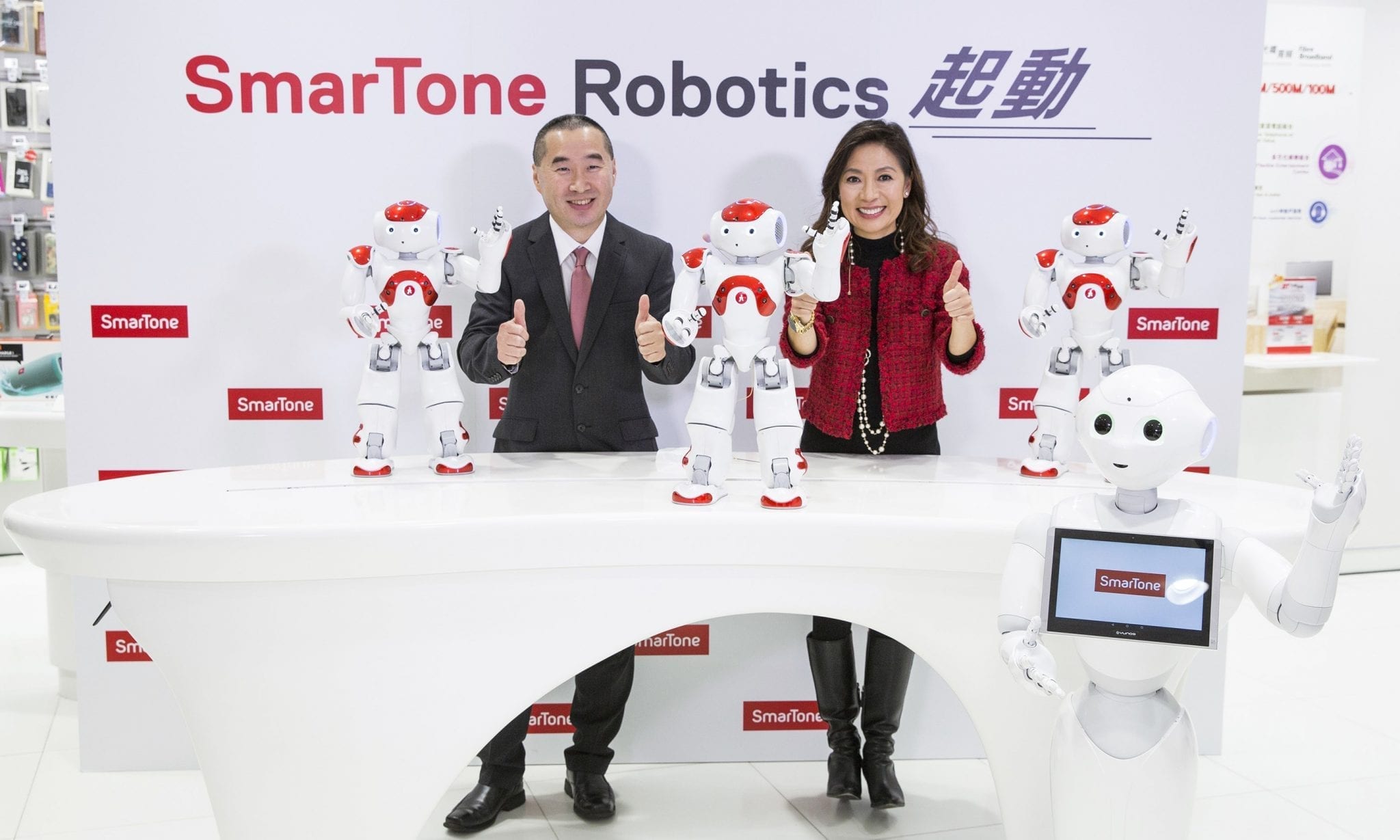
    Hong Kong’s SmarTone is deploying “smart robots” at its psychical retail stores to help enhance the customer experience. The initiative, launched last week on Valentine’s day, involves the leading mobile network operator in Hong Kong deploying the NAO robot at its stores.

    It marks the first time SmarTone is using actual robots for enhancing the customer experience. The idea is to streamline the customer experience while adding fun and improving engagement.

    At the launch ceremony at SmarTone’s apm store, NAO joined local Web-celebrity Lilian Kan to sing, dance and play games with customers while uttering words of love.

    Not to be outdone, Pepper, another smart robot, joined in the festivities as well. It was the first time both robots were pictured together.

    “SmarTone has always been pushing the frontiers of innovation, committed to innovating customer experience in the industry,” SmarTone head of marketing and sales Josephine Lam said.

    “The introduction of NAO will enable a fun and interactive experience, deepening in-store engagement with customers.”

    NAO can perform detailed actions and is multi-lingual. It offered details about the latest service plan offerings while providing recommendations on phone accessories.

    “Robotics is one of the hottest technologies and we know they will have a significant impact on our lives in the future,” SmarTone head of products and services Alex Kun said.

    “We will continue to seek ways to introduce the latest robotics technologies into our business as well as provide opportunities for local enterprises, organizations, and individuals to experience the technology.”

    SmarTone is not just looking to robotics to improve customer services and operational efficiency.

    The company is looking to improve overall robotics appreciation as a territory-wide effort. For example, it will include the introduction robot rental services and the organization of coding workshops to spur interest in robotics among the youth.

  • GSMA launches IoT, big data directory

    GSMA launches IoT, big data directory

    The GSMA has launched the IoT Big Data API Directory, which will make harmonized data sets from multiple sources worldwide available to developers and third parties, enabling them to create innovative new Internet of Things (IoT) services.

    The directory, which is the first of its kind, is designed to encourage a common approach to data sharing that will help the IoT to realize its full potential and encourage the development of new projects across transport, the environment and smart cities.

    Global mobile operators China Mobile, China Unicom, KT Corporation, Orange and Telefónica have already implemented solutions enabling them to share harmonized IoT data.

    “The IoT generates a huge amount of data that is currently retained in vertical silos. However, in order for the IoT to reach its full potential this data needs to be released and made available to developers and third parties,” said Alex Sinclair, CTO of GSMA.

    “A common, collaborative and interoperable approach to big data will remove the commercial and technical barriers to capitalizing on the IoT opportunity and usher in a new era of IoT solutions that will help the market to scale,” said Sinclair. “We encourage mobile operators to collaborate with the wider industry to benefit from the big data opportunity.”

    The IoT Big Data API Directory provides details of IoT and context data sets covering machines, devices, automotive, roads, environment, smart home and agriculture.

    All of the data sets are harmonized and can be viewed on github. A common approach to data sharing lowers costs and creates opportunities for IoT developers, data brokers and data providers.

    The IoT Big Data Framework defines how mobile operators can approach the delivery of IoT big data services. It is designed to enable industry participants to work together collaboratively to deliver big data services and support an ecosystem of third-party application developers.

    Mobile operators are seen as key participants in the delivery of an IoT big data ecosystem, although much of the IoT data that is collected will come from a range of data provider partners.

    The document provides a framework for the delivery of IoT big data services that recognizes the many different approaches towards the services that are offered and the technology choices that are made. The proposed architecture promises a degree of flexibility which allows IoT big data services to be offered in multiple ways.

  • Indonesia to hold limited spectrum

    Indonesia to hold limited spectrum

    The Indonesian government plans to hold a limited tender for unused spectrum in the 2.1-GHz and 2.3-GHz bands by the middle of the year.

    Communications and informatics minister Rudiantara has announced that the government expects to issue the terms of the tender process by the end of March, and to announce the winner by mid-year.

    Only existing operators will be entitled to participate in the limited tender, the minister said.

    The 2.1-GHz band is used by operators including Telkomsel, Indosat Ooreedoo, XL Axiata and Hutchison 3 Indonesia for 3G services, while the 2.3-GHz band is used for 4G wireless broadband services in parts of the country.

    Plans to reallocate the unused capacity in the 2.1-GHz band returned by Axis Telecom in 2014 following its merger into XL Axiata have been in the works since 2015, but the process has been delayed by technical and other difficulties.

    According to the report, only half of the unused 30 MHz of capacity in the 2.3-GHz band will be allocated.

    Indonesian operators, facing a spectrum crunch in major cities, have responded enthusiastically to the announcement, and are urging the government to ensure there are no further delays.

  • 5 operators are already testing 5G

    5 operators are already testing 5G

    Despite 5G standardization not being expected until 2020, 25 mobile operators have already commenced lab testing 5G technologies, according to industry data from network testing company Viavi.

    Of the 25 operators testing 5G, 12 have progressed to field testing, the company said. An additional four operators have announced plans for 5G trials but have not yet commenced them.

    Five operators have achieved data speeds of at least 35 Gbps in 5G trials, including Optus, M1 and StarHub.

    To date, Etisalat has the speed record at 36Gbps, Viavi said, with Ooredoo close behind at 35.46Gbps. All operators conducting 5G trials have reported data transmission speeds of at least 2Gbps.

    Viavi’s data also show that operators are testing 5G across a wide range of bands, ranging from sub 3-GHz up to 86-GHz.

    The most commonly trialed bandwidth among operators that have disclosed their test spectrum is currently 28-GHz – with eight operators using it – followed by 15-GHz, which is being used by seven operators.

    Among equipment suppliers, five major vendors have announced an involvement in 5G trials – Ericsson, Huawei, Nokia, Samsung and ZTE. Many operators are working with multiple vendors on their trials, with KT including all five equipment providers.

    “The pace of 5G development is already beyond the expectations of many observers,” Viavi CTO Sameh Yamany commented.

    “Now, as the technical delivery of data is starting to coalesce, it is time to think ahead to how future 5G networks can manage the disparate requirements of high data rates, very low latency applications and large-scale IoT services while maintaining QoS.”

    He said network slicing, involving the automation and programming of multiple cloud-based functions within a virtualized network, will be important to achieving these goals.

    “Service providers and their partners will require solutions that are virtualized from one end of the network to the other and have automated and correlated intelligence across each network slice for monitoring, optimization and service assurance.”

  • Vodafone New Zealand’s merger with SKY TV rejected

    Vodafone New Zealand’s merger with SKY TV rejected

    New Zealand regulator the Commerce Commission has declined to approve the proposed merger between Vodafone New Zealand and SKY Network Television on competition grounds.

    The commission held that a merger between the companies would negatively impact competition in the premium sports content market.

    “The proposed merger would have created a strong vertically integrated pay-TV and full service telecommunications provider in New Zealand owning all premium sports content,” Commerce Commission chair Dr Mark Berry said.

    “We acknowledge that this could result in more attractive offers for Sky combined with broadband and/or mobile being available to consumers in the immediate future…[but] the evidence before us suggests that the potential popularity of the merged entity’s offers could result in competitors losing or failing to achieve scale to the point that they would reduce investment or innovation in broadband and mobile markets in the future.”

    The Commerce Commission said it had particular concerns that the merger could impact the competiveness of key third players in these markets such as 2degrees and Vocus.

    “This is also against a backdrop of fibre being rolled out, making it an opportune time for the merged entity to entice consumers to a new offer,” Berry said.

    “If significant switching occurred, the merged entity could, in time, have the ability to price less advantageously than without the merger or to reduce the quality of its service. Given we are not satisfied that we can say that competition is unlikely to be substantially lessened by the proposed merger, we must decline clearance.”

    In a terse statement, Vodafone New Zealand acknowledged the regulator’s decision but made no further comment.

    Under the proposed merger, Vodafone Group would have taken up to a 51% stake in Sky TV, which itself would acquire up to 100% of Vodafone New Zealand. The merged entity would have been controlled by Vodafone Group.