Category: Telecom

Retail News Asia is committed to providing both local and global retailers with the latest Telecom & Telco news throughout the Asian market. This on a daily base.

  • T-Mobile promises cheap 5G services

    T-Mobile promises cheap 5G services

    T-Mobile has just announced that it’s starting limited home internet pilot, an invitation-only test for in-home internet service on LTE, which is meant to connect up to 50,000 homes by the end of the year, in both rural and underserved markets in the United States.

    The carrier states that due to LTE network and spectrum capacity constraints it can’t expand the pilot to more than 50,000 households, but if T-Mobile’s pending merger with Sprint is approved, it will most certainly cover more than half of US households with 5G service by 2024.

    If you’re interested, then you’ll be happy to know that the T-Mobile Home Internet pilot is offered exclusively in areas the carrier expects to deliver speeds of around 50 Mbps through fixed unlimited wireless service over LTE (no data caps). The cost is $50 per month with AutoPay, and there are no annual service contracts, no hidden fees, and no equipment costs.

    Considering customers pay at least $80 per month for wired in-home broadband service these days, T-Mobile pilot programs seems quite a good deal. Moreover, the carrier claims that if the merger with Sprint is approved, it will be able to cover more than half of US household with 5G broadband service by 2024 possibly at the same price.

    Upgrade from LTE to 5G for free, but the monthly fee could be different

    If you’re eligible and chosen to take part in T-Mobile’s Home Internet pilot, a small router will be shipped to you and you’ll be given simple step-by-step instructions on how to install it. You’ll also have to install a mobile app on your phone to optimize placement of router in the house, but that’s just about all you need to do to access T-Mobile’s LTE speeds.

    The router will be upgraded to provide customers 5G services when they will be available in their region, at no additional costs. However, it’s yet unclear whether or not the monthly price will be increased when that happens.

    It’s not the first time that T-Mobile’s CEO John Legere promises something, but it’s also worth mentioning that he kept his promises most of the time.Two weeks ago, I laid out our plans for home broadband with the New T-Mobile. Now, we’re already hard at work building toward that future. We’re w alking the walk and laying the foundation for a world where we can take the fight to Big Cable on behalf of consumers and offer real choice, competition and savings to Americans nationwide.

    Even if 5G services won’t be as cheap as we want them to be, it’s quite clear that thanks to competition customers will have at least a couple of alternatives that will fit their budget. And when it comes to competition, T-Mobile has been able to undercut its rivals many times in the past.

    T-Mobile’s Home Internet pilot is an admirable initiative

    Although all major US carriers announced plans to roll out 5G networks across the country by the end of the year, none have been willing to share anything about prices. Well, at least T-Mobile says it will offer lower prices if Sprint merger is approved.

    T-Mobile’s initiative is quite admirable considering that almost half of American households have no competitive choice for high-speed in-home broadband with speeds of 100Mbps, and in rural areas, more than three quarters have no high-speed service or only one option at their disposal.

    The Un-carrier won’t just bring better internet speeds to rural and underserved areas, but it will also allow 9.5 million households to cut the cord if the merger with Sprint is approved.

    At the other end, AT&T and Verizon are expected to announce their 5G network pricing as well, as both are preparing to launch home 5G services before bringing them to smartphones. It’s a fight between three giants that will have at least one winner: consumers.

  • Ericsson to provide 5G NR equipment for KT

    Ericsson to provide 5G NR equipment for KT

    South Korea’s KT has awarded Ericsson a 5G contract aimed at allowing the operator to launch commercial 5G services early next month.

    South Korean operators have agreed to launch 5G services at the same time in April at the request of regulator KCC.

    Under the contract with Ericsson, the vendor will provide 5G new radio hardware and software for KT’s 3.5-GHz non-standalone 5G network.

    KT selected Ericsson as a key 5G supplier in November last year as part of its preparations for a commercial launch.

    “Having worked successfully with Ericsson on 4G LTE, we are pleased to continue that partnership to make our 5G ambitions a reality with Ericsson’s leading 5G technology,” KT VP of access network design Jinho Choi said.

    “Korea is one of the most competitive and technology-advanced markets in the world. By taking a global lead to enable nationwide commercial 5G services through commercially available 5G smartphones, KT is demonstrating our commitment to our customers and showing how we can drive a global 5G ecosystem where Korea plays a key role.”

  • U Mobile taps ZTE to conduct 5G trials in Malaysia

    U Mobile taps ZTE to conduct 5G trials in Malaysia

    U Mobile has signed an MoU with ZTE to support its 5G deployment in Malaysia

    The agreement will see both parties collaborating on various 5G related developments including live testing, 5G showcases well as implementation of Massive MIMO.

    U Mobile CEO Wong Heang Tuck said the operator has a long standing working relationship with ZTE and it is a logical next step for the companies to collaborate on initiatives related to 5G.

    “In the near future, we will be working closely with ZTE to conduct live tests in select areas in the KL city, so Malaysians may experience the first-hand power of 5G,” Wong said in a statement.

    U Mobile CTO Woon Ooi Yuen added that the operator has been aggressively expanding its 4G LTE networks all across West and East Malaysia in recent months and started plotting its journey towards 5G.

    “As part of our 5G roadmap, we will be implementing Massive MIMO in certain areas in the KL City to further enhance customer experience by leveraging the wider bandwidths.”

    Steven Ge, managing director of ZTE Malaysia, said the company has 5G end-to-end solution capabilities, adding that the partnership with U Mobile will “turn 5G into a reality in the near future to benefit Malaysians.”

    Earlier this week, U Mobile has also formed a strategic partnership with Razer to collaborate in e-payments, e-sports, and 5G testbeds.

    Under the partnership, U Mobile and Razer are looking into leveraging e-sports events for 5G testbeds in Malaysia by conducting e-sports-related 5G testbeds and trials in the country.

  • Hong Kong’s Ofca assigns first 5G spectrum

    Hong Kong’s Ofca assigns first 5G spectrum

    Hong Kong operators HKT, SmarTone and China Mobile Hong Kong have all been granted spectrum in the 26-GHz and 28-GHz frequency bands for 5G use.

    The three operators, which had each applied to be assigned spectrum across the two bands, have each been offered 400 MHz of spectrum on a provisional basis by telecommunications regulator Ofca.

    The applicants were all found to have fulfilled the required licensing criteria to be granted assignment of the non-shared spectrum.

    The administrative assignment of the 26-GHz and 28-GHz spectrum will be followed up with the auction of 380MHz of spectrum in the 3.3-GHz, 3.5-GHz and 4.9-GHz bands in the middle of the year.

    Hong Kong’s second largest operator by market share 3 Hong Kong declined to apply to be assigned 26-GHz and 28-GHz spectrum, opting instead to rely on its existing airwaves and the spectrum it expects to be able to acquire in the upcoming 5G auction.

    In addition, 3 Hong Kong cited factors including Ofca’s requirement that operators establish thousands of radio units compatible with the spectrum within five years of the assignment, as well as the shortage of announced devices that support the two frequency bands.

  • China Mobile reports $17.6b profit for 2018

    China Mobile reports $17.6b profit for 2018

    China Mobile has reported a 3.1% increase in net profit for 2018 to 117.78 billion yuan ($17.58 billion) as the company focused on reducing costs and increasing operational efficiency.

    Operating revenue declined 0.5% in reported terms to 736.82 billion yuan, but grew 1.7% after 2017’s results were recalculated using the new IFRS revenue standard..

    Telecommunications service revenue fell a reported 0.4% but grew 3.7% in comparable terms to 670.9 billion yuan.

    The operator’s net profit was also aided by the listing of the company’s tower division China Tower in August last year.

    China Mobile reported a 4.3% increase in its total customer base for the year to 925 million, of which 713 million are 4G customers – a 9.7% increase from 2017. But mobile ARPU fell 8% to 53.1 yuan as a result of strong competition.

    Meanwhile total wireline broadband subscribers increased by 39% to 157 million, of which 147 million were household broadband customers. Household broadband blended ARPU grew 3.2% to 34.4 yuan.

    “2018 was a challenging year for telecommunications operators. Competition amongst peers changed in characteristics as products and services have become homogenized while cross-sector challenges have intensified. The value of traditional telecommunications business rapidly diminished, coupled with multiple challenges from a complex and rapidly-changing policy environment,” China Mobile chairman Yang Jie said.

    “In order to counter market competition, overcome the major obstacles in the ongoing reforms and enhance management, we continued to encourage everyone across the Company to take the ‘Big Connectivity’ strategy even further and implement the integrated development of the “four growth engines”.”

  • Softbank, Chunghwa Telecom partner on AI, IoT

    Softbank, Chunghwa Telecom partner on AI, IoT

    Taiwanese incumbent carrier Chunghwa Telecom has signed an MoU with Japan’s Softbank for collaboration on artificial intelligence (AI) and IoT.

    In a statement, the companies said the technological and commercial cooperation aims to develop use cases for future smart cities in Taiwan.

    It will also involve ST Solutions Taiwan Co. Ltd., a wholly owned subsidiary of SoftBank Corp.

    The pair said they plan to leverage their insights and experiences from the collaboration in AI, IoT and related fields.

    The collaboration will initially focus on such areas as global IoT platforms, smart infrastructure, smart agriculture as well as utilization of high-accuracy location data and big data.

    The partnership with Softbank is Chunghwa Telecom’s latest push in IoT.

    In February, the Taiwanese operator inked a deal with Ericsson to use the Swedish vendor’s IoT Accelerator platform to develop IoT services for its enterprise customers.

    Max Chen, president of mobile business group, at Chunghwa Telecom, was quoted as saying in the statement that the partnership with Ericsson will boost its capabilities in machine learning and IoT operations.

    “As Taiwan’s industry is mainly export-driven, Chunghwa Telecom’s IoT innovation drive will help local industries to expand their international IoT business horizon,” Chen said.

  • Australia to spend $114m to fill more mobile black spots

    Australia to spend $114m to fill more mobile black spots

    The Australian government has allocated A$160 million ($114.1 million) towards extending the national Mobile Black Spot Program for a further two rounds.

    The funding for rounds five and six of the program, which aims to fill gaps in mobile coverage in regional and remote communities, will be used primarily to help improve coverage at public interest premises such as medical facilities, schools and economic centers.

    The additional commitment brings the current government’s funding in the program to A$380 million. So far 1,047 new base stations will be delivered under the program at a total cost of A$760 million. Of these, 682 have been switched on nationally.

    Additional funding is being provided by local and state governments, mobile operators, businesses and community organizations.

    Applications from operators, businesses and local communities for round four of the program recently closed. This round will see 180 new base stations constructed, including 73 which will specifically target public interest premises.

    “Fast and reliable connectivity is essential to ensure regional areas remain competitive with access to the same business and study opportunities as the rest of Australia. We’re ensuring our regions are not left behind,” Australian minister for regional services and deputy leader senator Bridget McKenzie said.

    “All stakeholders are strongly encouraged to submit an application when we open the tender process and take advantage of the additional rounds under this fantastic program.”

  • CTG, Tata Communications form IoT alliance

    CTG, Tata Communications form IoT alliance

    China Telecom Global has entered a collaboration with India-based Tata Communications to launch a global internet of things service for the Chinese market.

    Under the collaboration, the two companies will develop IoT-based services targeting multiple industries, including consumer and industrial electronics, manufacturing, automotive, transport, and logistics.

    China Telecom Global will gain access to the Tata Communications MOVE service, which seeks to leverage the company’s relationships with more than 600 mobile operators worldwide to enable global connectivity for new IoT-enabled devices.

    Meanwhile China Telecom Global will provide Tata with connectivity for Hong Kong, mainland China, and Macau as well as access to the Chinese operator’s 4G network resources.

    For specific vertical industries including automotive, China Telecom Global will also provide Tata with IoT solutions that are compliant with Chinese market requirements and regulatory requirements.

    “We want to grab our share of the rapidly growing Chinese IoT market. China Telecom Global is working closely with Tata Communications to pave the way for innovative and advanced IoT solutions across industries,” China Telecom Global CEO Deng Xiaofeng commented.

    “We’re able to offer our customers the borderless, reliable and affordable network connectivity they need for their different IoT devices. As the volume of connected ‘things’ continues to grow, we are able to give our customers complete visibility and control to make the management of hundreds of thousands of IoT devices easier on a global scale.”

  • Docomo trials fiber manufacturing IoT in Thailand

    Docomo trials fiber manufacturing IoT in Thailand

    NTT Docomo and its Singapore subsidiary NTT Docomo Asia have commenced a trial of an IoT monitoring system to improve the manufacturing performance of a synthetic-fibers factory in Thailand.

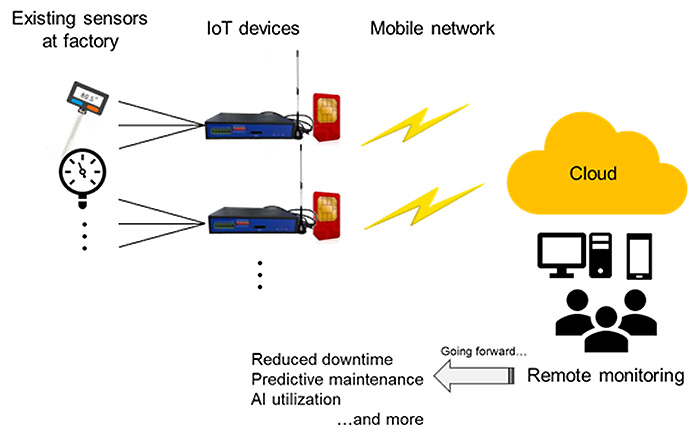
    In the trial, Docomo Asia is deploying the IoT Solution Platform to visualize the operational status of production operations in the Thai factory.

    Docomo said IoT devices equipped with up to 30 different sensors are collecting operational information on the factory floor and then transmitting real-time data to the cloud via a mobile network.

    “Technicians will be able to use PCs, smartphones or tablets to remotely monitor the status of production operations via the platform,” Docomo said in a statement.

    “The IoT Solution Platform enables manufacturers to digitalize their operations and rapidly gather information from factory floors for improved efficiency in production management.”

    It also helps to reduce production downtime by allowing manufacturers to closely monitor the status of their production equipment to detect malfunctions, maintenance needs and so on, the Japanese mobile carrier said.

    NTT Docomo fabric manufacturing IoT trial in Thailand

    Service scheme (Source: NTT Docomo)

    According to Docomo, the platform is already being used by an automotive plastic parts manufacturer and is now being introduced in the textile industry to enable manufacturers to realize more efficient and reliable production operations.

    The trial is part of Docomo’s global IoT initiative launched last July to provide global connectivity, operational support, and consulting to Japanese manufacturers with global IoT operations.

    The trial will be conducted until March 31, and is being conducted in collaboration with Teijin Polyester (Thailand) Limited, a Teijin Frontier subsidiary company that manufactures polyester fibers, filament yarn, chips and more.

    Docomo expects manufacturers of synthetic fibers and other products across Southeast Asia to increasingly adopt the IoT Solution Platform to increase the productivity and quality of their production operations going forward.

  • 5G to account for 57% of China tech spend in 2019

    5G to account for 57% of China tech spend in 2019

    Spending on 5G will account for the majority of China’s technology spending in 2019 as the nation continues to spend heavily to ensure it leads the global race to implement the mobile technology, Forrester Research predicts.

    China will spend a total of $256 billion on technology goods and services this year, with 5G spending to account for 57% of this, the research firm said in a new report.

    The nation is best positioned to win the global race to implement 5G after having outspent the US in this area by around $24 billion since 2015.

    Meanwhile China and Japan are set to dominate technology spending in Asia-Pacific, collectively accounting for 60% of the total market. India will be third with anticipated spending of $70 million, Forrester said.

    India, China and the US will also see the strongest growth amid a slowing global technology market. Total growth in spending is expected to slow to 4.5% in 2019, and to 3.8% in 2020.

    The report also found that Asia-Pacific still lags the US and Europe in terms of cloud adoption, because the infrastructure in most Asia-Pacific markets is not mature enough to support cloud solutions.

  • Inmarsat receives $3.3b buyout bid

    Inmarsat receives $3.3b buyout bid

    Satellite operator Inmarsat is in talks to be acquired by a consortium of private equity investors in a deal worth $3.3 billion.

    UK-based Inmarsat is still negotiating with the consortium members over the possible takeover and a binding offer has not yet been received. But the preliminary offer involves cash payment of $7.21 per share.

    The consortium, which includes Apax Partners, Canada Pension Plan Investment Board, Ontario Teachers’ Pension Plan Board and Warburg Pincus International, has until April 16 to submit a binding offer or decline to make one.

    The $3.3 billion offer price is only marginally higher than the price offered by US-based satellite provider EchoStar during its takeover bid for Inmarsat in July last year, which was then worth $3.25 billion.

    At the time, Inmarsat’s board rejected the offer on the ground that it “very significantly undervalued Inmarsat and its standalone prospects.”

    But Bloomberg notes that Inmarsat’s share price has been barely changed over the intervening time – until the price was lifted by takeover speculation – and UK-based stocks have been struggling recently due to public investors’ concerns over Brexit. The publication attributes these factors to Inmarsat’s decision to come to the negotiating table this time.

    The deal values Inmarsat at around $6 billion, and represents a 34% premium on the company’s average share price over the past three months.

  • Japan’s NETSTARS joins Singtel’s VIA alliance

    Japan’s NETSTARS joins Singtel’s VIA alliance

    Singtel‘s cross-border mobile payments alliance VIA has expanded into Japan through a partnership with Tokyo-bassed mobile payment technology NETSTARS.

    The addition of NETSTARS to the alliance will add 100,000 stores to the network’s current 1.6 million merchant partners in Asia.

    With the agreement, users of mobile wallets supported by VIA, including Singtel’s Dash and AIS Global Pay, will be able to use their respective wallets at merchants including airports, shopping malls, transportation modes and food and beverage outlets.

    Users will be able to pay instantly in their local currency with competitive foreign exchange rates in Japan.

    NETSTARS aims to grow its merchant base to 1 million stores throughout Japan by the end of next year

    As well as Dash and AIS Global Pay, Thailand’s Kasikornbank and Malaysia’s Boost will soon be adding their mobile wallets to the VIA alliance.

    Singtel Group plans to expand the VIA alliance to include other mobile regional associates including Airtel in India, Globe in the Philippines and Telkomsel in Indonesia, as well as more non-telco partners.

  • RCom chief spared jail over debt to Ericsson

    RCom chief spared jail over debt to Ericsson

    Reliance Communications (RCom) has terminated a deal to sell its telecom assets to Reliance Jio Infocomm after failing to receive regulatory approval.

    But RCom’s founder Anil Ambani has been granted a last-minute reprieve from being imprisoned for failing to meet the company’s court-ordered repayment obligations to major creditor Ericsson after support from his older brother and founder of Reliance Jio Mukesh.

    In a stock exchange filing, RCom blamed its decision to terminate its asset sale plan to factors including a failure to receive the required permissions from the Department of Telecom.

    RCom also has not received notice of consent or objection from more than 40 of its foreign an Indian lenders regarding the proposed sale, despite holding over 45 meetings over a 15 month period, the company said.

    RCom has also decided to attempt fast track resolution of its overall debt through the National Company Law Tribunal, and the Tribunal has restrained the company from selling or transferring ay assets while the case is ongoing.

    But due to last minute intervention from Mukesh Ambani, RCom revealed in a second statement that the company has managed to make the required 5.5 billion rupee ($80.1 million) payment to Ericsson before the deadline for him to be jailed.

    Ambani was last month found to be in contempt of court over a failure to make the 5.5 billion rupee payment RCom had promised to make to Ericsson in September. He was given four weeks to make the payment or face being jailed for three months.

    “My sincere and heartfelt thanks to my respected elder brother, Mukesh, and Nita, for standing by me during these trying times, and demonstrating the importance of staying true to our strong family values by extending this timely support,” Anil Ambani said in a statement.

    “I and my family are grateful we have moved beyond the past, and are deeply grateful and touched with this gesture.”

    Ambani was referring to the fallout the two brothers had over the inheritance of Reliance Industries from their father Dhirubhai Ambani following his death in 2002. The brothers have since reconciled.

  • Huawei adopts Open Rack for cloud data centers

    Huawei adopts Open Rack for cloud data centers

    Huawei has revealed plans to adopt the Open Compute Project’s (OCP) Open Rack standard for rack and power delivery architecture for its new public cloud data centers worldwide.

    The Open Rack initiative seeks to redefine the data center rack to significantly reduce energy consumption, while driving operational efficiency by reducing the time it takes to install and maintain racks.

    Huawei will be joining major hyperscale internet companies such as Facebook, Google and Microsoft in adopting the Open Rack standard, which is designed to integrate the rack into data center infrastructure.

    This marks the first OCP standard adopted by Huawei since the Chinese vendor joined the project last year. The vendor is also contributing to a number of OCP projects including rack and power, system management and server projects, and has developed an OCP-based compute module.

    “Huawei’s strategic investment and commitment to OCP is a win-win,” commented Kenneth Zhang, general manager of FusionServer within the Huawei Intelligent Computing Business Department.

    “Combining Huawei’s extensive experience in Telco and Cloud deployments together with the knowledge of the vast OCP community will help Huawei to provide cutting edge, flexible and open solutions to its global customers. In turn, Huawei can leverage its market leadership and global datacenter infrastructure to help introduce OCP to new geographies and new market segments worldwide.”

  • ADLINK, Charles Industries demo mobile edge AI/ML solution

    ADLINK, Charles Industries demo mobile edge AI/ML solution

    Test and measurement company ADLINK Technology and telecoms, marine and industrial manufacturer Charles Industries have developed the industry’s first pole-mounted multi-access Edge AI and machine learning solution.

    The solution, a complete micro-edge low latency AI, machine and deep learning solution can be co-located on LTE small cell poles or 5G radios, is specifically designed for outdoor telecoms use cases.

    The solution, which can be either pole or wall mounted, integrates ADLINK’s latest AI Edge Server with a Charles Industries Mico Edge Enclosure.

    According to the companies, the solution has the potential to enable a range of new and advanced services, including autonomous vehicles/pods, virtual and augmented reality applications, and vision analytics.

    ADLINK’s mobile edge computing platform has been designed to fully comply with the Open Data Center Committee’s Open Telecom IT Infrastructure standard to meet the 5G requirements of ultra-low latency, high bandwidth, and real-time access to the radio network.

    The companies are showcasing the solution at the NVIDIA GPU Technology Conference in San Jose in the US this week.