Category: Telecom

Retail News Asia is committed to providing both local and global retailers with the latest Telecom & Telco news throughout the Asian market. This on a daily base.

  • Docomo, Nokia testing 5G NR in 90-GHz band

    Docomo, Nokia testing 5G NR in 90-GHz band

    Japan’s NTT Docomo and Nokia are performing joint 5G technology trials using extremely high frequency 90-GHz millimeter wave (mmWave) spectrum.

    At the Brooklyn 5G Summit in New York this week, the companies are demonstrating the use of a Nokia Bell Labs-developed compact mmWave phased-array antenna system using an integrated circuit solution in the 90-GHz frequency band.

    The demonstration aims to show how using 5G new radio enhancements at higher mmWave bands can manage radio complexity while enabling greater bandwidth.

    Meanwhile using a larger number of antenna elements at higher frequency bands can minimize path loss to enable coverage similar to that found in lower mmWave bands, Nokia said.

    The companies also conducted a joint demonstration to show how dynamic offloading relocation in a 5G core will enable the low-latency networks required to support time critical mobile broadband applications such as automation and augmented reality.

    Nokia and Docomo have pledged to continue to test these technologies at Docomo’s research lab at the Yokosuka Research Park in Japan.

    “These demonstrations at the Brooklyn 5G Summit build on a long collaboration with Nokia,” Docomo CTO Hiroshi Nakamura said.

    “Working together, we want to accelerate the evolution of 5G technologies especially towards pioneering higher frequency bands such as 90 GHz.”

  • Philippines AirAsia adds capital connection

    Philippines AirAsia adds capital connection

    Philippines AirAsia launched a new link between Manila (MNL) and Bangkok Don Mueang (DMK) on 22 April. The 2,200-kilometre connection will link the capital cities of the Philippines and Thailand with daily flights operated by A320s. There is no direct competition, but schedules show that multiple carriers (including Philippine Airlines and Thai Airways) will operate a combined 46 weekly flights from Manila to Bangkok Suvarnabhumi during the week commencing 24 April. “AirAsia is a product of Asean (Association of Southeast Asian Nations) and we are so proud to be part of this region we call home,” said Dexter Comendador, CEO Philippines AirAsia.

    “We are the only airline that carries “I love Asean” painted on our aircraft including the ASEAN logo. AirAsia loves Asean is a commitment to help bridge communities and economies as we move toward even greater integration and mutual understanding.” Kajorndet Apichartrakul, Director, Tourism Authority of Thailand, said: “We want to bring people across the Asean region closer together and further expand our Asean footprint to serve more and more communities. We have 100% load for this inaugural flight and we hope to do more inter-Asean routes to serve every Filipino traveller’s needs and enable them to connect, do business and build socio-economic ties with neighbouring economies.”

  • Bharti Infratel to merge with Indus Towers

    Bharti Infratel to merge with Indus Towers

    India’s Bharti Airtel has approved a plan to merge its infrastructure unit Bharti Infratel with Indus Towers to create a listed pan-India tower company.

    The combined company will fully own the respective business of Bharti Infratel and Indus Towers, and will own over 163,000 towers across all 22 of India’s telecom circles, making it the largest tower company in the world outside of China. It will change its name to Indus Towers Limited.

    Bharti Airtel already owns a 42% stake in Indus Towers, with Vodafone Group owning another 42%, Idea Group owning 11.15% and Providence Equity Partners owning the remaining 4.85%.

    Post-merger, Vodafone will be issued 783.1 million new shares in the combined company, while Idea Group will be given the option of selling its shares in the company or taking shares based on the merger ratio, and Providence will be given the option of selling most of its holdings.

    Assuming Idea and Providence take up the option of selling their shares for cash, Airtel’s shareholding in the combined company will be diluted to 37.2% and Vodafone’s shareholding would be diluted to 29.4%.

    The combined company is expected to have an enterprise value of around $10.8 billion, Airtel said in a statement.

    Based on this expected valuation, Idea stands to gain around $1 billion from the sale of its shares. Vodafone’s holding in the combined company would meanwhile be worth around $4.3 billion.

    The merger is expected to be complete in the current financial year, which ends in March 2019.

  • uCloudlink launches innovative mobile data service GlocalMe Inside

    uCloudlink launches innovative mobile data service GlocalMe Inside

    uCloudlink, the global innovative mobile data solution provider, has today launched GlocalMe® Inside, a powerful data service designed for frequent and business travelers. GlocalMe® Inside service provides network coverage in 100+ countries and regions, enabled by CloudSIM technology and delivered through extensive carrier partnerships that ensure fair local data charges for its customers. This move marks the introduction of a new era of positive disruption for cross-border business, bringing expense management, convenience, flexibility and robust global network coverage for reliability of service.

    Alongside this new service innovation, uCloudlink also introduces two models of the brand new GlocalMe® Inside World Phone, in which the service has been pre-installed.

    As of April 2018, the new GlocalMe® Inside service has been rolled out in Hong Kong in collaboration with Hong Kong Broadband. The company is also in active conversations with potential customers and partners across key markets in Asia and North America, discussing the launch of GlocalMe® Inside service’s forthcoming global footprint in the near future.

    Mr. Simon Tan, Co-Founder and Chief Marketing Officer, uCloudlink says, “uCloudlink is dedicated to continuous mobile data solution innovation. Our vision is to offer the utmost accessibility of mobile data for everyone in the world. The new service and our new phone products are a reflection of our commitment to improve global mobility by enhancing and sharing CloudSIM technologies with the world. This will achieve true global connectivity and sharing without limitations. We hope this service innovation can turn many silent roamers into active ones, addressing one of the most pressing challenges facing the entire industry.”

    Elitek is the first phone brand to be launched with the service embedded. uCloudlink is expecting to see increasingly rapid collaboration with more third-party phone brands in the future for which the GlocalMe Inside mobile data service will be available, making them the first true World Phone.

    Mr. Bill Zhang, General Manager of the Smart Devices Business, uCloudlink, explains, “We are very excited about this service innovation which represents a significant breakthrough for business users and other mobile data service users who travel extensively. GlocalMe® Inside overhauls the current mobile data package fee and contracting model, and therefore is a massively positive disruption to the telecommunications industry in this regard. For too long, service users have been subject to high rates, non-transparent pricing models and data roaming which often costs well beyond what was expected; the GlocalMe® Inside revolution changes all that. We have for a long time now been inspired by the truly disruptive players who have changed the way the world works, from social media and accommodation booking services to app-based technology and changes to the media industry by disruptive communication. This is what uCloudlink GlocalMe® Inside is all about”.

    Global roaming revenue was not significantly increased with the growth of international travelers and smartphone users as was expected by the carriers. The main reason is the user’s fear of high data roaming charges. “Our disruptive technology and innovations built on customer convenience and genuine cost management changes all of this”, he concludes.

  • Telenor Pakistan introduces 24/7 Self-Service Booths across Pakistan

    Telenor Pakistan introduces 24/7 Self-Service Booths across Pakistan

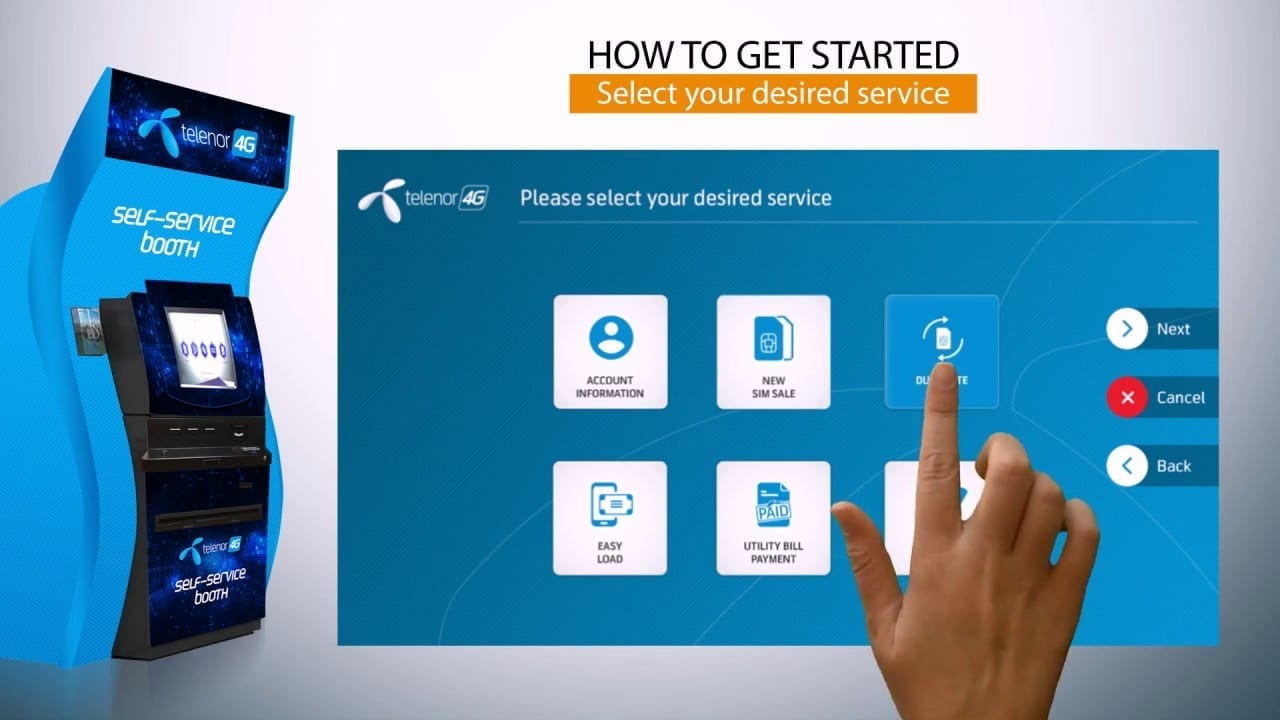
    Leading the developments in digital ecosystem in the country, Telenor Pakistan has introduced Self-Service Booths across the nation to provide easier, securer, and round-the-clock access to its products and services.

    These booths give customers the option of availing multiple Telenor and Easypaisa services at their convenience such as buying and replacing Telenor SIMs, buying Easyload top-ups & Easycards, and open new Easypaisa accounts at any time of the day without having to visit the Telenor franchise or retailer. These booths will also enable customers to pay their utility bills as well as send and receive money.

    Featuring biometric verification, these state-of-the-art machines warrant safety and security against unregistered individuals and unauthorized transactions. Telenor Pakistan plans to place these self-service booths across Pakistan to extend greater enablement to its customers in consistence with its vision of fostering customer-centricity across its business operations.

    “Self-service booths are going to redefine customer facilitation in today’s digital age,” said Bilal Kazmi, Chief Marketing Officer at Telenor Pakistan. “Through this initiative, we aim to empower the customers by transferring accessibility of Telenor & Easypaisa services into customers’ own hands while reducing dependency on physical outlets characterized with long queues and waiting time. Being a customer centric organization, we are evolving the processes and channels to serve our customer better and we shall continue to introduce innovative ways to bring the best to our customers.

    The introduction of this round the clock Self Service Booth, bringing access, ease and convenience, is set to redefine the concept of customer services. As part of its #TelenorHearsYou outreach campaign, Telenor Pakistanis actively listening to its customer feedback and concerns, and is taking a proactive approach to ensure delightful experiences for them.

  • Riverbed upgrades SteelConnect platform

    Riverbed upgrades SteelConnect platform

    Riverbed Technology has announced major updates to its SteelConnect SD-WANand cloud networking solution.

    Riverbed claims that SteelConnect is currently the only SD-WAN solution that provides unified connectivity and policy-based orchestration spanning the entire distributed network fabric – hybrid WAN, branch LAN/WLAN, data centers, and the cloud.

    With the latest upgrades to SteelConnect, Riverbed aims to expand the power of one-click connectivity and optimization into AWS and Microsoft Azure with added support for AWS Direct Connect and Azure ExpressRoute.

    Riverbed is also introducing seamless integration between SteelConnect and Riverbed Xirrus Wi-Fi with zero-touch provisioning of Riverbed Xirrus access points, and is providing new deployment flexibility with the addition of LTE wireless options for SteelConnect SD-WAN gateways.

    Customers can manage SD-WAN and Wi-Fi together through a centralized cloud console, including zero-touch provisioning of Riverbed Xirrus Wi-Fi Access Points, creation of Wi-Fi networks, and Wi-Fi monitoring.

    The platform now also supports LTE uplinks for a variety of use cases including back-up network connectivity in retail stores, pop-up stores, rural sites, or mobile retail. By leveraging LTE, retailers can maximize reach and productivity while increasing resiliency and agility of the network.

  • Airtel Q4 profit slumps 78% due to price war

    Airtel Q4 profit slumps 78% due to price war

    India’s Bharti Airtel has reported a steep 78% slump in net profit for the March quarter to 830 million rupees ($12.5 million), partly as a result of the industry’s ongoing price war.

    Revenue for the quarter fell 5.4% year-on-year to 196.3 billion rupees, with revenue from India falling 7.5% to 147.96 billion rupees on an underlying basis.

    India mobile revenues fell 13.5% due to the stiff competition, but Airtel increased its customer base by 4.9% from the previous quarter to 273.6 million.

    Revenue from Airtel’s African operations by contrast grew 10.7% year-on-year, with data traffic up 88%, voice minutes increasing by 37% and customer net additions increasing 11.5% to 84.13 million.

    During the quarter, Airtel expanded its operations to Rwanda with the purchase of Tigo Rwanda.

    For the full year, Airtel’s total revenue fell 9.8% to 836.8 billion rupees and its net income fell 71.1% to 10.99 billion rupees.

    “The [Indian] telecom industry continues to witness below cost, artificially suppressed pricing. Industry revenues were further adversely impacted this quarter due to the reduction in international termination rates,” Airtel CEO for India and South Asia Gopal Vittal said.

    “Airtel continued to consolidate its leadership position this quarter. Our strategic investments in data capacities, innovative digital content through Airtel TV, customer friendly bundles and upgrade programs led to the highest ever mobile data customer additions of 15 million during the quarter. Usage parameters remained robust–on a YOY basis, we saw data and voice traffic grow 584% and 55% respectively.”

  • Myanmar to impose 2% USF levy in June

    Myanmar to impose 2% USF levy in June

    The Myanmar government has revealed plans to impose a 2% tax on the income of mobile operators starting in June to fund expansion of telecoms services to unserved rural areas.

    The proceeds from the tax will be pooled into a universal service fund to fulfil the provision of basic telecoms services in rural areas.

    Myanmar’s four mobile operators, which include state-owned MPT, Telenor Myanmar, Ooredoo Myanmar and Mytel – the joint venture between Vietnam’s Viettel and a consortium of local ICT companies – will be required to pay into the scheme.

    Current mobile networks cover over 90% of Myanmar’s population, but the government believes the USF will be necessary to fund the development of network towers in unserved areas.

    Through the project the government is targeting 94% population coverage by the first quarter of next year and 99% coverage in the future.

    Once basic infrastructure is deployed to the rural areas, more advanced telecommunications services can be introduced in the future, the report states.

  • China Unicom, Huawei collaborate on 5G network slicing

    China Unicom, Huawei collaborate on 5G network slicing

    China Unicom and Huawei Technologies have signed an agreement to conduct joint research, demonstration, and deployment of 5G network slicing.

    Under the agreement, Unicom and Huawei will work together to develop key technologies and solution for the Chinese telco’s 5G network slicing services and applications.

    The pair will also jointly promote network slicing for various vertical markets, such as VR/AR games, industrial control, Internet of Vehicles (IoV), and the Internet of Things (IoT).

    “Network slicing is a key native capability of 5G, which can maximize the efficiency of communications networks and reduce network construction and O&M costs,” said Zhang Yong, president of China Unicom’s Network Technology Research Institute.

    “In the 5G era, the concepts of slice as a capability and slice as a product have become an industry consensus. China Unicom will demonstrate the multi-scenario slicing service in vertical industries and deepen the integration with the industry to facilitate digitalization in China.”

    Zhang said Unicom wants to focus efforts on terminals, chips, networks, and vertical industries.

    He Weijie, vice president of Huawei Cloud Core Network Product Line, said the company’s concepts of slice as a service and slice as a product have played a major role in shaping the 5G business model.

    With its agile deployment, security isolation, high reliability, and automatic management, network slicing helps operators like Unicom to expand the vertical industry market in the 5G era and fully exploit the potential of their networks, He said.

    As the fundamental feature of 5G, network slicing enables mobile operators to run multiple logical networks as virtually independent business operations on a common physical infrastructure. It brings new opportunities for operators to engage with the vertical market.

    In February, a handful of industry players, including China Mobile, HuaweiTencent, Germany’s Deutsche TelekomDigital Domain and Volkswagen, jointly founded the 5G Slicing Association.

    The association, inaugurated during Mobile World Congress 2018, will study key technical issues in 5G network slicing, cooperate with slicing-related standards development organizations and forge test beds and trials aimed at verifying the capabilities of the technology.

  • GSMA halts development of eSIM standard

    GSMA halts development of eSIM standard

    The GSMA has confirmed it has put development of a universal standard for eSIMs on hold pending the outcome of an investigation by the US Department of Justice.

    The eSIM standard would contain a range of features, including an option for the eSIM to be locked to a specific carrier.

    But the Department of Justice has now opened an antitrust investigation into the GMSA, as well as US operators AT&T and Verizon which are helping lead the development of the standard.

    The report, which cites six unnamed sources, states that the department is investigating allegations that AT&T, Verizon and the GSMA have been colluding to prevent customers from easily switching to another provider by allowing them to lock a device to their network.

    The investigation was reportedly opened in response to complaints from at least one device maker – Apple – and one rival wireless operator, the report adds.

    In a statement, the GSMA said that the development of the latest version of the eSIM specification is on hold pending the completion of the investigation, and that it is cooperating fully with the department.

    The industry body also noted that under the proposed standard, in the US, consumers would have to explicitly consent to being locked to a provider when signing up to specific contracts, such as when purchasing a subsidized device.

  • Open source movement to disrupt NFV and SDN marketplace

    Open source movement to disrupt NFV and SDN marketplace

    Software-defined networking (SDN) and network functions virtualization (NFV) are predicted to enable businesses that use these technologies to gain greater flexibility in backhaul infrastructure.

    Cost savings is the primary driver for accelerated NFV and SDN adoption, but these benefits will be realized gradually.

    According to Technology Business Research’s 1Q18 NFV/SDN Telecom Market Landscape report, open-source groups will spur NFV and SDN adoption by establishing industry standards that foster interoperability among a broader range of solution providers.

    “The ability to reduce capex will initially be the largest cost benefit realized by adopters of NFV and SDN as software-mediated technologies enable operators to significantly reduce spend on proprietary hardware,” said TBR telecom senior analyst Michael Soper. “Reducing opex will be a longer process as most operators will maintain both legacy and virtualized environments until they are ready to migrate fully to virtualized infrastructure.”

    As operators pursue cost reduction through NFV and SDN, incumbent vendors face numerous threats to their business models and disruption on multiple technology fronts. Industry trends are moving against the vendor community, with incumbent vendors, particularly hardware-centric vendors, poised to struggle the most.

    Operators globally are focused on significantly reducing the cost of network operations and capex, underscored by a desire to disaggregate the black box and commoditize the hardware layer. White-box-based universal customer premises equipment is the leading application of industry-standard hardware thus far, but operators are targeting additional domains, including the core and edge network.

    Operators are also facilitating NFV and SDN adoption by targeting new hires with relevant skill sets, retraining existing employees and launching internal startups to quickly improve their resource pools.

  • Vocus Group scraps plans to sell NZ business

    Vocus Group scraps plans to sell NZ business

    Australian enterprise-focused fixed line operator Vocus Group has abandoned plans to sell its New Zealand business, ending negotiations with all interested parties.

    In a statement, Vocus Group said none of the multiple offers it had received for the New Zealand business appropriately reflected the strategic value of the operation.

    The offers also did not provide the required certainty of funding and execution, according to Vocus Group chairman Bob Mansfield.

    As a result, Vocus Group now plans to “continue to invest in and grow Vocus NZ to enable that business to realise its strategic potential for shareholders.”

    Vocus Group first revealed it was seeking a buyer for its New Zealand operations in October 2017, and had originally planned to complete the sale by June this year.

    The company meanwhile announced that it is in the process of finalizing the appointment of several banks to arrange a full refinancing of its existing debt facilities, which will include an upsizing of the facilities. Vocus expects to complete its debt refinancing by the end of June.

    “The board would like to thank our bank group for their strong support shown to date,” Mansfield said.

    “We are comfortable that the increased financial capacity and covenants that will be sought through the refinancing will provide sufficient financial flexibility for the company to complete its strategic and transformation initiatives over the next few years.”

  • Carriers take M&A route to woo enterprise cloud business

    Carriers take M&A route to woo enterprise cloud business

    Revenue growth for carriers will be of critical importance in 2018, according to Craig Wigginton, global telecommunications sector leader for Deloitte.

    “Revenue yield on data services (revenue per bit consumed) continues to decline as consumers use more and more data, with static or declining monthly bills. Hence it is critical to identify rapid investment opportunities across the telecom portfolio—including 5G, IoT, and cross-industry partnerships (such as mHealth and mPayments), as well as a host of other growth opportunities,” Wigginton said.

    One avenue that many operators are pursuing with interest is enterprise cloud. Given that enterprises are a demanding lot,  operators are ramping up on infrastructure to support demand for cloud services.

    The Technology Business Research (TBR) 4Q17 Carrier Cloud Benchmark revealed a 15.7% year-to-year growth in 4Q17 is largely due to strategic acquisitions and alliances, investments in new data centers, and portfolio expansion in growth segments such as SaaS and hybrid cloud.

    Cloud revenue growth is being limited, however, due to pricing pressures and growing demand for solutions from webscale cloud providers such as Amazon Web Services (AWS). Carriers are cognizant of these trends and are becoming more focused on supporting hybrid and multi-cloud environments by launching new orchestration platforms.


    “All benchmarked companies sustained year-to-year Cloud as a Service revenue growth in 4Q17 as significant opportunity remains for carriers to target businesses seeking greater cost savings, scalability and efficiency by migrating traditional infrastructure and applications to the cloud,” said Steve Vachon, an analyst in TBR’s Telecom Practice.

    “Though cloud revenue growth is being limited by pricing pressures from webscale providers, carriers are relying on the value proposition and convenience offered by the bundling of their cloud solutions with other network offerings, such as SD-WAN, security and mobility services, to attract customers.”

    Operators are revamping their go-to-market strategies to counter disruption from webscale providers such as AWS, Google and Microsoft. Competition will intensify over the next several years as webscales seek to play a larger role within the European and Asian cloud markets by investing in additional data centers in those regions.

    Amid demand for solutions from webscales in the cloud market, most carriers are offering access to these companies to complement their existing cloud portfolios and to support hybrid and multi-cloud environments. Carriers are also integrating webscale cloud platforms to enhance adjacent portfolio segments such as Internet of Things and unified communications.

  • Taiwan price war could impede 5G development

    Taiwan price war could impede 5G development

    An ongoing price war in the Taiwanese mobile industry could hamper the development of 5G in the market, regulator NCC has warned.

    The regulator has asserted that operators merely competing to lure each other’s subscribers rather than developing innovative business models would not be positive for the development of 5G in Taiwan.

    The NCC’s comments come in the wake of Chunghwa Telecom’s introduction of a TW$499 ($16.85) per month unlimited 4G mobile data and phone call plan, and the subsequent introduction of plans at the same price by rivals Taiwan Mobile, Far EasTone and APT.

    While the NCC insisted that it respects the free market, a race to the bottom n price does not make the admissible market bigger and will not sustain operators through to the commercial launch of 5G services.

    Offering unlimited data and call services at unreasonably low prices will hurt operators’ development in the long term, the regulator added. Operators are already grappling with declining revenue as a result of the price war, coupled with the continued decline in voice revenues.

    The report adds that the NCC does not believe that Taiwan’s operators will be able to follow the models their overseas counterparts have been pursuing to sustain growth – such as expanding overseas or diversifying into original media content – due to Taiwanese operators’ relatively small size and regulatory restrictions.

  • SLT expects fiber investments to boost broadband growth

    SLT expects fiber investments to boost broadband growth

    Sri Lanka Telecom expects its heavy investments in its fiber network to start paying off, with broadband revenues dominating the company’s balance sheet over the next three years.

    The operator has invested over 70 billion rupees ($446.25 million) to expand its fiber network over the past two years, and connected its 2 millionth household to the network in late 2017.

    Broadband and data services meanwhile accounted for nearly 60% of SLT’s total revenue of 44.5 billion rupees for 2017, up from 38% in 2012.

    The company also has also connected 315 government premises to its fiber network and plans to connect 545 more by the end of this year.

    But SLT noted that margins from data are decreasing even as infrastructure capex grows, and revenue from international voice and other traditional services is on the decline due to the threat from OTT players.

    The company said fiber adoption will also boost third party OTT service consumption, which may further threaten traditional revenue sources but will also contribute to a better return on investment on its fiber network.