Tag: asia

  • Skoda Auto India’s Sales & Service Network Crosses 205 Outlets

    Skoda Auto India’s Sales & Service Network Crosses 205 Outlets

    Skoda Auto India has announced expanding its total customer touchpoints to over 205 outlets, across 123 cities. The carmaker says that it has 175 touchpoints in India in December 2021, and in the last six months the company has added more than 30 outlets. However, we must tell you that these are not just the larger dealerships, but rather also include Skoda’s low-cost sales and service touchpoints, which the company has been launching in tier 2 and tier 3 cities to have a wider network. Compared to a traditional dealership, these smaller outlets are 2- or 3-car showrooms with 2-bay workshops.

    Zac Hollis, Brand Director, Skoda Auto India said, “By rapidly increasing our customer touchpoints and expanding our network, we have the largest ever-presence of the Skoda brand in India. Not only have we expanded in quantity but have also focused on quality with our revolutionary digitalised showrooms.”

    In December 2021, Skoda had around 175 touchpoints in India, across 117 cities, and the company had set a target to reach 225 outlets by the end of 2022. However, given the number of new launches like – Skoda Slavia, Kodiaq and Kushaq Monte Carlo, the company ramped up its expansion plans, and now it is targeting 250 touchpoints by the end of this year. The company aims to add over 10 touchpoints in each of the four zones across India.

    Skoda wants to establish its presence in both metro and non-metro centres, covering important market clusters. In fact, Skoda will soon be opening its first touchpoints in Nagaland at Dimapur, and at Dibrugarh in Assam. In addition to these, the company will be entering or adding centres in other regions like Gandhidham and Morbi, in Gujarat, Ambala in Haryana, Amritsar in Punjab, Warangal in Telangana, Pollachi in Tamil Nadu, Haldwani in Uttarakhand and Tirur is Kerala.

  • MasterFoods releases two new blends for brunches

    MasterFoods releases two new blends for brunches

    With cost of living on the rise, more Aussies are looking to recreate their favorite meals at home. MasterFoods is helping to recreate brunch favorites from home, with two new herb and spice blends.

    The Cafe Style range features two products: Everything Eggs Spice Blend and Avocado Smash Spice Blend, to help home cooks create their own cafe quality brunches.

    The new range is aimed at Millennials and those who love brunch culture. Cafe Style Everything Eggs Spice Blend is made with paprika and chives, made to pair with eggs – scrambled, fried or poached.

    Cafe Style Avocado Smash Spice Blend is zesty with parsley and dill, for sprinkling over avocado, or adding to your favorite avo dip, smash or spread.

    Research by Mars Food Australia, the manufacturer of MasterFoods, has found more and more people are recreating their favorite brunch occasions from home.

    MasterFoods senior brand manager Dominique Caruana said brunch accounted for 20 percent of out of home meal occasions, with eggs and avocado smash as the signature dishes of the great Aussie brunch.

    “Over the past few years, scratch cooking occasions have nearly doubled, and with more people working from home these days, a delicious brunch does not have to be only for weekends,” said Caruana.

    Mars Food Australia portfolio marketing manager Rachel Humphrey said this was a significant milestone for the company, marking the first foray for herbs and spices outside of dinner.

    MasterFoods has been blending herbs and spices for over 75 years, with our spice blends helping Aussies transform everyday meals into flavoursome dishes. But this is the first time we have targeted the millennial weekend staple of brunch, ”Humphrey said.

    The new Cafe Style range is vegan friendly, with no artificial colors, flavors or preservatives and is available nationally in Coles, and in Woolworths from August.

  • Zalando takes control of Highsnobiety

    Zalando takes control of Highsnobiety

    Zalando says the two companies will join forces to lead the way in engaging and inspiring customers, leveraging each other’s complementary strengths by bringing together Highsnobiety’s cultural relevance and insight, fashion authority and storytelling expertise with Zalando’s fashion network, e-commerce know-how and operational capabilities.

    While continuing independent operations, Highsnobiety will act as a strategic and creative consultant helping Zalando develop new inspiration-focused spaces and formats on its platform. In turn, joining the Zalando Group allows Highsnobiety to leverage Zalando’s expertise and resources to fuel its own e-commerce capabilities.

    Highsnobiety was founded in Berlin in 2005 by David Fischer as a blog that heralded the convergence of streetwear and high-end luxury fashion. Today, Highsnobiety comprises a publishing arm, creative consultancy, and a curated commerce platform. Teaming up with Highsnobiety will accelerate Zalando’s ambition to be a top destination for streetwear, new luxury, and fashion inspiration, especially for the younger, fashion-forward consumers.

    “Both of our companies share a passion for building strong brand partnerships and enabling brands to inspire audiences with their products and stories. Partnering with Highsnobiety will allow us to execute much faster on our ambition to offer the most relevant and engaging – as well as convenient – shopping experience to our customers,” says David Schneider, Zalando’s founder and co-CEO.

    As part of the deal, Highsnobiety will retain its editorial and curational autonomy, with the publishing and agency work remaining fully independent. Highsnobiety will continue to be led by its two managing directors, Fischer and Jürgen Hopfgartner, and Fischer will retain a minority stake in the business.

    Last month, co-CEO of Zalando Robert Gentz said the company remains confident it will achieve its ambition to reach more than EUR30bn (US$31.8bn) Gross Merchandise Volume (GMV) by 2025, despite the impact of macroeconomic factors in the first quarter.

  • WhatsApp users will soon be able to transfer their data from Android to iOS with ease

    WhatsApp users will soon be able to transfer their data from Android to iOS with ease

    We have good news for those WhatsApp users who are thinking of leaving the Android realm to join Apple’s ecosystem. Soon, the transition between the two platforms will be easier.

    The latest version of the Move to iOS app for Android will now check if you have a WhatsApp account on your Android phone, and if you do, it will open WhatsApp and offer you the option to transfer your data to your iPhone as an encrypted package. This will keep all of your messages and threads fully intact.

    However, don’t get too excited just yet. In order for the feature to work, it must be supported by both the “Move to iOS” app and WhatsApp. It is currently available in the former, but it is supported only by the beta version of the WhatsApp application. Presumably, it will be available in the public version soon as well. Also, for the feature to work, your Android phone must be running on Android 12, and your iPhone must be on the latest version of iOS.

    Mark Zuckerberg, Meta’s CEO, said in a statement that the ability to transfer your WhatsApp data from Android to iOS with ease was a “top requested feature.” WhatsApp users can already move data from iOS to Android, so it was only a matter of time until Meta added a feature to do the opposite.

  • Sandeep Raj, Senior Vice President, Affiliate Marketing, Lazada (Alibaba) answering questions from Retail News

    Sandeep Raj, Senior Vice President, Affiliate Marketing, Lazada (Alibaba) answering questions from Retail News

    As a Senior Vice President for the Affiliate business for Lazada Southeast Asia, I look after the channels user growth and revenues. I was fascinated by the potential of e-commerce in Asia as I was fortunate to be part of the International expansion team for Amazon. Over the past 10 years I have been part of early launch and scaling teams in e-commerce industry.

    Could you give us a short introduction about yourself and what you do at Lazada? As the Senior Vice President for Affiliate business for Lazada Southeast Asia, I look after the channels user growth and revenues. I was fascinated by the potential of e-commerce in Asia when I was part of the International expansion team at Amazon. Over the past 10 years, I have been part of early launch and scaling teams in the e-commerce industry.

    What recommendations do you have for product owners to successfully promote a product to stay on top of consumers mind?

    Product owners should think of the end to end customer journey and how to wow them at      every touch point. Since digital touch points are a significant portion of the customer journey       these days, product owners should measure impact and carefully assess the RoI in each step.

    How does Alibaba tap on affiliate marketing to drive customers to their website? By nurturing and growing high quality channels present in the Southeast Asian market, we work very closely on expanding all types of partners in the eco-system from programmatic partners, advertising networks, news, gaming and utility portals, KOLs to micro and nano influencers.

    What are some ways retailers can grow their affiliate programmes?

    We work with many retailers and help them onboard as affiliate partners. We are creating       a win-win model with the brands and sellers, helping them tap on their loyal customers who shop on the Lazada platform and stand out from their competitors. We also give them the       access to tools that takes them from x to y very fast.

    How do you measure the success of Lazada’s affiliate marketing program?

    The  number one method to measure the success is if you’re able to create a win-win model between sellers, retailers, and brands as one entity, the affiliate partners as the second entity and the customers as the third entity.  Firstly, you would want to make sure that the retailers are gaining additional traffic and additional sales by working with our affiliate partners. Secondly, the affiliate partners should be getting the best Roi in terms of diverting or channeling traffic and their customers to Lazada’s portal. Last but not the least, the customers need to find the best value by engaging with our platform. They should be able to find the products that they want, reach them on time etc.

    Can you talk us through the approaches used to grow your Affiliate Program?

    I think affiliate marketing is still in early stages in Southeast Asia compared to other developed markets. We want to grow content creators in Southeast Asia, making sure that we’re able to tap into the best and high-quality content creators, making sure that they work with us.

    We give them the right support and incentives so that they continue to work with us. We want to ensure that we tap into different communities in the SEA markets for credible sources of passive income or income opportunities.  We work with YouTubers, Instagram influencers, influencers on Twitter or KOLs on different social media platforms, young students, fresh graduates and different communities of women from different parts of SEA. We really want to double down on that segment and then grow those segments for our partners and at the same time, we’re also quite conscious that there are many frauds, fraudulent partners surfacing in the market and then calling themselves as affiliate programs. We are conscious that this exists and we want to spread the message that all our content creators come directly through Zeta’s Portal and sign up. We never work with any third-party agencies that are promoting through SMS and other mechanisms.

    How has eCommerce Affiliate Marketing changed over the years and what are some new things we will see in 2022 and beyond?

    The three points I summarized earlier is testament to what has really changed in the past few years. A couple of changes took place. Number one, the top e-commerce companies came up with the affiliate program that that kickstarted the affiliate marketing revolution then a lot of new players in the market attempted affiliate marketing. Most of whom were primarily blogs and then a couple of other advertising tech companies which were trying to do affiliate marketing in the recent past, especially after COVID, since they realized that affiliate marketing is a credible way to make revenue. We had a lot of new segments of partners that came into the ecosystem. Yes, number one, we see that it’s going to be a rapid proliferation of the influencers and the key opinion leaders and content creators, which is in line with the creative economy boom that is happening across the world.

    How effective is affiliate marketing in recruiting new customers?

    Affiliate marketing is a great channel for new customers of eCommerce or someone who’s not familiar with an eCommerce model to try online shopping for the first time Primarily, because this is a channel which works on building trust with partners. Second is price – we also work with a lot of cashback sites in SEA, which takes away the inhibition of making that first purchase. We also work with a lot of fintech companies, payment companies and banks which gives good vouchers and incentives for new buyers.

    In the hopes of supporting your staff and moving them forward decisively and productively, what are the key characteristics for being an effective leader? How has this proven successful for you?

    Having had the good fortune of working in big tech companies like Amazon and running my own startups, I’ve seen how employees or the current generation of the workforce that is coming into the companies are thinking about work and what work means to them. Also, how they look at leaders – I think number one is they definitely look for authenticity. And second, they want to see that they are learning, that value being added to them to their day to day lives. Thirdly, they’re the kind that values two-way connection.  I feel a leader should be conscious of these three items before they go and recruit or build their team.

    How do you evaluate where to prioritize digitalisation across different areas of the business?

    As a retailer or a B2C brand, the first area that they should really prioritize digitalization is their is their supply chain. We see a lot of retailers kind of missing that out, which of course can add a huge value because that’s the first part in the overall supply chain or overall chain of selling their products or goods. I would say the second area to digitize would be the customer acquisition or the marketing trend, making sure that they’re using the right tools to track the customers and their behavior and ensuring that the buyers are getting the best value for the money that they are spending.

    What is your vision for the future of Lazada and which verticals do you foresee the most growth?

    Think for Lazada, it’s still very early stage not just for Lazada but all all e-commerce companies   in SEA.  Unlike the developed economies where e-commerce accounts for easily 25% to 30% of   the total retail in a specific market, e-commerce is still in single digits in SEA which I would say is possible to grow in the coming few years. In fact, a Google report predicts that the e-commerce economy will be worth $1,000,000,000,000 by 2030 which is quite a significant achievement. $1,000,000,000,000 would probably be the top in economy of top ten countries in the world by  GDP. Lazada is doing the right things for the partners and for the customers so that they can also enjoy the fruits of the good opportunities available in the e-commerce market.

  • ZTE Lands Largest Share of China Mobile 10G GPON ONT Tender

    ZTE Lands Largest Share of China Mobile 10G GPON ONT Tender

    Bandwidth-intensive 4K video, gaming and IPTV applications, coupled with emerging 5G and IoT services, spur unprecedented demand for higher bandwidth.

    According to the Global System for Mobile Communications Association (GSMA), the number of IoT connections will reach close to 25 billion by 2025. In addition, a surge in connected devices in homes and across industries makes it pressing for operators to evolve toward gigabit broadband, through the adoption of passive optical networking (PON) technology, to deliver gigabit experiences.Data from the consultancy Global Market Insights shows that global shipments of GPON products crossed 250 million units in 2021. The GPON market is forecasted to grow at a compound annual growth rate (CAGR) of over 10% from 2022 to 2028. A market segment that contributes to significant GPON growth is fiber-to-the-home (FTTH), which is essential for the implementation of smart home applications like home automation and home security.

    Large-scale deployment of newer services requires the evolution of GPON to 10G GPON. Many operators across the globe are deploying 10G GPON to provide higher bandwidth and lower latency. In China, which is a frontrunner in gigabit construction, the three major operators have been accelerating 10G GPON deployment in recent years.

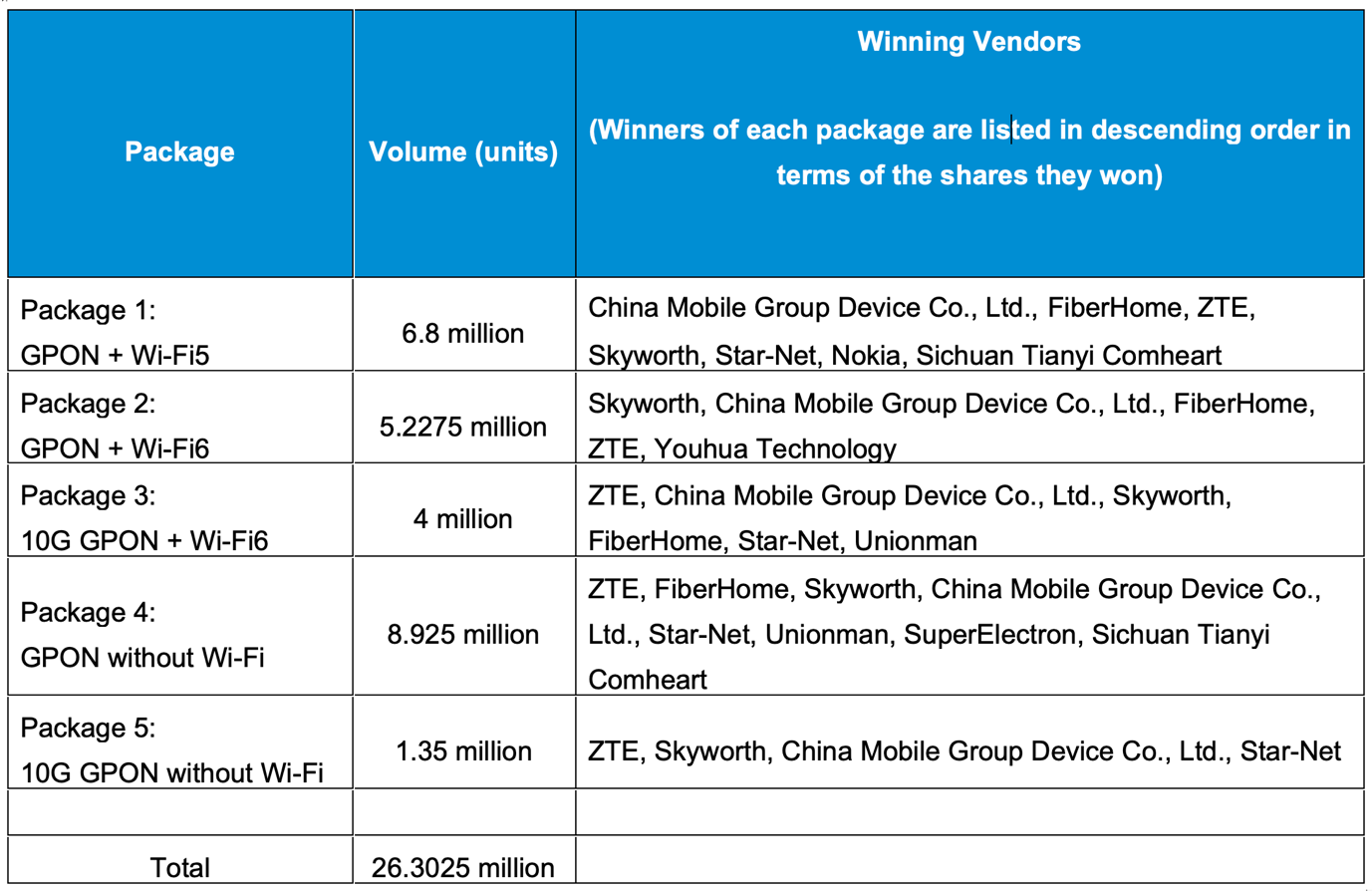
    In May 2022, China Mobile announced the results of its optical network terminal (ONT) tender for 2022-2023. With a total volume of 26.3025 million units, the tender represented the largest centralized procurement of ONTs by any operator in the Chinese market this year, drawing participation from numerous vendors.

    Based on the tender results, ZTE clinched a portion of all the five bidding packages and was the top winner in three of them. In the two packages for 10G GPON with Wi-Fi 6 and 10G GPON without Wi-Fi, ZTE landed the largest share, which testifies to its leadership in the commercial deployment of 10G GPON technology.

    ZTE ranked first for shipments of PON ONT devices with a 33% share of the global market in 2021, according to research firm Dell’Oro Group.

  • Apple suppliers competing for workers in Vietnam

    Apple suppliers competing for workers in Vietnam

    Apple’s major Chinese suppliers are competing for Vietnamese workers as they seek to expand operations outside their country.

    Young Liu, chairman of Foxconn’s flagship unit Hon Hai Precision Industry Co., told reporters in Taipei Saturday that his firm’s Chinese competitors have set up operations near its facilities in Vietnam just to poach workers.

    “The move should not be condoned,” he said without naming any companies.

    In recent years Foxconn’s competitors like Luxshare, GoerTek and BYD have flocked to Vietnam to avoid U.S. tariffs.

    Foxconn employs around 60,000 workers in Vietnam, which is its largest manufacturing base outside China.

    Liu said Foxconn would “significantly” increase the numbers of employees in Vietnam over the next one to two years.

    Earlier reports said Apple would mass produce its iPads for the first time in Vietnam as part of efforts to diversify its supply chain and reduce dependence on China.

  • Google Maps adds another nifty feature for Android and iOS users

    Google Maps adds another nifty feature for Android and iOS users

    Google Maps has already become a trusty companion for many Android and iOS users as the app is no longer just helps them navigate busy traffic. Less than a week ago, Google announced that Maps will be able to monitor air quality across the United States so that you can plan your outdoor activities accordingly.

    We’re pretty sure many more new features that might not have something to do with navigation will be added to the app, but the most recent one will definitely help you fully focus on your driving without having to think about … tolls.

    Starting today, Google Maps will show toll pass prices on both Android and iOS platforms. It’s a nifty feature that will allow users to choose which road to take, either it’s going to be the shorter route needing a toll pass, or the longer road that won’t cost you a dime.

    According to Google, the new feature will display the estimated toll price to your destination before you even start driving, which is possible thanks to the company’s partnership with local tolling authorities. The algorithm that presents you with the road choices and toll prices factors different variables such as having a toll pass or not, what the day of the week it is, as well as how much the toll is expected to cost at the specific time you’ll be crossing it.

    More importantly, the new feature comes with a toggle within settings that will allow users to make it show toll prices with or without having a toll pass, since the price changes based on the payment method you use in many regions.

    Also, Google Maps users will retain the ability to avoid routes crossing toll road completely, if possible, by choosing the “Avoid tolls” option within settings.

    As far as availability goes, Google announced that Maps users on Android and iOS should start seeing toll prices for about 2,000 toll roads in the United States, India, Japan, and Indonesia. It’s probably not much, but Google said more countries will be added in the not-so-distant future.

  • Why mattress disruptor Koala is getting in bed with homewares

    Why mattress disruptor Koala is getting in bed with homewares

    After success with both its mattress and furniture ranges, Australian company Koala is now moving into homewares.

    Koala decided to add décor to its product staple to encourage consumers to consider more sustainable options. The homewares collection features 34 pieces, including cushions, throws and the first wool rug range in Australia to use certified responsible wool.

    Other sustainable materials used in the new products are 100 per cent organic cotton and recycled plastic bottles.

    These designs are all inspired by Australia’s flora and fauna, art, culture or lifestyle and designed in-house. This means the pieces feature neutral colours and earthy tones, as well as nature-inspired textures and patterns.

    Koala said years of research has gone into creating the range, which has been designed to stand the test of time.

    The homewares are also built to withstand our hectic and messy lives with the throws and cushions machine washable and the rugs easy to clean.

    “With homewares, we want to celebrate Koala’s uniqueness whilst doing something meaningful and timeless for the brand. We’ve created a real sense of something special you can’t get anywhere else, with all colours and material finishes inspired by the Australian landscape, from outback red dirt to beautiful coral reefs,” Alexandra Owen, Koala design director said.

    You can feel good about supporting the environment while refreshing your home with this rug. It is made from 100 per cent recycled bottles and is super soft to the touch. There are two sizes and four colours available, with each colour inspired by Australia’s native foliage.

  • New Nike concept store opens in Hong Kong

    New Nike concept store opens in Hong Kong

    The new store has been launched by GMG as part of the company’s plans to ramp up its investment in the Asia market.

    The new Nike store spans over 2171sq ft and is situated in the East Point City shopping mall in Hang Tau district. It is home to sportswear for both men and women, in various categories including running, basketball and training.

    GMG has partnered with Nike in other markets since 1982, and entered the Asia market in 2020 after buying Royal Sporting House, a leading multi-sports retailer and recently purchasing Nike retail stores from SUTL Corporation, expanding its presence in Singapore and Malaysia.

    Mohammad A Baker, Deputy Chairman and CEO, GMG, said: “Asia is propelling the retail industry forward, generating a substantial portion of global growth in the sector and offering immense potential and expansion opportunities for GMG. The opening of our new Nike store in a key market such as Hong Kong, the first in two years, further signifies the recovery of a post-pandemic economy while allowing us to strengthen our physical retail presence in Asia.”

  • Workplace Technology Critical to Positive Customer Service Outcomes, Research Shows

    Workplace Technology Critical to Positive Customer Service Outcomes, Research Shows

    Only four percent of workers believe that technology did not play a role in their ability to serve customers today 

    Research by Humanforce, a provider of intelligent workforce management solutions, has shown seventy-four percent of frontline workers in Australia, including retail staff, believe that technology plays a critical role in customer service today.

    Alarmingly, while technology is being recognised as increasingly important to meeting customer needs, only twenty-eight percent of Australian retail workers feel that the technology they use in their workplace is advanced, with thirteen percent identifying that the technology in their workplace was either poor or limited.

    “Part-time and casual workers are at the frontline of customer service in Australia, making them commonly the first point of contact for customer queries and taking the lead for any issue resolution. Importantly, these workers rely on technology to connect with their employers and colleagues, assist in their roles and meet customer needs,” said Clayton Pyne, CEO, Humanforce.

    Workers themselves identify that they need advanced technologies to do their jobs, with only four percent of people surveyed saying that technology did not play a role in their ability to serve customers.

    Today, frontline retail workers not only prefer employers that offered workplace technologies that support their work but sought out companies that used technologies that empowered workers to manage their own shifts. Eighty-three percent of those surveyed would be more likely to join a company if they used automated technology to help better manage their work – including tasks, shift availability and pay. Conversely, twenty-three percent of frontline workers would consider leaving an employer if they did not offer technologies in the workplace that helped employees plan and manage their work.

    After mobile phones, tablets, and computers. the workplace technologies reportedly most used by frontline workers in Australia were:

    • Scanners – thirty-six percent
    • Point of sale (POS) systems – twenty-three percent
    • Wearable technologies – eleven percent

    “One bad experience or poor customer service interaction today can lead to customers abandoning a purchase and forming a negative perception of a brand, that may never subside. To meet Australian consumers’ expectations, businesses need to step up their customer service game and support workers with the right technologies,” said Pyne. “Solutions that can speed purchase processes, instantly surface a customer’s purchase history, or provide background on a product issue or complaint, equip frontline workers with invaluable tools and information to better meet customer needs, while in the flow of work.”

    Training was identified as a priority by retail workers to help them adapt to new workplace technologies, with hands-on training provided by a manager or colleague and online training accounting for 49% of respondents’ preferred training metholodogies.

    “In a competitive hiring environment, businesses need to focus on the employee experience by offering workers technologies that support positive customer service outcomes and enables them to better manage their work; while allowing businesses to optimise costs, improve productivity and realise compliance. Workforce management solutions can help simplify workplace processes and empower employees to manage their working lives through automating shift management, onboarding, training and more, while ensuring business objectives are met,” said Pyne. 

    Methodology

    • Humanforce contracted Zoho Survey to survey 500 Australian frontline workers (part-time and casual worker respondents) on technologies used in their workplaces in Q4 2021.

    About Humanforce

    The intelligent platform for your shift-based workforce.

    Almost every shift has its no-shows, late arrivals, and special requests, but you’ve also got to stay up to date with the big shifts in how people work – everything from new employee expectations to new technologies, new regulations and more. Humanforce brings a whole new approach to managing your teams by simplifying the process, giving you complete visibility and allowing you to stay ahead of the curve. That’s why thousands of businesses of all sizes – from hotels to hospitals, resources to recreation, stadiums to shops and more – use Humanforce to get ready for the next shift. www.humanforce.com

    Media Contact:

    Sarah Park

    Mulberry Marketing Communications

    +613 9023 9110

    [email protected]

  • Standards drive growing opportunities for the satellites industry

    Standards drive growing opportunities for the satellites industry

    Terry Bleakley, SVP in Asia, Intelsat, discussed in an interview the importance of standards in the satellite industry and highlighted how the company is leading in this area. He also shed light on the main growth opportunities presented to Intelsat in different areas of the satellites industry.

    How are satellite operators planning to integrate their satellite capabilities with terrestrial telecoms technology? 

    Organizations have different strategies. Looking back at the history of the satellites industry, it’s been very heterogeneous and sits outside telecom networks in general. We really need to become homogeneous and fit more with the telecom network. Statistics have shown that telecommunications and paid TV spend every year about $1.6 trillion and satellite makes up around $16 billion, which is about 1%. Therefore, to become more relevant, our solutions should interact more seamlessly with standards.

    At Intelsat, we have a $2 billion unified network made of three components, namely virtualization, standards, and smart edge terminals. The virtualization is about software-defined satellites which are very flexible. The second component is standards; Intelsat is working towards open standards. The satellite industry has been heterogeneous which makes it difficult to interface and doesn’t allow you to get scale. Being part of the telecom network gives us scale.

    In this framework, we will chair the NTN segment of the 3GPP as part of the Release 17 of 5G standardization efforts, which is considered a first in the industry. Never before has a satellite operator been involved in 3G or 4G standards.

    Moreover, we’re the first satellite operator to get MEF Ethernet certification which will allow our network to interface seamlessly with the Ethernet portion of the network.

    The third part of the standards is: DIFI (digital IF). At the moment the radio signal- IF is analog and we need a standard around the digital IF.

    As the 5G standard is adopted, new markets will evolve for satellite operators, IoT, private 5G network and cellular backhaul for densification because the wave form of 5G doesn’t go as fast as transmitting more information so it needs more cell sites and edge devices. Based on some of those opportunities, a market doesn’t really exist today for satellite; it’s just starring and in 2030, it will become an 8 billion dollar market of satellite operators. There’s a driving force for us to adopt 5G and embrace it and work with the telco operators.

    How will this impact the affordability and accessibility of satellite broadband services in the future? 

    The market we see growing is cellular backhaul, cloud connectivity, and private networks. People have this strange idea that satellites are not able to do video and voice over and the first thing people want to see from our network is whether Teams works and when they see it working seamlessly, they are convinced that geo-satellite works.

    If we look outside the traditional telco, we see a lot of growth in mobility. Our FlexMaritime Networks is a managed service that we provide and that connects ships using our capacity. We connect 9,000 ships today. In addition, we acquired in-flight connectivity company GOGO commercial aviation as well this year and we’ve incorporated that into Commercial Aviation Intelsat.

    We are looking at how we can bring our relationships with the media companies to aircraft passengers and how to strengthen our opportunities in that area. We already work in the US with T-Mobile for providing a more seamless experience for the passengers when they get on an aircraft. As we build out our 5G core, and we have a 5G network on the plane, we become a roaming service provider for them.

    Will the industry see the same growth cycles back in five or 10 years ago?

    Satellites industry has gained more awareness in recent years which has allowed us to meet more MNOs and high profile executives and has given us the chance to tell our story: We’re a 5G multi-led multi-orbit satellites network. We are getting a lot of business for growing cellular backhaul.

    We also see opportunities in government-lead initiatives to connect schools, hospitals, and governments remotely. These government-funded projects aim to reduce the digital divide and found in satellites the solution to solve their issues.

    Moreover, private LTE is getting more interest in terms of extending the cloud to remote areas.

  • McDonald’s eyes selling its South Korea unit

    McDonald’s eyes selling its South Korea unit

    McDonald’s Korea, the local unit wholly owned by the US fast-food giant, is seeking a new owner — joining the latest burger chain sales rush here.

    The company confirmed Friday that its US headquarters is selling its entire stake in the Korean unit as well as its business license after its first failed attempt six years ago.

    According to news reports, Mirae Asset Securities, the deal’s lead manager, plans to send letters as early as next month to invite potential bidders.

    With the addition of McDonald’s Korea, the largest fast-food chain by revenue here, four out of six major burger franchises — including Burger King, KFC and Mom’s Touch — are looking for new owners.

    Hong Kong-based Affinity Equity Partners is selling Burger King Korea, along with the burger chain’s Japanese unit. Meanwhile, Korean chemicals conglomerate KG Group is seeking an exit after its five-year ownership of KFC Korea. Mom’s Touch, a home-grown chicken burger chain owned by private equity firm Korea F&B Holding, recently delisted from the nation’s second bourse Kosdaq in a move to search for a new owner.

    Unlike the four, the remaining Lotteria and No Brand Burger are subsidiaries under retail giants Lotte and Shinsegae, respectively.

    The valuation of McDonald’s Korea is yet to be estimated, but market forecasts put it much higher than 2016’s 300 billion-500 billion won ($234 million-$469 million). Crosstown rival Burger King is currently valued at around 1 trillion won.

    US private equity giant Carlyle Group is cited as one of the potential buyers of McDonald’s Korea. In 2016, when the company was put up for sale, Carlyle created a consortium with Maeil Dairies — the nation’s leading dairy company — but later backed out from the deal. After its failed attempt to take over the Korean unit, it acquired the Chinese and Hong Kong branches in 2017.

    Along with the deal price, the US headquarters’ push to maintain its control over the Korean unit even after an exit could become a key factor in the acquisition talks. In 2016, the US head office insisted that it resume quality control of burger products and receive royalty payments from McDonald’s Korea, which evidently became another deal breaker.

    According to data from the Financial Supervisory Service, the Korean unit has paid 54.3 billion won in 2021 and 50.1 billion won in 2020 in commission payments for the US headquarters.

    Industry watchers say growing demand for premium burgers has led to heated competition in the market and an influx of newcomers. The food unit of Daewoo Development recently launched Good Stuff Eatery, a handcrafted burger chain frequented by former US President Barack Obama. BHC Group and Hanwha Solutions are poised to open Korean branches of Super Duper Burgers and Five Guys this year.

    As of 2021, McDonald’s Korea operates 404 stores nationwide. It posted 867 billion won in sales, up 9.7 percent from a year earlier, while logging 34.9 billion won in net losses.

  • E-wallet MoMo buys stake in securities firm

    E-wallet MoMo buys stake in securities firm

    The owner of e-wallet MoMo has purchased more than 4.4 million shares, or a 49 stake, in Hanoi-based CV Securities JSC (CVS). The deal was struck Thursday and Online Mobile Services JSC, or M Service, has received more than 4.4 shares from two shareholders of CVS – its vice chairman Jiang Wen and general director Nguyen Kim Hau – the securities firm said in a statement sent to the State Securities Commission of Vietnam (SCC).

    Established in 2009, CVS was first known as Hong Bang Securities JSC and renamed Hung Thinh Securities in 2015. The company also moved its headquarters from Ho Chi Minh City to Hanoi.

    Its annual revenue was VND4.4 billion ($190,000) and VND4.8 billion in 2020 and 2021 respectively. As of the first quarter of 2022, CVS had recorded a cumulative loss of more than VND80 billion.

    The new deal makes M_Service the second fintech firm to invest in a securities company after Finhay, who bought shares in Vina Securities early this week.

    Both Momo and Finhay are invested in by Thien Viet Securities (TVS). As of March 31, TVS recorded the original cost of investment in M_Service at VND27.8 billion and nearly VND62.5 billion at Finhay.

    Momo had 31 million users and 140,000 payment acceptance points last year. The wallet is now a partner of more than 50 banks, and financial and insurance companies.

    The e-wallet has completed a $200-million Series E funding round funded by a consortium of investors led by Japan’s Mizuho Bank. Investment funds Ward Ferry, Goodwater Capital and Kora Management make up the rest of the consortium.

    A media representative said he could not announce a specific figure, but MoMo’s valuation exceeds $2 billion, making it a startup unicorn.

  • Cleanery, eco-cleaning start-up set for Australian launch

    Cleanery, eco-cleaning start-up set for Australian launch

    Cleanery, the innovative Kiwi eco-cleaning and personal care products company, has closed an oversubscribed Seed Round of $2.34 million.

    Kiwi eco-cleaning start-up attracts big name backers for Australasian growth

    Cleanery, the innovative Kiwi eco-cleaning and personal care products company, has closed an oversubscribed Seed Round of $2.34 million.

    The raise attracted significant interest from the New Zealand business community, including Peter Cullinane, Nicola O’Rourke, and Michael Stiassny (via their company Founders Advisory), Shane Bradley (formerly GrabOne), and Lance Wiggs, via the newly minted Climate Venture Capital Fund.

    The Climate Venture Capital Fund is the largest investor in this Seed Round. Also investing is Icehouse Ventures, Angel HQ, and friends and family who have supported the company from day one.

    “This is an exciting time for us,” says Cleanery co-founder Mark Sorensen. “The size of the investment is larger than we initially anticipated and the quality of the people backing us is incredible. To have the likes of Peter Cullinane who made such a success with Lewis Road Creamery, or the Climate VC Fund, which sees our emissions reduction potential, gives us real confidence.

    “The money raised will be used to deliver an exciting New Zealand and Australian marketing plan, a USA e-commerce pilot, and resourcing the business for rapid growth,” says Sorensen.

    After a successful launch supported by Farro in October 2021, the products are already loved by many New Zealanders, with a growing direct-to-consumer offer.

    Woolworth’s launch

    The successful Seed Round coincides with Cleanery’s launch into Australia with a national rollout in Woolworths supermarkets, starting this week.

    “We have great capacity in our Auckland factory – and so it’s all about growing market share. The products work exceptionally well, and we’ve been selling online and in select outlets since last year, so we know there’s demand. It’s now about getting scale, which Woolworths and other supermarkets will bring in spades.”

    Just add water!

    Cleanery’s patented technology is revolutionising the cleaning and personal care categories by removing the water and the plastic bottle and simply using a sachet.

    “There’s no point shipping water when we’ve all got perfectly good water in our taps at home. And we all know the problem caused by packaging waste – so let’s reuse what you’ve already got under the sink,” says co-founder Ellie Brade.

    Cleanery products come in a recyclable sachet that can be mixed with water in a bottle the company supplies – or one of your own.

    “We’ll even give you a sticker to put over the old label,” she says.

    Cleanery estimates its products reduce plastic by 99%. And by not shipping water Cleanery can fit the equivalent of over 200,000 bottles in one shipping container – up to 20 times more than traditional products and at a fraction of the weight.

    Cullinane likes the disruption

    The proposition was immediately attractive to Peter Cullinane, whose former company Lewis Road Creamery shook up the dairy aisle. “The cleaning and personal care products industry is very large and very much ready for a disruption,” he says. “Cleanery is such a simple proposition: it’s the cleaner we want, not the bottle. And it works. It really does.”

    Tests demonstrate how Cleanery’s products clean more effectively than other mainstream cleaning products – eco or otherwise – while still having a safe, natural, plant and mineral based formulation.

    “So you have a cleaner that works better than any other, has such an elegant packaging solution, costs less, and has impeccable environmental credentials. What’s not to like?” says Cullinane.

    Emissions saved

    Dr Jez Weston, a partner in the Climate VC Fund says Cleanery meets its strict criteria for emissions reductions.

    “Our mission is to fund high growth companies that deliver significant emissions reductions. Cleanery means you’re not making more single use plastic bottles and spray heads and it means you’re not hauling that weight of water around the world. Every household uses cleaning products, so the emissions savings are going to be substantial.”

    This is the second investment by Climate VC Fund. Rohan MacMahon, partner of the fund, says Cleanery’s environmental credibility is matched by a strong management team. “We have huge confidence in the technical and commercial talent that Mark has attracted.”

    Born on a beach

    The investment in Cleanery is sweet reward for Sorensen, whose journey to solving plastic pollution started aged 14.

    “When we launched the company, my mother dug out an old essay I’d written in Social Studies about the urgent need to address the problems with packaging. I’d forgotten I’d even written it. I got an A+ by the way.”

    The essay was forgotten but the sentiment remained and during a three-day tramp in New Zealand’s Far North in 2017, Sorensen was surprised to find plastic on the coastline. “Here I was on remote beaches in the most remote country on Earth and I was still finding plastic. I was really motivated to do something.”

    Having worked with many of New Zealand’s most exciting science and technology companies as an advisor, he was well placed to know how to start and who to call on. But the technical challenge proved immense. “it’s one thing to slap together something that looks and smells like a cleaner – to create something that actually does the job, and can truly replace mainstream products, is another thing altogether.”

    Through a series of collaborations and explorations, the initial chemistry was developed and the real work – scaling up a factory capable of producing these novel formulations – began.

    “The timing is right. Consumers want to address the problem. China has stopped taking our so-called ‘recycling’ and the government and industry realise they need to do something.

    “And Covid helped highlight the need for scalable, local, manufacturing. The decisions we made during early Covid lockdowns, when supply chains started looking dicey, are paying off as we are now in control of our destiny with our own plant based here in Auckland and can produce product at any volume.”