Tag: asia

  • MobiFone Rolls Out 5G, Boosting Vietnam’s Digital Growth

    MobiFone Rolls Out 5G, Boosting Vietnam’s Digital Growth

    Initially, the 5G service will be available in major city centers, with plans to expand nationwide soon. The network operates on the 3.800-3.900 MHz frequency band, using both 5G NSA (non-standalone) and 5G SA (standalone) architectures. The network speed can reach up to 1.5 Gbps, which is 10 to 15 times faster than 4G.

    Existing 4G subscribers with 5G-compatible smartphones can access the 5G network across coverage areas without changing their SIM cards. For enterprise customers, MobiFone offers over 100 products and solutions for eight priority sectors, addressing national digital transformation. MobiFone has already implemented various 5G-based solutions for government agencies and businesses nationwide.

    Examples include an artificial intelligence (AI) camera solution for smart tourism and traffic management, as well as a 5G private network solution at Vicem Hoang Mai Cement Joint Stock Company.

    Vietnam launched 5G services at the end of 2024. As of January 2025, Viettel has 5.5 million 5G subscribers, while Vietnam Posts and Telecommunications Group (VNPT) has extended 5G coverage to 63 provinces and major airports, serving around 3 million users. MobiFone aims to accelerate 5G commercialization to support national economic growth.

    Prime Minister Pham Minh Chinh emphasized the importance of expanding 5G commercialization to achieve at least 8% economic growth by 2025. Mastering 5G technology is crucial to meet this goal. According to the GSMA, 5G is expected to contribute over USD 930 billion to the global economy by 2030, benefiting key sectors such as industrial manufacturing, public administration, services, IT and communications, and finance.

    To support 5G infrastructure development, the National Assembly has allocated state budget funds to assist telecom companies with the rapid network expansion. Enterprises deploying at least 20,000 5G base stations by the end of 2025 will have 15% of their equipment costs covered. MobiFone’s 5G service not only enhances digital transformation but also boosts technological innovation and economic competitiveness. By leveraging 5G, Vietnam aims to become a regional technology leader and an attractive destination for foreign investment.

  • Amazon’s last-second bid to buy TikTok is not being taken seriously

    Amazon’s last-second bid to buy TikTok is not being taken seriously

    By law, short-form video app TikTok has until this Saturday, April 5th, to be divested by its current owner ByteDance, or else face banishment in the U.S. The legislation requires ByteDance to find a buyer for the popular app that is not a Chinese company. TikTok has been accused of stealing users’ personal data, and disseminating propaganda from China and the Chinese Communist Party to U.S. viewers.

    It looks like an American company, as American as Apple Pie, has thrown a last-second bid for TikTok into the ring. An unnamed U.S. administration official said today that Amazon has made a bid to acquire TikTok, which had about 1.5 billion monthly active users early this year. Last week, Reuters reported that private equity firm Blackstone was looking at joining a group made up of TikTok’s non-Chinese stockholders Susquehanna International Group and General Atlantic to bid for the app.

    Another U.S. company believed to be interested in buying TikTok from ByteDance is Oracle. The firm is already involved with TikTok as it is designated as the app’s “trusted technology provider” in the U.S. and its servers are used to store the personal data of U.S. TikTok users.

    The New York Times reported today that Amazon’s bid for TikTok came in the form of a letter sent from the company to Vice President JD Vance and Commerce Secretary Howard Lutnick. However, the Times story says that various parties are not taking Amazon’s bid seriously. The value of Amazon’s bid as well as those of competing bids are unknown. The online retailer had previously attempted to copy TikTok by launching a similar feature inside its app called Inspire. However, Inspire was considered a failure and was removed from the Amazon app earlier this year.

    Meanwhile, President Donald Trump is reportedly hosting a meeting in the Oval Office on Wednesday to discuss TikTok and the possible suitors for the app. You might recall that in 2020 during Trump’s first term, he tried to broker the sale of TikTok to American firms that showed interest including Oracle, Walmart, and Microsoft. This time, there is legislation involved as a bill to ban TikTok in the U.S. was signed by then-President Joe Biden last April.

    The bill forced ByteDance to divest its holdings in TikTok by January 19th or get banned in the U.S. President Trump signed an executive order on January 20th, his inauguration day, that prevents the Justice Department from taking action against TikTok until the April 5th deadline.

  • CEVA Logistics expands global air freight capacity with WUX

    CEVA Logistics expands global air freight capacity with WUX

    In serving its customers with consistent, reliable air capacity on key trade lanes, CEVA Logistics is launching a new trans-Pacific charter program. The new air cargo charter solution connects Wuxi, China (WUX), to Chicago, U.S. (ORD), offering three flights per week.

    The inaugural charter flight departed from Wuxi to Chicago earlier on 28 March, carrying more than 100 tons of cargo. The Wuxi-Chicago charter is designed to accommodate a diverse range of cargo types, including industrial equipment, electronics, oversized cargo, e-commerce goods, and apparel. As part of the new charter program, CEVA is also offering customers sustainable aviation fuel (SAF) options through its CEVA FORPLANET suite of low carbon transport and circular economy solutions.

    CEVA is offering the charter solution through an agreement with Wuxi Sunan Shuofang International Airport Group. The Wuxi airport provides an inland advantage by easily covering the Yangtze River Delta Economic Development Zone. The ideal logistics hub serves not only global companies with manufacturing sites on the outskirts of Shanghai, but also Chinese companies in industrial, technology and e-commerce sectors.

    Upon arrival in Chicago, cargo can be efficiently distributed across various major U.S. cities thanks to CEVA’s gateway located less than 10 miles from the airport. The 700,000-square-foot air freight warehouse includes an 8,000-square-foot FTZ (Free Trade Zone), a 10,000-square-foot cold storage facility with two chambers, a 180,000-square-foot CFS (Container Freight Station), and a 180,000-square-foot CCSF (Certified Cargo Screening Facility) with ETA, x-ray, and K-9 inspection capabilities.

    Through CEVA’s robust domestic LTL ground transport network, more than 200 weekly linehaul options connect the Chicago gateway with hubs in Los Angeles, Dallas, Atlanta, Columbus, as well as 70 onward distribution sites across the country, to complete the final domestic delivery in less than 24 to 48 hours. The charter program also provides swift customs clearance and airport handling service, as well as other tailored solutions for cross-border volumes.

    In addition, CEVA’s freight management solutions across Southeast Asia extend the service’s reach to other major cities and manufacturing zones. By offering multi-modal transport options from Southeast Asia to Wuxi, CEVA can offer a broader range of its customers access to the new trans-Pacific air charter solution.

    Loic Gay, global air product leader, CEVA Logistics, said: “CEVA Logistics continues to invest in our global air freight network and our owned, controlled capacity. This new trans-Pac charter service underscores CEVA’s commitment to securing the right capacity on the right lanes for current and future customers in order to meet their evolving needs.”

  • Microsoft is changing how your Windows laptop tells you it’s crashing

    Microsoft is changing how your Windows laptop tells you it’s crashing

    Microsoft is shaking things up with some new changes to Windows and while some are aimed at making your experience smoother and faster, others, like the removal of the option to set up a new PC without signing in with a Microsoft Account, might ruffle the feathers of Windows 11 users who prefer a bit more freedom. And there is another change that might not sit well with everyone.

    Microsoft has announced it is revamping the infamous Blue Screen of Death (BSOD). The classic blue background, frowning face and QR code are gone, replaced by a simpler error screen in black.

    However, it is still unclear whether the black screen will stick around in the final update or if it will eventually turn green, as users on the beta, dev and canary channels are seeing the test builds with a green background instead. Time will tell, but one thing’s for sure – BSOD is getting a makeover.

    We’re previewing a new, more streamlined UI for unexpected restarts which better aligns with Windows 11 design principles and supports our goal of getting users back into productivity as fast as possible. We’ve simplified your experience while preserving the technical information on the screen. As a reminder, for Windows Insiders this appears as a “green screen”.

    This marks the biggest change to the BSOD since Microsoft first added the sad face back in Windows 8. The redesigned error screen still shows the faulty driver or error message but keeps things simple with just a “your device ran into a problem and needs to restart” message.

  • Italian motorbike brand Ducati to shut down only northern Vietnam store

    Italian motorbike brand Ducati to shut down only northern Vietnam store

    Ducati Vietnam will close its Hanoi showroom – the only one serving northern Vietnam – on Tuesday, citing market challenges.
    While the Hanoi dealership would cease operations, Ducati would continue to offer maintenance and repair services in the city, a Ducati Vietnam representative said.

    The closure decision stemmed from the lower-than-expected performance of the northern dealership.

    Although specific sales figures remain undisclosed, the representative indicated that the bulk of Ducati sales originate from customers in southern Vietnam.

    The representative acknowledged this move “would make it difficult for northern customers wanting to learn about and experience Ducati bikes.”

    The Hanoi showroom has been operating for nearly four years.

    Ducati currently offers nine models in Vietnam in a range of categories including scrambler, naked bike, sport, and adventure, all imported from Thailand.

    The importer and distributor for Ducati in Vietnam is CT-Wearnes Vietnam, a subsidiary of Singapore-based Wearnes Automotive.

    CT-Wearnes also distributes luxury car brands Bentley and Aston Martin in the country.

    In the motorcycle sector, CT-Wearnes previously handled distribution for India’s Royal Enfield from September 2022 but ceased operations for that brand exactly two years later, in September 2024, due to low sales volume.

    The closure occurs against a backdrop of a struggling market for large-displacement motorcycles (over 175cc) in Vietnam.

    Unlike the scooter segment, official sales data for these motorcycles is not regularly published. All such motorcycles sold locally are imported, primarily from Thailand.

    A sales manager at an official motorcycle dealership in HCMC highlighted a sharp decline in demand over the past two years, estimating that overall motorbike sales fell by approximately 30% in 2024 compared to 2023.

    “The enthusiasm for large bikes has cooled down due to economic difficulties as well as stricter government regulations on modifications and upgrades,” the manager said.

    “Motorbike dealerships all have to cut costs to make a profit.”

    Despite the downturn, Vietnam’s motorcycle market features most major global manufacturers.

    Competitors include Japanese brands like Honda and Yamaha, and Italian producers such as Ducati, Aprilia, and Moto Guzzi. There are also products from the U.K.’s Triumph, and Germany’s BMW Motorrad.

    Currently, Al Naboodah International Vietnam holds the distribution rights for the largest number of motorcycle brands, including Harley-Davidson, Triumph, KTM, and Husqvarna.

  • China Airlines partners with Chunghwa Telecom Laboratories on new roadmap to develop airline AI applications

    China Airlines partners with Chunghwa Telecom Laboratories on new roadmap to develop airline AI applications

    China Airlines (CAL), a Taiwan-based carrier, has strategically positioned itself for the future by signing a memorandum of understanding (MOU) this month with Chunghwa Telecom Laboratories (CHTTL) to expand the use of Artificial Intelligence (AI) technology resources. The two companies will share their respective industry applications and R&D technology to co-develop an integrated AI development and management platform. This strategic move will not only make services more accessible to travelers but also define a new roadmap for AI development in the airline industry.

    As the first airline to form such a partnership with CHTTL, CAL will focus on enhancing the AI service experience and strengthening corporate management of on-premises AI applications. The incorporation of “AI interactive voice response” functionality with customer service chatbots into the CAL website will provide travelers with additional answers to their inquiries, enhancing their overall experience. “Customer conservation analytics” performed by generative AI will analyze and categorize questions in audio files in real time to help customer service staff track common traveler questions with great precision. The data can also be used to improve internal education and training as well as enhance the productivity and quality of customer service.$

    For internal enterprise management, CAL will combine AI “forecasting and early warning applications” with big data to accurately predict the number and weight of luggage on each flight. The information can be used to maximize the utilization of belly cargo space on passenger flights and cargo hold space on freighter flights, which promises savings for the workforce. At the same time, the two companies will co-develop a “Smart Generative AI Platform” that uses machine learning model management and the construction of large language models (LLM) to accelerate the scaling and deployment of AI operations. The platform will also assist businesses with more effective management of on-premises AI applications and shorten model development time.

    Research and development of telecommunications and information-communications technologies have always been the focus of CHTTL. The Labs have played a key role in defining international standards and industrial innovation as well. Current fields of research include the core technologies for broadband networking, mobile networking, AI, and information security. CHTTL has already developed numerous AI applications for enterprise use, including AI customer service chatbots, AI voice assistances, and the customer sentiment analysis platform (DeepVoice). These solutions have been recognized by the Taiwan Excellence Awards, National Brand Yushan Awards, and other top awards, demonstrating the quality and innovation of CHTTL’s work. The latest partnership will lead to new milestones in the use of smart AI technology in the Taiwanese airline industry.

    CAL continues to promote innovative services by incorporating the latest AI applications into its traveler experience and into internal management to boost team productivity. In 2024, CAL became the first Taiwanese carrier to receive the award for Best AI System Application Team at the Customer Service Excellence Awards (CSEA). CAL will continue to track the latest developments in the AI industry and collaborate with leading external organizations to build strategic partnerships that will accelerate AI development and boost international competitiveness through smart airline AI services.

  • Gold prices set new records twice in one day

    Gold prices set new records twice in one day

    Vietnam gold prices kept climbing to new historic peaks on Monday afternoon after setting records in the morning.

    Saigon Jewelry Company gold bar price rose 0.3% to a record VND101.8 million (US$3,980.45) per tael. It had earlier surged 0.8% to VND101.5 million.

    Gold ring price was up 0.29% to VND101.9 million per tael after jumping 1.2% to VND101.6 million in the morning. A tael equals 37.5 grams or 1.2 ounces.

    Globally, gold hit a record high and was set to post its biggest quarterly gain in over 38 years on Monday, as concerns over U.S. President Donald Trump’s tariff plans widening the global trade war and triggering an economic slowdown boosted bullion’s appeal, Reuters reported.

    Spot gold jumped 1.1% to $3,116.82 an ounce after hitting an all-time high of $3,128.06 earlier. U.S. gold futures was up 1.1% to $3,148.00.

    Gold, traditionally seen as a hedge against political and economic uncertainties, has risen over 18% so far this quarter, its biggest quarterly gain since September 1986.

    Interest rate cut bets, central bank buying and exchange-traded fund (ETF) demand are the other factors that have supported the rally. The rapid price rise prompted multiple banks to increase their 2025 price forecasts.

    Trump is expected to announce reciprocal tariffs on April 2, while automobile tariffs will take effect on April 3. On Sunday, Trump said he was “pissed off” at Russian President Vladimir Putin and would impose secondary tariffs of 25%-50% on buyers of Russian oil if he feels Moscow is blocking his efforts to end the war in Ukraine.

  • Stocks close 4th session in red

    Stocks close 4th session in red

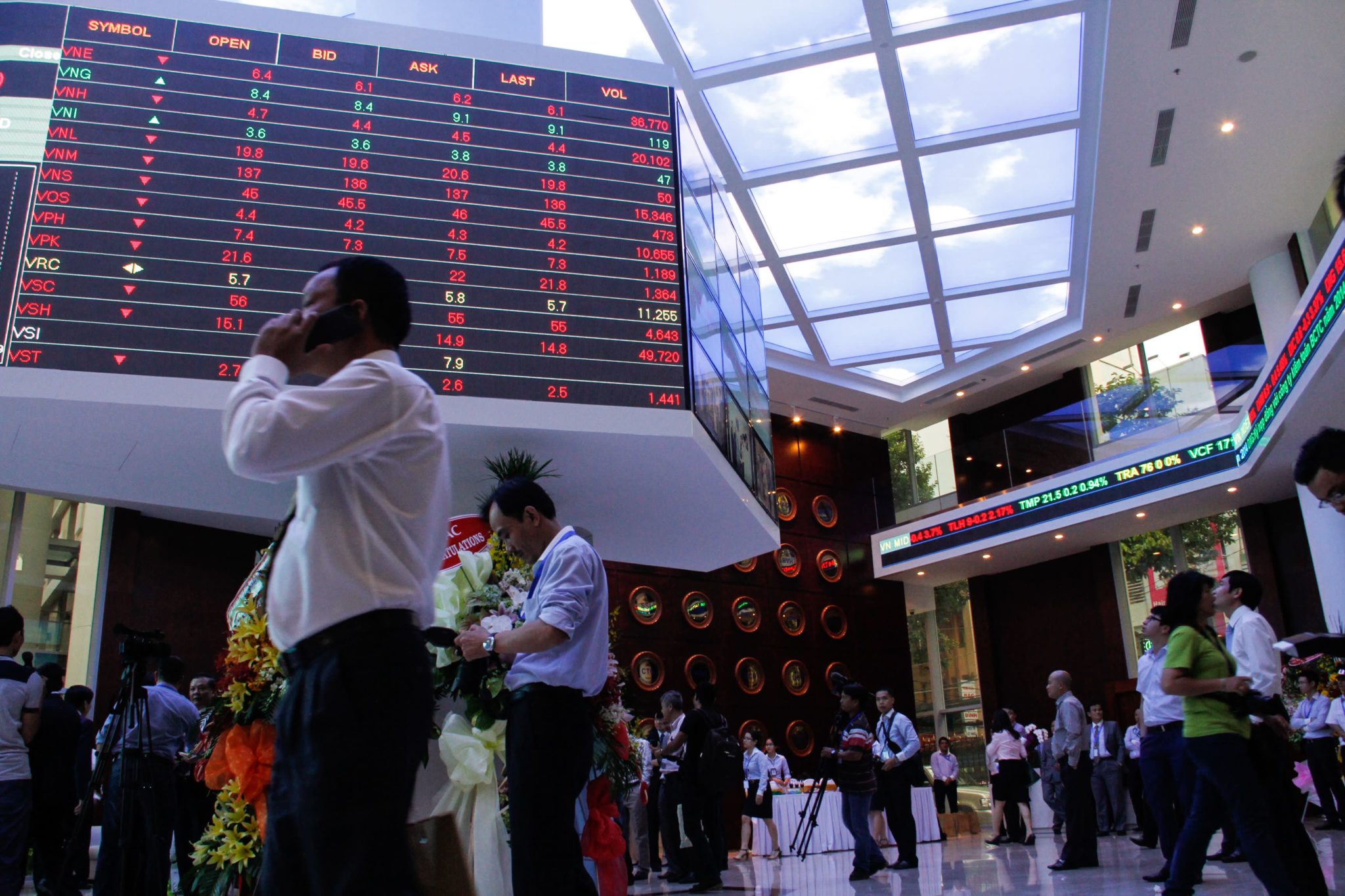
    Vietnam’s benchmark VN-Index fell 0.80% to 1,306.86 points Monday for the fourth session in a row.

    The index closed 10.60 points lower after dropping 6.35 points in the previous session.

    Trading on the Ho Chi Minh Stock Exchange increased by 24% to VND21.205 trillion (US$829.1 million).

    The VN-30 basket, comprising the 30 largest capped stocks, saw 20 tickers fell.

    GVR of Vietnam Rubber Group saw the biggest drop of 6.9%, BCM of Becamex Investment and Industrial Development followed with a 3.6% decline. MSN of conglomerate Masan Group was down 2.5%.

    Eight blue chips gained. MBB of lender MB rose 0.8%, TPB of private TPBank closed 0.7% higher, and VNM of dairy giant Vinamilk went up 0.5%.

    Foreign investors were net seller to the tune of VND1.28 trillion, mainly selling FPT of tech giant FPT Corporation and VNM.

    The HNX-Index for stocks on the Hanoi Stock Exchange, home to mid and small caps, fell 1.32%, while the UPCoM-Index for the Unlisted Public Companies Market went down 0.61%.

  • Is the EU’s push for more iPhone openness going too far?

    Is the EU’s push for more iPhone openness going too far?

    Apple’s relationship with the European Union has always been complicated, but the latest set of demands might be the point where the company starts pushing back more aggressively. Under the EU’s Digital Markets Act (DMA), Apple is being asked to open up even more of its famously closed ecosystem—this time targeting features that many would argue are fundamental to the Apple experience itself. And unlike with USB-C or RCS, this doesn’t feel like a consumer win. It feels like regulators are tampering with what makes Apple… Apple.

    Let’s backtrack for a second. The Digital Markets Act is a set of rules meant to keep “gatekeepers”—large tech companies with dominant platforms—from using that power to squash competition. Apple, along with Meta, Google, and others, falls into that category. So far, we’ve seen the EU use that power to get Apple to adopt USB-C on iPhones and begin support for RCS messaging in iOS 18—both reasonable and arguably overdue. But now, the EU wants Apple to take things much further.

    The new requirements include opening up the iPhone’s NFC chip (used for tap-to-pay services) to third-party apps beyond Apple Pay, letting non-Apple smartwatches access the same notification integrations as the Apple Watch, and even allowing non-AirPods to take advantage of features like seamless device switching. There’s also pressure to make AirDrop and AirPlay available to rival platforms.

    These are no longer just tweaks to help with interoperability or convenience. These are foundational elements of the Apple ecosystem—features that have historically been exclusive and are part of the reason many people choose Apple products over Android or other alternatives. Apple didn’t mince words in its response, stating that some of the changes the EU wants “pose very real privacy and data security risks” for users.

    That’s not just PR spin. Apple’s closed ecosystem has long been a double-edged sword—it offers security, consistency, and tight integration between devices, but at the cost of flexibility and openness. Plenty of people criticize Apple for that, and some of that criticism is valid. But forcing Apple to break down those walls entirely starts to feel like regulators trying to re-engineer a product, rather than just leveling the playing field.

    The Digital Markets Act forced Apple to allow third party app stores on the iPhone, to which Apple complied, but only in this region. | Image credit — DMA.

    And while Apple might be complying—at least on paper—it’s already found creative ways to limit how much these new rules actually affect the user experience. For example, in iOS 17.4 (the version tailored to the EU’s DMA requirements), Apple lets third-party app stores and alternative browser engines exist, but the hoops developers need to jump through are significant. And users are hit with scary warnings that could discourage them from straying too far from the Apple-approved path.

    What’s becoming clearer is that Apple may choose to keep restricting or disabling certain features in the EU entirely rather than continue to change the DNA of its products. We’ve already seen this play out with things like Apple Cash and Apple Card—both of which are still unavailable in the EU due to regulatory complications. And it’s not out of the question that some of the seamless device features we’ve gotten used to might eventually be region-locked.

    To be fair, Apple isn’t the only company under the DMA’s microscope. Google is also being asked to give users more choice when setting up Android devices, and Meta is facing scrutiny over how its services are bundled. But Apple is unique in how much of its brand is built around exclusivity and tight integration. Forcing them to open up feels more disruptive than it might be for a company that already plays well with others.

    As someone who generally supports more openness in tech—especially when it helps consumers—I was all for the EU pushing Apple toward USB-C and RCS. Even more so as someone who uses both an iPhone and an Android device as a daily driver. Those are about standardization and making basic tech functions easier for everyone. But this latest round of demands feels like something else entirely. It’s one thing to create fairer conditions for competition; it’s another to dismantle what makes a product distinct in the name of fairness.

    Apple shouldn’t be above regulation, and healthy competition is important. But regulators also need to recognize when they’re crossing from creating opportunity into reshaping products in a way that users didn’t ask for. At this rate, Apple may eventually decide it’s just not worth offering the same iPhone experience in the EU at all.

  • Waze pulls major reporting tool from iOS app and plans to replace it with Gemini

    Waze pulls major reporting tool from iOS app and plans to replace it with Gemini

    Waze users know that the directions offered by the app to a specific destination are enhanced by the data shared by the Waze community driving on the same road. Whether it is an accident, a slick road, heavy traffic, police activity, or weather, once the crowd-sourced data is shared Waze might change the route thanks to the new information it is presented with. There are multiple options that Waze users have to report this information.

    While most use touch input to report these issues, it is difficult to do while behind the wheel. Waze’s touch input can allow users to tap the on-screen button when spotting a hazard on the road and allow them to wait for a moment when the car is not moving to complete the submission. Another option that Waze users employ to report a hazard is Google Assistant. The digital assistant also was used to quickly arrange for navigation by asking it to navigate to your destination.

    The problem is that Google Assistant has never worked perfectly with the iOS version of Waze. This is the reason why Google is removing Google Assistant integration from the iOS version of Waze. Last week, a Waze staff member named Leigh wrote on the Waze discuss website, “We’ve decided to phase out Google Assistant on iOS…and replace it with an enhanced voice interaction solution in the near future. As always, we are committed to keeping you informed and will share more details as we progress.”

    Waze made it clear that Google Assistant “will continue to function seamlessly on Waze for Android, where it has consistently performed reliably.” While Google has yet to announce the “new voice interaction solution,” Waze will turn to Google’s Gemini AI for conversational reporting of hazards. This will allow Waze users to report issues using a more conversational style that will be less distracting for drivers.

    Here’s how this would work. Let’s say you’re driving and spot an accident on the road. You can press the reporting button and say, “So this crash is why traffic is such a nightmare.” This reports two issues with one quick sentence-the accident and the additional traffic causing a slowdown.

  • Bangkok quake death toll rises to 17

    Bangkok quake death toll rises to 17

    The death toll in Bangkok from a massive earthquake that hit Myanmar and Thailand rose to 17 on Sunday, city authorities said.

    The Bangkok Metropolitan Authority said 32 people were injured and 83 still unaccounted for — most from the site of a 30-story tower block under construction that collapsed when the magnitude 7.7 quake struck Friday.

  • UBS Secures Key Regulatory Win in China

    UBS Secures Key Regulatory Win in China

    Swiss bank UBS is strengthening its presence in China after receiving regulatory approval to acquire a local securities firm fully.

    UBS will acquire an additional 33 percent stake in UBS Securities from Beijing State-owned Assets Management Co., Ltd (BSAM), thereby taking full control of UBS Securities in China. The big bank announced this on Friday, having received the corresponding approval from the China Securities Regulatory Commission.

    UBS Securities was the first foreign-invested, fully licensed securities joint venture in China in 2007. In 2018, UBS became the first foreign bank to take majority control of a Chinese securities firm – initially with a 51 percent stake, which was increased to 67 percent in 2022.

    UBS Securities is active in global banking, global markets, research and wealth management.

    UBS is proud of its long history in China and of serving clients in one of the most important and fastest-growing markets in the world. We will continue to invest in China as a central pillar of our growth ambition, further strengthening our leadership position in the region, said Group CEO Sergio Ermotti.

    The move to full ownership of UBS Securities is an important milestone for our integrated strategy in the region. It enables us to further expand our investment banking and wealth management offering in China. Not only will we be able to capitalize on the tremendous business opportunities as China’s financial sector opens up, but we will also gain better access to the unique wealth creation that we can support with our products, services and advice,» Iqbal Khan, President Asia Pacific and Co-President Global Wealth Management at UBS, said.

  • PLDT Strengthens Digital Growth with Data Center Expansion

    PLDT Strengthens Digital Growth with Data Center Expansion

    PLDT Chief Operating Officer, Menardo Butch G. Jimenez, emphasized the increasing potential of tech-focused telcos in the region’s changing digital landscape. He mentioned, “We have already built 10 data centers and are finishing our 11th and biggest facility, which shows how strongly we believe that data centers are an important part of PLDT’s revenue growth.” He also said that PLDT has experienced strong growth rates in its data center business over the past five years.

    Through its subsidiary, ePLDT, PLDT has become a leader in the Philippines data center industry. The company operates a network of VITRO data centers, providing solutions for customers’ increasing IT outsourcing needs. The VITRO Sta. Rosa Data Center, the largest and most advanced in the country, is positioned to be the Philippines’ artificial intelligence (AI) hub, forming the first AI ecosystem in the nation.

    Jimenez also highlighted that data sovereignty laws represent a significant upcoming development, noting that localized data storage regulations enforced by the government will drive the demand for domestic data centers. Looking forward, PLDT is preparing for an AI-powered future by offering GPU-as-a-Service (GPUaaS) to meet the growing need for high-performance computing (HPC) due to AI and machine learning (ML) adoption.

    Through investments in data centers, AI infrastructure, and green energy, PLDT is solidifying its position as a leader in digital transformation and shaping the future of the telecommunications industry.

  • BharatNet Expands Connectivity to Rural India

    BharatNet Expands Connectivity to Rural India

    In a written response to the Rajya Sabha, Baghel stated that the Department of Telecommunications (DoT) is implementing the project in phases to ensure broadband connectivity reaches all Gram Panchayats nationwide.

    The BharatNet infrastructure is classified as a national asset and is accessible to service providers without discrimination. It supports various broadband services, including Fiber-to-the-Home (FTTH) connections, leased lines, dark fiber, and backhaul connections for mobile towers. As of February 2025, a total of 2,14,323 Gram Panchayats are service-ready, Baghel confirmed.

    Additionally, the Union Cabinet has approved the Amended BharatNet Program (ABP), adopting a design, build, operate, and maintain (DBOM) model. The revised program aims to upgrade the existing network under BharatNet Phases I and II, expand connectivity to approximately 42,000 Gram Panchayats that are yet to become service-ready, and ensure network operation and maintenance for the next decade.

    Baghel also noted that Bharat Sanchar Nigam Limited (BSNL) has been assigned the task of providing 1.50 crore FTTH connections to households over the next five years. The completion timeline for the ABP is set for March 2027.

  • Fitbit app redesign finally makes Health Metrics easier to read on Android and iOS

    Fitbit app redesign finally makes Health Metrics easier to read on Android and iOS

    Fitbit continues to advance its mobile app experience and the latest update focuses on one of the most essential areas for health-oriented users—the Health Metrics. Users of Android and iOS devices can now access the updated Health Metrics section..

    Until now, the Health Metrics section displayed data through two tabs dubbed  “Today” and “Trends.” The interface contained health data across both tabs but it appeared disconnected from other sections of the application.

    That’s finally changingFitbit eliminated the tabbed interface structure in their latest update. The health metrics data now occupies a single scrollable page without any tabs. Users can view their health statistics through a simple summary widget located at the top that shows their performance across five health metrics using a five-point scale. This feature used to exist exclusively in the “Today”  feed.

    Underneath the summary widget, there’s now a well-organized list of five core metrics:

    • Breathing Rate (BR)
    • Blood Oxygen (SpO2)
    • Resting Heart Rate (RHR)
    • Heart Rate Variability (HRV)
    • Skin Temperature Variation

    Each metric is shown in a card format, making it easier to understand at a glance. Tapping on any of these entries opens a more detailed “Trends” view that now includes Week, Month and Year filters, giving users a better view of long-term health changes.

    The new and more detailed trend pages include short explanations written in simple language for each statistic. For example, breathing rate is described as “the number of breaths you take per minute.”

    The update seems cosmetic at first glance but it greatly improves the user experience. The redesigned interface provides better responsiveness and improved navigation while maintaining design consistency throughout the application.

    This Health Metrics redesign is part of a broader visual overhaul across the Fitbit app. The Water Tracking screen was updated recently, and now Health Metrics follows suit. Next in line? Food logging, which still uses an older interface and could definitely benefit from a similar revamp.

    The new UI comes with the Fitbit 4.39 update for iOS, while the Android versions is rolling out more slowly. Not all users have access to it just yet, as Google which now lists Fitbit under its official “Google LLC” developer account—appears to be releasing it in waves.