Tag: Banking

  • Singapore to remove distinction between international and domestic banking

    Singapore to remove distinction between international and domestic banking

    The Monetary Authority of Singapore (MAS) plans to change accounting rules that split domestic and offshore banking into separate ‘units’. 03 Jul 2015

    Since 1968, banks have had to separate operations into domestic banking units (DBSs) and Asian current units (ACUs). Domestic operations, which are predominantly denominated in Singapore dollars, are accounted for through a bank’s DBU, while offshore operations, which are entirely denominated in foreign currency, are accounted for through the ACU.

    However, global regulatory developments over the past five years have created a situation where the split system is no longer useful, Singapore’s minister of finance Tharman Shanmugaratnam said.

    The initial aim of the divide was to safeguard domestic financial stability, Tharman said.

    “For example, MAS imposed liquidity requirements on banks’ Singapore dollar liabilities – that is, only within the DBU. In addition, DBU activities were subject to large exposure and equity investment limits,” he said.

    The divide also made it easier to offer incentives to encourage offshore banking activities out of Singapore, Tharman said, but focusing incentives in the ACU.

    “The DBU- ACU divide served us well for decades, but has been losing its relevance,” Tharman said.

    “Since 2004, our development incentives have no longer been based on the domestic versus offshore distinction, and the divide between domestic and offshore banking has in practice become increasingly porous,” he said.

    In addition, global regulatory changes have meant that banks’ offshore activities are now subject to rules that are broadly similar to those governing DBUs in Singapore. These rules have increased the amount and quality of capital and the liquidity buffers that banks need, Tharman said.

    “These global regulatory reforms have put all banks on a sounder footing. It has also reduced the relevance of MAS rules that distinguish between offshore and domestic banking activities of foreign banks, since home regulators will now be requiring their banks to meet enhanced standards on a group-wide basis,” he said.

    Changes to MAS’s own regulations have also made the divide less relevant, Tharman said.

    All banks in Singapore will have to meet liquidity requirements across the entirety of their operations by January 2016, while banks that are designated as ‘domestic systematically important banks’ will be subject to extra measures on both domestic and offshore business, he said.

    In addition, Tharman said, “where a foreign bank branch has significant retail presence in Singapore, it will also be required to locally incorporate its retail operations. The subsidiary will be subject to the same suite of regulation as the local banks, and the same supervisory regime aimed at minimising risks to local depositors”.

    MAS will therefore remove the divide from banking regulations, and details will be released in a consultation paper by August, Tharman said.

    “There is no rush. We will implement the changes in close consultation with the banking community, and phase them in over time,” he said.

  • Citigroup combines retail banking and mortgage operations

    Citigroup combines retail banking and mortgage operations

    Citigroup Inc (C.N) will combine its retail banking and mortgage operations under Jonathan Larsen, according to an internal memo seen by Reuters, in the second senior promotion for a veteran of the bank’s Asian franchise this year.

    The U.S. bank’s Asia Pacific chief Stephen Bird in April became the global head of Citi’s consumer bank, in a move seen by analysts as rewarding the U.S. lender’s strategy in the region.

    Larsen, currently global head of retail banking, previously ran Citi’s Singapore unit and spearheaded the lender’s push in credit cards in Asia. Citi’s Asian franchise now has 12 of the lender’s 24 consumer banking markets globally, and contributes a fifth of global profits.

    “Citi Asia is a sign of where Citigroup as a whole potentially can go,” CLSA analyst Mike Mayo said in a research note prior to the announcements. The lender’s strategy in the region has been to move from targeting the mass market to richer ‘mass affluent’ customers, Mayo wrote.

    The appointments this week of Larsen and Bird, who oversaw that push in Asia to trim low-profit customers and target wealthier clients, signals Citi’s intention to pursue the strategy globally.

    In a separate memo also seen by Reuters on Thursday, Citi named Anand Selvakesari as head of consumer banking for Asia, a position Larsen has been holding since 2009.

    A Citi spokesman confirmed the contents of the memos.

    Fabio Fontainha, the head of consumer banking in Brazil, will assume additional responsibility for consumer banking in Latin America.

  • Indonesian FinTech start-ups raise stakes for banks

    Indonesian FinTech start-ups raise stakes for banks

    A string of innovative financial products from Indonesian start-ups are circumventing the traditional payment and investment system, helping to broaden financial inclusion and challenging the established banks.

    Indonesia’s tech-savvy youth have already given rise to pioneering start-ups with social and religious missions and the so-called FinTech industry is set to disrupt traditional banks by offering everything from Bitcoin remittances to mobile pawn shops and retail lending platforms.x

    New alternatives

    With a large swath of the population still unbanked – in part due to the country’s challenging geography – new technologies in banking, transactions and payments offer significant growth potential, with banks under increasing pressure to respond to the trend.

    Banks and regulators in Asia are at difficult levels of understanding of the sector, explained Mohit Mehrotra, an executive director at Deloitte Consulting. “Asia has a huge potential for FinTechs. Countries like India and Indonesia, with their low financial services penetration and large unbanked and underserved populations, are perfect breeding grounds with several white spaces for FinTechs to play an important role,” he told local media in May.

    But collaboration with the FinTech sector is also an option and represents a potential source of growth, particularly for larger banks. “Big banks, by nature of their legacy set-ups, find it increasingly difficult for forging new digital-enabled business models that FinTechs specialise in,” said Mehrota.

    This is starting to be acknowledged by the big banks. Jamie Dimon, chairman of JPMorgan Chase & Co, in a letter to shareholders in May warned there were “hundreds of start-ups with a lot of brains and money” working on various alternatives to traditional banking services.

    Rapid rise

    With Indonesia’s demographic trends favouring smaller and more flexible solutions, start-ups are set to gain a competitive advantage over established banks in areas such as mobile payments and crowd funding, which are increasingly popular in the new web-based financial services field.

    Regional investors have been quick to spot the trend. On June 1, Japan-based venture capital firm CyberAgent Ventures announced a new $50m fund for South-east Asian start-ups, with more than half of the new fund’s activity directed towards the Indonesian market. The firm has predominantly focused on series A Indonesian start-ups until now, but the new fund will open the doors to tech start-ups in the seed, series A and series B stages.

    “We are very bullish, especially on Indonesia,” Steven Vanada told regional media. “It doesn’t only have to be in consumer business or e-commerce… We’re keeping our eyes on other sectors too,” he added.

    Such moves will likely draw interest towards firms like Blossom, a product targeting the global Muslim community. Based out of south Jakarta, the firm brings together Bitcoin, microfinance and Islamic finance, the latter of which is increasingly popular in Indonesia.

    The company’s model involves collecting money from global investors for entrepreneurs who want to start a small business. Blossom does not give the funds to business owners directly, but works through an intermediary or a local microfinance institution. After a 12-month investment cycle, Blossom collects profits from the microfinance institutions and distributes them to the investors.

    Bitcoin rise

    Due to Indonesia’s large underbanked population, Bitcoin is expected to gain significant traction as consumers bypass banks and other financial institutions. World Bank inclusion data from 2014 put the percentage of people above 15 years of age in Indonesia with a financial account at 36%, up from 20% in 2011 and the percentage with a loan from a financial institution at 13%. This compares poorly with regional peers with more than two-thirds of the population in East Asia and the Pacific having an account.

    Artabit, a US and Indonesian start-up, is tapping into the market by combining payment solutions using the Bitcoin network. One use of its products is for remittance services. Hong Kong-based Bitspark recently joined forces with Artabit to provide a remittance service for Indonesian workers in Hong Kong who want to send money back home.

    But despite the huge potential for digital payments in countries such as Indonesia, some industry participants say that infrastructure is still lacking. “Given the size of Indonesia, it may take some time before digital payments are widely used for retail e-commerce because the required infrastructure will have to be in place first,” said Raj Dharmodaran, MasterCard Asia Pacific’s group head for emerging payments.

    He also highlighted the importance of having a regulatory framework that supports the growth of digital payments, saying that a country should have globally standardised regulations conducive to the growth of digital payments.

    For now, the Indonesia government is maintaining a strict stand against the digital currency. The central bank does not recognise Bitcoin as a legal form of currency and has warned people to use it at their own risk. However, the Indonesian public are beginning to embrace the technology and related services as new FinTech start-ups help to make them more accessible and easier to use.

  • Citizen Card to facilitate online shopping in Myanmar

    Citizen Card to facilitate online shopping in Myanmar

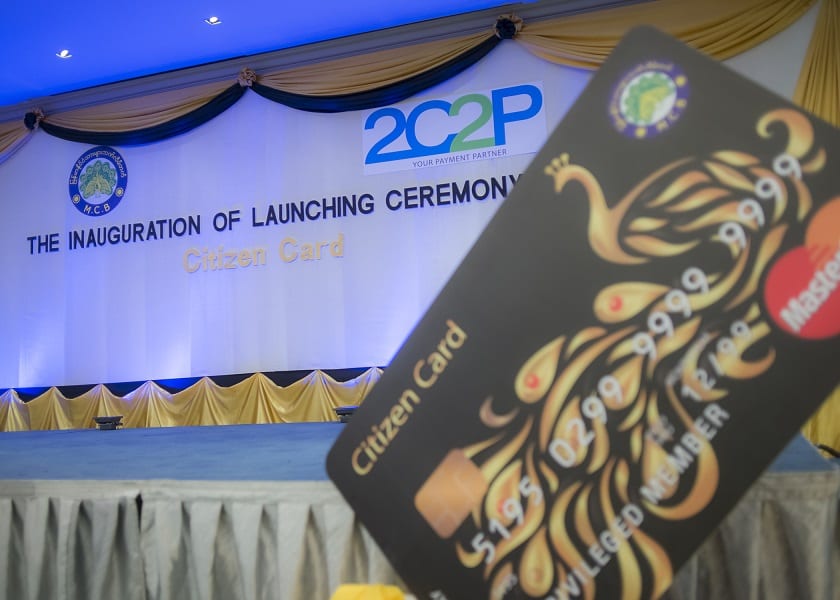
    A citizen card launched by payment services provider 2C2P and Myanmar Citizens Bank is expected to support e-commerce in Myanmar.

    The reloadable prepaid card is accepted by MasterCard merchants and comes with an optional smartphone application that allows cardholders to manage transactions in real time.

    “Targeted at the retail, and travel and tourism sectors, Citizen Card will facilitate both physical and online shopping. It will also be of use to Myanmar tourists when they travel overseas, as consumers can enjoy special benefits and privileges at destinations such as Thailand and Singapore, with a number of partner merchants in the airline, food and beverage and hospitality sectors,” said.

    Initially, supply of the Citizen Card will be limited to 5,000 units but plans are underway for options to roll out more within the year.

    According to McKinsey & Co, Myanmar is expected to quadruple the size of its economy from USD45 billion to over USD200 billion by 2030, with per capita GDP rising from USD1,300 in 2010 to USD5,100 by 2030.

    “Building on this momentum, we are pleased to partner with 2C2P and launch MCB’s very first prepaid card, which will help support the imminent growth in Myanmar e-commerce,” said U Myint Win, Managing Director of Myanmar Citizens Bank.

    2C2P has also introduced in Myanmar iACCEPT, a mobile point-of-sales system with Visa, MasterCard, Myanmar Citizens Bank and Myanmar Hotels International. In July, 2C2P partnered with Creative Web Studios, a Yangon-based e-commerce solutions provider, working to drive financial inclusion and develop Myanmar’s contactless payment infrastructure.

  • Australian shoppers flock to the Boxing Day sales despite poor sentiment

    Australian shoppers flock to the Boxing Day sales despite poor sentiment

    Retailers in Australia were delighted by a strong turnout of shoppers on Boxing Day, giving analysts further reason to suspect a turnaround in consumer sentiment.

    Myer executive general manager stores, Tony Sutton, said the crowd through the doors at the Melbourne Bourke Street store at 5am looked like its biggest in a decade.

    Accounting firm BDO reported that spending in the week before Christmas was up 13 percent on 2013. BDO national retail lead partner Simon Scalzo said the last few weeks of December had seen a shift in consumer sentiment and now more people were willing to spend.

  • Christmas shopping: Consumer anxiety falls in time for retail season

    Christmas shopping: Consumer anxiety falls in time for retail season

    Consumers in Australia are less anxious than at any time in the past 18 months amid signs of a robust finale to the Christmas shopping season.

    The National Australia Bank’s consumer anxiety index, released on Tuesday, has fallen for a second straight quarter to its lowest mark since mid-2013. It also revealed households have increased spending on non-essentials.

    New spending data pointed to solid retail spending growth in December, despite the hit to consumer confidence caused by last week’s siege in Martin Place. Commonwealth Bank figures, released on Tuesday, show the volume of debit and credit card transactions made in stores across Australia in the first three weeks of December was 10.7 percent higher than the same period last year. The total value of transactions was five per cent higher in that period.