Tag: China

  • Brooks Brothers reveals China retail rebrand

    Brooks Brothers reveals China retail rebrand

    Iconic American brand Brooks Brothers has revealed it plans to reposition retail efforts in China, a market which currently ranks third in revenue value behind the U.S. and Japan.

    In a recent visit to China, Brooks Brothers CEO Claudio Del Vecchio said he would like Chinese consumers to be reintroduced to the US heritage men’s brand, which turns 200 years old this year.

    “I think within less than two years, [China] will be our number-two country,” Del Vecchio told reporters, while speaking at one of the brand’s global bicentennial celebration parties, held in Shanghai, after events in Florence and New York this year.

    “We’ve been in Japan for 40 years and it’s still very strong and growing, but not growing as strongly as China. It’s certainly our biggest opportunity for the next 10 years.

    Within 10 years, it might actually be our number-one country,” he added.

    As part of its celebrations, Brooks Brothers inaugurated its store at the HKRI Taikoo Hui mall, inviting brand ambassador Louis Koo, to celebrate.

    With 20 retail stores and 20 outlets in mainland China, Brooks Brothers is looking to tweak its key store locations and rebrand, by positioning stores alongside recognised luxury retailers in China, not necessarily brands with the same price-point.

    “Today in China, our biggest challenge is actually that customers don’t know us, [so] they might judge the quality by the price. Because our price is not that high they might not have the perception of quality that we actually have,” said Del Vecchio.

    “There is a disconnect,” he added. “Our prices are so good, they don’t believe it.”

    The retail shift compliments the firm’s recent efforts to attract more Chinese custom, by shifting distribution partners and tapping online marketplaces.

    In 2016, Brooks Brothers shifted its China distribution from Dickson Concept, which was more of a licensee model, to being more directly operated. Still in retail partnership, Brooks Brothers changed to a new regional partner, working with Walton Brown, part of the Lane Crawford Joyce Group.

    In the same year it signed an agreement to stock its namesake suits and apparel on Alibaba’s Tmall, as well as its more affordable line, Red Fleece.

    “There are other opportunities we want to explore,” Del Vecchio added.

  • Rossignol Group Partners With IDG Capital to Seize Growth In China

    Rossignol Group Partners With IDG Capital to Seize Growth In China

    Skiing brand Rossignol Group has signed an agreement with IDG Capital, a US-based, China-focused investment firm, to launch the brand through Chinese retailers.

    China’s sports tourism market has had double-digit growth since 2011, and growth forecasts over the next five years are in the order of 30 per cent, according to a PWC study. Introduced in 1995 in China, skiing is the spearhead of this exponential development, particularly since the announcement of the 2022 Olympic Winter Games in Beijing.

    The winter sports market in China should reach RMB100 billion (€13.7 billion by 2025). The equipment alone would represent RMB16 billion for the same period.

    Through a capital increase leading to a 20 per cent ownership in the company, IDG Capital will use its expertise to support the development of the French group in the Chinese market. Founded in 1992, IDG Capital was the first foreign investment firm to enter the Chinese market. It has contributed to the growth of more than 700 major companies in China, including Baidu, Tencent and Xiaomi, as well as to the development of international companies such as Moncler, Farfetch, Olympique Lyonnais FC or InFront.

  • These Chinese giants make Facebook and Google look tame

    These Chinese giants make Facebook and Google look tame

    The technology world’s most bruising battle for supremacy is taking place in China. And it could point to Big Tech’s future everywhere else, too.

    Tencent Holdings and the Alibaba Group are ratcheting up their no-holds-barred contest to dominate the ways 770 million internet users communicate, shop, get around, entertain themselves and even invest their savings and visit the doctor.

    The two titans long ago branched out from their core businesses — games and social media for Tencent, e-commerce for Alibaba — to duke it out in ever more realms of Chinese life. They have competed in messaging, microblogging and delivering takeaway food. They go head-to-head in video streaming and cloud computing.

    Today, their fiercest fight is over digital money kept on smartphones. Mobile payments have transformed the Chinese economy. Both giants, plus Ant Financial, an Alibaba sister firm, are spending big to gobble up pieces of the action.

    China’s internet powerhouses stand at the forefront of the nation’s galloping high-tech progress — a surge that has been brought into sharp focus by the Trump administration’s efforts to counter it. On one hand, the standoff over the Chinese telecom equipment-maker ZTE has exposed, to many in China, the degree to which the country still lags in core technologies such as microchips.

    But in the internet realm, China still offers a spooky potential vision of the future, one in which online behemoths like Tencent and Alibaba become the gatekeepers to the entire economy, wielding immense power over traditional industries and becoming very, very rich in the process.

    At a conference in December in the Chinese city of Guangzhou, Tencent’s chief executive Pony Ma said he felt the two companies were competing in “too many” areas.

    “Sometimes I think, ‘Ah, we’re competing in this now, too? All right then,’” Ma said, chuckling. “It’s a little frustrating.”

    A duopoly this broad could not be easily replicated in other countries,  for example the United States. Entrenched competitors and the threat of government intervention generally keep the likes of Apple, Amazon, Google and Facebook from expanding pell-mell into adjacent businesses. All of them have sprawled and overlapped mightily, but Amazon, with its forays into groceries, pharmacies, health care and more, might be the furthest along towards creating an inescapable commercial universe.

    Still, with the European Union enacting tough new privacy laws, and some in the United States eager to follow, Google and Facebook could soon be forced to find ways to make money beyond selling users’ personal information to advertisers, said Raj Rajgopal, president of digital business strategy at Virtusa Corp, a consulting firm.

    “As profitability reduces, they’ll say, ‘Now I need to monetise my customer base,’” Rajgopal said. “The innovation we’re seeing in China could be seen in the US in the next three to five years,” he added. “Customers are demanding that.”

    China’s internet titans have a powerful ally found nowhere else, though: the Chinese government. Tencent and Alibaba have avoided anti-monopoly clampdowns by staying in Beijing’s good graces, said Hu Wenyou, a partner at the Beijing law firm Yingke. Their sheer size also makes them easier for authorities to control. They simply have too much to lose.

    “If you can become so big, and so successful in so many areas, this in itself shows that you must have maintained very good, very friendly relations with the government,” Hu said.

    Neither giant is done getting bigger.

    Each has a market capitalisation of close to $US500 billion ($663 billion), making them among the most highly valued technology firms on the planet. Google and Facebook still claim more users, but the Chinese heavyweights arguably do more — and more, and more — for theirs.

    The latest battleground? Brick-and-mortar stores. Alibaba has spent great sums — $US2.9 billion on a supermarket chain, $US2.6 billion on a department store and mall operator — to conquer the real world. Tencent has followed suit with its own retail partnerships and investments.

    Once the companies have locked people into their payment systems, they can become the enablers of commerce and financial services of even more kinds. In a sign of investors’ excitement about the possibilities, Ant Financial is making plans to go public, in a blockbuster stock offering that could give the company a market value larger than Goldman Sachs.

    China has become a model for tech’s world-swallowing tendencies partly out of circumstance.

    With the country’s high-speed churn of well-funded startups, planting flags on new turf is often the only way for large players not to be constantly losing ground.

    Also, both Alibaba and Tencent have struggled to make much money outside their home market. That means their surest way to keep growing is to get more deeply involved in more areas of their Chinese users’ lives.

    Those lives are riper for tech disruption than lives in the West. In China, small stores dominate retail. Hospitals are crowded and doctors overworked. Most people do not have credit cards. These are easier business opportunities for Alibaba and Tencent than they would be for Amazon or Facebook.

    In a report this week, Morgan Stanley predicted that by 2027, the total market in China in which Alibaba could be making money will be worth $US19 trillion — more than Amazon’s potential market worldwide.

  • Chinese retail tycoon’s fraud conviction thrown out

    Chinese retail tycoon’s fraud conviction thrown out

    China’s supreme court has thrown out the fraud conviction of a retail tycoon in an unusual gesture of official leniency toward entrepreneurs amid a string of high-profile detentions and prosecutions that has rattled the Chinese business world.

    The Supreme People’s Court ruling Thursday reversed the conviction of Zhang Wenzhong, former chairman of Wumart Stores, who served 12 years in prison on charges of improperly obtaining technology development subsidies.

    A number of Chinese businesspeople have been prosecuted or detained for questioning about possible offenses including embezzlement and bribery.

    On Wednesday, a lawyer for the imprisoned founder of the insurance company that owns New York City’s Waldorf Hotel said he planned to appeal his 18-year sentence imposed this month on fraud charges.

  • Wanda and Tencent join forces for omnichannel retail

    Wanda and Tencent join forces for omnichannel retail

    Dalian Wanda Group and Tencent Holdings Ltd will join forces to set up an internet technology firm, strengthening their position in retail.

    Dalian Wanda, which Is the largest property developer in China, will own 51% of the venture and Tencent 42.48%, with the remaining 6.52% going to Gaopeng, a joint venture between Groupon and Tencent.

    The project combines technology and brick-and-mortar retail and it is hoped that developing an omnichannel offering will help the businesses compete in New Retail, a space in which Alibaba is currently the world leader.

  • Vietnam rice exports to China drop

    Vietnam rice exports to China drop

    Vietnam’s rice export sector is showing signs of reducing its dependence on China with other markets picking up the slack, according the Ministry of Agriculture and Rural Development.

    In its monthly report for May, the ministry says that rice exports to China in the first four months of this year dropped to 33.5 percent of the total from 47.5 percent last year. The value of rice imported by China during this period fell 0.9 percent year on year to $370.8 million, it said.

    China still remains Vietnam’s top importer of rice.

    However, while the Chinese market shrinks, other markets in Asia are increasing their intake from Vietnam. Rice imported by Indonesia during the first four months went up 333 times over the same period last year, Iraqi imports increased by over 16 times, that of Malaysia tripled, of Hong Kong increased 41.5 percent and that of Singapore,15.7 percent.

    With the Philippines planning to import over 293,000 tons of Vietnamese rice in the coming months, rice export prices will stay positive, the report said.

    Last year, Vietnam exported almost 5.9 million tons of rice worth $2.66 billion. This number is likely to reach 6.7 million tons this year, according to the United States Department of Agriculture.

  • Pret A Manger sold to Krispy Kreme owner for £1.5bn

    Pret A Manger sold to Krispy Kreme owner for £1.5bn

    Pret A Manger’s global business, including Hong Kong and Singapore, has been sold to global investment firm JAB.

    Flush with cash from the sale of Jimmy Choo and a controlling interest in Bally, JAB is refocusing its core business investments on consumer goods and cafes. The company, majority owned by Germany’s secretive Reimann family – has controlling stakes in US coffee brand Keurig Green Mountain, European coffee supplier Jacobs Douwe Egberts, cafe chains Panera Bread, Peet’s Coffee & Tea, Caribou Coffee Company, US bagel chain Einstein Noah Restaurant Group, Krispy Kreme Doughnuts, and Espresso House, Scandinavia’s largest branded coffee shop chain. It also owns shares in makeup giant Coty and consumer goods company Reckitt Benckiser.

    UK-headquartered Pret A Manger, which has 530 stores globally, including 26 in Hong Kong, one in Singapore and two in Mainland China, serves 300,000 customers daily with global revenues of £879 million (US$1.166 billion).

    JAB will pay nearly $2 billion for the business (including taking over debt) to private equity investor Bridgepoint and an assortment of minority shareholders. According to BBC News, all 12,000 staff globally will receive a bonus of about US$1200. Bridgepoint bought the business in 2008, including a 33 per cent stake then held by fast-food operator McDonald’s Corporation, paying €500 million for the business, or US$584 million at today’s exchange rate.

    Pret A Manger CEO Clive Schlee described the sale announcement as “a day of celebration at Pret”.

    “This agreement recognises the hard work of all our amazing teams around the world. Bridgepoint has been a wonderful owner of the business for more than a decade. All of us at Pret believe JAB will be excellent long-term strategic owners.”

    He said JAB supported Pret’s growth plans, suggesting further expansion in Asia is on the cards as the company refines its offers in Singapore and China.

    “I am really looking forward to this next chapter of Pret’s story.”

    The deal follows a ninth successive year of like-for-like sales growth for Pret A Manger.

    “The brand continues to thrive around the world thanks to our simple recipe of freshly prepared food, served by genuinely engaged teams,” said Schlee.

    JAB partner and CEO Olivier Goudet said his company plans to continue Pret’s “extraordinary growth story”.

    “Management’s proven track record and commitment to customer service, investment in innovation and approach to freshly prepared food position Pret well as it capitalises on evolving consumer taste and lifestyle preferences. We look forward to working with Clive Schlee and his management team, while promoting the Pret brand and supporting Pret’s impressive culture for the next phase in the company’s growth with JAB.”

    Last year, Philippines fast-food operator Jollibee was linked to a bid for Pret A Manger at a value exceeding $1 billion and Bridgepoint was also reportedly considering an IPO for the business.

    It would appear from the published reactions of Pret A Manger management private ownership is a more comfortable fit with the business.

  • JD.com ready to roll out Thai domain

    JD.com ready to roll out Thai domain

    A JV between JD and Thailand’s Central Group, Central JD Commerce will launch online marketplace www.jd.co.th in August.

    A soft launch is scheduled within the next few weeks.

    “Thailand is our second-biggest market in Southeast Asia following Indonesia, with Vietnam in third place,” says JD corporate VP Gloria Li.

    She says Southeast Asia became part of JD’s overseas expansion strategy two years ago. “We will bring our technology expertise and transfers to local teams, building an innovative retail industry.”
    Li says Thailand is an attractive market because of its preference for high-quality products and the rising number of middle-income consumers.

    A partnership with Central Group will enhance the customer experience for online shopping and logistics, as well as warehouse and delivery capabilities.

    The marketplace will provide goods from qualified merchants, most of whom are brand owners and small- and medium-sized enterprises.

    Li says the JV will export Thai products where the company has a footprint, such as China and Russia.

    “Our big-data analytics technology will provide customers insights into products for which there is high demand, helping them run promotions for targeted customers,” says Li. The return on investment with such marketing campaigns can be measured.

    Globally, JD has 301 million customers, with 82 per cent of its orders made via mobile. It is the largest retailer in China with revenue of US$55.7 billion last year.

  • Play-Asia.com Partners with Worldpay to Optimise Payments

    Play-Asia.com Partners with Worldpay to Optimise Payments

    Play-Asia.com, Asia’s leading online gaming and lifestyle brand, has chosen Worldpay, Inc. a global leader in payments, to support the next phase of its business growth as it seeks to reduce fraud and accelerate its expansion plans into new territories.

    Play-Asia.com required a partner that could provide a comprehensive payments solution that would help understand where revenues may be affected by high fraud rates, allowing them to develop effective risk management strategies to minimise potential losses.

    After evaluating several payments providers Play-Asia.com selected Worldpay for its advanced end-to-end solution including online payment gateway, and fraud management services. Worldpay’s Risk Guardian tool is helping Play-Asia.com tailor automated fraud rules for their business model and industry, allowing them to maximise acceptance rates and protect their revenues.

    Supported with detailed insights on transactions, and fraud trends across each market they operate in, PlayAsia.com is equipped with actionable data to optimise their payment traffic and significantly reduce the resources needed to manage fraud. Since working with Worldpay, Play-asia.com has seen a 40 per cent reduction in the time spent processing fraud cases, customer orders and identity verification checks.

    The company can now also serve new customers by offering additional payment methods such as Diners, Discover, and UnionPay in China.

    The partnership with Worldpay has brought together two innovative companies from the gaming and payment industries. Play-Asia.com is renowned as one of the largest online gaming distributors globally, offering gaming products and content, while Worldpay provides in-depth knowledge and state-of-the-art payment technology to help companies reach new customers and improve their online shopping experience.

    Jan Neuhäußer, CEO at Play-Asia.com said, “With over 15 years of serving our customers, we have grown to become a leading online retailer, focused on providing the best shopping experience, genuine high quality products and outstanding gaming choices and experiences.

    “To continue to deliver consistency, quality and global fulfilment through our online marketplace, we required a partner who would support us to develop our offering and strengthen our position. Worldpay’s industry expertise and guidance has enabled us to expand the range of payment options we offer, to alleviate the risk of fraudulent payments, and support our expansion plans into Latin America.”

    Phil Pomford, General Manager for Asia Pacific, Global Enterprise eCommerce at Worldpay said: “Over the next few years we will see the global entertainment market grow from $1.8 trillion to $2.2 trillion, with consumer spending on videogames alone forecast to rise to $498 million by 20211. This is a huge opportunity for Play-Asia.com not just in terms of revenue, but also in providing customers with an optimal online shopping experience. By working with Worldpay to put payments at the forefront of its eCommerce strategy, Play-Asia.com has gained a significant competitive advantage.”

  • Ant Financial to support Shanghai Pudong Development Bank’s digital transformation

    Ant Financial to support Shanghai Pudong Development Bank’s digital transformation

    Ant Financial Services Group (“Ant Financial”) has signed a strategic cooperation agreement with Shanghai Pudong Development Bank Co., Ltd. (“SPD Bank”) to support the bank’s digital transformation with Ant Financial’s technological capabilities. The agreement is the third of its kind announced this month between Ant Financial and established banks, following partnerships with Huaxia Bank and China Everbright Bank.

    Ant Financial and SPD Bank will partner in online risk management, including fraud prevention, with the former providing technological support to help the latter prevent loan, transaction and marketing fraud. The partnership will also leverage Ant’s financial-grade technologies in AI, supply chain finance, biometric identification and risk management.

    “Ant Financial and SPD Bank share the same vision for the future. With this partnership, we will explore how to improve efficiency in banking operations, as well as how to leverage technology to create greater value for our users,” said Eric Jing, Executive Chairman and CEO of Ant Financial.

    In addition to sharing technological capabilities, the partnership will allow Ant Financial and SPD Bank to strengthen collaboration on a broad range of inclusive finance initiatives, from improving user experience while using online and offline payment services, to providing secure, convenient and efficient financial services for small and micro businesses.

    Last year at the 2017 Ant Fortune Open Platform Conference, Mr. Jing indicated that Ant’s technologies would be opened up to current and potential partners, with the only criterion being whether the partnership is innovative enough to deliver value to users.

    The partnership with SPD Bank is just one example of how Ant Financial’s technologydriven solutions are enabling financial institutions to deliver inclusive services efficiently and at scale. In addition to the bank partnerships announced this month, also in May, Ant Financial’s consumer finance service Huabei announced that it would partner with financial institutions to provide consumer financing solutions, while Alipay added two new third-party money market funds to the Yu’e Bao spare cash management platform.

  • Guess narrows losses in first quarter, revenues lift 14% on Asia earning

    Guess narrows losses in first quarter, revenues lift 14% on Asia earning

    Continued momentum in Asia has helped boost revenues for US clothing brand Guess Inc for its first quarter, to May 5.

    As the company continued to take advantage of its infrastructure investments in China and Japan, its operating margin in Asia improved by 430 basis points.

    Asia revenues increased 32.6 per cent in US dollars and 25.1 per cent in constant currency.

    Operating margin for the company’s Asia segment increased 430 basis points to 4.8 per cent in the quarter, compared to 0.5 per cent. This was driven mainly by higher gross margins.

    CEO Victor Herrero says company revenues overall grew 15 per cent in US dollars and 8 per cent in constant currency. “We were also able to expand the company’s operating margin, despite cost pressures related to our transition to our new distribution centre in Europe.”

    At the same time, the company had a GAAP net loss of $21.2 million, a 0.3 per cent improvement on the first quarter a year earlier. An adjusted net loss of $17.8 million was 7.9 per cent better than the same period 12 months ago.

  • Footwear giants shift outsourcing from China to Vietnam

    Footwear giants shift outsourcing from China to Vietnam

    Major brands in the footwear industry are shifting their outsourced work to Vietnam instead of China, but experts doubt this will be a good thing in the long run.

    Sneaker giant Adidas last year had 44 percent of its footwear produced in Vietnam, more than double the 19 percent made by suppliers in China. This figure also marked a 31 percent increase from 2012 for Vietnam and a 30 plus percent decrease for China.

    A similar move can also be seen at Adidas’ rival Nike, which had 46 percent of its footwear made in Vietnam last year, against just 27 percent in China.

    While China remains the top supplier in the fashion industry, Vietnam is now seen by major brands as a solid and critically important supplier in second place, according to survey results released by the United States Fashion Industry Association.

    “We are reporting a change in the sourcing trend, from ‘China Plus Many’ to ‘China Plus Vietnam Plus Many,’” the association said.

    The typical sourcing portfolio today is 30-50 percent from China, 11‑30 percent from Vietnam, and the rest from other countries, it added.

    According to experts in the industry, China manufacturing has become more focused on high value, and with workers’ wages rising, low-cost manufacturing is no longer its priority.

    This explains why Vietnam, Indonesia and Bangladesh are producing more shoes and apparel for export.

    However, while this trend can yield short-term benefits to Vietnam, long-term consequences will be severe, Professor Nguyen Van Nam, former director of the Institute of Trade Research under the Ministry of Industry and Trade said.

    Since advanced technology is not widely applied in Vietnam, the manufacturing sector exploits labor and pollutes the environment, he said.

    “Vietnam needs to push for the newest technologies in manufacturing, otherwise we will be a ‘landfill’ of other countries,” he added.

    Nguyen Duc Thuan, president of the Vietnam Leather Footwear and Handbag Association (LEFASO), highlighted another challenging aspect of the shift at a conference earlier this year.

    As workers in other countries are assisted by machines in the production process, each of them can make 1.2 pair of shoes in an hour, while their Vietnam peers can only manage 0.7, he said.

    “Labor productivity obviously increases when technology and high management skills are used, and this is a challenge that Vietnam needs to meet,” Thuan said.

    Vietnam’s footwear export value has been growing in recent years, from $8.4 billion in 2014 to $14.65 billion in 2017, a 42 percent increase. The country contributed a billion pairs of shoes to the 27 billion pairs produced globally last year.

  • Chinese cross-border online market is yet to be dug out

    Chinese cross-border online market is yet to be dug out

    Cross-border e-commerce is the new fashion trend in China, powered by a rising middle class and robust economic growth. With an estimated 125 million Chinese consumers purchasing $105 billion of overseas products through this channel in 2017, according to a new research report by Azoya Consulting and Frost & Sullivan.

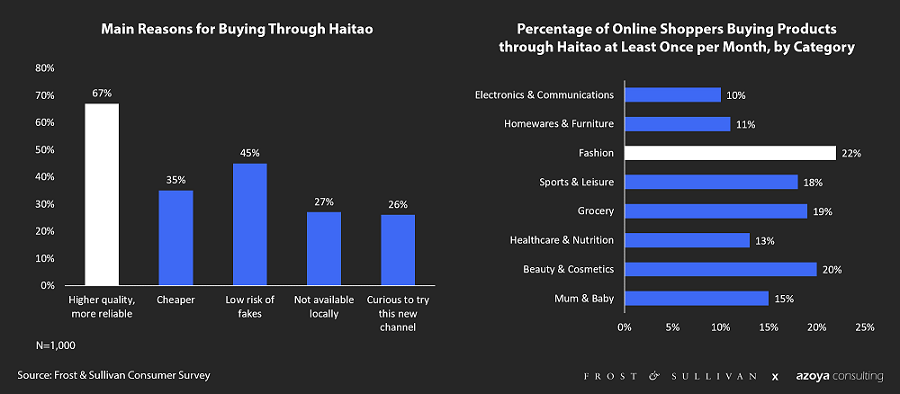
    In China cross-border e-commerce is often referred to as Haitao, which is overtaking the traditional method of buying through daigou agents (personal buyers) or friends/family based overseas as consumers seek a more legitimate, formal avenue for purchasing overseas products.; the research shows that the average Haitao shopper is spending RMB5,300 a year (US$848 a year) on products bought through this channel, with 60% intend to spend more. Fashion, beauty & cosmetics and grocery being the most popular categories.

    In China cross-border e-commerce is often referred to as Haitao, which is overtaking the traditional method of buying through daigou agents (personal buyers) or friends/family based overseas as consumers seek a more legitimate, formal avenue for purchasing overseas products; the research shows that the average Haitao shopper is spending RMB5,300 a year (US$848 a year) on products bought through this channel, with 60% intend to spend more. Fashion, beauty & cosmetics and grocery being the most popular categories.

    However, the research finds out while over 80% of western retailers see China as a lucrative opportunity, only 20% feel confident in their capability to succeed in China’s e-commerce market. Retailers cite regulations, intense competition, investment and not profitable as their main challenges, while retailers from different countries have distinctive strategy on enhancing their capabilities in China.

    Increased competition is making it difficult to succeed in the e-commerce marketplaces such as Tmall and Kaola were once seen as the major platforms where e-commerce sales and customer traffic come from, but now as the marketplaces are getting crowded and acquiring traffic is becoming more and more expensive, retailers find it increasingly difficult to differentiate themselves from one another, either satisfied with their sales performance in marketplaces.

    The research reveals that selling through marketplace holds the lowest satisfaction among other sales channels – only 21% of retailers are satisfied with their sales on marketplaces. Other concerns with selling through marketplaces include lack of direct customer access; high commissions up to 15% eating into margins; upfront costs to establish stores; and intense competition particularly around price.

    As a result, retailers are looking beyond marketplaces as their only approach to consider. “In fact, for retailers aim to establish long-term sales in China and build a brand that Chinese consumers trust, which commands a healthy profit margin and repeat buyers, retailers need to approach customers through multiple touchpoints. The key channel should be within retailers’ control, accompanied by supplementary platforms,” said Don Zhao, Co-Founder of Azoya International. “More and more retailers are establishing standalone websites as the core of their strategies, as these sites directly connect retailers with Chinese consumers who desire foreign brands, while empowering retailers with flexibility and control over their business.”

    Picky Chinese consumers are forcing brands to tailor their offerings to local tastes, while retailers react differently from countries Chinese consumers prefer to shop on cross-border e-commerce foreign platforms due to higher product quality and less risk of buying fake, while they tend to be picky when it comes to platform choices.

    The research finds out that China payment and website performance are the top influencers when selecting to buy from certain platform, the others were cited as Chinese customer support and nearby inventory.

    There’s also a trend that Chinese consumers are also looking for unique niche brands in pursuit of differentiating themselves from their peers and create a unique image. For cross-border transactions, shoppers are increasingly interested in seeking niche products suiting their personal needs; they also values the authenticity of a brand and the story it offers. Brand heritage and storytelling are important for brands to build a relationship with their customers now.

    Localisation is the key. Correspondently, retailers focus on enhancing their capabilities differently varies from countries. In mature countries where Chinese cross-border shoppers are familiar with, such as Australia and the USA, retailers focus on establishing warehouse or distribution centre in China to enhance shipment experience, tailoring their products to local consumer demands, and also Chinese language content such as blog articles to meet the tastes of Chinese consumers; while in the ‘late comers’ countries such as the UK, Germany, France and other European countries, retailers tend to focus on basic capabilities as introducing Chinese language website or entry level solution of social media strategy.

    The research draws a conclusion that retailers are advised to enter the Chinese market to take step by step approach that first research the market to understand the potential of certain brand or products in China, including category and product popularity; a second step involves deciding an entry model that’s most appropriate for their current stage offering the retailers enough control over the business while leave the flexibility of expanding to other channels; and finally, look for a local partner who will be able to guide the retailers through complex market, while adapt in time to the rapidly changing market when implementing.

  • Asia safes Michael Kors performance

    Asia safes Michael Kors performance

    Asia proved the strongest growth market for premium apparel and accessories retailer Michael Kors last year, offsetting ongoing weakness in its largest market, the Americas.

    Asian sales increased 17.5 per cent to US$137.7 million in the fourth quarter and were up 33.7 per cent to $469 million for the year.

    Michael Kors sales and profit numbers released overnight included a better than expected fourth quarter, but flat forecasts for the year ahead disappointed analysts.

    Net income for the three months ended March 31 was $44.5 million, a significant improvement over a $26.8 million loss during the same period last year.

    Fourth-quarter comparable Michael Kors sales were up 2.3 per cent on strength in accessories, footwear and men’s categories, but fell 1.7 per cent on a currency-corrected basis.

    Michael Kors has been investing heavily in transitioning its business model following the acquisition of Jimmy Choo last year, with chairman and CEO John D Idol saying a solid foundation had been created.

    “We created a global luxury group with the acquisition of Jimmy Choo and completed the first year of our Runway 2020 strategic plan for the Michael Kors brand, ending the year significantly ahead of our expectations,” he said.

    “Looking to fiscal 2019, we have a number of initiatives planned to drive growth in both of our luxury brands.

    The company expects building momentum to deliver first quarter revenue of around $1.13 billion, with a $140-$145 million contribution from Jimmy Choo’s 182 stores.

    Neil Saunders said the addition of Jimmy Choo had masked weakness in Michael Kors sales figures for last year.

    “While the headline growth number from Michael Kors looks strong … it is flattered by the addition of Jimmy Choo sales; when these are stripped out, the growth plummets to a lacklustre 0.6 per cent,” Saunders said.

    “This anemic underlying growth rate comes off the back of a dire performance last year when revenues plunged by 11.2 per cent. Taking account of all these things, the fashion brand is ending its fiscal year with soft growth.”

    Store renovations, expansion into new luxury concepts, a renewed focus on e-commerce and the launch of a new loyalty program have emerged as key pillars of the company’s 2020 strategic plan.

    In comparison, Americas sales declined by 2.5 per cent to $342.8 million in the fourth quarter and by two per cent to $1.67 billion for the year.

    “Perhaps the most damning figure is the Americas retail sales number,” Saunders said.

    “A particularly worrying outcome given the 18 per cent decline posted in the prior year. In our view, this number clearly indicates that Michael Kors is not back to full strength and still has a lot of work to do on its proposition.”

    Encouragingly, retail growth and the addition of Jimmy Choo bolstered margins, resulting in a 14.5 per cent increase in gross profit.

    Jimmy Choo sales were $107.9 million worldwide in the fourth quarter and $222.6 million for the full year, with Europe and the Middle East driving turnover.

    There were 1011 stores in Michael Kors business as at March 31, including 829 Michael Kors stores.

  • Alibaba shows off automated wine store in Hong Kong

    Alibaba shows off automated wine store in Hong Kong

    Alibaba’s Tmall, China’s leading B2C online marketplace, wants to give wine selection and consumption a 21st century upgrade.

    At Vinexpo Hong Kong this week, Tmall unveiled a host of new technologies for the industry, including an automatic wine store, initiatives far from the grape-stomping and oak barrels of old.

    Tmall showcased a “Future Bar,” which included facial-scanning for entry, a robot waiter, RFID technology to enhance browsing, touch-screen displays for product research and a “Smart Wine Cooler.” The technologies are part of a larger trend in “New Retail,” an initiative in China led by Alibaba to merge the best of online and offline commerce for the benefit of both consumers and merchants.

    Mike Hu, a senior director at Tmall, said the goal of New Retail is to make shopping more personal, more engaging and more convenient – even in traditionally stodgy industries such as wine.

    “China really is at the forefront of consumer engagement right now,” Hu said. “Shopping here is mobile, it’s fun, it’s interactive, and the wall between e-commerce and brick-and-mortar stores is coming down. This kind of comprehensive shopping experience is what Chinese consumers have come to expect, so wine sellers need to adapt if they want to be successful here.”

    Upon arriving at Alibaba’s booth, attendees were greeted by the Tmall Robot Waiter, who asked, “Hey, don’t you want to have a drink?” – in multiple languages. The advanced human-computer interaction offered a glimpse of the future for wine merchants and their customers, Hu said.

    Facial scanning

    Facial scanning, meanwhile, offered entry to the booth and pointed a still-growing but soon-to-be important part of the consumer experience in China: facial-recognition payments, Hu noted. Already, Alibaba’s supermarket chain, Hema, has implemented the technology in one of its Shanghai stores. It is being tested in a cashierless store at Alibaba’s Hangzhou headquarters as well.

    The RFID technology was embedded in the foil wrapping that covers the cork so that when they were picked up from a shelf, their product information was displayed on a nearby screen. So, too, were recommendations for food pairings.

    Touchscreens at the booth allowed visitors to research a wine’s home chateau and place orders through the brand’s Tmall flagship store. This kind of setup would save much-needed stock and shelf space for retailers, Hu said, while providing greater selection for consumers visiting the shop and offering delivery direct to their homes.

    Users of Tmall’s Smart Wine Cooler scanned a QR code to open the cooler door, after which they could choose their favorite bottle and then simply close the door again to pay automatically. Or, as Tmall put it, “close the door, the deal is done.”

    Ecommerce marketplaces, such as Tmall, are playing an important role in China’s wine market, said Guillaume Deglise, CEO of Vinexpo. Not least because the brick-and-mortar retail business is not on par with other markets.

    “It’s very difficult to find very good shops in China, especially in tier-two and tier-three cities,” Deglise said. “So, e-commerce is changing this.”

    Also, younger consumers in China are more used to online shopping than their peers in the US and Europe, he said, “so the distribution will be different in China than the rest of the world.”

    Asia, overall, is driving global growth in the wine market, according to a new report from Vinexpo. And China is leading that trend. The country was the world’s third-largest importer in 2017 by value, at $16.41 billion, behind only the US and UK By 2021, however, China will overtake the UK in the number-two spot with $22.97 billion – a near 40 per cent jump.

    Deglise points to the middle class for these increases, especially those in urban centers, such as Beijing and Shanghai. An uptake among women is also playing a role, as is a general trend toward wellness in China that has people reaching for vino instead of the country’s traditional “baijiu” hard liquor.

    Then, there’s travel to markets where wine is already popular, such as the US, Europe and Australia, which gives Chinese consumers the chance to try new varieties.

    “When they come back home they tend to drink more wine than before,” Deglise said.

    This means that wine-producing countries will benefit, he added. Vinexpo expects almost all producing countries to increase their exports to China over the next five years, making China the only market to prompt such demand.

    “All producing markets are depending on China,” Deglise said. “It’s a huge market with tremendous potential.”

    Alibaba signed two memoranda of understanding at Vinexpo on Wednesday, with governmental organisation Wine Australia and French wine critics Bettane & Desseauve. Tmall will work to market Australian wines on the platform and support Wine Australia’s marketing efforts around major events such as the 11.11 Global Shopping Festival. For Bettane & Desseauve, Tmall will use their reviews to complement its wine listings while also hosting their annual top wine lists as they are released. They will also partner on offline wine events in China.