Chinese internet giant Alibaba is seeking Competition Commission of India (CCI) approval to acquire a stake in online grocery startup BigBasket.
Financial details have not been disclosed in the CCI filing, which relates to “the acquisition and purchase of shares” of BigBasket parent Supermarket Grocery Supplies by Alibaba Singapore.
Alibaba Group Holding and its Indian associate PayTM E-Commerce were reported in July as having a 60-day exclusive pact with BigBasket. There were also reports of BigBasket being in merger talks with rival Grofers.
BigBasket has a presence in Bengaluru, Hyderabad, Pune, Mumbai, Chennai, Delhi-NCR, Kolkata, Jaipur, Punjab and Lucknow as well as four other cities, and has raised more than $200 million from investors.
Asia Pacific sales accounted for 39 per cent of group sales for Swiss luxury-goods holding company Richemont for its half-year to September 30.
Sales in Asia Pacific rose by by 25 per cent, with double-digit growth in most markets led by Mainland China, Hong Kong, Korea and Macau. While all product categories saw growth, the unaudited figures show jewellery and watch sales were particularly strong year on year, with watches benefiting as no inventory buy-backs were needed as in the previous year.
For Japan, the 7 per cent rise in sales was driven by higher domestic and tourist spending, which benefited from a weaker yen. Jewellery and watches led sales growth, partly supported by the reopening of the Cartier flagship store in September last year and new flagships for Piaget (November) and Van Cleef & Arpels (April), all in Ginza.
Overall, group sales rose by 10 per cent at actual exchange rates to €5.6 billion (US$6.5 billion) and by 12 per cent at constant exchange rates. Excluding the previous year’s inventory buy-backs, sales increased by 8 per cent at constant exchange rates.
Operating profit expanded by 46 per cent to €1.1 billion, with profit for the period up 80 per cent to €974 million.
Gross profit increased by 13 per cent, representing 65.4 per cent of sales. The 190-point margin increase was mainly because of the non-recurrence of inventory buy-backs and improved manufacturing capacity absorption, says Richemont.
Profit grew by 80 per cent to €974 million, mainly reflecting the higher operating profit and a €181 million reversal in net finance income.
A growing middle class in China that likes shopping for foreign brands is helping drive cross-border e-commerce spending, according to a forecast by research company eMarketer.
However, it warns of a growth slowdown ahead.
Total cross-border e-commerce sales in China are expected to reach US$100 billion by the end of this year, with the average buyer spend of $882. This average has increased since eMarketer’s previous forecast thanks to a growing awareness in China of overseas brands, as well as improved logistics and the perception that foreign goods are of better quality.
Also contributing to the growth is the popularity of JD Worldwide, Kaola and Tmall Global, sites that have made it easier for shoppers to access overseas products, says the eMarketer report.
It also notes that 23 per cent of digital buyers in China will make at least one cross-border purchase, but growth in these purchases will start to slow as preference switches to local brands for some categories, such as fashion. Realising the demand for better-quality goods, Chinese brands are starting to adapt, says the report.
However, eMarketer senior forecasting analyst Shelleen Shum says that with shopping sites adding more brands and improving cross-border logistics and processing times, foreign brands still have an opportunity to tap into the demand for high-quality products, especially in categories like baby, maternity, health and beauty.
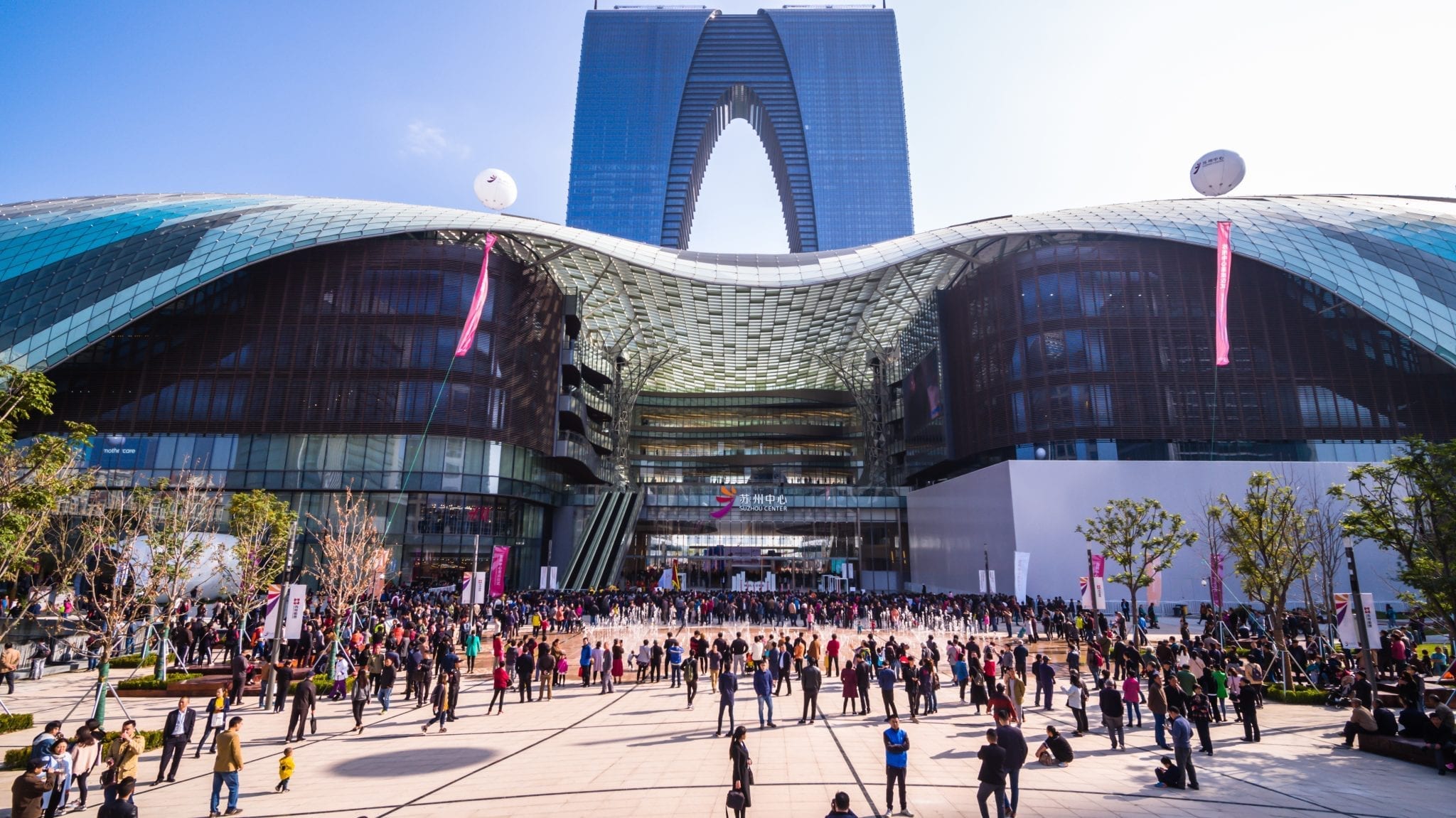
With the opening of its largest shopping centre yet, Suzhou Center Mall, Singapore retail-estate company CapitaLand has marked a record year of a million square metres of retail space.
More than three times the size of Ion Orchard in Singapore, the mall is also the largest shopping centre in the Chinese city. It spans nearly 300,000sqm in gross floor area (GFA), excluding car park.
More than 600 retail brands are housed within the mall, in the heart of the western CBD of Suzhou Industrial Park, next to the historic Jinji Lake. It is the centrepiece of the Suzhou Center integrated development that also comprises four grade-A office towers, two luxury residential towers and the W Suzhou hotel tower, which are all interconnected.
With a total GFA of 1.13 million square metres served by a 1570m tunnel leading to its basement car park and directly linked to two metro lines, Suzhou Center was master developed by Suzhou Hengtai Holding Group, owned by the Suzhou Industrial Park.
CapitaLand, through its wholly owned shopping business CapitaLand Mall Asia, is co-owner and co-developer for the mall and two 21-storey office towers.
World’s largest
Designed by multiple award-winning architectural firm Benoy, the seven-storey Suzhou Center Mall has an undulating roof that is the world’s largest free-form monocoque roof at more than 36,000sqm. Shaped like a pair of phoenix wings to symbolise Suzhou’s growth taking flight, the multi-coloured roof comprises 6947 pieces of uniquely shaped glass.
Suzhou Center Mall also boasts 60,000sqm of greenery across terraces, rooftops and the landscaped cantilever bridges that extend from two ends of the mall to the lakefront. A 45m-wide, 25m-high water curtain is a feature of the mall’s facade facing Jinji Lake.
The mall opened with more than 90 per cent lease commitment for its net lettable area of about 152,000sqm. Anchor tenants include more than 600 brands including Suzhou’s first CGV cinemas, its first Fanpekka children’s theme park, first indoor simulated gaming centre, an Olympic-size ice rink, a gourmet supermarket and a food court.
Nearly a third of the mall’s offerings are new to Suzhou, including Forever 21 and Victoria’s Secret. H&M and Zara will run triplex stores in the mall, their biggest outlets in the city.
CapitaLand says that with the opening of Suzhou Center Mall, 61 of its total portfolio of 69 owned and managed malls in China are up and running.
CapitaLand CEO Lim Ming Yan says the mall’s opening caps a record year for the company. “Nearly 1 million square metres of retail GFA across eight developments came on line this year, marking our largest-ever retail offering in a single year.”
CapitaLand Mall Asia CEO Jason Leow says that about 85 per cent of the group’s total assets contribute to recurring income, of which shopping malls and integrated developments form the bulk. “As we increase CapitaLand’s recurring income base with mall openings, we will also continue to enhance our retail scale and network through acquisitions and management contracts, as well as reconstitute our portfolio to achieve an optimal asset mix.”
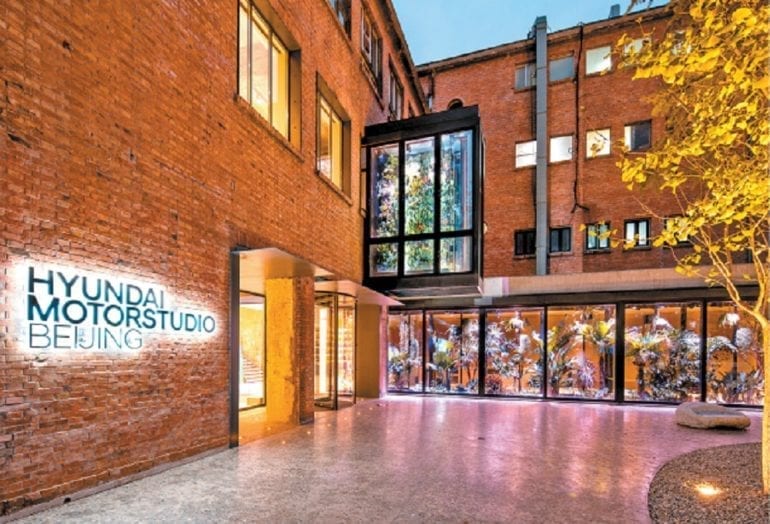
Hyundai Motor Group, Korea’s largest automaker, opened its sixth brand experience space in Beijing to reach more Chinese consumers.
Hyundai Motorstudio Beijing is located in the city’s 798 Art District, known for its galleries and cafes. The center will be a cultural space and not feature any cars. The Motorstudio is the second overseas location of its kind after one in Moscow.
Chung Eui-sun, the company’s vice chairman, attended the opening ceremony in Beijing on Nov 1, indicating just how vital the Chinese market is to the automaker. Hyundai Motor has been struggling in the country and hopes the center will boost its fortunes in the world’s largest auto market.
“Hyundai Motorstudio Beijing represents the direction of Hyundai Motor’s future path, which centers on sustainability and creative energy that can solve social problems,” Chung said. “It feels more meaningful that such venue could be established in this experimental and innovative neighborhood of 798 Art District.”
Hyundai Motorstudio Beijing includes a book lounge and cafe on the first floor and gallery on the second floor. A vivarium occupies one side of the building’s exterior, and other art installations are scattered across the studio space.
Along with the space, the automaker is running a program called Hyundai Blue Prize to support emerging artists and select a few to display their work in the Motorstudio.
The opening comes amid a thaw in relations between Seoul and Beijing. The Korean and Chinese governments agreed to a rapprochement after months of diplomatic cold shoulders over a U.S. missile defense system in Korea that China believes threatens its security.
Chung said at the ceremony that he expects a “positive effect” from the promise of better relations between the two countries.
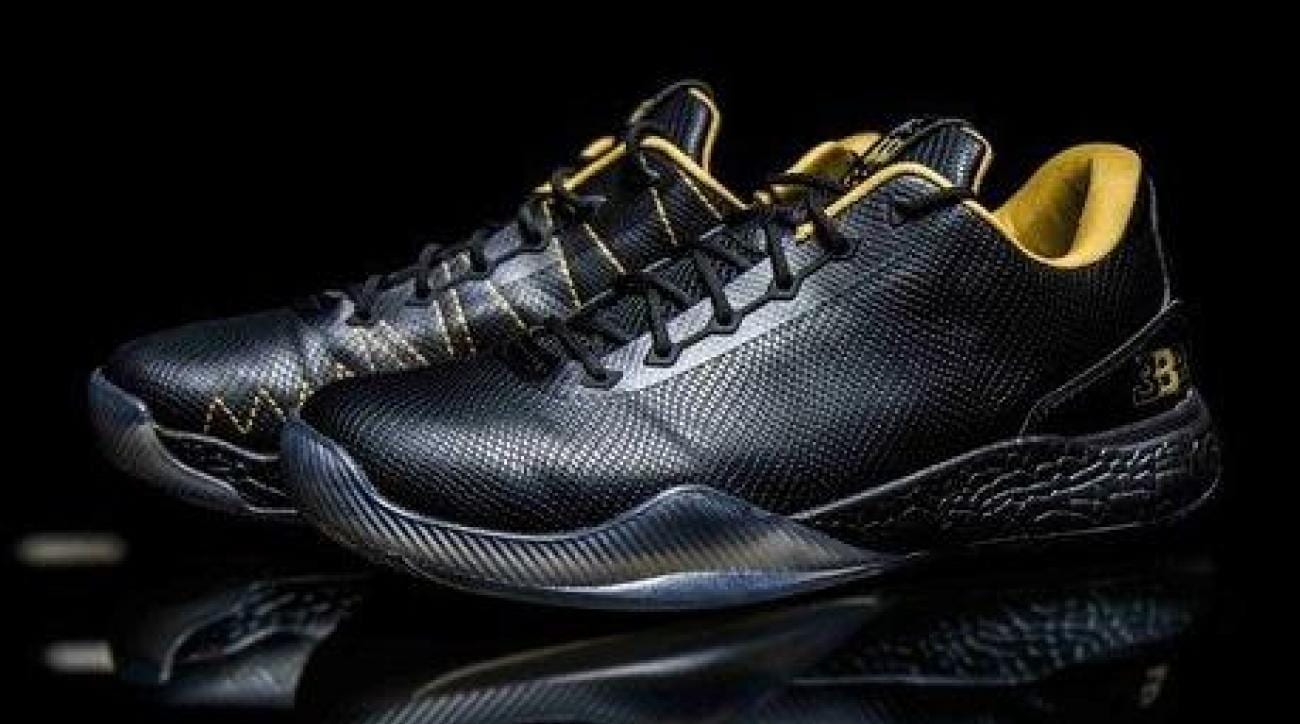
American sports apparel company Big Baller Brand has bounced into Hong Kong and Mainland China on the back of a basketball game.
Founder/CEO LeVar Ball, a former basketball and football player, took advantage of a match in which his son LiAngelo played for UCLA (University of California, Los Angeles) in Shanghai’s Mercedes Benz Arena, which has also just hosted the Victoria’s Secret annual showcase.
ESPN writer/editor Jovan Buha says the family used the trip to launch Big Baller Brand China via two pop-up stores, one at streetwear outlet WZK Shanghai followed by the other, opening today at Juice in Hong Kong.
Buha says the family’s brand is set to open its own flagship stores in both cities, along with a dedicated Chinese website.
Big Baller Brand was inspired by LiAngelo and his brothers Lonzo and LaMelo – following in their father’s footsteps as basketball players.
JD.com brings to the partnership its competitive edge in logistics and technologies such as artificial intelligence, cloud computing, drones and robots, while Central offers retail expertise including knowledge of Southeast Asian markets, brand relationships, customer base, physical store network and loyalty programmes.
E-commerce has enormous growth potential in Thailand, which the partnership hopes to tap into. For example, only 1-2 per cent of Central’s sales are online; by working with JD.com, Central aims to increase this to 15 per cent by 2021.
A major benefit for Central is better access to the Chinese market. JD.com has an alliance with Tencent, owner of the popular messaging app WeChat that averages 902 million daily logged-in users (as of September 2017). JD.com customers who make their purchases with WeChat have their goods delivered using an advanced logistics system which increasingly features drones. JD.com’s 150 or so drones make more deliveries than any other drone user globally. The company is also testing drones that can carry up to a tonne, and using robots in its warehouses.
JD.com’s drone-delivery model is different from that being tested by US retailers such as Amazon and 7-Eleven. Instead of delivering packages direct to individual homes, local distributors receive and distribute them. In the US, a stricter regulatory environment and privacy concerns mean drone deliveries are not advancing as rapidly as in China and are still in the testing phase.
JD.com founder and chairman Richard Liu believes drone deliveries would save massively on costs, especially in rural areas. He estimates that drone deliveries are at least 70 per cent cheaper than delivery by truck and take a fraction of the time.
Unlike China’s other e-commerce giant Alibaba, JD.com is focused on building a complementary bricks-and mortar-business through strategic alliances with strong retail brands such as Walmart, and selling luxury goods through its partnership with the online luxury-brand marketplace Farfetch.
According to Liu, JD.com is attracted to Thailand because of its large population, developed infrastructure and strong logistics network. The plan is to make Thailand a major hub for e-commerce expansion across Southeast Asia.
Many North American retail stores are closing – Sears and Macy’s among them – so it is encouraging to see the confidence reflected in this partnership. Given the Chinese love of shopping, Thailand’s experience in developing luxury malls and the rapid development of technology in this part of the world, this points to a prosperous future for retailing in Asia.
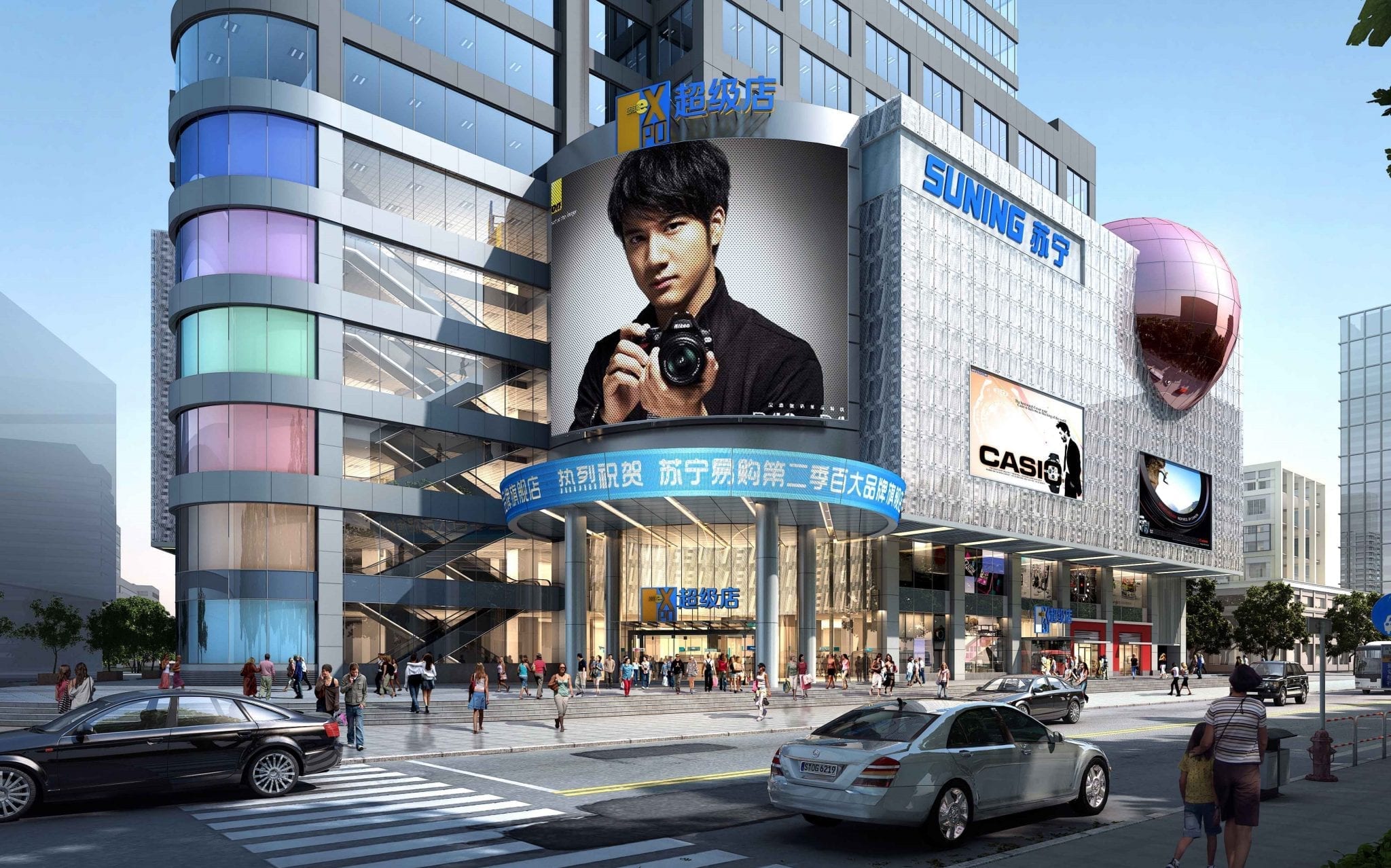
A Suning store in Shanghai introduces an intelligent self-service checkout using facial-recognition technology for payments.
Suning Biu is reportedly the retail giant’s second such store in China, reports China.org.
Covering about 100sqm, the new Suning store is larger with more varied product categories than the company’s first unmanned shop in Nanjing, where Suning has its headquarters.
Before shopping, customers need to download an app and upload their personal information including a photo of their face and a bank card. In the shop they scan their face to take advantage of the automatic payment process.
Without having to scan QR codes or barcodes to calculate prices, clients just need to step into a “payment area” at the exit and look at an overhead camera. Their purchases will be listed on a screen, and payment completed automatically using their registered bank card. The few staff members in the store are there to offer technical instructions if necessary.
Suning.com vice-CEO Fan Zhijun says self-service stores are expected to be introduced to other cities in China.
Louis Vuitton Korea has fallen behind its rivals, with sales dipping into minus territory this year, industry data shows.
Sales at a leading department store for the international fashion house for the January-October period backtracked 5.3 per cent. Demand for Louis Vuitton products were down 2.1 per cent at another department store during the same period.
Meanwhile, rivals Chanel and Hermes achieved double-digit sales during the same period. Chanel added 11.2 per cent and 13.7 per cent at the two department stores, while Hermes managed 16.5 per cent and 17.1 per cent growth, respectively.
“The vast popularity of Louis Vuitton in the past and consequent sales have made the brand too common, taking away much of its cachet,” an unidentified retailer said. “The popularity of its monogram series fizzled out, and there was no succeeding product, which is another reason for the slump,” he said.
Exact sales figures are not available for Louis Vuitton, after its local operator was turned into a privately-held company from a limited company in 2012 when its lack of social contribution compared to its dividend propensity became controversial. Privately-held firms do not have to disclose detailed corporate information, such as donations.
A law was revised recently, however, requiring private companies to undergo external inspections and to disclose financial information, including sales, dividend rates and contributions.
the frenzied annual celebration of consumption and commerce that is China’s much larger version of Black Friday — began as a protest of sorts against Valentine’s Day, propelled by college students in the 1990s.
The event’s date, written numerically as 11/11, was associated with unattached singles, known as “bare sticks.”
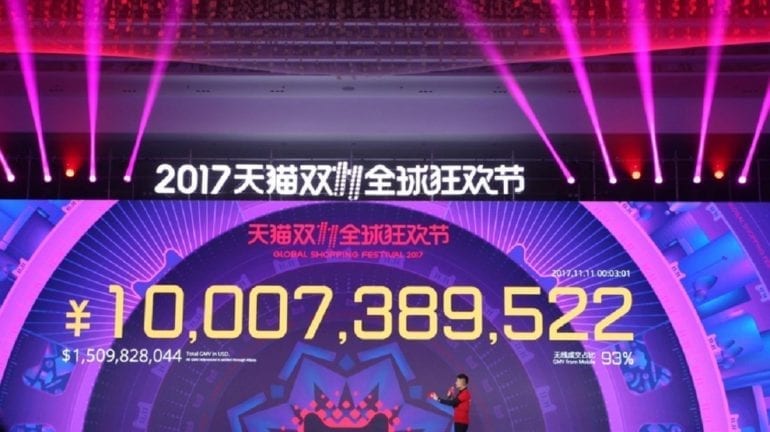
This year’s shopping festival entered new territory, blazing past $1 billion within two minutes of the holiday, starting at midnight on 11 November.
Singles’ Day is now inextricably linked with Alibaba, the Chinese e-commerce leviathan that in recent years has turned the holiday into an online — and occasionally brick-and-mortar — mercantile extravaganza. It routinely eclipses Amazon’s yearly Prime Day promotional event.
In July 2017, Prime Day generated an estimated $1 billion in revenue during its 30-hour sale window, resulting in what Amazon called its “biggest day ever.” A little more than an hour into this year’s Singles Day, sales had already exceeded $10 billion.
The event has evolved into a cultural phenomenon. On Friday night, Alibaba hosted a lavish gala in Shanghai, directed by one of the producers behind the 2016 Academy Awards.
Celebrities such as Nicole Kidman, Pharrell Williams and Maria Sharapova helped count down the moments before the 60,000 participating global brands released their Singles’ Day deals to shoppers.
One offer, from the Chongqing-based online alcohol brand Jiang Xiao Bai, allowed 33 fast-moving customers to make a single payment of 11,111 yuan, or $1,673, for a lifetime supply of a grain liquor known as baijiu.
Singles’ Day, which is largely powered through Alibaba’s Tmall marketplace, will test the company’s logistics network. The company promised delivery within an hour for certain products and, in advance of the shopping festival, converted nearly 100,000 stores across China into “smart stores” capable of processing payment using facial recognition and other advanced technologies.
Sales momentum in Mainland China helped boost growth for French luxury retailer Hermes in its third quarter.
Overall sales grew 11 per cent at constant exchange rates, and at the end of September revenues were up 10 per cent to €4 billion (US$4.6 billion).
Despite a strong comparison basis, sales in Asia (excluding Japan) rose 14 per cent, while Japan achieved a solid performance with a 5 per cent increase in the face of a strengthening yen.
Hermes says all sectors recorded growth, with a “remarkable” 11 per cent performance by ready-to-wear and accessories.
The 11 per cent growth in leather goods and saddlery was in line with the annual target of around 10 per cent, says the company, thanks to the success of its collections and diversity of models, particularly the Constance, Halzan, Lindy and Verrou bags, alongside Birkin and Kelly.
With 9 per cent growth, the silk and textiles business line benefited from sustained demand, the diversity of the collections and the wealth of the creations, says Hermes.
Strong growth of 13 per cent was posted by the perfumes division, driven notably by the launch of Twilly d’Hermes.
There was a slight 1 per cent improvement for watches, while other lines grew by 11 per cent, including jewellery, art of living, and table arts.
French luxury brand Hermès launched its very first WeChat pop-up store, a strategic move signaling the brand’s ambition to step up its digital innovation in China. But it also raises the question of just how aggressive it can be in the digital space.
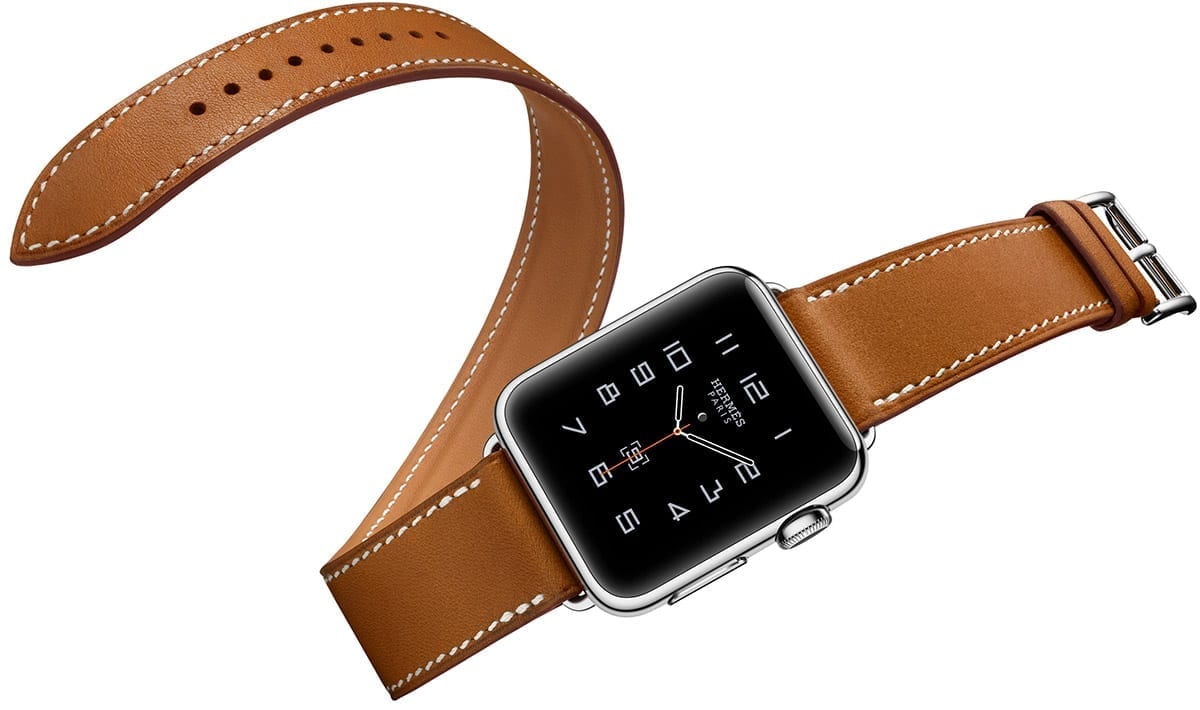
The WeChat post by the brand to introduce the pop-up store has a 13-second promotional video about the new Éperon d’Or Hermès x Apple Watch.
The product, in collaboration with Apple, features the classic pattern of Hermès scarf on the wristband. The pop-up store will last for two weeks.
When clicking on “read more” at the bottom of the post, readers are taken directly to Hermes’ watch collection page which offers a detailed view of six models.
The prices range from 8,988 yuan ($1354) to 10,988 yuan ($1655). Buyers need to register an account with the site—leaving their phone number and other relevant information—to track the order, and they must use WeChat Pay to complete the deals.
Chinese consumers have shown high interest in Hermès’ WeChat offering: by the time of this publication, the post had attracted 15,986 pageviews.
According to Hermès’ earnings results of the first six months of 2017, China led the growth in the Asia-Pacific region, contributing 14 percent to the region’s total revenues.
The brand continues to see rising interest among Chinese customers in purchasing its signature handbags, namely the Birkin Kelly, Constance, and Lindy models.
“We have really seen a recovery of China,” the global chief executive of Hermès International Group Axel Dumas said in an interview with Financial Times, “and the beginning of growth again in Hong Kong and Macau.”
For Hermès, the rebound of luxury consumption in China posed the question of how it can best capture the demand in the market for digital shopping.
Compared to many other luxury powerhouses, Hermès is a latecomer to the digital shopping game in China.
Hermès set a textbook example for hunger marketing, a strategy often deployed by brands to make consumers feel hungry for certain type products through a limited number of offers. Hermes has used this strategy before to promote the Birkin bag. With limited time and quantity, the offer of Apple Watch in the WeChat store has employed a similar technique.
However, this strategy of utilizing a sense of urgency is certainly not a new approach. Many brands, namely Dior, Longchamp, and Bulgari, were early adopters of WeChat flash sales, making headlines with impressive sales numbers from the flash sales. For example, during last year’s Chinese Valentine’s Day, Dior offered a Lady Dior handbag for 28,000RMB ($4,210) for four days; the media reported that all 200 models were sold out by 2 August 2017.
As the brand’s key rivals like Louis Vuitton and Gucci are selling online in China, there is a possibility for Hermès to open an exclusive e-commerce site for the country’s consumers, too.
There might be reasons why Hermès has been slow to adopt this digital trend; it is a reflection of a general attitude of the luxury industry to digital change.
They face many questions such as whether going digital can deliver the same luxury experience to consumers, or if it can become a steady purchase channel for high-priced goods. Luckily, the past experiences of early adopters show that the value of luxury can still be held if the brands approach it appropriately.
For Hermès, it is going to be a task to balance exclusivity and availability on the digital channel in China and their answer to it will set up an example for many luxury brands.
It is that time of the year again. China’s – and the world’s – biggest online shopping event is about to take place on 11 November.
Known as Singles’ Day, Alibaba and its founder, Jack Ma, transformed the de facto holiday from an ‘anti-Valentine’s Day’ for Chinese singletons to a global shopping festival back in 2009 – and made billions of dollars in the process.
How did it start?
Singles’ Day, also known as ‘bare sticks holiday,’ started in 1993 at Nanjing University as a day for students to celebrate their singledom. The date 11 November was chosen as it resembles 4 solitary bare sticks.
The annual event kicks off on the midnight of 11 November and runs for 24 hours featuring steep discounts that are driven by the main Alibaba-owned platform, Tmall.
Essentially, think of it as the Asian version of America’s Black Friday and Cyber Monday shopping sales – but bigger than the two combined.
Who’s participating?
This year, Alibaba says over 15 million products from more than 140,000 brands, including 60,000 international brands, will be offering discounts on Tmall – up from 100,000 in 2016.
Besides the e-commerce giant, other platforms like JD.com have become a key competitor and will be pushing equally hard to attract shoppers.
How much is spent?
In terms of sales, Singles’ Day is known for racking up record numbers – more so than Black Friday, Cyber Monday or Amazon Prime Day sales. In 2016, Alibaba made a staggering $17.8 billion ($5 billion in the first hour alone) and intends to break that record this year.
How is the high demand met?
Shoppers purchase everything – home appliances, electronics and even cars – on the day. To manage the high volume of deliveries, Alibaba opened its first automated, robot-managed warehouse. JD.com is not resting on its laurels either. It has teamed up with Walmart to simplify shopping processes and speed up deliveries.
2017 : Increased focus on luxury
This year, through strategic partnerships with international fashion luxury brands like Jason Wu, Opening Ceremony and Robert Geller, Alibaba is focusing heavily on the luxury sector. Similarly, JD.com is appealing to high-end consumers by launching a new luxury e-commerce site, TOPLIFE, which will go live on Singles’ Day.
The ‘New Retail’ strategy
This year also marks the one-year anniversary of Alibaba’s ‘New Retail’ strategy launch. The term coined by Ma aims to depict the increasingly blurry lines between offline and online shopping. As such, Alibaba is partnering with 52 shopping malls to set up 60 pop-up stores across 12 cities in China.
100,000 stores will also become ‘smart stores’ with tech features ranging from facial recognition-powered payment solutions, scan-and-deliver O2O shopping feature and AR beauty tutorials to create a much more immersive experience.
Entertainment will be big
To kickstart the event, Tmall will host a four-hour star-studded countdown gala on the night before, where Pharrell Williams is expected to perform alongside other Chinese celebrities. Last year, the glitzy show attracted over 400 million viewers – three times the number of those who watched this year’s Super Bowl.
Jack Ma to unveil debut movie
Starring alongside action superstars Jet Li and Donnie Yen, Ma will be unveiling his martial arts film, Gong Shou Dao (The Art of Attack and Defence), on video platform Youku on Singles’ Day. To promote the film, Ma also released a theme song entitled Feng Qing Yang that he recorded with Chinese singer Faye Wong.
Going global
“We want to make this a global holiday, a global festival for every consumer… We want [to] help global small business…” Ma told CNN in 2016. To demonstrate it, this year Tmall will bring 100 Chinese brands overseas offering special promotions to target millions of consumers around the world.
If you’re in China…
Timing is everything, so be sure to prepare your shopping list early instead of browsing the entire site once the sale starts. While you’re checking out, also look out for additional promo vouchers that you can use to gain further discounts. Payment can be made with Alipay, UnionPay or major credit cards.
If you’re abroad…
Since most of the sites are in Chinese, prep yourself with a translation tool like Google Translate to help you navigate. Before checking out, ensure the products can be shipped to your destination. Lastly, do a quick research to find out which credit cards offer the lowest rates for inter-bank transactions and exchange rates.
Alibaba, the Chinese e-commerce giant, said on 11 November 2017 its Singles’ Day sales extravaganza hit $25.4 billion, smashing its own record from last year and cementing it as the world’s biggest shopping event.
Once a celebration for China’s lonely hearts, Singles’ Day has become an annual 24-hour buying frenzy that exceeds the combined sales for Black Friday and Cyber Monday in the United States, and acts as a barometer for China’s consumers.
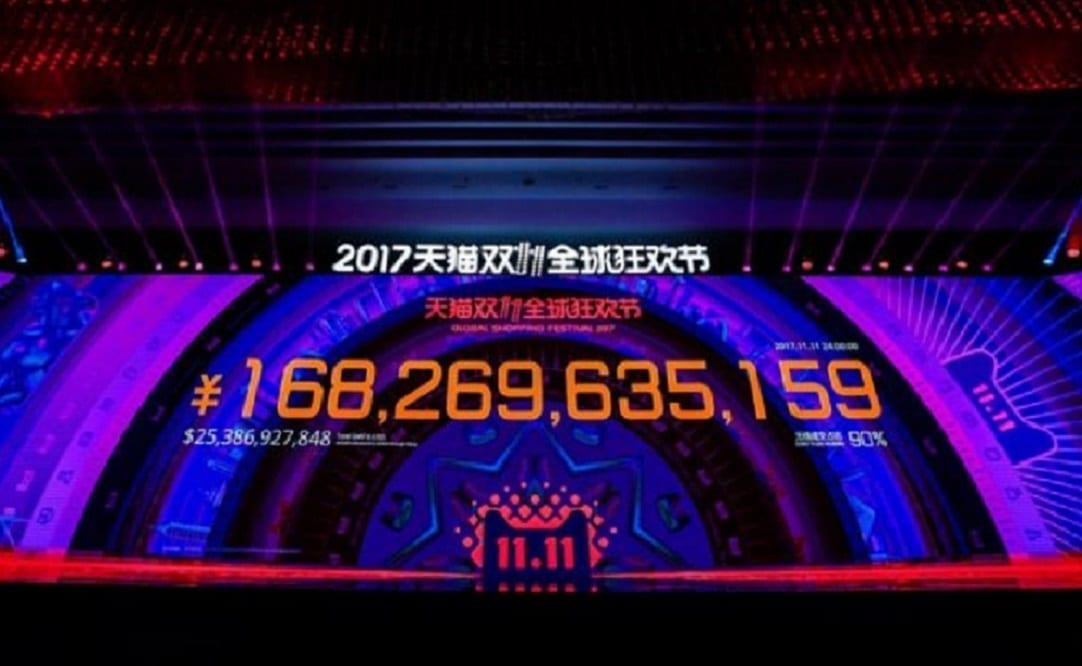
As tills shut midnight on Saturday, Alibaba’s live sales ticker registered 168.3 billion yuan, up 39 percent from 120.7 billion yuan in 2016. The dollar figure was up more steeply due to the strength of the yuan against the greenback in 2017.
The event began soon after a star-studded event in Shanghai late on 10 November 2017. As midnight hit, a deluge of pre-orders helped drive a billion dollars of sales on Alibaba’s platforms in the first two minutes and $10 billion in just over an hour.
“In terms of scale it just dwarfs any other event out there,” said
Ben Cavender, Shanghai-based principal at China Market Research Group.
At just past the halfway mark, the headline gross merchandise volume swept past last year’s dollar total just shy of $18 billion. Shortly afterward, sales surpassed the 2016 total in the local currency.
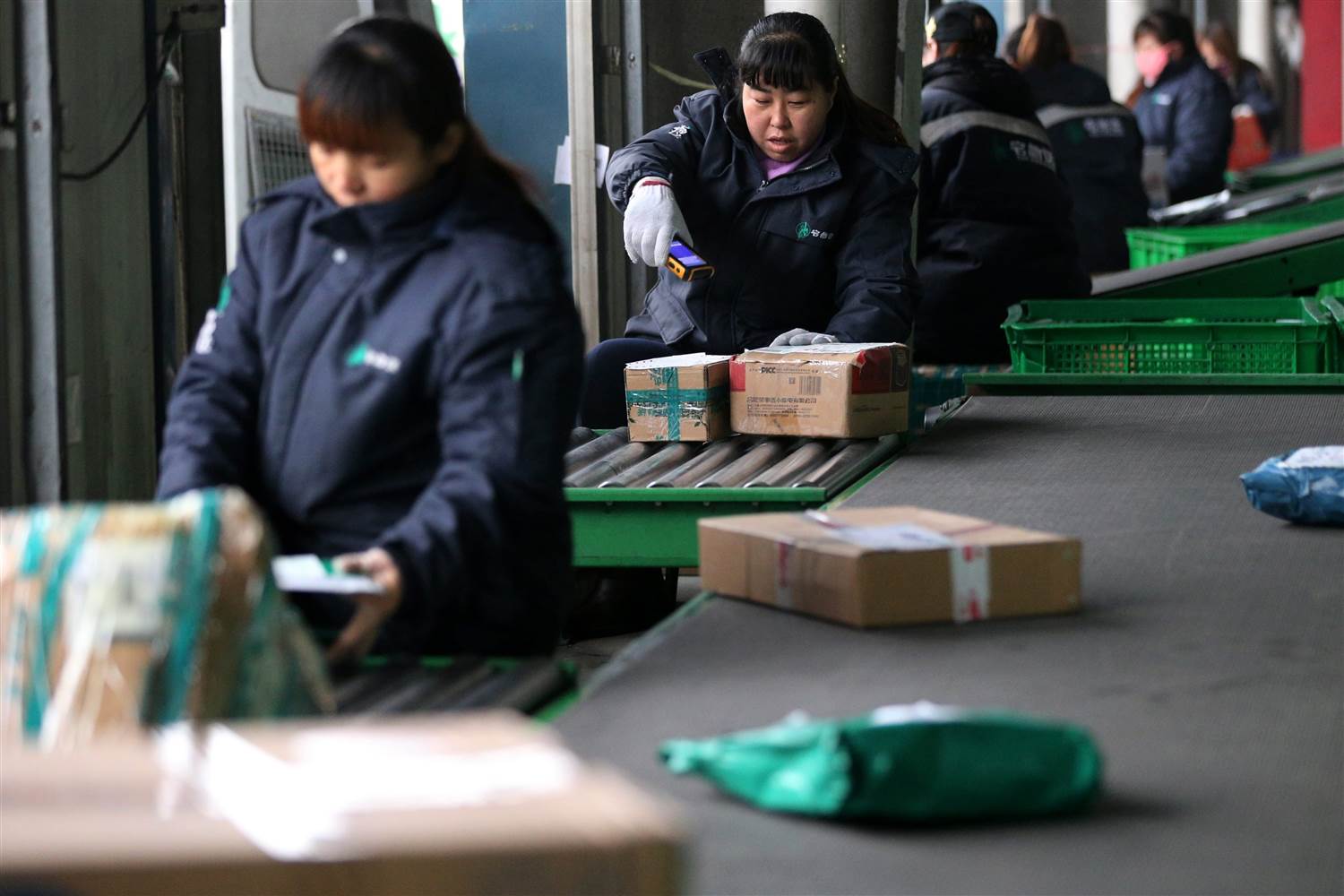
The event gets shoppers around China scouting for bargains and loading up their online shopping carts, while delivery men – and robots – brace for an estimated 1.5 billion parcels expected over the next six days.
“This is a big event for China, for the Chinese economy,” Joseph Tsai, Alibaba’s co-founder and vice chairman, said. “On Singles Day, shopping is a sport, it’s entertainment.”
Tsai said rising disposable incomes of China’s “over 300 million middle-class consumers” was helping drive the company’s online sales — and would continue. “This powerful group is propelling the consumption of China,” he said.
The final total — more than the GDP of Iceland or Cameroon — leaves other shopping days in the shade. Cyber Monday in the United States saw $3.45 billion in online sales last year.
Investors closely watch the headline number, though some analysts say the way it is calculated is too opaque. The U.S. Securities and Exchange Commission launched a probe into Alibaba‘s accounting practices in 2016, including into its Singles’ Day data. That investigation is as yet unresolved.
Last year, the sales number rose by nearly a third at the eighth iteration of the event – though that was slower than the 60 percent increase logged in 2015.
Slower growth?
At Alibaba’s Friday night gala on 10 November 2017, the company’s co-founder and chairman, Jack Ma, hosted guests including the actress Nicole Kidman, singer Pharrell Williams and Chinese musicians and film stars such as Zhang Ziyi and Fan Bingbing.
The excitement around the shopping blitz, however, masks the challenges facing China’s online retailers such as Alibaba and JD.com Inc., which are having to spend more to compete for shoppers in a broader economy where growth is slowing.
“A lot of the lower hanging fruit has been picked and there’s increased competition for a share of consumer spending,” said Matthew Crabbe, Asia Pacific research director at Mintel. The sale did though beat his forecast of 20 percent growth.
Online retailers were being forced to push offline as well as overseas to attract new shoppers, and the overall online retail market was close to “saturation,” raising questions about whether current rapid growth could be sustained.
“They’re having to spill over out of the purely online realm into the wider consumer market,” Crabbe said.
This has sparked deals to buy bricks-and-mortar stores in China, and overseas tie-ups, especially in Southeast Asia. Technology, too, has been key, with virtual reality dressing rooms and live fashion shows to attract shoppers.
Alibaba also said it had turned 100,000 physical shops around China into “smart stores” for this year’s event. Goods perused by people at the stores, but then bought and paid for on Alibaba’s platforms, were added towards the sales total.
China Market Research Group’s Cavender said brands were also increasingly making smaller price cuts to avoid “margins getting killed,” and were often asking for deposits in advance. In previous years, prices were often halved.
Fu Wenyue, a 23-year-old dresser in Shanghai, said offers this year were smaller but more “personalized” as brands used big data to hone their targets. Fu spent 4,000 yuan on clothes, cosmetics and kitchen utensils in pre-event sales, and kept shopping on the day.
“In actual fact, I think I spent even more than I did last year,” she said.
It is always tricky for multinationals to pick a name that sounds right to Chinese ears, but few went as wrong as McDonald’s latest business tweak.
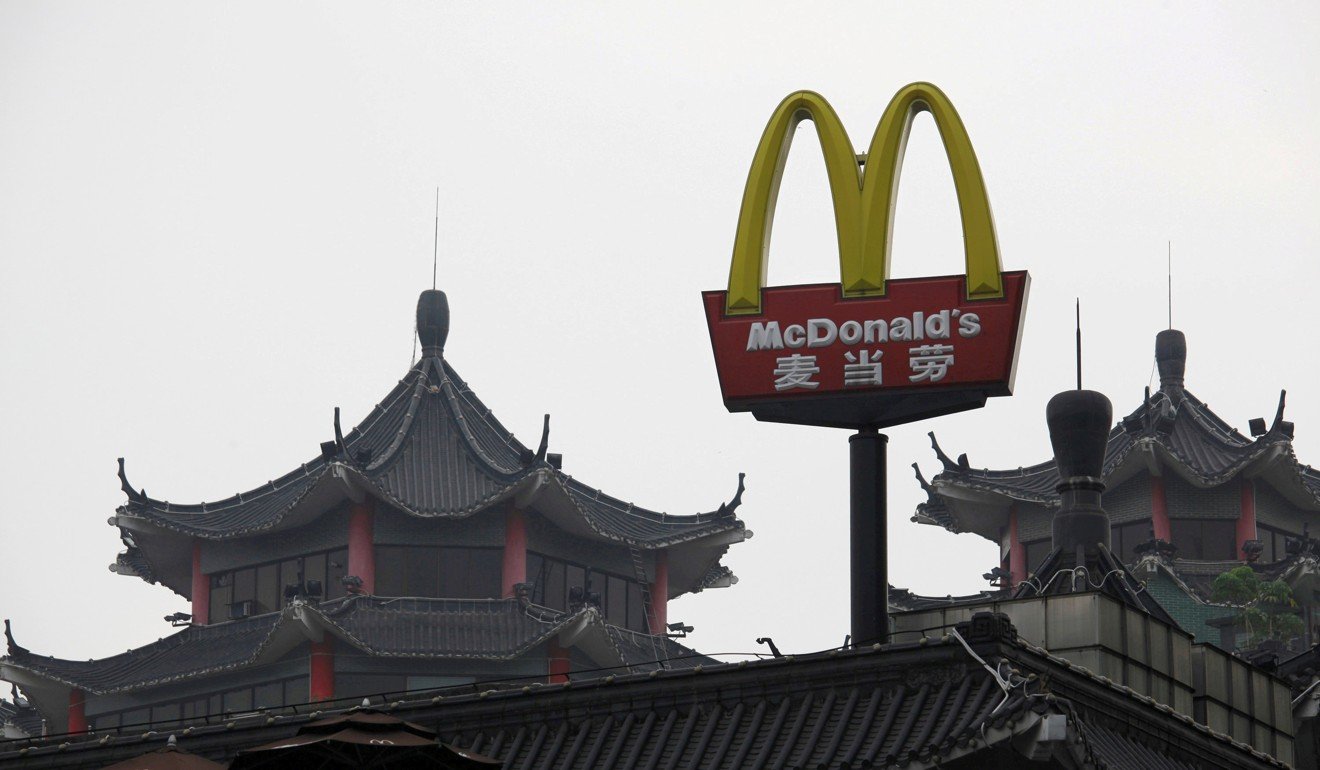
When the news broke last week that the American fast-food giant had changed its business name in China, ditching the previous Maidanglao – a transliteration of the company’s English name – in favour of Jingongmen, which roughly translates as “Golden Arches,” Chinese social media gorged itself with amusement.
“[The new name] sounds like a furniture store. Are you sure the food is edible?” one wrote, while another observed “even Ronald McDonald cannot stand the new name”, referring to a widely circulated image of the clown mascot on the phone, saying: “Boss, I have to quit. The new name is unbearable.”
Construction on mainland China’s first McDonald’s in Shenzhen takes place in 1990.
McDonald’s responded online, reassuring its customers that no one would dine at restaurants carrying the Jingongmen label and the change was for official paperwork only. It is unclear whether McDonald’s will manage to shake off this PR disaster, but even if it does, there are worries the American food giant cannot escape the fate of being downgraded.
“McDonald’s and KFC do not command the brand power they used to in the 1990s,” Jeffrey Towson, a business professor at Peking University in Beijing, said. “They are not viewed as upscale as they were in the 2000s.”
Once a tourism destination in China and a symbol of rapid modernisation, McDonald’s is now known as a low-end, cheap eat for many Chinese. Experts say this colossal change in attitude mirrors the rise of China, where local businesses have become increasingly competitive and Chinese customers no longer have to rely on Ronald McDonald to get a taste of America.
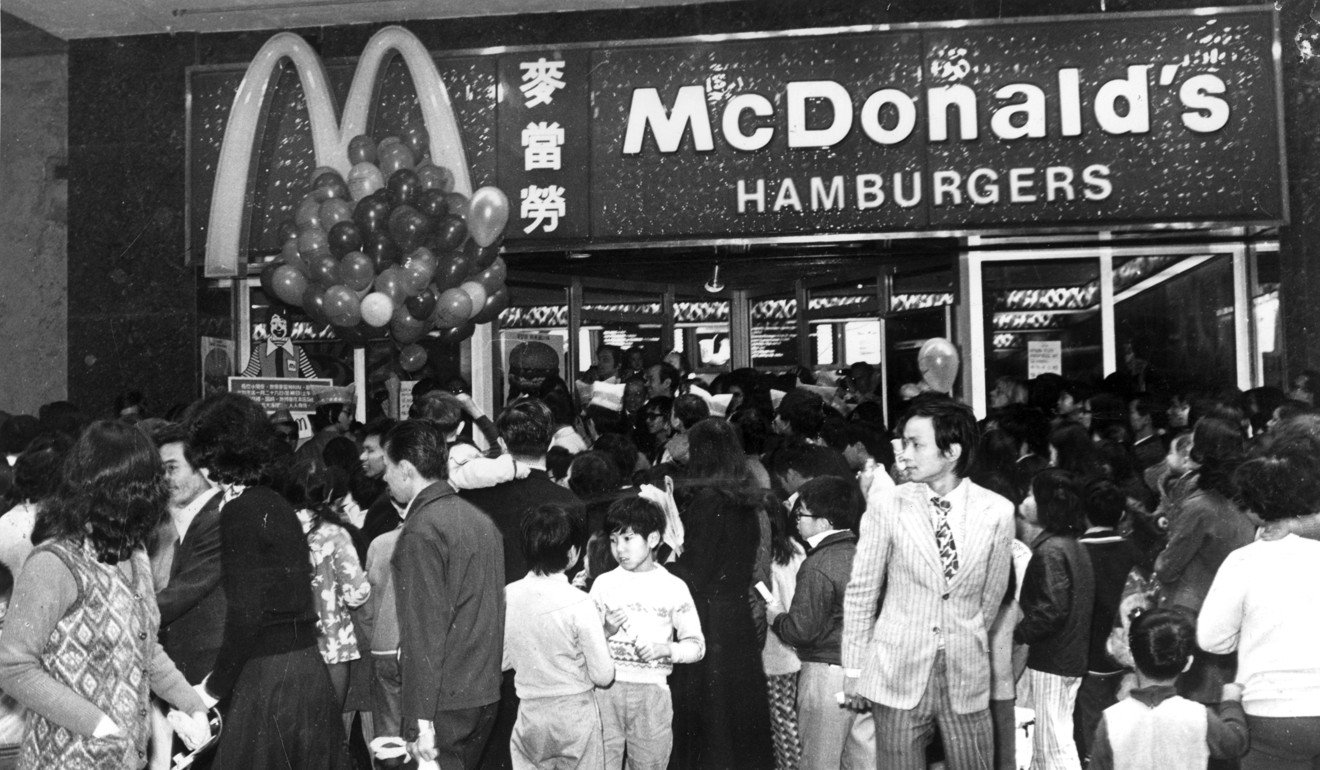
The first McDonald’s in Hong Kong opened in 1975 on Paterson Street in Causeway Bay.
Back in 1975, when McDonald’s opened its first store in Hong Kong, the popularity of McProducts in the then British colony created a phenomenon one local newspaper described as “Big Mac” fever. The fervour spread to Shenzhen, where McDonald’s made its debut in 1990. Media reports showed hundreds of Chinese queuing up outside McDonald’s first store on mainland China, and in the first three hours of its opening day, a week’s supply of products had sold out.
According to Yan Yunxiang, a professor at the University of California who studied the company’s operations in China in the 1990s, McDonald’s was so popular some parents thought the Big Mac contained a hidden ingredient luring their children to this exotic food.
And it was not just the children who had an appetite for it. When the first McDonald’s outlet arrived in Beijing in 1992, 82-year-old Wang Yonglu was one of the first customers. Munching on a hamburger, Wang explained to the United Press International: “I am just a retired proletarian. What chance do I have to go to the United States? This way, I can spend only 10 yuan (US$1.75) to see what America is like.”
Beijing’s first McDonald’s opened in Wangfujing in 1992.
Fast forward to the 21st century, the landscape in China is somewhat different. In 2016 alone, roughly 122 million Chinese – equivalent to the population of France, Spain and Denmark combined – went abroad, according to Beijing-based think tank China Tourism Academy.
“McDonald’s has lost that position because Chinese consumers are getting more sophisticated,” Shaun Rein, managing director for Shanghai market consultancy CMR China, said. “If they want Western culture and Western food, they can go to America.”
Zhang Yue, a 34-year-old marketing specialist in Chongqing, knows this well. When McDonald’s entered her hometown in southwestern China in the early 2000s, Zhang happily stood in line as she loved its “spotless dining environment.”
But now, she rarely goes. “There are so many good restaurants out there.”
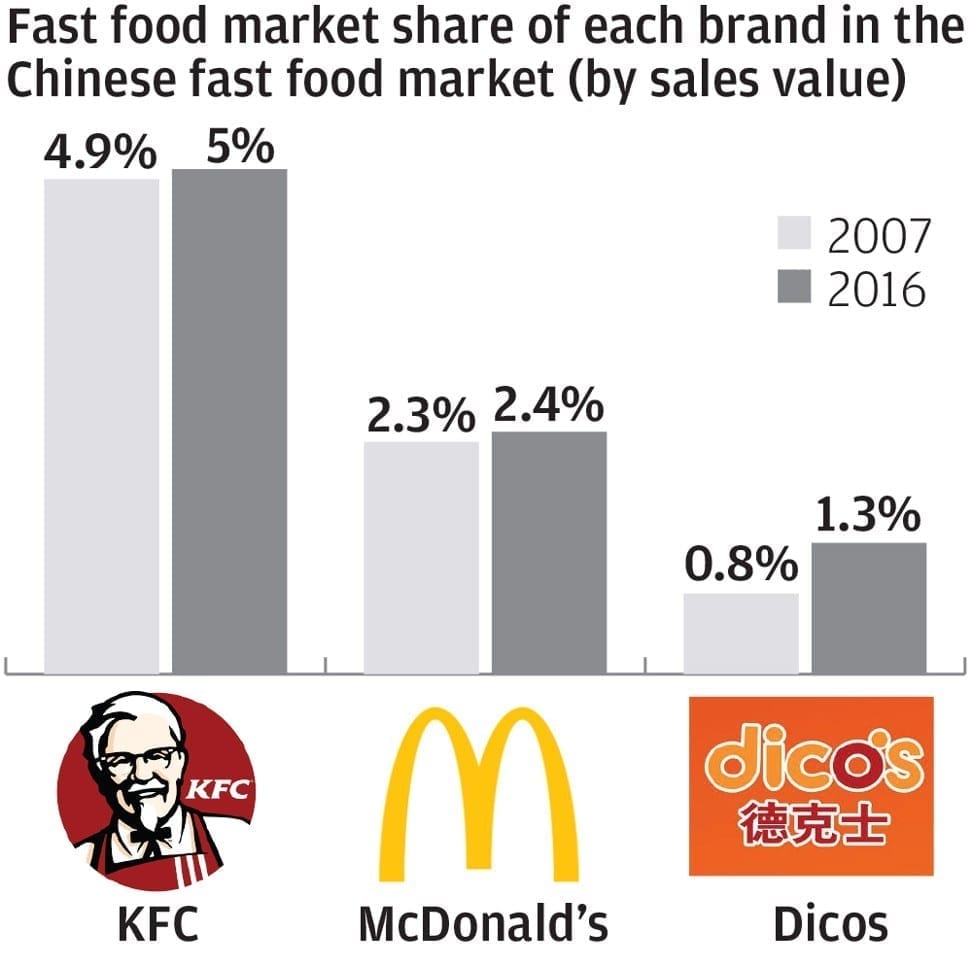
In recent years, a growing number of Western brands have flocked to China, hoping for a bite of the world’s biggest consumer market. Starbucks has opened 2,600 stores, and plans to add a coffee shop a day for the next five years. Meanwhile, home-grown food firms are catching up. Dicos, China’s third-largest fast food chain by retail value, has almost as many outlets as McDonald’s.
The boom of delivery businesses has made getting fed as simple as tapping a smartphone. Last year, at least 7.5 million hungry mouths a day were sated this way, according to a government report. That, in turn, has hampered the business for chains such as McDonald’s.
To lure in more diners, McDonald’s China has localised its menu. Currently, nNearly a quarter of items in its breakfast menu is Chinese food, including congee and soy milk.
To lure in more diners, McDonald’s China has localised its menu. Nearly a quarter of its breakfast menu is Chinese food, including congee and soy milk. Earlier this year, the American food chain also sold most of its business in China and Hong Kong to a Chinese consortium for more than US$2 billion. With the help of its new partner, McDonald’s said it will increase the number of Chinese outlets from 2,500 to 4,500 by 2022, with most of the new stores in smaller cities.
“When I studied McDonald’s in the early 1990s, I was told by management the strategy was to stick to the original American menu, not to apply McDonald’s franchise model in Beijing, and not to offer breakfast,” recalled Yan, the university professor. “It looks like the company has done everything now that it said it would not do in the early 1990s … either proactively to go [to] the next level or reactively to meet new challenges.”
The name tweak came after McDonald’s completed its China sale. A spokeswoman said it hasn’t affected the business in China and the company is happy Chinese diners no longer view it as an upscale brand. “After all, we never meant to be a five-star restaurant; McDonald’s is created to serve everyone,” she said.
China’s propaganda authority also had its say. The Beijing-based Guangming Daily, a newspaper backed by the Publicity Department of the Chinese Communist Party, wrote in a commentary last week: “Foreign brands have become ‘rustic’ [as] we Chinese have become more international.”