Tag: China

  • China Telecom taps Nokia to expand 4G coverage

    China Telecom taps Nokia to expand 4G coverage

    China Telecom has contracted Nokia to enhance the operator’s 4G coverage and capacity to meet growing subscriber demand.

    The companies have signed an agreement to expand the deployment of 4G in 19 provinces nationwide, which will include preparing China Telecom’s network for the planned launch of VoLTE services next year.

    Nokia will provide equipment including its Flexi MultiRadio base stations for the deployment, as well as project management, network design and installation and hardware and software maintenance services.

    The agreement covers the provinces of Shanghai, Jiangsu, Shandong, Zhejiang, Hunan, Hubei, Guangxi, Fujian, Jiangxi, Shaanxi, Heilongjiang, Hebei, Henan, Sichuan, Anhui, Liaoning, Guizhou, Xinjiang and Inner Mongolia.

    China Telecom added 31 million 4G users during the first six months of 2016 alone, taking its total to 90 million from an overall mobile subscriber base of nearly 207 million.

    Last year 4G traffic meanwhile grew more than sixfold, and is expected to account for more than 90% of the operator’s total mobile data traffic by 2017.

    “This agreement with China Telecom builds on our long history of collaboration. Our deep-rooted knowledge of the Chinese market will enable China Telecom to meet the demands of an ever-growing and dynamic 4G subscriber base,” Nokia Networks China head Mike Wang said.

  • China’s Alibaba Q1 revenue leaps 59%, best since IPO

    China’s Alibaba Q1 revenue leaps 59%, best since IPO

    Chinese e-commerce giant Alibaba saw revenues leap 59 percent year-on-year for the quarter ended in June, it said Thursday, its strongest growth since it listed on the New York Stock Exchange in 2014.

    Revenue for the company, seen as a proxy for China’s increasingly crucial consumer sector, reached 32.15 billion yuan ($4.83 billion) in the June quarter, it said in a statement.

    Alibaba is China’s dominant player in online commerce, with its Taobao platform estimated to hold more than 90 percent of the consumer-to-consumer market, and its Tmall platform is believed to have over half of business-to-consumer transactions.

    But according to the company net income plunged 77 percent year-on-year to $1.08 billion in the quarter, the first of its financial year.

    Still, Alibaba’s chief financial officer Maggie Wu described the results as “excellent”.

    “The 59 percent revenue growth for the company overall and the 49 percent revenue growth of our China retail marketplaces represent the highest growth rates we’ve achieved since our IPO,” she said in the statement.

    The company’s gross merchandise volume (GMV) — a measure of value for online sales — rose 24 percent year-on-year to $126 billion in the June quarter, the statement said, matching the growth of the previous three months.

    The company, often compared to eBay or Amazon of the United States, has expanded outside its core e-commerce business, in sectors ranging from sports to entertainment.

    “Our results show the scale and leverage of our ecosystem, as we strengthen our competitive positions in core commerce, cloud computing and digital media and entertainment,” Alibaba chief executive officer Daniel Zhang said in the statement.

  • Hugo Boss China plans to cull more stores

    Hugo Boss China plans to cull more stores

    The cull of Hugo Boss China stores will continue after a first round downsizing helped the German retailer’s bottom line.

    Hugo Boss revealed its quarterly operating profit on Friday, beating forecasts and giving incoming CEO Mark Langer a mandate for his tough strategy to return to profit growth.

    In March the company said it would close about 20 of its 145 stores in Greater China. Now, Langer says another 20 will follow over the next 18 months.

    “To return to profitable growth again in the medium term, we have made decisions that are painful to begin with,” Langer said. “The market environment will remain difficult for the foreseeable future.”

    Hugo Boss earnings fell 13 per cent to 108 million euros (US$120 million) in the second quarter on sales down 4 per cent to euro 622 million. Net profit has hit by 57 million in extraordinary items, largely costs relating to closing stores.

    Langer’s strategy to improve Hugo Boss’ earnings includes renegotiating rents, shutting stores and refocusing marketing spending on its core menswear range rather than womenswear, a category his predecessor diversified into.

    He also plans to sell the brand in high-quality stores in the US market, to try to reduce discounting.

    Hugo Boss’ share price rose 6 per cent on Friday after the results were revealed and some analysts are now recommending investors buy the stock.

  • China July vehicle sales rose 23 pct y/y – China Passenger Car Association

    China July vehicle sales rose 23 pct y/y – China Passenger Car Association

    Passenger vehicle sales in China to retail customers rose 23 percent in July from a year earlier, the China Passenger Car Association (CPCA) said on Tuesday.

    Auto retail sales totaled 1.6 million vehicles, CPCA said in a statement on its website. For January-July, passenger car sales rose 11 percent versus the same period in 2015, it said.

    The China Association of Automobile Manufacturers, whose statistics are generally viewed as the benchmark for the industry, is due to report wholesale data for July on Friday.

  • Asian stocks mostly up despite weak economic news from China

    Asian stocks mostly up despite weak economic news from China

    Asian shares traded in positive territory Tuesday as gains in commodity stocks helped offset weakness overnight in U.S. markets.

    The Nikkei Stock Average NIK, +0.69% rose 0.2% with the S&P/ASX 200 XJO, +0.27% up 0.2% and Korea’s Kospi SEU, +0.62% up 0.3%. Hong Kong’s Hang Seng Index HSI,-0.28% was down 0.1% while the Shanghai Composite SHCOMP, +0.65% was flat.

    Traders sent U.S. oil prices up 2.9% to $43.02 a barrel following news that the Organization of the Petroleum Exporting Countries planned to hold informal talks in September that could lead to production cuts.

  • China National Service Corp opens Shanghai downtown duty free store

    China National Service Corp opens Shanghai downtown duty free store

    State-owned China National Service Corporation (CNSC) opened its ambitious Shanghai downtown duty free store on 8 August. The corporation aims to invest heavily in the burgeoning downtown duty free sector in China.

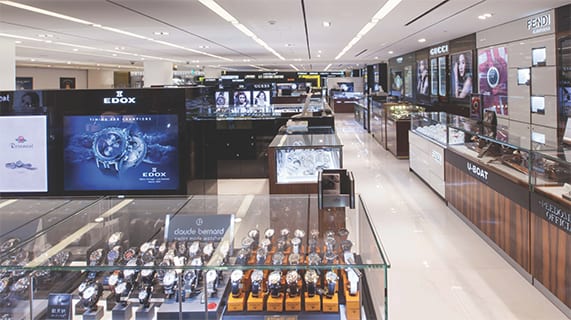
    The store opening attracted thousands of shoppers on opening day. It houses an initial 100 brands from the region and worldwide over two floors, with more to come in the next three months, according to local reports. Categories on offer includes watches & jewellery, beauty, confectionery, toys, gifts and special sections dedicated to Korean and Japanese items,

    According to reports from Shanghai, the leading brands sold on day one were Estée Lauder, La Mer and MAC.

    The reports said that year one sales should hit around 400 million Yuan (US$60 million).

    CNSC said it planned to improve its retail systems and service processes, as well as its customer capacity.

    Landmark day: The new CNSC store opens in Shanghai (Phoho: Duty Free Expert)

    Landmark day: The new CNSC store opens in Shanghai (Photos: Duty Free Expert)

    Large crowds gathered in anticipation of the new store's unveiling

    Large crowds gathered in anticipation of the new store’s unveiling

  • H&M Hong Kong recognised as top employer

    H&M Hong Kong recognised as top employer

    Fashion retailer H&M Hong Kong has received Asia’s Best Employer Brand Award at a ceremony hosted by the Employer Branding Institute, World HRD Congress and Stars of the Industry Group.

    Presented at the Pan Pacific Singapore, the award recognises organisations in Asia for excellence in building their brand as an employer of choice.

    The jury for the seventh edition of the award – leaders, researchers and academicians – judged companies for their development initiatives, employee hiring, training and retention practices, and HR innovation.

    Vivian Chen, Marketing Director of H&M Greater China, accepted the award on behalf of H&M (Photo credit - ASIA BEST EMPLOYER BRAND AWARDS)

    “I am thankful that H&M’s effort to provide a fun, creative and dynamic workplace is being recognised,” says H&M greater China manager Magnus Olsson. “People are our success, and we are committed to being a good employer.”

    He says H&M’s corporate culture is based on a range of values: believing in people, being one team, constantly improving, being straightforward and open-minded, encouraging an entrepreneurial spirit, keeping it simple and being cost-conscious.

  • Michael Kors Asia outperforms US

    Michael Kors Asia outperforms US

    Michael Kors Asia sales are showing healthy growth – at the same time as same-store figures are falling heavily in its US home market.

    Michael Kors has kicked off its new financial year with a weak set of numbers this week.

    Total revenue was virtually flat, just 0.2 per cent higher than during the same period last year., and driven by the opening of new stores which helped push overall retail sales up by 7.6 per cent. That offset a dismal comparable sales decline of 7.4 per cent.

    Michael Kors Asia has been a growth spot, with revenues rising by 74.5 per cent – although this is flattered by the acquisition of the company’s Greater China licensee.

    However, even on an underlying basis, the region is in positive territory, again thanks to the more favorable brand perception from consumers.

    In the US, one of the key issues is that interest in the brand appears to have peaked. This is evident from Conlumino’s brand tracking, which shows that while Michael Kors is not viewed unfavorably by consumers, it is not enjoying the resurgence that Coach has managed to engineer. This domestic woe is evident in the North American numbers which tumbled by 5 per cent, a sequentially worse performance than the previous quarter.

    The worsening of North American results is partly attributable to the stronger dollar which has likely weakened tourist sales at key flagships in the US, and Michael Kors is affected more than Coach in this respect, as it relies more on tourist spend at its larger stores. Nevertheless, given the investment being put into the new digital flagships – such as the one at 520 Broadway in New York – such an outcome is disappointing.

    The numbers from Europe were somewhat better with a 3.3 per cent increase in revenue over last year. Here, the MK brand is less ubiquitous and the company’s new stores, such as the one recently opened on London’s Regent St, are generating good trade in a way that the stores in North America are failing to do. Given that the company has several further European digital flagship stores in the pipeline for this fall, it looks likely that Europe will continue to deliver respectable sales growth across this fiscal year.

    Wholesale decline

    In the continuation of a theme we have seen across many luxury brands, wholesale revenue has decreased – falling by 7 per cent. Some of this is down to the company’s own actions to reduce exposure to channels that do not reflect its brand image, and some is down to the generally weaker traffic to malls across North America which has affected a number of outlets and stores that sell Michael Kors product.

    Looking ahead, while international sales will grow this year, the increase will be offset by continued pressures in North America. As such, revenues will likely be flat which will create pressure on the bottom line given all of the investments the brand is making.

  • Jollibee sales strongest in years

    Jollibee sales strongest in years

    Jollibee Foods Corp (JFC) has reported that its system-wide sales grew by 15.1 per cent in the second quarter compared to sales for the same period of 2015.

    For the first half of the year, sales of the Philippines’ largest foodservice company grew by 14.9 per cent to Php71 billion, while revenues grew 13.7 per cent to Php54 billion, compared with the first half of 2015. In the same period, profits rose by 14.8 per cent to Php3.1 billion from Php2.7 billion.

    JFC CEO Ernesto Tanmantiong said the Philippine business, which accounts for at least 80 per cent of the company’s worldwide sales, has been experiencing its strongest organic growth in many years.

    Tanmantiong said all brands performed ‘very well’ and he attributes the record growth to continued improvement in product quality and value offering supported by focused marketing campaigns, store expansion and renovation, low inflation rate, healthy growth of the country’s economy and election-related spending.

    Sales growth in the Philippines accelerated to 17.9 per cent in the second quarter, with brands growing in double digits.

    “Our business abroad had mixed performance. Southeast Asia grew by 37 per cent, led by Singapore with 56 per cent and Vietnam with 49 per cent. The Middle East rose by 17 per cent and the US increased by 11 per cent. China’s sales decreased by 5.7 per cent due to competitive pressure on Yonghe King, our largest brand there,” said Tanmantiong.

    “We look forward to a strong recovery of our Yonghe King business in the months ahead with the launch of new products with high value and taste scores supported by strong marketing campaigns and continuously building  a significant business in the People’s Republic of China and other parts  of the world.”

    JFC CFO Ysmael Baysa said:  “We look forward to continued strong profit growth while preparing for likely higher inflation rate in 2017 in the Philippines and other parts of the world and improving the profitability of our joint venture businesses.”

    JFC has a 50 per cent  interest in the following joint ventures with the number of stores indicated: Highlands Coffee (Vietnam, Philippines) 131, Pho 24 (Vietnam, Indonesia, Cambodia, Korea and Australia) 32, 12 Hotpot (China) 20, others 8; and a 40 per cent interest in Smashburger that has 366 outlets, mostly in the US.

    As of June 30, JFC was operating 2528 restaurant outlets in the country: Jollibee 939, Chowking 457, Greenwich 237, Red Ribbon 378, Mang Inasal 455 and Burger King 62. Abroad, it had 655 stores: Yonghe King (China) 321, Hong Zhuang Yuan (China) 40, San Pin Wang (China) 59, Dunkin’ Donuts (China) 4, Jollibee 151 (US 33, Vietnam 79, Brunei 14, Saudi Arabia 10, Qatar 2, Kuwait 4, Hong Kong 1, Singapore 4,  Bahrain 1 and UAE 3), Red Ribbon in the US 33, Chowking 44 (US 16, UAE 20, Qatar 4, Oman 2, Kuwait 1 and Saudi Arabia 1), Jinja Bar (US) 3.

    The JFC Group has 3183 stores worldwide.
  • Sainsbury’s taps into China’s love of British products through Tmall

    Sainsbury’s taps into China’s love of British products through Tmall

    The move comes after the British retailer trialled the web marketplace for less than a year and claimed the test was a success. It will now sell over 100 own-label products across four categories—British breakfast, drinks, organic and baby—on Tmall, and has plans to add further ranges later this year.

    With online Chinese sales dominated by key promotional sales events, Sainsbury’s was the only international retailer to be given a “Super Brand Day” on Tmall during the annual 8.8 Tmall Global Shopping Festival on August 8.

    “Many customers want to replicate tastes and occasions that they have enjoyed or heard about through international travel. Products to make a British breakfast and English afternoon tea have therefore proved hits,” said John Rogers, chief financial officer of Sainsbury’s,

    Rogers added that granola, tea, shortbread and UHT milk have been among the sales channel’s top-selling lines to date.

    Our trial with Tmall has enabled us to learn a lot about China’s huge digital market, including the importance of sales events such as Singles’ Day and 8.8,” he added..

    Alibaba’s expertise in the rapidly growing Chinese digital consumer market will be a huge asset to us as we grow and develop our business in China.”

    Amee Chande, Alibaba’s managing director in Britain and Ireland, said that a famous British brand like Sainsbury’s was “a key addition to our ecosystem” as it built brand awareness, directly engaged a new audience and met the evolving food demands of Chinese consumers.

    Our collaboration is introducing the large and growing Chinese consumer class to a new range of products to enhance their daily lives,” said Chande.


  • Chinese retail real estate crushed

    Chinese retail real estate crushed

    One of the under discussed aspects of rising real estate prices is the attendant rising rents amid a brick-and-mortar retail slowdown. In 2015, the top 100 chain stores saw sales growth of only 4.3 percent.

    Locally, in Beijing the smaller mom-and-pop retail shops as well as national chains are being forced out by high rents, as rental agreements expire and the minimum increases are at least 100 percent. Mix in shifting consumer behavior, particularly the popularity of online shopping, and it is a brutal environment for the least efficient retailers.

    A reporter for the Beijing Evening News heads to Xinjiekou Beida Street to see the impact on the ground.

    Yesterday afternoon, just the beginning of autumn (Liqiu August 7-22) of Beijing is still hot. From Jishuitan subway station out along Xinjiekou North Main Street South a rough count shows about ten small stores at least half with the words “sale”, “clearance” and even more than one “contract expiration” two or three family has to pull the shutter doors, completely closed shop closed state. The old familiar clothes shop has been replaced by a shop selling steamed buns and meat patties. A clothing store retreated from higher rental shops along the street to the alley inside, to attract customers it has a “Grand Sale” promotion red sign hanging.

    Contact by telephone sublease front of the store, correspondent to turn to a store owner. He told reporters that although the lease is to expire in April next year, but because of the difficult business environment, ready to move up, “mainly rents are too high.” The owner said, Xinjiekou traffic here also, but his rented storefront upper and lower rent would more than 1.5 million yuan a year, an average of 129,000 yuan a month, plus the prior renovation costs, operation stress is too great. Now the shop is handbags sale, sell a single inexpensive earn more than twenty yuan, the most expensive also more than fifty yuan. Even under the most expensive 50 yuan terms, without considering other costs, the shop must to sell 2580 each month to pay the rent. The boss said, in order to share the rent pressure, a lot of shops in this street are sharing the rent two- and three-ways.

    Chain stores are feeling the pressure as well:

    In fact, more than street shops closed tide appears, district located in Daphne, Metersbonwe, Ning [ -0.73% ] , Jeanswest and other brand shoes and apparel shops are also rapidly reduced stores. According to Daphne released the first half of 2016, a profit warning report shows only the first half of this year, Daphne net off store 450, including 400 direct sales stores and 50 franchise stores. Once all the rage Metersbonwe business situation is not optimistic about 2013 sales stores and franchise also has nearly 5000, the end of 2015 has been remaining 3700, store sales decreased by about a quarter. Jeanswest in the past 4 years has closed 1012 stores, at the end of 2015 had only 2249 retail stores.

    In the micro-channel circle of friends spread a worldwide brick-and-mortar retail death list, it is revealing physical retail bleak. According to this list were killed in the first half 2016, a second-tier cities major retail companies closed shop more than eighty percent. China Chain hundred reports China Chain Store & Franchise Association released statistics also show that in 2015 the chain of hundred sales volume of 2.1 trillion yuan, an increase of only 4.3%, the lowest ever one. Department stores even have negative growth of -0.7%.

    China Chain Store & Franchise Association, the relevant responsible person said, “This year the store is really a life and death to the moment”, but specialty stores, convenience stores have achieved double-digit growth.

    Entity is not fully closed shop because of the impact of the electricity supplier, there are real weak economic growth, labor costs, rental costs, taxes, weak profits and other reasons. In the late 1990s, chains began a large expansion, rental contracts generally expired in 10 to 15 years, these contracts are now expiring and the rent is at least doubling, some low-margin supermarkets, department stores have been unable to renew the lease.

    Another issue is the failure to embrace changes in the market:

    Beijing Zhi future starting from Consulting Group founder Li pointed out that the impact of the electricity supplier, rent increases, etc. are one of the most direct reason. But more than the rent, labor, electricity providers more powerful impact, and is continuing under the influence of these factors, changes in consumer spending habits occurred. More important reason is consumer behavior, consciousness, the pursuit of consumer convenience, reliance on technology and the like. On the other hand, traditional commercial aspects of the transition moves more slowly. Department stores these years has been to break, suffer not found the right ways, not kept pace with changes in consumers.

    Li Zhi said that from the domestic and international experience, the current transformation of department stores there are two main directions. On the one hand is to break through the high-end direction, shrinking front, the focus is more on the line, service requirements are relatively high business forms; in the other direction is toward a more pluralistic, more inclusive development, to provide similar shopping mall such a large, integrated leisure experience scenes business forms.


  • Asia leads Burger King sales growth

    Asia leads Burger King sales growth

    Burger King sales are growing faster in Asia than in any other part of the world, reports parent Restaurant Brands.

    Sales in Asia rose 5.3 per cent, according to the company’s second quarter earnings data released overnight. Latin America sales rose 4.9 per cent. The performance in those two markets was enough to offset a 0.8 per cent decline in same-restaurant sales across the US and Canada, resulting in flat global systemwide sales growth.

    The success in Asia comes at a time when rivals Yum Brands (parent of KFC and Pizza Hut) and McDonald’s are struggling to maintain growth in Asia, where both companies are trying to sell long-term franchise rights.

    It also partly explains why Restaurant Brands this week announced a priority of expanding its Tim Hortons coffee cafe brand into Asia, with the Philippines the first stop.

    The Asia and Latin American figures were high points in a result best described as “adequate”.

    However, Neil Saunders, CEO of Conlumino, observes that although the headline result of a 0.2 per cent decline in overall revenue looks somewhat gloomy, this is mostly the consequence of a strong US dollar and weak Canadian dollar, which especially affected revenues from Canadian-based Tim Hortons.

    “The underlying numbers are slightly better, with both divisions in positive territory on a comparable sales basis and system-wide sales up by 0.6 per cent even after the impact of exchange rate fluctuations.”

    Saunders says the loss of sales momentum from previous quarters is in line with recent numbers from rivals like McDonald’s and Yum.

    “This trend is being driven, primarily, by a slowdown in spending on eating out by American consumers.  The softness in the US market is disappointing given the initially positive reaction to menu changes and the introduction [by Burger King] of hot dogs. It underlines the fact that menu change and innovation is not now something that can be done periodically: fast food players need to see this as a constant process that has to be supported by ongoing promotions and marketing activity.”

    Saunders believes McDonald’s continues to hold a slight edge over Burger King, and is doing more to shake up its traditional business model to maintain consumer interest and drive growth.

    “All that noted, the one saving grace for Burger King is good cost control which allowed [pre-tax earnings] to grow by 3.7 per cent this quarter.

    “Overall, Restaurant Brands continues to make progress; but with spend tightening and competition intensifying it now needs to up the pace of innovation if it is to grow further,” concluded Saunders.

  • China’s LeEco acquires US-based Vizio for $2b

    China’s LeEco acquires US-based Vizio for $2b

    LeEco entered into a definitive agreement to acquire Vizio for $2 billion, with the latter’s hardware and software businesses to be operated as a wholly owned subsidiary.

    Meanwhile, Vizio’s data business, Inscape, will spin out and operate as a separate, privately owned company.

    “LeEco believes in breakthrough technologies, a complete ecosystem and disruptive pricing,” said Yueting Jia, chairman and CEO of LeEco. “Acquiring Vizio is an important step in our globalization strategy and building our North American presence.”

    The acquisition benefits both companies with Vizio offering LeEco a steady install base of users and a brand that is distributed throughout major North American retail channels.

    Commenting on the transaction, which is expected to close during the fourth quarter of 2016, research firm IHS Technology said the biggest challenge for LeEco will be convincing Vizio’s US retail customers that it will be business as usual during the integration, with no loss of product quality/supply, account service or supply chain discipline.

    IHS said the acquisition will help LeEco and Vizio to optimize their supply chain resources. While TV supply chain relationship for both LeEco and Vizio will likely stay unchanged for the next few years, TV manufacturers that supply products exclusively to Vizio or LeEco may have more opportunities as long as they are cost competitive.

    Also, the acquisition is also likely to impact their competitors, should LeEco decide to apply its current business model in China to North America and other markets.

    The Chinese company focuses on the growth of the paid content subscription, while it sells TV hardware at below manufacturing cost or even provides it for free during promotional periods.

  • Modern Avenue Group cancels Italian store deal

    Modern Avenue Group cancels Italian store deal

    Chinese distributor Modern Avenue Group (formerly Canudilo) has decided not to proceed with its purchase of the luxury Excelsior Milano department store.

    Modern Avenue, which owns sport couture brand Dirk Bikkembergs, has not given a reason for its change of heart.

    A purchase price of €21.3 million (US$23.7 million) was announced at the end of June for the store, launched in 2012 by Italian group Coin. The deal was to have been finalised this month. With a specific selection of high-end fashion, Excelsior Milano is overseen by Antonia Giacinti, who owns the new boutique collective Antonia.

    The Antonia brand was confirmed last month under an agreement with Modern Avenue, with a view to open five franchise stores over the next four years. The first Antonia store will debut next month.

  • New Look to expand China network

    New Look to expand China network

    Fast fashion retailer New Look is to expand its China store network.

    And while the UK retailer has modest aspirations in terms of store numbers – just 25 globally over five years – it is increasing its focus on menswear. Some of the new stores slated to open in China and France within the next 12 months will stock only men’s clothing.

    New Look is experiencing “exceptional growth” in China, since its debut there early in 2015, according to UK news channel Retail Gazette.

    The first standalone menswear store opened less than a year ago and customers of the previously womenswear brand have taken to its style and range.

    New Look has not broken down the figures by market as to where the new stores will open.