Tag: China

  • Xuhui Vanke Centre landmark in Shanghai

    Xuhui Vanke Centre landmark in Shanghai

    Benoy has been commissioned to work on the design of the Xuhui Vanke Center in Shanghai.

    This is developer Vanke’s first large-scale commercial real estate project with a mixed-use program in Shanghai. Benoy, a global studio of architects, masterplanners, interior and graphic designers, has won a multi-disciplinary scope which includes tower and retail architecture, retail and office interior design and graphic design.

    The landmark development sits at a prime location adjacent to the Shanghai South Railway Station; the city’s second most prominent station after the Shanghai Railway Station. The overall scheme is being developed over three phases with Benoy as the chief architect delivering the final phase alongside Skidmore, Owings & Merill LLP (SOM).

    Benoy director Ferdinand Cheung said the scheme provides a rare opportunity to give the landscape back to the community on a significant scale.

    “As designers, we were drawn to the approach which intertwines nature and buildings and we look forward to seeing this development come to life over the next few years.”

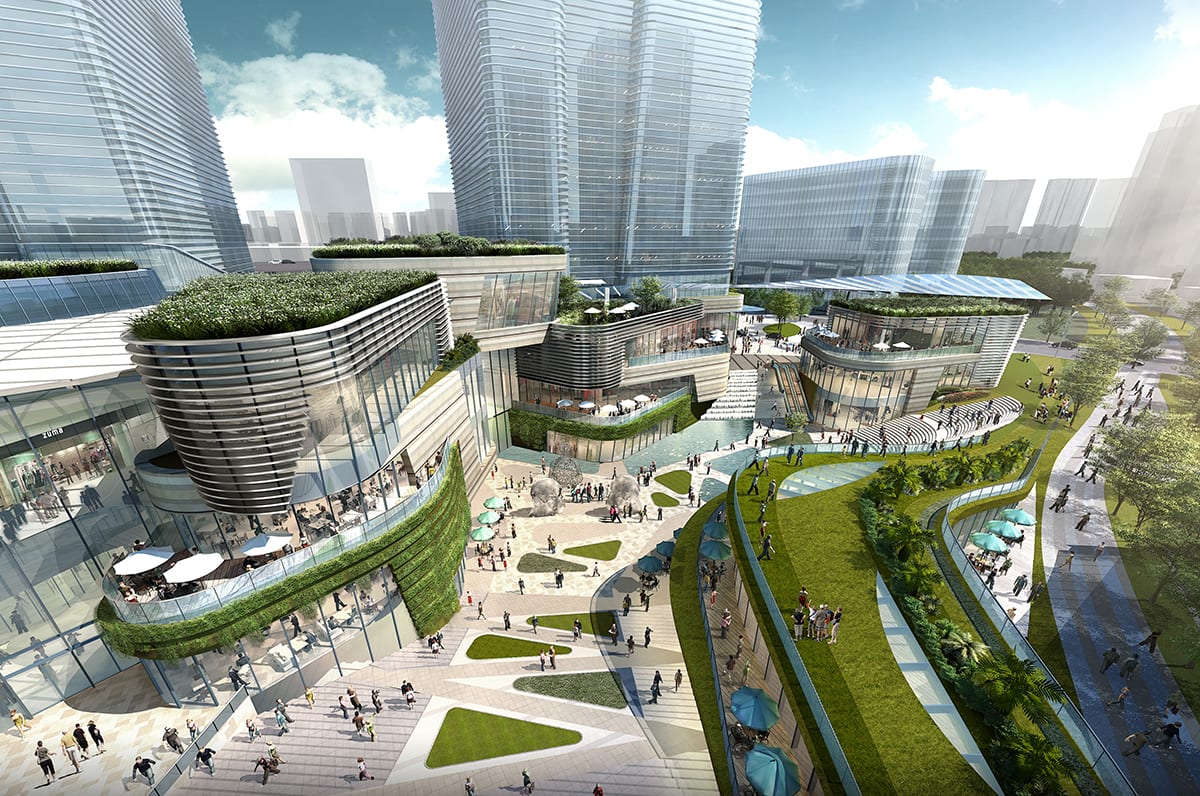
    Connecting six commercial blocks, the scheme aims to create a new urban complex set within a 70,000 sqm landscaped realm. The three phases are connected by a mile-long green valley which runs diagonally across the site. The wider development’s 12 buildings overlook and interact with the urban parkland which essentially brings a green streetscape experience into the heart of the development. The green belt begins at the Shanghai South Railway Station edge and continues through to a museum and arts complex which anchors the journey.

    “The green spine gave us the opportunity to bring a streetscape and smaller-scale environment to the commercial complex, and physically and visually unite Phase III with the earlier phases. We transformed the commercial components by blending the parkland into the architecture and interior design,” said Cheung.

    Mimicking the forms of the rolling landscape, the 100,000 sqm multi-level retail podium is a network of interconnected buildings. The podium has been fragmented into a collection of curved individual blocks, each carved out to create unique spaces for retail, F&B, leisure and arts tenants.

    “The result is an undulating internal streetscape which blends public and commercial spaces, landscape and building, culture and business.”

    The final phase of the development has commenced construction and is due to complete by 2019.

    Benoy established its Shanghai Studio in 2008 and has since grown an acclaimed portfolio in the city which includes built schemes such as the Shanghai ifc mall, Shanghai ICC and iAPM and Jing An Kerry Center.

  • Duty free sales will recover, says Global Blue China report

    Duty free sales will recover, says Global Blue China report

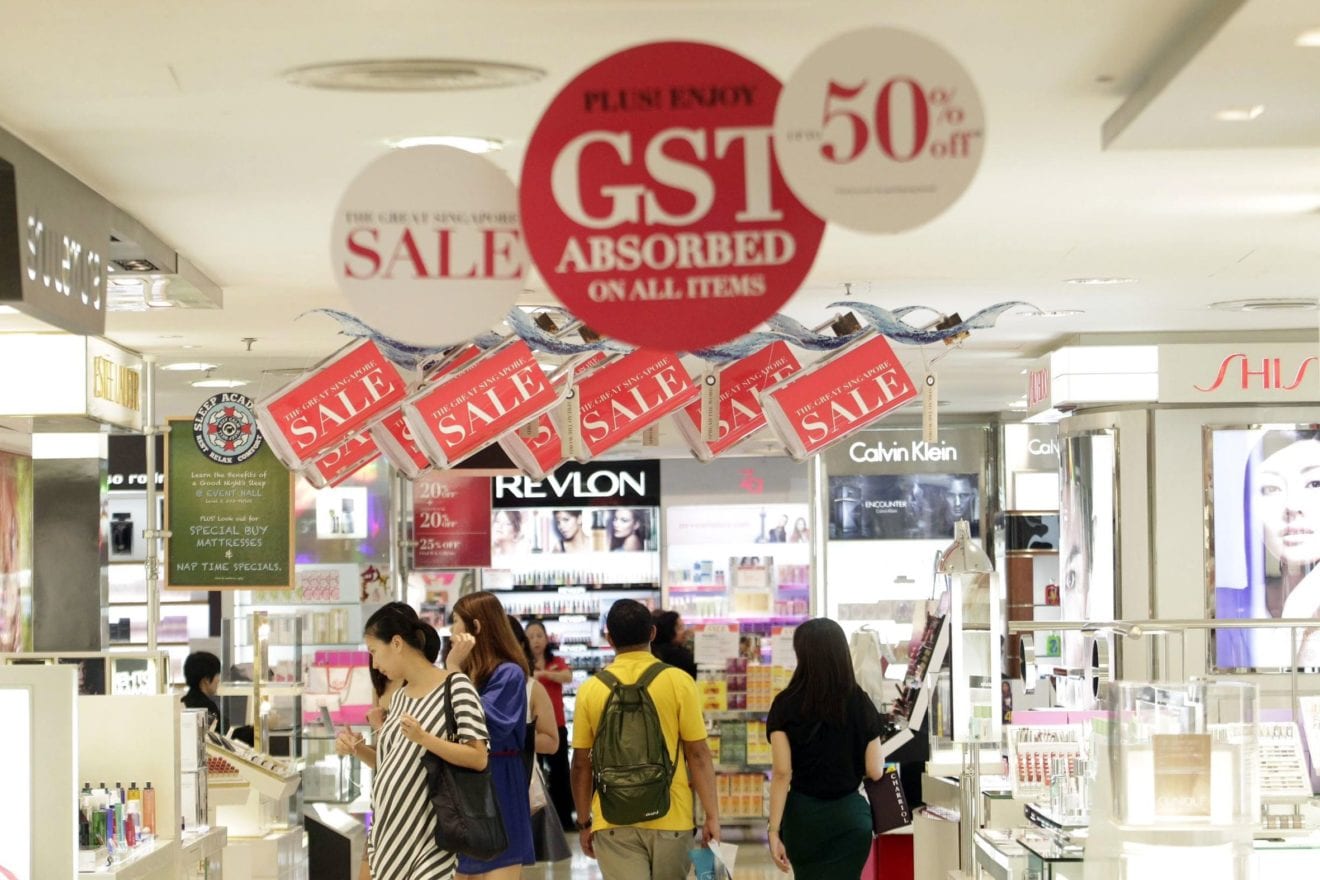
    After 58 per cent growth last year, Chinese tax-free shopping has gone into reverse gear, according to the Global Blue China Shopper Report.

    However, China has retained its position as the number-one global shopper market, accounting for a third of tax-free shopping sales worldwide.

    Switzerland-based Global Blue says May and October are set to be busiest months for travel by “regular” Chinese travellers, offering opportunities for global retailers, who need to focus on value and convenience to attract them.

    Its China report combines data from more than 27 million tax-free shopping transactions with the opinions of 5000 regular Chinese travellers about their travel and spending plans for this year. Regular Chinese travellers are defined as survey respondents who have been on an international holiday in the past two years or plan to go on one this year.

    Despite the recent turbulence, Chinese global shoppers remain a lucrative market, says the report. Last month, Chinese tax-free shopping dropped into negative growth, falling 24 per cent year-on-year. This followed slow growth for the first two months of the year (11 per cent in January and 5 per cent in February).

    Reasons for the decline include the ability to obtain visas (an important consideration for 22 per cent of regular Chinese travellers), and terrorist attacks (safety and security were cited by 56 per cent of respondents as an important destination factor).

    Shopping important

    Fluctuation of the yuan on tax-free shopping sales is likely to be minimal, says the report, as the yuan weakened by just 3 per cent against the euro this first quarter. However, the research indicated that nearly half of those surveyed would reconsider their destination (46 per cent) or cut their shopping budget (47 per cent) because of exchange rates.

    Shopping remains a hugely important part of the holiday experience for regular Chinese travellers, says the report, as 81 per cent of those planning international travel this year will shop during their trip with an average shopping budget of 25,902CNY (US$3997) when travelling to Europe and 18,398CNY for Asia visits.

    May is expected to be the most popular month for travel to Europe, Japan and South Korea, while October will be attractive for visits to other Asia-Pacific destinations such as Australia and Singapore. These two key months coincide with major Chinese holidays: Labour Day (May 1-4) and Golden Week (October 1-7).

    Asia is the main destination for Chinese visitors throughout the year, with 73 per cent of those planning a holiday this year intending to travel within the region. South Korea is targeted by 26 per cent of Chinese travellers this year, followed by Japan (23 per cent).

    When it comes to Chinese tax-free shopping spend within Asia, Japan was the region’s strongest performer during the first quarter with 50 per cent growth. Chinese shoppers accounted for 54 per cent of APAC’s sales. Also, Chinese transactions in Asia increased by 32 cent during the quarter.

    What they like

    When asked what makes a good shopping destination, 35 per cent of respondents opted for a good selection of shopping malls or retail parks, while 33 per cent said they looked for a destination with famous international brand stores. For 31 per cent, the availability of products at better prices than in China was important.

    The research also revealed the top five services that should be offered by retailers looking to attract Chinese shoppers: tax-free shopping (65 per cent), ability to pay with China Union Pay (55 per cent), ability to pay in their home currency (46 per cent), retail staff who speak their language (39 per cent) and Wi-Fi in-store (26 per cent).

    Their main research points for international shopping include travel, shopping and fashion websites (43 per cent) and recommendations from friends and family (also 43 per cent), Social media also plays a key role, either through the brand’s own site (38 per cent) or via inspiration from friends’ pages (36 per cent).

    Opinium Research ran the survey, sampling 5005 Chinese travellers between January 22 and February 1.

    Global Blue came up with the concept of tax-free shopping more than 35 years ago and now creates value for retailers and partners through a range of products and services. It has a presence in 51 countries, employing more than 1800 people worldwide. Global Blue last year powered more than 27 million transactions involving 22 million dyna

  • India discounts narrow as jewellers reopen shops after strike

    India discounts narrow as jewellers reopen shops after strike

    Gold demand in India improved this week as jewellery retailers reopened stores after a strike, but the world’s second biggest bullion market remained at a discount to the global benchmark as purchases across the region were curbed by higher prices.

    Indian jewellers went on an indefinite strike since the start of March in protest over the reintroduction of a sales tax on gold jewellery after four years. They started opening shops from last week.

    “Demand is better than last week, but it is lower than expected,” said Harshad Ajmera, the proprietor of JJ Gold House, a wholesaler in the eastern Indian city of Kolkata.

    “We were expecting retail consumers’ rush as jewellery shops were closed for a long time. We couldn’t see that kind of rush.”

    Dealers were offering a discount of up to $8 an ounce to the global spot benchmark this week, down from a discount of up to $25 last week. The discount hit a record high of $53 an ounce in late February on weak demand.

    India’s gold imports in March slumped 80.5 percent from a year ago to $973 million, the government said earlier this week.

    “Gradually discounts will taper off and we could see market at parity or at premium by Akshaya Trititya,” said a Mumbai-based bullion dealer with a private bank.

    India will celebrate Akshaya Tritiya, the second-biggest gold-buying festival after Dhanteras, on May 9.

    For now, a rally in global gold prices has kept buyers away.

    The gold price hit a five-week high of $1,270.10 an ounce on Thursday, and was set to post a weekly gain of 1 percent. [GOL/]

    Dealers said they were seeing some investment demand for gold, though not robust purchases.

    “These prices are quite high for retail consumers so they are holding back,” said a bullion dealer in Hong Kong.

    “Banks and trading house are trying to reduce their gold inventory as there is no demand, so premiums are quite low,” he added.

    Prices in Hong Kong were at a premium of 50 cents an ounce to the global benchmark, their lowest since May 2015, traders said.

    In top consumer China, premiums were steady at around $1 to $2 an ounce. Tokyo prices were on par, with dealers reporting little demand. Singapore premiums also held near 50 cents.

  • Chow Sang Sang and Luk Fook eye new move to boost holiday sales

    Chow Sang Sang and Luk Fook eye new move to boost holiday sales

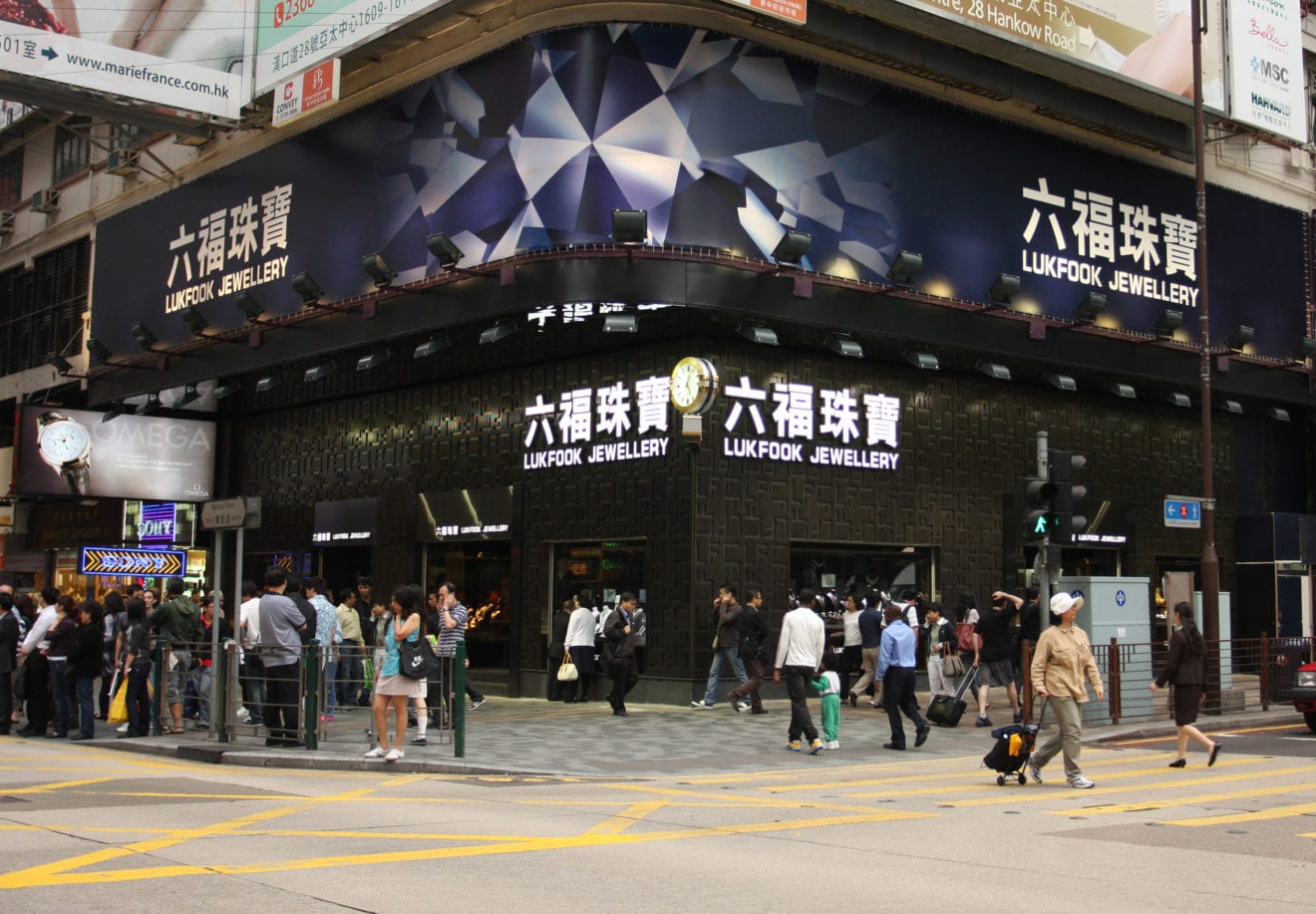
    Jewelry retailers Chow Sang Sang Holdings (00116.HK) and Luk Fook Holdings 00590.HK) are said to be waiving the craftsmanship fee on their gold products in a bid to spur sales during the upcoming Labor Day holidays.

    The promotional period will last for six days until May 2 at Chow Sang Sang, and until May 4 in the case of Luk Fook, according to the Hong Kong Economic Journal.

    Chow Sang Sang’s Greater China general manager for retail operations, Lau Hak-bun, was quoted as saying that the move is aimed at addressing a slowdown in business.

    The jewelry retailer has seen a 20-percent decline in revenue during the first quarter despite a 10-percent bounce in gold prices.

    With the waiver of the craftsmanship fee, customers can save HK$400 to HK$1,000 on wedding bracelets, according to Lau.

    A slowdown in tourist arrivals from the mainland has affected Hong Kong’s retail sector, with luxury goods shops particularly feeling the pinch.

    Export sales of Swiss luxury watches fell 16.1 percent in March, with sales to Hong Kong tumbling as much as 37.7 percent, according to data from the Federation of the Swiss Watch Industry FH.

  • KFC owner Yum profits boosted by China sales

    KFC owner Yum profits boosted by China sales

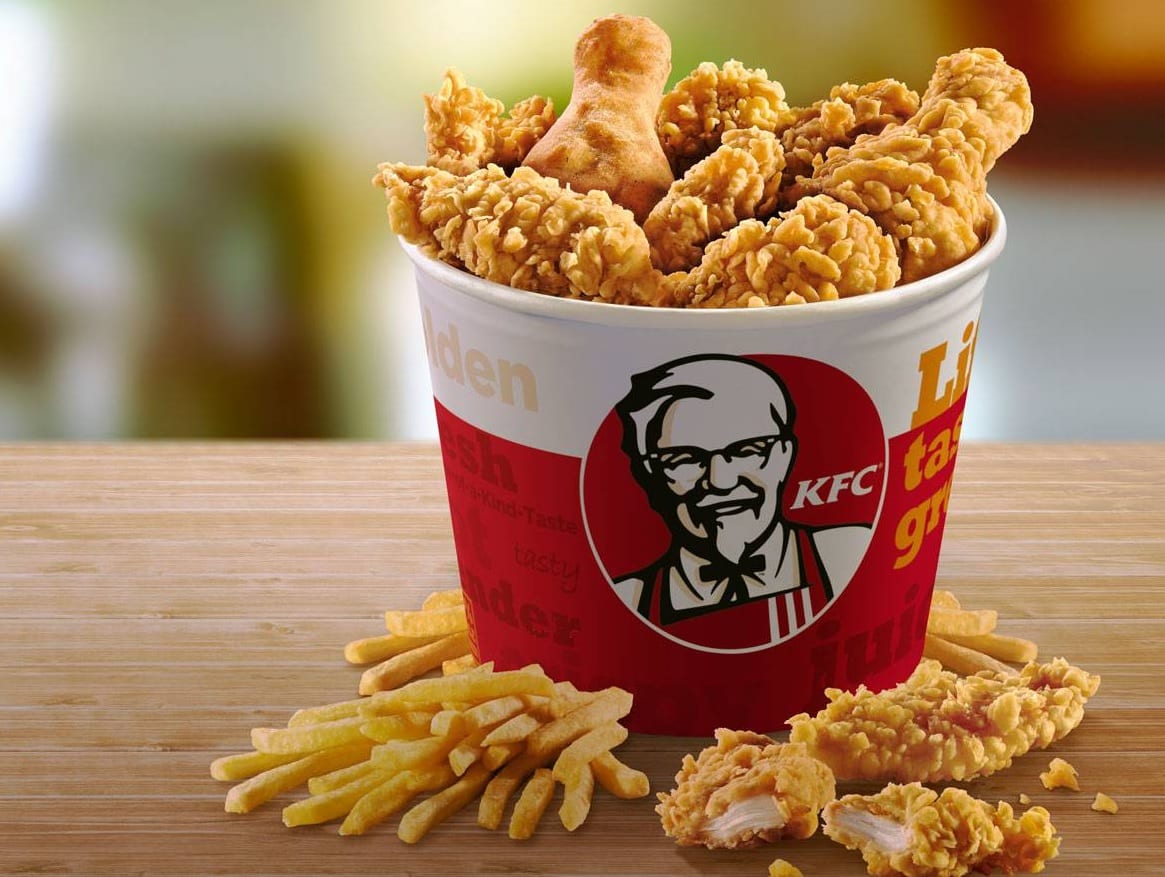
    Yum Brands, the parent company behind fast-food chains KFC, Pizza Hut and Taco Bell, has reported a surprise 8% rise in first-quarter net operating profit. One-time gains in the quarter from a Chinese New Year chicken bucket promotion helped boost sales in China and bring in profits of $391m (£273m; €346m) in the January to March period.

    Adjusted earnings per share came in at 95 cents, beating analyst forecasts for earnings per share of 83 cents. Sales at restaurants that have been open for at least a year in China — the company’s biggest profit-driving region — were up 6% from the same period a year ago, helped by a 12% sales jump at KFC China.

    Yum chief executive Greg Creed said 2016 was a “transformational year” for the company and announced that the China division would split into a separate business by the end of the year.

    The firm also upped its core operating profit growth forecast for the year to 12% from 10%. Yum shares jumped nearly 4% in after-hours trading in New York following the earnings release.

    Global sales up

    Worldwide same-store sales were up 2% in the quarter, with sales at KFC and Pizza Hut up 1% and 3% respectively. Same-store sales at the US Pizza Hut division were up 5%.

    “KFC China had an outstanding Chinese New Year bucket promotion,” Creed said in a statement. “While it’s early in the year and there may be bumps in the road, we’re confident in raising core operating profit growth guidance to 12% from 10% previously.

    Pizza Hut

    “This is a transformational year for our company as we remain on track to finalise the separation of our China business by year end. We look forward to establishing two powerful, independent, focused growth companies dedicated to building on our brand strengths and rewarding our shareholders.”

    Yum opened 68 new restaurants in China during the quarter, bringing the total number of its outlets in the country to nearly 7,000. It is the largest western restaurant brand in China and plans to spin-off the division into a separate publicly-traded company by year end to modernise services and streamline operations in other markets.

  • CE China makes debut

    CE China makes debut

    Brings together local and international retailers and suppliers.

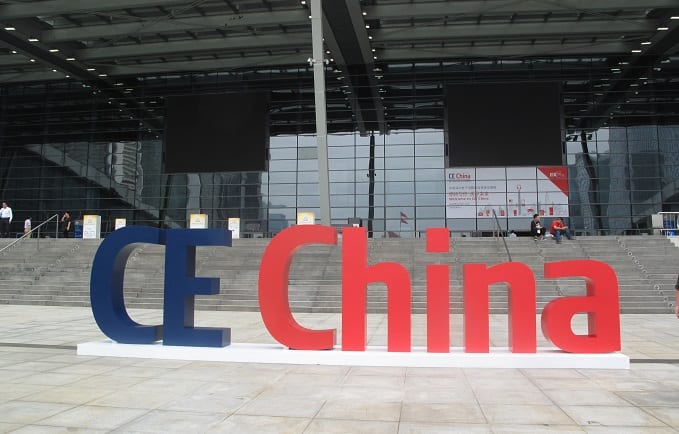
    The CE China exhibition launched in Shenzhen this week, created by the organisers of the annual IFA Berlin exhibition, has brought together retailers including Alibaba and Amazon China with leading Chinese and international manufacturers for a unique exhibition concept.

    There were over 150 exhibitors for the three-day event, concluding today (April 22) across an exhibition area of over 15,000 square metres at the Shenzhen Convention and Exhibition Center.

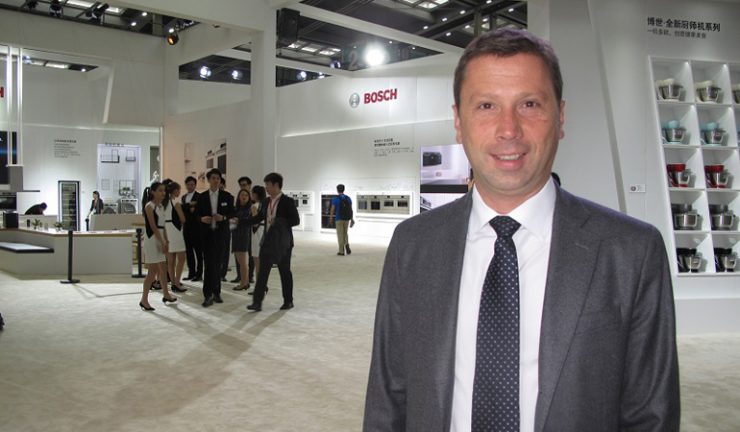
    According to Jens Heithecker (pictured below), the executive director of IFA at Messe Berlin, this new exhibition is designed to provide Chinese consumers and members of the trade with a local and international experience.

    Jens-Heithecker

    “Welcome to the very first edition of the new CE China trade show and you can see it is a retail brand show – this means we have Chinese retailers as well as Chinese brands and global brands from around the world here in one place. This is the newest show for the Chinese market, but with clear influence to the Asian markets as well.

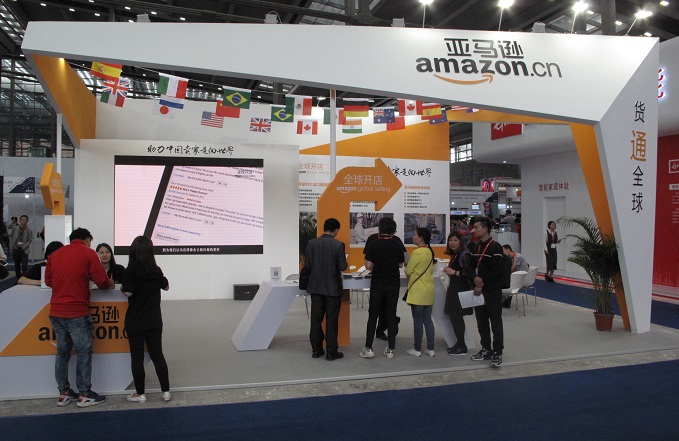
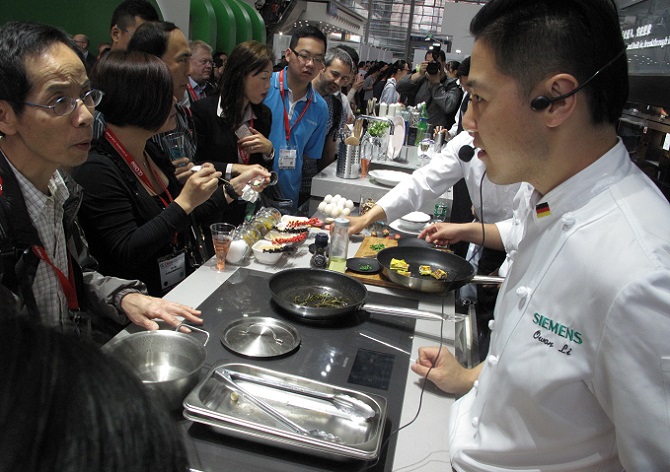
    “We are proud that some of our largest exhibitors the very first year of the show are retailers such as Alibaba, Suning, Gome and Amazon China. In addition to this, from the industry side the dominating booths are from Bosch, Siemens, Karcher, Onkyo emphasising that this is an international show. It is not a trade show with a lot of small booths, it is a brand show that China has not seen so frequently in the past.

    CE China Amazon

    “It is a step for IFA to conquer the Asian market with our own show, but we have also realised in the last couple of months what influence this show has to Berlin. We have much better contact with the Chinese retailers and manufacturers who are better informed about IFA in Berlin.

    “We have also brought the Euronics and Expert buying groups from Europe and they will inform the industry in China that they act differently to other retailers worldwide, the influence is both ways. We bring over international and niche brands that is what the new Chinese middle class is looking for and of course the leading brands worldwide.

    “We have two kinds of trade visitors – the traditional Chinese retailers with central buyers who spread out the products through the shops, but also in this competitive environment of rising online retailers, it is clear that you have to train staff in a better way so the retail shops have better chance to survive.

    “The consumer experience in-store has to be an experience and not only a place to pick up products. And the manufacturers feel as though they need much more brand experience in the retail stores, bringing retailers and manufacturers together to train each other with the newest products for the best sales outcome. That is the basic idea here in China and we look forward to demonstrating how we do it in Europe.

    CE China Siemens

    “The other point, is that here in the region of Shenzhen is the world’s largest hub for the electronics industry which means for all these companies developing, manufacturing and marketing these products they need to understand in a better way to work with international brands and international markets and this is the chance for them to see and learn about at CE China.”

    Dr. Christian Göke, CEO of Messe Berlin added: “As the Asian counterpart of the global IFA trade show, CE China is consciously aligned to the needs of Chinese distributors, and existing retail structures in particular. These distributors are interested in products manufactured by well-known international brands. It will be our task to successfully bring together these companies and distributors at CE China.”

  • Starbucks Corporation Growth Falters, but Remains Steady in China

    Starbucks Corporation Growth Falters, but Remains Steady in China

    Starbucks Corporation posted its second quarter financial results for the fiscal year 2016 (2QFY16), after the closing bell yesterday. The world’s leading coffee chain posted a 16.3% growth in earnings, as it continued to benefit from rapid expansion and growth.

    Earnings per share (EPS) for the second quarter came in at 39 cents, in-line with the Street’s expectations. Net income was registered at $575.1 million, higher from $494.9 million or $0.33 per share, reported last year.

    Even though sales missed analysts’ expectations, the company’s president claimed it to be a record quarter, as the reported revenues outdid all preceding non-holiday quarters. In total, the $4.99 billion sales registered a 9.4% growth, from comparable quarter last year, when the company reported $4.56 billion in sales. The company lagged behind analysts’ $5.03 billion revenue estimates, by $40 million.

    The company has aggressively worked to expand its physical footprint abroad; it recently disclosed plans to launch outposts, in Germany and Italy. Starbucks also opened its first store in South Africa, yesterday. For the quarter, the company opened a total of 350 stores globally, bringing the total to 23,921 stores worldwide.

    And yet, sales growth fell shy of the Street’s estimates. Global sales from stores established for at least a year, improved just 6% for the period ending March 27. This included 2% improvement in store traffic globally, and 4% growth in average ticket. The global comps, which reflect a 200 basis points deceleration from the last quarter, disappointed investors; the company recorded 8% growth in the metric in the previous quarter.

    Disheartened investors offloaded their holdings, as the stock took a downturn in the after-hours trade and tumbled as much as 5%, to $57.58 per share. The losses trimmed down in early market hours today; the stock is now down 2.7% to $59 apiece, as of 4:00 AM EDT.

    Sturdy Domestic Numbers

    Though global same store sales were slower than expected, region-wise growth was better than expected. “We posted 6 percent increase in comps globally, but if you go region by region, there is a story under each of those regions,” commented Starbucks’ president and chief operating officer, Kevin Johnson, in the earnings release.

    By region, the Americas and the US segment posted a 7% comp growth, which was the highest for the quarter, followed by a 3% growth in the China/Asia Pacific region. Europe, Middle East, and Africa (EMEA) region reported a 1% comps growth, as the foreign currency headwind against euros and pounds continued to affect international sales.

    Growth in the US and the Americas played out well, due to the company’s constant efforts in the region. The company targets to double food revenue, from domestic flagship revenues. In this regard, it has made efforts to get more people to sign up for its mobile app. Starbucks looks to diversify its menu and push food beyond the coffee lineup, to include salad boxes and breakfast sandwiches. This strategy has played out well, as food ascribed to more than 20% of total US sales, for the quarter.

    The company’s digital initiatives, including its mobile app, have helped Starbucks report a 9% growth in global revenues. According to the earnings call, the company’s investment in mobile initiatives, including the mobile order and pay app, has made it convenient for its users to make purchases at the store. This has resulted into significant growth, on the domestic front.

    Starbucks disclosed that mobile usage and orders have nearly doubled from the comparable quarter last year. The company has processed eight million mobile ordered and paid transactions, on a monthly basis. According to an analyst at RBC Capital Markets, a normal mobile app user spends nearly three times as much as a store going customer, which can play out nicely for the company’s future revenues.

    Doubling Down on China

    Despite a slight deceleration in global comps, the company has managed to report $5 billion in a record profit, for a non-holiday quarter. China outdid all other regions, as transactions in the country grew by 5%. This growth resulted in a remarkable 18% growth in revenues.

    “Starbucks recorded Q2 financial and operating performance – including a stunning 18% increase in revenues and a 5% increase in transactions in China – underscores the strength of the Starbucks brand and the resiliency of our global retail and CPG businesses,” stated the company’s chairman and CEO, Howard Schultz. “Loyalty, technology and innovation are continuing to fuel our digital flywheel and propel our business forward all around the world.”

    With hopes of continued growth in China, the company would add 500 stores each year in the country, in a move that could make the Asian country, one of the busiest Starbucks’ markets worldwide. A new store is set to be launched in mid-June, at the entrance of the newly opened Shanghai Disneyland. As it intends to cash-in on Disney World’s popularity, the company expects the launch to become the company’s “highest grossing retail store overnight.”

    While Starbucks continues to underscore the global nature of its rapidly expanding business, Mr. Schultz commented in the conference call: “Starbucks is only getting started” in China. Though the company didn’t divulge on profit contribution from the country, China and the Pacific Region in total reported 15% growth in profits.

    In fiscal year 2016, the coffee chain has plans to launch 1,800 new outlets globally. With nearly 700 outlets planned for the US, the company plans to open around 900 in the Asia Pacific region. For the year, consolidated revenues are expected to grow by 10%; the GAAP EPS is expected to fall anywhere in the $1.85-1.86 range. For the third quarter, EPS is expected to clock in between 47-48 cents apiece.
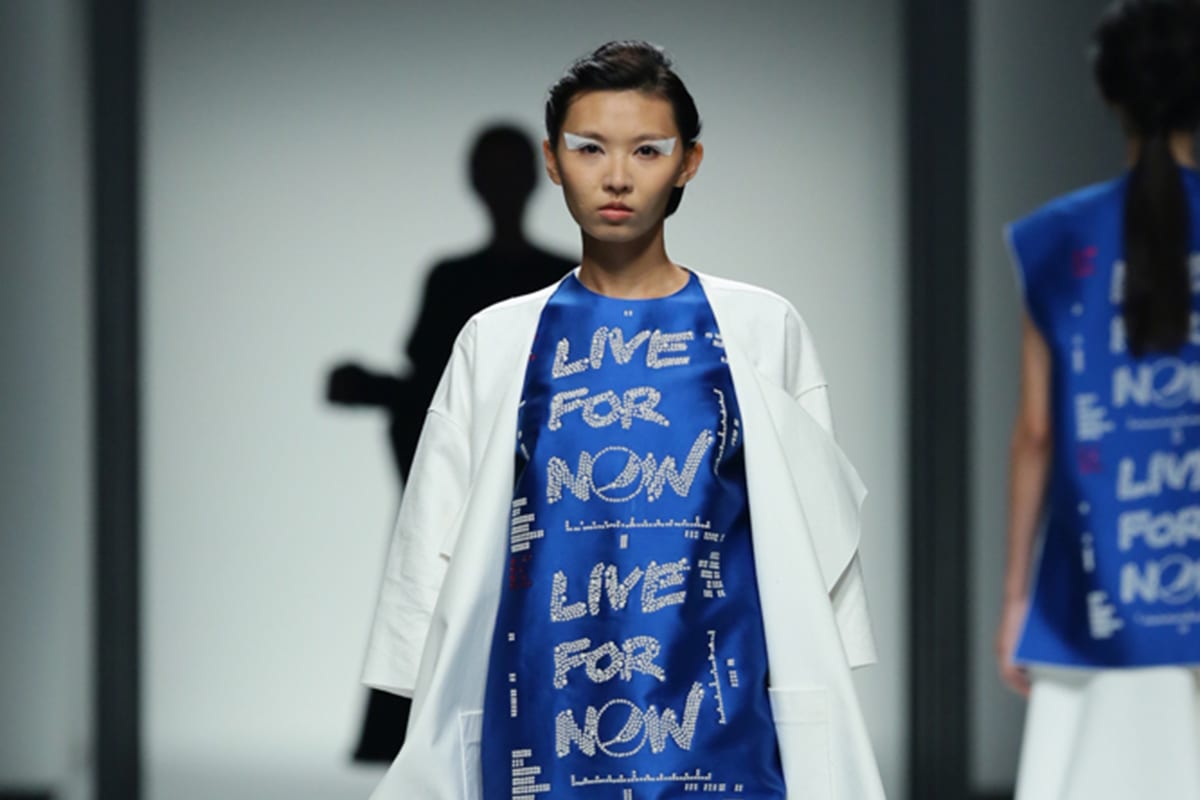
  • Shanghai Fashion Week wraps up after nine breathless and optimistic days

    Shanghai Fashion Week wraps up after nine breathless and optimistic days

    Shanghai Fashion Week was bigger than ever this year – almost too big, in fact. While it is the range of events beyond the catwalk shows that has made it such a success in so short a time, this year’s edition spread over a very long nine days and, for all its inclusiveness, could perhaps have been better curated.

    “There are a lot of shows taking place during Shanghai Fashion Week. Some of the shows are great, some of them less so,” says Richard Hobbs, co-founder of The HUB, a trade show that also hosted a series of catwalk shows for young British designers. “I like to think that what we do is more selective.”

    Still, there was an undeniable air of optimism around Shanghai this month.

    “The event is definitely one of the youngest, in terms of atmosphere, and is also the most vibrant one,” says Yichi Zhang, a creative consultant who has styled for Vogue Chinaand Harper’s Bazaar China.

    “Part of the reason comes from the fact that a lot of independent platforms and agencies are based here– so emerging brands work with them to get the kind of industry attention they would otherwise struggle to find by themselves.”

    One example was showroom concept Labelhood, which hosted a series of presentations by some of China’s emerging and most innovative designers on The Bund. One standout from the showroom was London-based Haizhen Wang, who showed a collection with elongated sleeves, structured coats and raw hemlines.

    Another big draw was the show by Shenzhen-based label Ffixxed, which has shown previously at Shanghai Fashion Week. The brand explored the idea of sustainability by weaving together leftover fabric from previous seasons to create new textures. Part presentation, part catwalk show, the event was held across a long corridor lined with office-style grey blinds.

    Back in the main tents, special attention was paid to Ban Xiao Xue, 2012 winner of the China Woolmark Prize. The designer showed a range of romantic looks in white and black, featuring textures and prints that were full of ideas. But with so many looks on offer, the show was a metaphor for Shanghai Fashion Week as a whole – a smaller and more cohesive collection would have been better.

    Among the brands showing at The HUB trade show were established British brand Henry Holland, up and coming British labels such as Sibling and Ryan Lo, and group from incubator Fashion East. Also taking part for the first time was Hong Kong brand Squarestreet – one of a number of Hong Kong brands emboldened by the city’s poor retail outlook to explore Shanghai Fashion Week for opportunities.

    “China represents a huge opportunity for expansion,” says Alexis Holm, founder of Squarestreet. “Comparing Hong Kong as a retail market to China would be like putting a pebble next to a boulder, and we’re not about to miss out.”

    He adds: “On paper, it looks like China as a whole is having a few financial issues. But the general feel on the ground is comparable to that of Europe 10 years ago – an insatiable appetite for everything new and a newfound appreciation for niche brands. Having said that, China is of course still emerging, which means the amount of quality retailers and customers is limited – but growing every day.”

    Squarestreet not only showed at The HUB but had a booth at trade show Ontimeshow. While positioned for the local market, this event had an impressive array of brands and saw plenty of traffic from store buyers and media on all three days of operation.

  • BMW expects China sales to rise by single digit percentage

    BMW expects China sales to rise by single digit percentage

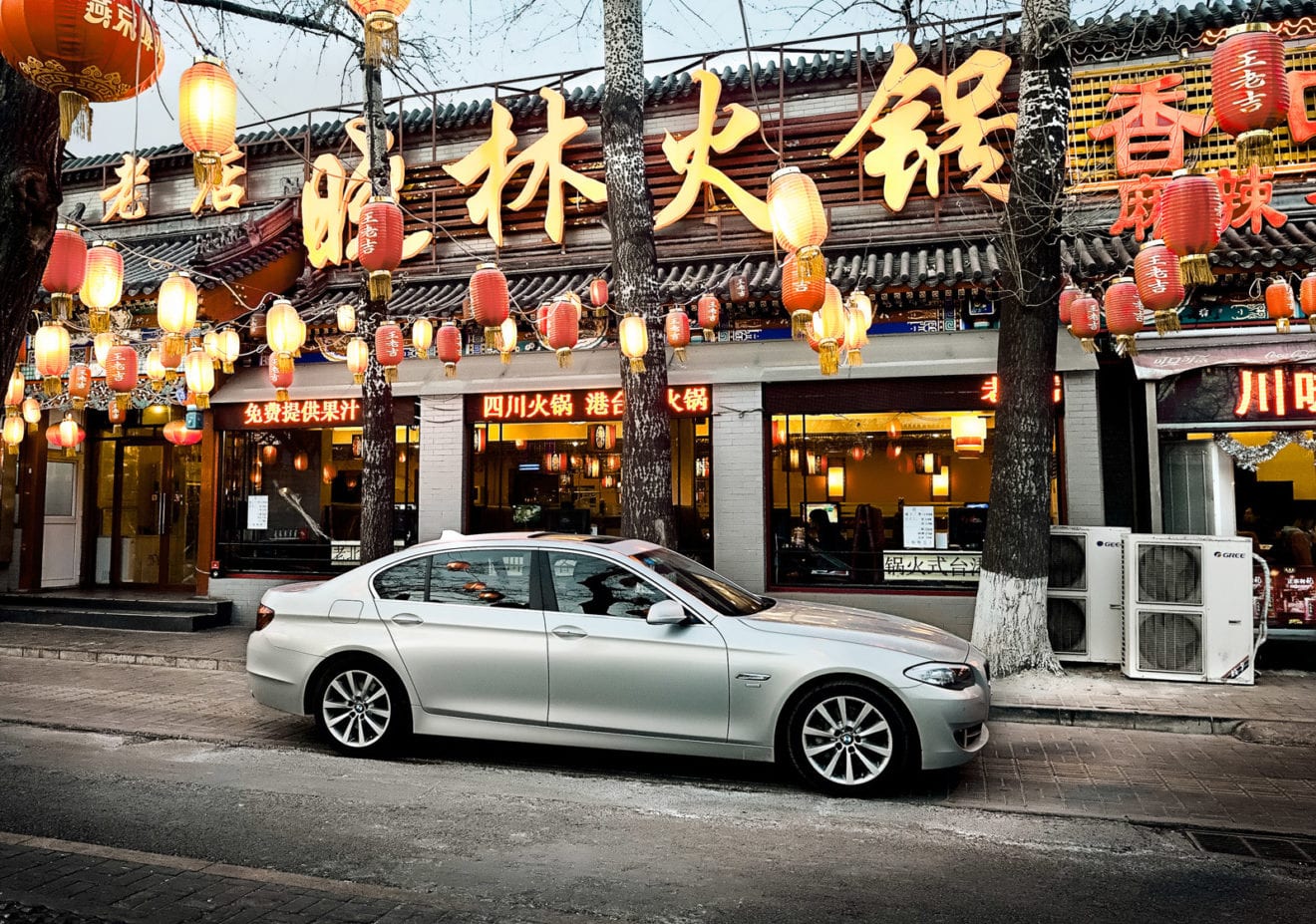
    BMW expects its car sales in China to rise by a mid-single-digit percentage this year, in line with the overall growth of the world’s biggest passenger car market, board member Ian Robertson said on Monday.

    Last year, BMW sold 460,000 cars in China, marking a 1.7 percent rise, said Robertson, who is responsible for marketing and sales.

    Growth is expected to accelerate once the long wheelbase BMW X1 is launched, helping BMW to increase the number of locally manufactured vehicles to six, Robertson said.

    BMW expects its sales in the United States and across the globe to rise by a single digit percentage this year, Robertson said.

  • Spar Asia flourishes

    Spar Asia flourishes

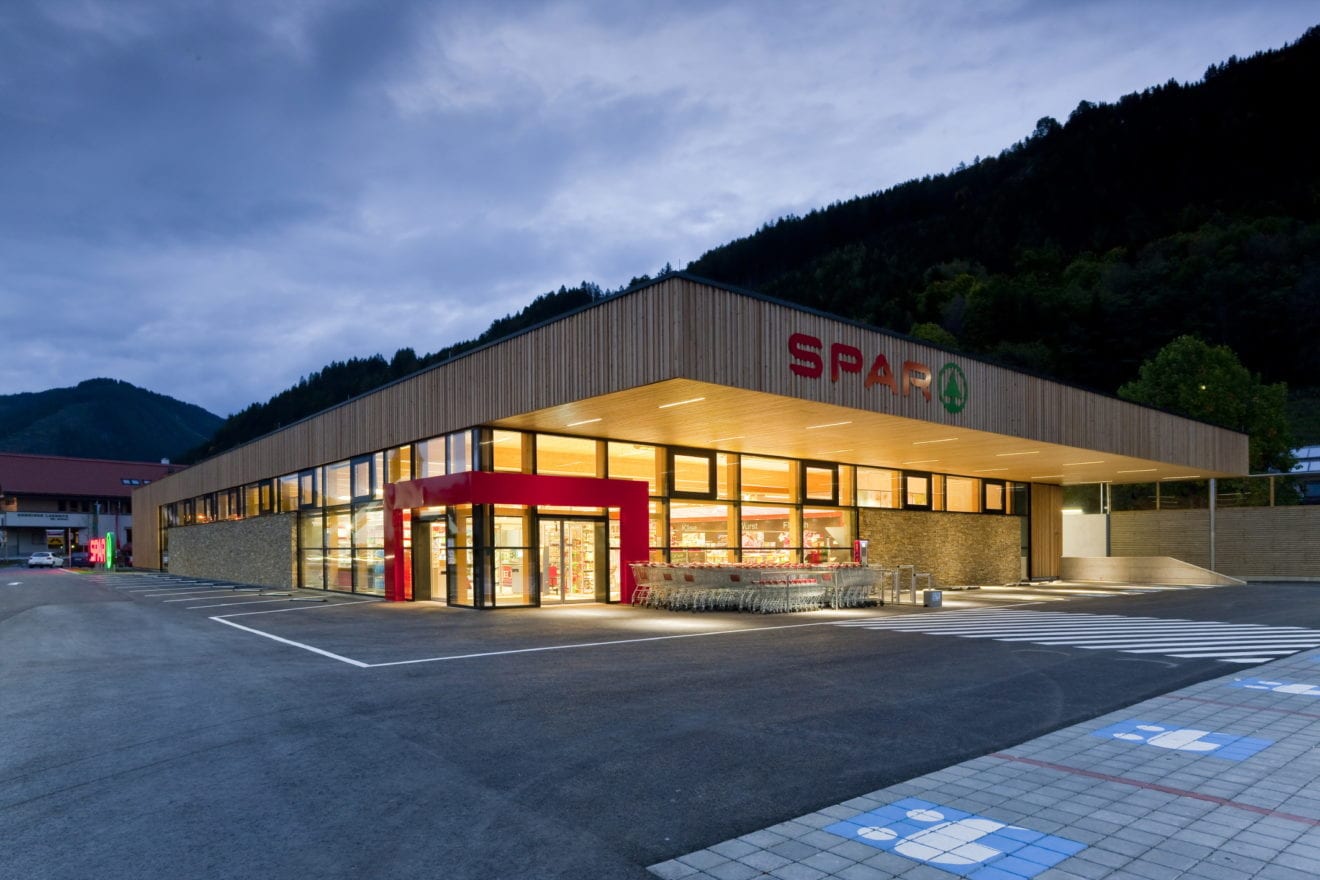
    Food retailer Spar Asia had “significant” developments during its latest financial year.

    In a partnership with Ramayana, the Amsterdam-based group opened 15 stores in Indonesia in nine months, had rapid growth in India after re-entering the market in 2014, and saw its China sales rise 6.8 per cent to €1.9 billion (US$2.14 billion).

    Internationally, its retail sales netted €33 billion for the year, a 3.5 per cent increase on 2014 – the group’s strongest sales growth in five years.

    During the year it entered four new countries, in Asia, Africa and the Middle East, taking its total to 12,100 stores in 42 countries serving 13 million customers a day. Spar International’s multi-format strategy includes hypermarkets, supermarkets, and neighbourhood and convenience stores.

    The fresh department is at the core of the Spar concept, with the stores also offering FMCG products and core non-food ranges. Value is underpinned through its low-priced, quality private-label products.

  • Issey Miyake China launches in open-air complex

    Issey Miyake China launches in open-air complex

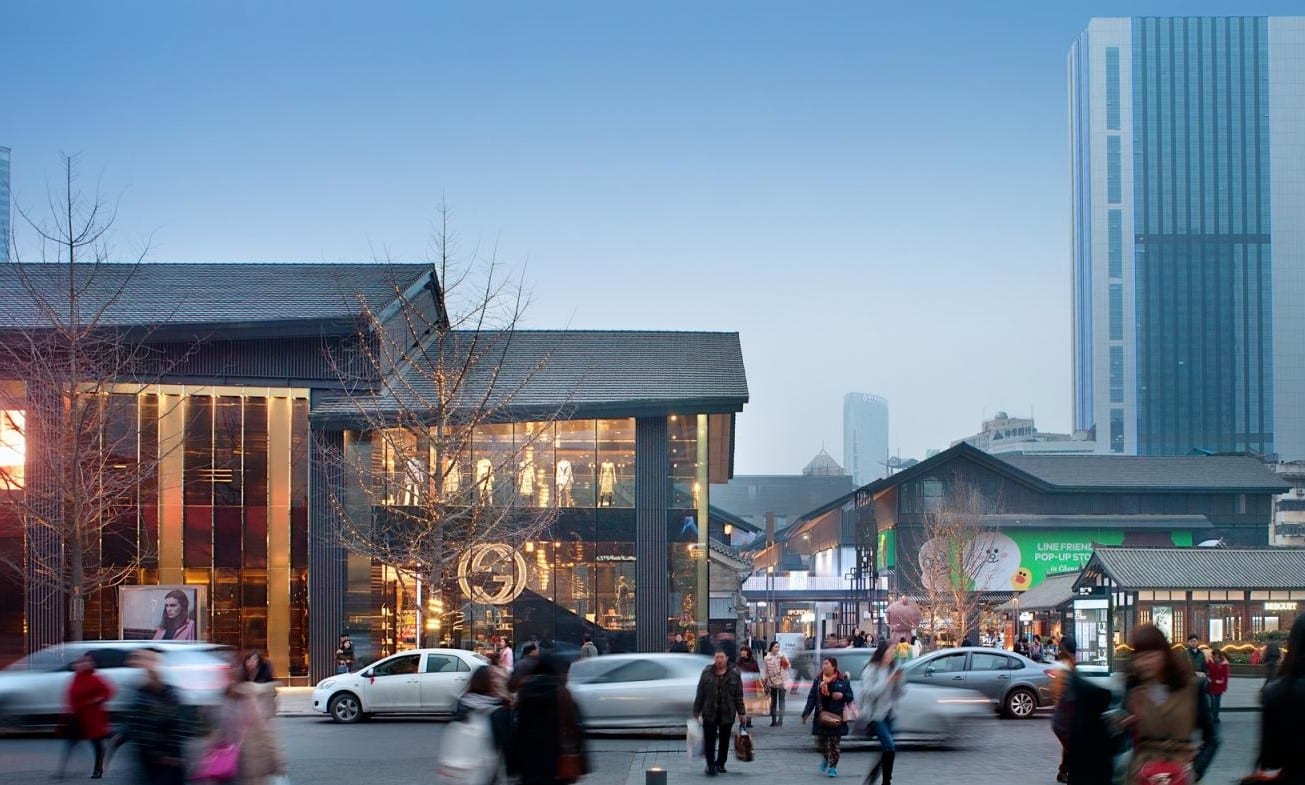
    An Issey Miyake China boutique has opened in Chengdu, at the open-air shopping complex Sino-ocean Taikoo Li.

    Covering two floors, the Japanese fashion store has a white interior with modular displays and sleek metal racks that makes the products stand out. Its range includes women’s items from the Issey Miyake main collection, as well as Pleats Please, Bao Bao and Me Lines items.

    Issey-Miyake-store-Chengdu-China

    Sino-ocean Taikoo Li is centered around the historic Buddhist Daci Temple. It is a low-rise project that includes shopping, dining, drinking, entertainment, offices and hotels with the setting of lanes, squares, streets, alleys and courtyards.

    Issey-Miyake-store-Chengdu-China-02

    Its retail planning concept is “Fast Lane” and “Slow Lane” (play fast, live slow). “Fast Lane” incorporates luxury brands and high-end contemporary fashion, while “Slow Lane” comprises outdoor dining and lifestyle stores.

    Master planner for the project and lead architect was the Oval Partnership.

    Issey-Miyake-store-Chengdu-China-03

  • Starbucks China convinces suppliers on ethics

    Starbucks China convinces suppliers on ethics

    Ten years ago when Starbucks China hosted its first suppliers summit there were just 10 people present.

    This year, more than 350 supplier representatives were in Shenzhen to hear the coffee giant’s pitch to join its commitment for a sustainable, ethical supply chain.

    “We studied the leadership position we were taking to get high-quality coffee,” said Kelly Goodejohn, director, Starbucks ethical sourcing. “We wanted to build something similar for other products that we source.”

    Similar to coffee, Starbucks wanted to understand where manufactured goods were sourced, how farmers and workers were being treated and the impact the suppliers were having in local communities. The summit served as a starting point to gain more of this knowledge, no matter what the products being sourced are.

    “It was an awareness opportunity,” said Goodejohn. “What we found was that many of our suppliers shared our values, wanted to do more for their employees and communities, but didn’t know how to do it.”

    The 10th Annual Supplier Summit this week featured Starbucks leaders, representatives of nonprofits and industry experts. During the event, Starbucks shared key company initiatives, discussed global responsibility goals and provided tools and resources to help suppliers improve business practices.

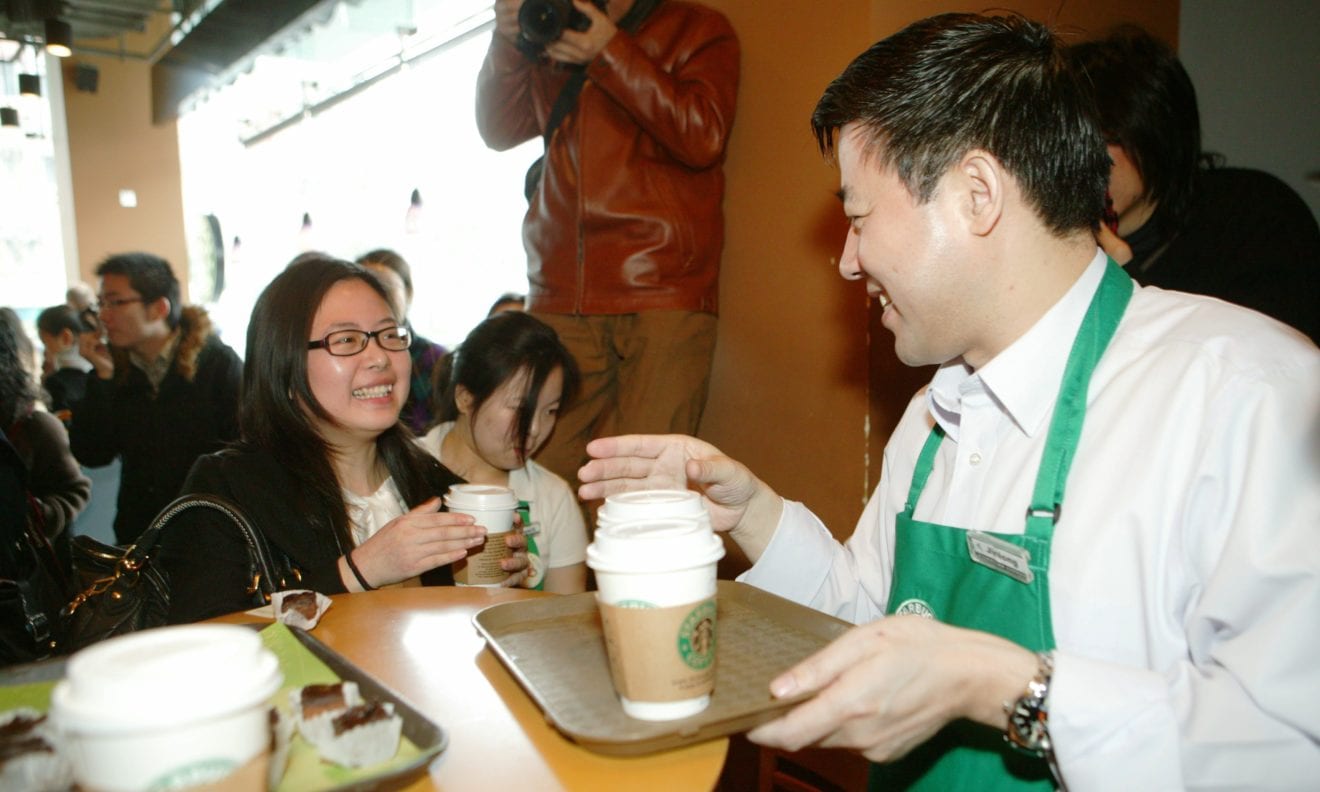
    Starbucks China


    Building trust

    Back in 2006, at that first summit, one of Starbucks goals was to cultivate a stronger rapport with suppliers.

    “Building authentic relationships with our suppliers was important as well as working with them to make improvements,” said Goodejohn. “Over time, we have worked with our suppliers in China to improve labor and environmental performance to enable higher overall performance, so they are positioned to grow with Starbucks as our business grows.”

    At first, not all suppliers were willing to take Starbucks at face value.

    “It was difficult to build trust, but we got there,” said Goodejohn. “While some suppliers moved on, the majority were willing to work with us and are still our suppliers today.”

    Starbucks has worked with suppliers to improve worker health and safety, ensure employees get paid a fair wage, provide better living conditions at factory dormitories and confirm that products are made without emitting dangerous chemicals to protect water and air.

    Three years ago, Starbucks incorporated community service into the supplier summit to highlight an important aspect of the company’s mission.

    On Wednesday, suppliers, Starbucks partners (employees) and customers convened for a beautification and career development service project at the Shiao Community and the Young Dream Center in Shenzhen. The project is one of many that the company will engage in during its Global Month of Service that takes place throughout the month.

    Sharing knowledge

    As a way to support suppliers on the ground year-round, Starbucks hired two field managers in China to help implement best practices related to social and environmental performance. They teach factory managers and work on continuous improvement with suppliers.

    “I’m immensely proud of what we’ve done and the partners who are elevating ethical sourcing with suppliers on a regular basis,” said Goodejohn.

    “We have many countries that manufacture goods for us and we can bring the learnings from China to other regions. We have the right momentum and we will keep moving.”

  • Waitrose China launches via Alibaba

    Waitrose China launches via Alibaba

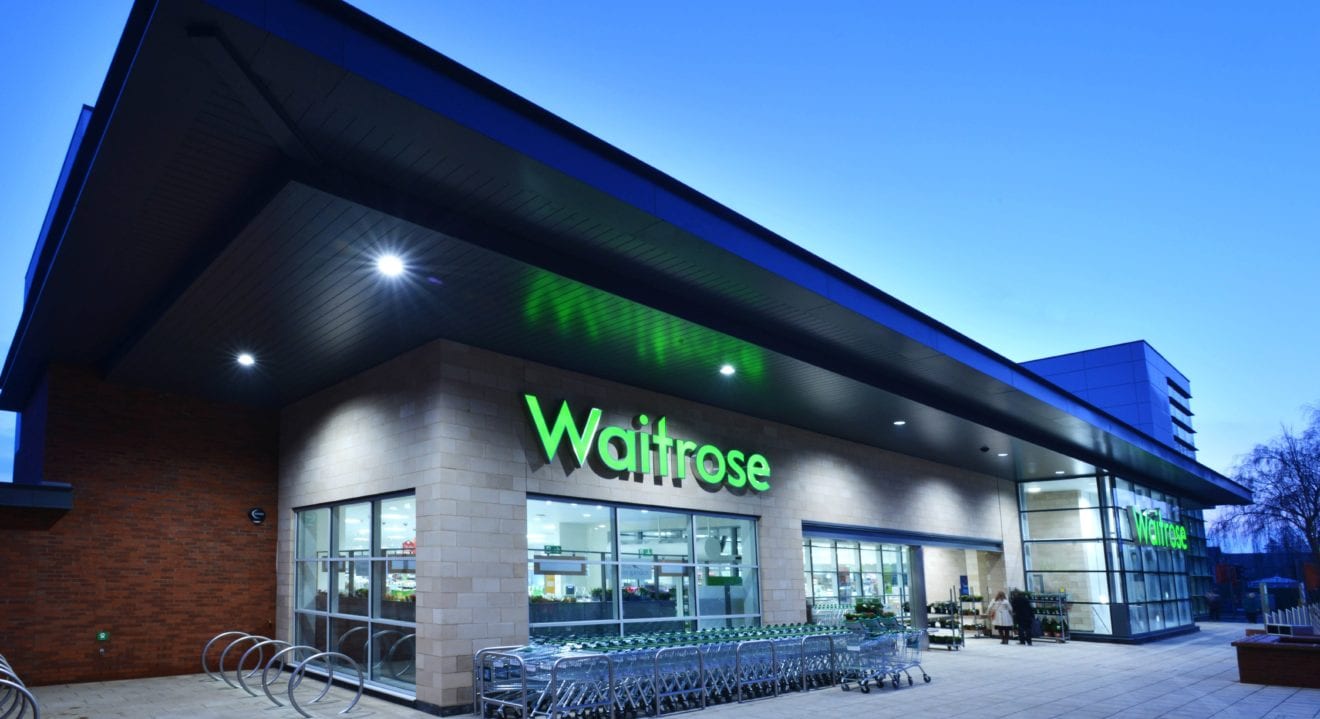
    Upmarket British grocery chain Waitrose has broken new ground in a deal with online marketplace Alibaba, opening the doors for it to export to China.

    Waitrose China will offer products and ranges to buyers across the mainland exclusively through theRoyal Mail Store on Tmall Global, Alibaba Group’s online marketplace. Waitrose arranged the deal through Avenue51, which runs Royal Mail’s store on the platform.

    Royal Mail promotes British companies, and Waitrose will be one of its highest-profile brands with a dedicated page on its online store. There will be 30 products initially, including biscuits, cereals, coffee, nuts and tea, plus beauty, baby and organic ranges.

    “The potential for Waitrose in China is huge, and though this is a relatively modest start it’s our ambition to see it become our biggest international business in the next three to five years,” says Waitrose commercial director Mark Williamson.

  • NZ govt teams up with Alibaba to boost Chinese trade

    NZ govt teams up with Alibaba to boost Chinese trade

    New Zealand has joined the likes of other Southern Hemisphere agricultural nations like Australia, Chile and Peru by forming a strategic alliance with the world’s leading online retailer, Alibaba.

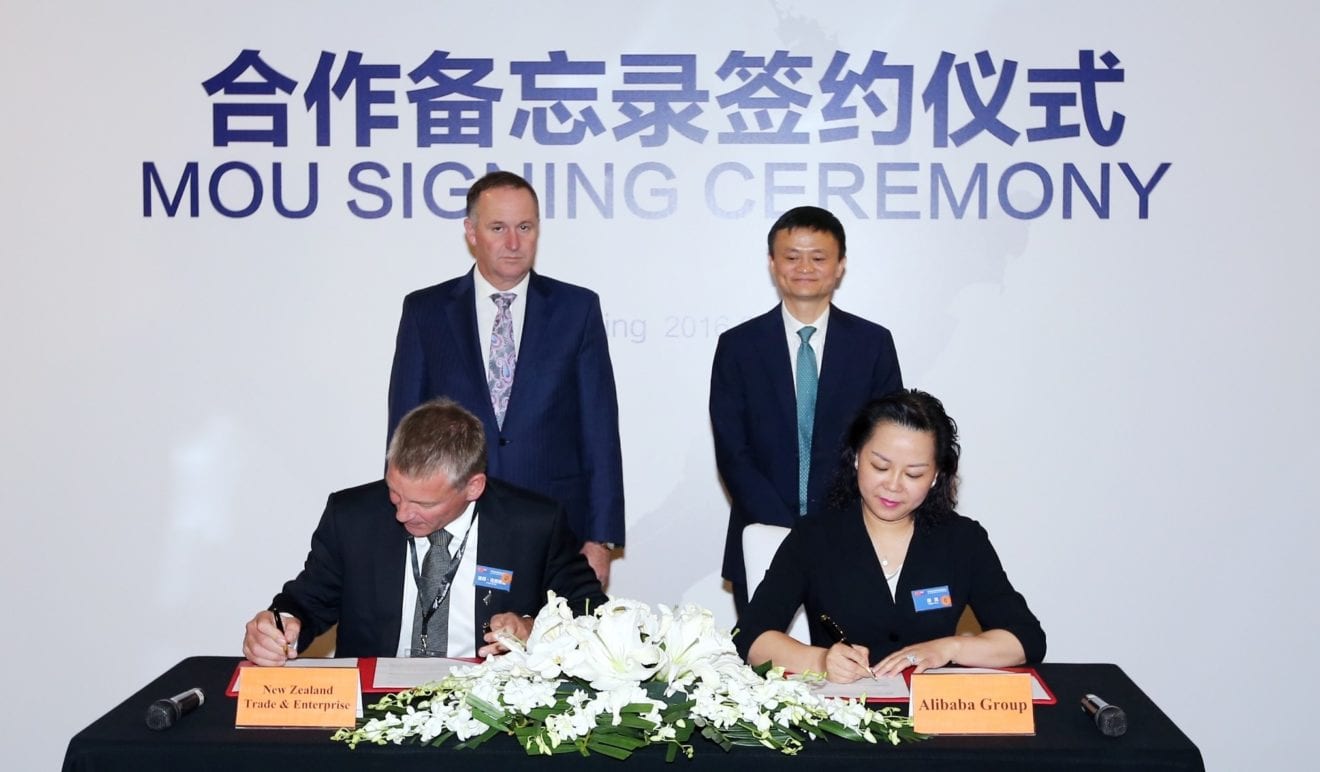
    The Memorandum of Understanding (MOU) between the group and government business development agency New Zealand Trade and Enterprise (NZTE) was signed yesterday to formalize discussions for strengthening trade between the two countries and to support New Zealand brands in China.

    Under the MOU, the parties will explore different collaboration opportunities, including Alibaba providing support for New Zealand companies to enter the Chinese consumer market through its various e-commerce channels, while NZTE will assist local companies to understand and optimize the opportunities Alibaba’s system offers in terms of business growth in China.

    “We are excited to extend our cooperation with the New Zealand Government by collaborating with NZTE to support local businesses to enter China through Alibaba’s platforms,” said Maggie Zhou, Alibaba’s newly appointed managing director for Australia and New Zealand.

    “With our strong networks in China and expertise in e-commerce, we will enable Chinese consumers to benefit from the premium products and fresh foods that New Zealand businesses can offer.

    NZTE chief executive Peter Chrisp said the new arrangement offered significant opportunities for New Zealand businesses to reach more consumers as well as advocating the country’s reputation as a place of “open spaces, open hearts and open minds”.

    “New Zealand businesses are already using Alibaba’s channels to sell a wide range of products including dairy, meat, seafood, fruit, wine, beverage, cereal, skincare and health supplements,” he said.

  • Foxconn reportedly to return to China retail channel

    Foxconn reportedly to return to China retail channel

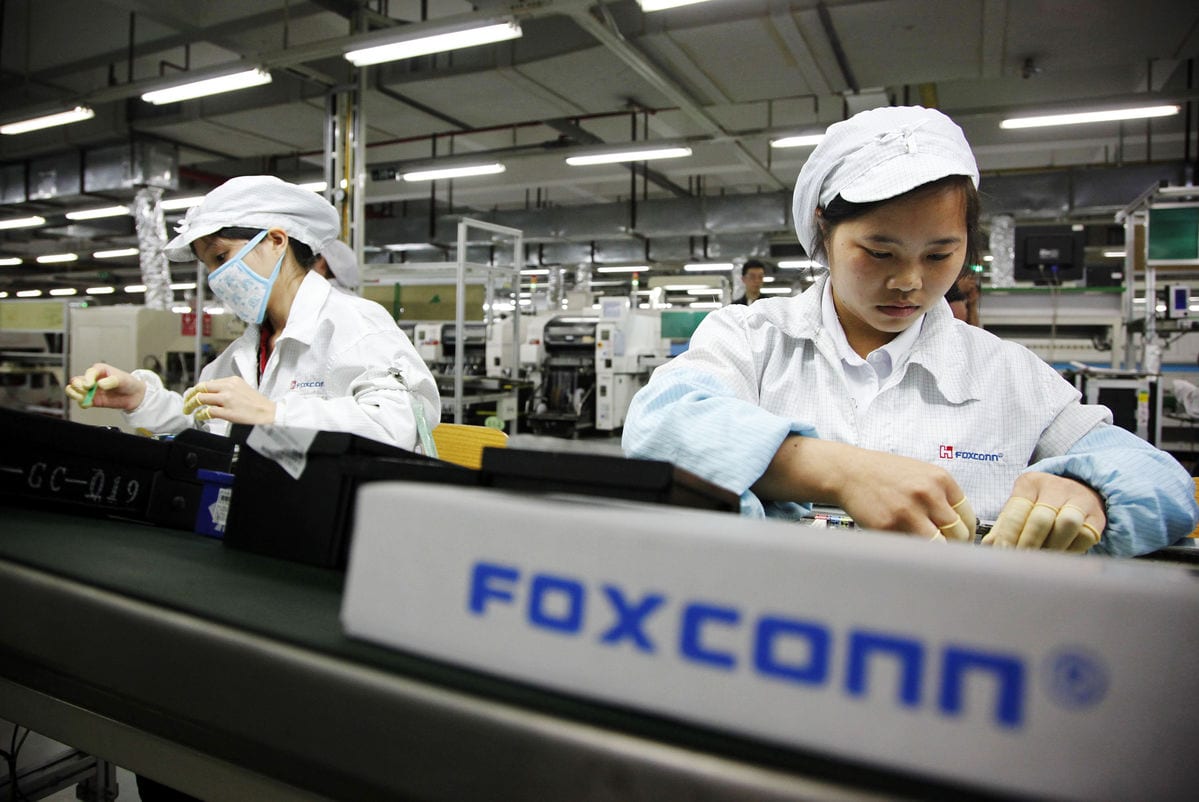
    Foxconn Electronics (Hon Hai Precision Industry) reportedly is planning to return to China’s retail channel, but instead of creating a specific department, Foxconn is separating the country into 8-10 areas for each of its sub-business groups to handle one segment, according to industry sources.

    The establishment of physical channel has been an important part of its long-term development, and related investment projects have been implemented accordingly, Foxconn said, but declined to elaborate on details.

    Foxconn’s latest development echoed company chairman Terry Gou’s recent remarks made after signing an investment pact with Sharp, saying that Foxconn will integrate and optimize its manufacturing strength to enable consumers globally to buy Sharp’s household appliances at affordable prices.

    Previously, Foxconn had tried several times to establish its own retail channels in China, but most of them had failed to achieve significant results, said the sources.

    Even so, Foxconn has continued its efforts to build its retail channel through the establishment of an online shopping platform, flnet.com, in 2015. The online shopping platform has built a number of experimental shops in China and Taiwan.

    One of the group’s subsidiaries has obtained the license from Apple to establish shops to sell Apple’s products in China, the sources noted.

    Meanwhile, under the new strategy, each sub-business group will be responsible for implementing its own plans to build up retail channel in the assigned region, as well as for profits and losses, said the sources.