Tag: China

  • Digital Push In China: Can This Impact Starbucks’ Revenues In The Region?

    Digital Push In China: Can This Impact Starbucks’ Revenues In The Region?

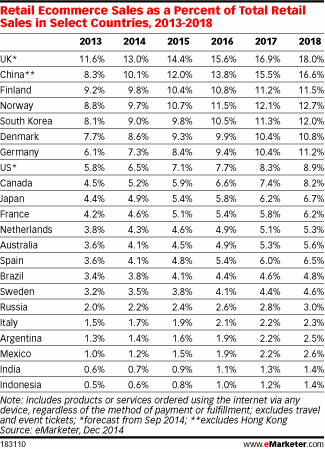
    Recently, Starbucks Corporation China announced the opening of its first online store in China’s popular ecommerce site, Tmall, which will feature unique and specially designed e-cards, Starbucks cards and coffee vouchers providing an easy gifting option. [].While this initiative is part of the company’s increased focus on digital presence, it could tap into the significant growth of retail ecommerce in China. According to eMarketer, retail ecommerce sales in China are projected to grow at more than 30% each year, over the next three years and reach more than $1500 billion by 2018. []. While mobile is expected to account for nearly half of the total ecommerce sales in China in 2015, this figure is expected to increase to 70% by 2019. []. We believe Starbucks’ ecommerce initiative in China should benefit from the growing internet users in the region and the online shopping habits of Chinese consumers.

    More Than 16% Of Total Retail Sales In China Through Ecommerce By 2018

    It is estimated that in 2015, ecommerce sales will account for nearly 7% of the total retail sales in the U.S., while this number is much higher at 12% for China. By 2018, it is estimated that these figures will increase to nearly 9% for the U.S. and more than 16% for China.
    183110

    Given the preference of Chinese consumers towards online shopping, we believe Starbucks’ initiative to expand its digital presence in the region is the right strategy.  China is a growth market for Starbucks. For the fiscal year 2015, comparable store sales in the China Asia Pacific region grew by 9% compared to a 7% number for the Americas. This growth was driven by a 8% increase in traffic while the corresponding number for Americas was 3%. []. The company plans to double its store count in the China Asia Pacific region to 10,000 stores in the next five years, with the store account in China projected to be 3,400 by the end of 2019. As the Chinese economy shifts from an export focussed industrial region to one relying on services and domestic demand, we believe Starbucks will benefit from this trend with the urban middle class increasing and becoming well off. With aggressive expansion plans in China, which the company expects will be its biggest international market; we believe the ecommerce entry could drive growth in the region and also provide a boost to the Starbucks loyalty program.


     

  • All about China and oil again as shares slip

    All about China and oil again as shares slip

    Shares in Europe and Asia fell on Monday in trade thinned by holidays in a number of financial centres, hit by slumping oil prices and concerns over Chinese growth and finances – two of the year’s major factors.

    Prices of both Brent and U.S. crude fell 1.8 percent LCOc1 CLc1, reversing a brief rebound that helped shares in the Middle East over the weekend, while Chinese stocks fell almost 3 percent after a weak batch of industrial profits data.

    While most bank dealing rooms in Europe were on skeleton staffing, and London shut, that had repercussions for a range of assets, driving the Australian and Canadian dollars down about a third of a percent and pushing bond yields lower.

    Profits at Chinese industrial companies in November fell 1.4 percent from a year earlier, the sixth consecutive month of decline and another sign that the world’s chief engine of growth for the past decade is sputtering.

    “Over-capacity and declines in producer prices are hurting the Chinese government efforts and if the government cannot come up with a solution to stop this, the picture will keep on becoming more worse,” retail brokerage AvaTrade chief market analyst, Naeem Aslam, said.

    MSCI’s broadest index of Asia-Pacific shares outside Japan .MIAPJ0000PUS gave up early modest gains to fall half a percent, putting it on track for an 11-percent loss this year.

    China’s two main share indexes .SSEC .CSI300 fell 2.6 and 2.9 percent respectively, with banking shares leading the fall. Hong Kong’s Hang Seng .HSI dropped 1 percent. South Korea’s KOSPI .KS11 fell 1.3 percent.

    Stocks affiliated with Samsung Group fell after the South Korean conglomerate said on Sunday its battery-making arm Samsung SDI will sell shares in sister firm Samsung C&T Corp to comply with regulatory requirements.

    Japan’s Nikkei .N225, however, rose 0.6 percent, with soft domestic production and retail data hinting at more pressure on the Bank of Japan to take further steps to stimulate growth.

    International Brent crude traded at $37.26 LCOc1 a barrel, just over a cent above 11-year lows hit before Christmas.

    The fall in oil prices has depressed inflation globally, in turn reducing long-term expectations for price growth that drive longer-dated bond yields. That tends to draw investors back into bond markets at the expense of stocks and pushes up the price of longer-dated government bonds.

    German 10-year Bund yields DE10YT=TWEB, which set the standard for euro zone borrowing costs, fell 2 basis points to 0.60 percent.

    “Oil prices could be part of this but it’s probably just minor trades that we’re seeing here, we shouldn’t read too much into it,” Rabobank fixed income analyst, Bas van Geffen, said. “Most market participants have already closed their books and small…(trades) can move markets quite a lot.”

  • Leak suggests Galaxy A9 will retail for just under $500 in China

    Leak suggests Galaxy A9 will retail for just under $500 in China

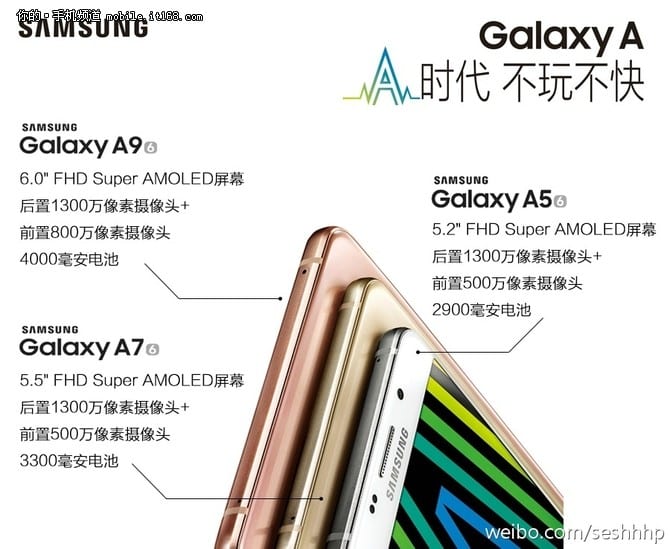
    Samsung’s latest phablet has come as a surprise for some: unlike the other members of the Galaxy A 2016 family, the Galaxy A9 has no such “subtitle” for it is the first of its kind. Sporting a 6-inch Full HD Super AMOLED display and with a metal unibody frame, the device is perfect for those who wanted a truly large phone from Samsung yet had to make do with a Plus 5. Today, a new leak out of China has added a possible price point as well: 3199 yuan (about $490).

    Given the device’s prime positioning as an upper mid-range phone, the cost would appear to be a fair price, all the more considering how expensive the Galaxy A8 was in some territories.

    Those in need of a spec recap will be happy to note that the Galaxy A9 comes with the aforementioned 6-inch Full HD Super AMOLED display (complete with 2.5D glass), a 64-bit Octa Core Qualcomm Snapdragon 652 SoC, 3GB of RAM, 32GB of on-board storage, a 13-megapixel rear camera and 8-megapixel front camera, an integrated fingerprint sensor, Dual SIM support, a 4,000mAh battery, microSD support, and Android 5.1.1.

    Samsung Galaxy A9

    While the exact release date for the extra-large phone is still unknown, it is possible Samsung will announce its plans in the next few weeks given the decision to launch it prior to CES 2016. At the same time, the phone has currently only been announced for China and is therefore operating on a slightly different release schedule. Perhaps it will hit stores just before Chinese New Year.

    What do you think of the cost? Assuming the leak is legitimate, would you pay around $500 for such a device? Is it too expensive given the competition? Leave us your thoughts in the comments below!

  • Rakuten to open on JD.com

    Rakuten to open on JD.com

    Rakuten, Japan’s largest eCommerce company, is to open an online flagship on Chinese cross-border eCommerce platform JD.com.

    The Japanese company says it aims to take “the best Japanese products to Chinese consumers”. It launched a beta version of the new marketplace on JD Worldwide earlier this month. Plans are under way to expand the merchandise range over coming months, with an initial focus on categories such as cosmetics, snacks and health food products.

    Masato Takahashi, managing executive officer of Rakuten, said the partnership between Rakuten and JD.com will promote cross-border trade by connecting Chinese consumers with authentic and popular Japanese products from a top selection of Rakuten’s merchants from around Japan, both small and large.

    “Rakuten will continue to work to expand our offering to Chinese consumers.”

    Haoyu Shen, CEO of JD Mall, said imported Japanese products have proven popular in China to date.

    “Our focus remains on partnering with the most trusted retailers in key overseas markets to meet the growing demand for premium imported products.”

    Expansion of the product line-up will continue over the coming months.

  • Boom in teenage arrests for selling counterfeit goods online

    Boom in teenage arrests for selling counterfeit goods online

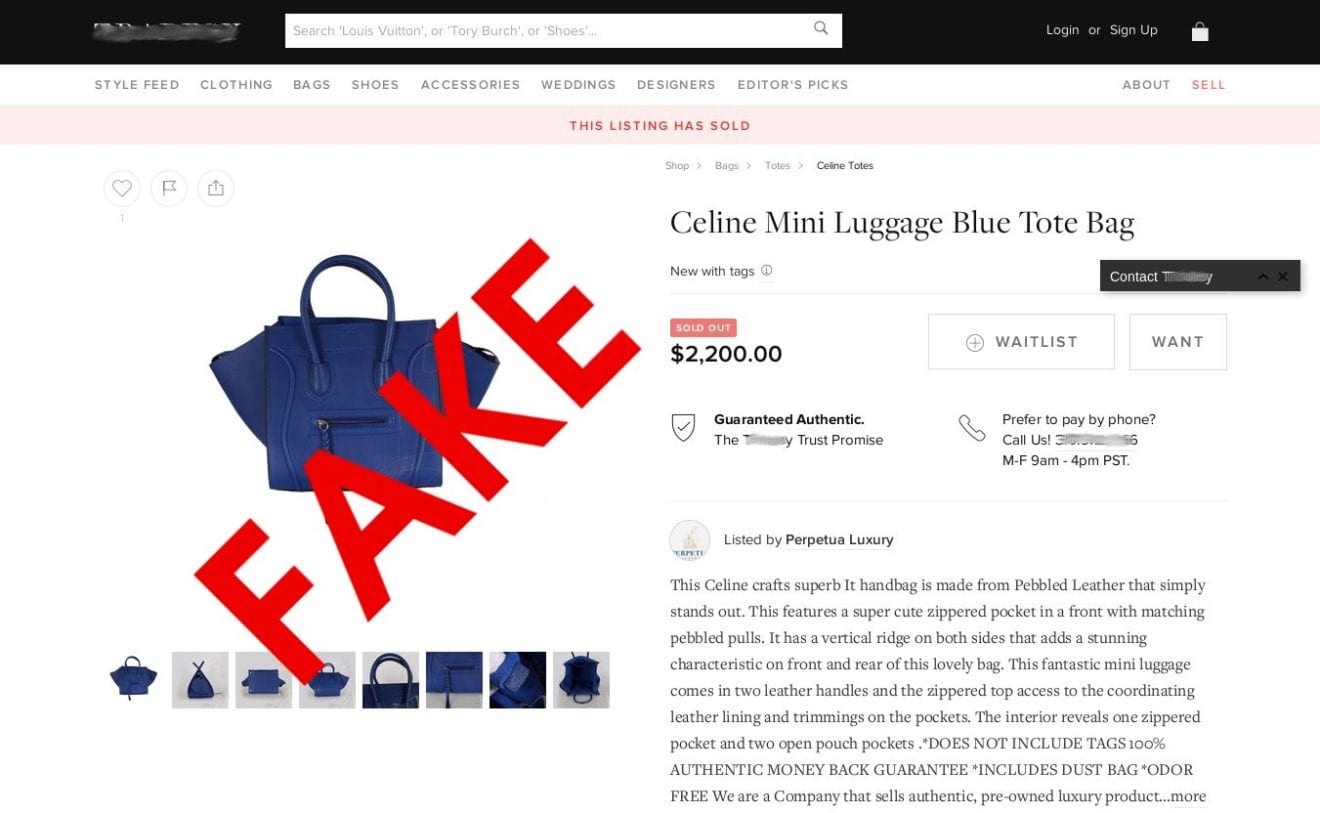
    Hong Kong Customs officials report they have arrested a record number of teenagers for selling counterfeit goods online via social media.

    According to a report in the South China Morning Post, officials have arrested double the number of teenagers in the first 11 months of 2015 as in the entire previous year.

    The majority of the arrested – 54 secondary school pupils and 28 university students – were allegedly selling fake goods on social media, with Facebook an especially popular channel.

    Last year, just 41 arrested were made, according to Louise Ho, head of the intellectual property investigation bureau of the Hong Kong Customs and Excise Department.

    The 82 arrests accounted for nearly 40 per cent of all the counterfeit arrests made by customs this year.

    Ho says students seem unaware of their legal responsibilities and the criminal nature of selling counterfeit goods online, and see the trade as easy money.

    They appear unaware it is insufficient defence legally to disclose the goods are counterfeit.

  • Here’s Why All That Glitters Is Not Gold In China Jewelry Market

    Here’s Why All That Glitters Is Not Gold In China Jewelry Market

    Market reports on Wednesday claim that Jewelry manufacturing and retail industry are among the worst hit sectors in China due to a slowdown in the country’s economic growth. Shuibei, which was once the mecca for Jewelry retail and production in China, is now feeling the heat in terms of declining number of consumer visits due to the economic uncertainty in China.

    Among the most pertinent reasons for slumping gold demand in China are the economic slowdown as well as the government’s anti-corruption drive which has resulted in low demand for luxury items. However, the most worrisome sign for Chinese gold market is the fact that the consumers have started to become wary of the prevailing economic uncertainty. The shaken consumer confidence is likely to hit the Chinese gold market, which is also the largest market in world for the precious metal.

    Analysts say that China is entering the maturity phase of its economic cycle after growing exponentially for the last few decades. As the economic growth slows down, there may be uncertainty regarding how the government and certain sectors deal with it. This situation has been made worse by the devaluation of Chinese yuan by the People’s Bank Of China (PBOC) in August. The yuan has suffered a constant decline since and some analysts believe that this might be a deliberate step by the Chinese government.

    The gold prices are already languishing at a six-year low due to global economic uncertainty. Therefore, with China and India, the largest and second largest gold markets going soft, it would only mean more trouble for the global gold prices.

    Many of the businesses in the Shuibei district of Shenzhen have suffered a slump in trade due to the current gloomy economic growth forecast for China. This is happening due to a shift in customer confidence from being enthusiastic to wary.

    According to Wang Zhichang, regional manager of Glory Gold store, the demand for gold is unlikely to pick up anytime soon due to the fact that consumers have lost confidence in the precious metal. Therefore, it is quite possible that the revenue in the Chinese gold industry may fall in 2016 at least 10%. The revenue of Chinese gold market overall has seen a plunge of almost 20% in the current year.

    Mr. Wang also claims that due to the worsening gold market conditions in China, a number of factories had shut their operations in the last 12 months. The impact of the current slump in Chinese economy on local gold market is so widely spread that even the nationwide huge gold retail chains like Chow Tai Fook are forced to close outlets and cut down future store openings.Chow Tai Fook, the largest gold retailer in China in terms of market value, had to suffer a 42% plunge in net profit for the period from April to September 2015. This has forced the company to plan opening of only 60 stores in China in its current financial year which ends in March 2016, instead of the originally planned 150 outlets.

    A representative of Chow Tai Fook opined that the customers had become more rational with their choices and purchases in the recent times. This translates into the pressure under which the Chinese gold industry is at the moment.

    CBN opines that it was only a matter of time before the worse impacts of the economic slowdown in China began to reflect on the country’s booming gold market. With the prices of gold falling on a global level and the economic uncertainty in China, the gold market was always going to suffer. We believe that as the growth in Chinese economy slows down due to the country entering the maturity stage of its economic progression, the consumers are likely to become more wary of making bold acquisitions.

    We believe that Chinese customers are likely to want an added value for the transactions they make in the current circumstances. With the gold prices falling globally, the sense of security of holding on to a precious metal is no longer going to be the driving force for its purchase. Furthermore, doubts over economic growth are likely to force the hand of Chinese consumers towards basic necessities more than luxury acquisitions. Therefore, the struggle in the gold market in China is likely to continue at least for the coming couple of years.

  • Nike Defies Stagnation in U.S. Retail, China as Orders Surge

    Nike Defies Stagnation in U.S. Retail, China as Orders Surge

    Nike Inc. posted second-quarter results that showed the footwear and athletic-apparel giant remains largely immune to the shopper malaise that’s plagued much of retail.

    The world’s largest sporting-goods maker posted profit of 90 cents a share, topping analysts’ average estimate of 86 cents, as it continued to reap the rewards of a dominant brand and the ongoing fashion shift toward casual, sporty attire. It also defied concerns about slowing economic growth in China, with revenue there gaining 24 percent to $938 million.

    • Orders for the Nike brand for the next four months rose 20 percent, excluding the effects of currency. Analysts expected a 13.6 percent gain.
    • Net income increased 20 percent to $785 million.
    • Sales rose 4.1 percent to $7.69 billion. Analysts estimated $7.81 billion.
    • Gross margin widened 0.5 percentage point to 45.6 percent.

    The shares rose as much as 4.1 percent to $137.31 in late trading in New York. Nike had gained 37 percent this year through the close on Tuesday.

    “Overseas markets have great potential,” for Nike, said Paul Swinand, an analyst at Morningstar Inc. “Investors should take a read on Chinese consumers from the futures orders: There’s room to purchase new Western goods in people’s budgets. That highlights the potential for the long-term middle-class growth there.“

    $50 Billion

    The earnings report is Nike’s first since it announced a goal of increasing annual sales to $50 billion by fiscal 2020, up from $30.6 billion in its most recent fiscal year. The target implies an annual growth rate of 10.3 percent, slightly higher than the past two years. The company expects about a third of those gains to come from its online business. That trend played out last quarter, with sales through its websites surging 49 percent.

    In the most recent quarter, Nike’s China unit was the standout. Footwear sales there gained 30 percent to $600 million, while apparel revenue climbed 15 percent to $306 million. The strength looks set to continue, with futures orders for the segment increasing 34 percent, excluding currency effects.

    Part of Nike’s success in China has been a plan started two years ago to revamp its distribution and merchandise — like the fit of its apparel — after a glut of inventory after the Olympics weighed on results. It also has been selling more products through its own stores and websites, which is part of a companywide strategy. Revenue from those segments in China rose 51 percent last quarter.

    North America also turned in a strong performance, with sales increasing 9.4 percent to $3.55 billion. Footwear led the gain, with a 12 percent increase. North American futures orders grew 14 percent.

  • Woolworths plans to sell online in China

    Woolworths plans to sell online in China

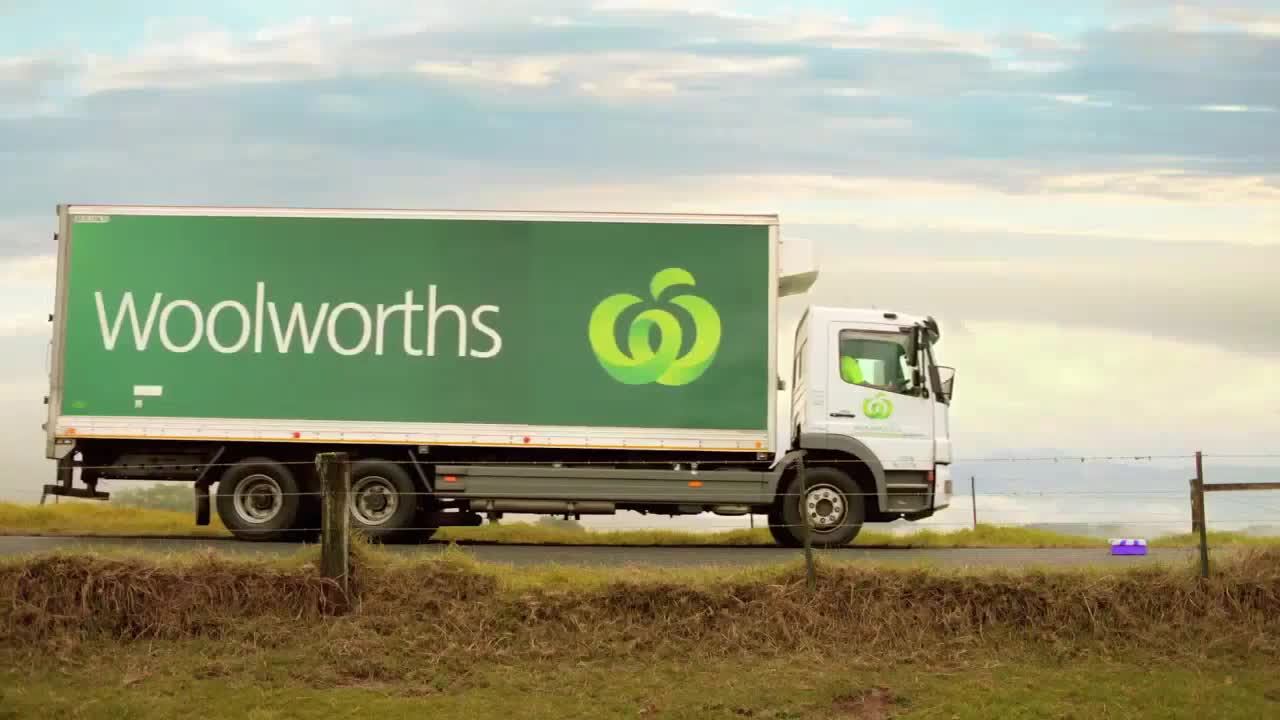
    Supermarket titan Woolworths considers taking advantage of China’s voracious interest for Australian food and grocery items.  Australia’s biggest general store chain has connected with China-based eCargo Holdings to construct and operate a Woolworths storefront on Alibaba’s Tmall business-to-customer online marketplace.

    eCargo will likewise facilitate Woolworths’ stock, packing and dissemination requirements, counsel on brand strategy and embrace an extensive variety of online and social advertising exercises for the retailer. Woolworths has a vicinity in the Chinese market after obtaining alcoholic beverages merchant Summergate a year ago for $US25 million. Rising interest among China’s well-to-do white collar class in food and dairy items delivered from abroad has opened up a substantial business sector for Australian food and dairy items.

    eCargo Chairman John Lau said in an announcement that they trust the food and grocery market will encounter enormous development in the coming years in between Australia and China, as cross-outskirt exchange limitations ease and the China Australia FTA produces results.

    Woolworths online invasion into China takes after a comparative move by smaller local opponent Metcash, which set up shop on Tmall not long ago to sell items like Weet-Bix, Tim Tams, long-life milk and newborn child formula.

    As of late, a few well known worldwide brands including Amazon, Macy’s and Germany’s Metro have set up shop in the online market place operated by Alibaba and rival JD.com, with an end goal to take into account China’s growing interest for imported customer items. The Chinese e business sector is conjecture to more than twofold throughout the following three years to $US1.5 trillion, as indicated by New York based research firm eMarketer.

    Woolworths has struggled in the domestic market over the previous year in the wake of taking a profit hit from its price war with adversary grocery store titan Coles and German discounter Aldi.

  • Nan Hai plans big China push for Crabtree & Evelyn

    Nan Hai plans big China push for Crabtree & Evelyn

    Nan Hai Corp. is planning a big push in the mainland China market after acquiring a company that manufactures and sells skincare products under the Crabtree & Evelyn brand.

    The Hong Kong-listed firm has received leasing invitations from several shopping malls in the mainland, and is planning to open its first Crabtree shop in a first-tier city, the Hong Kong Economic Journal reported.

    It aims to leverage the brand image and establish points-of-sale in various retail locations, including movie theater complexes and food and beverage outlets, the report said, citing Yu Xin, managing director of Nan Hai’s subsidiary Dadi Digital Cinema.

    Nan Hai plans to set up sales spots at its 270 movie theaters across the country to promote cross-sales and electronic commerce.

    Crabtree & Evelyn has 30 retail shops in Hong Kong and an aggregate of 4,000 sales spots around the globe.

    The brand’s sales in Asia and North America declined last year.

    Yu expects profitability to improve due to integration of resources and supply chain, as well as fresh marketing initiatives, once the acquisition is completed.

  • Deutsche Bank sells China’s Hua Xia Bank stake for up to $4 billion

    Deutsche Bank sells China’s Hua Xia Bank stake for up to $4 billion

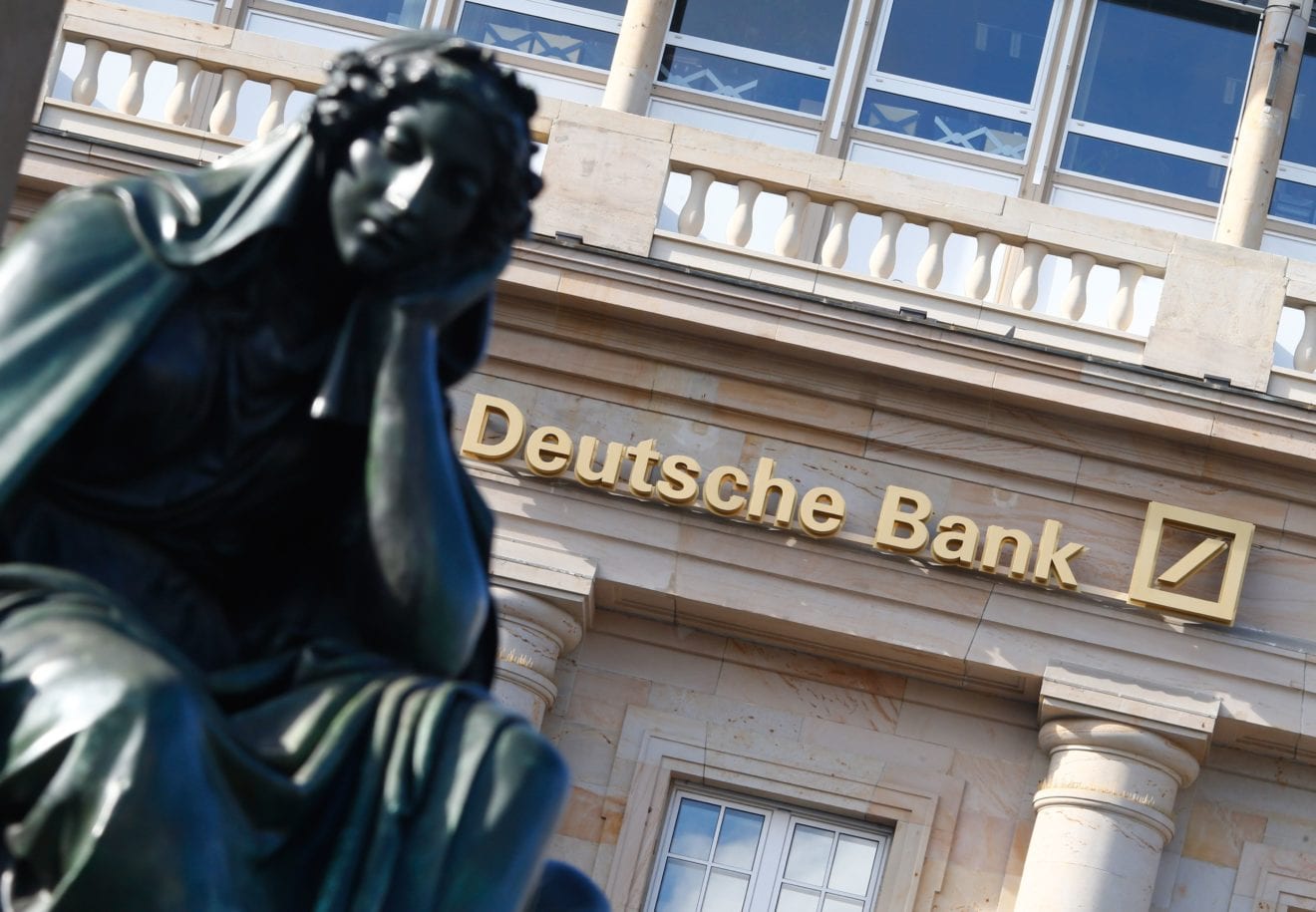
    Deutsche Bank has agreed to sell its 20 percent stake in China’s Hua Xia Bank to insurer PICC Property and Casualty Co for up to 25.7 billion yuan ($4 billion) as it seeks to raise cash and reduce its balance sheet exposure.

    “As we execute on Deutsche Bank’s strategic agenda, now is the right time for us to sell this investment,” Chief Executive John Cryan said in a statement on Monday.

    Deutsche Bank has announced plans to slash 15,000 jobs, shed businesses employing some 20,000 staff and suspend dividends for two years as it seeks to bolster its finances.

    The stake in Hua Xia will generate between 23.0 billion and 25.7 billion yuan ($3.6-4.0 billion), or 3.2 billion to 3.7 billion euros at current exchange rates, depending on Hua Xia’s share price ahead of the sale’s completion.

    At the end of September, the stake was in Deutsche Bank’s books at a fair value of 3.038 billion euros.

    When Deutsche Bank first invested in Hua Xia in 2006 to tap into China’s retail banking sector, the Chinese lender’s stock stood below 4 yuan a share, compared with 11.44 yuan at Monday’s close.

    The stake sale will help boost the German bank’s common equity tier 1 capital ratio as of Sept. 30 by about 0.3 to 0.4 percentage points from 11.5 percent, it said.

    PICC said it expected relatively steady investment returns from its stake in Hua Xia, in addition to the benefits of a strategic cooperation.

  • Alibaba and UBM to create O2O trade buying experience

    Alibaba and UBM to create O2O trade buying experience

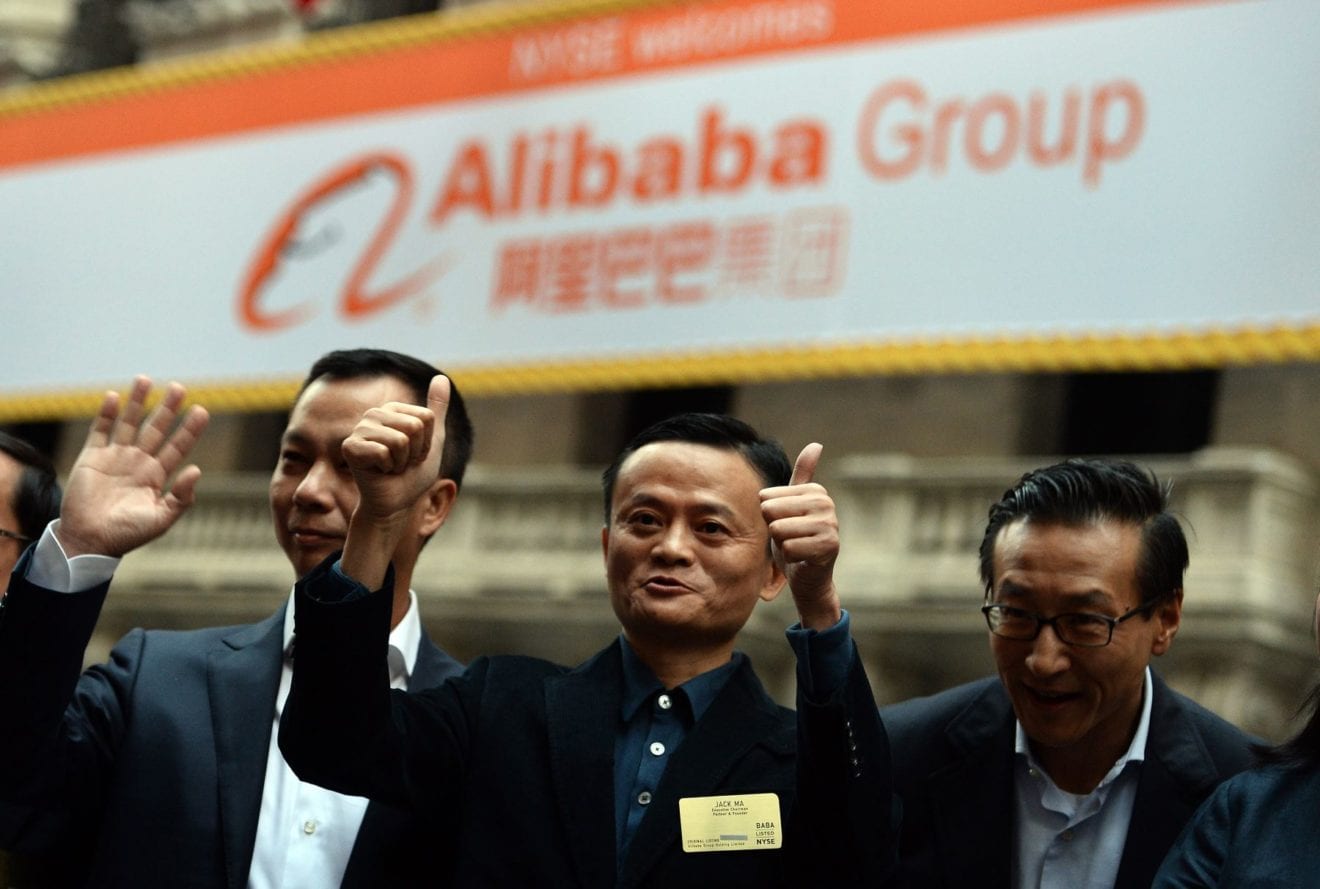
    Alibaba’s B2B business unit, including Alibaba.com and 1688.com, has teamed with trade exhibition organiser UBM Plc to “unite the online and offline trade buying experience” initially in Asia.

    The two companies have begun exploring opportunities to link the B2B online and face-to-face trading worlds by leveraging their combined strengths, technologies and relationships. The alliance will begin with pilot programs introducing Alibaba B2B business unit’s online secure transactional platforms and business portals for companies participating in select UBM Asia trade fairs.

    Cross promotional marketing, match-making services and audience development of the two company’s brands and networks will be another key aspect in working towards the longer term goal of creating the next generation of on and offline trade experiences.

    Sophie Wu, president of the Alibaba B2B business unit, says collaborating with UBM will offer small and medium-sized enterprises a multichannel B2B trading experience.

    “They can also tap into the abundant and combined expertise of the two industry pioneers for more worldwide trading opportunities.”

    Tim Cobbold, CEO of UBM  says a fundamental element of his company’s ‘Events First’ strategy is its commitment to innovate and to deliver value for customers.

    “We are excited at the opportunity to partner with Alibaba.com, to create the next generation of trade buying experience.”

    Pilot programs for the joint collaboration will begin with UBM Asia’s Malaysia International Furniture Fair (MIFF) to be held on 1-5 March 2016 in Kuala Lumpur, Malaysia, Finefood Shanghai – part of Hotelex Shanghai – to be held 29 March to 1 April 2016 in Shanghai, China; and the co-located Materials Manufacturing & Technology (MM&T) and Fashion Access (FA) fairs to be held 30 March to 1 April 2016 in Hong Kong.

    The collaboration will commence with promotions of the UBM fairs to both parties’ respective trade audiences and Alibaba will begin offering their Trade Assurance service onsite to select exhibitors.

    Alibaba’s Trade Assurance service allows participating suppliers to offer guarantees on order quality standards and on-time shipment.

    Further pilots in the second half of 2016 will include additional business match-making components for other UBM Asia events such as Shanghai International Children Baby Maternity Industry Expo (CBME China) and Sign & LED China fairs.

    James Dong, head of B2B strategy, investment, business development and business intelligence of Alibaba.com, says the eCommerce giant sees great added values for global business traders through the collaboration.

    “Alibaba’s online trading resources and technology complements with the interaction and dialogues in the offline UBM trade shows. Such an alliance not only makes trading more cost-effective but enables higher level of trust between global buyers and sellers,” he said.

    James Dong of Alibaba, left, and Jime Essink of UBM Asia announcing the new partnership.

    Jime Essink, president and CEO of UBM Asia Ltd, says one of the challenges of the trade exhibition industry is continuing the buyer and seller dialogue and experience throughout the year.

    “Meanwhile, the limitation of a pure online trading world is the absence of the physical interaction and development of the personal relationship. With Alibaba and UBM Asia – both prominent players in our respective fields of B2B trade – working together, we see opportunities to change how online and offline trade takes place, providing improved returns and efficiencies for our customers.”

  • Qianhai Centre Shenzhen design revealed

    Qianhai Centre Shenzhen design revealed

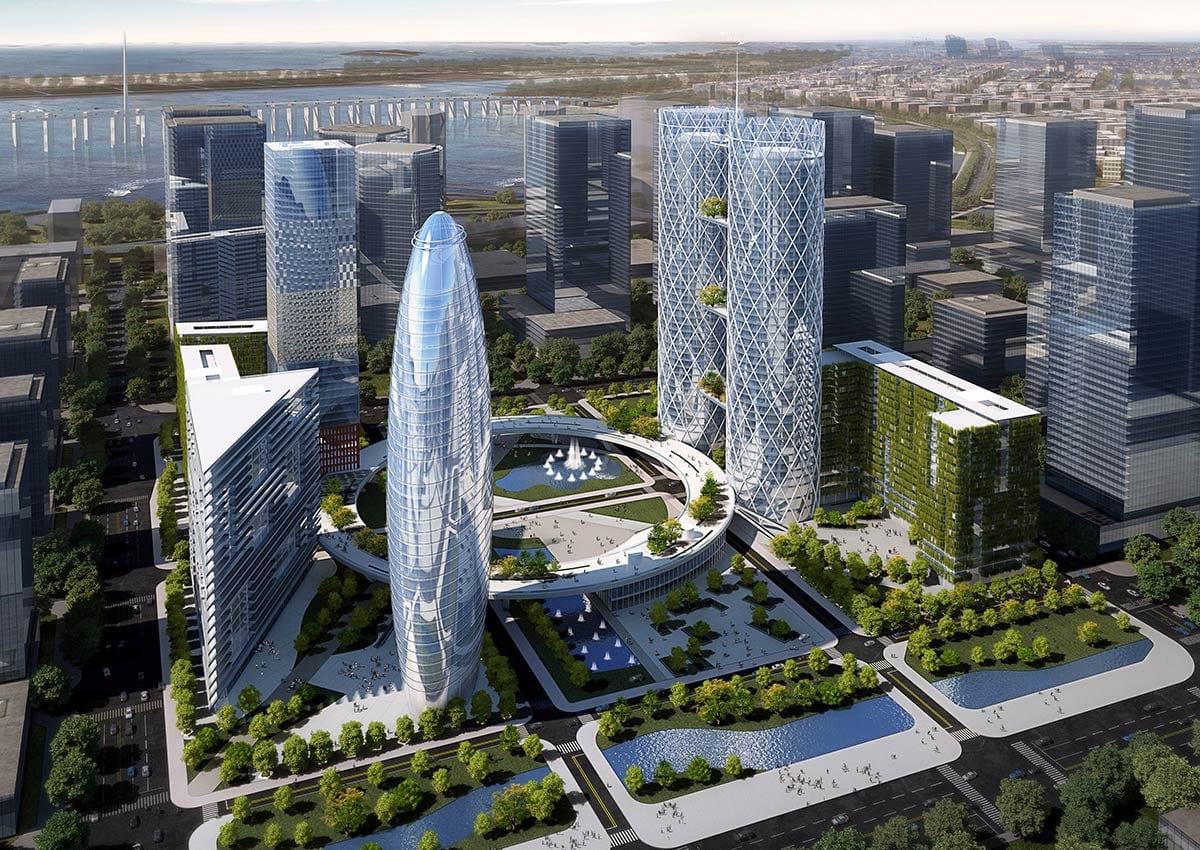
    Benoy, the global studio of Architects, Masterplanners, Interior and Graphic Designers has revealed its design of the future China Resources Land (CRL) Qianhai Centre Shenzhen.

    The development will form a core part of the highly publicised Qianhai special economic zone. As masterplanner and retail architect, Benoy says it has “challenged the status quo of a traditional finance district” by creating a multi-layered active city environment for the commercial scheme.

    Located in the centre of Qianhai, the development sits within ‘Neighbourhood 2’ of the district. With a vision to transform the district into the ‘Manhattan of the Pearl River Delta’, Qianhai itself is expected to attract $45 billion in future investment.

    “Our design has aimed to capture how we want our cities to look, feel and function in the future; bringing a new concept to shape this emerging zone,” said Chao Wu, Benoy director.

    Benoy’s masterplan for the 54,000 sqm site aims to create an active 24 hour destination and develop the plot to its fullest potential. The scheme will feature a four-storey podium including a basement retail level which will connect to five towers comprising commercial offices, a five star international hotel and serviced apartment residences.

    Enlivening the heart of the development, and, in turn, the wider district has been a key consideration of the design. As such, Benoy has carved two main ‘spines’ through the development to create a lively internal streetscape. The Financial Valley and the Green Belt thoroughfares open up the podium to create an interconnected environment from the sunken basement levels up to the roof garden on Level 4.

    As Chao explains: “These open-air spines bring the development to life with their fluid form which is accentuated by landscaping, terraces and an eclectic mix of spaces. The design gives human-scale and creates a recreational experience and personality for the emerging financial zone.”

    At the intersection of these internal streets sits the focal point of the scheme – a large, vertically and horizontally connected outdoor event space. This outdoor entertainment area has been designed for year-round enjoyment with a monocoque steel canopy featuring ETFE material. A modern theatre and art gallery have been strategically positioned nearby to support the events programme, reiterating the commitment to inject art and culture into the commercial precinct.

    “This development needs to serve both the living and working needs of the surrounding community. We wanted to create a model which functions as a recreational realm bustling with activities and different environments to form a centrepiece for the wider commercial masterplan,” says Chao.

    The development has not ignored its identity within the financial district with the architectural language respecting both functions of the scheme. The lively designs along the interior spines of the development have been complemented by the formal and clean lines of the street-facing facades which reference the corporate nature of the district.

    Following the vision of the district, CRL Qianhai Centre promotes a strong integration of public transport and a multi-layered pedestrian-friendly environment as a Transit Oriented Development. Three metro lines which include Line 1, Line 5 and the future Line 11 are seamlessly integrated into the scheme. Environmentally aware, the development is targeting both LEED and China Green Building three star certifications.

    CRL Qianhai Centre has broken ground and is due to complete construction in 2018. The development adds to Benoy’s growing portfolio in the emerging Pearl River Delta economic zone.

  • China to add 200 new international routes in 2016

    China to add 200 new international routes in 2016

    The Chinese Government has delivered an unexpected Christmas present by agreeing to add another 200 international air routes in 2016. Xinuanet, the Civil Administration of China is committed to the new programme, with China’s official news agency referring directly to The China Daily newspaper’s coverage of remarks made by Li Jiaxiang, head of the Civil Aviation Administration of China.

    Xinuanet reports that Jiaxiang told this month’s Beijing civil aviation industry conference that these new routes will be in addition to the existing 660-plus approved international bi-lateral agreements between China and its foreign partners.

    He said these new initiatives will be based around the highly strategic ‘One Belt, One Road’ (OBOR) initiative announced by Chinese President Xi Jinping in 2013.

    This consists of new preferred-status free-trade agreements with 65 countries (as opposed to the previous 12) on a line from China to Europe, linking multiple points in Asia and Africa.

    He also predicted that this new initiative should provide yet another strong stimulus to China’s civil aviation sector, although he also apparently warned that pressures on existing infrastructure and air traffic control congestion need to be addressed.

    It is hardly any secret that Chinese air space is already highly congested, with the Civil Administration of China routinely juggling its ability to expand new air corridors without encroaching on the automatic priority given to military-controlled air space corridors.

    As a result, delays at the country’s airports are now the norm rather the exception.

  • Latest products from China are better than ever

    Latest products from China are better than ever

    Chung Chang-mook recently bought a Tunland pickup truck, made by Chinese automaker Foton. At 33 million won ($27,951), the Tunland is more expensive than local competitor Ssangyong’s Korando, which runs between 21 million won and 28 million won. But Chung liked the fact that Tunland can hold up to 9,000 kilograms (19,841 pounds), which is more than double the capacity of the Korando.

    Tunland entered the local market in October and has already received over 200 preorders, according to an auto industry insider. “We set the sales target at 3,000 in 2016,” said a spokesman for Daewoong Auto, which manages Tunland’s sales in Korea.

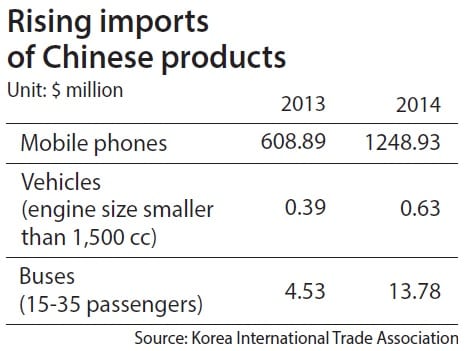
    The pickup is just one example of the way in which companies from China, which are making higher-quality consumer goods than ever before, are poised to succeed in Korea.

    Perhaps the most widely recognized case is electronics maker Xiaomi. Once dubbed the “mistake of China” for its ambition to change the negative perception of Chinese goods by offering top-tier products at rock-bottom prices, Xiaomi now has Korean retailers clambering to become official distributors of its popular smartphones when it sends representatives to Seoul next month. Currently, Xiaomi products are imported to Korea independently by small and medium-sized trading companies.

    “Whoever wins an official deal with Xiaomi will be able to make a huge profit,” a retail industry insider said. “We are just waiting for them to contact and choose us.”

    “Chinese manufacturers are spending more money on research and development and getting rid of pre-existing notions about the low quality of goods from the mainland,” said Cho Cheol, a director at the Korea Institute for Industrial Economics and Trade’s auto department. “A growing number of local consumers now thinks Chinese products are worth what they have paid for them.”

    Xiaomi is adding TVs to that list, with a local importing company recently receiving certification from the National Radio Research Agency to sell Xiaomi’s 40-inch model.

    Xiaomi’s TV is currently 50 percent cheaper than similar models by local manufacturers including Samsung and LG – and that’s worrying to some.

    “It’s significant because Xiaomi has expanded its market from accessory items to actual home appliances,” an employee of a local TV manufacturing company said. “We are discussing how to compete with its mid to low-priced products.”

    Other Chinese companies are making similarly expansionary moves. Most recently, Huawei began distributing its Y6 smartphone on the local market through LG U+ on Tuesday. The Y6 allows its customers to make free phone calls when connected to Wi-Fi, boasts a 360-degree panorama camera and includes face-recognition technology – all for 154,000 won, making it the cheapest smartphone in the local market.

    “More and more consumers are appreciating Huawei products’ low prices, and that’s why we’re doing business with the company,” a spokesman for LG U+ said. “This smartphone is actually free of charge when you take into account government subsidies.”

    Syma’s drones, Novelview’s Bluetooth speakers and UNIC’s micro-projectors are also very popular in Korea, and many Koreans have dubbed them “mistakes of China” as well.

    Chinese auto brands are growing in popularity, too. China’s Sunlong Bus entered the market in 2013 and sold 100 buses that year. Since then, it has sold about 550 in Korea. Other automakers are preparing to enter the Korean market as well.

    But this is just the beginning. The Chinese government have announced new initiatives to boost the economy, such as “China Manufacturing 2025” in May. The plans lay the groundwork for the nation to further develop as a global manufacturing superpower.

    But it’s not just advances in production that are worrying Korean companies – it’s also the narrowing of the technological gap in the IT industries of the two countries. Korean manufacturers had a 2.4-year lead over Chinese companies in 2012, but that has been narrowed to 1.8 years as of last year, according to the Korea Institute of S&T Evaluation and Planning. In the energy industry, the gap is only a year, and China now leads in the aerospace industry.

    “The government needs to ease regulations in order for industries to increase the amount they spend on R&D,” said Han Jae-jin, a researcher at Hyundai Research Institute. “Manufacturing companies also have to reform themselves [to compete].”


  • Chinese imports of UHT milk continue to grow

    Chinese imports of UHT milk continue to grow

    Imports of liquid milk into China are growing with European countries successfully tapping into the market, according to AHDB dairy.

    China is expected to import 350,000T of liquid milk in 2015, up nearly a tenth from last year and equalling its Whole Milk Powder imports, according to the USDA.

    The AHDB says two-thirds of China’s liquid imports came from the EU in January-September.

    “Prices appear to be supported by strong demand for imported liquid milk in China. Chinese retail prices for imported brands of ultra-heat treated milk (UHT) are nearly 50% higher than the average UK UHT price.

    “Consumer confidence in the safety of imports is reportedly helping drive growing UHT sales, which demonstrates the value of using branding to target consumer needs within the right markets.

    “Chinese retail prices for imported brands of ultra-heat treated milk (UHT) are nearly 50% higher than the average EU UHT price, it says.

    According to the AHDB, consumer confidence in the safety of imports is reportedly helping drive growing UHT sales, which demonstrates the value of using branding to target consumer needs within the right markets.

    The number of potential consumers is also increasing as UHT is becoming more widely available in China’s smaller cities.

    “Online sales platforms are performing strongly, providing easy access and home delivery to more shoppers at prices that are competitive against powdered milk alternatives,” it says.

    The AHDB says China’s imported UHT consumption is expected to continue to grow off the back of these trends.

    “From here the challenge is to stay in favour with Chinese consumers, which means being price competitive and continuing to build a reputation for quality and safety,” it says.

    Both Glanbia and Lakeland Dairies have confirmed sustained growth in UHT milk sales to China and South East Asia as a whole.

    “There is a strong market for both plain and unflavoured milks in China,” said Lakeland CEO Michael Hanley.

    And this demand will continue to grow at a steady rate. Our products have a shelf life of between six and nine months. We export directly from Ireland to China.

    “Lakeland has a strong presence on the ground in that market. This has allowed us develop a good working relationship with distributors.”

    Glanbia launched its Avonmore UHT brand in China 12 months ago with 1L packs reported to be selling for the equivalent of €3.50 in retail outlets.

    “Sales have taken off at a steady rate,” a company spokesman said.

    “Our aim is to target UHT sales growth in both China and South East Asia as a whole. This will be done on the back of the Avonmore brand and own-label contract arrangements with distributors.”