Tag: China

  • Aeon China to launch self-serve store

    Aeon China to launch self-serve store

    Aeon China is set to launch a self-service store network equipped with technology to anticipate what a customer will buy upon entry.

    The facial-recognition technology will activate recommendations and coupons displayed on the customer’s phone, based on individual purchase habits and digital payment history. It will be installed in 80 of the group’s roughly 480 locations in the territory.

    The Japanese-headquartered retailer’s strategy is intended to reduce staffing costs, allow automatic product ordering and draw in customers. Management needs for the new stores will be addressed by a new centre to be established in Chinese Hangzhou.

    Aeon China also plans to launch an online supermarket and a cross-border e-commerce platform in China this year, in part to accumulate data to support the self-service store network. The firm expects that its development in China will prime the technology for rollout in Japan and Southeast Asia.

  • China’s 5G investments may be slowing

    China’s 5G investments may be slowing

    While China is certain to be one of the world’s largest 5G markets and has been spending heavily to gain an early lead in 5G adoption, there are signs that 5G momentum is slowing down in the market.

    This was one of the conclusions of a new report from IDTechEx Research on the 5G technology market forecast for the next 10 years.

    The report found that China’s big three operators China Mobile, China Telecom and China Unicom have all announced 5G capex budgets that are lower than expected.

    China Unicom plans to spend between 6 billion yuan ($893.3 million) and 8 billion yuan on 5G in 2019, while China Telecom has allocated 9 billion yuan. While market leader China Mobile has not disclosed its projected 5G spending, the report forecasts that its spending will be in the region of 17 billion yuan.

    The total 5G capex budget allocated in China (34 billion yuan) for 2019 is therefore significantly lower than the projected 50 billion to 100 billion yuan.

    Factors behind the lower than expected spending include greater activity to upgrade 3G networks to 4G, falling per-subscriber revenue and the uncertainty over whether 5G investments will generate returns, the company said.

    Based on slower than expected 5G deployment schedules, the total contribution of 5G for the telecoms sector could be reduced from the projected $200 billion by 2029 to $160 billion.

    But operators are projected to invest around $200 billion to $350 billion for 5G development from 2020 to 2030.


  • Burberry Shanghai Closes Flagship Store

    Burberry Shanghai Closes Flagship Store

    he Burberry Shanghai flagship store has been shuttered as the British luxury-goods retailer looks to reduce costs.

    It is the fourth Burberry location within Mainland China to be shuttered within the last eight months as part of a global restructuring effort, representing a conspicuous and somewhat puzzling drawing back from a key luxury market.

    The closure of the 1000sqm flagship means that half of Shanghai’s Burberry outlets have now vanished, after the brand’s K11 mall store disappeared last August and its Westgate Mall and Hongqiao airport halted operations a month ago.

    The closures were prompted by poor demand for Burberry products in Asian markets, and are part of the firm’s global strategy to cut back on underperforming retail locations.

    Representatives of the brand have pushed back on speculation that the closures signal an all-out withdrawal from China.

    “China is a hugely important market for Burberry and we are fully committed to growing our business there. We are making some of our biggest investments in Shanghai where we recently refreshed our flagship store at Kerry Centre and we will open two new stores at IFC Mall and IAPM Mall in the coming months. This strengthens our presence in Shanghai, a key luxury shopping destination, and we are excited to welcome our customers to these new locations.” said a company spokesperson.

    “Burberry is not so much closing down as relocating to new stores,” said JLL’s head of retail for China Ellen Wei, noting that Burberry plans to open two more strategically located stores in Shanghai shortly.

    Burberry bought out its Chinese franchises in 2010 for £70 million (US$91.4 million at current rates) in response to the country’s burgeoning taste for luxury products.

    The Burberry Shanghai flagship was located in the L’Avenue shopping centre in Gubei.

  • Honor Starts Looking for Market Dominance

    Honor Starts Looking for Market Dominance

    Huawei’s CEO has revealed details of how the telecommunications giant will foster its spin-off Honor brand in Asia.

    The strategy includes store rollouts, an increasing focus on online sales and revised price positioning differentiating the two brands.

    Richard Yu, CEO of Huawei Consumer BG, posted details on his Sina Weibo account, predicting Huawei will become the world’s largest smartphone maker this year through its two-brand strategy. Honor on its own is tipped to become China’s second largest-selling smartphone brand and fourth in the world.

    “The company will support Honor in the development of cutting-edge products and continue its investments in technology innovation, channel distribution and retail strategies while maintaining a firm dual-brand strategy between Honor and Huawei,” said Yu.

    Both brands will maintain “a forward-thinking mindset and help create an intelligent, fully-connected world”.

    While IDC figures show global shipments of smartphones fell by 3.1 per cent in the first three quarters of last year, Honor’s volumes soared 27.1 per cent.

    Last year, Huawei’s consumer business grew by 48.4 per cent, outperforming the company’s carrier-network business and becoming the company’s largest revenue earner.

    George Zhao, Honor’s president, told the recent Mobile World Congress that Honor is “on the brink of yet another breakthrough and there is no slowing down for us”.

    “As the going gets tough, the tough get going. We’ll treat each day as an opportunity to deliver greater value to our fans. For Honor, the best is yet to come,” he said.

  • AirAsia adds Quanzhou to its Asian routes

    AirAsia adds Quanzhou to its Asian routes

    AirAsia will be flying direct daily from Kuala Lumpur to Quanzhou in Fujian, China.bOnce, one of the world’s biggest ports and the starting point of the Maritime Silk Road, Quanzhou was known to Arab traders as Zaiton and was praised by Marco Polo as the “one of the two greatest havens in the world for commerce”.

    Thanks to its status as a major trading port for more than three centuries, Quanzhou today remains a melting pot of diverse cultures and religions, and boasts many Buddhist and Hindu temples, mosques and churches, as well as museums celebrating its proud maritime heritage.

    Some of these must-visit sites include the Kaiyuan Temple, the largest Buddhist temple in Fujian, which was built over 1,300 years ago, as well as the Qingjing Mosque, China’s oldest Arab-style mosque, inspired by the Umayyad Mosque in Damascus.

    Then there is the Luoyang Bridge, one of the ‘four ancient bridges of China’, which resembles a silver dragon lying above the green waters of the Luoyang River.

    Another site is the largest stone carving of the famous Chinese sage Laozi made during the Song Dynasty, which is found at the foot of Mount Qingyuan.

    Meanwhile, the beautiful port city of Xiamen is only an hour away by high-speed train.

    AirAsia Malaysia CEO Riad Asmat said: “AirAsia has been championing connectivity to secondary cities in China such as Guilin, Shantou, and Nanning.

    “This Kuala Lumpur-Quanzhou service further grows our footprint of unique destinations in China, and will provide greater accessibility to Malaysian and Chinese travellers.

    “We look forward to exploring opportunities to connect our, other secondary hubs in Malaysia to China as well.”

    AirAsia currently is offering promotional all-in fares from RM99 for those who book flights from Kuala Lumpur to Quanzhou from now till Sunday at airasia.com or via the AirAsia mobile app, for travel from May 1 to Oct 26, 2019.

  • Taobao Leverages Live Streaming to Boost Rural Development

    Taobao Leverages Live Streaming to Boost Rural Development

    Taobao will leverage its livestreaming technology to help incubate 1,000 key opinion leaders in China’s countryside in an effort to boost rural development. By helping farmers go online, Taobao aims to enable farmers to find new markets and customers from their homegrown products.

    Taobao’s target is to boost the livelihood of 1,000 farmer livestreamers from 100 counties in Chinan by helping them each generate over RMB10,000 in monthly income. The idea is to drive online sales of local agricultural products via livestreams conducted by the newly minted rural KOLs – the farmers, themselves. To promote this new initiative, Taobao plans collaboration with countylevel governments to highlight local points of interest and expand the popularity and recognition of various villages participating in the livestreaming.

    “Our rural livestream program aims to empower local livestreamers to boost business for povertystricken areas, while enabling farmers to manage their own livestream e-commerce channels. It’s Taobao’s devotion to poverty relief by leveraging e-commerce and livestreaming via creative digital technologies.” said Chen Lei, director of e-commerce content at Taobao. Last year, Taobao hosted more than 150,000 agriculture-themed livestreams, which drew over 400 million viewers. Taobao innovated the “Live on the Farm” model, featured with agriculture livestreamers, KOLs, and even local government officials from counties to join livestream sessions and promote their local goods. In January 2019, Taobao’s “Live on the Farm” sevenday online sales campaign generated over RMB9.35 million in sales, right ahead of Chinese New Year, a prime gifting period in China.

    Many agriculture livestreamers tasted their first success on the platform last year, including Chen Jiubei, who has helped farmers in her hometown in Hunan province sell up to 2 million kilograms
    of previously unsaleable oranges in just 13 days last winter. Taobao also coordinated with county-level governments to provide a suite of livestreaming marketing services, including seeking out and training livestreamers, as well as identifying local selling points. With more than 60,000 distinct livestreams on agricultural products every month,

    Taobao is committed to driving RMB 3 billion in sales for the sector in 2019. This month, Taobao will roll out livestreams that introduce the source of a range of agricultural products, helping viewers discover the local landscape and customs where their products come  from. In addition, Taobao also plans to partner with CCTV, Hunan Television and Zhejiang Television to develop livestreaming shows that invite popstars and celebrities to participate in poverty-relief activities, aiming to generate more public awareness for underprivileged areas. More on Taobao Livestreaming Taobao livestreaming is an emerging marketing channel that started in 2016 and has rapidly grown into a proven marketing strategy. Powered by advanced technologies from across the Alibaba Group, KOLs and livestreamers provide both indoor and outdoor livestreaming to customers. During these livestreams, they introduce and recommend different products across diverse areas ranging from clothing, cosmetics and jewelry, to agriculture goods and plus-sized clothes. In 2018, 81 livestreamers notched over RMB 100 million in sales, respectively.

    Across all industries and sectors in China, brands and sellers are already transforming their digitalncapabilities to stimulate business development through Taobao livestreaming. L’Oréal’s flagship store experienced a nearly 20% increase in purchases after Viya and Jiaqi Li, Taobao’s most recognized livestreamers promoted the brand’s signature goods via livestream. Among the top female clothing brands, more than 30% of sales are driven by live streaming. In certain industries such as jewelry and jade, flowers and plants, the penetration rate of brands using Taobao livestreaming is close to 50%, bringing great changes to the previous online marketing mix that was adopted.

    Livestreaming serves as an efficient tool to empower traditional industries and drive sales. During the “Double 12 Shopping Festival” in 2018, Taobao organized a 12-day livestreaming event from once-booming industrial belts to rejuvenate traditional businesses with cutting-edge technologies and powerful new modes of retail operation. Livestreamers were everywhere from an agricultural products base in Sichuan and porcelain production firm in Jingdezhen to a home textiles mall in Nantong and leather factory in Haining, bringing a growing number of young customers to forgotten industrial towns. In order to inject more renewed energy into traditional industries, Taobao also launched plans at the recent summit to incubate and develop 10 offline traditional retail markets. The aspiration is to help them reach annual revenues of over RMB 100 million. Other initiatives that are being rolled out to maximize the influence of livestreaming includes developing 10 professional PGC (Professional Generated Content) organizations with over RMB 100 million revenues, creating 10 super programs with more than 100 million views and promoting over 100 regional television stations to collaborate with Tao Live, an app focused on PGC area.

  • China Mobile, ZTE launch maritime broadband solution

    China Mobile, ZTE launch maritime broadband solution

    ZTE and the Zhejiang branch of China Mobile have jointly launched commercial trials of a new maritime broadband satellite solution.

    The solution, Heweitong, is designed to help solve common problems of maritime communication, such as poor coverage, slow data rate, and high cost.

    It will allow people at sea to communicate and access the internet by merely installing a mobile app on their smartphones.

    During the trial period, China Mobile and ZTE are offering the solution for free. Once commercially launched, the companies expect the cost to be 90% lower than traditional marine communications solutions.

    Heweitong has already undergone verification testing involving more than 50 ships and nearly 300 users in the Bohai Sea, the East China Sea and the South China Sea.

    The project forms part of China Mobile’s goal of offering ubiquitous connectivity via an integrated space, sky and land based communications solution.

  • Autotalks trials C-V2X on Chinese road

    Autotalks trials C-V2X on Chinese road

    Israeli vehicle-to-everything (V2X) communications solutions provider Autotalks has announced the successful completion of cellular V2X field trials in China.

    The trials on a public road, conducted in collaboration with an unnamed large Chinese technology company, validated Autotalks’ C-V2X capabilities, including a communication range of over 2km with a nominal range of around 1.5km.

    The successful field test involved the use of hardware compliant with standards body 3GPP’s Release 15 for V2C communications improvements.

    Autotalks has been building momentum in China in a bid to target the large local market, growing its partner ecosystem and increasing staff.

    The company is a member of the government’s IMT-2020 (5G) Promotion Group, as well as the China Industry Innovation Alliance for the Intelligent and Connected Vehicles (CAICV) and China ITS (intelligent transport systems) Industry Alliance.

    In November, Autotalks recruited former Ceragon Networks country manager Yang Xiaobing to lead up its Chinese business development efforts out of its branch in Beijing.

    In February, Autotalks partnered with Taiwanese fabless semiconductor company MediaTek for a project focused on cooperating on integrating V2X and telematics technologies.

    Autotalks also recently launched the first global V2X solution supporting both C-V2X and dedicated short range communications (DSRC) technologies, the two main connected vehicle standards being adopted by car manufacturers.

  • Global fixed broadband subs to reach 1b by year-end

    Global fixed broadband subs to reach 1b by year-end

    The global fixed broadband market is on track to reach 1 billion subscribers by the end of 2019, driven by unprecedented growth of fiber connections in Asia Pacific, particularly China, according to Kagan.

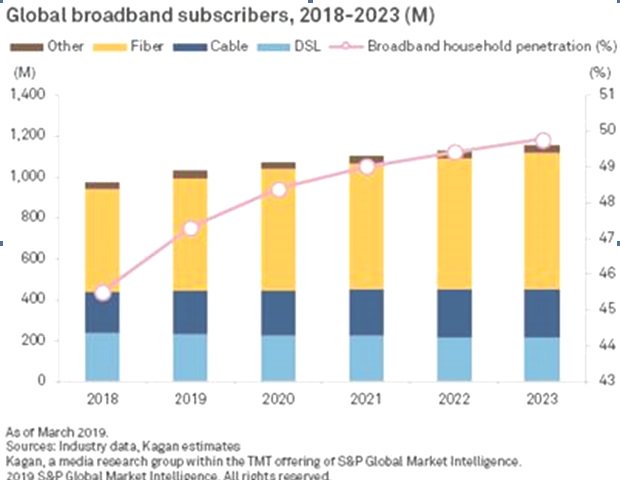
    At the end of 2018, broadband subscriptions reached 974.7 million while broadband household penetration reached 45.5%, up from 43.2% in 2017. However, household penetration is projected to remain under 50% until 2025, the S&P Global Market Intelligence research unit said.

    Kagan: Global broadband subscirbers 2018-2023

    Source: Kagan

    China and US remain by far the largest fixed-broadband markets, together accounting for half (50.7%) of the global total in 2018. China alone claims 40.1% of the global total and 74.4% of Asian broadband subs due to large-scale fiber deployments as part of the country’s national Broadband China project.

    Singapore maintains the highest fixed-broadband household penetration in the world, at over 100%.

    In terms of access technology, 51.4% of the global fixed broadband subscribers are using fiber-to-the-premises (FTTP), which overtook DSL in 2016 to become the largest fixed-broadband platform on a global scale.

    FTTP remains the fastest-growing fixed-broadband platform, growing by 13.8% year over year in 2018.

    According to Kagan, fiber subscriptions have overtaken DSL in Asia and Eastern Europe, with China, Japan, Russia, South Korea and US being the five largest fiber-optic markets in the world.

    Western Europe, the Middle East and Africa are still in favor of using DSL, making it the dominant multichannel platform in these continents, while cable leads in North America and Latin America.

  • Fashion Brand Alexander McQueen joins Tmall

    Fashion Brand Alexander McQueen joins Tmall

    British fashion house Alexander McQueen — known for its unique tailoring and audacious designs — has soft-launched a virtual store on the Tmall Luxury Pavilion, Alibaba Group’s platform for luxury and premium brands.

    It will be the first online store in China that’s directly run by the house itself, rather than through a local partner, giving it full creative control over the look and feel of the site, the Pavilion said.

    The luxury brand was founded in 1992 by the late Lee Alexander McQueen, known for combining a respect for traditional craftsmanship with provocative, darkly romantic designs. Today, his eponymous label remains hugely influential, seen as synonymous with modern British couture. Following his death in 2010, Sarah Burton was appointed creative director of the house. Burton, who worked alongside McQueen for 14 years, currently oversees the creative direction of all the brand’s collections.

    The Alexander McQueen brand oversees a network of 73 directly operated brick-and-mortar boutiques, as well as several franchises and specialty stores worldwide, with flagships stores due to open in Shanghai and Hong Kong in 2019, per its parent Kering Group.

    The Tmall Luxury Pavilion Alexander McQueen store will officially launch on April 16, featuring items that incorporate images from the John Daekin Archive as part of the designs. The archive manages the work of John Daekin, the 20th-century British photographer who captured the lives of his artist and poet friends in London’s bohemia, Soho.

    Alexander McQueen is the third Kering-owned luxury brand to join the Pavilion, following Hong Kong-based jeweller Qeelin and Italian fashion house Bottega Veneta. Launched in 2017, Tmall Luxury Pavilion now offers more than 100 brands, ranging from apparel and beauty items to watches and luxury cars, including Valentino, Burberry, Tod’s, Versace, Stella McCartney, Moschino, Giuseppe Zanotti, MCM, La Mer, Maserati, LVMH-owned Rimowa, Guerlain, Givenchy, Tag Heuer and Zenith.

    Sherry Lang, MD of Tmall’s luxury division, said the Pavilion helps maisons and premium brands engage with China’s younger generation of consumers, delivering the same brand exclusivity and tailored shopping experience online that they would get in a brick-and-mortar store.

    “We also want to help luxury brands expand their reach in smaller cities and rural areas, where purchasing power is growing, but offer limited access to luxury goods,” said Lang. “The Pavilion is well-positioned to fill that gap.”

    The growth of the Pavilion comes as Chinese consumers drive global high-end spending, with Mainland China’s luxury sales growing 20 per cent to €23 billion ($25.8 billion) last year, according to Bain & Co. The consulting firm forecasts that by 2025, Chinese consumers will account for 46 per cent of the global market, up from 33 per cent last year.

  • Shanghai launches 5G trial district

    Shanghai launches 5G trial district

    The City of Shanghai has launched 5G trials in the Hongkou district, which also has the distinction of having a gigabit broadband network.

    The 5G trial, backed by China Mobile, involves providing full coverage of the district.

    During a commencement ceremony for the trial, a 5G video call was placed using the Huawei Mate X foldable 5G smartphone.

    The city plans to deploy over 10,000 5G base stations by the end of the year, and over 30,000 by 2021.

    As part of the trials, the city also plans to provide support for over 100 companies developing 5G-related application scenarios.

    The wide-scale trial follows Huawei’s deployment of trial 5G services at Shanghai’s Hongqiao Railway Station in February.

    Other Chinese cities are also investing in taking an early lead with 5G deployments, including Chengdu in the Sichuan province and Wuhan in Central China.

    The latter city has deployed a trial 5G network encompassing over 100 5G base stations to explore developments in autonomous vehicles, drones and satellite-based positioning, the report states.

  • SF Express Logistics shuts SF Best retail network

    SF Express Logistics shuts SF Best retail network

    Chinese logistics firm SF Express is reportedly closing its network of SF Best offline retail stores in major Chinese cities.

    The move, which has seen the shuttering of the firm’s e-commerce and retail business SF Best, has been prompted by a slowing economy and thin margins in the sector. The brand was formally considered at the head of China’s e-commerce wave.

    Just two years ago, SF Best announced plans to open 10,000 outlets within three years. Its aggressive offline expansion plans, however, saw heavy retail losses and a high turnover in management that sent the firm into a dive.

    A spokesperson for the firm announced that it is currently undergoing restructuring and plans to ramp up operations in Beijing and southern China before further expansion. It is also working to strengthen its online brand.

  • Fabernovel supports the global digital transformation of Shiseido

    Fabernovel supports the global digital transformation of Shiseido

    Fabernovel supports the leading international cosmetic company Shiseido to achieve its digital transformation at a global level by 2020. Shiseido has just received the Valiente’s Transformation Award at SXSW in Austin, Texas, acknowledging its excellence in digital transformation empowered by the SHISEIDO+ Digital Academy program launched in 2016 in collaboration with Fabernovel.

    Creation of a worldwide digital platform

    With Fabernovel, Shiseido launched the SHISEIDO+ Digital Academy program, creating a new approach of learning, both online and offline, to enable digital education and transformation at a global level.

    Shiseido executives and employees have been immersed in the innovation landscape through this fully fledged online learning platform comprised of 24 customized curriculums targeting various job functions, with more than a dozen of collaborative events (live sessions, learning expeditions, summits) in the world’s most advanced ecosystems from the Americas to Asia in order to accelerate digital transformation, stay ahead of the latest trends in their local markets, and adjust their business strategies accordingly.

    This digital transformation was a cultural challenge, as the project has to adapt to the way Shiseido communicates to over 30 different nationalities within the company. The customized curriculums have been created to meet the needs of each job function, both in terms of the specific issues they want to address and their level of digital maturity. In addition, the program is delivered in English, Japanese and Chinese (Mandarin) to maximize its effectiveness for each region.

    Over 2,000 employees across the globe are benefiting from the SHISEIDO+ Digital Academy and the company is getting closer to the objective of making Shiseido the most digitally fit beauty company by 2020. Thus, the program will continue expanding through its ongoing partnership with Fabernovel.

    “It is probably Fabernovel’s most ‘global’ project to date, and it means we can approach the digital transformation of a large organization from all angles, including cultural ones.” explains Dominique Piotet, International Development Director at Fabernovel

    Project awarded at SXSW

    The Valiente Awards recognize marketers as Angelica Munson, Global President of Shiseido Digital Center of Excellence, who have disrupted the status quo and who embrace the role of the modern marketer. The advisory panel showcase marketing change agents who have shown courage, ingenuity and spirit in delivering remarkable results for their organizations.

    “When I joined Shiseido Group in 2016, I considered myself extremely lucky to be part of the company’s Digital Center of Excellence and now even more so to lead that function for the global organization. Shiseido is such an innovative company, not only in terms of its cutting-edge products and progressive marketing strategies, but in its approach to professional development, particularly its commitment to “future-proof” the careers of its employees. The SHISEIDO+Digital Academy, overseen by my colleague Rosina Cascos, Executive Director, Global Programs, Shiseido Digital Center of Excellence, and developed in close collaboration with our agency partners at Fabernovel, is a prime example of that commitment.” Angelica Munson, Global President of Shiseido Digital Center of Excellence

  • Sephora Hong Kong Reopening Soon

    Sephora Hong Kong Reopening Soon

    Makeup superstore Sephora has confirmed its widely anticipated return to Hong Kong in physical store form.

    The LVMH-owned cosmetics retailer will sublease a 4000sqft space in the Zara store at IFC Mall in Central, nine years after it closed its last store in the territory.

    Despite its physical absence in the market, Sephora Hong Kong has continued to sell products online to loyal customers.

    The last Sephora Hong Kong store traded for just two years in Mong Kok, closing in 2010. At the time, retail commentators said the brand failed due to poor store location, lacklustre marketing and high rents.

    Sephora is popular in Mainland China and has stores across Southeast Asia trading profitably, especially in Singapore and Malaysia.

    According to news reports in Chinese media, Sephora has subleased the space from Zara for HK$2 million (US$254,800) per month.

  • Fritz Hansen Opens First Store in China

    Fritz Hansen Opens First Store in China

    Furniture firm Fritz Hansen has launched a Jaime Hayon-designed showroom in the Chinese city of Xi’an.

    The new 1000sqm gallery, represents a stage in the brand’s ambition to become the largest Danish brand in China, is Fritz Hansen’s first store in China and its largest in the world.

    “You always need to find a way to be new, never done before – you need to create an experience,” said Fritz Hansen’s Asia CEO Dario Reicherl in an interview with Dezeen. “Through a series of steps, I believe we can be the biggest Danish brand in China in a couple of years.”

    The gallery/store is designed to resemble a temple with high ceilings, warm-hued walls and vaulted walkways created by the Spanish designer. Furniture on display is arranged in living room-style set-ups. Fourteen more intimate show spaces are accessible by a grand staircase.

    “Like in a labyrinth, you start to discover the little areas and each one has the furniture of Fritz Hansen,” said designer Jaime Hayon, “from the historical ones to the new ones I have designed, and pieces from other designers. The lighting and everything has been composed together with some art, carpeting, plants and small objects. So in this way we can inspire the client.”

    “China is the second biggest luxury market in the world, soon overtaking the US,” according to the brand’s executive VP of sales and marketing Lars Hardboe Galsgaard. “It will definitely be the biggest market and economy in the world in terms of private consumption and commercial consumption within a few years. So if you look at that marketplace, we needed to move here. We need to be part of that and we need to be part of defining design, furniture and lifestyle in China.”