Tag: International

  • Swarovski creates Victoria’s Secret Fantasy Bra

    Swarovski creates Victoria’s Secret Fantasy Bra

    Atelier Swarovski has partnered with Victoria’s Secret to craft this year’s 2018 Dream Angels Fantasy Bra. The bra, which will be modelled by Victoria’s Secret Angel Elsa Hosk at the 2018 Victoria’s Secret Fashion Show in New York, is crafted with more than 2100 Swarovski-created diamonds and topaz. Also, for the first time, the Fantasy Bra will place sustainability centrestage.

    Valued at US$1 million, the elaborate design took four craftsmen 930 hours to create, incorporating 71.05 carats of created diamonds with a pear-shape Swarovski created diamond centre stone weighing 2.03 carats. The bra’s casing is also set in sterling silver.

    Member of the Swarovski executive board Nadja Swarovski said the company was delighted to have been selected to collaborate with Victoria’s Secret on this year’s Fantasy Bra.

    “This stunning handcrafted Atelier Swarovski piece features thousands of Swarovski created diamonds set alongside responsibly sourced topaz. We hope it provides a bold new vision of luxury – mixing glamour and innovative materials – when it hits the runway at this legendary show.”

    Swarovski created diamonds are grown in a lab, yet have the same optical, chemical and physical attributes as mined diamonds – both are 100-per cent carbon and have the same hardness and brilliance.

    Elsa and the Fantasy Bra will walk the Victoria’s Secret Fashion Show runway on December 2.

  • ‘Physical and online retail will co-exist in the future in India’

    ‘Physical and online retail will co-exist in the future in India’

    The retail sector in India has been evolving at a swift pace. Rapid urbanisation and digitisation, rising disposable incomes and lifestyle changes – of particularly the middle-class – are major contributors to the revolution of the retail industry.

    In a freewheeling chat, Anuj Puri, Chairman – ANAROCK Property Consultants talks about what canbe expected from the Indian retail industry going ahead. Excerpts:

    How do you see retail industry shaping up in India?

    Retail is back with a big push. A lot of foreign brands are looking to enter India, a number of Indian brands are expanding rapidly, a number of new Indian brands are opening up retail stores. Equally, I see a huge amount of promptness within the Indian retail real estate on the bounce back of organised retail in India. Modern retail is growing fast. 10 years ago, the contribution of modern retail format was only 2 percent and today it is getting into the double digits.

    Which retail format will come out clear-cut winner in future?

    There will be newer formats that will be very important to get into the retail real estate spaces. F&B and new formats in entertainment will continue to do very well.

    Anything which is experiential and cannot be bought online and has an ability to touch, feel, taste, hear and smell, those formats in the physical space will continue to do well.

    With e-commerce expanding at a rapid pace, what is future of malls in India?

    Expanding e-commerce in India has a positive impact on the physical retail real estate. E-commerce space cannot divulge into physical space. Both of them are integrating with each other like Walmart has recently bought Flipkart, Amazon in setting up its physical stores, there are number of e-commerce players which are planning to set up their retail stores and many e-retailers are also investing/ buying existing physical stores. We can say it is an integration of e-commerce and physical space.

    What is the future of malls a few years from now?

    Going ahead, technology is going to play a big role for both retailers and mall developers. The taste of the consumer coming in, the ability to drive the footfalls to the right stores, to understand the demographics of the people who are coming into mall are all going to be important learnings which the mall developer will pass on to his partners – the retail brands.

    In future, technology will integrate the experience, partners and will help in driving the sales, deriving right retail formats in the malls. Just like in the more mature markets, where technology plays a huge role in the mall operation, similarly it will be replicated in India as well.

    How can the malls stay relevant to the consumers for years?

    It is true that a mall has to continue to change its skin. It is necessary to bring something new to attract different retailers. Change is a perennial process. Malls must continue to attract footfalls by adapting to change.

    What is your outlook on retail spaces in Tier II cities and beyond?

    Big retailers are occupying a huge space in Tier II cities as the profit margins are very high and the rentals are low. Also, since consumers coming to these stores have more time to spend, they have an ability to experience on the entertainment, leisure, retail and food. We are not only bullish on Tier II cities but Tier III cities as well. Retailers are often seen complaining about lack of good retail real estate spaces in India.

    How do you see this changing in the future?

    At this point of time, we are starved for good quality retail spaces. It is absolutely true that there are more retailers who want to get into the malls which are successful. We are hopeful that over the next 2-3 years there will be a better equilibrium because there are number of malls that are under-construction and it is expected that these malls will be able to cater to the increasing requirement of retailers.

    I also think that these mall developers who are building up the malls have also learnt that how to build, operate good quality malls and how to attract right kind of retailers within those malls.

  • From influencers to investors

    From influencers to investors

    Clean cosmetics brand Kosas has in the space of a year grown from the best-kept secret of beauty industry insiders to a buzzy makeup line with rapidly growing sales. Founder Sheena Yaitanes says two recent investors deserve much of the credit: Man Repeller founder Leandra Medine and lifestyle blogger Arielle Charnas.

    The indie makeup range she started three years ago is one of an increasing number of fashion, beauty and lifestyle brands looking beyond Silicon Valley to the world of social mediawhen raising funding.

    They’re seeking a new kind of “social capital,” handing over stakes in their companies to influencers in exchange for a small cash investment – typically $10,000 to $50,000 – or sometimes, no upfront payment at all.

    The payoff can be big for both sides.

    The brands secure long-term commitments from celebrity backers who provide everything from industry contacts to real-estate advice to marketing expertise (and in some cases, enthusiastic promotion on Instagram). And if a brand takes off, early backers can find themselves sitting on stakes worth millions of dollars, far more than influencers can make through endorsements.

    “It’s social proof that your brand has buzz,” Yaitanes said of including influencers in her latest funding round, which was led by CircleUp Growth Partners and included participation from M3 Ventures, Scooter Braun’s TQ Ventures, Medine and Charnas.

    “It’s doing them a disservice to just call them influencers because they’re large scale business owners in their own right. It’s because of their business acumen [that I work with them].”

    Among the new wave of influencer-investors: Medine and husband Abie Cohen, who have also invested in makeup brand Drunk Elephant, direct-to-consumer activewear seller Outdoor Voices and underwear startup Lively, and Charnas, who owns a stake in activewear retailer Bandier, as does Nasiba Adilova.

    Chiara Ferragni owns a stake in apparel resale site Depop, and Danielle Bernstein has invested in six companies in the fashion, tech, fitness and lifestyle spaces over the past two years. With the exception of Adilova, this group got their start fashion blogging almost a decade ago.

    Ferragni and Charnas began chronicling their outfits on The Blonde Salad and Something Navy in 2009, followed by Medine and Bernstein, who started their Man Repeller and We Wore What blogs a year later.

    They’re taking inspiration from the entertainment industry, where stars have forged deep and fantastically lucrative ties to Silicon Valley.

    Ashton Kutcher and talent manager Guy Oseary put $500,000 into Uber in 2011 and count Warby Parker and Spotify as two of the dozens of investments they’ve made through their Sound Ventures fund.

    In 2007, 50 Cent made an estimated $100 million off Vitamin Water when it was sold to Coca-Cola.

    Leonardo Dicaprio, Tobey Maguire and Adam Levine are all investors in Casper, the direct-to-consumer mattress company.

    Bringing influencers on board helps solve a problem faced by many new fashion and beauty brands: the high cost of acquiring customers, particularly as Instagram becomes crowded with startups going after the same pool of consumers.

    Influencers can advise a new brand about the best approach to sell to their followers, and in some cases post about their investments on Instagram, exposure that would cost thousands of dollars through a standard endorsement deal.

    “There is a reason why [brands] reach out to this particular talent. They aren’t just asking for money. They are asking for your involvement along with that cash,” said Ashley Villa, chief executive of Rare Global, an influencer management agency.

    “These days, it’s so nuts you can’t launch a brand without some kind of face that has social influence.”

    Often, an influencer will join a brand as an “investor” or in an advisory capacity in exchange for equity with no cash required.

    For instance, Charnas didn’t pay for her stake in Bandier, which amounts to a percentage of equity, and frequently mentions the retailer in Instagram Stories and posts to her feed.

    She said she had no formal agreement to endorse the retailer to her followers.

    Medine and Adilova take a more behind-the-scenes approach, offering expertise and connections rather than public endorsements.

    Medine, whose media platform is known for its quirky take on fashion and its founder’s deeply personal essays, has invested in 15 companies with her husband.

    Nasiba Adilova, founder of children’s brand The Tot, has invested in over 20 companies with husband Thomas Hartland-Mackie.

    Adilova’s portfolio spans Christine Centenera’s apparel startup Wardrobe to fitness app Aaptiv and Monte Kids, an online education platform.

    Because they have a direct dialog with followers, influencers have a pulse on consumers and know exactly what their fans want and need.

    Adilova said a typical check she writes for a “very young company” raising at a seed level would start around $50,000, but this number jumps for later-stage investments.

    She rarely posts about Bandier and other investments because she wants her social media to focus on The Tot, which just opened its first store in New York City.

    Medine said she invests in brands that appeal to her as an editor, and sees herself and the founders she works with as “thinking partners.”

    She said she might provide input on creative content or product development, introduce founders to her industry contacts and recommend financing partners.

    But she said her role is strictly behind the scenes – no Instagram endorsements or steering coverage toward her investments on manrepeller.com.

    “I keep Man Repeller, and my own social currency out of it,” said Medine, who maintained that she and Cohen invest as individual angels, not on behalf of Man Repeller. “There is never a contractual clause that I will promote the product. I take organic interest in certain brands as an editor and seek to deepen my relationship with the ones that really stand out by pursuing an investment opportunity.”

    Medine said if Man Repeller does mention an item from a company she’s invested in and the writer is aware of it, it is disclosed.

    However, Medine was clear that because she no longer oversees the day to day editorial functions of the property, some mentions get missed if a writer isn’t aware of the investment.

    On social media, influencers are required under US law to note when they are investors in a product they endorse.

    While disclosure in general has been spotty on Instagram, the law is the same as influencers having to disclose when a product is gifted or they’ve been paid to post about a brand.

    Last September the FTC took action against gaming influencers Trevor “TmarTn” Martin and Thomas “Syndicate” Cassell for failing to disclose joint ownership in CSGO Lotto, an online gambling service they endorsed.

    Martin and Cassell, who wound up settling the FTC charges, also allegedly paid other influencers to promote the site on various social channels without requiring disclosures of payment on social media posts.

    Influencers risk a backlash for paid endorsements, but can turn an investment disclosure to their advantage.

    “[It means] that you believe so much in the product that you would invest either your cash or your time or your social capital in a brand,” she said. “It’s more helpful to the brand because this influencer … stands by the product.”

    Bernstein, who declined to disclose which brands she’s invested in, said she includes an ad disclosure when posting about brands where she owns a stake.

    Her deals are split between financial investment and sweat equity, the latter of which has given her a seat on three companies’ board of advisors.

    “I’m not posting about the ones that I just advise for at all,” Bernstein said of her non-cash investments. “But it’s important even when investing with social capital that I feel like I have some skin in the game with a financial investment too.”

    Charnas has found the way to best communicative involvement in these companies is to be direct.

    She and husband Brandon Charnas are said to own a low single digit percentage of Bandier – more than the standard fractions of a percent given to influencers – but Charnas said there’s no terms that dictate when, how or the amount of times she’s expected to post about the retailer.

    She does regularly post content about the retailer on Instagram.

    “It’s not just a paid, sponsored post. It’s partly mine,” she said. “On Instagram Stories I was completely honest. I said I invested in these companies because I use these products every day and I believe in the product…and I want to be involved in the growth of the brand. I give [followers] the heads up that it’s going to be something promoted on my account all the time.”


  • Why did Under Armour stock rise by 27% ?

    Why did Under Armour stock rise by 27% ?

    The sportswear maker, in the midst of a convincing turnaround this year, blew away Wall Street estimates in third quarter earnings reported this week and injected a dose of optimism into the stock market. Under Armour shares were up an overwhelming 27.82 percent.

    The broader index seesawed for much of the day but a late afternoon rally lifted it to a gain of 1.55 percent.

    While few companies this quarter have been rewarded for good financial results, Under Armour scored the trifecta: It beat estimates on earnings and revenues, and it raised forward guidance on profits by nearly 20 percent.

    Akamai Technologies also soared today on strong earnings.

    The online content delivery company beat earnings estimates by more than 10 percent and revenues by more than 1 percent on the strength of demand from video-gamers and cyber-security customers.

    The stock was up 16.92 percent.

    Tech services provider Cognizant Technology, on the other hand, saw its stock fall 3.9 percent — the biggest decline on the index — after it lowered fourth quarter guidance because of weak demand from bank customers.

    The broader technology sector rallied strongly with Twitter (4.54 percent), Facebook (2.91 percent) and Alphabet Inc. (1.58 percent) posting gains while Amazon.com (-0.55 percent) and Adobe Systems Inc. (-0.56 percent) had small losses.

    Chipmaker NVIDIA Corp. continued to play the tech sector pinball. Down 6.39 percent then up 9.36 percent.

    Telecom giant Comcast continued to draft off its strong earnings report last week and what appears to be a shift in the market to more defensive stocks with dependable outlooks.

    The stock gained 4.78 percent and is up more than 10 percent since it reported earnings last week.

  • Why is Kering buying its shares back?

    Why is Kering buying its shares back?

    Kering, which owns Gucci, Saint Laurent and Balenciaga, said it planned to buy back up to 1 percent of its share capital over a 12-month period. According to the luxury-goods group, the total amount of the share buyback agreement would not exceed €300 million (about $342 million) and the price would not exceed €480 per share.

    A stock buyback, also known as a share repurchase, occurs when a company buys back its shares from the marketplace. This means that by paying shareholders the market value per share, a company like Kering can reabsorb a portion of its ownership that was previously distributed among public and private investors.

    But what are the reasons for this?

    Each share represents a small stake in the ownership of the company. There can be several reasons for a share buyback, such as preserving stock price, but in Kering’s case, the move suggests that the company’s senior management is confident about the business and believes its shares are undervalued.

    Undervaluation can occur for multiple reasons. Kering’s management may believe the business is undervalued due to investors’ jittery sentiment around the China market and their ability to see potential in the company’s long term performance.

    Shares in Kering hit a record high of around €522 in June, but dipped in the past three months over worries that white-hot megabrand Gucci was running out of steam.

    The stock rose again in late October after the group reported a better-than-expected rise in third-quarter revenue.

    Sales growth for the conglomerate had been expected to slow from 31.5 percent a quarter earlier to the 22.5 percent rise forecast in a poll of analysts by Inquiry Financial.

    But Gucci sales proved stronger than expected.

    Buying back shares is also a common way for companies sitting on big cash piles to do something about it, and the ideal time is usually after a drop in the stock price.

    It wasn’t Kering’s stocks alone that fell earlier this month.

    Shares in European luxury-goods companies including French rival LVMH sunk, with analysts citing concerns over a consumer slowdown in China, its single biggest market.

    Part of this is due to a crackdown by customs officials, which limits the amount individual Chinese travellers can bring back from abroad.

    “In the most recent weeks, Kering has suffered more than its fair share of pain on the back of the luxury sector downward adjustment following concerns on Chinese consumer confidence,” said Luca Solca, head of luxury goods at BNP Exane Paribas.

    “This has come as investors wanting to reduce exposure to the sector have chosen to lock in gains in stocks that had performed the most, like Kering.”

    Since Chinese consumers account for 32 percent of the worldwide total of luxury sales and about one third of them shop overseas, this is a worry for brands.

    In addition, there is the continued issue of daigou (grey market shopping agents) and the fact that China’s economy is growing at its slowest pace since the financial crisis.

    Gucci president and chief executive Marco Bizzarri acknowledged these challenges.

    “I control what I can control,” he said.

    “Currency fluctuations, traffic flows, daigou duties. It is something we cannot control as a company, so as a CEO I need to control what I can. I hope that Chinese customers are now going to spend more in China, so we’ll do our best to increase their shopping experience here.”

    Jean-Marc Duplaix, Kering’s financial director, said during Kering’s third-quarter earnings call, which came after luxury stocks fell, that the company was seeing an improvement in the retention of Chinese millennial customers and demand had not dipped.

    “In terms of spending power, the situation is still quite sound in China,” he said. “All the events especially in China we had in September or in October, we saw quite good figures. I think that underlying trends are still very, very, very solid.”

    Earlier this year, Bizzarri said that Gucci’s eventual target is to achieve €10 billion ($11.6 billion) in annual revenue.

    “We don’t expect short-term growth issues at Gucci, and anticipate more positive surprises on operating leverage,” said Solca.

  • Balmain’s comeback into the couture calendar

    Balmain’s comeback into the couture calendar

    Balmain is returning to the couture calendar for the first time in 16 years. Leading the charge is Olivier Rousteing, who has been at the creative helm of the house since 2011 and is widely credited with boosting the brand’s profile through his Balmain Army – an inner circle of internationally famous poster girls, including Kim Kardashian West and a handful of Victoria’s Secret models.

    Speaking at WWD’s Retail & Apparel CEO Summit, the French designer said that he is “looking to bring back the Parisian DNA” by reviving the couture division.

    The January haute couture shows will premiere his inaugural Balmain output as a couturier, but, he revealed, he has his sights set on accessories, fragrance and cosmetics too.

    Indeed, the Balmain expansion plan is firmly underway.

    In May 2017, Rousteing partnered with L’Oréal Paris on a collection of Balmain lipsticks that he had designed himself.

    He said the collaboration was rooted in three things: “First, the savoir faire, which means couture to me. Second, diversity, because this is a topic that is really important to me. And third, modernity.”

    As with his Victoria’s Secret collaboration the same year, and his H&M collaboration in 2015, Rousteing welcomed the chance to make his creations available to a wider audience through lower price points.

    “A lot of people love Balmain but can’t afford it, and with the lipstick they can get into the Balmain universe in an affordable way,” he said.

    “I create a world that is expensive because with Balmain it’s luxury, but if you think of my ideas and ideologies it’s more than a price on the clothes,” he explained.

    Though couture does not support the affordable aspect of the business model, it will certainly expand Balmain’s world and, crucially, underline all of Rousteing’s efforts with real craftsmanship and integrity.

  • Vogue Magazine makes debut in Hong Kong

    Vogue Magazine makes debut in Hong Kong

    International lifestyle magazine publisher Condé Nast has confirmed it’s entry into the Hong Kong market. It will launch a local edition of fashion bible Vogue, which is set to debut in spring 2019. Vogue Hong Kong will be the 26th edition of the glossy publication and will be published under a licensing agreement with Rubicon Media.

    Desiree Au has been appointed publisher of Vogue Hong Kong, whose fashion and lifestyle content will be distributed in print, online and on social media.

    The print edition of the magazine will be published in traditional Chinese, while its website will be bilingual (Chinese and English).

    This is not Condé Nast International’s first foray into Southeast Asia.

    In 2013 the company launched Vogue Thailand in partnership with Serendipity Media and, unbeknown to many, also started a Singapore edition of Vogue in 1994 before shutting down the title in January 1997.

    Hong Kong is a relatively mature market, especially when it comes to women’s fashion publishing.

    Just this year, Harper’s Bazaar Hong Kong celebrated its 30th anniversary (Elle Hong Kong reached that milestone in 2017 and Cosmopolitan Hong Kong in 2014), while Marie Claire has been around since 1990.

    This makes Vogue a latecomer to the city’s fashion and lifestyle publishing industry, but Markus Grindel, managing director of brand licensing at Condé Nast International in London, says that Hong Kong is big enough to sustain its own edition of Vogue, not only because of the size of its advertising and luxury business but most importantly because it has a highly educated demographic interested in reading a magazine such as Vogue.

    “Hong Kong has a very rich culture, and with Art Basel and a long history in fashion, it combines to create a very sophisticated reader,” he says. “That for us is the measurement that says that a market is ready for us.”

    In the past three years, Condé Nast International has entered emerging markets such as the Middle East, where it launched Vogue Arabia in 2016, and Eastern Europe, where it debuted Vogue Poland and Vogue Czech Republic and Slovakia earlier this year, all under licence.

    While Condé Nast International is ramping up its expansion plans around the world, Condé Nast in the United States has been grappling with significant challenges in recent years, shuttering print titles such as Gourmet in 2009 and, early this year, Teen Vogue (Teen Vogue still exists online); making repeated rounds of lay-offs; putting magazines such as W and Brides up for sale; and reducing the frequency of key publications such as GQArchitectural Digest and Condé Nast Traveler. The latter will merge next year with Condé Nast Traveller, the UK version.

    This last development is the beginning of a global consolidation plan for the company, which until now has operated as two separate entities, one based in New York and the other in London, operating all the international titles.

    Grindel says that there’s bound to be some sharing of content between Vogue Hong Kong and its sister editions around the world, such as Vogue China, but he also emphasises the individual nature of each edition of Vogue.

    As for whether Condé Nast will expand further in the region – Singapore is said to be in the publisher’s sights – Grindel says the company likes to take a wait-and-see approach to new launches, especially when it comes to Vogue, its flagship title.

    Neither Condé Nast nor Au was able to elaborate on editorial appointments, which suggests that key positions have yet to be filled. While Au is said to have approached candidates from international publications in countries such as China, one name that has been bandied about for the coveted role of editor in chief is that of veteran journalist Peter Wong, formerly of Hong Kong Economic Journal and most recently the founder and editor of Magazine P.

    Meanwhile, Condé Nast has been acting to stay up to date with the growing roel taken by social media influencers.

    Condé Nast Italia has debuted the Social Talent Agency, a new agency focused on developing influencers.

    To start, the agency has enlisted 27 Italian and international influencers who span fashion, modeling, beauty, sport, travel and automotive.

    Some members previously participated in the Condé Nast Social Academy, a partnership between L’Oreal Italia’s luxury division and supported by Milan’s SDA Bocconi School of Management.

    Riccardo Pozzoli, serial entrepreneur and co-founder of TheBlondeSalad, is a Condé Nast Social Academy coach and will serve as the creative director of the newly formed agency.

  • Coach & Kate Spade power Tapestry sales

    Coach & Kate Spade power Tapestry sales

    One year into its major push to become an American luxury conglomerate, things appear to be moving in the right direction at Tapestry, which recently posted first-quarter results that topped expectations across the board. The firm — parent of Coach, Kate Spade and Stuart Weitzman — said its Q1 sales advanced 7 percent to $1.38 billion, driven mostly by the flagship Coach brand but also helped by Kate Spade, which it acquired in 2017.

    “Results were driven by continued growth at Coach, where global comparable store sales rose 4 percent, led by outperformance in digital, and reflected our compelling offering across categories and channels,” said Tapestry CEO Victor Luis. “Kate Spade contributed to our overall performance, as we made continued progress on our integration efforts, including the realization of synergies and the execution of strategic initiatives.”

    Trends at Stuart Weitzman, improved from the prior quarter, according to Luis, but results continued to be negatively impacted by development and delivery delays, which pressured sales and margins.

    “Production levels and shipments have now stabilized, reflecting the investment in talent and processes, as well as added manufacturing capacity. As a result, we remain on track to achieve profitable sales growth in the holiday quarter,” Luis added.

    Overall, the company reversed the prior year’s losses, posting profits of $122 million, or 42 cents per diluted share. Adjusted profits were $142 million, or 48 cents per share, topping analysts’ bets for 45 cents per share.

    By brand, net sales at Coach rose 4 percent to $961 million, Kate Spade’s sales surged 21 percent to $325 million, and Stuart Weitzman fell 1 percent to $95 million.

    “Our first-quarter performance and progress on our strategic priorities to date give us confidence in our ability to achieve the goals we’ve set out for fiscal 2019,” said Luis.

    “We continue to expect to deliver strong revenue and operating income growth, while making investments to support our long-term vision and drive a return to both double-digit operating income and earnings-per-share growth in fiscal 2020.”

    To that end, the firm lifted its profit outlook for the fiscal year and now projects earnings per diluted share in the range of $2.75 to $2.80, compared with the previous range of $2.70 to $2.80. It continues to expect revenues to increase at a mid-single-digit rate to $6.1 billion to $6.2 billion.


  • Versus to merge into Versace Jeans line

    Versus to merge into Versace Jeans line

    It has only been a month since Versace announced it was to be sold to Michael Kors’ parent company Capri Holdings for a reported sum of 2.12 billion dollars. As an early indicator of change, and perhaps cost-saving measures under its new structuring, Versace is to integrate its Versus line into Versace Jeans.

    Versace Chief Executive Jonathan Akeroyd said “During the last few months we have studied how to simplify our business model with a view to focusing on the portfolio of our brands, continuing to ensure innovation and relevance in everything we do. We decided to integrate our two contemporary collections into one, merging Versus and Versace Jeans. This operation will allow us to further develop Versace Jeans’ proposals and, at the same time, not to lose the DNA and the codes that have made this iconic Versus “.

    The collection was notably absent from the catwalk and fashion week after it decamped to London to show its autumn winter 2018 collection.

    The Versace Jeans label is currently under license to Swinger International, also the licensing partner to brands including Genny and Cavalli Class.

    The unexpected move by Versace is indicative of the transformations and shakeups happening in luxury brand’s diffusion ranges.

    Earlier this week Blufin announced the launch of the new Be Blumarine label that will replace Blugirl; Missoni recently reported Margherita Missoni as the new creative director of its M Missoni diffusion line; Marc Jacobs famously shuttered his Marc by Marc Jacobs stores, integrating the label under a single brand umbrella.

    Donatella Versace will reportedly continue to lead the creative vision for the Versace brand.

    At the time of the acquisition it was reported she would become a shareholder of Capri Holdings, along with her brother and daughter.

  • Bolloré Logistics Awarded at the 5th FPSO & FLNG & FSRU Asia Pacific Summit

    Bolloré Logistics Awarded at the 5th FPSO & FLNG & FSRU Asia Pacific Summit

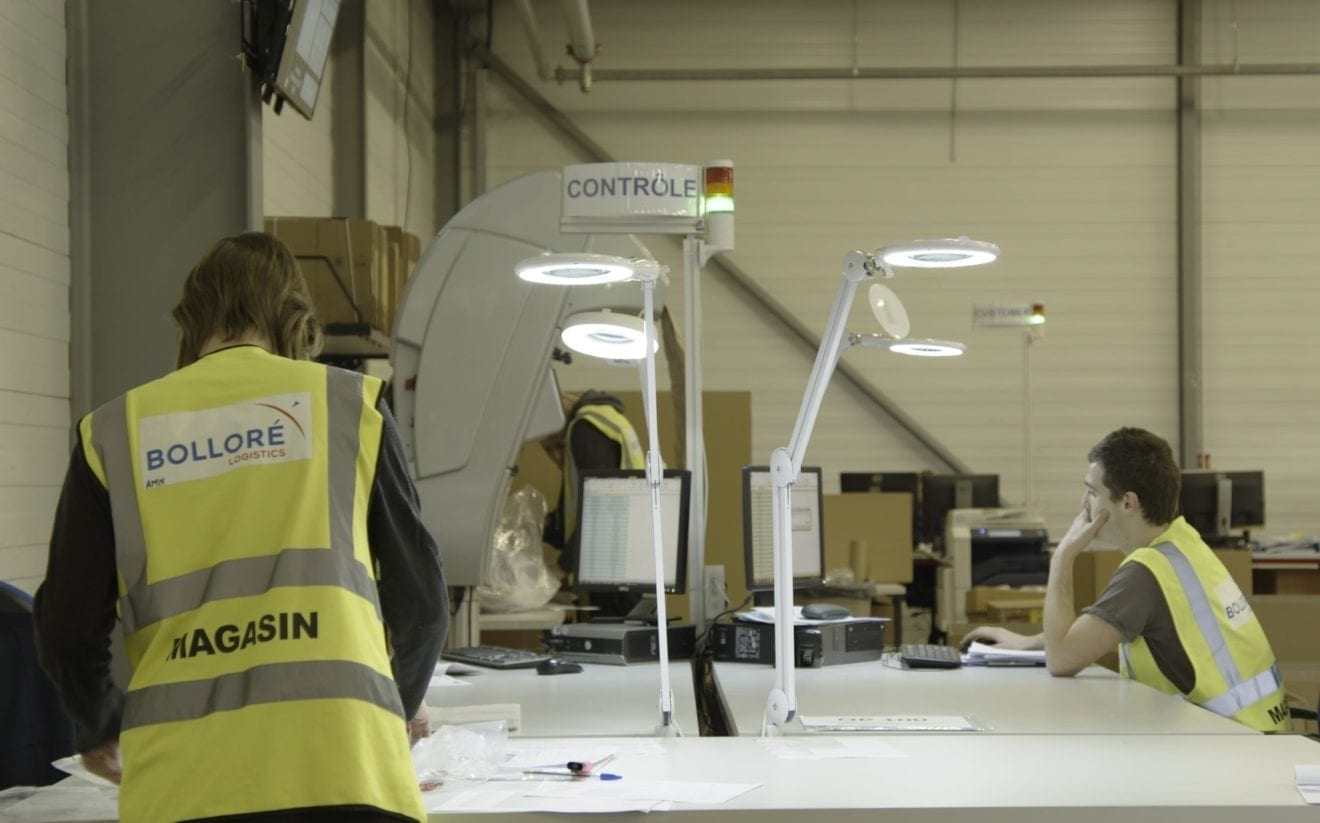
    From October 18th – 19th, 2018, Bolloré Logistics participated in the 5th FPSO & FLNG & FSRU Asia Pacific Summit held in Shanghai – China.  This event gathered more than 800 decision makers from the FPSO, FLNG and FSRU industry sectors to discover the latest industry trends, technological wave for digitization and business model innovations.

    Bolloré Logistics, represented by their Chinese entity, was awarded the “Outstanding FPSO Logistics Contractor of the Year”. Bruce BOUDAILLER, Oil & Gas Regional Director at Bolloré Logistics Asia-Pacific, who received the award on behalf of the team, said: “We are very appreciative of the confidence and loyalty shown by our customers and partners. Bolloré Logistics has been a leader for the last 15 years in supporting the FPSO industry, with a track record of more than 20 FPSO conversion projects handled, and contract logistics for around the same number of FPSOs in production.”

    This experience allowed Bolloré Logistics to be entrusted with a high profile FSRU project which was completed last year. The award comes as earned recognition of the professionalism shown by Bolloré Logistics’ Oil & Gas teams located in the construction and conversion countries, as well as in the countries from where all materials originate.

    “Our valuable and experienced long lasting colleagues, which must be seen as our main asset, are prepared to face the industry upturn after the challenging last three years that the industry went through,” added Bruce BOUDAILLER.

    Kari GU, Oil & Gas Product Manager at Bolloré Logistics China, confirms the readiness of the teams to cater for any new opportunity: “China is becoming the main location in terms of conversions and construction, with what appears as a shift from Singapore and South Korea. Together with our Oil & Gas teams of specialists, we are ready to support locally and internationally any new project related to FPSO, FLNG or FSRU,” she highlighted.

    An expert in Oil & Gas solutions and services

    Present in the major global hubs, as well as in most of the oil and gas producing countries, with a strong implementation in Africa and Asia, Bolloré Logistics offers tailor-made solutions on contract or project basis. It prides itself in delivering simple or complex solutions to its oil & gas customers, sometimes in the most challenging areas of the world, in full compliance with Ethics and the QHSE standards. Differentiating itself from the other major international freight forwarders, Bolloré Logistics has developed a very strong expertise and track record in handling very big capital asset projects onshore and offshore, and extended the logistics chain beyond the entry gates of the supply bases.

    As an extension of the supply chain, Bolloré Logistics has been integrating for many years in its solutions marine services as well as supply base services. With reference to the Oil & Gas players and many industry suppliers in its portfolio, Bolloré Logistics also created a movie showcasing its technical expertise of logistics operations dedicated to the Oil & Gas in Port Gentil, Gabon.

  • Marriott International Wins AON Best Employer in APAC

    Marriott International Wins AON Best Employer in APAC

    Marriott International has once again been crowned Best Employer Asia Pacific by Aon plc (NYSE: AON). The company was also recognized as Aon Best Employer in 17 markets across APAC – an increase in four markets from last year. The accolades are testament to Marriott International’s commitment to its people and its active encouragement for them to be their best in both their professional and personal lives.

    Craig S. Smith, Marriott International’s President and Managing Director for Asia Pacific, said, “At Marriott International we put people first and take care of our associates so that they, in turn, take care of our guests. We are thrilled that this commitment to our people, which has been embedded in the company’s DNA from the outset, has been recognized yet again by Aon. We focus on training, developing and retaining our associates, creating a loyal and passionate workforce that is committed to offering the best service and experiences to our guests.”

    With over 680 properties across 23 brands in more than 20 markets and a further 530 plus properties in the pipeline, Asia Pacific is Marriott International’s second fastest-growing region. The organization’s approach to developing talent is central to this growth as increased opportunities in the company enable associates to progress their careers from within, retaining not only talent but also the legacy of service values and commitment to excellence throughout the entire operation.

    “We implement a systematic and purposeful approach to enable associates to realize their full potential through a structured human capital planning process,” said Regan Taikitsadaporn, Chief Human Resources Officer for Asia Pacific at Marriott International. “We see it as important to nurture and groom our talent with comprehensive training and leadership development programs to enable career growth and facilitate internal promotions that will empower the growth of our company. These initiatives help us attract best-in-class talent as well as create a positive and nurturing environment for all associates.”

    Marriott International also offers professional development programs for associates at every stage of their career, from the Global Voyage Leadership Development Program for recent university graduates to the Marriott Development Academy, which helps prepare aspiring and new managers for the leadership role of general managers. As part of its commitment to diversity and inclusion, Marriott also focuses on promoting and developing women leaders. In 2018 alone, the Asia Pacific region saw a 12 percent increase in the number of women general managers across Asia Pacific.

    Marriott International is the only company to receive global recognition consecutively since Aon began the program in 2014 – a testament to the group’s commitment to putting its people at the core of its business. In 2018, Marriott also achieved certification as Best Employer globally.

    With more than 15 years of experience in best employer studies across the world, backed by more than 20 years of experience in employee research, the Aon Best Employer program recognizes the achievements of organizations that demonstrate excellence in the workplace.

    The company’s research proves that Aon Best Employers drive a committed workforce and performance through a compelling employer brand, effective leadership, and a high performance culture and level of employee engagement.

    • Engagement: Employees speak positively about their employer, intend to stay, and are motivated to exert extra effort at work.
    • Leadership: Leaders treat employees as valued assets, engage employees in the vision, and lead the organization to success.
    • Performance Culture: Employees are aligned to organizational goals and are rewarded and recognized for their contribution.
    • Employer Brand: Employees are proud of being part of their organization and can clearly explain what makes their employer different from others.
  • Victoria’s Secret reveales collaborative capsule with Mary Katrantzou

    Victoria’s Secret reveales collaborative capsule with Mary Katrantzou

    Lingerie brand Victoria’s Secret has announced its newest designer collaboration: Victoria’s Secret x Mary Katrantzou. The collaboration marks the second time that Victoria’s Secret has partnered with a luxury brand to create an exclusive range.

    Katrantzou, a London-based fashion designer dubbed the “Queen of Prints”, has designed an exclusive collection for VS that blends a feminine design aesthetic with the brand’s signature sexy and glamorous style.

    Katrantzou commented: “Everything that Victoria’s Secret creates is about a woman feeling confident and empowered – and also having fun with what she is wearing. This collaboration is going to be bold, fun and playful.”

    Katrantzou has also designed a section for the 2018 Victoria’s Secret Fashion Show. The Victoria’s Secret x Mary Katrantzou capsule collection will feature looks from the runway and will be carried in select Victoria’s Secret stores and on VictoriasSecret.com this holiday season.

  • Indonesia Falls in 2019 Ease of Doing Business Ranking

    Indonesia Falls in 2019 Ease of Doing Business Ranking

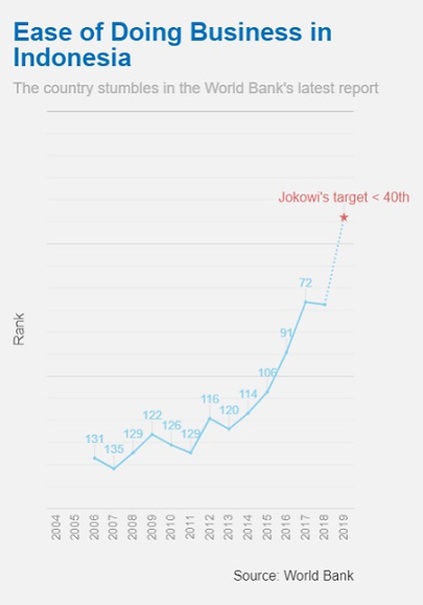
    If President Joko “Jokowi” Widodo wants to see Indonesia join the top 40 countries in the World Bank’s Ease of Doing Business ranking under his watch, he should make sure he wins re-election next year. Indonesia slipped one place to 73rd, behind Greece, the Ukraine and Kyrgyzstan, in the 2019 Ease of Doing Business report, released late on Wednesday. The president has set a target for the country to be in the top 40 by next year, but his second term will be decided in April, while the next report would not be out until next November.

    While Indonesia has made considerable progress in reforming the regulatory environment for businesses since Jokowi took office in 2014, Wednesday’s report reveals the stark realities of the country’s limited capacity to continue with these reforms.

    The country scored 67.96 out of 100 in the report’s aggregate measurement, up by only 1.46 points from last year. Slovenia, a Central European nation of only 2 million people and a $49 billion economy, sits in the coveted 40th place with an overall score of 75.61.

    Indonesia, for one, issued new rules that make starting a business, registering property and obtaining credit, easier for businesses and make it cheaper for them to get electricity. But reform stagnated in areas such as obtaining construction permits, protecting minority investors, paying taxes, trading across borders, enforcing contracts and resolving insolvencies.

    These bottlenecks allow economies like China, Kenya and Kyrgyzstan to overtake Indonesia. China made a leap to 46thplace in this year’s report, from 78th last year. Kenya moved up 19 places to 61st, while Kyrgyzstan went up seven places to 70th.

    Still, the report highlights Indonesia’s success in reforming its judiciary system and making the country a case study for others to emulate. The Supreme Court introduced training programs in 2003 for new and experienced judges, as well as special training for judges presiding over more specialized cases, such as those involving commercial or maritime disputes.

    “Indonesia’s efforts to train judges following judicial reforms bore positive results through a substantial decrease in court backlogs and insolvency case resolution times,” the World Bank said in the report.

  • Apple profit driven by higher iPhone models

    Apple profit driven by higher iPhone models

    Tech giant Apple Inc. may not have sold as many iPhones during the quarter ending September 30, but the company’s pricier models are driving its profits higher than ever. The California-based company reported it sold about 46,889 iPhones during the quarter, almost the same number of iPhones sold in the previous corresponding period.

    Apple was selling its iPhone ASP at $793 during the quarter compared to the $618 price of the unit in the corresponding quarter a year ago. The company has also introduced the iPhone XS in September at a price starting $999 and the iPhone XS Max which costs about $100 more than the XS model.

    The tech company has posted a 20 per cent increase in its quarterly revenue for the quarter to $62.9 billion, and quarterly earnings per diluted share of $2.91, up 41 per cent.

    International sales accounted for 61 per cent of the quarter’s revenue.

    Apple’s services revenue has seen a 27-per cent increase of $10 billion.

    “We’re thrilled to report another record-breaking quarter that caps a tremendous fiscal 2018, the year in which we shipped our two billionth iOS device, celebrated the 10th anniversary of the App Store and achieved the strongest revenue and earnings in Apple history,” said Tim Cook, Apple’s CEO.

    Cook said with their recently introduced new versions of iPhone, Apple Watch, iPad and Mac, and the company’s four operating systems, they have entered the holiday season with their “strongest lineup of products and services ever.”

    “We concluded a record year with our best September quarter ever, growing double digits in every geographic segment. We set September quarter revenue records for iPhone and Wearables and all-time quarterly records for Services and Mac,” said Luca Maestri, Apple’s CFO. “We generated $19.5 billion in operating cash flow and returned over $23 billion to shareholders in dividends and share repurchases in the September quarter, bringing total capital returned in fiscal 2018 to almost $90 billion.”

    Apple is looking at a revenue of between $89 billion and $93 billion for the first quarter of the 2019 fiscal year, a gross margin of 38 per cent and 38.5 per cent, and operating expenses between $8.7 billion and $8.8 billion.

    Apple’s board of directors has declared a cash dividend of $0.73 per share of the Company’s common stock. The dividend is payable on November 15.

    Neil Saunders, managing director of GlobalData Retail, said the quarter’s results underlines all of the innovation the company has put into its suite of products over the past year.

    “Admittedly, the new iPhone XS and XS Max versions, along with Apple Watch Series 4, were only available at the very end of this quarter, but we still believe they had a positive material impact on sales,” Saunders said.

    Saunders said with the tech giant’s strong release of products, the potential launch of new services, and more sessions being added to better stores, Apple has set itself up for another year of growth.

  • Renewable project facing criticism in Korea

    Renewable project facing criticism in Korea

    The government’s plan to build a renewable energy complex at Saemangeum, North Jeolla, is generating controversy as it deviates from plans to develop the reclaimed tidal flat into a regional economic hub and is being pursued without public approval.

    The controversy flared up as President Moon Jae-in announced Tuesday that the government will construct a solar and wind energy complex at Saemangeum.

    The government argues that around 10 trillion won ($8.7 billion) in private investment will flow into the project and that two million workers will be employed annually in the building of the facility.

    Despite the optimistic forecasts, the move is being criticized as an abrupt policy shift.

    When President Moon Jae-in visited Saemangeum last year, he mentioned developing the area into an economic hub for the Yellow Sea region but said nothing of solar or wind power. Opposition lawmakers have raised concerns about the projects.

    “The government’s plan to make Saemangeum, previously touted to be developed into an economic center for the Yellow Sea, into a mecca of renewable energy means a policy change,” said Chung Dong-young, a lawmaker for the Jeolla-based Party for Democracy and Peace. “This is the same as abandoning plans to expedite the development of Saemangeum.”

    The Party for Democracy and Peace, with 14 lawmakers from the Honam region, is especially angry about being bypassed.

    In light of such concerns, the government has explained that plans for Saemangeum’s renewable energy complex, which will cover an area comparable to the size of four nuclear power plants, will not interfere with existing initiatives.

    “The government’s determination to develop Saemangeum into an economic hub of the Yellow Sea area remains unchanged,” Minister of Land, Infrastructure and Transport Kim Hyun-mee said during the annual audit by lawmakers on Monday.

    A spokesman for the state-run Saemangeum Development and Investment Agency explained that it was not the right time for consultations with local residents and the general public.

    “Taking comments from local residents is done during the construction approval process. We are not yet at the development stage, so we haven’t asked for [comments], but we are obviously planning to do so,” he said.

    Opposition lawmakers and energy experts are suspicious that the plans for Saemangeum were changed to accommodate the Moon administration’s pledge to reduce nuclear power dependency.

    The new Saemangeum initiative is part of the government’s 3020 renewable energy plan, which established a renewable target of 20 percent by 2030. With current renewable energy output at just 8 percent of the total, the government is in need of more solar and wind power plants.

    “[The government] seems to be developing Saemangeum as there aren’t vast plots of land in the country suitable for solar or wind power complexes,” said a professor of nuclear energy who requested anonymity.

    Questions regarding the feasibility of the energy project have also been raised.

    “The electrical output produced by the energy complex will be little, at around 60 percent of a nuclear power plant,” said Kim Sam-hwa, a lawmaker for minor opposition Bareunmirae Party. “If it means building six-tenths of a nuclear power plant by spending 10 trillion won, wouldn’t it just be better to continue operating the Wolsong 1 plant?”

    Wolsong 1 is a nuclear plant set to be decommissioned.

    At the moment, renewable energy is less economical when compared with nuclear energy, explained Roh Dong-seok, a senior researcher at the Korea Energy Economics Institute. As the efficiency rate for solar power is about 15 percent, the actual production output of solar power plants is much lower than their rated capacity.

    The government’s promise to return the plots of land to their original state after operating solar and wind power plants at the location for 20 years is in doubt as the energy produced will have to be replaced.

    Local residents remain divided over the new project.

    “Even if it’s a government project, I can’t accept something that is pushed without prior notice,” said Ko Yoon-seok, a local leader of a town adjacent to the tidal flat. “There isn’t enough information to determine whether it’s right or wrong, but it’s difficult to say that everyone is against it.”