Amazon has acquired video doorbell and home security camera maker Ring in a deal reportedly worth more than $1bn, as it pushes further into the internet of things and in-home-delivery space.
The deal values Ring, which makes and sells popular video doorbells in the US, UK and Europe, at between $1.2bn (£86.4m) and $1.8bn, according to reports, making it Amazon’s second largest acquisition after Whole Foods Market.
Analysts see the Santa Monica, California-based Ring fitting in with Amazon’s move into the home security market, driven by a bet on delivering packages inside shoppers’ homes to boost sales.
“As Amazon moves more aggressively into the grocery delivery space … we believe smart security devices will be an important factor in driving user adoption,” said Baird Equity Research analyst Colin Sebastian.
Amazon already sells two different camera products: the Echo Look fashion-advice camera and the Amazon Cloud Cam indoor security camera, which forms part of Amazon’s Key service that lets uses a smartlock to allow delivery personnel put packages inside a home to avoid theft or, in the case of fresh food, spoiling.
Amazon’s venture capital for voice technology arm, the Alexa Fund, previously invested in Ring, which first shot to notoriety after founder Jamie Siminoff’s appearance on ABC’s Shark Tank, in which he declined investment from the show’s panel.
The company’s line of devices, including the Ring Video Doorbell 2, currently integrate with Amazon’s voice-controlled assistant Alexa. Users of Amazon’s Echo Show or Echo Spot devices can say, “Alexa, show my front door” to receive a live feed of activity around their home via Ring cameras.
Ring is not the first home security firm Amazon has bought in the last six months. In December, the company acquired smart camera and video doorbell startup Blink for a reported $90m. While the Blink purchase provided the retailer with access to potentially groundbreaking low-power chips that could extend the life and power-efficiency of Amazon’s cameras, Ring offers Amazon a popular consumer electronics brand that the retailer may not have been able to replicate internally.
For Ring, Amazon provides a scale not possible for a small company. Siminoff said in an interview with the Guardian in November: “We are a lot like Amazon from the side of reinvesting revenues into the business.
“The idea that Amazon goes into things to win, to deliver the best service to the customer, that aligns with what we want to do. We want to deliver the most cost-effective solution to customers at scale. So it is not about maximising the dollar per customer, it is about maximising the overall scale.”
Wedbush Securities analyst Michael Pachter said: “Amazon, more than Ring, can revolutionise home security.”
US security and alarm company ADT could be the biggest loser, Pachter said, adding that Ring’s “camera technology is far superior to physical security. With Amazon having roughly 100 million Prime members, that’s a big addressable market for them to start selling this into.”
Ring, which employs more than 1,500 people with offices in the UK and a European headquarters in Amsterdam, was involved in a legal battle with ADT over intellectual property for a forthcoming integrated alarm system, which was settled in January. Shares of ADT Inc fell more than 2% after the news to close at $11.60. Amazon stock closed down 0.7%.
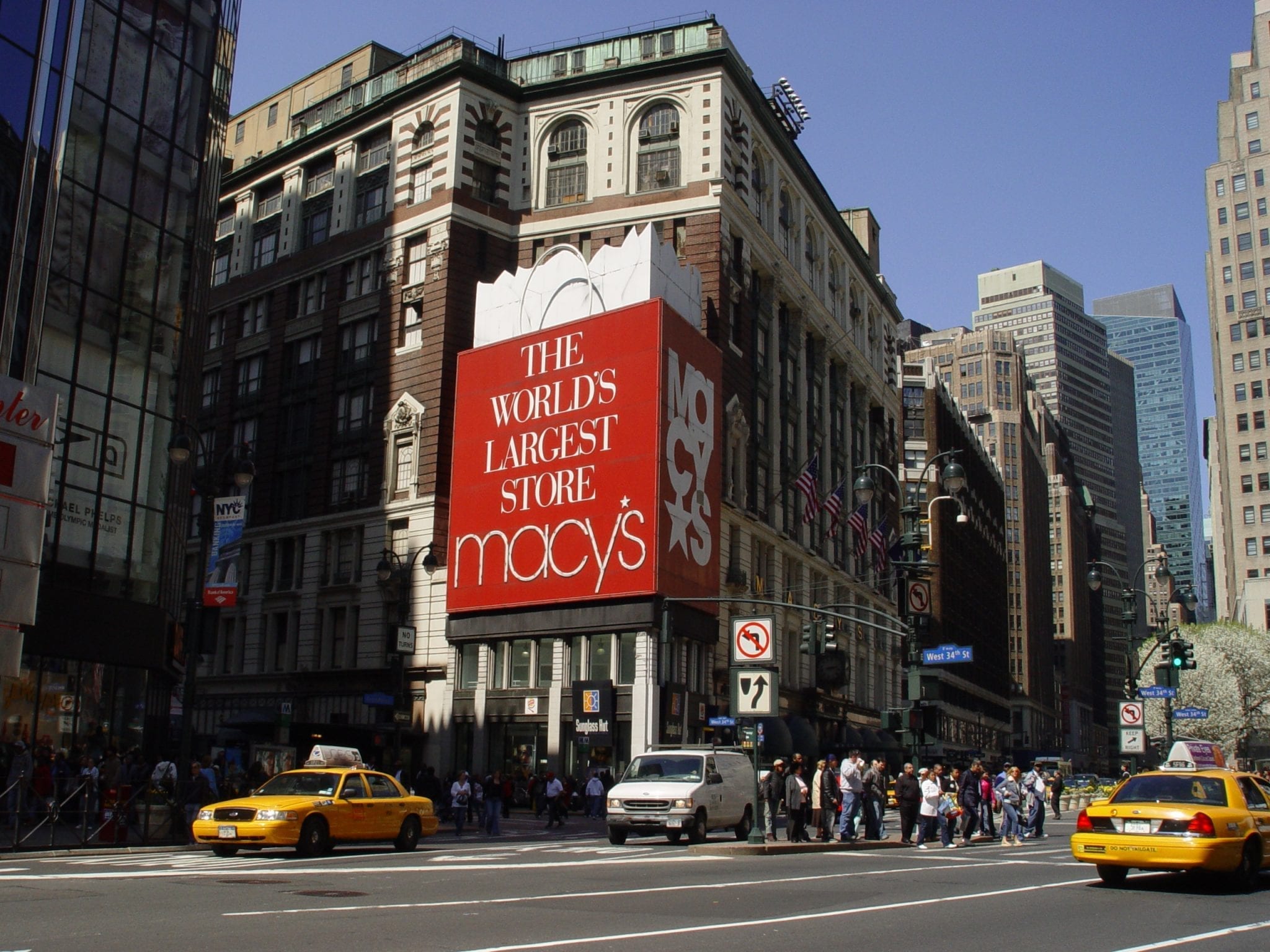
While the latest Macy’s sales figures do not suggest there is a miracle on 34th Street – or at any other Macy’s location – they do provide a little cheer.
Comparable sales are now positive after an extended period of decline, meaning Macy’s gets to end its fiscal year on a positive rather than a gloomy note.
That said, the note sounded is rather faint. And these results are by no means a clarion call that Macy’s is firmly back on track. This is not pessimism, but realism about Macy’s situation and the context of the latest numbers.
A total Macy’s sales uplift of 1.8 per cent is aided by an additional week of trading. When this is removed, we estimate that total sales shrunk. Admittedly, much of this relates to the prudent store closure program, but it nevertheless provides a more balanced picture of Macy’s current position.
The comparable Macy’s sales figures account for the additional week of trade, so are an accurate reflection of underlying performance. However, while we applaud the 1.3 per cent growth, it is essential to unpick how much of this is down to Macy’s strategy and how much is attributable to the general uplift in external conditions.
A simple way of assessing this is to look at whether Macy’s is gaining or losing market share. Unfortunately, on this basis, Macy’s growth is well below retail spending growth of 3.9 per cent over the same period. So, Macy’s has lost ground both at an overall level and, by our calculations, within a number of key categories like apparel and home. This view is backed by our consumer data, which shows no real recovery for Macy’s in terms of shopper share or shopper opinion about its proposition.
None of this is to suggest that Macy’s is standing still. We know that the business has many initiatives in play, and we recognise that it is making changes. However, as we have noted before, that change is not yet established enough nor is it ambitious enough to drive a step up in performance. One of the main reasons for this is that although Macy’s highlights improvements to its proposition, there are many stores where this cannot be seen or felt by shoppers. In essence, there is a long tail of shops that look dated, are in sub-optimal locations, and where the customer experience is poor. Macy’s must remedy this if it is to transform the business.
Thankfully, we believe Macy’s is in a position to make and create the more widespread change required. Finances are in a sound state, with asset and property sales are helping to provide capital for investment. Smaller divisions like Bluemercury and Backstage have potential and can become much more significant contributors to profits and sales. The refurbishment of departments such as home furnishings and footwear in some stores have shown that where Macy’s makes an effort, sales results follow. And the digital operation is still growing and puts Macy’s in an excellent position to meet the omnichannel needs of consumers.
The latest boost to performance affords Macy’s more space and time to enact its plans. Hopefully, it will also give management the confidence to be bolder and more ambitious – especially as the near-term trading environment looks positive and should cushion performance. In short, Macy’s cannot just wait around for a miracle; management needs the strength and will to engineer one.
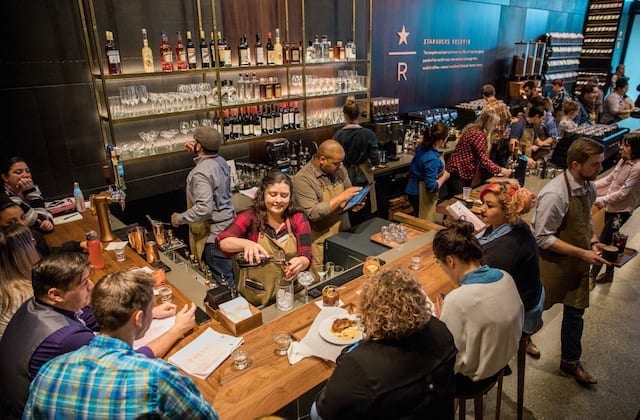
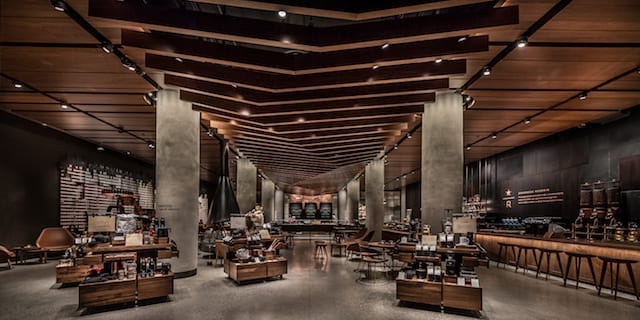
With the latest generation design and product offer, the new Starbucks Reserve Seattle store which opened this week offers a taste of what is to come for the 1000-plus stores planned globally bearing the sub-brand, including in Asia.
In just 14 months since the concept was unveiled at an investors conference, dozens of Reserve stores have opened including a massive Chinese flagship in Shanghai.
Starbucks partners work in the new Starbucks Reserve store at the Starbucks Support Center in Seattle on Wednesday, February 21, 2018.
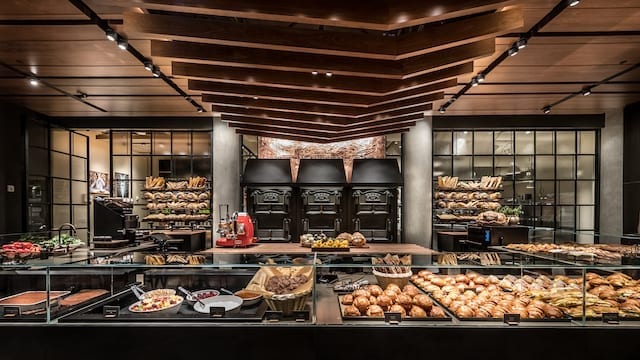
The marketplace-styled Starbucks Reserve Seattle Sodo store is remarkable not just for the latest evolution of the upmarket sub-brand’s fit-out, but for the inclusion of the new Princi Italian restaurant concept with an open kitchen, seamlessly folded into the cafe format. Starbucks plans to open standalone Princi outlets in Seattle, Chicago and New York, so expect to see them integrated into the brand’s offer in key Asian markets as well.
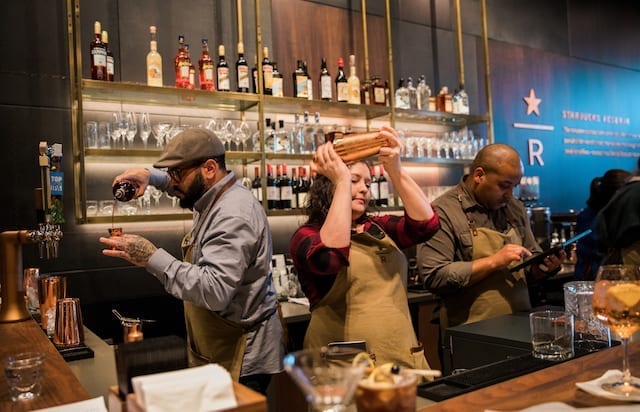
Starbucks partners work in the new Starbucks Reserve store at the Starbucks Support Center in Seattle on Wednesday, February 21, 2018.
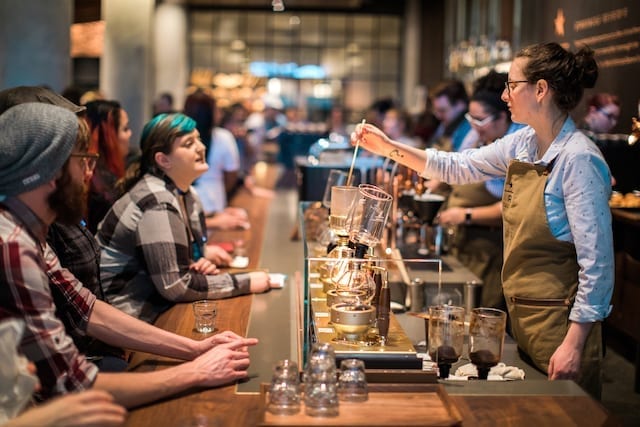
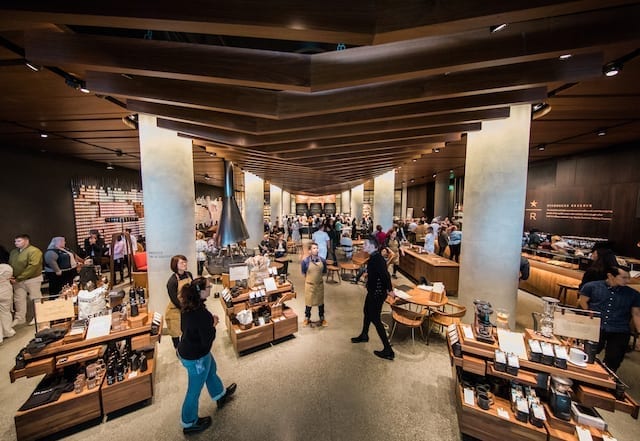
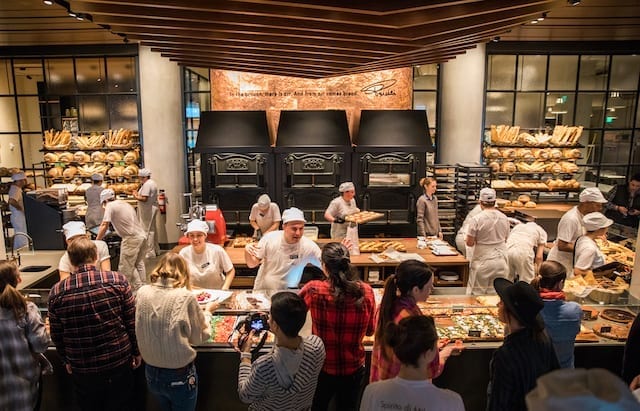
Designed in an open, marketplace style, Starbucks Reserve Sodo store customers can engage with and order from partners (employees) at the Princi counter or Reserve coffee bar, then gather with family and friends at community tables or lounge areas around two fireplaces. Open to view is the Princi kitchen where customers can see breads and pastries being made and fresh ingredients prepared daily.
Starbucks partners work in the new Starbucks Reserve store at the Starbucks Support Center in Seattle on Wednesday, February 21, 2018.
Located on the street level of the company’s headquarters, the store opened on Tuesday (February 27). It was created “to offer a mingling of public and private; a place where Starbucks partners and visitors can relax in a leather lounge chair near the fireplace, nosh on a piece of focaccia at the counter or enjoy the latest Reserve espresso and a flaky cornetti from Princi,” in the words of Starbucks in-house writer Heidi Peiper.
Christian Davies, VP creative global design & innovation for Starbucks, wants visitors to feel like they are part of an experience from the moment they cross the threshold and pass through the entry doors.
“Every detail is deliberate, starting with the pattern on the hand-carved doors – concentric circles borrowed from the art for a Starbucks Reserve coffee card.
“When you walk into the space from the entry, you can take everything in in the sweep of an eye,” says Davies. “We wanted people to walk through those doors and immediately find themselves in something different and unique, but they would still recognise as Starbucks.”
To the left, there’s a colorful art installation. Just beyond is the chef’s table and Princi case.
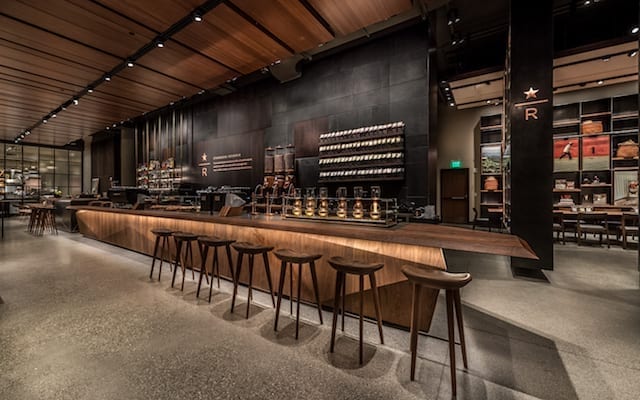
Behind that, through framed art glass, is the Princi kitchen. Anchoring the center of the main cafe is a floor-to-ceiling fireplace, signaling a welcoming place to gather. Then look to the right and you’ll see a long wood-topped craft bar with Starbucks Reserve coffees and a mixology bar, finishing with the coffee library and doors to the patio.
In addition to the open layout, Davies added other subtle touches, such as flecks of amber-colored glass and mirror sprinkled into the concrete floor that help suggest a path through the store.
“When people come into a space they can navigate, you can see their shoulders relax. They instantly feel more comfortable,” says Davies.
Art meets leisure
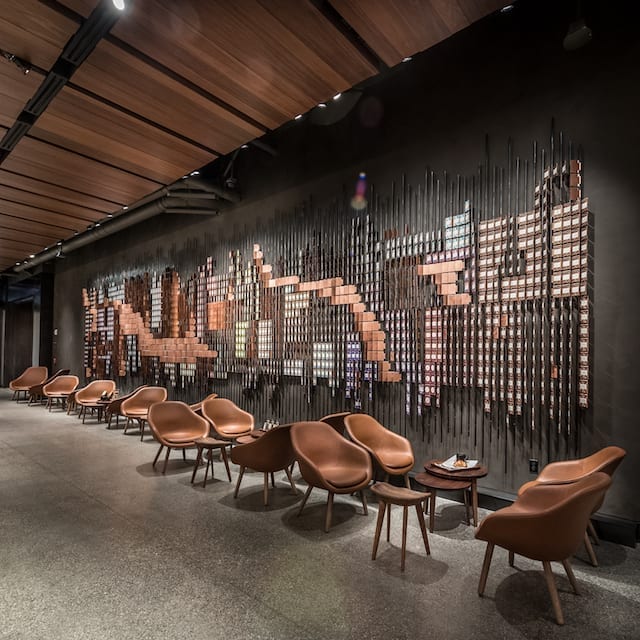
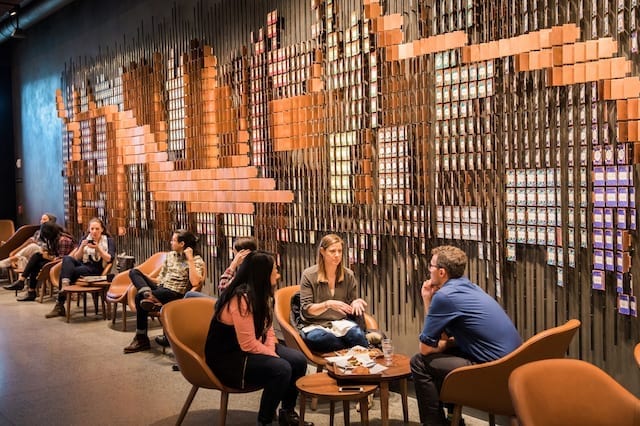
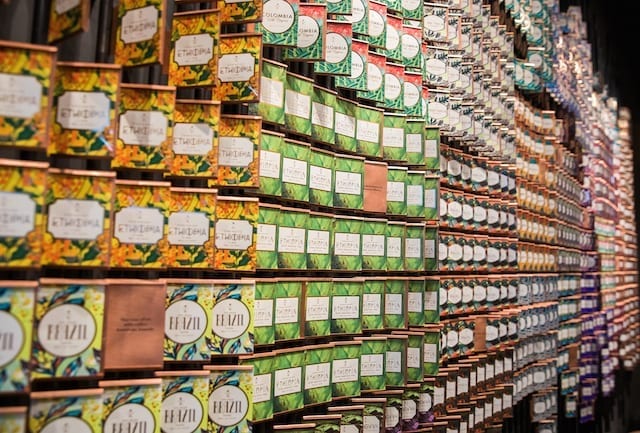
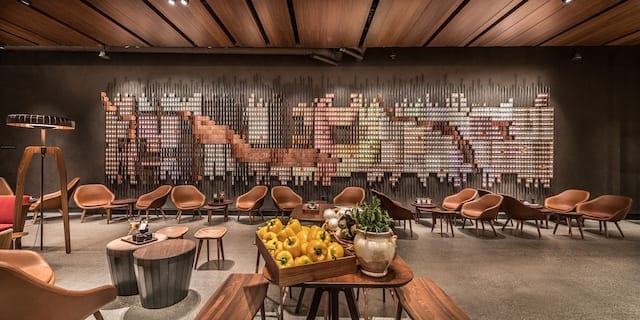
The path begins at a stunning copper art installation that features nearly 3700 Starbucks Reserve cards, designed in-house. From a distance, the card wall’s shape evokes the topography of the gentle mountains where coffee is grown. Each card can pivot, creating shimmering waves of color like fish scales. But step closer, and individual coffee cards come into view, each one a work of art in itself. Every now says and again, a copper card is planted in the field of cards that tells a story about Starbucks Reserve.
“On one level, it’s simply a beautiful, gestural piece,” says Davies. “As you dive into the next level, and then the next, more comes out.”
Beyond the card wall is the first of three intimate meeting spaces, each creating its own moment of storytelling. The chef’s table room features the story of Rocco Princi, with shelves lined with ingredients from his pantry – cans of capers, artichokes and tomatoes and tall glass jars of preserved lemons. A favorite poem by Alda Merini, a friend of Princi, hangs in a place of honor.
Gathered around the long wooden chef’s table, visitors can look through a glass wall into the Princi kitchen with artisan bakers and chefs at work.
And taking center stage is the Princi bakery and cafe, featuring the full Princi menu with artisanal baked breads, and breakfast anchored by signature cornetti and brioche. At lunchtime, the menu offers soups, salads, focaccia and pizza. To the right is the mixology bar for later in the day with traditional Italian aperitivo, such as Aperol Spritz paired with small plates, as well as beer, wine and spirits.
Celebrating ‘our never-ending curiosity’
The store represents the latest phase of innovation in the century-old building in Seattle’s Sodo neighborhood, which has served as Starbucks headquarters since 1993. In its previous life as a Sears Catalog distribution center, it employed what was then cutting-edge technology, with orders being picked by warehouse workers on roller skates and bicycles and delivered to the first floor via slides for quick shipping. The Reserve store continues that enterprising spirit, acting like a testing ground for the company, where it will debut new coffees, launch new products and host events. The store’s second meeting room, tucked back between the kitchen and the craft bar, is a tribute to this tradition. Starbucks R&D team will use this working lab to taste and test new beverages, starting with the cold coffee innovation.
“The lab celebrates our never-ending curiosity,” says Davies. “We can continue to push R&D around new beverages and ingredient combinations.”
The Reserve coffee bar is an eye-catching counterpoint to the Princi case. Here the craft of coffee is on display, with a full-lineup of brewing methods to explore, including siphon. Chemex, pour-over and Clover and a variety of Starbucks Reserve beverage creations to explore. The backdrop for this stunning display is a dark-stained walnut and leather back-bar, with hand-stitched copper wire adding sparkle and interest.
The story from bean to cup
In the third meeting space, visitors can learn coffee’s story from bean to cup. The Starbucks Reserve coffee library can be hidden away behind a pivoting full-height wall of 1200 bags of Starbucks Reserve Coffee. The space houses a collection of books on the geography, flora and fauna of Starbucks coffee-growing regions, and features a hand-painted Siren by Jordan Kay, the Starbucks artist behind this year’s holiday cup. An inside-outside fireplace brings warmth to those gathered in the room, and visitors enjoying the patio outside.
“When we were designing the space, we wanted to create layers of experiences and understanding – something new to discover,” adds Kenna Giuzio, senior store concept designer for Starbucks. “I hope with each visit, our customers will come away with a new story of Starbucks.”
The new cafe also features several new menu items, including Nitro Draft Latte, Spiced Ginger Cold Brew on tap, and new espresso drinks such as the Bianco Mocha.
Charlotte Olympia US has collapsed, with all of its store closed.
The US retail arm of the UK-headquartered luxury fashion and shoe retailer is believed to have debts amounting to US$19.2 million, and assets of just $3.2 million. It had four stores: in New York, Las Vegas, Beverly Hills and Orange County. A fifth store in Bel Harbour, Florida, was closed last year.
In its bankruptcy filing, the company cited “unprecedented disruption in the retail market”.
The stores were operated by Pinktoe Tarantula and its affiliates Desert Blonde Tarantula and Red Pump Tarantula.
“The brick-and-mortar retail environment has been experiencing, and continues to experience, unprecedented disruption due to a confluence of factors, including the proliferation of online retailers, changing consumer tastes and demographics, and increased competition,” the companies said in the filing. “Despite selling the iconic Charlotte Olympia brand and taking steps to reduce their expenditures, the debtors’ operations are not profitable due to the widespread disruption in the retail industry.”
Charlotte Olympia’s US wholesale business is unaffected by the bankruptcy of the retail operations.
The fashion label was founded in 2007 by Charlotte Olympia Dellal and also has stores in the UK, Dubai, Thailand and Russia. Its clothes and shoes are stocked by upmarket department atores around the world, including MyTheresa, Saks and Bloomingdale’s, and online on Net-a-Porter.
Coty, the global beauty company, is to begin a new technology start-up programme which will offer $100,000 in cash prizes for the best pitches involving artificial intelligence (AI) solutions.
The digital accelerator start-up programme will ultimately see eight companies work with Coty’s brand portfolio which includes GHD, Burberry and Covergirl, and will see a focus placed on a number of digital capabilities including AI.
Dates for submitting AI pitches using one of Coty’s brands will be accepted by 12 March, with a concise description of brand benefit expected, including metrics.
A follow up presentation for potential winners will take place at Coty’s brand leaders Digital Accelerator Summit in London and New York on 27 and 28 March. Prizes will range from between $10k – $50k with strategic support offered by the digital team at Coty.
Publicis’ media group, Zenith will be involved in summit, working alongside the company’s inhouse agency, Beamly as the business aims to foster its own ‘act like a start-up’ ethos, with AI one of its key priorities for development, explained Jason Forbes, chief digital and media officer for Coty.
“At Coty, we’re focused on transforming our digital capabilities across the organization, and the launch of the Digital Accelerator represented another step in this transformation. I’m thrilled to take this initiative a step further by bringing external start-ups into the mix. Coty has a growing expertise in partnerships with a breadth of start-ups to drive growth across our brands,” he commented.
Fred Gerantabee, Coty’s VP of digital innovation, added: “Partnerships between Coty and emerging companies such as Beamly and Holition, which launched our first an app free Augmented Reality (AR) experience exclusively for Covergirl, is an indication of how we’d like to bring disruptive new approaches to the market in partnership with unique new players in AI, AR, voice and other rapidly growing technologies. We intend to foster these relationships and looks forward to more examples like this coming out of our Digital Accelerator summits.”
Benoit Cacheux, global digital & innovation Lead at Zenith, said, “We’re really excited to work closely with Coty across this important strategic capability. Zenith and Publicis Media have been able to unlock a suite of great AI start-ups and we look forward to introducing more through this important initiative.”
This is the second year of the digital accelerator programme which aims to develop the digital capabilities of Coty overall.
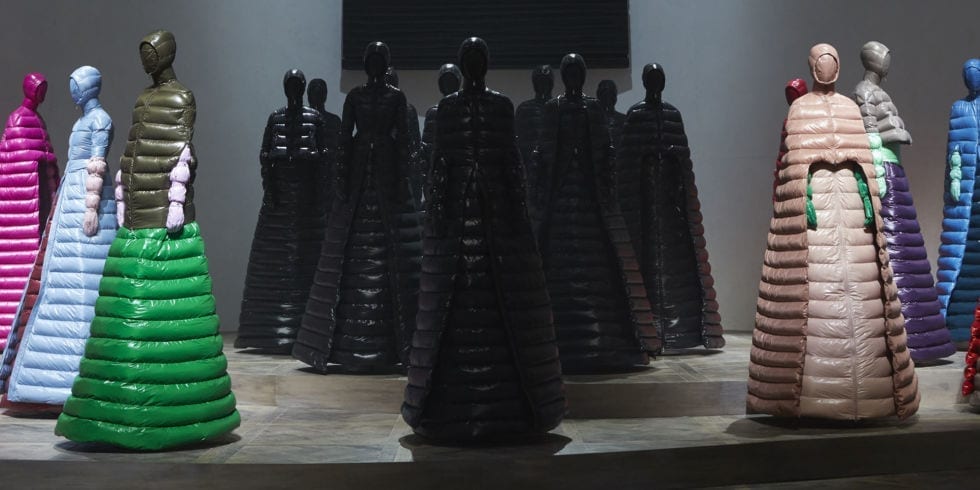
During the opening of Milan Fashion Week, Moncler finally revealed the highly anticipated Moncler Genius Building—a conceptual space that housing the Moncler Genius collections designed in collaboration with Hiroshi Fujiwara, Francesco Ragazzi of Palm Angels, Craig Green, and other well-known names.
Moncler packed out the Palazzo Delle Scintille—a 15,500 square meter exhibition space—with an international crowd excited to finally discover what Moncler had been hiding and shrouding with mystery for weeks.
Upon entering the Palazzo Delle Scintille, the mystery continued. The space was filled with large tent-like shapes of all sizes shrouded with silver fabric, surrounded by smoke and glittering under bright spotlights.
It looked like the silver shrouds would at once fall away for a big reveal but instead, following a long wait and a sudden countdown, curtains within the silver fabric opened and guests were invited inside the designers’ minds one at a time.
None of the spaces featured a traditional runway presentation. Instead, the capsule collections were displayed on mannequins in a humid jungle; in an eerily dark room; hung from the ceiling; and on models performing a snow angel dance routine reflect in an enormous mirror.
Francesco Ragazzi of Palm Angels took the most unorthodox approach, hosting two booths advertised by the slogans “Make It Rain” and “I’m So High.” Ragazzi and his team simply handed out free t-shirts periodically to keen attendees throughout the two-hour event.
In the build-up, Moncler explained that with this new project it would “let creativity run wild,” and it certainly backed up its claim. Pierpaolo Piccioli of Valentino put together a monastic collection disturbingly reminiscent of the women’s uniforms in The Handmaid’s Tale and surrounded by the work of artist and monk Sidival Fila.
Craig Greens’ collection was typically conceptual and utilitarian, denoting inflatable life jackets. Hiroshi Fujiwara of Fragment brought preppy, and in places grungy, vibes to the table with a sense Americana and mountaineering.
Moncler did not stop at human clothes either. Happy pooches clad in tiny Moncler outfits ran joyfully around a doggy obstacle course as the brand showcased its animal jackets.
The Moncler Genius Building acts as the project’s central hub. Within the space, each designer’s individualized cell represents a different facet of the brand’s identity and alludes to its unique vision for the future of fashion and design. The result is a grand composite of extraordinary minds united by the desire to innovate and create the new.
Moncler’s President and Creative Director Remo Ruffini hopes these monthly capsule collections will disrupt the traditional, biannual fashion schedule. They will release in a similar fashion to the routine “drops” employed by some streetwear brand and provide consumers with newness far more regularly.
Moncler will launch a collection once a month starting June. Clothes and accessories from its collaborative lines will be available in cities around the world at boutiques, selected stores and pop-ups.
Eyewear manufacturer Safilo has appointed a new CEO this week, following the sudden departure Luisa Delgado, who relinquishes her role at the Italian firm for personal reasons, as of 28 February 2018.
The maker and distribution of luxury sunglasses has named Andrea Trocchia as its new CEO. Trocchia will become director of the Safilo group on 1 April 2018.
Until a new CEO is appointed, Safilo’s President Eugenio Ranzelli will take charge of the business in the interim, Safilo said in a press release. The firm added that Delgado’s contract was terminated by mutual agreement with the group’s board.
Delgado’s severance package will be worth €1 million, plus vested stock options and other non-monetary benefits.
Trocchia will join Safilo Group S.p.a. as a director at the beginning of April. He will be included in the list put forward by Multibrands Italy BV, the eyewear group’s holding company, to be appointed CEO of Safilo Group S.p.a. at the next AGM on 24 April 2018.
Trocchia was previously chairman and CEO of Unilever Italia, a role he held since 2013. Before this, he was chairman and CEO of Unilever Israel. After an MBA at the STOA’/MIT in Naples and a PhD in aeronautical engineering at the University La Sapienza in Rome, Trocchia began his career at Unilever in 1991, in the supply chain and sales departments.
Safilo has been experiencing difficulties for several quarters. It claims to be still affected by the termination of its Gucci eyewear licence, which took place in December 2016.
At the end of the 2017 financial year, consolidated net sales were €1.047 billion, down €194 million (-15.6%) at constant exchange rates compared to the 2016 financial year. At the time of reporting last months, Safilo said the “sales decrease reflects both the transformation of the Gucci licence into a supply contract, for a total of €155 million (-12%), and the deployment of a new IT system for the global management of orders and stocks at the start of the year.”
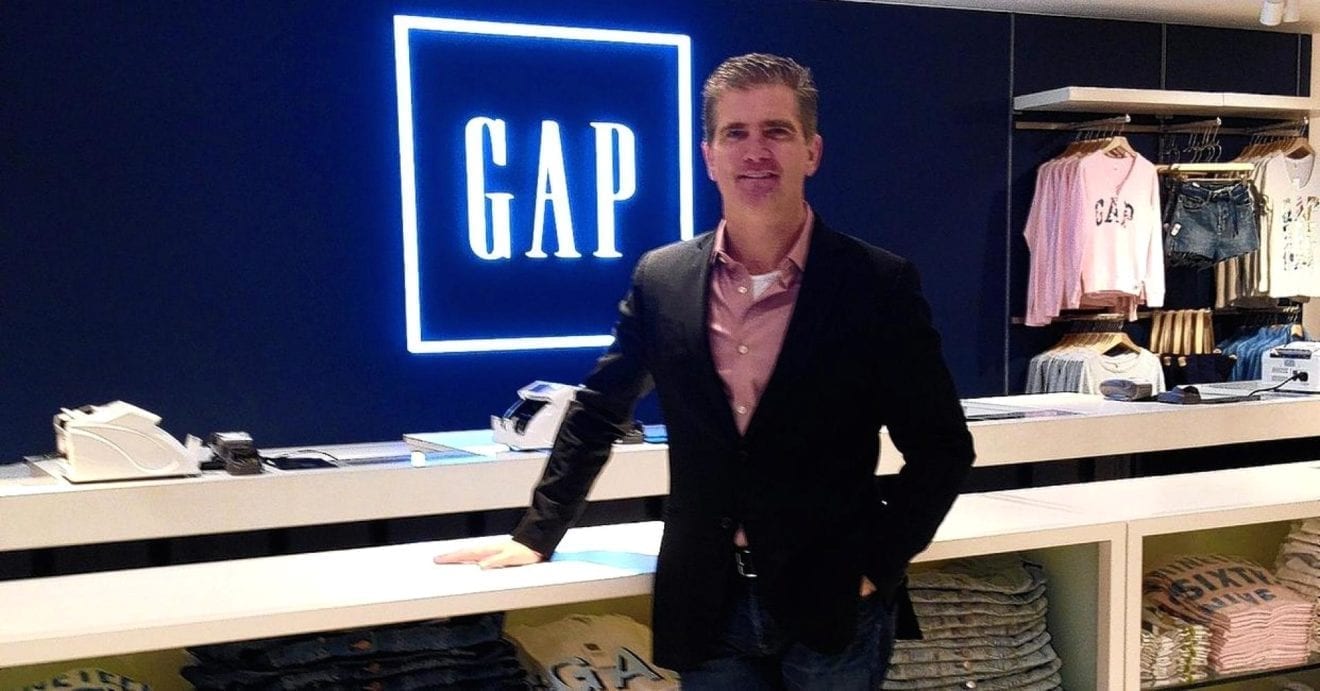
Gap Inc has announced that Gap brand president/CEO Jeff Kirwan will leave the clothing retail company.
A search has been launched to find a replacement.
“As we move into the brand’s next phase of development, Jeff and I agreed it was an appropriate time for a change in leadership,” says Gap Inc CEO Art Peck.
“Under Jeff’s leadership we made significant progress on the operating model of the brand. We are faster and more responsive than ever before, we radically improved quality and fit, and we centered the brand on the aesthetic our customers love: casual, optimistic and American.
“We have also seen the results of exceptional marketing and customer engagement reflected in increased traffic, improved sales and the strength of the digital business.
“While I am pleased with our progress in brand health and product quality, we have not achieved the operational excellence and accelerated profit growth we know is possible at Gap brand.”
Until a new president is found, the brand will be overseen by executive VP Brent Hyder, who was previously the brand’s COO.
Gap has been struggling both at home and abroad in recent years. Its Singapore franchisor FJ Benjamin this week announced it was ceding the franchise for both Gap and Banana Republic.
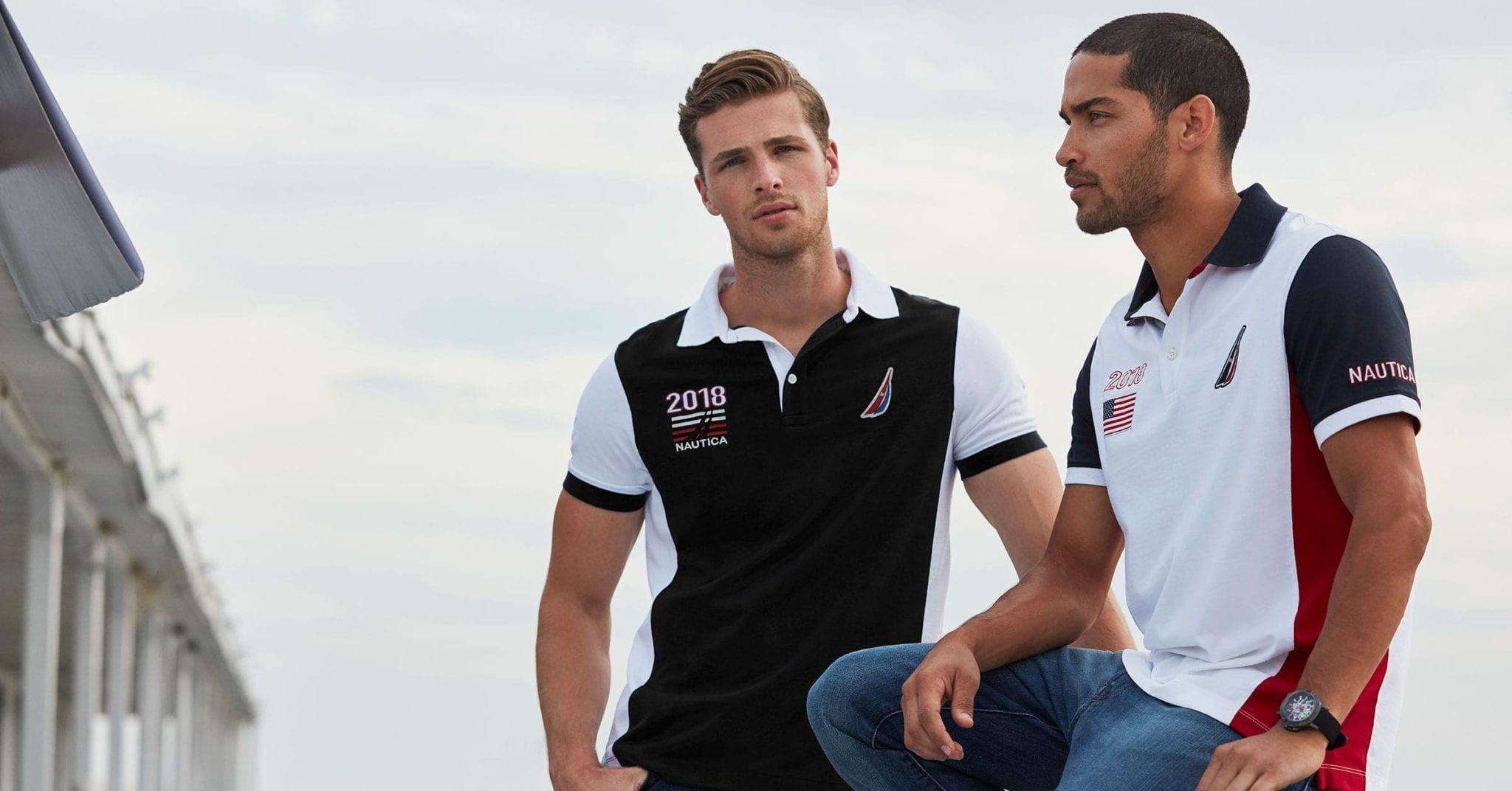
US apparel group VF Corp. is on a mission to divest its Nautica brand, saying the decision to sell met the “held-for-sale and discontinued operations accounting criteria”.
VF Corp. bought Nautica Enterprises Inc. in 2003 for $586 million.
The company, which owns the North Face, Vans and Timberland, said it had decided to sell Nautica during the fourth quarter and has classified it as a discontinued business.
It follows VF Corp’s decision in early 2017 to sell off Licensed Sports Group and after it sold its Contemporary Brands business in 2016.
The news coincided with VF Corp’s fourth-quarter results released on Friday.
For the three months ended December 30, net losses were $90.3 million, or $0.23 cents per diluted share, compared to net income of $264.3 million, or $0.63 cents, a year ago. On an adjusted basis, earnings per share were $1.01.
However, revenue for the quarter increased 20 percent to $3.6 billion, which included a $247 million contribution from the company’s acquisition of Williamson-Dickie, a global workwear company, in October. This was a touch below analysts’ estimations of US$3.66bn.
Full year 2017 revenue increased seven percent to $11.8 billion. Excluding the Williamson-Dickie acquisition, full-year revenue increased five percent.
“VF’s fourth quarter results were stronger than we expected as growth continues to accelerate across core dimensions of our portfolio,” said Steve Rendle, Chairman and Chief Executive Officer. “We remain in the early phase of a multi-year journey to become a purpose led, agile, consumer centric organization. I am pleased with our early progress and look forward to building on our momentum in 2018.”
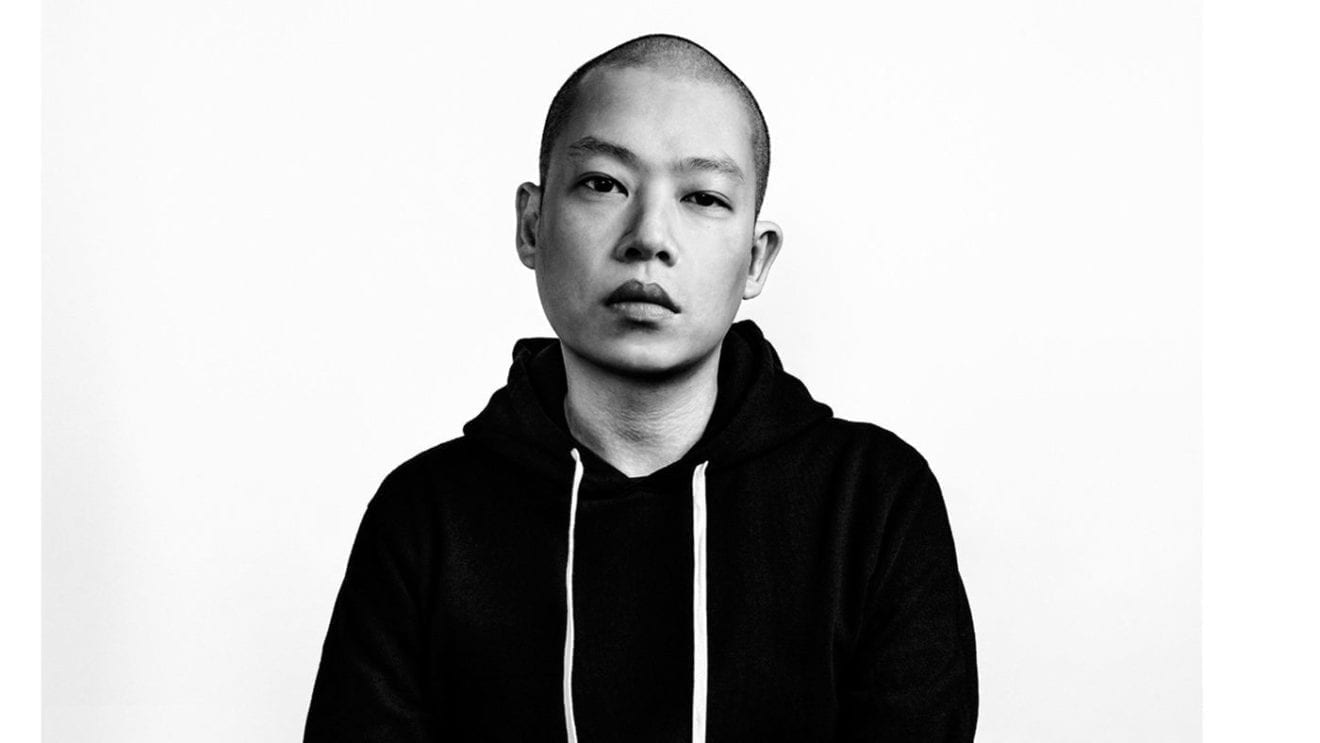
Jason Wu is stepping down from his role as artistic director of Boss women’s. His Autumn/Winter 2018 show, presented during New York Fashion Week, is the designer’s final collection for the German fashion house.
“The five years at Hugo Boss have been a very exciting time for me. I am especially grateful to the entire Boss womenswear team. Now the time has come for me to concentrate fully on my own label,” Wu said in a statement.
“I would like to thank Jason for his incredible creative input and inspiration. I feel certain that he will approach all his future projects with the same compelling passion and zest that he brought to Hugo Boss,” added chief brand officer Ingo Wilts.
Wu, an editorial favourite, as well as a go-to for celebrities and former First Lady, Michelle Obama, gained fans with his namesake line’s merging of classic American sportswear with sophisticated society dressing. In September 2014, Wu sold a majority stake to investment firm InterLuxe.
Since joining Hugo Boss as artistic director in June 2013 — when he assumed responsibility for all product and image-related components of the brand’s women’s line — Wu has been credited for injecting a new, approachable, ease to the women’s line of the storied house, while remaining in tune with the brand’s roots in German austerity.
Wu’s departure follows 18 months of strategic changes at Hugo Boss, which has struggled with unclear positioning between premium and luxury. In November, 2016 — six months into Mark Langer’s appointment as chief executive — the German fashion house shifted its priorities away from its womenswear business. The brand announced its plans to eliminate two brands (Boss Orange and Boss Green) within its portfolio, while narrowing its focus to casualwear and business clothes. Meanwhile, it slowed expansion of its store network and put more resources towards its online operations.
The refocusing on men’s is slowly paying off, despite a trend of men moving away from formal wear. In its most recent fourth-quarter earnings, posted last month, Hugo Boss reported a 5 percent increase in currency-adjusted sales to €735 million ($902 million) compared to the year prior.
This increase was driven by a rebound in direct-to-consumer sales (online sales were up by 42 percent), as well as a recovery in the US. Hugo Boss will report its full-year results on 8 March 2018.
US grocery chain Tops Markets has filed for Chapter 11 bankruptcy.
The company says the process will not affect store operations but will enable it to pursue a financial restructure to eliminate “a substantial portion of debt” from its balance sheet and ensure its long-term survival.
“Tops has built strong market share and our stores continue to distinguish themselves by offering quality products at affordable prices with superior customer service,” said CEO Frank Curci in a statement.
“We believe the financing that we received from our noteholders is a vote of confidence in our business.
Our operations are strong and we have an outstanding network of stores and a talented team to support them. We are now undertaking a financial restructuring, through which we expect to substantially reduce our debt and achieve long-term financial flexibility. This will enable us to invest further in our stores, create an even more exceptional shopping experience for our customers and compete more effectively in today’s highly competitive and evolving market.”
Tops Markets, based in Williamsville, New York, operates 178 stores in its home state, Pennsylvania and Vermont, and employs 15,000 people. The company recently received a $140 million loan from the Bank of America and a commitment for a further US$125 million to cover debtor financing.
SAP SE introduced three new solutions supporting organizations that have a need to collect customer data in compliance with the EU General Data Protection Regulation (GDPR) while delivering personalized experiences. The three new products are available now and can be deployed separately or as a package.
Many brands today are struggling to initiate and build trusted relationships with their online customers. Lack of transparency and control of personal information by brands has eroded trust in digital customer experiences. In fact, a recent survey shows that data being used without their knowledge is the chief reason consumers leave brands.
Overcoming the Compliance Challenge
GDPR, which is effective May 25, gives extensive new rights to EU residents and visitors and applies to organizations anywhere in the world that collect personal information from within the EU.
With the integration of its recent acquisition of Gigya, SAP now provides customers with solutions to support them in gaining transparency and control over their data, helping them overcome the compliance challenge with robust registration, consent preference and profile management. The solutions can quickly and securely scale to manage billions of identities and thousands of digital properties across hundreds of brands to help companies meet the requirements of evolving privacy and data protection regulations.
“With GDPR around the corner, the timing of these solutions couldn’t be better,” SAP Hybris President Alex Atzberger said. “At a time when SAP is doubling down on its strategy to provide the leading front-office suite, the combination of SAP Hybris and Gigya solutions is a tremendous benefit for customers. Importantly, it turns a compliance need into a strategic business advantage and creates more trusted customer relationships.”
Three New SAP® Hybris® Solutions from Gigya
SAP is bringing three new solutions to market to help organizations adopt a digital approach to drive more effective marketing, sales and service through data, while keeping the customer in control of how much data is shared:
SAP® Hybris® Identity establishes secure customer registration and login across websites, mobile applications and Internet of Things devices using flexible user authentication options, federation standards and single sign-on functionality. It captures and stores customer identity data for trusted and personalized digital experiences. Optimized registration flows increase conversion, while the platform helps protect consumers against identity fraud and data theft.
SAP Hybris Consent presents and captures customer consent for terms of service and privacy agreements, including cookie consent and marketing communications. For auditing purposes, consent agreements and consent history are tracked across the customer lifecycle. This information can be synchronized with marketing, sales and service applications. Customers are in control of their personal information with features for consent revocation, data export and account deletion. Consent records are stored in a secure data vault.
SAP Hybris Profile transforms customer identity information, profile attributes and other system data into a single customer view, which can be orchestrated in real time or in batch to virtually any application, service or data warehouse. Organizations can govern all the information in these single customer views throughout the customer’s lifecycle. With the platform — and providing consumer consent and transparency has been granted — SAP customers can analyze data within these single customer views to plan, predict and optimize digital experiences to support sales and services.
“If data is the new oil, then trust is the ultimate currency that drives this new data economy,” Gigya CEO Patrick Salyer said. “To create trust, consumers demand transparency and control over how their customer data is managed. GDPR goes further by legally requiring it. With these new SAP Hybris offerings from Gigya, we can provide one of the only solutions on the market that create trusted customer relationships — just four months after SAP announced its intent to acquire Gigya.”
After a 17-year partnership, French luxury group Kering is selling its 50 percent share of Stella McCartney back to the namesake designer. The public announcement, originally slated for early January 2018, is imminent, according to a source with first-hand knowledge of the discussions.
According to the source, the Stella McCartney HR team is preparing a booklet outlining the details of the separation to answer outstanding questions and ease employee concerns. However, both parties issued a joint statement saying nothing has been confirmed.
“Kering and Ms Stella McCartney have been operating and growing the Stella McCartney brand since 2001 as a 50/50 joint venture. As already stated, as it is customary between stakeholders, there are regular discussions about the future of the partnership,” Kering and Stella McCartney said. “Any significant change to the current relationship would be made public at the appropriate time. Any piece of information circulating to this respect can only be considered as speculation.”
To be sure, unravelling the partnership will be a time consuming, expensive process.
According the source, Kering’s brands will be forbidden from hiring Stella McCartney employees during the transition process, which could take as long as two years.London-based retail strategy consulting firm Javelin, part of global advisory firm Accenture, is working with Stella McCartney to reorganise during the transition period, creating a blueprint for the newly independent Stella McCartney business.
While Kering and Stella McCartney have acknowledged that there have been separation talks on more than one occasion over their 17-year partnership, the exact reasons for the break, and why it’s happening now, are not yet known. The reported split does come at a time when Kering is streamlining its portfolio and focusing its attention on blockbuster brands including Gucci, Saint Laurent and Balenciaga.
In early January 2018, the group announced that it would spin off German sportswear brand Puma, inching the parent company further toward becoming a pure luxury player. In the fiscal year ending December 31, 2017, consolidated revenues were €15.5 billion, up 27.6 percent on a reported basis. Sales within the luxury group, which excludes Puma, Cobra and skate brand Volcom, were up 27.5 percent on a reported basis.
Stella McCartney first launched as a joint venture with the Gucci Group in 2001. At the time, the Gucci Group was run by chief executive Domenico De Sole and Tom Ford, who designed both Gucci and Yves Saint Laurent. Alexander McQueen joined the group in 2000.
Over the next two decades, McCartney and Kering built a global brand, driven not only by the designer’s exuberant sportswear but also by her commitment to animal-free fashion. McCartney’s faux-fur and faux-leather apparel and accessories helped to elevate the materials in the eyes of the consumer, serving as an example for other brands and a resource for Kering’s entire portfolio, which now also includes Balenciaga, Christopher Kane and Brioni. In 2016, Stella McCartney published its first environmental profit-and-loss account.
Kering does not break out the revenues of its smaller houses, although in 2015 market sources estimated that Stella McCartney’s annual global sales were somewhere between $150 million and $200 million. However, the annual retail value of Stella McCartney products is likely significantly more thanks to branded collaborations with Procter & Gamble for beauty, Adidas for activewear and Bendon for lingerie. Her collection with Adidas, first launched in 2004, has become a brand in itself. McCartney then launched menswear in 2016.
As for how Stella McCartney may transform under the founder’s absolute rule, a push to drive more direct sales could be in the cards.
In May 2017, the company announced that it would open four new store locations, including a second store in Paris, one in Florence, in one Costa Mesa, California, and a second location in New York City.
A year earlier, it also assumed control of store operations of its three Hong Kong stores, which were previously managed by a local partner. The brand’s retail store portfolio currently includes 52 locations, with another store on London’s Bond Street on the way.
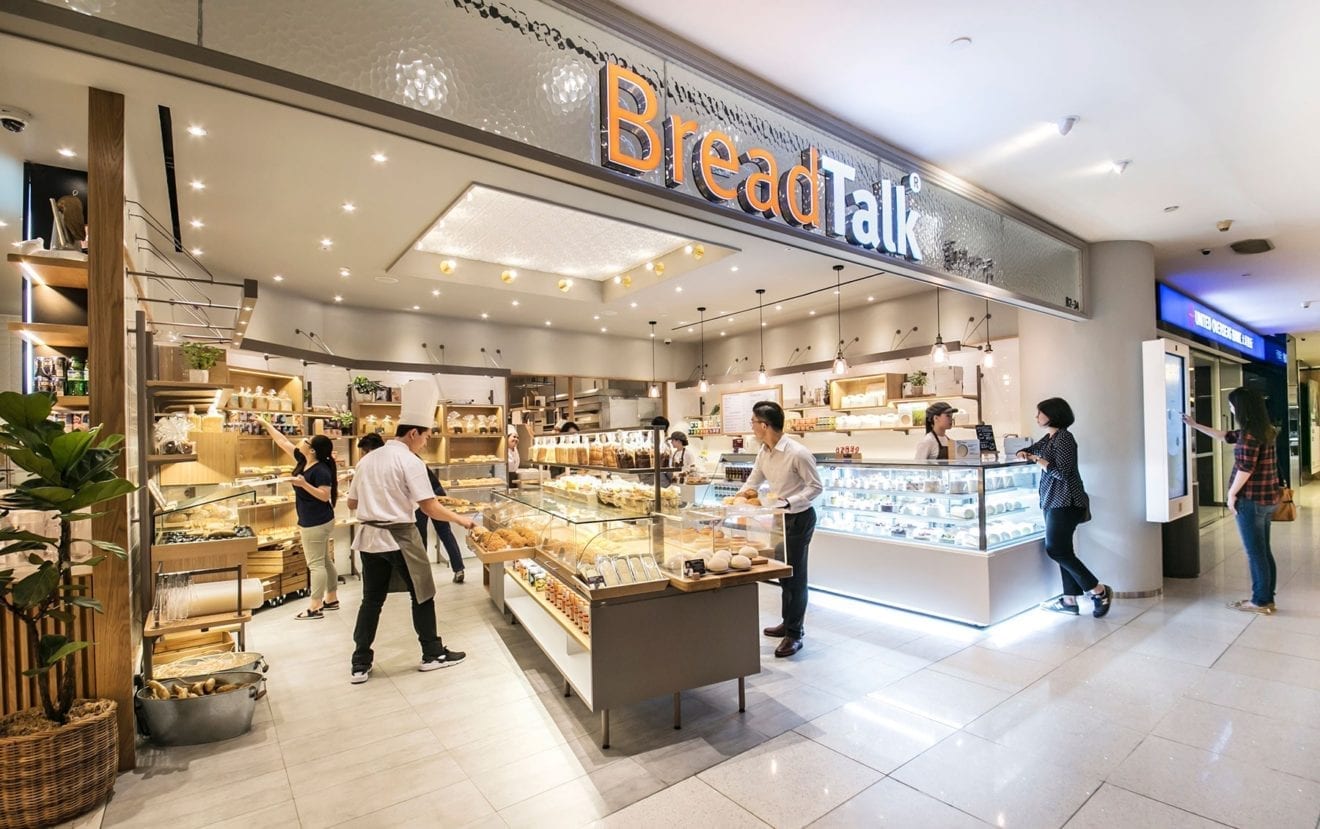
With a record 91 per cent profit growth, lifestyle F&B company BreadTalk Group says it is ready to soar in a challenging market.
Its record net profit for last year came in at US$21.8 million despite an “unpredictable” macro retail environment, says the Singapore-headquartered company.
“We are well positioned to soar above the challenging retail market conditions,” says chairman Dr George Quek.
“The group remains determined to identify innovative food concepts and partnerships, delivering them promptly across our 17 territories.”
In line with the group’s consolidation strategy for the year, group revenue eased 2.5 per cent to $599.7 million.
For the same period, earnings before interest, tax, depreciation and amortisation (EBITDA) fell 3.5 per cent to $84.4 million, with EBITDA margin steady at 14.1 per cent.
Profit after tax and minority interests (PATMI) improved 91 per cent from $11.4 million to $21.8 million. PATMI margin rose from 1.9 to 3.6 per cent.
During the year, $9.3 million in net capital gain was recognised from the divestment of the group’s investment in TripleOne Somerset in the first quarter.
Excluding one-off items, core F&B business net profit for the year would have been $17.7 million, an improvement of 153.3 per cent.
Bakery less bouyant
Bakery-division revenue declined 3.2 per cent to $297.2 million, attributed to lower revenue from directly run stores in Beijing, Shanghai and Hong Kong, as well as lower franchise revenue from China because of the planned early termination of eight franchisees during the year.
There were 20 fewer directly run stores at 240, following the reclassification of the eight outlets in Malaysia in the fourth quarter to franchise, as well as closures in China and Singapore.
Franchise outlets ended the year at 631, 29 more because of the addition of the re-classified outlets from Malaysia as well as more outlet openings by franchisees in Indonesia, Philippines and Thailand.
EBITDA for the division declined 20.5 per cent to $23.2 million, with EBITDA margin at 7.8 per cent, down from 9.5 per cent, mainly because of lower profitability at Shanghai and Singapore directly run stores, and lower high-margin revenue contribution from the China franchise business.
For the food atrium division, revenue was 5.4 per cent lower at $149.3 million with four fewer outlets. The same-store sales growth momentum for the entire food atrium portfolio was strong, especially in China. Two outlets opened in Shenzhen during the fourth quarter, at MIXC World and Uniwalk.
EBITDA improved 53.7 per cent to $25.1 million, with EBITDA margin improving from 10.3 to 16.8 per cent.
London debut
For the restaurant division, revenue was up 2.2 per cent to $140.7 million, with one outlet being added in Thailand. EBITDA rose in tandem by 2.1 per cent to $30.1 million with EBITDA margin steady at 21.4 per cent despite costs related to the start-up of the group’s first Din Tai Fung outlet in London.
A new business division, the 4orth Division, was launched with the objective of incubating F&B concepts, as well as enter into joint ventures. The division ended the year with revenue of $7.9 million and EBITDA of $500,000, translating to an EBITDA margin of 6.8 per cent.
“Significant” efforts were put into consolidating and turning around the group’s bakery business, particularly underperforming stores in China and Singapore. Also, the Toast Box product in China was revamped to better suit the local palate and to meet the consumers’ mobile lifestyle.
BreadTalk’s food-atrium division ended the year with a record low stall vacancies of less than 2 per cent.
The management team is also staying focused on deepening reach in Singapore and Thailand to further optimise economies of scale. Two outlets were opened last month, at the new Northpoint City in Singapore and at Thonglor in Bangkok.
All five Ramen Play outlets were rebranded as So, turning the business profitable. The group’s first JV, Song Fa Bak Kut Teh outlet at Jing An Kerry Centre in Shanghai officially opened last month, to be followed by further Song Fa outlets in other parts of Shanghai as well as in other cities in China and Thailand.
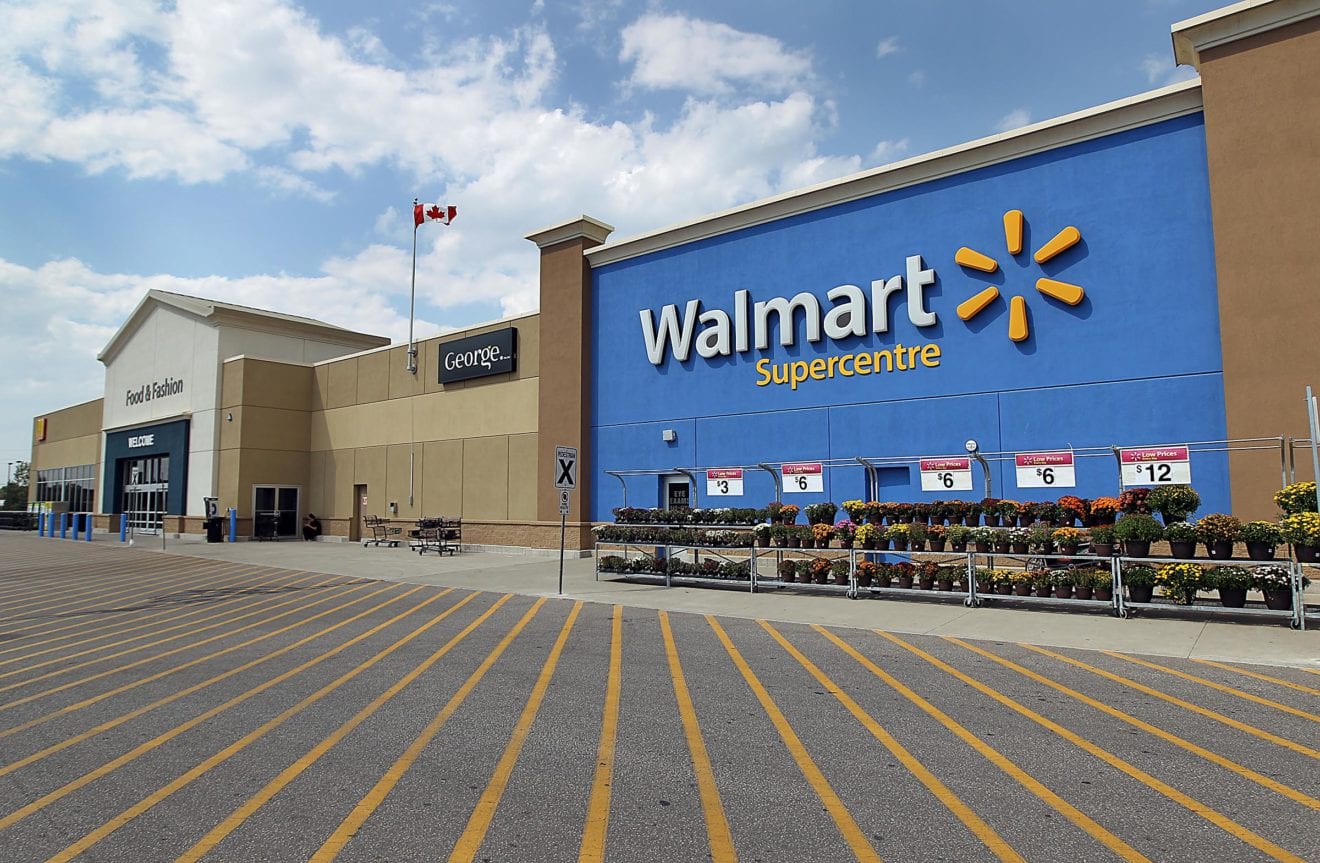
Walmart sales reached US$500.3 billion last year, an increase of $14.5 billion, or 3 per cent.
But that failed to excite shareholders, with the share price shedding 10 per cent of its value immediately after the announcement.
Arguably, the world’s largest retailer’s biggest success last year was its e-commerce business where it is looking to take market share away from Amazon – just as Amazon is trying to encroach on the brick-and-mortar space in the US.
E–commerce sales rose 44 per cent for the full year, although growth slowed from 50 per cent to 23 per cent in the last quarter, partly due to the annualisation of its year-old Jet.com acquisition. It forecasts 40 per cent growth in the current quarter.
Neil Saunders, MD of GlobalData Retail, says Walmart has more work to do to widen its e-commerce customer base.
“There are many demographics, especially younger and professional segments, for whom Walmart is not the destination of choice online. This isn’t because it doesn’t sell what they want or because the price or delivery options are suboptimal; instead, it is because they do not associate Walmart with online or they default to Amazon. This is a tough nut for Walmart to crack, and one that it can only break by more heavily marketing its services and proposition.”
While figures for the Walmart China business were not broken out, the international division posted 6.7 per cent year-on-year growth in the latest quarter. China and Mexico were the star performers and Walmart’s troubled UK grocery chain Asda showed long-awaited improvement.
Bottom line blues
The weakest part of Walmart’s figures was on the bottom line. Consolidated operating income was $20.4 billion for the year, a decrease of 10.2 per cent, however the company says that when one-off impairments and costs are taken out of the equation, operating income would have been “relatively flat”.
Saunders says there is no cause for alarm over the bottom line performance. “Walmart remains comfortably profitable and much of the deterioration is down to the various investments Walmart is making in future-proofing its business. We applaud this long-term view, especially as it is now being coupled with some rationalisation and streamlining initiatives.”
Meanwhile, a solid US market performance reflects higher customer traffic and higher average spend.
“Part of this is down to a more optimistic and carefree consumer, who was in a mood to spend over the holidays.
Arguably those shoppers did not have to visit Walmart – but many did, and from our data, Walmart increased its share of shoppers over the final quarter. We believe this is down to Walmart’s focus on low prices plus better customer service, improved ranges, and better-selling environments. The bottom line is that even in an era of stiff competition, Walmart is becoming more and not less relevant to the American consumer,” said Saunders.