Tag: Korea

  • South Korea among G20’s top IoT-ready markets

    South Korea among G20’s top IoT-ready markets

    The United States, South Korea, and the United Kingdom ranked as the three countries in the G20 most ready to contribute to and benefit from the IoT, according to IDC.

    The research firm said  the US scored particularly well on measures such as ease of doing business, government effectiveness, innovation, and cloud infrastructure, as well as technology spending as a percent of GDP.

    Meanwhile, South Korea scored extremely well on IoT-specific spending and has a business environment that fosters innovation and promotes attractive investment opportunities.

    Similarly, the UK scored very highly on measures of ease of doing business, government effectiveness, regulatory quality, start-up procedures, innovation, and broadband penetration.

    The standout country in the ranking, however, proved to be Australia, which, despite its relatively small GDP, scored exceptionally high on ease of doing business and start-up procedures, government effectiveness and regulatory quality, and innovation and education.

    The original index was first published in 2013 but the updated index is now comprised of 13 criteria that IDC views as necessary for sustained development of the IoT and reflects each nation’s economic stature, technological preparedness, and business readiness to benefit from the efficiencies linked to IoT solutions.

    “Countries are keen to become or maintain a competitive advantage and, as such, are looking to the Internet of Things as one of those initiatives,” said Vernon Turner, senior vice president, Enterprise Systems and IDC fellow for the IoT.

    “Knowing where a country stands in the IoT Index will help global and local IT vendors know what opportunities lie ahead of them as they line up their strategies at federal, local, and enterprise levels.”
  • Korean Fashion Struts Authentic Style to Thailand’s Online Shoppers

    Korean Fashion Struts Authentic Style to Thailand’s Online Shoppers

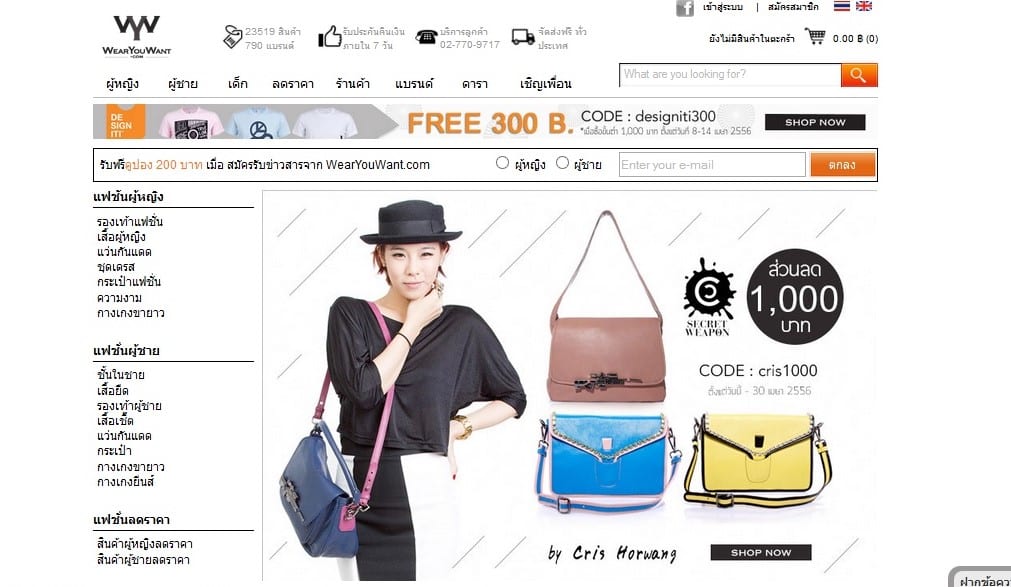
    WearYouWant, Thailand’s leading online fashion and beauty marketplace, is launching a premium, Korean fashion range in Thailand, designed and made in Korea, to satisfy the ever-growing love of Korean brands in the Kingdom. Developing a close relationship with online fashion house, Atria International Style, WearYouWant is sourcing authentic Korean brands, importing these for the Thai market from up-and-coming local Korean designers.

    Just as Korean pop music as captured a huge fan base in Thailand, there is high demand for Korean fashion too. The new Korean range of cool and stylish women’s apparel, accessories, bags and shoes, is to be showcased on WearYouWant. The launch, planned for December 2016, is big news for Thailand’s online shoppers. It is also a sign of growing focus from Korea on Thailand’s rapidly developing e-commerce market; the fastest growing in Southeast Asia.

    The WearYouWant collection is unique in Thailand and has been specially curated by fashion experts to assure quality and to appeal to the country’s online fashion-buying market who are actively seeking out Korean brands. Martin Toft Sorensen, Co-Founder and Co-CEO of WearYouWant confirms that this latest fashion collection launch is part of an ongoing strategy to understand and meet their customers’ needs and a response to the market in Korea too.

    Our decision to move forward with Korean brands is in part due to a general push for designers to expand beyond the saturated markets in Korea. WearYouWant is an ideal platform for this expansion as there is a great amount of passionate interest from our online shoppers for Korean fashions. We pride our success in being ahead of the curve with consumer trends and this is what makes our platform so vibrant, relevant and exciting.”

    This launch follows the Last Mile Fulfilment (LMF) Korea 2016 conference in September 2016, which Martin Toft Sorensen attended. The event focused on the attraction of Thailand’s solid e-commerce market and higher purchasing power for Korean brands looking to grow within Southeast Asia and succeed outside Korea’s competitive markets. Also clearly highlighted was the importance of fashion distributors in assisting Korean brands to spread out within the region and the value that this can bring to outside markets. The WearYouWant launch aims to add value to Thailand’s blossoming ecommerce market where demand is strong and expectations high.

    ATRIA STYLE (www.atriastyle.com), a powerful South Korean platform that sells contemporary fashion and beauty brands all over the world has been working closely with WearYouWant to fuel cross-border fashion and beauty relations in Thailand to build strong commerce presence between these two key retail luxury markets.

    Founder and CEO, Cindy Yun is optimistic about the future success of Korean fashion and beauty brands through the WearYouWant platform.  “Korean designer fashion is forward thinking, high quality and, in terms of production, there is a good lead time in creating output. This means that brands are stylish and affordable which greatly appeals to savvy Thai consumers. For designers looking to expand their collections outside of Korea, WearYouWant is a vital online lifeline and the e-commerce opportunity this launch entails will enable them to realize their true potential.”

  • Asia drives All Saints growth

    Asia drives All Saints growth

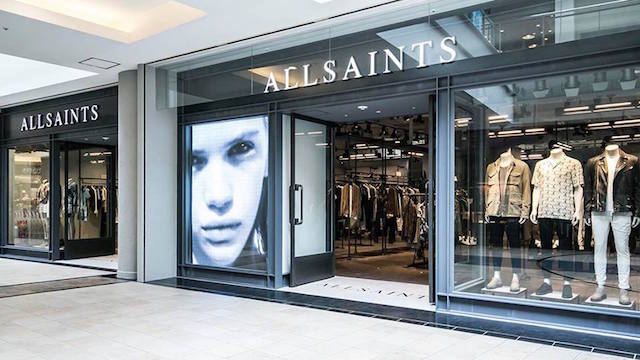
    Asia has proven the major driver of All Saints growth in the last year’s reported sales.

    A stellar set of results was led by international sales growth of 12 per cent to £108.2 million, as it opened 23 new stores internationally in countries including Japan, South Korea, Taiwan and the US.

    The retailer has big ambitions for its international arm, as it aims for international sales to account for nearly two-thirds of the business by 2020 (currently 43 per cent), with Asia and the Middle East being the prime focus. All Saints has also performed well in its home market, with UK sales up 7.4 per cent to £144.3 million, while online sales grew 33 per cent to reach £47.3 million – 19 per cent of total sales.

    All Saints’ continued success is evidence of how having a distinct design signature, desirable brand image and a loyal shopper base is imperative in a tough trading environment, as it keeps the brand front of mind for shoppers. The retailer has remained true to its edgy design aesthetic, and translated it effectively into range extensions such as its Capital collection of women’s handbags. It is also capitalising upon its relatively unique position of being equally desirable for both men and women (sales are split almost equally) by launching a men’s bags and accessories ranges, following the success of the Capital collection. All Saints continues to keep shoppers engaged via regular product drops, a broad but well-edited collection and a distinct instore customer experience.

    All Saints

    All Saints has maintained tight control over its brand image, and chosen to enter new markets directly through own stores and partnerships with department stores, rather than through wholesale and licensing – a strategic move that has helped make its mark in new territories without diluting the brand.

    It has also managed to control online costs effectively as it owns its distribution centres and does its website coding in-house; while its diversified market presence and direct sourcing model has helped it achieve a natural hedging position, broadly protecting it from currency fluctuations.

    All Saints’ focus on controlling costs and protecting brand image as it expands, will continue to stand it in good stead, and help achieve sales growth in 2016/17.

    Nivindya Sharma

  • South Korea, Indonesia to cooperate to sell aircraft globally

    South Korea, Indonesia to cooperate to sell aircraft globally

    Korea Aerospace Industries, the country’s sole aircraft manufacturer, said Wednesday it had signed an initial agreement with an Indonesian company to sell its products in the global market.

    In the 2016 Indo Defence Expo and Forum set to run from Wednesday through Saturday in Jakarta, KAI and PT Dirgantara Indonesia (PTDI) agreed to carry out joint marketing to export aircraft in Southeast Asia, the Middle East and Africa, KAI said in a statement.

    “The two companies will expand their cooperation in passenger carriers, military aircraft and aerospace businesses,” KAI Chief Executive and President Ha Sung-yong said in the statement.

    Under the pact, KAI aims to export the KUH-1 Surion utility helicopters to Indonesia as its military is expected to gradually replace the aging fleet of 200 choppers. It will help the PTDI improve its aircraft maintenance capabilities, and the PTDI will help KAI win local projects in aircraft maintenance, repairs and operations, it said.

    The two aircraft companies also plan to jointly develop unmanned aerial vehicles (UAVs) and promote their aircraft in global markets through joint marketing, KAI said.

  • McDonald’s Korea sale collapses

    McDonald’s Korea sale collapses

    And in the simultaneous divestment process for the 20-year McDonald’s China franchise rights, TPG Capital has reportedly withdrawn leaving two rival private equity firms in the race – Bain Capital and Carlyle Group – competing with two Chinese companies previously reported to be in the negotiations: retailer Wumart Stores and Sanpower Group.

    With Maeil Dairies Industry Co dropping out of the running for McDonald’s Korea, that sale process seems at best stalled.

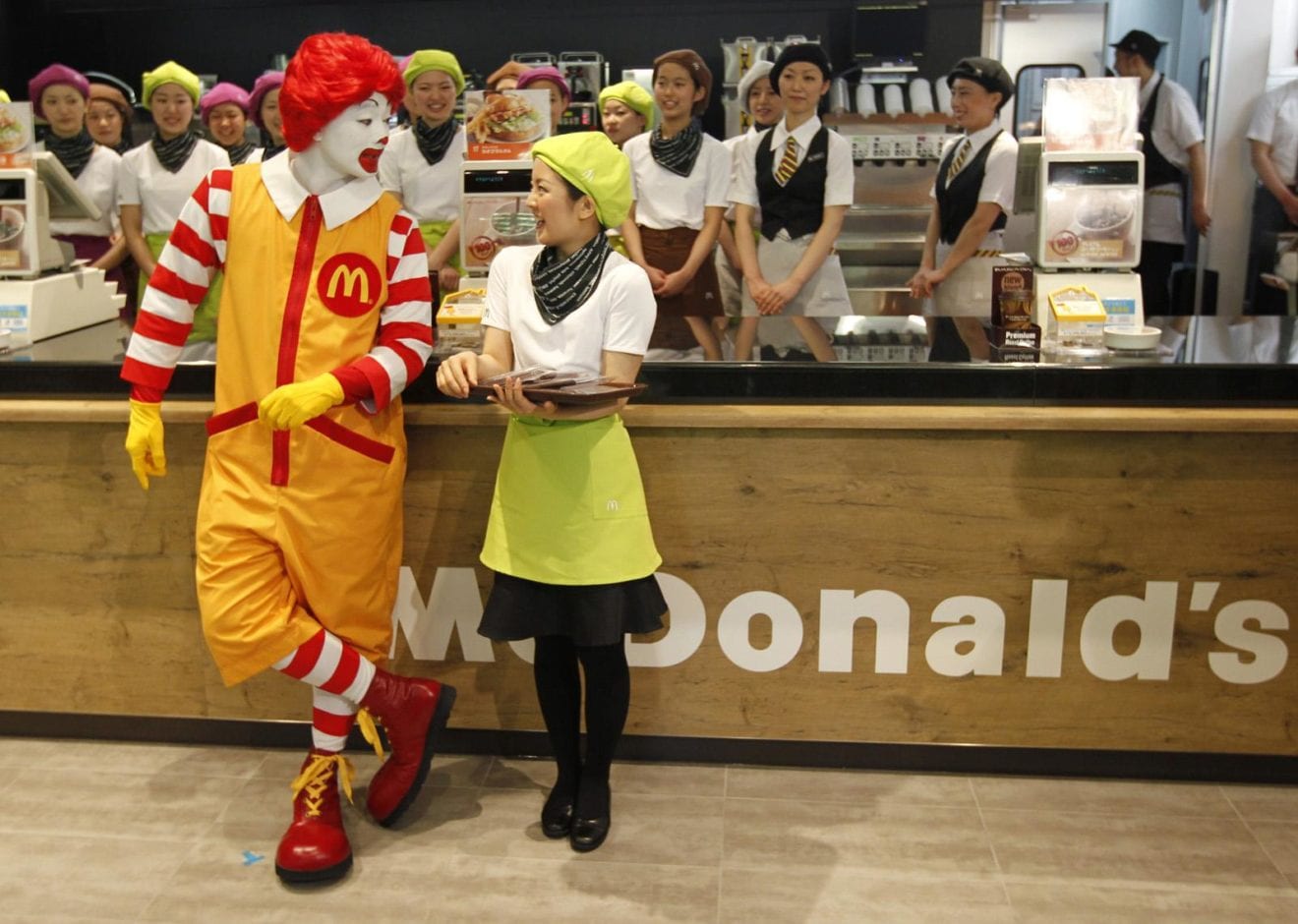
    McDonald’s, which directly manages about 400 stores in South Korea, has been looking for local partners to run the Korean outlets as franchise stores that pay annual commissions instead. The deal initially drew interests from several investors, including CJ and NHN Entertainment, but they have nixed their plans.

    Maeil Dairies had formed a consortium with Carlyle Group, but pulled out after failing to agree on terms of contract, industry sources familiar with the matter told the Yonhap news agency.

    “We can’t verify the specific details as McDonald’s headquarters office is in charge of the bidding process, but the sales process is still under way,” an official at McDonald’s Korea said, without elaborating on the deal.

    Meanwhile, in China, TPG’s withdrawal was confirmed overnight by unidentified sources close to the matter and reported by several news networks.

    Carlyle Group has partnered with Citic Group and Bain with GreenTree Hospitality, a hotel group.

    McDonald’s is seeking as much as $3 billion for the China rights, which come with a 10-year expansion option.

    There are about 2400 McDonald’s restaurants in China and Hong Kong and the US company wants its master franchisee to expand that network rapidly to compete with rival Yum! China’s expansion plans.

    The ongoing presence of private equity bidders in the process is surprising, because McDonald’s has made it clear it is seeking a long-term partner rather than private equity firms, which typically cash out after a few years.

  • BMW recalling 154,472 vehicles over fuel pumps

    BMW recalling 154,472 vehicles over fuel pumps

    BMW is recalling 154,472 vehicles registered in the United States and Canada for a fuel pump problem that could cause stalling, according to a filing with U.S. safety regulators and BMW.

    BMW told regulators that no injuries have been reported. Since 2014, the German-based company has conducted safety recall campaigns in China, Japan and South Korea for the same issue, according to a filing posted on Friday by the U.S. National Highway Traffic Safety Administration.

    Of the vehicles recalled in North America, 88 percent are registered in the United States.

    BMW is recalling certain vehicles in the United States and Canada for model years 2007-2012. Among them in the United States are the X5 3.0si, X5 4.8i, X5 M, X5 xDrive30i, X5 xDrive35i, X5 xDrive48i and X5 xDrive50i, 2008-2011 X6 x Drive35i, X6 xDrive50i and X6 M, 2010-2011 X6 ActiveHybrid, according to the filing.

    Also the 535i xDrive Gran Turismo, 535i Gran Turismo, 550i xDrive Gran Turismo and 550i Gran Turismo, 2011-2012 528i, 535i, 535i xDrive, 550i and 550i xDrive and 2012 535i ActiveHybrid, 640i Convertible, 650i Convertible, 650i xDrive Convertible, 650i Coupe and 650i Coupe xDrive vehicles.

    BMW will notify owners and dealers to replace a fuel pump module free of charge beginning in early December. BMW owners can call BMW customer service for details.

  • Kakao food-delivery service planned

    Kakao food-delivery service planned

    Korean internet company Kakao, known for its chat app KakaoTalk, plans to jump into the food-delivery sector.

    The Kakao food-delivery service is planned for launch by January, and it is expected to be incorporated into the app, which has four menu buttons. One of them lists extra services such as sending gifts or making reservations.

    A Kakao spokesperson says the deliveries would mainly be from franchise restaurants.

    In July, Kakao acquired a 20 per cent stake of CNT Tech, a developer of an order-receiving platform for more than 80 franchise restaurant brands in Korea.

    CNT Tech has 90 per cent of market share in the ordering platform sector. Once an order is placed through a franchise’s key number or homepage, the start-up connects orders to stores nearest the customer.

    Already companies are battling for share in the food-delivery market, including Baedal Minjok, Baedaltong and Yogiyo. Baedal Minjok, which has more than 50 per cent market share, is the only start-up that has turned around its business from losses.

    Kakao head of communications Lee Su-jin says its new on-demand service will follow the company’s business perspective that an online-to-offline service should add value both to individual service providers and customers.
    “Through our Kakao Taxi service, the annual income of taxi drivers rose by more than 3 million won [US$2650],” he says.

  • Shinsegae Group to run mall, arcade

    Shinsegae Group to run mall, arcade

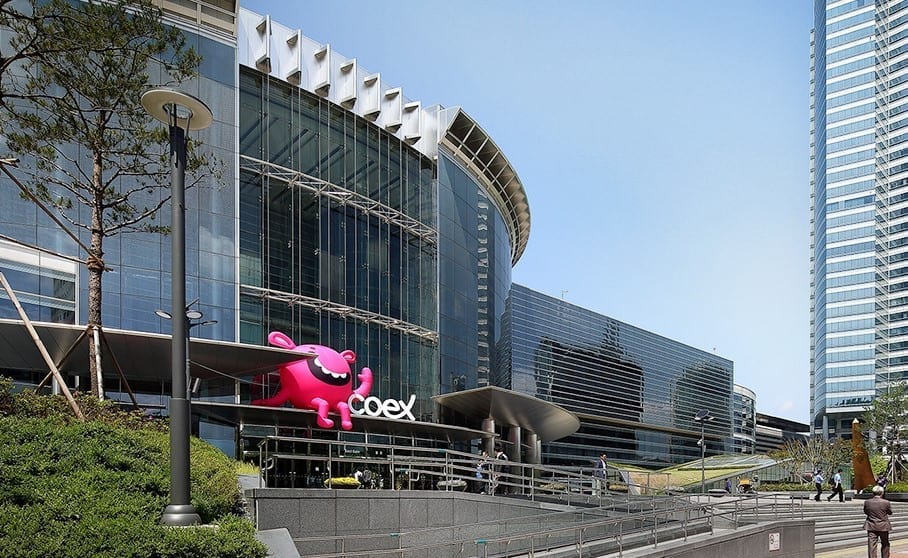
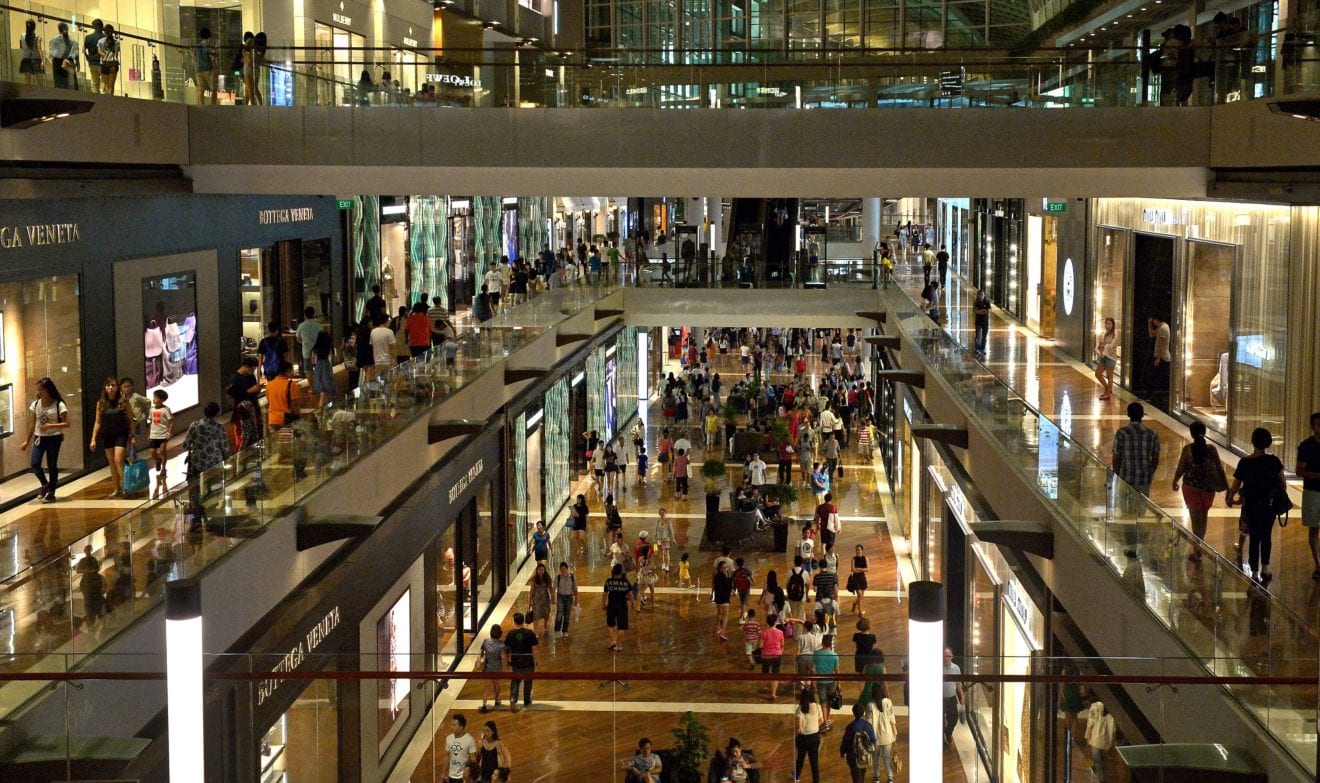
    Following a bidding process, Shinsegae Group has become the manager for Coex Mall and the adjacent CALT shopping arcade in Samseong-dong, southern Seoul.

    An official signing has taken place with the Korea International Trade Association (KITA), which owns the two venues.

    The confirmation comes three months after Shinsegae Property, the shopping-mall management arm of the retail giant, was chosen as preferred bidder.

    Shinsegae Group expects the lease profit to be around 66 billion won (US$58.3 million) this year.

  • Squeeze in Chinese tourists starts to bite

    Squeeze in Chinese tourists starts to bite

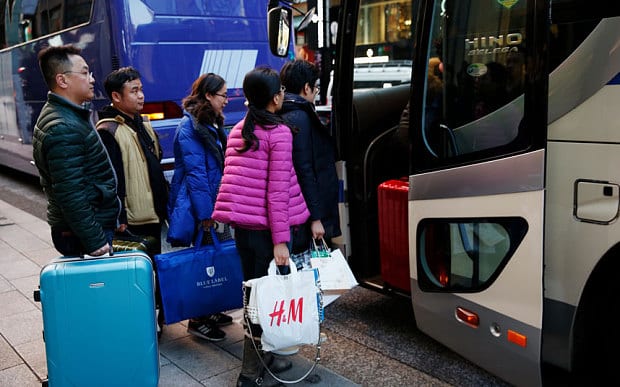
    The Chinese government’s forced reduction of tourists visiting Korea by 20 percent is already dealing a blow to businesses.

    “Even today, tourism offices in several provincial governments are acknowledging they are lowering the numbers of tourists going to Korea,” said an insider working in China’s tourism industry on Tuesday. “In several areas, there were even orders to send visitors to the Philippines instead of Korea.”

    chart

    Relations between China and the Philippines, which were sour for some time due to a territorial dispute in the South China Sea, recently softened after President Rodrigo Duterte visited China last week.

    Seoul’s ties with China have gotten frostier after it decided to deploy a U.S. missile defense shield that Beijing opposes.

    Businesses that rely on Chinese visitors are worrying that the decision will hit them hard. It hasn’t been long since they overcame the aftermath of last year’s Middle East respiratory syndrome (MERS).

    The first signal came from the stock market: shares of companies that could be hurt posted sharp declines Tuesday as news spread. Cosmetics leader AmorePacific fell 7.12 percent to 345,500 won ($305.06). LG Household and Healthcare lost 8.34 percent to 846,000 won. The impact was evident in tourism shares as well: Hotel Shilla lost 6.94 percent and HanaTour retreated 8.04 percent. All shares failed to recover Monday’s closing prices on Wednesday. Companies running group tours were most vulnerable.

    According to the Korea Tourism Organization, 2.4 million Chinese tourists came on group tours last year, 41 percent of the total number of Chinese tourists to Korea, which was approximately 6 million. As group tours are organized two to three months before departure, the decline is expected to really show by year’s end.

    “If Chinese group tours fall by 20 percent, the annual loss in relevant industries may reach a minimum of 2 trillion won,” said researcher Shen Jia at the LG Economic Research Institute. “If the decline spreads to individual tourists, the economic damage will deepen even further.”

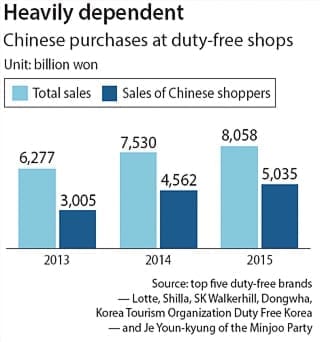
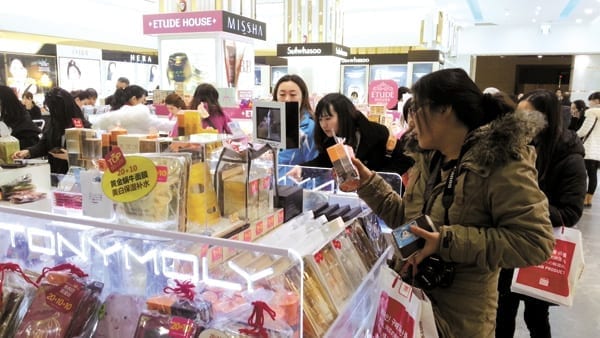
    Duty-free shops are nervous. Last year, the top five duty free operators – Lotte, Shilla, SK Walkerhill, Dongwha and Korea Tourism Organization’s Duty Free Korea – earned 5.4 trillion won in revenues from Chinese tourists, 62 percent of total sales of 8.6 trillion won.

    Through September of this year, Chinese tourists spent 3 trillion won at Lotte Department Stores. As soon as the news of the cutback spread Tuesday, duty-free stores organized emergency meetings with Chinese partners to devise some kind of a backup plan.

    There are currently nine duty-free shops in Seoul, with four more waiting to open next year. Competition in the duty-free industry is fierce, as it is one of the most robust retail markets in Korea. “A sudden drop in Chinese shoppers will cause considerable impact to both current and future duty-free operators,” said a spokesperson for Shilla Duty Free.

    Mid-priced hotels are nervous too. They are popular with group tours. “Half of the guests at business hotels in Myeong-dong or Dongdaemun are Chinese, and most are from group tours,” said Park Jong-mo, manager of the Ramada Hotel and Suites Seoul Namdaemun. “The market supply is rising, with new mid- and low-priced hotels being built in the city center. We’ll be seeing more vacant rooms.”

  • Duty-free sales climb 36% in Korea so far in 2016

    Duty-free sales climb 36% in Korea so far in 2016

    Duty-free sales from South Korea’s retailers increased 36.4% year-on-year to W8.9trn ($7.9bn) in the first nine months of 2016, according to local media reports. This is compared with W6.55trn a year ago.

    Sales growth in particular is driven by the rise in foreign tourists, with Chinese travellers comprising nearly 43% of all travellers. Chinese spend per passengers reached a total of $350, while Koreans spent $106, according to The Korea Times.

    According to the publication, despite the increase in sales many retailers in the country are facing deficits, with the exception of Lotte Duty Free and The Shilla Duty Free, which reportedly saw profits totalling W232bn and W38bn in the first half the year, respectively.

    Galleria Duty Free Shop of Hanwha was reported to have suffered a W17bn loss, while Doosan’s Doota Duty Free saw a W16bn loss for the same period.

    Despite this, there is still room for optimism, with potential for annual duty-free sales to top W10trn by the end of the year. Retail real-estate developments such as Hanwha Galleria’s launch of the Galleria Duty Free 63 store in July, and buoyant figures reported by retailers like Shinsegae, add to the country’s potential for a possible positive rebound.

    Photo of KTO

  • Singapore, Manila rise in retail rent rankings

    Singapore, Manila rise in retail rent rankings

    The data may be a little dated, but Asian cities are holding their own in the retail rent rankings.

    New York’s Fifth Avenue still tops the list with an average rent of US$3500 per sqft per year. Hong Kong’s Causeway Bay is cemented in second place at $2399 and the Champs Elysee in Paris a distant third at $1372.

    (It should be noted, the list ranks the single most most expensive shopping strip in each country, not overall.)

    Data released by Cushman Wakefield this month – albeit more than a year out of date – shows the Philippines making the biggest gain: retail rental rates in Manila’s Bonifacio Global City High St were a mere US$56.40 per sqft per annum, but that is enough to make Manila 51st on the top 65 list – up eight places.

    Singapore’s Orchard Rd ranked 14th – up two places – at $336.80 and Taipei’s ZhongXiao East Rd 20th, up three places, at $273.20.

    The Ginza in Tokyo,  Japan, ranks a modest eighth at $881.90 in a virtual tie with Myeongdong in Seoul, Korea at $881.80.  The Ginza has fallen from sixth in last year’s survey, while Myeongdong has dropped from eighth.

    Cushman & Wakefield stresses that the global rankings focus on high street locations. This excludes mall rental rates – and in cities like Manila, Bangkok and Kuala Lumpur, malls dominate the premium retail landscape, not high street strips.

    Vietnam’s Ho Chi Minh City CBD retail rents are more expensive than in Bangkok at $150.50 for 32nd place, and $125.40 for 35th respectively. Bukit Bintang in Kuala Lumpur, Malaysia, ranked 40th (up one place) at $111.

  • iPhone 7 debut in South Korea hurts Samsung

    Apple Inc’s iPhone 7 went on sale in South Korea yesterday, seeking to fill a void left by archrival Samsung Electronics Co on its home turf following a damaging recall fiasco over the Note 7 smartphone.

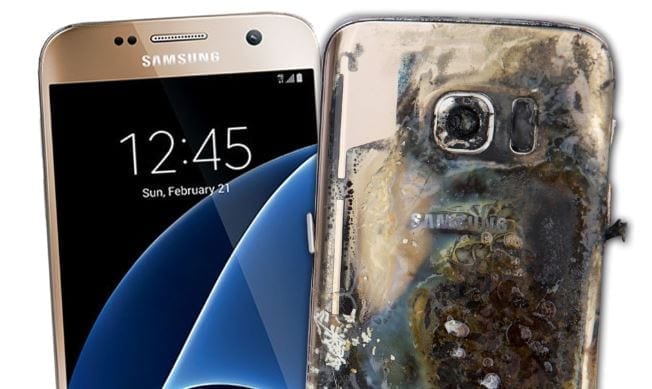
    The South Korean electronics giant discontinued the Note 7 — one of its key iPhone challengers — on Tuesday last week following reports that replacements for combustible models were also catching fire.

    The decision is set to cost Samsung billions of US dollars in lost profits and there are already signs that Apple is reaping some of the benefits.

    Samsung shares fell nearly 2 percent yesterday as iPhone 7 hit stores across the nation.

    An official at mobile carrier Korea Telecom said the first batch of 50,000 iPhone 7s it put up for preorder a week ago sold out in 15 minutes.

    “I would attribute part of that to the Note 7 effect,” said the official, who declined to be identified because he was not authorized to talk to the media.

    Customer defection is one of Samsung’s biggest concerns, especially as the Note 7 was specifically aimed at taking on the iPhone in the premium handset market.

    In the hope of retaining customer loyalty, Samsung had offered Note 7 users a 70,000 won (US$60) phone bill credit if they swapped their faulty phones for another Samsung handset.

    The half-dozen customers buying the new iPhone at a Korea Telecom store in central Seoul yesterday were all long-time Apple users who had preordered their handsets.

    Office worker Lee Kyung-hee, 34, said she had moved fast when the preorder service opened, fearing a surge of interest from unhappy Note 7 owners.

    “I set an alarm and was very quick,” Lee said.

    In South Korea, retail prices for the iPhone 7 and 7 Plus start from 869,000 won and 1.02 million won respectively for the basic 32GB models.

  • Gong Cha Korea to expand globally

    Gong Cha Korea to expand globally

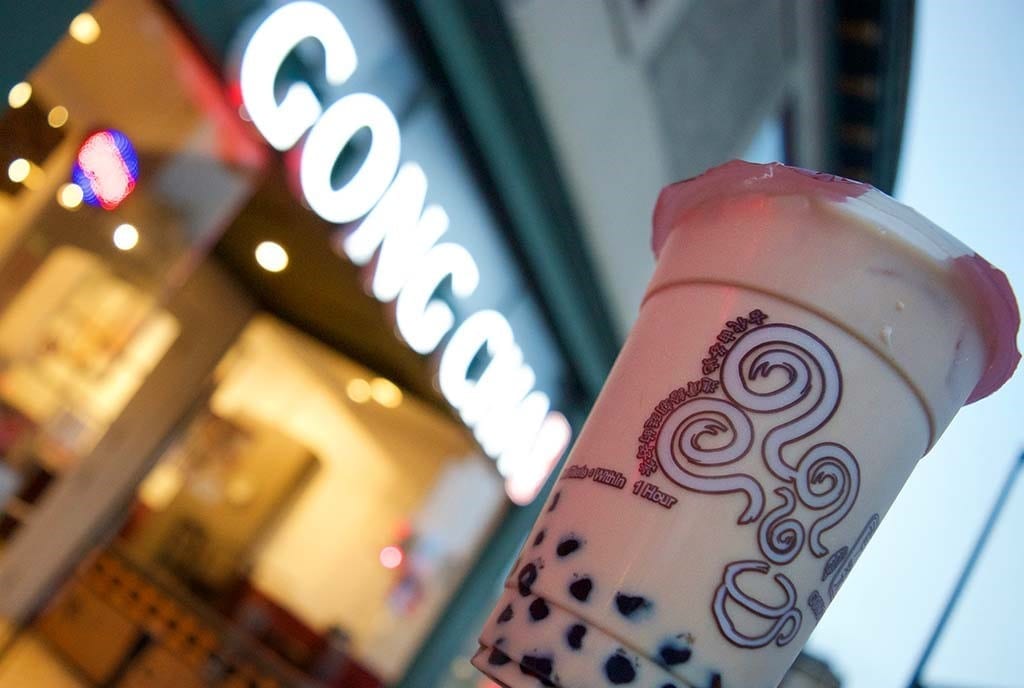
    Bubble tea brand Gong Cha Korea is planning international expansion.

    Aided by the global passion for Hallyu, or the so-called Korean Wave, Gong Cha plans to open stores in the Middle East and Europe. It will also buy more than 1380 stores in 18 countries, including the US, Canada, Australia, New Zealand, China, Japan, Singapore, the Philippines, and Hong Kong.

    Currently, Gong Cha Korea operates only about 360 stores in its home market, which last year brought in KRW8 billion (US$7 million) profit – representing 11 per cent growth year-on-year.

    As most of Gong Cha’s customers are aged from 10 to their 30s, the company expects entering new foreign markets will be easier through creating synergies with Hallyu.

    The expansion will be facilitated by a share transaction with its parent company Royal Tea Taiwan in which the Korean business will progressively boost its ownership from 35 per cent to 70 per cent by January 2017.

    Royal Tea Taiwan was launched in 2006, and introduced to Korea by franchisee Kim Yeo-jin in 2012. Two years later, Japanese private equity fund Unison Capital bought 70 per cent of the Korean business.

  • Surge in Chinese tourist arrivals continues to boost South Korean duty free

    Surge in Chinese tourist arrivals continues to boost South Korean duty free

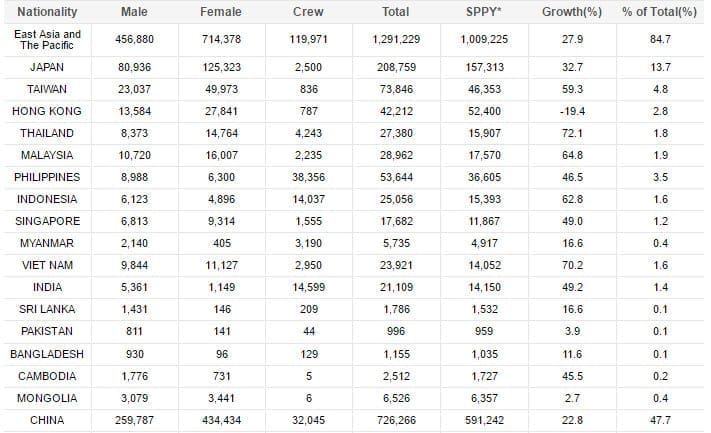
    Chinese visitor numbers to South Korea in August climbed by +70.2% year-on-year to 873,771, according to the Korea Tourism Organization. The figures are distorted by the 2015 MERS health crisis which ravaged inbound tourism in 2015, prompting a -32.3% year-on-year fall in arrivals last August. A better base comparison is the +15.2% growth in August 2016 over the same month in 2014, when Chinese arrivals reached 757,683.

    Chinese visitors are critical to South Korea’s travel retail sector (the world’s largest), representing 52.5% of total arrivals in the month.

    For the first eight months of 2016 Chinese arrivals rose by +48.8% year-on-year to 5,608,046.

    The importance of group tourists to the travel retail channel is underlined by the breakdown of Chinese visitor numbers (see table below) with 4,839,309 group travellers arriving in South Korea over the first eight months. Group tourists accounted for 86% of Chinese arrivals. Others (principally free independent travellers) represented just 731,731 arrivals, a 13% share, with business travellers and officials making up the balance.

    Attracting the FIT market is an increasingly important battleground in the fight between retailers to attract big-name luxury brands.

    However, arrivals by ‘others’ fell -7.0% year-on-year in the first eight months, while Chinese group tourist numbers surged +64.1%.

    Japanese arrivals grew -51.7% to 225,456 in August, a 14% share.

    The first eight months of 2016 saw a +23.5% rise in Japanese visitor numbers to 1,451,565, a 12.6% share.

    Korean departures increased by +12.5% in August to 2,064,241; and for the first eight months by +16.8% to 14,780,387.

    Visitor arrivals by gender for August; Source: Korea Tourism Organization

    Visitor arrivals by gender for August; Source: Korea Tourism Organization

    Accumulative visitor arrivals by gender for first eight months; Source: Korea Tourism Organization

    Accumulative visitor arrivals by gender for first eight months; Source: Korea Tourism Organization

    Visitor arrivals by purpose and nationality for August; Source: Korea Tourism Organization

    Visitor arrivals by purpose and nationality for August; Source: Korea Tourism Organization

    Accumulative visitor arrivals by purpose and nationality for first eight months; Source: Korea Tourism Organization

    Accumulative visitor arrivals by purpose and nationality for first eight months; Source: Korea Tourism Organization

    Outbound departures of Korean nationals by gender for the first eight months of 2016; Source: Korea Tourism Organization

    Outbound departures of Korean nationals by gender for the first eight months of 2016; Source: Korea Tourism Organization

    Outbound departures of Korean nationals by age for the first eight months of 2016; Source: Korea Tourism Organization

    Outbound departures of Korean nationals by age for the first eight months of 2016; Source: Korea Tourism Organization

  • Samsung to compensate suppliers hit by Note 7 crisis

    Samsung to compensate suppliers hit by Note 7 crisis

    Samsung Electronics said Tuesday it would compensate suppliers hit by the decision to scrap its Galaxy Note 7 smartphones because of safety fears with exploding batteries.

    The South Korean electronics giant announced a week ago that it was discontinuing the Note 7 after a chaotic recall that saw replacement phones also catching fire.

    Samsung said the affair would cost the company an estimated $5.3 billion in lost profits over the three quarters beginning July.

    The crisis also hit its numerous suppliers — who produce everything from camera modules to casings — with their losses estimated at up to $1.7 billion.

    “We will offer full compensation for remaining inventories of Note 7 components among our suppliers,” the firm said in a statement.

    “We feel sorry for causing concern among our suppliers due to discontinuation of the Galaxy Note 7…we will complete the compensation quickly to minimise difficulty faced by them,” it said.

    The statement provided no specific figures, but said the payout would be calculated according to the different suppliers’ inventory volumes.

    Given the Samsung Group’s stature within Asia’s fourth-largest economy — it accounts for around 17 percent of GDP — the Note 7 debacle has had a national impact.

    The central Bank of Korea said it had taken the crisis into consideration when it trimmed South Korea’s 2017 growth outlook to 2.8 percent last week from its previous 2.9 percent forecast.