Tag: Korea

  • Shinsegae opens Show&Tell stores for men

    Shinsegae opens Show&Tell stores for men

    South Korean retail conglomerate Shinsegae has launched a lifestyle editorial shop for men.

    The “Show&Tell” store opened in two Shinsegae locations; one at the Starfield luxury shopping complex in Hanam, and the other as an outlet in Yeoju city.

    Described as “providing a new playground for men,” Show&Tell displays a range of local and foreign brands priced to attract consumers to visit offline malls.

    Shinsegae has recently introduced giant luxury and leisure shopping malls locally and a discount chain store in Japan.

  • Uber Eats aims to boost presence with CJ deal

    Uber Eats aims to boost presence with CJ deal

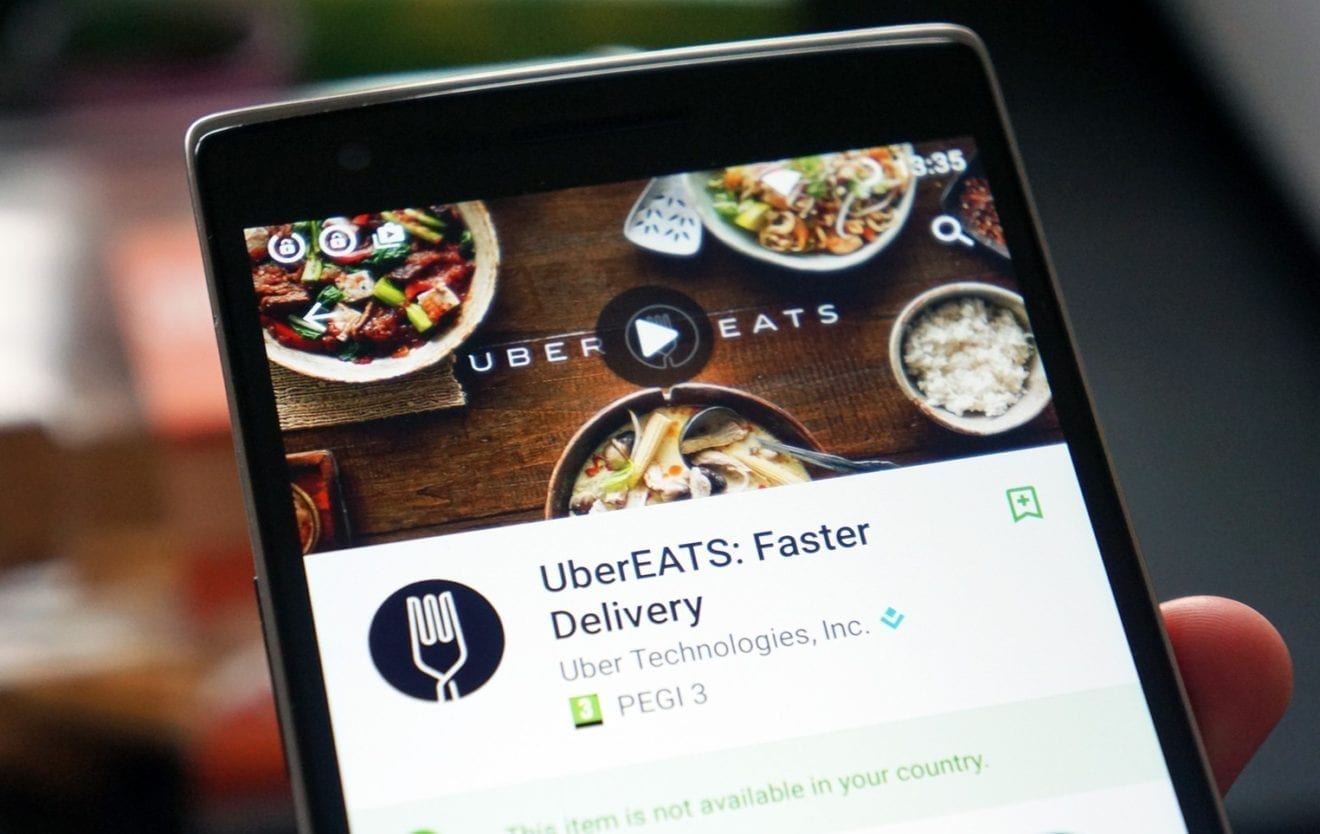
    U.S. food delivery app Uber Eats said Wednesday that it has signed a partnership with Korean food service company CJ Foodville in the latest move to boost its presence in the country’s growing food delivery market.

    Uber Eats said major CJ Foodville brands, such as VIPS, Cheiljemyunso, The Place and Juice Solution, would be easily accessible through its app in Seoul, a heavily populated city with a population of some 10 million.

    Eight out of 10 Koreans use smartphones, and they increasingly order popular food items through mobile apps.

    “We are excited about our partnership with CJ Foodville, the national representative food service brand, bringing its diverse selection to our customers,” Jean-Marc Serayssol, head of Asia sales at Uber Eats, said of the deal signed last Tuesday. “With this partnership, Uber Eats customers can now order CJ Foodville brands at the simple tap of a button, and Uber Eats will continue to expand to provide our services anytime, anywhere.”

    The food franchise unit of Korean food and entertainment conglomerate CJ Group has about 1,500 franchises across Korea and nearly 400 franchise stores in seven countries, including the United States, China and Vietnam. CJ Foodville is planning to reinforce the collaboration with Uber Eats overseas.

    Uber Eats, a food delivery service app run by ride-sharing pioneer Uber Technologies, began its business in Korea in August last year and currently has more than 1,500 local restaurant partners in Seoul.

    Uber Eats did not disclose its share in Korea’s estimated 12 trillion won ($10.7 billion) food delivery app market dominated by homegrown apps, such as YoGiYo and Baedal Minjok.

    Uber Eats is part of Uber’s attempt to expand its presence in Korea, where the company’s flagship ride-sharing service, Uber X, was banned in 2015 because it conflicted with the local transportation law.

  • LG vows to invest more in Austrian affiliate ZKW

    LG vows to invest more in Austrian affiliate ZKW

    LG Electronics said Friday it will continue to invest more in Austrian automotive lighting system firm ZKW Group, which was purchased by the South Korean company earlier this year.

    In April, LG Electronics bought a 70 percent stake in ZKW, with the holding firm LG Corp. purchasing a 30 percent stake. The 1.4 trillion-won ($1.24 billion) deal marked the biggest merger project carried out by LG to date.

    The Korean tech giant said LG Vice Chairman and CEO Jo Seong-jin visited the headquarters of ZKW, located in Wieselburg, Austria, earlier this week, sharing the company’s vision with the new sister firm.

    Jo stressed ZKW will play a great role in LG’s future projects and promised to give leeway to the Austrian-based firm’s management based on trust.

    In April, LG said it will retain the current management at ZKW even after the acquisition and guarantee the employment of its Austria-based staff for the next five years. LG also vowed to continue making investments in ZKW.

    ZKW, meanwhile, announced its new logo to mark a new start after becoming a member of the LG family.

    The Austrian firm was established in 1938 and is specialized in the production of premium automobile lights.

    LG Electronics plans to increase investments in ZKW to bolster its automotive parts business.

  • Asiana Airlines Korea appointed new president

    Asiana Airlines Korea appointed new president

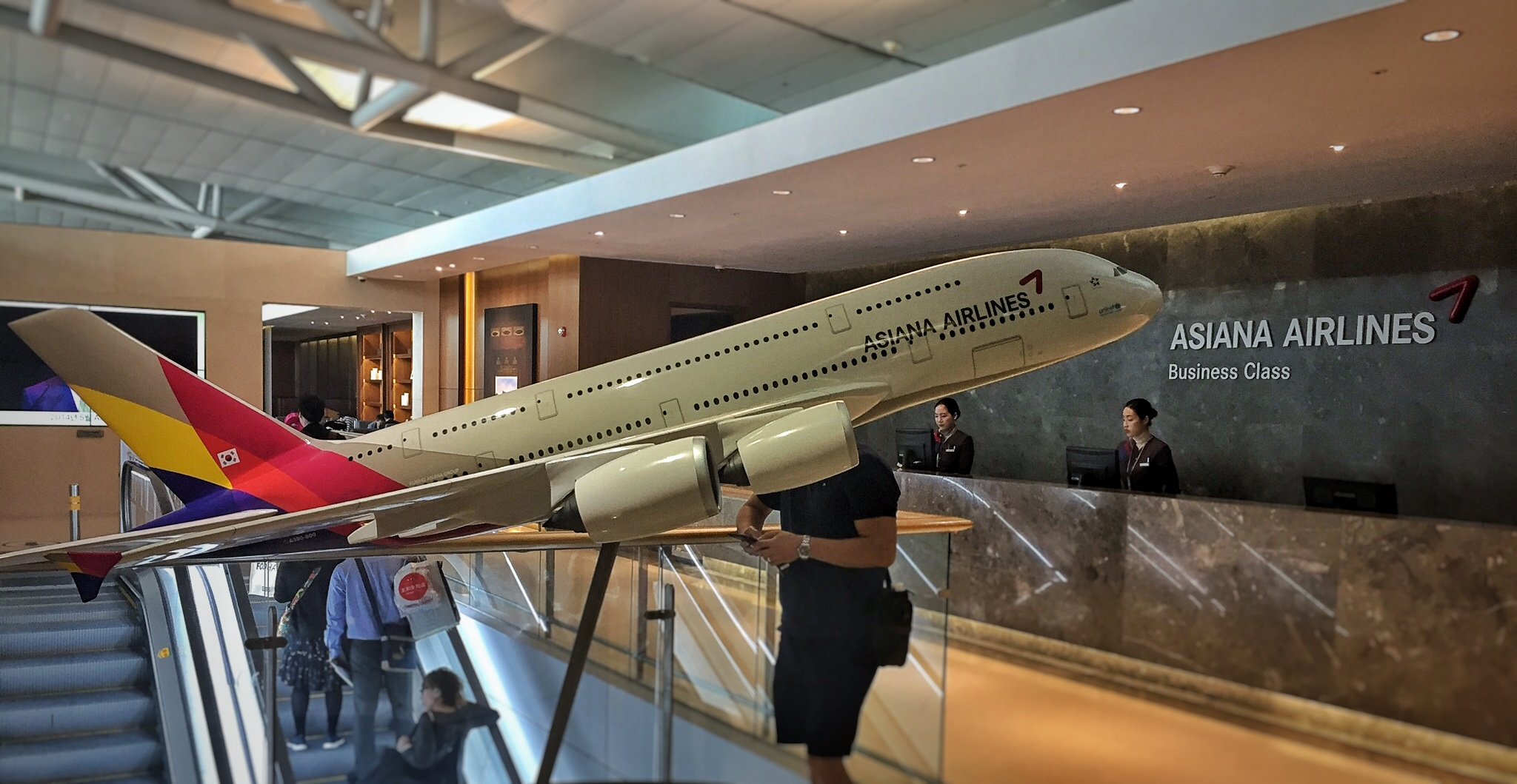
    Kumho Asiana Group announced a personnel shift on Friday, with Han Chang-soo, head of Asiana IDT, an information and communication technology unit of the airliner group, being appointed as the new president of Asiana Airlines.

    Park Se-chang, a third-generation member of the Kumho Asiana founding family, succeeded Han as head of Asiana IDT.

    Park is the only son of Kumho Asiana Group Chairman Park Sam-koo and the current CEO of Kumho Asiana Group, a position that he took over in February 2016.

    The 43-year-old Park has held various positions since he joined the group in 2002, including at Kumho Tire, where he was the vice president.

    While the CEO of Kumho Asiana Group, Park led a task force dedicated to fourth industrial revolution technologies.

    Asiana Airlines’ new president, Han, joined the group in 1986 and was one of the employees that participated in the launch of the airline in 1988.

    From 2005, he worked in strategic planning in the airlines financial department before being appointed as the head of Asiana IDT in March 2015.

    Han’s appointment came after his predecessor Kim Soo-cheon offered to quit a day earlier.

  • Purchases made online with phones hit record in July

    Purchases made online with phones hit record in July

    Purchases made using the internet and mobile devices in Korea reached an all-time high in July, government data showed Wednesday, demonstrating the popularity of smartphones, fast delivery and convenient payment options offered to local shoppers.

    The total value of transactions made with computers, smartphones and tablets reached a record 9.45 trillion won ($8.45 billion) in July, up 22.7 percent, or 1.75 trillion won, from a year earlier, according to the data from Statistics Korea.

    The sharp rise was attributed to increased demand for electronics, leisure goods, daily necessities and food amid sweltering weather and the vacation season, the agency said.

    The total value of mobile transactions soared 33.5 percent to a record 5.92 trillion won, accounting for a record 62.6 percent of all online purchases in July.

    Mobile purchases in Korea have been on the rise for years as devices expand their presence in the world’s most wired country and rapidly replace computers as the means of conducting online transactions.

  • H&M to open first hypermarket store in S. Korea

    H&M to open first hypermarket store in S. Korea

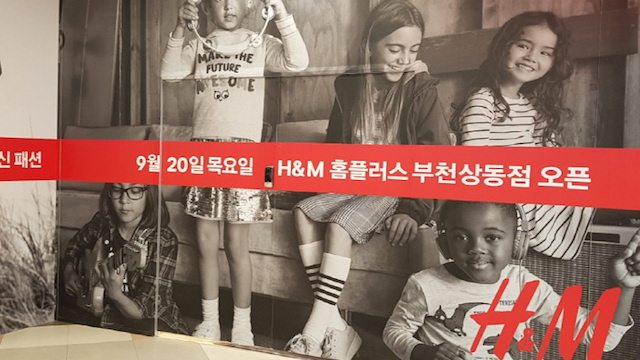
    Swedish fashion label H&M is launching an outlet at the Homeplus Bucheon hypermarket in South Korea.

    The brand’s 29th Korean store, located to the West of Seoul, will open on September 20 and is its first hypermarket venture in the territory.

    The company’s first store inside a hypermarket marks a significant strategic step away from high street and fashion-first shopping malls in South Korea. Both H&M and Homeplus Bucheon believe the move will benefit both sides with increased foot traffic at the mall drawn in by the popular brand, while H&M can expect to gain easier access to families.

    The new store will span 1535sqm and retail men’s, women’s and kids’ clothing.

    The group has enjoyed considerable success in Korea, with revenues last year reaching KRW238.6 billion (US$213.5 million).

  • Anais and Greygrei to make China debut

    Anais and Greygrei to make China debut

    Korean clothing brands Anais and Greygrei are set to enter the Chinese market under Korean young-casual clothing firm Maison de Anais.

    The label, which successfully launched in northern Europe earlier this year, will target the late 20’s to late 30’s womenswear market in China after having received interest at the Shandong Korean Product Exhibition last July.

    The Greygrei brand is currently pending its official release on VIP.com, one of the three leading B2C internet shopping malls with the largest sales among Chinese e-commerce mobile apps.

    A Maison de Anais spokesperson said online fashion platforms are attractive to brands as they can help establish brands in the fast-changing Chinese market.

    “By introducing on VIP.com, Maison de Anais hopes to promote the brand to various buyers and distribution channels in China by increasing the brand competitiveness and reference of Greygrei as we establish direct contact with the customers.”

    Company president Jeong Ho Lee added: “Times are changing where a wide range of age groups, especially female consumers from their late 20’s to late 30’s, are taking the main role in invigorating the fashion market in China, from an era where the early-to-mid-20’s used to be at the helm. Greygrei and Maison de Anais hope to write [a] success story with China as the main stage.”

  • August Korea exports reach record, pass $50 billion

    August Korea exports reach record, pass $50 billion

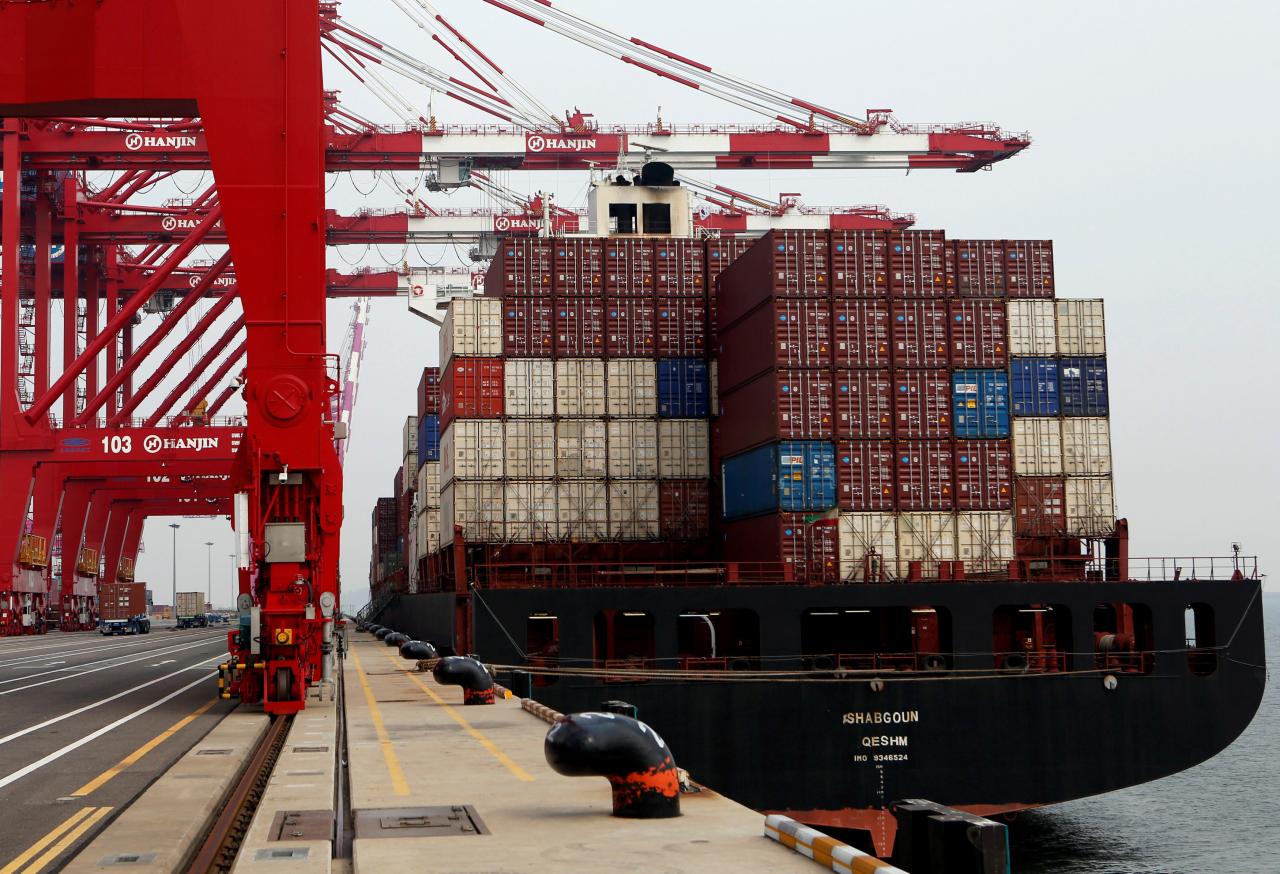
    Korea exported more than $50 billion of goods in August despite fears of a global trade war, but experts continue to worry about the overreliance on a handful of popular products.

    According to data from the Ministry of Trade, Industry and Energy released over the weekend, Korea Inc. shipped out $51.2 billion worth of goods in August this year, up 8.7 percent compared to the same period last year.

    “Factors that contributed to the increase in exports include the improved condition of the global manufacturing sector, expansion of the gross domestic products of major economies and the increases in gas price and the prices of Korea’s main export items,” said an official from the Trade Ministry.

    August is the fourth straight month this year that monthly shipments from Korea have exceeded the $50-billion threshold.

    It is also the first time ever that August exports in any year have passed the $50-billion mark, another milestone for the Korean economy.

    “We expect the average monthly increase in exports in the second half will be maintained at around 5 percent,” said Paik Un-gyu, the minister for trade, industry and energy. “Accordingly, the total amount of exports from this year will surpass $600 billion for the first time in history.”

    From January to August, outbound shipments from Korea totaled at $399.8 billion, up 6.6 percent from the same period last year and a record high for the period.

    Despite the strong numbers, concerns loom large that the economy is unable to break free from depending too heavily on one or two export items, including computer chips.

    Data shows that semiconductor exports in August catapulted by 31.5 percent from a year ago to $11.5 billion, beating the historic high it set just two months ago in June at $11.2 billion.

    As a result, computer chip shipments are taking a bigger share of the pie each month. In January, semiconductors took up 19.7 percent of total exports. In August that figure had jumped up to 22.5 percent.

    If semiconductor exports are taken out of the picture, Korea’s outbound shipments from January to August have only risen by 0.37 percent. More disconcerting is the slowdown in investment by semiconductor companies. Data from Statistics Korea shows that facilities investment has dipped for five straight months since March this year.

    An official from the statistics agency explained that the investment made by major chip companies began slowing as new facilities entered the final phase of construction.

    “The Korean economy is in an unstable situation where, if semiconductor exports take a hit, it could be in crisis,” said Sung Tae-yoon, a professor of economics at Yonsei University. “The economy needs a strategy where it reduces its reliance on semiconductors while also increasing the competitiveness of the industry itself.”

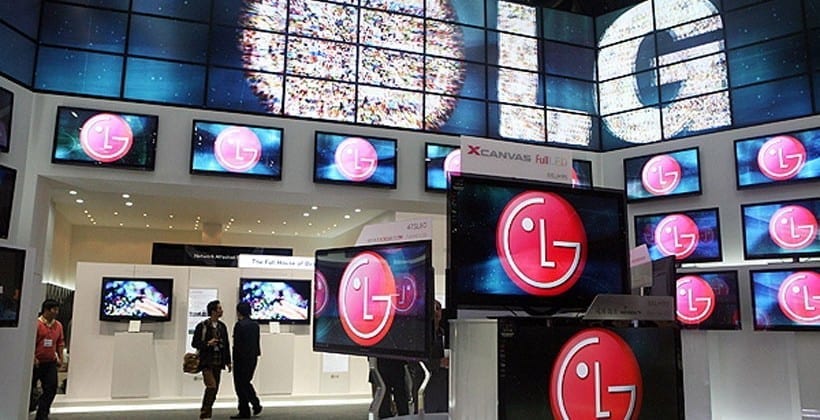
  • Samsung, LG show off hottest gadgets at IFA

    Samsung, LG show off hottest gadgets at IFA

    The 2018 IFA, the biggest trade show in Europe for electronic appliances, kicked off Friday with a lot of buzz about connected homes, artificial intelligence (AI) and televisions with extraordinary resolution.

    IFA is a “place for many different industries – each with their expert knowledge – to share, discuss and develop their innovation and vision,” said Christian Goke, CEO of Messe Berlin, host of the annual tech fair, in a statement. “Nowadays, hardly any company can innovate without partners, alliances or open ecosystems. That brings a new mindset and heralds the Age of Co-innovation.”

    Korean tech giants Samsung Electronics and LG Electronics as well as dozens of smaller business operators have booths showing off their latest products.

    But Samsung and LG opted for different strategies for this IFA. Whereas Samsung highlighted its technological prowess by showing a few notable new products, LG was more ambitious in unveiling a flurry of new gadgets.

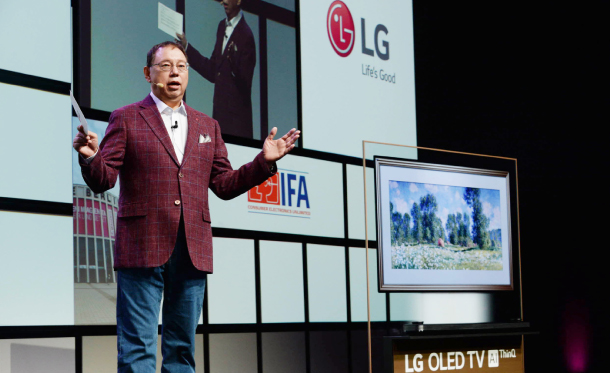
    Two top leaders from LG jointly delivered an opening keynote welcome.

    Jo Seong-jin, vice chairman and chief executive officer, and Park Il-pyung, president and chief technology officer, talked about what is next for the company as it looks to the future. They emphasized its signature ThinQ artificial intelligence platform, which has the slogan “Think wise, be free: Living freer with AI.”

    It was the first time that an LG executive delivered a keynote speech at the IFA.

    Jo provided his insights into how LG’s AI strategy can change customers’ lives with its “open platform, open partnership and open connectivity” philosophy.

    “Combined with cutting-edge computing, big data and enhanced connectivity through 5G, AI will integrate life, space and time into one, and open new possibilities that allow people to pursue freer, more valuable lives,” Jo said.

    Park explained how LG’s AI technology is being used in refrigerators, televisions and washing machines and why an open AI strategy was designed with the consumer in mind.

    Other tech company leaders speaking at the trade show over the next several days include those from Huawei, Microsoft and Amazon.

    More than one third of LG’s exhibition space is dedicated to AI, with a range of LG ThinQ products displayed in three different lifestyle zones: ThinQ Travel, ThinQ Gourmet and ThinQ Style. Each zone has been designed to reflect the diverse lifestyles of modern consumers by incorporating AI-enabled products into futuristic home environments.

    The ThinQ Travel zone will demonstrate the process of searching for an optimal holiday destination using AI televisions and booking flights and accommodations using the LG G7ThinQ smartphone.

    In the Internet of Things (IoT) living room – designed in collaboration with Italian luxury furniture company Natuzzi – the XBOOM AI ThinQ smart speaker shows it can turn on a TV and alter the settings of connected sofas and lighting installations.

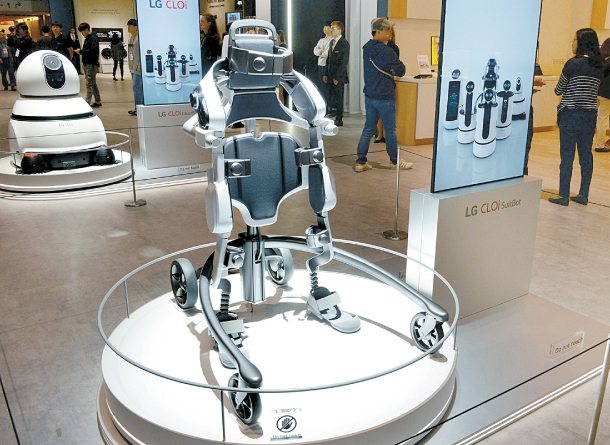
    The CLOi SuitBot, a wearable robot, is being shown for the first time at the IFA. It is meant to empower humans at work. The robot supports lower limbs and enhances a human worker’s power, helping him lift or move heavy things with ease. That makes it useful in manufacturing and construction. A person with weaker lower-body strength may also use it to more easily walk around.

    The robot is equipped with sandal-type shoes and automatically adjusts itself to fit the body.

    The core tech zone highlights innovative technology used in LG ThinQ products such as LG OLED TVs and LG SUPER UHD TVs. An 88-inch 8K OLED TV is debuting in the zone, boasting 7,680 by 4,320-pixel resolution and the ability to generate deep blacks and vivid colors while making wide-viewing angles possible.

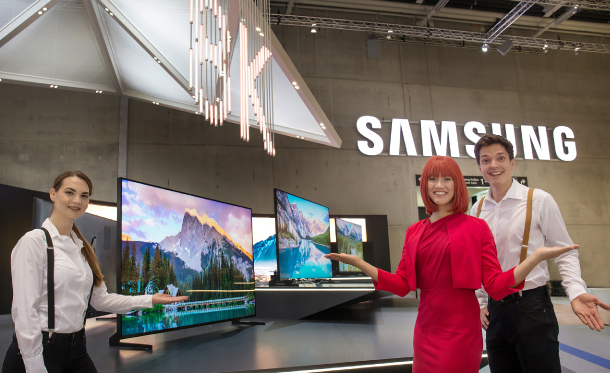
    Samsung took the wraps off an 8K QLED TV, which Kim Hyun-seok, president and CEO of the consumer electronics division, said would “revolutionize the visual display industry.”

    Available in four sizes – 65, 75, 82 and 85 inches – the extraordinarily high resolution televisions boast 16 times better resolution than currently available 4K and ultra high-definition televisions.

    He did not disclose the time of their launch or their prices but said Samsung may release them before 2020.

    “Samsung has been a leader in TVs for the past 12 years globally and 13 years in Europe,” said Kim at a press conference on Thursday. “We will keep up that status with 8K.”

    Currently, 4K televisions account for 70 percent of all televisions sold by Samsung, even though video content for such high-resolution televisions is not widely available. Samsung’s AI technology upgrades the original lower-resolution videos into a format matching the 4K television.

    The tech behemoth also showcased The Wall, a 146-inch MicroLED modular screen. It can transform into any size or shape according to a user’s needs. It also eliminates the need for color filters or backlighting.

  • Owners say Galaxy S7s are suffering ‘boot loop’

    Owners say Galaxy S7s are suffering ‘boot loop’

    Some users of Samsung Electronics’ Galaxy S7 smartphones are claiming their phones are suffering from boot loop – the phone continues to turn itself on and off – and other malfunctions after a recent upgrade to the operating system, according to industry sources Friday.

    An online community was created Tuesday to report and discuss defects in the Galaxy S7. The community has over 130 members.

    A 32-year-old Galaxy S7 user surnamed Han, who founded the community, claimed his phone started heating up and suffering from boot loop after an update to the Android 8.0 Oreo operating system in June, as reported. Han said he experienced no such problem before the upgrade.

    Some other members reported that the phone’s main circuit board, which handles communications between crucial electronic components in the phone, broke down several days after the update.

    Fixing the motherboard costs roughly 200,000 won ($180) at Samsung service centers, members of the community said. They argued that Samsung needs to offer explanations for the malfunctions and offer free repairs.

    In the past, LG Electronics has offered free repairs after owners of its premium G4 and V10 smartphones complained about boot loops.

    Industry sources say Samsung may have overlooked whether the new operating system was compatible with older models such as the Galaxy S7.

    A spokesperson for the Korean electronics giant said they need to examine whether the update was the problem or if there were other factors.

    Samsung is sensitive to malfunctions after its traumatic experience with Galaxy Note7s, which exploded due to battery problems and were eventually withdrawn from sale.

    The online community members said they plan to file a petition with the Korea Consumer Agency if the company doesn’t take suitable measures.

  • IKEA Korea to start Online Sales this Saturday

    IKEA Korea to start Online Sales this Saturday

    IKEA Korea will open an online mall, on September 1, in line with its Swedish headquarters’ efforts to increase its online sales worldwide, the global home furnishing company‘s local subsidiary said.

    “We will officially launch our e-commerce channel September to offer better accessibility to customers nationwide, because we have only two stores in Korea,” IKEA Korea’s country retail manager Andre Schmidtgall said at an IKEA pop-up store in Seoul.

    According to IKEA Korea, a distribution center has already been established to improve inventory and distribution management efficiency. The online shopping platform will offer a comprehensive range of products with a few exceptions such as foods.

    The company is also considering various ways to cater to urban residents.

    The chief executive said his company is moving to open more “customer touchpoints” in downtown areas around Korea to better understand their needs, as IKEA Group CEO Jesper Brodin said during his visit to Korea in April.

    Including the opening of pop-up stores in Seoul, an IKEA Korea taskforce is conducting various tests to consider the possibility, according to Schmidtgall.

    IKEA’s aggressive expansion in Korea is expected to weigh on domestic rivals such as Hanssem and Hyundai Livart, although the furniture makers have ostensibly taken a positive attitude toward the market competition so far, saying the rivalry can improve their productivity.

    “Hanssem will face more difficulty in recovering its stock prices, following the opening of IKEA’s online marketplace,” KB Securities analyst Jang Mun-jun said.

    Schmidtgall, however, said the company still put emphasis on offline stores, citing the stores can display a wider range of products and allow the retailer to directly meet customers and respond promptly to their needs. He promised IKEA will continue to open additional outlets in Korea.

    IKEA Korea, which runs stores in the Gyeonggi Province cities of Gwangmyeong and Goyang, held a groundbreaking ceremony recently for its Giheung-gu store in Yongin in the same province.

    “We are eager to expand our customer touchpoints and reach more of the many people in Korea through the launch of e-commerce and IKEA Giheung, construction of which is set to be complete at the end of next year,” Schmidtgall said.

    IKEA Korea also said it posted 471.6 billion won (US$425 million) in sales between September 2017 and August 2018, up 29 percent year-on-year. It did not disclose its operating profit.

  • Robots start serving Korea’s customers

    Robots start serving Korea’s customers

    On the 31st floor of Lotte World Tower in Jamsil, southern Seoul, a polar bear-shaped robot is reading customers’ palms instead of their credit cards to take their payments.

    The robot can also answer simple questions and make different 3D faces, depending on the conversation topic. If a customer complains about stress, Veny offers up a helpful suggestion: “There’s nothing like spicy food to beat stress. Why don’t you try the Hot Chicken Flavor Ramen and sprinkle cheese on top?” It throws out jokes, too, though they aren’t always winners: “A king that parks? Park-ing.”

    Veny is one of many robots introduced at local brick-and-mortar retailers in August. Companies have recently been trying to add new automated technologies, like expanded electronic kiosks, to their stores. Several major retailers upped their game last month by introducing humanoid robots in hopes of building closer connections with customers than other machines could provide.

    On Wednesday, the second-generation humanoid Pepper robot starting working at discount chain Emart’s Seongsu branch in eastern Seoul. It works three times a day for one and a half hours each shift at the store’s imported food section.

    Developed by Japan’s SoftBank Robotics, Pepper is equipped with software from Emart to help it serve consumers at the discount store. This was the second launch after the discount chain introduced an early version of Pepper in May. Although identical in appearance, the new Pepper can move by itself and is more outgoing.

    With its sensors and camera, the humanoid robot is on the lookout for consumers to offer assistance. “Sir, I can help you. Wait for me,” it says after spotting a customer. Pepper uses its screen to show items, escorts consumers to them, suggests the best sauce for dinner and waves goodbye.

    Emart explained in a statement that it chose the imported food section as the test-bed for Pepper because it has many products that local shoppers are unfamiliar with. Unlike the mobile Pepper, Veny sits still on top of the cashier desk. The robot has a monitor on its belly through which consumers can pay at 7-Eleven.

    Veny accepts credit cards, but its real trick is reading palms with its electronic paw. After registering your credit card information and doing a palm scan at a kiosk in front of the store, Veny will automatically retrieve payments from your account after you place your hand on his left paw. The service is currently limited to Lotte Card holders.

    Veny’s cashier function is not very different from what existed before at the two 7-Eleven Signature branches, which were the first unmanned convenience stores in Korea when they opened in May last year. A major point the company focused on with Veny was charm.

    The robot can recognize the face of past customers if they permit it to and can also talk about over 1,000 scenarios, including the fictional story of how he traveled to Korea all the way from the North Pole.

    A pioneer in the restaurant business is delivery app Baedal Minjok’s Dilly Plate robot, which was developed by Bear Robotics. For two weeks starting from Aug. 6, the server robot had its first local test-run at a Pizza Hut restaurant in Mok-dong, western Seoul. Dilly Plate looks like a high stool with a round top just about the right size to hold a pizza pan. It can safely carry up to 22 kilograms (49 pounds) at once.

    “The response was better than we expected,” said a Baedal Minjok spokesman who visited the branch several times during the test period. “One thing I noticed was that people got used to seeing Dilly running on the floor quite quickly. After one or two trials, servers seemed more comfortable working efficiently with the robot. Consumers were interested at first, and they quickly got accustomed to Dilly serving plates.”

    Another robot experiment in the food sector is local coffee franchise Dal.Komm Coffee’s b;eat – an unmanned take-out coffee stand. A robot serves drinks behind glass windows.

    B;eat has around 20 branches across Seoul. It takes orders through a mobile app or a kiosk beside the machine from seven iced or hot menu options, ranging from Americanos to cappuccinos. A coffee machine from the Swiss company Thermoplan makes the espresso-based beverages. B;eat’s robot arm moves plastic cups around to pour ice and coffee and delivers drinks to customers. It takes around three or four minutes to receive a drink after ordering it.

    “B:eat runs 24 hours a day, so it works best at places like airports, terminals or public spaces like libraries and universities,” said Dal.Komm Coffee in a statement. After its launch in January, B;eat has also proved to be popular at office buildings.

    While some people are intrigued seeing robots do human tasks, many also fear that this may be the start of robots pushing out the human workforce. Some local media outlets reported that the increased interest in robots in the retail industry is in line with the increased burden on companies due to the minimum wage hike.

    Retail companies say otherwise. They say their ongoing automation efforts are aimed at enhancing service while leaving tedious, repetitive work to robots and offer an entertainment factor get customers into brick-and-mortar stores.

    “An internal survey we did on store staff a few years ago showed that more than 60 percent of their work was taking care of payments,” said a 7-Eleven spokesman. “There are many more tasks that if done properly can lead to increased profits, such as placing orders, cleaning, arranging the shelves and stock management, and these can only be done by people, not robots … even for our unmanned stores, we need people to offer help on the new systems. It’s unlikely that technology will ever completely replace people at brick-and-mortar stores.”

    The global market for reception robots was estimated at $1.4 billion last year. This is expected to reach $11.8 billion by 2025. Robot experts point out that Korea is still in its infancy in terms of service robots.

    “The local robot industry is centered on industrial robots,” said a 2017 report from the Institute for Information and Communications Technology Promotion. “There are a few companies that develop robots for education or cleaning, but it is hard to find any in other service sectors.”

    “Regarding reception and emotional robots, in particular, Korea has very few companies that have technology in the sector comparable to Japan and China, whose governments are supporting the market’s growth.”

  • Emart24 opens swanky cafes overlooking Han river Korea

    Emart24 opens swanky cafes overlooking Han river Korea

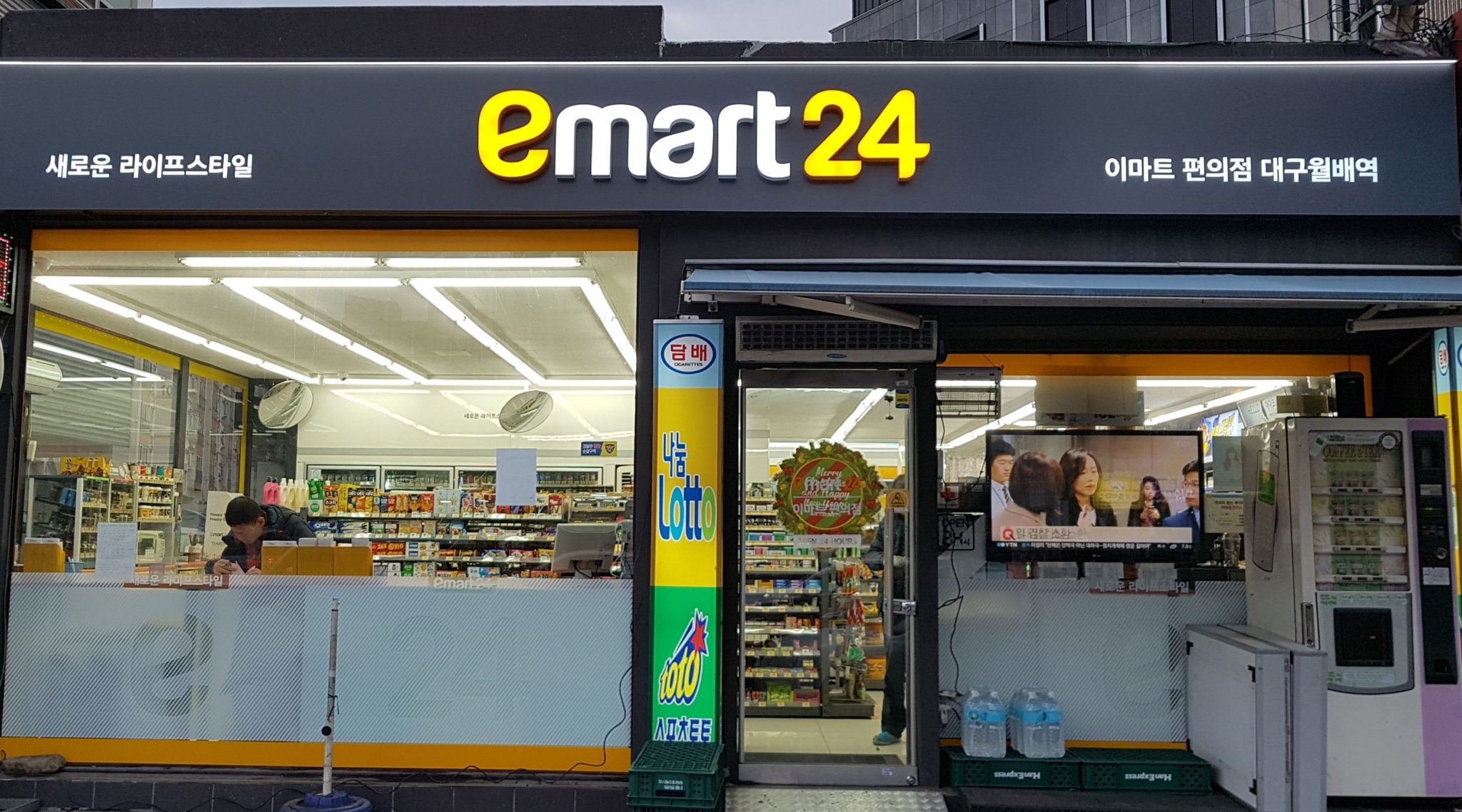
    Convenience store Emart24 is hoping to entice visitors to stay awhile at its two new shops overlooking the Han River that open this Friday.

    The multi-level stores will each host a bookstore and cafe that will offer beer on tap.

    Emart24 is taking over the spaces from two existing observatory cafes which face each other at the south end of Dongjak Bridge. Both spots are known for offering great sunset and nighttime views.

    On the bridge’s western side, the cafe’s view includes N Seoul Tower, while the cafe on the east side looks toward the Moonlight Rainbow Fountain at Banpo Bridge.

    Each Emart24 will have five floors: a cafe and snack zone on the first and second floor, a small bookshop and lounge on the third and fourth and an outdoor rooftop on the fifth.

    “The new operations were aimed to look more like a cafe in order to break through the perception people have about convenience stores and make them into a cultural space,” said Emart24 in a statement released Wednesday.

    True to this concept, Emart24 will only offer one-fifth as many products at the Han River shops as its normal branches. However, it will offer a wider variety of desserts, like cake, puddings and macarons. Baristas will also serve up coffee at the cafe.

    Riverside drinkers will find two beers made from the craft brewery Devil’s Door, run by Emart24’s parent company Shinsegae, as well as Heineken draft beer. Wine options are set to be added in the future.

    The Gureum and Noeul Cafes that Emart24 is taking over are two of eight observatory cafes on the Han River. These cafes were part of an initiative by the Seoul Metropolitan Government to develop cultural and tourism infrastructure on the banks of the Han back in 2009. The sites were rented out by the city and made into coffee shops or restaurants, but not all of the operations were successful.

    An Emart24 spokesman said the company won a three-year contract for Gureum and Noeul, the two largest observatory cafes by the Han River.

    “The company sees it more like an experiment rather than a profitable revenue source,” said the spokesman. “We thought if we make it into a cultural space where people can casually stop by without an entrance fee, more people and foreigners would want to come.”

    The bookstore on the third and fourth floors will offer around 800 titles. Every quarter, local publishing house Munhak Dongnae will curate a new selection.

  • Expert investigation says BMW software to blame in fire incident

    Expert investigation says BMW software to blame in fire incident

    An investigation by the Korea Consumer Association (KCA) concluded that the spate of BMW fires that left Korea in a state of panic over the summer was the fault of the engine control unit (ECU) software, not the hardware issue that the German carmaker has maintained.

    The KCA claim that BMW updated the ECU software to make an engine part, called the bypass valve, open at higher temperatures, leading to higher engine performance and better fuel efficiency but also to a higher risk of fire.

    “An update in the ECU to enhance the car’s performance and fuel efficiency is not wrong by itself,” said Lee Ho-geun, an automotive engineering professor at Daeduk University who is leading the investigation team at the KCA, at a press briefing Tuesday.

    “But the fact that the carmaker didn’t fortify other parts to make them endure higher temperatures, leading to engine fires which put consumers’ lives at risk, is wrong,” Lee added.

    The KCA’s investigative team comprising of experts in the auto industry and law carried out a separate investigation into two BMW vehicles manufactured before August 2011 that are not subject to recalls and four recall-subjected cars.

    The team said that the bypass valve for recall-subjected vehicles opened while in operation, while that of vehicles not subject for recall didn’t open at all while in operation.

    According to Lee, a bypass valve in a diesel engine is generally supposed to be closed in order to block gas that’s hotter than 500 degrees Celsius (932 degrees Fahrenheit) from entering the intake manifold in the engine. It usually opens when the coolant’s temperature is lower than 50 to 60 degrees Celsius.

    “Bypass valve operation is controlled by the ECU,” said Lee. “If a vehicle opens the bypass valve while driving – causing a high possibility of a fire breaking out – it means BMW set the software to behave that way.”

    BMW Korea has persistently claimed that the cause of the fire is a hardware issue in the exhaust gas recirculation (EGR) cooler and valve. The ongoing recall process also includes replacing the two parts and cleaning the EGR pipe.

    The KCA investigative team said it is nothing but a temporary fix.

    “It will reduce the number of fires until the car gets that much accumulated sediment inside the pipe,” said Choi Younh-suk, a professor of smart automotive engineering at Sun Moon University at the briefing.

    According to Koo Bon-seung, an attorney at Heon Law, who is in charge of handling legal issues for the team, a total of 1,784 BMW owners have applied for a class-action lawsuit against BMW with Heon.

    Each owner will seek 15 million won ($13,547) in compensation.

    “As this case involves compensation worth 15 billion won in total, we are going to seek the provisional attachment of BMW Korea headquarters in central Seoul as well as the BMW Driving Center in Incheon and other logistics centers as well,” Koo said.

    Meanwhile, BMW Korea Chairman Kim Hyo-joon said he will look into the option of suspending sales of affected cars in Korea at a hearing held at the National Assembly on Tuesday.

    Kim said he feels shame for selling such defective vehicles in Korea and said he will take responsibility.

    Kim reiterated that the issue derives from a defect in the vehicles and not from the driving habits of Korean consumers.

    Earlier this month, BMW spokesman Jochen Frey came under fire for blaming Korean driving habits and traffic conditions for the fires in an interview with Chinese media. BMW Korea instantly refuted the comment, saying it was a translation error.

  • Musinsa : Online shop creates offline opportunities

    Musinsa : Online shop creates offline opportunities

    Online fashion retailer Musinsa held a presentation to introduce its newly opened Musinsa Studio and announce its goal of reaching a total sales volume of 1 trillion won (US$902 million) by 2020 in Dongdaemun, central Seoul.

    Musinsa, Korea’s largest online fashion retailer, was founded in 2001 as a fashion message board where users shared fashion tips and photos with one another and developed into a small online shopping outlet in September 2004 after it gained popularity among young Korean fashionistas. Its sales volume reached 30 million won last year and is estimated to make a total of 42 billion won by the end of 2018. There are currently around 3,500 different brands that sell their products through Musinsa, with the number growing daily.

    On June 15, Musinsa Studio opened its doors, taking up four floors of the Hyundai City Outlet Dongdaemun branch and offering space to small fashion-related companies. Musinsa has always focused on its online business, and this is the company’s first big step out into offline retail. Many in the fashion industry have taken note that Musinsa didn’t build an offline store, but rather an open studio for smaller, younger businesses to grow.

    “We believe that the two most important things for Musinsa are the brand and the customers,” said Seo Seung-wan, head of the business development team. “So instead of building an offline store, which would limit our communication with customers only through that particular branch, we decided to open up a space for brands [that sell their products on Musinsa] and their customers. The brands [that sell through Musinsa] have grown along with us through the years. So we don’t just sell their things. We are also building an ecosystem with them.”

    Small businesses, even one-person start-ups, can rent a studio space for a minimum of three months, during which the occupants may use the many facilities provided by the company, including the meeting rooms, seminar rooms, free repair service, photography studio and discounted parcel service. Businesses that entered the space early this summer represent a diverse range of talent, from fashion designers and textiles developers to film producers who create fashion-related content.

    The two basement floors contain storage rooms, photo studios and parcel services that occupants can use. “The cost for a box for delivery is set at 3,000 won all across Dongdaemun,” said Lee Ji-hye, a manager of the studio. “Here, we have a staff from CJ Logistics who takes care of all the deliveries everyday at half that price. The doors of the packing zone lead straight out into the parking lot, cutting time and money.”

    The 13th floor houses the brands and an office for the Musinsa customer service team, which Seo emphasized is part of Musinsa’s communication strategy. “We had 20 staff members on the customer service team, but the new office can hold up to 200. Communication is the one thing that we hold most sincerely at Musinsa, so that customers start to believe they don’t have to shop anywhere else. Rather than having an offline store, we can communicate with more customers this way.”

    Through all these means, Musinsa hopes to maintain its position as No. 1 in Korea and further develop into Asia’s biggest online fashion business. “Everything that we do is focused on providing customers with the best experience in online shopping and fashion, and it will always stay that way,” said Seo.

    To celebrate the official opening of the studio, Musinsa is holding the first offline Musinsa Market on the 12th floor on August 29 from 11 a.m. to 6 p.m. Get off at Dongdaemun History and Culture Park station.