Tag: retail sales

  • Singapore Retail Sales Rebound In October

    Singapore Retail Sales Rebound In October

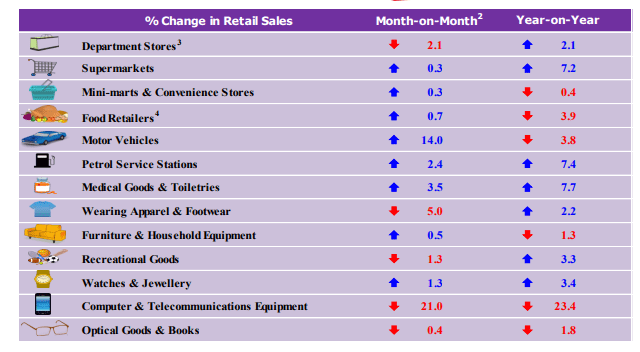
    October Singapore retail sales rose a meagre 0.8 per cent over the same month last year, falling 1 per cent from September.

    Those figures exclude motor vehicles which typically skew Singapore’s data. Including those, retail sales declined 0.1 per cent year on year.

    Month on month, real retail sales fell 1 per cent, but they rose 1.5 per cent including vehicles.

    The total retail sales value in October 2017 was estimated at S$3.6 billion.

    The greatest negative contributor to year on year October Singapore retail sales data was the computer and telecommunications category, which slumped 23.4 per cent. Sales by food retailers, of optical goods and books, furniture and household equipment and at mini-marts and convenience stores decreased between 0.4 per cent and 3.9 per cent.

    However, sales of medical goods and toiletries, at supermarkets, of watches and jewellery, recreational goods, clothing and footwear and sales of goods at department stores rose by between 2.1 per cent and 7.7 per cent in October.


    Sales of food and beverage services at restaurants, cafes and fast-food outlets increased 0.7 per cent in October.

  • Big retailers expect solid final quarter

    Big retailers expect solid final quarter

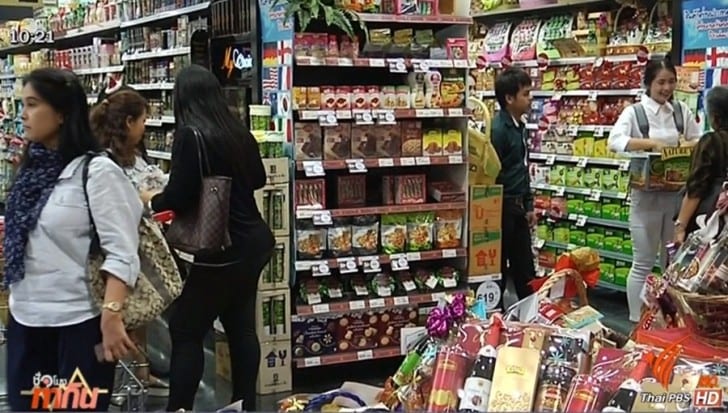
    There are more signs of recovery in spending power, noting that there is talk about the government and the Bank of Thailand introducing further stimulatory measures to boost employment and the broader economy.

    TRA president Jariya Chirathivat said that since 2013, retail growth has fallen off. The main factor has been the restructuring of the macro-economy, for which the results will not be felt for many years. Base consumer spending power has still not improved and household debt is still high. Sales of fast-moving consumer goods (FMCG) have also dropped, the association’s figures show.

    The TRA represents the big department stores and supermarkets along with chain stores – collectively dubbed modern retailers – that account for about 30 per cent of the country’s retail sales.

    Among households, middle level consumers still have large credit card debts, and private investment has still not recovered. Meanwhile, farm prices have not been doing as well as expected, the association said.

    While growth in retail sales for the fist nine months of 2017 was clear across all product categories, spending was clustered in Bangkok and other large cities. Fast growing categories included supermarkets aimed at middle-high level consumers, and the health and beauty segment, which is split into beauty stores, pharmacies and health and personal goods shops.

    Department store products remained impacted by a shopping atmosphere which is still not normal, while prices do not encourage tourist spending because of import duties on luxury brands. These are still high compared to other countries that have a policy of reducing luxury taxes to entice tourists to their shopping destinations.

    The home improvement and home appliance and electronics categories did not register the expected growth because of a slump in the construction and real estate sectors.

    As for the food category (hypermarkets and convenience stores) targeting middle-low consumers, this has faced growth problems as spending in this group is still weak. Measures to get spending budgets to the grassroots is starting to become more efficient and have started to stimulate spending, but slowly.

    After the great national loss of 2016, most Thais slowed down spending until last month, when there were signs of a recovery in spending power. This was partly from improved sentiment and partly from government efforts to stimulate the base with budgets, as well as the New Year spending season. The result should be a fourth quarter recovery in 2017 compared to the same quarter of 2016.

    The government’s “Shop Chuay Chart” measures will be implemented in November this year, but the project tends to assist consumers in the middle to high bracket who have started shopping in anticipation of receiving tax rebates.

    The Ministry of Commerce is launching a campaign called “Ruam Jai Perm Suk Shop Sanuk Lod Rub Pi Mai” from December 14 to January 4, involving cooperation from manufacturers, distributors, retailers and wholesalers nationwide to stimulate consumption and affect buying power in every sector.

    The TRA believes the economy in the last quarter of 2017 will become brighter, whether from a lack of spending sentiment for over a year, the Pracha Rat Welfare Card that has given cash to the grassroots to stimulate spending or the state projects “Shop Chuay Chart” and “Ruam Jai Perm Suk Shop Sanuk Lod Rub Pi Mai”.

    This is on top of private sector promotions and sales activities throughout the long holiday until January, which will increase money in circulation and result in a retail index that is improved on expectations at the start of the year. Growth is forecast at about 3.2 to 3.4 per cent (on projected national GDP growth for 2017 of 3.9 per cent).

    Gross domestic product grew 4.3 per cent in the third quarter compared to the same period last year, with projections that GDP growth for the whole year will be as high as 3.9 per cent.

    The TRA projects 2018 growth in the retail index should be in the range of 3.8 to 4 per cent.

  • Japan’s Q3 growth twice as fast as first estimated, outlook brightens

    Japan’s Q3 growth twice as fast as first estimated, outlook brightens

    Japan’s economy grew twice as fast as originally estimated in the third quarter thanks to big gains in capital expenditure, revised data showed on Friday, with expansion seen to continue thanks to buoyant exports.

    The capital expenditure component of gross domestic product was revised to a rise of 1.1 percent from the previous quarter, well over the forecast 0.4 percent growth, and soaring above the preliminary 0.2 percent reading.

    The economy grew an annualized 2.5 percent in July-September, more than the median estimate for 1.5 percent annualised growth and more than the preliminary reading of a 1.4 percent annualised expansion.

    Real wages rose in October for the first time in almost a year, offering some hope that consumer spending will pick up, separate data showed.

    The revised figures showed that Japan is in its longest uninterrupted period of growth since comparable data became available in 1994.

    This is a boon to the government as it is expected to agree later on Friday a spending package to subsidise education and encourage more corporate investment.

    “The economy is doing well, but annualised growth above 2 percent seems a little too quick,” said Norio Miyagawa, senior economist at Mizuho Securities.

    “I expect that exports and capital expenditure will lead growth next year, but the pace will moderate to around 1 percent.”

    The figure translates into quarter-on-quarter growth of 0.6 percent, versus a preliminary reading of 0.3 percent growth and the median estimate for 0.4 percent growth.

    Steady economic expansion also offers hope to the Bank of Japan that inflationary pressure will build up next year and nudge consumer prices closer to its 2 percent inflation target.

    Capital expenditure was revised up because wholesale companies and retailers are increasing investment to deal with increased inbound tourism, a Cabinet Office official told reporters.

    Inventories contributed 0.4 percentage point in the third quarter, which was revised up from a preliminary 0.2 percentage point contribution, due to a build up of chemicals and plastics used in manufacturing, the official said.

    Net exports contributed 0.5 percentage point in the third quarter, unchanged from the preliminary reading.

    Private consumption fell 0.5 percent in July-September, also unchanged from the preliminary reading.

    Real wages rose 0.2 percent in October marking their first rise since December 2016 in a sign a tight job market may finally be leading to higher salaries.

    Japan’s economy has expanded for seven consecutive quarters, and many economists expect growth to continue as consumer spending gains strength and export growth is seen on track to continue.

  • VW brand forecasts record sales of over 6 million models

    VW brand forecasts record sales of over 6 million models

    The Volkswagen car brand expects deliveries to hit a record this year and raised its midterm profitability forecast on Thursday, citing cost cuts and expanding ranges of higher-margin models.

    While the emissions scandal of September 2015 has cost Volkswagen (VW) billions of euros in fines and penalties, it doesn’t seem to have had a lasting effect on the carmaker’s popularity with motorists.

    The world’s largest automaker said it expects to significantly exceed last year’s record 5.99 million VW brand auto sales in 2017, counting on strong momentum in China, Europe and the United States.

    The operating profit margin at the VW brand may climb to between 4 and 5 percent by 2020, the carmaker said, still lagging rivals such as PSA Group and Toyota  but higher than the 4 percent or more VW has previously been indicating.

    The increase brings the VW group’s largest division by sales into line with a more upbeat outlook for overall VW group profit announced earlier in November.

    “We have completed the first five kilometers of a marathon,” VW brand chief executive Herbert Diess said. “We are all aware of the challenges that lie ahead of us.”

    The maker of VW’s top-selling Golf hatchback expects to significantly improve underlying earnings this year from the 1.9 billion euros in 2016, which would mark the brand’s first profit gain year-on-year since 2011, Diess said at a news conference.

    Profit will be driven by a growing number of more lucrative sport-utility vehicles (SUVs), whose share of overall brand sales may triple to about 40 percent by 2020 from currently 14 percent, the CEO said, citing the redesigned Touareg and an all-new T-Cross due to hit dealerships in 2018.

    “With SUVs, we are earnings the money we need to fund the shift towards electric mobility,” Diess said, referring to the brand’s accelerating push into zero-emission vehicles.

    The VW brand, which has been undergoing heavy restructuring for about a year, said it has kept fixed costs broadly stable this year despite growing spending on model launches.

    The carmaker said it will achieve 3,800 job cuts in Germany by the end of 2017, a year after it agreed with unions to slash 23,000 positions via natural attrition by 2020.

  • Toyota’s November China vehicle sales dip 1.3 pct

    Toyota’s November China vehicle sales dip 1.3 pct

    Toyota Motor’s sales in China fell 1.3 percent in November from a year earlier to 109,600 vehicles, following a 13.5 percent gain in October, the company said on Tuesday.

    The Japanese automaker’s sales during the first 11 months of the year totaled 1.18 million vehicles, up 7.5 percent from the same period a year ago.

  • Tourism kicks up Hong Kong retail sales

    Tourism kicks up Hong Kong retail sales

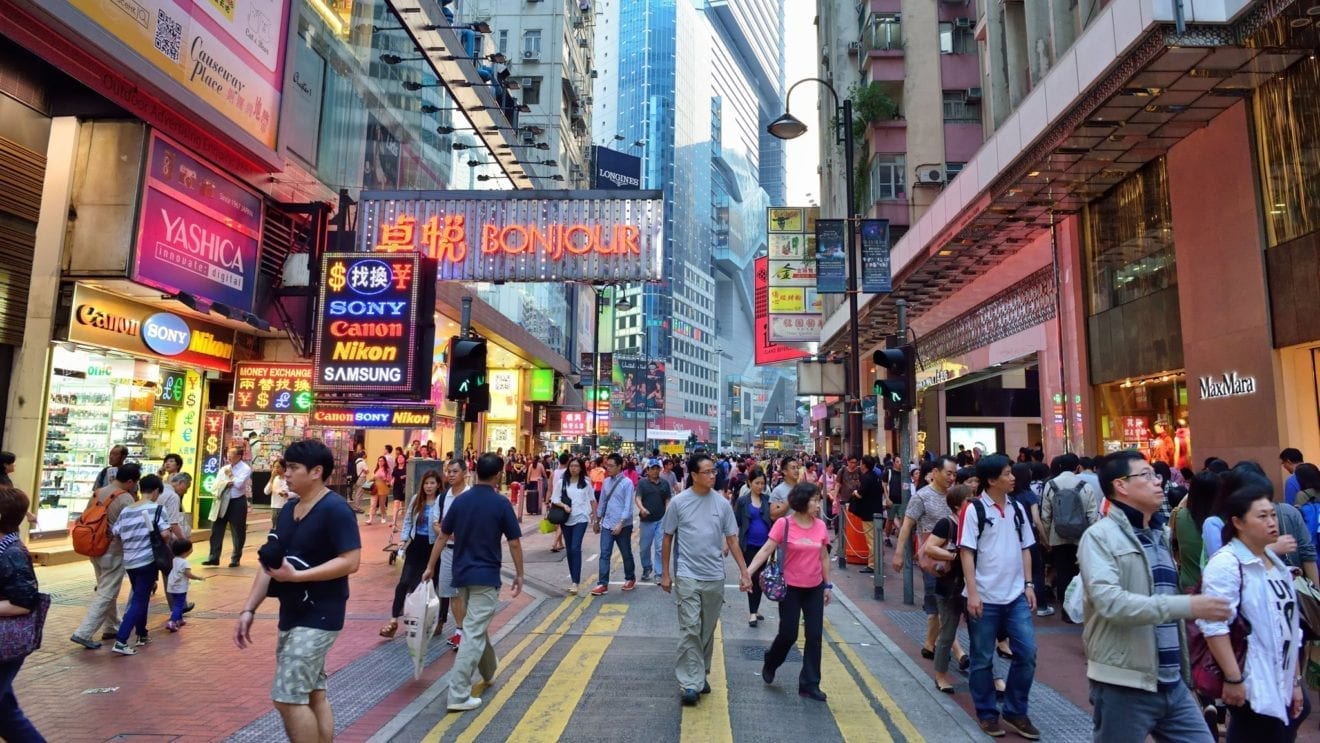
    Continuing revival of inbound tourism and optimistic consumer sentiment drove a 3.9 per cent increase in Hong Kong retail sales in October.

    And two consecutive months of solid increases has lifted the year-to-date increase to 1.2 per cent.

    Official Census and Statistics Department figures estimate the total value of retail sales in October at $37.5 billion. The month’s rise followed a revised 5.7 per cent figure for September.

    C&SD said that after netting out the effect of price changes over the same period, the volume of retail sales in October increased by 3.6 per cent year-on-year and by 5.7 per cent in September.

    As expected, sales of jewellery, watches and luxury gifts drove the revival, rising 8.4 per cent year-on-year. Sales of medicines and cosmetics rose 9.9 per cent, of food, alcoholic drinks and tobacco by 8.5 per cent, apparel sales by 7 per cent and department store sales by 6.2 per cent.

    Sales of electrical goods and photographic equipment fell 2.2 per cent and of books, newspapers, stationery and gifts by 2.4 per cent.

    A government spokesman indicated that the favourable income and employment situation, together with the ongoing recovery of inbound tourism, should continue to render support to retail business in the near term.

  • Japan’s retail sales going down

    Japan’s retail sales going down

    Following a rebound in September, Japan’s retail sales have softened again.

    Despite the 2.3 per cent spike, sales figures for last month eased 0.2 per cent year on year – the first decline in 12 months.

    Sales slipped for general merchandise (a 2 per cent drop after a 1.2 per cent lift in September) and F&B (-1.5 vs 0.6 per cent). Weak spots included fabrics, apparel and accessories (0.5 vs 5.3 per cent), and medicines and toiletries (3.2 vs 5.7 per cent).

    Retail sales in Japan averaged 4.64 per cent from 1971 until this year, reaching a high of 36.5 per cent in January 1979, and a record low of -14.3 per cent in March 1998.

    Department stores had the largest decline, 1.5 per cent, while supermarket sales were flat, losing ground from 1.6 per cent growth in September. Even convenience stores, which usually lead sales, had a mere 0.6 per cent growth last month. It was their worst performance since March 2013.

    While some retail chains are blaming October’s storms for the negative performance, observers say private consumption in Japan is still fragile.

  • Positive trend for Vietnam retail sales

    Positive trend for Vietnam retail sales

    Vietnam retail sales will exceed US$484.58 billion annually by 2025 and nearly $1.938 trillion by 2035 according to figures from the Ministry of Industry and Trade.

    In a draft strategy document released for public comment, the ministry expects an annual increase in sales of 13 per cent between now and 2020, rising to 14 per cent between 2012 and 2025. The figures were calculated after examining sales trends between 2011 and 2015.

    The paper predicts that domestic retail organisations will account for 80 per cent of the nation’s retail trade by 2020 but foreign direct investment will grow its share beyond 50 per cent as consumers move away from traditional retail models and shop in so-called ‘modern trade models’.

    Modern trade, which now accounts for 30 per cent of retailing, will grow to 35 per cent by 2025 and reach 50 per cent by 2035, the ministry predicts.

    AT Kearney last year ranked Vietnam in the world’s top 30 retail markets and with the best opportunities for multinational retailers.

  • Europe and Asia give Guess strong quarter

    Europe and Asia give Guess strong quarter

    American fashion brand Guess’ third quarter turnover grew more than 3 %, mainly thanks to excellent sales in Asia and Europe. It did post a net profit loss however.

    Drop in America

    Guess’ total third quarter turnover reached 554.1 million dollars (470 million euro), which represents a 3.3 % turnover growth. European and Asian sales grew 19 and 17 % respectively, thanks to new stores and a good wholesale performance. North and South American sales did not fare as well: retail turnover dropped 13.4 % and wholesale turnover even dropped 16.8 %.

    “Looking at our company’s future, I can see more opportunities in Europe and Asia and we should achieve strong growth there next year as well”, CEO Victor Herrero said

    Despite that higher turnover, Guess did not manage a profit in the third quarter: it published a 2.9 million dollars (2.5 million euro) net loss, compared to a 9.1 million dollars (7.7 million euro) net profit the year before.

  • Asia leads global retail growth

    Asia leads global retail growth

    Asia’s grocery retail market will be significantly boosted by a rising population and increased shopper spend, with consumer spending in the region accounting for nearly half of additional sales generated to 2022.

    Global growth will be driven by several factors including inflation, population growth and increased consumer spending on grocery products, IGD said.

    Key findings from IGD’s global grocery forecasts to 2022 include:

    • Asia’s grocery market will add US$1.2 trn in sales, which is more than Africa, Europe and Latin America combined, and will enjoy a compound annual growth rate (CAGR) of 6.6 per cent
    • With a CAGR of 4.2 per cent, Europe is set to benefit from the biggest increase in shopper spend, driven by countries in Central and Eastern Europe (CEE)
    • North America will add almost US$100bn to its grocery retail market by 2022
    • Latin America’s market will be dominated by Brazil and Mexico, accounting for nearly 10 per cent of sales

    Commenting on the latest forecasts, Jon Wright, head of retail Insight, IGD, said: “Our new global grocery forecasts reveal a positive outlook for the sector as we predict that most regions will experience faster growth to 2022 than forecast in 2016, representing excellent opportunities for retailers and manufacturers.

    “However, an awareness of the underlying causes of growth in each region is key. Despite it being set to experience the strongest uplift, growth in Africa’s grocery market will be primarily driven by inflation rather than increased consumer spend. The most attractive and sustainable growth opportunities are in markets where sales increase will be due to population growth or consumers spending more money – for example, Asia, Latin America and North America.”

    On Asia, Wright said: “With China, India and Japan all in our top five, Asia’s grocery market continues to be in rude health thanks to growing populations and shoppers with more disposable income. Innovations in this market also continue apace, especially in China, where retailers are experimenting to drive the online and convenience channels.”

  • Joyce Boutique loses more from stagnant market

    Joyce Boutique loses more from stagnant market

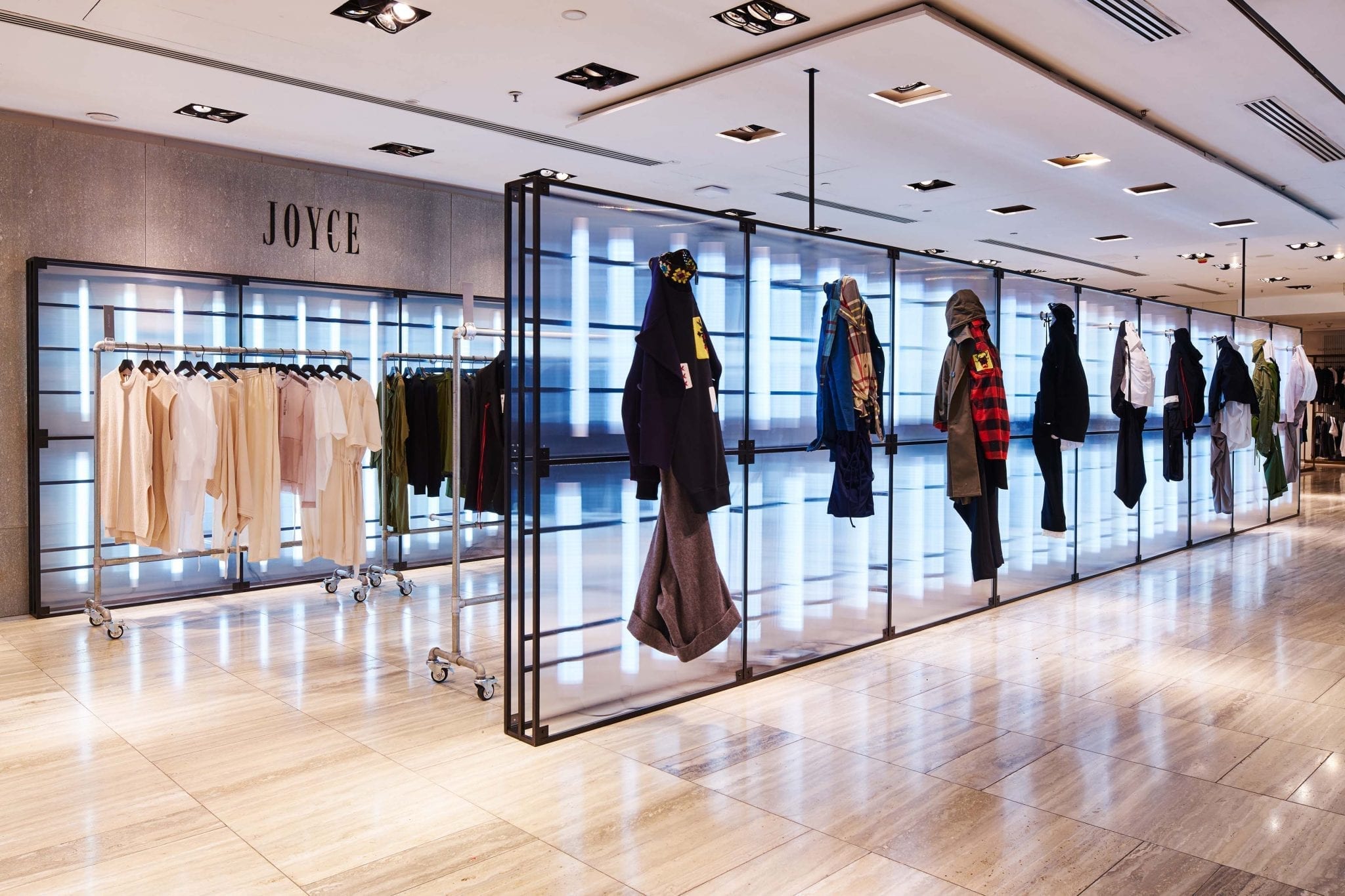
    A stagnant luxury market has made it a tough half-year for fashion retailer Joyce Boutique Holdings, its interim results showing an HK$28.1 million (US$3.5 million) net loss.

    This follows a HK$16.6 loss for the same period last year.

    The group says its results were also impacted by low visitor traffic from Mainland China as well as the closure of shops in the previous financial year. This was mitigated by the inclusion of a $5.8 million write-back of an “onerous contract provision” made for the Joyce shop at Shanghai IAPM plus the savings in running costs.

    Turnover dropped by 19.4 per cent to $386.7 million for the six months. Gross margin also fell by 1.5 points, mainly a result of a higher number of warehouse outlet sales during the period.
    Hong Kong turnover dropped by 15.8 per cent and accounted for 88.7 per cent of group turnover.

    The division pushed out its operating loss from $8.5 million the previous first half to $27.2 million, primarily caused by the decline in turnover coupled with the drop in gross margin.

    With difficult trading conditions and the closure of loss-making shops in previous year, China turnover dropped 40 per cent, but with cost efficiencies and the contract write-back, the division managed to make an operating profit of $1.6 million, a turnaround from a $6.9 million loss for the same period last year.
    Loss contribution from the Marni JV business increased from $400,000 to $600,000, mainly because of a drop in turnover.

    In July, the group opened Joyce Beauty shop in Yuen Long Yoho Mall to extend its customer base to the West and North Territories and Shenzhen. At the same time, two non-performing shops were closed when their lease expired.

    The group says its expects the retail environment will stay challenging in the near term as online specialty fashion retailing continues to impact on its core retail business. Rental levels in prime shopping malls, meanwhile, remain high relative to turnover.

  • Singapore retail sales stagnate

    Singapore retail sales stagnate

    Singapore retail sales fell by a mere 0.2 per cent in September, compared to both the same month last year and August this year.

    SG retail sales September

    Including motor vehicles, sales fell 0.5 per cent year on year.

    SG FB retail sales September


    Sales of food & beverage services (seasonally adjusted) decreased 0.3 per cent year on year, with restaurant turnover down 3.7 per cent and fast food outlets, catering services and eating places up between 0.1 per cent and 8.3 per cent.

    Compared to September 2016, retail sales of computer and telecommunications equipment, furniture and household items, food, optical goods and books and by mini-marts and convenience stores declined by between 1.3 per cent and 7.4 per cent.

    However, retail sales by supermarkets and petrol service stations, of clothing and footwear, by department stores, of medical goods and toiletries, recreational goods and watches and jewellery increased between 4.4 per cent and 9.8 per cent year on year.

  • China online spending is already 50 per cent of retail sales

    China online spending is already 50 per cent of retail sales

    China online spending is set to account for almost 50 per cent of the country’s total retail market this year.

    According to fresh data from Mintel, this year’s figure will be 45.7 per cent of “total per capita retail spend”. In many categories, already more is spent on goods online than in physical stores in the world’s largest digital economy.

    “China is experiencing a fundamental shift in the way consumers shop, and in how the shopping experience fits into the wider environment of customer service, delivered both online and in-store,” said Matthew Crabbe, research director, APAC, with Mintel.

    The research shows China’s online retail market has reached a critical mass. Business-to-consumer (B2C) online retail is expected to reach more than 60 per cent of total e-commerce sales this year, with mobile online retail expected to make up more than 80 per cent of the B2C retail category.

    However, while Mintel estimates per capita online retail spend will reach 45.7 per cent of total per capita retail spend by the end of this year it predicts that share will hold steady between until the end of 2019.

    Crabbe said there are several reasons for the projected peak.

    “One issue is that consumers are increasingly buying experiences and services online, rather than products. The other issue is that consumers are already adapting to ‘new retail’; they are embracing greater integration between online and in-store shopping. This will mean much tougher competition between retailers. It will also likely mean more pressure for further consolidation in the market, resulting in more mergers, acquisitions and strategic partnerships,” he said.

    China’s ‘new retail’ experience has consumers purchasing different products from different channels. Mintel research shows that 72 per cent of in-home food shoppers prefer to shop in-store, compared with 60 per cent of consumers who prefer to shop online for toys, games, clothing, and accessories. Apart from alcoholic drinks (61 per cent shop in-store) and pharmaceuticals and healthcare products (57 per cent shop in-store), in all other sectors the combined total of those who shop online via a mobile device or lap/desktop is greater than the proportion who shop in-store.

    While in-store grocery shopping still dominates, 66 per cent of consumers buy in-home food and drinks in-store, the average number of consumers who shop online (mobile or desk/laptop) for in-home food and drinks grew three percentage points since 2016, with 49 per cent buying in-home food online using a mobile device.

    “The growth in mobile online shopping across all sectors this year illustrates how mobile is driving the convergence of online and offline shopping into ‘new retail’,” said Crabbe. “Meanwhile, online shopping penetration is high across most sectors. There may be room to expand fresh and luxury food product sales online, thus increasing the number of high-income consumers who shop online, but the room for expansion of share of pocket among China’s consumers is running out.”

    Arise the ‘grocernauts’

    In fact, urban Chinese consumers are keen to get the immediate experience that only shopping in-store can offer. Mintel research reveals that 62 per cent of urban Chinese consumers say the ability to try, see, and experience products in-person before buying encourages them to shop in-store; the same proportion (62 per cent) shop in-store to ensure the freshness of produce, and 55 per cent say in-store shopping means they can get what they want faster.

    “Supermarkets and hypermarkets are moving away from just selling in-home foods towards  providing catering services (so called ‘groceraunts’), as well as offering online food ordering and in-store pick up services. And convenience stores are morphing into unmanned, checkout-free, cashless, elaborate vending machines. We’ve also seen shopping malls evolve away from retail spots into theme park-like leisure developments. This is all leading to a very diverse potential retail environment that includes retail as part of a wider range of consumer services. Store functions will increasingly incorporate online-enabled, front-of-store consumer touch points for selling goods and providing other customer services – even ones not related to the retailer’s core business,” Crabbe added.

    Probably the main driver of online retail’s success, 65 per cent of urban Chinese consumers say they find products cheaper online, while 63 per cent say that online offers more choice. More than half (52 per cent) of consumers say they find what they were looking for faster when shopping online.

    “Despite the instant sensual and entertainment experiences that consumers enjoy when shopping in-store, low cost, high convenience and more choices are the key ingredients that drive consumers to do more of their shopping online. As online retail platforms invest in and collaborate with physical retailers, who in turn look to increase their online exposure, these new business models will create the ideal ‘new retail’ experience for shoppers. However, companies and brands will be challenged to find their own, unique combination of online and in-store features in order to create their own bespoke experience,” concluded Crabbe.

    Total B2C and consumer-to-consumer (C2C) online retail sales in China are expected to reach RMB 6.4 trillion by year-end, having grown at a compound annual growth rate of 37.9 per cent since 2012 – that represents nearly fivefold value growth in just five years.

  • Boom predicted for China Singles’ Day

    Boom predicted for China Singles’ Day

    Three days out from China Singles’ Day, retail experts are predicting Alibaba’s annual e-commerce sales event will continue to set records.

    With the Chinese online giant expanding it to a 24-day shopping and entertainment bonanza, the global marketing hype is likely translate to record cross-border e-commerce demand, according to marketing research company eMarketer Retail.

    Global payments processor Worldpay has released new data showing that last year’s event grew by 39 per cent globally. When sales peaked, Worldpay was processing 44,505 payments a minute.
    Meanwhile, more and more international brands have been opting to participate in this year’s 11.11 shopping festival.

    Worldpay’s transaction data supports findings from the Global eCommerce Leaders Forum (GELF), which revealed the rise in consumer spending power in China is translating into growing sales on international e-commerce sites as growing numbers of shoppers seek genuine products from trusted global brands.

    Fastest growth

    Retailers in Australia and Hong Kong are seeing the fastest growth, with sales rising by 105 and 71 per cent year on year respectively, says Worldpay. While the volume of sales has plateaued in Mainland China, the average spend per purchase continues to rise at a rate of 9 per cent.

    “Since its inception as a local celebration of singledom, Singles’ Day has risen to become the world’s top grossing-online shopping holiday, and the event knows no boundaries,” says Worldpay Asia Pacific GM Phil Pomford.

    “For international businesses looking to break into the huge Chinese e-commerce market, November 11 should be an important landmark in the calendar year.

    eMarketer Retail analyst and editor-at-large Andria Cheng agrees. “For international brands this event will continue to mark Alibaba’s biggest pitch and showcase for them to get on board its platform and test the waters regarding Chinese consumer demand and promise,” she says

    “The fact more than two-fifths of this year’s 140,000 brands at the shopping extravaganza come from outside of China speaks to the continued international hope and bet that Chinese consumers will pick up the slack left by the slowing domestic growth for many brands.”

    Threefold increase

    According to marketing technology company Criteo, sales on Singles’ Day have increased threefold, with shoppers browsing online up to four days earlier.

    “This makes it the main sales peak of the season, impacting most retail categories, and is a major opportunity for both shoppers and retailers,” says Criteo GM Alban Villani, who covers Southeast Asia, Hong Kong and Taiwan.

    Analysing more than 5.1 million online transactions in Southeast Asia between October 1 and December 31 last year, it found that retail sales spiked by 254 per cent on November 11.

    Between November 9 and 12 there had been a rise of 28 per cent in average online traffic on key retail companies’ websites, and shoppers had started buying as early as November 7.

    Shoppers are increasingly buying via apps, accounting for nearly half of all transactions and 73 per cent of mobile transactions.

    Meantime, a forecast from eMarketer Retail shows that retail e-commerce sales in China will grow by 33.1 per cent this year to reach $1.13 trillion, representing 23.1 per cent of total retail sales.

    Retail m-commerce, which includes products and services ordered via mobile devices, will increase by almost 42 per cent in China this year, reaching $881.96 billion, and accounting for nearly three-quarters of all retail e-commerce sales, says eMarketer Retail.

    Close competition

    Alibaba says $18.2 billion worth of products were sold on its platforms during Singles’ Day last year, up 32 per cent from the previous year. By comparison, says eMarketer Retail, JD.com’s 618 Festival, which involved 18 days of discounts from June 1 to 18, was reported to have brought in $17.6 billion this year.

    Worldwide e-commerce sales are expected to reach $2 trillion this year. Almost half of these sales will be generated by consumers in China. eMarketer Retail says retail e-commerce sales worldwide will increase at four times the rate of retail sales this year, jumping 23.2 per cent to $2.2 trillion.

    Also, Alibaba has overtaken Google this year to be the second company to Facebook for display ad revenue, with a spend of $14.62 billion.

    Meanwhile, Worldpay has advice for retailers opting in to the Alibaba festival… “To turn browsers into buyers, it is essential to tailor the online shopping experience to local tastes. For Chinese consumers, this means focusing on your mobile proposition. Shoppers expect to use their preferred payment option – increasingly e-wallets like Alipay and WeChat Pay.”

    For Singles’ Day last year, Worldpay processed a total of 14.9 billion transactions altogether worth £451.1 billion (US$594.1 billion).

    Worldpay provides payment technology and services to about 400,000 customers. It can process payments across 146 countries and 126 currencies, helping its clients accept more than 300 different types of payment.
  • Hong Kong retail start recovering

    Hong Kong retail start recovering

    A “steady if cautious” Hong Kong retail recovery is clearly underway, according to a report from Savills released today.

    “The retail sector is slowly coming to life after four years of painful adjustment which has seen the emergence of a ‘tenant’s market’, a rare occurrence in Hong Kong’s landlord-dominated retail scene,” observed Simon Smith, head of research and consultancy with Savills.

    Over recent months, he said, retailers have been taking the opportunity to upgrade for little or no extra cost and examples include Pandora which moved within IFC Mall and Hourglass, which runs Patek Philippe, relocating within Tsim Sha Tsui from the Imperial Hotel to a better site in the Holiday Inn.

    In further evidence of upgrade demand, Harry Winston has taken the space previously occupied by Ferragamo in the Mandarin Hotel and will open in early 2018. Alternatively, retailers are cutting overheads as they find that renewal negotiations are yielding significant savings as landlords discover a new pragmatism.As reported, Topshop has renewed the lease on its Queen’s Road Central store at a discount of about 50 per cent.

    While landlords of high street shops remain on the back foot, larger shopping centres, such as  Harbour City, IFC Mall and New Town Plaza, are proving relatively immune to the downtown, says Smith.

    In IFC Mall, Italian menswear brand Boggi opened recently while Brunello Cucinelli has launched a new flagship in the same mall.

    “As street-shop rents have fallen heavily while centre rents have only seen a minor adjustment, the gap between the two has narrowed considerably and tenants are now finding that a prime street front pitch can be a viable alternative to taking space in a nearby mall. This is the narrowest the gap has been since 2009 and represents a return to the norm after seven years of major gains in street shop rents.”

    Strength in regions

    Savills also notes that regional and district malls such as Popcorn in Tseung Kwan O and Tuen Mun Town Plaza are doing relatively well.

    “Hong Kong’s tight geography, excellent transport infrastructure and dense retail environment has helped this type of mall defend against the threat from online. The appeal of air conditioned spaces in the summer months and the lure of enhanced F&B offerings have also helped boost the appeal of local malls. We have also seen landlords putting more effort into marketing campaigns with better events, more pop-up stores and creative TV and online advertising,” said Smith.

    “Most malls now have a very well-established cyber-presence via websites and apps. Click-and-collect is making some limited headway locally, with brands such as Zara, Burberry, L’Occitane, Watson’s Wine, Chow Sang Sang and Starbucks all offering the service.

    “In a mixed market some trade categories are performing well and pharmacies in particular are expanding aggressively at the moment. Not every landlord wants them but they are often prepared to pay above-market rents. F&B is also out-performing, driven in part by a richly valued stock market and rising wages.”

    Nick Bradstreet, head of retail with Savills, said luxury fashion is turning around in Hong Kong even though brands have been closing stores in Macau and Mainland China over the past year or so. Luxury sales in China have actually surged over the past six to nine months.

    “Cosmetics retailers are reporting fairly stable business, but after a period of rapid expansion, many brands are still culling store numbers. Electrical goods retailers are consolidating in what is a very competitive marketplace,” he said.

    Savills prime street shop rental indices remained flat over the third quarter while rents in prime malls continued to drift off marginally. The latest September retail sales figures from government recorded a seventh consecutive month of rises attributable in part to a strong inbound tourist numbers. Jewellery, watches, clocks and valuable gift sales outperformed, rising by 14.7 per cent year-on-year, with strong growth also noted for medicines, cosmetics and Chinese drugs.