Tag: retail sales

  • Japan retail sales continues positive result

    Japan retail sales continues positive result

    Retail sales in Japan have reportedly risen for the ninth straight month year on year, reflecting the importance of private consumption to the world’s third largest economy.

    However while the news has prompted enthusiasm in the Japanese central bank, claiming it reflects improved consumer confidence, other commentators suggest the pace of gains is slowing.

    A senior economist at BNP Paribas Securities Azusa Kato said employment and household incomes are not so robust as the Bank of Japan thinks.

    “As such, private consumption is likely to pull back from a rebound seen in the April-June quarter.”

    Senior Japan economist at Capital Economics Marcel Thieliant said the upshot is that private consumption started Q3 on a soft note.

    “However, the fundamentals for a continued improvement in spending remain in place. Both employment and wages are growing strongly, so household incomes are expanding rapidly.”

    Wages are on the increase in Japan with the gradual aging of the working population.

  • Hong Kong retail sales experiences grow

    Hong Kong retail sales experiences grow

    The pace of Hong Kong retail sales growth is tapering off.

    The Census and Statistics Department (C&SD) estimates total sales at HK$38.9 billion in July, 7.8 per cent higher than the same month last year. That follows a revised estimate of 11.9 per cent in June.

    For the first seven months of his year, Hong Kong retail sales rose by 12.6 per cent.

    However after netting out price changes year on year, the growth was 5.9 per cent for the month and 9.8 per cent year to date.

    A government spokesman said that while retail sales grew at a decelerated pace there was still solid demand from local consumers as well as visitors.

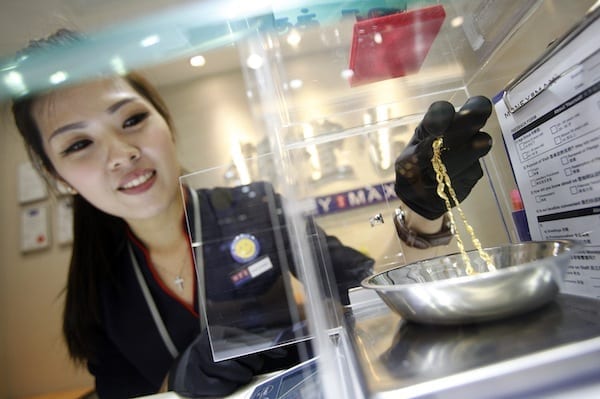
    The biggest contributing category to Hong Kong’s overall sales – watches, jewellery and valuable gifts – posted a 16.8 per cent increase. Cosmetics rose by 12.7 per cent.

    However there was less movement in more localised categories: supermarket sales rose by just 0.7 per cent, apparel by 3.4 per cent, department store sales by 8.6 per cent, food, liquor and tobacco by 3 per cent, and footwear and accessories by 5.5 per cent. Optical shop sales rose by 2.3 per cent, Chinese medicines by 0.8 per cent and electrical goods and other consumer durables by 5.7 per cent.

    The only category to decline in July was books, newspapers, stationery and gifts, down 1.4 per cent.

  • Singapore tourist spends less

    Singapore tourist spends less

    Singapore tourist spending has dipped by half a percent, despite a 7.3 per cent boost in arrivals.

    According to the Singapore Tourism Board, about 4.6 million visitors arrived in the city state in the first quarter of this year – but they spent less on shopping and accommodation. Their total collective spend was about S$6.7 billion.

    According to the government data, tourist spending on shopping declined 9 per cent, with accommodation spending down 13 per cent and food and beverage down by 16 per cent.

    Instead of spending in shops, hotels and eateries, tourists splurged on sightseeing, gambling and entertainment, collectively up by 6 per cent.

    China, Indonesia and India were Singapore’s largest source of visitors and spending during the quarter.

  • Singapore retail sales shows disappointing number in June

    Singapore retail sales shows disappointing number in June

    June Singapore retail sales remained static in June, rising a mere 0.2 per cent after motor vehicles were excluded from the data.

    Month on month, retail sales excluding cars fell by 1.8 per cent.

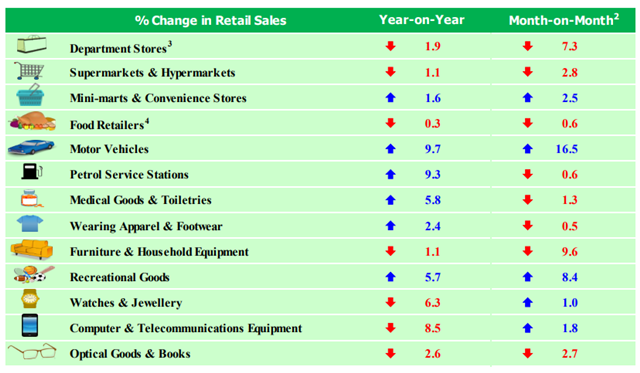
    Considering higher fuel prices drove a 9.3 per cent increase in sales year on year, traditional retail sales probably did not increase at all in June. Statistics Singapore said that in volume terms, after removing the price effect, the increase recorded by petrol service stations was 0.2 per cent.

    Sales of medical goods & toiletries increased by 5.8 per cent, due to higher sales of cosmetics & toiletries. Sales of recreational goods rose by 5.7 per cent, mainly from sporting apparel during the FIFA World Cup.

    Sectors to record declines in June Singapore retail sales included computer and telecommunications equipment (down 8.5 per cent), watches & jewellery (down 6.3 per cent) and optical goods & books (down 2.6 per cent). Following sales growths in the previous month, sales of department stores and furniture & household equipment decreased by 1.9 per cent and 1.1 per cent, respectively.

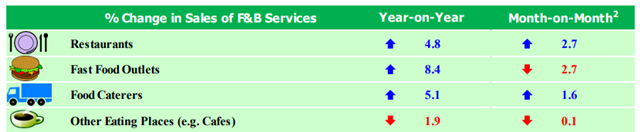
    Most food & beverage service industries achieved higher turnover in June this year, compared with last year. Fast-food outlets, food caterers and restaurants rose between 4.8 per cent and 8.4 per cent during this period.

    In contrast, sales of other eating places, such as cafes, fell by 1.9 per cent.

  • China retail sales slump in July

    China retail sales slump in July

    Mainland China retail sales fell in July according to a survey of 50 major retail chains.

    According to the China National Commercial Information Centre (CNCIC), a government-backed consultancy authorised by the National Statistics Bureau, sales fell 3.9 per cent year on year, with home appliance retailers the worst hit, with a decline of 9.9 per cent.

    Sales of ‘daily necessities’ dropped 5.7 per cent and of clothing by 3.8 per cent. The only category showing strong growth was cosmetics, up 6.5 per cent.

    “In general, the performance of China’s retail sector was rather sluggish in July,” said CNCIC.

  • Hong Kong’s retail sales continue to growth

    Hong Kong’s retail sales continue to growth

    Hong Kong’s retail sales renaissance continued in June, with a 12 per cent rise for the month.

    That is marginally less than the 12.9 per cent increase in May, and below the 13.4 per cent increase for the first half year, but the rate shows signs the growth is stabilising.

    The Census and Statistics Department estimated the total value of retail sales in June at HK$37.8 billion (US$4.8 billion). After netting out the effect of price changes over the same period, the volume of retail sales in June rose by 9.8 per cent.

    Predictably, sales of jewellery, watches and clocks, and valuable gifts led the way, up by 27.8 per cent. Other strong performing categories were cosmetics, up 18.3 per cent, department store sales up 15 per cent, footwear and accessories up 11.4 per cent and Chinese drugs and herbs up 10.3 per cent – all categories popular with visitors from Mainland China.

    Retail categories largely dominated by local shoppers showed more modest growth: supermarket sales rose 1.1 per cent, electrical goods by 0.4 per cent, furniture and fixtures by 8.9 per cent, books and stationery by 3.1 per cent, optical shops by 6.9 per cent and food and alcohol by 8.9 per cent.

    The C&SD said that after seasonal adjustment, the value of retail sales decreased by 0.2 per cent from the first quarter to the second and the volume by 0.1 per cent.

    A government spokesman said the sustained double-digit growth of retail sales in June reflected favourable local consumer sentiment amid a tight labour market and rising visitor arrivals.

    “Looking ahead, favourable job and income conditions and buoyant inbound tourism should continue to provide support to the retail sector in the near term. Yet, we need to closely monitor how the heightened external uncertainties might affect consumption sentiment going forward.”

  • Food and fuel boost japanese retail sales rise

    Food and fuel boost japanese retail sales rise

    Japanese retail sales increased by 1.8 per cent in June thanks to strong food sales and rising petrol prices.

    According to the Ministry of Economy, Trade and Industry, Japanese retail sales reached ¥11.8 trillion (US$106.25 billion) during the month. It was the eighth consecutive monthly rise.

    Rising crude oil prices flowed through to petrol pump prices, which surged 16.7 per cent year on year. Sales of cosmetics and pharmacy products rose 3.9 per cent, largely due to demand from overseas visitors.

    Food and beverage sales rose 1.5 per cent, with prepared meals and meat fuelling growth.

    Supermarket sales rose 1.9 per cent, while department store sales rose 2.6 per cent, which the ministry said was due to there being one more Saturday in June this year than last year.

  • S. Korean retail sales rise in first half on increased online sales

    S. Korean retail sales rise in first half on increased online sales

    South Korean retail sales rose 7.4 per cent in the first half of this year based on solid performance in e-commerce.

    Data from the Ministry of Trade, Industry and Energy showed online sales running 16.3 per cent higher than during the same time last year, while offline sales rose just 2.7 per cent.

    Grocery shopping via online malls with home delivery saw a major rise this year, with a 20.8 per cent increase in sales over last year.

    Similar rises were reported for convenience stores, department stores and online marketplaces, although a 1.8 per cent drop hit large discount store chains.

  • Singapore’s May retail sales rise by 2.2 per cent

    Singapore’s May retail sales rise by 2.2 per cent

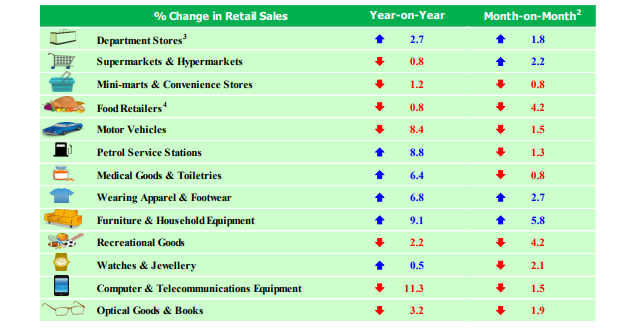
    Singapore retail sales rose 2.2 per cent in May after excluding motor vehicles.

    The year-on-year increase was driven by rising sales of furniture and household equipment – up 9.1 per cent – and increased shopping before the Hari Raya festive period. Sales at petrol service stations rose 8.8 per cent, due partly to higher petrol prices.

    Sales of the apparel and footwear, medical goods and toiletries and department stores rose by between 2.7 per cent and 6.8 per cent. But sales of computer and telecommunications equipment fell 11.3 per cent.

    Compared to April, Singapore retail sales increased 0.4 per cent, after excluding motor vehicles.

    Statistics Singapore estimated total retail sales in May as worth S$3.8 billion. Online retail sales accounted for about 4.3 per cent of that.

    Compared to May last year, sales of food & beverage services increased 1.2 per cent in May to an estimated $689 million.

    Fast-food outlets and food caterers registered higher sales at 10.8 per cent and 5.7 per cent respectively, while turnover of restaurants and other eating places, such as cafes, fell by 0.3 per cent and 1.9 per cent respectively.


  • Singapore retail sales up in May

    Singapore retail sales up in May

    Retail sales in Singapore edged up marginally in May, with growth constrained partly by lower motor vehicle sales, according to Thursday’s (July 12) Department of Statistics release.

    May’s retail takings were up 0.1 per cent from the same month a year ago, with a total estimated sales value of S$3.8 billion, of which online retail sales contributed 4.3 per cent. Excluding motor vehicles, the rise was more significant, at 2.2 per cent.

    With increased shopping before the Hari Raya Puasa festive period, furniture and household equipment saw the biggest jump in sales, at 9.1 per cent. Sales at petrol service stations rose 8.8 per cent, due partly to higher petrol prices; after removing the price effect, the rise was just 0.8 per cent.

    Sales of apparel and footwear, medical goods and toiletries, and department stores industries also saw increases of between 2.7 per cent and 6.8 per cent.

    In contrast, sales of computer and telecommunications equipment fell 11.3 per cent, while those of motor vehicles fell 8.4 per cent. Takings from optical goods and books, recreational goods, minimarts and convenience stores, supermarkets and hypermarkets, and food retailers saw smaller decreases of between 0.8 per cent and 3.2 per cent.

    Lower vehicle sales also weighed down the month-on-month figures, though to a smaller degree. On a seasonally-adjusted basis, retail sales rose 0.1 per cent in May compared to April 2018. Excluding motor vehicles, retail sales rose 0.4 per cent month on month.

    Sales of food and beverage services rose on both a year-on-year and a seasonally-adjusted month-on-month basis: up 1.2 per cent compared to a year before, and up 0.6 per cent compared to the previous month. The total sales value of food and beverage services was estimated at S$689 million, up from S$681 million in May 2017.

  • Malaysia retailers see higher sales growth in 2018

    Malaysia retailers see higher sales growth in 2018

    The Malaysia Retailers Association (MRA) forecasts retail sales to be 5.3% for 2018, an improvement from the 4.7% growth in its March survey, boosted temporarily by the zero Goods and Sales Tax in June.

    The MRA said for the first quarter of 2018, the Malaysia retail industry recorded a below-than-expected growth rate of 2.6% in retail sales versus the 3.1% in October to December last year and 1.2% growth a year ago.

    “Despite poor performance recorded a year ago (-1.2% in Q12017), the Malaysia retail market remained subdued early this year. Shoppers were still careful in their spending on festive goods during the Chinese New Year period”.

    The MRA said except the supermarket and hypermarket sub-sector, all retail sub-sectors recorded improvement in their retail businesses during the first quarter of 2018.

    It said its members are hopeful that their businesses will recover by the second quarter of 2018. They projected an average growth rate of 6.0%. The change in ruling party after the general election on May 9, 2018 is expected to boost consumers’ confidence level and increase their willingness to spend.

    At the same time, the largest festival in Malaysia, Hari Raya, will be celebrated in June this year.

    “The department store cum supermarket operators are expecting a better performance with a growth of 4.6% for the second quarter of this year.

    “The department store operators are expecting to sustain their businesses with a growth rate of 4.7% for the second three-month period of this year,” it said.

    On the other hand, supermarket and hypermarket operators will not see improvement in their business in the coming months. They expect to remain in the red zone with a -4.4% growth rate for the second quarter of 2018.

    The Retail Group Malaysia adjusted the Q2 retail growth rate from 3.7% (estimated in March 2018) to 6.3%.

    This revision is also higher than the latest projection made by MRA members. This new estimate took into consideration the tax holiday during the last month (June) of second quarter as well as Hari Raya celebration at the middle of June 2018.

    The retail sale growth rate for third quarter has also been revised from 5.2% (estimated in March 2018) to 6.8%. This revision took into consideration the remaining two months of tax break before Sales and Services Tax (SST) is to be re-introduced from 1 September 2018.

    “For the last quarter of this year, the retail growth rate has been revised downwards from 5.0% (estimated in March 2018) to 3.5%.

    “This lower adjustment is needed to reflect higher consumers’ spending during the three-month period with zero-rated GST. Major purchases are expected to have been made from June to August of this year,” it said.

  • Singapore retail sales still lacklustre in April

    Singapore retail sales still lacklustre in April

    Retail sales continued its lacklustre streak in April, ticking up marginally by 0.4 per cent compared to a year ago, dragged down by a sharp dip in computer and telecommunications equipment.

    This followed March’s 1.1 per cent drop in retail sales.

    Excluding motor vehicle sales, retail takings inched up 0.7 per cent in April, according to Singapore Department of Statistics data released on Tuesday.

    Performance among the retail industries was a mixed bag, with the largest decline seen in computer and telecommunications equipment (-9.8 per cent), followed by apparel and footwear (-3.4 per cent), supermarkets and hypermarkets (-2.3 per cent), and department stores (-1.7 per cent).

    The top performer in April was petrol service stations, which reported a sales growth of 8.5 per cent, due partly to higher petrol prices.

    On a month-on-month basis, seasonally-adjusted retail sales fared even worse, decreasing by 0.2 per cent in April. Excluding motor vehicles, retail sales declined 1.7 per cent.

    The total retail sales value in April 2018 was estimated at S$3.6 billion, of which online sales accounted for about 4.4 per cent.

    The food and beverage services index was also awash in red in April, dipping 1.2 per cent compared to a year ago. On a month-on-month basis, it fell by 3.4 per cent.

    The total sales value of food and beverage services in April 2018 was estimated at S$662 million, lower than the S$670 million in April 2017.

  • Retail Sales During Ramadan Signal a Rebound

    Retail Sales During Ramadan Signal a Rebound

    Retail sales in Indonesia increased ahead of the Idul Fitri holiday, hinting of a much-anticipated rebound in private consumption.

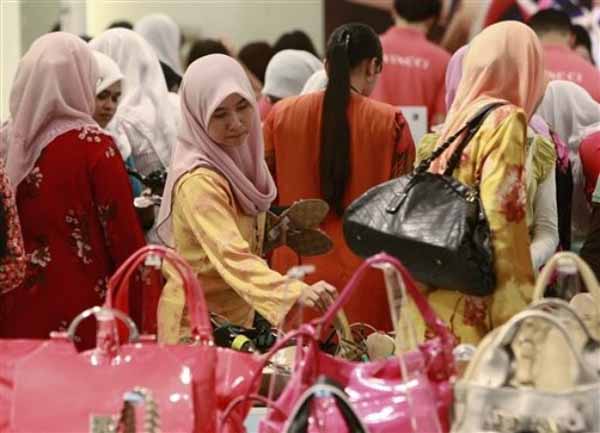
    Shopping malls saw crowds of people hunting for discounts on new clothes, jewelry or the latest trends in shoes and handbags ahead of the annual festivity. Housewives have meanwhile been filling their grocery baskets with staples such as beef, chicken and chili, the prices of which have been uncharacteristically low for this time of the year.

    “We expect retail sales to increase by between 20 percent and 25 percent, compared with the Idul Fitri holiday last year,” said Roy Mandey, chairman of the Indonesian Retailers Association (Aprindo).

    Sales growth has been accelerating since January, reversing last year’s downward trend, and reached 3.4 percent in April – the highest in 10 months, according to World Bank data.

    A Bank Indonesia survey also showed the Consumer Confidence Index increasing 2.9 points in May to 125.1 – near its three-year peak. A reading above 100 reflects optimism.

    Consumers started spending more of their incomes, according to the survey. The average income-for-consumption ratio slightly increased to 66.1 percent from 66 percent the previous month, while the income-for-saving ratio declined to 19.6 percent from 20 percent.

    According to Roy, retail sales during Ramadan and the Idul Fitri holiday will contribute around 40 percent to the full-year target. Last year, retail sales only contributed 6 percent to the total in the same period. The average contribution is 15 percent.

    Indofood Sukses Makmur, one of Indonesia’s largest producers of packaged goods and flour, predicts a 10 percent to 12 percent increase in sales during this period.

    “We increased stocks to meet rising demand during the fasting month and holidays that follow it,” Indofood director Taufik Wiraatmadja said on Thursday (07/06). He added that this was done to boost the company’s sales during Ramadan.

    Indofood CBP Sukses Makmur, its subsidiary that produces various branded consumer products such as instant noodles, snacks and dairy products, predicts an 8 percent to 12 percent rise, while Bogasari, its flour producer arm, predicts a 10 percent increase in sales.

    The growth in retail sales is also reflected in advertising spending during Ramadan, which increased 7 percent overall during Ramadan this year, compared with the same period last year.

    Research by Nielsen shows that there was an average of 7 million TV viewers in Indonesia per day during this year’s Ramadan, which is 18.6 percent more compared with other months. People watched TV about five hours 19 minutes on average during Ramadan, compared with four hours and 53 minutes during the non-Ramadan period. The research compared the Ramadan period on May 16-21, with the non-Ramadan period of April 1-7.

    “For online shopping during Ramadan, there is growth in clothing products, food and beverages products, household products and travel-related products,” said Hellen Katherina, executive director of media business at Nielsen Indonesia.

    Signs of a Turnaround

    Ramadan sales usually contribute 15 percent of Indonesian retailers’ annual sales, according to Roy of Aprindo. But last year’s sales were weak and only made up 6 percent of the full-year sales. As a result, retailers saw only 3.65 percent growth in 2017, representing the sector’s worst performance in the past 10 years.

    The positive trend comes as a relief to retailers, who are now confident of reaching between 8 percent and 9 percent growth by the end of this year, Roy said.

    He attributed the spike in retail sales to holiday bonuses and 13th checks received by some 4.3 million civil servants across the country.

    This year, the government allocated Rp 35.76 trillion ($2.56 billion) towards 13th checks and holiday bonuses for civil servants who have not seen pay raises since 2016. Last year’s figure was Rp 23 trillion. The government has also raised its expenditure on social assistance, which includes village funds, cash transfers under the Family Hope Program (PKH) and rice social assistance (Rastra). It has spent Rp 17.9 trillion between January and March, almost a double last year’s figure.

    “While a quarter that includes Ramadan usually fares better than other quarters, Jokowi’s move to increase the allowance for civil servants and expenditure on social programs proves to be a good decision to boost retail sales,” Alfred Nainggolan, a research analyst at brokerage firm Koneksi Kapital said on Sunday, referring to President Joko Widodo by his popular nickname.

    “There will be more momentum to increase it, such as regional elections and the Asian Games, which in turn will further support Indonesia’s economic growth,” Alfred said. The regional elections will be held at the end of June, while the Asian Games will take place in August and September.

    Stable food prices also contributed to consumer confidence, according to Juan Permata Adoe, deputy chairman of strategic foods affairs at the Indonesian Chamber of Commerce and Industry (Kadin).

    The government opened the import market for staple goods and imposed price controls on rice, sugar, meat, packaged cooking oil, and fuel and power to stabilize prices.

    A kilogram of beef sold for Rp 149,300 per kilogram during the last week of Ramadan, virtually unchanged from a month ago, according to National Strategic Food Price Information Center. In the past, it has not been unusual to see a 30 percent jump in commodity food prices during Ramadan and Idul Fitri.
  • Watches, jewellery boosts Hong Kong retail sales growth

    Watches, jewellery boosts Hong Kong retail sales growth

    Booming trade in watches, jewellery and gifts are flattering the overall performance of Hong Kong retail sales this year.

    For the first four months combined, retail sales are up 13.9 per cent year on year.

    But while the consistent double-digit increases in sales over the first four months of this year serve as an encouragement for the broader retail market – not to mention nervous landlords – high-price goods are dominating the numbers.

    Due to their sheer value, fluctuations in sales volume of the “jewellery, watches and clocks and valuable gifts” category, (as defined by the Census and Statistics Department), always has the greatest impact on the overall figure. Thus it is difficult to get a sense of the more mainstream, locally driven retail sales market.

    April’s 12.3 per cent rise in total Hong Kong retail sales followed an 11.5 per cent rise in March and a 15.7 per cent gain in combined January-February, traditionally combined to allow for true year-on-year comparisons due to the timing of Lunar New Year.

    In January-February, jewellery, watches and valuable gifts sales rose 21 per cent, in March by 23.1 per cent and in April by 24.6 per cent. So that category is growing by a faster rate each month so far this year.

    Arguably, apparel sales may well be a better bellwether of the broader market, despite being influenced by the climate. In January-February, apparel sales rose 19.5 per cent, in March by 11.2 per cent and in April by 6.3 per cent – figures which paint a very different trend to watches and jewellery.

    Medicines and cosmetics, usually one of the other categories with strong influence over the total figures, grew by 17.4 per cent in January-February, by 16.5 per cent in March and by 17.9 per cent in April: very stable growth.

    Clearly, Hong Kong’s overall retail sales growth is being driven by the rising number of mainland visitors, after a significant lull in that market for the three years or so until mid last year.

    A government spokesman says the sustained double-digit increases this year have been underpinned by strong local consumer spending as well as buoyant inbound tourism. There is every indications those tourist numbers will hold up in coming months.

    Other categories with a strong performance in April included electronics up 17.1 per cent, department stores up 12.6 per cent, footwear and accessories up 9.4 per cent, and optical shops by 8 per cent.

    But it was a far less spectacular month for supermarkets, where sales rose just 1.1 per cent, furniture stores – up 1.4 per cent – and books and stationery retailers who pretty much stood still at 0.3 per cent.

    So while the luxury sector is booming again, the golden era has not yet returned for many retail categories.

  • Are Macau’s glory days back?

    Are Macau’s glory days back?

    Macau’s gaming sector rebounded in 2017 with total visitor arrivals growing 5.1% year-on-year. With increasing visitors, gaming and retail sales has rebounded dramatically however distribution of these gains has not been equal.

    During the fourth quarter of 2017, Macao has experienced record sales with an increase by 12.6% compared to the previous year. This impressive recovery takes place just two years after the 2015 crisis during which sales dropped by 80%.

    Operators, retailers and the government seem to have found the good recipe to attract people and make them stay in Macao.

    Macao’s hotels have become attractions by themselves. They propose a wide range of accommodations and a large variety of facilities such as swimming pools, restaurants, fitness centers, shopping centers… “40% of visitors choose their place to stay in Macao based on retail and dining options” said Olivier Tong, Head of Retail at JLL.

    On top of that, the average 5-stars hotel price in Macao is 45% cheaper than Hong-Kong.

    These two strategies definitely improve customers’ experience in Macao and clearly have the same objective: make visitors stay longer in Macao. And it seems to work because Macao has recorded an increase of 22.2% of overnighters compared with 2015.

    Casino operators are diversifying their business by offering more shopping options to their clients. The highest revenue growth rates have been recorded in casinos with the highest retail surface.

    The government is also aware of its past as a destination for one-day trippers. This is why it encourages developing nightlife and non-gaming activities. Every year, the Government is involved in the organization of important events such as the Light Festival or the Macao International Parade.

    It also would impose non-gaming commitments to casinos to enable them to renew their gambling license. For instance, non-gaming revenue must reach 9% of total revenue to meet the government’s commitment. This new rule would offer great opportunities for many brands to make business in casinos like the recent Prada pop-up at Galaxy Macau.

    Thanks to all that, Macau is experimenting a strong economic recovery with a VIP-gaming, which is “much healthier” according to Olivier Tong, representing 56% of overall gaming. But operators, retailers and government still need to make this recovery sustainable.

    Contributor: Quentin Mauriac

    Quentin Mauriac is a EDHEC Business School Grande Ecole Program student. He is currently an intern for Financial Planning & Analysis at Bluebell Group. Prior to Bluebell, he was an intern at Credit Mutel – CIC bank as Investment Advisor Assistant, and Internal Controller at Cdiscount, a leading e-commerce retailer in France. During his studies at EDHEC, he also had the opportunity to manage a 36-members team as President of EDHEC Jobs Management, a provider of marketing and business services to large companies such as LVMH, Danone, P&G, etc. Following his internship at Bluebell, Quentin will pursue his international experience in Germany where he will complete his Master degree and take the CFA certificated examination.