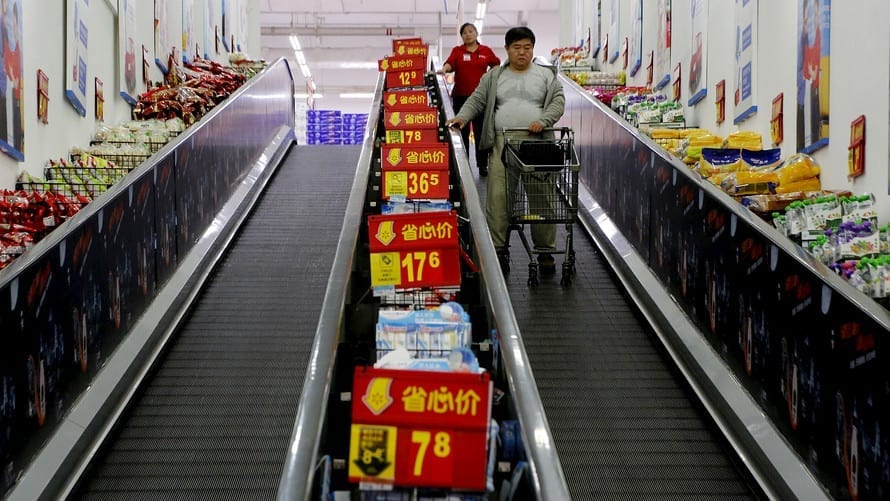
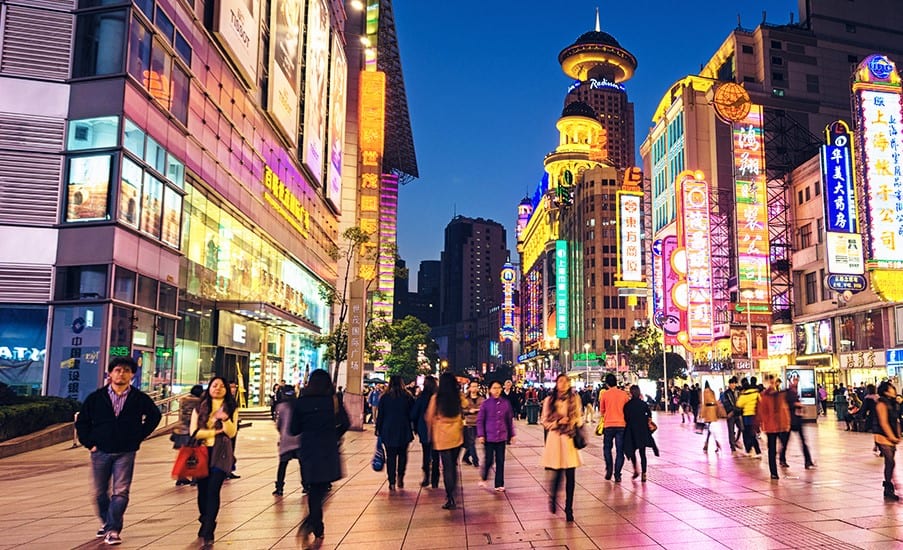
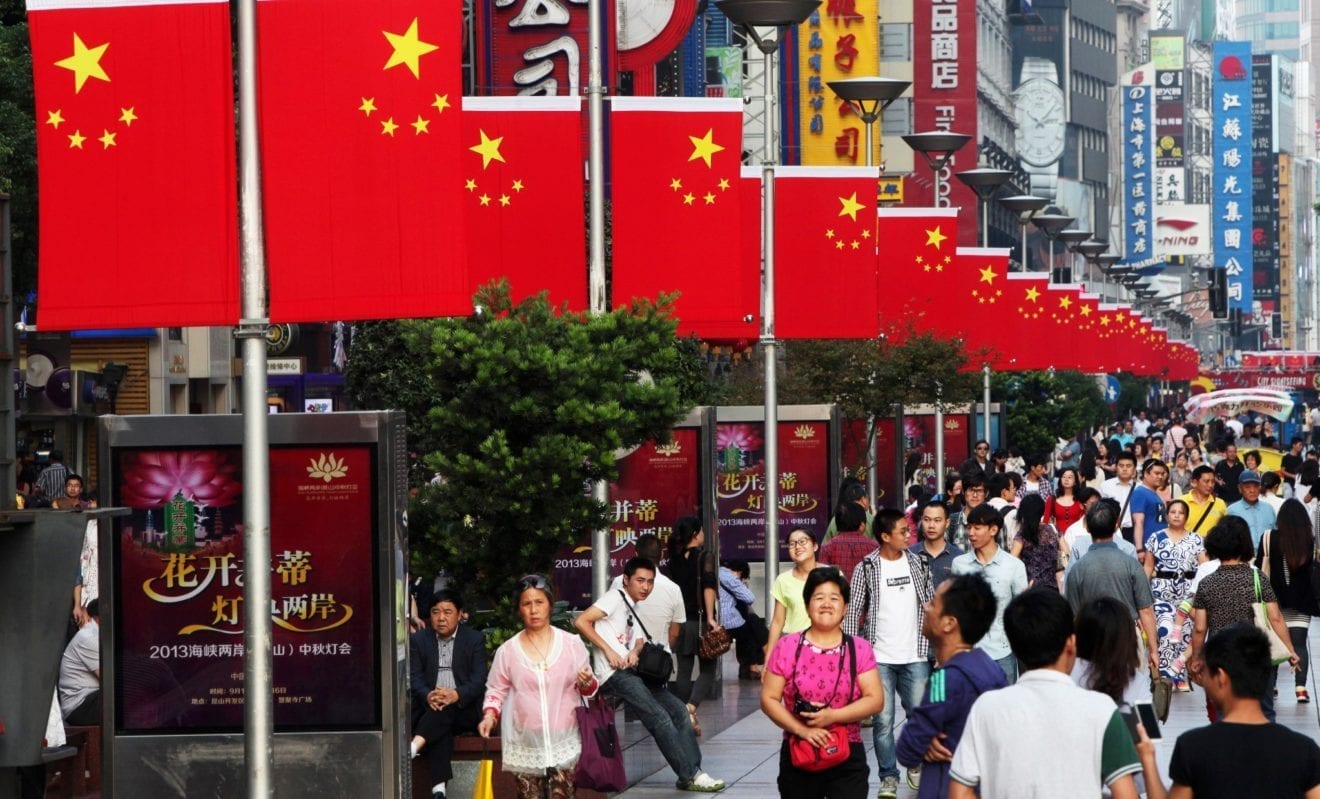
China’s retail sales growth rose to 10.0 per cent on-year in October, missing analysts’ forecasts of 10.7 per cent growth — the rate sales grew at the previous month. Thus there was a slowdown in retail sales despite the growth.
Industrial output rose 6.1 per cent in October from a year earlier, the National Bureau of Statistics said, again below analysts’ estimates of 6.2 per cent.
The world’s second largest economy has been facing slowing growth of late.
China is predominantly an export-led economy but with global demand falling, the country needs to re-work its growth strategy. The country has been trying to move towards consumption-led growth but the transition has been bumpy.
Recent data points to the fact that China’s growth is increasingly dependent on government spending and ballooning debt as private investment hovers around record lows.
Last week, Alibaba’s Singles’ Day festival posted record sales of $17.73 billion.
While sales were good, the day-long shopping gala saw slow growth as Chinese shoppers searched for heavier discounts and lower price tags.
China’s fixed asset investment rose by 8.3 per cent in the first ten months of the year, slightly higher than market expectations.
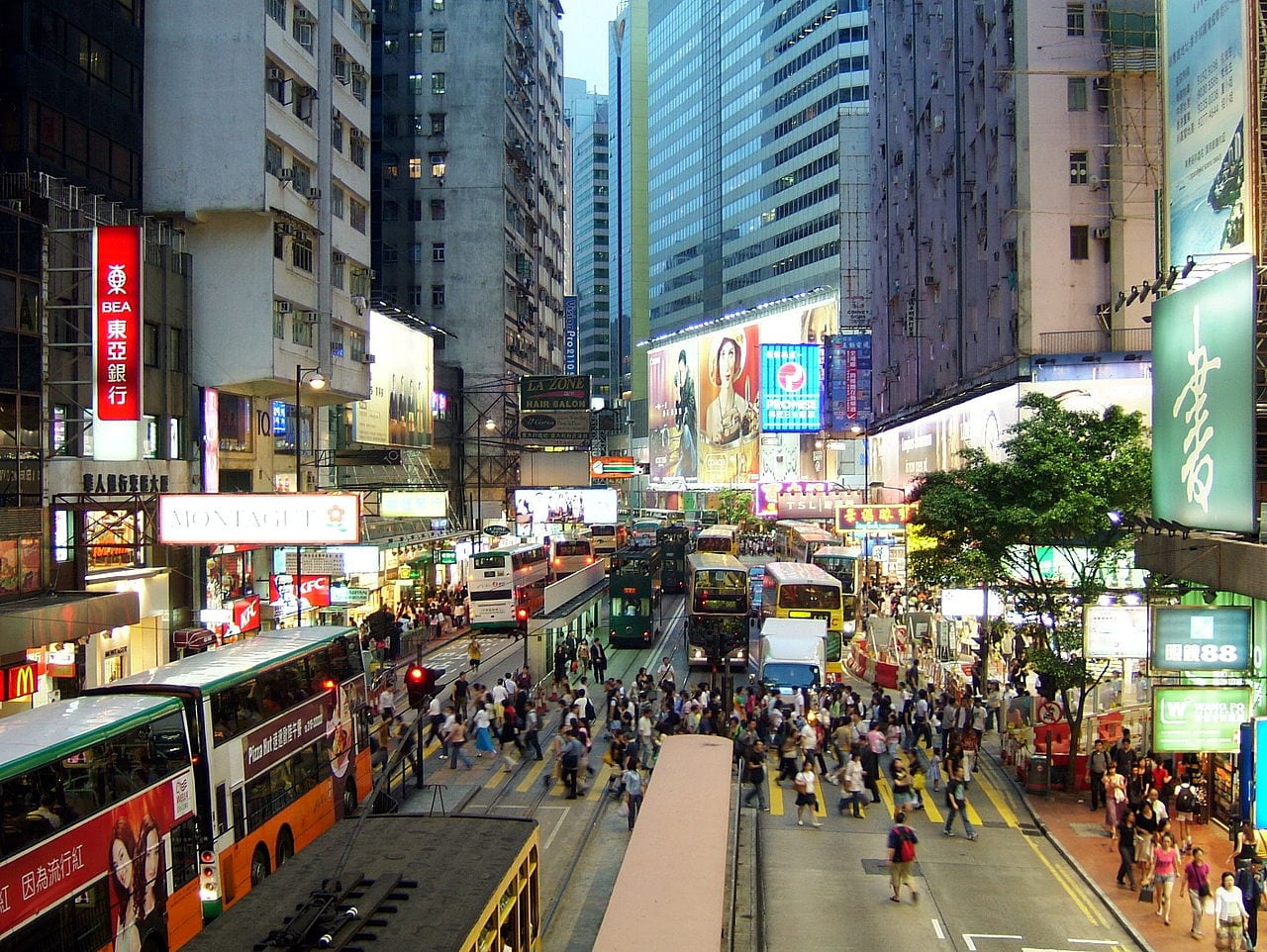
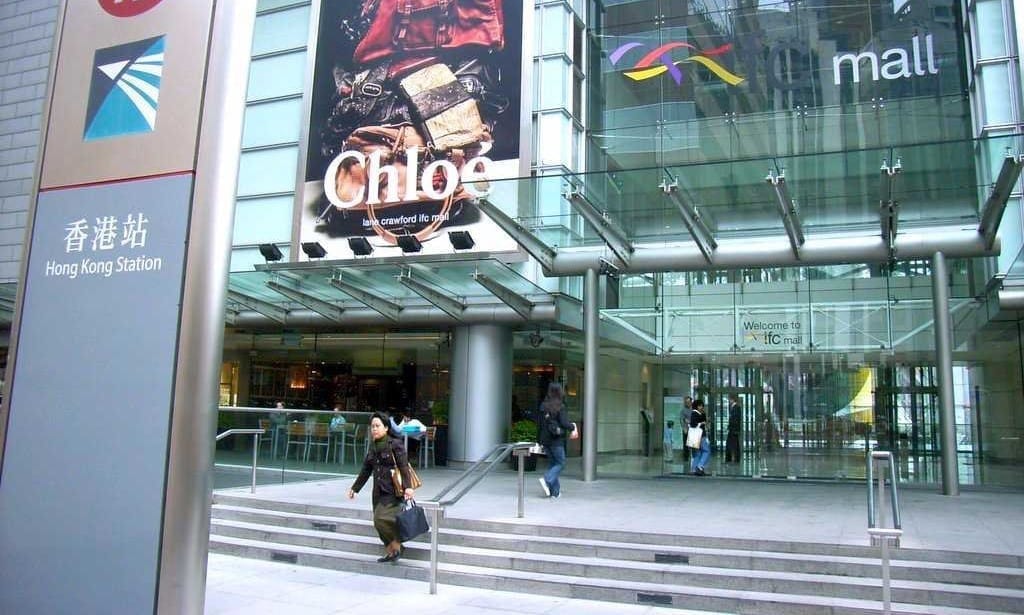
The heavy rate of decline in Hong Kong retail sales may be over, with September figures showing a relatively small contraction.
According to data released by the Census and Statistics Department (C&SD), the value retail sales in September, provisionally estimated at $33.8 billion, decreased by 4.1 per cent with the same month last year.
That compares very favourably with a year-to-date figure of 9.6 per cent and August’s revised figure of 10.5 per cent. However, it should be noted, these declines are measured against a low base as 12 months ago the city’s major retail decline was well underway.
“Retail sales showed a visibly narrower year-on-year decline in September, conceivably due partly to a reduced drag from the smaller decline in visitor arrivals in that month and partly to some improvement in consumer sentiment amid a somewhat more stable external environment,” said a government spokesperson.
“Looking ahead, the near-term outlook for retail sales is still subject to uncertainty, depending on the performance of inbound tourism as well as the extent to which local consumer sentiment will be affected by various external uncertainties.”
After netting out the effect of price changes over the same period, the provisional estimate of the volume of total retail sales in September 2016 decreased by 3.9 per cent compared with a year earlier.
For the first time in more than a year, luxury goods did not show the greatest decline. The worst-performing category in September was electrical goods and photographic equipment down 12.8 per cent, with jewellery, watches and valuable gifts down 12.3 per cent. Department store sales slipped 2.4 per cent.
Apparel sales actually rose by 1.8 per cent, and optical retailers experienced 1.7 per cent growth.
There were negligible changes in any other category.
On a year-over-year basis, China’s retail sales showed a strong recovery in September 2016, according to the National Bureau of Statistics of China. The country’s retail sales rose 10.7% in September 2016 compared to a 10.6% rise in August. This reading was above the market expectations of a 10.6% rise, and it was the highest since January 2016.
Sector-by-sector performance
Building material sales rose 14.2%, furniture sales rose 8.7%, home appliance sales rose 8.6%, telecommunications sales rose 5.1%, personal care sales rose 12.5%, automobiles sales rose 13.1%, and cosmetics sales rose 7.7%.
Economic impact
The sales improvements in different sectors signify that consumer sentiment is improving. After the slowdown in economic activity in China, the economy is going through a transitional phase. From a manufacturing hub, it’s transitioning to a consumer-based economy. Consumerism will play a large role in the country’s future economic growth.
Consumption patterns are changing in China’s economy. Chinese consumers are becoming more selective toward the products and services that they use. As China is one of the world’s most important economies, improvement in its growth drivers could aid the global economy.
In the next part of this series, we’ll analyze China’s monthly new loans in September 2016.
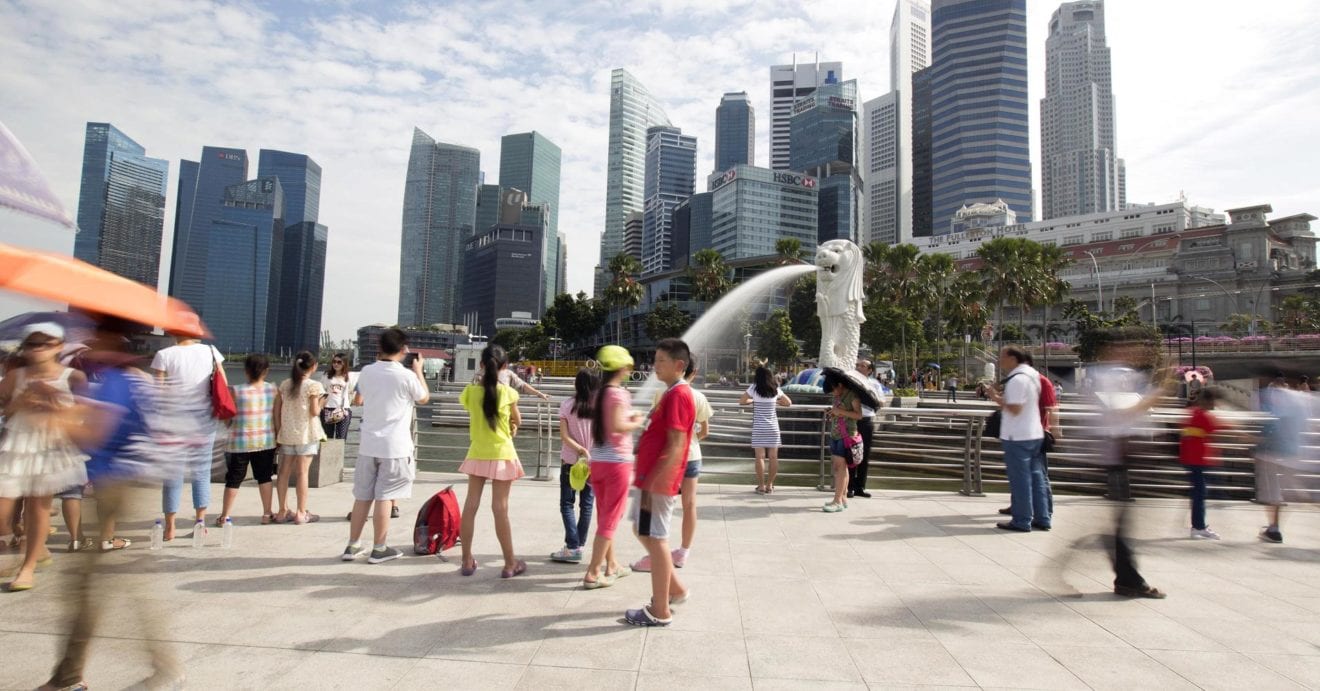
Real Singapore retail sales fell 6.5 year-on-year in August – twice the rate of decline of the previous month.
While the headline figures were 1.1 per cent over July, and 1 per cent over August 2015, those figures included motor vehicle sales. Excluding motor vehicles, retail sales declined 2.1 per cent from July to August.
According to Statistics Singapore, the retail sales value in August 2016 was estimated at S$3.6 billion, including vehicles.
While sales in department stores and of computers and phones increased by up to 3.1 per cent month-on-month, sales of recreational goods, apparel & footwear, furniture & household goods, optical goods and books, medical goods & toiletries, supermarkets, mini-marts & convenience stores, watches & jewellery and food & beverages all decreased between 0.5 per cent and 8.9 per cent month-on-month.
Year-on-year, sales of computers & phones, watches & jewellery, apparel & footwear and recreational goods decreased by between 11.1 per cent and 19.6 per cent. Similarly, sales at petrol service stations, of food & beverages, furniture & household equipment, optical goods & books, supermarkets, department stores, medical goods & toiletries and mini-marts & convenience stores declined between 0.4 per cent and 9.9 per cent.
Food & beverage sales
Meanwhile, sales of food & beverage services decreased 1.6 per cent in August 2016 over July.
Compared to August last year, sales of food & beverage services declined 2.5 per cent. Fast food retailers grew their sales by 3.9 per cent and caterers by 4.7 per cent, but restaurants were down 5.3 per cent.
Year-on-year, turnover of restaurants fell 8.8 per cent in August 2016.
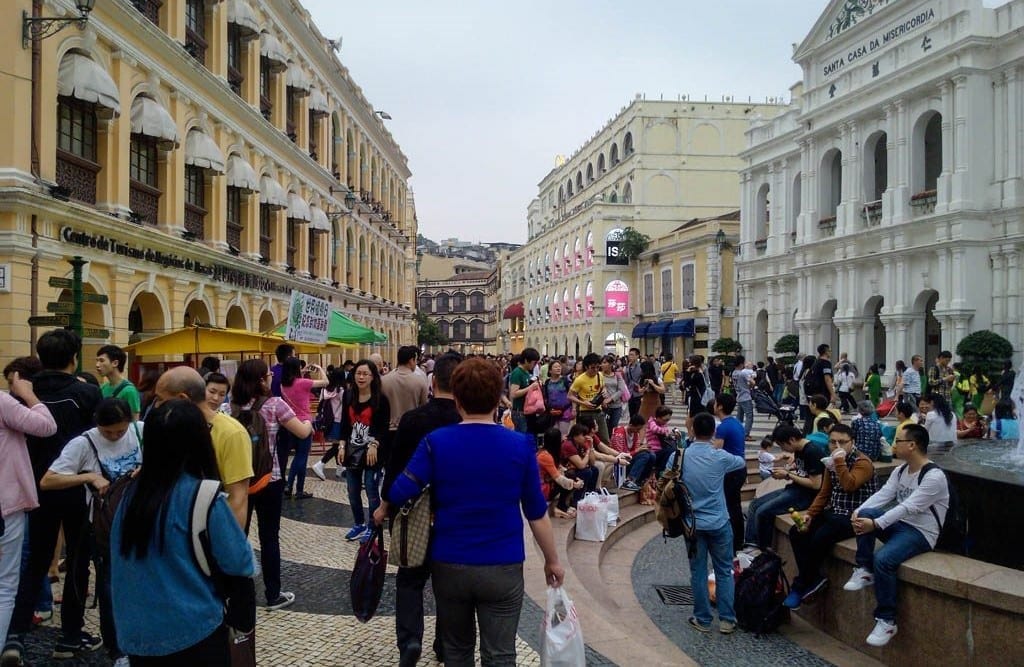
Macau’s move to reposition itself from gaming hub to shopping and entertainment destination appears to be paying off already.
Tourist numbers rose in Macau over Golden Week as an expanding shopping offer and shows drew 8.45 per cent more visitors than the same period last year.
During Golden Week – from October 1 to October 10 – 1.61 million people visited Macau according to data from the Public Security Police Force.
Total border crossings at the city’s seven immigration checkpoints reached 4.7 million for the 10 days: 2,355,720 arrivals and 2,359,090 departures.
Of the seven border checkpoints, the Border Gate recorded the highest number of arrivals and departures, at 1.15 million and 1.28 million, respectively. The second popular border was the Outer Harbour Terminal on the Peninsula, with 157,211 arrivals and 150,749 departures recorded.
The busiest day of Golden Week was the third day with 520,386 border crossings registered.
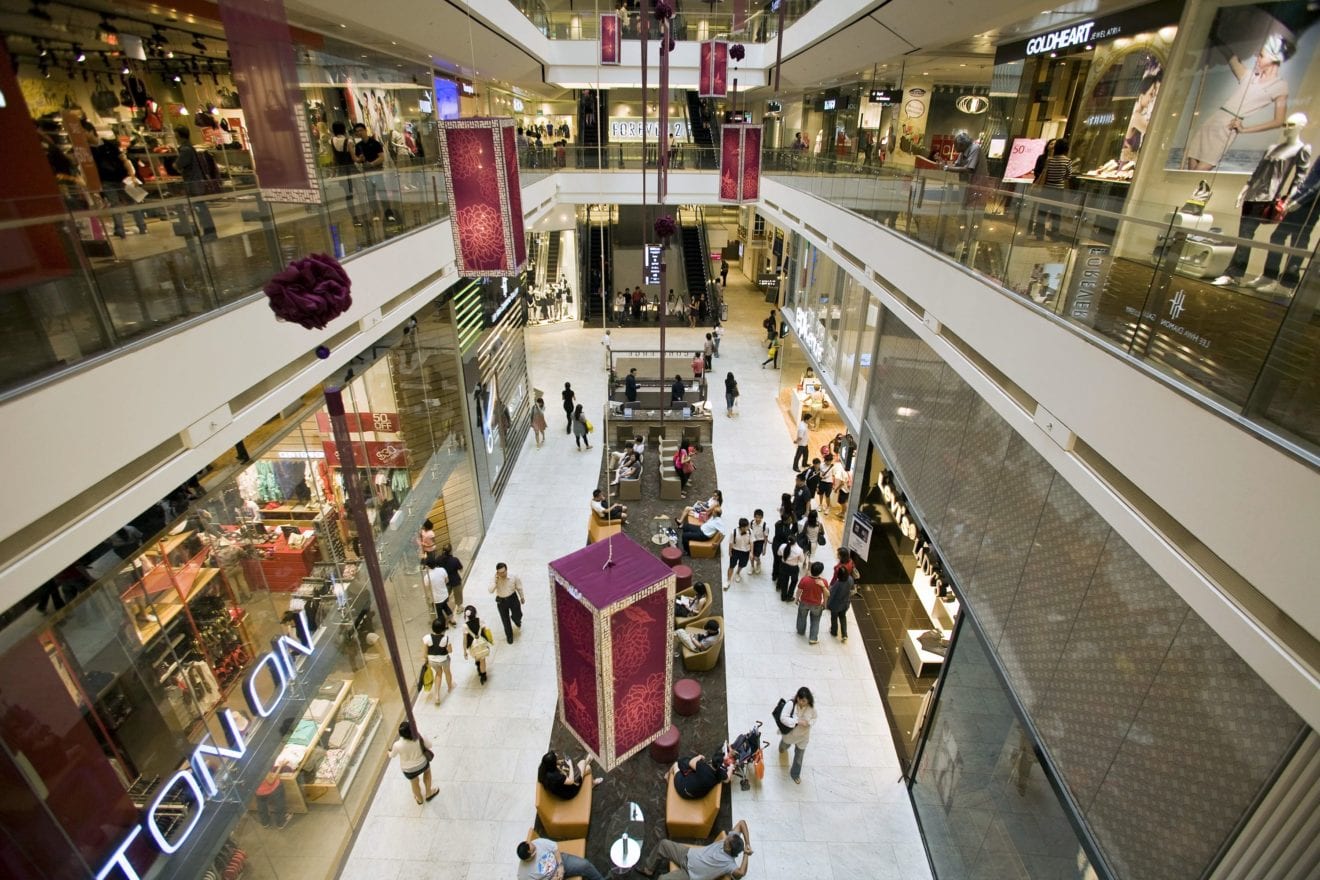
The outlook for Singapore’s retail sector for the last three months of the year remains subdued, with weak retail rents made worse by retailers consolidating outlets to streamline cost.
Average island-wide prime retail rents moderated in Q3 2016, with that of Orchard Road falling for the first time since Q2 2015 on the back of the tougher retail climate, reports Knight Frank (KF).
The average gross rents for prime spaces was $31.20, which represents 2.2% decline YoY and 0.2% dip on a quarterly basis. Average Orchard Road prime rents, meanwhile, declined by 0.1% YoY and 0.5% QoQ.
According to KF, average rents in the Central Region are envisaged to fall by 6.0% to 8.0% y-o-y by Q4 2016, while the more resilient prime rents to moderate downwards by up to 3.0% y-o-y in the same period.
“The expected fall in rents takes into account not only the projected weakened demand from retailers, but also the likelihood of landlords readjusting the rental structures to help their tenants tide over down cycles of the market in order to maintain healthy occupancy status,” it said.
An estimated 1,072,000 sq ft of net lettable major retail space is slated for completion in the whole of 2016. KF noted that out of this, 38.2% (409,000 sq ft) was ready in the first half of 2016, with the remaining 663,000 sq ft to be completed in H2 2016.
“In addition to this is the cautious stance taken by retailers towards business expansion, and island-wide occupancy is likely to fall from 92.8% in Q4 2015 to between 90.0% and 92.0% in Q4 2016,” said KF.
KF’s bearish outlook on Singapore’s retail sector is supported by the following indications of weak overall spending:
1. Singapore’s consumer confidence entered the pessimistic range.
According to the Mastercard Index of Consumer Confidence, Singapore saw a significant decline of 10.7 points in H1 2016 from H2 2015. The degree of decline lagged behind only Indonesia (-14.7 points) and Hong Kong (-12.4 points), of the 17 countries within the Asia Pacific region tracked by Mastercard.
2. The overall Retail Sales Index (excluding motor vehicles)(seasonally adjusted, at constant prices) improved by 3.5% m-o-m in July 2016 compared to the preceding month. All retail trades saw improvement with the exception of Food & Beverages, which declined by 1.5% monthon-month (m-o-m) over the same period. However on a year-on-year (yo-y) basis, the overall retail sales (at constant prices) declined by 3.7% in July 2016, with Computer & Telecommunication Equipment (-18.7% y-oy), Watches & Jewellery (-16.6% y-o-y) and Food & Beverages (-9.7% yo-y) trades seeing the steepest falls.
3. Employment in the wholesale and retail trade declined by 1.8% in H1 2016 compared to H2 2015. This could be attributed to the weaker retail sales and greater caution in manpower deployment by retailers.
4. Total visitor arrivals for the period of January to July 2016 increased by 11.5%, compared to the same period last year, to reach 9.8 million. While visitors from China and Indonesia rose by 49.2% y-o-y and 6.8% y-o-y respectively in the first seven months of 2016 compared to the same period in 2015, visitors from Malaysia dropped by 1.6% y-o-y.
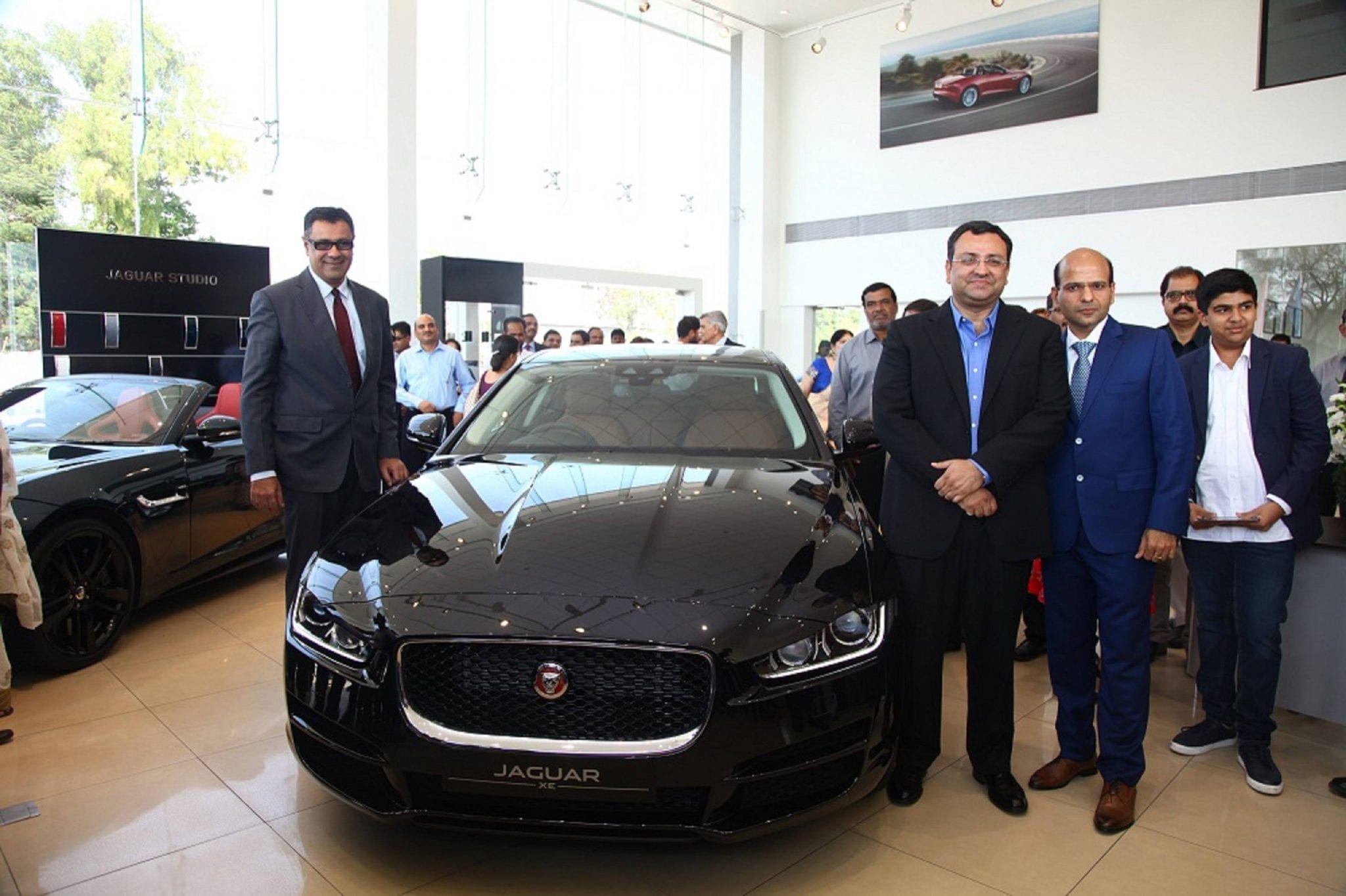
Jaguar Land Rover, the UK’s leading manufacturer of premium luxury vehicles, today reported its best ever September retail sales of 61,047 vehicles, up 28% compared to September 2015. The month’s performance has been driven by strong sales of the Land Rover Discovery, Discovery Sport, the Range Rover Evoque and the Jaguar F-PACE, as well as solid sales in China.
Jaguar Land Rover delivered solid retail sales growth across all key regions year on year, with China up 50%, Europe up 32%, UK up 30%, North America up 23% and other overseas markets up 3%. Jaguar Land Rover sold 434,025 vehicles in the first nine months of 2016, 24% up on the same period in the prior year.
Commenting on the performance, Andy Goss, Jaguar Land Rover Group Sales Operations Director said, “September is always an important month for the automotive industry and we are proud of our results. Performance was strong in China and Europe, where collectively we sold almost 23,000 cars this month alone.
“With the new Discovery launched in Paris this month and sales starting for the first locallybuilt Jaguar in China – the XFL, our British line-up continues to expand and delight in markets across the world.”
Jaguar recorded its best September ever, with retail sales reaching 17,640 vehicles, up 70% on the previous year, reflecting the strong launch of the F-PACE as well as continued solid sales of the XE. Calendar year-to-date sales for Jaguar were 103,366 up 72% year-on-year.
Land Rover strengthened its position as a world-leading manufacturer of all-terrain SUVs, with its strongest ever September sales of 43,407 vehicles, up 17% year-on-year. The strong sales were led by the Discovery Sport, retailing 12,838 vehicles, up 50% compared to last September, and Range Rover Evoque retailing 11,761 vehicles, up 53%. Calendar year-to-date sales for Land Rover reached 330,659 vehicles, 14% up on the prior year.
China’s retail sales rose at a double-digit pace during the week-long National Day holiday in October, data from the Ministry of Commerce showed, but growth slowed slightly compared with last year.
Sales of retailers and catering firms increased 10.7 percent to 1.2 trillion yuan ($180 billion) during the Oct. 1-7 “Golden Week” holiday, the ministry said in a statement posted on its website late Friday. Revenues grew 11 percent a year earlier.
In revenue terms, the holiday is more important for retailers than Chinese New Year as they vie for customers with promotions and discounts.
During the National Day holiday, millions take time off work to travel, get married, and generally spend more money than usual on consumer products such as household appliances, mobile phones, jewellery, clothing and cars.
Economists are closely watching China’s consumption data as the country’s leaders try to bolster the economy, which expanded at its slowest rate in a quarter of a century last year.
Hong Kong retail sales fell again in August – largely due to declining visitor numbers.
The Census and Statistics Department (C&SD) says the value of retail sales in August, provisionally estimated at $33.9 billion, decreased by 10.5 per cent compared with August 2015. That’s sharper than the 7.7 per cent revised decline in July, and slightly above the year-to-date figure of 10.2 per cent.
A government spokesman said the weak performance reflected the drag from the decline in visitor arrivals in August as well as the cautious consumer sentiment amid an uncertain economic outlook.
Meanwhile, the HKRMA said most member retailers are “not optimistic” about sales recovering in September and October this year, but forecasting a lower percentage drop in the single digits.
According to the C&SD, after netting out the effect of price changes year-on-year, sales in August decreased by 12.7 per cent.
As usual, jewellery, watches and clocks accounted for the majority of the decline, that category down 26.6 per cent for the month. Department store sales fell by 10.7 per cent and electrical goods and photographic equipment (which account for a lower share of total retail sales) by 27.9 per cent. Apparel sales were down 3.4 per cent.
Sales of food for consumption at home, alcohol and tobacco rose by 8.8 per cent. The HKRMA said this figure was buoyed by baked goods as people stocked up for the Mid-Autumn Festival.
The government spokesperson said the near-term outlook for retail sales will still hinge on the performance of inbound tourism “and the extent to which local consumer sentiment will be affected by various external headwinds”.
Singapore’s retail sector may be looking gloomy, but all is not lost as six trailblazers share ideas on how to brighten up the scene
To describe shopping here, six individuals – including influencers in their own industries – throw up the words homogeneous, safe, scripted.
The outspoken Ms Patrina Tan, senior vice-president for retail, marketing and leasing at property developer OUE, calls it as it is: boring and dead.
This lack of imagination, compounded by restrictions imposed by landlords, unadventurous shoppers and uninspired service staff, has eroded the Republic’s reputation as a shopping paradise, they say.
One has to look only as far as the ailing Great Singapore Sale (GSS), seen by many as a microcosm of the wider malaise affecting the industry here, to see how times have changed.
Launched by the Singapore Tourism Board in 1994 to market the city, the GSS had helped to cement Singapore’s standing as a shopper’s haven.
Tourists flocked to the island during the sale period, stores trotted out steep discounts and Singaporeans would wait for the sale to make big-ticket purchases.
But its golden days are over. Last week, GSS organisers questioned its relevance after three consecutive years of dwindling takings. Discussions are under way to see if it should be scraped.
Critics say the GSS and brick- and-mortar stores in Singapore have failed to evolve with changing consumer preferences, letting regional competitors such as Hong Kong and Japan steal their thunder.
Others point out that retailers here have a lot to grapple with – a slowing economy, falling tourism spending, a labour crunch, the rise of e-commerce as well as high operational costs.
But, across the board, all agree on one thing: Singapore is simply not the shopping paradise it once was.
Can the island recover its shine?
SIX WAYS TO BEAT THE RETAIL BLUES
1. Loosen up, mall owners
Malls’ uniform appearance and short-term leases make them unappealing to set up business in, says Mr Loh Lik Peng
If hotelier-restaurateur Loh Lik Peng could say one thing to mall landlords, it would be this: Please stop your obsession with the polished, corporate look.
And please, please, give longer-term leases.
This will breathe new life into Singapore’s cookie- cutter retail scene, dominated by shopping malls all too similar to one another, he says.
Drawing from past experience, the director of Unlisted Collection, which runs a stable of restaurants including Salted & Hung, Pollen and Esquina, says malls typically tell prospective tenants to submit a design of their restaurant or shop that is “subject to approval from mall management”.
“I think this is unfortunate because malls here are obsessed about how they look in terms of their facade. You do not encourage innovation when you do that,” says the 44-year-old, who also manages hotels including New Majestic in Bukit Pasoh Road and Wanderlust in Little India.
“You are ‘strongly encouraged’ to have that very sort of, frankly, that very polished look. So you don’t find interesting shop fronts,” says the father of two.
“All the malls want that shiny kind of look with the double storey and huge branding. This uniformity is driven by the malls.”
The Republic has more than 100 malls across the island. Along Orchard Road – the country’s famous retail belt – there are at least 40 shopping centres, with many standing side by side along the 2.2km boulevard.
Despite numerous requests, Mr Loh has yet to open a restaurant in a mall.
“It never reached the stage of us giving them a rendering, we just could not be bothered. Most malls want a cookie-cutter thing. They want the retail experience to be very uniform as the customer walks through. That is just not us,” says Mr Loh, who was one of the first movers in the heritage boutique hotel segment here – he opened Hotel 1929 in Keong Saik Road in 2003.
Non-mall landlords, he says, give tenants free rein and “nobody dictates how you must look, how wide your door is”.
Mr Loh, who is drawn to the quaint vintage shops in Notting Hill in London, as well as the “small-tailoring” shops in the nearby Spitalfields district, says: “You can never get this kind of store here.”
The short lease terms and requirement that tenants put down a large rental deposit, he says, are too prohibitive.
In Singapore, landlords typically offer a “three plus three” retail lease agreement, which is fixed for the initial three years, but leaves room for rental adjustments and a reassessment thereafter.
“If you go to England or Australia, your minimum lease is 15 years. Here, even if you build a successful outlet, chances are, the next round, the landlord will raise the rent because he sees you doing well,” he says.
“It is a landlord’s market in Singapore. Three plus three, it’s crazy, it does not encourage people to take risks.”
2. Know the shopper
Retailers should identify their consumer and build their concept on their target group’s lifestyle and needs, says Ms Patrina Tan
Bigger and better do not cut it anymore – not if you want shoppers to bite.
To get them to stick, businesses must study what makes them tick, says Ms Patrina Tan, senior vice-president for retail, marketing and leasing at property developer OUE.
“Find out what their lifestyle is now, so that you can put forth a proposition that relates to them, that will make them sit up and want to part with their time, attention and money. Then, evolve with them,” says Ms Tan, speaking to The Straits Times at a cafe in Mandarin Gallery, which OUE manages.
This, says the 48-year-old, must be the approach taken to revamp retail here – shops cannot simply import concepts from overseas or hire a good interior designer to create “just another pretty place”.
Adding that many retailers here take this short-cut, she says: “Who can do better in terms of interior design, how sustainable is that?”
“The question to ask is, really, what is it that is holding the customer?”
Downtown Gallery, OUE’s bold retail concept in the Central Business District to open by the first quarter of next year, is the property developer’s attempt to answer that question. But it is not for every shopper, of course – specifically, it targets working adults who value fitness and want to live well.
This market, says Ms Tan, includes the highly sought-after consumer segment, Middle-Aged Men In Lycra or Mamils – cycling enthusiast fathers aged between 35 and 45 who ride expensive racing bicycles for leisure and wear spandex for comfort.
Retail is ancillary at the 145,000 sq ft compound. Instead, it is dominated by services – gyms, chiropractors and a 4,000 sq ft “social kitchen” where shoppers can book slots and bring their own ingredients to cook.
“In this space, they can work out, get themselves cleaned up, have a meal that supports their lifestyle of eating clean, then pick up things they need – like a yoga top – or do their hair,” says the mother of four, adding that OUE works with tenants to pull out specific products to appeal to this target market.
There will also be a trend gallery on the ground floor with the latest “in eating well, keeping well and looking well”.
This laser-beam precision is sorely lacking among retailers here, she says, describing them as “jittery”.
“Halfway through things, they get kiasu and start widening their nets to try and catch a little bit here, a little bit there for fear of losing out. When you do that, everything gets diluted and you end up being nothing to anyone.”
Orchard Road, she says, is still known for its luxury brands, as suburban malls are unable to bait them for now. But the challenge, she says, is for such brands to reach out to the millennials.
“Your Louis Vuitton, Prada, Bottega Veneta – these may not be luxury to them. The definition of luxury is changing. For some, living well is a badge of luxury; for others, it is being able to mix and match different classes of things at different price points to form a statement. Luxury is not confined to brands anymore.”
Shoppers, she says, are now exposed to a cornucopia of brands worldwide – bespoke ones, streetwear and independent labels – many of them more statement- making as far as the individual is concerned.
Retail in Singapore now, “it is boring, it is dead”.
She adds: “Most of the retailers here, sadly, you try to sell them a concept and they just throw up their hands and complain that consumers are jaded and not spending, that online is cannibalising their business, all these excuses.
“But the truth is, what are you doing about it in your own space?”
3. Set up brand temples
The future of retail is to create brand temples where consumers can experience the brand, says creative director Chris Lee.PHOTO: YANG TAN
Brand bombing – where businesses flood the market with outlets, one in every mall – is passe.
Retailers should instead have one or two “brand temples” for shoppers to visit to “breathe in the brand”, says Mr Chris Lee, founder and creative director of design agency Asylum. The bulk of sales can then be conducted online.
Such temples, says the 46-year-old, let retailers introduce themselves and paint a narrative.
“Such temples are a way to get buy-in, to reel consumers in to become advocates,” says Mr Lee, whose firm is behind the branding of National Gallery Singapore.
“People now want to be connected to what they are buying and they want to know the story behind everything – where the fabric is from, how is it made.”
Take, for instance, an Asylum project in Beijing – a four-storey Johnnie Walker House opened in 2013, one of the whisky label’s “brand temples”.
Its reception area is a modern take on a grocery store, as the label’s founder John Walker started as a grocer in Scotland.
From there, you enter a room adorned with the primary ingredients of whisky, with walls of barley, peat and a flowing water wall.
Old Johnnie Walker advertisements from Hong Kong and China in the early 1900s, around the time the brand started reaching out to the China market, are fashioned into lamp shades and wallpaper.
Bottles are tagged with radio frequency identification chips. Place one on the table and it turns into a screen with information of what ingredients are in that particular bottle and how to appreciate it.
The public is allowed into the bar in the basement, but the other floors are open only to invited guests.
Visitors can buy limited-edition bottles that cannot be found anywhere else or customise a barrel.
Such houses, says Mr Lee, helped create an edge for Johnnie Walker in the saturated whisky market.
Other brands are starting to catch on, he says, pointing out Uniqlo’s new flagship store in Orchard Central which boasts curated spaces co-created with home-grown production houses, brands and musicians. When the store opened on Sept 2, consumers queued up to attend workshops and snag limitededition totes.
“People always want a reason to go to a store. I would make the retail space as entertaining as the shopping,” he says, throwing out a suggestion to retailers.
“Why not, instead of selling me clothes, sell me mood. Are you thinking party or a weekend away in Phuket? Then direct me to specially curated areas.
“Shops here just don’t do enough.”
4. Make service staff love the job
Having happy employees gives an edge to a retail store or restaurant, says chef Bjorn Shen.
Give chef Bjorn Shen the chance and he would kill this oft-uttered phrase: The customer is always right.
This mentality, he says, turns away self-respecting individuals who want to work in the service sector – and puts retail in Singapore at a disadvantage.
“This has been my biggest beef with the industry, this phrase, that the customer is always right. It needs to have been dead 10 years ago,” says the 34-year-old, who owns restaurants Artichoke Cafe & Bar in Middle Road and Bird Bird in Tanjong Pagar.
“When business owners have this mentality, staff feel powerless and servile. They will never love their job, they will never see it as something for the long term.”
This is one reason Singapore cannot compete with competition overseas, he says.
“It’s not like in other countries where you walk into a shop and someone says, ‘Hi, how are you? Can I help you with anything? All right I will be here if you need any help.’
“In Singapore, the sales staff say a very scripted thing or tail you wherever you go. A lot of that natural warmth is missing,” he says.
“Ask me what my name is or how my day has been. Don’t just say, ‘What size you want?’ Or, “This one also got this colour.’” he quips, with a chuckle.
The change, says the father-to-be, has to come from the top.
Take, for example, an incident at Artichoke, when a customer demanded to change an order that she claimed was put in “a minute ago”.
Chef Shen quickly checked the restaurant’s CCTV camera and found that the order had been placed eight minutes ago. The diner was told, but left happy after she was served the dish she asked for free of charge.
“My staff, they felt we did the right thing. If I had given them a hard time, they’d have felt a great sense of injustice,” he says, adding that one thing he asks of his staff is to make an emotional connection with every table.
At fried chicken eatery Bird Bird, employees are given a stack of shot glasses and told to hand out free shooters on busy Friday nights.
“What we are trying to create is an atmosphere of generosity. It’s not like we are going to strip you of every dollar you have. In fact, here is something free,” he says, describing the move.
“When you do that, people become better friends. It’s much more than the product, it’s the delivery, the atmosphere, the energy – everything else.”
Having happy staff is what he hopes will give him an edge – which is crucial now, a time he calls “the breaking point” in the service industry.
“We have pushed ourselves to the point that the bubble has burst. How many shops and restaurants can Singapore sustain? How much can someone eat and buy? I think we have gone beyond the breaking point,” he says, adding that businesses have definitely been affected.
“We cannot reverse the fact that we just have too many shops and restaurants. Now, the only way to survive is to find a way to take someone else’s piece of the pie.”
5. Support home-grown shops
Singaporeans can help the retail scene by giving new brands and styles a chance, says artist Woon Tien Wei.ST PHOTO: MARCUS TAN
What ails Singapore’s retail scene is that it is just “too safe”, says home-grown artist Woon Tien Wei.
The curator of Post-Museum, an independent cultural and social space in Rowell Road, says he sees this on all fronts – consumers are too cautious and so are retailers and landlords.
The result is a bland retail destination flooded with duplicate stores from major brands, with sparing content from home-grown designers and few unique offerings.
“We are too safe. Shoppers shy away from exploring new styles, new brands,” says the 41-year-old.
“They stick to the tried-and-tested, the mainstream brands. People should go to a different neighbourhood, see what others are doing.
“It’s like in the arts, people go to big, loud, mainstream events such as the Night Festival. But in such a space, you won’t get to experience the more quiet works. Give them a chance too. Are we watching only blockbuster movies? These are of a cookie-cutter format. What about alternatives? The same can be said about fashion.”
Being nationalistic, he says, should not be just about putting up your flag once a year.
He points out, for instance, that Singapore niche retailers in the books industry – such as Books Actually, Grassroots Book Room and Select Books – would find it hard-pressed to grow.
“I would like to see them grow and become good, big bookstores, like retail bookstore chain Eslite in Taiwan, which has become an institution, a purveyor of culture,” he says.
“I don’t see that happening here. Consumers think of book stores as a sunset business.”
He adds: “There are genuine people out there doing good, honest, solid business and we should get to know them and support them for what they do.”
When consumers shy away from the new and different, it affects retailers, he says.
“They stick to what they know will work and will ensure their survival. They stop imagining,” says Woon, pointing out that even hipster stores in Haji Lane are starting to follow a formula, offering similar clothing and the same bare-essentials decor.
“They will always have the Kinfolk magazine and the Flying Pigeon bicycle,” he says, referring to the hip indie magazine and the retro bicycle brand.
Landlords, too, have this mindset, preferring to take the easy way out by bringing in brands with a good track record: flagship stores of major brand names and luxury maisons.
Rents are also high, a huge challenge for fledgling brands.
“Malls think, I bring an H&M in here, a Uniqlo there – it will work,” he says, adding that prominent spaces in malls tend to be leased to tenants who can pay the most.
“Singapore brands go to less prominent spaces because they cannot afford the rent.
“And with a population that may not seek them out and having no money to advertise, well, it’s just a vicious circle.”
6. Help shoppers hone their style
Fashion stores should curate accessories that complement their products to enhance the shopping experience, says Ms Neo Lirong.
Shoppers these days want to make a statement.
“Retailers should help us do that,” says Ms Neo Lirong, 29.
The freelance fashion stylist mostly shops overseas, at second-hand stores in Omotesando, Japan, or at the wholesale centres in Dongdaemun, South Korea.
These areas, she says, “speak” to her – a feeling that she does not get here.
“Over there, I go from shop to shop and I find something I want in every one. It’s almost like the items have been curated to suit my style,” she says, adding that each area attracts certain shops based on the district’s personality.
Shopping in Singapore, on the other hand, is just “not here, not there”, she says.
“Every mall is so formulaic. It wants to appeal to everyone – there is a movie theatre, something for kids, a supermarket, a foodcourt,” she says, adding that she turns to online fashion stores such as Asos for “the basics”.
“It’s boring in Singapore, there is no vibe. Why would I take the time to go out and shop when I can get everything I want so conveniently online?”
She describes her style as street and rock chic, an image she feels projects her carefree and relaxed personality.
To achieve her look, she picks mostly monochrome colours spiced up with a statement piece – a pair of Gucci fur-lined loafers, for instance, or a studded leather jacket, or a vintage bag.
Occasionally, she throws on a hat or her favourite item, a pair of Adidas sneakers.
“Shoppers like me, we want to stand out from our peers. Dressing up, to me, is about mixing items and making a statement,” she says. “It’s not really about specific brands anymore.”
The bachelorette, who styles Mediacorp artists such as Chen Liping and Rui En, hopes retailers here can help her hone her style.
She suggests they curate accessories or shoes that may complement items in their collection, or have a stylist on site to give tips to shoppers.
Subscription boxes – where shoppers pay a fixed amount each month for a bumper box of fashion items – may also be a good way for businesses to snag her as a loyal customer.
“I may not like every item in the box, but you are giving me new ideas,” she says. “And that’s a real bonus.”
South Korea’s department store sales rose for a third straight month in August thanks to widespread discounting ahead of a major public holiday this month, government data showed on Thursday.
Combined sales at department stores run by Hyundai Department Store, Lotte Shopping and Shinsegae Co rose 4.1 percent on-year, data from the Ministry of Trade, Industry and Energy said.
This followed a 7.0 percent jump in July.
Sales of all individual categories at department stores rose in August, with the exception of men’s clothing.
The same data showed August sales at discount stores fell 1.3 percent from a year ago after rising for two months previously. In August, sales rose 2.1 percent.
The decline was attributed to a 14.8 percent slump in sports-related goods as the unusually hot summer weather this year discouraged customers from seeking them out, the monthly report said.
Online open market sales growth at websites owned by eBay Korea Co Ltd and others slowed slightly to 22.4 percent in August from 31.2 percent in July.
Retail sales overall in August mainly saw demand for household electronics like air conditioners and gifts ahead of the Chuseok holiday season, the data said.
South Korea kicked off a nationwide shopping event on Thursday with a variety of promotions, cultural and entertainment events to draw more shoppers at home and abroad and revive the sluggish domestic consumption.
The massive shopping campaign called “Korea Sale Festa” runs until Oct. 9, involving major retailers, manufacturers and traditional markets, while cultural and entertainment programs for foreign travelers will be held throughout October.
The shopping festival is jointly hosted by the Ministry of Trade, Industry and Energy and the Ministry of Culture, Sports and Tourism to tie up the retail industry with tourism and cultural sectors to unleash pent-up demands in time with the major Chinese holiday season.
A total of 249 retailers, manufacturers and online malls provide discounts and promotions at 59,000 stores across the nation, offering much wider options compared with last year’s fall shopping season when “Korea Black Friday” and “Korea Grand Sale” were held between September and October.
This shopping season isn’t just limited to malls and online retailers. Consumers looking for a new vehicle, phone or television will find some attractive bargains at car dealerships and electronics stores as major companies join the shopping season. Among the big names are Samsung Electronics, LG Electronics, Hyundai Motor, AmorePacific and LG Household & Healthcare.
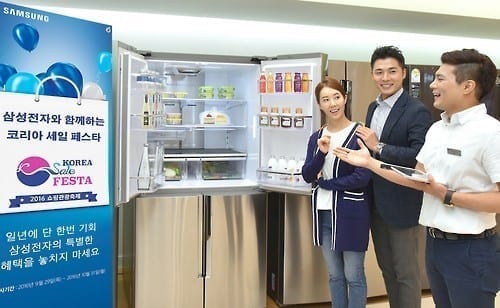
A sales manager at Samsung’s electronics store in Seoul explains discount deals on a refrigerator on Sept. 28, 2016, in this photo provided by the company.
Three car makers — Hyundai Motor, SsangYong Motor and Renault Samsung Motors — offer up to a 10 percent discount on cars during the period, while Samsung Electronics and LG Electronics give half priced deals on best-selling home appliance items. Consumers can get up to a 670,000 won discount (US$612) on Samsung’s Galaxy S6 Edge Plus smartphone.
Department stores give deep discounts on luxury goods, fashion items and cosmetics, knocking down price tags by up to 80 percent.
Among the top price for a giveaway event is a 700 million won apartment offered by Lotte Department Store, the retail unit of Lotte Group.
Online malls and social commerce sites, including Coupang and Ticket Monster, are also offering cyber deals during the period, with the government supporting part of their delivery fees to boost sales.
About 400 traditional markets nationwide will hold various events and unique festivals in October to catch the eyes of visitors and spur the local economy.
The event held ahead of the year-end holiday season is raising expectations among local retailers as it overlaps with a Chinese national holiday that runs from Oct. 1-7. It’s when deep-pocketed Chinese travelers hop on planes to go on a holiday shopping spree.
According to industry officials, about 250,000 Chinese tourists are expected to visit South Korea during the weeklong autumn holiday.
With so much money up for grabs, local retailers have prepared a bunch of promotional events and giveaways targeting Chinese patrons.
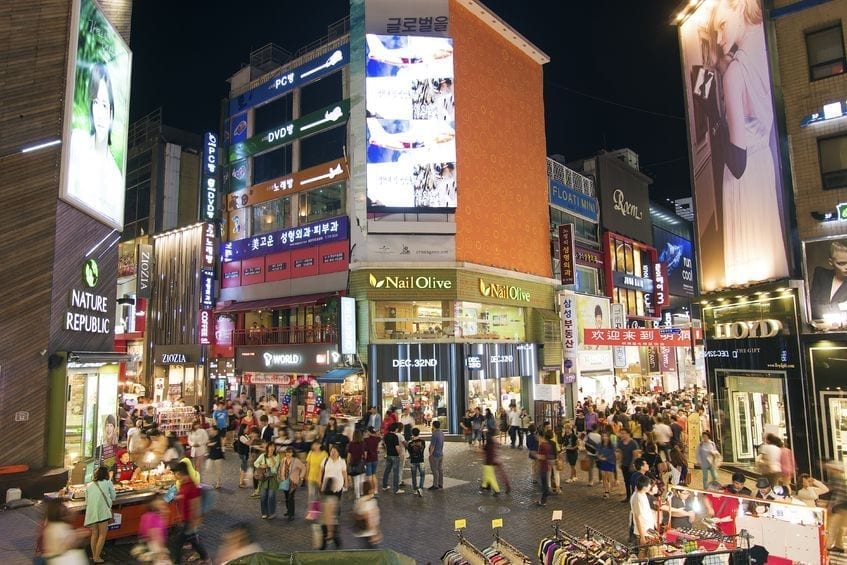
Myeongdong, the busiest shopping street in downtown Seoul, has transformed to embrace Chinese travelers, supplementing Chinese-speaking shop assistants and putting up Mandarin signs for the latest beauty products.
Duty free stores, which heavily rely on Chinese travelers, also offer promotional and entertainment events, teaming up with credit card companies.
Shinsegae Duty Free holds “K-beauty and fashion week” during the Chinese holiday at its Myeongdong branch to attract those who are interested in beauty know-how and encourage purchase of Korean beauty products.
Market watchers say the influx of Chinese tourists will give much-needed momentum to revitalize the tepid domestic consumption, which will in turn drive up shares related to consumption and leisure.
“While last year’s sales event was mostly about offering discount deals, Korea Sale Festa is more systematic with wider discounts and cultural events for foreign travelers,” Nam Ok-jin, a researcher at Samsung Securities, said. “Special offers given during (China’s) National Day is expected to maximize the effect.”
The food industry has done more than relieving hunger as it has also made huge impact in the overall economic growth of Singapore, contributing a bulk to the city-state’s GDP.
According to the Food Industry Asia report by the Oxford Economics, F&B industry contributes an estimated $14.4 billion to GDP and employs nearly 300,000 people.
The study revealed that overall impact of the food industry is dominated by food distribution.
“The wholesale and retail of food, along with activities linked to Singapore’s 6,700 food service locations (which include restaurants, coffee shops and street hawker stands) account for two-thirds of the food industry’s GDP contribution, and four-fifths of the employment it supports,” the study said.
Meanwhile, the food manufacturing industry has also made a huge impact on Singapore’s GDP, with its direct support for 38,800 jobs.
In 2014, the food manufacturing industry earned S$9.8 billion from sales in Singapore.
More so, food manufacturers’ supply chain spending within Singapore supported $1.6 billion of domestic procurement, $610 million of GDP, 6,100 jobs, $31 million in tax revenues, and S$37 million in Central Provident Fund contributions in the same year.
“Based on the report’s findings, the food manufacturing industry is equivalent in size to Singapore’s aerospace industry, and larger than industries such as speciality chemicals, petrochemicals, medical technology and land transport engineering,” the study noted.
August shopping data from tax refund specialist, Global Blue, indicates a downward trend in tax-free in-store sales of -13% (year-on-year) – the worst decline since the start of the year and a big fall compared with July’s 0% change.
There are stark differences in August tax-free sales, largely because of the beneficial ‘MERS effect’ in Korea.
While transactions rose significantly in August by +25%, the decline of average spend at -30% clearly shows that individual travellers are spending less and this is probably due to a combination of factors ranging from China’s customs clampdown, a different passenger profile, and currency influences.
Global Blue says: “The rise of less affluent middle class Chinese travellers continues to bring down the average spend of tax-free shopping globally, with a sizeable impact in Asia. Across the region more ‘value seekers’ from second-tier and third-tier cities are growing their transactions, but with less affluent spending patterns.”
Duty free and travel retailers can take comfort from the rising number of travellers in Asia, which correlates with higher numbers of transactions in South Korea, Japan and Singapore. But, says Global Blue, the overall sales performance in the region is significantly limited by the headwinds of a stronger yen in Japan and Chinese spending in the region increasingly being driven by value-seeking shoppers who spend less.
COMMON THEME IS LOWER SPEND POTENTIAL
The travel boost is not compensating for the spending fall in key duty free and travel retail locations such as Singapore and Japan – while Hong Kong (downtown) does not even have the benefit of rising traveller numbers.
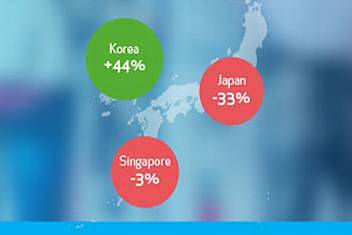
All Global Blue’s Asia tax-free shopping destinations rely on increased arrivals and traffic, yet the common theme is lower spend potential. With -33% sales in August, Japan has been affected by the strong currency, which has negatively impacted the number of transactions.
Transactions are strongly up but average spending is even more strongly down.
Global Blue estimates that 23% of Japan’s negative sales performance this month is driven by the softer yen and the other 10% is due to increased numbers of less affluent Chinese shoppers arriving in Japan (+20 to +30% more in the first half of the year at Narita airport) from second-tier and third-tier cities.
South Korea’s sales performance of +44% this month (versus an impressive triple-digit growth of +215% for July) is on the back of highly beneficial comparisons to last year when the MERS virus took a big toll on traffic.
ASIA YEAR-TO-DATE DOWN -21%
Transaction numbers are significantly up across all globe shopper nationalities in Asia, except for Hong Kong (-10%), reflecting the increase in air arrivals across Japan and South Korea. Taiwanese globe shoppers (+43%) showed the highest transactions growth in the region in August, followed by Chinese (+28%), with Thais and Indonesians up too. However, the decline in average spend per transaction is a long-term trend.
Global Blue estimates that the new Chinese value seekers are having a negative impact of between -6% and -10% across Asia as their demand for regional travel increases, driven by the Chinese government’s strategy of strengthening the economy by localising discretionary spending.
Year to date tax-free sales performance across the region is flat and average sales are down -21%. A less favourable economic situation in mainland China is also not helping travel spending: for example Japan’s current picture YTD is a +26% increase in transactions and a decline of -25% in average sales.
Going into last week’s Chuseok holidays, expectations were low in the retail sector due to a prolonged economic slowdown and a soon-to-be-implemented anti-graft law that will make expensive presents unlawful.
Against all odds, however, four major department stores in Korea enjoyed growth in the sales of holiday gift sets. To skirt an anti-graft law known as the Kim Young-ran Act, which goes into effect Sept. 28 and bans the exchange of gifts costing more than 50,000 won among civil servants and even journalists, the stores offered lower-cost gift sets.
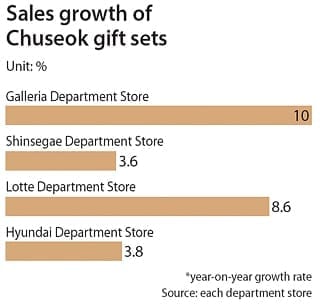
Galleria Department Store said sales of holiday gift sets rose 10 percent between Aug. 26 and Sept. 14 compared to the same period last year.
The proportion of products that were cheaper than 50,000 won was 26 percent – the highest share and 6 percentage points more than last year. Products that cost more than 300,000 won accounted for 14 percent, 1 percentage point lower than last year.
Galleria Department Store expanded gift options that cost less than 50,000 won from last year’s 56 items to 478. As a result, revenue generated from 50,000-won-or-less products rose by 47 percent year-on-year.
Lotte Department Store said sales of holiday gift sets between Aug. 26 and Sept. 13 rose 8.6 percent year-on-year. Sales of processed food products and daily necessities – which usually cost less than 50,000 won – rose by 16.5 percent. But sales of meat and gulbi (dried corvinas) – relatively expensive holiday gifts – only increased by 6.5 and 3.8 percent respectively.
Hyundai Department Store said its holiday gift set sales between Aug. 29 and Sept. 14 rose by 3.8 percent.
Shinsegae Department Store saw a sales increase of 3.6 percent in Chuseok gift sets sold between Aug. 26 and Sept. 13. Products or sets cheaper than 50,000 won saw an increase of 7.8 percent while more costly items only rose 2.9 percent.
The Kim Young-ran Act was not the only factor in holiday spending.
An unprecedented heat wave during the summer on top of a prolonged economic slowdown prompted many consumers to buy health supplements, which are cheaper than agricultural and marine products.
The most popular product was red ginseng extracts or pills. Health-related products saw a sales surge of 26 percent year-on-year at branches of Galleria Department Store. The top seller in the health category was red ginseng extract, which is in the 80,000-won price range.
Shinsegae, which is known for its extensive and affordable wine selection, said sales of wine rose the most – 40.5 percent – followed by health-related items, which rose by 20.8 percent year-on-year.
Health-conscious products were the most popular at Lotte as well, enjoying a 28 percent year-on-year increase in sales.