Tag: Vietnam

  • Lotte plans second Hanoi mall

    Lotte plans second Hanoi mall

    South Korean conglomerate Lotte is to build a second Hanoi mall.

    It will be in a 200,000 sqm complex near West Lake in the Vietnamese capital, The Korea Heraldreports.

    Included in the mall will be a department store, supermarket and a cinema, all to be directly run by Lotte affiliates.

    Construction is set to start within the next couple of months for completion in 2020.

    It has been reported that the project, previously known as Ciputra Ha Noi Mall and owned by the Citra West Lake City Development Company, was acquired by Lotte this year.

    Started in 2007 with an estimated investment of US$2 billion, the project has been stalled for various reasons.

    The total investment capital of the new Lotte project is expected to reach nearly $300 million.

    The Lotte Group invested $400 million in the 65-storey Lotte Center Ha Noi mall, currently the second-tallest building in the city.

    The Korean giant plans to expand its retail network in Vietnam through mergers and acquisitions, and plans 60 shopping malls in the country by 2020 – a five-fold increase, reports Nikkei.

    Lotte has 285 shopping centres in Asian countries including China, Indonesia and South Korea, and views Vietnam as one of the fastest-growing retail markets in the region. In October, Lotte Mart launched its e-commerce channel in Vietnam following the introduction of Lotte Shopping TV in 2012.

    As well as providing South Korean products to Vietnamese consumers, Lotte plans to export Vietnamese products like coffee, dried fruit, wooden artifacts and ceramics back to its home market.

  • 20,000 farmers join in international standard tea production

    20,000 farmers join in international standard tea production

    Nearly 30 firms and 20,000 farmers will take part in producing 25,000 tonnes of tea of international standards in a project to promote the private-public partnership (PPP) model in tea production.

    The information was released at a conference to launch the second phase of the project “promoting tea farmers to join the sustainable and quality tea supply chain” in Hanoi on February 28.

    The project, jointly implemented by the sustainable trade initiative (IDH) organisation of the Netherlands, the Unilever group and the Ministry of Agriculture and Rural Development (MARD), aims to train and provide technical assistance for farmers to produce tea certified by the Rainforest Alliance (RA).

    Le Quang Chuyen, Deputy Director General of the My Lam Tea JSC in northern Tuyen Quang province said the PPP model has helped improve tea quality and productivity while saving production costs and labour. Their tea products meet food safety requirements of the EU and Japan.

    Tran Vu Hoai, Vice President of Unilever Vietnam, underlined tea quality improvements after three years of implementing the PPP model, saying that the group raised its import volume of Vietnam’s tea from 5,000 tonnes to 11,000 tonnes.

    He expressed his hope that with the model will continue improving Vietnam’s tea quality and the group can import up to 20,000 tonnes of tea from Vietnam.

    Under the second phase of the project, 15 factories and 6,500 households are expected to work together and produce 25,000 tonnes of tea, including 15,000 tonnes of RA certified tea, which are shipped overseas and supply for Unilever.

    So far, only eight firms have registered to join the project.

    Besides, the Vietnam Tea Association is implementing an IDH-funded project on the quality and sustainability of the tea industry. The project aims to enhance Vietnam’s tea quality to meet international standards.

  • More than 14,000 enterprises established in Vietnam in two months

    More than 14,000 enterprises established in Vietnam in two months

    More than 14,450 enterprises were set up in the first two months of this year, with a total registered capital of over VND152.5 trillion (US$6.71 billion), up 3.9% in terms of number of enterprises and 35% in terms of registered capital over the same period in 2016, according to the Business Registration Management Agency.

    The average registered capital per new enterprise reached VND10.6 billion (US$466,000), an increase of 29.9% against the same period of last year.

    However, in February alone, more than 5,400 enterprises were established, with VND62.2 trillion (US$2.74 billion) worth of registered capital, a decrease of 39.3% in the number of enterprises and 31% in registered capital compared to January.

    The fall in number of newly established enterprises was due to a long Tet holiday in late January and early February.

    The first two months of this year also saw more than 7,900 enterprises resume their operations, up 7.6% compared to the corresponding period last year.

    In the meantime, about 2,500 enterprises were dissolved, up 14.9% compared to the same period of 2016, including more than 2,300 enterprises with a registered capital of less than VND10 billion (US$440,000) while more than 16,300 enterprises registered to suspend operations.

    The sectors that attract the participation of a large number of labourers include the processing and manufacturing industry, wholesale and retail sales, automobile and motorcycle repairs and construction, among others.

  • Techcom trust debuts on HOSE

    Techcom trust debuts on HOSE

    Techcom Việt Nam Real Estate Investment Trust (TCREIT) made debut on the HCM Stock Exchange (HOSE) yesterday under the code FUCVREIT at a par value of VNĐ10,000 (44 US cents) per fund certificate.

    Five million FUCVREIT fund certificates were floated on the southern bourse, without a specific due term for the fund’s being traded. Changes in the due term will be
    decided by investors’ resolutions.

    HOSE said in a statement that this was also the first domestic-invested fund in Việt Nam’s  securities market. The trust fund was founded by the Techcom Capital Co Ltd (TCC), an investment arm of Techcombank.

    Ending the first session, its price closed at VNĐ12,000 apiece with 8,330 fund certificates exchanged.

    The investment trust was founded as a closed-end fund with initial capital of VNĐ50 billion (US$2.22 million). The fund expects to increase its capital in the future to meet
    investors’ demands when targeting potential real-estate projects.

    By making investments in Techcom Capital’s property investment trust, domestic and overseas investors can indirectly own part of potential real-estate projects and receive
    constant earnings from those projects without spending money on direct investments in the projects.

    In addition, with the fund’s trading on HOSE, investors can buy and sell fund certificates more easily, compared to trading in a real-estate project.

    A REIT fund is founded by investors’ capital when they purchase fund certificates and authorise the fund management board to supervise their shares. A real estate
    investment fund often spends most of its net asset value (NAV) investing in real-estate projects and real-estate companies.

    The domestic real estate investment fund has a long-term investment strategy focusing on property projects, such as office buildings, hotels, resorts and shopping centres,
    which generate constant earnings for the fund from leasing and business activities.

    The fund will also consider making investments in projects, such as apartment buildings and housing, which are developed by reputable institutional developers and have high
    possibilities of price increases, to benefit from selling products in those projects.

    In Việt Nam, there are some foreign-invested real-estate investment trusts, such as Vinaland by the VinaCapital, VPF by the Dragon Capital and VPH by the Saigon Asset Management. These funds mobilise capital from overseas investors to purchase stakes in Việt Nam’s real-estate projects and property stocks, after which the funds will be
    listed on overseas stock exchanges.

    According to current regulations, of the total NAV, a REIT must spend at least 65 per cent investing in real-estate projects and property stocks and, at most, 35 per cent investing in other types of assets, such as deposits, bonds and securities.

    When the fund seeks capital via an initial public offering (IPO) and/or increases its capital, investors can purchase more fund certificates by making payments in cash or
    they can contribute their stakes in real-estate projects to receive the amount of certificates that are of equal value to the stakes in property projects.

    This could become a new tool to help investors offload their stakes from real-estate projects by selling their fund certificates, if the projects have low trading liquidity in the property market.

  • VietJet stock jumps 20 pct on debut – exchange

    VietJet stock jumps 20 pct on debut – exchange

    That’s the maximum jump allowed for stock price on its debut day by Ho Chi Minh Stock Exchange. Vietnam’s biggest private airline, jumped by the maximum 20 percent limit in early trading on debut on Tuesday to hit 108,000 dong ($4.74), data from Ho Chi Minh Stock Exchange showed.

    The budget airline’s stocks rose from a starting price of 90,000 dong per share. A combined 103 shares were traded by 0233GMT, the data showed.

    The bourse allows the stock price to move a maximum of 20 percent up or down from the starting price on its debut day.

    On February 13, Vietnamese budget airline Vietjet Aviation VJC.HM would list on the domestic Ho Chi Minh Stock Exchange on February 28 at a starting price of 90,000 dong ($3.97) per share.

    The price announced by Vietjet would put the capitalization of Vietnam’s biggest private airline at $1.19 billion.

    The airline had intended to list overseas by last year, but the plan was put on ice. Singapore sovereign wealth fund GIC and a Morgan Stanley investment fund are among 26 foreign investors which recently bought a stake in VietJet.

    Company CEO Nguyen Thi Phuong Thao, the nation’s first female billionaire, is the biggest shareholder.

    The CAPA Center for Aviation has said that VietJet, which currently commands 40 percent of Vietnam’s domestic market, will likely surpass flag carrier Vietnam Airlines this year as the nation’s top domestic carrier.

    VietJet currently operates about 60 routes both locally and internationally, and expects to have a fleet of 200 aircraft by 2023. It had ordered billions worth of jets from both Airbus and Boeing in recent years.

    Its 2016 net profit jumped 96 percent annually to VND2.29 trillion on rising revenue, the filing showed, while its CEO Thao told the bottom line is expected to climb 30 percent this year.

  • Vietnam’s annual e-commerce growth to reach 30-50%

    Vietnam’s annual e-commerce growth to reach 30-50%

    “The size of Vietnam’s e-commerce market may reach $10 billion within the next five years,” he added.

    Ms. Dang Thuy Ha, Chief Representative at market researcher Nielsen in Hanoi, said the e-commerce market was worth up to $4 billion last year.

    Of Vietnam’s 91 million people, she said, 45 per cent access the internet and 28 per cent use e-commerce.

    Each person spends $160 a year on shopping via e-commerce platforms. Therefore, growth in e-commerce is 22 per cent, according to Nielsen’s report.

    The report also notes that the number of people using smartphones has increased sharply, giving a boost to e-commerce.

    Thirty-two per cent of enterprises have set up business relations with foreign partners through online channels and 11 per cent have participated in electronic trade floor and website activities, according to a VECOM report.

    Ms. Tran Thi Phuong Lan, Vice Director of Hanoi Industrial and Trade, said that retail revenue via e-commerce in the capital stood at VND30 trillion ($1.3 billion) last year, representing 6 per cent of total retail revenue and up 15 per cent against 2015. More than 5,600 e-commerce websites are registered in Hanoi.

    VOBF 2017 had five sessions: Overview, Cloud Technology and Mobile Phones with E-commerce, Omni Channel, Cross Border E-commerce, and Online Startups. The Vietnam E-commerce Index 2017 was also released.

    This is the first time the Forum has been held. Speakers included representatives from the Vietnam E-commerce and Information Technology Agency, Nielsen, Google, Facebook, Vietnam Post, Verisign, and Lazada.

    Attendees had the chance to meet with representatives from Z.com, VeriSign, Matbao, Bizweb, Gimasys, TrustPay, Interspace, Netnam, and iNet. The special features of startups in the sector was also discussed.

    VOBF 2017 will be held in Ho Chi Minh City on March 3.

  • Free trade agreements fuel cosmetics market in Vietnam

    Free trade agreements fuel cosmetics market in Vietnam

    The assessment was released at an event to introduce the Mekong Beauty Show 2017 in Ho Chi Minh City on February 23.

    Statistics show that Vietnam’s cosmetics market is potential with revenue of 26 trillion VND (1.14 billion USD) in 2015 and has maintained a double-digit growth rate for several years.

    While Vietnamese consumers’ spending on cosmetics is still four-five times lower than other regional countries, the middle class, which has high demand for beauty products, is growing strongly and forecast to double its current size to 33 million people in 2020.

    Ly Nguyen Lan Phuong, a representative of the Saigon Cosmetics Corporation, said despite such huge potential, domestic businesses’ technological capacity and financial strength remain modest. As a result, the local market is still dominated by foreign brands.

    Claudia Bonfiglioli, International Director of Informa Beauty, said to compete in the domestic market, aside from improving quality, cosmetics producers of Vietnam should keep innovating.

    Nguyen Van Minh, Vice Chairman of the Vietnam Association of Oils, Aroma and Cosmetics, said to help promote the industry’s development, the association has carried trade and investment promotion activities.

    Among those efforts, the Mekong Beauty Show 2017 is aimed to connect Vietnamese enterprises with other domestic and foreign partners to seek cooperation opportunities. It is also expected to become a leading trade forum on cosmetics and beauty products in the region.

    The show is slated for June 15-17 with the participation of more than 200 companies from the EU, the Republic of Korea, Thailand, Malaysia and Singapore.

  • New regulations legalise betting services

    New regulations legalise betting services

    Previously, casinos were only open to foreign passport holders and gambling was illegal in Vietnam. The prime minister recently signed Decree 6 that allows eligible firms to sell tickets and provide betting services on horse and dog racing and betting on foreign football matches.

    However, firms are not allowed to determine the time to start and end the betting and only Vietnamese dongs are allowed to use in betting. The decree also states that the government does not encourage the development of these services. The project is still in the pilot stages, and customers would be able to participate in legal football betting from March 31.

    According to the Ministry of Finance (MoF), there are many illegal betting services and the authorities don’t have enough personnel to manage and control these services. The MoF said those services could cause negative effects on social order and lead to the illegal transfer of money abroad.

    The new regulations are expected to help the authorities better manage betting services. A new decree on casinos was also issued in January to attract investors into resorts projects and boost local tourism. The 3-year pilot programme allows Vietnamese to gamble in casinos.

    The MoF said legal betting would satisfy ‘entertainment demand’, reduce illegal gambling sites and stop people spending money abroad.

  • Tariffs are cut, import prices fall, but cars are still pricey

    Tariffs are cut, import prices fall, but cars are still pricey

    According to GDC, in January 2017 alone, Vietnam imported 1,000 cars from India, worth $3.7 million in total. The average import price was $3,700 only, or VND85 million, the price level described as ‘surprisingly low’ and ‘dirt cheap’. The imports from India are mostly Hyundai i10 and i20.

    However, Vietnamese cannot buy imports at VND85 million. The amount of money they have to pay will be four or five times higher.

    As explained by a car dealer, imports from India are taxed 70 percent. Besides, they are also subject to other kinds of tax, including luxury tax (35 percent for 1.0-1.5L cars) and VAT (10 percent).

    Imports also bear many other different kinds of fees, such as ownership registration fee (10-12 percent, or VND233-237 million), the number plate granting fee (VND20 million in Hanoi), registration fees (VND340,000 for the first time), and road maintenance fee (VND130,000 a month).

    At present, a Hyundai i10 is sold at VND350-450 million in the market, or five times higher than the factory price.As such, every import product from India would cost VND260 million on average after taxes and fees. Meanwhile, the selling prices will be defined after adding up distribution expenses, profits for distributors, storage fees, and marketing & advertisement costs.

    The same is occurring with imports from ASEAN. Though the import tariffs have been cut from 40 percent 30 percent since early 2017, the selling prices are still many times higher than the import prices.

    Nguyen Tuan, director of Thien An Phuc, a distributor, said a Toyota Fortuner from Indonesia has the CIF price of $27,500, or VND700 million. However, the selling price could be as high as VND1.3 billion.

    “Because of high taxes, Vietnamese have to pay high to own cars,” he explained, adding that the selling price in Vietnam is 2-3 times higher than in other regional countries.

    By 2018, when the import tariff goes down to zero percent, the price of one Fortuner would fall by VND290 million thanks to the tariff cut. Many people don’t buy cars at this moment, because they don’t want to waste hundreds of millions of dong on car tax.

    Ngo Tri Long, a renowned economist, said people hope the car prices would be decreasing once the tariffs are cut. However, sharp price decreases may not occur, because the car prices not only depend on import tariffs, but also on luxury taxes, fees and pricing strategies followed by car distributors.

    “In Vietnam, you’d better not dream of cheap cars,” he said.

  • Vietnamese spend big on foreign high-street clothes

    Vietnamese spend big on foreign high-street clothes

    Huong, an office worker in Hoang Mai district in Hanoi, said she reserves a budget of VND2-3 million for buying new clothes every month. But she does not want products bearing Vietnamese brands, but preferably orders Zara and Mango products from overseas shops online.

    Huong said that the foreign high-street products are now affordable for office workers like her.

    “Why don’t you choose foreign brands if they have diverse design, good materials and reasonable prices?” she said.“Manufacturers and distributors often launch sale promotion campaigns with big discount rates. I can buy many products at the prices just equal to or even cheaper than Vietnam’s export products,” she explained.

    Oanh, an account executive in Hanoi, said she looks for Zara, H&M, Mango and Uniqlo products regularly, which allows her to buy high-quality products at reasonable prices.

    Sometimes she can buy products at just VND1 million or lower in sales campaigns.

    “I never buy Vietnamese goods during sale promotion campaigns because I am not sure about the actual value of the goods,” she said. “Meanwhile, no need to worry about this when you buy products from these brands. And the prices are very good”.

    Huong and Oanh order the products online and pay fees to have the products shipped to Vietnam. There are many shipping agents in Hanoi, who are in charge of receiving products, carrying to Vietnam and delivering to clients.

    Thuy Linh, one of the agents, commented that Vietnamese clients mostly order clothes and footwear, and 80 percent of ordered products bear high-street brands such as Zara, Mango, and Forever 21, while the remaining 20 percent are luxury brands.

    Linh said she is always busy so Vietnamese tend to favor foreign high-street brands. A T-shirt with Zara or Mango brand can be bought at VND180,000 only, including fees, which is cheaper than Chinese products.

    Understanding the Vietnamese taste and realizing the rapid increase of middle-income earners in Vietnam, a lot of high-street brands have been conquering the local market. Zara, the fashion brand from Spain, has been present in Vietnam since mid-2016. Mango, which targets customers aged 18-40, has been present in Vietnam since 2004 through a franchise contract signed with Maison JSC.

    In the latest news, H&M has begun employing workers to prepare for its landing in Vietnam. The Swedish brand’s first shop would be in Hanoi, cover an area of 2,000 square meters and employ 100 workers. The recruitment will also be implemented in HCMC.

  • Malaysian bubble-tea stoush now question of loyalty

    Malaysian bubble-tea stoush now question of loyalty

    Malaysia’s Chatime bubble-tea stoush continues, with a fresh argument regarding outlet loyalties.

    Taiwanese Chatime franchise owner La Kaffa International says nearly 50 outlets will stay with it, while former Malaysian master franchisee Loob Holdings claims that only four outlets have opted to keep the Chatime banner.

    Loob CEO Bryan Loo says more than 95 per cent of the total 165 Chatime outlets in Malaysia have decided to quit the brand and adopt Loob Holding’s new brand.

    “Only three franchisees, who run a total of four stalls, do not want to move on with us. They will be handed back to the franchise owner,” he told journalists at Kuala Lumpur’s Pavilion Shopping Mall after launching his new brand, Tealive.

    He did not name the franchisees or pinpoint their outlets.

    Loo says the new name was chosen to appeal not only to Malaysians, but across the other regions – and internationally.

    “So we felt like we had to find a very good name; and it had to be different from Chatime. We started with over 300 names and over three days, we shortlisted it down to 30 names and then the last one. In the end, we wanted a name that was simple and easy to digest no matter who you are.

    “While shortlisting, we felt that we exceptionally liked the names that had different pronunciations.

    People used to pronounce Chatime in so many different ways and it stirred conversation. So we wanted the same spirit; and that’s how we landed on the name Tealive (live pronounced similar to ‘a live show’). Some people could pronounce it tea-live (as in live at home) but the important thing is the underlying meaning to it – we want to bring a new life to tea.”

    Loo said in an interview that Tealive will be very different to other brands in the crowded bubble-tea market.

    “We want to be the brand that protects the weak and isn’t afraid of the strong; but also the brand that embraces changes. On the other side, with our hands untied, I believe that over the next quarters there is going to be a lot of innovation in terms of products, which we couldn’t do before.

    “When we used to collaborate with local brands, we were served warning letters; so moving forward that’s something we don’t have to worry about, so we can be innovative. I would also like to establish a regional R&D centre to come up with more creative drinks that will excite the market. Also, we’re looking to carry on with our aggressive expansion and move into other regions. We were already planning to do that with the previous brand, but now we get to do it with Tealive,” Loo said.

    La Kaffa contradicts claims

    At a press conference in a Kuala Lumpur hotel earlier this month, La Kaffa International executive VP Teresa Wang said the company was confident that nearly 50 franchisees would continue to collaborate with Chatime.

    At the same time, La Kaffa claimed Loob Holdings had stopped ordering the halal ingredients it supplied from Taiwan for Chatime’s Malaysia outlets. Loob Holdings has denied this, with Loo saying its products are certified by the Department of Islamic Development Malaysia (Jakim).

    The dispute bubbled to the surface in early December when the Taiwanese company terminated the master franchise agreement between the two parties, even though there was more than 20 years left on the deal.

    Loo has lodged a police report over the sudden termination, and both companies have taken the dispute to the Singapore International Arbitration Centre.

    Vietnam foray

    Meanwhile, Loo says Tealive will be opening its first overseas outlet in Vietnam before October.
    “We plan to deliver five outlets in Vietnam this year, and hope to increase that with another 20 outlets by the end of next year,” he says.

    Chatime is already in Vietnam with seven outlets in Hanoi, two in Ho Chi Minh City and one in Di An, Binh Duong province.

    Loo says Tealive will also venture into other Asean countries within the next few years.

  • World’s largest container ship docks in southern Vietnam

    World’s largest container ship docks in southern Vietnam

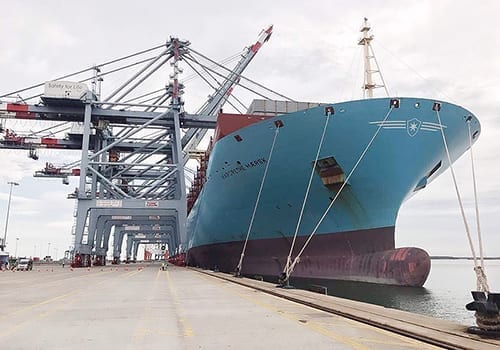
    A giant container vessel arrived at Cai Mep International Terminal in Vietnam’s southern region Monday, helping mark the port on the world’s shipping map.

    The 194,000-DWT Margrethe Maersk of 399 meters long of the world’s biggest container ship family was built in 2015 and is owned by Denmark’s Maersk Line. The vessel can carry 18,300 TEU (twenty-foot equivalent unit).

    Cai Mep in the southern province of Ba Ria-Vung Tau is now among the world’s 19 ports which can accommodate Triple-E class container ships of more than 18,000 TEU.

    Vietnamese transport officials said the arrival marked “a milestone” in the country’s shipping history as they aim to develop Cai Mep into a transit port for cargo shipping between Asia and northern Europe.

  • Taxis claim unfair competition

    Taxis claim unfair competition

    Ta Long Hy, chairman of HCM City Taxi Association, told a conference on Thursday that the taxi market has seen unfair competition between traditional firms and foreign companies with strong financial potential and state-of-the-art technologies.

    Hy said the number of licenced traditional taxis with less than nine seats in HCM was reduced from 20,000 in 2010 to 11,000 this year. The rapid development of Uber and Grab has quickly narrowed the traditional taxi market share, hurting cabs in their own playground due to decreasing number of passengers and incomes.

    Tax policies are also causing concern for traditional taxi firms, including a 10 per cent value added tax and 20 per cent corporate income tax. “The Ministry of Finance (MoF) levies 3 per cent VAT for Uber. We urge authorities to impose a common tax policy for both traditional and tech-based taxis of 5 per cent,” he said.

    Do Quoc Binh, chairman of Ha Noi Taxi Association, said taxi companies are bound by strict business conditions regarding parking areas, registration licences, logos, price lists, uniform and price registration, while Grab and Uber are not subject to any conditions.

    “The Government’s policies seem to be tightening the operation of traditional taxis while loosening management of Grab and Uber,” Binh said.

    He said Uber and Grab should be managed as regular taxi firms to create fair competition.

    Truong Dinh Quy, Vinasun Corp’s deputy general director, claimed Uber and Grab had broken the law to enjoy low tax rates, hurting the State budget.

    Figures from the General Taxation Department showed that the total tax collection from 15,000 Uber and Grab taxis in 2014-15 was VND19 billion (US$832,000), while Vinasun contributed VND692 billion from its 6,000 taxis.

    “We can see that the State budget has lost a big tax amount. This has been unfair to traditional taxi firms,” Quy added.

    Nguyen Van Thanh, chairman of the Viet Nam Automobile Association, said the association would work with the MoF’s agencies to review tax calculation and ensure their fairness.

    “We should ask legal agencies to resolve the issue. We should prevent Uber from conducting tax evasion. We will not ask to stop Uber operations in Viet Nam but require that they complete their business registration,” he added.

    In addition, he urged taxi companies to update their business systems, improve service quality and thus enhance their competitiveness.

  • First Japanese apartments in Phu My Hung launched

    First Japanese apartments in Phu My Hung launched

    Prestigious real estate developer Phu My Hung plans to launch its new apartments, developed in cooperation with three leading Japanese partners, in Ho Chi Minh City in the coming weeks.

    The Grande is built over 5,540 square meters. The 26-floor building, with two basements, has 309 apartments and 13 shops. There are options for apartments ranging from 69 and 249 square meters with one to four bedrooms. Two-bedroom apartments account for 62 percent of all the units.

    Customers will have 28 months to pay for half of the prices, the investors said. They will pay another 45 percent when receiving the apartment and the remaining 5 percent when receiving the ownership certificate.

    The project is guaranteed by Vietcombank’s South Saigon Branch and Vietnam International Bank, which also work with the investors to provide interest rate support for customers seeking bank loans.

    Midtown, a complex of condos, office and retail space and amusement centers, is Phu My Hung’s biggest investment the past three years, with many high-end facilities, some of which have never appeared at any Phu My Hung projects.

    Phu My Hung Midtown hopes to bring a new concept about living space, which should be a perfect combination of facilities instead of an individual house.

    The complex is the first one built with cooperation from three leading Japanese property developers – Daiwa House Group, Nomura Real Estate Group and Sumitomo Forestry Group, which together account for 50 percent of the property market in Japan.

    A Phu My Hung executive said Japan is a country with good infrastructure and great experience in infrastructure development, especially for complex and high-rise buildings.

    “Our meaningful cooperation with strong, experienced partners will help achieve desired goals and quality in our construction projects,” he said.

    The complex is designed as a multi-facility zone at different levels, allowing its residents to access all kinds of services from inside to outside the house without having to go far.

    Golf simulation studio inside The Grande.

    Golf simulation studio inside The Grande.

    The Grande, for example, is designed with many exclusive services for its residents such as swimming pools, BBQ areas, gardens, yoga courts, golf simulation studio and libraries.

    All the facilities are built based on careful research of the habits and interests of residents, making sure all members of a family can find some activities that suit them.

    The residents will also be able to enjoy the value of Sakura Park, which stands across the apartments with riverside views of beautiful trees and flowers.

    There are other facilities such as a sports complex, a recreational area for children with sections for different ages, a flower square, a water fountain and a pavilion. The project is entirely protected with a security system that will guarantee the privacy of all residents.

    Sakura Park runs 602 meters along the Ca Cam River. It covers 11,722 square meters, with construction on 6,414 square meters or 54.7 percent of the area, and natural plants on 5,308 square meters (45.3 percent). The park comprises three parts – the main square, a kids playground and a sports area.

    Facilities around the complex, including a cherry blossom park, represent a new style in Phu My Hungs quality housing development.

    Facilities around the complex, including a cherry blossom park, represent a new style in Phu My Hung’s quality housing development.

    The recreational area for children and two gardens nearby allow residents to relax while watching their children. Sakura Plaza, a square at the center of the park, carries the shape of a cherry blossom. The square features a fountain with beautiful jets at different heights, dotted by colorful flowers.

    Besides the sports complex and the mini football court, the sports area of the park also gives families some space if they want to have a picnic day and enjoy the fresh air.

    The park also has parking space for more than 150 cars, which is conveniently connected to other parts in Midtown.

    Phu My Hung Midtown complex with the impressive Sakura Park promises to be a must-visit place for Saigon residents in the future. Here we have a lot of green space, natural harmony and many interesting activities for sports, dining and entertainment,” the investor said.

    The first phase of Sakura Park will complete in 2019, around the same time with the first apartment building of the complex, The Grande.

  • Image leak suggests new Samsung phone ‘made in Vietnam’

    Image leak suggests new Samsung phone ‘made in Vietnam’

    A leaked picture would suggest Samsung’s latest smartphone, the Galaxy S8+, is being manufactured in Vietnam, despite last year’s Galaxy Note 7 saga.

    The picture shows the back panel of a phone tagged with “Made in Vietnam” below the “Galaxy S8 6” branding.

    The number “6” has been interpreted by people familiar with the matter as the 6 GB RAM variant of the Samsung Galaxy S8.

    Samsung is expected to officially unveil its next flagship devices, the Galaxy S8 and Galaxy S8+, on March 29 in New York. The phones will go on sale on April 21.

    Other leaked images of purported technical specifications have fueled rumors of a 5.8 inch and 6.2 inch display, backed by a 3000 mAh battery or 3500 mAh battery.

    Samsung’s production in Vietnam incurred a loss of $122.6 million in the third quarter of last year after it was forced to recall 2.5 million Galaxy Note 7s globally following battery explosions.

    The recall affected production at its two plants in the northern provinces of Bac Ninh and Thai Nguyen, which produce a combined 35 percent of all smartphones that Samsung supplies to the global market.

    However, that did not affect Samsung’s dominant position in Vietnam’s export sector last year. The company earned $39.9 billion in revenue from shipping electronics, up 10 percent against 2015 and contributing 23 percent to Vietnam’s total export revenue.

    Samsung Vietnam said no jobs had been cut due to the Galaxy Note 7 incident. The company is targeting an export growth rate of between 7 and 10 percent this year.

    Related news: