Tag: China

  • Singapore developer plans healthcare hubs in 20 to 40 Chinese cities

    Singapore developer plans healthcare hubs in 20 to 40 Chinese cities

    Less than a year after making its first foray into China’s healthcare sector, Singapore developer Perennial Real Estate Holdings has now set ambitious goals for itself: to set up integrated healthcare hubs in 20 to 40 Chinese cities.

    The concept will be similar to that of the Perennial International Health and Medical Hub in south-western Chengdu city, which is touted as the largest integrated healthcare development in western China with 280,000 sq m of gross floor area.

    Located next to the Chengdu East high-speed rail station, the hub will include eldercare homes, hotels, serviced apartments, commercial offices and retail.

    Perennial chief executive officer Pua Seck Guan said at a briefing yesterday that the company is already in talks over similar projects in several cities.

    He hinted that they are provincial capitals and located in the western regions.

    “The projects should be located around transportation hubs to reach a sizeable population. Also, a capital city can provide sufficient human resources for hospitals,” said Mr Pua, at a media briefing yesterday after Perennial secured key tenants for its Chengdu project.

    Perennial, whose businesses were largely retail, residential, office and hotel till its entry into healthcare last July, entered a joint venture on Thursday with two Chinese firms – Shanghai Summit and Shanghai RST Chinese Medicine – to operate the eldercare segment of its Chengdu hub.

    Yesterday, Singapore healthcare operator Parkway Pantai held a lease-signing ceremony to set up the ParkwayHealth Chengdu Hospital that will occupy 48,000 sq m and provide up to 350 beds.

    It will be the first foreign tertiary hospital in western China and also a first for Parkway Pantai, which is a subsidiary of IHH Healthcare, the world’s second-largest healthcare operator by market capitalisation.

    Parkway Pantai Group CEO Tan See Leng said in his speech that the company is investing 900 million yuan (S$197 million) into the hospital, which is targeted to open next year. He added that the company decided to expand into Chengdu as it is one of the fastest-growing cities in western China and that the location at the Chengdu East rail station is ideal, providing transport to some 148 million people within a two-hour train ride.

    Mr Pua said Perennial and Parkway are working together because they are familiar with each other’s strengths, which is crucial for their first healthcare project and first hospital in China, respectively.

    Now with the key tenants settled, the next step is to ensure that the hub, which is set to complete construction this year, would be able to provide top-notch medical treatment and quality service, said Mr Pua.

    He also outlined potential challenges, such as the need to keep costs low as Perennial has to operate the hub over time, instead of just building and selling properties.

    “Another challenge is to win stakeholders in those cities over to our concept.”
  • Louis Vuitton and Chinese dispute

    Louis Vuitton and Chinese dispute

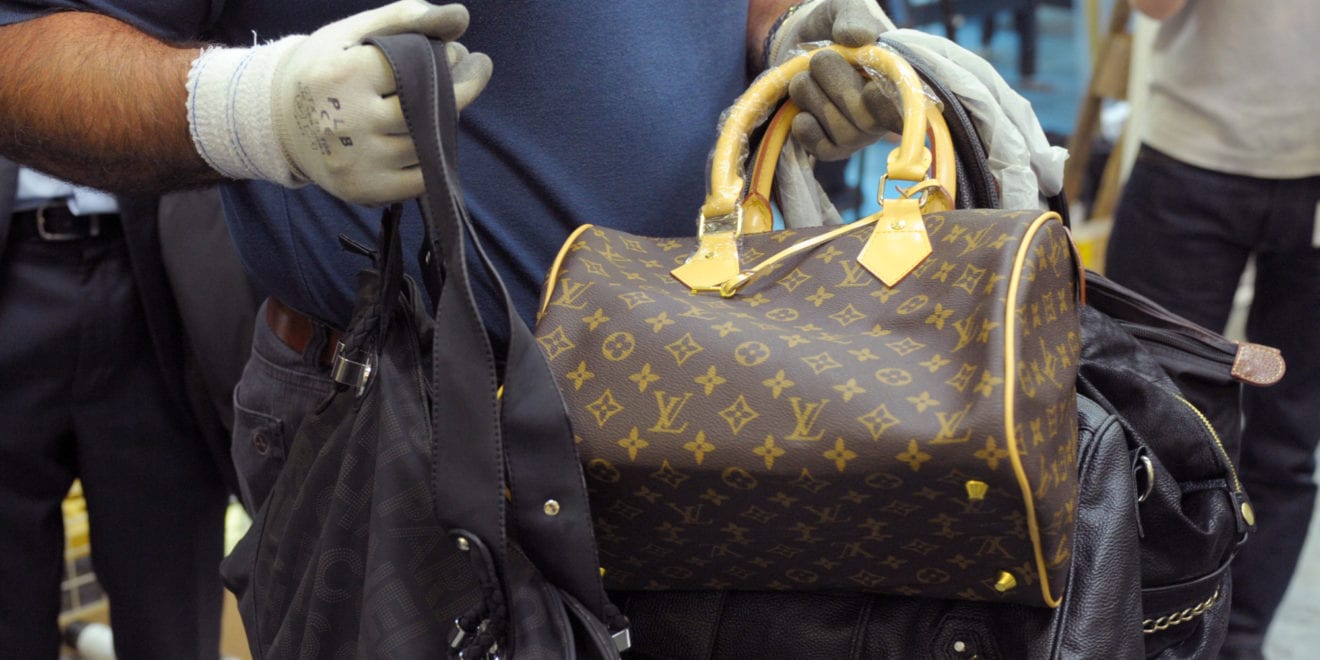
    Luxury retailer Louis Vuitton is suing three individuals in China for selling counterfeit items on Alibaba’s online shopping outlet Taobao.

    Damages of 250,000 RMB ($37,900) are being sought by the LVMH-owned company, says a statement on a Beijing court’s website uploaded yesterday. It says the suits are against a person surnamed Liang and two with the surname Han, who were sentenced in 2014 for selling counterfeit Louis Vuitton clothing, shoes and handbags between 2011 and 2014.

    This move comes nine months after luxury conglomerate Kering pursued legal action over fakes on Alibaba’s platforms. The group sued Alibaba directly, filing the suit in the US rather than China.

    In 2013 LVMH signed a co-operation agreement with Taobao to fight fakes on its platforms. Under the agreement, Taobao agreed to proactively track down and remove listings of counterfeit LVMH items.

    Meanwhile, Alibaba has been working to defend its reputation. It hired a former counterfeit investigator from Apple in December as its new head of global intellectual property enforcement. This followed the American Apparel & Footwear Association calling on the US Trade Representative to add Alibaba back to its blacklist of “notorious markets” for fakes (it was removed in 2012). Alibaba has also hired extra staff to fight fakes and is releasing an English-language version of its intellectual property reporting system.

    The courts’ decisions on the Kering and Louis Vuitton lawsuits could have an impact on the way brands formulate their China anti-counterfeit strategy in the years to come, observes Jing Daily. Kering has challenges with its US lawsuit as the Bank of China has refused to comply with a subpoena to disclose information about counterfeiters’ bank accounts to the New York District Court. The bank is also appealing a $50,000-a-day fine imposed by the court, arguing that the order violates Chinese bank secrecy laws.

  • Sa Sa feels pinch of Chinese policy

    Sa Sa feels pinch of Chinese policy

    China’s policy of one trip a week for mainlanders plus the strength of the Hong Kong dollar against a weaker yen have gouged sales for cosmetics retailer Sa Sa International.

    Both its retail and wholesale turnover dropped 14.2 per cent for the third quarter (October 1 to December 31), the company has announced. Turnover declined by 15.8 per cent in the Hong Kong and Macau markets, where same-store sales dropped 12.2 per cent.

    Overall, transactions were 7 per cent weaker, average sales per transaction fell 9.1 per cent and there was a 12.1 per cent dip in same-store sales. The group’s total turnover in other markets, including Mainland China, Malaysia, Singapore, Taiwan and online, dropped 6.7 per cent.

    Chairman/CEO Dr Simon Kwok says the impact of the “one-trip-per-week” policy had gradually gained momentum, leading to a notable year-on-year decline in the number of same-day visitor arrivals.

    “We expect the negative trend will continue to influence the local retail market.”

    In response, he says the group will optimise its product offering and enhance the shopping experience for its customers.

    Back in October, Sa Sa International Holdings already warned that its net profit for the six months to September 30 would be slashed in half because of the sluggish retail scene.

  • African exports to China descend by 40 percent

    African exports to China descend by 40 percent

    African exports to China fell by 40 percent in 2015, China’s customs office reports. China is Africa’s greatest single trading partner and its interest for African products has fuelled the continent’s recent financial development. The decrease in exports mirrors the recent slowdown in China’s economy. This has, thus, put African economies under weight and to some extent represents the falling estimation of numerous African currencies.

    Exhibiting China’s previous year trading figures, customs representative Huang Songping advised that African exports to China aggregated $67bn (£46.3bn), which was 38% down on the figure for 2014. BBC Africa Business Report editor Matthew Davies says that as China’s economy sets out toward what numerous experts say will be a hard finding, its requirement for African oil, metals and minerals has fallen quickly, taking commodity prices lower.

    There is likewise less funds coming from China to Africa, with direct investment from China into the mainland falling by 40% in the initial six months of 2015, he says. In the mean time, Africa’s interest for Chinese products is rising. In 2015 China sent $102bn worth of products to the mainland, an expansion of 3.6%. A year ago, South Africa facilitated a China-Africa summit amid which President Xi Jinping declared $60bn of aid and loans, symbolizing the nation’s growing part on the Continent.

  • 2 Reasons Why China’s Macro Woes Won’t Affect Apple, Inc. as Much as You Think

    2 Reasons Why China’s Macro Woes Won’t Affect Apple, Inc. as Much as You Think

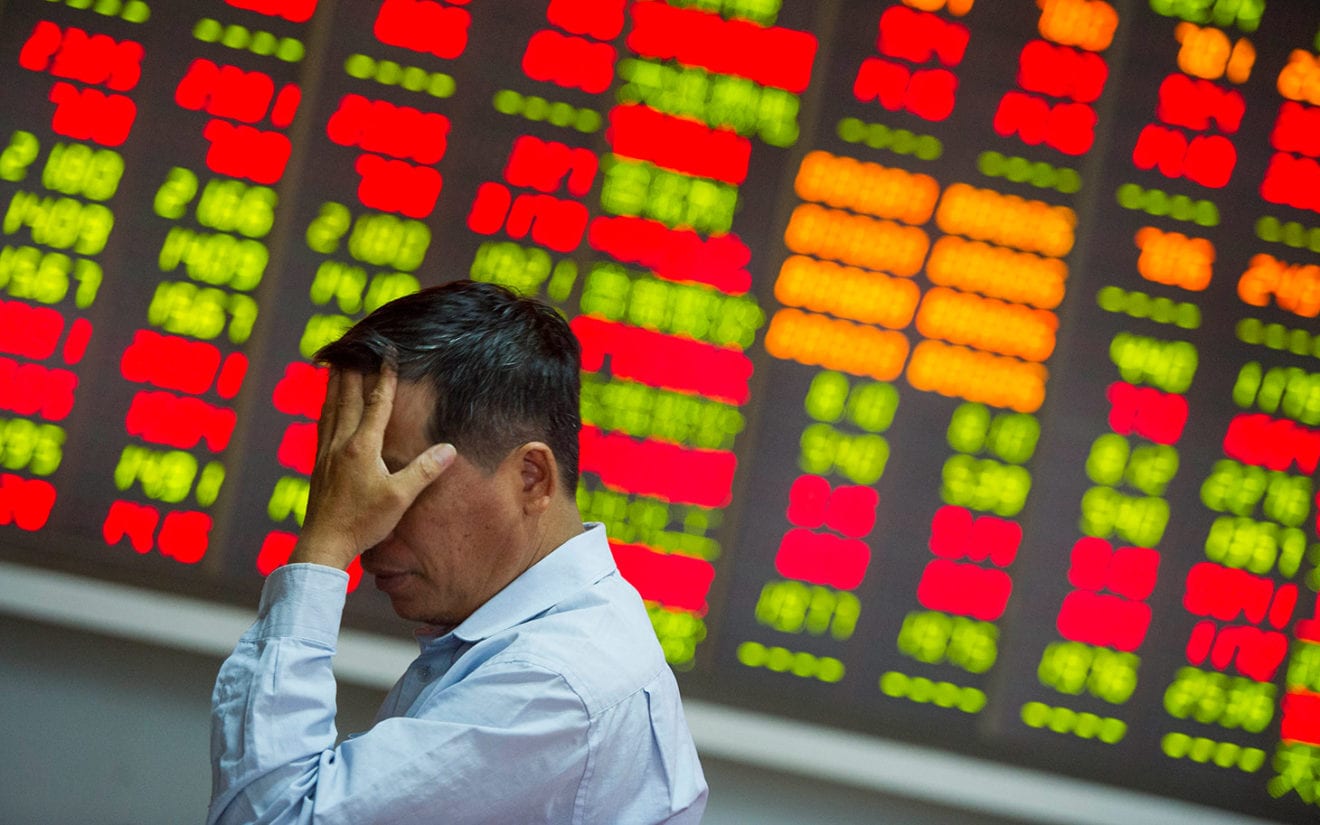
    The market certainly woke up on the wrong side of the bed for 2016, and most fingers are pointed to troubling macro-economic data out of China along with The Middle Kingdom’s brutal market sell-off. The Shanghai Composite Index is already down 10% year to date, and it’s only been a week. You probably also saw those headlines about the day that the Chinese market was only open for less than 30 minutes before circuit breakers (which have since been suspended) were triggered, ending the day down 7%.

    Meanwhile, pessimism surrounding Apple continues to build as well, in part because China is such an important market for the Mac maker. But there are two important reasons why all of the China-related storylines won’t affect Apple as much as you might think.

    China’s stock market participation is very low
    It’s true that China’s stock market is largely dominated by retail investors instead of institutional investors (a stark contrast to the U.S.), with an estimated 90% of all capital accounts owned by retail investors. Chinese investors also tend to be short-term traders instead of long-term investors, which contributed to heightened volatility.

    But it’s also true that overall stock market participation is fairly low in China, so the gyrations aren’t directly affecting the average consumer. For example, the Southwestern University of Finance and Economics in Chengdu conducts a regular China Household Finance Survey led by professor Gan Li. According to the survey, just 6% of households in China owned stock during the first quarter of 2015.

    So while the volatility of the Chinese stock market makes for some panicky headlines, the average Chinese consumer’s discretionary spending and income is just fine. They can still go out and buy that iPhone.

    China’s slowing GDP growth is not affecting the mainstream consumer
    The other recurring theme is China’s slowing macroeconomy, as evidenced by decelerating GDP growth rates. But again, these GDP figures aren’t directly translating into reduced income or spending on the consumer level. Quite the contrary, in fact.

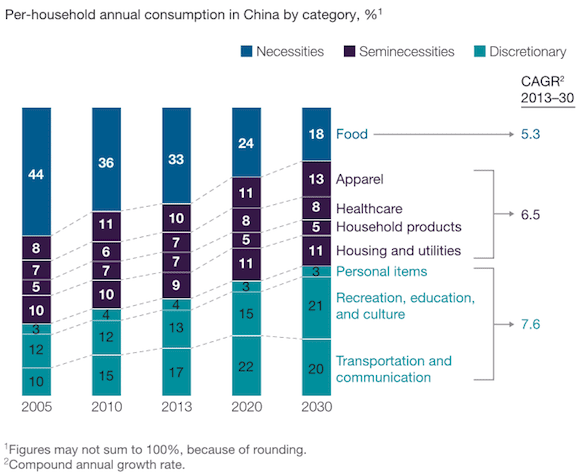
    Much of China’s GDP growth over the past decade has been driven by investing and exports, but China’s economy is now transitioning toward consumer consumption, which will only benefit consumer-oriented companies like Apple. Consider per-household annual consumption by category from 2005, along with forecasts through 2030, where discretionary categories are growing the fastest:

    China Spending

    Source: McKinsey.

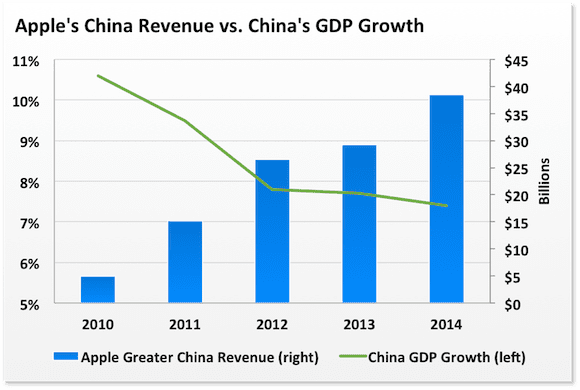
    Or consider the fact that Apple’s China business has grown incredibly against a backdrop of slowing GDP:

    Aapl Gc Vs Gdp

    Source: SEC filings and The World Bank. China GDP growth measured in constant local currency. Calendar years shown.

    The rising middle class in China won’t be stopped, and that’s good news for Apple.


  • ‘Don’t blame retail investors for China’s flash crash’

    ‘Don’t blame retail investors for China’s flash crash’

    Picture this: the market plunged 9 percent in around 30 minutes of hectic trading. Regulators raced to contain the damage, that was estimated in the trillions. Later, the plunge was repeated with a market collapse of 6.5 percent as 1,100 points were wiped in about five minutes. Trading was halted multiple times and circuit breakers were praised for preventing a full-on market crash of epic proportions.

    It just goes to show that this is an untrustworthy, poorly developed market that has to be managed externally by imposing trading halts.

    Hang on, there’s just one problem with this assumption. The 9 percent plunge happened on May 6, 2010. It was the infamous Flash Crash on the New York Stock Exchange. The second 6.5 percent fall was the August 24, 2015 flash crash, also on the NYSE.

    And rather than signaling the end of the financial world as we know it, markets simply shrugged their collective shoulders and moved on.

    But analysts seem to apply a different yardstick to the China market and are using this week’s Shanghai Composite flash crash to highlight what they see as China’s economic disaster.

    This is more than easily dismissed as double-standard analysis, because closer examination suggests some alternative explanations.

    Let’s first go back to the US flash crashes. The 2010 crash was widely attributed to the activity of exchange traded funds (ETFs). The 2015 crash was attributed to high frequency trading because sell algorithms cascaded in a falling market.

    The true reasons are certainly more complex, but it’s the nature of these suspects that is interesting because they highlight the connection between the derivative markets and the underlying market.

    One of the key connections is the rapid placement and withdrawal of trading orders that lies at the core of high frequency trading. These are placed in the futures and associated markets. In its subsequent investigation, the Commodity and Futures Trading Commission (CFTC) concluded that this activity was at least significantly responsible for order imbalances in the derivatives market, which in turn affected the stock market.

    The key feature is that these types of extreme and rapid market collapses are most often associated with markets dominated by derivative trading. These crashes are caused by institutional trading from ETFs and HFT. They are not caused by mums and dads trading because mums and dads simply do not act in such a coordinated fashion in such a short timeframe. Mums and dads also do not have the leverage to shift markets in this way within 30 minutes or an hour. That power lies in the hands of large-scale derivative traders.

    So, heres the rub. The onshore China market is dominated by retail traders. The offshore derivative market is dominated by institutional funds and ETFs and trading activity has been facilitated by the Shanghai-Hong Kong Stock Connect that opened in November 2014.

    Chinese authorities have been concerned for some time by allegations of Qualified Foreign Institutional Invetor (QFFI) funds being used in offshore shadow derivative trading. In June 2015 there were claims that the Shanghai index sell-off from the high of 5,176 was preceded by a spike in the placement and rapid removal of sell orders that is typical of HFT activity. It took the CFTC 4 years to deliver a final report on the 2010 Flash Crash so its unreasonable to expect a CSRC report on the June 2015 fall anytime soon.

    The January 1 Shanghai flash crash has all the characteristics of the NYSE flash crashes but in a market that is not dominated by fund managers and institutional trading. It’s the imposition of circuit breaker-thinking, imported directly from the flash crash-vulnerable NYSE market, that stopped this Shanghai flash crash from worsening.

    It’s convenient but far too simplistic to blame Chinese retail traders. The pattern of order placement in the physical and derivative markets need further investigation.


  • What’s Driving China’s Stock Market Selloff?

    What’s Driving China’s Stock Market Selloff?

    Just as they did when Chinese stocks swooned in July, global investors appear to be learning the right lessons about China for all the wrong reasons. Investors who can see through the haze and confusion can keep picking up bargains in undervalued markets like Indonesia.

    First and foremost, the latest stock-market turmoil does not mean that China’s economy is in a meltdown. Yes, China’s economy is still slowing as investment retreats and exports decline. Spending by China’s emerging middle class remains a bright spot. But the service sector’s growth isn’t powerful enough to counteract the slowdown in China’s industrial sector. Most predictions are for growth of roughly 6.4% this year, slightly below the government’s 6.5% target.

    What’s driving the selloff? Not global investors jittery about China’s growth prospects. China’s markets remain highly restricted to foreigners, who represent a tiny fraction of trading. On the contrary, trading in China is dominated by domestic, retail investors. This makes the market relatively volatile. Retail investors everywhere tend to trade more frequently are more prone to herd behavior. Many in China fled the market after last summer’s turmoil, which has left the market in the hands of an even smaller group of jittery, retail punters.

    That’s why China’s new circuit breakers turned out to be such a bad idea. Intended to halt panics so cooler heads could prevail, the trading curbs proved too narrow for a market as volatile as China’s. In the U.S., a much less volatile market, trading pauses for 15 minutes if the S&P500 drops 7% or more and halts for the day only if the index falls 20%. China’s circuit breaker imposed a 15-minute halt after a 5% drop and halted trading if its CSI300 index fell 7%, a fluctuation all too common last year. So as stocks started falling, retail investors nervous they might be frozen into positions if the circuit breakers tripped joined the stampede to sell. The circuit breakers thus heightened volatility. Realizing this, regulators scotched the breakers Thursday night.

    Most of these domestic, retail investors in the stock market aren’t middle-class consumers. They’re relatively affluent individuals who invest a conservative portion of their net worth in stocks. Volatility in China’s stock market therefore poses little threat to the overall wealth of China’s middle class and its ability to spend.

    So what caused these wealthy punters to take flight? Because China’s economy is so tightly controlled by the government, and the stock market so dominated by big government-controlled companies, investors in Shanghai have long looked to signals on policy, rather than corporate profits, to drive markets. Beijing’s intervention in the stock market last summer has only reinforced this logic. So signals over the weekend that President Xi Jinping might favor painful economic reform over feel-good stimulus measures touched off this week’s selling.

    Does that mean we shouldn’t be worried? Absolutely not. While China’s slowdown by itself isn’t enough to derail global growth, it won’t help. As times get tougher, growing labor unrest is a worrisome red flag. And the more growth slows, the more difficult it will be for China Inc. to service a mountain of corporate and local government debt that by some estimates has swelled to 250% of GDP. China is inching closer to a possible credit crisis.

    That’s particularly true now that China has removed its gloves to join the global currency war already underway between Japan and Europe. It fired a shot across the bow in August with a one-time depreciation of its currency, the yuan. Then in December, the People’s Bank of China started marking the yuan down with the currencies of China’s major trading partners.

    Some economists believe most of that revaluation lower is complete. Not likely. Central banks in Europe and Japan, which are using weaker currencies to try to revive growth, will now likely need to push their own currencies lower still, which will prompt China to nudge the yuan lower with them. That creates a vicious circle of depreciation.

    Worse, China’s decision to move the yuan lower appears to be accelerating what was already a torrent of outflows by Chinese savers eager to get their cash out of the way of the slowing economy and a widening crackdown on corruption. China is trying to discourage the outflows by cracking down on foreign-exchange transactions and even trying to influence rates for yuan offshore. But the vacuum of funds out of banks is pushing up the cost of credit, forcing the PBoC to print yet more yuan to inject into the banking system – a measure that stands to weaken the yuan even further. And Jefferies warns that liquidity is likely to tighten even more ahead of the Lunar New Year holidays a month from now.

    A weaker yuan will ultimately be good for China’s exporters and stocks. But because it inflates China’s economy by exporting deflation, the cheaper yuan is bad for economies that rely on exporting to China, like Australia, or that are using a weaker currency to try to inflate their own growth, like Japan.

    Not surprisingly, stocks in Australia and Japan suffered the biggest declines in Asia outside China this week, falling 5.8% and 5.4%, respectively. Also hit hard was South Korea, which has one of the region’s highest exposures to China’s import demand. Stocks there have dropped 2.8%.

    But the turmoil doesn’t alter the overall outlook for regional markets this column laid out earlier this week. Because it’s most likely to enjoy government support, China’s stock market is still likely to outperform its neighbors’. And stocks in a handful of Asian markets still stand to exceed investors’ rock-bottom expectations. This week’s declines have made stocks in Jakarta, for example, even more attractive.

    Comments? E-mail us at [email protected]

    Comments? E-mail us at [email protected]

  • Luk Fook same store sales down 26 pct in SARs for fiscal Q3

    Luk Fook same store sales down 26 pct in SARs for fiscal Q3

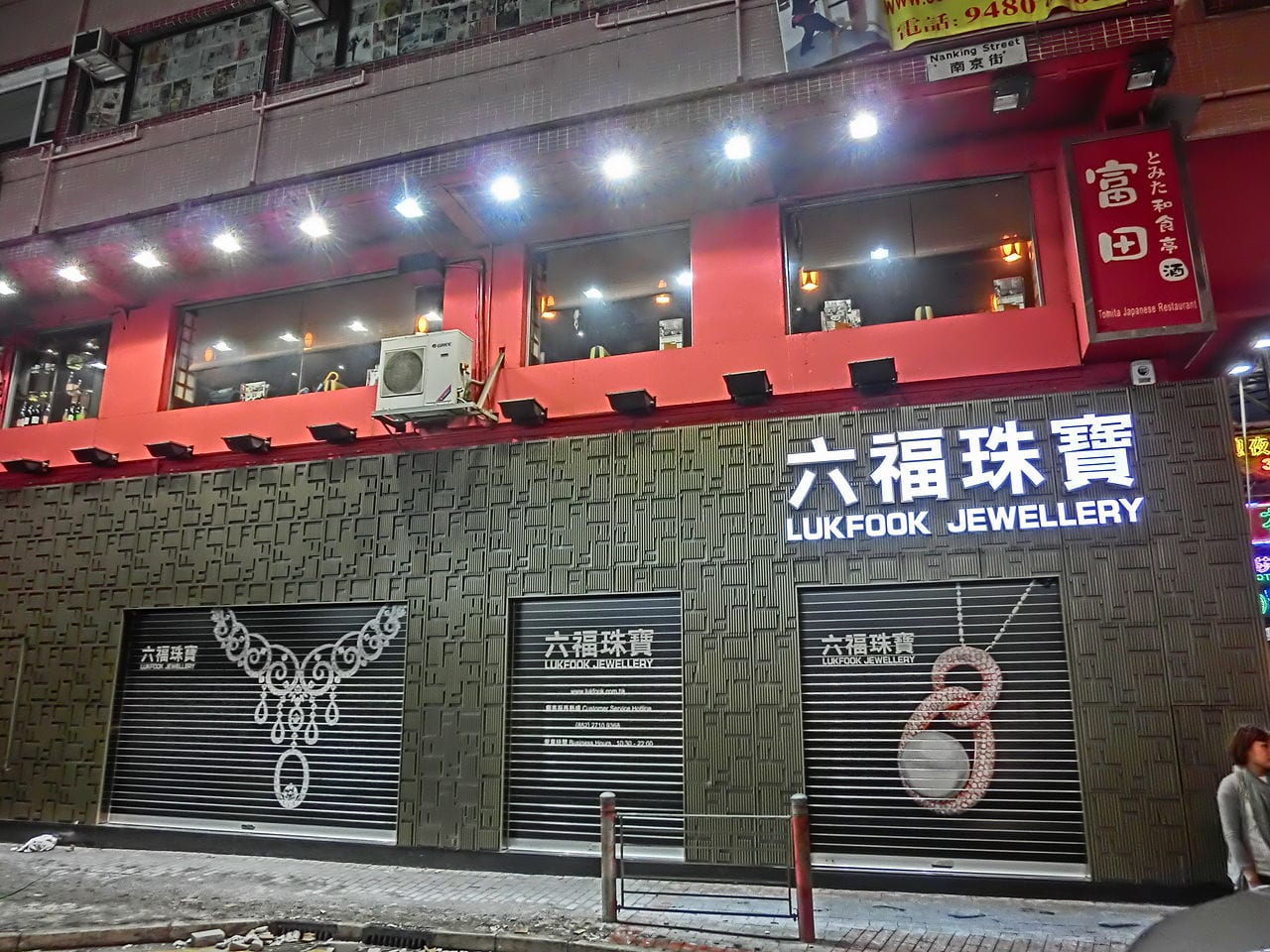
    Hong Kong-listed jewellery retailer Luk Fook Holdings (International) Ltd. saw a 26 per cent year-on-year decrease in its same store sales from Hong Kong and Macau shops for the three months ended December 2015, the biggest decline since the final quarter of 2014.

    During the third quarter fiscal, Luk Fook saw a decline of same store sales of 26 per cent year-on-year in gold from its shops in both Hong Kong and Macau, while that of gem-set jewellery fell 27 per cent, the company told the Hong Kong Stock Exchange after trading hours on Wednesday.

    The exact sales revenue figures were not disclosed in the retailer’s Wednesday filing, and the sales performance disclosed by the company only covered sales from its self-operated shops, while the sales of licensed shops and e-commerce business was excluded.

    The same store sales of Luk Fook’s group-wide retail business was down 25 per cent in the fiscal third quarter, as the retailer also saw a drop of 10 per cent in its shops in Mainland China.

    According to the filing, Luk Fook blamed the sales decline in the third quarter on ‘continuing overall sluggish retail sentiment’ and a relatively high base in sales figures.

    As at the end of last year, Luk Fook ran 96 self-operated shops on the Mainland, 47 shops in Hong Kong, 10 in Macau and 6 overseas. The jewellery retailer ran another 1,261 licensed shops on the Mainland and in Korea.

  • Hong Kong Government Collaborates With China In Phasing Out Ivory Trade

    Hong Kong Government Collaborates With China In Phasing Out Ivory Trade

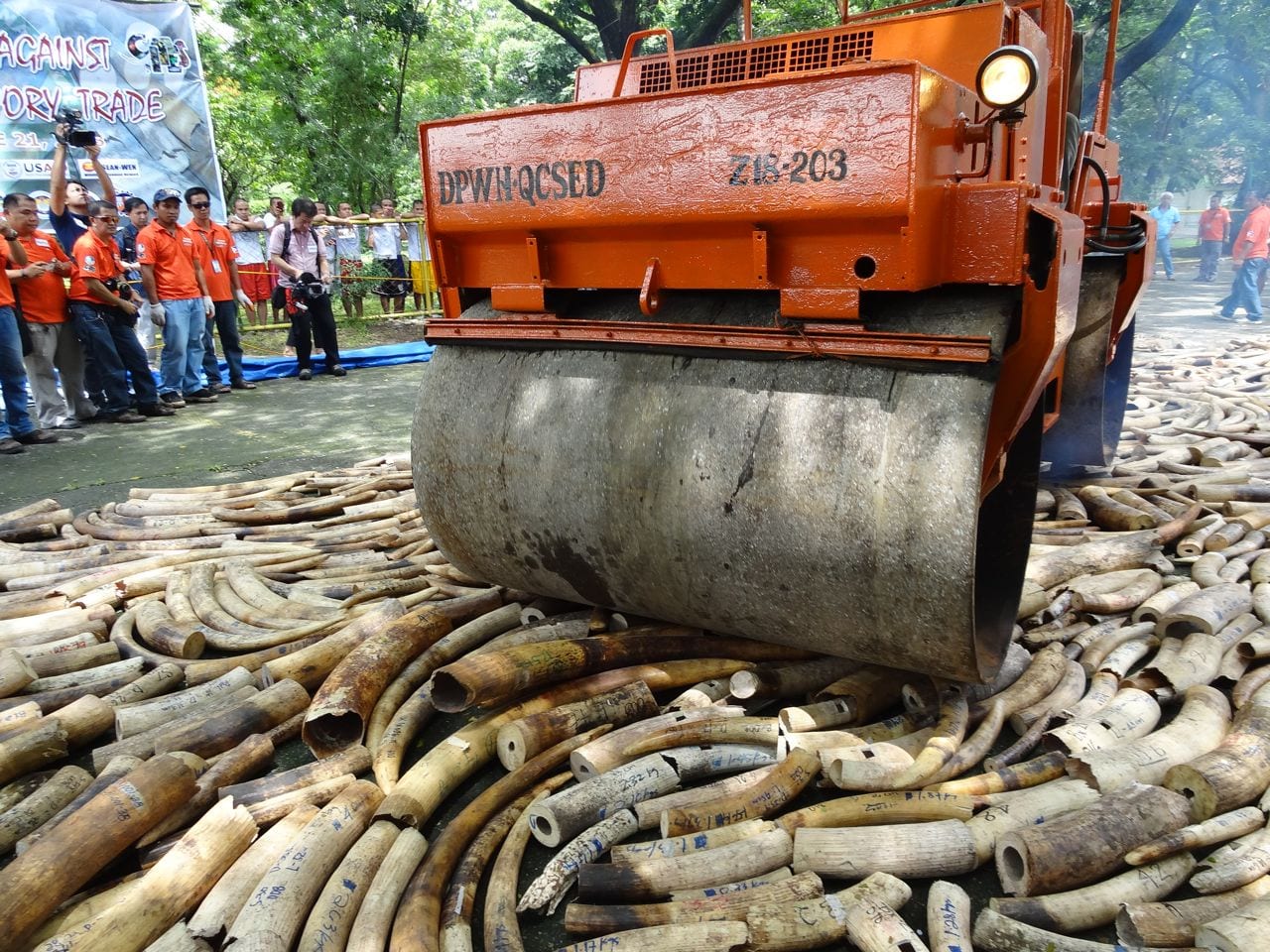
    This week, animal rights activists in Hong Kong are celebrating a huge win as their plea to eliminate global ivory trade has been heard. Hong Kong’s Chief Executive Leung Chun Ying announced in his annual policy address that the country will phase out on ivory trading in collaboration with China.

    CNN reported that Hong Kong was allegedly the world’s largest retail market for ivory and a facilitator of illegal ivory transport into mainland China.

    The Government is very concerned about the illegal poaching of elephants in Africa,” Leung said in his speech, “It will kick start legislative procedures as soon as possible to ban the import and export of elephant hunting trophies.”

    Hong Kong’s government has also vowed to impose heavy penalties against those who partake in illegal ivory trade and importation

    China reportedly has better laws regarding ivory trade compared to Hong Kong.

    According to Huffington Post, 30,000 African elephants are killed every year for their tusks, hence putting the species at a risk of extinction.  The government has reportedly begun a crackdown on the illegal trade, and the action is already making a difference.

    Earth Torch News Network asserted that the activist group initially began pinning down perpetrators three years ago, although the government was not so keen on doing the same. Additionally, reports indicate that the import and export of ivory have been banned in Hong Kong since 1989. However, there have been loopholes in the enforcement of such prohibition, thus allowing the trade to propagate.

    Meanwhile, an estimated 16.7 tons of ivory have been confiscated in Hong Kong for the past three years.

    In other news, animal rights activists are calling other Southeast Asian countries, including Thailand, to emulate China, Hongkong and the United States in banning the domestic trade of ivory.

    Wild Life reported that new fears arise as South Africa is planning to propose the re-opening of a regulated trade of rhino horn. Once the bill is passed, elephant poachers are likely to venture into rhino poaching to supply investors.

  • Burberry sees return to sales growth in China

    Burberry sees return to sales growth in China

    Luxury fashion group Burberry on Thursday announced a return to retail sales growth in China despite an economic slowdown, boosting overall results in its third quarter.

    The British handbag and clothing company reported overall retail sales of £603 million ($866 million, 794 million euros) in the October through December period, “as (sales in) mainland China returned to growth”, Burberry said in an earnings statement.

    China is in sharp focus for markets amid an overall slowdown for the world’s second largest economy.

    In the three months to the end of 2015, Burberry saw total underlying retail sales growth of 1.0 percent, an improvement on the 4.0-percent decline in its second quarter.

    Burberry’s financial year runs from April to the end of March

    On the downside, sales in Hong Kong fell by more than 20 percent owing to long-standing protests against China.

    All of Burberry’s Hong Kong stores remain profitable however thanks to cost controls, the company said in the statement.

    “The outlook for our sector remains uncertain,” said chief executive Christopher Bailey.

    “However, we are anticipating and responding to these changes through an intense focus on new growth opportunities.”

    Chief financial officer Carol Fairweather told a conference call with reporters that Burberry’s performance in France had been impacted by fewer tourists visiting from China and the Middle East following the Paris terrorist attacks in November.

  • Uniqlo struggles with currency and weather

    Uniqlo struggles with currency and weather

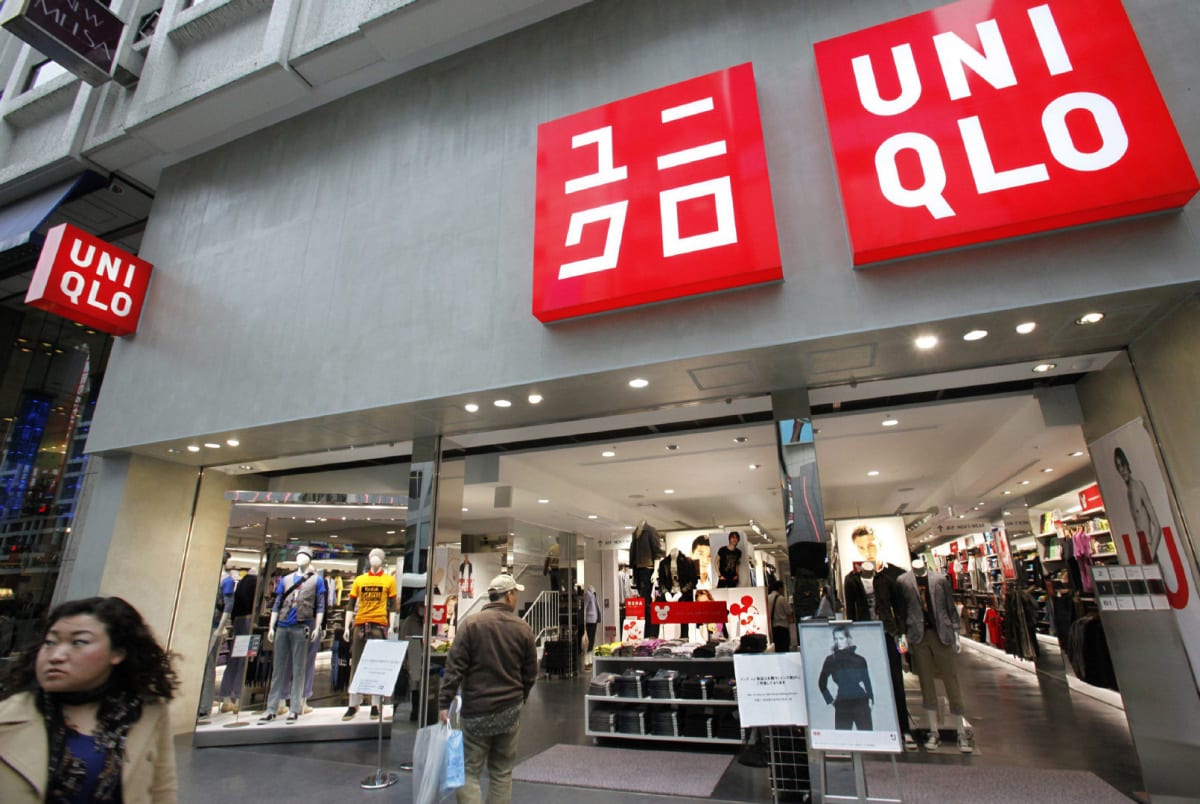
    Uniqlo, Asia’s largest apparel retailer, has delivered a disappointing set of results for the quarter to November 30.

    While revenue rose 8.5 per cent year on year to ¥520.3 billion (US$4.44 billion), profit fell 16.9 per cent to ¥75.9 billion ($647.1 million). Considerable depreciation of the Japanese yen was the main factor in a ¥29.0 billion fall in pre-tax profits, the company said.

    Uniqlo International sales also fell short of target in the first quarter, reporting a rise in revenue but a decline in profit (revenue: ¥196.9 billion (+17.2 per cent year on year), operating profit: ¥20.8 billion (-14.2 per cent)).

    “Unseasonal warm winter weather around the globe adversely impacted same-store sales at Uniqlo Greater China (encompassing operations in mainland China, Hong Kong and Taiwan), Uniqlo South Korea and Uniqlo US in particular, resulting in a lower than expected first-quarter performance and declining profits in all three of these areas.

    Meanwhile, Uniqlo Europe reported higher than forecast gains in both revenue and profit, and Uniqlo Southeast Asia and Oceania reported a steady operating profit, as expected.

    New store openings proceeded as planned, with a net 66 stores opened during the first quarter, mainly in Greater China and Southeast Asia. As a result, the total number of Uniqlo International stores had expanded by 169 year on year to 864 stores as at November 30.

    Uniqlo Japan fell short of expectations in the first quarter, declining in both revenue and profit Revenue was ¥230.9 billion (-0.7 per cent), operating profit ¥44.8 billion (-12.4 per cent).

    “While online sales expanded 23.2 per cent year on year, same-store sales declined 2.3 per cent, resulting the fall in revenue,” the company said.

    “In September and October, fall winter items such as cashmere sweaters, merino sweaters, gaucho pants and wide pants got off to a great start and sales proved strong, pushing same-stores sales higher as a result. However, the unexpected heatwave in November stifled demand for winter items, and led to a sharp drop in revenue.

    “On the profit side, hefty discounting of winter items in November squeezed the first-quarter gross profit margin, while lower than-expected first-quarter sales inflated the selling, general and administrative expenses to revenue ratio.”

    The number of directly run Uniqlo Japan stores, excluding 38 franchise outlets, totaled 806 stores at the end of November 2015. While that represents a net decrease of 18 stores year-on-year, 10 of these stores were converted from directly-run stores to new employee-franchise outlets.

    The group reiterated its goal of becoming the globe’s largest apparel retailer.

    “To this aim, we have focused our efforts on expanding Uniqlo’s global operations, boosting store numbers in each country where we operate, opening global flagship stores and large-format stores in major cities around the world, and offering exciting joint collections with well-known designers from around the world, such as Ines de la Fressange. This strategy is designed to both boost awareness and visibility of the Uniqlo brand and strengthen our global operational base. We are also actively promoting our GU brand by accelerating the opening of new stores in Japan and launching the label in the Chinese market.

    “We believe the GU operation has reached a key turning point in its growth and development as a second pillar brand for the group,” the company concluded.

    Uniqlo’s Global Brands division exceeded expectations in the first quarter by reporting a 17.4 per cent year on year gain in revenue to ¥91.8 billion, and a 29.7 per cent year on year gain in operating profit to ¥12.4 billion.

    “Within the Global Brands segment, our low-priced GU fashion casualwear label reported significant rises in both revenue and profit that surpassed our initial forecasts. GU reported double-digit growth in same-store sales on the back of strong sales of heavily advertised campaign items such wide pants, baggy sweaters and knitted bottoms.

    “Meanwhile, our Theory fashion brand and J Brand premium denim label both fell slightly short of target when they reported a decline in profits.”

    The company’s France-based Comptoir des Cotonniers and Princesse tam.tam labels reported lower-than-expected sales and a decline in profit, after the November terrorist attacks in Paris forced some stores to close temporarily.

  • China’s stock market like a casino, only riskier

    China’s stock market like a casino, only riskier

    The one thing to remember about the Chinese stock market is that it operates so differently from U.S. and European markets. First off, the China market is dominated by retail investors, who treat it very much like a casino. Look at this chart:

    There are more than 200 million trading accounts in China. That’s the same size as America’s adult population. And that’s one of the main reasons we’re seeing so much volatility. FIS Group in a recent report said that more than 90 percent of capital accounts are owned by retail investors, suggesting the wild moves in Chinese stocks is primarily driven by “their market structure” and “trade momentum.”

    Even though we’ve seen huge drops in the last week, let’s not forget how massive the spikes up have been in the past 10 years. Chinese stock market volatility makes the S&P 500 look almost like a flat line.

    Another way to see it: the difference between small and large caps.

    Of course small caps anywhere tend to move more than large caps — but in China, that difference is bigger, especially in the past months.

    Remember, many Chinese large-cap stocks are primarily state-owned enterprises, so retail traders generally look toward smaller companies to make their quick bucks.

    Wu Jinglian, a veteran economist, has said comparing Chinese markets to a casino is actually unfair — to the casinos. He said that at least the casinos have stronger rules, and don’t have price manipulation.

    That’s why when bad news in the economy happens, a spooked and scared set of retail traders will be much quicker to bail versus the more professionally dominated U.S. market.

  • Chow Tai Fook’s Hong Kong, Macau Sales Plunge on Fewer Chinese

    Chow Tai Fook’s Hong Kong, Macau Sales Plunge on Fewer Chinese

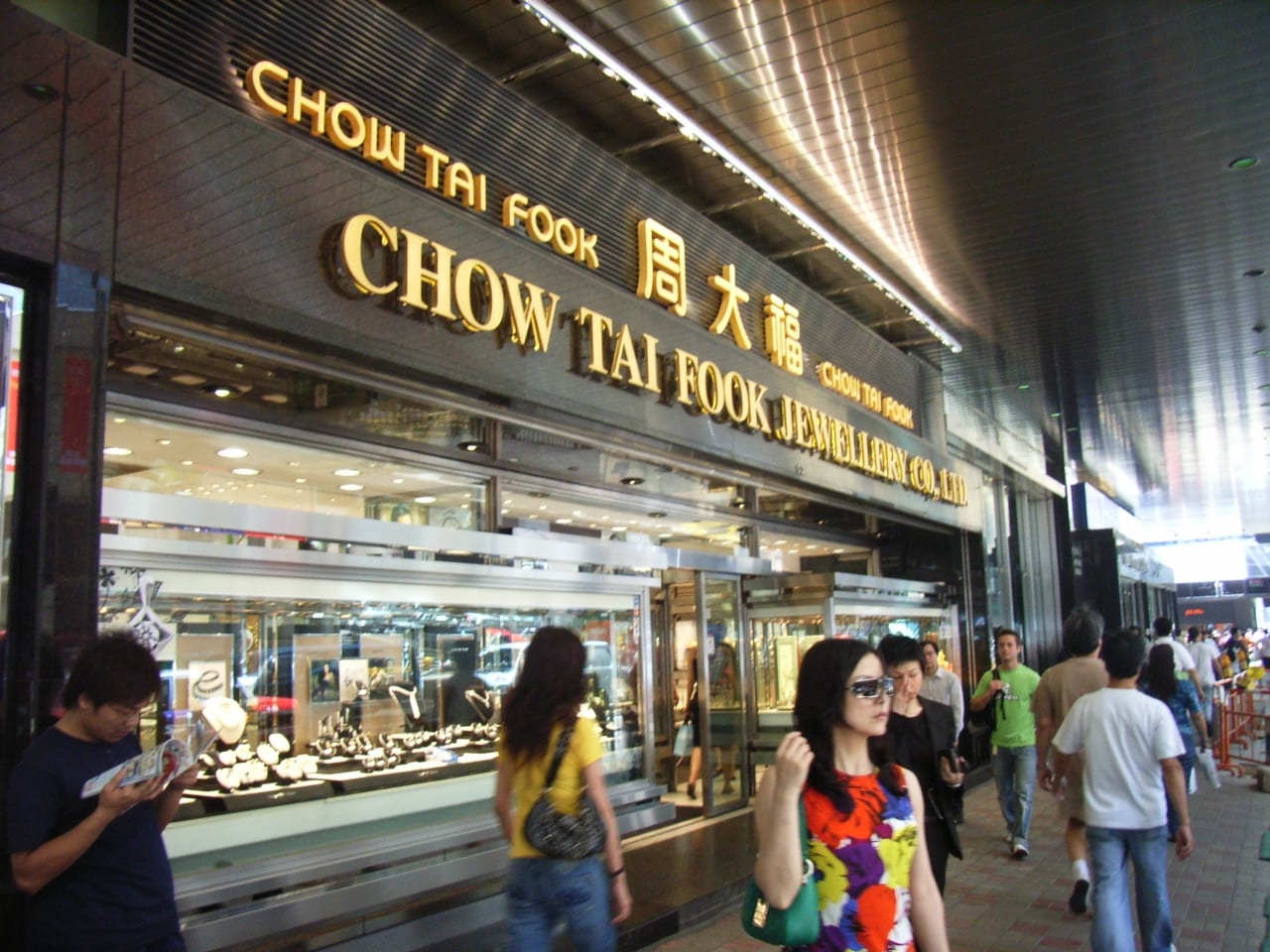
    Chow Tai Fook Jewellery Group Ltd., the world’s largest listed jewelry chain, said same-store sales in Hong Kong and Macau plunged 23 percent in the final three months of 2015 as fewer mainland Chinese tourists visited the two cities.

    Same-store sales, for outlets open at least a year, fell 6 percent for those in mainland China, bringing the total decline to 15 percent for the fiscal third quarter ending December, the company said in a statement Friday. The retail sales value for all of the company’s outlets slumped 11 percent in the period, it added.

    The operating environment in China as well as sales outlook for the Lunar New Year holidays in February remain challenging, and the company will continue to focus on cost-cutting measures in the rest of the current fiscal year ending March, Managing Director Kent Wong said on a conference call with reporters Friday.

    “The retail jewelry industry is now in a consolidation stage after the rapid growth in the past decade,” Wong said. “What we can do now is to better control cost structure on both rentals and staff costs, while expanding our high-end product lines.”

    Chow Tai Fook in November declared its first-ever special dividend even as it posted the steepest decline in semi-annual profit since it went public, after its shares fell to about 70 percent before its offer price since its 2011 share listing. China’s economic slowdown, as well as campaigns against corruption and extravagant spending have hurt luxury retailers and casino companies.

    The retailer of gems and watches has said it will shut outlets that do not perform well, but doesn’t plan to lay off workers. Still, the number of employees may fall further after it dropped 8 percent in the first half, reducing staff costs by 13 percent, Wong said Friday.

    Chow Tai Fook Chairman Henry Cheng said in November the company has shelved its overseas expansion plans and will focus on the Hong Kong, Macau and mainland China businesses.

    Mainland Chinese tourists to Hong Kong, who accounted for more than 70 percent of the total in November, have dropped 16 percent in the month, according to the city’s tourism board.

    Chow Tai Fook may request rental reductions of 30 percent on average, for the roughly one-third of its Hong Kong stores that renew their lease agreements each year, it had said in November. Wong said the company is in talks to renew leases for three shops in the city.

    The luxury chain’s retail network expanded to 2,317 points of sales as of end-2015, including a net opening of 28 jewelry, and 2 watch outlets in mainland China. It will open between 50 to 60 points of sales in China in the rest of the fiscal year, Wong said.

    Competitor Chow Sang Sang Holdings International Ltd. said it won’t cut prices even as it expects same-store sales to slide during the Lunar New Year holidays, amid a strong Hong Kong dollar that has turned mainland tourists away, the Standard newspaper reported Friday citing Lau Hak-bun, the company’s general manager of Greater China retail.

    Chow Tai Fook’s Wong also said the company has no plan to cut product prices in the future.

  • China imposes fresh stock-sale restrictions

    China imposes fresh stock-sale restrictions

    China’s securities regulator will suspend its newly implemented circuit-breaker mechanism designed to tame market volatility after it exacerbated stock sell-offs and shut down equity trading early twice in one week.

    The China Securities Regulatory Commission announced late on Thursday night that the circuit-breaker system would be halted from Friday, only four days after introduction, without saying how long the suspension will last.

    “It didn’t work out as expected… Currently the negative effect is bigger than the positive one. Therefore, we have decided to suspend it in order to maintain market stability,” the CSRC said in a statement posted on its Weibo account.

    The regulator implemented the mechanism on Monday, hoping to offer a “cooling period” when there are sharp fluctuations in the market and therefore stamp out the wild swings.

    A move of 5% in either direction on the CSI 300 Index, China’s blue-chip tracker, triggered a 15-minute trading halt for stocks, convertible bonds, stock options and futures contracts. A swing of 7% froze trading for the rest of the day.

    Previously, individual Chinese stocks were only allowed to rise or sink by a maximum 10% per day.

    Circuit-breaker controversy

    However, the new mechanism appears to have amplified the panic among investors and prompted new waves of selling in response to sluggish economic data and renminbi weakening, according to some market players and equity analysts.

    Hong Hao, chief China strategist at Bank of Communications in Hong Kong, said circuit-breakers could easily pose threats to market liquidity and investor sentiment.

    “Clearly the tight stops of 5% and 7% of China’s circuit breaker have a magnet effect as prices gravitate towards the breaker [striking points] and prompt a stampede that drains market liquidity,” he said.

    The circuit-breaker system halted trading early on Thursday for the second time in a week, following its first use on Monday. The close of a 14-minute trading session in Shanghai and Shenzhen on Thursday morning also marked the shortest in the country’s history.

    “There are huge risks to introduce it in China now as irrational, retail investors are not really for it. When they see the market fall by 3%, they will only want to sell rather than buy. Then it could soon trigger the trading halt. Then there’s no liquidity,” one Hong Kong-based senior investment banker at a Wall Street bank told FinanceAsia.

    Fresh stock-sale restrictions

    Earlier on Thursday, the CSRC also introduced fresh restrictions on stock sales. It announced new rules to prohibit large shareholders and company directors or managers with stakes of more than 5% from selling more than 1% of their outstanding shares every three months.

    In a separate statement, the CSRC said the new rules would help to “defuse panic sentiment” among investors and would not lead to a new peak of stock selling. “There’s no basis to say they will lead to sharp falls in the market.”

    The new rules, which will come into effect on January 9, require stock sales to be conducted through a centralised auction system and major shareholders to disclose equity-disposal plans 15 days in advance.

    “The 15-day heads-up could more or less dilute the impact on the market – as retail investors know which company’s major holders plan to sell shares. Retail investors can exit their positions first,” said one Beijing-based fund manager at Citic Securities.

    The new measures, which will apply to significant stakes held when a company listed, replace an existing ban set to expire on Friday.

    Beijing in early July imposed a six-month curb on stock selling by major shareholders as part of a raft of controversial measures introduced in the summer to prop up sagging markets.

    China’s stock market, dominated by retail investors, has been one of the most volatile in the world over the last 18 months, with the Shanghai Composite index advancing by as much as 150% in a year-long rally running through mid-June, before plunging 43% by late August. It recovered somewhat in the subsequent months, and plunged again into 2016.

    Hong at Bank of Communications told FinanceAsia earlier on Thursday that the new restrictions alone would be “useless to stem the market plunge as the top priority now is either to abolish the circuit breaker mechanism or improve it.”

    Some of China’s retail investors have tried to use humour on social media platforms like Wechat and Weibo to deal with the new circumstances.

    One wag said the new circuit breakers were like having a girlfriend with a bad temper: “If she’s angry with you and you fail to cheer her up in 15 minutes, she won’t be talking to you for the rest of the day.”

  • China’s stock market is a clown show

    China’s stock market is a clown show

    Just as “bad cases make bad law,” to cite the ancient legal adage, bad stock markets make for bad investment decisions. China’s stock market, with its repeated crashes, has the entire world in a tizzy.

    The Shanghai stock exchange experienced its shortest trading day ever on Wednesday, as circuit breakers designed to end trading if the market slid 7% kicked in after only 14 minutes of active trading. As reported, the Shanghai Composite has dropped about 12% this year, and the Shenzhen composite has fallen more than 15%.

    Investors in the U.S. have taken the opportunity to sell. As of Thursday’s close, the Standard & Poor’s 500 index is down 4.67% from the opening bell for 2016 trading Monday, theNasdaq has lost 4.29%, and the Dow Jones Industrials have shed 5.12%. European stocks have marched over the cliff in tandem.in the U.S. took the opportunity to sell. As of Thursday’s close, the Standard & Poor’s 500 index is down 4.67% from the opening bell for 2016 trading Monday, the Nasdaq has lost 4.29%, and the Dow Jones Industrials have shed 5.12%. European stocks have marched over the cliff in tandem.

    The world should take a deep breath. The China stock market meets the definition of a bad stock market.

    The market is the target of relentless intervention by the Chinese government, which has been setting investment rules and tweaking them without any evident understanding of how open markets work. Adding to the chaos, the market was inflated by an inflow of small investors buying on huge margins — a notoriously skittish class of investors buying under conditions that made them especially vulnerable to the market’s volatile swings.

    Last April, as Evan Osnos of the New Yorker reported, the official organ of the Chinese Communist Party exhorted citizens to plunge into the market. An upsurge of more than 80% in four months was “merely the start of a bull market.” Investors should take heart from the government’s determination to keep Chinese companies strong.

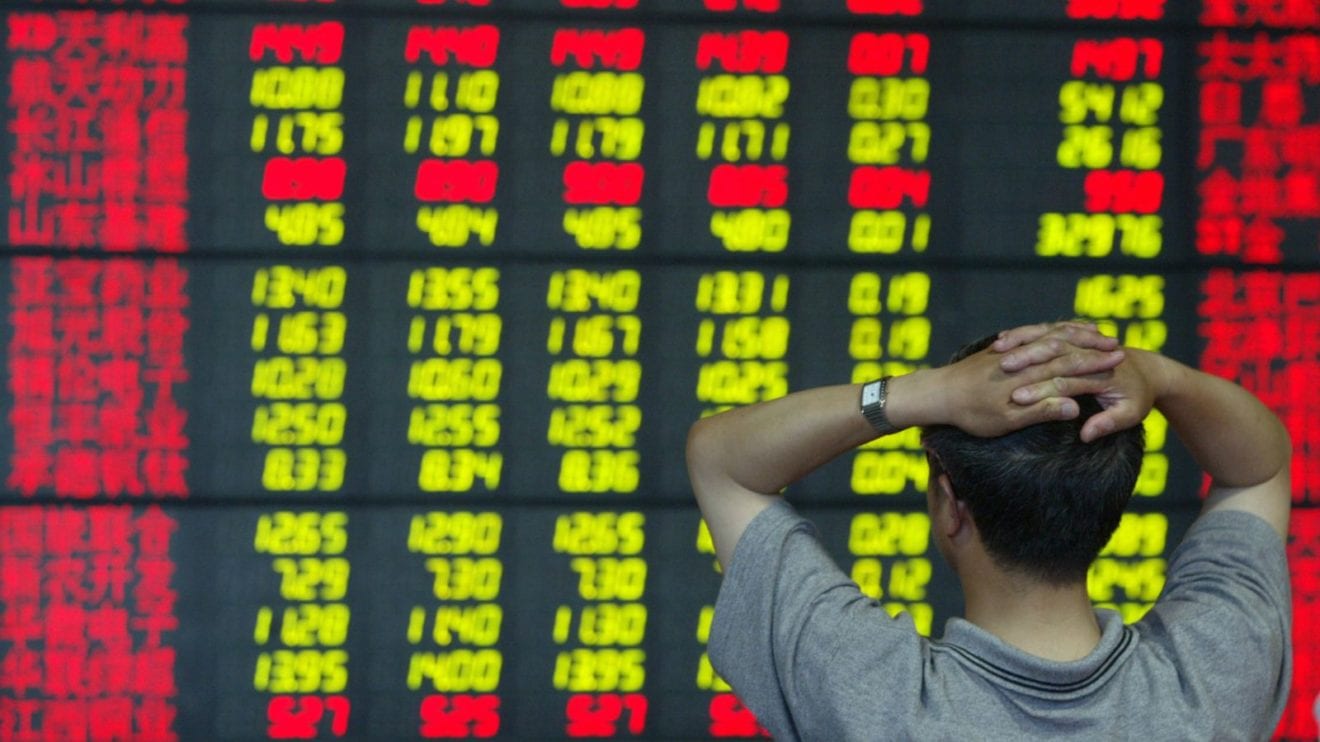
    “Over the next two and a half months, investors opened thirty-eight million new stock accounts, more than quadruple the number of accounts opened in all of 2014,” Osnos wrote. “Retail exchanges, equipped with audience seating, attracted retirees and other small-time investors who spent hours scanning the digital displays, like visitors to the dog track.”

    This was a bubble primed for pricking. But that wasn’t all. On July 8, during a major market crash, Chinese regulators imposed a lockup on shareholders owning 5% or more of their companies, prohibiting them from selling for six months.

    The effect of lockups is well understood in mature stock markets; they tend to create latent bearish pressures as the expiration approaches. That expiration was due for Friday, Jan. 8, plainly creating some of the downdraft witnessed this week.

    The circuit breakers are another source of trouble. Introduced Jan. 4, the rules halt trading for 15 minutes after a 5% drop in the benchmark CSI 300 index, and stop trading for the rest of the day when the index falls 7%. They were triggered on day one, and again on Wednesday.

    Circuit breakers exist in U.S. markets, but critics say they’re cinched too tight in China, where 5% swings have been far more common. In the U.S., trading is shut down only if the Standard & Poor’s 500 benchmark falls 20% in a day.

    Adding to the confusion is that Chinese authorities lack the courage of their own convictions. On Wednesday, regulators tried to keep the bear caged by extending the stock lockup for three more months, albeit in modified form–big shareholders could sell, but only up to 1% of their companies’ shares. And following the circuit-breaker meltdowns of Monday and Wednesday, they scrapped the circuit-breakers themselves, a clear indication that they were not implemented properly in the first place.

    Among other signs of the immaturity of the markets and their regulators are stiff limits on short-selling–after a market crash this summer, the Shanghai and Shenzhen exchanges banned one-day short sales, in which traders place short orders and cover them on the same day. Mature exchanges understand that short selling is an indispensable relief valve for overheated bull markets.

    All these features, artifacts of the government’s inclination toward intervention in the stock market on the bull side, make the market an unreliable gauge of economic trends, many critics say. (Though they’re not unanimous — last February, economists at MIT and New York University argued that the market had matured to the point that it was providing reasonably accurate signals about future corporate earnings. “China’s stock market no longer deserves its reputation as a casino,” they wrote.)

    None of this means that there’s not cause to be concerned about the Chinese economy and its effect on world markets. Underlying the Chinese market plunge are signs that the world’s second-largest economy is slowing down, and that government economic officials aren’t fully up to the task of managing it.

    They’ve been frantically depreciating the Chinese yuan, which will put pressure on the nation’s trading partners by making Chinese exports more competitive and imports more expensive. The rapid depreciation sends a signal, moreover, that policymakers are getting to the end of their stimulative arsenal.

    Adding to uneasiness about government policy, no one has ever been entirely certain about the pace of China’s economic growth because its official figures are untrustworthy. Gross domestic product may have been overstated as much as three-fold, some observers believe.

    There’s no question that cracks in the Chinese economy are worrisome, but the wild swings of the stock market may be exaggerating the mood of panic. It makes sense for investors worldwide to keep their eye on the economy, but the stock exchanges? Just watch the ride.