Retail News CRM

Tag: akamai

  • Akamai: Embracing AI Security as a Vital Economic and Strategic Imperative for Retailers

    Akamai: Embracing AI Security as a Vital Economic and Strategic Imperative for Retailers

    Artificial Intelligence (AI) is revolutionizing industries across Asia through generative content, intelligent automation, and rapid decision-making. However, this swift advancement also exposes enterprises to an alarming surge in cyber threats.

    The Alarming Rise of Cyberattacks in Asia

    In 2024, Akamai recorded a staggering 51 billion web attacks aimed at both traditional and AI-driven applications in the Asia Pacific and Japan region, marking a 73 percent increase compared to the previous year. Within this digital battlefield, the financial services sector faced the brunt with 27 billion attacks, while e-commerce was targeted 18 billion times.

    These sectors are pivotal to the region’s digital economy. Financial services contribute over 14 percent of Singapore’s GDP and underpin many facets of APAC’s burgeoning digital landscape. E-commerce is no slouch either, generating nearly half of global sales transactions, amounting to an impressive US$1.8 trillion annually. Their expansive networks, reliance on hybrid infrastructures, APIs, and real-time interactions make them irresistible prey for cybercriminals.

    As businesses lean heavily into technologies like large language models (LLMs) and generative AI, securing these sophisticated systems transitions from a mere technical requirement to an essential economic priority.

    Understanding the Target on AI-Driven Applications

    AI models are fundamentally different from traditional systems. They process dynamic and unstructured data while operating in probabilistic, non-deterministic manners, making them susceptible to a new wave of cyber threats like prompt injection and model extraction. The vulnerabilities within LLMs are being unearthed more frequently and exploited with alarming speed.

    Despite these dangers, many organizations still resort to outdated tools such as conventional web application firewalls (WAFs). These relics not only fail to detect contemporary threats but can also create visibility blind spots, erratic model behavior, and significant security gaps.

    The API Visibility Challenge

    APIs serve as the backbone of AI ecosystems, facilitating interactions with various data sources, tools, and services. However, numerous enterprises still lack comprehensive, real-time insight into these crucial interfaces. Akamai’s API Security Impact Report revealed a troubling statistic: nine out of ten global organizations encountered an API-related incident in the past year. In the APJ region, each incident is said to cost an enterprise an eye-watering average of US$580,000. Those APIs supporting AI models are particularly perilous; they innovate quickly, often remain undocumented, and fall short on security as their usage grows.

    Without continuous discovery, classification, and governance of APIs, organizations leave their critical AI workloads vulnerable. Achieving full visibility into every API endpoint, particularly those that connect AI systems to external applications, should be a paramount concern.

    AI Security: Not Just an Option—A Regulatory Necessity

    Across Asia, governments are turning up the heat on AI governance, positioning it as both a regulatory priority and a corporate responsibility. Initiatives like Singapore’s AI Verify framework and Australia’s Digital Platform Regulators Forum underscore the fact that the responsible deployment of AI must be accompanied by robust security measures.

    Presently, AI security is becoming a matter that reaches boardrooms and shapes compliance agendas. Forward-thinking organizations are aligning their security strategies with emerging regulatory frameworks, embedding risk management, audit preparations, and ethical oversight deeply into the processes of AI development and deployment.

    Securing Your AI Workloads: A Roadmap

    The journey to secure AI systems starts with clarity. Organizations need to identify where their AI models are deployed—be it internally, externally, or through open-source solutions—and understand how they are queried, assessed, and governed.

    After mapping their AI landscape, firms should take proactive measures to safeguard their AI environments. This can include cataloging all AI models, implementing continuous API discovery to monitor interactions, and applying zero-trust principles to ensure user access is limited to the least privilege necessary. Furthermore, integrating security governance throughout the development lifecycle is essential to avoid vulnerabilities.

    As demand for intelligent security grows, innovative AI-native frameworks are emerging, designed to detect sophisticated threats like prompt injection and adversarial inputs in real time. This shift represents a broader evolution in security, moving from static, rules-based controls to dynamic, intelligent systems tailored for AI environments.

    While AI is reshaping the business landscape, its full potential can only be realized if the underlying security measures are robust. The rapidly changing AI threat landscape calls for new frameworks and collaborative approaches that span disciplines.

    Organizations that recognize AI security as a strategic necessity will be best positioned to foster responsible innovation. The future will belong to those who devise proactive, adaptive security strategies that evolve alongside the technologies they protect.

    Questions & Answers

    What are the major industries targeted by cyber-attacks in Asia?
    The financial services and e-commerce sectors are particularly vulnerable, accounting for billions of attacks in 2024, making them prime targets due to their significance in the digital economy.

    How can organizations enhance their security measures for AI systems?
    Organizations can enhance security by mapping their AI deployments, implementing continuous API monitoring, and adopting zero-trust security principles while integrating governance throughout the development process.

    Why is AI security becoming a regulatory concern?
    With various governments in Asia prioritizing AI governance, security regulations are evolving to ensure responsible deployment and compliance, compelling organizations to adopt better security practices to avoid legal and reputational risks.


  • Akamai could be up for sale

    Akamai could be up for sale

    A recent report claims that Akamai is working with Morgan Stanley to explore strategic alternatives. On the table, apparently, is a sale of the company. To whom, though?

    The move may be in response to pressure from Elliot Management Corp, which holds a 6.5% stake in Akamai and has been pushing the company to consider ways to maximize shareholder value. The thesis is that Akamai’s core business is being challenged by big content’s moves to bring such capabilities in-house.

    Now, it’s not the first time Akamai has faced overall trends that threatened to divert revenue away from the middle man, yet the company always seems to come out on top. We believe that this time is the same, but just as a theoretical exercise let’s consider who might do the buying.

    From the network infrastructure side, it would probably take a major network operator like Verizon or AT&T or Comcast or CenturyLink to do such a deal. In particular, Verizon’s appetite for Yahoo and other content certainly could fit well with Akamai. If the opportunity were right, We think they might jump at it. But We doubt they’d pay the premium required in this case.

    It’s a bit more interesting from the content/cloud side of course. Since they are building such infrastructure in-house, it’s not such a stretch to think that one of Google, Microsoft, Facebook, Apple, or Amazon could decide to drop $12 billion to 15 billion to instantly scale it. But there are channel conflicts in there that give me pause.

    The other option would be for private equity to move in and take the company private. If there is private equity out there that thinks Akamai isn’t taking advantage of all the opportunities on its plate and that it could grow faster and more profitably if not tethered to a publicly floated stock, then sure. But again, it’s not as if Akamai is hurting for resources to invest.

  • AT&T and Akamai extend their global alliance

    AT&T and Akamai extend their global alliance

    Akamai and AT&T have renewed their global alliance, extending it through 2019.

    The agreement will keep Akamai’s CDN and web security services on AT&T’s business solutions menu, including the addition of DDoS capabilities. Akamai will also be able to further extend it’s server footprint out onto AT&T’s edge.

    The partnership between AT&T’s IP network and Akamai’s CDN and cloud networking infrastructure was put in place just over four years ago. AT&T moved its own CDN infrastructure onto Akamai’s platform, and gained access to AT&T’s network. Things seem to have gone pretty well since.

    There was a time not so many years ago that every network out there wanted to have its own CDN infrastructure. It seemed like the two industries were about to merge, but it never fully happened and Akamai is still going strong.

    The fact that CDNs and networks remained separate in most cases was perhaps a sign that the more general cloud opportunity would also not gel that well purely within telecoms walls.


  • IoT devices drive DDoS attack traffic in Q4

    IoT devices drive DDoS attack traffic in Q4

    Unsecured IoT devices continued to drive significant DDoS attack traffic in the fourth quarter of 2016, according to Akamai’s latest State of the Internet / Security Report.

    The fourth quarter report also revealed that attacks greater than 100 Gbps increased to 12 during the quarter, a 40% year-over-year increase.

    Seven of the 12 Q4 2016 mega attacks, those with traffic greater than 100 Gbps, can be directly attributed to the Mirai IoT botnet.

    But the largest DDoS attack in Q4 2016, which peaked at 517 Gbps, came from Spike, a non-IoT botnet that has been around for more than two years.

    The number of IP addresses involved in DDoS attacks grew significantly this quarter, despite DDoS attack totals dropping overall. The United States sourced the most IP addresses participating in DDoS attacks – more than 180,000.

    “With the predicted exponential proliferation of these devices, threat agents will have an expanding pool of resources to carry out attacks, validating the need for companies to increase their security investments,” said Martin McKeay, senior security advocate and senior editor of the report.

    “Additional emerging system vulnerabilities are expected before devices become more secure.”

    Of the 25 DDoS attack vectors tracked in Q4 2016, the top three were UDP fragment (27%), DNS (21%), and NTP (15%), while overall DDoS attacks decreased by 16 percent.

    Akamai started tracking a new reflection DDoS attack vector this quarter, Connectionless Lightweight Directory Access Protocol (CLDAP), which attackers abuse to amplify DDoS traffic.

    “If anything, our analysis of Q4 2016 proves the old axiom ‘expect the unexpected’ to be true for the world of web security,” continued McKeay.

    “For example, perhaps the attackers in control of Spike felt challenged by Mirai and wanted to be more competitive. If that’s the case, the industry should be prepared to see other botnet operators testing the limits of their attack engines, generating ever larger attacks.”

  • Beware the Internet of Unpatchable Things: Akamai

    Beware the Internet of Unpatchable Things: Akamai

    A recent spate of attacks involving attackers using IoT devices to remotely generate attack traffic by using a 12-year old vulnerability in OpenSSH have been discovered by researchers at Akamai Technologies.

    Akamai notes that the research and subsequent advisory do not introduce a new type of vulnerability or attack technique, but rather a continued weakness in many default configurations of Internet-connected devices. These devices are now actively being exploited in mass-scale attack campaigns against Akamai customers.

    The Threat Research Team said it has observed incidents of what it has called SSHowDowN Proxy attacks originating from the following types of devices:

    • CCTV, NVR, DVR devices (video surveillance)
    • Satellite antenna equipment
    • Networking devices (e.g. Routers, Hotspots, WiMax, Cable and ADSL modems, etc.)
    • Internet connected NAS devices (Network Attached Storage)

    Compromized devices are being used for mounting attacks against a multitude of internet targets and internet-facing services, such as HTTP, SMTP and Network Scanning. It is also being used to launch attacks against internal networks that host these connected devices.

    Once malicious users access the web administration console, they have been able to compromise the device’s data and, in some cases, fully take over the machine.

    “We’re entering a very interesting time when it comes to DDoS and other web attacks; ‘The Internet of Unpatchable Things’ so to speak,” explained Ory Segal, senior director for threat research at Akamai.

    “New devices are being shipped from the factory not only with this vulnerability exposed, but also without any effective way to fix it. We’ve been hearing for years that it was theoretically possible for IoT devices to attack. That, unfortunately, has now become the reality.”

  • Singtel expands MSS alliance with Akamai

    Singtel expands MSS alliance with Akamai

    Singtel announced it has expended its alliance with Akamai by becoming the world’s first telco provider to have its advanced security operations centre staff certified to deliver Akamai managed security services.

    The two companies teamed up last month to offer DDoS mitigation services based on Akamai’s Intelligent Platform to enterprises across APAC.

    Now this alliance has been expanded, with Singtel’s ASOC staff trained and certified to deliver professional managed and security services for Akamai’s web security portfolio in the region.

    Singtel is launching the capability for Singapore enterprises first before expanding it to other regional APAC markets.

    “This partnership augments our award-winning Managed Security Services by integrating our ASOC in Singapore with Akamai’s best-in-class cyber security solutions,” Singtel Group Enterprise managing director for cyber security William Woo said.

    “The partnership further strengthens our existing relationship with Akamai, taking it to a new level of collaboration to reinforce Singapore as a safe business hub, and the Asia Pacific as a region which is conducive for doing business.”

    Singtel operates a network of eight security operations centers across Asia, Europe and the US, including its advanced security operations center in Singapore.

  • Korea and Singapore’s broadband lead narrows

    Korea and Singapore’s broadband lead narrows

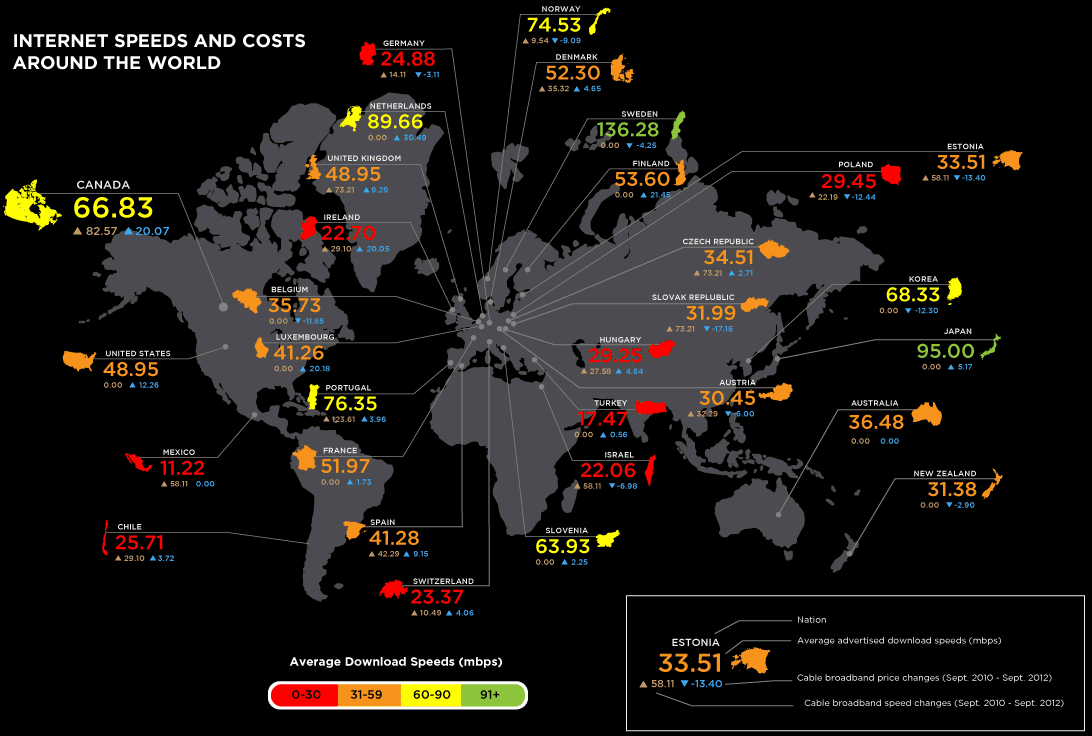
    South Korea continued to have the highest average connection speed in the world at 27 Mbps while Singapore maintained its position as the country with the highest average peak connection speed at 157.3 Mbps.

    These were among the findings of the Akamai Technologies’ Second Quarter, 2016 State of the Internet Report.

    Both countries, however, registered declines in average connection speed and average peak connection speed, respectively, at 7.2% (South Korea) and 7.1% (Singapore) compared to the first quarter.

    Meanwhile, the global average connection speed decreased 2.3% quarter over quarter to 6.1 Mbps, while the global average peak connection speed increased 3.7% to 36 Mbps. The 10 Mbps broadband adoption rate grew 0.7% quarter over quarter, but 15 Mbps and 25 Mbps broadband adoption rates fell 0.8% and 2.1%, respectively.

    In Asia-Pacific, the report noted that 14 of the 15 surveyed countries had average connection speeds above the 4 Mbps broadband threshold. Indonesia registered a 148% gain in average connection speed in the second quarter and the only country to see its speed double compared to the previous year.

    In the mobile space, Akamai reported that average mobile connection speeds ranged from a high of 23.1 Mbps in the United Kingdom to a low of 2.2 Mbps in Venezuela. The report noted that in the upcoming quarters, it expects to see mobile speeds continue to climb as 4G LTE becomes deployed more broadly worldwide.

    In Asia-Pacific, South Korea (11.1 Mbps) also led the world in average mobile connection in the second quarter of 2016, followed by New Zealand (9.8 Mbps), Japan (9.5 Mbps), Taiwan (9.3 Mbps), Australia (8.9 Mbps), and the Philippines (8.5 Mbps).

  • Average internet speeds grow 12% during Q1

    Average internet speeds grow 12% during Q1

    Global average internet connection speeds grew 12% sequentially during the first quarter to 6.3Mbps, according to Akamai’s latest State of the Internet report.

    The report aslso shows that the global average peak connection speed increased 6.8% to 34.7 Mbps over the same period.

    Global broadband adoption of 10Mbps, 15Mbps, and 25Mbps connections also grew significantly during the quarter, posting year-over-year gains of 10%, 14%, and 19% at each threshold, respectively.

    Meanwhile, average mobile connection speeds ranged from a high of 27.9Mbps in the United Kingdom to a low of 2.2Mbps in Algeria during the period, while average peak mobile connection speeds ranged from 171.6Mbps in Germany to 11.7Mbps in Ghana.

    “What this means,” said Rob Morton, Director of Public Relations, Akamai Technologies, in a video message, “is that more people around the world can take advantage of video streaming with higher bit rates, resulting in a better quality viewing experience.”

    David Belson, editor of the State of the Internet Report, said the expectation is that this summer’s biggest sporting events will be watched by more online viewers than ever.

    “Global connection speeds have more than doubled since the summer of 2012, which can help support higher quality video streaming for bigger audiences across even more connected devices and platforms,” he affirmed.

    The report noted that at the country level, South Korea continued to have the highest average connection speed in the world at 29.0Mbps, an 8.6% gain over the fourth quarter of 2015, while Singapore maintained its position as the country with the highest average peak connection speed at 146.9Mbps, an 8.3% quarterly increase.

    It said South Korea also led the world across the 10Mbps, 15Mbps, and 25Mbps broadband tiers once again, with adoption rates of 84%, 69%, and 42% respectively, after seeing robust quarterly gains across all three metrics.

  • Akamai addresses mobile performance challenges

    Akamai addresses mobile performance challenges

    Akamai Technologies has upgraded its flagship web performance solution Akamai Ion to improve the platform’s mobile capabilities.

    Ion is designed to accelerate the delivery of websites, web applications and mobile apps over fixed and cellular connections. The new Ion release focuses on overcoming key problem areas, which can result in much faster experiences for all users.

    Ion offers optimizations that are designed to address the challenges imposed by the realities of today’s modern web. For example, the prevalent use of CSS in web design can result in poor mobile experiences because rendering web pages is dependent on when CSS files are delivered to browsers. Further, increasing amounts of third-party content, including links to social networks, advertising and sponsored content, can also create performance bottlenecks.

    The introduction of new web protocols and standards, such as HTTP/2, also means site owners will need to deliver content to all users and ensure the best possible experience independent of whether users’ browsers support these protocols or not.

    Ion also  features a number of new capabilities designed to deliver better and more consistent mobile experiences by addressing the unique challenges associated with mobile devices such as cellular connections and underpowered devices.

    Ion offers improved browsing experiences by focusing on the ability to re-sequence CSS files, so that mobile audiences can view and interact with mobile web pages sooner, even over cellular connections.

    Ion also introduces Preconnect to help prevent embedded third party URLs from becoming bottlenecks in web page performance by establishing connections with embedded third-party hosts even before the browser asks for those connections.

    Akamai is now making HTTP/2 support broadly available to all customers – the first CDN to offer such broad availability of the new standard.

    To help all users realize the best possible experience, the new version of Ion offers HTTP/2 aware Front End Optimizations (FEO). This means Ion can apply the most appropriate client-side performance optimizations whether the browser supports HTTP/2 or not – without the need for custom setup.

  • How should retailers prepare for this holiday season?

    How should retailers prepare for this holiday season?

    E-commerce presents enormous opportunity for retailers. Hong Kong’s 2014 sales value of Internet retailing, excluding tax, was HK$1.5 billion (Hong Kong Trade Development Council), and it is estimated to increase to HK$2.1 billion in 2019.

    As Singles’ Day, Thanksgiving and Christmas are just around the corner, it is time to start preparing for the holiday season as traffic spikes will affect web performance or even result in downtime.

    Retailers need to prepare to serve the needs of their customers through two primary activities that lead to revenue – the shopping phase and the buying phase, to capture additional spending during holiday seasons.

    Shopping
    As customers begin the process of searching for a product or service, there are a number of potential channels available to them, including emails from retailers, websites and online search.

    Retailers should focus their efforts on improving the personalisation of their emails to increase the likelihood of opens, click-through and eventually purchases.

    This will also push more consumers into the “shopped from this website before” group, helping to create a growing, loyal customer base.

    Success here is tied to customers’ abilities to access the content they need to move from awareness to consideration in a simple, fast and reliable way – regardless of content type, device being used, or location.

    Buying
    A cohesive purchasing experience across physical and digital channels (regardless of location, device type or size) is no longer the exception for advanced retailers. It is fast becoming the norm – table stakes for success.

    “Customers increasingly expect that all parts of their relationship with a retailer – loyalty programs, past purchase history, customer service and other interactions – will be connected, regardless of how and when they interact with the retailer,” according to 2015 Retail Holiday Planning Playbook, July 2015, National Retail Federation and Prosper Insights and Analytics.

    According to The Nielsen Global Survey of E-commerce conducted in 2014, Hong Kong consumers tend to be researchers when engaging in e-commerce.

    More than three out of five respondents will check out products in the store before purchasing them online (61%), or they will often look at products online before purchasing them in the store (60%).

    Hence, retailers need to ensure their digital experiences are optimized across devices, screen sizes, operating systems, browsers and locations so customers have a consistent, reliable experience wherever they are.

    Akamai’s Performance Matters report reveals that consumers participate in e-commerce research activity more frequently on mobile devices and tablets than on desktops in three key categories: searching for products, comparing prices, and reading reviews.

    The report shows that 56% of mobile users and 57% of tablet users search for products once a week or more, compared to 37% of desktop users.

    Additionally, 15% of mobile and tablet users search daily, compared to 5% of desktop users. In terms of price comparison, 52% of mobile users and 53% of tablet users compared prices once a week or more, while 34% used their desktops to do so.

    On the reviews front, 46% of mobile users and 50% of tablet users read reviews online once a week or more, compared to 28% of desktop users.

    The ability to quickly transition from reviewing product content, images, and reviews then into a buying decision phase increases the conversion rate. Cloud-based, globally distributed technologies are a key component to success in delivering an omni-channel experience that is content rich, fast and reliable.